Individualism and Associational
Life in the New Millennium
Gen Me or
Gen We?
s
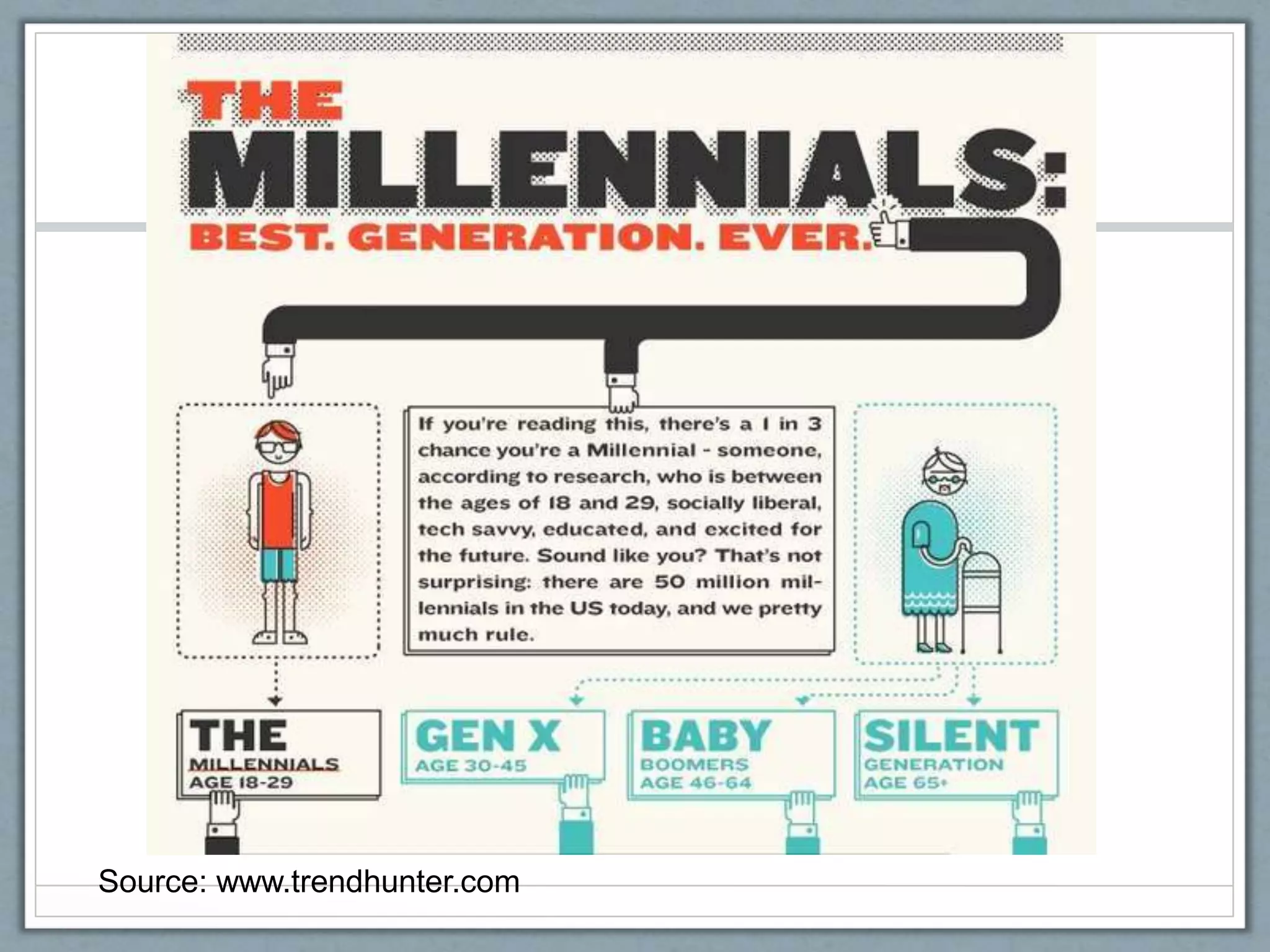
Source: www.trendhunter.com
• Those born 1982-2000
• ‘lazy, entitled, selfish and shallow’
• narcissistic personality disorder three times as high
for people in their 20s as for those over 65
• ‘They are the most threatening and exciting
generation since the baby boomers brought about
social revolution, not because they're trying to take
over the Establishment but because they're growing
up without one.’ – the information revolution has
greatly empowered individuals (Stein & Sanburn,
2013)
Who are the Millennials?
No Establishment, no
authority – no rebellion…
• ‘Their great mantra has been: Challenge
convention’
• ‘They are informed but inactive’
• Stein presents an image of a confident,
assured and innovative group of people
who display ‘less civic engagement and
lower political participation’ than previous
generations.
Interpersonal relationships:
better or worse?
• Personal branding via social media –
increased self-promotion and narcissism
• Less ‘face-to-face’ time means this
generation increasingly lacks empathy
• They have larger social networks and more
diverse communities
• Yet they also have more social interaction
with their peers than with other generations
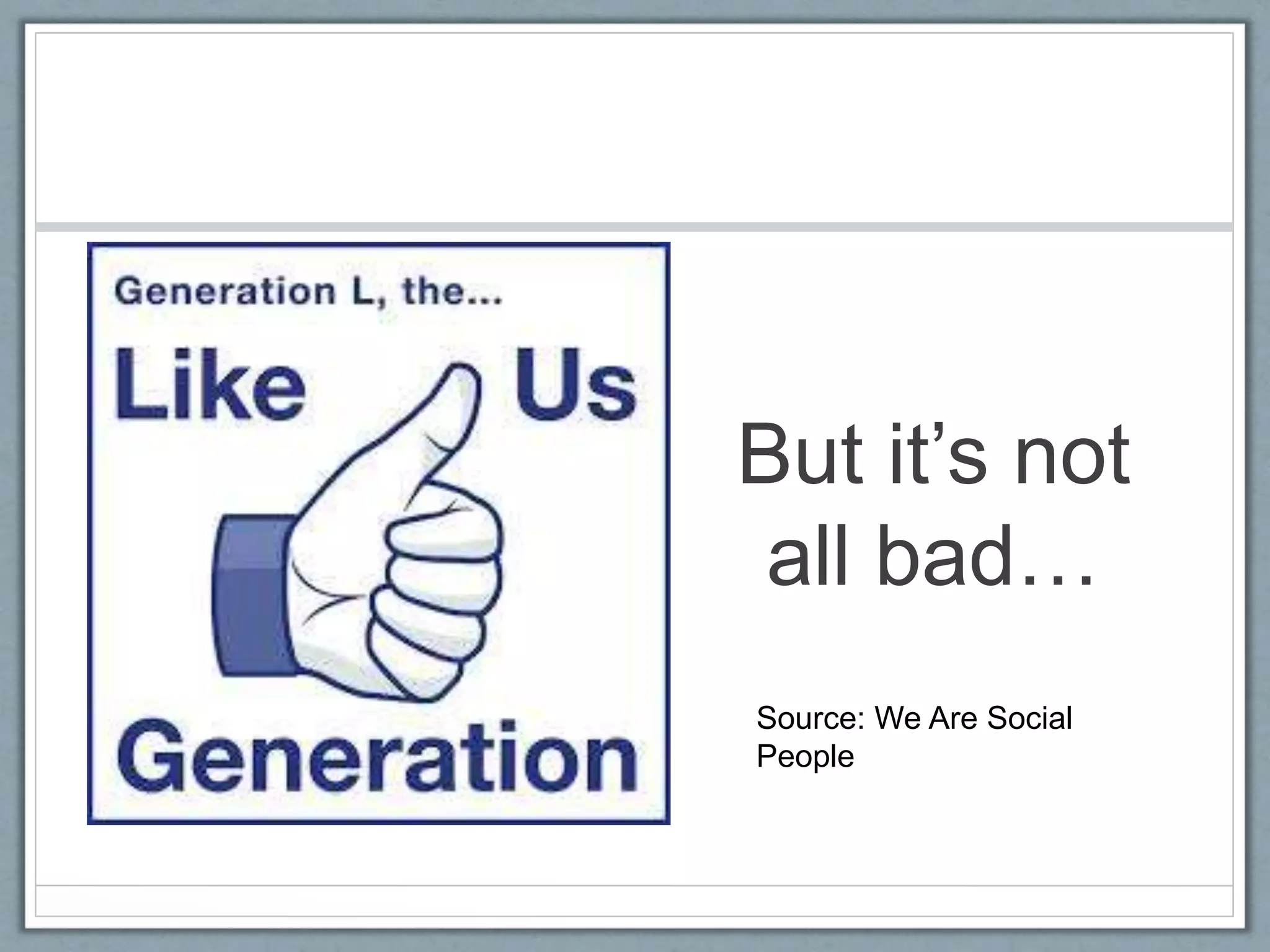
But it’s not
all bad…
Source: We Are Social
People
Jean
Twenge
disagrees…
• "People born between 1982 and 2000
are the most civic-minded since the
generation of the 1930s and 1940s...”
(USA Today)
• "Generation We is noncynical and
civic-minded. They believe in the
value of political engagement and are
convinced that government can be a
powerful force for good…”
Greenberg and Weber, Generation We
(2008)
Generation We?
• Jean Twenge (Professor of Psychology at
San Diego State University)
• Children of the 1970s+ born
into a world that celebrated
the individual
• Unshakeable belief that you
are important
• ‘We are all special’
• Spread of self-esteem
curriculum in schools
• ‘Just be yourself’
• ‘Believe in yourself’
• ‘Follow your dreams’
Helen: Everyone's special, Dash.
Dash: Which is another way of saying no one is.
The Baby Boomers
• Post-war generation growing up in 1950s and 1960s
• Individualism is a new territory
• New emphasis on ‘finding yourself’
• But the journeys are typically collective: cultural and
social experimentation (the 60s counter-culture), political
activism (civil rights movement), etc.
• Changing the world, rather than simply changing
yourself…
Jean Twenge, ‘Millennials: The Greatest
Generation or the Most Narcissistic?’
(The Atlantic, May 2012)
• ‘Millennials were less likely than Boomers and
even GenXers to say they thought about social
problems, to be interested in politics and
government, to contact public officials, or to
work for a political campaign. They were less
likely to say they trusted the government to do
what's right, and less likely to say they were
interested in government and current events.’
Twenge cites national surveys on community feeling
and civic engagement.
Compared to the Boomers, this generation are:
• less likely to do things in their daily lives to conserve
energy and help the environment
• less likely to want a job that is helpful to others or is
worthwhile to society
• more likely to volunteer – but she attributes this to
high schools requiring students to volunteer in order
to graduate
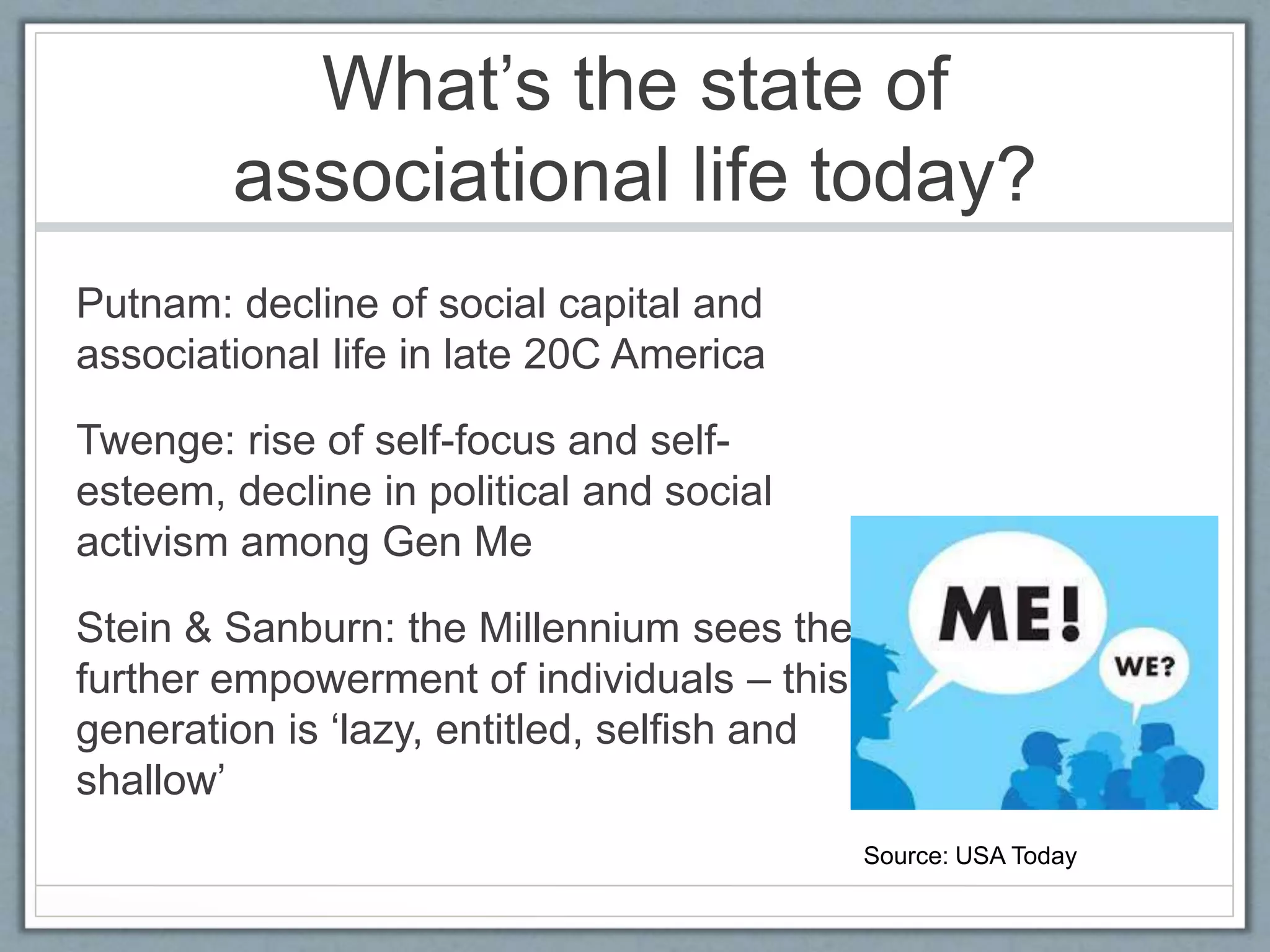
What’s the state of
associational life today?
Putnam: decline of social capital and
associational life in late 20C America
Twenge: rise of self-focus and self-
esteem, decline in political and social
activism among Gen Me
Stein & Sanburn: the Millennium sees the
further empowerment of individuals – this
generation is ‘lazy, entitled, selfish and
shallow’
Source: USA Today
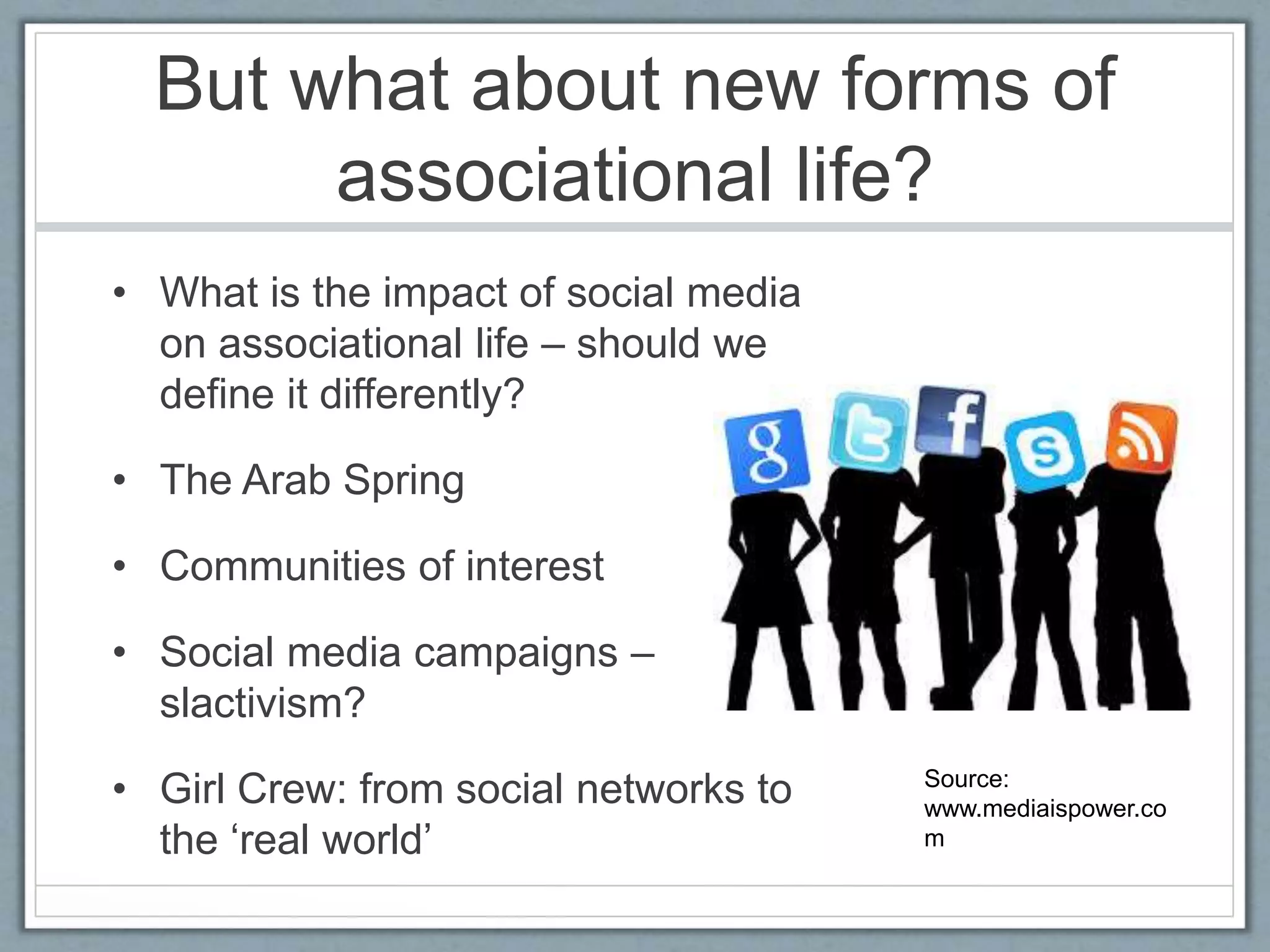
But what about new forms of
associational life?
• What is the impact of social media
on associational life – should we
define it differently?
• The Arab Spring
• Communities of interest
• Social media campaigns –
slactivism?
• Girl Crew: from social networks to
the ‘real world’
Source:
www.mediaispower.co
m
What do you think?
• This generation is
‘informed but inactive’
• Lacks empathy
• Less interaction with
other generations
• Focus on personal branding: self-
promotion and narcissism
• But is this generation ever truly
alone? Have social networks not
also strengthened our community
life?
Source:
www.cheesusfried.com
Pause for thought…
• When is the last time you logged on to a social media site?
(answer honestly)
• When did you last spend 12 hours or more (in daytime) without
being connected?
• When did you last spend 12 hours or more offline when you
could easily have checked in?
• How many Facebook friends do you have?
• How many Facebook friends do you have that you would call
to meet for a coffee? (assuming you were in the same town)
• In what ways do you think social media enhances and/or
detracts from your social capital?
Group work:
research & brief presentation
Investigate:
• A significant social media campaign, e.g. an example
of charity fundraising – compare to traditional methods
• A political campaign (e.g. that of an election candidate)
in which social media has played a significant role.
• Data that may counter the arguments of Stein or
Twenge (it must come from a reliable source) - e.g. on
youth activism in Ireland and/or America, on trends in
associational life, on demographic support for the
Occupy movement or other political movements, etc.

Gen me we

  • 1.
    Individualism and Associational Lifein the New Millennium Gen Me or Gen We?
  • 2.
  • 3.
    • Those born1982-2000 • ‘lazy, entitled, selfish and shallow’ • narcissistic personality disorder three times as high for people in their 20s as for those over 65 • ‘They are the most threatening and exciting generation since the baby boomers brought about social revolution, not because they're trying to take over the Establishment but because they're growing up without one.’ – the information revolution has greatly empowered individuals (Stein & Sanburn, 2013) Who are the Millennials?
  • 4.
    No Establishment, no authority– no rebellion… • ‘Their great mantra has been: Challenge convention’ • ‘They are informed but inactive’ • Stein presents an image of a confident, assured and innovative group of people who display ‘less civic engagement and lower political participation’ than previous generations.
  • 5.
    Interpersonal relationships: better orworse? • Personal branding via social media – increased self-promotion and narcissism • Less ‘face-to-face’ time means this generation increasingly lacks empathy • They have larger social networks and more diverse communities • Yet they also have more social interaction with their peers than with other generations
  • 6.
    But it’s not allbad… Source: We Are Social People
  • 7.
    Jean Twenge disagrees… • "People bornbetween 1982 and 2000 are the most civic-minded since the generation of the 1930s and 1940s...” (USA Today) • "Generation We is noncynical and civic-minded. They believe in the value of political engagement and are convinced that government can be a powerful force for good…” Greenberg and Weber, Generation We (2008) Generation We?
  • 8.
    • Jean Twenge(Professor of Psychology at San Diego State University) • Children of the 1970s+ born into a world that celebrated the individual • Unshakeable belief that you are important • ‘We are all special’ • Spread of self-esteem curriculum in schools • ‘Just be yourself’ • ‘Believe in yourself’ • ‘Follow your dreams’
  • 9.
    Helen: Everyone's special,Dash. Dash: Which is another way of saying no one is.
  • 10.
    The Baby Boomers •Post-war generation growing up in 1950s and 1960s • Individualism is a new territory • New emphasis on ‘finding yourself’ • But the journeys are typically collective: cultural and social experimentation (the 60s counter-culture), political activism (civil rights movement), etc. • Changing the world, rather than simply changing yourself…
  • 11.
    Jean Twenge, ‘Millennials:The Greatest Generation or the Most Narcissistic?’ (The Atlantic, May 2012) • ‘Millennials were less likely than Boomers and even GenXers to say they thought about social problems, to be interested in politics and government, to contact public officials, or to work for a political campaign. They were less likely to say they trusted the government to do what's right, and less likely to say they were interested in government and current events.’
  • 12.
    Twenge cites nationalsurveys on community feeling and civic engagement. Compared to the Boomers, this generation are: • less likely to do things in their daily lives to conserve energy and help the environment • less likely to want a job that is helpful to others or is worthwhile to society • more likely to volunteer – but she attributes this to high schools requiring students to volunteer in order to graduate
  • 13.
    What’s the stateof associational life today? Putnam: decline of social capital and associational life in late 20C America Twenge: rise of self-focus and self- esteem, decline in political and social activism among Gen Me Stein & Sanburn: the Millennium sees the further empowerment of individuals – this generation is ‘lazy, entitled, selfish and shallow’ Source: USA Today
  • 14.
    But what aboutnew forms of associational life? • What is the impact of social media on associational life – should we define it differently? • The Arab Spring • Communities of interest • Social media campaigns – slactivism? • Girl Crew: from social networks to the ‘real world’ Source: www.mediaispower.co m
  • 15.
    What do youthink? • This generation is ‘informed but inactive’ • Lacks empathy • Less interaction with other generations • Focus on personal branding: self- promotion and narcissism • But is this generation ever truly alone? Have social networks not also strengthened our community life? Source: www.cheesusfried.com
  • 16.
    Pause for thought… •When is the last time you logged on to a social media site? (answer honestly) • When did you last spend 12 hours or more (in daytime) without being connected? • When did you last spend 12 hours or more offline when you could easily have checked in? • How many Facebook friends do you have? • How many Facebook friends do you have that you would call to meet for a coffee? (assuming you were in the same town) • In what ways do you think social media enhances and/or detracts from your social capital?
  • 17.
    Group work: research &brief presentation Investigate: • A significant social media campaign, e.g. an example of charity fundraising – compare to traditional methods • A political campaign (e.g. that of an election candidate) in which social media has played a significant role. • Data that may counter the arguments of Stein or Twenge (it must come from a reliable source) - e.g. on youth activism in Ireland and/or America, on trends in associational life, on demographic support for the Occupy movement or other political movements, etc.