College Writing
Self, Society & Sustainability
David Brooks, “The Problem
with Confidence”
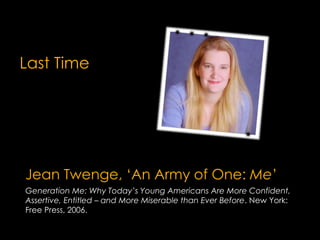
Jean Twenge, ‘An Army of One: Me’
Generation Me: Why Today’s Young Americans Are More Confident,
Assertive, Entitled – and More Miserable than Ever Before. New York:
Free Press, 2006.
Last Time
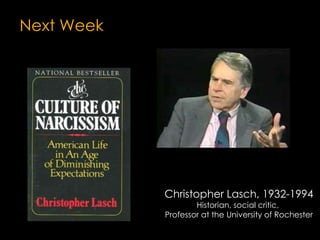
Christopher Lasch, 1932-1994
Historian, social critic,
Professor at the University of Rochester
Next Week
Today
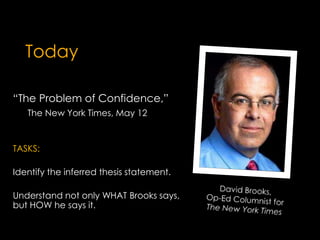
“The Problem of Confidence,”
The New York Times, May 12
TASKS:
Identify the inferred thesis statement.
Understand not only WHAT Brooks says,
but HOW he says it.
HOW to Say Something that Matters
 Bringing certain assumptions to light?
 Raising questions of fact?
 Raising questions of opinion?
 Appeals to intellect (logos)?
 Appeals to emotion (pathos)?
 Appeals to authority (ethos)?
HOW does Brooks develop his point
 Defining by Example
 Defining by Negation
 Defining by Comparison and Contrast
 Defining by Analysis
 Defining by Cause and Effect
 Marshaling Factual Evidence
 Marshaling Evidence from Authority

Brooks and the problem of confidence

  • 1.
    College Writing Self, Society& Sustainability David Brooks, “The Problem with Confidence”
  • 2.
    Jean Twenge, ‘AnArmy of One: Me’ Generation Me: Why Today’s Young Americans Are More Confident, Assertive, Entitled – and More Miserable than Ever Before. New York: Free Press, 2006. Last Time
  • 3.
    Christopher Lasch, 1932-1994 Historian,social critic, Professor at the University of Rochester Next Week
  • 4.
    Today “The Problem ofConfidence,” The New York Times, May 12 TASKS: Identify the inferred thesis statement. Understand not only WHAT Brooks says, but HOW he says it.
  • 5.
    HOW to SaySomething that Matters  Bringing certain assumptions to light?  Raising questions of fact?  Raising questions of opinion?  Appeals to intellect (logos)?  Appeals to emotion (pathos)?  Appeals to authority (ethos)?
  • 6.
    HOW does Brooksdevelop his point  Defining by Example  Defining by Negation  Defining by Comparison and Contrast  Defining by Analysis  Defining by Cause and Effect  Marshaling Factual Evidence  Marshaling Evidence from Authority

Editor's Notes

  • #4 Lasch tries to explain, that a narcissist is not simply self-preoccupied by an excessive sense of self-love. He more develops selfish behaviours as defences against the aggressive impulses in his own psyche. The narcissist is always looking outward for forms of self-approval and affirmation b/c deep down, he suffers from a form of self-loathing: deep down, he knows that he lacks the inner resources to survive in our image-oriented consumerist society. Writers like Edith Wharton, Henry James and George Sanat beginning of the 20thC noted the beginnings of this shift and they wrote a lot about characters who, in their nearly compulsive need to look sideways, miss the opportunity to be nurtured and sustained by a rich “inner life.”
  • #6 When you’re reading any of the essays we assign, pay attention not only to what is said in the essay, but how it is said. Twenge begins her essay with a memory of driving in the car with her mother, hearing Whitney Houston’s “The Greatest Love of All.” She’s struck by the difference in two generations’s understanding of the song. When Twenge asks her mother, “what’s the greatest love of all”? Her mother plainly replies that clearly the greatest love is about children.” But then Twenge goes on to critique the song in a rather mocking tone. “My mother was sweet, but wrong. The song does say that children are the future (always good to begin with a strikingly original thought) and that we should teach them well. About world peace, maybe? Or great literature? Nope. Children should be educated about the beauty “inside,” the song declares. We all need heroes, Whitney sings, but she never found “anyone to fulfil my needs,” so she learned to depend on (wait for it) “me”. The chorus then declares, “learning to love yourself is the greatest love of all.” So, we know, by the tone of the writing, that Twenge is going to take swipe at the kind of cultural mindset that created this celebration of the self, and here – self-esteem in particular- and trying to understand a “stunning reversal in attitude toward from previous generations: Back in her mother’s day, respect for others was more important than respect for yourself. The term “self-esteem” wasn’t widely used until the late 1960s
  • #7 When you’re reading any of the essays we assign, pay attention not only to what is said in the essay, but how it is said. Twenge begins her essay with a memory of driving in the car with her mother, hearing Whitney Houston’s “The Greatest Love of All.” She’s struck by the difference in two generations’s understanding of the song. When Twenge asks her mother, “what’s the greatest love of all”? Her mother plainly replies that clearly the greatest love is about children.” But then Twenge goes on to critique the song in a rather mocking tone. “My mother was sweet, but wrong. The song does say that children are the future (always good to begin with a strikingly original thought) and that we should teach them well. About world peace, maybe? Or great literature? Nope. Children should be educated about the beauty “inside,” the song declares. We all need heroes, Whitney sings, but she never found “anyone to fulfil my needs,” so she learned to depend on (wait for it) “me”. The chorus then declares, “learning to love yourself is the greatest love of all.” So, we know, by the tone of the writing, that Twenge is going to take swipe at the kind of cultural mindset that created this celebration of the self, and here – self-esteem in particular- and trying to understand a “stunning reversal in attitude toward from previous generations: Back in her mother’s day, respect for others was more important than respect for yourself. The term “self-esteem” wasn’t widely used until the late 1960s