College Writing
Close-reading
& Saying something that
Matters
How writers appeal to
their audiences
Pathos, Ethos and Logos
Bringing certain assumptions to light
Raising questions of fact
Raise questions of opinion
and how you can too!
Why do some articles catch your
attention and others not?
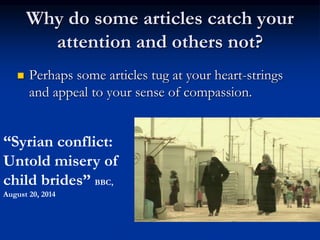
 Perhaps some articles tug at your heart-strings
and appeal to your sense of compassion.
“Syrian conflict:
Untold misery of
child brides” BBC,
August 20, 2014
Pathos
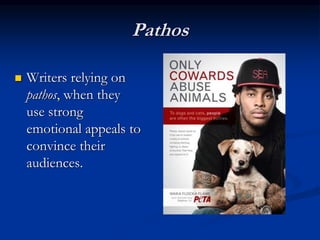
 Writers relying on
pathos, when they
use strong
emotional appeals to
convince their
audiences.
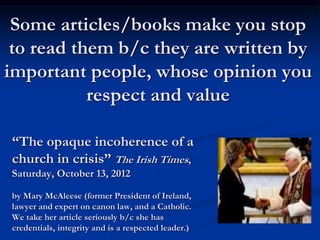
Some articles/books make you stop
to read them b/c they are written by
important people, whose opinion you
respect and value
“The opaque incoherence of a
church in crisis” The Irish Times,
Saturday, October 13, 2012
by Mary McAleese (former President of Ireland,
lawyer and expert on canon law, and a Catholic.
We take her article seriously b/c she has
credentials, integrity and is a respected leader.)
Ethos
Writers using ethos
attempt to convince their
readers of their ethics or
their trustworthiness and
reliability on their
respective subjects.
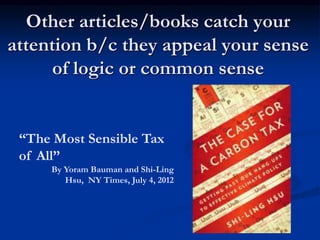
Other articles/books catch your
attention b/c they appeal your sense
of logic or common sense
“The Most Sensible Tax
of All”
By Yoram Bauman and Shi-Ling
Hsu, NY Times, July 4, 2012
Logos
Logos is an appeal to
logic. Writers using
this present facts and
research as the basis
for their reliability.
Putnam, Robert D. “‘Bowling Alone’:
America’s Declining Social
Capital.” Journal of Democracy 6:1
(1995): 65-78.
- This was a study which published
major conclusions about the decline in
Americans’ levels of participation in
clubs and associations; the study was
based on ten years of sociological
research.
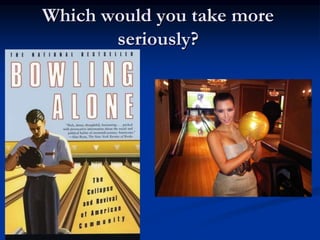
Which would you take more
seriously?
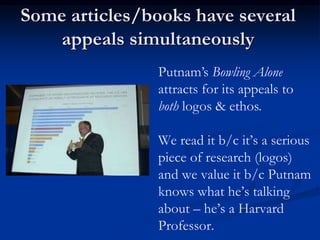
Some articles/books have several
appeals simultaneously
Putnam’s Bowling Alone
attracts for its appeals to
both logos & ethos.
We read it b/c it’s a serious
piece of research (logos)
and we value it b/c Putnam
knows what he’s talking
about – he’s a Harvard
Professor.
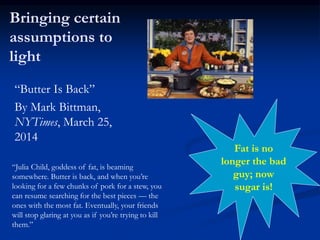
Bringing certain
assumptions to
light
“Butter Is Back”
By Mark Bittman,
NYTimes, March 25,
2014
“Julia Child, goddess of fat, is beaming
somewhere. Butter is back, and when you’re
looking for a few chunks of pork for a stew, you
can resume searching for the best pieces — the
ones with the most fat. Eventually, your friends
will stop glaring at you as if you’re trying to kill
them.”
Fat is no
longer the bad
guy; now
sugar is!
Raising questions
of fact
Raising questions
of opinion
Some articles cast
Snowden as a spy.
Others claim he was a
patriot.
Tasks:
1. Read the article and actively highlight key points and make notes in the margin.
2. Describe how the author introduces the article. How does he/she begin?
3. Identify the thesis statement. Copy and paste it.
4. How does the author “say something that matters”? Copy and paste instances
of
a. Ethos
b. Logos
c. Pathos
d. Bring certain assumptions to light?
e. Raise questions of fact?
f. Raise questions of opinion?
CLOSE-READING FORM – at the top
of your moodle page
(cont’d)
5. Consider how the author makes his/her point. Copy and paste examples of
instances where the writer DEVELOPS his/her point by
a. Example
b. Defining by Negation
c. Comparison and Contrast
d. Analysis
e. Cause and Effect
f. Marshalling Factual Evidence
g. Marshalling Evidence from Authority
6. Write: Summarise the author’s conclusion.
7. Connections / Implications for the larger “self-society” debate: Write a few
sentences outlining how this article helped you approach that debate.
8. Upload your note document to moodle.
CLOSE-READING FORM – at the top
of your moodle page
David Haybron’s article, “Happiness and Its
Discontents,” NYT April 13, 2014.
Response # 2: Upload your marked-up close-reading
of Haybron’s article and make sure you summarise his
definition of what constitutes happiness. Consider
what his definition includes and what is leaves out.
READ & DO
B R E A K
1. Take detailed notes of the Deneen article,
“Awakening from the American Dream: The End
of Escape in American Cinema?” Perspectives on
Political Science, April 2, 2010.
2. Think about your outline for Essay #1 Close-
Reading: What makes “a wonderful life”? (750
words)
H.W.
Do a close-reading of the Deneen article, “Awakening from the American Dream: The
End of Escape in American Cinema?” What makes “a wonderful life”?
What are the three lessons offered by Deneen’s examination of the movies discussed in
the article? Put these three lessons together, and in your own words, try to summarise
some truth about what makes a wonderful life.
Whether you are or are not from the U.S., comment on the extent to which conflicts
between individual freedom, personal choice, duty to family and community, and
configurations in the built environment (where and how we live) are issues within the
society you just left. How much of Deneen’s reading of the films’ critiques on
American society would be relevant to your own experience in your home country?
Finally, in your own conclusion, how can the cynicism at the end of Deneen’s article be
balanced by the hope for more genuine fulfilment in the society of tomorrow?
Describe your hopes for the relationship between individuals, society and the built
environment. Because you have limited space (750 words), try to isolate this hope to
one or two central values.
The Task for Essay #1
We’re not asking you to simply re-hash the Deneen
article. We’re not interested in reading papers that
simply re-count what Deneen says about the three
films.
We ARE interested in reading what YOU think of
Deneen’s analyses. Is it accurate? Did it make you
think in terms about what makes ‘a wonderful’ life? If
so, describe how life can be more wonderful.
Always remember to answer the question, which in
this instance is “What makes ‘a wonderful’ life?
Remember!
Subject the Deneen article to the Close-Reading form.
Think critically about not only what he says, but how
he says it.
Think about how the beginning sits rhetorically in
relation to the body of the article.
Is the beginning creative?
How does Deneen ‘say something that matters’?
Remember to use your new reading muscles!
As part of your introduction, will you start with
anecdote or discussion of a quote?
Make sure your thesis statement is clear.
How will YOU ‘say something that matters’?
How will YOU develop your points?
Will your conclusion signal further implications? Or
does it just re-state your thesis?
Keep the tips in mind for yourself.

How to do a close reading

  • 1.
  • 2.
    How writers appealto their audiences Pathos, Ethos and Logos Bringing certain assumptions to light Raising questions of fact Raise questions of opinion and how you can too!
  • 3.
    Why do somearticles catch your attention and others not?  Perhaps some articles tug at your heart-strings and appeal to your sense of compassion. “Syrian conflict: Untold misery of child brides” BBC, August 20, 2014
  • 4.
    Pathos  Writers relyingon pathos, when they use strong emotional appeals to convince their audiences.
  • 5.
    Some articles/books makeyou stop to read them b/c they are written by important people, whose opinion you respect and value “The opaque incoherence of a church in crisis” The Irish Times, Saturday, October 13, 2012 by Mary McAleese (former President of Ireland, lawyer and expert on canon law, and a Catholic. We take her article seriously b/c she has credentials, integrity and is a respected leader.)
  • 6.
    Ethos Writers using ethos attemptto convince their readers of their ethics or their trustworthiness and reliability on their respective subjects.
  • 7.
    Other articles/books catchyour attention b/c they appeal your sense of logic or common sense “The Most Sensible Tax of All” By Yoram Bauman and Shi-Ling Hsu, NY Times, July 4, 2012
  • 8.
    Logos Logos is anappeal to logic. Writers using this present facts and research as the basis for their reliability. Putnam, Robert D. “‘Bowling Alone’: America’s Declining Social Capital.” Journal of Democracy 6:1 (1995): 65-78. - This was a study which published major conclusions about the decline in Americans’ levels of participation in clubs and associations; the study was based on ten years of sociological research.
  • 9.
    Which would youtake more seriously?
  • 10.
    Some articles/books haveseveral appeals simultaneously Putnam’s Bowling Alone attracts for its appeals to both logos & ethos. We read it b/c it’s a serious piece of research (logos) and we value it b/c Putnam knows what he’s talking about – he’s a Harvard Professor.
  • 11.
    Bringing certain assumptions to light “ButterIs Back” By Mark Bittman, NYTimes, March 25, 2014 “Julia Child, goddess of fat, is beaming somewhere. Butter is back, and when you’re looking for a few chunks of pork for a stew, you can resume searching for the best pieces — the ones with the most fat. Eventually, your friends will stop glaring at you as if you’re trying to kill them.” Fat is no longer the bad guy; now sugar is!
  • 12.
  • 13.
    Raising questions of opinion Somearticles cast Snowden as a spy. Others claim he was a patriot.
  • 14.
    Tasks: 1. Read thearticle and actively highlight key points and make notes in the margin. 2. Describe how the author introduces the article. How does he/she begin? 3. Identify the thesis statement. Copy and paste it. 4. How does the author “say something that matters”? Copy and paste instances of a. Ethos b. Logos c. Pathos d. Bring certain assumptions to light? e. Raise questions of fact? f. Raise questions of opinion? CLOSE-READING FORM – at the top of your moodle page
  • 15.
    (cont’d) 5. Consider howthe author makes his/her point. Copy and paste examples of instances where the writer DEVELOPS his/her point by a. Example b. Defining by Negation c. Comparison and Contrast d. Analysis e. Cause and Effect f. Marshalling Factual Evidence g. Marshalling Evidence from Authority 6. Write: Summarise the author’s conclusion. 7. Connections / Implications for the larger “self-society” debate: Write a few sentences outlining how this article helped you approach that debate. 8. Upload your note document to moodle. CLOSE-READING FORM – at the top of your moodle page
  • 16.
    David Haybron’s article,“Happiness and Its Discontents,” NYT April 13, 2014. Response # 2: Upload your marked-up close-reading of Haybron’s article and make sure you summarise his definition of what constitutes happiness. Consider what his definition includes and what is leaves out. READ & DO
  • 17.
    B R EA K
  • 18.
    1. Take detailednotes of the Deneen article, “Awakening from the American Dream: The End of Escape in American Cinema?” Perspectives on Political Science, April 2, 2010. 2. Think about your outline for Essay #1 Close- Reading: What makes “a wonderful life”? (750 words) H.W.
  • 19.
    Do a close-readingof the Deneen article, “Awakening from the American Dream: The End of Escape in American Cinema?” What makes “a wonderful life”? What are the three lessons offered by Deneen’s examination of the movies discussed in the article? Put these three lessons together, and in your own words, try to summarise some truth about what makes a wonderful life. Whether you are or are not from the U.S., comment on the extent to which conflicts between individual freedom, personal choice, duty to family and community, and configurations in the built environment (where and how we live) are issues within the society you just left. How much of Deneen’s reading of the films’ critiques on American society would be relevant to your own experience in your home country? Finally, in your own conclusion, how can the cynicism at the end of Deneen’s article be balanced by the hope for more genuine fulfilment in the society of tomorrow? Describe your hopes for the relationship between individuals, society and the built environment. Because you have limited space (750 words), try to isolate this hope to one or two central values. The Task for Essay #1
  • 20.
    We’re not askingyou to simply re-hash the Deneen article. We’re not interested in reading papers that simply re-count what Deneen says about the three films. We ARE interested in reading what YOU think of Deneen’s analyses. Is it accurate? Did it make you think in terms about what makes ‘a wonderful’ life? If so, describe how life can be more wonderful. Always remember to answer the question, which in this instance is “What makes ‘a wonderful’ life? Remember!
  • 21.
    Subject the Deneenarticle to the Close-Reading form. Think critically about not only what he says, but how he says it. Think about how the beginning sits rhetorically in relation to the body of the article. Is the beginning creative? How does Deneen ‘say something that matters’? Remember to use your new reading muscles!
  • 22.
    As part ofyour introduction, will you start with anecdote or discussion of a quote? Make sure your thesis statement is clear. How will YOU ‘say something that matters’? How will YOU develop your points? Will your conclusion signal further implications? Or does it just re-state your thesis? Keep the tips in mind for yourself.

Editor's Notes