

Public relations in 2018
There’s never been such an exciting time to work in
the business of public relations
Stephen Waddington
@wadds
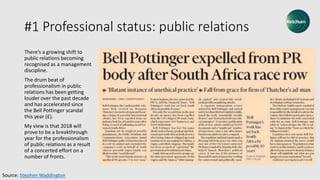
#1 Professional status: public relations
There’s a growing shift to
public relations becoming
recognised as a management
discipline.
The drum beat of
professionalism in public
relations has been getting
louder over the past decade
and has accelerated since
the Bell Pottinger scandal
this year (£).
My view is that 2018 will
prove to be a breakthrough
year for the professionalism
of public relations as a result
of a concerted effort on a
number of fronts.
Source: Stephen Waddington
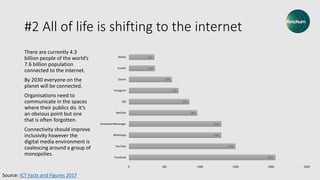
#2 All of life is shifting to the internet
There are currently 4.3
billion people of the world’s
7.6 billion population
connected to the internet.
By 2030 everyone on the
planet will be connected.
Organisations need to
communicate in the spaces
where their publics do. It’s
an obvious point but one
that is often forgotten.
Connectivity should improve
inclusivity however the
digital media environment is
coalescing around a group of
monopolies. 2061
1500
1300
1300
963
850
700
606
368
361
0 500 1000 1500 2000 2500
Facebook
YouTube
WhatsApp
Facebook Messenger
WeChat
QQ
Instagram
Qzone
Tumblr
Weibo
Source: ICT Facts and Figures 2017
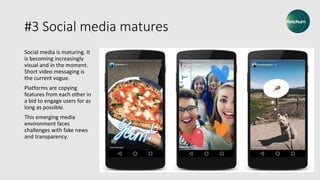
#3 Social media matures
Social media is maturing. It
is becoming increasingly
visual and in the moment.
Short video messaging is
the current vogue.
Platforms are copying
features from each other in
a bid to engage users for as
long as possible.
This emerging media
environment faces
challenges with fake news
and transparency.
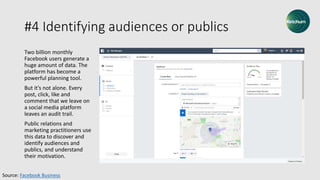
#4 Identifying audiences or publics
Two billion monthly
Facebook users generate a
huge amount of data. The
platform has become a
powerful planning tool.
But it’s not alone. Every
post, click, like and
comment that we leave on
a social media platform
leaves an audit trail.
Public relations and
marketing practitioners use
this data to discover and
identify audiences and
publics, and understand
their motivation.
Source: Facebook Business
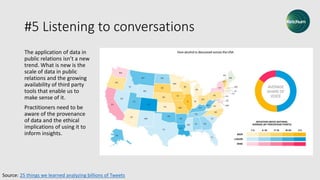
#5 Listening to conversations
The application of data in
public relations isn’t a new
trend. What is new is the
scale of data in public
relations and the growing
availability of third party
tools that enable us to
make sense of it.
Practitioners need to be
aware of the provenance
of data and the ethical
implications of using it to
inform insights.
Source: 25 things we learned analyzing billions of Tweets
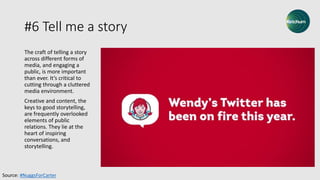
#6 Tell me a story
The craft of telling a story
across different forms of
media, and engaging a
public, is more important
than ever. It’s critical to
cutting through a cluttered
media environment.
Creative and content, the
keys to good storytelling,
are frequently overlooked
elements of public
relations. They lie at the
heart of inspiring
conversations, and
storytelling.
Source: #NuggsForCarter
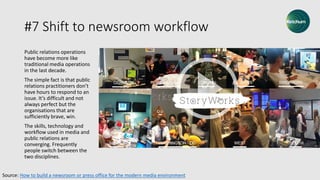
#7 Shift to newsroom workflow
Public relations operations
have become more like
traditional media operations
in the last decade.
The simple fact is that public
relations practitioners don’t
have hours to respond to an
issue. It’s difficult and not
always perfect but the
organisations that are
sufficiently brave, win.
The skills, technology and
workflow used in media and
public relations are
converging. Frequently
people switch between the
two disciplines.
Source: How to build a newsroom or press office for the modern media environment
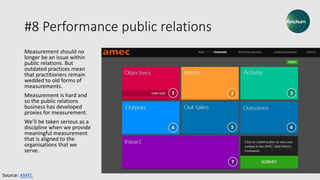
#8 Performance public relations
Measurement should no
longer be an issue within
public relations. But
outdated practices mean
that practitioners remain
wedded to old forms of
measurements.
Measurement is hard and
so the public relations
business has developed
proxies for measurement.
We’ll be taken serious as a
discipline when we provide
meaningful measurement
that is aligned to the
organisations that we
serve.
Source: AMEC
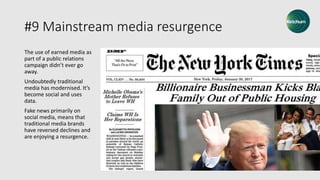
#9 Mainstream media resurgence
The use of earned media as
part of a public relations
campaign didn’t ever go
away.
Undoubtedly traditional
media has modernised. It’s
become social and uses
data.
Fake news primarily on
social media, means that
traditional media brands
have reversed declines and
are enjoying a resurgence.
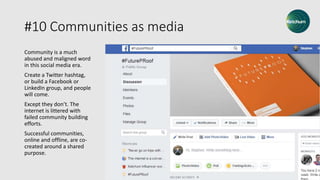
#10 Communities as media
Community is a much
abused and maligned word
in this social media era.
Create a Twitter hashtag,
or build a Facebook or
LinkedIn group, and people
will come.
Except they don’t. The
internet is littered with
failed community building
efforts.
Successful communities,
online and offline, are co-
created around a shared
purpose.
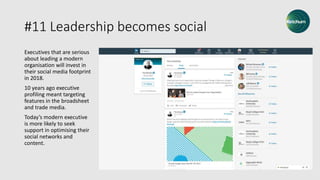
#11 Leadership becomes social
Executives that are serious
about leading a modern
organisation will invest in
their social media footprint
in 2018.
10 years ago executive
profiling meant targeting
features in the broadsheet
and trade media.
Today’s modern executive
is more likely to seek
support in optimising their
social networks and
content.
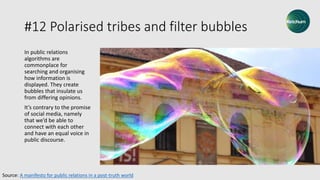
#12 Polarised tribes and filter bubbles
In public relations
algorithms are
commonplace for
searching and organising
how information is
displayed. They create
bubbles that insulate us
from differing opinions.
It’s contrary to the promise
of social media, namely
that we’d be able to
connect with each other
and have an equal voice in
public discourse.
Source: A manifesto for public relations in a post-truth world
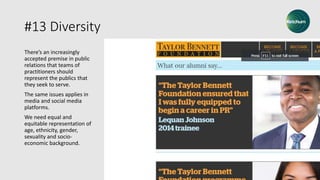
#13 Diversity
There’s an increasingly
accepted premise in public
relations that teams of
practitioners should
represent the publics that
they seek to serve.
The same issues applies in
media and social media
platforms.
We need equal and
equitable representation of
age, ethnicity, gender,
sexuality and socio-
economic background.
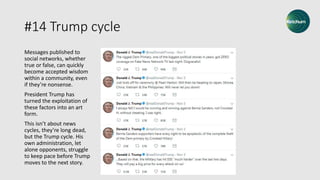
#14 Trump cycle
Messages published to
social networks, whether
true or false, can quickly
become accepted wisdom
within a community, even
if they’re nonsense.
President Trump has
turned the exploitation of
these factors into an art
form.
This isn’t about news
cycles, they’re long dead,
but the Trump cycle. His
own administration, let
alone opponents, struggle
to keep pace before Trump
moves to the next story.
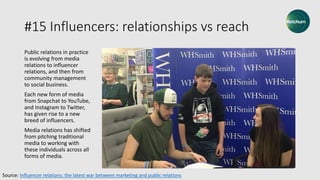
#15 Influencers: relationships vs reach
Public relations in practice
is evolving from media
relations to influencer
relations, and then from
community management
to social business.
Each new form of media
from Snapchat to YouTube,
and Instagram to Twitter,
has given rise to a new
breed of influencers.
Media relations has shifted
from pitching traditional
media to working with
these individuals across all
forms of media.
Source: Influencer relations: the latest war between marketing and public relations
#16 Artificial intelligence normalised
Artificial intelligence was
the shiny new thing in
public relations in 2017.
I’ve been using artificial
intelligence since I used
WordPerfect 5.1 in the
early 80s. In fact it’s never
been bettered as a word
processor.
But we’re starting to feel
the impact of machines in
at least three areas:
content production;
content distribution and
publication; and workflow.
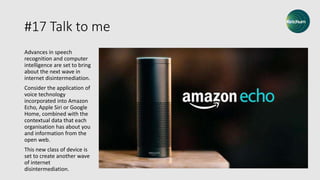
#17 Talk to me
Advances in speech
recognition and computer
intelligence are set to bring
about the next wave in
internet disintermediation.
Consider the application of
voice technology
incorporated into Amazon
Echo, Apple Siri or Google
Home, combined with the
contextual data that each
organisation has about you
and information from the
open web.
This new class of device is
set to create another wave
of internet
disintermediation.
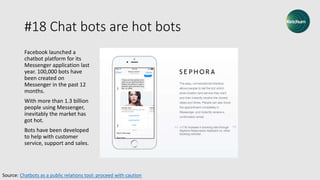
#18 Chat bots are hot bots
Facebook launched a
chatbot platform for its
Messenger application last
year. 100,000 bots have
been created on
Messenger in the past 12
months.
With more than 1.3 billion
people using Messenger,
inevitably the market has
got hot.
Bots have been developed
to help with customer
service, support and sales.
Source: Chatbots as a public relations tool: proceed with caution
#19 Fake news and brand misplacement
There are two main
purposes for fake news.
The first is propaganda and
the second is profiteering.
We’ve only just started to
understand how social
media can be manipulated.
In 2018 we need greater
disclosure from social
media platforms, more
academic research, and the
introduction of legislation
to start to deal with this
issue.
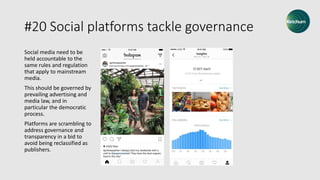
#20 Social platforms tackle governance
Social media need to be
held accountable to the
same rules and regulation
that apply to mainstream
media.
This should be governed by
prevailing advertising and
media law, and in
particular the democratic
process.
Platforms are scrambling to
address governance and
transparency in a bid to
avoid being reclassified as
publishers.
Thank you. Questions?
Please visit my blog for an expanded version of this deck. If there’s anything that I
can do in my role at Ketchum to help your organisation address any of the issues
highlighted, please let me know.
Stephen Waddington
Ketchum
stephen.waddington@ketchum.com
@wadds

Public relations in 2018

  • 1.
    Public relations in2018 There’s never been such an exciting time to work in the business of public relations Stephen Waddington @wadds
  • 3.
    #1 Professional status:public relations There’s a growing shift to public relations becoming recognised as a management discipline. The drum beat of professionalism in public relations has been getting louder over the past decade and has accelerated since the Bell Pottinger scandal this year (£). My view is that 2018 will prove to be a breakthrough year for the professionalism of public relations as a result of a concerted effort on a number of fronts. Source: Stephen Waddington
  • 4.
    #2 All oflife is shifting to the internet There are currently 4.3 billion people of the world’s 7.6 billion population connected to the internet. By 2030 everyone on the planet will be connected. Organisations need to communicate in the spaces where their publics do. It’s an obvious point but one that is often forgotten. Connectivity should improve inclusivity however the digital media environment is coalescing around a group of monopolies. 2061 1500 1300 1300 963 850 700 606 368 361 0 500 1000 1500 2000 2500 Facebook YouTube WhatsApp Facebook Messenger WeChat QQ Instagram Qzone Tumblr Weibo Source: ICT Facts and Figures 2017
  • 5.
    #3 Social mediamatures Social media is maturing. It is becoming increasingly visual and in the moment. Short video messaging is the current vogue. Platforms are copying features from each other in a bid to engage users for as long as possible. This emerging media environment faces challenges with fake news and transparency.
  • 6.
    #4 Identifying audiencesor publics Two billion monthly Facebook users generate a huge amount of data. The platform has become a powerful planning tool. But it’s not alone. Every post, click, like and comment that we leave on a social media platform leaves an audit trail. Public relations and marketing practitioners use this data to discover and identify audiences and publics, and understand their motivation. Source: Facebook Business
  • 7.
    #5 Listening toconversations The application of data in public relations isn’t a new trend. What is new is the scale of data in public relations and the growing availability of third party tools that enable us to make sense of it. Practitioners need to be aware of the provenance of data and the ethical implications of using it to inform insights. Source: 25 things we learned analyzing billions of Tweets
  • 8.
    #6 Tell mea story The craft of telling a story across different forms of media, and engaging a public, is more important than ever. It’s critical to cutting through a cluttered media environment. Creative and content, the keys to good storytelling, are frequently overlooked elements of public relations. They lie at the heart of inspiring conversations, and storytelling. Source: #NuggsForCarter
  • 9.
    #7 Shift tonewsroom workflow Public relations operations have become more like traditional media operations in the last decade. The simple fact is that public relations practitioners don’t have hours to respond to an issue. It’s difficult and not always perfect but the organisations that are sufficiently brave, win. The skills, technology and workflow used in media and public relations are converging. Frequently people switch between the two disciplines. Source: How to build a newsroom or press office for the modern media environment
  • 10.
    #8 Performance publicrelations Measurement should no longer be an issue within public relations. But outdated practices mean that practitioners remain wedded to old forms of measurements. Measurement is hard and so the public relations business has developed proxies for measurement. We’ll be taken serious as a discipline when we provide meaningful measurement that is aligned to the organisations that we serve. Source: AMEC
  • 11.
    #9 Mainstream mediaresurgence The use of earned media as part of a public relations campaign didn’t ever go away. Undoubtedly traditional media has modernised. It’s become social and uses data. Fake news primarily on social media, means that traditional media brands have reversed declines and are enjoying a resurgence.
  • 12.
    #10 Communities asmedia Community is a much abused and maligned word in this social media era. Create a Twitter hashtag, or build a Facebook or LinkedIn group, and people will come. Except they don’t. The internet is littered with failed community building efforts. Successful communities, online and offline, are co- created around a shared purpose.
  • 13.
    #11 Leadership becomessocial Executives that are serious about leading a modern organisation will invest in their social media footprint in 2018. 10 years ago executive profiling meant targeting features in the broadsheet and trade media. Today’s modern executive is more likely to seek support in optimising their social networks and content.
  • 14.
    #12 Polarised tribesand filter bubbles In public relations algorithms are commonplace for searching and organising how information is displayed. They create bubbles that insulate us from differing opinions. It’s contrary to the promise of social media, namely that we’d be able to connect with each other and have an equal voice in public discourse. Source: A manifesto for public relations in a post-truth world
  • 15.
    #13 Diversity There’s anincreasingly accepted premise in public relations that teams of practitioners should represent the publics that they seek to serve. The same issues applies in media and social media platforms. We need equal and equitable representation of age, ethnicity, gender, sexuality and socio- economic background.
  • 16.
    #14 Trump cycle Messagespublished to social networks, whether true or false, can quickly become accepted wisdom within a community, even if they’re nonsense. President Trump has turned the exploitation of these factors into an art form. This isn’t about news cycles, they’re long dead, but the Trump cycle. His own administration, let alone opponents, struggle to keep pace before Trump moves to the next story.
  • 17.
    #15 Influencers: relationshipsvs reach Public relations in practice is evolving from media relations to influencer relations, and then from community management to social business. Each new form of media from Snapchat to YouTube, and Instagram to Twitter, has given rise to a new breed of influencers. Media relations has shifted from pitching traditional media to working with these individuals across all forms of media. Source: Influencer relations: the latest war between marketing and public relations
  • 18.
    #16 Artificial intelligencenormalised Artificial intelligence was the shiny new thing in public relations in 2017. I’ve been using artificial intelligence since I used WordPerfect 5.1 in the early 80s. In fact it’s never been bettered as a word processor. But we’re starting to feel the impact of machines in at least three areas: content production; content distribution and publication; and workflow.
  • 19.
    #17 Talk tome Advances in speech recognition and computer intelligence are set to bring about the next wave in internet disintermediation. Consider the application of voice technology incorporated into Amazon Echo, Apple Siri or Google Home, combined with the contextual data that each organisation has about you and information from the open web. This new class of device is set to create another wave of internet disintermediation.
  • 20.
    #18 Chat botsare hot bots Facebook launched a chatbot platform for its Messenger application last year. 100,000 bots have been created on Messenger in the past 12 months. With more than 1.3 billion people using Messenger, inevitably the market has got hot. Bots have been developed to help with customer service, support and sales. Source: Chatbots as a public relations tool: proceed with caution
  • 21.
    #19 Fake newsand brand misplacement There are two main purposes for fake news. The first is propaganda and the second is profiteering. We’ve only just started to understand how social media can be manipulated. In 2018 we need greater disclosure from social media platforms, more academic research, and the introduction of legislation to start to deal with this issue.
  • 22.
    #20 Social platformstackle governance Social media need to be held accountable to the same rules and regulation that apply to mainstream media. This should be governed by prevailing advertising and media law, and in particular the democratic process. Platforms are scrambling to address governance and transparency in a bid to avoid being reclassified as publishers.
  • 23.
    Thank you. Questions? Pleasevisit my blog for an expanded version of this deck. If there’s anything that I can do in my role at Ketchum to help your organisation address any of the issues highlighted, please let me know. Stephen Waddington Ketchum stephen.waddington@ketchum.com @wadds