P T E
Session 1
Pearson Test of English
Orientation
Session 1 of 4
About PTE
• Pearson Test of English.
• It is the world’s most popular English Language
Proficiency test.
• Tests you on your Communication Skills in English
language.
Orientation
Session 1 of 4
Why PTE
• It can help you study, live or work abroad.
• Universities and government of Australia and many
other countries accept this as a valid test for English
language proficiency.
• A computer based test whose results are declared
within 3 – 5 days.
• Scores valid for 2 years.
Orientation
Session 1 of 4
There are four modules in the test
• Listening
• Speaking
• Reading
• Writing
The Modules in PTE
Orientation
Session 1 of 4
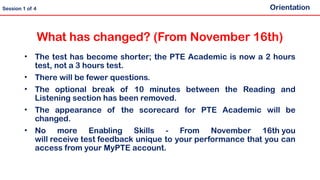
What has changed? (From November 16th)
• The test has become shorter; the PTE Academic is now a 2 hours
test, not a 3 hours test.
• There will be fewer questions.
• The optional break of 10 minutes between the Reading and
Listening section has been removed.
• The appearance of the scorecard for PTE Academic will be
changed.
• No more Enabling Skills - From November 16th you
will receive test feedback unique to your performance that you can
access from your MyPTE account.
Orientation
Session 1 of 4
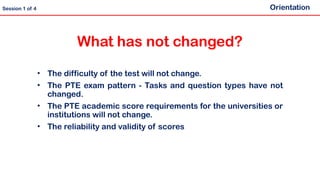
What has not changed?
• The difficulty of the test will not change.
• The PTE exam pattern - Tasks and question types have not
changed.
• The PTE academic score requirements for the universities or
institutions will not change.
• The reliability and validity of scores
Orientation
Session 1 of 4
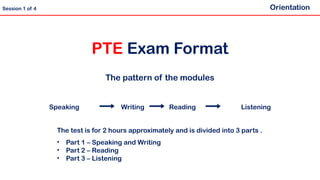
Speaking Writing Reading Listening
PTE Exam Format
The pattern of the modules
Orientation
Session 1 of 4
The test is for 2 hours approximately and is divided into 3 parts .
• Part 1 – Speaking and Writing
• Part 2 – Reading
• Part 3 – Listening
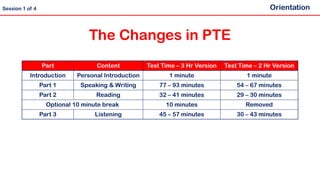
The Changes in PTE
Orientation
Session 1 of 4
Part Content Test Time – 3 Hr Version Test Time – 2 Hr Version
Introduction Personal Introduction 1 minute 1 minute
Part 1 Speaking & Writing 77 – 93 minutes 54 – 67 minutes
Part 2 Reading 32 – 41 minutes 29 – 30 minutes
Optional 10 minute break 10 minutes Removed
Part 3 Listening 45 – 57 minutes 30 – 43 minutes
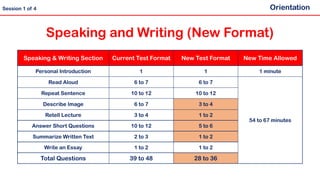
Speaking and Writing (New Format)
Orientation
Session 1 of 4
Speaking & Writing Section Current Test Format New Test Format New Time Allowed
Personal Introduction 1 1 1 minute
Read Aloud 6 to 7 6 to 7
54 to 67 minutes
Repeat Sentence 10 to 12 10 to 12
Describe Image 6 to 7 3 to 4
Retell Lecture 3 to 4 1 to 2
Answer Short Questions 10 to 12 5 to 6
Summarize Written Text 2 to 3 1 to 2
Write an Essay 1 to 2 1 to 2
Total Questions 39 to 48 28 to 36
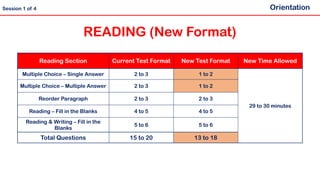
READING (New Format)
Orientation
Session 1 of 4
Reading Section Current Test Format New Test Format New Time Allowed
Multiple Choice – Single Answer 2 to 3 1 to 2
29 to 30 minutes
Multiple Choice – Multiple Answer 2 to 3 1 to 2
Reorder Paragraph 2 to 3 2 to 3
Reading – Fill in the Blanks 4 to 5 4 to 5
Reading & Writing – Fill in the
Blanks
5 to 6 5 to 6
Total Questions 15 to 20 13 to 18
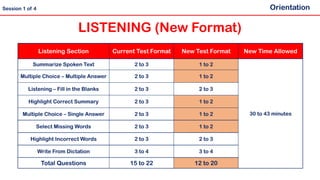
LISTENING (New Format)
Orientation
Session 1 of 4
Listening Section Current Test Format New Test Format New Time Allowed
Summarize Spoken Text 2 to 3 1 to 2
30 to 43 minutes
Multiple Choice – Multiple Answer 2 to 3 1 to 2
Listening – Fill in the Blanks 2 to 3 2 to 3
Highlight Correct Summary 2 to 3 1 to 2
Multiple Choice – Single Answer 2 to 3 1 to 2
Select Missing Words 2 to 3 1 to 2
Highlight Incorrect Words 2 to 3 2 to 3
Write From Dictation 3 to 4 3 to 4
Total Questions 15 to 22 12 to 20
PTE Exam Scoring
Orientation
Session 1 of 4
Updated Score Report (Without the Enabling Skills)
The score report now has 2 parts:
• Overall Score
• Communicative skills
Orientation
Session 1 of 4
Communicative Skills
• The communicative skills include scores of the Listening,
Reading, Speaking and Writing modules.
• The scores are calculated based on 20 question types of
the PTE test.
• For each module the scores range between 10 - 90.
• For integrated skills, (those assessing reading and
speaking, listening and speaking, reading and writing,
listening and writing, or listening and reading) the item
score contributes to the score for the communicative
skills that the item assesses.
PTE Exam Scoring
Orientation
Session 1 of 4
Session 1 of 4
PTE Speaking
Session 1 of 4
The objective of the Speaking Module
• To check whether you can speak in such a way that
most English speakers can easily understand you.
• This does not refer to accent development, but
clarity & flow of speech.
• It also checks your Reading & Listening skills.
Speaking Module Overview
Session 1 of 4
The question types in the speaking module
• Personal Introduction (Unscored)
• Read Aloud
• Repeat Sentence
• Describe Image
• Retell Lecture
• Answer Short Questions
Session 1 of 4
Speaking Module Overview
Task Type: Personal Introduction
Session 1 of 4
Task Type: Personal Introduction
Session 1 of 4
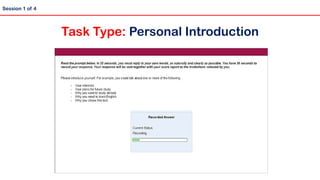
• Personal introduction is not a question because it is
unscored.
• It is important because it is sent to the universities and
employers along with the score card.
• Good way of introducing yourself .
• You get 25 seconds to read the instructions.
• Speak for 30 seconds.
Session 1 of 4
Features: Personal Introduction
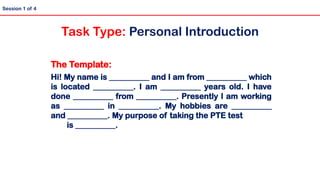
The Template:
Hi! My name is __________ and I am from __________ which
is located __________. I am __________ years old. I have
done __________ from __________. Presently I am working
as __________ in __________. My hobbies are __________
and __________. My purpose of taking the PTE test
is __________.
Session 1 of 4
Task Type: Personal Introduction
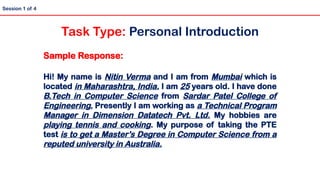
Sample Response:
Hi! My name is Nitin Verma and I am from Mumbai which is
located in Maharashtra, India. I am 25 years old. I have done
B.Tech in Computer Science from Sardar Patel College of
Engineering. Presently I am working as a Technical Program
Manager in Dimension Datatech Pvt. Ltd. My hobbies are
playing tennis and cooking. My purpose of taking the PTE
test is to get a Master’s Degree in Computer Science from a
reputed university in Australia.
Session 1 of 4
Task Type: Personal Introduction
Task Type: Read Aloud
Session 1 of 4
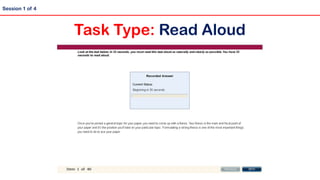
• As the heading suggests, you to need read aloud a
short text displayed on the screen.
• Read Aloud aims to test one’s understanding of the
content.
Session 1 of 4
Task Type: Read Aloud
Session 1 of 4
• A short text with a maximum of 70 words is shown on the
screen.
• There are 6 -7 Read Aloud tasks.
• If the text is less than 60 words, then you will be given 30-35
secs to read it before the recording starts.
• If the text is more than 60 words, then 40 secs will be given to
read it before the recording starts.
• After the countdown, you will hear a short beep after which
you should start speaking.
• The countdown is displayed in the recording status box.
Session 1 of 4
Features: Read Aloud
This is an Integrated Task in which:
• Reading and Speaking skills are tested.
• You are evaluated based on Content, Oral Fluency and
Pronunciation.
Scoring: Read Aloud
Session 1 of 4
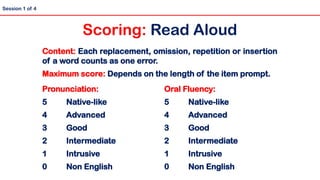
Content: Each replacement, omission, repetition or insertion
of a word counts as one error.
Maximum score: Depends on the length of the item prompt.
Scoring: Read Aloud
Session 1 of 4
Pronunciation:
5 Native-like
4 Advanced
3 Good
2 Intermediate
1 Intrusive
0 Non English
Oral Fluency:
5 Native-like
4 Advanced
3 Good
2 Intermediate
1 Intrusive
0 Non English
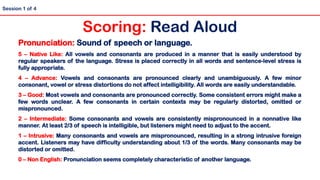
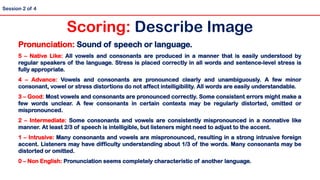
Pronunciation: Sound of speech or language.
5 – Native Like: All vowels and consonants are produced in a manner that is easily understood by
regular speakers of the language. Stress is placed correctly in all words and sentence-level stress is
fully appropriate.
4 – Advance: Vowels and consonants are pronounced clearly and unambiguously. A few minor
consonant, vowel or stress distortions do not affect intelligibility. All words are easily understandable.
3 – Good: Most vowels and consonants are pronounced correctly. Some consistent errors might make a
few words unclear. A few consonants in certain contexts may be regularly distorted, omitted or
mispronounced.
2 – Intermediate: Some consonants and vowels are consistently mispronounced in a nonnative like
manner. At least 2/3 of speech is intelligible, but listeners might need to adjust to the accent.
1 – Intrusive: Many consonants and vowels are mispronounced, resulting in a strong intrusive foreign
accent. Listeners may have difficulty understanding about 1/3 of the words. Many consonants may be
distorted or omitted.
0 – Non English: Pronunciation seems completely characteristic of another language.
Scoring: Read Aloud
Session 1 of 4
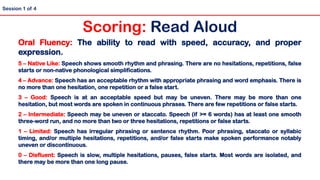
Oral Fluency: The ability to read with speed, accuracy, and proper
expression.
5 – Native Like: Speech shows smooth rhythm and phrasing. There are no hesitations, repetitions, false
starts or non-native phonological simplifications.
4 – Advance: Speech has an acceptable rhythm with appropriate phrasing and word emphasis. There is
no more than one hesitation, one repetition or a false start.
3 – Good: Speech is at an acceptable speed but may be uneven. There may be more than one
hesitation, but most words are spoken in continuous phrases. There are few repetitions or false starts.
2 – Intermediate: Speech may be uneven or staccato. Speech (if >= 6 words) has at least one smooth
three-word run, and no more than two or three hesitations, repetitions or false starts.
1 – Limited: Speech has irregular phrasing or sentence rhythm. Poor phrasing, staccato or syllabic
timing, and/or multiple hesitations, repetitions, and/or false starts make spoken performance notably
uneven or discontinuous.
0 – Disfluent: Speech is slow, multiple hesitations, pauses, false starts. Most words are isolated, and
there may be more than one long pause.
Scoring: Read Aloud
Session 1 of 4
Tips and Strategies
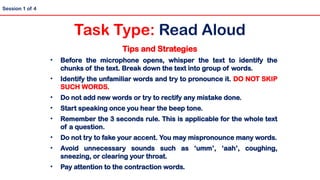
• Before the microphone opens, whisper the text to identify the
chunks of the text. Break down the text into group of words.
• Identify the unfamiliar words and try to pronounce it. DO NOT SKIP
SUCH WORDS.
• Do not add new words or try to rectify any mistake done.
• Start speaking once you hear the beep tone.
• Remember the 3 seconds rule. This is applicable for the whole text
of a question.
• Do not try to fake your accent. You may mispronounce many words.
• Avoid unnecessary sounds such as ‘umm’, ‘aah’, coughing,
sneezing, or clearing your throat.
• Pay attention to the contraction words.
Session 1 of 4
Task Type: Read Aloud
Session 1 of 4
Task Type: Read Aloud
Tips and Strategies
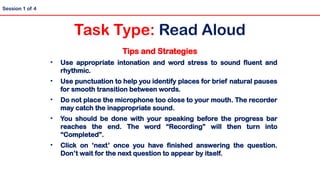
• Use appropriate intonation and word stress to sound fluent and
rhythmic.
• Use punctuation to help you identify places for brief natural pauses
for smooth transition between words.
• Do not place the microphone too close to your mouth. The recorder
may catch the inappropriate sound.
• You should be done with your speaking before the progress bar
reaches the end. The word “Recording” will then turn into
“Completed”.
• Click on ‘next’ once you have finished answering the question.
Don’t wait for the next question to appear by itself.
Tips and Strategies
• Do not place the microphone too close to your mouth. The recorder
may catch the inappropriate sound.
• Click on ‘next’ once you have finished answering the question.
Don’t wait for the next question to appear by itself.
Advice: Imagine that you are reading an article or a story to a person,
and not reading a text to yourself, so read in a natural tone.
Session 1 of 4
Task Type: Read Aloud
Sample Question:
Once you’ve picked a general topic for your paper, you
need to come up with a thesis. Your thesis is the main
and focal point of your paper and it’s the position you
will take on your particular topic. Formulating a strong
thesis is one of the most important thing you need to do
to ace your paper.
Advice: When you read the text, use contracted sound
for the contracted words; have falling tone after
punctuations and stress on the meaningful words.
Session 1 of 4
Task Type: Read Aloud
Session 1 of 4
End of Session 1 of 4
Session 2 of 4
PTE Speaking
Session - 2
Session 2 of 4
Task Type: Repeat Sentence
Session 2 of 4
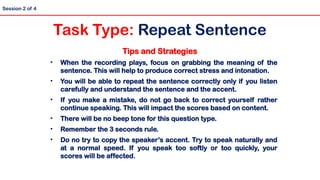
• This task require you to speak the sentence exactly
what you hear in the audio clip.
• You need to repeat the sentence verbatim.
Session 2 of 4
Task Type: Repeat Sentence
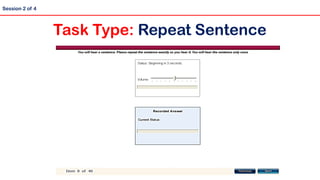
• You will hear a sentence of between 3 and 9 secs in length.
• There are 10 - 12 questions in this task.
• After you hear the sentence, you get just one second
before your recording. So speak immediately as you will
not hear any beep or tone.
• Repeat into the microphone within 15 secs.
• You should be done with your speaking before the progress
bar reaches the end.
Session 2 of 4
Features: Repeat Sentence
Session 2 of 4
Task Type: Repeat Sentence
Session 2 of 4
Scoring: Repeat Sentence
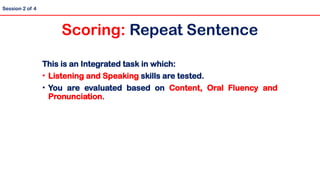
This is an Integrated task in which:
• Listening and Speaking skills are tested.
• You are evaluated based on Content, Oral Fluency and
Pronunciation.
Scoring: Repeat Sentence
Session 2 of 4
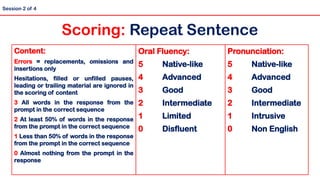
Oral Fluency:
5 Native-like
4 Advanced
3 Good
2 Intermediate
1 Limited
0 Disfluent
Pronunciation:
5 Native-like
4 Advanced
3 Good
2 Intermediate
1 Intrusive
0 Non English
Content:
Errors = replacements, omissions and
insertions only
Hesitations, filled or unfilled pauses,
leading or trailing material are ignored in
the scoring of content
3 All words in the response from the
prompt in the correct sequence
2 At least 50% of words in the response
from the prompt in the correct sequence
1 Less than 50% of words in the response
from the prompt in the correct sequence
0 Almost nothing from the prompt in the
response
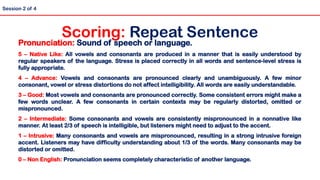
Pronunciation: Sound of speech or language.
5 – Native Like: All vowels and consonants are produced in a manner that is easily understood by
regular speakers of the language. Stress is placed correctly in all words and sentence-level stress is
fully appropriate.
4 – Advance: Vowels and consonants are pronounced clearly and unambiguously. A few minor
consonant, vowel or stress distortions do not affect intelligibility. All words are easily understandable.
3 – Good: Most vowels and consonants are pronounced correctly. Some consistent errors might make a
few words unclear. A few consonants in certain contexts may be regularly distorted, omitted or
mispronounced.
2 – Intermediate: Some consonants and vowels are consistently mispronounced in a nonnative like
manner. At least 2/3 of speech is intelligible, but listeners might need to adjust to the accent.
1 – Intrusive: Many consonants and vowels are mispronounced, resulting in a strong intrusive foreign
accent. Listeners may have difficulty understanding about 1/3 of the words. Many consonants may be
distorted or omitted.
0 – Non English: Pronunciation seems completely characteristic of another language.
Scoring: Repeat Sentence
Session 2 of 4
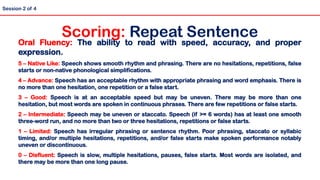
Oral Fluency: The ability to read with speed, accuracy, and proper
expression.
5 – Native Like: Speech shows smooth rhythm and phrasing. There are no hesitations, repetitions, false
starts or non-native phonological simplifications.
4 – Advance: Speech has an acceptable rhythm with appropriate phrasing and word emphasis. There is
no more than one hesitation, one repetition or a false start.
3 – Good: Speech is at an acceptable speed but may be uneven. There may be more than one
hesitation, but most words are spoken in continuous phrases. There are few repetitions or false starts.
2 – Intermediate: Speech may be uneven or staccato. Speech (if >= 6 words) has at least one smooth
three-word run, and no more than two or three hesitations, repetitions or false starts.
1 – Limited: Speech has irregular phrasing or sentence rhythm. Poor phrasing, staccato or syllabic
timing, and/or multiple hesitations, repetitions, and/or false starts make spoken performance notably
uneven or discontinuous.
0 – Disfluent: Speech is slow, multiple hesitations, pauses, false starts. Most words are isolated, and
there may be more than one long pause.
Scoring: Repeat Sentence
Session 2 of 4
Tips and Strategies
• When the recording plays, focus on grabbing the meaning of the
sentence. This will help to produce correct stress and intonation.
• You will be able to repeat the sentence correctly only if you listen
carefully and understand the sentence and the accent.
• If you make a mistake, do not go back to correct yourself rather
continue speaking. This will impact the scores based on content.
• There will be no beep tone for this question type.
• Remember the 3 seconds rule.
• Do no try to copy the speaker’s accent. Try to speak naturally and
at a normal speed. If you speak too softly or too quickly, your
scores will be affected.
Session 2 of 4
Task Type: Repeat Sentence
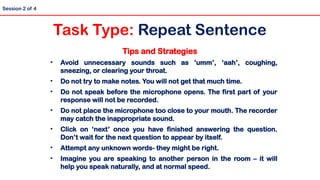
Tips and Strategies
• Avoid unnecessary sounds such as ‘umm’, ‘aah’, coughing,
sneezing, or clearing your throat.
• Do not try to make notes. You will not get that much time.
• Do not speak before the microphone opens. The first part of your
response will not be recorded.
• Do not place the microphone too close to your mouth. The recorder
may catch the inappropriate sound.
• Click on ‘next’ once you have finished answering the question.
Don’t wait for the next question to appear by itself.
• Attempt any unknown words- they might be right.
• Imagine you are speaking to another person in the room – it will
help you speak naturally, and at normal speed.
Session 2 of 4
Task Type: Repeat Sentence
Task Type: Describe Image
Session 2 of 4
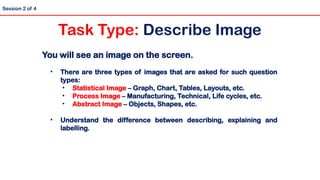
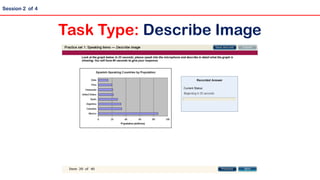
You will see an image on the screen.
• There are three types of images that are asked for such question
types:
• Statistical Image – Graph, Chart, Tables, Layouts, etc.
• Process Image – Manufacturing, Technical, Life cycles, etc.
• Abstract Image – Objects, Shapes, etc.
• Understand the difference between describing, explaining and
labelling.
Session 2 of 4
Task Type: Describe Image
• There are 3 to 4 tasks.
• You get 25 seconds to look at the image.
• After the countdown, you will be given 40 seconds to
record your answer.
Session 2 of 4
Features: Describe Image
Session 2 of 4
Task Type: Describe Image
Session 2 of 4
Scoring: Describe Image
This is a Communicative Skill task in which:
• Speaking skills are tested.
• You are evaluated based on Content, Oral Fluency and
Pronunciation.
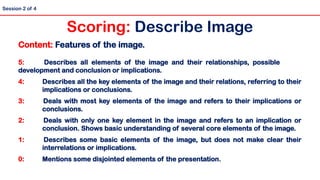
Content: Features of the image.
5: Describes all elements of the image and their relationships, possible
development and conclusion or implications.
4: Describes all the key elements of the image and their relations, referring to their
implications or conclusions.
3: Deals with most key elements of the image and refers to their implications or
conclusions.
2: Deals with only one key element in the image and refers to an implication or
conclusion. Shows basic understanding of several core elements of the image.
1: Describes some basic elements of the image, but does not make clear their
interrelations or implications.
0: Mentions some disjointed elements of the presentation.
Scoring: Describe Image
Session 2 of 4
Pronunciation: Sound of speech or language.
5 – Native Like: All vowels and consonants are produced in a manner that is easily understood by
regular speakers of the language. Stress is placed correctly in all words and sentence-level stress is
fully appropriate.
4 – Advance: Vowels and consonants are pronounced clearly and unambiguously. A few minor
consonant, vowel or stress distortions do not affect intelligibility. All words are easily understandable.
3 – Good: Most vowels and consonants are pronounced correctly. Some consistent errors might make a
few words unclear. A few consonants in certain contexts may be regularly distorted, omitted or
mispronounced.
2 – Intermediate: Some consonants and vowels are consistently mispronounced in a nonnative like
manner. At least 2/3 of speech is intelligible, but listeners might need to adjust to the accent.
1 – Intrusive: Many consonants and vowels are mispronounced, resulting in a strong intrusive foreign
accent. Listeners may have difficulty understanding about 1/3 of the words. Many consonants may be
distorted or omitted.
0 – Non English: Pronunciation seems completely characteristic of another language.
Scoring: Describe Image
Session 2 of 4
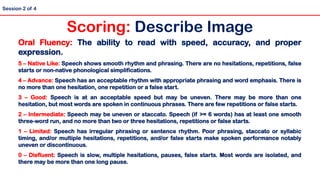
Oral Fluency: The ability to read with speed, accuracy, and proper
expression.
5 – Native Like: Speech shows smooth rhythm and phrasing. There are no hesitations, repetitions, false
starts or non-native phonological simplifications.
4 – Advance: Speech has an acceptable rhythm with appropriate phrasing and word emphasis. There is
no more than one hesitation, one repetition or a false start.
3 – Good: Speech is at an acceptable speed but may be uneven. There may be more than one
hesitation, but most words are spoken in continuous phrases. There are few repetitions or false starts.
2 – Intermediate: Speech may be uneven or staccato. Speech (if >= 6 words) has at least one smooth
three-word run, and no more than two or three hesitations, repetitions or false starts.
1 – Limited: Speech has irregular phrasing or sentence rhythm. Poor phrasing, staccato or syllabic
timing, and/or multiple hesitations, repetitions, and/or false starts make spoken performance notably
uneven or discontinuous.
0 – Disfluent: Speech is slow, multiple hesitations, pauses, false starts. Most words are isolated, and
there may be more than one long pause.
Scoring: Describe Image
Session 2 of 4
Tips and Strategies
• Ask your self the following questions once the image appears on
screen:
• What is the image about?
• What is the highest number?
• What is the lowest number?
• What are the major trends?
• What can be concluded?
Session 2 of 4
Task Type: Describe Image
Tips and Strategies
• Remember the 3 seconds rule. Start speaking once you hear the beep tone.
• Do not try to include every detail mentioned in the image.
• Avoid unnecessary sounds such as ‘umm’, ‘aah’, coughing, sneezing, or
clearing your throat.
• Do not try to make notes. You will not get that much time.
• Do not place the microphone too close to your mouth. The recorder may
catch the inappropriate sound.
• Your response will be evaluated on the content, oral fluency and
pronunciation. So speak as naturally and fluently as possible. Do not speak
very fast. This may lead to mispronunciation.
• Click on ‘next’ once you have finished answering the question. Don’t wait for
the next question to appear by itself.
Session 2 of 4
Task Type: Describe Image
Session 3 of 4
PTE Speaking
Session - 3
Session 3 of 4
While you speak -
• Introduction: (10 Seconds)
“The chart/graph illustrates/shows/explains…………”
• Body: (20 seconds)
What are the main trends?
• Conclusion: (10 seconds)
“It can be concluded that…………” [ mention What is
the highest number? What is the lowest number? ]
Session 3 of 4
Task Type: Describe Image
While you speak -
• Use an Introductory Expression: (10 Seconds)
“The chart/graph illustrates/shows/explains…………”
• Next: (20 seconds)
Describe the main information with details and
summarise your ideas.
Describe the most significant information and if
applicable, give figures or use approximations if the
numbers are not exact.
• Finally: (10 seconds)
Give a conclusion. “It can be concluded that…………”
Session 3 of 4
Task Type: Describe Image
Task Type: Retell Lecture
Session 4 of 4
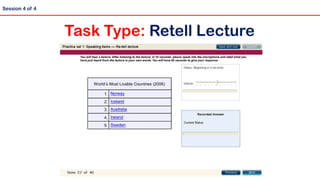
• You will hear a lecture or watch a video on an
academic subject.
• As the label says, you need to tell a lecture in your
own words
Session 4 of 4
Task Type: Retell Lecture
• The duration of the lecture will be around 40 – 120 seconds.
• You will have 10 seconds to prepare your answer.
• The computer will give 40 seconds to record an answer.
• You will get 1 – 2 tasks.
Session 4 of 4
Features: Retell Lecture
Task Type: Retell Lecture
Session 4 of 4
Session 4 of 4
Scoring: Retell Lecture
This is a Communicative Skill task in which:
• Listening and Speaking skills are tested.
• You are evaluated based on Content, Oral Fluency and
Pronunciation.
Content: Main features of the lecture.
5: Re-tells all points of the presentation and describes characters, aspects and
actions, their relationships, the underlying development, implications and
conclusions.
4: Describes all key points of the lecture and their relations, referring to their
implications and conclusions.
3: Deals with most points in the lecture and refers to their implications and
conclusions.
2: Deals with only one key point and refers to an implication or conclusion. Shows
basic understanding of several core elements of the lecture.
1: Describes some basic elements of the lecture but does not make clear their
interrelations or implications.
0: Mentions some disjointed elements of the presentation
Scoring: Retell Lecture
Session 4 of 4
Pronunciation: Sound of speech or language.
5 – Native Like: All vowels and consonants are produced in a manner that is easily understood by
regular speakers of the language. Stress is placed correctly in all words and sentence-level stress is
fully appropriate.
4 – Advance: Vowels and consonants are pronounced clearly and unambiguously. A few minor
consonant, vowel or stress distortions do not affect intelligibility. All words are easily understandable.
3 – Good: Most vowels and consonants are pronounced correctly. Some consistent errors might make a
few words unclear. A few consonants in certain contexts may be regularly distorted, omitted or
mispronounced.
2 – Intermediate: Some consonants and vowels are consistently mispronounced in a nonnative like
manner. At least 2/3 of speech is intelligible, but listeners might need to adjust to the accent.
1 – Intrusive: Many consonants and vowels are mispronounced, resulting in a strong intrusive foreign
accent. Listeners may have difficulty understanding about 1/3 of the words. Many consonants may be
distorted or omitted.
0 – Non English: Pronunciation seems completely characteristic of another language.
Scoring: Retell Lecture
Session 4 of 4
Oral Fluency: The ability to read with speed, accuracy, and proper
expression.
5 – Native Like: Speech shows smooth rhythm and phrasing. There are no hesitations, repetitions, false
starts or non-native phonological simplifications.
4 – Advance: Speech has an acceptable rhythm with appropriate phrasing and word emphasis. There is
no more than one hesitation, one repetition or a false start.
3 – Good: Speech is at an acceptable speed but may be uneven. There may be more than one
hesitation, but most words are spoken in continuous phrases. There are few repetitions or false starts.
2 – Intermediate: Speech may be uneven or staccato. Speech (if >= 6 words) has at least one smooth
three-word run, and no more than two or three hesitations, repetitions or false starts.
1 – Limited: Speech has irregular phrasing or sentence rhythm. Poor phrasing, staccato or syllabic
timing, and/or multiple hesitations, repetitions, and/or false starts make spoken performance notably
uneven or discontinuous.
0 – Disfluent: Speech is slow, multiple hesitations, pauses, false starts. Most words are isolated, and
there may be more than one long pause.
Scoring: Retell Lecture
Session 4 of 4
Session 4 of 4
Task Type: Retell Lecture
Structure of Response
• The lecturer talked about …………
• He / She says further says that …………
• The lecturer also mentions that …………
• He / She then proclaims that …………
• He / She concludes saying that …………
Session 4 of 4
PTE Speaking
Session - 4
Session 4 of 4
Tips and Strategies
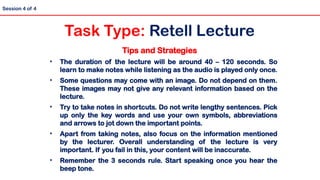
• The duration of the lecture will be around 40 – 120 seconds. So
learn to make notes while listening as the audio is played only once.
• Some questions may come with an image. Do not depend on them.
These images may not give any relevant information based on the
lecture.
• Try to take notes in shortcuts. Do not write lengthy sentences. Pick
up only the key words and use your own symbols, abbreviations
and arrows to jot down the important points.
• Apart from taking notes, also focus on the information mentioned
by the lecturer. Overall understanding of the lecture is very
important. If you fail in this, your content will be inaccurate.
• Remember the 3 seconds rule. Start speaking once you hear the
beep tone.
Session 4 of 4
Task Type: Retell Lecture
Tips and Strategies
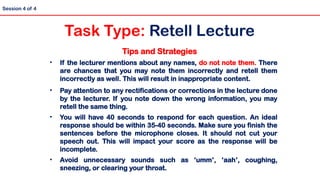
• If the lecturer mentions about any names, do not note them. There
are chances that you may note them incorrectly and retell them
incorrectly as well. This will result in inappropriate content.
• Pay attention to any rectifications or corrections in the lecture done
by the lecturer. If you note down the wrong information, you may
retell the same thing.
• You will have 40 seconds to respond for each question. An ideal
response should be within 35-40 seconds. Make sure you finish the
sentences before the microphone closes. It should not cut your
speech out. This will impact your score as the response will be
incomplete.
• Avoid unnecessary sounds such as ‘umm’, ‘aah’, coughing,
sneezing, or clearing your throat.
Session 4 of 4
Task Type: Retell Lecture
Tips and Strategies
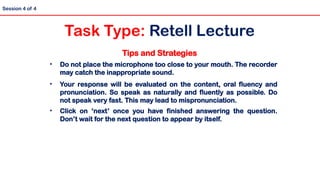
• Do not place the microphone too close to your mouth. The recorder
may catch the inappropriate sound.
• Your response will be evaluated on the content, oral fluency and
pronunciation. So speak as naturally and fluently as possible. Do
not speak very fast. This may lead to mispronunciation.
• Click on ‘next’ once you have finished answering the question.
Don’t wait for the next question to appear by itself.
Session 4 of 4
Task Type: Retell Lecture
Task Type: Answer Short Questions
Session 4 of 4
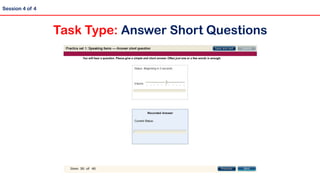
• In this question type, you will hear a question which
you need to answer in usually one or a very small
number of words.
Session 4 of 4
Task Type: Answer Short Questions
• There is no need to give details.
• There is no short tone / beep after the question
completes.
• You will be asked 5 - 6 questions.
• You will have 10 seconds to answer.
Session 4 of 4
Features: Answer Short Questions
Task Type: Answer Short Questions
Session 4 of 4
Session 4 of 4
Scoring: Answer Short Questions
This is a Communicative Skill task in which:
• Listening and Speaking skills are tested.
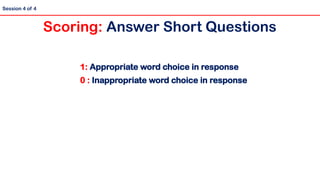
• You are evaluated based on Vocabulary.
1: Appropriate word choice in response
0 : Inappropriate word choice in response
Scoring: Answer Short Questions
Session 4 of 4
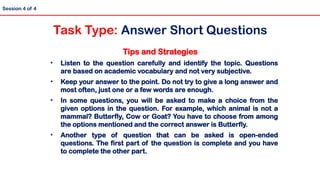
Tips and Strategies
• Listen to the question carefully and identify the topic. Questions
are based on academic vocabulary and not very subjective.
• Keep your answer to the point. Do not try to give a long answer and
most often, just one or a few words are enough.
• In some questions, you will be asked to make a choice from the
given options in the question. For example, which animal is not a
mammal? Butterfly, Cow or Goat? You have to choose from among
the options mentioned and the correct answer is Butterfly.
• Another type of question that can be asked is open-ended
questions. The first part of the question is complete and you have
to complete the other part.
Session 4 of 4
Task Type: Answer Short Questions
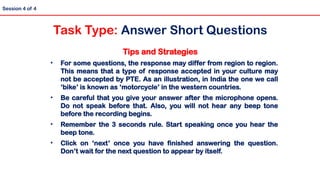
Tips and Strategies
• For some questions, the response may differ from region to region.
This means that a type of response accepted in your culture may
not be accepted by PTE. As an illustration, in India the one we call
‘bike’ is known as ‘motorcycle’ in the western countries.
• Be careful that you give your answer after the microphone opens.
Do not speak before that. Also, you will not hear any beep tone
before the recording begins.
• Remember the 3 seconds rule. Start speaking once you hear the
beep tone.
• Click on ‘next’ once you have finished answering the question.
Don’t wait for the next question to appear by itself.
Session 4 of 4
Task Type: Answer Short Questions
Session 4 of 4
End of Speaking Module
Session 4 of 4

PTE Speaking (1).pptx speaking speaking.

  • 1.
    P T E Session1 Pearson Test of English Orientation Session 1 of 4
  • 2.
    About PTE • PearsonTest of English. • It is the world’s most popular English Language Proficiency test. • Tests you on your Communication Skills in English language. Orientation Session 1 of 4
  • 3.
    Why PTE • Itcan help you study, live or work abroad. • Universities and government of Australia and many other countries accept this as a valid test for English language proficiency. • A computer based test whose results are declared within 3 – 5 days. • Scores valid for 2 years. Orientation Session 1 of 4
  • 4.
    There are fourmodules in the test • Listening • Speaking • Reading • Writing The Modules in PTE Orientation Session 1 of 4
  • 5.
    What has changed?(From November 16th) • The test has become shorter; the PTE Academic is now a 2 hours test, not a 3 hours test. • There will be fewer questions. • The optional break of 10 minutes between the Reading and Listening section has been removed. • The appearance of the scorecard for PTE Academic will be changed. • No more Enabling Skills - From November 16th you will receive test feedback unique to your performance that you can access from your MyPTE account. Orientation Session 1 of 4
  • 6.
    What has notchanged? • The difficulty of the test will not change. • The PTE exam pattern - Tasks and question types have not changed. • The PTE academic score requirements for the universities or institutions will not change. • The reliability and validity of scores Orientation Session 1 of 4
  • 7.
    Speaking Writing ReadingListening PTE Exam Format The pattern of the modules Orientation Session 1 of 4 The test is for 2 hours approximately and is divided into 3 parts . • Part 1 – Speaking and Writing • Part 2 – Reading • Part 3 – Listening
  • 8.
    The Changes inPTE Orientation Session 1 of 4 Part Content Test Time – 3 Hr Version Test Time – 2 Hr Version Introduction Personal Introduction 1 minute 1 minute Part 1 Speaking & Writing 77 – 93 minutes 54 – 67 minutes Part 2 Reading 32 – 41 minutes 29 – 30 minutes Optional 10 minute break 10 minutes Removed Part 3 Listening 45 – 57 minutes 30 – 43 minutes
  • 9.
    Speaking and Writing(New Format) Orientation Session 1 of 4 Speaking & Writing Section Current Test Format New Test Format New Time Allowed Personal Introduction 1 1 1 minute Read Aloud 6 to 7 6 to 7 54 to 67 minutes Repeat Sentence 10 to 12 10 to 12 Describe Image 6 to 7 3 to 4 Retell Lecture 3 to 4 1 to 2 Answer Short Questions 10 to 12 5 to 6 Summarize Written Text 2 to 3 1 to 2 Write an Essay 1 to 2 1 to 2 Total Questions 39 to 48 28 to 36
  • 10.
    READING (New Format) Orientation Session1 of 4 Reading Section Current Test Format New Test Format New Time Allowed Multiple Choice – Single Answer 2 to 3 1 to 2 29 to 30 minutes Multiple Choice – Multiple Answer 2 to 3 1 to 2 Reorder Paragraph 2 to 3 2 to 3 Reading – Fill in the Blanks 4 to 5 4 to 5 Reading & Writing – Fill in the Blanks 5 to 6 5 to 6 Total Questions 15 to 20 13 to 18
  • 11.
    LISTENING (New Format) Orientation Session1 of 4 Listening Section Current Test Format New Test Format New Time Allowed Summarize Spoken Text 2 to 3 1 to 2 30 to 43 minutes Multiple Choice – Multiple Answer 2 to 3 1 to 2 Listening – Fill in the Blanks 2 to 3 2 to 3 Highlight Correct Summary 2 to 3 1 to 2 Multiple Choice – Single Answer 2 to 3 1 to 2 Select Missing Words 2 to 3 1 to 2 Highlight Incorrect Words 2 to 3 2 to 3 Write From Dictation 3 to 4 3 to 4 Total Questions 15 to 22 12 to 20
  • 12.
  • 13.
    Updated Score Report(Without the Enabling Skills) The score report now has 2 parts: • Overall Score • Communicative skills Orientation Session 1 of 4
  • 14.
    Communicative Skills • Thecommunicative skills include scores of the Listening, Reading, Speaking and Writing modules. • The scores are calculated based on 20 question types of the PTE test. • For each module the scores range between 10 - 90. • For integrated skills, (those assessing reading and speaking, listening and speaking, reading and writing, listening and writing, or listening and reading) the item score contributes to the score for the communicative skills that the item assesses. PTE Exam Scoring Orientation Session 1 of 4
  • 15.
    Session 1 of4 PTE Speaking Session 1 of 4
  • 16.
    The objective ofthe Speaking Module • To check whether you can speak in such a way that most English speakers can easily understand you. • This does not refer to accent development, but clarity & flow of speech. • It also checks your Reading & Listening skills. Speaking Module Overview Session 1 of 4
  • 17.
    The question typesin the speaking module • Personal Introduction (Unscored) • Read Aloud • Repeat Sentence • Describe Image • Retell Lecture • Answer Short Questions Session 1 of 4 Speaking Module Overview
  • 18.
    Task Type: PersonalIntroduction Session 1 of 4
  • 19.
    Task Type: PersonalIntroduction Session 1 of 4
  • 20.
    • Personal introductionis not a question because it is unscored. • It is important because it is sent to the universities and employers along with the score card. • Good way of introducing yourself . • You get 25 seconds to read the instructions. • Speak for 30 seconds. Session 1 of 4 Features: Personal Introduction
  • 21.
    The Template: Hi! Myname is __________ and I am from __________ which is located __________. I am __________ years old. I have done __________ from __________. Presently I am working as __________ in __________. My hobbies are __________ and __________. My purpose of taking the PTE test is __________. Session 1 of 4 Task Type: Personal Introduction
  • 22.
    Sample Response: Hi! Myname is Nitin Verma and I am from Mumbai which is located in Maharashtra, India. I am 25 years old. I have done B.Tech in Computer Science from Sardar Patel College of Engineering. Presently I am working as a Technical Program Manager in Dimension Datatech Pvt. Ltd. My hobbies are playing tennis and cooking. My purpose of taking the PTE test is to get a Master’s Degree in Computer Science from a reputed university in Australia. Session 1 of 4 Task Type: Personal Introduction
  • 23.
    Task Type: ReadAloud Session 1 of 4
  • 24.
    • As theheading suggests, you to need read aloud a short text displayed on the screen. • Read Aloud aims to test one’s understanding of the content. Session 1 of 4 Task Type: Read Aloud
  • 25.
    Task Type: ReadAloud Session 1 of 4
  • 26.
    • A shorttext with a maximum of 70 words is shown on the screen. • There are 6 -7 Read Aloud tasks. • If the text is less than 60 words, then you will be given 30-35 secs to read it before the recording starts. • If the text is more than 60 words, then 40 secs will be given to read it before the recording starts. • After the countdown, you will hear a short beep after which you should start speaking. • The countdown is displayed in the recording status box. Session 1 of 4 Features: Read Aloud
  • 27.
    This is anIntegrated Task in which: • Reading and Speaking skills are tested. • You are evaluated based on Content, Oral Fluency and Pronunciation. Scoring: Read Aloud Session 1 of 4
  • 28.
    Content: Each replacement,omission, repetition or insertion of a word counts as one error. Maximum score: Depends on the length of the item prompt. Scoring: Read Aloud Session 1 of 4 Pronunciation: 5 Native-like 4 Advanced 3 Good 2 Intermediate 1 Intrusive 0 Non English Oral Fluency: 5 Native-like 4 Advanced 3 Good 2 Intermediate 1 Intrusive 0 Non English
  • 29.
    Pronunciation: Sound ofspeech or language. 5 – Native Like: All vowels and consonants are produced in a manner that is easily understood by regular speakers of the language. Stress is placed correctly in all words and sentence-level stress is fully appropriate. 4 – Advance: Vowels and consonants are pronounced clearly and unambiguously. A few minor consonant, vowel or stress distortions do not affect intelligibility. All words are easily understandable. 3 – Good: Most vowels and consonants are pronounced correctly. Some consistent errors might make a few words unclear. A few consonants in certain contexts may be regularly distorted, omitted or mispronounced. 2 – Intermediate: Some consonants and vowels are consistently mispronounced in a nonnative like manner. At least 2/3 of speech is intelligible, but listeners might need to adjust to the accent. 1 – Intrusive: Many consonants and vowels are mispronounced, resulting in a strong intrusive foreign accent. Listeners may have difficulty understanding about 1/3 of the words. Many consonants may be distorted or omitted. 0 – Non English: Pronunciation seems completely characteristic of another language. Scoring: Read Aloud Session 1 of 4
  • 30.
    Oral Fluency: Theability to read with speed, accuracy, and proper expression. 5 – Native Like: Speech shows smooth rhythm and phrasing. There are no hesitations, repetitions, false starts or non-native phonological simplifications. 4 – Advance: Speech has an acceptable rhythm with appropriate phrasing and word emphasis. There is no more than one hesitation, one repetition or a false start. 3 – Good: Speech is at an acceptable speed but may be uneven. There may be more than one hesitation, but most words are spoken in continuous phrases. There are few repetitions or false starts. 2 – Intermediate: Speech may be uneven or staccato. Speech (if >= 6 words) has at least one smooth three-word run, and no more than two or three hesitations, repetitions or false starts. 1 – Limited: Speech has irregular phrasing or sentence rhythm. Poor phrasing, staccato or syllabic timing, and/or multiple hesitations, repetitions, and/or false starts make spoken performance notably uneven or discontinuous. 0 – Disfluent: Speech is slow, multiple hesitations, pauses, false starts. Most words are isolated, and there may be more than one long pause. Scoring: Read Aloud Session 1 of 4
  • 31.
    Tips and Strategies •Before the microphone opens, whisper the text to identify the chunks of the text. Break down the text into group of words. • Identify the unfamiliar words and try to pronounce it. DO NOT SKIP SUCH WORDS. • Do not add new words or try to rectify any mistake done. • Start speaking once you hear the beep tone. • Remember the 3 seconds rule. This is applicable for the whole text of a question. • Do not try to fake your accent. You may mispronounce many words. • Avoid unnecessary sounds such as ‘umm’, ‘aah’, coughing, sneezing, or clearing your throat. • Pay attention to the contraction words. Session 1 of 4 Task Type: Read Aloud
  • 32.
    Session 1 of4 Task Type: Read Aloud Tips and Strategies • Use appropriate intonation and word stress to sound fluent and rhythmic. • Use punctuation to help you identify places for brief natural pauses for smooth transition between words. • Do not place the microphone too close to your mouth. The recorder may catch the inappropriate sound. • You should be done with your speaking before the progress bar reaches the end. The word “Recording” will then turn into “Completed”. • Click on ‘next’ once you have finished answering the question. Don’t wait for the next question to appear by itself.
  • 33.
    Tips and Strategies •Do not place the microphone too close to your mouth. The recorder may catch the inappropriate sound. • Click on ‘next’ once you have finished answering the question. Don’t wait for the next question to appear by itself. Advice: Imagine that you are reading an article or a story to a person, and not reading a text to yourself, so read in a natural tone. Session 1 of 4 Task Type: Read Aloud
  • 34.
    Sample Question: Once you’vepicked a general topic for your paper, you need to come up with a thesis. Your thesis is the main and focal point of your paper and it’s the position you will take on your particular topic. Formulating a strong thesis is one of the most important thing you need to do to ace your paper. Advice: When you read the text, use contracted sound for the contracted words; have falling tone after punctuations and stress on the meaningful words. Session 1 of 4 Task Type: Read Aloud
  • 35.
    Session 1 of4 End of Session 1 of 4
  • 36.
    Session 2 of4 PTE Speaking Session - 2 Session 2 of 4
  • 37.
    Task Type: RepeatSentence Session 2 of 4
  • 38.
    • This taskrequire you to speak the sentence exactly what you hear in the audio clip. • You need to repeat the sentence verbatim. Session 2 of 4 Task Type: Repeat Sentence
  • 39.
    • You willhear a sentence of between 3 and 9 secs in length. • There are 10 - 12 questions in this task. • After you hear the sentence, you get just one second before your recording. So speak immediately as you will not hear any beep or tone. • Repeat into the microphone within 15 secs. • You should be done with your speaking before the progress bar reaches the end. Session 2 of 4 Features: Repeat Sentence
  • 40.
    Session 2 of4 Task Type: Repeat Sentence
  • 41.
    Session 2 of4 Scoring: Repeat Sentence This is an Integrated task in which: • Listening and Speaking skills are tested. • You are evaluated based on Content, Oral Fluency and Pronunciation.
  • 42.
    Scoring: Repeat Sentence Session2 of 4 Oral Fluency: 5 Native-like 4 Advanced 3 Good 2 Intermediate 1 Limited 0 Disfluent Pronunciation: 5 Native-like 4 Advanced 3 Good 2 Intermediate 1 Intrusive 0 Non English Content: Errors = replacements, omissions and insertions only Hesitations, filled or unfilled pauses, leading or trailing material are ignored in the scoring of content 3 All words in the response from the prompt in the correct sequence 2 At least 50% of words in the response from the prompt in the correct sequence 1 Less than 50% of words in the response from the prompt in the correct sequence 0 Almost nothing from the prompt in the response
  • 43.
    Pronunciation: Sound ofspeech or language. 5 – Native Like: All vowels and consonants are produced in a manner that is easily understood by regular speakers of the language. Stress is placed correctly in all words and sentence-level stress is fully appropriate. 4 – Advance: Vowels and consonants are pronounced clearly and unambiguously. A few minor consonant, vowel or stress distortions do not affect intelligibility. All words are easily understandable. 3 – Good: Most vowels and consonants are pronounced correctly. Some consistent errors might make a few words unclear. A few consonants in certain contexts may be regularly distorted, omitted or mispronounced. 2 – Intermediate: Some consonants and vowels are consistently mispronounced in a nonnative like manner. At least 2/3 of speech is intelligible, but listeners might need to adjust to the accent. 1 – Intrusive: Many consonants and vowels are mispronounced, resulting in a strong intrusive foreign accent. Listeners may have difficulty understanding about 1/3 of the words. Many consonants may be distorted or omitted. 0 – Non English: Pronunciation seems completely characteristic of another language. Scoring: Repeat Sentence Session 2 of 4
  • 44.
    Oral Fluency: Theability to read with speed, accuracy, and proper expression. 5 – Native Like: Speech shows smooth rhythm and phrasing. There are no hesitations, repetitions, false starts or non-native phonological simplifications. 4 – Advance: Speech has an acceptable rhythm with appropriate phrasing and word emphasis. There is no more than one hesitation, one repetition or a false start. 3 – Good: Speech is at an acceptable speed but may be uneven. There may be more than one hesitation, but most words are spoken in continuous phrases. There are few repetitions or false starts. 2 – Intermediate: Speech may be uneven or staccato. Speech (if >= 6 words) has at least one smooth three-word run, and no more than two or three hesitations, repetitions or false starts. 1 – Limited: Speech has irregular phrasing or sentence rhythm. Poor phrasing, staccato or syllabic timing, and/or multiple hesitations, repetitions, and/or false starts make spoken performance notably uneven or discontinuous. 0 – Disfluent: Speech is slow, multiple hesitations, pauses, false starts. Most words are isolated, and there may be more than one long pause. Scoring: Repeat Sentence Session 2 of 4
  • 45.
    Tips and Strategies •When the recording plays, focus on grabbing the meaning of the sentence. This will help to produce correct stress and intonation. • You will be able to repeat the sentence correctly only if you listen carefully and understand the sentence and the accent. • If you make a mistake, do not go back to correct yourself rather continue speaking. This will impact the scores based on content. • There will be no beep tone for this question type. • Remember the 3 seconds rule. • Do no try to copy the speaker’s accent. Try to speak naturally and at a normal speed. If you speak too softly or too quickly, your scores will be affected. Session 2 of 4 Task Type: Repeat Sentence
  • 46.
    Tips and Strategies •Avoid unnecessary sounds such as ‘umm’, ‘aah’, coughing, sneezing, or clearing your throat. • Do not try to make notes. You will not get that much time. • Do not speak before the microphone opens. The first part of your response will not be recorded. • Do not place the microphone too close to your mouth. The recorder may catch the inappropriate sound. • Click on ‘next’ once you have finished answering the question. Don’t wait for the next question to appear by itself. • Attempt any unknown words- they might be right. • Imagine you are speaking to another person in the room – it will help you speak naturally, and at normal speed. Session 2 of 4 Task Type: Repeat Sentence
  • 47.
    Task Type: DescribeImage Session 2 of 4
  • 48.
    You will seean image on the screen. • There are three types of images that are asked for such question types: • Statistical Image – Graph, Chart, Tables, Layouts, etc. • Process Image – Manufacturing, Technical, Life cycles, etc. • Abstract Image – Objects, Shapes, etc. • Understand the difference between describing, explaining and labelling. Session 2 of 4 Task Type: Describe Image
  • 49.
    • There are3 to 4 tasks. • You get 25 seconds to look at the image. • After the countdown, you will be given 40 seconds to record your answer. Session 2 of 4 Features: Describe Image
  • 50.
    Session 2 of4 Task Type: Describe Image
  • 51.
    Session 2 of4 Scoring: Describe Image This is a Communicative Skill task in which: • Speaking skills are tested. • You are evaluated based on Content, Oral Fluency and Pronunciation.
  • 52.
    Content: Features ofthe image. 5: Describes all elements of the image and their relationships, possible development and conclusion or implications. 4: Describes all the key elements of the image and their relations, referring to their implications or conclusions. 3: Deals with most key elements of the image and refers to their implications or conclusions. 2: Deals with only one key element in the image and refers to an implication or conclusion. Shows basic understanding of several core elements of the image. 1: Describes some basic elements of the image, but does not make clear their interrelations or implications. 0: Mentions some disjointed elements of the presentation. Scoring: Describe Image Session 2 of 4
  • 53.
    Pronunciation: Sound ofspeech or language. 5 – Native Like: All vowels and consonants are produced in a manner that is easily understood by regular speakers of the language. Stress is placed correctly in all words and sentence-level stress is fully appropriate. 4 – Advance: Vowels and consonants are pronounced clearly and unambiguously. A few minor consonant, vowel or stress distortions do not affect intelligibility. All words are easily understandable. 3 – Good: Most vowels and consonants are pronounced correctly. Some consistent errors might make a few words unclear. A few consonants in certain contexts may be regularly distorted, omitted or mispronounced. 2 – Intermediate: Some consonants and vowels are consistently mispronounced in a nonnative like manner. At least 2/3 of speech is intelligible, but listeners might need to adjust to the accent. 1 – Intrusive: Many consonants and vowels are mispronounced, resulting in a strong intrusive foreign accent. Listeners may have difficulty understanding about 1/3 of the words. Many consonants may be distorted or omitted. 0 – Non English: Pronunciation seems completely characteristic of another language. Scoring: Describe Image Session 2 of 4
  • 54.
    Oral Fluency: Theability to read with speed, accuracy, and proper expression. 5 – Native Like: Speech shows smooth rhythm and phrasing. There are no hesitations, repetitions, false starts or non-native phonological simplifications. 4 – Advance: Speech has an acceptable rhythm with appropriate phrasing and word emphasis. There is no more than one hesitation, one repetition or a false start. 3 – Good: Speech is at an acceptable speed but may be uneven. There may be more than one hesitation, but most words are spoken in continuous phrases. There are few repetitions or false starts. 2 – Intermediate: Speech may be uneven or staccato. Speech (if >= 6 words) has at least one smooth three-word run, and no more than two or three hesitations, repetitions or false starts. 1 – Limited: Speech has irregular phrasing or sentence rhythm. Poor phrasing, staccato or syllabic timing, and/or multiple hesitations, repetitions, and/or false starts make spoken performance notably uneven or discontinuous. 0 – Disfluent: Speech is slow, multiple hesitations, pauses, false starts. Most words are isolated, and there may be more than one long pause. Scoring: Describe Image Session 2 of 4
  • 55.
    Tips and Strategies •Ask your self the following questions once the image appears on screen: • What is the image about? • What is the highest number? • What is the lowest number? • What are the major trends? • What can be concluded? Session 2 of 4 Task Type: Describe Image
  • 56.
    Tips and Strategies •Remember the 3 seconds rule. Start speaking once you hear the beep tone. • Do not try to include every detail mentioned in the image. • Avoid unnecessary sounds such as ‘umm’, ‘aah’, coughing, sneezing, or clearing your throat. • Do not try to make notes. You will not get that much time. • Do not place the microphone too close to your mouth. The recorder may catch the inappropriate sound. • Your response will be evaluated on the content, oral fluency and pronunciation. So speak as naturally and fluently as possible. Do not speak very fast. This may lead to mispronunciation. • Click on ‘next’ once you have finished answering the question. Don’t wait for the next question to appear by itself. Session 2 of 4 Task Type: Describe Image
  • 57.
    Session 3 of4 PTE Speaking Session - 3 Session 3 of 4
  • 58.
    While you speak- • Introduction: (10 Seconds) “The chart/graph illustrates/shows/explains…………” • Body: (20 seconds) What are the main trends? • Conclusion: (10 seconds) “It can be concluded that…………” [ mention What is the highest number? What is the lowest number? ] Session 3 of 4 Task Type: Describe Image
  • 59.
    While you speak- • Use an Introductory Expression: (10 Seconds) “The chart/graph illustrates/shows/explains…………” • Next: (20 seconds) Describe the main information with details and summarise your ideas. Describe the most significant information and if applicable, give figures or use approximations if the numbers are not exact. • Finally: (10 seconds) Give a conclusion. “It can be concluded that…………” Session 3 of 4 Task Type: Describe Image
  • 60.
    Task Type: RetellLecture Session 4 of 4
  • 61.
    • You willhear a lecture or watch a video on an academic subject. • As the label says, you need to tell a lecture in your own words Session 4 of 4 Task Type: Retell Lecture
  • 62.
    • The durationof the lecture will be around 40 – 120 seconds. • You will have 10 seconds to prepare your answer. • The computer will give 40 seconds to record an answer. • You will get 1 – 2 tasks. Session 4 of 4 Features: Retell Lecture
  • 63.
    Task Type: RetellLecture Session 4 of 4
  • 64.
    Session 4 of4 Scoring: Retell Lecture This is a Communicative Skill task in which: • Listening and Speaking skills are tested. • You are evaluated based on Content, Oral Fluency and Pronunciation.
  • 65.
    Content: Main featuresof the lecture. 5: Re-tells all points of the presentation and describes characters, aspects and actions, their relationships, the underlying development, implications and conclusions. 4: Describes all key points of the lecture and their relations, referring to their implications and conclusions. 3: Deals with most points in the lecture and refers to their implications and conclusions. 2: Deals with only one key point and refers to an implication or conclusion. Shows basic understanding of several core elements of the lecture. 1: Describes some basic elements of the lecture but does not make clear their interrelations or implications. 0: Mentions some disjointed elements of the presentation Scoring: Retell Lecture Session 4 of 4
  • 66.
    Pronunciation: Sound ofspeech or language. 5 – Native Like: All vowels and consonants are produced in a manner that is easily understood by regular speakers of the language. Stress is placed correctly in all words and sentence-level stress is fully appropriate. 4 – Advance: Vowels and consonants are pronounced clearly and unambiguously. A few minor consonant, vowel or stress distortions do not affect intelligibility. All words are easily understandable. 3 – Good: Most vowels and consonants are pronounced correctly. Some consistent errors might make a few words unclear. A few consonants in certain contexts may be regularly distorted, omitted or mispronounced. 2 – Intermediate: Some consonants and vowels are consistently mispronounced in a nonnative like manner. At least 2/3 of speech is intelligible, but listeners might need to adjust to the accent. 1 – Intrusive: Many consonants and vowels are mispronounced, resulting in a strong intrusive foreign accent. Listeners may have difficulty understanding about 1/3 of the words. Many consonants may be distorted or omitted. 0 – Non English: Pronunciation seems completely characteristic of another language. Scoring: Retell Lecture Session 4 of 4
  • 67.
    Oral Fluency: Theability to read with speed, accuracy, and proper expression. 5 – Native Like: Speech shows smooth rhythm and phrasing. There are no hesitations, repetitions, false starts or non-native phonological simplifications. 4 – Advance: Speech has an acceptable rhythm with appropriate phrasing and word emphasis. There is no more than one hesitation, one repetition or a false start. 3 – Good: Speech is at an acceptable speed but may be uneven. There may be more than one hesitation, but most words are spoken in continuous phrases. There are few repetitions or false starts. 2 – Intermediate: Speech may be uneven or staccato. Speech (if >= 6 words) has at least one smooth three-word run, and no more than two or three hesitations, repetitions or false starts. 1 – Limited: Speech has irregular phrasing or sentence rhythm. Poor phrasing, staccato or syllabic timing, and/or multiple hesitations, repetitions, and/or false starts make spoken performance notably uneven or discontinuous. 0 – Disfluent: Speech is slow, multiple hesitations, pauses, false starts. Most words are isolated, and there may be more than one long pause. Scoring: Retell Lecture Session 4 of 4
  • 68.
    Session 4 of4 Task Type: Retell Lecture Structure of Response • The lecturer talked about ………… • He / She says further says that ………… • The lecturer also mentions that ………… • He / She then proclaims that ………… • He / She concludes saying that …………
  • 69.
    Session 4 of4 PTE Speaking Session - 4 Session 4 of 4
  • 70.
    Tips and Strategies •The duration of the lecture will be around 40 – 120 seconds. So learn to make notes while listening as the audio is played only once. • Some questions may come with an image. Do not depend on them. These images may not give any relevant information based on the lecture. • Try to take notes in shortcuts. Do not write lengthy sentences. Pick up only the key words and use your own symbols, abbreviations and arrows to jot down the important points. • Apart from taking notes, also focus on the information mentioned by the lecturer. Overall understanding of the lecture is very important. If you fail in this, your content will be inaccurate. • Remember the 3 seconds rule. Start speaking once you hear the beep tone. Session 4 of 4 Task Type: Retell Lecture
  • 71.
    Tips and Strategies •If the lecturer mentions about any names, do not note them. There are chances that you may note them incorrectly and retell them incorrectly as well. This will result in inappropriate content. • Pay attention to any rectifications or corrections in the lecture done by the lecturer. If you note down the wrong information, you may retell the same thing. • You will have 40 seconds to respond for each question. An ideal response should be within 35-40 seconds. Make sure you finish the sentences before the microphone closes. It should not cut your speech out. This will impact your score as the response will be incomplete. • Avoid unnecessary sounds such as ‘umm’, ‘aah’, coughing, sneezing, or clearing your throat. Session 4 of 4 Task Type: Retell Lecture
  • 72.
    Tips and Strategies •Do not place the microphone too close to your mouth. The recorder may catch the inappropriate sound. • Your response will be evaluated on the content, oral fluency and pronunciation. So speak as naturally and fluently as possible. Do not speak very fast. This may lead to mispronunciation. • Click on ‘next’ once you have finished answering the question. Don’t wait for the next question to appear by itself. Session 4 of 4 Task Type: Retell Lecture
  • 73.
    Task Type: AnswerShort Questions Session 4 of 4
  • 74.
    • In thisquestion type, you will hear a question which you need to answer in usually one or a very small number of words. Session 4 of 4 Task Type: Answer Short Questions
  • 75.
    • There isno need to give details. • There is no short tone / beep after the question completes. • You will be asked 5 - 6 questions. • You will have 10 seconds to answer. Session 4 of 4 Features: Answer Short Questions
  • 76.
    Task Type: AnswerShort Questions Session 4 of 4
  • 77.
    Session 4 of4 Scoring: Answer Short Questions This is a Communicative Skill task in which: • Listening and Speaking skills are tested. • You are evaluated based on Vocabulary.
  • 78.
    1: Appropriate wordchoice in response 0 : Inappropriate word choice in response Scoring: Answer Short Questions Session 4 of 4
  • 79.
    Tips and Strategies •Listen to the question carefully and identify the topic. Questions are based on academic vocabulary and not very subjective. • Keep your answer to the point. Do not try to give a long answer and most often, just one or a few words are enough. • In some questions, you will be asked to make a choice from the given options in the question. For example, which animal is not a mammal? Butterfly, Cow or Goat? You have to choose from among the options mentioned and the correct answer is Butterfly. • Another type of question that can be asked is open-ended questions. The first part of the question is complete and you have to complete the other part. Session 4 of 4 Task Type: Answer Short Questions
  • 80.
    Tips and Strategies •For some questions, the response may differ from region to region. This means that a type of response accepted in your culture may not be accepted by PTE. As an illustration, in India the one we call ‘bike’ is known as ‘motorcycle’ in the western countries. • Be careful that you give your answer after the microphone opens. Do not speak before that. Also, you will not hear any beep tone before the recording begins. • Remember the 3 seconds rule. Start speaking once you hear the beep tone. • Click on ‘next’ once you have finished answering the question. Don’t wait for the next question to appear by itself. Session 4 of 4 Task Type: Answer Short Questions
  • 81.
    Session 4 of4 End of Speaking Module Session 4 of 4