Writing Task 2
Questions Type Details
The types of questions you can expect in this Task are listed below and
these are just classification of types.
•Discuss both sides of an argument
•Discuss the pros and cons or advantages or disadvantages
•Present your point of view on an issue
•Agree or disagree with a statement
•Gives reasons for the existence of a problem
In the Task- 2 of the Writing Test of IELTS you will need to write
an essay of at least 250 words on a topic which requires you to
present an argument in a format that the instructions lay down.
This Task takes about 40 minutes.
The topics are mostly abstract with no right answer. The point to
note here is that this task is worth twice as much as Task -1. So,
spending time developing a relevant vocabulary for presenting
your views will be a wise investment.
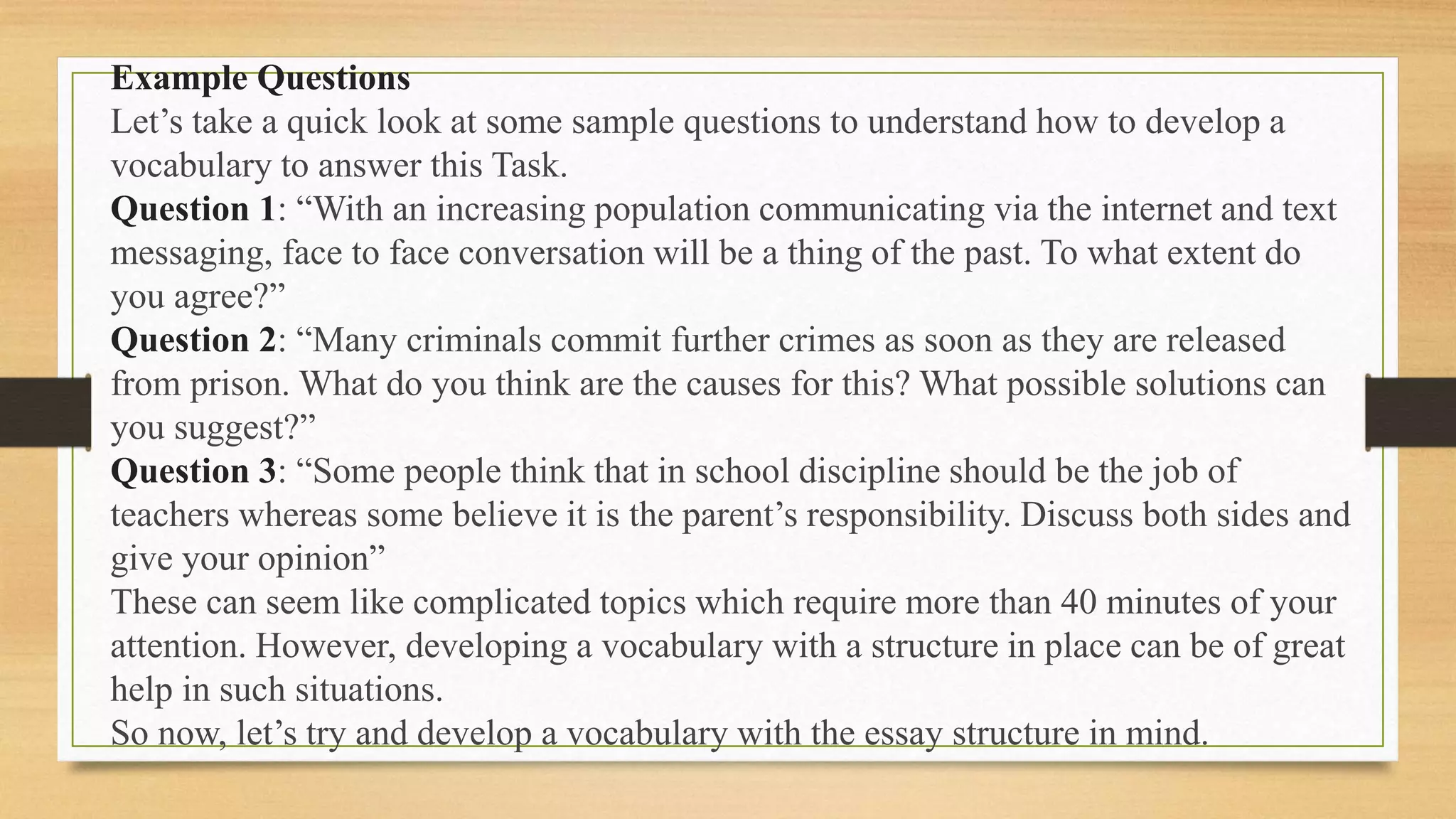
Example Questions
Let’s take a quick look at some sample questions to understand how to develop a
vocabulary to answer this Task.
Question 1: “With an increasing population communicating via the internet and text
messaging, face to face conversation will be a thing of the past. To what extent do
you agree?”
Question 2: “Many criminals commit further crimes as soon as they are released
from prison. What do you think are the causes for this? What possible solutions can
you suggest?”
Question 3: “Some people think that in school discipline should be the job of
teachers whereas some believe it is the parent’s responsibility. Discuss both sides and
give your opinion”
These can seem like complicated topics which require more than 40 minutes of your
attention. However, developing a vocabulary with a structure in place can be of great
help in such situations.
So now, let’s try and develop a vocabulary with the essay structure in mind.
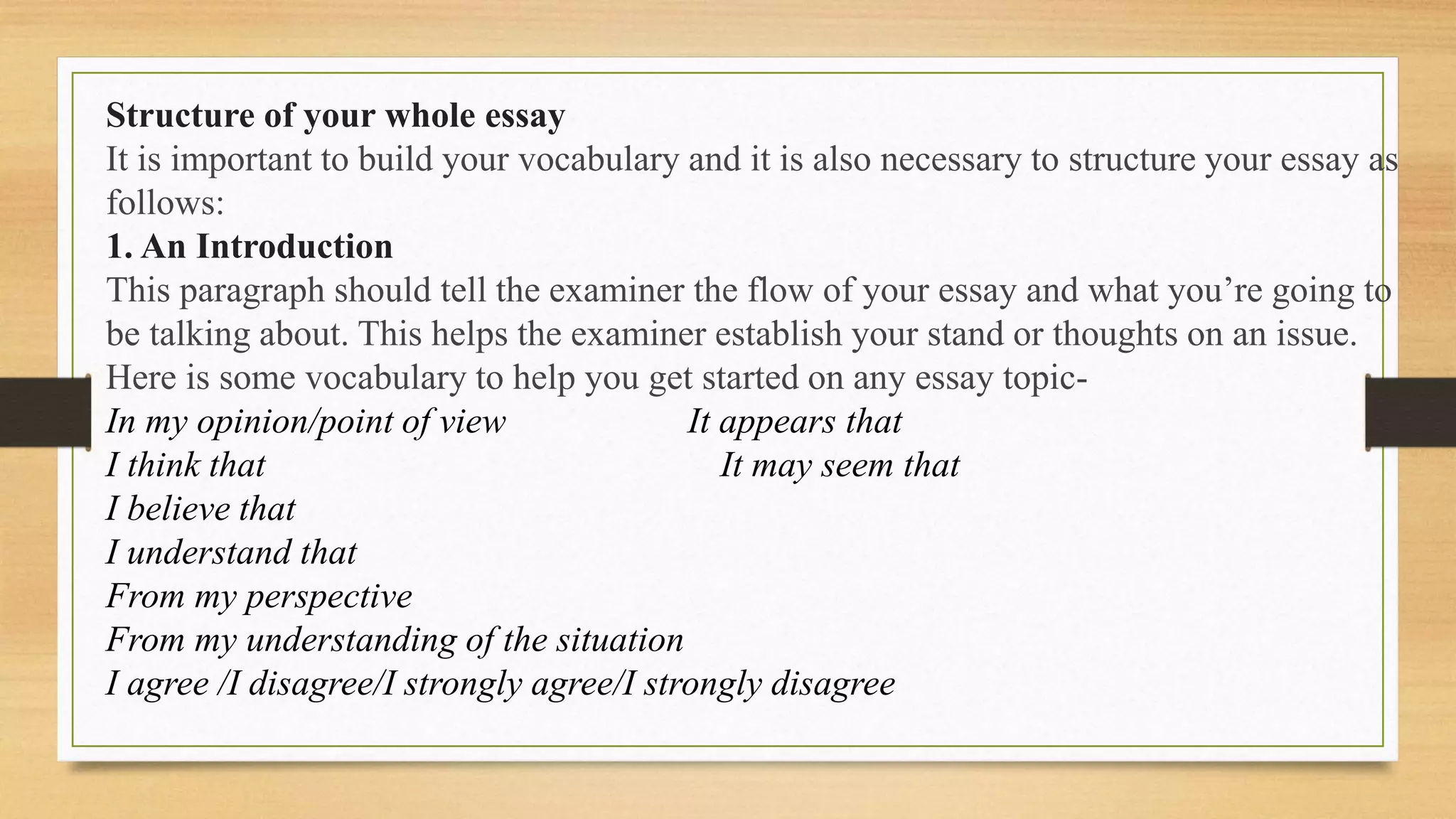
Structure of your whole essay
It is important to build your vocabulary and it is also necessary to structure your essay as
follows:
1. An Introduction
This paragraph should tell the examiner the flow of your essay and what you’re going to
be talking about. This helps the examiner establish your stand or thoughts on an issue.
Here is some vocabulary to help you get started on any essay topic-
In my opinion/point of view It appears that
I think that It may seem that
I believe that
I understand that
From my perspective
From my understanding of the situation
I agree /I disagree/I strongly agree/I strongly disagree
2. The Main Body or Argument
This paragraph should be divided into more than one paragraph. The
main body should continue in line with the introduction, detailing out the
reasons for your opinion, supporting it with relevant examples and
explanation. Vocabulary you can use for it is:
•In my opinion
•My first argument
•To embark on
•It is commonly believed
•Firstly
•Initially
•First of all
•In the first place
•To begin with
•To start with
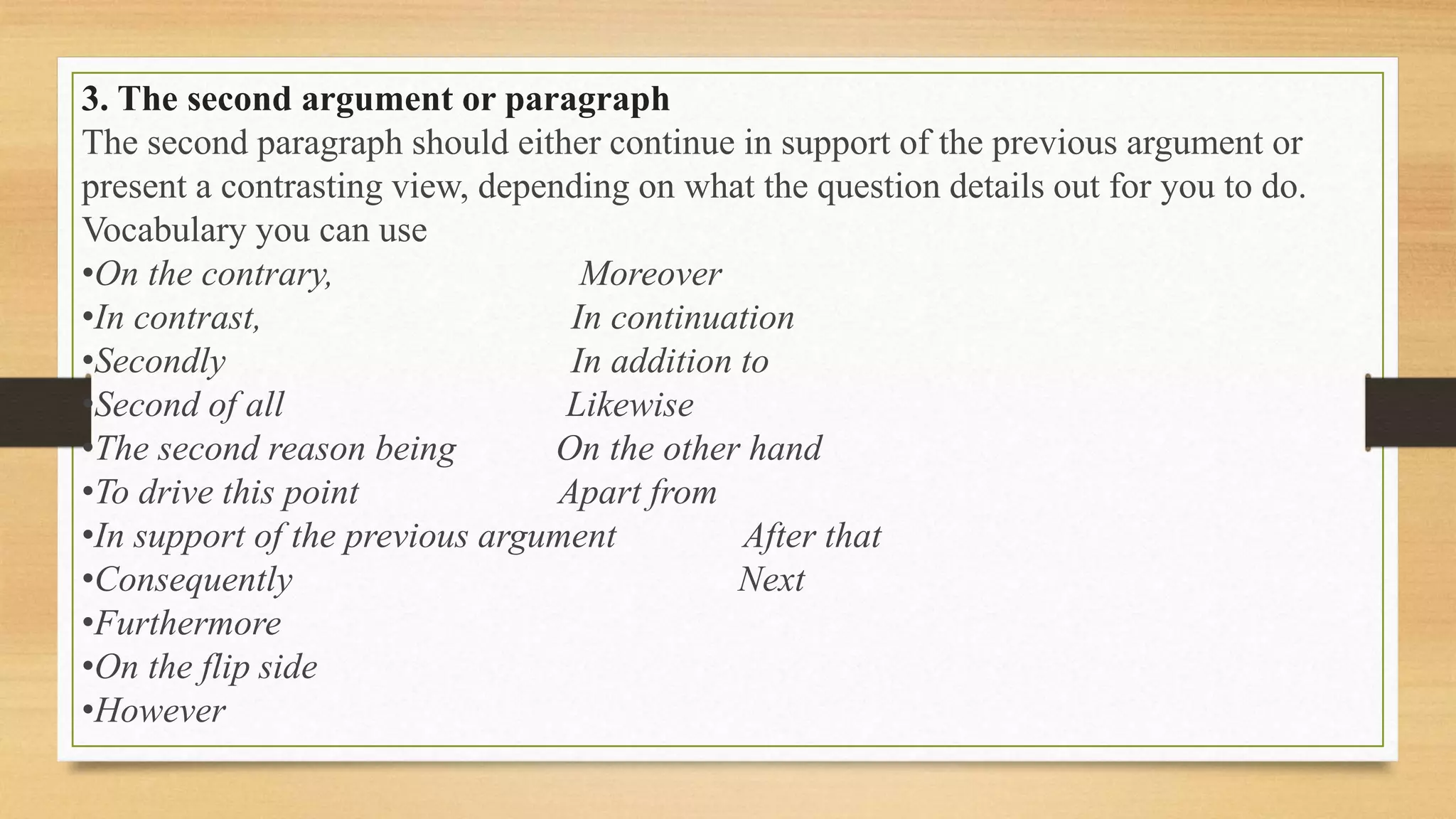
3. The second argument or paragraph
The second paragraph should either continue in support of the previous argument or
present a contrasting view, depending on what the question details out for you to do.
Vocabulary you can use
•On the contrary, Moreover
•In contrast, In continuation
•Secondly In addition to
•Second of all Likewise
•The second reason being On the other hand
•To drive this point Apart from
•In support of the previous argument After that
•Consequently Next
•Furthermore
•On the flip side
•However
4. The concluding paragraph
This paragraph should focus on summarising your line of thought. A short crisp
ending which concludes the whole argument in whatever way is required.
Vocabulary for the conclusion can be:
•In conclusion
•I would like to conclude by saying
•I would like to close this argument by
•Finally
•To summarize
•Overall
•To sum up
•I would personally conclude by saying
•It may seem that
Here are some tips to help you achieve a good band
1. Read the question really well. Don’t make the mistake of assuming what you are
expected to do. You could be asked to do any of the above types of questions.
2. Make sure you sound like an academic when arguing and avoid using overtly
passionate language like I hate or I would not like.
3. Do not write in one big paragraph, make sure you break up each section while
keeping in mind the cohesiveness of the essay.
4. Try not to repeat yourself even when trying to reiterate an idea. Use different
terms or angles if you feel the need to reiterate in any way.
5. Take 5 to 10 minutes to plan the essay before you start writing it. This makes all
the difference once you begin. It will help you achieve the task in less time.
6. Make sure to conclude your essay. Even if you are running out of time, write a few
concluding lines to your essay.
7. Avoid using slangs, overtly complicated language or leaving sentences half done.
Make sure you have time to revise and make corrections since the exam is written in
pencil.

IELTS Writing task 2

  • 1.
  • 2.
    Questions Type Details Thetypes of questions you can expect in this Task are listed below and these are just classification of types. •Discuss both sides of an argument •Discuss the pros and cons or advantages or disadvantages •Present your point of view on an issue •Agree or disagree with a statement •Gives reasons for the existence of a problem
  • 3.
    In the Task-2 of the Writing Test of IELTS you will need to write an essay of at least 250 words on a topic which requires you to present an argument in a format that the instructions lay down. This Task takes about 40 minutes. The topics are mostly abstract with no right answer. The point to note here is that this task is worth twice as much as Task -1. So, spending time developing a relevant vocabulary for presenting your views will be a wise investment.
  • 4.
    Example Questions Let’s takea quick look at some sample questions to understand how to develop a vocabulary to answer this Task. Question 1: “With an increasing population communicating via the internet and text messaging, face to face conversation will be a thing of the past. To what extent do you agree?” Question 2: “Many criminals commit further crimes as soon as they are released from prison. What do you think are the causes for this? What possible solutions can you suggest?” Question 3: “Some people think that in school discipline should be the job of teachers whereas some believe it is the parent’s responsibility. Discuss both sides and give your opinion” These can seem like complicated topics which require more than 40 minutes of your attention. However, developing a vocabulary with a structure in place can be of great help in such situations. So now, let’s try and develop a vocabulary with the essay structure in mind.
  • 5.
    Structure of yourwhole essay It is important to build your vocabulary and it is also necessary to structure your essay as follows: 1. An Introduction This paragraph should tell the examiner the flow of your essay and what you’re going to be talking about. This helps the examiner establish your stand or thoughts on an issue. Here is some vocabulary to help you get started on any essay topic- In my opinion/point of view It appears that I think that It may seem that I believe that I understand that From my perspective From my understanding of the situation I agree /I disagree/I strongly agree/I strongly disagree
  • 6.
    2. The MainBody or Argument This paragraph should be divided into more than one paragraph. The main body should continue in line with the introduction, detailing out the reasons for your opinion, supporting it with relevant examples and explanation. Vocabulary you can use for it is: •In my opinion •My first argument •To embark on •It is commonly believed •Firstly •Initially •First of all •In the first place •To begin with •To start with
  • 7.
    3. The secondargument or paragraph The second paragraph should either continue in support of the previous argument or present a contrasting view, depending on what the question details out for you to do. Vocabulary you can use •On the contrary, Moreover •In contrast, In continuation •Secondly In addition to •Second of all Likewise •The second reason being On the other hand •To drive this point Apart from •In support of the previous argument After that •Consequently Next •Furthermore •On the flip side •However
  • 8.
    4. The concludingparagraph This paragraph should focus on summarising your line of thought. A short crisp ending which concludes the whole argument in whatever way is required. Vocabulary for the conclusion can be: •In conclusion •I would like to conclude by saying •I would like to close this argument by •Finally •To summarize •Overall •To sum up •I would personally conclude by saying •It may seem that
  • 9.
    Here are sometips to help you achieve a good band 1. Read the question really well. Don’t make the mistake of assuming what you are expected to do. You could be asked to do any of the above types of questions. 2. Make sure you sound like an academic when arguing and avoid using overtly passionate language like I hate or I would not like. 3. Do not write in one big paragraph, make sure you break up each section while keeping in mind the cohesiveness of the essay. 4. Try not to repeat yourself even when trying to reiterate an idea. Use different terms or angles if you feel the need to reiterate in any way. 5. Take 5 to 10 minutes to plan the essay before you start writing it. This makes all the difference once you begin. It will help you achieve the task in less time. 6. Make sure to conclude your essay. Even if you are running out of time, write a few concluding lines to your essay. 7. Avoid using slangs, overtly complicated language or leaving sentences half done. Make sure you have time to revise and make corrections since the exam is written in pencil.