P T E
Session 1
Pearson Test of English
Orientation
Session 1 of 4
About PTE
• Pearson Test of English.
• It is the world’s most popular English Language
Proficiency test.
• Tests you on your Communication Skills in English
language.
Orientation
Session 1 of 4
Why PTE
• It can help you study, live or work abroad.
• Universities and government of Australia and many
other countries accept this as a valid test for English
language proficiency.
• A computer based test whose results are declared
within 3 – 5 days.
• Scores valid for 2 years.
Orientation
Session 1 of 4
There are four modules in the test
• Listening
• Speaking
• Reading
• Writing
The Modules in PTE
Orientation
Session 1 of 4
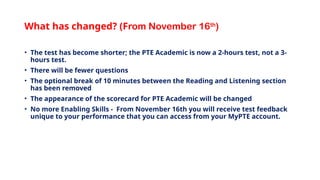
What has changed? (From November 16th
)
• The test has become shorter; the PTE Academic is now a 2-hours test, not a 3-
hours test.
• There will be fewer questions
• The optional break of 10 minutes between the Reading and Listening section
has been removed
• The appearance of the scorecard for PTE Academic will be changed
• No more Enabling Skills - From November 16th you will receive test feedback
unique to your performance that you can access from your MyPTE account.
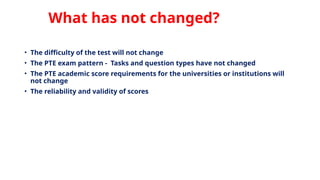
What has not changed?
• The difficulty of the test will not change
• The PTE exam pattern - Tasks and question types have not changed
• The PTE academic score requirements for the universities or institutions will
not change
• The reliability and validity of scores
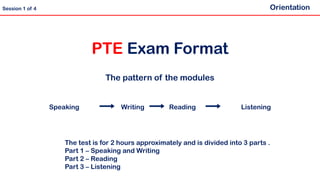
Speaking Writing Reading Listening
PTE Exam Format
The pattern of the modules
Orientation
Session 1 of 4
The test is for 2 hours approximately and is divided into 3 parts .
Part 1 – Speaking and Writing
Part 2 – Reading
Part 3 – Listening
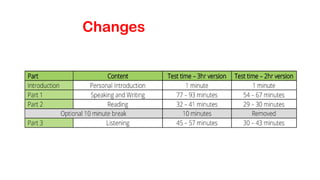
Changes
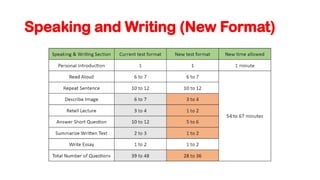
Speaking and Writing (New Format)
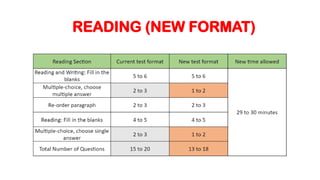
READING (NEW FORMAT)
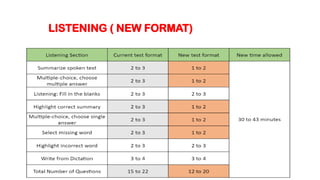
LISTENING ( NEW FORMAT)
PTE Exam Scoring
Orientation
Session 1 of 4
Updated Score Report (Without the Enabling Skills)
The score report now has 2 parts:
• Overall Score
• Communicative skills
Orientation
Session 1 of 4
Communicative Skills
• The communicative skills include scores of the Listening,
Reading, Speaking and Writing modules.
• The scores are calculated based on 20 question types of
the PTE test.
• For each module the scores range between 10 - 90.
• For integrated skills, (those assessing reading and
speaking, listening and speaking, reading and writing,
listening and writing, or listening and reading) the item
score contributes to the score for the communicative
skills that the item assesses.
PTE Exam Scoring
Orientation
Session 1 of 4
Reading Module
Session 1 of 4
Session 1 of 4
The objective of the Reading Module
• The objective of the Reading Module is to test your
ability to understand written English.
• It also checks your vocabulary.
Reading Module Overview
Session 1 of 4
The total duration of the reading module is 29 – 30
minutes.
Reading questions are not timed individually. However,
you can refer to the timer which counts down the
remaining time.
Texts are about academic subjects related to humanities,
natural sciences or social sciences. It is not required to
have a prior information about the topics as the
information needed is contained in the texts.
Reading Module Overview
Session 1 of 4
The question types in the Reading Module
• Multiple Choice – Single Answer
• Multiple Choice – Multiple Answer
• Reorder Paragraphs
• Reading – Fill in the Blanks
• Reading & Writing – Fill in the Blanks
Session 1 of 4
Reading Module Overview
Task Type: Multiple Choice Questions
Session 1 of 4
Single Answer
In this task type, you need to select a single answer
to a question about information in a text.
There will be four options to choose from and only
one answer is correct.
Select an answer by clicking on a Radio button.
Session 1 of 4
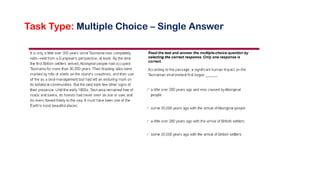
Task Type: Multiple Choice – Single Answer
You will get 1 – 2 Multiple Choice – Single Answer
questions in this module.
The length of each text will be up to 300 words.
These tasks contribute to your scores in Reading
module only.
Session 1 of 4
Features: Multiple Choice – Single Answer
This task type is either scored as correct or
incorrect.
For every correct answer, you will receive one
point.
There is no negative marking for this task.
Session 1 of 4
Scoring: Multiple Choice – Single Answer
Tips and Strategies
• There are three types of questions that are asked under this
question type:
• What is the main idea / purpose of the text?
• Which of the following __________________?
• What is the writer’s conclusion / purpose of writing?
• Read the question before reading the passage and understand the
question type. This will help you to understand which part of the
text to read.
• Read the options to give you an idea of the topic.
• The options may use synonyms for words in the passage and not
the exact words.
• Read the part of the text which will have the answer and
comprehend the information.
Session 1 of 4
Task Type: Multiple Choice – Single Answer
Additional Tips
• Eliminate the incorrect options given in the question.
• Do not choose an option just because it has words that appear in
the text. You need to make sure the whole idea expressed by the
option is correct.
• Confirm your answer by matching the information. Check for
synonym to do this.
• Do not spend more than 1 and half minutes in any question. Click
“Next’ and move on.
Session 1 of 4
Task Type: Multiple Choice – Single Answer
Session 1 of 4
End of Session 1 of 4
Session 2 of 4
PTE Reading
Session - 2
Session 2 of 4
Task Type: Multiple Choice Questions
Session 1 of 4
Multiple Answer
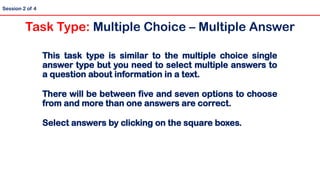
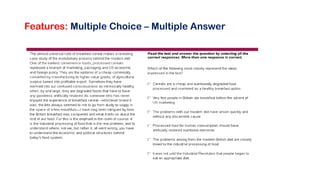
This task type is similar to the multiple choice single
answer type but you need to select multiple answers to
a question about information in a text.
There will be between five and seven options to choose
from and more than one answers are correct.
Select answers by clicking on the square boxes.
Session 2 of 4
Task Type: Multiple Choice – Multiple Answer
Features: Multiple Choice – Multiple Answer
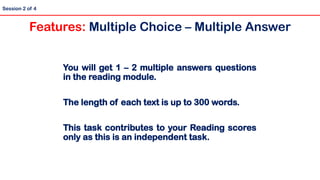
You will get 1 – 2 multiple answers questions
in the reading module.
The length of each text is up to 300 words.
This task contributes to your Reading scores
only as this is an independent task.
Session 2 of 4
Features: Multiple Choice – Multiple Answer
Session 2 of 4
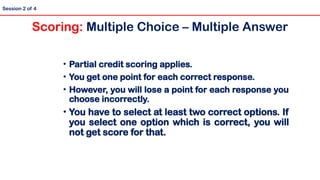
• Partial credit scoring applies.
• You get one point for each correct response.
• However, you will lose a point for each response you
choose incorrectly.
• You have to select at least two correct options. If
you select one option which is correct, you will
not get score for that.
Scoring: Multiple Choice – Multiple Answer
Tips and Strategies
• The common question type here will be:
• Which of the following __________________?
• Read the question before reading the passage and understand the
question type. This will help you to understand which part of the text to
read.
• Read the options to give you an idea of the topic.
• The options may use synonyms for words in the passage and not the exact
words.
• Read the passage quickly to understand the overall information.
• Eliminate the incorrect options from the list.
• Do not make guesses on this task as you lose a point for each
incorrect answer.
• Spend 2 to 3 minutes on each question.
Session 2 of 4
Task Type: Multiple Choice – Multiple Answer
Session 3 of 4
PTE Reading
Session - 3
Session 3 of 4
Task Type: Reorder Paragraph
Session 3 of 4
As the name suggests, the task is to
rearrange a set of jumbled texts in a proper
meaningful sequence.
In this task type, several text boxes appear in
a random order and you need to put the text
boxes in correct order.
Session 3 of 4
Task Type: Reorder Paragraph
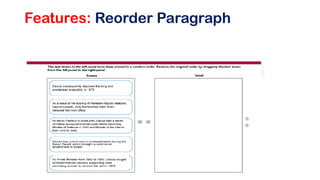
You will get 2 – 3 Reorder Paragraph questions in
the reading module
Paragraphs in incorrect order are in the left panel
and you need to drag and drop the the text boxes
in correct order in the right panel by using the
arrow buttons on the screen
The complete text for each question is up to 150
words.
Session 3 of 4
Features: Reorder Paragraph
Session 3 of 4
If all the text boxes are arranged in a correct order,
then you receive the maximum score.
Each adjacent pair will give you one point, so even if
you make one or two or all pairs right, you will get
scores.
There is no negative marking for wrong adjustments.
Scoring: Reorder Paragraph
Tips and Strategies
• Read each sentence and try to identify the opening sentence. This sentence
usually DOES NOT starts with a pronoun. It is always an independent sentence; a
sentence that stands alone - it should not be grammatically dependent on other
ideas and/or should be passive.
• After identifying the first statement, look for the next sentence by finding the
relation or related keywords or pronouns.
• Pay attention to connecting words. This will help you to understand when the tone
changes.
• After arranging the sentences reread the whole paragraph to ensure that it makes
logical sense.
• Subject – Verb – Object approach : Identifying the subject in lengthy sentences can
be problematic under time constrained situations. So, this approach is optional.
• Never understand a single sentence in isolation . Find out the tone of the writer.
Session 3 of 4
Approach: Reorder Paragraph
Session 4 of 4
PTE Reading
Session - 4
Session 4 of 4
Task Type: Reading – Fill in the Blanks
Session 4 of 4
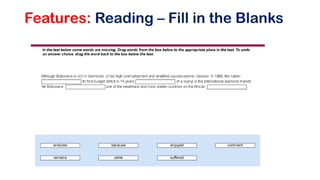
In this task, a text appears on the screen with
several gaps and you need to fill the blanks with
words.
You are judged on your ability to use context and
grammatical cues to identify words that complete
a reading text.
Session 4 of 4
Task Type: Reading – Fill in the Blanks
Features: Reading – Fill in the Blanks
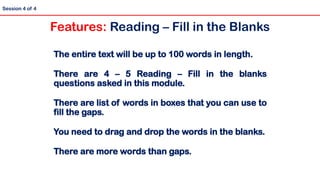
The entire text will be up to 100 words in length.
There are 4 – 5 Reading – Fill in the blanks
questions asked in this module.
There are list of words in boxes that you can use to
fill the gaps.
You need to drag and drop the words in the blanks.
There are more words than gaps.
Session 4 of 4
Features: Reading – Fill in the Blanks
Session 4 of 4
Each blank filled with a correct word gives one
point.
If you fill some of the blanks correctly, partial
credit applies.
There is no negative marking in this question type.
These questions contribute to the Reading score
only.
Scoring: Reading – Fill in the Blanks
Tips and Strategies
• Read the sentence with the blank and try to understand the overall information. This will help to identify
what type of word is required in the blank.
• Read the text more carefully to PREDICT answers for the missing blanks. There are two ways to identify
them -
• Collocations (list of words given in the material)
• Word choice (to know what type of word is missing) - For example: is it a verb, noun, singular, plural,
positive word, negative word etc…?
• Look at the options and try to understand the meaning of words and whether they will fit the blank.
• Use grammar rules to understand which word can fit a blank.
• When you have filled all the blanks, read the text again to check that it makes sense in the context.
• If you can not do one, just move to the next blank. Do not spend more than 1 minute 30 secs.
Quick Tip
• Improve word knowledge by practicing synonyms and collocations.
Session 4 of 4
Approach: Reading – Fill in the Blanks
Task Type: Reading & Writing
Fill in the blanks
Session 4 of 4
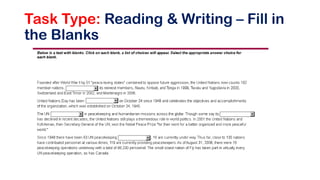
In this task type, a text appears on the screen with
several gaps and you need to fill the blanks with words.
You are judged on your ability to use context and
grammatical cues to identify words that complete a
reading text.
Session 4 of 4
Task Type: Reading & Writing – Fill in the Blanks
The entire text will be up to 300 words.
For each blank, there will be a drop-down menu.
Once clicked on the drop down menu, 4 options
will appear.
There are 5 – 6 questions in this task type.
Session 4 of 4
Features: Reading & Writing – Fill in the Blanks
Task Type: Reading & Writing – Fill in
the Blanks
Session 4 of 4
Each blank filled up with a correct word will add one
point.
If you fill some of the blanks correctly, partial credit
applies.
There is no negative marking.
These questions contribute to the Reading and Writing
score.
They are based more on grammar rather than
collocation
Scoring: Reading & Writing – Fill in the Blanks
Tips and Strategies
• Skim the text quickly ignoring the blanks to understand the general topic.
• Read the text more carefully to PREDICT answers for the missing blanks. Look at
the context surrounding the gaps. There are two ways to identify them:
• Collocations [ list of words given in the material ]
• Word choice [ to know what type of word is missing] - For example, Is it a verb, noun,
singular, plural , positive word, negative word etc…?
• Normally, the list of words are noun, verb, adverb, adjective, preposition. Also, pay
attention to subject-verb agreement.
• When you have filled all the blanks, read the text again to check that it makes sense
in the context.
• If you can not do one, just move to the next blank . The more blanks you fill in, the
easier the missing ones will be.
• Do not spend more than 2 minutes 30 seconds.
Session 4 of 4
Task Type: Reading & Writing – Fill in the Blanks
Session 4 of 4
End of Reading Module
Session 4 of 4

PTE Reading.pptx reading reading reading

  • 1.
    P T E Session1 Pearson Test of English Orientation Session 1 of 4
  • 2.
    About PTE • PearsonTest of English. • It is the world’s most popular English Language Proficiency test. • Tests you on your Communication Skills in English language. Orientation Session 1 of 4
  • 3.
    Why PTE • Itcan help you study, live or work abroad. • Universities and government of Australia and many other countries accept this as a valid test for English language proficiency. • A computer based test whose results are declared within 3 – 5 days. • Scores valid for 2 years. Orientation Session 1 of 4
  • 4.
    There are fourmodules in the test • Listening • Speaking • Reading • Writing The Modules in PTE Orientation Session 1 of 4
  • 5.
    What has changed?(From November 16th ) • The test has become shorter; the PTE Academic is now a 2-hours test, not a 3- hours test. • There will be fewer questions • The optional break of 10 minutes between the Reading and Listening section has been removed • The appearance of the scorecard for PTE Academic will be changed • No more Enabling Skills - From November 16th you will receive test feedback unique to your performance that you can access from your MyPTE account.
  • 6.
    What has notchanged? • The difficulty of the test will not change • The PTE exam pattern - Tasks and question types have not changed • The PTE academic score requirements for the universities or institutions will not change • The reliability and validity of scores
  • 7.
    Speaking Writing ReadingListening PTE Exam Format The pattern of the modules Orientation Session 1 of 4 The test is for 2 hours approximately and is divided into 3 parts . Part 1 – Speaking and Writing Part 2 – Reading Part 3 – Listening
  • 8.
  • 9.
  • 10.
  • 11.
  • 12.
  • 13.
    Updated Score Report(Without the Enabling Skills) The score report now has 2 parts: • Overall Score • Communicative skills Orientation Session 1 of 4
  • 14.
    Communicative Skills • Thecommunicative skills include scores of the Listening, Reading, Speaking and Writing modules. • The scores are calculated based on 20 question types of the PTE test. • For each module the scores range between 10 - 90. • For integrated skills, (those assessing reading and speaking, listening and speaking, reading and writing, listening and writing, or listening and reading) the item score contributes to the score for the communicative skills that the item assesses. PTE Exam Scoring Orientation Session 1 of 4
  • 15.
    Reading Module Session 1of 4 Session 1 of 4
  • 16.
    The objective ofthe Reading Module • The objective of the Reading Module is to test your ability to understand written English. • It also checks your vocabulary. Reading Module Overview Session 1 of 4
  • 17.
    The total durationof the reading module is 29 – 30 minutes. Reading questions are not timed individually. However, you can refer to the timer which counts down the remaining time. Texts are about academic subjects related to humanities, natural sciences or social sciences. It is not required to have a prior information about the topics as the information needed is contained in the texts. Reading Module Overview Session 1 of 4
  • 18.
    The question typesin the Reading Module • Multiple Choice – Single Answer • Multiple Choice – Multiple Answer • Reorder Paragraphs • Reading – Fill in the Blanks • Reading & Writing – Fill in the Blanks Session 1 of 4 Reading Module Overview
  • 19.
    Task Type: MultipleChoice Questions Session 1 of 4 Single Answer
  • 20.
    In this tasktype, you need to select a single answer to a question about information in a text. There will be four options to choose from and only one answer is correct. Select an answer by clicking on a Radio button. Session 1 of 4 Task Type: Multiple Choice – Single Answer
  • 21.
    Task Type: MultipleChoice – Single Answer
  • 22.
    You will get1 – 2 Multiple Choice – Single Answer questions in this module. The length of each text will be up to 300 words. These tasks contribute to your scores in Reading module only. Session 1 of 4 Features: Multiple Choice – Single Answer
  • 23.
    This task typeis either scored as correct or incorrect. For every correct answer, you will receive one point. There is no negative marking for this task. Session 1 of 4 Scoring: Multiple Choice – Single Answer
  • 24.
    Tips and Strategies •There are three types of questions that are asked under this question type: • What is the main idea / purpose of the text? • Which of the following __________________? • What is the writer’s conclusion / purpose of writing? • Read the question before reading the passage and understand the question type. This will help you to understand which part of the text to read. • Read the options to give you an idea of the topic. • The options may use synonyms for words in the passage and not the exact words. • Read the part of the text which will have the answer and comprehend the information. Session 1 of 4 Task Type: Multiple Choice – Single Answer
  • 25.
    Additional Tips • Eliminatethe incorrect options given in the question. • Do not choose an option just because it has words that appear in the text. You need to make sure the whole idea expressed by the option is correct. • Confirm your answer by matching the information. Check for synonym to do this. • Do not spend more than 1 and half minutes in any question. Click “Next’ and move on. Session 1 of 4 Task Type: Multiple Choice – Single Answer
  • 26.
    Session 1 of4 End of Session 1 of 4
  • 27.
    Session 2 of4 PTE Reading Session - 2 Session 2 of 4
  • 28.
    Task Type: MultipleChoice Questions Session 1 of 4 Multiple Answer
  • 29.
    This task typeis similar to the multiple choice single answer type but you need to select multiple answers to a question about information in a text. There will be between five and seven options to choose from and more than one answers are correct. Select answers by clicking on the square boxes. Session 2 of 4 Task Type: Multiple Choice – Multiple Answer
  • 30.
    Features: Multiple Choice– Multiple Answer
  • 31.
    You will get1 – 2 multiple answers questions in the reading module. The length of each text is up to 300 words. This task contributes to your Reading scores only as this is an independent task. Session 2 of 4 Features: Multiple Choice – Multiple Answer
  • 32.
    Session 2 of4 • Partial credit scoring applies. • You get one point for each correct response. • However, you will lose a point for each response you choose incorrectly. • You have to select at least two correct options. If you select one option which is correct, you will not get score for that. Scoring: Multiple Choice – Multiple Answer
  • 33.
    Tips and Strategies •The common question type here will be: • Which of the following __________________? • Read the question before reading the passage and understand the question type. This will help you to understand which part of the text to read. • Read the options to give you an idea of the topic. • The options may use synonyms for words in the passage and not the exact words. • Read the passage quickly to understand the overall information. • Eliminate the incorrect options from the list. • Do not make guesses on this task as you lose a point for each incorrect answer. • Spend 2 to 3 minutes on each question. Session 2 of 4 Task Type: Multiple Choice – Multiple Answer
  • 34.
    Session 3 of4 PTE Reading Session - 3 Session 3 of 4
  • 35.
    Task Type: ReorderParagraph Session 3 of 4
  • 36.
    As the namesuggests, the task is to rearrange a set of jumbled texts in a proper meaningful sequence. In this task type, several text boxes appear in a random order and you need to put the text boxes in correct order. Session 3 of 4 Task Type: Reorder Paragraph
  • 37.
    You will get2 – 3 Reorder Paragraph questions in the reading module Paragraphs in incorrect order are in the left panel and you need to drag and drop the the text boxes in correct order in the right panel by using the arrow buttons on the screen The complete text for each question is up to 150 words. Session 3 of 4 Features: Reorder Paragraph
  • 38.
  • 39.
    Session 3 of4 If all the text boxes are arranged in a correct order, then you receive the maximum score. Each adjacent pair will give you one point, so even if you make one or two or all pairs right, you will get scores. There is no negative marking for wrong adjustments. Scoring: Reorder Paragraph
  • 40.
    Tips and Strategies •Read each sentence and try to identify the opening sentence. This sentence usually DOES NOT starts with a pronoun. It is always an independent sentence; a sentence that stands alone - it should not be grammatically dependent on other ideas and/or should be passive. • After identifying the first statement, look for the next sentence by finding the relation or related keywords or pronouns. • Pay attention to connecting words. This will help you to understand when the tone changes. • After arranging the sentences reread the whole paragraph to ensure that it makes logical sense. • Subject – Verb – Object approach : Identifying the subject in lengthy sentences can be problematic under time constrained situations. So, this approach is optional. • Never understand a single sentence in isolation . Find out the tone of the writer. Session 3 of 4 Approach: Reorder Paragraph
  • 41.
    Session 4 of4 PTE Reading Session - 4 Session 4 of 4
  • 42.
    Task Type: Reading– Fill in the Blanks Session 4 of 4
  • 43.
    In this task,a text appears on the screen with several gaps and you need to fill the blanks with words. You are judged on your ability to use context and grammatical cues to identify words that complete a reading text. Session 4 of 4 Task Type: Reading – Fill in the Blanks
  • 44.
    Features: Reading –Fill in the Blanks
  • 45.
    The entire textwill be up to 100 words in length. There are 4 – 5 Reading – Fill in the blanks questions asked in this module. There are list of words in boxes that you can use to fill the gaps. You need to drag and drop the words in the blanks. There are more words than gaps. Session 4 of 4 Features: Reading – Fill in the Blanks
  • 46.
    Session 4 of4 Each blank filled with a correct word gives one point. If you fill some of the blanks correctly, partial credit applies. There is no negative marking in this question type. These questions contribute to the Reading score only. Scoring: Reading – Fill in the Blanks
  • 47.
    Tips and Strategies •Read the sentence with the blank and try to understand the overall information. This will help to identify what type of word is required in the blank. • Read the text more carefully to PREDICT answers for the missing blanks. There are two ways to identify them - • Collocations (list of words given in the material) • Word choice (to know what type of word is missing) - For example: is it a verb, noun, singular, plural, positive word, negative word etc…? • Look at the options and try to understand the meaning of words and whether they will fit the blank. • Use grammar rules to understand which word can fit a blank. • When you have filled all the blanks, read the text again to check that it makes sense in the context. • If you can not do one, just move to the next blank. Do not spend more than 1 minute 30 secs. Quick Tip • Improve word knowledge by practicing synonyms and collocations. Session 4 of 4 Approach: Reading – Fill in the Blanks
  • 48.
    Task Type: Reading& Writing Fill in the blanks Session 4 of 4
  • 49.
    In this tasktype, a text appears on the screen with several gaps and you need to fill the blanks with words. You are judged on your ability to use context and grammatical cues to identify words that complete a reading text. Session 4 of 4 Task Type: Reading & Writing – Fill in the Blanks
  • 50.
    The entire textwill be up to 300 words. For each blank, there will be a drop-down menu. Once clicked on the drop down menu, 4 options will appear. There are 5 – 6 questions in this task type. Session 4 of 4 Features: Reading & Writing – Fill in the Blanks
  • 51.
    Task Type: Reading& Writing – Fill in the Blanks
  • 52.
    Session 4 of4 Each blank filled up with a correct word will add one point. If you fill some of the blanks correctly, partial credit applies. There is no negative marking. These questions contribute to the Reading and Writing score. They are based more on grammar rather than collocation Scoring: Reading & Writing – Fill in the Blanks
  • 53.
    Tips and Strategies •Skim the text quickly ignoring the blanks to understand the general topic. • Read the text more carefully to PREDICT answers for the missing blanks. Look at the context surrounding the gaps. There are two ways to identify them: • Collocations [ list of words given in the material ] • Word choice [ to know what type of word is missing] - For example, Is it a verb, noun, singular, plural , positive word, negative word etc…? • Normally, the list of words are noun, verb, adverb, adjective, preposition. Also, pay attention to subject-verb agreement. • When you have filled all the blanks, read the text again to check that it makes sense in the context. • If you can not do one, just move to the next blank . The more blanks you fill in, the easier the missing ones will be. • Do not spend more than 2 minutes 30 seconds. Session 4 of 4 Task Type: Reading & Writing – Fill in the Blanks
  • 54.
    Session 4 of4 End of Reading Module Session 4 of 4

Editor's Notes

  • #40 Read all the text boxes quickly before you start re-ordering them to understand the main idea.  Look for the 1st sentence which is usually the most general. It is unlikely to start with a pronoun or a linking word and will be  the topic sentence and introduce the main idea. - This is also called an Independent sentence. What is an Independent sentence? - A sentence that stands alone - it should not be grammatically dependant on other ideas and/or should be passive.  Once you have identified the first statement, look for the following one by finding the relation or related keywords.  Look for pronoun- noun relationship and usage of definite article.  Understand connecting words.  Never understand a single sentence in isolation . Find out the tone of the writer.