
Matching Features
Reading: Tips & Strategy
Reading
• Content
• What do you need to do?
• What does it test?
• Examples
• Common problems
• Tips and advice
• Strategy
Reading
• What do you need to do?
• You will be asked to match a person’s
name, usually an expert, a scientist, or a
researcher, to a statement from the text.
• You will be given a list of names and the
reading text will tell you what each person
has said or done.
• Often you will be given more names than
required.
Reading
• What does it test?
• The ability to select detailed information by
scanning a text.
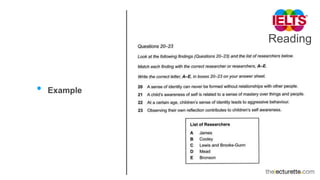
• Example
Reading
Reading
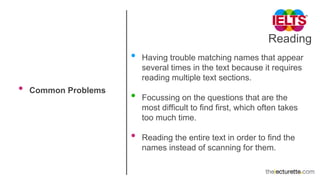
• Common Problems
• Having trouble matching names that appear
several times in the text because it requires
reading multiple text sections.
• Focussing on the questions that are the
most difficult to find first, which often takes
too much time.
• Reading the entire text in order to find the
names instead of scanning for them.
Reading
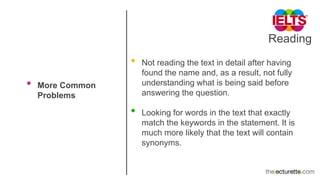
• More Common
Problems
• Not reading the text in detail after having
found the name and, as a result, not fully
understanding what is being said before
answering the question.
• Looking for words in the text that exactly
match the keywords in the statement. It is
much more likely that the text will contain
synonyms.
Reading
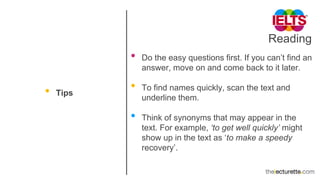
• Tips
• Do the easy questions first. If you can’t find an
answer, move on and come back to it later.
• To find names quickly, scan the text and
underline them.
• Think of synonyms that may appear in the
text. For example, ‘to get well quickly’ might
show up in the text as ‘to make a speedy
recovery’.
Reading
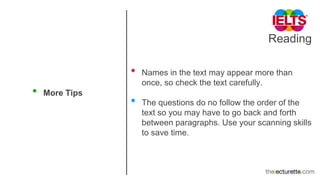
• More Tips
• Names in the text may appear more than
once, so check the text carefully.
• The questions do no follow the order of the
text so you may have to go back and forth
between paragraphs. Use your scanning skills
to save time.
Reading
• Strategy
• Read the questions carefully.
• Focus on the names first and underline them
in the text. You may want to use different
colors for different names.
• Focus on the names that appear in the text
only once first, because they are usually the
easiest.
Reading
• More Strategy
• Read around the names you found to see
whether the findings, opinions, etc. come
before or after the name.
• Read what is said about the research and
findings and then go back to the questions
and match. Beware of synonyms .
Reading
• Even More Strategy
• After you have found a match between a
name and a statement, cross out the
statement. Each statement can only be used
once.
• Repeat this strategy for the rest of the
names.

IELTS Reading: Matching Features

  • 1.
  • 2.
    Reading • Content • Whatdo you need to do? • What does it test? • Examples • Common problems • Tips and advice • Strategy
  • 3.
    Reading • What doyou need to do? • You will be asked to match a person’s name, usually an expert, a scientist, or a researcher, to a statement from the text. • You will be given a list of names and the reading text will tell you what each person has said or done. • Often you will be given more names than required.
  • 4.
    Reading • What doesit test? • The ability to select detailed information by scanning a text.
  • 5.
  • 6.
    Reading • Common Problems •Having trouble matching names that appear several times in the text because it requires reading multiple text sections. • Focussing on the questions that are the most difficult to find first, which often takes too much time. • Reading the entire text in order to find the names instead of scanning for them.
  • 7.
    Reading • More Common Problems •Not reading the text in detail after having found the name and, as a result, not fully understanding what is being said before answering the question. • Looking for words in the text that exactly match the keywords in the statement. It is much more likely that the text will contain synonyms.
  • 8.
    Reading • Tips • Dothe easy questions first. If you can’t find an answer, move on and come back to it later. • To find names quickly, scan the text and underline them. • Think of synonyms that may appear in the text. For example, ‘to get well quickly’ might show up in the text as ‘to make a speedy recovery’.
  • 9.
    Reading • More Tips •Names in the text may appear more than once, so check the text carefully. • The questions do no follow the order of the text so you may have to go back and forth between paragraphs. Use your scanning skills to save time.
  • 10.
    Reading • Strategy • Readthe questions carefully. • Focus on the names first and underline them in the text. You may want to use different colors for different names. • Focus on the names that appear in the text only once first, because they are usually the easiest.
  • 11.
    Reading • More Strategy •Read around the names you found to see whether the findings, opinions, etc. come before or after the name. • Read what is said about the research and findings and then go back to the questions and match. Beware of synonyms .
  • 12.
    Reading • Even MoreStrategy • After you have found a match between a name and a statement, cross out the statement. Each statement can only be used once. • Repeat this strategy for the rest of the names.