What is it?
 The

tendency to judge a person
in an unpleasant situation in a
bad light, and attribute her/his
behavior to internal causes and
qualities rather than
understanding the situation or
circumstances that may cause
the person to behave in that
manner
Why we make attributions
Knowing why others do what they do helps
us predict behavior
 Sometimes we attribute behavior to internal
factors instead of external factors

EXAMPLES
Pen clicking-annoying. Have you ever
thought someone was trying to annoy
you when they were just being
themselves?
 Mrs. Kerns example

Application to Medieval Hx


Can you think of a time from the lessons
when a group of people made internal
attributions about another group,
causing or exacerbating persecution or
conflict?
PROPOGANDA
Blood Libel- FAE allowed a great deal of
anti-Semitism to occur. Jews in Europe
were accused of murdering children and
using their blood in rituals.
 Portrayals of Jewish people in many
forms of Media, painting, prints and
songs depicted them as having many
unpleasant characteristics

Most propaganda uses our tendency to make
the FAE in order to make an outgroup seem
more evil, alien or less human
 This can increase ingroup cohesion, which
may allow for increased taxation or
conscription, or even help one group behave
violently toward another
 Most racist beliefs are based on some form of
FAE

Examples?


Someone is having trouble starting their car. You
decide to help the person by giving her a piece of
advice on something they should do to get the car
started. The person shoots you down, snaps at you,
or just ignores you. You get angry yourself and
dismiss the person as a rude, misbehaved individual
who does not value the help someone is trying to
offer. It is possible that a lot of people have offered the
person the same piece of advice that you did and it
didn't work; or that the person has already had a
rough day and the car getting spoiled was the cherry
on the icing. This is another example of a
fundamental attribution error.
Racist example?
He/She does _______________
because he is ______________
 This excludes examination of external
factors and simplifies human behavior
into simple, predetermined roles niches.

GROUPTHINK!
Would do a group activity, but you are
either too nice, too smart or both for that
to work, sooooo….
 Groupthink is:



Groupthink, a term coined by social psychologist
Irving Janis (1972), occurs when a group makes
faulty decisions because group pressures lead to
a deterioration of “mental efficiency, reality testing,
and moral judgment” (p. 9). Groups affected by
groupthink ignore alternatives and tend to take
irrational actions that dehumanize other groups. A
group is especially vulnerable to groupthink when
its members are similar in background, when the
group is insulated from outside opinions, and
when there are no clear rules for decision making.
In short
Groupthink occurs when a group of
people become more concerned with
maintaining consensus and harmony
than reaching a good decision.
 Some examples of groupthink: Bay of
Pigs, Rejection of MS windows, Space
Shuttle challenger explosion, the
decision to hire Mr. Kerns and many,
many others.

Defense?











Decision experts have determined that groupthink may be
prevented by adopting some of the following measures:
a) The leader should assign the role of critical evaluator to each
member
b) The leader should avoid stating preferences and expectations
at the outset
c) Each member of the group should routinely discuss the groups'
deliberations with a trusted associate and report back to the group
on the associate's reactions
d) One or more experts should be invited to each meeting on a
staggered basis. The outside experts should be encouraged to
challenge views of the members.
e) At least one articulate and knowledgeable member should be
given the role of devil's advocate (to question assumptions and
plans)
f) The leader should make sure that a sizeable block of time is set
aside to survey warning signals from rivals; leader and group
construct alternative scenarios of rivals' intentions.
How does this apply?
Big picture- imagine you are a Byzantine
Citizen and Theodora is trying to
convince you to cut down a defenseless
enemy, how might she use FAE, Risky
shift or ingroup/outgroup bias or
groupthink to get you to do this?
 How might you have defended yourself
against this?

Thesis Sentences!
Persuasive
 Should be a snapshot/preview of your
paper
 Should be thought provoking
 Should be concise, not run on
 Single Sentence

Persuasive aspect
A slight challenge to the reader will elicit
interest
 Be aware of assimilation vs. contrast
 Always be able to back yourself up with
citable facts
 Remember- “While it is easy to lie with
statistics, it is even easier to lie without
them.”
-Fredrick Mostelle

Practical use
Mr. Kerns is making you write about who
your favorite history teacher is this year.
 Mr. Kerns apparently has no sense
whatsoever.

My Thesis Sentence


“While Mr. and Mrs. Kerns are both
great teachers, Mr. Kerns generally goes
above and beyond in terms of choosing
shirts and apparel which maximize
classroom learning potential, making
him the better educator.”
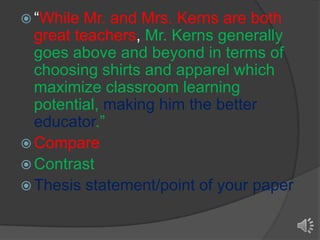
 “While

Mr. and Mrs. Kerns are both
great teachers, Mr. Kerns generally
goes above and beyond in terms of
choosing shirts and apparel which
maximize classroom learning
potential, making him the better
educator.”
 Compare
 Contrast
 Thesis statement/point of your paper
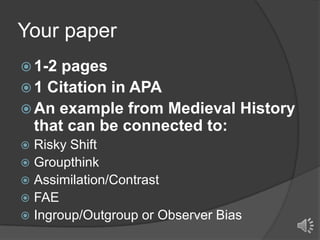
Your paper
 1-2

pages
 1 Citation in APA
 An example from Medieval History
that can be connected to:
Risky Shift
 Groupthink
 Assimilation/Contrast
 FAE
 Ingroup/Outgroup or Observer Bias


Fundamental Attribution Error MPHSAP

  • 2.
    What is it? The tendency to judge a person in an unpleasant situation in a bad light, and attribute her/his behavior to internal causes and qualities rather than understanding the situation or circumstances that may cause the person to behave in that manner
  • 3.
    Why we makeattributions Knowing why others do what they do helps us predict behavior  Sometimes we attribute behavior to internal factors instead of external factors 
  • 4.
    EXAMPLES Pen clicking-annoying. Haveyou ever thought someone was trying to annoy you when they were just being themselves?  Mrs. Kerns example 
  • 5.
    Application to MedievalHx  Can you think of a time from the lessons when a group of people made internal attributions about another group, causing or exacerbating persecution or conflict?
  • 6.
    PROPOGANDA Blood Libel- FAEallowed a great deal of anti-Semitism to occur. Jews in Europe were accused of murdering children and using their blood in rituals.  Portrayals of Jewish people in many forms of Media, painting, prints and songs depicted them as having many unpleasant characteristics 
  • 7.
    Most propaganda usesour tendency to make the FAE in order to make an outgroup seem more evil, alien or less human  This can increase ingroup cohesion, which may allow for increased taxation or conscription, or even help one group behave violently toward another  Most racist beliefs are based on some form of FAE 
  • 8.
    Examples?  Someone is havingtrouble starting their car. You decide to help the person by giving her a piece of advice on something they should do to get the car started. The person shoots you down, snaps at you, or just ignores you. You get angry yourself and dismiss the person as a rude, misbehaved individual who does not value the help someone is trying to offer. It is possible that a lot of people have offered the person the same piece of advice that you did and it didn't work; or that the person has already had a rough day and the car getting spoiled was the cherry on the icing. This is another example of a fundamental attribution error.
  • 9.
    Racist example? He/She does_______________ because he is ______________  This excludes examination of external factors and simplifies human behavior into simple, predetermined roles niches. 
  • 10.
    GROUPTHINK! Would do agroup activity, but you are either too nice, too smart or both for that to work, sooooo….  Groupthink is: 
  • 11.
     Groupthink, a termcoined by social psychologist Irving Janis (1972), occurs when a group makes faulty decisions because group pressures lead to a deterioration of “mental efficiency, reality testing, and moral judgment” (p. 9). Groups affected by groupthink ignore alternatives and tend to take irrational actions that dehumanize other groups. A group is especially vulnerable to groupthink when its members are similar in background, when the group is insulated from outside opinions, and when there are no clear rules for decision making.
  • 12.
    In short Groupthink occurswhen a group of people become more concerned with maintaining consensus and harmony than reaching a good decision.  Some examples of groupthink: Bay of Pigs, Rejection of MS windows, Space Shuttle challenger explosion, the decision to hire Mr. Kerns and many, many others. 
  • 13.
    Defense?        Decision experts havedetermined that groupthink may be prevented by adopting some of the following measures: a) The leader should assign the role of critical evaluator to each member b) The leader should avoid stating preferences and expectations at the outset c) Each member of the group should routinely discuss the groups' deliberations with a trusted associate and report back to the group on the associate's reactions d) One or more experts should be invited to each meeting on a staggered basis. The outside experts should be encouraged to challenge views of the members. e) At least one articulate and knowledgeable member should be given the role of devil's advocate (to question assumptions and plans) f) The leader should make sure that a sizeable block of time is set aside to survey warning signals from rivals; leader and group construct alternative scenarios of rivals' intentions.
  • 14.
    How does thisapply? Big picture- imagine you are a Byzantine Citizen and Theodora is trying to convince you to cut down a defenseless enemy, how might she use FAE, Risky shift or ingroup/outgroup bias or groupthink to get you to do this?  How might you have defended yourself against this? 
  • 15.
    Thesis Sentences! Persuasive  Shouldbe a snapshot/preview of your paper  Should be thought provoking  Should be concise, not run on  Single Sentence 
  • 16.
    Persuasive aspect A slightchallenge to the reader will elicit interest  Be aware of assimilation vs. contrast  Always be able to back yourself up with citable facts  Remember- “While it is easy to lie with statistics, it is even easier to lie without them.” -Fredrick Mostelle 
  • 17.
    Practical use Mr. Kernsis making you write about who your favorite history teacher is this year.  Mr. Kerns apparently has no sense whatsoever. 
  • 18.
    My Thesis Sentence  “WhileMr. and Mrs. Kerns are both great teachers, Mr. Kerns generally goes above and beyond in terms of choosing shirts and apparel which maximize classroom learning potential, making him the better educator.”
  • 19.
     “While Mr. andMrs. Kerns are both great teachers, Mr. Kerns generally goes above and beyond in terms of choosing shirts and apparel which maximize classroom learning potential, making him the better educator.”  Compare  Contrast  Thesis statement/point of your paper
  • 20.
    Your paper  1-2 pages 1 Citation in APA  An example from Medieval History that can be connected to: Risky Shift  Groupthink  Assimilation/Contrast  FAE  Ingroup/Outgroup or Observer Bias 