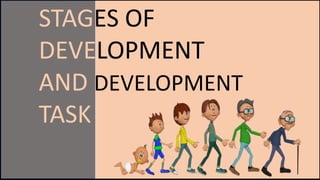
STAGES OF
DEVELOPMENT
AND DEVELOPMENT
TASK
EIGHT STAGES OF
DEVELOPMENT
BY ERIC ERICSON
ERIC HOMBURGER
ERICSON
Psychologist Erik Erikson developed
his eight stages of development to
explain how people mature. The stages
clarify the developmental challenges
faced at various points in life. His
theory is widely taught in courses in the
United States.
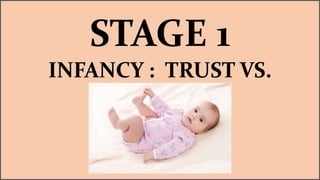
STAGE 1
INFANCY : TRUST VS.
MISTRUST
Infants depend on caregivers, usually parents, for
basic needs such as food. Infants learn to trust others
based upon how well caregivers meet their needs.
•Trust: When caregivers respond promptly to an
infant’s cries, the baby can learn to rely on others.
As caregivers fill an infant’s needs, the baby can
develop a sense of trust and security.
•Mistrust: If caregivers neglect an infants’ needs, or
care is sporadic, an infant may grow insecure. They
STAGE 2
TOODLERHOOD :
AUTONOMY VS. SHAME AND
SELF DOUBT
During this phase, young children begin exploring the
world around them. They learn more about their
environment and their place within it. They also develop
basic skills such as toilet training.
•Autonomy: In this stage, caregivers often serve as a safe
base from which to explore the world. When caregivers
encourage independence, children will feel secure enough
to take risks.
•Shame: Children whose caregivers discourage them may
develop feelings of shame. If caregivers foster excessive
STAGE 3
PRE SCHOOL YEARS :
INITIATIVE VS. GUILT
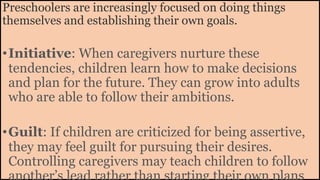
Preschoolers are increasingly focused on doing things
themselves and establishing their own goals.
•Initiative: When caregivers nurture these
tendencies, children learn how to make decisions
and plan for the future. They can grow into adults
who are able to follow their ambitions.
•Guilt: If children are criticized for being assertive,
they may feel guilt for pursuing their desires.
Controlling caregivers may teach children to follow
another’s lead rather than starting their own plans
STAGE 4
EARLY SCHOOL YEARS :
INDUSTRY VS. INFERIORITY
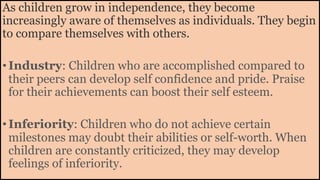
As children grow in independence, they become
increasingly aware of themselves as individuals. They begin
to compare themselves with others.
•Industry: Children who are accomplished compared to
their peers can develop self confidence and pride. Praise
for their achievements can boost their self esteem.
•Inferiority: Children who do not achieve certain
milestones may doubt their abilities or self-worth. When
children are constantly criticized, they may develop
feelings of inferiority.
STAGE 5
ADOLESCENES : IDENTITY
VS. ROLE CONFUSION
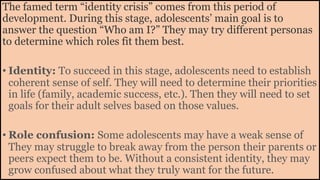
The famed term “identity crisis” comes from this period of
development. During this stage, adolescents’ main goal is to
answer the question “Who am I?” They may try different personas
to determine which roles fit them best.
• Identity: To succeed in this stage, adolescents need to establish
coherent sense of self. They will need to determine their priorities
in life (family, academic success, etc.). Then they will need to set
goals for their adult selves based on those values.
• Role confusion: Some adolescents may have a weak sense of
They may struggle to break away from the person their parents or
peers expect them to be. Without a consistent identity, they may
grow confused about what they truly want for the future.
STAGE 6
YOUNG ADULTHOOD :
INTIMACY VS. ISOLATION
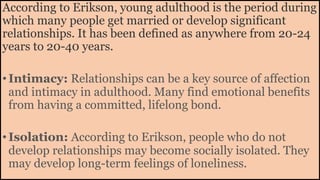
According to Erikson, young adulthood is the period during
which many people get married or develop significant
relationships. It has been defined as anywhere from 20-24
years to 20-40 years.
•Intimacy: Relationships can be a key source of affection
and intimacy in adulthood. Many find emotional benefits
from having a committed, lifelong bond.
•Isolation: According to Erikson, people who do not
develop relationships may become socially isolated. They
may develop long-term feelings of loneliness.
STAGE 7
MIDDLE ADULTHOOD :
GENERATIVITY VS.
STAGNATION
The focus of this stage is to contribute to society and the
next generation. Adults in this stage are often at the height
of their careers. Many people are raising children.
•Generativity: People may offer guidance to the next
generation through parenting or mentorship. They may
also offer lead the way by leaving a legacy. Contributing to
society’s future can give people a sense of community and
purpose.
•Stagnation: Some people may feel as if they have no
impact on society. If people do not find their work
meaningful, they may feel restless or isolated. Some may
feel they have “peaked” and that their lives will only get
STAGE 8
LATE ADULTHOOD :
GENERATIVITY VS.
STAGNATION
During this phase, older adults reflect on the life
they have lived.
•Ego Integrity: Those who feel fulfilled by
lives can face death and aging proudly.
•Despair: People who have disappointments or
regrets may fall into despair.
END OF
DISCUSSION
THANK YOU!

Stages of Development.pptx

  • 1.
  • 2.
  • 3.
    ERIC HOMBURGER ERICSON Psychologist ErikErikson developed his eight stages of development to explain how people mature. The stages clarify the developmental challenges faced at various points in life. His theory is widely taught in courses in the United States.
  • 4.
    STAGE 1 INFANCY :TRUST VS. MISTRUST
  • 5.
    Infants depend oncaregivers, usually parents, for basic needs such as food. Infants learn to trust others based upon how well caregivers meet their needs. •Trust: When caregivers respond promptly to an infant’s cries, the baby can learn to rely on others. As caregivers fill an infant’s needs, the baby can develop a sense of trust and security. •Mistrust: If caregivers neglect an infants’ needs, or care is sporadic, an infant may grow insecure. They
  • 6.
    STAGE 2 TOODLERHOOD : AUTONOMYVS. SHAME AND SELF DOUBT
  • 7.
    During this phase,young children begin exploring the world around them. They learn more about their environment and their place within it. They also develop basic skills such as toilet training. •Autonomy: In this stage, caregivers often serve as a safe base from which to explore the world. When caregivers encourage independence, children will feel secure enough to take risks. •Shame: Children whose caregivers discourage them may develop feelings of shame. If caregivers foster excessive
  • 8.
    STAGE 3 PRE SCHOOLYEARS : INITIATIVE VS. GUILT
  • 9.
    Preschoolers are increasinglyfocused on doing things themselves and establishing their own goals. •Initiative: When caregivers nurture these tendencies, children learn how to make decisions and plan for the future. They can grow into adults who are able to follow their ambitions. •Guilt: If children are criticized for being assertive, they may feel guilt for pursuing their desires. Controlling caregivers may teach children to follow another’s lead rather than starting their own plans
  • 10.
    STAGE 4 EARLY SCHOOLYEARS : INDUSTRY VS. INFERIORITY
  • 11.
    As children growin independence, they become increasingly aware of themselves as individuals. They begin to compare themselves with others. •Industry: Children who are accomplished compared to their peers can develop self confidence and pride. Praise for their achievements can boost their self esteem. •Inferiority: Children who do not achieve certain milestones may doubt their abilities or self-worth. When children are constantly criticized, they may develop feelings of inferiority.
  • 12.
    STAGE 5 ADOLESCENES :IDENTITY VS. ROLE CONFUSION
  • 13.
    The famed term“identity crisis” comes from this period of development. During this stage, adolescents’ main goal is to answer the question “Who am I?” They may try different personas to determine which roles fit them best. • Identity: To succeed in this stage, adolescents need to establish coherent sense of self. They will need to determine their priorities in life (family, academic success, etc.). Then they will need to set goals for their adult selves based on those values. • Role confusion: Some adolescents may have a weak sense of They may struggle to break away from the person their parents or peers expect them to be. Without a consistent identity, they may grow confused about what they truly want for the future.
  • 14.
    STAGE 6 YOUNG ADULTHOOD: INTIMACY VS. ISOLATION
  • 15.
    According to Erikson,young adulthood is the period during which many people get married or develop significant relationships. It has been defined as anywhere from 20-24 years to 20-40 years. •Intimacy: Relationships can be a key source of affection and intimacy in adulthood. Many find emotional benefits from having a committed, lifelong bond. •Isolation: According to Erikson, people who do not develop relationships may become socially isolated. They may develop long-term feelings of loneliness.
  • 16.
    STAGE 7 MIDDLE ADULTHOOD: GENERATIVITY VS. STAGNATION
  • 17.
    The focus ofthis stage is to contribute to society and the next generation. Adults in this stage are often at the height of their careers. Many people are raising children. •Generativity: People may offer guidance to the next generation through parenting or mentorship. They may also offer lead the way by leaving a legacy. Contributing to society’s future can give people a sense of community and purpose. •Stagnation: Some people may feel as if they have no impact on society. If people do not find their work meaningful, they may feel restless or isolated. Some may feel they have “peaked” and that their lives will only get
  • 18.
    STAGE 8 LATE ADULTHOOD: GENERATIVITY VS. STAGNATION
  • 19.
    During this phase,older adults reflect on the life they have lived. •Ego Integrity: Those who feel fulfilled by lives can face death and aging proudly. •Despair: People who have disappointments or regrets may fall into despair.
  • 20.