Synopsis
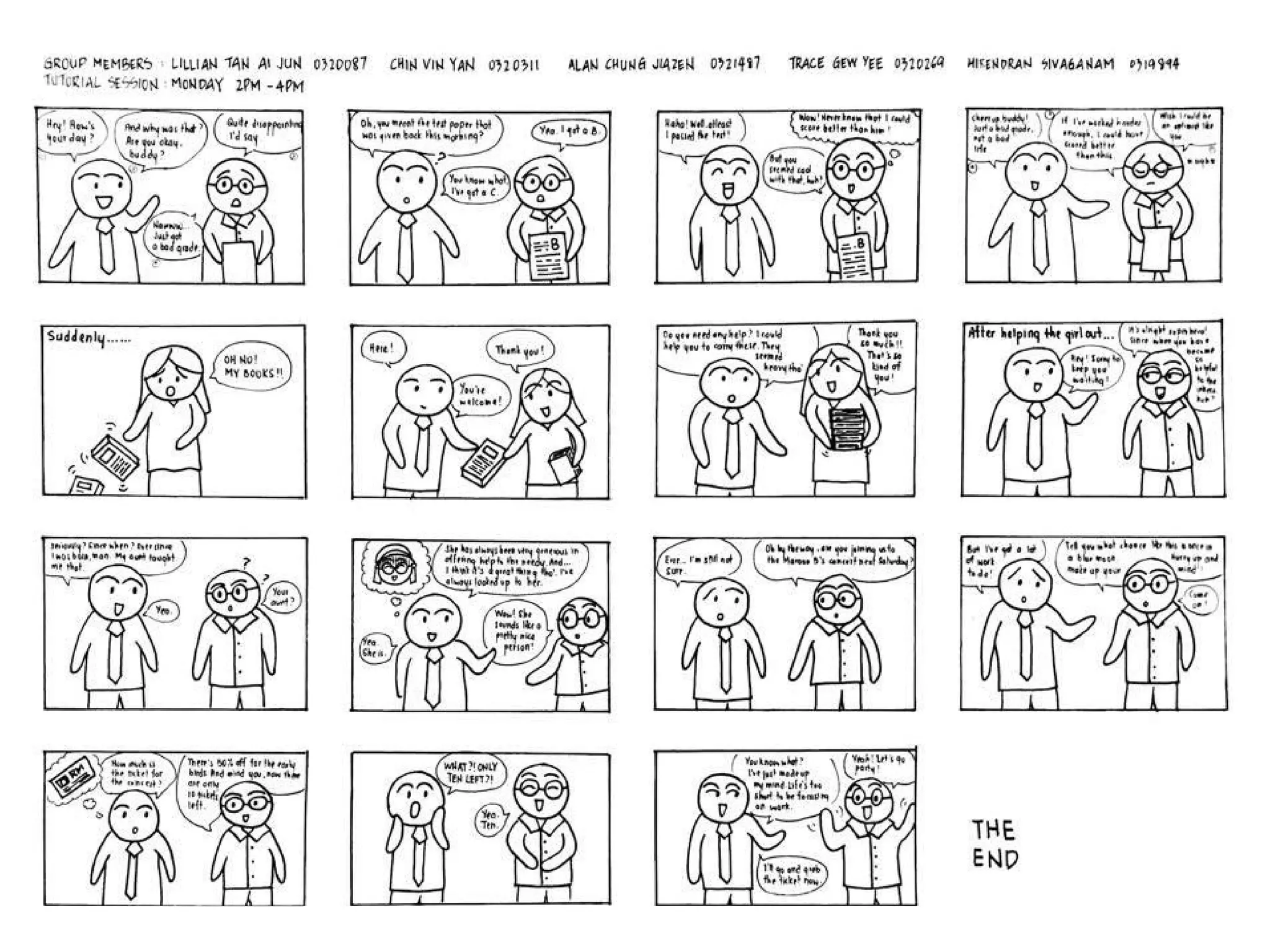
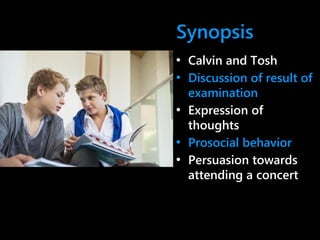
• Calvin and Tosh
• Discussion of result of
examination
• Expression of
thoughts
• Prosocial behavior
• Persuasion towards
attending a concert
Downward Social Comparison
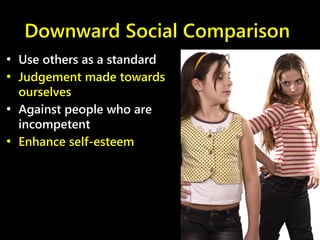
• Use others as a standard
• Judgement made towards
ourselves
• Against people who are
incompetent
• Enhance self-esteem
Downward Social Comparison
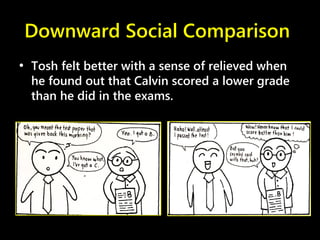
• Tosh felt better with a sense of relieved when
he found out that Calvin scored a lower grade
than he did in the exams.
Counterfactual
Thinking
• Tendency to create possible alternatives to life events
that have already occurred
Epitomized by the phrase “what might have been”
Is usually associated with bad/negative events
Counterfactual Thinking
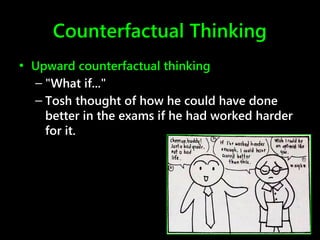
• Upward counterfactual thinking
– "What if..."
– Tosh thought of how he could have done
better in the exams if he had worked harder
for it.
Counterfactual Thinking
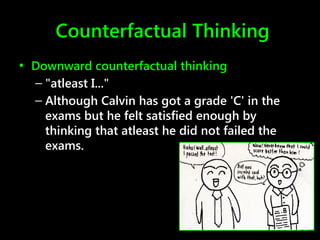
• Downward counterfactual thinking
– "atleast I..."
– Although Calvin has got a grade 'C' in the
exams but he felt satisfied enough by
thinking that atleast he did not failed the
exams.
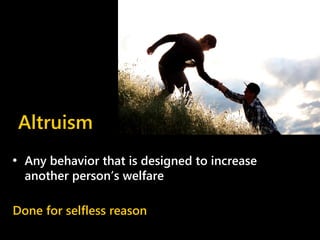
Altruism
• Any behavior that is designed to increase
another person’s welfare
Done for selfless reason
Altruism
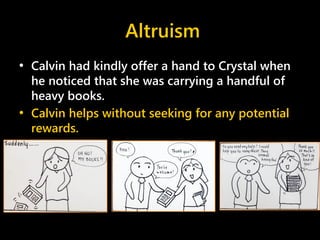
• Calvin had kindly offer a hand to Crystal when
he noticed that she was carrying a handful of
heavy books.
• Calvin helps without seeking for any potential
rewards.
Observational Learning
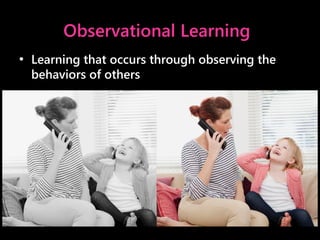
• Learning that occurs through observing the
behaviors of others
Observational Learning
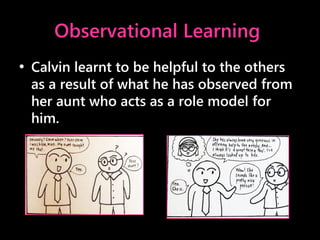
• Calvin learnt to be helpful to the others
as a result of what he has observed from
her aunt who acts as a role model for
him.
Cialdini's Six Weapon of Influence
- Scarcity
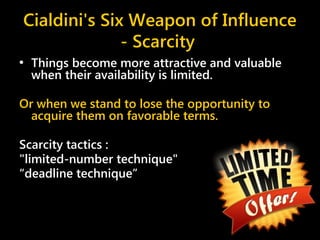
• Things become more attractive and valuable
when their availability is limited.
Or when we stand to lose the opportunity to
acquire them on favorable terms.
Scarcity tactics :
"limited-number technique"
“deadline technique”
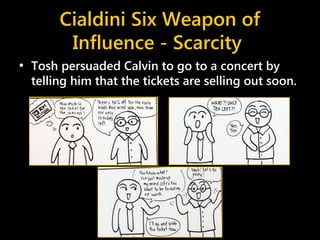
Cialdini Six Weapon of
Influence - Scarcity
• Tosh persuaded Calvin to go to a concert by
telling him that the tickets are selling out soon.
THANK YOU !
REFERENCES
• Duff, K. (2012). Think social psychology. Boston, MA: Allyn & Bacon/Pearson.
Fraser-Thill, R. (2015). Downward Comparisons. About.com Parenting. Retrieved
29 May 2015, from
http://tweenparenting.about.com/od/physicalemotionalgrowth/a/Downwar
d-Comparisons.htm
Mindtools.com,. (2015). Cialdini's Six Principles of Influence: Convincing Others
to Say. Retrieved 29 May 2015, from
http://www.mindtools.com/pages/article/six-principles-influence.htm
Sites.google.com,. (2015). Chapter 7: Scarcity - Revised - 724e Cialdini wiki.
Retrieved 29 May 2015, from
https://sites.google.com/site/724ecialdiniwiki/tyrone-dixon--scarcity-
summary
Stangor, C. (2012). Social Psychology Principles (1st ed., p. 753). Andy Schmitz.
Retrieved from http://2012books.lardbucket.org/pdfs/social-psychology-
principles.pdf

PSYCHO COMIC SLIDES

  • 2.
    Synopsis • Calvin andTosh • Discussion of result of examination • Expression of thoughts • Prosocial behavior • Persuasion towards attending a concert
  • 3.
    Downward Social Comparison •Use others as a standard • Judgement made towards ourselves • Against people who are incompetent • Enhance self-esteem
  • 4.
    Downward Social Comparison •Tosh felt better with a sense of relieved when he found out that Calvin scored a lower grade than he did in the exams.
  • 5.
    Counterfactual Thinking • Tendency tocreate possible alternatives to life events that have already occurred Epitomized by the phrase “what might have been” Is usually associated with bad/negative events
  • 6.
    Counterfactual Thinking • Upwardcounterfactual thinking – "What if..." – Tosh thought of how he could have done better in the exams if he had worked harder for it.
  • 7.
    Counterfactual Thinking • Downwardcounterfactual thinking – "atleast I..." – Although Calvin has got a grade 'C' in the exams but he felt satisfied enough by thinking that atleast he did not failed the exams.
  • 8.
    Altruism • Any behaviorthat is designed to increase another person’s welfare Done for selfless reason
  • 9.
    Altruism • Calvin hadkindly offer a hand to Crystal when he noticed that she was carrying a handful of heavy books. • Calvin helps without seeking for any potential rewards.
  • 10.
    Observational Learning • Learningthat occurs through observing the behaviors of others
  • 11.
    Observational Learning • Calvinlearnt to be helpful to the others as a result of what he has observed from her aunt who acts as a role model for him.
  • 12.
    Cialdini's Six Weaponof Influence - Scarcity • Things become more attractive and valuable when their availability is limited. Or when we stand to lose the opportunity to acquire them on favorable terms. Scarcity tactics : "limited-number technique" “deadline technique”
  • 13.
    Cialdini Six Weaponof Influence - Scarcity • Tosh persuaded Calvin to go to a concert by telling him that the tickets are selling out soon.
  • 14.
  • 15.
    REFERENCES • Duff, K.(2012). Think social psychology. Boston, MA: Allyn & Bacon/Pearson. Fraser-Thill, R. (2015). Downward Comparisons. About.com Parenting. Retrieved 29 May 2015, from http://tweenparenting.about.com/od/physicalemotionalgrowth/a/Downwar d-Comparisons.htm Mindtools.com,. (2015). Cialdini's Six Principles of Influence: Convincing Others to Say. Retrieved 29 May 2015, from http://www.mindtools.com/pages/article/six-principles-influence.htm Sites.google.com,. (2015). Chapter 7: Scarcity - Revised - 724e Cialdini wiki. Retrieved 29 May 2015, from https://sites.google.com/site/724ecialdiniwiki/tyrone-dixon--scarcity- summary Stangor, C. (2012). Social Psychology Principles (1st ed., p. 753). Andy Schmitz. Retrieved from http://2012books.lardbucket.org/pdfs/social-psychology- principles.pdf