




Improving Self-Esteem In
  Children and Teens
         Angela Adamson, LCSW, ACT
         Behavioral Health & Cognitive
                Therapy Center
Agenda
•   What is Self-Esteem?
•   Why it is important
•   Statistics
•   Self-Esteem Movement
•   Cognitive Model
•   Explanatory Style
•   What can parents do?
What is self-esteem

                      • Self-Acceptance
                               
                                    strengths and weaknesses
                               
                                    accuracy


                      • Doing well                                             Feeling good
                               
                                    Mastery of skills/strengths
                               
                                    Bonus side effect

Seligman, Martin (1995). The Optimistic Child. New York, NY: Harper Collins.
Why is it important?
                                       If you have low self-
                                       esteem it can lead to:

                                              •Depression
                                              •Anxiety
                                              •Pervasive pessimism
                                              •Difficulty coping with stress
                                              •Anger
                                              •Reduced effort


Seligman, Martin (1995). The Optimistic Child. New York, NY: Harper Collins.
Statistics
              • 10-15% of children have some symptoms of
                depression right now

              • 1/33 children have clinical depression

              • 1/8 adolescents have clinical depression

              • Since the 1960s depression has been
                significantly increasing.
                       • 30 year old women 1940 vs. 1980

Seligman, Martin (1995). The Optimistic Child. New York, NY: Harper Collins.
Chansky, Tamar (2008). Freeing Your Child From Negative Thinking. Cambridge, MA: Da Capo Press.
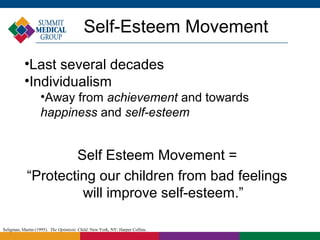
Self-Esteem Movement

           •Last several decades
           •Individualism
                   •Away from achievement and towards
                   happiness and self-esteem


                    Self Esteem Movement =
            “Protecting our children from bad feelings
                     will improve self-esteem.”

Seligman, Martin (1995). The Optimistic Child. New York, NY: Harper Collins.
Self-Esteem Movement


Retrieved from, http://www.bernardgoldberg.com/the-presidency-should-not-be-a-participation-trophy/ on February 18, 2013
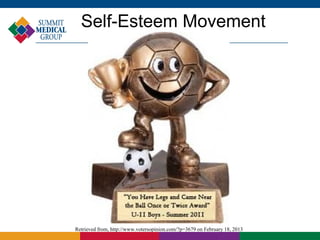
Self-Esteem Movement


Retrieved from, http://www.votersopinion.com/?p=3679 on February 18, 2013
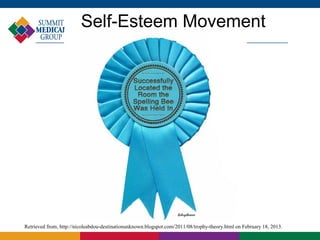
Self-Esteem Movement


Retrieved from, http://nicoleabdou-destinationunknown.blogspot.com/2011/08/trophy-theory.html on February 18, 2013.
Self-Esteem Movement


                   Self Esteem Movement =
           “Protecting our children from bad feelings
                    will improve self-esteem.”


Seligman, Martin (1995). The Optimistic Child. New York, NY: Harper Collins.
Self-Esteem Movement
                                  
                                       Feeling good Doing well
                                          • Backwards!


                                  
                                       Empty Praise

                                  
                                       Inauthentic

                         • We got it wrong!
Seligman, Martin (1995). The Optimistic Child. New York, NY: Harper Collins.
Self-Esteem Movement


   “Parental Guidance” Clip

http://www.youtube.com/watch?v=_BzOH61eL24
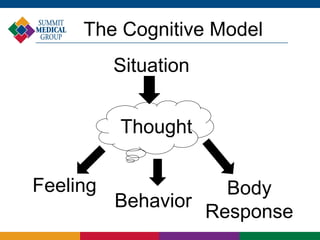
The Cognitive Model
          Situation


          Thought


Feeling              Body
          Behavior
                   Response
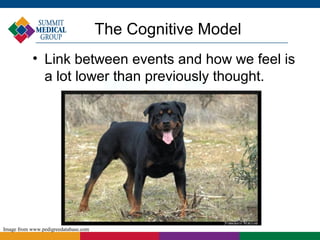
The Cognitive Model
           • Link between events and how we feel is
             a lot lower than previously thought.


Image from www.pedigreedatabase.com
How we explain events to ourselves


               • This is called “Explanatory Style”

               • Think about where you fall on continuum/where
                 your child falls?


Seligman, Martin (1995). The Optimistic Child. New York, NY: Harper Collins.
Explanatory Style-
                                                Good Events
   Permanent                                                                    Temporary
Across situations                                                              One situation
      Self                                                                        Others


       High Self Esteem: I am good at math so I got a good grade on the
       test (permanent). If I could do well on this test I know I can do well on
       my Bio exam (across situations). Good thing I put in those extra hours
       studying, it really paid off (self).

       Low Self-Esteem: I just got lucky on this math test (temporary). I
       am still going to fail my Bio exam (one situation). The teacher probably
       made this test easier (others).

Seligman, Martin (1995). The Optimistic Child. New York, NY: Harper Collins.
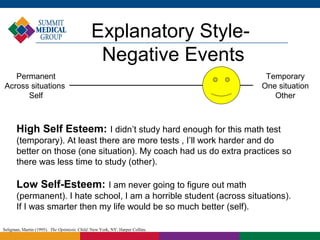
Explanatory Style-
                                               Negative Events
   Permanent                                                                    Temporary
Across situations                                                              One situation
      Self                                                                        Other


       High Self Esteem: I didn’t study hard enough for this math test
       (temporary). At least there are more tests , I’ll work harder and do
       better on those (one situation). My coach had us do extra practices so
       there was less time to study (other).

       Low Self-Esteem: I am never going to figure out math
       (permanent). I hate school, I am a horrible student (across situations).
       If I was smarter then my life would be so much better (self).

Seligman, Martin (1995). The Optimistic Child. New York, NY: Harper Collins.
What can parents do?
What to Teach About Thoughts


1. We constantly have thoughts


2. Just because we think something doesn’t
  mean it’s true or not true
  • Example: Rainbow Striped Elephant
What to Teach About Thoughts

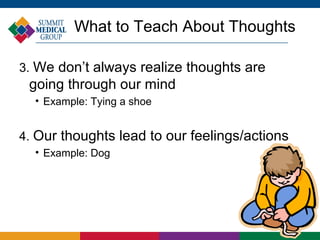
3. We don’t always realize thoughts are
 going through our mind
  • Example: Tying a shoe


4. Our thoughts lead to our feelings/actions
  • Example: Dog
How to Recognize Negative
              Thoughts

• Goal: be more aware of thoughts as
  precursor to feelings.

• Feelings are indicator of thoughts.

• Identify thoughts once per day.
How to Recognize Negative
                                         Thoughts
               For children:
               •“Thought catching” game.
                       • Positive, negative, neutral

               •“Negative Brain” Character.
                       • Bad News Brain

               •Label
                       • “It looks like Bad News Brain might be talking to
                         you right now.”
Seligman, Martin (1995). The Optimistic Child. New York, NY: Harper Collins.
Chansky, Tamar (2008). Freeing Your Child From Negative Thinking. Cambridge, MA: Da Capo Press.
How to Recognize Negative
               Thoughts
For teens:
•Daily list of thoughts.

•Code Words for “Negative Brain”

•Listening
   • How are they explaining what happened
      to them?
How to Combat
          Negative Thoughts

• Stand up for yourself!

• Be skeptical.
  
      Find the truth within the thought.


• Repeat and practice!
How to Combat
                                                   Negative Thoughts

            For children:

            •“Bossing Back”

            •Parental “bossing back”


Chansky, Tamar (2008). Freeing Your Child From Negative Thinking. Cambridge, MA: Da Capo Press.
“Bossing Back”

     • Mr. Mean Head, you aren’t the boss of me!

     • Mr. Mean Head, you’re tricking me again.

     • You never tell me the truth!

     • You lie to me, I know the truth is__________.


Chansky, Tamar (2008). Freeing Your Child From Negative Thinking. Cambridge, MA: Da Capo Press.
Parental “Bossing Back”

     • “That sounds like Mr. Mean Head again!”

     • “Woah, Mr. Mean Head is really bothering you
       today.”

     • “It’s not fair to you how much Mr. Mean Head
       is talking to you today.”


Chansky, Tamar (2008). Freeing Your Child From Negative Thinking. Cambridge, MA: Da Capo Press.
How to Combat
                                                 Negative Thoughts

           For children:
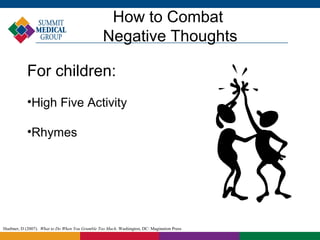
           •High Five Activity

           •Rhymes


Huebner, D (2007). What to Do When You Grumble Too Much. Washington, DC: Magination Press
How to Combat
                                                     Negative Thoughts

                    For teens:

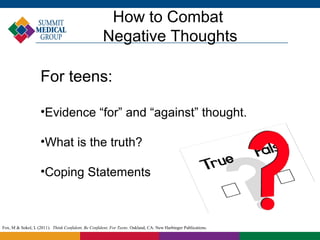
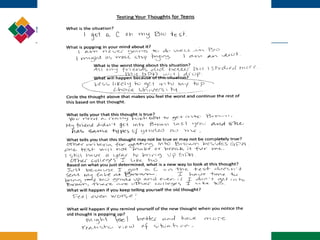
                    •Evidence “for” and “against” thought.

                    •What is the truth?

                    •Coping Statements


Fox, M & Sokol, L (2011). Think Confident, Be Confident, For Teens. Oakland, CA: New Harbinger Publications.
Finding the Truth
Finding more helpful thoughts...

  
      “Even though….the truth is….”
  
      “It may be true that…however…”

       • Even though I wasn’t invited to Jessica’s birthday
         party, it does not mean that I have no friends. I have
         been invited to a lot of other parties. I will invite Jill
         over from my dance class on that day and we will do
         something fun.
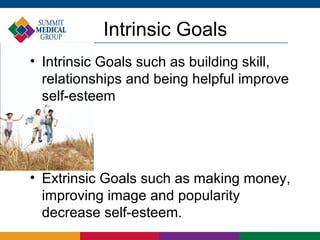
Intrinsic Goals
• Intrinsic Goals such as building skill,
  relationships and being helpful improve
  self-esteem


• Extrinsic Goals such as making money,
  improving image and popularity
  decrease self-esteem.
Intrinsic Goals
• Encourage Relationships with peers

  
      For Children: Help them set up play-dates,
      develop friendships with parents, be involved in
      classroom.

  
      For teens: Let them go out with friends.
Intrinsic Goals

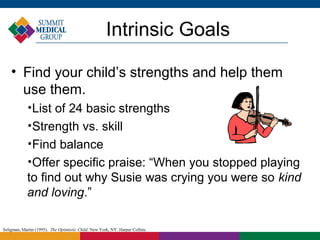
    • Find your child’s strengths and help them
      use them.
            
             List of 24 basic strengths
            
             Strength vs. skill
            
             Find balance
            
             Offer specific praise: “When you stopped playing
            to find out why Susie was crying you were so kind
            and loving.”

Seligman, Martin (1995). The Optimistic Child. New York, NY: Harper Collins.
Intrinsic Goals
          1. Gratitude
                  
                     Says thank you without prompting.
                  
                     Acknowledges good others do.
                        •         I loved how you wanted to send thank you cards to
                                  the firemen that helped clear the roads during
                                  Hurricane Sandy. You have gratitude.


          2. Forgiveness
                  
                     Not holding grudges.
                  
                     Giving people second chances.
Seligman, Martin (1995). The Optimistic Child. New York, NY: Harper Collins.
Autonomy
• Avoid “helicopter parenting”

• Allow your child/teen to make mistakes.

• Trust them to make certain decisions,
  even if they are not the ones you would
  make (ie; when they should begin their homework)
Autonomy
• Allow for self-direction vs. management
  when appropriate.
• Teach the skill of self-management
  
      Management: Did you put your soccer shoes, change of
      clothes and water bottle in your bag?
  
      Self-Direction: Remember, you have practice today at 5:00.


• Without independence, children/teens
  may develop a belief about themselves
  that they are inadequate or not capable.
How to Praise

               • Offer praise accurately.
               • Praise effort.
               • Avoid empty praises.
                        
                             Offering empty praise too often can lead to
                             difficulty for children to internally motivate
                             themselves
                        
                             Problems in “real world”


Seligman, Martin (1995). The Optimistic Child. New York, NY: Harper Collins.
How to Praise
               • Empty Praise:
                        
                             (After striking out at a baseball game) You
                             did such a great job today! You are such a
                             good baseball player!


               • Accurate Praise:
                        
                             You put a lot of effort into the game today. I
                             bet if you keep practicing the way you have
                             been you’ll keep improving!

Seligman, Martin (1995). The Optimistic Child. New York, NY: Harper Collins.
Criticize with Care

  • Be Accurate!

  • Avoid permanent and pervasive criticism

           
                For example: “You never listen to anything I
                say, you’ll never amount to anything!” or “I will
                never trust you again.”


Seligman, Martin (1995). The Optimistic Child. New York, NY: Harper Collins.
Criticize with Care
• Strive for temporary and specific criticism

        
         “I did not like that you called Susie ‘stupid’ today. I
        was surprised since you are typically such a
        supportive big sister. I expect you to work on that.”

        
         “I felt really disappointed that you didn’t study more
        for your math exam. Next time I expect you’ll start
        sooner.”

Seligman, Martin (1995). The Optimistic Child. New York, NY: Harper Collins.
When to Seek Help

• Low mood most days for a month or
  more
• Difficulty/Refusal with going to
  school/activities
• Self-harm
• Thoughts of suicide
• If your child asks for help
Additional Information
• The Optimistic Child by Martin Seligman

• Freeing Your Child of Negative Thinking by Tamar Chansky

• Think Confident, Be Confident For Teens by Marci Fox and
  Leslie Sokol
• What to Do When you Grumble Too Much by Dawn
  Huebner
• www.authentichappiness.com
Q and A
References

Chansky, Tamar (2008). Freeing Your Child From Negative
  Thinking. Cambridge, MA: Da Capo Press.

Fox, M & Sokol, L (2011). Think Confident, Be Confident, For
  Teens. Oakland, CA: New Harbinger Publications.

Huebner, D (2007). What to Do When You Grumble Too Much.
  Washington, DC: Magination Press.

Seligman, Martin (1995). The Optimistic Child. New York, NY:
   Harper Collins.

Improving Self Esteem in Children and Teens

  • 1.
    Improving Self-Esteem In Children and Teens Angela Adamson, LCSW, ACT Behavioral Health & Cognitive Therapy Center
  • 2.
    Agenda • What is Self-Esteem? • Why it is important • Statistics • Self-Esteem Movement • Cognitive Model • Explanatory Style • What can parents do?
  • 3.
    What is self-esteem • Self-Acceptance  strengths and weaknesses  accuracy • Doing well Feeling good  Mastery of skills/strengths  Bonus side effect Seligman, Martin (1995). The Optimistic Child. New York, NY: Harper Collins.
  • 4.
    Why is itimportant? If you have low self- esteem it can lead to: •Depression •Anxiety •Pervasive pessimism •Difficulty coping with stress •Anger •Reduced effort Seligman, Martin (1995). The Optimistic Child. New York, NY: Harper Collins.
  • 5.
    Statistics • 10-15% of children have some symptoms of depression right now • 1/33 children have clinical depression • 1/8 adolescents have clinical depression • Since the 1960s depression has been significantly increasing. • 30 year old women 1940 vs. 1980 Seligman, Martin (1995). The Optimistic Child. New York, NY: Harper Collins. Chansky, Tamar (2008). Freeing Your Child From Negative Thinking. Cambridge, MA: Da Capo Press.
  • 6.
    Self-Esteem Movement •Last several decades •Individualism •Away from achievement and towards happiness and self-esteem Self Esteem Movement = “Protecting our children from bad feelings will improve self-esteem.” Seligman, Martin (1995). The Optimistic Child. New York, NY: Harper Collins.
  • 7.
    Self-Esteem Movement Retrieved from,http://www.bernardgoldberg.com/the-presidency-should-not-be-a-participation-trophy/ on February 18, 2013
  • 8.
    Self-Esteem Movement Retrieved from,http://www.votersopinion.com/?p=3679 on February 18, 2013
  • 9.
    Self-Esteem Movement Retrieved from,http://nicoleabdou-destinationunknown.blogspot.com/2011/08/trophy-theory.html on February 18, 2013.
  • 10.
    Self-Esteem Movement Self Esteem Movement = “Protecting our children from bad feelings will improve self-esteem.” Seligman, Martin (1995). The Optimistic Child. New York, NY: Harper Collins.
  • 11.
    Self-Esteem Movement  Feeling good Doing well • Backwards!  Empty Praise  Inauthentic • We got it wrong! Seligman, Martin (1995). The Optimistic Child. New York, NY: Harper Collins.
  • 12.
    Self-Esteem Movement “Parental Guidance” Clip http://www.youtube.com/watch?v=_BzOH61eL24
  • 13.
    The Cognitive Model Situation Thought Feeling Body Behavior Response
  • 14.
    The Cognitive Model • Link between events and how we feel is a lot lower than previously thought. Image from www.pedigreedatabase.com
  • 15.
    How we explainevents to ourselves • This is called “Explanatory Style” • Think about where you fall on continuum/where your child falls? Seligman, Martin (1995). The Optimistic Child. New York, NY: Harper Collins.
  • 16.
    Explanatory Style- Good Events Permanent Temporary Across situations One situation Self Others High Self Esteem: I am good at math so I got a good grade on the test (permanent). If I could do well on this test I know I can do well on my Bio exam (across situations). Good thing I put in those extra hours studying, it really paid off (self). Low Self-Esteem: I just got lucky on this math test (temporary). I am still going to fail my Bio exam (one situation). The teacher probably made this test easier (others). Seligman, Martin (1995). The Optimistic Child. New York, NY: Harper Collins.
  • 17.
    Explanatory Style- Negative Events Permanent Temporary Across situations One situation Self Other High Self Esteem: I didn’t study hard enough for this math test (temporary). At least there are more tests , I’ll work harder and do better on those (one situation). My coach had us do extra practices so there was less time to study (other). Low Self-Esteem: I am never going to figure out math (permanent). I hate school, I am a horrible student (across situations). If I was smarter then my life would be so much better (self). Seligman, Martin (1995). The Optimistic Child. New York, NY: Harper Collins.
  • 18.
  • 19.
    What to TeachAbout Thoughts 1. We constantly have thoughts 2. Just because we think something doesn’t mean it’s true or not true • Example: Rainbow Striped Elephant
  • 20.
    What to TeachAbout Thoughts 3. We don’t always realize thoughts are going through our mind • Example: Tying a shoe 4. Our thoughts lead to our feelings/actions • Example: Dog
  • 21.
    How to RecognizeNegative Thoughts • Goal: be more aware of thoughts as precursor to feelings. • Feelings are indicator of thoughts. • Identify thoughts once per day.
  • 22.
    How to RecognizeNegative Thoughts For children: •“Thought catching” game. • Positive, negative, neutral •“Negative Brain” Character. • Bad News Brain •Label • “It looks like Bad News Brain might be talking to you right now.” Seligman, Martin (1995). The Optimistic Child. New York, NY: Harper Collins. Chansky, Tamar (2008). Freeing Your Child From Negative Thinking. Cambridge, MA: Da Capo Press.
  • 24.
    How to RecognizeNegative Thoughts For teens: •Daily list of thoughts. •Code Words for “Negative Brain” •Listening • How are they explaining what happened to them?
  • 25.
    How to Combat Negative Thoughts • Stand up for yourself! • Be skeptical.  Find the truth within the thought. • Repeat and practice!
  • 26.
    How to Combat Negative Thoughts For children: •“Bossing Back” •Parental “bossing back” Chansky, Tamar (2008). Freeing Your Child From Negative Thinking. Cambridge, MA: Da Capo Press.
  • 27.
    “Bossing Back” • Mr. Mean Head, you aren’t the boss of me! • Mr. Mean Head, you’re tricking me again. • You never tell me the truth! • You lie to me, I know the truth is__________. Chansky, Tamar (2008). Freeing Your Child From Negative Thinking. Cambridge, MA: Da Capo Press.
  • 28.
    Parental “Bossing Back” • “That sounds like Mr. Mean Head again!” • “Woah, Mr. Mean Head is really bothering you today.” • “It’s not fair to you how much Mr. Mean Head is talking to you today.” Chansky, Tamar (2008). Freeing Your Child From Negative Thinking. Cambridge, MA: Da Capo Press.
  • 29.
    How to Combat Negative Thoughts For children: •High Five Activity •Rhymes Huebner, D (2007). What to Do When You Grumble Too Much. Washington, DC: Magination Press
  • 30.
    How to Combat Negative Thoughts For teens: •Evidence “for” and “against” thought. •What is the truth? •Coping Statements Fox, M & Sokol, L (2011). Think Confident, Be Confident, For Teens. Oakland, CA: New Harbinger Publications.
  • 32.
    Finding the Truth Findingmore helpful thoughts...  “Even though….the truth is….”  “It may be true that…however…” • Even though I wasn’t invited to Jessica’s birthday party, it does not mean that I have no friends. I have been invited to a lot of other parties. I will invite Jill over from my dance class on that day and we will do something fun.
  • 33.
    Intrinsic Goals • IntrinsicGoals such as building skill, relationships and being helpful improve self-esteem • Extrinsic Goals such as making money, improving image and popularity decrease self-esteem.
  • 34.
    Intrinsic Goals • EncourageRelationships with peers  For Children: Help them set up play-dates, develop friendships with parents, be involved in classroom.  For teens: Let them go out with friends.
  • 35.
    Intrinsic Goals • Find your child’s strengths and help them use them.  List of 24 basic strengths  Strength vs. skill  Find balance  Offer specific praise: “When you stopped playing to find out why Susie was crying you were so kind and loving.” Seligman, Martin (1995). The Optimistic Child. New York, NY: Harper Collins.
  • 36.
    Intrinsic Goals 1. Gratitude  Says thank you without prompting.  Acknowledges good others do. • I loved how you wanted to send thank you cards to the firemen that helped clear the roads during Hurricane Sandy. You have gratitude. 2. Forgiveness  Not holding grudges.  Giving people second chances. Seligman, Martin (1995). The Optimistic Child. New York, NY: Harper Collins.
  • 37.
    Autonomy • Avoid “helicopterparenting” • Allow your child/teen to make mistakes. • Trust them to make certain decisions, even if they are not the ones you would make (ie; when they should begin their homework)
  • 38.
    Autonomy • Allow forself-direction vs. management when appropriate. • Teach the skill of self-management  Management: Did you put your soccer shoes, change of clothes and water bottle in your bag?  Self-Direction: Remember, you have practice today at 5:00. • Without independence, children/teens may develop a belief about themselves that they are inadequate or not capable.
  • 39.
    How to Praise • Offer praise accurately. • Praise effort. • Avoid empty praises.  Offering empty praise too often can lead to difficulty for children to internally motivate themselves  Problems in “real world” Seligman, Martin (1995). The Optimistic Child. New York, NY: Harper Collins.
  • 40.
    How to Praise • Empty Praise:  (After striking out at a baseball game) You did such a great job today! You are such a good baseball player! • Accurate Praise:  You put a lot of effort into the game today. I bet if you keep practicing the way you have been you’ll keep improving! Seligman, Martin (1995). The Optimistic Child. New York, NY: Harper Collins.
  • 41.
    Criticize with Care • Be Accurate! • Avoid permanent and pervasive criticism  For example: “You never listen to anything I say, you’ll never amount to anything!” or “I will never trust you again.” Seligman, Martin (1995). The Optimistic Child. New York, NY: Harper Collins.
  • 42.
    Criticize with Care •Strive for temporary and specific criticism  “I did not like that you called Susie ‘stupid’ today. I was surprised since you are typically such a supportive big sister. I expect you to work on that.”  “I felt really disappointed that you didn’t study more for your math exam. Next time I expect you’ll start sooner.” Seligman, Martin (1995). The Optimistic Child. New York, NY: Harper Collins.
  • 43.
    When to SeekHelp • Low mood most days for a month or more • Difficulty/Refusal with going to school/activities • Self-harm • Thoughts of suicide • If your child asks for help
  • 44.
    Additional Information • TheOptimistic Child by Martin Seligman • Freeing Your Child of Negative Thinking by Tamar Chansky • Think Confident, Be Confident For Teens by Marci Fox and Leslie Sokol • What to Do When you Grumble Too Much by Dawn Huebner • www.authentichappiness.com
  • 45.
  • 46.
    References Chansky, Tamar (2008).Freeing Your Child From Negative Thinking. Cambridge, MA: Da Capo Press. Fox, M & Sokol, L (2011). Think Confident, Be Confident, For Teens. Oakland, CA: New Harbinger Publications. Huebner, D (2007). What to Do When You Grumble Too Much. Washington, DC: Magination Press. Seligman, Martin (1995). The Optimistic Child. New York, NY: Harper Collins.