COMPUTING THE VARIANCE OF A
DISCRETE PROBABILITY DISTRIBUTION
Lesson Objectives
At the end of this lesson, you are expected to:
• illustrate and calculate the variance of a
discrete random variable;
• interpret the variance of a discrete random
variable; and
• solve problems involving variance of
probability distributions.
Pre-Assessment
Recap: Finding the variance of a data set.
Lesson Introduction
The variance and standard deviation describe
the amount of spread, dispersion, or variability
of the items in a distribution.
How do you describe the spread or dispersion
in a probability distribution?
Discussion Points
Steps in Finding the Variance and Standard
Deviation of a Discrete Probability Distribution
1. Find the mean of the probability distribution.
2. Subtract the mean from each value of the
random variable X.
3. Square the results obtained in Step 2.
4. Multiply the results obtained in Step 3 by the
corresponding probability.
5. Get the sum of the results obtained in Step 4.
Discussion Points
Illustrative Example:
The number of cars sold per day at a local car
dealership, along with its corresponding
probabilities, is shown in the succeeding table.
Compute the variance and the standard
deviation of the probability distribution.
Discussion Points
Step 1.
Find the mean of the
probability distribution
using the formula
μ=∑X• P(X)
Discussion Points
Step 2.
Subtract the mean from each value of the random
variable X.
Discussion Points
Step 3.
Square the results obtained in Step 2.
Discussion Points
Step 4.
Multiply the results obtained in Step 3 by the
corresponding probability.
Discussion Points
Step 5.
Get the sum of the
results obtained in
Step 4. The result is the
value of the variance.
So, the formula for the
variance is:
σ2 = Σ(X – μ)2 • P(X).
Discussion Points
Step 6.
Get the square root of the variance to get the standard
deviation.
The variance of the probability distribution is 1.56.
The standard deviation is σ = √1.56 = 1.25.
Discussion Points
Discussion Points
Alternative Procedure in Finding the Variance and
Standard Deviation of a Probability Distribution
1. Find the mean of the probability distribution.
2. Multiply the square of the value of the random variable X
by its corresponding probability.
3. Get the sum of the results obtained in Step 2.
4. Subtract the mean from the results obtained in Step 3.
Example
Number of Heads
When three coins are tossed, the probability
distribution for the random variable X
representing the number of heads that occur is
given below. Compute the variance and
standard deviation of the probability
distribution.
Solution to Example
Step 1.
Find the mean of the probability distribution
using the formula:
μ=∑X• P(X)
Solution to Example
Step 2:
Multiply the square of the value of the random
variable X by its corresponding probability.
Solution to Example
Step 3:
Get the sum of the results obtained in Step 2.
Solution to Example
Step 4:
Subtract the square of the mean from the results
obtained in Step 3 to get the variance. So, the
formula for the variance of a probability distribution
is given by σ2 = ∑X2 • P(X) – μ2
The standard deviation is the square root of the
variance. Thus, σ = √∑X2 • P(X) – μ2
Solution to Example
Step 4:
The variance is given by
σ2 = ∑X2 • P(X) – μ2
= 3 – (1.5)2
= 0.75
The standard deviation is
σ = √0.75 = 0.87.
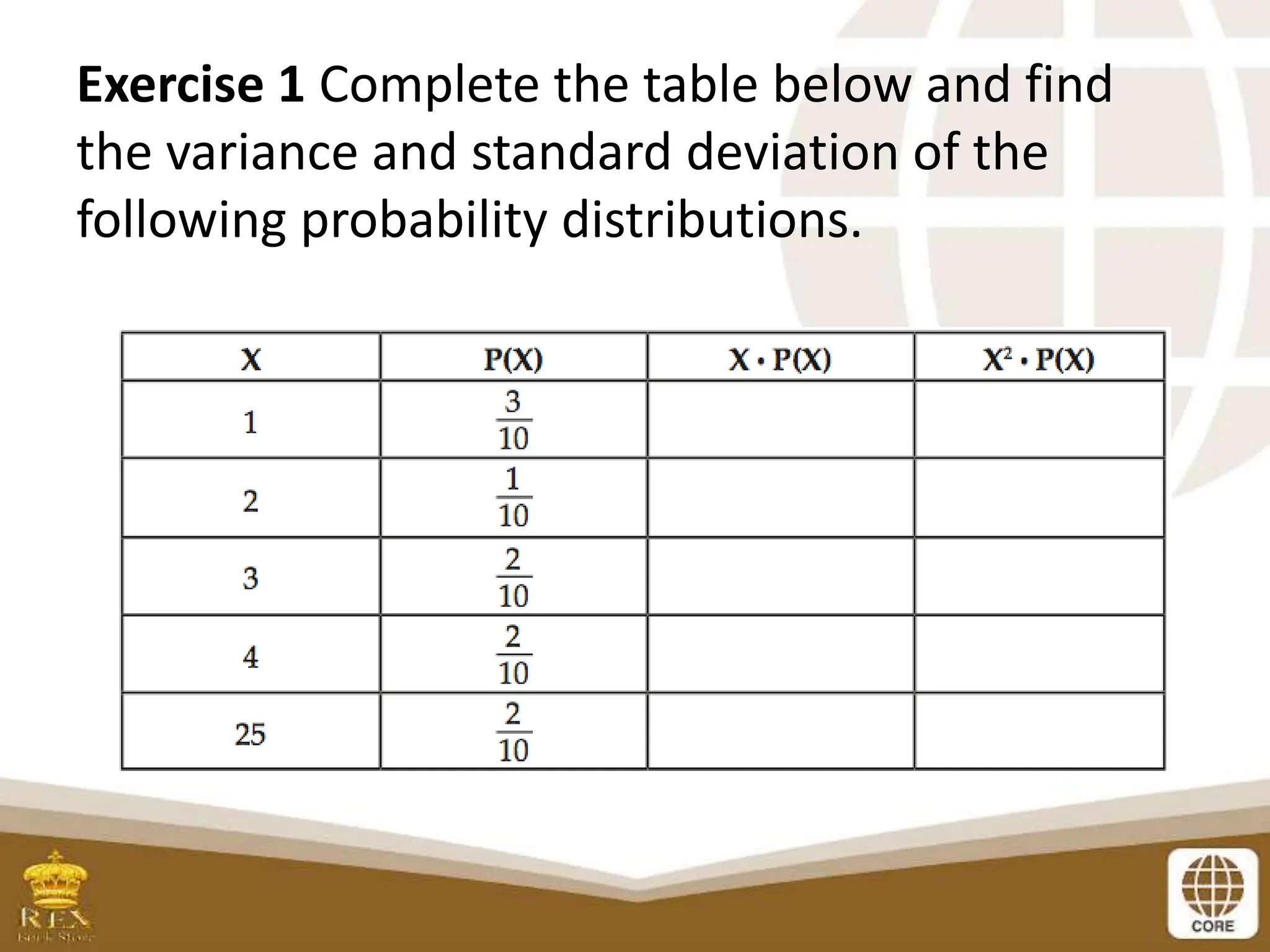
Exercise 1 Complete the table below and find
the variance and standard deviation of the
following probability distributions.
Exercise 2
Find the variance and standard deviation of the
probability distribution of the random variable
X, which can take only the values 3, 5, and 7,
given that P(3)= 7/30,P(5)= 1/3,andP(7)=13/30.
Exercise 3
The probabilities of a machine manufacturing 0, 1,
2, 3, 4, or 5 defective parts in one day are 0.75,
0.17, 0.04, 0.025, 0.01, and 0.005, respectively. Find
the variance and standard deviation of the
probability distribution.
Exercise 4
The number of inquiries received per day by the
Office of Admissions in a certain university is
shown below. Find the variance and standard
deviation.
Number of Inquiries X Probability P(X)
22 0.08
23 0.19
24 0.36
25 0.25
26 0.07
27 0.05
Summary
To find the mean of the probability distribution,
1. Find the mean of the probability distribution.
2. Multiply the square of the value of the
random variable X by its corresponding
probability.
3. Get the sum of the results obtained in Step 2.
4. Subtract the mean from the results obtained in
Step 3.

PSUnit_I_Lesson_4_Computing_the_Variance_of_a_Discrete_Probability_Distribution.pptx

  • 1.
    COMPUTING THE VARIANCEOF A DISCRETE PROBABILITY DISTRIBUTION
  • 2.
    Lesson Objectives At theend of this lesson, you are expected to: • illustrate and calculate the variance of a discrete random variable; • interpret the variance of a discrete random variable; and • solve problems involving variance of probability distributions.
  • 3.
    Pre-Assessment Recap: Finding thevariance of a data set.
  • 4.
    Lesson Introduction The varianceand standard deviation describe the amount of spread, dispersion, or variability of the items in a distribution. How do you describe the spread or dispersion in a probability distribution?
  • 5.
    Discussion Points Steps inFinding the Variance and Standard Deviation of a Discrete Probability Distribution 1. Find the mean of the probability distribution. 2. Subtract the mean from each value of the random variable X. 3. Square the results obtained in Step 2. 4. Multiply the results obtained in Step 3 by the corresponding probability. 5. Get the sum of the results obtained in Step 4.
  • 6.
    Discussion Points Illustrative Example: Thenumber of cars sold per day at a local car dealership, along with its corresponding probabilities, is shown in the succeeding table. Compute the variance and the standard deviation of the probability distribution.
  • 7.
    Discussion Points Step 1. Findthe mean of the probability distribution using the formula μ=∑X• P(X)
  • 8.
    Discussion Points Step 2. Subtractthe mean from each value of the random variable X.
  • 9.
    Discussion Points Step 3. Squarethe results obtained in Step 2.
  • 10.
    Discussion Points Step 4. Multiplythe results obtained in Step 3 by the corresponding probability.
  • 11.
    Discussion Points Step 5. Getthe sum of the results obtained in Step 4. The result is the value of the variance. So, the formula for the variance is: σ2 = Σ(X – μ)2 • P(X).
  • 12.
    Discussion Points Step 6. Getthe square root of the variance to get the standard deviation. The variance of the probability distribution is 1.56. The standard deviation is σ = √1.56 = 1.25.
  • 13.
  • 14.
    Discussion Points Alternative Procedurein Finding the Variance and Standard Deviation of a Probability Distribution 1. Find the mean of the probability distribution. 2. Multiply the square of the value of the random variable X by its corresponding probability. 3. Get the sum of the results obtained in Step 2. 4. Subtract the mean from the results obtained in Step 3.
  • 15.
    Example Number of Heads Whenthree coins are tossed, the probability distribution for the random variable X representing the number of heads that occur is given below. Compute the variance and standard deviation of the probability distribution.
  • 16.
    Solution to Example Step1. Find the mean of the probability distribution using the formula: μ=∑X• P(X)
  • 17.
    Solution to Example Step2: Multiply the square of the value of the random variable X by its corresponding probability.
  • 18.
    Solution to Example Step3: Get the sum of the results obtained in Step 2.
  • 19.
    Solution to Example Step4: Subtract the square of the mean from the results obtained in Step 3 to get the variance. So, the formula for the variance of a probability distribution is given by σ2 = ∑X2 • P(X) – μ2 The standard deviation is the square root of the variance. Thus, σ = √∑X2 • P(X) – μ2
  • 20.
    Solution to Example Step4: The variance is given by σ2 = ∑X2 • P(X) – μ2 = 3 – (1.5)2 = 0.75 The standard deviation is σ = √0.75 = 0.87.
  • 21.
    Exercise 1 Completethe table below and find the variance and standard deviation of the following probability distributions.
  • 22.
    Exercise 2 Find thevariance and standard deviation of the probability distribution of the random variable X, which can take only the values 3, 5, and 7, given that P(3)= 7/30,P(5)= 1/3,andP(7)=13/30. Exercise 3 The probabilities of a machine manufacturing 0, 1, 2, 3, 4, or 5 defective parts in one day are 0.75, 0.17, 0.04, 0.025, 0.01, and 0.005, respectively. Find the variance and standard deviation of the probability distribution.
  • 23.
    Exercise 4 The numberof inquiries received per day by the Office of Admissions in a certain university is shown below. Find the variance and standard deviation. Number of Inquiries X Probability P(X) 22 0.08 23 0.19 24 0.36 25 0.25 26 0.07 27 0.05
  • 24.
    Summary To find themean of the probability distribution, 1. Find the mean of the probability distribution. 2. Multiply the square of the value of the random variable X by its corresponding probability. 3. Get the sum of the results obtained in Step 2. 4. Subtract the mean from the results obtained in Step 3.

Editor's Notes