Computing the
Probability and Mean of
a Discrete Probability
Distribution
CONSTRUCTING
PROBABILITY
DISTRIBUTIONS
Probabilit
y
Probability is a measure of how
often a particular event will
happen if something is done
repeatedly. It is a chance that
something will happen.
●There is a 20 percent
chance of rain tomorrow.
●The probability of winning
the lottery is one in many
millions.
Examples:
Suppose three coins are
tossed. Let Y be the random
variable representing the number
of tails that occur. Find the
probability of each of the values of
the random variable Y.
Example 1:
Solution:
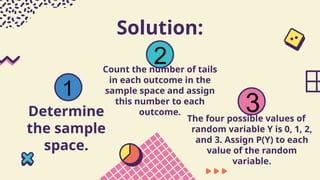
Determine
the sample
space.
Count the number of tails
in each outcome in the
sample space and assign
this number to each
outcome.
The four possible values of
random variable Y is 0, 1, 2,
and 3. Assign P(Y) to each
value of the random
variable.
1
2
3
SOLUTION:
Determine the sample space.
S = {TTT, TTH, THT, HTT,
HHT, HTH, THH, HHH}
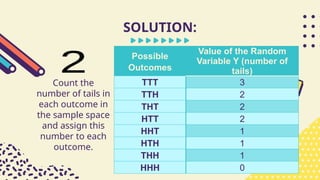
Count the
number of tails in
each outcome in
the sample space
and assign this
number to each
outcome.
SOLUTION:
Possible
Outcomes
Value of the Random
Variable Y (number of
tails)
TTT 3
TTH 2
THT 2
HTT 2
HHT 1
HTH 1
THH 1
HHH 0
The four possible
values of random
variable Y is 0, 1, 2,
and 3. Assign P(Y) to
each value of the
random variable.
SOLUTION:
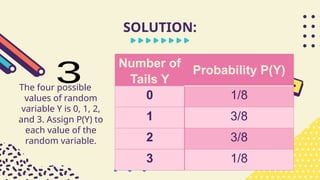
Number of
Tails Y
Probability P(Y)
0 1/8
1 3/8
2 3/8
3 1/8
Two balls are drawn in succession
without replacement from an urn
containing red balls and blue balls. Let
Z be the random variable representing
the number of blue balls. Construct the
probability distribution of the random
variable Z.
Example 2:
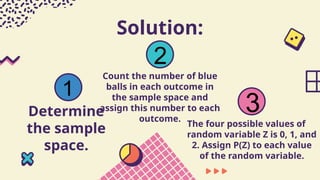
Solution:
Determine
the sample
space.
Count the number of blue
balls in each outcome in
the sample space and
assign this number to each
outcome.
The four possible values of
random variable Z is 0, 1, and
2. Assign P(Z) to each value
of the random variable.
1
2
3
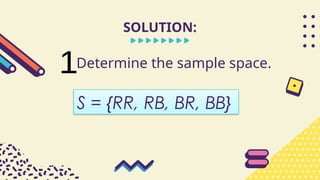
SOLUTION:
Determine the sample space.
S = {RR, RB, BR, BB}
Count the
number of blue
balls in each
outcome in the
sample space and
assign this
number to each
outcome.
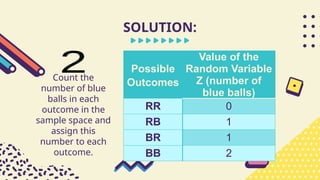
SOLUTION:
Possible
Outcomes
Value of the
Random Variable
Z (number of
blue balls)
RR 0
RB 1
BR 1
BB 2
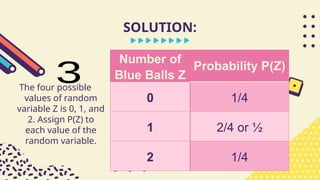
The four possible
values of random
variable Z is 0, 1, and
2. Assign P(Z) to
each value of the
random variable.
SOLUTION:
Number of
Blue Balls Z
Probability P(Z)
0 1/4
1 2/4 or ½
2 1/4
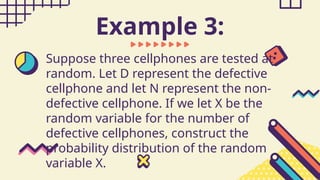
Suppose three cellphones are tested at
random. Let D represent the defective
cellphone and let N represent the non-
defective cellphone. If we let X be the
random variable for the number of
defective cellphones, construct the
probability distribution of the random
variable X.
Example 3:
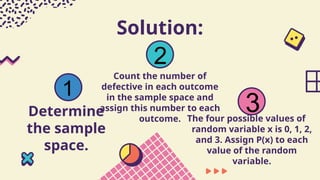
Solution:
Determine
the sample
space.
Count the number of
defective in each outcome
in the sample space and
assign this number to each
outcome. The four possible values of
random variable x is 0, 1, 2,
and 3. Assign P(x) to each
value of the random
variable.
1
2
3
SOLUTION:
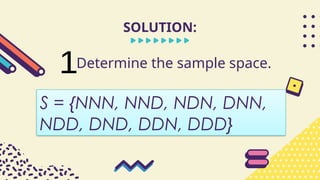
Determine the sample space.
S = {NNN, NND, NDN, DNN,
NDD, DND, DDN, DDD}
Count the
number of
defective in each
outcome in the
sample space and
assign this
number to each
outcome.
SOLUTION:
Possible Outcomes
Value of the Random
Variable X (number of
defective cellphones)
NNN 0
NND 1
NDN 1
DNN 1
NDD 2
DND 2
DDN 2
DDD 3
The four possible
values of random
variable x is 0, 1, 2,
and 3. Assign P(x) to
each value of the
random variable.
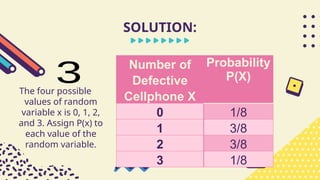
SOLUTION:
Number of
Defective
Cellphone X
Probability
P(X)
0 1/8
1 3/8
2 3/8
3 1/8
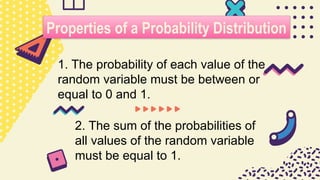
Properties of a Probability Distribution
2. The sum of the probabilities of
all values of the random variable
must be equal to 1.
1. The probability of each value of the
random variable must be between or
equal to 0 and 1.
MEAN OF A DISCRETE
PROBABILITY
DISTRIBUTION
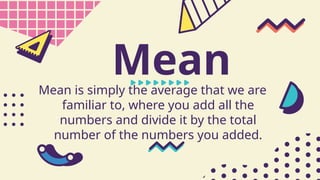
Mean
Mean is simply the average that we are
familiar to, where you add all the
numbers and divide it by the total
number of the numbers you added.
Consider rolling a die.
What is the average
number of spots that would
appear?
Example 1:
Solution:
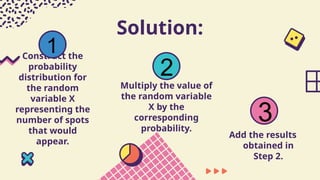
Construct the
probability
distribution for
the random
variable X
representing the
number of spots
that would
appear.
Multiply the value of
the random variable
X by the
corresponding
probability.
Add the results
obtained in
Step 2.
1
2
3
SOLUTION:
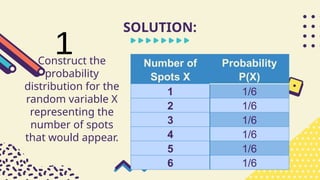
Construct the
probability
distribution for the
random variable X
representing the
number of spots
that would appear.
Number of
Spots X
Probability
P(X)
1 1/6
2 1/6
3 1/6
4 1/6
5 1/6
6 1/6
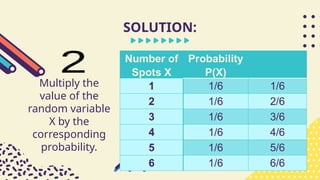
Multiply the
value of the
random variable
X by the
corresponding
probability.
SOLUTION:
Number of
Spots X
Probability
P(X)
1 1/6 1/6
2 1/6 2/6
3 1/6 3/6
4 1/6 4/6
5 1/6 5/6
6 1/6 6/6
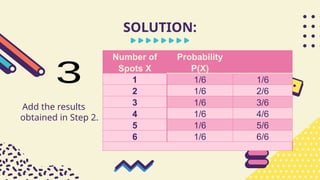
Add the results
obtained in Step 2.
SOLUTION:
Number of
Spots X
Probability
P(X)
1 1/6 1/6
2 1/6 2/6
3 1/6 3/6
4 1/6 4/6
5 1/6 5/6
6 1/6 6/6
ACTIVITY 1
1. Four coins are tossed.
Let Z be the random variable
representing the number of
heads that occur. Find the
probability and mean of the
random variable Z.
Find the probability of the following events.
1. Getting an even number in single roll of die.
2. Getting a sum of 6 when two dice are rolled
3. Getting an ace when a card is drawn from a deck
4. The probability that all children are boys if a couple has 3 children
5. Getting an odd number and a tail when a die is rolled, and a coin is tossed
simultaneously
9th Grade
Computing the Variance
and Standard Deviation
of a Discrete
Probability
Distribution
RECAP
01
VARIANCE OF A DISCRETE
PROBABILITY
DISTIRBUTION
ASSIGNMENT
03 ACTIVITY
04
02
LESSON 3
RECAP
01
VARIANCE AND STANDARD
DEVIATION OF A DISCRETE
PROBABILITY DISTIRBUTION
02
Standard Deviation - is the measure
of spread, most commonly used in
statistical practice when the mean is
used to calculate central tendency.
Thus, it measures spread around the
mean.
Variance - is a measure of how
spread out a data set is.
Steps in Finding
the Variance and
Standard
Deviation
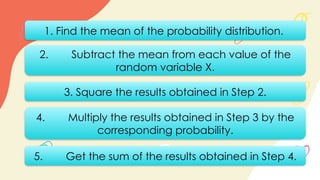
1. Find the mean of the probability distribution.
2. Subtract the mean from each value of the
random variable X.
3. Square the results obtained in Step 2.
5. Get the sum of the results obtained in Step 4.
4. Multiply the results obtained in Step 3 by the
corresponding probability.
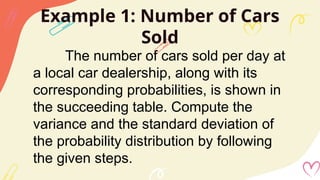
Example 1: Number of Cars
Sold
The number of cars sold per day at
a local car dealership, along with its
corresponding probabilities, is shown in
the succeeding table. Compute the
variance and the standard deviation of
the probability distribution by following
the given steps.
Example 1: Number of Cars
Sold
Number of Cars Sold X Probability P(X)
0 1/10
1 2/10
2 3/10
3 2/10
4 2/10
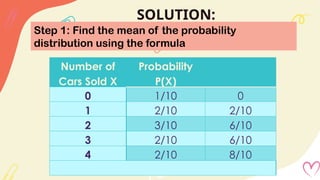
SOLUTION:
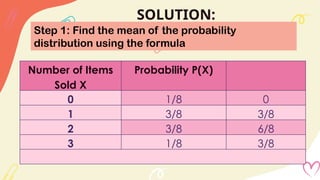
Step 1: Find the mean of the probability
distribution using the formula
Number of
Cars Sold X
Probability
P(X)
0 1/10 0
1 2/10 2/10
2 3/10 6/10
3 2/10 6/10
4 2/10 8/10
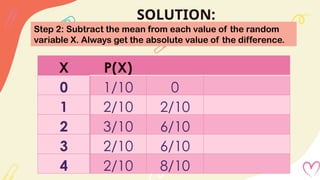
SOLUTION:
Step 2: Subtract the mean from each value of the random
variable X. Always get the absolute value of the difference.
X P(X)
0 1/10 0
1 2/10 2/10
2 3/10 6/10
3 2/10 6/10
4 2/10 8/10
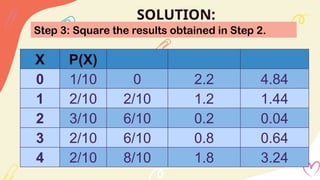
SOLUTION:
Step 3: Square the results obtained in Step 2.
X P(X)
0 1/10 0 2.2 4.84
1 2/10 2/10 1.2 1.44
2 3/10 6/10 0.2 0.04
3 2/10 6/10 0.8 0.64
4 2/10 8/10 1.8 3.24
SOLUTION:
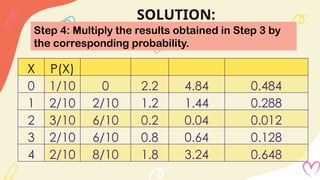
Step 4: Multiply the results obtained in Step 3 by
the corresponding probability.
X P(X)
0 1/10 0 2.2 4.84 0.484
1 2/10 2/10 1.2 1.44 0.288
2 3/10 6/10 0.2 0.04 0.012
3 2/10 6/10 0.8 0.64 0.128
4 2/10 8/10 1.8 3.24 0.648
SOLUTION:
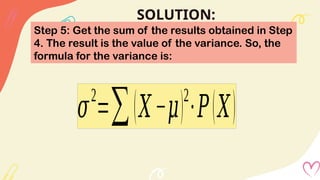
Step 5: Get the sum of the results obtained in Step
4. The result is the value of the variance. So, the
formula for the variance is:
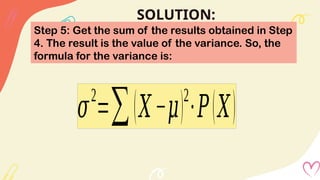
𝜎
2
=∑(𝑋−𝜇)2
∙𝑃(𝑋)
SOLUTION:
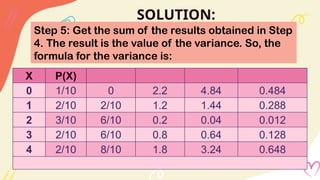
Step 5: Get the sum of the results obtained in Step
4. The result is the value of the variance. So, the
formula for the variance is:
X P(X)
0 1/10 0 2.2 4.84 0.484
1 2/10 2/10 1.2 1.44 0.288
2 3/10 6/10 0.2 0.04 0.012
3 2/10 6/10 0.8 0.64 0.128
4 2/10 8/10 1.8 3.24 0.648
SOLUTION:
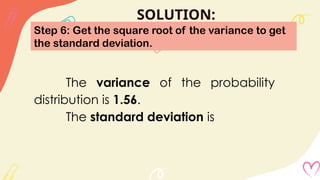
Step 6: Get the square root of the variance to get
the standard deviation.
The variance of the probability
distribution is 1.56.
The standard deviation is
Formula for the Variance and Standard
Deviation of a Discrete Probability Distribution
The variance of a discrete probability distribution is given by
the formula:
The standard deviation of a discrete probability distribution
is given by the formula:
Formula for the Variance and Standard
Deviation of a Discrete Probability Distribution
Where:
X = value of the random variable
P(X) = probability of the random variable X
μ = mean of the probability distribution
σ^2 = variance of the probability distribution
σ = standard deviation of the probability distribution
Example 2:
When three coins are tossed, the
probability distribution for the random
variable X representing the number of
heads that occur is given below.
Compute the variance and standard
deviation of the probability distribution.
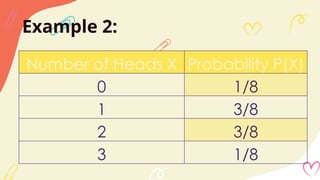
Example 2:
Number of Heads X Probability P(X)
0 1/8
1 3/8
2 3/8
3 1/8
SOLUTION:
Step 1: Find the mean of the probability
distribution using the formula
Number of Items
Sold X
Probability P(X)
0 1/8 0
1 3/8 3/8
2 3/8 6/8
3 1/8 3/8
SOLUTION:
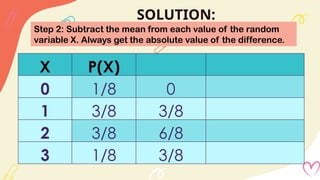
Step 2: Subtract the mean from each value of the random
variable X. Always get the absolute value of the difference.
X P(X)
0 1/8 0
1 3/8 3/8
2 3/8 6/8
3 1/8 3/8
SOLUTION:
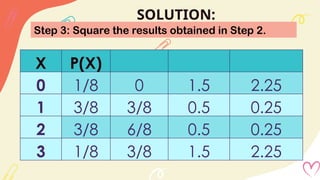
Step 3: Square the results obtained in Step 2.
X P(X)
0 1/8 0 1.5 2.25
1 3/8 3/8 0.5 0.25
2 3/8 6/8 0.5 0.25
3 1/8 3/8 1.5 2.25
SOLUTION:
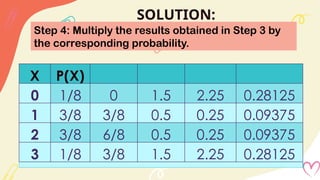
Step 4: Multiply the results obtained in Step 3 by
the corresponding probability.
X P(X)
0 1/8 0 1.5 2.25 0.28125
1 3/8 3/8 0.5 0.25 0.09375
2 3/8 6/8 0.5 0.25 0.09375
3 1/8 3/8 1.5 2.25 0.28125
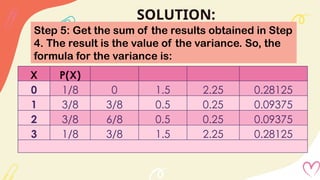
SOLUTION:
Step 5: Get the sum of the results obtained in Step
4. The result is the value of the variance. So, the
formula for the variance is:
𝜎
2
=∑(𝑋−𝜇)2
∙𝑃(𝑋)
SOLUTION:
Step 5: Get the sum of the results obtained in Step
4. The result is the value of the variance. So, the
formula for the variance is:
X P(X)
0 1/8 0 1.5 2.25 0.28125
1 3/8 3/8 0.5 0.25 0.09375
2 3/8 6/8 0.5 0.25 0.09375
3 1/8 3/8 1.5 2.25 0.28125
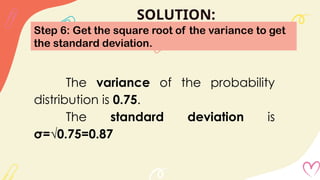
SOLUTION:
Step 6: Get the square root of the variance to get
the standard deviation.
The variance of the probability
distribution is 0.75.
The standard deviation is
σ=√0.75=0.87
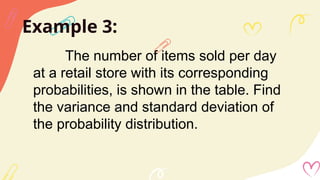
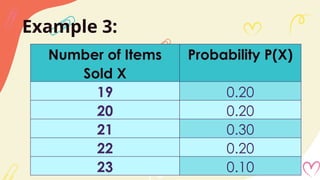
Example 3:
The number of items sold per day
at a retail store with its corresponding
probabilities, is shown in the table. Find
the variance and standard deviation of
the probability distribution.
Example 3:
Number of Items
Sold X
Probability P(X)
19 0.20
20 0.20
21 0.30
22 0.20
23 0.10
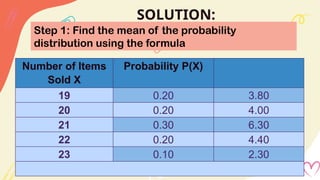
SOLUTION:
Step 1: Find the mean of the probability
distribution using the formula
Number of Items
Sold X
Probability P(X)
19 0.20 3.80
20 0.20 4.00
21 0.30 6.30
22 0.20 4.40
23 0.10 2.30
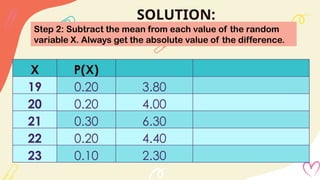
SOLUTION:
Step 2: Subtract the mean from each value of the random
variable X. Always get the absolute value of the difference.
X P(X)
19 0.20 3.80
20 0.20 4.00
21 0.30 6.30
22 0.20 4.40
23 0.10 2.30
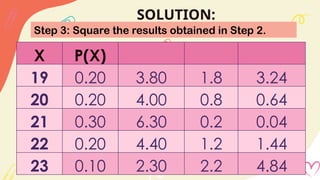
SOLUTION:
Step 3: Square the results obtained in Step 2.
X P(X)
19 0.20 3.80 1.8 3.24
20 0.20 4.00 0.8 0.64
21 0.30 6.30 0.2 0.04
22 0.20 4.40 1.2 1.44
23 0.10 2.30 2.2 4.84
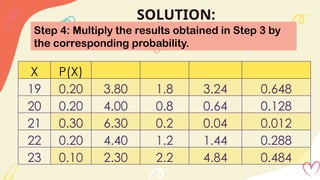
SOLUTION:
Step 4: Multiply the results obtained in Step 3 by
the corresponding probability.
X P(X)
19 0.20 3.80 1.8 3.24 0.648
20 0.20 4.00 0.8 0.64 0.128
21 0.30 6.30 0.2 0.04 0.012
22 0.20 4.40 1.2 1.44 0.288
23 0.10 2.30 2.2 4.84 0.484
SOLUTION:
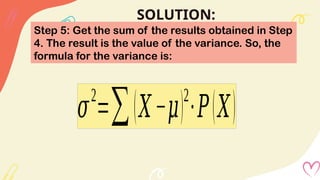
Step 5: Get the sum of the results obtained in Step
4. The result is the value of the variance. So, the
formula for the variance is:
𝜎
2
=∑(𝑋−𝜇)2
∙𝑃(𝑋)
SOLUTION:
Step 5: Get the sum of the results obtained in Step
4. The result is the value of the variance. So, the
formula for the variance is:
X P(X)
19 0.20 3.80 1.8 3.24 0.648
20 0.20 4.00 0.8 0.64 0.128
21 0.30 6.30 0.2 0.04 0.012
22 0.20 4.40 1.2 1.44 0.288
23 0.10 2.30 2.2 4.84 0.484
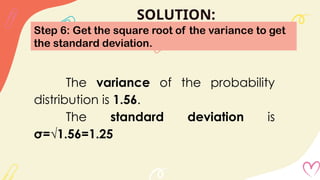
SOLUTION:
Step 6: Get the square root of the variance to get
the standard deviation.
The variance of the probability
distribution is 1.56.
The standard deviation is
σ=√1.56=1.25
NORMAL CURVE
DISTRIBUTION
03
Normal Distribution - is a probability
distribution that is symmetric about
the mean, showing that data near the
mean are more frequent in
occurrence than data far from the
mean.
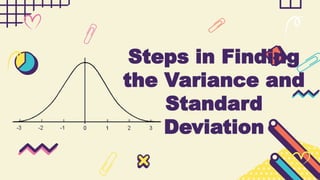
Steps in Finding
the Variance and
Standard
Deviation
1. The distribution curve is bell- shaped.
2. The curve is symmetrical about its center.
3. The mean, the median, and the mode coincide
at the center.
4. The width of the curve is determined by the
standard deviation of the distribution.
5. The tails of the curve flatten out indefinitely along
the horizontal axis, always approaching the axis but
never touching it. That is, the curve is asymptotic to
the base line.
6. The area under the curve is 1. Thus, it
represents the probability or proportion, or the
percentage associated with specific sets of
measurement values.
Standard Normal Curve
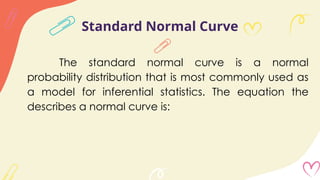
The standard normal curve is a normal
probability distribution that is most commonly used as
a model for inferential statistics. The equation the
describes a normal curve is:
Standard Normal Curve
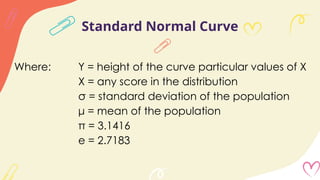
Where: Y = height of the curve particular values of X
X = any score in the distribution
σ = standard deviation of the population
μ = mean of the population
π = 3.1416
e = 2.7183
Standard Normal Curve
A standard normal curve is a normal probability
distribution that has a mean of 0 and a standard
deviation of 1.
Standard Normal Curve
The Table of Areas Under the Normal Curve is
also known as the z-Table. The z-table score is
measure of relative standing. It is calculated by
subtracting X (or μ) from the measurement X and
̅
then dividing the result by s (or σ). The final result, the
z-score, represents the distance between a given
measurement X and the mean, expressed in standard
deviations. Either the z- score locates X within a
sample or within a population.
Four- Step
Process in
Finding the
Areas Under the
Normal Curve
Given a z-Value
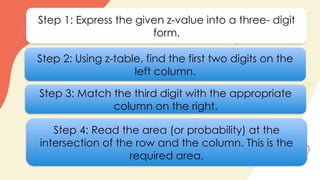
Step 1: Express the given z-value into a three- digit
form.
Step 2: Using z-table, find the first two digits on the
left column.
Step 3: Match the third digit with the appropriate
column on the right.
Step 4: Read the area (or probability) at the
intersection of the row and the column. This is the
required area.
Example 1:
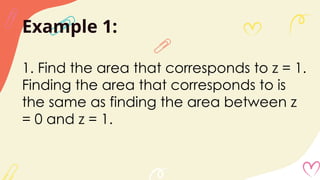
1. Find the area that corresponds to z = 1.
Finding the area that corresponds to is
the same as finding the area between z
= 0 and z = 1.
Example 1:
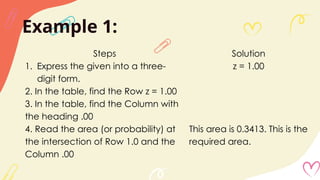
Steps Solution
1. Express the given into a three-
digit form.
z = 1.00
2. In the table, find the Row z = 1.00
3. In the table, find the Column with
the heading .00
4. Read the area (or probability) at
the intersection of Row 1.0 and the
Column .00
This area is 0.3413. This is the
required area.
Example 1:
Steps Solution
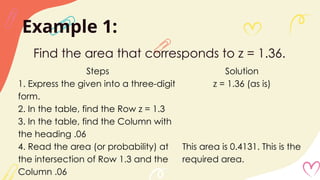
1. Express the given into a three-digit
form.
z = 1.36 (as is)
2. In the table, find the Row z = 1.3
3. In the table, find the Column with
the heading .06
4. Read the area (or probability) at
the intersection of Row 1.3 and the
Column .06
This area is 0.4131. This is the
required area.
Find the area that corresponds to z = 1.36.
ASSESSMENT
04
CREDITS: This presentation template was created by Slidesgo,
including icons by Flaticon, infographics & images by Freepik and
illustrations by Storyset
THANKS!
Please keep this slide for attribution
EXPLORING Z-
SCORE
THE Z- SCORE
Z- score is a numerical measurement used
in statistics of a value's relationship to the mean
(average) of a group of values, measured in
terms of standard deviations from the mean.
The areas under the normal curve are given in
terms of z-values or scores. Either the z-score
locates X within a sample or within a population.
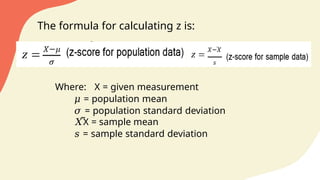
The formula for calculating z is:
Where: X = given measurement
𝜇 = population mean
𝜎 = population standard deviation
𝑋̅X = sample mean
𝑠 = sample standard deviation
Example 1:
1.Given the 𝜇 = 50 and 𝜎 = 4 of a population of
Reading scores. Find the z-value that corresponds
to X = 58.
Solution:
Step 1. Identify the given values.
Given: = 50, = 4, X = 58
𝜇 𝜎
Solution:
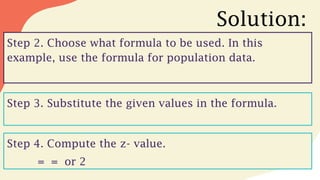
Step 2. Choose what formula to be used. In this
example, use the formula for population data.
Step 3. Substitute the given values in the formula.
Step 4. Compute the z- value.
= = or 2
Solution:
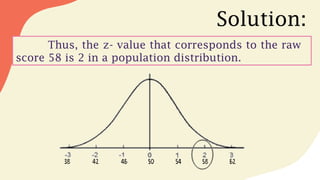
Thus, the z- value that corresponds to the raw
score 58 is 2 in a population distribution.
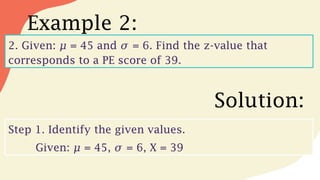
Example 2:
2. Given: = 45 and = 6. Find the z-value that
𝜇 𝜎
corresponds to a PE score of 39.
Solution:
Step 1. Identify the given values.
Given: = 45, = 6, X = 39
𝜇 𝜎
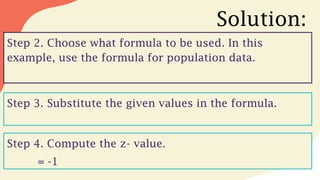
Solution:
Step 2. Choose what formula to be used. In this
example, use the formula for population data.
Step 3. Substitute the given values in the formula.
Step 4. Compute the z- value.
= -1
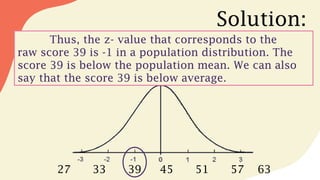
Solution:
Thus, the z- value that corresponds to the
raw score 39 is -1 in a population distribution. The
score 39 is below the population mean. We can also
say that the score 39 is below average.
27 33 39 45 51 57 63
Example 3:
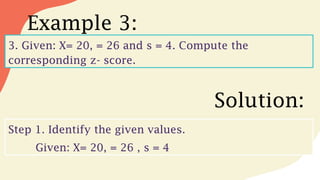
3. Given: X= 20, = 26 and s = 4. Compute the
corresponding z- score.
Solution:
Step 1. Identify the given values.
Given: X= 20, = 26 , s = 4
Solution:
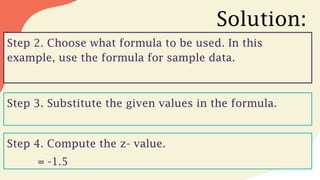
Step 2. Choose what formula to be used. In this
example, use the formula for sample data.
Step 3. Substitute the given values in the formula.
Step 4. Compute the z- value.
= -1.5
Solution:
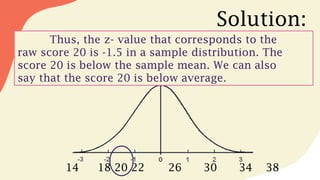
Thus, the z- value that corresponds to the
raw score 20 is -1.5 in a sample distribution. The
score 20 is below the sample mean. We can also
say that the score 20 is below average.
14 18 20 22 26 30 34 38
ACTIVITY :2
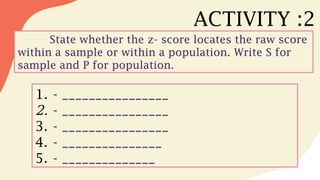
State whether the z- score locates the raw score
within a sample or within a population. Write S for
sample and P for population.
1. - ________________
2. - ________________
3. - ________________
4. - _______________
5. - ______________
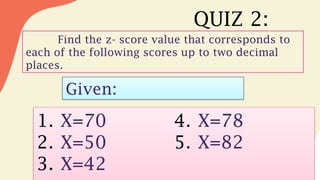
QUIZ 2:
Find the z- score value that corresponds to
each of the following scores up to two decimal
places.
Given:
1. X=70
2. X=50
3. X=42
4. X=78
5. X=82
IDENTIFYING REGIONS
OF THE NORMAL CURVE
Using the z-table in
Determining Areas Under
the Normal Curve when z
is Given
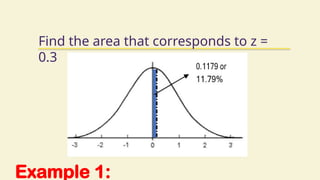
Example 1:
Find the area that corresponds to z =
0.3
Example 1:
Find the area that corresponds to z =
0.3
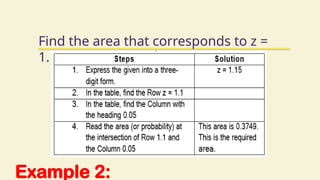
Example 2:
Find the area that corresponds to z =
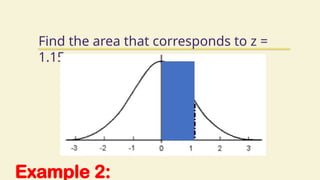
1.15
Example 2:
Find the area that corresponds to z =
1.15
Note:
When z is negative, we simply ignore the
negative sign and proceed as before. The
negative sign informs us that the region we
are interested in is found on the left side of
the mean. Areas are positive values.
Determining
Probabilities
Note:
The following notations for a random variable are
used in our various solutions concerning the normal curve.
Mathematical notations are convenient forms of lengthy
expressions.
𝑃( < < )
𝑎 𝑧 𝑏 denotes the probability that the z-score is
between a and b.
𝑃( > )
𝑧 𝑎 denotes the probability that the z-score is greater
than a.
𝑃( < )
𝑧 𝑎 denotes the probability that the z-score is less than
a. Where a and b are z-score values
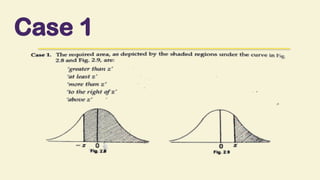
Case 1
Example 1:
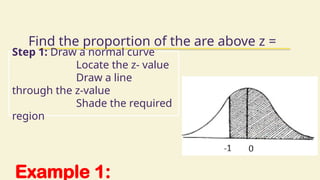
Find the proportion of the are above z =
-1.
Step 1: Draw a normal curve
Locate the z- value
Draw a line
through the z-value
Shade the required
region
Example 1:
Find the proportion of the are above z =
-1.
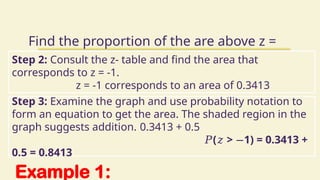
Step 2: Consult the z- table and find the area that
corresponds to z = -1.
z = -1 corresponds to an area of 0.3413
Step 3: Examine the graph and use probability notation to
form an equation to get the area. The shaded region in the
graph suggests addition. 0.3413 + 0.5
𝑃( > 1) = 0.3413 +
𝑧 −
0.5 = 0.8413
Example 2:
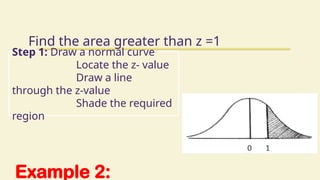
Find the area greater than z =1
Step 1: Draw a normal curve
Locate the z- value
Draw a line
through the z-value
Shade the required
region
Example 2:
Find the area greater than z =1
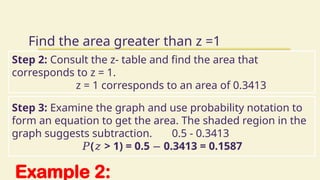
Step 2: Consult the z- table and find the area that
corresponds to z = 1.
z = 1 corresponds to an area of 0.3413
Step 3: Examine the graph and use probability notation to
form an equation to get the area. The shaded region in the
graph suggests subtraction. 0.5 - 0.3413
𝑃( > 1) = 0.5 0.3413 = 0.1587
𝑧 −
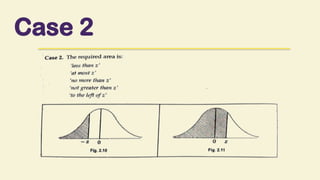
Case 2
Example 3:
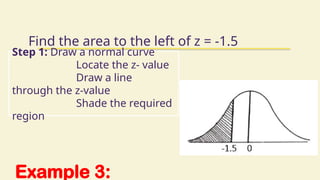
Find the area to the left of z = -1.5
Step 1: Draw a normal curve
Locate the z- value
Draw a line
through the z-value
Shade the required
region
Example 3:
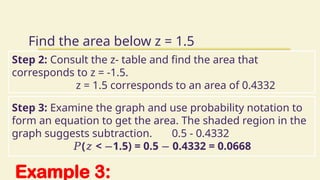
Find the area below z = 1.5
Step 2: Consult the z- table and find the area that
corresponds to z = -1.5.
z = 1.5 corresponds to an area of 0.4332
Step 3: Examine the graph and use probability notation to
form an equation to get the area. The shaded region in the
graph suggests subtraction. 0.5 - 0.4332
𝑃( < 1.5) = 0.5 0.4332 = 0.0668
𝑧 − −
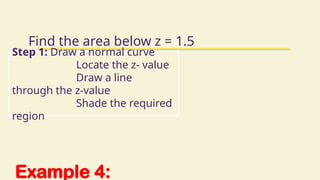
Example 4:
Find the area below z = 1.5
Step 1: Draw a normal curve
Locate the z- value
Draw a line
through the z-value
Shade the required
region
Example 4:
Find the area below z = 1.5
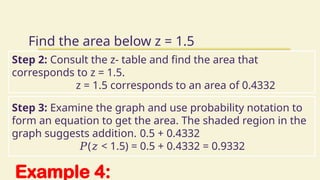
Step 2: Consult the z- table and find the area that
corresponds to z = 1.5.
z = 1.5 corresponds to an area of 0.4332
Step 3: Examine the graph and use probability notation to
form an equation to get the area. The shaded region in the
graph suggests addition. 0.5 + 0.4332
𝑃( < 1.5) = 0.5 + 0.4332 = 0.9332
𝑧
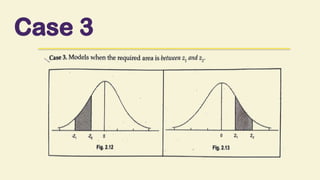
Case 3
Example 5:
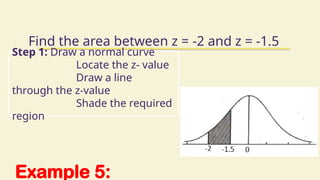
Find the area between z = -2 and z = -1.5
Step 1: Draw a normal curve
Locate the z- value
Draw a line
through the z-value
Shade the required
region
Example 5:
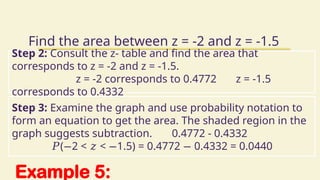
Find the area between z = -2 and z = -1.5
Step 2: Consult the z- table and find the area that
corresponds to z = -2 and z = -1.5.
z = -2 corresponds to 0.4772 z = -1.5
corresponds to 0.4332
Step 3: Examine the graph and use probability notation to
form an equation to get the area. The shaded region in the
graph suggests subtraction. 0.4772 - 0.4332
𝑃( 2 < < 1.5) = 0.4772 0.4332 = 0.0440
− 𝑧 − −
Example 6:
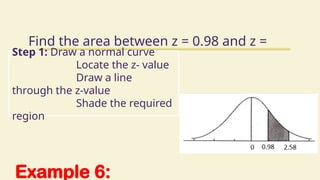
Find the area between z = 0.98 and z =
2.58
Step 1: Draw a normal curve
Locate the z- value
Draw a line
through the z-value
Shade the required
region
Example 6:
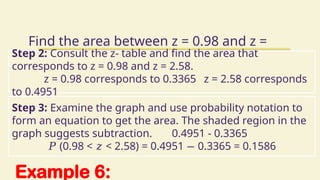
Find the area between z = 0.98 and z =
2.58
Step 2: Consult the z- table and find the area that
corresponds to z = 0.98 and z = 2.58.
z = 0.98 corresponds to 0.3365 z = 2.58 corresponds
to 0.4951
Step 3: Examine the graph and use probability notation to
form an equation to get the area. The shaded region in the
graph suggests subtraction. 0.4951 - 0.3365
𝑃 (0.98 < < 2.58) = 0.4951 0.3365 = 0.1586
𝑧 −
SAMPLING AND
SAMPLING
DISTRIBUTION
CORMATH 02
SAMPLING
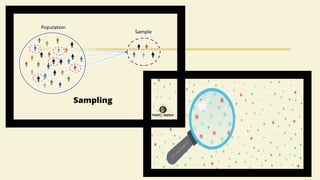
Sampling is the process of
selecting observations (a sample)
to provide an adequate
description and inferences of the
population.
It means selecting the group
that you will actually collect data
from in your research.
Sample
Sample
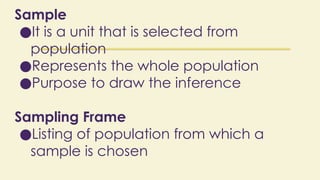
●It is a unit that is selected from
population
●Represents the whole population
●Purpose to draw the inference
Sampling Frame
●Listing of population from which a
sample is chosen
Sampling
Distributio
n of
Sample
Means
Example 1:
A population consists of the numbers 2, 4, 9,
10 and 5. Let us list all possible samples of size 3
from this population and compute the mean of
each sample.
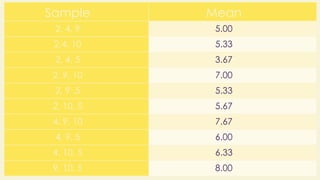
Sample Mean
2, 4, 9 5.00
2,4, 10 5.33
2, 4, 5 3.67
2, 9, 10 7.00
2, 9 ,5 5.33
2, 10, 5 5.67
4, 9, 10 7.67
4, 9, 5 6.00
4, 10, 5 6.33
9, 10, 5 8.00
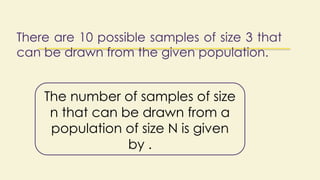
There are 10 possible samples of size 3 that
can be drawn from the given population.
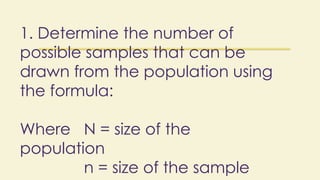
The number of samples of size
n that can be drawn from a
population of size N is given
by .
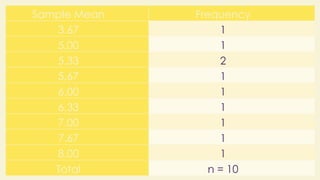
This time let us make a
frequency distribution of the
sample means. We shall call
this frequency distribution; the
sampling distribution of
sample means.
Sample Mean Frequency
3.67 1
5.00 1
5.33 2
5.67 1
6.00 1
6.33 1
7.00 1
7.67 1
8.00 1
Total n = 10
Sampling distribution of sample means
is a frequency distribution using the means
computed from all possible random
samples of a specific size taken from a
population.
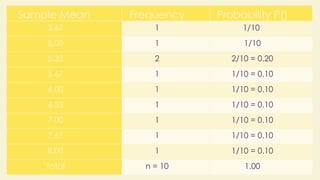
The probability distribution of the
sample means is also called the
sampling distribution of the sample
means.
Sample Mean Frequency Probability P()
3.67 1 1/10
5.00 1 1/10
5.33 2 2/10 = 0.20
5.67 1 1/10 = 0.10
6.00 1 1/10 = 0.10
6.33 1 1/10 = 0.10
7.00 1 1/10 = 0.10
7.67 1 1/10 = 0.10
8.00 1 1/10 = 0.10
Total n = 10 1.00
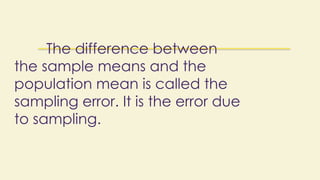
The difference between
the sample means and the
population mean is called the
sampling error. It is the error due
to sampling.
Steps in
Constructing the
Sampling
Distribution of the
Means
1. Determine the number of
possible samples that can be
drawn from the population using
the formula:
Where N = size of the
population
n = size of the sample
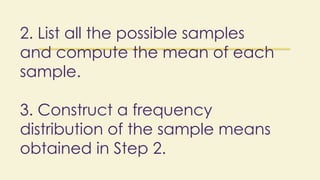
2. List all the possible samples
and compute the mean of each
sample.
3. Construct a frequency
distribution of the sample means
obtained in Step 2.
Example 2:
Samples of three cards are
drawn at random from a
population of eight cards
numbered from 1 to 8.
Example 2:
a. How many possible
samples can be drawn?
Given: N = 8 and n = 3.
Example 2:
b. Construct the
sampling distribution of
sample means.
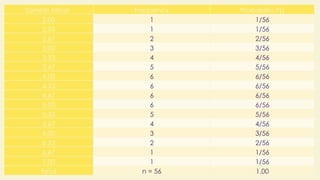
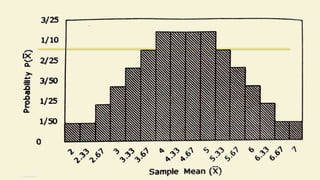
Sample Mean Frequency Probability P()
2.00 1 1/56
2.33 1 1/56
2.67 2 2/56
3.00 3 3/56
3.33 4 4/56
3.67 5 5/56
4.00 6 6/56
4.33 6 6/56
4.67 6 6/56
5.00 6 6/56
5.33 5 5/56
5.67 4 4/56
6.00 3 3/56
6.33 2 2/56
6.67 1 1/56
7.00 1 1/56
Total n = 56 1.00
Example 2:
c. Construct a histogram of
the sampling distribution of
the means
THAN
K YOU
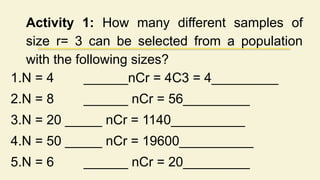
Activity 1: How many different samples of
size r= 3 can be selected from a population
with the following sizes?
1.N = 4 ______nCr = 4C3 = 4_________
2.N = 8 ______ nCr = 56_________
3.N = 20 _____ nCr = 1140__________
4.N = 50 _____ nCr = 19600__________
5.N = 6 ______ nCr = 20_________
Activity 1: How many different samples of
size r= 3 can be selected from a population
with the following sizes?
1.N = 4 _______________
2.N = 8 _______________
3.N = 20 _______________
4.N = 50 _______________
5.N = 6 _______________
1.A population consists of the five numbers
2, 3, 6, 8, and 11. Consider samples of size
2 that can be drawn from this population.
a.List all the possible samples and the
corresponding mean.
b.Construct the sampling distribution of the
sample means.
c.Draw a histogram of the sampling distribution of
the means.
MEAN AND VARIANCE OF
A SAMPLING
DISTRIBUTION OF
SAMPLE MEANS
MEAN
VARIANCE
1. Consider a population consisting of 1, 2, 3, 4, and
5. Suppose samples of size 2 are drawn from this
population. Describe the sampling distribution of the
sample means.
● What is the mean and variance of the sampling
distribution of the sample means?
● Compare these values to the mean and variance
of the population.
● Draw the histogram of the sampling distribution of
the population mean.
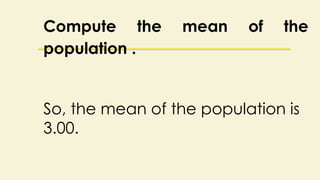
Compute the mean of the
population .
So, the mean of the population is
3.00.
Compute the variance of the
population (σ).
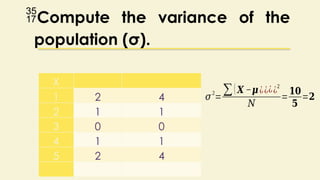
Compute the variance of the
population (σ).
X
1 2 4
2 1 1
3 0 0
4 1 1
5 2 4
𝜎2
=
∑(𝑿 −𝝁¿¿¿¿2
𝑁
=
𝟏𝟎
𝟓
=𝟐
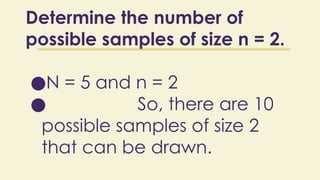
Determine the number of
possible samples of size n = 2.
●N = 5 and n = 2
● So, there are 10
possible samples of size 2
that can be drawn.
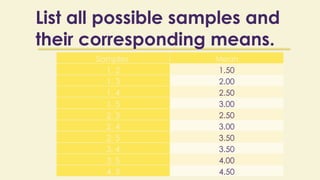
List all possible samples and
their corresponding means.
Samples Mean
1, 2 1.50
1, 3 2.00
1, 4 2.50
1, 5 3.00
2, 3 2.50
2, 4 3.00
2, 5 3.50
3, 4 3.50
3, 5 4.00
4, 5 4.50
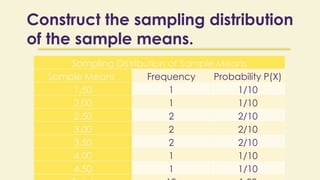
Construct the sampling distribution
of the sample means.
Sampling Distribution of Sample Means
Sample Means Frequency Probability P(X)
1.50 1 1/10
2.00 1 1/10
2.50 2 2/10
3.00 2 2/10
3.50 2 2/10
4.00 1 1/10
4.50 1 1/10
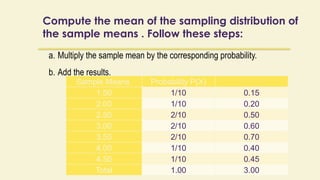
Compute the mean of the sampling distribution of
the sample means . Follow these steps:
a. Multiply the sample mean by the corresponding probability.
b. Add the results.
Sample Means Probability P(X)
1.50 1/10 0.15
2.00 1/10 0.20
2.50 2/10 0.50
3.00 2/10 0.60
3.50 2/10 0.70
4.00 1/10 0.40
4.50 1/10 0.45
Total 1.00 3.00
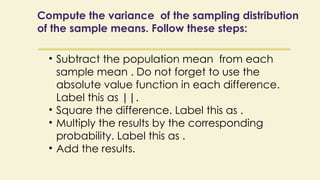
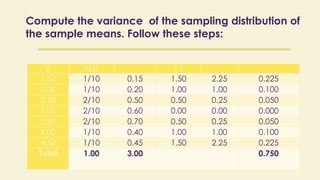
Compute the variance of the sampling distribution
of the sample means. Follow these steps:
• Subtract the population mean from each
sample mean . Do not forget to use the
absolute value function in each difference.
Label this as ||.
• Square the difference. Label this as .
• Multiply the results by the corresponding
probability. Label this as .
• Add the results.
Compute the variance of the sampling distribution of
the sample means. Follow these steps:
X P(X) ||
1.50 1/10 0.15 1.50 2.25 0.225
2.00 1/10 0.20 1.00 1.00 0.100
2.50 2/10 0.50 0.50 0.25 0.050
3.00 2/10 0.60 0.00 0.00 0.000
3.50 2/10 0.70 0.50 0.25 0.050
4.00 1/10 0.40 1.00 1.00 0.100
4.50 1/10 0.45 1.50 2.25 0.225
Total 1.00 3.00 0.750
Compute the variance of the sampling distribution
of the sample means. Follow these steps:
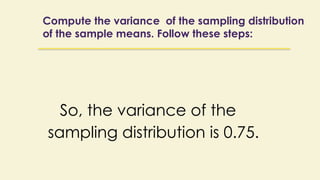
So, the variance of the
sampling distribution is 0.75.
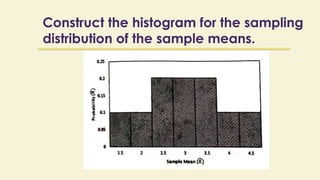
Construct the histogram for the sampling
distribution of the sample means.
2. A population consists of
the numbers 3, 6, 9, 12, 15.
Let us list all possible
samples of size 3 from this
population and compute
the mean of each sample.
Percentile and the
T-Distribution
T-DISTRIBUTION
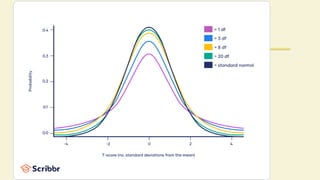
oAlso called Student’s t-distribution
is a family of distributions that look
almost identical to the normal
distribution curve, only a bit shorter
and stouter.
T-DISTRIBUTION
oIt was developed by
William Sealy Gosset in
1908.
oFormula:
T-DISTRIBUTION
T-DISTRIBUTION
o The t-distribution is used instead of the
normal distribution when you have small
samples. The larger the sample size, the
more the t distribution looks like the normal
distribution. In fact, for sample sizes larger
than 20, the distribution is almost exactly like
the normal distribution.
T-DISTRIBUTION
o Like the normal distribution, the t-
distribution has a smooth shape.
o Like the normal distribution, the t-
distribution is symmetric. If you think about
folding it in half at the mean, each side will
be the same.
T-DISTRIBUTION
o Like a standard normal distribution (or z-
distribution), the t-distribution has a mean of
zero.
o The t-distribution is defined by the degrees
of freedom. These are related to the sample
size.
DEGREE OF FREEDOM
o This refers to the maximum number
of logically independent values
which vary in the data sample.
o Formula : n-1
PERCENTILE
oThis is a measure of
position with data divided
into 100 parts.
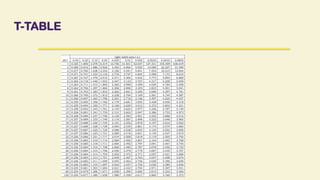
T-TABLE
EXAMPLE
1. Identify the t-value whose number of samples
n = 7 and has an area ( ) equal to 0.05.
𝛼
2. Find the t-value whose degree of freedom is 20
and has = 0.01.
𝛼
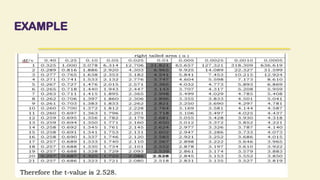
3. Identify the t-value of the following percentiles
given the number of samples.
a. 95th percentile , N= 30
b. 90th percentile, N=20
EXAMPLE
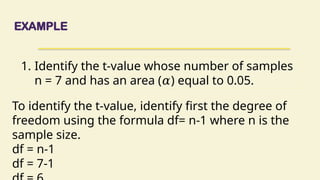
1. Identify the t-value whose number of samples
n = 7 and has an area ( ) equal to 0.05.
𝛼
To identify the t-value, identify first the degree of
freedom using the formula df= n-1 where n is the
sample size.
df = n-1
df = 7-1
EXAMPLE
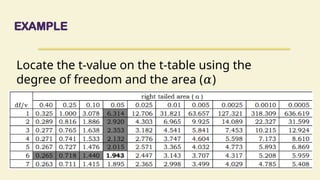
Locate the t-value on the t-table using the
degree of freedom and the area ( )
𝛼
EXAMPLE
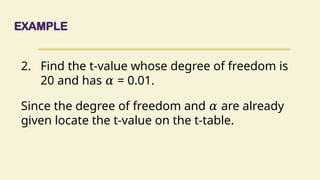
2. Find the t-value whose degree of freedom is
20 and has = 0.01.
𝛼
Since the degree of freedom and are already
𝛼
given locate the t-value on the t-table.
EXAMPLE
EXAMPLE
3. Identify the t-value of the following
percentiles given the number of samples.
a. 95th percentile , N= 30
The 95th percentile is the number where 95% of the
values lie below it and 5% lie above it, so you want
the right-tail area to be 0.05. Move across the row,
find the column for 0.05, and then locate the t-value
using n=30 or df = 29.
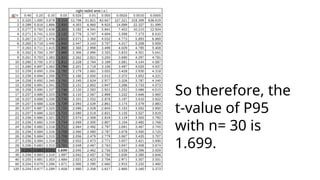
So therefore, the
t-value of P95
with n= 30 is
1.699.
EXAMPLE
3. Identify the t-value of the following
percentiles given the number of samples.
b. 90th percentile, N=20
The 90th percentile is the number where 90% of the
values lie below it and 10% lie above it, so you want
the right-tail area to be 0.01. Move across the row,
find the column for 0.05, and then locate the t-value
using n=20 or df = 19.
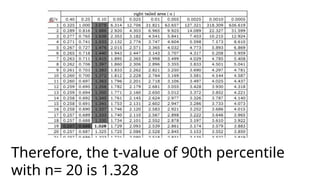
Therefore, the t-value of 90th percentile
with n= 20 is 1.328
CONFIDENCE
INTERVAL
interval estimate
CONFIDENCE INTERVAL
An interval estimate, called a confidence interval, is a
range of values or interval (with lower and upper limits)
used to estimate the population parameter. This estimate
may or may not contain the true parameter value. The
parameter is specified as being between two values. It is
usually in the form of a < ϴ < b, which tells that the
estimated parameter (ϴ) is between two values (a and b)
at a certain level of confidence.)
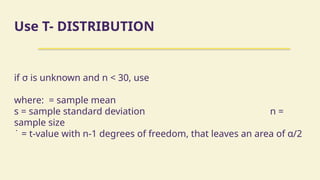
Use T- DISTRIBUTION
if σ is unknown and n < 30, use
where: = sample mean
s = sample standard deviation n =
sample size
̇ = t-value with n-1 degrees of freedom, that leaves an area of α/2
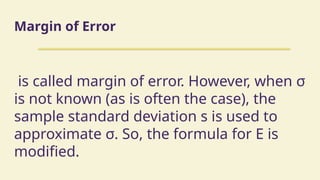
Margin of Error
is called margin of error. However, when σ
is not known (as is often the case), the
sample standard deviation s is used to
approximate σ. So, the formula for E is
modified.
Example 1:
Compute the margin of error of the 90% confidence
interval estimate of µ when s = 5, n = 16.
Given: s= 5
n= 16
confidence level = 90%
Example 1:
Compute the margin of error of the 90% confidence
interval estimate of µ when s = 5, n = 16.
Formula:
Example 1:
therefore,
Example 1:
Hence, the margin of error is 2.19.
Example 2:
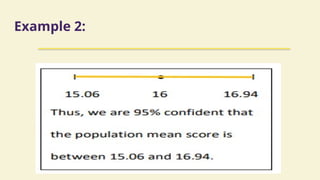
The average hemoglobin reading for a sample of 20
teachers was 16 grams per 100 milliliters with a sample
standard deviation of 2 grams. Find the 95% confidence
interval of the true mean.
Given: Confidence Level = 95%
n= 20 s = 2
Example 2:
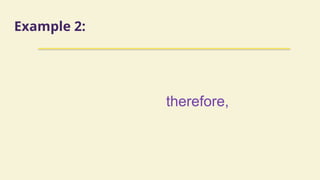
therefore,
Example 2:
Hence, the margin of error is 0.94.
Example 2:
Example 2:
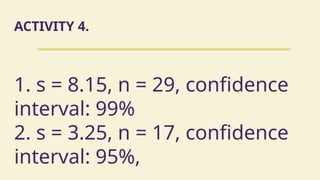
ACTIVITY 4.
1. s = 8.15, n = 29, confidence
interval: 99%
2. s = 3.25, n = 17, confidence
interval: 95%,
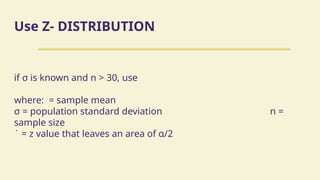
Use Z- DISTRIBUTION
if σ is known and n > 30, use
where: = sample mean
σ = population standard deviation n =
sample size
̇ = z value that leaves an area of α/2
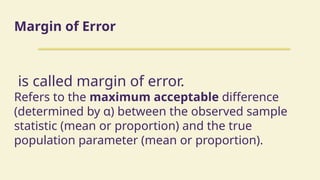
Margin of Error
is called margin of error.
Refers to the maximum acceptable difference
(determined by α) between the observed sample
statistic (mean or proportion) and the true
population parameter (mean or proportion).
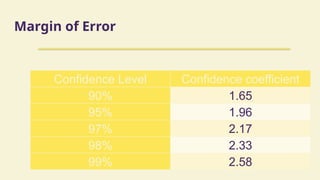
Margin of Error
Confidence Level Confidence coefficient
90% 1.65
95% 1.96
97% 2.17
98% 2.33
99% 2.58
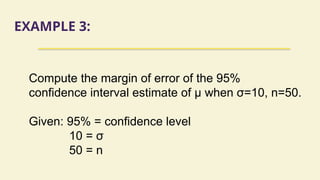
EXAMPLE 3:
Compute the margin of error of the 95%
confidence interval estimate of µ when σ=10, n=50.
Given: 95% = confidence level
10 = σ
50 = n
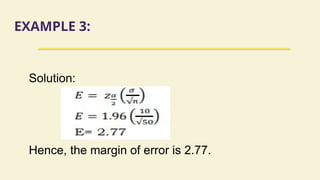
EXAMPLE 3:
Solution:
Hence, the margin of error is 2.77.
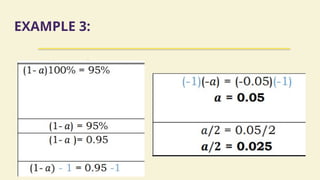
EXAMPLE 3:
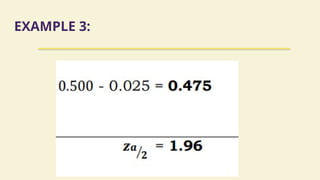
EXAMPLE 3:
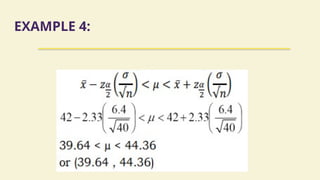
EXAMPLE 4:
Compute the 98% confidence interval
estimate of µ given the ff:
σ=6.4, n=40, and =42.
𝑥̅
Given: 98% = confidence level
40 = n
6.4 = σ
42 = 𝑥̅
EXAMPLE 4:
Population
Proportion
POPULATION PROPORTION
● In test of population proportions, p
stands for population proportion and (p-
hat) for sample proportion. Population
proportion is a fraction of the population
that has a certain characteristic.
POPULATION PROPORTION
● For example, let us say you had
1,000 people in the population and 346 of
those people have rapid quarantine pass.
The fraction of people who have rapid
pass is 346 out of 1,000 or 346/1000.
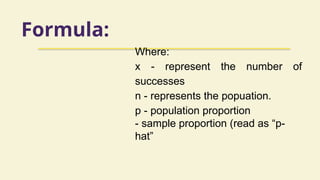
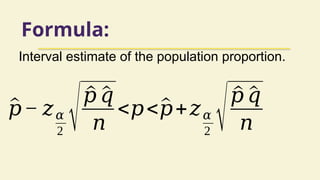
Formula:
Where:
x - represent the number of
successes
n - represents the popuation.
p - population proportion
- sample proportion (read as “p-
hat”
Formula:
^
𝑝− 𝑧𝛼
2 √^
𝑝 ^
𝑞
𝑛
<𝑝<^
𝑝+𝑧𝛼
2 √^
𝑝 ^
𝑞
𝑛
Interval estimate of the population proportion.
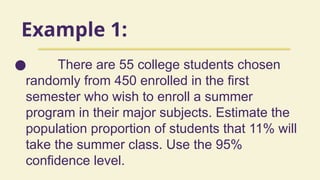
Example 1:
● There are 55 college students chosen
randomly from 450 enrolled in the first
semester who wish to enroll a summer
program in their major subjects. Estimate the
population proportion of students that 11% will
take the summer class. Use the 95%
confidence level.
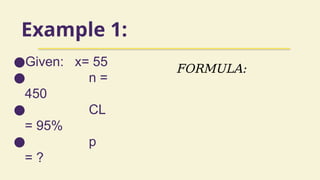
Example 1:
●Given: x= 55
● n =
450
● CL
= 95%
● p
= ?
FORMULA:
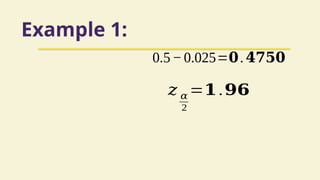
Example 1:
𝑧 𝛼
2
=𝟏.𝟗𝟔
0.5−0.025=𝟎.𝟒𝟕𝟓𝟎
Example 1:
Example 1:
Example 1:
Example 1:
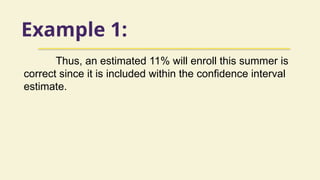
Thus, an estimated 11% will enroll this summer is
correct since it is included within the confidence interval
estimate.
Example 2:
For a class project, a grade 11 student in a public
school wants to estimate the percentage of students who
are registered voters. He surveys 500 students and finds
that 300 are registered voters. Compute a 90%
confidence interval for the true percentage of students
who are registered voters and interpret the confidence
interval.

Example 2:
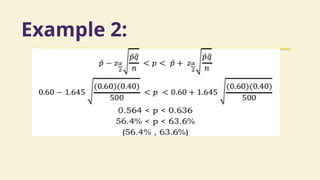
Example 2:
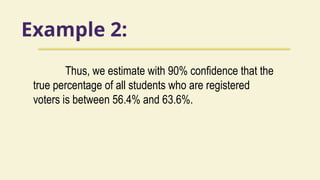
Thus, we estimate with 90% confidence that the
true percentage of all students who are registered
voters is between 56.4% and 63.6%.

Statistics and Probability Reviewer.pptx

  • 1.
    Computing the Probability andMean of a Discrete Probability Distribution
  • 2.
  • 3.
    Probabilit y Probability is ameasure of how often a particular event will happen if something is done repeatedly. It is a chance that something will happen.
  • 4.
    ●There is a20 percent chance of rain tomorrow. ●The probability of winning the lottery is one in many millions. Examples:
  • 5.
    Suppose three coinsare tossed. Let Y be the random variable representing the number of tails that occur. Find the probability of each of the values of the random variable Y. Example 1:
  • 6.
    Solution: Determine the sample space. Count thenumber of tails in each outcome in the sample space and assign this number to each outcome. The four possible values of random variable Y is 0, 1, 2, and 3. Assign P(Y) to each value of the random variable. 1 2 3
  • 7.
    SOLUTION: Determine the samplespace. S = {TTT, TTH, THT, HTT, HHT, HTH, THH, HHH}
  • 8.
    Count the number oftails in each outcome in the sample space and assign this number to each outcome. SOLUTION: Possible Outcomes Value of the Random Variable Y (number of tails) TTT 3 TTH 2 THT 2 HTT 2 HHT 1 HTH 1 THH 1 HHH 0
  • 9.
    The four possible valuesof random variable Y is 0, 1, 2, and 3. Assign P(Y) to each value of the random variable. SOLUTION: Number of Tails Y Probability P(Y) 0 1/8 1 3/8 2 3/8 3 1/8
  • 10.
    Two balls aredrawn in succession without replacement from an urn containing red balls and blue balls. Let Z be the random variable representing the number of blue balls. Construct the probability distribution of the random variable Z. Example 2:
  • 11.
    Solution: Determine the sample space. Count thenumber of blue balls in each outcome in the sample space and assign this number to each outcome. The four possible values of random variable Z is 0, 1, and 2. Assign P(Z) to each value of the random variable. 1 2 3
  • 12.
    SOLUTION: Determine the samplespace. S = {RR, RB, BR, BB}
  • 13.
    Count the number ofblue balls in each outcome in the sample space and assign this number to each outcome. SOLUTION: Possible Outcomes Value of the Random Variable Z (number of blue balls) RR 0 RB 1 BR 1 BB 2
  • 14.
    The four possible valuesof random variable Z is 0, 1, and 2. Assign P(Z) to each value of the random variable. SOLUTION: Number of Blue Balls Z Probability P(Z) 0 1/4 1 2/4 or ½ 2 1/4
  • 15.
    Suppose three cellphonesare tested at random. Let D represent the defective cellphone and let N represent the non- defective cellphone. If we let X be the random variable for the number of defective cellphones, construct the probability distribution of the random variable X. Example 3:
  • 16.
    Solution: Determine the sample space. Count thenumber of defective in each outcome in the sample space and assign this number to each outcome. The four possible values of random variable x is 0, 1, 2, and 3. Assign P(x) to each value of the random variable. 1 2 3
  • 17.
    SOLUTION: Determine the samplespace. S = {NNN, NND, NDN, DNN, NDD, DND, DDN, DDD}
  • 18.
    Count the number of defectivein each outcome in the sample space and assign this number to each outcome. SOLUTION: Possible Outcomes Value of the Random Variable X (number of defective cellphones) NNN 0 NND 1 NDN 1 DNN 1 NDD 2 DND 2 DDN 2 DDD 3
  • 19.
    The four possible valuesof random variable x is 0, 1, 2, and 3. Assign P(x) to each value of the random variable. SOLUTION: Number of Defective Cellphone X Probability P(X) 0 1/8 1 3/8 2 3/8 3 1/8
  • 20.
    Properties of aProbability Distribution 2. The sum of the probabilities of all values of the random variable must be equal to 1. 1. The probability of each value of the random variable must be between or equal to 0 and 1.
  • 21.
    MEAN OF ADISCRETE PROBABILITY DISTRIBUTION
  • 22.
    Mean Mean is simplythe average that we are familiar to, where you add all the numbers and divide it by the total number of the numbers you added.
  • 23.
    Consider rolling adie. What is the average number of spots that would appear? Example 1:
  • 24.
    Solution: Construct the probability distribution for therandom variable X representing the number of spots that would appear. Multiply the value of the random variable X by the corresponding probability. Add the results obtained in Step 2. 1 2 3
  • 25.
    SOLUTION: Construct the probability distribution forthe random variable X representing the number of spots that would appear. Number of Spots X Probability P(X) 1 1/6 2 1/6 3 1/6 4 1/6 5 1/6 6 1/6
  • 26.
    Multiply the value ofthe random variable X by the corresponding probability. SOLUTION: Number of Spots X Probability P(X) 1 1/6 1/6 2 1/6 2/6 3 1/6 3/6 4 1/6 4/6 5 1/6 5/6 6 1/6 6/6
  • 27.
    Add the results obtainedin Step 2. SOLUTION: Number of Spots X Probability P(X) 1 1/6 1/6 2 1/6 2/6 3 1/6 3/6 4 1/6 4/6 5 1/6 5/6 6 1/6 6/6
  • 28.
  • 29.
    1. Four coinsare tossed. Let Z be the random variable representing the number of heads that occur. Find the probability and mean of the random variable Z.
  • 30.
    Find the probabilityof the following events. 1. Getting an even number in single roll of die. 2. Getting a sum of 6 when two dice are rolled 3. Getting an ace when a card is drawn from a deck 4. The probability that all children are boys if a couple has 3 children 5. Getting an odd number and a tail when a die is rolled, and a coin is tossed simultaneously
  • 31.
    9th Grade Computing theVariance and Standard Deviation of a Discrete Probability Distribution
  • 32.
    RECAP 01 VARIANCE OF ADISCRETE PROBABILITY DISTIRBUTION ASSIGNMENT 03 ACTIVITY 04 02 LESSON 3
  • 33.
  • 34.
    VARIANCE AND STANDARD DEVIATIONOF A DISCRETE PROBABILITY DISTIRBUTION 02
  • 35.
    Standard Deviation -is the measure of spread, most commonly used in statistical practice when the mean is used to calculate central tendency. Thus, it measures spread around the mean. Variance - is a measure of how spread out a data set is.
  • 36.
    Steps in Finding theVariance and Standard Deviation
  • 37.
    1. Find themean of the probability distribution. 2. Subtract the mean from each value of the random variable X. 3. Square the results obtained in Step 2. 5. Get the sum of the results obtained in Step 4. 4. Multiply the results obtained in Step 3 by the corresponding probability.
  • 38.
    Example 1: Numberof Cars Sold The number of cars sold per day at a local car dealership, along with its corresponding probabilities, is shown in the succeeding table. Compute the variance and the standard deviation of the probability distribution by following the given steps.
  • 39.
    Example 1: Numberof Cars Sold Number of Cars Sold X Probability P(X) 0 1/10 1 2/10 2 3/10 3 2/10 4 2/10
  • 40.
    SOLUTION: Step 1: Findthe mean of the probability distribution using the formula Number of Cars Sold X Probability P(X) 0 1/10 0 1 2/10 2/10 2 3/10 6/10 3 2/10 6/10 4 2/10 8/10
  • 41.
    SOLUTION: Step 2: Subtractthe mean from each value of the random variable X. Always get the absolute value of the difference. X P(X) 0 1/10 0 1 2/10 2/10 2 3/10 6/10 3 2/10 6/10 4 2/10 8/10
  • 42.
    SOLUTION: Step 3: Squarethe results obtained in Step 2. X P(X) 0 1/10 0 2.2 4.84 1 2/10 2/10 1.2 1.44 2 3/10 6/10 0.2 0.04 3 2/10 6/10 0.8 0.64 4 2/10 8/10 1.8 3.24
  • 43.
    SOLUTION: Step 4: Multiplythe results obtained in Step 3 by the corresponding probability. X P(X) 0 1/10 0 2.2 4.84 0.484 1 2/10 2/10 1.2 1.44 0.288 2 3/10 6/10 0.2 0.04 0.012 3 2/10 6/10 0.8 0.64 0.128 4 2/10 8/10 1.8 3.24 0.648
  • 44.
    SOLUTION: Step 5: Getthe sum of the results obtained in Step 4. The result is the value of the variance. So, the formula for the variance is: 𝜎 2 =∑(𝑋−𝜇)2 ∙𝑃(𝑋)
  • 45.
    SOLUTION: Step 5: Getthe sum of the results obtained in Step 4. The result is the value of the variance. So, the formula for the variance is: X P(X) 0 1/10 0 2.2 4.84 0.484 1 2/10 2/10 1.2 1.44 0.288 2 3/10 6/10 0.2 0.04 0.012 3 2/10 6/10 0.8 0.64 0.128 4 2/10 8/10 1.8 3.24 0.648
  • 46.
    SOLUTION: Step 6: Getthe square root of the variance to get the standard deviation. The variance of the probability distribution is 1.56. The standard deviation is
  • 47.
    Formula for theVariance and Standard Deviation of a Discrete Probability Distribution The variance of a discrete probability distribution is given by the formula: The standard deviation of a discrete probability distribution is given by the formula:
  • 48.
    Formula for theVariance and Standard Deviation of a Discrete Probability Distribution Where: X = value of the random variable P(X) = probability of the random variable X μ = mean of the probability distribution σ^2 = variance of the probability distribution σ = standard deviation of the probability distribution
  • 49.
    Example 2: When threecoins are tossed, the probability distribution for the random variable X representing the number of heads that occur is given below. Compute the variance and standard deviation of the probability distribution.
  • 50.
    Example 2: Number ofHeads X Probability P(X) 0 1/8 1 3/8 2 3/8 3 1/8
  • 51.
    SOLUTION: Step 1: Findthe mean of the probability distribution using the formula Number of Items Sold X Probability P(X) 0 1/8 0 1 3/8 3/8 2 3/8 6/8 3 1/8 3/8
  • 52.
    SOLUTION: Step 2: Subtractthe mean from each value of the random variable X. Always get the absolute value of the difference. X P(X) 0 1/8 0 1 3/8 3/8 2 3/8 6/8 3 1/8 3/8
  • 53.
    SOLUTION: Step 3: Squarethe results obtained in Step 2. X P(X) 0 1/8 0 1.5 2.25 1 3/8 3/8 0.5 0.25 2 3/8 6/8 0.5 0.25 3 1/8 3/8 1.5 2.25
  • 54.
    SOLUTION: Step 4: Multiplythe results obtained in Step 3 by the corresponding probability. X P(X) 0 1/8 0 1.5 2.25 0.28125 1 3/8 3/8 0.5 0.25 0.09375 2 3/8 6/8 0.5 0.25 0.09375 3 1/8 3/8 1.5 2.25 0.28125
  • 55.
    SOLUTION: Step 5: Getthe sum of the results obtained in Step 4. The result is the value of the variance. So, the formula for the variance is: 𝜎 2 =∑(𝑋−𝜇)2 ∙𝑃(𝑋)
  • 56.
    SOLUTION: Step 5: Getthe sum of the results obtained in Step 4. The result is the value of the variance. So, the formula for the variance is: X P(X) 0 1/8 0 1.5 2.25 0.28125 1 3/8 3/8 0.5 0.25 0.09375 2 3/8 6/8 0.5 0.25 0.09375 3 1/8 3/8 1.5 2.25 0.28125
  • 57.
    SOLUTION: Step 6: Getthe square root of the variance to get the standard deviation. The variance of the probability distribution is 0.75. The standard deviation is σ=√0.75=0.87
  • 58.
    Example 3: The numberof items sold per day at a retail store with its corresponding probabilities, is shown in the table. Find the variance and standard deviation of the probability distribution.
  • 59.
    Example 3: Number ofItems Sold X Probability P(X) 19 0.20 20 0.20 21 0.30 22 0.20 23 0.10
  • 60.
    SOLUTION: Step 1: Findthe mean of the probability distribution using the formula Number of Items Sold X Probability P(X) 19 0.20 3.80 20 0.20 4.00 21 0.30 6.30 22 0.20 4.40 23 0.10 2.30
  • 61.
    SOLUTION: Step 2: Subtractthe mean from each value of the random variable X. Always get the absolute value of the difference. X P(X) 19 0.20 3.80 20 0.20 4.00 21 0.30 6.30 22 0.20 4.40 23 0.10 2.30
  • 62.
    SOLUTION: Step 3: Squarethe results obtained in Step 2. X P(X) 19 0.20 3.80 1.8 3.24 20 0.20 4.00 0.8 0.64 21 0.30 6.30 0.2 0.04 22 0.20 4.40 1.2 1.44 23 0.10 2.30 2.2 4.84
  • 63.
    SOLUTION: Step 4: Multiplythe results obtained in Step 3 by the corresponding probability. X P(X) 19 0.20 3.80 1.8 3.24 0.648 20 0.20 4.00 0.8 0.64 0.128 21 0.30 6.30 0.2 0.04 0.012 22 0.20 4.40 1.2 1.44 0.288 23 0.10 2.30 2.2 4.84 0.484
  • 64.
    SOLUTION: Step 5: Getthe sum of the results obtained in Step 4. The result is the value of the variance. So, the formula for the variance is: 𝜎 2 =∑(𝑋−𝜇)2 ∙𝑃(𝑋)
  • 65.
    SOLUTION: Step 5: Getthe sum of the results obtained in Step 4. The result is the value of the variance. So, the formula for the variance is: X P(X) 19 0.20 3.80 1.8 3.24 0.648 20 0.20 4.00 0.8 0.64 0.128 21 0.30 6.30 0.2 0.04 0.012 22 0.20 4.40 1.2 1.44 0.288 23 0.10 2.30 2.2 4.84 0.484
  • 66.
    SOLUTION: Step 6: Getthe square root of the variance to get the standard deviation. The variance of the probability distribution is 1.56. The standard deviation is σ=√1.56=1.25
  • 67.
  • 68.
    Normal Distribution -is a probability distribution that is symmetric about the mean, showing that data near the mean are more frequent in occurrence than data far from the mean.
  • 69.
    Steps in Finding theVariance and Standard Deviation
  • 70.
    1. The distributioncurve is bell- shaped. 2. The curve is symmetrical about its center. 3. The mean, the median, and the mode coincide at the center. 4. The width of the curve is determined by the standard deviation of the distribution.
  • 71.
    5. The tailsof the curve flatten out indefinitely along the horizontal axis, always approaching the axis but never touching it. That is, the curve is asymptotic to the base line. 6. The area under the curve is 1. Thus, it represents the probability or proportion, or the percentage associated with specific sets of measurement values.
  • 72.
    Standard Normal Curve Thestandard normal curve is a normal probability distribution that is most commonly used as a model for inferential statistics. The equation the describes a normal curve is:
  • 73.
    Standard Normal Curve Where:Y = height of the curve particular values of X X = any score in the distribution σ = standard deviation of the population μ = mean of the population π = 3.1416 e = 2.7183
  • 74.
    Standard Normal Curve Astandard normal curve is a normal probability distribution that has a mean of 0 and a standard deviation of 1.
  • 75.
    Standard Normal Curve TheTable of Areas Under the Normal Curve is also known as the z-Table. The z-table score is measure of relative standing. It is calculated by subtracting X (or μ) from the measurement X and ̅ then dividing the result by s (or σ). The final result, the z-score, represents the distance between a given measurement X and the mean, expressed in standard deviations. Either the z- score locates X within a sample or within a population.
  • 76.
    Four- Step Process in Findingthe Areas Under the Normal Curve Given a z-Value
  • 77.
    Step 1: Expressthe given z-value into a three- digit form. Step 2: Using z-table, find the first two digits on the left column. Step 3: Match the third digit with the appropriate column on the right. Step 4: Read the area (or probability) at the intersection of the row and the column. This is the required area.
  • 78.
    Example 1: 1. Findthe area that corresponds to z = 1. Finding the area that corresponds to is the same as finding the area between z = 0 and z = 1.
  • 79.
    Example 1: Steps Solution 1.Express the given into a three- digit form. z = 1.00 2. In the table, find the Row z = 1.00 3. In the table, find the Column with the heading .00 4. Read the area (or probability) at the intersection of Row 1.0 and the Column .00 This area is 0.3413. This is the required area.
  • 80.
    Example 1: Steps Solution 1.Express the given into a three-digit form. z = 1.36 (as is) 2. In the table, find the Row z = 1.3 3. In the table, find the Column with the heading .06 4. Read the area (or probability) at the intersection of Row 1.3 and the Column .06 This area is 0.4131. This is the required area. Find the area that corresponds to z = 1.36.
  • 81.
  • 82.
    CREDITS: This presentationtemplate was created by Slidesgo, including icons by Flaticon, infographics & images by Freepik and illustrations by Storyset THANKS! Please keep this slide for attribution
  • 83.
  • 84.
    THE Z- SCORE Z-score is a numerical measurement used in statistics of a value's relationship to the mean (average) of a group of values, measured in terms of standard deviations from the mean. The areas under the normal curve are given in terms of z-values or scores. Either the z-score locates X within a sample or within a population.
  • 85.
    The formula forcalculating z is: Where: X = given measurement 𝜇 = population mean 𝜎 = population standard deviation 𝑋̅X = sample mean 𝑠 = sample standard deviation
  • 86.
    Example 1: 1.Given the𝜇 = 50 and 𝜎 = 4 of a population of Reading scores. Find the z-value that corresponds to X = 58. Solution: Step 1. Identify the given values. Given: = 50, = 4, X = 58 𝜇 𝜎
  • 87.
    Solution: Step 2. Choosewhat formula to be used. In this example, use the formula for population data. Step 3. Substitute the given values in the formula. Step 4. Compute the z- value. = = or 2
  • 88.
    Solution: Thus, the z-value that corresponds to the raw score 58 is 2 in a population distribution.
  • 89.
    Example 2: 2. Given:= 45 and = 6. Find the z-value that 𝜇 𝜎 corresponds to a PE score of 39. Solution: Step 1. Identify the given values. Given: = 45, = 6, X = 39 𝜇 𝜎
  • 90.
    Solution: Step 2. Choosewhat formula to be used. In this example, use the formula for population data. Step 3. Substitute the given values in the formula. Step 4. Compute the z- value. = -1
  • 91.
    Solution: Thus, the z-value that corresponds to the raw score 39 is -1 in a population distribution. The score 39 is below the population mean. We can also say that the score 39 is below average. 27 33 39 45 51 57 63
  • 92.
    Example 3: 3. Given:X= 20, = 26 and s = 4. Compute the corresponding z- score. Solution: Step 1. Identify the given values. Given: X= 20, = 26 , s = 4
  • 93.
    Solution: Step 2. Choosewhat formula to be used. In this example, use the formula for sample data. Step 3. Substitute the given values in the formula. Step 4. Compute the z- value. = -1.5
  • 94.
    Solution: Thus, the z-value that corresponds to the raw score 20 is -1.5 in a sample distribution. The score 20 is below the sample mean. We can also say that the score 20 is below average. 14 18 20 22 26 30 34 38
  • 95.
    ACTIVITY :2 State whetherthe z- score locates the raw score within a sample or within a population. Write S for sample and P for population. 1. - ________________ 2. - ________________ 3. - ________________ 4. - _______________ 5. - ______________
  • 96.
    QUIZ 2: Find thez- score value that corresponds to each of the following scores up to two decimal places. Given: 1. X=70 2. X=50 3. X=42 4. X=78 5. X=82
  • 97.
  • 98.
    Using the z-tablein Determining Areas Under the Normal Curve when z is Given
  • 99.
    Example 1: Find thearea that corresponds to z = 0.3
  • 100.
    Example 1: Find thearea that corresponds to z = 0.3
  • 101.
    Example 2: Find thearea that corresponds to z = 1.15
  • 102.
    Example 2: Find thearea that corresponds to z = 1.15
  • 103.
    Note: When z isnegative, we simply ignore the negative sign and proceed as before. The negative sign informs us that the region we are interested in is found on the left side of the mean. Areas are positive values.
  • 104.
  • 105.
    Note: The following notationsfor a random variable are used in our various solutions concerning the normal curve. Mathematical notations are convenient forms of lengthy expressions. 𝑃( < < ) 𝑎 𝑧 𝑏 denotes the probability that the z-score is between a and b. 𝑃( > ) 𝑧 𝑎 denotes the probability that the z-score is greater than a. 𝑃( < ) 𝑧 𝑎 denotes the probability that the z-score is less than a. Where a and b are z-score values
  • 106.
  • 107.
    Example 1: Find theproportion of the are above z = -1. Step 1: Draw a normal curve Locate the z- value Draw a line through the z-value Shade the required region
  • 108.
    Example 1: Find theproportion of the are above z = -1. Step 2: Consult the z- table and find the area that corresponds to z = -1. z = -1 corresponds to an area of 0.3413 Step 3: Examine the graph and use probability notation to form an equation to get the area. The shaded region in the graph suggests addition. 0.3413 + 0.5 𝑃( > 1) = 0.3413 + 𝑧 − 0.5 = 0.8413
  • 109.
    Example 2: Find thearea greater than z =1 Step 1: Draw a normal curve Locate the z- value Draw a line through the z-value Shade the required region
  • 110.
    Example 2: Find thearea greater than z =1 Step 2: Consult the z- table and find the area that corresponds to z = 1. z = 1 corresponds to an area of 0.3413 Step 3: Examine the graph and use probability notation to form an equation to get the area. The shaded region in the graph suggests subtraction. 0.5 - 0.3413 𝑃( > 1) = 0.5 0.3413 = 0.1587 𝑧 −
  • 111.
  • 112.
    Example 3: Find thearea to the left of z = -1.5 Step 1: Draw a normal curve Locate the z- value Draw a line through the z-value Shade the required region
  • 113.
    Example 3: Find thearea below z = 1.5 Step 2: Consult the z- table and find the area that corresponds to z = -1.5. z = 1.5 corresponds to an area of 0.4332 Step 3: Examine the graph and use probability notation to form an equation to get the area. The shaded region in the graph suggests subtraction. 0.5 - 0.4332 𝑃( < 1.5) = 0.5 0.4332 = 0.0668 𝑧 − −
  • 114.
    Example 4: Find thearea below z = 1.5 Step 1: Draw a normal curve Locate the z- value Draw a line through the z-value Shade the required region
  • 115.
    Example 4: Find thearea below z = 1.5 Step 2: Consult the z- table and find the area that corresponds to z = 1.5. z = 1.5 corresponds to an area of 0.4332 Step 3: Examine the graph and use probability notation to form an equation to get the area. The shaded region in the graph suggests addition. 0.5 + 0.4332 𝑃( < 1.5) = 0.5 + 0.4332 = 0.9332 𝑧
  • 116.
  • 117.
    Example 5: Find thearea between z = -2 and z = -1.5 Step 1: Draw a normal curve Locate the z- value Draw a line through the z-value Shade the required region
  • 118.
    Example 5: Find thearea between z = -2 and z = -1.5 Step 2: Consult the z- table and find the area that corresponds to z = -2 and z = -1.5. z = -2 corresponds to 0.4772 z = -1.5 corresponds to 0.4332 Step 3: Examine the graph and use probability notation to form an equation to get the area. The shaded region in the graph suggests subtraction. 0.4772 - 0.4332 𝑃( 2 < < 1.5) = 0.4772 0.4332 = 0.0440 − 𝑧 − −
  • 119.
    Example 6: Find thearea between z = 0.98 and z = 2.58 Step 1: Draw a normal curve Locate the z- value Draw a line through the z-value Shade the required region
  • 120.
    Example 6: Find thearea between z = 0.98 and z = 2.58 Step 2: Consult the z- table and find the area that corresponds to z = 0.98 and z = 2.58. z = 0.98 corresponds to 0.3365 z = 2.58 corresponds to 0.4951 Step 3: Examine the graph and use probability notation to form an equation to get the area. The shaded region in the graph suggests subtraction. 0.4951 - 0.3365 𝑃 (0.98 < < 2.58) = 0.4951 0.3365 = 0.1586 𝑧 −
  • 121.
  • 122.
  • 123.
    Sampling is theprocess of selecting observations (a sample) to provide an adequate description and inferences of the population. It means selecting the group that you will actually collect data from in your research.
  • 125.
  • 126.
    Sample ●It is aunit that is selected from population ●Represents the whole population ●Purpose to draw the inference Sampling Frame ●Listing of population from which a sample is chosen
  • 127.
  • 128.
    Example 1: A populationconsists of the numbers 2, 4, 9, 10 and 5. Let us list all possible samples of size 3 from this population and compute the mean of each sample.
  • 129.
    Sample Mean 2, 4,9 5.00 2,4, 10 5.33 2, 4, 5 3.67 2, 9, 10 7.00 2, 9 ,5 5.33 2, 10, 5 5.67 4, 9, 10 7.67 4, 9, 5 6.00 4, 10, 5 6.33 9, 10, 5 8.00
  • 130.
    There are 10possible samples of size 3 that can be drawn from the given population. The number of samples of size n that can be drawn from a population of size N is given by .
  • 131.
    This time letus make a frequency distribution of the sample means. We shall call this frequency distribution; the sampling distribution of sample means.
  • 132.
    Sample Mean Frequency 3.671 5.00 1 5.33 2 5.67 1 6.00 1 6.33 1 7.00 1 7.67 1 8.00 1 Total n = 10
  • 133.
    Sampling distribution ofsample means is a frequency distribution using the means computed from all possible random samples of a specific size taken from a population. The probability distribution of the sample means is also called the sampling distribution of the sample means.
  • 134.
    Sample Mean FrequencyProbability P() 3.67 1 1/10 5.00 1 1/10 5.33 2 2/10 = 0.20 5.67 1 1/10 = 0.10 6.00 1 1/10 = 0.10 6.33 1 1/10 = 0.10 7.00 1 1/10 = 0.10 7.67 1 1/10 = 0.10 8.00 1 1/10 = 0.10 Total n = 10 1.00
  • 135.
    The difference between thesample means and the population mean is called the sampling error. It is the error due to sampling.
  • 136.
  • 137.
    1. Determine thenumber of possible samples that can be drawn from the population using the formula: Where N = size of the population n = size of the sample
  • 138.
    2. List allthe possible samples and compute the mean of each sample. 3. Construct a frequency distribution of the sample means obtained in Step 2.
  • 139.
    Example 2: Samples ofthree cards are drawn at random from a population of eight cards numbered from 1 to 8.
  • 140.
    Example 2: a. Howmany possible samples can be drawn? Given: N = 8 and n = 3.
  • 141.
    Example 2: b. Constructthe sampling distribution of sample means.
  • 142.
    Sample Mean FrequencyProbability P() 2.00 1 1/56 2.33 1 1/56 2.67 2 2/56 3.00 3 3/56 3.33 4 4/56 3.67 5 5/56 4.00 6 6/56 4.33 6 6/56 4.67 6 6/56 5.00 6 6/56 5.33 5 5/56 5.67 4 4/56 6.00 3 3/56 6.33 2 2/56 6.67 1 1/56 7.00 1 1/56 Total n = 56 1.00
  • 143.
    Example 2: c. Constructa histogram of the sampling distribution of the means
  • 145.
  • 146.
    Activity 1: Howmany different samples of size r= 3 can be selected from a population with the following sizes? 1.N = 4 ______nCr = 4C3 = 4_________ 2.N = 8 ______ nCr = 56_________ 3.N = 20 _____ nCr = 1140__________ 4.N = 50 _____ nCr = 19600__________ 5.N = 6 ______ nCr = 20_________
  • 147.
    Activity 1: Howmany different samples of size r= 3 can be selected from a population with the following sizes? 1.N = 4 _______________ 2.N = 8 _______________ 3.N = 20 _______________ 4.N = 50 _______________ 5.N = 6 _______________
  • 148.
    1.A population consistsof the five numbers 2, 3, 6, 8, and 11. Consider samples of size 2 that can be drawn from this population. a.List all the possible samples and the corresponding mean. b.Construct the sampling distribution of the sample means. c.Draw a histogram of the sampling distribution of the means.
  • 149.
    MEAN AND VARIANCEOF A SAMPLING DISTRIBUTION OF SAMPLE MEANS
  • 150.
  • 151.
  • 153.
    1. Consider apopulation consisting of 1, 2, 3, 4, and 5. Suppose samples of size 2 are drawn from this population. Describe the sampling distribution of the sample means. ● What is the mean and variance of the sampling distribution of the sample means? ● Compare these values to the mean and variance of the population. ● Draw the histogram of the sampling distribution of the population mean.
  • 154.
    Compute the meanof the population . So, the mean of the population is 3.00.
  • 155.
    Compute the varianceof the population (σ).
  • 156.
    Compute the varianceof the population (σ). X 1 2 4 2 1 1 3 0 0 4 1 1 5 2 4 𝜎2 = ∑(𝑿 −𝝁¿¿¿¿2 𝑁 = 𝟏𝟎 𝟓 =𝟐
  • 157.
    Determine the numberof possible samples of size n = 2. ●N = 5 and n = 2 ● So, there are 10 possible samples of size 2 that can be drawn.
  • 158.
    List all possiblesamples and their corresponding means. Samples Mean 1, 2 1.50 1, 3 2.00 1, 4 2.50 1, 5 3.00 2, 3 2.50 2, 4 3.00 2, 5 3.50 3, 4 3.50 3, 5 4.00 4, 5 4.50
  • 159.
    Construct the samplingdistribution of the sample means. Sampling Distribution of Sample Means Sample Means Frequency Probability P(X) 1.50 1 1/10 2.00 1 1/10 2.50 2 2/10 3.00 2 2/10 3.50 2 2/10 4.00 1 1/10 4.50 1 1/10
  • 160.
    Compute the meanof the sampling distribution of the sample means . Follow these steps: a. Multiply the sample mean by the corresponding probability. b. Add the results. Sample Means Probability P(X) 1.50 1/10 0.15 2.00 1/10 0.20 2.50 2/10 0.50 3.00 2/10 0.60 3.50 2/10 0.70 4.00 1/10 0.40 4.50 1/10 0.45 Total 1.00 3.00
  • 161.
    Compute the varianceof the sampling distribution of the sample means. Follow these steps: • Subtract the population mean from each sample mean . Do not forget to use the absolute value function in each difference. Label this as ||. • Square the difference. Label this as . • Multiply the results by the corresponding probability. Label this as . • Add the results.
  • 162.
    Compute the varianceof the sampling distribution of the sample means. Follow these steps: X P(X) || 1.50 1/10 0.15 1.50 2.25 0.225 2.00 1/10 0.20 1.00 1.00 0.100 2.50 2/10 0.50 0.50 0.25 0.050 3.00 2/10 0.60 0.00 0.00 0.000 3.50 2/10 0.70 0.50 0.25 0.050 4.00 1/10 0.40 1.00 1.00 0.100 4.50 1/10 0.45 1.50 2.25 0.225 Total 1.00 3.00 0.750
  • 163.
    Compute the varianceof the sampling distribution of the sample means. Follow these steps: So, the variance of the sampling distribution is 0.75.
  • 164.
    Construct the histogramfor the sampling distribution of the sample means.
  • 165.
    2. A populationconsists of the numbers 3, 6, 9, 12, 15. Let us list all possible samples of size 3 from this population and compute the mean of each sample.
  • 166.
  • 167.
    T-DISTRIBUTION oAlso called Student’st-distribution is a family of distributions that look almost identical to the normal distribution curve, only a bit shorter and stouter.
  • 168.
    T-DISTRIBUTION oIt was developedby William Sealy Gosset in 1908. oFormula:
  • 169.
  • 170.
    T-DISTRIBUTION o The t-distributionis used instead of the normal distribution when you have small samples. The larger the sample size, the more the t distribution looks like the normal distribution. In fact, for sample sizes larger than 20, the distribution is almost exactly like the normal distribution.
  • 171.
    T-DISTRIBUTION o Like thenormal distribution, the t- distribution has a smooth shape. o Like the normal distribution, the t- distribution is symmetric. If you think about folding it in half at the mean, each side will be the same.
  • 172.
    T-DISTRIBUTION o Like astandard normal distribution (or z- distribution), the t-distribution has a mean of zero. o The t-distribution is defined by the degrees of freedom. These are related to the sample size.
  • 173.
    DEGREE OF FREEDOM oThis refers to the maximum number of logically independent values which vary in the data sample. o Formula : n-1
  • 174.
    PERCENTILE oThis is ameasure of position with data divided into 100 parts.
  • 175.
  • 176.
    EXAMPLE 1. Identify thet-value whose number of samples n = 7 and has an area ( ) equal to 0.05. 𝛼 2. Find the t-value whose degree of freedom is 20 and has = 0.01. 𝛼 3. Identify the t-value of the following percentiles given the number of samples. a. 95th percentile , N= 30 b. 90th percentile, N=20
  • 177.
    EXAMPLE 1. Identify thet-value whose number of samples n = 7 and has an area ( ) equal to 0.05. 𝛼 To identify the t-value, identify first the degree of freedom using the formula df= n-1 where n is the sample size. df = n-1 df = 7-1
  • 178.
    EXAMPLE Locate the t-valueon the t-table using the degree of freedom and the area ( ) 𝛼
  • 179.
    EXAMPLE 2. Find thet-value whose degree of freedom is 20 and has = 0.01. 𝛼 Since the degree of freedom and are already 𝛼 given locate the t-value on the t-table.
  • 180.
  • 181.
    EXAMPLE 3. Identify thet-value of the following percentiles given the number of samples. a. 95th percentile , N= 30 The 95th percentile is the number where 95% of the values lie below it and 5% lie above it, so you want the right-tail area to be 0.05. Move across the row, find the column for 0.05, and then locate the t-value using n=30 or df = 29.
  • 182.
    So therefore, the t-valueof P95 with n= 30 is 1.699.
  • 183.
    EXAMPLE 3. Identify thet-value of the following percentiles given the number of samples. b. 90th percentile, N=20 The 90th percentile is the number where 90% of the values lie below it and 10% lie above it, so you want the right-tail area to be 0.01. Move across the row, find the column for 0.05, and then locate the t-value using n=20 or df = 19.
  • 184.
    Therefore, the t-valueof 90th percentile with n= 20 is 1.328
  • 185.
  • 186.
    CONFIDENCE INTERVAL An intervalestimate, called a confidence interval, is a range of values or interval (with lower and upper limits) used to estimate the population parameter. This estimate may or may not contain the true parameter value. The parameter is specified as being between two values. It is usually in the form of a < ϴ < b, which tells that the estimated parameter (ϴ) is between two values (a and b) at a certain level of confidence.)
  • 187.
    Use T- DISTRIBUTION ifσ is unknown and n < 30, use where: = sample mean s = sample standard deviation n = sample size ̇ = t-value with n-1 degrees of freedom, that leaves an area of α/2
  • 188.
    Margin of Error iscalled margin of error. However, when σ is not known (as is often the case), the sample standard deviation s is used to approximate σ. So, the formula for E is modified.
  • 189.
    Example 1: Compute themargin of error of the 90% confidence interval estimate of µ when s = 5, n = 16. Given: s= 5 n= 16 confidence level = 90%
  • 190.
    Example 1: Compute themargin of error of the 90% confidence interval estimate of µ when s = 5, n = 16. Formula:
  • 191.
  • 192.
    Example 1: Hence, themargin of error is 2.19.
  • 193.
    Example 2: The averagehemoglobin reading for a sample of 20 teachers was 16 grams per 100 milliliters with a sample standard deviation of 2 grams. Find the 95% confidence interval of the true mean. Given: Confidence Level = 95% n= 20 s = 2
  • 194.
  • 195.
    Example 2: Hence, themargin of error is 0.94.
  • 196.
  • 197.
  • 198.
    ACTIVITY 4. 1. s= 8.15, n = 29, confidence interval: 99% 2. s = 3.25, n = 17, confidence interval: 95%,
  • 199.
    Use Z- DISTRIBUTION ifσ is known and n > 30, use where: = sample mean σ = population standard deviation n = sample size ̇ = z value that leaves an area of α/2
  • 200.
    Margin of Error iscalled margin of error. Refers to the maximum acceptable difference (determined by α) between the observed sample statistic (mean or proportion) and the true population parameter (mean or proportion).
  • 201.
    Margin of Error ConfidenceLevel Confidence coefficient 90% 1.65 95% 1.96 97% 2.17 98% 2.33 99% 2.58
  • 202.
    EXAMPLE 3: Compute themargin of error of the 95% confidence interval estimate of µ when σ=10, n=50. Given: 95% = confidence level 10 = σ 50 = n
  • 203.
    EXAMPLE 3: Solution: Hence, themargin of error is 2.77.
  • 204.
  • 205.
  • 206.
    EXAMPLE 4: Compute the98% confidence interval estimate of µ given the ff: σ=6.4, n=40, and =42. 𝑥̅ Given: 98% = confidence level 40 = n 6.4 = σ 42 = 𝑥̅
  • 207.
  • 208.
  • 209.
    POPULATION PROPORTION ● Intest of population proportions, p stands for population proportion and (p- hat) for sample proportion. Population proportion is a fraction of the population that has a certain characteristic.
  • 210.
    POPULATION PROPORTION ● Forexample, let us say you had 1,000 people in the population and 346 of those people have rapid quarantine pass. The fraction of people who have rapid pass is 346 out of 1,000 or 346/1000.
  • 211.
    Formula: Where: x - representthe number of successes n - represents the popuation. p - population proportion - sample proportion (read as “p- hat”
  • 212.
    Formula: ^ 𝑝− 𝑧𝛼 2 √^ 𝑝^ 𝑞 𝑛 <𝑝<^ 𝑝+𝑧𝛼 2 √^ 𝑝 ^ 𝑞 𝑛 Interval estimate of the population proportion.
  • 213.
    Example 1: ● Thereare 55 college students chosen randomly from 450 enrolled in the first semester who wish to enroll a summer program in their major subjects. Estimate the population proportion of students that 11% will take the summer class. Use the 95% confidence level.
  • 214.
    Example 1: ●Given: x=55 ● n = 450 ● CL = 95% ● p = ? FORMULA:
  • 215.
  • 216.
  • 217.
  • 218.
  • 219.
    Example 1: Thus, anestimated 11% will enroll this summer is correct since it is included within the confidence interval estimate.
  • 220.
    Example 2: For aclass project, a grade 11 student in a public school wants to estimate the percentage of students who are registered voters. He surveys 500 students and finds that 300 are registered voters. Compute a 90% confidence interval for the true percentage of students who are registered voters and interpret the confidence interval.

  • 221.
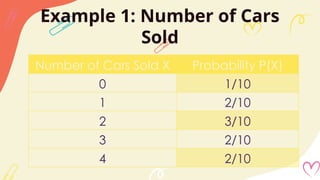
  • 222.
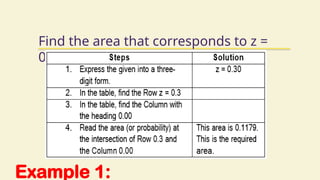
    Example 2: Thus, weestimate with 90% confidence that the true percentage of all students who are registered voters is between 56.4% and 63.6%.

Editor's Notes

  • #128 This kind of written curriculum needs to be pilot tested or tried out in sample schools to determine its effectiveness.
  • #130 This kind of written curriculum needs to be pilot tested or tried out in sample schools to determine its effectiveness.
  • #131 This kind of written curriculum needs to be pilot tested or tried out in sample schools to determine its effectiveness.
  • #132 This kind of written curriculum needs to be pilot tested or tried out in sample schools to determine its effectiveness.
  • #134 This kind of written curriculum needs to be pilot tested or tried out in sample schools to determine its effectiveness.
  • #139 This kind of written curriculum needs to be pilot tested or tried out in sample schools to determine its effectiveness.
  • #140 This kind of written curriculum needs to be pilot tested or tried out in sample schools to determine its effectiveness.
  • #141 This kind of written curriculum needs to be pilot tested or tried out in sample schools to determine its effectiveness.
  • #143 This kind of written curriculum needs to be pilot tested or tried out in sample schools to determine its effectiveness.