PSLE T-Score Explained ? ? ?
OUTLINE   PSLE is a placement exam What is the PSLE Aggregate SCORE? Why is T-Score used? Definition & Calculation of T-Score Questions about T-Score
PSLE  - a placement exam Need to reflect the relative achievement level of pupils within their peers. Places pupils into different courses according to their academic ability Enables posting to secondary schools by merit and as far as possible into a school of their choice.
What is PSLE Aggregate Score? It is a sum of scores. What are these scores? Are they raw scores?
The PSLE Aggregate Score  incorporates performance of pupils in all 4 subjects allows pupils to be ranked fairly
Can raw scores be used? NO !
Why Not? Different subjects have different levels of difficulty So are the spread of marks from the average mark,  i.e. the standard deviation (spread = standard deviation)
MEASURE OF S  P  R  E  A  D Narrow Wide
DOLLY I scored 85% in both English and Mother Tongue ! H U R R A Y !
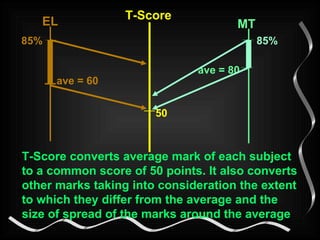
Dolly scores 85% in both EL and MT  EL EL ave = 60 MT MT ave = 80 0 100 85% Her performance in MT is very close to that of other pupils She did much better in EL as compared to other pupils
A need for standardisation of the raw scores Transformed Score or T-Score
T-Score MT T-Score converts average mark of each subject to a common score of 50 points. It also converts other marks taking into consideration the extent to which they differ from the average and the size of spread of the marks around the average  ave = 60 EL ave = 80 50 85% 85%
What is T-Score? It gives the relative position of a pupil’s performance as compared to the performance of all the other pupils in that subject The raw mark obtained in the exam only shows how good the pupil is in that subject, not how good he is as compared to others
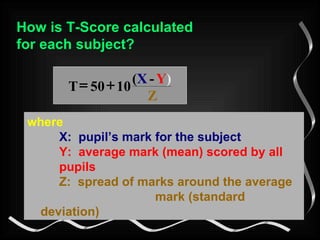
How is T-Score calculated for each subject? where  X:  pupil’s mark for the subject Y:  average mark (mean) scored by all  pupils Z:  spread of marks around the average  mark (standard deviation) Z Y ) - ( X 10 50 T  
Example: Pupil’s mark (X) in exam  = 50.0 Average mark (Y) scored by   all pupils  = 68.0 Spread of marks (Z) around the  average mark (Y)  = 14.0 T = 50 + 10  (50 - 68.0) 14.0 =  37.14
How is the Aggregate Score calculated? By adding the T-Scores of the 4 subjects
Example: Subject Total Mark T-Score EL1 200 105 34 CL2 200 152 51 Maths 100 67 53 Science 100 58 47 Aggregate: 185
Finally, all pupils are ranked according to their Aggregate Scores
T-SCORES & GRADES: Is it possible for a pupil with 3A* and 1A to be ranked lower than another pupil who has only 1A* and 3As? Yes, it is possible
Aggregate T-Score:  246  249

PSLE T-score

  • 1.
  • 2.
    OUTLINE PSLE is a placement exam What is the PSLE Aggregate SCORE? Why is T-Score used? Definition & Calculation of T-Score Questions about T-Score
  • 3.
    PSLE -a placement exam Need to reflect the relative achievement level of pupils within their peers. Places pupils into different courses according to their academic ability Enables posting to secondary schools by merit and as far as possible into a school of their choice.
  • 4.
    What is PSLEAggregate Score? It is a sum of scores. What are these scores? Are they raw scores?
  • 5.
    The PSLE AggregateScore incorporates performance of pupils in all 4 subjects allows pupils to be ranked fairly
  • 6.
    Can raw scoresbe used? NO !
  • 7.
    Why Not? Differentsubjects have different levels of difficulty So are the spread of marks from the average mark, i.e. the standard deviation (spread = standard deviation)
  • 8.
    MEASURE OF S P R E A D Narrow Wide
  • 9.
    DOLLY I scored85% in both English and Mother Tongue ! H U R R A Y !
  • 10.
    Dolly scores 85%in both EL and MT EL EL ave = 60 MT MT ave = 80 0 100 85% Her performance in MT is very close to that of other pupils She did much better in EL as compared to other pupils
  • 11.
    A need forstandardisation of the raw scores Transformed Score or T-Score
  • 12.
    T-Score MT T-Scoreconverts average mark of each subject to a common score of 50 points. It also converts other marks taking into consideration the extent to which they differ from the average and the size of spread of the marks around the average ave = 60 EL ave = 80 50 85% 85%
  • 13.
    What is T-Score?It gives the relative position of a pupil’s performance as compared to the performance of all the other pupils in that subject The raw mark obtained in the exam only shows how good the pupil is in that subject, not how good he is as compared to others
  • 14.
    How is T-Scorecalculated for each subject? where X: pupil’s mark for the subject Y: average mark (mean) scored by all pupils Z: spread of marks around the average mark (standard deviation) Z Y ) - ( X 10 50 T  
  • 15.
    Example: Pupil’s mark(X) in exam = 50.0 Average mark (Y) scored by all pupils = 68.0 Spread of marks (Z) around the average mark (Y) = 14.0 T = 50 + 10 (50 - 68.0) 14.0 = 37.14
  • 16.
    How is theAggregate Score calculated? By adding the T-Scores of the 4 subjects
  • 17.
    Example: Subject TotalMark T-Score EL1 200 105 34 CL2 200 152 51 Maths 100 67 53 Science 100 58 47 Aggregate: 185
  • 18.
    Finally, all pupilsare ranked according to their Aggregate Scores
  • 19.
    T-SCORES & GRADES:Is it possible for a pupil with 3A* and 1A to be ranked lower than another pupil who has only 1A* and 3As? Yes, it is possible
  • 20.

Editor's Notes

  • #3 My presentation will focus on: Placement: there is a need to inform pupils what is in store for them in their next lap of education careers. And How this is met through the use of PSLE aggregates Whose building blocks are the T-scores . Just what are this PSLE aggregates and T-scores: I will elaborate on this and the mechanic of their computation as we proceed.t Last but not least, I will illustrate with example on the relationship between grades and T-scores.
  • #4 T
  • #6 Basic consideration in the derivation of the aggregate: Must do JUSTICE to the pupils, the aggregate must incorporate the performance of the pupils in their four main areas of studies. Ranking to to into consideration, the relative standing (worth) of pupils in the respective subjects.
  • #8 Elaborate on SPREAD: As how ell the pupils’ performance are spread across the possible mark range. In some sense, spread denotes how precise a given test (as an instrument) Proceed s to the next slide to illustrate the concept of SPREAD as Precision of instrument.. The extent to which the test is ble to distinguish the performance of the pupils.
  • #9 Illustrate the concept of SPREAD as Precision of instrument.. The extent to which the test is able to distinguish the performance of the pupils.: by pointing to the way the (size/strength) of the given animals.
  • #11 Pinpoint in the order of the slide how as more information on the performance are revealed, the relative standing of Dolly’s in MT differ starkly from that of her EL.
  • #12 The previous slide showed that different subjects appeared to have different standard and thus there is a need to standardise the marks before aggregating them. This is done through the use of T-Score.
  • #13 Elaborate on the GIST of this transformation process: GIST: Bench mark each pupil’s performance against the average and reward he/she to the extent on how well he/she performed in relation to the average pupil., taking into consideration, the spread (precision) of the distribution of marks earned by the pupils.
  • #14 In essence, T-Scores provide the relative standing standing of a pupil’s performance in relation to his/her who take the same examination (in the same subject)
  • #15 Stress the concept of benchmarking against each pupil to the average performance (X-Y) and reward he/she with regards to how far is he/she above (or below) the average level of performance within a given subject, taking into consideration, the spread of the performance in the subject.
  • #17 Just the sum of T-scores
  • #20 This slide is to illustrate relationship between grades and T-score/aggregates
  • #21 Key Idea: There is a range of T-scores associated with a given grade. The A* in John case were weak A*. While the As in Susan’s case were very strong As, and her A8 was really a strong A* as well.