Components
of Language
Reading would not exist without
the human capacity for language.
Because the components of
language and their associated
terminology align with our
demarcations for many of the
elements of reading, they are
described briefly in this section.
Linguists have identified five basic
components (phonology, morphology,
syntax, semantics, and pragmatics)
found across languages.
 Language acquisition progresses
across these components with
increasing quantity (e.g., sounds,
words, and sentence length) and
gradual refinement, and
understanding of the subtler and
more complex points of usage (e.g.,
using “taught” rather than
“teached”).
Readers are encouraged to explore
the literature in the field of language
development to better understand
and appreciate the oral language
skills students may bring to the
reading process.
Speech and language pathologists
are a great resource for identifying
resources in this area and assisting
in determining whether a child’s
language skills are developing
normally and providing support
when assessment and intervention
may be required.
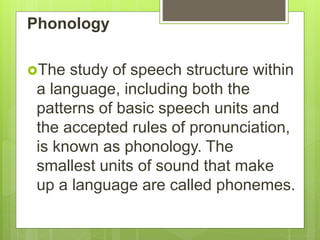
Phonology
The study of speech structure within
a language, including both the
patterns of basic speech units and
the accepted rules of pronunciation,
is known as phonology. The
smallest units of sound that make
up a language are called phonemes.
For example, the word “that”
contains three phonemes the
“th” represents one phoneme
/th/, the “a” maps to the short a
sound /ă/, and the “t” to its basic
sound /t/.
Morphology
Moving to the next level of
language, we find the study of the
smallest units of meaning,
morphemes.
Morphemes include base words,
such as “hat,” “dog,” or “love,” as
well as affixes, such as “un-,” “re-,”
the plural “s” or “es,” and the past
tense “ed.”
Knowledge of the morphology of
our language is critical to
vocabulary development and
reflects the smallest building blocks
for comprehension.
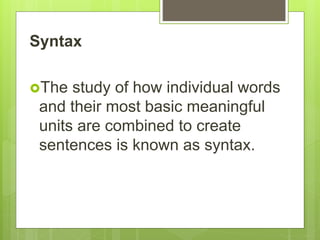
Syntax
The study of how individual words
and their most basic meaningful
units are combined to create
sentences is known as syntax.
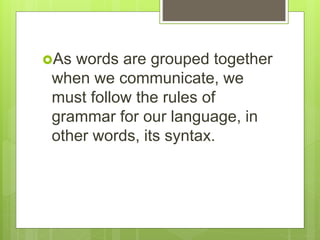
As words are grouped together
when we communicate, we
must follow the rules of
grammar for our language, in
other words, its syntax.
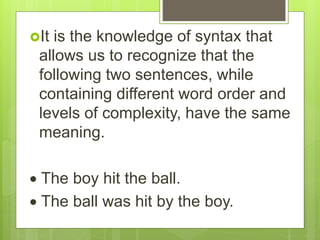
It is the knowledge of syntax that
allows us to recognize that the
following two sentences, while
containing different word order and
levels of complexity, have the same
meaning.
 The boy hit the ball.
 The ball was hit by the boy.
Syntax also allows us to
accept “I went to the store” as
a meaningful (grammatical)
sentence while “To store went
I” would not be acceptable
English.
Semantics
Not only does the grammatical
structure of our language provide the
needed clues for understanding, we
also have a wealth of figurative
language and rich description that
adds color and nuance to our
communication.
Semantics refers to the ways in which
a language conveys meaning.
It is our understanding of semantics
that allows us to recognize that
someone who is “green with envy” has
not changed hue, or that “having cold
feet” has less to do with the
appendage at the end of our legs and
more to do with our anxiety about a
new experience.
Because semantics moves beyond
the literal meaning of words and is
culture-dependent, this is among the
most difficult aspects of language for
individuals who are not native
speakers and even those who speak
the same language but come from
different cultures and convey
meaning using words in unique ways.
Anyone who has attempted to
converse with a teenager in
his own vernacular can
appreciate the importance of
sharing a semantic base for
communicating clearly.
Pragmatics
‘Pragmatics’ refers to the ways the
members of the speech community
achieve their goals using language.”
The way we speak to our parents is
not the same as the way we interact
with a sibling, for example.
The language used in a formal
speech may bear little resemblance
to what we would hear at a lunch
with five friends.
The conversational style of day-to-
day interactions is quite different
from the language used even when
reading a storybook to a toddler.
Knowing the difference and when to
use which style is the essence of
pragmatics.
Facility with language is critical to
social interactions. Our ability to
effectively communicate with others
through spoken and written
language is considered one of the
ultimate goals of our educational
system, with reading receiving
much-needed emphasis.

Lec.-1-Components-of-Language.pptx bsed english

  • 1.
  • 2.
    Reading would notexist without the human capacity for language. Because the components of language and their associated terminology align with our demarcations for many of the elements of reading, they are described briefly in this section.
  • 3.
    Linguists have identifiedfive basic components (phonology, morphology, syntax, semantics, and pragmatics) found across languages.
  • 4.
     Language acquisitionprogresses across these components with increasing quantity (e.g., sounds, words, and sentence length) and gradual refinement, and understanding of the subtler and more complex points of usage (e.g., using “taught” rather than “teached”).
  • 5.
    Readers are encouragedto explore the literature in the field of language development to better understand and appreciate the oral language skills students may bring to the reading process.
  • 6.
    Speech and languagepathologists are a great resource for identifying resources in this area and assisting in determining whether a child’s language skills are developing normally and providing support when assessment and intervention may be required.
  • 7.
    Phonology The study ofspeech structure within a language, including both the patterns of basic speech units and the accepted rules of pronunciation, is known as phonology. The smallest units of sound that make up a language are called phonemes.
  • 8.
    For example, theword “that” contains three phonemes the “th” represents one phoneme /th/, the “a” maps to the short a sound /ă/, and the “t” to its basic sound /t/.
  • 9.
    Morphology Moving to thenext level of language, we find the study of the smallest units of meaning, morphemes.
  • 10.
    Morphemes include basewords, such as “hat,” “dog,” or “love,” as well as affixes, such as “un-,” “re-,” the plural “s” or “es,” and the past tense “ed.” Knowledge of the morphology of our language is critical to vocabulary development and reflects the smallest building blocks for comprehension.
  • 11.
    Syntax The study ofhow individual words and their most basic meaningful units are combined to create sentences is known as syntax.
  • 12.
    As words aregrouped together when we communicate, we must follow the rules of grammar for our language, in other words, its syntax.
  • 13.
    It is theknowledge of syntax that allows us to recognize that the following two sentences, while containing different word order and levels of complexity, have the same meaning.  The boy hit the ball.  The ball was hit by the boy.
  • 14.
    Syntax also allowsus to accept “I went to the store” as a meaningful (grammatical) sentence while “To store went I” would not be acceptable English.
  • 15.
    Semantics Not only doesthe grammatical structure of our language provide the needed clues for understanding, we also have a wealth of figurative language and rich description that adds color and nuance to our communication.
  • 16.
    Semantics refers tothe ways in which a language conveys meaning. It is our understanding of semantics that allows us to recognize that someone who is “green with envy” has not changed hue, or that “having cold feet” has less to do with the appendage at the end of our legs and more to do with our anxiety about a new experience.
  • 17.
    Because semantics movesbeyond the literal meaning of words and is culture-dependent, this is among the most difficult aspects of language for individuals who are not native speakers and even those who speak the same language but come from different cultures and convey meaning using words in unique ways.
  • 18.
    Anyone who hasattempted to converse with a teenager in his own vernacular can appreciate the importance of sharing a semantic base for communicating clearly.
  • 19.
    Pragmatics ‘Pragmatics’ refers tothe ways the members of the speech community achieve their goals using language.”
  • 20.
    The way wespeak to our parents is not the same as the way we interact with a sibling, for example. The language used in a formal speech may bear little resemblance to what we would hear at a lunch with five friends.
  • 21.
    The conversational styleof day-to- day interactions is quite different from the language used even when reading a storybook to a toddler. Knowing the difference and when to use which style is the essence of pragmatics.
  • 22.
    Facility with languageis critical to social interactions. Our ability to effectively communicate with others through spoken and written language is considered one of the ultimate goals of our educational system, with reading receiving much-needed emphasis.