


CHOMSKY’S VIEW AND 
EVOLUTION OF LANGUAGE 
PANPACIFIC UNIVERSITY NORTH PHILIPPINES 
URDANETA CITY 
INSTITUTE OF GRADUATE SCHOOL 
Lecturer: 
MARLY IBARRA VILLACRUSIS 
Professor: 
DR. MA. MARTHA MANNETTE A. MADRID
Language serves as a cornerstone 
for human cognition, yet much 
about its evolution remains 
puzzling. 
Few would argue the significance of language in the 
evolution of the human species. Language serves many critical 
functions within the human experience, from keeping us safe 
to social engagement. While communication certainly exists in 
other species, the depth and complexity of human language is 
second to none. 
Although linguists and psychologists tend to agree about the 
importance of language, there is some disagreement about 
how language acquisition occurs. Are we born with a clean 
slate when it comes to language, or do we enter the world 
with a set of language skills ready to be put to use?
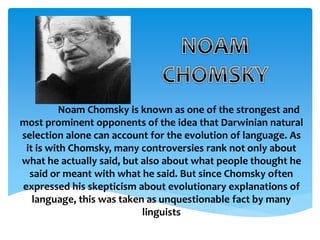
Noam Chomsky is known as one of the strongest and 
most prominent opponents of the idea that Darwinian natural 
selection alone can account for the evolution of language. As 
it is with Chomsky, many controversies rank not only about 
what he actually said, but also about what people thought he 
said or meant with what he said. But since Chomsky often 
expressed his skepticism about evolutionary explanations of 
language, this was taken as unquestionable fact by many 
linguists
Chomsky and the Evolution of Language 
Many authors, adopting the approach of evolutionary 
psychology, believe that language has been shaped 
by natural selection. In their view, certain random 
genetic mutations were thus selected over many 
thousands of years to provide certain individuals with 
a decisive adaptive advantage. Whether the 
advantage that language provided was in co-ordinating 
hunting parties, warning of danger, or 
communicating with sexual partners remains 
uncertain, however.
Chomsky, for his part, does not see our linguistic faculties as 
having originated from any particular selective pressure, but 
rather as a sort of fortuitous accident. He bases this view, among 
other things, on studies which found that recursivity—the ability 
to embed one clause inside another, as in “the person who was 
singing yesterday had a lovely voice”—might be the only 
specifically human component of language. According to the 
authors of these studies, recursivity originally developed not to 
help us communicate, but rather to help us solve other problems 
connected, for example, with numerical quantification or social 
relations, and humans did not become capable of complex 
language until recursivity was linked with the other motor and 
perceptual abilities needed for this purpose. According to 
Chomsky and his colleagues, there is nothing to indicate that this 
linkage was achieved through natural selection. They believe that 
it might simply be the result of some other kind of neuronal 
reorganization.
CHOMSKY’S VIEW OF THE LANGUAGE 
During the first half of the 20th century, linguists who theorized about the 
human ability to speak did so from the behaviourist perspective that 
prevailed at that time. They therefore held that language learning, like any 
other kind of learning, could be explained by a succession of trials, errors, 
and rewards for success. In other words, children learned their mother 
tongue by simple imitation, listening to and repeating what adults said. 
This view became radically questioned, however, by the American linguist 
Noam Chomsky. For Chomsky, acquiring language cannot be reduced to 
simply developing an inventory of responses to stimuli, because every 
sentence that anyone produces can be a totally new combination of words. 
When we speak, we combine a finite number of elements—the words of 
our language—to create an infinite number of larger structures— 
sentences.
In Chomsky’s view, the reason that 
children so easily master the complex 
operations of language is that they have 
innate knowledge of certain principles that 
guide them in developing the grammar of 
their language. In other words, Chomsky’s 
theory is that language learning is 
facilitated by a predisposition that our 
brains have for certain structures of 
language.
But what about language? 
For Chomsky’s theory to hold true, all of the 
languages in the world must share certain structural 
properties. And indeed, Chomsky and other 
generative linguists like him have shown that the 
5000 to 6000 languages in the world, despite their 
very different grammars, do share a set of syntactic 
rules and principles. These linguists believe that this 
“universal grammar” is innate and is embedded 
somewhere in the neuronal circuitry of the human 
brain. And that would be why children can select, 
from all the sentences that come to their minds, only 
those that conform to a “deep structure” encoded in 
the brain’s circuits.
Chomsky believed that language is innate, or in other 
words, we are born with a capacity for language. Language 
rules are influenced by experience and learning, but the 
capacity for language itself exists with or without 
environmental influences. Chomsky believed that language is 
so complex, with an unlimited combination of sounds, words, 
and phrases, that environmental learning is not able to account 
for language acquisition alone. It would take a lifetime to teach 
someone all of the rules of language, but even small children 
can understand them. Chomsky believed that the human brain 
comes into the world with a pre-determined set of rules for 
how language works. Environment and learning are involved, 
but the foundation for language comes with us from the 
womb.
Noam Chomsky postulated that the mechanism of the language 
acquisition is derived from the innate processes. Innate is 
something which is already there in mind since birth. The 
theory proposed by Chomsky is proved by the children living in 
same linguistic community. Moreover, they are not influenced 
by the external experiences which bring about the comparable 
grammar. He thus proposed his theory on language acquisition 
in 1977 as "all children share the same internal constraints 
which characterize narrowly the grammar they are going to 
construct." He also proposed that all of us live in a biological 
world, and according to him, mental world is no exception. He 
also believes that as there are stages of development for other 
parts of the body, language development can also be achieved 
up to a certain age.
Observations that Support the 
Chomskyian View of Language 
Until Chomsky propounded his theory of 
universal grammar in the 1960s, the 
empiricist school that had dominated 
thinking about language since the 
Enlightenment held that when children came 
into the world, their minds were like a blank 
slate. Chomsky’s theory had the impact of a 
large rock thrown into this previously 
tranquil, undisturbed pond of empiricism.
Subsequent research in the cognitive 
sciences, which combined the tools of 
psychology, linguistics, computer science, 
and philosophy, soon lent further support 
to the theory of universal grammar. For 
example, researchers found that babies 
only a few days old could distinguish the 
phonemes of any language and seemed to 
have an innate mechanism for processing 
the sounds of the human voice.
Thus, from birth, children would appear to have certain 
linguistic abilities that predispose them not only to acquire a 
complex language, but even to create one from whole cloth if 
the situation requires. One example of such a situation dates 
back to the time of plantations and slavery. On many 
plantations, the slaves came from many different places and so 
had different mother tongues. They therefore developed what 
are known as pidgin languages to communicate with one 
another. (Pidgin languages are not languages in the true sense, 
because they employ words so chaotically—there is tremendous 
variation in word order, and very little grammar.) But these 
slaves’ children, though exposed to these pidgins at the age 
when children normally acquire their first language, were not 
content to merely imitate them. Instead, the children 
spontaneously introduced grammatical complexity into their 
speech, thus in the space of one generation creating new 
languages, known as creoles.
Impact, Strengths and Weaknesses of Chomsky's Approach 
to Language Acquisition 
Based on the Chomky’s view and evolution of language, it is believed 
that we humans are born with a predisposition to learn language and with the 
basic rules for language intact. Though many specific language structures are 
heavily influenced by the environment, according to Chomsky, the human brain 
is ready made to quickly acquire language at specific stages in the 
developmental process. 
With regards to the evolution of language, Chomsky has not given 
much importance to the development of language. Mostly because he cannot 
imagine how the evolution of language came about. 
We must take Chomsky’s point of view with a grain of salt, just 
because he does not have a strong theory about the evolution of language 
does not mean that learning it is not important. The difficulty of understanding 
the evolution of language should not be an indictment on its’ importance 
rather it could be more of an indictment of our own intelligence. The evolution 
of language is complicated and still one of the great mysteries of the world. It 
may have been a random mutation without any clear advantages, but we still 
do not know. To better understand ourselves we must continue develop 
theories and research the evolution of language, because language is what 
separates us from other animals.
Noam Chomsky is perhaps the best known and influential linguist of the second half of 
the Twentieth Century. He has made a number of claims about language in particular, he 
suggests that language is an innate discipline in that we are born with a set of rules 
about language in our heads which he refers to as the 'Universal Grammar'. The 
universal grammar is the basis upon which all human languages build. In Chomsky's 
early work, this takes the form of an innate structure called the Language Acquisition 
Device (LAD). Psychologists have produced several accounts of infant language 
acquisition, which differ in their underlying theoretical perspectives. Behavioral 
perspectives in Language acquisition identified a sequence in language development. 
Skinner (1957) argued that language was learned by the child through the process of 
operant conditioning, a process of stimulus-response where a result occurs as a 
consequence of actions and that the environment in which a child lives reinforces 
behavior. 
Chomsky argued that Skinner's theory implied that children learn entirely through 
trial and error, that they try out possible utterances which they adopt if approved and 
reject if they do not. He argued that children acquire language in such a short space of 
time, acquiring complex grammatical rules and extensive vocabulary that would not 
have been possible through a trial and error system. Chomsky proposed that the child 
has a language acquisition device (LAD) which is an inherent mechanism allowing the 
child to hear the spoken language around it to reveal the basic principles of the 
language. 
In 1983, J Bruner brought together the two previous perspectives on Language 
acquisition to form the Interactionist Perspective, which consisted of the two elements, 
cognitive and social interaction between the child and the environment. He argued that 
parents provide their children with a language acquisition support system (LASS) which 
is a collection of strategies that parents use to facilitate their children's acquisition of 
language.
WEAKNESSES: 
A study of a child born to deaf parents. 
This child was surrounded by language in the form of television and radio but received no 
spoken language or LASS from his parents. The child only succeeded in acquiring language 
once he was referred to a speak therapist. As soon as the child received the social interaction 
of language he developed very quickly. 
This disproved Chomsky's views on the biological perspective. Although there have been 
many critics of Chomsky, many of his views have appeared in later research into the 
interactionist perspective. 
STRENGHTS: 
The focus of attention on features of languages common to all languages is one of the 
strengths of Chomsky's approach, the idea of universal grammar. The theory that a child does 
not simply copy the language that they hear around them, they deduce rules from it, which 
they can then use to create sentences that they have never heard before. Many studies of 
child directed speech, research undertaken by Catherine Snow (1979), show that speech to 
young children is slow, clear, grammatical and repetitious, supporting the work of Chomsky 
that children are able to learn without the social interaction.
Sources: 
Chomsky, Noam 1988. Language and Problems of Knowledge: The Managua 
Lectures. Cambridge, Mass. / London, England: MIT Press (Current Studies in 
Linguistics Series 16). 
evolutionoflanguage.blogspot.com/2010/12 
en.wikipedia.org/wiki/Noam_Chomsky 
www.brighteducation.com 
Sharedsymbolicstorage.blogspot.com/2008/02/language 
_evolution_i_noam_chomsky.html 
http://www.chomsky.info
Chomsky's view and evolution of language

Chomsky's view and evolution of language

  • 1.
    CHOMSKY’S VIEW AND EVOLUTION OF LANGUAGE PANPACIFIC UNIVERSITY NORTH PHILIPPINES URDANETA CITY INSTITUTE OF GRADUATE SCHOOL Lecturer: MARLY IBARRA VILLACRUSIS Professor: DR. MA. MARTHA MANNETTE A. MADRID
  • 2.
    Language serves asa cornerstone for human cognition, yet much about its evolution remains puzzling. Few would argue the significance of language in the evolution of the human species. Language serves many critical functions within the human experience, from keeping us safe to social engagement. While communication certainly exists in other species, the depth and complexity of human language is second to none. Although linguists and psychologists tend to agree about the importance of language, there is some disagreement about how language acquisition occurs. Are we born with a clean slate when it comes to language, or do we enter the world with a set of language skills ready to be put to use?
  • 3.
    Noam Chomsky isknown as one of the strongest and most prominent opponents of the idea that Darwinian natural selection alone can account for the evolution of language. As it is with Chomsky, many controversies rank not only about what he actually said, but also about what people thought he said or meant with what he said. But since Chomsky often expressed his skepticism about evolutionary explanations of language, this was taken as unquestionable fact by many linguists
  • 4.
    Chomsky and theEvolution of Language Many authors, adopting the approach of evolutionary psychology, believe that language has been shaped by natural selection. In their view, certain random genetic mutations were thus selected over many thousands of years to provide certain individuals with a decisive adaptive advantage. Whether the advantage that language provided was in co-ordinating hunting parties, warning of danger, or communicating with sexual partners remains uncertain, however.
  • 5.
    Chomsky, for hispart, does not see our linguistic faculties as having originated from any particular selective pressure, but rather as a sort of fortuitous accident. He bases this view, among other things, on studies which found that recursivity—the ability to embed one clause inside another, as in “the person who was singing yesterday had a lovely voice”—might be the only specifically human component of language. According to the authors of these studies, recursivity originally developed not to help us communicate, but rather to help us solve other problems connected, for example, with numerical quantification or social relations, and humans did not become capable of complex language until recursivity was linked with the other motor and perceptual abilities needed for this purpose. According to Chomsky and his colleagues, there is nothing to indicate that this linkage was achieved through natural selection. They believe that it might simply be the result of some other kind of neuronal reorganization.
  • 6.
    CHOMSKY’S VIEW OFTHE LANGUAGE During the first half of the 20th century, linguists who theorized about the human ability to speak did so from the behaviourist perspective that prevailed at that time. They therefore held that language learning, like any other kind of learning, could be explained by a succession of trials, errors, and rewards for success. In other words, children learned their mother tongue by simple imitation, listening to and repeating what adults said. This view became radically questioned, however, by the American linguist Noam Chomsky. For Chomsky, acquiring language cannot be reduced to simply developing an inventory of responses to stimuli, because every sentence that anyone produces can be a totally new combination of words. When we speak, we combine a finite number of elements—the words of our language—to create an infinite number of larger structures— sentences.
  • 7.
    In Chomsky’s view,the reason that children so easily master the complex operations of language is that they have innate knowledge of certain principles that guide them in developing the grammar of their language. In other words, Chomsky’s theory is that language learning is facilitated by a predisposition that our brains have for certain structures of language.
  • 8.
    But what aboutlanguage? For Chomsky’s theory to hold true, all of the languages in the world must share certain structural properties. And indeed, Chomsky and other generative linguists like him have shown that the 5000 to 6000 languages in the world, despite their very different grammars, do share a set of syntactic rules and principles. These linguists believe that this “universal grammar” is innate and is embedded somewhere in the neuronal circuitry of the human brain. And that would be why children can select, from all the sentences that come to their minds, only those that conform to a “deep structure” encoded in the brain’s circuits.
  • 9.
    Chomsky believed thatlanguage is innate, or in other words, we are born with a capacity for language. Language rules are influenced by experience and learning, but the capacity for language itself exists with or without environmental influences. Chomsky believed that language is so complex, with an unlimited combination of sounds, words, and phrases, that environmental learning is not able to account for language acquisition alone. It would take a lifetime to teach someone all of the rules of language, but even small children can understand them. Chomsky believed that the human brain comes into the world with a pre-determined set of rules for how language works. Environment and learning are involved, but the foundation for language comes with us from the womb.
  • 10.
    Noam Chomsky postulatedthat the mechanism of the language acquisition is derived from the innate processes. Innate is something which is already there in mind since birth. The theory proposed by Chomsky is proved by the children living in same linguistic community. Moreover, they are not influenced by the external experiences which bring about the comparable grammar. He thus proposed his theory on language acquisition in 1977 as "all children share the same internal constraints which characterize narrowly the grammar they are going to construct." He also proposed that all of us live in a biological world, and according to him, mental world is no exception. He also believes that as there are stages of development for other parts of the body, language development can also be achieved up to a certain age.
  • 11.
    Observations that Supportthe Chomskyian View of Language Until Chomsky propounded his theory of universal grammar in the 1960s, the empiricist school that had dominated thinking about language since the Enlightenment held that when children came into the world, their minds were like a blank slate. Chomsky’s theory had the impact of a large rock thrown into this previously tranquil, undisturbed pond of empiricism.
  • 12.
    Subsequent research inthe cognitive sciences, which combined the tools of psychology, linguistics, computer science, and philosophy, soon lent further support to the theory of universal grammar. For example, researchers found that babies only a few days old could distinguish the phonemes of any language and seemed to have an innate mechanism for processing the sounds of the human voice.
  • 13.
    Thus, from birth,children would appear to have certain linguistic abilities that predispose them not only to acquire a complex language, but even to create one from whole cloth if the situation requires. One example of such a situation dates back to the time of plantations and slavery. On many plantations, the slaves came from many different places and so had different mother tongues. They therefore developed what are known as pidgin languages to communicate with one another. (Pidgin languages are not languages in the true sense, because they employ words so chaotically—there is tremendous variation in word order, and very little grammar.) But these slaves’ children, though exposed to these pidgins at the age when children normally acquire their first language, were not content to merely imitate them. Instead, the children spontaneously introduced grammatical complexity into their speech, thus in the space of one generation creating new languages, known as creoles.
  • 14.
    Impact, Strengths andWeaknesses of Chomsky's Approach to Language Acquisition Based on the Chomky’s view and evolution of language, it is believed that we humans are born with a predisposition to learn language and with the basic rules for language intact. Though many specific language structures are heavily influenced by the environment, according to Chomsky, the human brain is ready made to quickly acquire language at specific stages in the developmental process. With regards to the evolution of language, Chomsky has not given much importance to the development of language. Mostly because he cannot imagine how the evolution of language came about. We must take Chomsky’s point of view with a grain of salt, just because he does not have a strong theory about the evolution of language does not mean that learning it is not important. The difficulty of understanding the evolution of language should not be an indictment on its’ importance rather it could be more of an indictment of our own intelligence. The evolution of language is complicated and still one of the great mysteries of the world. It may have been a random mutation without any clear advantages, but we still do not know. To better understand ourselves we must continue develop theories and research the evolution of language, because language is what separates us from other animals.
  • 15.
    Noam Chomsky isperhaps the best known and influential linguist of the second half of the Twentieth Century. He has made a number of claims about language in particular, he suggests that language is an innate discipline in that we are born with a set of rules about language in our heads which he refers to as the 'Universal Grammar'. The universal grammar is the basis upon which all human languages build. In Chomsky's early work, this takes the form of an innate structure called the Language Acquisition Device (LAD). Psychologists have produced several accounts of infant language acquisition, which differ in their underlying theoretical perspectives. Behavioral perspectives in Language acquisition identified a sequence in language development. Skinner (1957) argued that language was learned by the child through the process of operant conditioning, a process of stimulus-response where a result occurs as a consequence of actions and that the environment in which a child lives reinforces behavior. Chomsky argued that Skinner's theory implied that children learn entirely through trial and error, that they try out possible utterances which they adopt if approved and reject if they do not. He argued that children acquire language in such a short space of time, acquiring complex grammatical rules and extensive vocabulary that would not have been possible through a trial and error system. Chomsky proposed that the child has a language acquisition device (LAD) which is an inherent mechanism allowing the child to hear the spoken language around it to reveal the basic principles of the language. In 1983, J Bruner brought together the two previous perspectives on Language acquisition to form the Interactionist Perspective, which consisted of the two elements, cognitive and social interaction between the child and the environment. He argued that parents provide their children with a language acquisition support system (LASS) which is a collection of strategies that parents use to facilitate their children's acquisition of language.
  • 16.
    WEAKNESSES: A studyof a child born to deaf parents. This child was surrounded by language in the form of television and radio but received no spoken language or LASS from his parents. The child only succeeded in acquiring language once he was referred to a speak therapist. As soon as the child received the social interaction of language he developed very quickly. This disproved Chomsky's views on the biological perspective. Although there have been many critics of Chomsky, many of his views have appeared in later research into the interactionist perspective. STRENGHTS: The focus of attention on features of languages common to all languages is one of the strengths of Chomsky's approach, the idea of universal grammar. The theory that a child does not simply copy the language that they hear around them, they deduce rules from it, which they can then use to create sentences that they have never heard before. Many studies of child directed speech, research undertaken by Catherine Snow (1979), show that speech to young children is slow, clear, grammatical and repetitious, supporting the work of Chomsky that children are able to learn without the social interaction.
  • 17.
    Sources: Chomsky, Noam1988. Language and Problems of Knowledge: The Managua Lectures. Cambridge, Mass. / London, England: MIT Press (Current Studies in Linguistics Series 16). evolutionoflanguage.blogspot.com/2010/12 en.wikipedia.org/wiki/Noam_Chomsky www.brighteducation.com Sharedsymbolicstorage.blogspot.com/2008/02/language _evolution_i_noam_chomsky.html http://www.chomsky.info