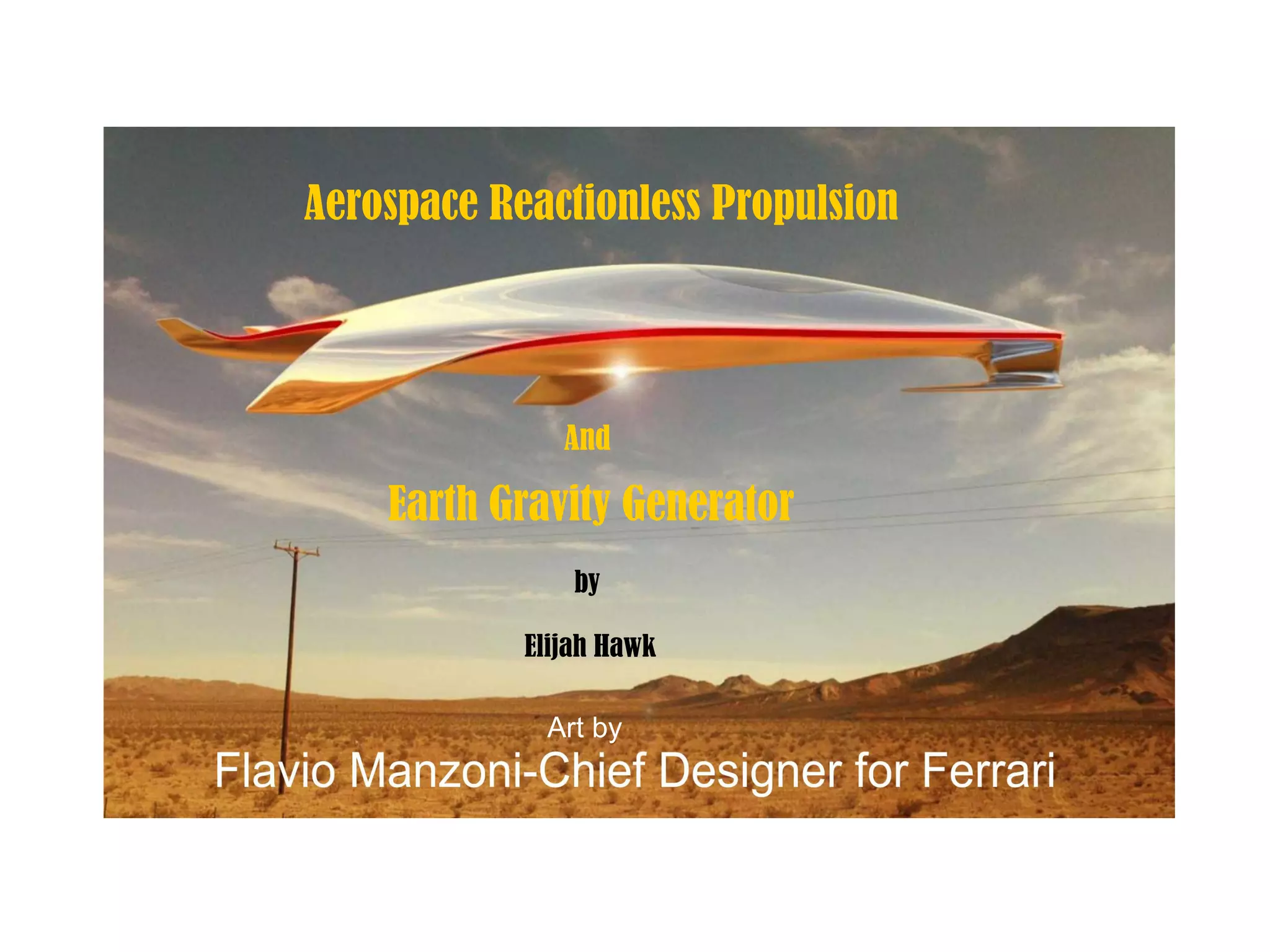
Aerospace Reactionless Propulsion
And
Earth Gravity Generator
by
Elijah Hawk
Art by
PROLOGUE
These mathematical models are presented here as theoretical concepts
that may, or not, represent actual workable mechanizes. According to
the present, well established view of the existing laws of physics, they will
not work. It is the view of this author that the existing laws of physics,
which are based on the the Inertial Frame of Reference, need to be modified
in order to reflect the dynamics within the Non-inertial Frame of Reference.
It is to this end that this work is hereby presented for others to evaluate.
Chapter 1
Chapter 2
Chapter 3
Distinction
Inertial Frame of Reference
vs
Non-inertial Frame of Reference
Mathematical Model
Reactionless Propulsion
Mathematical Model
Earth Gravity Generator
“The only way of discovering the limits
of the possible is to venture a little way
past them into the impossible.”
Arthur C. Clarke (Clarke's second law)
“In order to do the impossible,
you must see the invisible”
David Murdock
“Conventional wisdom leads to stagnation.
Unconventional wisdom leads to advancement.”
Elijah Hawk
Chapter 1
Inertial Frame of Reference
vs
Non-inertial Frame of Reference
Inertial Frame of Reference
In physics, an  inertial frame of reference (also  inertial
reference frame or  inertial frame or  Galilean reference
frame or  inertial space) is a  frame of reference that
describes time and space homogeneously,
isotropically, and in a time-independent manner.
Landau, L. D.; Lifshitz, E. M. (1960).  Mechanics. Pergamon Press. pp.  4–6.
Inertial Frame of Reference
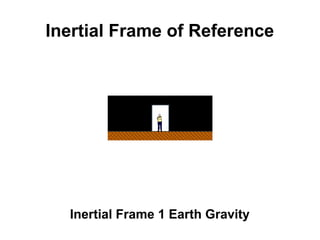
Inertial Frame 1 Earth Gravity
Inertial Frame of Reference
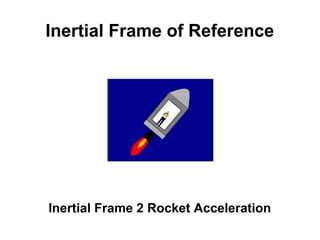
Inertial Frame 2 Rocket Acceleration
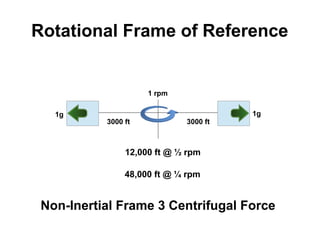
Rotational Frame of Reference
Non-Inertial Frame 3 Centrifugal Force
3000 ft 3000 ft
1 rpm
1g1g
12,000 ft @ ½ rpm
48,000 ft @ ¼ rpm
Centrifugal Force (Rotating Reference Frame)
In classical mechanics, the centrifugal force
is an outward force which arises when
describing the motion of objects in a
rotating reference frame. Because a rotating
frame is an example of a non-inertial
reference frame, Newton's laws of motion do
not accurately describe the dynamics within
the rotating frame. (John Robert Taylor)
Einstein's Principle of Equivalence
The equivalence principle was properly introduced by Albert Einstein in
1907, when he observed that the acceleration of bodies towards the
center of the Earth at a rate of 1g (g = 9.81 m/s2 being a standard
reference of gravitational acceleration at the Earth's surface) is
equivalent to the acceleration of an inertially moving body that would
be observed on a rocket in free space being accelerated at a rate of 1g.
Einstein stated it thus:
“We assume the complete physical equivalence of a gravitational field
and a corresponding acceleration of the reference system”.
—Einstein, 1907
The Hawk Principle of Equivalence
All Three Frames of Reference Affect Mass Proportionately the Same
Inertial Frame 1 Earth Gravity
Inertial Frame 2 Rocket Acceleration
Non-Inertial Frame 3 Centrifugal Force
The Hawk Equivalency
Newton's Laws/Inertial Frames
The laws of Newtonian mechanics do not always hold in
their simplest form.... Newton's laws hold in their simplest
form only in a family of reference frames, called inertial
frames. This fact represents the essence of the Galilean
principle of relativity: ”The laws of mechanics have the
same form in all inertial frames”.
Milutin Blagojević:  Gravitation and Gauge Symmetries, p. 4
The Laws of Physics Vary
Physical laws take the same form in all inertial frames.  By
contrast, in a non-inertial reference frame the laws of
physics vary depending on the acceleration of that frame
with respect to an inertial frame, and the usual physical
forces must be supplemented by fictional forces.
  Milton A. Rothman (1989). . Courier Dover Publications. p. 23
Sidney Borowitz & Lawrence A. Bornstein (1968). A Commentary View of Physics
Spiral Galaxies
Modified Newtonian Dynamics (MOND) is a hypothesis
advanced by Mordehai Milgrom (Milgrom, 1993) in order  to
explain the anomalous rotation of spiral galaxies. Many
such galaxies do not appear to obey Newton's law of
gravitational attraction....
EarthTech International Website http://earthtech.org/mond/ Harold Puthoff, Ph.D
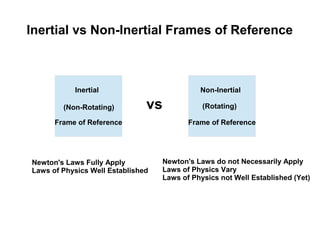
Inertial vs Non-Inertial Frames of Reference
Inertial
Frame of Reference
Non-Inertial
(Rotating)
Frame of Reference
vs
Newton's Laws Fully Apply
Laws of Physics Well Established
Newton's Laws do not Necessarily Apply
Laws of Physics Vary
Laws of Physics not Well Established (Yet)
(Non-Rotating)
Chapter 2
Mathematical Model
Reactionless Propulsion
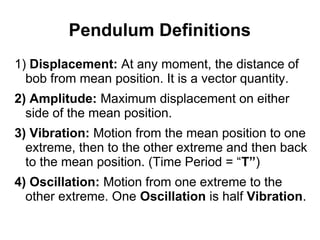
Pendulum Definitions
1) Displacement: At any moment, the distance of
bob from mean position. It is a vector quantity.
2) Amplitude: Maximum displacement on either
side of the mean position.
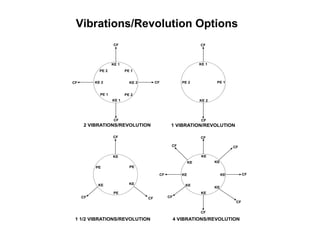
3) Vibration: Motion from the mean position to one
extreme, then to the other extreme and then back
to the mean position. (Time Period = “T”)
4) Oscillation: Motion from one extreme to the
other extreme. One Oscillation is half Vibration.
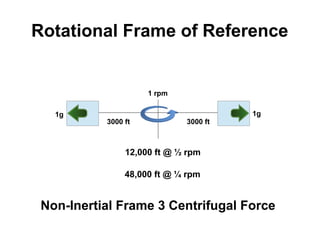
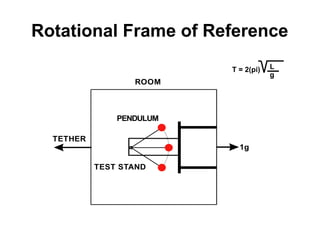
Rotational Frame of Reference
Non-Inertial Frame 3 Centrifugal Force
3000 ft 3000 ft
1 rpm
1g1g
12,000 ft @ ½ rpm
48,000 ft @ ¼ rpm
Rotational Frame of Reference
ROOM
TETHER
TEST STAND
PENDULUM
1g
T = 2(pi) L
g
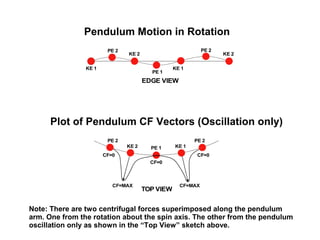
KE 1
KE 2
PE 1
PE 2
KE 1
PE 2
KE 2
EDGE VIEW
KE 1PE 1KE 2
PE 2 PE 2
TOP VIEW
CF=0
CF=0
CF=0
CF=MAXCF=MAX
Pendulum Motion in Rotation
Plot of Pendulum CF Vectors (Oscillation only)
Note: There are two centrifugal forces superimposed along the pendulum
arm. One from the rotation about the spin axis. The other from the pendulum
oscillation only as shown in the “Top View” sketch above.
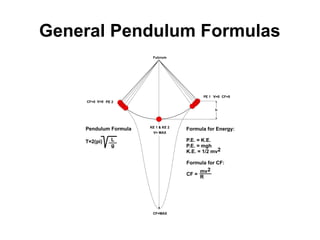
General Pendulum Formulas
2
Vibrations/Revolution Options
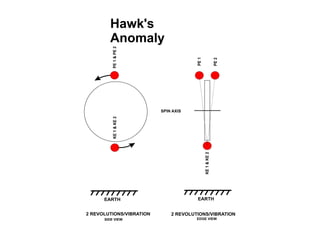
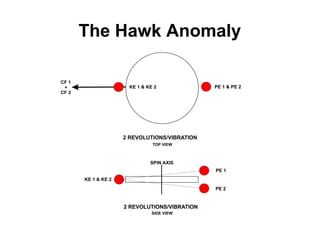
The Hawk Anomaly
PE 1
PE 2
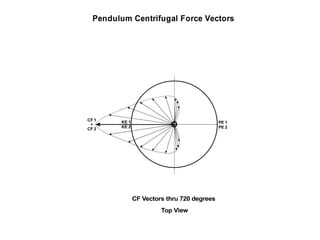
CF Vectors thru 720 degrees
Top View
Pendulum Centrifugal Force Vectors
KE 1
KE 2
CF 1
+
CF 2
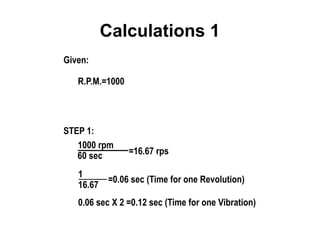
Calculations 1
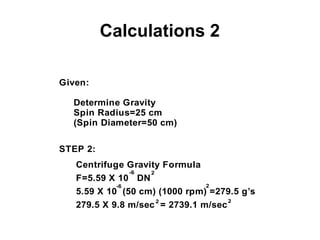
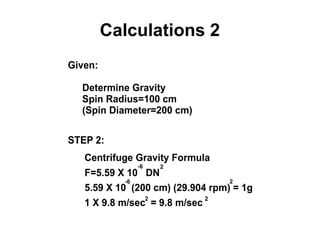
Calculations 2
Given:
Determine Gravity
Spin Radius=25 cm
(Spin Diameter=50 cm)
STEP 2:
Centrifuge Gravity Formula
F=5.59 X 10 DN
-6 2
5.59 X 10 (50 cm) (1000 rpm) =279.5 g’s
2-6
279.5 X 9.8 m/sec = 2739.1 m/sec
2 2
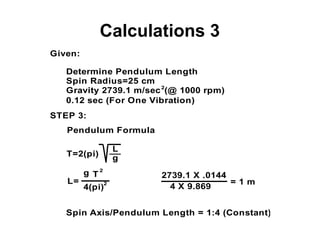
Calculations 3
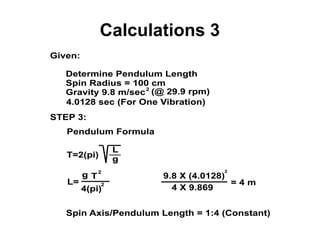
Given:
Determine Pendulum Length
Spin Radius=25 cm
Gravity 2739.1 m/sec
STEP 3:
2
Pendulum Formula
T=2(pi)
L
g
L=
g
4(pi)
2739.1 X .0144
= 1 m
0.12 sec (For One Vibration)
(@ 1000 rpm)
Spin Axis/Pendulum Length = 1:4 (Constant)
T
2
2
4 X 9.869
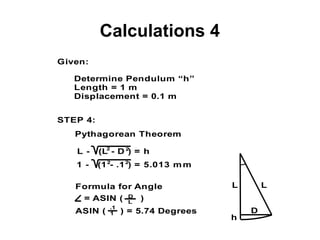
Calculations 4
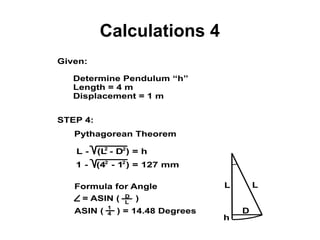
Given:
Determine Pendulum “h”
Length = 1 m
Displacement = 0.1 m
STEP 4:
Pythagorean Theorem
L - (L - D ) = h2
1 - (1 - .1 ) = 5.013 mm
L
D
h
LFormula for Angle
= ASIN ( )D
L
ASIN ( ) = 5.74 Degrees
.1
1
2
2 2
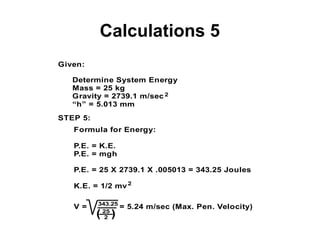
Calculations 5
Given:
Determine System Energy
Mass = 25 kg
Gravity = 2739.1 m/sec
“h” = 5.013 mm
STEP 5:
Formula for Energy:
P.E. = K.E.
P.E. = mgh
P.E. = 25 X 2739.1 X .005013 = 343.25 Joules
K.E. = 1/2 mv
2
2
V = = 5.24 m/sec (Max. Pen. Velocity)343.25
25
2( )
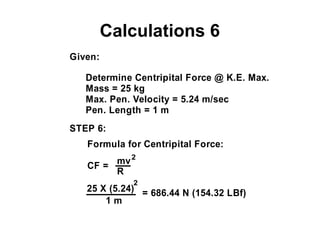
Calculations 6
Given:
Determine Centripital Force @ K.E. Max.
Mass = 25 kg
Max. Pen. Velocity = 5.24 m/sec
Pen. Length = 1 m
STEP 6:
Formula for Centripital Force:
CF =
2
mv
R
25 X (5.24)
1 m
= 686.44 N (154.32 LBf)
2
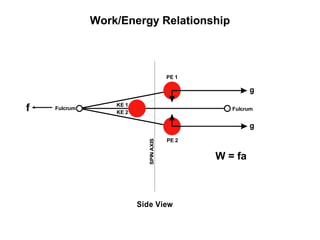
g
g
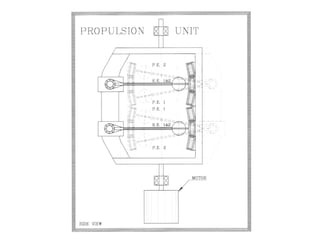
FulcrumFulcrum
PE 1
PE 2
KE 2
KE 1
SPINAXIS
Side View
Work/Energy Relationship
W = fa
f
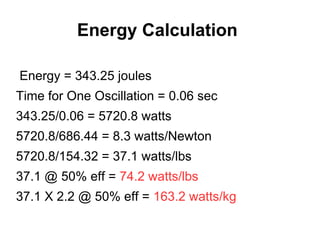
Energy Calculation
Energy = 343.25 joules
Time for One Oscillation = 0.06 sec
343.25/0.06 = 5720.8 watts
5720.8/686.44 = 8.3 watts/Newton
5720.8/154.32 = 37.1 watts/lbs
37.1 @ 50% eff = 74.2 watts/lbs
37.1 X 2.2 @ 50% eff = 163.2 watts/kg
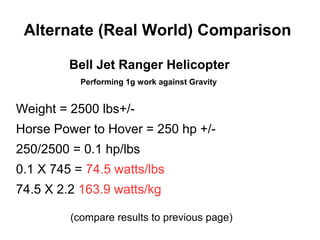
Alternate (Real World) Comparison
Bell Jet Ranger Helicopter
Performing 1g work against Gravity
Weight = 2500 lbs+/-
Horse Power to Hover = 250 hp +/-
250/2500 = 0.1 hp/lbs
0.1 X 745 = 74.5 watts/lbs
74.5 X 2.2 163.9 watts/kg
(compare results to previous page)
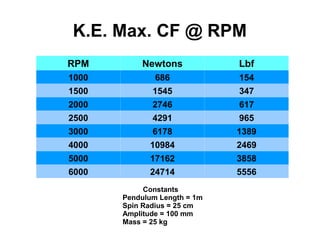
K.E. Max. CF @ RPM
RPM Newtons Lbf
1000 686 154
1500 1545 347
2000 2746 617
2500 4291 965
3000 6178 1389
4000 10984 2469
5000 17162 3858
6000 24714 5556
Constants
Pendulum Length = 1m
Spin Radius = 25 cm
Amplitude = 100 mm
Mass = 25 kg
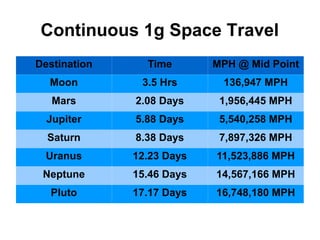
Continuous 1g Space Travel
Destination Time MPH @ Mid Point
Moon 3.5 Hrs 136,947 MPH
Mars 2.08 Days 1,956,445 MPH
Jupiter 5.88 Days 5,540,258 MPH
Saturn 8.38 Days 7,897,326 MPH
Uranus 12.23 Days 11,523,886 MPH
Neptune 15.46 Days 14,567,166 MPH
Pluto 17.17 Days 16,748,180 MPH
Chapter 3
Mathematical Model
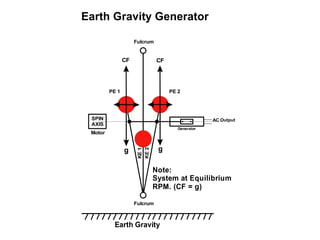
Earth Gravity Generator
g g
Fulcrum
Fulcrum
PE 1 PE 2
KE2
KE1
SPIN
AXIS
Earth Gravity
Earth Gravity Generator
AC Output
Generator
CF CF
Note:
System at Equilibrium
RPM. (CF = g)
Motor
Hawk's
Anomaly
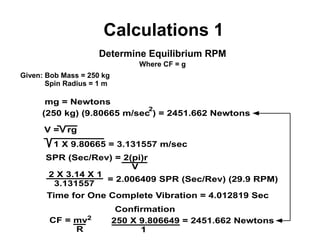
Calculations 1
Determine Equilibrium RPM
Where CF = g
Given: Bob Mass = 250 kg
Spin Radius = 1 m
Calculations 2
Calculations 3
Calculations 4
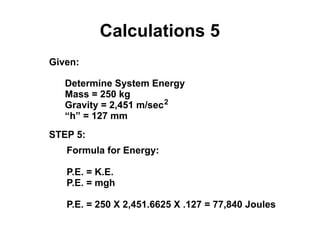
Calculations 5
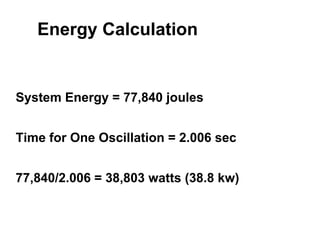
Energy Calculation
System Energy = 77,840 joules
Time for One Oscillation = 2.006 sec
77,840/2.006 = 38,803 watts (38.8 kw)
Q.E.D.

Propulsion/Energy Concept

  • 1.
    Aerospace Reactionless Propulsion And EarthGravity Generator by Elijah Hawk Art by
  • 2.
    PROLOGUE These mathematical modelsare presented here as theoretical concepts that may, or not, represent actual workable mechanizes. According to the present, well established view of the existing laws of physics, they will not work. It is the view of this author that the existing laws of physics, which are based on the the Inertial Frame of Reference, need to be modified in order to reflect the dynamics within the Non-inertial Frame of Reference. It is to this end that this work is hereby presented for others to evaluate.
  • 3.
    Chapter 1 Chapter 2 Chapter3 Distinction Inertial Frame of Reference vs Non-inertial Frame of Reference Mathematical Model Reactionless Propulsion Mathematical Model Earth Gravity Generator
  • 4.
    “The only wayof discovering the limits of the possible is to venture a little way past them into the impossible.” Arthur C. Clarke (Clarke's second law) “In order to do the impossible, you must see the invisible” David Murdock “Conventional wisdom leads to stagnation. Unconventional wisdom leads to advancement.” Elijah Hawk
  • 5.
    Chapter 1 Inertial Frameof Reference vs Non-inertial Frame of Reference
  • 6.
    Inertial Frame ofReference In physics, an  inertial frame of reference (also  inertial reference frame or  inertial frame or  Galilean reference frame or  inertial space) is a  frame of reference that describes time and space homogeneously, isotropically, and in a time-independent manner. Landau, L. D.; Lifshitz, E. M. (1960).  Mechanics. Pergamon Press. pp.  4–6.
  • 7.
    Inertial Frame ofReference Inertial Frame 1 Earth Gravity
  • 8.
    Inertial Frame ofReference Inertial Frame 2 Rocket Acceleration
  • 9.
    Rotational Frame ofReference Non-Inertial Frame 3 Centrifugal Force 3000 ft 3000 ft 1 rpm 1g1g 12,000 ft @ ½ rpm 48,000 ft @ ¼ rpm
  • 10.
    Centrifugal Force (RotatingReference Frame) In classical mechanics, the centrifugal force is an outward force which arises when describing the motion of objects in a rotating reference frame. Because a rotating frame is an example of a non-inertial reference frame, Newton's laws of motion do not accurately describe the dynamics within the rotating frame. (John Robert Taylor)
  • 11.
    Einstein's Principle ofEquivalence The equivalence principle was properly introduced by Albert Einstein in 1907, when he observed that the acceleration of bodies towards the center of the Earth at a rate of 1g (g = 9.81 m/s2 being a standard reference of gravitational acceleration at the Earth's surface) is equivalent to the acceleration of an inertially moving body that would be observed on a rocket in free space being accelerated at a rate of 1g. Einstein stated it thus: “We assume the complete physical equivalence of a gravitational field and a corresponding acceleration of the reference system”. —Einstein, 1907
  • 12.
    The Hawk Principleof Equivalence All Three Frames of Reference Affect Mass Proportionately the Same Inertial Frame 1 Earth Gravity Inertial Frame 2 Rocket Acceleration Non-Inertial Frame 3 Centrifugal Force The Hawk Equivalency
  • 13.
    Newton's Laws/Inertial Frames Thelaws of Newtonian mechanics do not always hold in their simplest form.... Newton's laws hold in their simplest form only in a family of reference frames, called inertial frames. This fact represents the essence of the Galilean principle of relativity: ”The laws of mechanics have the same form in all inertial frames”. Milutin Blagojević:  Gravitation and Gauge Symmetries, p. 4
  • 14.
    The Laws ofPhysics Vary Physical laws take the same form in all inertial frames.  By contrast, in a non-inertial reference frame the laws of physics vary depending on the acceleration of that frame with respect to an inertial frame, and the usual physical forces must be supplemented by fictional forces.   Milton A. Rothman (1989). . Courier Dover Publications. p. 23 Sidney Borowitz & Lawrence A. Bornstein (1968). A Commentary View of Physics
  • 15.
    Spiral Galaxies Modified NewtonianDynamics (MOND) is a hypothesis advanced by Mordehai Milgrom (Milgrom, 1993) in order  to explain the anomalous rotation of spiral galaxies. Many such galaxies do not appear to obey Newton's law of gravitational attraction.... EarthTech International Website http://earthtech.org/mond/ Harold Puthoff, Ph.D
  • 16.
    Inertial vs Non-InertialFrames of Reference Inertial Frame of Reference Non-Inertial (Rotating) Frame of Reference vs Newton's Laws Fully Apply Laws of Physics Well Established Newton's Laws do not Necessarily Apply Laws of Physics Vary Laws of Physics not Well Established (Yet) (Non-Rotating)
  • 17.
  • 18.
    Pendulum Definitions 1) Displacement:At any moment, the distance of bob from mean position. It is a vector quantity. 2) Amplitude: Maximum displacement on either side of the mean position. 3) Vibration: Motion from the mean position to one extreme, then to the other extreme and then back to the mean position. (Time Period = “T”) 4) Oscillation: Motion from one extreme to the other extreme. One Oscillation is half Vibration.
  • 19.
    Rotational Frame ofReference Non-Inertial Frame 3 Centrifugal Force 3000 ft 3000 ft 1 rpm 1g1g 12,000 ft @ ½ rpm 48,000 ft @ ¼ rpm
  • 20.
    Rotational Frame ofReference ROOM TETHER TEST STAND PENDULUM 1g T = 2(pi) L g
  • 21.
    KE 1 KE 2 PE1 PE 2 KE 1 PE 2 KE 2 EDGE VIEW KE 1PE 1KE 2 PE 2 PE 2 TOP VIEW CF=0 CF=0 CF=0 CF=MAXCF=MAX Pendulum Motion in Rotation Plot of Pendulum CF Vectors (Oscillation only) Note: There are two centrifugal forces superimposed along the pendulum arm. One from the rotation about the spin axis. The other from the pendulum oscillation only as shown in the “Top View” sketch above.
  • 22.
  • 23.
  • 24.
  • 25.
    PE 1 PE 2 CFVectors thru 720 degrees Top View Pendulum Centrifugal Force Vectors KE 1 KE 2 CF 1 + CF 2
  • 26.
  • 27.
    Calculations 2 Given: Determine Gravity SpinRadius=25 cm (Spin Diameter=50 cm) STEP 2: Centrifuge Gravity Formula F=5.59 X 10 DN -6 2 5.59 X 10 (50 cm) (1000 rpm) =279.5 g’s 2-6 279.5 X 9.8 m/sec = 2739.1 m/sec 2 2
  • 28.
    Calculations 3 Given: Determine PendulumLength Spin Radius=25 cm Gravity 2739.1 m/sec STEP 3: 2 Pendulum Formula T=2(pi) L g L= g 4(pi) 2739.1 X .0144 = 1 m 0.12 sec (For One Vibration) (@ 1000 rpm) Spin Axis/Pendulum Length = 1:4 (Constant) T 2 2 4 X 9.869
  • 29.
    Calculations 4 Given: Determine Pendulum“h” Length = 1 m Displacement = 0.1 m STEP 4: Pythagorean Theorem L - (L - D ) = h2 1 - (1 - .1 ) = 5.013 mm L D h LFormula for Angle = ASIN ( )D L ASIN ( ) = 5.74 Degrees .1 1 2 2 2
  • 30.
    Calculations 5 Given: Determine SystemEnergy Mass = 25 kg Gravity = 2739.1 m/sec “h” = 5.013 mm STEP 5: Formula for Energy: P.E. = K.E. P.E. = mgh P.E. = 25 X 2739.1 X .005013 = 343.25 Joules K.E. = 1/2 mv 2 2 V = = 5.24 m/sec (Max. Pen. Velocity)343.25 25 2( )
  • 31.
    Calculations 6 Given: Determine CentripitalForce @ K.E. Max. Mass = 25 kg Max. Pen. Velocity = 5.24 m/sec Pen. Length = 1 m STEP 6: Formula for Centripital Force: CF = 2 mv R 25 X (5.24) 1 m = 686.44 N (154.32 LBf) 2
  • 32.
    g g FulcrumFulcrum PE 1 PE 2 KE2 KE 1 SPINAXIS Side View Work/Energy Relationship W = fa f
  • 33.
    Energy Calculation Energy =343.25 joules Time for One Oscillation = 0.06 sec 343.25/0.06 = 5720.8 watts 5720.8/686.44 = 8.3 watts/Newton 5720.8/154.32 = 37.1 watts/lbs 37.1 @ 50% eff = 74.2 watts/lbs 37.1 X 2.2 @ 50% eff = 163.2 watts/kg
  • 34.
    Alternate (Real World)Comparison Bell Jet Ranger Helicopter Performing 1g work against Gravity Weight = 2500 lbs+/- Horse Power to Hover = 250 hp +/- 250/2500 = 0.1 hp/lbs 0.1 X 745 = 74.5 watts/lbs 74.5 X 2.2 163.9 watts/kg (compare results to previous page)
  • 35.
    K.E. Max. CF@ RPM RPM Newtons Lbf 1000 686 154 1500 1545 347 2000 2746 617 2500 4291 965 3000 6178 1389 4000 10984 2469 5000 17162 3858 6000 24714 5556 Constants Pendulum Length = 1m Spin Radius = 25 cm Amplitude = 100 mm Mass = 25 kg
  • 37.
    Continuous 1g SpaceTravel Destination Time MPH @ Mid Point Moon 3.5 Hrs 136,947 MPH Mars 2.08 Days 1,956,445 MPH Jupiter 5.88 Days 5,540,258 MPH Saturn 8.38 Days 7,897,326 MPH Uranus 12.23 Days 11,523,886 MPH Neptune 15.46 Days 14,567,166 MPH Pluto 17.17 Days 16,748,180 MPH
  • 38.
  • 39.
    g g Fulcrum Fulcrum PE 1PE 2 KE2 KE1 SPIN AXIS Earth Gravity Earth Gravity Generator AC Output Generator CF CF Note: System at Equilibrium RPM. (CF = g) Motor
  • 40.
  • 41.
    Calculations 1 Determine EquilibriumRPM Where CF = g Given: Bob Mass = 250 kg Spin Radius = 1 m
  • 42.
  • 43.
  • 44.
  • 45.
  • 46.
    Energy Calculation System Energy= 77,840 joules Time for One Oscillation = 2.006 sec 77,840/2.006 = 38,803 watts (38.8 kw)
  • 47.