Chapter 2
Using F = ma
The general goal of classical mechanics is to determine what happens to a given set
of objects in a given physical situation. In order to figure this out, we need to know
what makes objects move the way they do. There are two main ways of going about
this task. One way (the more advanced one) involves the Lagrangian method, which
we will discuss in Chapter 5. The other (which you are undoubtedly familiar with)
involves Newton’s laws, which will be the subject of the present chapter.
It should be noted that each of these two methods is perfectly sufficient for
solving any problem. They both produce the same information in the end (that is,
the same equations), but they are based on vastly different principles. We’ll talk
more about this is Chapter 5.
2.1 Newton’s Laws
Newton published his three laws in 1687 in his Principia Mathematica. The laws are
quite intuitive (although it seems a bit strange to attach the adjective “intuitive”
to a set of statements that took millennia for humans to write down). They may be
formulated as follows (although there are other possible variations).
• First Law: A body moves with constant velocity (which may be zero) unless
acted on by a force.
• Second Law: The time rate of change of the momentum of a body equals
the force acting on the body.
• Third Law: The forces two bodies apply to each other are equal in magnitude
and opposite in direction.
We could discuss for days on end the degree to which these statements are
physical laws, and the degree to which they are definitions. Sir Arthur Eddington
once made the unflattering comment that the first law essentially says that “every
particle continues in its state of rest or uniform motion in a straight line except
insofar that it doesn’t.” Although Newton’s laws may seem somewhat vacuous at
first glance, there is actually a bit more content to them than Eddington’s statement
II-1
II-2 CHAPTER 2. USING F = MA
implies. Let’s look at each in turn. The discussion will be brief, because we have to
save time for other things in this book that we really do want to discuss for days on
end.
First Law
One thing this law does is give a definition of zero force.
Another thing it does is give a definition of an inertial frame (which is defined
simply as a reference frame in which the first law holds). Since the term ‘velocity’ is
used, we have to state what frame of reference we are measuring the velocity with
respect to. The first law does not hold in an arbitrary frame. For example, it fails in
the frame of a spinning turntable.1 Intuitively, an inertial frame is one that moves
at constant speed. But this is ambiguous, because you have to say what the frame
is moving at constant speed with respect to. At any rate, an inertial frame is simply
defined as the special type of frame where the first law holds.
So, what we have now are two intertwined definitions of “force” and “inertial
frame”. Not much physical content here. But, however sparse in content the law is,
it still holds for all particles. So if we have a frame where one free particle moves
with constant velocity, then if we replace it with another particle, it will likewise
move with constant velocity. This is a statement with content.
Second Law
One thing this law does is give a definition of non-zero force. Momentum is defined2
to be mv. If m is constant, then this law says that
F = ma, (2.1)
where a ≡ dv/dt. This law holds only in an inertial frame (which was defined by
the first law).
For things moving free or at rest,
Observe what the first law does best.
It defines a key frame,
“Inertial” by name,
Where the second law then is expressed.
So far, the second law merely gives a definition of F. But the meaningful state-
ment arises when we invoke the fact that the law holds for all particles. If the same
force (for example, the same spring stretched by the same amount) acts on two
particles, with masses m1 and m2, then their accelerations must be related by
a1
a2
=
m2
m1
. (2.2)
1
It is, however, possible to fudge things so that Newton’s laws hold in such a frame, but we’ll
save this discussion for Chapter 9.
2
We’re doing everything nonrelativistically here, of course. Chapter 11 gives the relativistic
modification of the mv expression.
2.2. FREE-BODY DIAGRAMS II-3
This relation holds regardless of what the common force is. Therefore, once you’ve
used one force to find the relative masses of two objects, then you know what the
ratio of their a’s will be when they are subjected to any other force.
Of course, we haven’t really defined mass yet. But eq. (2.2) gives an experi-
mental method for determining an object’s mass in terms of a standard (say, 1 kg)
mass. All you have to do is compare its acceleration with that of the standard mass
(when acted on by the same force).
There is also another piece of substance in this law, in that it says F = ma,
instead of, say, F = mv or F = m d3x/dt3. This issue is related to the first law.
F = mv is certainly not viable, because the first law says that it is possible to have
a velocity without a force. And F = md3x/dt3 would make the first law incorrect,
because it would then be true that a particle moves with constant acceleration
(instead of constant velocity) unless acted on by a force.
Note that F = ma is a vector equation, so it is really three equations in one. In
cartesian coordinates, it says that Fx = max, Fy = may, and Fz = maz.
Third Law
This law essentially postulates that momentum is conserved, (that is, not dependent
on time). To see this, note that
dp
dt
=
d(m1v1 + m2v2)
dt
= m1a1 + m2a2
= F1 + F2, (2.3)
where F1 and F2 are the forces acting on m1 and m2, respectively. Therefore,
momentum conservation (that is, dp/dt = 0) is equivalent to Newton’s third law
(that is, F1 = −F2.)
There isn’t much left to be defined in this law, so the statement of the third law
is one of pure content. It says that if you have two isolated particles, then their
accelerations are opposite in direction and inversely proportional to their masses.
This third law cannot be a definition, because it’s actually not always valid. It
only holds for forces of the “pushing” and “pulling” type. It fails for the magnetic
force, for example.
2.2 Free-body diagrams
The law that allows us to be quantitative is the second law. Given a force, we can
apply F = ma to find the acceleration. And knowing the acceleration, we should be
able to determine the behavior of a given object (that is, where it is and how fast
it is moving). This process sometimes takes a bit of work, but there are two basic
types of situations that commonly arise.
• In many problems, all you are given is a physical situation (for example, a
block resting on a plane, strings connecting masses, etc.), and it is up to you
II-4 CHAPTER 2. USING F = MA
to find all the forces acting on all the objects. These forces generally point in
various directions, so it is easy to lose track of them. It therefore proves useful
to isolate the objects and draw all the forces acting on each of them. This is
the subject of the present section.
• In other problems, you are given the force, F(x), as a function of position
(we’ll just work in one dimension here), and the task immediately becomes
the mathematical one of solving the F(x) = ma ≡ m¨x equation. These
differential equations can be difficult (or impossible) to solve exactly. They
are the subject of Section 2.3.
Let’s now consider the first of these two types of problems, where we are pre-
sented with a physical situation, and where we must determine all the forces in-
volved. The term free-body diagram is used to denote a diagram with all the forces
drawn on all the objects. After drawing such a diagram, we simply write down all
the F = ma equations it implies. The result will be a system of linear equations
in various unknown forces and accelerations, for which we must then solve. This
procedure is best understood through an example.
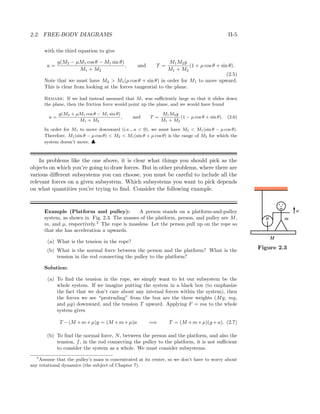
Example (A plane and masses): Mass M1 is held on a plane with inclination
angle θ, and mass M2 hangs over the side. The two masses are connected by a massless
string which runs over a massless pulley (see Fig. 2.1). The coefficient of friction
M1
M2
θ
µ
Figure 2.1 (assume the kinetic and static coefficients are equal) between M1 and the plane is µ.
Mass M1 is released. Assuming that M2 is sufficiently large so that M1 gets pulled up
the plane, what is the acceleration of the system? What is the tension in the string?
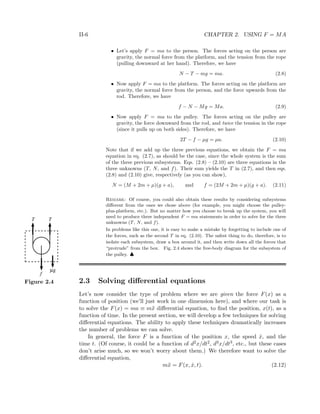
Solution: The first thing to do is draw all the forces on the two masses. These
are shown in Fig. 2.2. The forces on M2 are gravity and the tension. The forces
M1
M2
θ
N T
f
T
g
g
Figure 2.2
on M1 are gravity, friction, the tension, and the normal force. Note that the friction
force points down the plane, since we are assuming that M1 moves up the plane.
We now simply have to write down all the F = ma equations. When dealing with
M1, we could break things up into horizontal and vertical components, but it is
much cleaner to use the components tangential and normal to the plane. These two
components of F = ma, along with the vertical F = ma for M2, give
T − f − M1g sin θ = M1a,
N − M1g cos θ = 0,
M2g − T = M2a, (2.4)
where we have used the fact that the two masses accelerate at the same rate (and
we have defined the positive direction for M2 to be downward). We have also used
the fact that tension is the same at both ends of the string, because otherwise there
would be a net force on some part of the string which would then have to undergo
infinite acceleration, since it is massless.
There are four unknowns: T, a, N, and f. Fortunately, we have a fourth equation,
namely f = µN. Therefore, the second equation above gives f = µM1g cos θ. The
first equation then becomes T −µM1g cos θ−M1g sin θ = M1a. This may be combined
2.2. FREE-BODY DIAGRAMS II-5
with the third equation to give
a =
g(M2 − µM1 cos θ − M1 sin θ)
M1 + M2
, and T =
M1M2g
M1 + M2
(1 + µ cos θ + sin θ).
(2.5)
Note that we must have M2 > M1(µ cos θ + sin θ) in order for M1 to move upward.
This is clear from looking at the forces tangential to the plane.
Remark: If we had instead assumed that M1 was sufficiently large so that it slides down
the plane, then the friction force would point up the plane, and we would have found
a =
g(M2 + µM1 cos θ − M1 sin θ)
M1 + M2
, and T =
M1M2g
M1 + M2
(1 − µ cos θ + sin θ). (2.6)
In order for M1 to move downward (i.e., a < 0), we must have M2 < M1(sin θ − µ cos θ).
Therefore, M1(sin θ − µ cos θ) < M2 < M1(sin θ + µ cos θ) is the range of M2 for which the
system doesn’t move. ♣
In problems like the one above, it is clear what things you should pick as the
objects on which you’re going to draw forces. But in other problems, where there are
various different subsystems you can choose, you must be careful to include all the
relevant forces on a given subsystem. Which subsystems you want to pick depends
on what quantities you’re trying to find. Consider the following example.
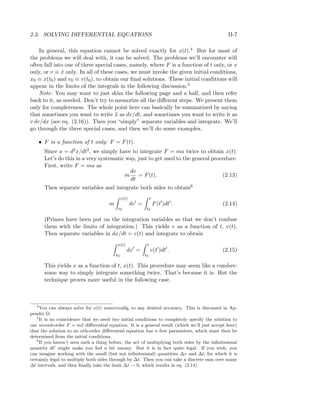
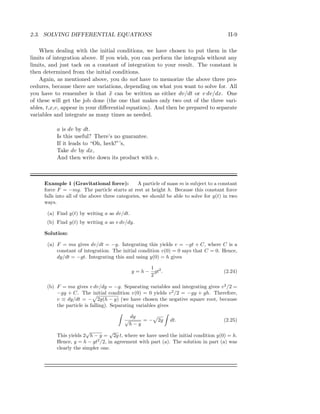
Example (Platform and pulley): A person stands on a platform-and-pulley
system, as shown in Fig. 2.3. The masses of the platform, person, and pulley are M, m
M
a
µ
Figure 2.3
m, and µ, respectively.3
The rope is massless. Let the person pull up on the rope so
that she has acceleration a upwards.
(a) What is the tension in the rope?
(b) What is the normal force between the person and the platform? What is the
tension in the rod connecting the pulley to the platform?
Solution:
(a) To find the tension in the rope, we simply want to let our subsystem be the
whole system. If we imagine putting the system in a black box (to emphasize
the fact that we don’t care about any internal forces within the system), then
the forces we see “protruding” from the box are the three weights (Mg, mg,
and µg) downward, and the tension T upward. Applying F = ma to the whole
system gives
T −(M +m+µ)g = (M +m+µ)a =⇒ T = (M +m+µ)(g +a). (2.7)
(b) To find the normal force, N, between the person and the platform, and also the
tension, f, in the rod connecting the pulley to the platform, it is not sufficient
to consider the system as a whole. We must consider subsystems.
3
Assume that the pulley’s mass is concentrated at its center, so we don’t have to worry about
any rotational dynamics (the subject of Chapter 7).
II-6 CHAPTER 2. USING F = MA
• Let’s apply F = ma to the person. The forces acting on the person are
gravity, the normal force from the platform, and the tension from the rope
(pulling downward at her hand). Therefore, we have
N − T − mg = ma. (2.8)
• Now apply F = ma to the platform. The forces acting on the platform are
gravity, the normal force from the person, and the force upwards from the
rod. Therefore, we have
f − N − Mg = Ma. (2.9)
• Now apply F = ma to the pulley. The forces acting on the pulley are
gravity, the force downward from the rod, and twice the tension in the rope
(since it pulls up on both sides). Therefore, we have
2T − f − µg = µa. (2.10)
Note that if we add up the three previous equations, we obtain the F = ma
equation in eq. (2.7), as should be the case, since the whole system is the sum
of the three previous subsystems. Eqs. (2.8) – (2.10) are three equations in the
three unknowns (T, N, and f). Their sum yields the T in (2.7), and then eqs.
(2.8) and (2.10) give, respectively (as you can show),
N = (M + 2m + µ)(g + a), and f = (2M + 2m + µ)(g + a). (2.11)
Remark: Of course, you could also obtain these results by considering subsystems
different from the ones we chose above (for example, you might choose the pulley-
plus-platform, etc.). But no matter how you choose to break up the system, you will
need to produce three independent F = ma statements in order to solve for the three
unknowns (T, N, and f).
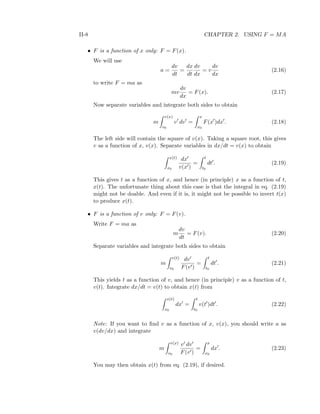
In problems like this one, it is easy to make a mistake by forgetting to include one of
the forces, such as the second T in eq. (2.10). The safest thing to do, therefore, is to
isolate each subsystem, draw a box around it, and then write down all the forces that
“protrude” from the box. Fig. 2.4 shows the free-body diagram for the subsystem of
f
TT
µg
Figure 2.4
the pulley. ♣
2.3 Solving differential equations
Let’s now consider the type of problem where we are given the force F(x) as a
function of position (we’ll just work in one dimension here), and where our task is
to solve the F(x) = ma ≡ m¨x differential equation, to find the position, x(t), as a
function of time. In the present section, we will develop a few techniques for solving
differential equations. The ability to apply these techniques dramatically increases
the number of problems we can solve.
In general, the force F is a function of the position x, the speed ˙x, and the
time t. (Of course, it could be a function of d2x/dt2, d3x/dt3, etc., but these cases
don’t arise much, so we won’t worry about them.) We therefore want to solve the
differential equation,
m¨x = F(x, ˙x, t). (2.12)
2.3. SOLVING DIFFERENTIAL EQUATIONS II-7
In general, this equation cannot be solved exactly for x(t).4 But for most of
the problems we will deal with, it can be solved. The problems we’ll encounter will
often fall into one of three special cases, namely, where F is a function of t only, or x
only, or v ≡ ˙x only. In all of these cases, we must invoke the given initial conditions,
x0 ≡ x(t0) and v0 ≡ v(t0), to obtain our final solutions. These initial conditions will
appear in the limits of the integrals in the following discussion.5
Note: You may want to just skim the following page and a half, and then refer
back to it, as needed. Don’t try to memorize all the different steps. We present them
only for completeness. The whole point here can basically be summarized by saying
that sometimes you want to write ¨x as dv/dt, and sometimes you want to write it as
v dv/dx (see eq. (2.16)). Then you “simply” separate variables and integrate. We’ll
go through the three special cases, and then we’ll do some examples.
• F is a function of t only: F = F(t).
Since a = d2x/dt2, we simply have to integrate F = ma twice to obtain x(t).
Let’s do this in a very systematic way, just to get used to the general procedure.
First, write F = ma as
m
dv
dt
= F(t). (2.13)
Then separate variables and integrate both sides to obtain6
m
v(t)
v0
dv =
t
t0
F(t )dt . (2.14)
(Primes have been put on the integration variables so that we don’t confuse
them with the limits of integration.) This yields v as a function of t, v(t).
Then separate variables in dx/dt = v(t) and integrate to obtain
x(t)
x0
dx =
t
t0
v(t )dt . (2.15)
This yields x as a function of t, x(t). This procedure may seem like a cumber-
some way to simply integrate something twice. That’s because it is. But the
technique proves more useful in the following case.
4
You can always solve for x(t) numerically, to any desired accuracy. This is discussed in Ap-
pendix D.
5
It is no coincidence that we need two initial conditions to completely specify the solution to
our second-order F = m¨x differential equation. It is a general result (which we’ll just accept here)
that the solution to an nth-order differential equation has n free parameters, which must then be
determined from the initial conditions.
6
If you haven’t seen such a thing before, the act of multiplying both sides by the infinitesimal
quantity dt might make you feel a bit uneasy. But it is in fact quite legal. If you wish, you
can imagine working with the small (but not infinitesimal) quantities ∆v and ∆t, for which it is
certainly legal to multiply both sides through by ∆t. Then you can take a discrete sum over many
∆t intervals, and then finally take the limit ∆t → 0, which results in eq. (2.14)
II-8 CHAPTER 2. USING F = MA
• F is a function of x only: F = F(x).
We will use
a =
dv
dt
=
dx
dt
dv
dx
= v
dv
dx
(2.16)
to write F = ma as
mv
dv
dx
= F(x). (2.17)
Now separate variables and integrate both sides to obtain
m
v(x)
v0
v dv =
x
x0
F(x )dx . (2.18)
The left side will contain the square of v(x). Taking a square root, this gives
v as a function of x, v(x). Separate variables in dx/dt = v(x) to obtain
x(t)
x0
dx
v(x )
=
t
t0
dt . (2.19)
This gives t as a function of x, and hence (in principle) x as a function of t,
x(t). The unfortunate thing about this case is that the integral in eq. (2.19)
might not be doable. And even if it is, it might not be possible to invert t(x)
to produce x(t).
• F is a function of v only: F = F(v).
Write F = ma as
m
dv
dt
= F(v). (2.20)
Separate variables and integrate both sides to obtain
m
v(t)
v0
dv
F(v )
=
t
t0
dt . (2.21)
This yields t as a function of v, and hence (in principle) v as a function of t,
v(t). Integrate dx/dt = v(t) to obtain x(t) from
x(t)
x0
dx =
t
t0
v(t )dt . (2.22)
Note: If you want to find v as a function of x, v(x), you should write a as
v(dv/dx) and integrate
m
v(x)
v0
v dv
F(v )
=
x
x0
dx . (2.23)
You may then obtain x(t) from eq. (2.19), if desired.
2.3. SOLVING DIFFERENTIAL EQUATIONS II-9
When dealing with the initial conditions, we have chosen to put them in the
limits of integration above. If you wish, you can perform the integrals without any
limits, and just tack on a constant of integration to your result. The constant is
then determined from the initial conditions.
Again, as mentioned above, you do not have to memorize the above three pro-
cedures, because there are variations, depending on what you want to solve for. All
you have to remember is that ¨x can be written as either dv/dt or v dv/dx. One
of these will get the job done (the one that makes only two out of the three vari-
ables, t,x,v, appear in your differential equation). And then be prepared to separate
variables and integrate as many times as needed.
a is dv by dt.
Is this useful? There’s no guarantee.
If it leads to “Oh, heck!”’s,
Take dv by dx,
And then write down its product with v.
Example 1 (Gravitational force): A particle of mass m is subject to a constant
force F = −mg. The particle starts at rest at height h. Because this constant force
falls into all of the above three categories, we should be able to solve for y(t) in two
ways.
(a) Find y(t) by writing a as dv/dt.
(b) Find y(t) by writing a as v dv/dy.
Solution:
(a) F = ma gives dv/dt = −g. Integrating this yields v = −gt + C, where C is a
constant of integration. The initial condition v(0) = 0 says that C = 0. Hence,
dy/dt = −gt. Integrating this and using y(0) = h gives
y = h −
1
2
gt2
. (2.24)
(b) F = ma gives v dv/dy = −g. Separating variables and integrating gives v2
/2 =
−gy + C. The initial condition v(0) = 0 yields v2
/2 = −gy + gh. Therefore,
v ≡ dy/dt = − 2g(h − y) (we have chosen the negative square root, because
the particle is falling). Separating variables gives
dy
√
h − y
= − 2g dt. (2.25)
This yields 2
√
h − y =
√
2g t, where we have used the initial condition y(0) = h.
Hence, y = h − gt2
/2, in agreement with part (a). The solution in part (a) was
clearly the simpler one.
II-10 CHAPTER 2. USING F = MA
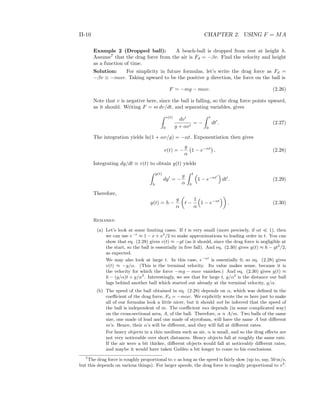
Example 2 (Dropped ball): A beach-ball is dropped from rest at height h.
Assume7
that the drag force from the air is Fd = −βv. Find the velocity and height
as a function of time.
Solution: For simplicity in future formulas, let’s write the drag force as Fd =
−βv ≡ −mαv. Taking upward to be the positive y direction, the force on the ball is
F = −mg − mαv. (2.26)
Note that v is negative here, since the ball is falling, so the drag force points upward,
as it should. Writing F = m dv/dt, and separating variables, gives
v(t)
0
dv
g + αv
= −
t
0
dt . (2.27)
The integration yields ln(1 + αv/g) = −αt. Exponentiation then gives
v(t) = −
g
α
1 − e−αt
. (2.28)
Integrating dy/dt ≡ v(t) to obtain y(t) yields
y(t)
h
dy = −
g
α
t
0
1 − e−αt
dt . (2.29)
Therefore,
y(t) = h −
g
α
t −
1
α
1 − e−αt
. (2.30)
Remarks:
(a) Let’s look at some limiting cases. If t is very small (more precisely, if αt 1), then
we can use e−x
≈ 1 − x + x2
/2 to make approximations to leading order in t. You can
show that eq. (2.28) gives v(t) ≈ −gt (as it should, since the drag force is negligible at
the start, so the ball is essentially in free fall). And eq. (2.30) gives y(t) ≈ h − gt2
/2,
as expected.
We may also look at large t. In this case, e−αt
is essentially 0, so eq. (2.28) gives
v(t) ≈ −g/α. (This is the terminal velocity. Its value makes sense, because it is
the velocity for which the force −mg − mαv vanishes.) And eq. (2.30) gives y(t) ≈
h − (g/α)t + g/α2
. Interestingly, we see that for large t, g/α2
is the distance our ball
lags behind another ball which started out already at the terminal velocity, g/α.
(b) The speed of the ball obtained in eq. (2.28) depends on α, which was defined in the
coefficient of the drag force, Fd = −mαv. We explicitly wrote the m here just to make
all of our formulas look a little nicer, but it should not be inferred that the speed of
the ball is independent of m. The coefficient mα depends (in some complicated way)
on the cross-sectional area, A, of the ball. Therefore, α ∝ A/m. Two balls of the same
size, one made of lead and one made of styrofoam, will have the same A but different
m’s. Hence, their α’s will be different, and they will fall at different rates.
For heavy objects in a thin medium such as air, α is small, and so the drag effects are
not very noticeable over short distances. Heavy objects fall at roughly the same rate.
If the air were a bit thicker, different objects would fall at noticeably different rates,
and maybe it would have taken Galileo a bit longer to come to his conclusions.
7
The drag force is roughly proportional to v as long as the speed is fairly slow (up to, say, 50 m/s,
but this depends on various things). For larger speeds, the drag force is roughly proportional to v2
.
2.4. PROJECTILE MOTION II-11
What would you have thought, Galileo,
If instead you dropped cows and did say, “Oh!
To lessen the sound
Of the moos from the ground,
They should fall not through air, but through mayo!” ♣
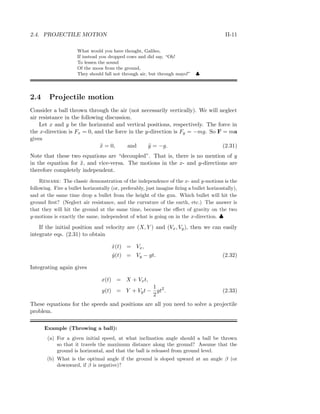
2.4 Projectile motion
Consider a ball thrown through the air (not necessarily vertically). We will neglect
air resistance in the following discussion.
Let x and y be the horizontal and vertical positions, respectively. The force in
the x-direction is Fx = 0, and the force in the y-direction is Fy = −mg. So F = ma
gives
¨x = 0, and ¨y = −g. (2.31)
Note that these two equations are “decoupled”. That is, there is no mention of y
in the equation for ¨x, and vice-versa. The motions in the x- and y-directions are
therefore completely independent.
Remark: The classic demonstration of the independence of the x- and y-motions is the
following. Fire a bullet horizontally (or, preferably, just imagine firing a bullet horizontally),
and at the same time drop a bullet from the height of the gun. Which bullet will hit the
ground first? (Neglect air resistance, and the curvature of the earth, etc.) The answer is
that they will hit the ground at the same time, because the effect of gravity on the two
y-motions is exactly the same, independent of what is going on in the x-direction. ♣
If the initial position and velocity are (X, Y ) and (Vx, Vy), then we can easily
integrate eqs. (2.31) to obtain
˙x(t) = Vx,
˙y(t) = Vy − gt. (2.32)
Integrating again gives
x(t) = X + Vxt,
y(t) = Y + Vyt −
1
2
gt2
. (2.33)
These equations for the speeds and positions are all you need to solve a projectile
problem.
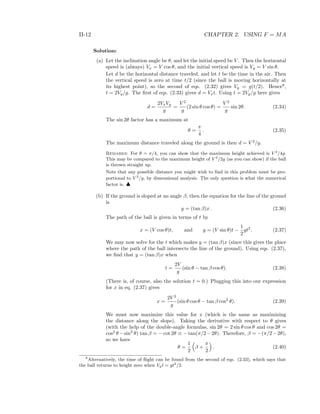
Example (Throwing a ball):
(a) For a given initial speed, at what inclination angle should a ball be thrown
so that it travels the maximum distance along the ground? Assume that the
ground is horizontal, and that the ball is released from ground level.
(b) What is the optimal angle if the ground is sloped upward at an angle β (or
downward, if β is negative)?
II-12 CHAPTER 2. USING F = MA
Solution:
(a) Let the inclination angle be θ, and let the initial speed be V . Then the horizontal
speed is (always) Vx = V cos θ, and the initial vertical speed is Vy = V sin θ.
Let d be the horizontal distance traveled, and let t be the time in the air. Then
the vertical speed is zero at time t/2 (since the ball is moving horizontally at
its highest point), so the second of eqs. (2.32) gives Vy = g(t/2). Hence8
,
t = 2Vy/g. The first of eqs. (2.33) gives d = Vxt. Using t = 2Vy/g here gives
d =
2VxVy
g
=
V 2
g
(2 sin θ cos θ) =
V 2
g
sin 2θ. (2.34)
The sin 2θ factor has a maximum at
θ =
π
4
. (2.35)
The maximum distance traveled along the ground is then d = V 2
/g.
Remarks: For θ = π/4, you can show that the maximum height achieved is V 2
/4g.
This may be compared to the maximum height of V 2
/2g (as you can show) if the ball
is thrown straight up.
Note that any possible distance you might wish to find in this problem must be pro-
portional to V 2
/g, by dimensional analysis. The only question is what the numerical
factor is. ♣
(b) If the ground is sloped at an angle β, then the equation for the line of the ground
is
y = (tan β)x. (2.36)
The path of the ball is given in terms of t by
x = (V cos θ)t, and y = (V sin θ)t −
1
2
gt2
. (2.37)
We may now solve for the t which makes y = (tan β)x (since this gives the place
where the path of the ball intersects the line of the ground). Using eqs. (2.37),
we find that y = (tan β)x when
t =
2V
g
(sin θ − tan β cos θ). (2.38)
(There is, of course, also the solution t = 0.) Plugging this into our expression
for x in eq. (2.37) gives
x =
2V 2
g
(sin θ cos θ − tan β cos2
θ). (2.39)
We must now maximize this value for x (which is the same as maximizing
the distance along the slope). Taking the derivative with respect to θ gives
(with the help of the double-angle formulas, sin 2θ = 2 sin θ cos θ and cos 2θ =
cos2
θ −sin2
θ) tan β = − cot 2θ ≡ − tan(π/2−2θ). Therefore, β = −(π/2−2θ),
so we have
θ =
1
2
β +
π
2
. (2.40)
8
Alternatively, the time of flight can be found from the second of eqs. (2.33), which says that
the ball returns to height zero when Vyt = gt2
/2.
2.5. MOTION IN A PLANE, POLAR COORDINATES II-13
In other words, the throwing angle should bisect the angle between the ground
and the vertical.
Remarks: For β = π/2, we have θ = π/2, as should be the case. For β = 0, we have
θ = π/4, as found in part (a). And for β = −π/2, we have θ = 0, which makes sense.
Substituting the value of θ from eq. (2.40) into eq. (2.39), you can show (after a bit
of algebra) that the maximum distance traveled along the tilted ground is
d =
x
cos β
=
V 2
/g
1 + sin β
. (2.41)
This checks in the various limits for β. ♣
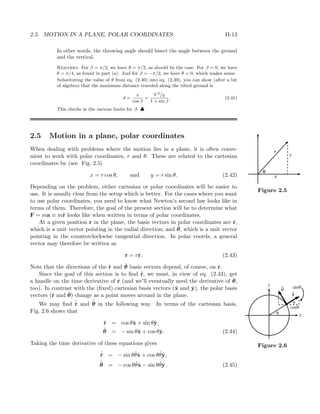
2.5 Motion in a plane, polar coordinates
When dealing with problems where the motion lies in a plane, it is often conve-
nient to work with polar coordinates, r and θ. These are related to the cartesian
coordinates by (see Fig. 2.5)
r
y
x
θ
Figure 2.5
x = r cos θ, and y = r sin θ. (2.42)
Depending on the problem, either cartesian or polar coordinates will be easier to
use. It is usually clear from the setup which is better. For the cases where you want
to use polar coordinates, you need to know what Newton’s second law looks like in
terms of them. Therefore, the goal of the present section will be to determine what
F = ma ≡ m¨r looks like when written in terms of polar coordinates.
At a given position r in the plane, the basis vectors in polar coordinates are ˆr,
which is a unit vector pointing in the radial direction; and ˆθ, which is a unit vector
pointing in the counterclockwise tangential direction. In polar coords, a general
vector may therefore be written as
r = rˆr. (2.43)
Note that the directions of the ˆr and ˆθ basis vectors depend, of course, on r.
Since the goal of this section is to find ¨r, we must, in view of eq. (2.43), get
a handle on the time derivative of ˆr (and we’ll eventually need the derivative of ˆθ,
too). In contrast with the (fixed) cartesian basis vectors (ˆx and ˆy), the polar basis
vectors (ˆr and ˆθ) change as a point moves around in the plane.
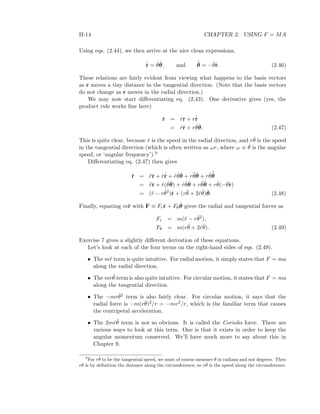
We may find ˙ˆr and
˙ˆθ in the following way. In terms of the cartesian basis,
Fig. 2.6 shows that
y
x
cos
sin
θ
θ
θ
θ
r
θ
Figure 2.6
ˆr = cos θˆx + sin θˆy,
ˆθ = − sin θˆx + cos θˆy. (2.44)
Taking the time derivative of these equations gives
˙ˆr = − sin θ ˙θˆx + cos θ ˙θˆy,
˙ˆθ = − cos θ ˙θˆx − sin θ ˙θˆy. (2.45)
II-14 CHAPTER 2. USING F = MA
Using eqs. (2.44), we then arrive at the nice clean expressions,
˙ˆr = ˙θˆθ, and
˙ˆθ = − ˙θˆr. (2.46)
These relations are fairly evident from viewing what happens to the basis vectors
as r moves a tiny distance in the tangential direction. (Note that the basis vectors
do not change as r moves in the radial direction.)
We may now start differentiating eq. (2.43). One derivative gives (yes, the
product rule works fine here)
˙r = ˙rˆr + r˙ˆr
= ˙rˆr + r ˙θˆθ. (2.47)
This is quite clear, because ˙r is the speed in the radial direction, and r ˙θ is the speed
in the tangential direction (which is often written as ωr, where ω ≡ ˙θ is the angular
speed, or ‘angular frequency’).9
Differentiating eq. (2.47) then gives
¨r = ¨rˆr + ˙r˙ˆr + ˙r ˙θˆθ + r¨θˆθ + r ˙θ
˙ˆθ
= ¨rˆr + ˙r( ˙θˆθ) + ˙r ˙θˆθ + r¨θˆθ + r ˙θ(− ˙θˆr)
= (¨r − r ˙θ2
)ˆr + (r¨θ + 2 ˙r ˙θ)ˆθ. (2.48)
Finally, equating m¨r with F ≡ Frˆr + Fθ
ˆθ gives the radial and tangential forces as
Fr = m(¨r − r ˙θ2
),
Fθ = m(r¨θ + 2 ˙r ˙θ). (2.49)
Exercise 7 gives a slightly different derivation of these equations.
Let’s look at each of the four terms on the right-hand sides of eqs. (2.49).
• The m¨r term is quite intuitive. For radial motion, it simply states that F = ma
along the radial direction.
• The mr¨θ term is also quite intuitive. For circular motion, it states that F = ma
along the tangential direction.
• The −mr ˙θ2 term is also fairly clear. For circular motion, it says that the
radial force is −m(r ˙θ)2/r = −mv2/r, which is the familiar term that causes
the centripetal acceleration.
• The 2m ˙r ˙θ term is not so obvious. It is called the Coriolis force. There are
various ways to look at this term. One is that it exists in order to keep the
angular momentum conserved. We’ll have much more to say about this in
Chapter 9.
9
For r ˙θ to be the tangential speed, we must of course measure θ in radians and not degrees. Then
rθ is by definition the distance along the circumference; so r ˙θ is the speed along the circumference.
2.5. MOTION IN A PLANE, POLAR COORDINATES II-15
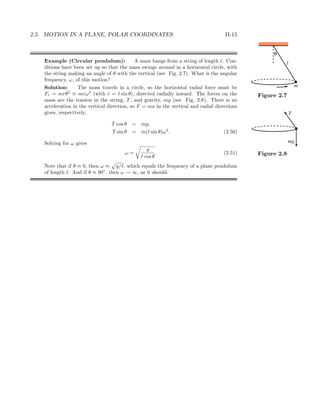
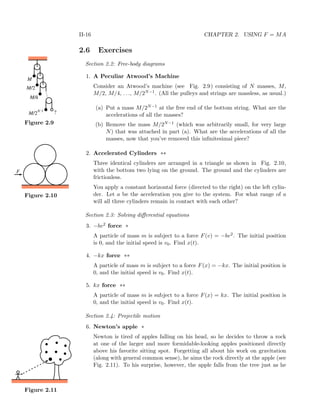
Example (Circular pendulum): A mass hangs from a string of length . Con-
ditions have been set up so that the mass swings around in a horizontal circle, with
the string making an angle of θ with the vertical (see Fig. 2.7). What is the angular
θ
l
m
Figure 2.7
frequency, ω, of this motion?
Solution: The mass travels in a circle, so the horizontal radial force must be
Fr = mr ˙θ2
≡ mrω2
(with r = sin θ), directed radially inward. The forces on the
mass are the tension in the string, T, and gravity, mg (see Fig. 2.8). There is no
T
mg
Figure 2.8
acceleration in the vertical direction, so F = ma in the vertical and radial directions
gives, respectively,
T cos θ = mg,
T sin θ = m( sin θ)ω2
. (2.50)
Solving for ω gives
ω =
g
cos θ
. (2.51)
Note that if θ ≈ 0, then ω ≈ g/ , which equals the frequency of a plane pendulum
of length . And if θ ≈ 90◦
, then ω → ∞, as it should.
II-16 CHAPTER 2. USING F = MA
2.6 Exercises
Section 2.2: Free-body diagrams
1. A Peculiar Atwood’s Machine
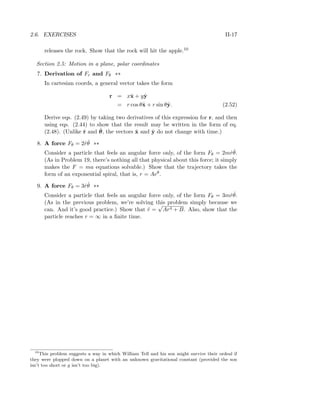
Consider an Atwood’s machine (see Fig. 2.9) consisting of N masses, M,M/
M/
M/
M
.....
N 1-
?
2
2
4
Figure 2.9
M/2, M/4, . . ., M/2N−1. (All the pulleys and strings are massless, as usual.)
(a) Put a mass M/2N−1 at the free end of the bottom string. What are the
accelerations of all the masses?
(b) Remove the mass M/2N−1 (which was arbitrarily small, for very large
N) that was attached in part (a). What are the accelerations of all the
masses, now that you’ve removed this infinitesimal piece?
2. Accelerated Cylinders **
Three identical cylinders are arranged in a triangle as shown in Fig. 2.10,
F
Figure 2.10
with the bottom two lying on the ground. The ground and the cylinders are
frictionless.
You apply a constant horizontal force (directed to the right) on the left cylin-
der. Let a be the acceleration you give to the system. For what range of a
will all three cylinders remain in contact with each other?
Section 2.3: Solving differential equations
3. −bv2 force *
A particle of mass m is subject to a force F(v) = −bv2. The initial position
is 0, and the initial speed is v0. Find x(t).
4. −kx force **
A particle of mass m is subject to a force F(x) = −kx. The initial position is
0, and the initial speed is v0. Find x(t).
5. kx force **
A particle of mass m is subject to a force F(x) = kx. The initial position is
0, and the initial speed is v0. Find x(t).
Section 2.4: Projectile motion
6. Newton’s apple *
Newton is tired of apples falling on his head, so he decides to throw a rock
at one of the larger and more formidable-looking apples positioned directly
above his favorite sitting spot. Forgetting all about his work on gravitation
(along with general common sense), he aims the rock directly at the apple (see
Fig. 2.11). To his surprise, however, the apple falls from the tree just as he
Figure 2.11
2.6. EXERCISES II-17
releases the rock. Show that the rock will hit the apple.10
Section 2.5: Motion in a plane, polar coordinates
7. Derivation of Fr and Fθ **
In cartesian coords, a general vector takes the form
r = xˆx + yˆy
= r cos θˆx + r sin θˆy. (2.52)
Derive eqs. (2.49) by taking two derivatives of this expression for r, and then
using eqs. (2.44) to show that the result may be written in the form of eq.
(2.48). (Unlike ˆr and ˆθ, the vectors ˆx and ˆy do not change with time.)
8. A force Fθ = 2 ˙r ˙θ **
Consider a particle that feels an angular force only, of the form Fθ = 2m ˙r ˙θ.
(As in Problem 19, there’s nothing all that physical about this force; it simply
makes the F = ma equations solvable.) Show that the trajectory takes the
form of an exponential spiral, that is, r = Aeθ.
9. A force Fθ = 3 ˙r ˙θ **
Consider a particle that feels an angular force only, of the form Fθ = 3m ˙r ˙θ.
(As in the previous problem, we’re solving this problem simply because we
can. And it’s good practice.) Show that ˙r =
√
Ar4 + B. Also, show that the
particle reaches r = ∞ in a finite time.
10
This problem suggests a way in which William Tell and his son might survive their ordeal if
they were plopped down on a planet with an unknown gravitational constant (provided the son
isn’t too short or g isn’t too big).
II-18 CHAPTER 2. USING F = MA
2.7 Problems
Section 2.2: Free-body diagrams
1. Sliding down a plane **
(a) A block slides down a frictionless plane from the point (0, y) to the point
(b, 0), where b is given. For what value of y does the journey take the
shortest time? What is this time?
(b) Answer the same questions in the case where there is a coefficient of
kinetic friction, µ, between the block and the plane.
2. Sliding plane ***
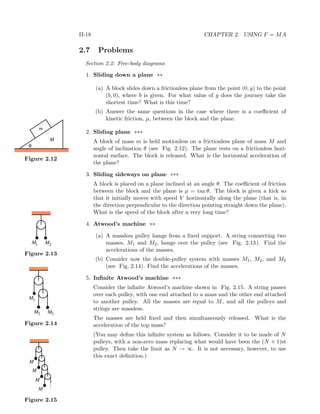
A block of mass m is held motionless on a frictionless plane of mass M and
angle of inclination θ (see Fig. 2.12). The plane rests on a frictionless hori-θ
m
M
Figure 2.12
zontal surface. The block is released. What is the horizontal acceleration of
the plane?
3. Sliding sideways on plane ***
A block is placed on a plane inclined at an angle θ. The coefficient of friction
between the block and the plane is µ = tan θ. The block is given a kick so
that it initially moves with speed V horizontally along the plane (that is, in
the direction perpendicular to the direction pointing straight down the plane).
What is the speed of the block after a very long time?
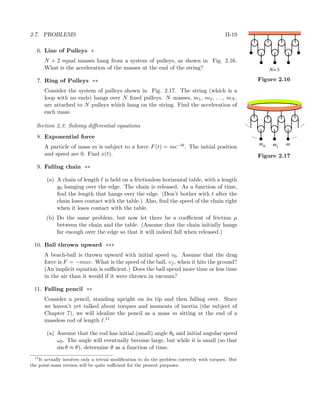
4. Atwood’s machine **
(a) A massless pulley hangs from a fixed support. A string connecting two
masses, M1 and M2, hangs over the pulley (see Fig. 2.13). Find theM1 M2
Figure 2.13
accelerations of the masses.
(b) Consider now the double-pulley system with masses M1, M2, and M3
(see Fig. 2.14). Find the accelerations of the masses.
M1
M3M2
Figure 2.14
5. Infinite Atwood’s machine ***
Consider the infinite Atwood’s machine shown in Fig. 2.15. A string passes
M
M
M
M
.....
Figure 2.15
over each pulley, with one end attached to a mass and the other end attached
to another pulley. All the masses are equal to M, and all the pulleys and
strings are massless.
The masses are held fixed and then simultaneously released. What is the
acceleration of the top mass?
(You may define this infinite system as follows. Consider it to be made of N
pulleys, with a non-zero mass replacing what would have been the (N + 1)st
pulley. Then take the limit as N → ∞. It is not necessary, however, to use
this exact definition.)
2.7. PROBLEMS II-19
6. Line of Pulleys *
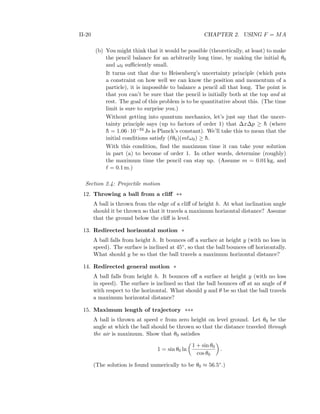
N + 2 equal masses hang from a system of pulleys, as shown in Fig. 2.16.
N=3
Figure 2.16
What is the acceleration of the masses at the end of the string?
7. Ring of Pulleys **
Consider the system of pulleys shown in Fig. 2.17. The string (which is a
....
....
....
....
mN m1
m
Figure 2.17
loop with no ends) hangs over N fixed pulleys. N masses, m1, m2, . . ., mN ,
are attached to N pulleys which hang on the string. Find the acceleration of
each mass.
Section 2.3: Solving differential equations
8. Exponential force
A particle of mass m is subject to a force F(t) = me−bt. The initial position
and speed are 0. Find x(t).
9. Falling chain **
(a) A chain of length is held on a frictionless horizontal table, with a length
y0 hanging over the edge. The chain is released. As a function of time,
find the length that hangs over the edge. (Don’t bother with t after the
chain loses contact with the table.) Also, find the speed of the chain right
when it loses contact with the table.
(b) Do the same problem, but now let there be a coefficient of friction µ
between the chain and the table. (Assume that the chain initially hangs
far enough over the edge so that it will indeed fall when released.)
10. Ball thrown upward ***
A beach-ball is thrown upward with initial speed v0. Assume that the drag
force is F = −mαv. What is the speed of the ball, vf , when it hits the ground?
(An implicit equation is sufficient.) Does the ball spend more time or less time
in the air than it would if it were thrown in vacuum?
11. Falling pencil **
Consider a pencil, standing upright on its tip and then falling over. Since
we haven’t yet talked about torques and moments of inertia (the subject of
Chapter 7), we will idealize the pencil as a mass m sitting at the end of a
massless rod of length .11
(a) Assume that the rod has initial (small) angle θ0 and initial angular speed
ω0. The angle will eventually become large, but while it is small (so that
sin θ ≈ θ), determine θ as a function of time.
11
It actually involves only a trivial modification to do the problem correctly with torques. But
the point-mass version will be quite sufficient for the present purposes.
II-20 CHAPTER 2. USING F = MA
(b) You might think that it would be possible (theoretically, at least) to make
the pencil balance for an arbitrarily long time, by making the initial θ0
and ω0 sufficiently small.
It turns out that due to Heisenberg’s uncertainty principle (which puts
a constraint on how well we can know the position and momentum of a
particle), it is impossible to balance a pencil all that long. The point is
that you can’t be sure that the pencil is initially both at the top and at
rest. The goal of this problem is to be quantitative about this. (The time
limit is sure to surprise you.)
Without getting into quantum mechanics, let’s just say that the uncer-
tainty principle says (up to factors of order 1) that ∆x∆p ≥ ¯h (where
¯h = 1.06·10−34 Js is Planck’s constant). We’ll take this to mean that the
initial conditions satisfy ( θ0)(m ω0) ≥ ¯h.
With this condition, find the maximum time it can take your solution
in part (a) to become of order 1. In other words, determine (roughly)
the maximum time the pencil can stay up. (Assume m = 0.01 kg, and
= 0.1 m.)
Section 2.4: Projectile motion
12. Throwing a ball from a cliff **
A ball is thrown from the edge of a cliff of height h. At what inclination angle
should it be thrown so that it travels a maximum horizontal distance? Assume
that the ground below the cliff is level.
13. Redirected horizontal motion *
A ball falls from height h. It bounces off a surface at height y (with no loss in
speed). The surface is inclined at 45◦, so that the ball bounces off horizontally.
What should y be so that the ball travels a maximum horizontal distance?
14. Redirected general motion *
A ball falls from height h. It bounces off a surface at height y (with no loss
in speed). The surface is inclined so that the ball bounces off at an angle of θ
with respect to the horizontal. What should y and θ be so that the ball travels
a maximum horizontal distance?
15. Maximum length of trajectory ***
A ball is thrown at speed v from zero height on level ground. Let θ0 be the
angle at which the ball should be thrown so that the distance traveled through
the air is maximum. Show that θ0 satisfies
1 = sin θ0 ln
1 + sin θ0
cos θ0
.
(The solution is found numerically to be θ0 ≈ 56.5◦.)
2.7. PROBLEMS II-21
16. Maximum area under trajectory *
A ball is thrown at speed v from zero height on level ground. At what angle
should the ball be thrown so that the area under the trajectory is maximum?
17. Bouncing ball *
A ball is thrown straight upward so that it reaches a height h. It falls down
and bounces repeatedly. After each bounce, it returns to a certain fraction
f of its previous height. Find the total distance traveled, and also the total
time, before it comes to rest. What is its average speed?
Section 2.5: Motion in a plane, polar coordinates
18. Free particle **
Consider a free particle in a plane. Using cartesian coordinates, it is trivial
to show that the particle moves in a straight line. The task of this problem
is to demonstrate this result in the much more cumbersome way, using eqs.
(2.49). More precisely, show that cos θ = r0/r for a free particle, where r0 is
the radius at closest approach to the origin, and θ is measured with respect
to this radius.
19. A force Fθ = ˙r ˙θ **
Consider a particle that feels an angular force only, of the form Fθ = m ˙r ˙θ.
(There’s nothing all that physical about this force; it simply makes the F = ma
equations solvable.) Show that ˙r =
√
A ln r + B, where A and B are constants
of integration, determined by the initial conditions.
II-22 CHAPTER 2. USING F = MA
2.8 Solutions
1. Sliding down a plane
(a) Let θ be the angle the plane makes with the horizontal. The component of
gravity along the plane in g sin θ. The acceleration in the horizontal direction is
then ax = g sin θ cos θ. Since the horizontal distance is fixed, we simply want to
maximize ax. So θ = π/4, and hence y = b.
The time is obtained from axt2
/2 = b, with ax = g sin θ cos θ = g/2. Therefore,
t = 2 b/g.
(b) The normal force on the plane is Mg cos θ, so the friction force is µMg cos θ. The
acceleration along the plane is therefore g(sin θ−µ cos θ), and so the acceleration
in the horizontal direction is ax = g(sin θ − µ cos θ) cos θ. We want to maximize
this. Setting the derivative equal to zero gives
(cos2
θ − sin2
θ) + 2µ sin θ cos θ = 0, =⇒ tan 2θ =
−1
µ
. (2.53)
For µ → 0, this reduces to the answer in part (a). For µ → ∞, we obtain
θ ≈ π/2, which makes sense.
To find t, we need to find ax. Using sin 2θ = 1/ 1 + µ2 and cos 2θ = −µ/ 1 + µ2,
we have
ax = g sin θ cos θ − µg cos2
θ
=
g sin 2θ
2
−
µg(1 + cos 2θ)
2
=
g
2
( 1 + µ2 − µ). (2.54)
(For µ → ∞, this behaves like ax ≈ g/(4µ).) Therefore, axt2
/2 = b gives
t =
2b
ax
=
2 b/g
1 + µ2 − µ
= 2 b/g 1 + µ2 + µ. (2.55)
(For µ → ∞, this behaves like t ≈ 2 2µb/g.)
2. Sliding plane
Let F be the normal force between the block and the plane. Then the various F = ma
equations (vertical and horizontal for the block, and horizontal for the plane) are
mg − F cos θ = may
F sin θ = max
F sin θ = MAx. (2.56)
(We’ve chosen positive ax and ay to be leftward and downward, respectively, and
positive Ax to be rightward.)
There are four unknowns here (ax,ay,Ax,F), so we need one more equation. This
last equation is the constraint that the block remains in contact with the plane.
The horizontal distance between the block and its starting point on the plane is
2.8. SOLUTIONS II-23
(ax + Ax)t2
/2, and the vertical distance is ayt2
/2. The ratio of these distances must
equal tan θ if the block is to remain on the plane. Therefore, we must have
ay
ax + Ax
= tan θ. (2.57)
Using eqs. (2.56), this becomes
g − F
m cos θ
F
m sin θ + F
M sin θ
= tan θ
=⇒ F = g sin θ tan θ
1
m
+
1
M
+
cos θ
m
−1
. (2.58)
The third of eqs. (2.56) then yields Ax, which may be written as
Ax =
F sin θ
M
=
mg tan θ
M(1 + tan2
θ) + m tan2
θ
. (2.59)
Remarks: For given M and m, the angle θ0 which maximizes Ax is found to be
tan θ0 =
M
M + m
. (2.60)
If M m, then θ0 ≈ 0. If M m, then θ0 ≈ π/4.
In the limit M m, we have Ax ≈ g/ tan θ. This makes sense, because m falls essentially
straight down, and the plane gets squeezed out to the right.
In the limit M m, we have Ax ≈ g(m/M) tan θ/(1 + tan2
θ) = g(m/M) sin θ cos θ. This
is more transparent if we instead look at ax = (M/m)Ax ≈ g sin θ cos θ. Since the plane is
essentially at rest in this limit, this value of ax implies that the acceleration of m along the
plane is essentially equal to ax/ cos θ ≈ g sin θ, as expected. ♣
3. Sliding sideways on plane
The normal force from the plane is N = mg cos θ, so the friction force on the block
is µN = (tan θ)N = mg sin θ. This force acts in the direction opposite to the motion.
The block also feels the gravitational force of mg sin θ pointing down the plane.
Since the magnitudes of the friction and gravitational forces are equal, the acceleration
along the direction of motion equals the negative of the acceleration in the direction
down the plane. Therefore, in a small increment of time, the speed that the block loses
along its direction of motion exactly equals the speed that it gains in the direction
down the plane. Letting v be the speed of the block, and letting vy be the component
of the velocity in the direction down the plane, we therefore have
v + vy = C, (2.61)
where C is a constant. C is given by its initial value, which is V + 0 = V . The final
value of C is Vf + Vf = 2Vf (where Vf is the final speed of the block), since the block
is essentially moving straight down the plane after a very long time. Therefore,
2Vf = V =⇒ Vf = V/2. (2.62)
II-24 CHAPTER 2. USING F = MA
4. Atwood’s machine
(a) Let T be the tension in the string. Let a be the acceleration of M2 (with
downward taken to be positive). Then −a is the acceleration of M1. So we have
M1g − T = M1(−a),
M2g − T = M2a. (2.63)
Subtracting the two equations yields
a = g
M2 − M1
M1 + M2
. (2.64)
As a double-check, this has the correct limits when M2 M1, M2 M1, and
M2 = M1, namely a ≈ g, a ≈ −g, and a = 0, respectively.
We may also solve for the tension, T = 2M1M2/(M1 + M2). If M1 = M2 ≡ M,
then T = Mg, as it should. If M1 M2, then T ≈ 2M1g, as it should (because
then the net upward force on M1 is M1g, so its acceleration equals g upwards,
as it must, since M2 is essentially in free-fall).
(b) The key here is that since the pulleys are massless, there can be no net force on
them, so the tension in the bottom string must be half of that in the top string.
Let these be T/2 and T, respectively. Let ap be the acceleration of the bottom
pulley, and let a be the acceleration of M3 relative to the bottom pulley (with
downward taken to be positive). Then we have
M1g − T = M1(−ap),
M2g −
T
2
= M2(ap − a),
M3g −
T
2
= M3(ap + a). (2.65)
Solving for ap and a gives
ap = g
4M2M3 − M1(M2 + M3)
4M2M3 + M1(M2 + M3)
, a = g
2M1(M3 − M2)
4M2M3 + M1(M2 + M3)
. (2.66)
The accelerations of M2 and M3, namely ap − a and ap + a, are
ap − a = g
4M2M3 + M1(M2 − 3M3)
4M2M3 + M1(M2 + M3)
,
ap + a = g
4M2M3 + M1(M3 − 3M2)
4M2M3 + M1(M2 + M3)
. (2.67)
You can check various limits. One nice one is where M2 is much less than both M1 and M3.
The accelerations of M1, M2, and M3 are then
−ap = g, ap − a = −3g, ap + a = g, (2.68)
(with downward taken to be positive).
5. Infinite Atwood’s machine
First Solution: Consider the following auxiliary problem.
Problem: Two set-ups are shown in Fig. 2.18. The first contains a hanging massM1 M2
m
as as
Figure 2.18
m. The second contains a hanging pulley, over which two masses, M1 and M2, hang.
2.8. SOLUTIONS II-25
Let both supports have acceleration as downward. What should m be, in terms of
M1 and M2, so that the tension in the top string is the same in both cases?
Answer: In the first case, we have
mg − T = mas. (2.69)
In the second case, let a be the acceleration of M2 relative to the support (with
downward taken to be positive). Then we have
M1g −
T
2
= M1(as − a),
M2g −
T
2
= M2(as + a). (2.70)
Note that if we define g ≡ g − as, then we may write these three equations as
mg = T,
M1g =
T
2
− M1a,
M2g =
T
2
+ M2a. (2.71)
The last two give 4M1M2g = (M1 + M2)T. The first equation then gives
m =
4M1M2
M1 + M2
. (2.72)
Note that the value of as is irrelevant. (We effectively have a fixed support in a world
where the acceleration from gravity is g .) This problem shows that the two-mass
system in the second case may be equivalently treated as a mass m, as far as the
upper string is concerned.
Now let’s look at our infinite Atwood machine. Start at the bottom. (Assume that
the system has N pulleys, where N → ∞.) Let the bottom mass be x. Then the
above problem shows that the bottom two masses, M and x, may be treated as an
effective mass f(x), where
f(x) =
4x
1 + (x/M)
. (2.73)
We may then treat the combination of the mass f(x) and the next M as an effective
mass f(f(x)). These iterations may be repeated, until we finally have a mass M and
a mass f(N−1)
(x) hanging over the top pulley.
We must determine the behavior of fN
(x), as N → ∞. The behavior is obvious by
looking at a plot of f(x) (which we’ll let you draw). (Note that x = 3M is a fixed
point of f, i.e., f(3M) = 3M.) It is clear that no matter what x we start with, the
iterations approach 3M (unless, of course, x = 0). So our infinite Atwood machine is
equivalent to (as far as the top mass is concerned) just the two masses M and 3M.
We then easily find that the acceleration of the top mass equals (net downward
force)/(total mass) = 2Mg/(4M) = g/2.
As far as the support is concerned, the whole apparatus is equivalent to a mass 3M.
So 3Mg is the weight the support holds up.
Second Solution: If the gravity in the world were multiplied by a factor η, then
the tension in all the strings would likewise be multiplied by η. (The only way to
II-26 CHAPTER 2. USING F = MA
make a tension, i.e., a force, is to multiply a mass times g.) Conversely, if we put the
apparatus on another planet and discover that all the tensions are multiplied by η,
then we know the gravity there must be ηg.
Let the tension in the string above the first pulley be T. Then the tension in the string
above the second pulley is T/2 (since the pulleys are massless). Let the acceleration
of the second pulley be ap2. Then the second pulley effectively lives in a world where
the gravity is g − ap2. If we imagine holding the string above the second pulley and
accelerating downward at ap2 (so that our hand is at the origin of the new world),
then we really haven’t changed anything, so the tension in this string in the new world
is still T/2.
But in this infinite setup, the system of all the pulleys except the top one is the same
as the original system of all the pulleys. Therefore, by the arguments in the first
paragraph, we must have
T
g
=
T/2
g − ap2
. (2.74)
Hence, ap2 = g/2. (Likewise, the relative acceleration of the second and third pulleys
is g/4, etc.) But ap2 is also the acceleration of the top mass. So our answer is g/2.
Note that T = 0 also makes eq. (2.74) true. But this corresponds to putting a mass
of zero at the end of a finite pulley system.
6. Line of Pulleys
Let m be the common mass, and let T be the tension in the string. Let a be the
acceleration of the end masses, and let a be the acceleration of the other masses (with
downward taken to be positive). Then we have
T − mg = ma,
2T − mg = ma . (2.75)
The string has fixed length, therefore
N(2a ) + a + a = 0. (2.76)
Eliminating T from eqs. (2.75) gives a = 2a + g. Combining this with eq. (2.76)
then gives
a =
−g
2 + 1
N
. (2.77)
For N = 0 we have a = 0. For N = 1 we have a = −g/3. For larger N, a increases in
magnitude until it equals −g/2 for N → ∞.
7. Ring of Pulleys
Let T be the tension in the string. Then F = ma for mi gives
2T − mig = miai, (2.78)
with upward taken to be positive.
But the string has a fixed length. Therefore, the sum of all the displacements of the
masses is zero. Hence,
a1 + a2 + · · · + aN = 0. (2.79)
If we divide eq. (2.78) by mi, and then add the N such equations together, we then
obtain
2T
1
m1
+
1
m2
+ · · · +
1
mN
− Ng = 0. (2.80)
2.8. SOLUTIONS II-27
Substituting this value for T into (2.78) gives
ai = g

 N
mi
1
m1
+ 1
m2
+ · · · + 1
mN
− 1

 . (2.81)
If all the masses are equal, then all ai = 0. If mk = 0 (and all the others are not 0), then
ak = (N − 1)g, and all the other ai = −g.
8. Exponential force
We are given ¨x = e−bt
. Integrating this w.r.t. time gives v(t) = −e−bt
/b + A.
Integrating again gives x(t) = e−bt
/b2
+At+B. The initial conditions are 0 = v(0) =
−1/b + A and 0 = x(0) = 1/b2
+ B. Therefore,
x(t) =
e−bt
b2
+
t
b
−
1
b2
. (2.82)
For t → ∞, the speed is v → 1/b. The particle eventually lags a distance 1/b2
behind a
particle that starts at the same position but with speed v = 1/b.
9. Falling chain
(a) Let y(t) be the length hanging over the edge at time t. Let the density of the
chain be ρ. Then the total mass is M = ρ , and the mass hanging over the edge
is ρy. The downward force on the chain (that isn’t countered by a normal force
from the table) is therefore (ρy)g, so F = ma gives
ρgy = ρ ¨y =⇒ ¨y =
g
y. (2.83)
The solution to this equation is
y(t) = Aeαt
+ Be−αt
, where α ≡
g
. (2.84)
Taking the derivative of this to obtain ˙y(t), and using the given information that
˙y(0) = 0, we find A = B. Using y(0) = y0, we then find A = B = y0/2. So the
length that hangs over the edge is
y(t) =
y0
2
eαt
+ e−αt
≡ y0 cosh(αt). (2.85)
And the speed is
˙y(t) =
αy0
2
eαt
− e−αt
≡ αy0 sinh(αt). (2.86)
The time T that satisfies y(T) = is given by = y0 cosh(αT). Using sinh x =
cosh2
x − 1, we find that the speed of the chain right when it loses contact
with the table is
˙y(T) = αy0 sinh(αT) = α 2 − y2
0 ≡ g 1 − η2
0, (2.87)
where η0 ≡ y0/ is the initial fraction hanging over the edge. If η0 ≈ 0, then the
speed at T is
√
g (which is clear, since the center-of-mass falls a distance /2)
Also, you can show that T goes to infinity logarithmically as η0 → 0.
II-28 CHAPTER 2. USING F = MA
(b) The normal force on the table is gρ( − y), so the friction force opposing gravity
is µgρ( − y). Therefore, F = ma gives
ρgy − µgρ( − y) = ρ ¨y. (2.88)
This equation is valid only if the gravitational force is greater than the friction
force (i.e., the left-hand side is positive), otherwise the chain just sits there.
The left-hand side is positive if y > µ /(1 + µ). Let us define a new variable
z ≡ y − µ /(1 + µ). (So our ending point, y = , corresponds to z = /(1 + µ).)
Then eq. (2.88) becomes
¨z = z
g
(1 + µ). (2.89)
At this point, we can either repeat all the steps in part (a), with slightly different
variables, or we can just realize that we now have the exact came problem, with
the only change being that has turned into /(1 + µ). So we have
z(t) = z0 cosh(α t), where α ≡
g(1 + µ)
,
=⇒ y(t) = y0 −
µ
1 + µ
cosh(α t) +
µ
1 + µ
. (2.90)
And the final speed is
˙y(T ) = ˙z(T ) = α z0 sinh(αT ) = α
2
(1 + µ)2
− z2
0 ≡
g
1 + µ
1 − η 2
0 ,
(2.91)
where η0 ≡ z0/[ /(1 + µ)] is the initial ‘excess fraction’. That is, it is the excess
length above the minimal length, µ /(1 + µ), divided by the maximum possible
excess length, /(1 + µ). If η0 ≈ 0, then the speed at T is g /(1 + µ).
10. Ball thrown upward
Let’s take upward to be the positive direction. Then on the way up, the force is
F = −mg − mαv. (v is positive here, so the drag force points downward, as it
should.)
The first thing we must do is find the maximum height, h, the ball reaches. You can
use the technique in eqs. (2.21) and (2.22) to solve for v(t) and then y(t). But it is
much simpler to use eq. (2.23) to solve for v(y), and to then take advantage of the
fact that we know the speed of the ball at the top, namely zero. Eq. (2.23) gives
0
v0
v dv
g + αv
= −
h
0
dy. (2.92)
Write v/(g + αv) as [1 − g/(g + αv)]/α and integrate to obtain
v0
α
−
g
α2
ln 1 +
αv0
g
= h. (2.93)
On the way down, the force is again F = −mg − mαv. (v is negative here, so the
drag force points upward, as it should.) If vf is the final speed (we’ll take vf to be a
positive number, so that the final velocity is −vf ), then eq. (2.23) gives
−vf
0
v dv
g + αv
= −
0
h
dy. (2.94)
2.8. SOLUTIONS II-29
This gives
−
vf
α
−
g
α2
ln 1 −
αvf
g
= h. (2.95)
(This is the same as eq. (2.93), with v0 replaced by −vf .)
Equating the expressions for h in eqs. (2.93) and (2.95) gives an implicit equation for
vf in terms of v0,
v0 + vf =
g
α
ln
g + αv0
g − αvf
. (2.96)
Remarks: Let’s find approximate values for h in eqs. (2.93) and (2.95), in the limit of small
α (which is the same as large g). More precisely, let’s look at the limit αv0/g 1. Using
ln(1 + x) = x − x2
/2 + x3
/3 − · · ·, we find
h ≈
v2
0
2g
−
αv3
0
3g2
and h ≈
v2
f
2g
+
αv3
f
3g2
. (2.97)
The leading terms, v2
/2g, are as expected.
For small α, we may find vf in terms of v0. Equating the two expressions for h in eq. (2.97)
(and using the fact that vf ≈ v0) gives
v2
0 − v2
f ≈
2α
3g
(v3
0 + v3
f )
=⇒ (v0 + vf )(v0 − vf ) ≈
2α
3g
(v3
0 + v3
f )
=⇒ 2v0(v0 − vf ) ≈
4α
3g
v3
0
=⇒ v0 − vf ≈
2α
3g
v2
0
=⇒ vf ≈ v0 −
2α
3g
v2
0. (2.98)
We may also make approximations for large α (or small g). In this case, eq. (2.93) gives
h ≈ v0/α. And eq. (2.95) gives vf ≈ g/α (because the log term must be a very large
negative number, in order to yield a positive h). There is no way to relate vf and h is this
case, because the ball quickly reaches the terminal velocity of g/α, independent of h. ♣
Let’s now find the time it takes for the ball to go up and to go down. If T1 is the
time of the upward path, then integrating eq. (2.21), with F = −mg − mαv, from
the start to the apex gives
T1 =
1
α
ln 1 +
αv0
g
. (2.99)
Likewise, the time T2 for the downward path is
T2 = −
1
α
ln 1 −
αvf
g
. (2.100)
Therefore,
T1 + T2 =
1
α
ln
g + αv0
g − αvf
. (2.101)
Using eq. (2.96), we have
T1 + T2 =
v0 + vf
g
. (2.102)
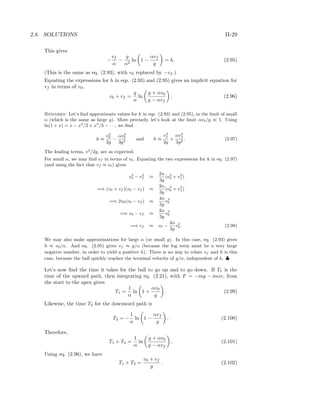
II-30 CHAPTER 2. USING F = MA
This is shorter than the time in vacuum, namely 2v0/g, because vf < v0.
Remarks: The fact that the time here is shorter than the time in vacuum isn’t all that
obvious. On one hand, the ball doesn’t travel as far in air as it would in vacuum (so you
might think that T1 + T2 < 2v0/g). But on the other hand, the ball moves slower in air (so
you might think that T1 + T2 > 2v0/g). It isn’t obvious which effect wins, without doing a
calculation.
For any α, you can easily use eq. (2.99) to show that T1 < v0/g. T2 is harder to get a handle
on, since it is given in terms of vf . But in the limit of large α, the ball quickly reaches
terminal velocity, so we have T2 ≈ h/vf ≈ (v0/α)/(g/α) = v0/g. Interestingly, this is the
same as the downward (and upward) time for a ball thrown in vacuum.
The very simple form of eq. (2.102) suggests that there should be a cleaner way to calculate
the total time of flight. And indeed, if we integrate m dv/dt = −mg − mαv with respect
to time on the way up, we obtain −v0 = −gT1 − αh (because v dt = h). Likewise, if
we integrate m dv/dt = −mg − mαv with respect to time on the way down, we obtain
−vf = −gT2 + αh (because v dt = −h). Adding these two results gives eq. (2.102). This
procedure only worked, of course, because the drag force was proportional to v. ♣
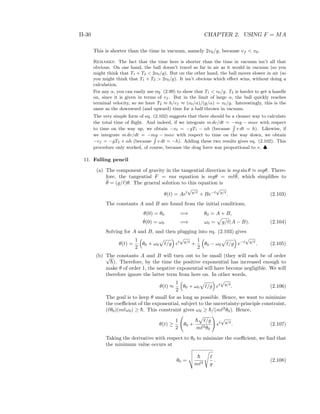
11. Falling pencil
(a) The component of gravity in the tangential direction is mg sin θ ≈ mgθ. There-
fore, the tangential F = ma equation is mgθ = m ¨θ, which simplifies to
¨θ = (g/ )θ. The general solution to this equation is
θ(t) = Aet
√
g/
+ Be−t
√
g/
. (2.103)
The constants A and B are found from the initial conditions,
θ(0) = θ0 =⇒ θ0 = A + B,
˙θ(0) = ω0 =⇒ ω0 = g/ (A − B). (2.104)
Solving for A and B, and then plugging into eq. (2.103) gives
θ(t) =
1
2
θ0 + ω0 /g et
√
g/
+
1
2
θ0 − ω0 /g e−t
√
g/
. (2.105)
(b) The constants A and B will turn out to be small (they will each be of order√
¯h). Therefore, by the time the positive exponential has increased enough to
make θ of order 1, the negative exponential will have become negligible. We will
therefore ignore the latter term from here on. In other words,
θ(t) ≈
1
2
θ0 + ω0 /g et
√
g/
. (2.106)
The goal is to keep θ small for as long as possible. Hence, we want to minimize
the coefficient of the exponential, subject to the uncertainty-principle constraint,
( θ0)(m ω0) ≥ ¯h. This constraint gives ω0 ≥ ¯h/(m 2
θ0). Hence,
θ(t) ≥
1
2
θ0 +
¯h /g
m 2θ0
et
√
g/
. (2.107)
Taking the derivative with respect to θ0 to minimize the coefficient, we find that
the minimum value occurs at
θ0 =
¯h
m 2 g
. (2.108)
2.8. SOLUTIONS II-31
Substituting this back into eq. (2.107) gives
θ(t) ≥
¯h
m 2 g
et
√
g/
. (2.109)
Setting θ = 1, and then solving for t gives
t ≤
g
ln
m1/2 3/4
g1/4
¯h1/2
. (2.110)
With the given values, m = 0.01 kg and = 0.1 m, along with g = 10 m/s2
and
¯h = 1.06 · 10−34
Js, we obtain
t ≤ (0.1 s) ln(3 · 1015
) ≈ 3.5 s. (2.111)
No matter how clever you are, no matter how much money you spend on the newest,
cutting-edge pencil-balancing equipment, you can never get a pencil to balance for
more than about four seconds.
Remarks: This smallness of this answer is quite amazing. It is remarkable that a quantum
effect on a macroscopic object produces an everyday value for a time scale. Basically, what
is going on here is that the fast exponential growth of θ (which gives rise to the log in the
final result for t) wins out over the smallness of ¯h, and produces a result for t of order 1.
When push comes to shove, exponential effects always win.
The above value for t depends strongly on and g, through the /g term. But the
dependence on m, , and g in the log term is very weak. If m were increased by a factor
of 1000, for example, the result for t would increase by only about 10%. Note that this
implies that any factors of order 1 that we neglected throughout this problem are completely
irrelevant. They will appear in the argument of the log term, and will thus have negligible
effect. ♣
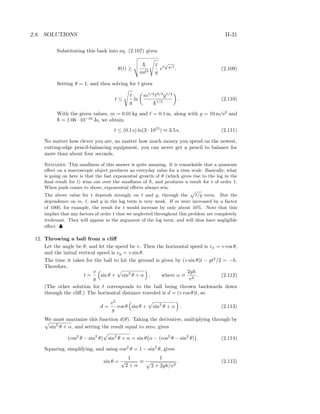
12. Throwing a ball from a cliff
Let the angle be θ, and let the speed be v. Then the horizontal speed is vx = v cos θ,
and the initial vertical speed is vy = v sin θ.
The time it takes for the ball to hit the ground is given by (v sin θ)t − gt2
/2 = −h.
Therefore,
t =
v
g
sin θ + sin2
θ + α , where α ≡
2gh
v2
. (2.112)
(The other solution for t corresponds to the ball being thrown backwards down
through the cliff.) The horizontal distance traveled is d = (v cos θ)t, so
d =
v2
g
cos θ sin θ + sin2
θ + α . (2.113)
We must maximize this function d(θ). Taking the derivative, multiplying through by
sin2
θ + α, and setting the result equal to zero, gives
(cos2
θ − sin2
θ) sin2
θ + α = sin θ α − (cos2
θ − sin2
θ) . (2.114)
Squaring, simplifying, and using cos2
θ = 1 − sin2
θ, gives
sin θ =
1
√
2 + α
≡
1
2 + 2gh/v2
. (2.115)
II-32 CHAPTER 2. USING F = MA
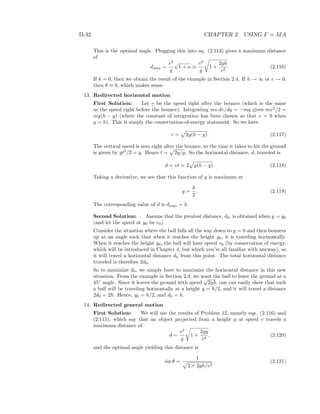
This is the optimal angle. Plugging this into eq. (2.113) gives a maximum distance
of
dmax =
v2
g
√
1 + α ≡
v2
g
1 +
2gh
v2
. (2.116)
If h = 0, then we obtain the result of the example in Section 2.4. If h → ∞ or v → 0,
then θ ≈ 0, which makes sense.
13. Redirected horizontal motion
First Solution: Let v be the speed right after the bounce (which is the same
as the speed right before the bounce). Integrating mv dv/dy = −mg gives mv2
/2 =
mg(h − y) (where the constant of integration has been chosen so that v = 0 when
y = h). This is simply the conservation-of-energy statement. So we have
v = 2g(h − y). (2.117)
The vertical speed is zero right after the bounce, so the time it takes to hit the ground
is given by gt2
/2 = y. Hence t = 2y/g. So the horizontal distance, d, traveled is
d = vt = 2 y(h − y). (2.118)
Taking a derivative, we see that this function of y is maximum at
y =
h
2
. (2.119)
The corresponding value of d is dmax = h.
Second Solution: Assume that the greatest distance, d0, is obtained when y = y0
(and let the speed at y0 be v0).
Consider the situation where the ball falls all the way down to y = 0 and then bounces
up at an angle such that when it reaches the height y0, it is traveling horizontally.
When it reaches the height y0, the ball will have speed v0 (by conservation of energy,
which will be introduced in Chapter 4, but which you’re all familiar with anyway), so
it will travel a horizontal distance d0 from this point. The total horizontal distance
traveled is therefore 2d0.
So to maximize d0, we simply have to maximize the horizontal distance in this new
situation. From the example in Section 2.4, we want the ball to leave the ground at a
45◦
angle. Since it leaves the ground with speed
√
2gh, one can easily show that such
a ball will be traveling horizontally at a height y = h/2, and it will travel a distance
2d0 = 2h. Hence, y0 = h/2, and d0 = h.
14. Redirected general motion
First Solution: We will use the results of Problem 12, namely eqs. (2.116) and
(2.115), which say that an object projected from a height y at speed v travels a
maximum distance of
d =
v2
g
1 +
2gy
v2
, (2.120)
and the optimal angle yielding this distance is
sin θ =
1
2 + 2gh/v2
. (2.121)
2.8. SOLUTIONS II-33
In the problem at hand, the object is dropped from a height h, so conservation of
energy (or integration of mv dv/dy = −mg) says that the speed at height y is
v = 2g(h − y). (2.122)
Plugging this into eq. (2.120) shows that the maximum horizontal distance, as a
function of y, is
dmax(y) = 2 h(h − y). (2.123)
This is clearly maximum at y = 0, in which case the distance is dmax = 2h. Eq.
(2.121) then gives the associated optimal angle as θ = 45◦
.
Second Solution: Assume that the greatest distance, d0, is obtained when y =
y0 = 0 and θ = θ0 (and let the speed at y0 be v0). We will show that this cannot
be the case. We will do this by explicitly constructing a situation yielding a greater
distance.
Consider the situation where the ball falls all the way down to y = 0 and then bounces
up at an angle such that when it reaches the height y0, it is traveling at an angle θ0
with respect to the horizontal. When it reaches the height y0, the ball will have
speed v0 (by conservation of energy), so it will travel a horizontal distance d0 from
this point. But the ball traveled a nonzero horizontal distance on its way up to the
height y0. We have therefore constructed a situation yielding a distance greater than
d0. Hence, the optimal setup cannot have y0 = 0. Therefore, the maximum distance
must be obtained when y = 0 (in which case the example in Section 2.4 says that the
optimal angle is θ = 45◦
).
If you want the ball to go even further, simply dig a (wide enough) hole in the ground
and have the ball bounce from the bottom of the hole.
15. Maximum length of trajectory
The coordinates are given by x = (v cos θ)t and y = (v sin θ)t − gt2
/2. Eliminating t
gives
y = (tan θ)x −
gx2
2v2 cos2 θ
. (2.124)
The length of the arc is twice the length up to the maximum. The maximum occurs
at t = (v/g) sin θ, and hence x = (v2
/g) sin θ cos θ. So the length of the arc is
L = 2
(v2
/g) sin θ cos θ
0
1 + (dy/dx)2 dx
= 2
(v2
/g) sin θ cos θ
0
1 + (tan θ − gx/v2 cos2 θ)2 dx. (2.125)
Letting z ≡ tan θ − gx/v2
cos2
θ, we obtain
L =
2v2
cos2
θ
g
tan θ
0
1 + z2 dz
=
2v2
cos2
θ
g
1
2
z 1 + z2 + ln z + 1 + z2
tan θ
0
=
v2
g
sin θ + cos2
θ ln
1 + sin θ
cos θ
. (2.126)
II-34 CHAPTER 2. USING F = MA
(As a double-check, some special cases are L = 0 at θ = 0, and L = v2
/g at θ = 90◦
,
as one can explicitly verify.) Taking the derivative to find the maximum, we have
0 = cos θ − 2 cos θ sin θ ln
1 + sin θ
cos θ
+ cos2
θ
cos θ
1 + sin θ
cos2
θ + (1 + sin θ) sin θ
cos2 θ
(2.127)
This reduces to
1 = sin θ ln
1 + sin θ
cos θ
, (2.128)
as was to be shown.
Remark: The possible trajectories are shown in Fig. 2.19. Since it is well-known that
y
x
45
path
θ=
o
Figure 2.19
θ = 45◦
provides the maximum horizontal distance, it is clear from the figure that the
θ0 yielding the arc of maximum length must satisfy θ0 ≥ 45◦
. The exact angle, however,
requires the above detailed calculation. ♣
16. Maximum area under trajectory
The coordinates are given by x = (v cos θ)t and y = (v sin θ)t − gt2
/2. The time in
the air is T = 2(v sin θ)/g. The area under the trajectory is
A =
xmax
0
y dx
=
2v sin θ/g
0
(v sin θ)t − gt2
/2 v cos θ dt
=
2v4
3g2
sin3
θ cos θ. (2.129)
Taking a derivative, we find that the maximum occurs when tan θ =
√
3, i.e.,
θ = 60◦
. (2.130)
The maximum area is then Amax =
√
3v4
/8g2
. (By dimensional analysis, we know
that it has to be proportional to v4
/g2
.)
17. Bouncing ball
The ball travels 2h during the first up-and-down journey. It travels 2hf during the
second, then 2hf2
during the third, and so on. Therefore, the total distance traveled
is
D = 2h(1 + f + f2
+ f3
+ · · ·)
=
2h
1 − f
. (2.131)
The time it takes to fall down during the first up-and-down is obtained from h = gt2
/2.
So the time for the first up-and-down is 2t = 2 2h/g. The time for the second up-
and-down will likewise be 2 2(hf)/g. Each successive time decreases by a factor of√
f. The total time is therefore
T = 2
2h
g
(1 + f1/2
+ f1
+ f3/2
+ · · ·)
= 2
2h
g
1
1 −
√
f
. (2.132)
2.8. SOLUTIONS II-35
(Note that if f is exactly equal to 1, then the summations of the above series’ are not
valid.)
The average speed
D
T
=
gh/2
1 +
√
f
. (2.133)
Remark: For f ≈ 1, the average speed is roughly half of the average speed for f ≈ 0. This
may seem somewhat counterintuitive, because in the f ≈ 0 case the ball slows down far
sooner than in the f ≈ 1 case. But the point is that the f ≈ 0 case consists of essentially
only one bounce, and the average speed for that bounce is the largest of any bounce. Both
D and T are smaller for f ≈ 0 than for f ≈ 1; but T is smaller by a larger factor. ♣
18. Free particle
For zero force, eqs. (2.49) yield
¨r = r ˙θ2
,
−2 ˙r ˙θ = r¨θ. (2.134)
Separating variables in the second equation and then integrating gives
−
2 ˙r
r
=
¨θ
˙θ
=⇒ −2 ln r = ln ˙θ + C =⇒ ˙θ =
D
r2
, (2.135)
where D = e−C
is a constant of integration, determined by the initial conditions.12
Substituting this value of ˙θ into the first of eqs. (2.140), and then multiplying both
sides by ˙r and integrating, gives
¨r = r
D
r2
2
=⇒ ¨r ˙r = D2 ˙r
r3
=⇒
˙r2
2
= −
D2
2r2
+ E. (2.136)
Therefore,
˙r = V 1 −
r2
0
r2
, (2.137)
where V ≡ D/r0. The constant E was chosen so that ˙r = 0 when r = r0. Separating
variables and integrating gives
r ˙r
r2 − r2
0
= V =⇒ r2 − r2
0 = V t =⇒ r = r2
0 + (V t)2,
(2.138)
where the constant of integration is zero, because r = r0 when t = 0. Using this value
for r in the ˙θ = D/r2
≡ V r0/r2
result from eq. (2.135) gives
dθ =
V r0 dt
r2
0 + (V t)2
=⇒ θ = tan−1 V t
r0
=⇒ cos θ =
r0
r2
0 + (V t)2
.
(2.139)
Combining this with the result for r from eq. (2.137) finally gives cos θ = r0/r, as
desired.
12
The statement that r2 ˙θ is a constant is simply the statement of conservation of angular mo-
mentum, because r2 ˙θ = r(r ˙θ) = rvθ. Much more on this in Chapters 6 and 7.
II-36 CHAPTER 2. USING F = MA
19. A force Fθ = ˙r ˙θ
With the given force, eqs. (2.49) yield
0 = m(¨r − r ˙θ2
),
m ˙r ˙θ = m(r¨θ + 2 ˙r ˙θ). (2.140)
The second of these equations gives − ˙r ˙θ = r¨θ. Therefore,
−
˙r
r
=
¨θ
˙θ
=⇒ − ln r = ln ˙θ + C =⇒ ˙θ =
D
r
, (2.141)
where D = e−C
is a constant of integration, determined by the initial conditions.
Substituting this value of ˙θ into the first of eqs. (2.140), and then multiplying both
sides by ˙r and integrating, gives
¨r = r
D
r
2
=⇒ ¨r ˙r = D2 ˙r
r
=⇒
˙r2
2
= D2
ln r + E. (2.142)
Therefore,
˙r =
√
A ln r + B , (2.143)
where A = 2D2
and B = 2E.
2.8. SOLUTIONS II-37

Ch2 using f ma

  • 1.
    Chapter 2 Using F= ma The general goal of classical mechanics is to determine what happens to a given set of objects in a given physical situation. In order to figure this out, we need to know what makes objects move the way they do. There are two main ways of going about this task. One way (the more advanced one) involves the Lagrangian method, which we will discuss in Chapter 5. The other (which you are undoubtedly familiar with) involves Newton’s laws, which will be the subject of the present chapter. It should be noted that each of these two methods is perfectly sufficient for solving any problem. They both produce the same information in the end (that is, the same equations), but they are based on vastly different principles. We’ll talk more about this is Chapter 5. 2.1 Newton’s Laws Newton published his three laws in 1687 in his Principia Mathematica. The laws are quite intuitive (although it seems a bit strange to attach the adjective “intuitive” to a set of statements that took millennia for humans to write down). They may be formulated as follows (although there are other possible variations). • First Law: A body moves with constant velocity (which may be zero) unless acted on by a force. • Second Law: The time rate of change of the momentum of a body equals the force acting on the body. • Third Law: The forces two bodies apply to each other are equal in magnitude and opposite in direction. We could discuss for days on end the degree to which these statements are physical laws, and the degree to which they are definitions. Sir Arthur Eddington once made the unflattering comment that the first law essentially says that “every particle continues in its state of rest or uniform motion in a straight line except insofar that it doesn’t.” Although Newton’s laws may seem somewhat vacuous at first glance, there is actually a bit more content to them than Eddington’s statement II-1
  • 2.
    II-2 CHAPTER 2.USING F = MA implies. Let’s look at each in turn. The discussion will be brief, because we have to save time for other things in this book that we really do want to discuss for days on end. First Law One thing this law does is give a definition of zero force. Another thing it does is give a definition of an inertial frame (which is defined simply as a reference frame in which the first law holds). Since the term ‘velocity’ is used, we have to state what frame of reference we are measuring the velocity with respect to. The first law does not hold in an arbitrary frame. For example, it fails in the frame of a spinning turntable.1 Intuitively, an inertial frame is one that moves at constant speed. But this is ambiguous, because you have to say what the frame is moving at constant speed with respect to. At any rate, an inertial frame is simply defined as the special type of frame where the first law holds. So, what we have now are two intertwined definitions of “force” and “inertial frame”. Not much physical content here. But, however sparse in content the law is, it still holds for all particles. So if we have a frame where one free particle moves with constant velocity, then if we replace it with another particle, it will likewise move with constant velocity. This is a statement with content. Second Law One thing this law does is give a definition of non-zero force. Momentum is defined2 to be mv. If m is constant, then this law says that F = ma, (2.1) where a ≡ dv/dt. This law holds only in an inertial frame (which was defined by the first law). For things moving free or at rest, Observe what the first law does best. It defines a key frame, “Inertial” by name, Where the second law then is expressed. So far, the second law merely gives a definition of F. But the meaningful state- ment arises when we invoke the fact that the law holds for all particles. If the same force (for example, the same spring stretched by the same amount) acts on two particles, with masses m1 and m2, then their accelerations must be related by a1 a2 = m2 m1 . (2.2) 1 It is, however, possible to fudge things so that Newton’s laws hold in such a frame, but we’ll save this discussion for Chapter 9. 2 We’re doing everything nonrelativistically here, of course. Chapter 11 gives the relativistic modification of the mv expression.
  • 3.
    2.2. FREE-BODY DIAGRAMSII-3 This relation holds regardless of what the common force is. Therefore, once you’ve used one force to find the relative masses of two objects, then you know what the ratio of their a’s will be when they are subjected to any other force. Of course, we haven’t really defined mass yet. But eq. (2.2) gives an experi- mental method for determining an object’s mass in terms of a standard (say, 1 kg) mass. All you have to do is compare its acceleration with that of the standard mass (when acted on by the same force). There is also another piece of substance in this law, in that it says F = ma, instead of, say, F = mv or F = m d3x/dt3. This issue is related to the first law. F = mv is certainly not viable, because the first law says that it is possible to have a velocity without a force. And F = md3x/dt3 would make the first law incorrect, because it would then be true that a particle moves with constant acceleration (instead of constant velocity) unless acted on by a force. Note that F = ma is a vector equation, so it is really three equations in one. In cartesian coordinates, it says that Fx = max, Fy = may, and Fz = maz. Third Law This law essentially postulates that momentum is conserved, (that is, not dependent on time). To see this, note that dp dt = d(m1v1 + m2v2) dt = m1a1 + m2a2 = F1 + F2, (2.3) where F1 and F2 are the forces acting on m1 and m2, respectively. Therefore, momentum conservation (that is, dp/dt = 0) is equivalent to Newton’s third law (that is, F1 = −F2.) There isn’t much left to be defined in this law, so the statement of the third law is one of pure content. It says that if you have two isolated particles, then their accelerations are opposite in direction and inversely proportional to their masses. This third law cannot be a definition, because it’s actually not always valid. It only holds for forces of the “pushing” and “pulling” type. It fails for the magnetic force, for example. 2.2 Free-body diagrams The law that allows us to be quantitative is the second law. Given a force, we can apply F = ma to find the acceleration. And knowing the acceleration, we should be able to determine the behavior of a given object (that is, where it is and how fast it is moving). This process sometimes takes a bit of work, but there are two basic types of situations that commonly arise. • In many problems, all you are given is a physical situation (for example, a block resting on a plane, strings connecting masses, etc.), and it is up to you
  • 4.
    II-4 CHAPTER 2.USING F = MA to find all the forces acting on all the objects. These forces generally point in various directions, so it is easy to lose track of them. It therefore proves useful to isolate the objects and draw all the forces acting on each of them. This is the subject of the present section. • In other problems, you are given the force, F(x), as a function of position (we’ll just work in one dimension here), and the task immediately becomes the mathematical one of solving the F(x) = ma ≡ m¨x equation. These differential equations can be difficult (or impossible) to solve exactly. They are the subject of Section 2.3. Let’s now consider the first of these two types of problems, where we are pre- sented with a physical situation, and where we must determine all the forces in- volved. The term free-body diagram is used to denote a diagram with all the forces drawn on all the objects. After drawing such a diagram, we simply write down all the F = ma equations it implies. The result will be a system of linear equations in various unknown forces and accelerations, for which we must then solve. This procedure is best understood through an example. Example (A plane and masses): Mass M1 is held on a plane with inclination angle θ, and mass M2 hangs over the side. The two masses are connected by a massless string which runs over a massless pulley (see Fig. 2.1). The coefficient of friction M1 M2 θ µ Figure 2.1 (assume the kinetic and static coefficients are equal) between M1 and the plane is µ. Mass M1 is released. Assuming that M2 is sufficiently large so that M1 gets pulled up the plane, what is the acceleration of the system? What is the tension in the string? Solution: The first thing to do is draw all the forces on the two masses. These are shown in Fig. 2.2. The forces on M2 are gravity and the tension. The forces M1 M2 θ N T f T g g Figure 2.2 on M1 are gravity, friction, the tension, and the normal force. Note that the friction force points down the plane, since we are assuming that M1 moves up the plane. We now simply have to write down all the F = ma equations. When dealing with M1, we could break things up into horizontal and vertical components, but it is much cleaner to use the components tangential and normal to the plane. These two components of F = ma, along with the vertical F = ma for M2, give T − f − M1g sin θ = M1a, N − M1g cos θ = 0, M2g − T = M2a, (2.4) where we have used the fact that the two masses accelerate at the same rate (and we have defined the positive direction for M2 to be downward). We have also used the fact that tension is the same at both ends of the string, because otherwise there would be a net force on some part of the string which would then have to undergo infinite acceleration, since it is massless. There are four unknowns: T, a, N, and f. Fortunately, we have a fourth equation, namely f = µN. Therefore, the second equation above gives f = µM1g cos θ. The first equation then becomes T −µM1g cos θ−M1g sin θ = M1a. This may be combined
  • 5.
    2.2. FREE-BODY DIAGRAMSII-5 with the third equation to give a = g(M2 − µM1 cos θ − M1 sin θ) M1 + M2 , and T = M1M2g M1 + M2 (1 + µ cos θ + sin θ). (2.5) Note that we must have M2 > M1(µ cos θ + sin θ) in order for M1 to move upward. This is clear from looking at the forces tangential to the plane. Remark: If we had instead assumed that M1 was sufficiently large so that it slides down the plane, then the friction force would point up the plane, and we would have found a = g(M2 + µM1 cos θ − M1 sin θ) M1 + M2 , and T = M1M2g M1 + M2 (1 − µ cos θ + sin θ). (2.6) In order for M1 to move downward (i.e., a < 0), we must have M2 < M1(sin θ − µ cos θ). Therefore, M1(sin θ − µ cos θ) < M2 < M1(sin θ + µ cos θ) is the range of M2 for which the system doesn’t move. ♣ In problems like the one above, it is clear what things you should pick as the objects on which you’re going to draw forces. But in other problems, where there are various different subsystems you can choose, you must be careful to include all the relevant forces on a given subsystem. Which subsystems you want to pick depends on what quantities you’re trying to find. Consider the following example. Example (Platform and pulley): A person stands on a platform-and-pulley system, as shown in Fig. 2.3. The masses of the platform, person, and pulley are M, m M a µ Figure 2.3 m, and µ, respectively.3 The rope is massless. Let the person pull up on the rope so that she has acceleration a upwards. (a) What is the tension in the rope? (b) What is the normal force between the person and the platform? What is the tension in the rod connecting the pulley to the platform? Solution: (a) To find the tension in the rope, we simply want to let our subsystem be the whole system. If we imagine putting the system in a black box (to emphasize the fact that we don’t care about any internal forces within the system), then the forces we see “protruding” from the box are the three weights (Mg, mg, and µg) downward, and the tension T upward. Applying F = ma to the whole system gives T −(M +m+µ)g = (M +m+µ)a =⇒ T = (M +m+µ)(g +a). (2.7) (b) To find the normal force, N, between the person and the platform, and also the tension, f, in the rod connecting the pulley to the platform, it is not sufficient to consider the system as a whole. We must consider subsystems. 3 Assume that the pulley’s mass is concentrated at its center, so we don’t have to worry about any rotational dynamics (the subject of Chapter 7).
  • 6.
    II-6 CHAPTER 2.USING F = MA • Let’s apply F = ma to the person. The forces acting on the person are gravity, the normal force from the platform, and the tension from the rope (pulling downward at her hand). Therefore, we have N − T − mg = ma. (2.8) • Now apply F = ma to the platform. The forces acting on the platform are gravity, the normal force from the person, and the force upwards from the rod. Therefore, we have f − N − Mg = Ma. (2.9) • Now apply F = ma to the pulley. The forces acting on the pulley are gravity, the force downward from the rod, and twice the tension in the rope (since it pulls up on both sides). Therefore, we have 2T − f − µg = µa. (2.10) Note that if we add up the three previous equations, we obtain the F = ma equation in eq. (2.7), as should be the case, since the whole system is the sum of the three previous subsystems. Eqs. (2.8) – (2.10) are three equations in the three unknowns (T, N, and f). Their sum yields the T in (2.7), and then eqs. (2.8) and (2.10) give, respectively (as you can show), N = (M + 2m + µ)(g + a), and f = (2M + 2m + µ)(g + a). (2.11) Remark: Of course, you could also obtain these results by considering subsystems different from the ones we chose above (for example, you might choose the pulley- plus-platform, etc.). But no matter how you choose to break up the system, you will need to produce three independent F = ma statements in order to solve for the three unknowns (T, N, and f). In problems like this one, it is easy to make a mistake by forgetting to include one of the forces, such as the second T in eq. (2.10). The safest thing to do, therefore, is to isolate each subsystem, draw a box around it, and then write down all the forces that “protrude” from the box. Fig. 2.4 shows the free-body diagram for the subsystem of f TT µg Figure 2.4 the pulley. ♣ 2.3 Solving differential equations Let’s now consider the type of problem where we are given the force F(x) as a function of position (we’ll just work in one dimension here), and where our task is to solve the F(x) = ma ≡ m¨x differential equation, to find the position, x(t), as a function of time. In the present section, we will develop a few techniques for solving differential equations. The ability to apply these techniques dramatically increases the number of problems we can solve. In general, the force F is a function of the position x, the speed ˙x, and the time t. (Of course, it could be a function of d2x/dt2, d3x/dt3, etc., but these cases don’t arise much, so we won’t worry about them.) We therefore want to solve the differential equation, m¨x = F(x, ˙x, t). (2.12)
  • 7.
    2.3. SOLVING DIFFERENTIALEQUATIONS II-7 In general, this equation cannot be solved exactly for x(t).4 But for most of the problems we will deal with, it can be solved. The problems we’ll encounter will often fall into one of three special cases, namely, where F is a function of t only, or x only, or v ≡ ˙x only. In all of these cases, we must invoke the given initial conditions, x0 ≡ x(t0) and v0 ≡ v(t0), to obtain our final solutions. These initial conditions will appear in the limits of the integrals in the following discussion.5 Note: You may want to just skim the following page and a half, and then refer back to it, as needed. Don’t try to memorize all the different steps. We present them only for completeness. The whole point here can basically be summarized by saying that sometimes you want to write ¨x as dv/dt, and sometimes you want to write it as v dv/dx (see eq. (2.16)). Then you “simply” separate variables and integrate. We’ll go through the three special cases, and then we’ll do some examples. • F is a function of t only: F = F(t). Since a = d2x/dt2, we simply have to integrate F = ma twice to obtain x(t). Let’s do this in a very systematic way, just to get used to the general procedure. First, write F = ma as m dv dt = F(t). (2.13) Then separate variables and integrate both sides to obtain6 m v(t) v0 dv = t t0 F(t )dt . (2.14) (Primes have been put on the integration variables so that we don’t confuse them with the limits of integration.) This yields v as a function of t, v(t). Then separate variables in dx/dt = v(t) and integrate to obtain x(t) x0 dx = t t0 v(t )dt . (2.15) This yields x as a function of t, x(t). This procedure may seem like a cumber- some way to simply integrate something twice. That’s because it is. But the technique proves more useful in the following case. 4 You can always solve for x(t) numerically, to any desired accuracy. This is discussed in Ap- pendix D. 5 It is no coincidence that we need two initial conditions to completely specify the solution to our second-order F = m¨x differential equation. It is a general result (which we’ll just accept here) that the solution to an nth-order differential equation has n free parameters, which must then be determined from the initial conditions. 6 If you haven’t seen such a thing before, the act of multiplying both sides by the infinitesimal quantity dt might make you feel a bit uneasy. But it is in fact quite legal. If you wish, you can imagine working with the small (but not infinitesimal) quantities ∆v and ∆t, for which it is certainly legal to multiply both sides through by ∆t. Then you can take a discrete sum over many ∆t intervals, and then finally take the limit ∆t → 0, which results in eq. (2.14)
  • 8.
    II-8 CHAPTER 2.USING F = MA • F is a function of x only: F = F(x). We will use a = dv dt = dx dt dv dx = v dv dx (2.16) to write F = ma as mv dv dx = F(x). (2.17) Now separate variables and integrate both sides to obtain m v(x) v0 v dv = x x0 F(x )dx . (2.18) The left side will contain the square of v(x). Taking a square root, this gives v as a function of x, v(x). Separate variables in dx/dt = v(x) to obtain x(t) x0 dx v(x ) = t t0 dt . (2.19) This gives t as a function of x, and hence (in principle) x as a function of t, x(t). The unfortunate thing about this case is that the integral in eq. (2.19) might not be doable. And even if it is, it might not be possible to invert t(x) to produce x(t). • F is a function of v only: F = F(v). Write F = ma as m dv dt = F(v). (2.20) Separate variables and integrate both sides to obtain m v(t) v0 dv F(v ) = t t0 dt . (2.21) This yields t as a function of v, and hence (in principle) v as a function of t, v(t). Integrate dx/dt = v(t) to obtain x(t) from x(t) x0 dx = t t0 v(t )dt . (2.22) Note: If you want to find v as a function of x, v(x), you should write a as v(dv/dx) and integrate m v(x) v0 v dv F(v ) = x x0 dx . (2.23) You may then obtain x(t) from eq. (2.19), if desired.
  • 9.
    2.3. SOLVING DIFFERENTIALEQUATIONS II-9 When dealing with the initial conditions, we have chosen to put them in the limits of integration above. If you wish, you can perform the integrals without any limits, and just tack on a constant of integration to your result. The constant is then determined from the initial conditions. Again, as mentioned above, you do not have to memorize the above three pro- cedures, because there are variations, depending on what you want to solve for. All you have to remember is that ¨x can be written as either dv/dt or v dv/dx. One of these will get the job done (the one that makes only two out of the three vari- ables, t,x,v, appear in your differential equation). And then be prepared to separate variables and integrate as many times as needed. a is dv by dt. Is this useful? There’s no guarantee. If it leads to “Oh, heck!”’s, Take dv by dx, And then write down its product with v. Example 1 (Gravitational force): A particle of mass m is subject to a constant force F = −mg. The particle starts at rest at height h. Because this constant force falls into all of the above three categories, we should be able to solve for y(t) in two ways. (a) Find y(t) by writing a as dv/dt. (b) Find y(t) by writing a as v dv/dy. Solution: (a) F = ma gives dv/dt = −g. Integrating this yields v = −gt + C, where C is a constant of integration. The initial condition v(0) = 0 says that C = 0. Hence, dy/dt = −gt. Integrating this and using y(0) = h gives y = h − 1 2 gt2 . (2.24) (b) F = ma gives v dv/dy = −g. Separating variables and integrating gives v2 /2 = −gy + C. The initial condition v(0) = 0 yields v2 /2 = −gy + gh. Therefore, v ≡ dy/dt = − 2g(h − y) (we have chosen the negative square root, because the particle is falling). Separating variables gives dy √ h − y = − 2g dt. (2.25) This yields 2 √ h − y = √ 2g t, where we have used the initial condition y(0) = h. Hence, y = h − gt2 /2, in agreement with part (a). The solution in part (a) was clearly the simpler one.
  • 10.
    II-10 CHAPTER 2.USING F = MA Example 2 (Dropped ball): A beach-ball is dropped from rest at height h. Assume7 that the drag force from the air is Fd = −βv. Find the velocity and height as a function of time. Solution: For simplicity in future formulas, let’s write the drag force as Fd = −βv ≡ −mαv. Taking upward to be the positive y direction, the force on the ball is F = −mg − mαv. (2.26) Note that v is negative here, since the ball is falling, so the drag force points upward, as it should. Writing F = m dv/dt, and separating variables, gives v(t) 0 dv g + αv = − t 0 dt . (2.27) The integration yields ln(1 + αv/g) = −αt. Exponentiation then gives v(t) = − g α 1 − e−αt . (2.28) Integrating dy/dt ≡ v(t) to obtain y(t) yields y(t) h dy = − g α t 0 1 − e−αt dt . (2.29) Therefore, y(t) = h − g α t − 1 α 1 − e−αt . (2.30) Remarks: (a) Let’s look at some limiting cases. If t is very small (more precisely, if αt 1), then we can use e−x ≈ 1 − x + x2 /2 to make approximations to leading order in t. You can show that eq. (2.28) gives v(t) ≈ −gt (as it should, since the drag force is negligible at the start, so the ball is essentially in free fall). And eq. (2.30) gives y(t) ≈ h − gt2 /2, as expected. We may also look at large t. In this case, e−αt is essentially 0, so eq. (2.28) gives v(t) ≈ −g/α. (This is the terminal velocity. Its value makes sense, because it is the velocity for which the force −mg − mαv vanishes.) And eq. (2.30) gives y(t) ≈ h − (g/α)t + g/α2 . Interestingly, we see that for large t, g/α2 is the distance our ball lags behind another ball which started out already at the terminal velocity, g/α. (b) The speed of the ball obtained in eq. (2.28) depends on α, which was defined in the coefficient of the drag force, Fd = −mαv. We explicitly wrote the m here just to make all of our formulas look a little nicer, but it should not be inferred that the speed of the ball is independent of m. The coefficient mα depends (in some complicated way) on the cross-sectional area, A, of the ball. Therefore, α ∝ A/m. Two balls of the same size, one made of lead and one made of styrofoam, will have the same A but different m’s. Hence, their α’s will be different, and they will fall at different rates. For heavy objects in a thin medium such as air, α is small, and so the drag effects are not very noticeable over short distances. Heavy objects fall at roughly the same rate. If the air were a bit thicker, different objects would fall at noticeably different rates, and maybe it would have taken Galileo a bit longer to come to his conclusions. 7 The drag force is roughly proportional to v as long as the speed is fairly slow (up to, say, 50 m/s, but this depends on various things). For larger speeds, the drag force is roughly proportional to v2 .
  • 11.
    2.4. PROJECTILE MOTIONII-11 What would you have thought, Galileo, If instead you dropped cows and did say, “Oh! To lessen the sound Of the moos from the ground, They should fall not through air, but through mayo!” ♣ 2.4 Projectile motion Consider a ball thrown through the air (not necessarily vertically). We will neglect air resistance in the following discussion. Let x and y be the horizontal and vertical positions, respectively. The force in the x-direction is Fx = 0, and the force in the y-direction is Fy = −mg. So F = ma gives ¨x = 0, and ¨y = −g. (2.31) Note that these two equations are “decoupled”. That is, there is no mention of y in the equation for ¨x, and vice-versa. The motions in the x- and y-directions are therefore completely independent. Remark: The classic demonstration of the independence of the x- and y-motions is the following. Fire a bullet horizontally (or, preferably, just imagine firing a bullet horizontally), and at the same time drop a bullet from the height of the gun. Which bullet will hit the ground first? (Neglect air resistance, and the curvature of the earth, etc.) The answer is that they will hit the ground at the same time, because the effect of gravity on the two y-motions is exactly the same, independent of what is going on in the x-direction. ♣ If the initial position and velocity are (X, Y ) and (Vx, Vy), then we can easily integrate eqs. (2.31) to obtain ˙x(t) = Vx, ˙y(t) = Vy − gt. (2.32) Integrating again gives x(t) = X + Vxt, y(t) = Y + Vyt − 1 2 gt2 . (2.33) These equations for the speeds and positions are all you need to solve a projectile problem. Example (Throwing a ball): (a) For a given initial speed, at what inclination angle should a ball be thrown so that it travels the maximum distance along the ground? Assume that the ground is horizontal, and that the ball is released from ground level. (b) What is the optimal angle if the ground is sloped upward at an angle β (or downward, if β is negative)?
  • 12.
    II-12 CHAPTER 2.USING F = MA Solution: (a) Let the inclination angle be θ, and let the initial speed be V . Then the horizontal speed is (always) Vx = V cos θ, and the initial vertical speed is Vy = V sin θ. Let d be the horizontal distance traveled, and let t be the time in the air. Then the vertical speed is zero at time t/2 (since the ball is moving horizontally at its highest point), so the second of eqs. (2.32) gives Vy = g(t/2). Hence8 , t = 2Vy/g. The first of eqs. (2.33) gives d = Vxt. Using t = 2Vy/g here gives d = 2VxVy g = V 2 g (2 sin θ cos θ) = V 2 g sin 2θ. (2.34) The sin 2θ factor has a maximum at θ = π 4 . (2.35) The maximum distance traveled along the ground is then d = V 2 /g. Remarks: For θ = π/4, you can show that the maximum height achieved is V 2 /4g. This may be compared to the maximum height of V 2 /2g (as you can show) if the ball is thrown straight up. Note that any possible distance you might wish to find in this problem must be pro- portional to V 2 /g, by dimensional analysis. The only question is what the numerical factor is. ♣ (b) If the ground is sloped at an angle β, then the equation for the line of the ground is y = (tan β)x. (2.36) The path of the ball is given in terms of t by x = (V cos θ)t, and y = (V sin θ)t − 1 2 gt2 . (2.37) We may now solve for the t which makes y = (tan β)x (since this gives the place where the path of the ball intersects the line of the ground). Using eqs. (2.37), we find that y = (tan β)x when t = 2V g (sin θ − tan β cos θ). (2.38) (There is, of course, also the solution t = 0.) Plugging this into our expression for x in eq. (2.37) gives x = 2V 2 g (sin θ cos θ − tan β cos2 θ). (2.39) We must now maximize this value for x (which is the same as maximizing the distance along the slope). Taking the derivative with respect to θ gives (with the help of the double-angle formulas, sin 2θ = 2 sin θ cos θ and cos 2θ = cos2 θ −sin2 θ) tan β = − cot 2θ ≡ − tan(π/2−2θ). Therefore, β = −(π/2−2θ), so we have θ = 1 2 β + π 2 . (2.40) 8 Alternatively, the time of flight can be found from the second of eqs. (2.33), which says that the ball returns to height zero when Vyt = gt2 /2.
  • 13.
    2.5. MOTION INA PLANE, POLAR COORDINATES II-13 In other words, the throwing angle should bisect the angle between the ground and the vertical. Remarks: For β = π/2, we have θ = π/2, as should be the case. For β = 0, we have θ = π/4, as found in part (a). And for β = −π/2, we have θ = 0, which makes sense. Substituting the value of θ from eq. (2.40) into eq. (2.39), you can show (after a bit of algebra) that the maximum distance traveled along the tilted ground is d = x cos β = V 2 /g 1 + sin β . (2.41) This checks in the various limits for β. ♣ 2.5 Motion in a plane, polar coordinates When dealing with problems where the motion lies in a plane, it is often conve- nient to work with polar coordinates, r and θ. These are related to the cartesian coordinates by (see Fig. 2.5) r y x θ Figure 2.5 x = r cos θ, and y = r sin θ. (2.42) Depending on the problem, either cartesian or polar coordinates will be easier to use. It is usually clear from the setup which is better. For the cases where you want to use polar coordinates, you need to know what Newton’s second law looks like in terms of them. Therefore, the goal of the present section will be to determine what F = ma ≡ m¨r looks like when written in terms of polar coordinates. At a given position r in the plane, the basis vectors in polar coordinates are ˆr, which is a unit vector pointing in the radial direction; and ˆθ, which is a unit vector pointing in the counterclockwise tangential direction. In polar coords, a general vector may therefore be written as r = rˆr. (2.43) Note that the directions of the ˆr and ˆθ basis vectors depend, of course, on r. Since the goal of this section is to find ¨r, we must, in view of eq. (2.43), get a handle on the time derivative of ˆr (and we’ll eventually need the derivative of ˆθ, too). In contrast with the (fixed) cartesian basis vectors (ˆx and ˆy), the polar basis vectors (ˆr and ˆθ) change as a point moves around in the plane. We may find ˙ˆr and ˙ˆθ in the following way. In terms of the cartesian basis, Fig. 2.6 shows that y x cos sin θ θ θ θ r θ Figure 2.6 ˆr = cos θˆx + sin θˆy, ˆθ = − sin θˆx + cos θˆy. (2.44) Taking the time derivative of these equations gives ˙ˆr = − sin θ ˙θˆx + cos θ ˙θˆy, ˙ˆθ = − cos θ ˙θˆx − sin θ ˙θˆy. (2.45)
  • 14.
    II-14 CHAPTER 2.USING F = MA Using eqs. (2.44), we then arrive at the nice clean expressions, ˙ˆr = ˙θˆθ, and ˙ˆθ = − ˙θˆr. (2.46) These relations are fairly evident from viewing what happens to the basis vectors as r moves a tiny distance in the tangential direction. (Note that the basis vectors do not change as r moves in the radial direction.) We may now start differentiating eq. (2.43). One derivative gives (yes, the product rule works fine here) ˙r = ˙rˆr + r˙ˆr = ˙rˆr + r ˙θˆθ. (2.47) This is quite clear, because ˙r is the speed in the radial direction, and r ˙θ is the speed in the tangential direction (which is often written as ωr, where ω ≡ ˙θ is the angular speed, or ‘angular frequency’).9 Differentiating eq. (2.47) then gives ¨r = ¨rˆr + ˙r˙ˆr + ˙r ˙θˆθ + r¨θˆθ + r ˙θ ˙ˆθ = ¨rˆr + ˙r( ˙θˆθ) + ˙r ˙θˆθ + r¨θˆθ + r ˙θ(− ˙θˆr) = (¨r − r ˙θ2 )ˆr + (r¨θ + 2 ˙r ˙θ)ˆθ. (2.48) Finally, equating m¨r with F ≡ Frˆr + Fθ ˆθ gives the radial and tangential forces as Fr = m(¨r − r ˙θ2 ), Fθ = m(r¨θ + 2 ˙r ˙θ). (2.49) Exercise 7 gives a slightly different derivation of these equations. Let’s look at each of the four terms on the right-hand sides of eqs. (2.49). • The m¨r term is quite intuitive. For radial motion, it simply states that F = ma along the radial direction. • The mr¨θ term is also quite intuitive. For circular motion, it states that F = ma along the tangential direction. • The −mr ˙θ2 term is also fairly clear. For circular motion, it says that the radial force is −m(r ˙θ)2/r = −mv2/r, which is the familiar term that causes the centripetal acceleration. • The 2m ˙r ˙θ term is not so obvious. It is called the Coriolis force. There are various ways to look at this term. One is that it exists in order to keep the angular momentum conserved. We’ll have much more to say about this in Chapter 9. 9 For r ˙θ to be the tangential speed, we must of course measure θ in radians and not degrees. Then rθ is by definition the distance along the circumference; so r ˙θ is the speed along the circumference.
  • 15.
    2.5. MOTION INA PLANE, POLAR COORDINATES II-15 Example (Circular pendulum): A mass hangs from a string of length . Con- ditions have been set up so that the mass swings around in a horizontal circle, with the string making an angle of θ with the vertical (see Fig. 2.7). What is the angular θ l m Figure 2.7 frequency, ω, of this motion? Solution: The mass travels in a circle, so the horizontal radial force must be Fr = mr ˙θ2 ≡ mrω2 (with r = sin θ), directed radially inward. The forces on the mass are the tension in the string, T, and gravity, mg (see Fig. 2.8). There is no T mg Figure 2.8 acceleration in the vertical direction, so F = ma in the vertical and radial directions gives, respectively, T cos θ = mg, T sin θ = m( sin θ)ω2 . (2.50) Solving for ω gives ω = g cos θ . (2.51) Note that if θ ≈ 0, then ω ≈ g/ , which equals the frequency of a plane pendulum of length . And if θ ≈ 90◦ , then ω → ∞, as it should.
  • 16.
    II-16 CHAPTER 2.USING F = MA 2.6 Exercises Section 2.2: Free-body diagrams 1. A Peculiar Atwood’s Machine Consider an Atwood’s machine (see Fig. 2.9) consisting of N masses, M,M/ M/ M/ M ..... N 1- ? 2 2 4 Figure 2.9 M/2, M/4, . . ., M/2N−1. (All the pulleys and strings are massless, as usual.) (a) Put a mass M/2N−1 at the free end of the bottom string. What are the accelerations of all the masses? (b) Remove the mass M/2N−1 (which was arbitrarily small, for very large N) that was attached in part (a). What are the accelerations of all the masses, now that you’ve removed this infinitesimal piece? 2. Accelerated Cylinders ** Three identical cylinders are arranged in a triangle as shown in Fig. 2.10, F Figure 2.10 with the bottom two lying on the ground. The ground and the cylinders are frictionless. You apply a constant horizontal force (directed to the right) on the left cylin- der. Let a be the acceleration you give to the system. For what range of a will all three cylinders remain in contact with each other? Section 2.3: Solving differential equations 3. −bv2 force * A particle of mass m is subject to a force F(v) = −bv2. The initial position is 0, and the initial speed is v0. Find x(t). 4. −kx force ** A particle of mass m is subject to a force F(x) = −kx. The initial position is 0, and the initial speed is v0. Find x(t). 5. kx force ** A particle of mass m is subject to a force F(x) = kx. The initial position is 0, and the initial speed is v0. Find x(t). Section 2.4: Projectile motion 6. Newton’s apple * Newton is tired of apples falling on his head, so he decides to throw a rock at one of the larger and more formidable-looking apples positioned directly above his favorite sitting spot. Forgetting all about his work on gravitation (along with general common sense), he aims the rock directly at the apple (see Fig. 2.11). To his surprise, however, the apple falls from the tree just as he Figure 2.11
  • 17.
    2.6. EXERCISES II-17 releasesthe rock. Show that the rock will hit the apple.10 Section 2.5: Motion in a plane, polar coordinates 7. Derivation of Fr and Fθ ** In cartesian coords, a general vector takes the form r = xˆx + yˆy = r cos θˆx + r sin θˆy. (2.52) Derive eqs. (2.49) by taking two derivatives of this expression for r, and then using eqs. (2.44) to show that the result may be written in the form of eq. (2.48). (Unlike ˆr and ˆθ, the vectors ˆx and ˆy do not change with time.) 8. A force Fθ = 2 ˙r ˙θ ** Consider a particle that feels an angular force only, of the form Fθ = 2m ˙r ˙θ. (As in Problem 19, there’s nothing all that physical about this force; it simply makes the F = ma equations solvable.) Show that the trajectory takes the form of an exponential spiral, that is, r = Aeθ. 9. A force Fθ = 3 ˙r ˙θ ** Consider a particle that feels an angular force only, of the form Fθ = 3m ˙r ˙θ. (As in the previous problem, we’re solving this problem simply because we can. And it’s good practice.) Show that ˙r = √ Ar4 + B. Also, show that the particle reaches r = ∞ in a finite time. 10 This problem suggests a way in which William Tell and his son might survive their ordeal if they were plopped down on a planet with an unknown gravitational constant (provided the son isn’t too short or g isn’t too big).
  • 18.
    II-18 CHAPTER 2.USING F = MA 2.7 Problems Section 2.2: Free-body diagrams 1. Sliding down a plane ** (a) A block slides down a frictionless plane from the point (0, y) to the point (b, 0), where b is given. For what value of y does the journey take the shortest time? What is this time? (b) Answer the same questions in the case where there is a coefficient of kinetic friction, µ, between the block and the plane. 2. Sliding plane *** A block of mass m is held motionless on a frictionless plane of mass M and angle of inclination θ (see Fig. 2.12). The plane rests on a frictionless hori-θ m M Figure 2.12 zontal surface. The block is released. What is the horizontal acceleration of the plane? 3. Sliding sideways on plane *** A block is placed on a plane inclined at an angle θ. The coefficient of friction between the block and the plane is µ = tan θ. The block is given a kick so that it initially moves with speed V horizontally along the plane (that is, in the direction perpendicular to the direction pointing straight down the plane). What is the speed of the block after a very long time? 4. Atwood’s machine ** (a) A massless pulley hangs from a fixed support. A string connecting two masses, M1 and M2, hangs over the pulley (see Fig. 2.13). Find theM1 M2 Figure 2.13 accelerations of the masses. (b) Consider now the double-pulley system with masses M1, M2, and M3 (see Fig. 2.14). Find the accelerations of the masses. M1 M3M2 Figure 2.14 5. Infinite Atwood’s machine *** Consider the infinite Atwood’s machine shown in Fig. 2.15. A string passes M M M M ..... Figure 2.15 over each pulley, with one end attached to a mass and the other end attached to another pulley. All the masses are equal to M, and all the pulleys and strings are massless. The masses are held fixed and then simultaneously released. What is the acceleration of the top mass? (You may define this infinite system as follows. Consider it to be made of N pulleys, with a non-zero mass replacing what would have been the (N + 1)st pulley. Then take the limit as N → ∞. It is not necessary, however, to use this exact definition.)
  • 19.
    2.7. PROBLEMS II-19 6.Line of Pulleys * N + 2 equal masses hang from a system of pulleys, as shown in Fig. 2.16. N=3 Figure 2.16 What is the acceleration of the masses at the end of the string? 7. Ring of Pulleys ** Consider the system of pulleys shown in Fig. 2.17. The string (which is a .... .... .... .... mN m1 m Figure 2.17 loop with no ends) hangs over N fixed pulleys. N masses, m1, m2, . . ., mN , are attached to N pulleys which hang on the string. Find the acceleration of each mass. Section 2.3: Solving differential equations 8. Exponential force A particle of mass m is subject to a force F(t) = me−bt. The initial position and speed are 0. Find x(t). 9. Falling chain ** (a) A chain of length is held on a frictionless horizontal table, with a length y0 hanging over the edge. The chain is released. As a function of time, find the length that hangs over the edge. (Don’t bother with t after the chain loses contact with the table.) Also, find the speed of the chain right when it loses contact with the table. (b) Do the same problem, but now let there be a coefficient of friction µ between the chain and the table. (Assume that the chain initially hangs far enough over the edge so that it will indeed fall when released.) 10. Ball thrown upward *** A beach-ball is thrown upward with initial speed v0. Assume that the drag force is F = −mαv. What is the speed of the ball, vf , when it hits the ground? (An implicit equation is sufficient.) Does the ball spend more time or less time in the air than it would if it were thrown in vacuum? 11. Falling pencil ** Consider a pencil, standing upright on its tip and then falling over. Since we haven’t yet talked about torques and moments of inertia (the subject of Chapter 7), we will idealize the pencil as a mass m sitting at the end of a massless rod of length .11 (a) Assume that the rod has initial (small) angle θ0 and initial angular speed ω0. The angle will eventually become large, but while it is small (so that sin θ ≈ θ), determine θ as a function of time. 11 It actually involves only a trivial modification to do the problem correctly with torques. But the point-mass version will be quite sufficient for the present purposes.
  • 20.
    II-20 CHAPTER 2.USING F = MA (b) You might think that it would be possible (theoretically, at least) to make the pencil balance for an arbitrarily long time, by making the initial θ0 and ω0 sufficiently small. It turns out that due to Heisenberg’s uncertainty principle (which puts a constraint on how well we can know the position and momentum of a particle), it is impossible to balance a pencil all that long. The point is that you can’t be sure that the pencil is initially both at the top and at rest. The goal of this problem is to be quantitative about this. (The time limit is sure to surprise you.) Without getting into quantum mechanics, let’s just say that the uncer- tainty principle says (up to factors of order 1) that ∆x∆p ≥ ¯h (where ¯h = 1.06·10−34 Js is Planck’s constant). We’ll take this to mean that the initial conditions satisfy ( θ0)(m ω0) ≥ ¯h. With this condition, find the maximum time it can take your solution in part (a) to become of order 1. In other words, determine (roughly) the maximum time the pencil can stay up. (Assume m = 0.01 kg, and = 0.1 m.) Section 2.4: Projectile motion 12. Throwing a ball from a cliff ** A ball is thrown from the edge of a cliff of height h. At what inclination angle should it be thrown so that it travels a maximum horizontal distance? Assume that the ground below the cliff is level. 13. Redirected horizontal motion * A ball falls from height h. It bounces off a surface at height y (with no loss in speed). The surface is inclined at 45◦, so that the ball bounces off horizontally. What should y be so that the ball travels a maximum horizontal distance? 14. Redirected general motion * A ball falls from height h. It bounces off a surface at height y (with no loss in speed). The surface is inclined so that the ball bounces off at an angle of θ with respect to the horizontal. What should y and θ be so that the ball travels a maximum horizontal distance? 15. Maximum length of trajectory *** A ball is thrown at speed v from zero height on level ground. Let θ0 be the angle at which the ball should be thrown so that the distance traveled through the air is maximum. Show that θ0 satisfies 1 = sin θ0 ln 1 + sin θ0 cos θ0 . (The solution is found numerically to be θ0 ≈ 56.5◦.)
  • 21.
    2.7. PROBLEMS II-21 16.Maximum area under trajectory * A ball is thrown at speed v from zero height on level ground. At what angle should the ball be thrown so that the area under the trajectory is maximum? 17. Bouncing ball * A ball is thrown straight upward so that it reaches a height h. It falls down and bounces repeatedly. After each bounce, it returns to a certain fraction f of its previous height. Find the total distance traveled, and also the total time, before it comes to rest. What is its average speed? Section 2.5: Motion in a plane, polar coordinates 18. Free particle ** Consider a free particle in a plane. Using cartesian coordinates, it is trivial to show that the particle moves in a straight line. The task of this problem is to demonstrate this result in the much more cumbersome way, using eqs. (2.49). More precisely, show that cos θ = r0/r for a free particle, where r0 is the radius at closest approach to the origin, and θ is measured with respect to this radius. 19. A force Fθ = ˙r ˙θ ** Consider a particle that feels an angular force only, of the form Fθ = m ˙r ˙θ. (There’s nothing all that physical about this force; it simply makes the F = ma equations solvable.) Show that ˙r = √ A ln r + B, where A and B are constants of integration, determined by the initial conditions.
  • 22.
    II-22 CHAPTER 2.USING F = MA 2.8 Solutions 1. Sliding down a plane (a) Let θ be the angle the plane makes with the horizontal. The component of gravity along the plane in g sin θ. The acceleration in the horizontal direction is then ax = g sin θ cos θ. Since the horizontal distance is fixed, we simply want to maximize ax. So θ = π/4, and hence y = b. The time is obtained from axt2 /2 = b, with ax = g sin θ cos θ = g/2. Therefore, t = 2 b/g. (b) The normal force on the plane is Mg cos θ, so the friction force is µMg cos θ. The acceleration along the plane is therefore g(sin θ−µ cos θ), and so the acceleration in the horizontal direction is ax = g(sin θ − µ cos θ) cos θ. We want to maximize this. Setting the derivative equal to zero gives (cos2 θ − sin2 θ) + 2µ sin θ cos θ = 0, =⇒ tan 2θ = −1 µ . (2.53) For µ → 0, this reduces to the answer in part (a). For µ → ∞, we obtain θ ≈ π/2, which makes sense. To find t, we need to find ax. Using sin 2θ = 1/ 1 + µ2 and cos 2θ = −µ/ 1 + µ2, we have ax = g sin θ cos θ − µg cos2 θ = g sin 2θ 2 − µg(1 + cos 2θ) 2 = g 2 ( 1 + µ2 − µ). (2.54) (For µ → ∞, this behaves like ax ≈ g/(4µ).) Therefore, axt2 /2 = b gives t = 2b ax = 2 b/g 1 + µ2 − µ = 2 b/g 1 + µ2 + µ. (2.55) (For µ → ∞, this behaves like t ≈ 2 2µb/g.) 2. Sliding plane Let F be the normal force between the block and the plane. Then the various F = ma equations (vertical and horizontal for the block, and horizontal for the plane) are mg − F cos θ = may F sin θ = max F sin θ = MAx. (2.56) (We’ve chosen positive ax and ay to be leftward and downward, respectively, and positive Ax to be rightward.) There are four unknowns here (ax,ay,Ax,F), so we need one more equation. This last equation is the constraint that the block remains in contact with the plane. The horizontal distance between the block and its starting point on the plane is
  • 23.
    2.8. SOLUTIONS II-23 (ax+ Ax)t2 /2, and the vertical distance is ayt2 /2. The ratio of these distances must equal tan θ if the block is to remain on the plane. Therefore, we must have ay ax + Ax = tan θ. (2.57) Using eqs. (2.56), this becomes g − F m cos θ F m sin θ + F M sin θ = tan θ =⇒ F = g sin θ tan θ 1 m + 1 M + cos θ m −1 . (2.58) The third of eqs. (2.56) then yields Ax, which may be written as Ax = F sin θ M = mg tan θ M(1 + tan2 θ) + m tan2 θ . (2.59) Remarks: For given M and m, the angle θ0 which maximizes Ax is found to be tan θ0 = M M + m . (2.60) If M m, then θ0 ≈ 0. If M m, then θ0 ≈ π/4. In the limit M m, we have Ax ≈ g/ tan θ. This makes sense, because m falls essentially straight down, and the plane gets squeezed out to the right. In the limit M m, we have Ax ≈ g(m/M) tan θ/(1 + tan2 θ) = g(m/M) sin θ cos θ. This is more transparent if we instead look at ax = (M/m)Ax ≈ g sin θ cos θ. Since the plane is essentially at rest in this limit, this value of ax implies that the acceleration of m along the plane is essentially equal to ax/ cos θ ≈ g sin θ, as expected. ♣ 3. Sliding sideways on plane The normal force from the plane is N = mg cos θ, so the friction force on the block is µN = (tan θ)N = mg sin θ. This force acts in the direction opposite to the motion. The block also feels the gravitational force of mg sin θ pointing down the plane. Since the magnitudes of the friction and gravitational forces are equal, the acceleration along the direction of motion equals the negative of the acceleration in the direction down the plane. Therefore, in a small increment of time, the speed that the block loses along its direction of motion exactly equals the speed that it gains in the direction down the plane. Letting v be the speed of the block, and letting vy be the component of the velocity in the direction down the plane, we therefore have v + vy = C, (2.61) where C is a constant. C is given by its initial value, which is V + 0 = V . The final value of C is Vf + Vf = 2Vf (where Vf is the final speed of the block), since the block is essentially moving straight down the plane after a very long time. Therefore, 2Vf = V =⇒ Vf = V/2. (2.62)
  • 24.
    II-24 CHAPTER 2.USING F = MA 4. Atwood’s machine (a) Let T be the tension in the string. Let a be the acceleration of M2 (with downward taken to be positive). Then −a is the acceleration of M1. So we have M1g − T = M1(−a), M2g − T = M2a. (2.63) Subtracting the two equations yields a = g M2 − M1 M1 + M2 . (2.64) As a double-check, this has the correct limits when M2 M1, M2 M1, and M2 = M1, namely a ≈ g, a ≈ −g, and a = 0, respectively. We may also solve for the tension, T = 2M1M2/(M1 + M2). If M1 = M2 ≡ M, then T = Mg, as it should. If M1 M2, then T ≈ 2M1g, as it should (because then the net upward force on M1 is M1g, so its acceleration equals g upwards, as it must, since M2 is essentially in free-fall). (b) The key here is that since the pulleys are massless, there can be no net force on them, so the tension in the bottom string must be half of that in the top string. Let these be T/2 and T, respectively. Let ap be the acceleration of the bottom pulley, and let a be the acceleration of M3 relative to the bottom pulley (with downward taken to be positive). Then we have M1g − T = M1(−ap), M2g − T 2 = M2(ap − a), M3g − T 2 = M3(ap + a). (2.65) Solving for ap and a gives ap = g 4M2M3 − M1(M2 + M3) 4M2M3 + M1(M2 + M3) , a = g 2M1(M3 − M2) 4M2M3 + M1(M2 + M3) . (2.66) The accelerations of M2 and M3, namely ap − a and ap + a, are ap − a = g 4M2M3 + M1(M2 − 3M3) 4M2M3 + M1(M2 + M3) , ap + a = g 4M2M3 + M1(M3 − 3M2) 4M2M3 + M1(M2 + M3) . (2.67) You can check various limits. One nice one is where M2 is much less than both M1 and M3. The accelerations of M1, M2, and M3 are then −ap = g, ap − a = −3g, ap + a = g, (2.68) (with downward taken to be positive). 5. Infinite Atwood’s machine First Solution: Consider the following auxiliary problem. Problem: Two set-ups are shown in Fig. 2.18. The first contains a hanging massM1 M2 m as as Figure 2.18 m. The second contains a hanging pulley, over which two masses, M1 and M2, hang.
  • 25.
    2.8. SOLUTIONS II-25 Letboth supports have acceleration as downward. What should m be, in terms of M1 and M2, so that the tension in the top string is the same in both cases? Answer: In the first case, we have mg − T = mas. (2.69) In the second case, let a be the acceleration of M2 relative to the support (with downward taken to be positive). Then we have M1g − T 2 = M1(as − a), M2g − T 2 = M2(as + a). (2.70) Note that if we define g ≡ g − as, then we may write these three equations as mg = T, M1g = T 2 − M1a, M2g = T 2 + M2a. (2.71) The last two give 4M1M2g = (M1 + M2)T. The first equation then gives m = 4M1M2 M1 + M2 . (2.72) Note that the value of as is irrelevant. (We effectively have a fixed support in a world where the acceleration from gravity is g .) This problem shows that the two-mass system in the second case may be equivalently treated as a mass m, as far as the upper string is concerned. Now let’s look at our infinite Atwood machine. Start at the bottom. (Assume that the system has N pulleys, where N → ∞.) Let the bottom mass be x. Then the above problem shows that the bottom two masses, M and x, may be treated as an effective mass f(x), where f(x) = 4x 1 + (x/M) . (2.73) We may then treat the combination of the mass f(x) and the next M as an effective mass f(f(x)). These iterations may be repeated, until we finally have a mass M and a mass f(N−1) (x) hanging over the top pulley. We must determine the behavior of fN (x), as N → ∞. The behavior is obvious by looking at a plot of f(x) (which we’ll let you draw). (Note that x = 3M is a fixed point of f, i.e., f(3M) = 3M.) It is clear that no matter what x we start with, the iterations approach 3M (unless, of course, x = 0). So our infinite Atwood machine is equivalent to (as far as the top mass is concerned) just the two masses M and 3M. We then easily find that the acceleration of the top mass equals (net downward force)/(total mass) = 2Mg/(4M) = g/2. As far as the support is concerned, the whole apparatus is equivalent to a mass 3M. So 3Mg is the weight the support holds up. Second Solution: If the gravity in the world were multiplied by a factor η, then the tension in all the strings would likewise be multiplied by η. (The only way to
  • 26.
    II-26 CHAPTER 2.USING F = MA make a tension, i.e., a force, is to multiply a mass times g.) Conversely, if we put the apparatus on another planet and discover that all the tensions are multiplied by η, then we know the gravity there must be ηg. Let the tension in the string above the first pulley be T. Then the tension in the string above the second pulley is T/2 (since the pulleys are massless). Let the acceleration of the second pulley be ap2. Then the second pulley effectively lives in a world where the gravity is g − ap2. If we imagine holding the string above the second pulley and accelerating downward at ap2 (so that our hand is at the origin of the new world), then we really haven’t changed anything, so the tension in this string in the new world is still T/2. But in this infinite setup, the system of all the pulleys except the top one is the same as the original system of all the pulleys. Therefore, by the arguments in the first paragraph, we must have T g = T/2 g − ap2 . (2.74) Hence, ap2 = g/2. (Likewise, the relative acceleration of the second and third pulleys is g/4, etc.) But ap2 is also the acceleration of the top mass. So our answer is g/2. Note that T = 0 also makes eq. (2.74) true. But this corresponds to putting a mass of zero at the end of a finite pulley system. 6. Line of Pulleys Let m be the common mass, and let T be the tension in the string. Let a be the acceleration of the end masses, and let a be the acceleration of the other masses (with downward taken to be positive). Then we have T − mg = ma, 2T − mg = ma . (2.75) The string has fixed length, therefore N(2a ) + a + a = 0. (2.76) Eliminating T from eqs. (2.75) gives a = 2a + g. Combining this with eq. (2.76) then gives a = −g 2 + 1 N . (2.77) For N = 0 we have a = 0. For N = 1 we have a = −g/3. For larger N, a increases in magnitude until it equals −g/2 for N → ∞. 7. Ring of Pulleys Let T be the tension in the string. Then F = ma for mi gives 2T − mig = miai, (2.78) with upward taken to be positive. But the string has a fixed length. Therefore, the sum of all the displacements of the masses is zero. Hence, a1 + a2 + · · · + aN = 0. (2.79) If we divide eq. (2.78) by mi, and then add the N such equations together, we then obtain 2T 1 m1 + 1 m2 + · · · + 1 mN − Ng = 0. (2.80)
  • 27.
    2.8. SOLUTIONS II-27 Substitutingthis value for T into (2.78) gives ai = g   N mi 1 m1 + 1 m2 + · · · + 1 mN − 1   . (2.81) If all the masses are equal, then all ai = 0. If mk = 0 (and all the others are not 0), then ak = (N − 1)g, and all the other ai = −g. 8. Exponential force We are given ¨x = e−bt . Integrating this w.r.t. time gives v(t) = −e−bt /b + A. Integrating again gives x(t) = e−bt /b2 +At+B. The initial conditions are 0 = v(0) = −1/b + A and 0 = x(0) = 1/b2 + B. Therefore, x(t) = e−bt b2 + t b − 1 b2 . (2.82) For t → ∞, the speed is v → 1/b. The particle eventually lags a distance 1/b2 behind a particle that starts at the same position but with speed v = 1/b. 9. Falling chain (a) Let y(t) be the length hanging over the edge at time t. Let the density of the chain be ρ. Then the total mass is M = ρ , and the mass hanging over the edge is ρy. The downward force on the chain (that isn’t countered by a normal force from the table) is therefore (ρy)g, so F = ma gives ρgy = ρ ¨y =⇒ ¨y = g y. (2.83) The solution to this equation is y(t) = Aeαt + Be−αt , where α ≡ g . (2.84) Taking the derivative of this to obtain ˙y(t), and using the given information that ˙y(0) = 0, we find A = B. Using y(0) = y0, we then find A = B = y0/2. So the length that hangs over the edge is y(t) = y0 2 eαt + e−αt ≡ y0 cosh(αt). (2.85) And the speed is ˙y(t) = αy0 2 eαt − e−αt ≡ αy0 sinh(αt). (2.86) The time T that satisfies y(T) = is given by = y0 cosh(αT). Using sinh x = cosh2 x − 1, we find that the speed of the chain right when it loses contact with the table is ˙y(T) = αy0 sinh(αT) = α 2 − y2 0 ≡ g 1 − η2 0, (2.87) where η0 ≡ y0/ is the initial fraction hanging over the edge. If η0 ≈ 0, then the speed at T is √ g (which is clear, since the center-of-mass falls a distance /2) Also, you can show that T goes to infinity logarithmically as η0 → 0.
  • 28.
    II-28 CHAPTER 2.USING F = MA (b) The normal force on the table is gρ( − y), so the friction force opposing gravity is µgρ( − y). Therefore, F = ma gives ρgy − µgρ( − y) = ρ ¨y. (2.88) This equation is valid only if the gravitational force is greater than the friction force (i.e., the left-hand side is positive), otherwise the chain just sits there. The left-hand side is positive if y > µ /(1 + µ). Let us define a new variable z ≡ y − µ /(1 + µ). (So our ending point, y = , corresponds to z = /(1 + µ).) Then eq. (2.88) becomes ¨z = z g (1 + µ). (2.89) At this point, we can either repeat all the steps in part (a), with slightly different variables, or we can just realize that we now have the exact came problem, with the only change being that has turned into /(1 + µ). So we have z(t) = z0 cosh(α t), where α ≡ g(1 + µ) , =⇒ y(t) = y0 − µ 1 + µ cosh(α t) + µ 1 + µ . (2.90) And the final speed is ˙y(T ) = ˙z(T ) = α z0 sinh(αT ) = α 2 (1 + µ)2 − z2 0 ≡ g 1 + µ 1 − η 2 0 , (2.91) where η0 ≡ z0/[ /(1 + µ)] is the initial ‘excess fraction’. That is, it is the excess length above the minimal length, µ /(1 + µ), divided by the maximum possible excess length, /(1 + µ). If η0 ≈ 0, then the speed at T is g /(1 + µ). 10. Ball thrown upward Let’s take upward to be the positive direction. Then on the way up, the force is F = −mg − mαv. (v is positive here, so the drag force points downward, as it should.) The first thing we must do is find the maximum height, h, the ball reaches. You can use the technique in eqs. (2.21) and (2.22) to solve for v(t) and then y(t). But it is much simpler to use eq. (2.23) to solve for v(y), and to then take advantage of the fact that we know the speed of the ball at the top, namely zero. Eq. (2.23) gives 0 v0 v dv g + αv = − h 0 dy. (2.92) Write v/(g + αv) as [1 − g/(g + αv)]/α and integrate to obtain v0 α − g α2 ln 1 + αv0 g = h. (2.93) On the way down, the force is again F = −mg − mαv. (v is negative here, so the drag force points upward, as it should.) If vf is the final speed (we’ll take vf to be a positive number, so that the final velocity is −vf ), then eq. (2.23) gives −vf 0 v dv g + αv = − 0 h dy. (2.94)
  • 29.
    2.8. SOLUTIONS II-29 Thisgives − vf α − g α2 ln 1 − αvf g = h. (2.95) (This is the same as eq. (2.93), with v0 replaced by −vf .) Equating the expressions for h in eqs. (2.93) and (2.95) gives an implicit equation for vf in terms of v0, v0 + vf = g α ln g + αv0 g − αvf . (2.96) Remarks: Let’s find approximate values for h in eqs. (2.93) and (2.95), in the limit of small α (which is the same as large g). More precisely, let’s look at the limit αv0/g 1. Using ln(1 + x) = x − x2 /2 + x3 /3 − · · ·, we find h ≈ v2 0 2g − αv3 0 3g2 and h ≈ v2 f 2g + αv3 f 3g2 . (2.97) The leading terms, v2 /2g, are as expected. For small α, we may find vf in terms of v0. Equating the two expressions for h in eq. (2.97) (and using the fact that vf ≈ v0) gives v2 0 − v2 f ≈ 2α 3g (v3 0 + v3 f ) =⇒ (v0 + vf )(v0 − vf ) ≈ 2α 3g (v3 0 + v3 f ) =⇒ 2v0(v0 − vf ) ≈ 4α 3g v3 0 =⇒ v0 − vf ≈ 2α 3g v2 0 =⇒ vf ≈ v0 − 2α 3g v2 0. (2.98) We may also make approximations for large α (or small g). In this case, eq. (2.93) gives h ≈ v0/α. And eq. (2.95) gives vf ≈ g/α (because the log term must be a very large negative number, in order to yield a positive h). There is no way to relate vf and h is this case, because the ball quickly reaches the terminal velocity of g/α, independent of h. ♣ Let’s now find the time it takes for the ball to go up and to go down. If T1 is the time of the upward path, then integrating eq. (2.21), with F = −mg − mαv, from the start to the apex gives T1 = 1 α ln 1 + αv0 g . (2.99) Likewise, the time T2 for the downward path is T2 = − 1 α ln 1 − αvf g . (2.100) Therefore, T1 + T2 = 1 α ln g + αv0 g − αvf . (2.101) Using eq. (2.96), we have T1 + T2 = v0 + vf g . (2.102)
  • 30.
    II-30 CHAPTER 2.USING F = MA This is shorter than the time in vacuum, namely 2v0/g, because vf < v0. Remarks: The fact that the time here is shorter than the time in vacuum isn’t all that obvious. On one hand, the ball doesn’t travel as far in air as it would in vacuum (so you might think that T1 + T2 < 2v0/g). But on the other hand, the ball moves slower in air (so you might think that T1 + T2 > 2v0/g). It isn’t obvious which effect wins, without doing a calculation. For any α, you can easily use eq. (2.99) to show that T1 < v0/g. T2 is harder to get a handle on, since it is given in terms of vf . But in the limit of large α, the ball quickly reaches terminal velocity, so we have T2 ≈ h/vf ≈ (v0/α)/(g/α) = v0/g. Interestingly, this is the same as the downward (and upward) time for a ball thrown in vacuum. The very simple form of eq. (2.102) suggests that there should be a cleaner way to calculate the total time of flight. And indeed, if we integrate m dv/dt = −mg − mαv with respect to time on the way up, we obtain −v0 = −gT1 − αh (because v dt = h). Likewise, if we integrate m dv/dt = −mg − mαv with respect to time on the way down, we obtain −vf = −gT2 + αh (because v dt = −h). Adding these two results gives eq. (2.102). This procedure only worked, of course, because the drag force was proportional to v. ♣ 11. Falling pencil (a) The component of gravity in the tangential direction is mg sin θ ≈ mgθ. There- fore, the tangential F = ma equation is mgθ = m ¨θ, which simplifies to ¨θ = (g/ )θ. The general solution to this equation is θ(t) = Aet √ g/ + Be−t √ g/ . (2.103) The constants A and B are found from the initial conditions, θ(0) = θ0 =⇒ θ0 = A + B, ˙θ(0) = ω0 =⇒ ω0 = g/ (A − B). (2.104) Solving for A and B, and then plugging into eq. (2.103) gives θ(t) = 1 2 θ0 + ω0 /g et √ g/ + 1 2 θ0 − ω0 /g e−t √ g/ . (2.105) (b) The constants A and B will turn out to be small (they will each be of order√ ¯h). Therefore, by the time the positive exponential has increased enough to make θ of order 1, the negative exponential will have become negligible. We will therefore ignore the latter term from here on. In other words, θ(t) ≈ 1 2 θ0 + ω0 /g et √ g/ . (2.106) The goal is to keep θ small for as long as possible. Hence, we want to minimize the coefficient of the exponential, subject to the uncertainty-principle constraint, ( θ0)(m ω0) ≥ ¯h. This constraint gives ω0 ≥ ¯h/(m 2 θ0). Hence, θ(t) ≥ 1 2 θ0 + ¯h /g m 2θ0 et √ g/ . (2.107) Taking the derivative with respect to θ0 to minimize the coefficient, we find that the minimum value occurs at θ0 = ¯h m 2 g . (2.108)
  • 31.
    2.8. SOLUTIONS II-31 Substitutingthis back into eq. (2.107) gives θ(t) ≥ ¯h m 2 g et √ g/ . (2.109) Setting θ = 1, and then solving for t gives t ≤ g ln m1/2 3/4 g1/4 ¯h1/2 . (2.110) With the given values, m = 0.01 kg and = 0.1 m, along with g = 10 m/s2 and ¯h = 1.06 · 10−34 Js, we obtain t ≤ (0.1 s) ln(3 · 1015 ) ≈ 3.5 s. (2.111) No matter how clever you are, no matter how much money you spend on the newest, cutting-edge pencil-balancing equipment, you can never get a pencil to balance for more than about four seconds. Remarks: This smallness of this answer is quite amazing. It is remarkable that a quantum effect on a macroscopic object produces an everyday value for a time scale. Basically, what is going on here is that the fast exponential growth of θ (which gives rise to the log in the final result for t) wins out over the smallness of ¯h, and produces a result for t of order 1. When push comes to shove, exponential effects always win. The above value for t depends strongly on and g, through the /g term. But the dependence on m, , and g in the log term is very weak. If m were increased by a factor of 1000, for example, the result for t would increase by only about 10%. Note that this implies that any factors of order 1 that we neglected throughout this problem are completely irrelevant. They will appear in the argument of the log term, and will thus have negligible effect. ♣ 12. Throwing a ball from a cliff Let the angle be θ, and let the speed be v. Then the horizontal speed is vx = v cos θ, and the initial vertical speed is vy = v sin θ. The time it takes for the ball to hit the ground is given by (v sin θ)t − gt2 /2 = −h. Therefore, t = v g sin θ + sin2 θ + α , where α ≡ 2gh v2 . (2.112) (The other solution for t corresponds to the ball being thrown backwards down through the cliff.) The horizontal distance traveled is d = (v cos θ)t, so d = v2 g cos θ sin θ + sin2 θ + α . (2.113) We must maximize this function d(θ). Taking the derivative, multiplying through by sin2 θ + α, and setting the result equal to zero, gives (cos2 θ − sin2 θ) sin2 θ + α = sin θ α − (cos2 θ − sin2 θ) . (2.114) Squaring, simplifying, and using cos2 θ = 1 − sin2 θ, gives sin θ = 1 √ 2 + α ≡ 1 2 + 2gh/v2 . (2.115)
  • 32.
    II-32 CHAPTER 2.USING F = MA This is the optimal angle. Plugging this into eq. (2.113) gives a maximum distance of dmax = v2 g √ 1 + α ≡ v2 g 1 + 2gh v2 . (2.116) If h = 0, then we obtain the result of the example in Section 2.4. If h → ∞ or v → 0, then θ ≈ 0, which makes sense. 13. Redirected horizontal motion First Solution: Let v be the speed right after the bounce (which is the same as the speed right before the bounce). Integrating mv dv/dy = −mg gives mv2 /2 = mg(h − y) (where the constant of integration has been chosen so that v = 0 when y = h). This is simply the conservation-of-energy statement. So we have v = 2g(h − y). (2.117) The vertical speed is zero right after the bounce, so the time it takes to hit the ground is given by gt2 /2 = y. Hence t = 2y/g. So the horizontal distance, d, traveled is d = vt = 2 y(h − y). (2.118) Taking a derivative, we see that this function of y is maximum at y = h 2 . (2.119) The corresponding value of d is dmax = h. Second Solution: Assume that the greatest distance, d0, is obtained when y = y0 (and let the speed at y0 be v0). Consider the situation where the ball falls all the way down to y = 0 and then bounces up at an angle such that when it reaches the height y0, it is traveling horizontally. When it reaches the height y0, the ball will have speed v0 (by conservation of energy, which will be introduced in Chapter 4, but which you’re all familiar with anyway), so it will travel a horizontal distance d0 from this point. The total horizontal distance traveled is therefore 2d0. So to maximize d0, we simply have to maximize the horizontal distance in this new situation. From the example in Section 2.4, we want the ball to leave the ground at a 45◦ angle. Since it leaves the ground with speed √ 2gh, one can easily show that such a ball will be traveling horizontally at a height y = h/2, and it will travel a distance 2d0 = 2h. Hence, y0 = h/2, and d0 = h. 14. Redirected general motion First Solution: We will use the results of Problem 12, namely eqs. (2.116) and (2.115), which say that an object projected from a height y at speed v travels a maximum distance of d = v2 g 1 + 2gy v2 , (2.120) and the optimal angle yielding this distance is sin θ = 1 2 + 2gh/v2 . (2.121)
  • 33.
    2.8. SOLUTIONS II-33 Inthe problem at hand, the object is dropped from a height h, so conservation of energy (or integration of mv dv/dy = −mg) says that the speed at height y is v = 2g(h − y). (2.122) Plugging this into eq. (2.120) shows that the maximum horizontal distance, as a function of y, is dmax(y) = 2 h(h − y). (2.123) This is clearly maximum at y = 0, in which case the distance is dmax = 2h. Eq. (2.121) then gives the associated optimal angle as θ = 45◦ . Second Solution: Assume that the greatest distance, d0, is obtained when y = y0 = 0 and θ = θ0 (and let the speed at y0 be v0). We will show that this cannot be the case. We will do this by explicitly constructing a situation yielding a greater distance. Consider the situation where the ball falls all the way down to y = 0 and then bounces up at an angle such that when it reaches the height y0, it is traveling at an angle θ0 with respect to the horizontal. When it reaches the height y0, the ball will have speed v0 (by conservation of energy), so it will travel a horizontal distance d0 from this point. But the ball traveled a nonzero horizontal distance on its way up to the height y0. We have therefore constructed a situation yielding a distance greater than d0. Hence, the optimal setup cannot have y0 = 0. Therefore, the maximum distance must be obtained when y = 0 (in which case the example in Section 2.4 says that the optimal angle is θ = 45◦ ). If you want the ball to go even further, simply dig a (wide enough) hole in the ground and have the ball bounce from the bottom of the hole. 15. Maximum length of trajectory The coordinates are given by x = (v cos θ)t and y = (v sin θ)t − gt2 /2. Eliminating t gives y = (tan θ)x − gx2 2v2 cos2 θ . (2.124) The length of the arc is twice the length up to the maximum. The maximum occurs at t = (v/g) sin θ, and hence x = (v2 /g) sin θ cos θ. So the length of the arc is L = 2 (v2 /g) sin θ cos θ 0 1 + (dy/dx)2 dx = 2 (v2 /g) sin θ cos θ 0 1 + (tan θ − gx/v2 cos2 θ)2 dx. (2.125) Letting z ≡ tan θ − gx/v2 cos2 θ, we obtain L = 2v2 cos2 θ g tan θ 0 1 + z2 dz = 2v2 cos2 θ g 1 2 z 1 + z2 + ln z + 1 + z2 tan θ 0 = v2 g sin θ + cos2 θ ln 1 + sin θ cos θ . (2.126)
  • 34.
    II-34 CHAPTER 2.USING F = MA (As a double-check, some special cases are L = 0 at θ = 0, and L = v2 /g at θ = 90◦ , as one can explicitly verify.) Taking the derivative to find the maximum, we have 0 = cos θ − 2 cos θ sin θ ln 1 + sin θ cos θ + cos2 θ cos θ 1 + sin θ cos2 θ + (1 + sin θ) sin θ cos2 θ (2.127) This reduces to 1 = sin θ ln 1 + sin θ cos θ , (2.128) as was to be shown. Remark: The possible trajectories are shown in Fig. 2.19. Since it is well-known that y x 45 path θ= o Figure 2.19 θ = 45◦ provides the maximum horizontal distance, it is clear from the figure that the θ0 yielding the arc of maximum length must satisfy θ0 ≥ 45◦ . The exact angle, however, requires the above detailed calculation. ♣ 16. Maximum area under trajectory The coordinates are given by x = (v cos θ)t and y = (v sin θ)t − gt2 /2. The time in the air is T = 2(v sin θ)/g. The area under the trajectory is A = xmax 0 y dx = 2v sin θ/g 0 (v sin θ)t − gt2 /2 v cos θ dt = 2v4 3g2 sin3 θ cos θ. (2.129) Taking a derivative, we find that the maximum occurs when tan θ = √ 3, i.e., θ = 60◦ . (2.130) The maximum area is then Amax = √ 3v4 /8g2 . (By dimensional analysis, we know that it has to be proportional to v4 /g2 .) 17. Bouncing ball The ball travels 2h during the first up-and-down journey. It travels 2hf during the second, then 2hf2 during the third, and so on. Therefore, the total distance traveled is D = 2h(1 + f + f2 + f3 + · · ·) = 2h 1 − f . (2.131) The time it takes to fall down during the first up-and-down is obtained from h = gt2 /2. So the time for the first up-and-down is 2t = 2 2h/g. The time for the second up- and-down will likewise be 2 2(hf)/g. Each successive time decreases by a factor of√ f. The total time is therefore T = 2 2h g (1 + f1/2 + f1 + f3/2 + · · ·) = 2 2h g 1 1 − √ f . (2.132)
  • 35.
    2.8. SOLUTIONS II-35 (Notethat if f is exactly equal to 1, then the summations of the above series’ are not valid.) The average speed D T = gh/2 1 + √ f . (2.133) Remark: For f ≈ 1, the average speed is roughly half of the average speed for f ≈ 0. This may seem somewhat counterintuitive, because in the f ≈ 0 case the ball slows down far sooner than in the f ≈ 1 case. But the point is that the f ≈ 0 case consists of essentially only one bounce, and the average speed for that bounce is the largest of any bounce. Both D and T are smaller for f ≈ 0 than for f ≈ 1; but T is smaller by a larger factor. ♣ 18. Free particle For zero force, eqs. (2.49) yield ¨r = r ˙θ2 , −2 ˙r ˙θ = r¨θ. (2.134) Separating variables in the second equation and then integrating gives − 2 ˙r r = ¨θ ˙θ =⇒ −2 ln r = ln ˙θ + C =⇒ ˙θ = D r2 , (2.135) where D = e−C is a constant of integration, determined by the initial conditions.12 Substituting this value of ˙θ into the first of eqs. (2.140), and then multiplying both sides by ˙r and integrating, gives ¨r = r D r2 2 =⇒ ¨r ˙r = D2 ˙r r3 =⇒ ˙r2 2 = − D2 2r2 + E. (2.136) Therefore, ˙r = V 1 − r2 0 r2 , (2.137) where V ≡ D/r0. The constant E was chosen so that ˙r = 0 when r = r0. Separating variables and integrating gives r ˙r r2 − r2 0 = V =⇒ r2 − r2 0 = V t =⇒ r = r2 0 + (V t)2, (2.138) where the constant of integration is zero, because r = r0 when t = 0. Using this value for r in the ˙θ = D/r2 ≡ V r0/r2 result from eq. (2.135) gives dθ = V r0 dt r2 0 + (V t)2 =⇒ θ = tan−1 V t r0 =⇒ cos θ = r0 r2 0 + (V t)2 . (2.139) Combining this with the result for r from eq. (2.137) finally gives cos θ = r0/r, as desired. 12 The statement that r2 ˙θ is a constant is simply the statement of conservation of angular mo- mentum, because r2 ˙θ = r(r ˙θ) = rvθ. Much more on this in Chapters 6 and 7.
  • 36.
    II-36 CHAPTER 2.USING F = MA 19. A force Fθ = ˙r ˙θ With the given force, eqs. (2.49) yield 0 = m(¨r − r ˙θ2 ), m ˙r ˙θ = m(r¨θ + 2 ˙r ˙θ). (2.140) The second of these equations gives − ˙r ˙θ = r¨θ. Therefore, − ˙r r = ¨θ ˙θ =⇒ − ln r = ln ˙θ + C =⇒ ˙θ = D r , (2.141) where D = e−C is a constant of integration, determined by the initial conditions. Substituting this value of ˙θ into the first of eqs. (2.140), and then multiplying both sides by ˙r and integrating, gives ¨r = r D r 2 =⇒ ¨r ˙r = D2 ˙r r =⇒ ˙r2 2 = D2 ln r + E. (2.142) Therefore, ˙r = √ A ln r + B , (2.143) where A = 2D2 and B = 2E.
  • 37.