International Journal of Pure and Applied Mathematics
Volume 92 No. 2 2014, 181-190
ISSN: 1311-8080 (printed version); ISSN: 1314-3395 (on-line version)
url: http://www.ijpam.eu
doi: http://dx.doi.org/10.12732/ijpam.v92i2.4
PAijpam.eu
A SYSTEMATIC APPROACH FOR SOLVING MIXED
INTUITIONISTIC FUZZY TRANSPORTATION PROBLEMS
P. Senthil Kumar1 §, R. Jahir Hussain2
1,2PG and Research Department of Mathematics
Jamal Mohamed College (Autonomous)
Tirchirappalli, 620 020, Tamilnadu, INDIA
Abstract: In this paper, we formulate a transportation problem in which
supplies, demands and costs are different types of real, fuzzy and intuitionistic
fuzzy numbers. The new multiplication operations of triangular intuitionistic
fuzzy numbers are employed to get the optimal solution. Mixed Intuitionistic
fuzzy zero point method is proposed to find the optimal solution in terms of
triangular intuitionistic fuzzy numbers. The proposed method is easy to un-
derstand and to apply for finding the intuitionistic fuzzy optimal solution in a
mixed intuitionistic fuzzy transportation problem. The method is illustrated
by a numerical example.
AMS Subject Classification: 03E72, 03F55, 90B06
Key Words: triangular intuitionistic fuzzy numbers, mixed intuitionistic
fuzzy transportation problem, intuitionistic fuzzy zero point method, optimal
solution
1. Introduction
The theory of fuzzy set introduced by L.A. Zadeh[11] in 1965 has achieved
successful applications in various fields. The concept of Intuitionistic Fuzzy
Received: November 19, 2013 c 2014 Academic Publications, Ltd.
url: www.acadpubl.eu
§Correspondence author
182 P.S. Kumar, R.J. Hussain
Sets (IFSs) proposed by K.T.Atanassov[1] in 1986 is found to be highly useful
to deal with vagueness. The concept of fuzzy mathematical programming was
introduced by Tanaka et al in 1947 the frame work of fuzzy decision of Bellman
and Zadeh[4].
In [2], Amit Kumar et al investigated fuzzy linear programming approach
for solving fuzzy transportation problems with transshipment. In [9], P. Pan-
dian and G. Natarajan presented a new algorithm for finding a fuzzy optimal
solution for fuzzy transportation problem. In [10], D. Stephen Dinager et al pre-
sented Transportation problem in fuzzy environment. In [8],R. Jahir Hussain
et all presented transportation problem with the aid of triangular intuitionistic
fuzzy numbers. In [5], S. Ismail Mohideen and P. Senthil Kumar investigated
a comparative study on transportation problem in fuzzy environment.
There is no systematic approach for finding an optimal solution for mixed
intuitionistic fuzzy transportation problem, but when we search our literature
it has demonstrated intuitionistic fuzzy transportation problems [6, 7, 8] only.
In this paper, a new ranking procedure which can be found in [3] and is used
to obtain an optimal solution for a mixed intuitionistic fuzzy transportation
problem [MIFTP].
This paper is organized as follows: In Section 2, some definitions and new
multiplication operation is reviewed, In Section 3, provides the definition of in-
tuitionistic fuzzy transportation problem and its mathematical formulation, In
Section 4, solution procedure for solving mixed intuitionistic fuzzy transporta-
tion problem is discussed. In Section 5, to illustrate the proposed method a
numerical example with results and discussion is discussed and followed by the
conclusions are given in Section 6.
2. Preliminaries
Definition 1. Let A be a classical set, µA(x) be a function from A to
[0, 1]. A fuzzy set A∗ with the membership function µA(x) is defined by
A∗
= {(x, µA(x)); x ∈ A and µA(x) ∈ [0, 1]}.
Definition 2. Let X be denote a universe of discourse, then an intuition-
istic fuzzy set A in X is given by a set of ordered triples,
˜AI
= {< x, µA(x), νA(x) >; x ∈ X}
Where µA, νA : X → [0, 1], are functions such that 0 ≤ µA(x) + νA(x) ≤
1, ∀x ∈ X. For each x the membership µA(x) and νA(x) represent the degree of
A SYSTEMATIC APPROACH FOR SOLVING MIXED... 183
membership and the degree of non-membership of the element x ∈ X to A ⊂ X
respectively.
Definition 3. A fuzzy number A is defined to be a triangular fuzzy
number if its membership function µA : R → [0, 1] is equal to
µA(x) =



(x−a1)
(a2−a1) ifx ∈ [a1, a2]
(a3−x)
(a3−a2) ifx ∈ [a2, a3]
0 otherwise
where a1 ≤ a2 ≤ a3. This fuzzy number is denoted by (a1, a2, a3).
Definition 4. A Triangular Intuitionistic Fuzzy Number( ˜AI is an intu-
itionistic fuzzy set in R with the following membership function µA(x) and
non-membership function νA(x) : )
µA(x) =



0 for x < a1
(x−a1)
(a2−a1) for a1 ≤ x ≤ a2
1 for x = a2
(a3−x)
(a3−a2) for a2 ≤ x ≤ a3
0 for x > a3
νA(x) =



1 for x < a′
1
(a2−x)
(a2−a′
1) for a′
1 ≤ x ≤ a2
0 for x = a2
(x−a2)
(a′
3−a2)
for a2 ≤ x ≤ a′
3
1 for x > a′
3
Where a
′
1 ≤ a1 ≤ a2 ≤ a3 ≤ a
′
3 and µA(x), νA(x) ≤ 0.5 for µA(x) =
νA(x), ∀x ∈ R This TrIFN is denoted by ˜AI = (a1, a2, a3)(a
′
1, a2, a
′
3).
Particular Cases: Let ˜AI = (a1, a2, a3)(a
′
1, a2, a
′
3) be a TrIFN. Then the
following cases arise
Case 1: If a
′
1 = a1, a
′
3 = a3, then ˜AI represent Tringular Fuzzy Number
(TFN). It is denoted by A = (a1, a2, a3).
Case 2: If a
′
1 = a1 = a2 = a3 = a
′
3 = m,then ˜AI represent a real number
m.
Ranking of triangular intuitionistic fuzzy numbers
The Ranking of a triangular intuitionistic fuzzy number
˜AI = (a1, a2, a3)(a
′
1, a2, a
′
3) is defined by
R( ˜AI
) =
1
3
(a
′
3 − a
′
1)(a2 − 2a
′
3 − 2a
′
1) + (a3 − a1)(a1 + a2 + a3) + 3(a
′
3
2
− a
′
1
2
)
a
′
3 − a1
′ + a3 − a1
If νA(x) = 1 − µA(x), then TrIFN ˜AI = (a1, a2, a3)(a
′
1, a2, a
′
3) will become the
TrFN (a1, a2, a3). Then a
′
1 = a1 and a
′
3 = a3
R( ˜AI
) = (a1 + a2 + a3)/3
184 P.S. Kumar, R.J. Hussain
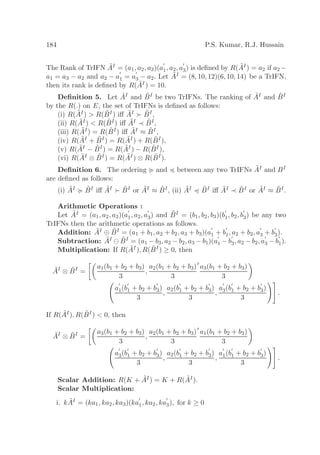
The Rank of TrIFN ˜AI = (a1, a2, a3)(a
′
1, a2, a
′
3) is defined by R( ˜AI) = a2 if a2 −
a1 = a3 − a2 and a2 − a
′
1 = a
′
3 − a2. Let ˜AI = (8, 10, 12)(6, 10, 14) be a TrIFN,
then its rank is defined by R( ˜AI ) = 10.
Definition 5. Let ˜AI and ˜BI be two TrIFNs. The ranking of ˜AI and ˜BI
by the R(.) on E, the set of TrIFNs is defined as follows:
(i) R( ˜AI) > R( ˜BI) iff ˜AI ≻ ˜BI,
(ii) R( ˜AI) < R( ˜BI) iff ˜AI ≺ ˜BI,
(iii) R( ˜AI) = R( ˜BI) iff ˜AI ≈ ˜BI,
(iv) R( ˜AI + ˜BI) = R( ˜AI) + R( ˜BI),
(v) R( ˜AI − ˜BI) = R( ˜AI) − R( ˜BI),
(vi) R( ˜AI ⊗ ˜BI) = R( ˜AI) ⊗ R( ˜BI).
Definition 6. The ordering and between any two TrIFNs ˜AI and BI
are defined as follows:
(i) ˜AI ˜BI iff ˜AI ≻ ˜BI or ˜AI ≈ ˜BI, (ii) ˜AI ˜BI iff ˜AI ≺ ˜BI or ˜AI ≈ ˜BI.
Arithmetic Operations :
Let ˜AI = (a1, a2, a3)(a
′
1, a2, a
′
3) and ˜BI = (b1, b2, b3)(b
′
1, b2, b
′
3) be any two
TrIFNs then the arithmetic operations as follows.
Addition: ˜AI ⊕ ˜BI = (a1 + b1, a2 + b2, a3 + b3)(a
′
1 + b
′
1, a2 + b2, a
′
3 + b
′
3).
Subtraction: ˜AI ⊖ ˜BI = (a1 − b3, a2 − b2, a3 − b1)(a
′
1 − b
′
3, a2 − b2, a
′
3 − b
′
1).
Multiplication: If R( ˜AI ), R( ˜BI) ≥ 0, then
˜AI
⊗ ˜BI
=
a1(b1 + b2 + b3)
3
,
a2(b1 + b2 + b3)
3
′
a3(b1 + b2 + b3)
3
a
′
1(b
′
1 + b2 + b
′
3)
3
,
a2(b
′
1 + b2 + b
′
3)
3
,
a
′
3(b
′
1 + b2 + b
′
3)
3
.
If R( ˜AI), R( ˜BI) < 0, then
˜AI
⊗ ˜BI
=
a3(b1 + b2 + b3)
3
,
a2(b1 + b2 + b3)
3
′
a1(b1 + b2 + b3)
3
a
′
3(b
′
1 + b2 + b
′
3)
3
,
a2(b
′
1 + b2 + b
′
3)
3
,
a
′
1(b
′
1 + b2 + b
′
3)
3
.
Scalar Addition: R(K + ˜AI) = K + R( ˜AI).
Scalar Multiplication:
i. k ˜AI = (ka1, ka2, ka3)(ka
′
1, ka2, ka
′
3), for k ≥ 0
A SYSTEMATIC APPROACH FOR SOLVING MIXED... 185
ii. k ˜AI = (ka3, ka2, ka1)(ka
′
3, ka2, ka
′
1), for k < 0
3. Intuitionistic Fuzzy Transportation Problem
Consider a transportation with m origins (rows) and n destinations (columns).
Let ˜cI
ij be the cost of transporting one unit of the product from ith origin to
jth destination. Let ˜aI
i be the quantity of commodity available at origin i.
Let ˜bI
j be the quantity of commodity needed at destination j and ˜xI
ij is the
quantity transported from ith origin to jth destination, so as to minimize the
Intuitionistic Fuzzy Transportation Cost [IFTC].
(IFTP)Minimize ˜ZI =
m
i=1
n
j=1
˜cI
ij ⊗ ˜xI
ij
Subject to,
n
j=1
˜xI
ij ≈ ˜aI
i , for i = 1, 2, · · · , m
m
i=1
˜xI
ij ≈ ˜bI
j , for j = 1, 2, · · · , n
˜xI
ij ≈ ˜0I
, for i = 1, 2, · · · , m and j = 1, 2, · · · , n
Where m = the number of supply points, n = the number of demand points
˜cI
ij = (c1
ij, c2
ij, c3
ij)(c1
′
ij , c2
ij, c3
′
ij ), ˜aI
i = (a1
i , a2
i , a3
i )(a1
′
i , a2
i , a3
′
i ),
˜bI
j = (b1
j , b2
j , b3
j )(b1
′
j , b2
j , b3
′
j ), ˜xI
ij = (x1
ij, x2
ij, x3
ij)(x1
′
ij , x2
ij, x3
′
ij )
4. The Computational Procedure for Mixed Intuitionistic Fuzzy
Transportation Problem
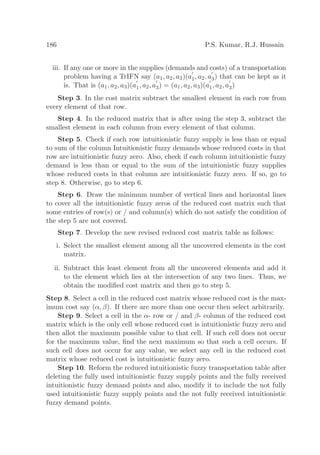
Step 1. Construct the transportation table in which costs, supplies and
demands are must be a combination of real, fuzzy and intuitionistic fuzzy num-
bers. Convert the given MIFTP into a balanced mixed intuitionistic fuzzy
transportation problem(BMIFTP), if it is not, by ranking method. Step 2.
After using step 1 convert BMIFTP into balanced intuitionistic fuzzy trans-
portation problem (BIFTP) using the following steps
i. If any one or more in the supplies (demands and costs) of a transportation
problem having a real number say a1 that can be expanded as a TrIFN
a1 = (a1, a1, a1)(a1, a1, a1).
ii. If any one or more in the supplies (demands and costs) of a transportation
problem having a triangular fuzzy number say (a1, a2, a3) that can be
expanded as a TrIFN (a1, a2, a3) = (a1, a2, a3)(a1, a2, a3).
186 P.S. Kumar, R.J. Hussain
iii. If any one or more in the supplies (demands and costs) of a transportation
problem having a TrIFN say (a1, a2, a3)(a
′
1, a2, a
′
3) that can be kept as it
is. That is (a1, a2, a3)(a
′
1, a2, a
′
3) = (a1, a2, a3)(a
′
1, a2, a
′
3)
Step 3. In the cost matrix subtract the smallest element in each row from
every element of that row.
Step 4. In the reduced matrix that is after using the step 3, subtract the
smallest element in each column from every element of that column.
Step 5. Check if each row intuitionistic fuzzy supply is less than or equal
to sum of the column Intuitionistic fuzzy demands whose reduced costs in that
row are intuitionistic fuzzy zero. Also, check if each column intuitionistic fuzzy
demand is less than or equal to the sum of the intuitionistic fuzzy supplies
whose reduced costs in that column are intuitionistic fuzzy zero. If so, go to
step 8. Otherwise, go to step 6.
Step 6. Draw the minimum number of vertical lines and horizontal lines
to cover all the intuitionistic fuzzy zeros of the reduced cost matrix such that
some entries of row(s) or / and column(s) which do not satisfy the condition of
the step 5 are not covered.
Step 7. Develop the new revised reduced cost matrix table as follows:
i. Select the smallest element among all the uncovered elements in the cost
matrix.
ii. Subtract this least element from all the uncovered elements and add it
to the element which lies at the intersection of any two lines. Thus, we
obtain the modified cost matrix and then go to step 5.
Step 8. Select a cell in the reduced cost matrix whose reduced cost is the max-
imum cost say (α, β). If there are more than one occur then select arbitrarily.
Step 9. Select a cell in the α- row or / and β- column of the reduced cost
matrix which is the only cell whose reduced cost is intuitionistic fuzzy zero and
then allot the maximum possible value to that cell. If such cell does not occur
for the maximum value, find the next maximum so that such a cell occurs. If
such cell does not occur for any value, we select any cell in the reduced cost
matrix whose reduced cost is intuitionistic fuzzy zero.
Step 10. Reform the reduced intuitionistic fuzzy transportation table after
deleting the fully used intuitionistic fuzzy supply points and the fully received
intuitionistic fuzzy demand points and also, modify it to include the not fully
used intuitionistic fuzzy supply points and the not fully received intuitionistic
fuzzy demand points.
A SYSTEMATIC APPROACH FOR SOLVING MIXED... 187
Step 11. Repeat step 8 to the step 10 until all intuitionistic fuzzy supply
points are fully used and all intuitionistic fuzzy demand points are fully received.
This allotment yields an optimal solution.
5. Numerical Example
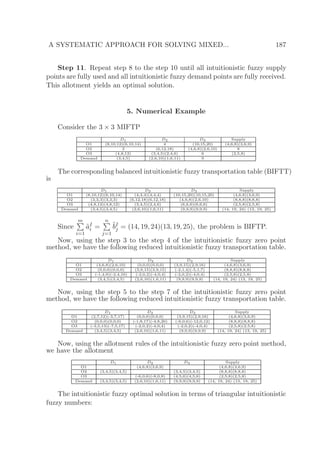
Consider the 3 × 3 MIFTP
D1 D2 D3 Supply
O1 (8,10,12)(6,10,14) 4 (10,15,20) (4,6,8)(3,6,9)
O2 3 (6,12,18) (4,6,8)(2,6,10) 8
O3 (4,8,12) (3,4,5)(2,4,6) 6 (2,5,8)
Demand (3,4,5) (2,6,10)(1,6,11) 9
The corresponding balanced intuitionistic fuzzy transportation table (BIFTT)
is
D1 D2 D3 Supply
O1 (8,10,12)(6,10,14) (4,4,4)(4,4,4) (10,15,20)(10,15,20) (4,6,8)(3,6,9)
O2 (3,3,3)(3,3,3) (6,12,18)(6,12,18) (4,6,8)(2,6,10) (8,8,8)(8,8,8)
O3 (4,8,12)(4,8,12) (3,4,5)(2,4,6) (6,6,6)(6,6,6) (2,5,8)(2,5,8)
Demand (3,4,5)(3,4,5) (2,6,10)(1,6,11) (9,9,9)(9,9,9) (14, 19, 24) (13, 19, 25)
Since
m
i=1
˜aI
i =
n
j=1
˜bI
j = (14, 19, 24)(13, 19, 25), the problem is BIFTP.
Now, using the step 3 to the step 4 of the intuitionistic fuzzy zero point
method, we have the following reduced intuitionistic fuzzy transportation table.
D1 D2 D3 Supply
O1 (4,6,8)(2,6,10) (0,0,0)(0,0,0) (3,9,15)(2,9,16) (4,6,8)(3,6,9)
O2 (0,0,0)(0,0,0) (3,9,15)(3,9,15) (-2,1,4)(-5,1,7) (8,8,8)(8,8,8)
O3 (-1,4,9)(-2,4,10) (-2,0,2)(-4,0,4) (-2,0,2)(-4,0,4) (2,5,8)(2,5,8)
Demand (3,4,5)(3,4,5) (2,6,10)(1,6,11) (9,9,9)(9,9,9) (14, 19, 24) (13, 19, 25)
Now, using the step 5 to the step 7 of the intuitionistic fuzzy zero point
method, we have the following reduced intuitionistic fuzzy transportation table.
D1 D2 D3 Supply
O1 (2,7,12)(-3,7,17) (0,0,0)(0,0,0) (3,9,15)(2,9,16) (4,6,8)(3,6,9)
O2 (0,0,0)(0,0,0) (-1,8,17)(-4,8,20) (-6,0,6)(-12,0,12) (8,8,8)(8,8,8)
O3 (-3,5,13)(-7,5,17) (-2,0,2)(-4,0,4) (-2,0,2)(-4,0,4) (2,5,8)(2,5,8)
Demand (3,4,5)(3,4,5) (2,6,10)(1,6,11) (9,9,9)(9,9,9) (14, 19, 24) (13, 19, 25)
Now, using the allotment rules of the intuitionistic fuzzy zero point method,
we have the allotment
D1 D2 D3 Supply
O1 (4,6,8)(3,6,9) (4,6,8)(3,6,9)
O2 (3,4,5)(3,4,5) (3,4,5)(3,4,5) (8,8,8)(8,8,8)
O3 (-6,0,6)(-8,0,8) (4,5,6)(4,5,6) (2,5,8)(2,5,8)
Demand (3,4,5)(3,4,5) (2,6,10)(1,6,11) (9,9,9)(9,9,9) (14, 19, 24) (13, 19, 25)
The intuitionistic fuzzy optimal solution in terms of triangular intuitionistic
fuzzy numbers:
188 P.S. Kumar, R.J. Hussain
˜xI
12 = (4, 6, 8)(3, 6, 9), ˜xI
21 = (3, 4, 5)(3, 4, 5), ˜xI
23 = (3, 4, 5)(3, 4, 5)˜xI
32 =
(−6, 0, 6)(−8, 0, 8), ˜xI
33 = (4, 5, 6)(4, 5, 6), Hence, the minimum total intuition-
istic fuzzy transportation cost is
Min ˜ZI = (41, 90, 139)(21, 90, 159)
Results and discussion
The minimum total intuitionistic fuzzy transportation cost is
˜ZI
= (41, 90, 139)(21, 90, 159) (1)
The result in (1) can be explained (refer to Figure 1) as follows
1
0 21 41 90 139 159 R
Figure 1: Graphical Representation of IFTC
(a) Transportation cost lies in [41,139].
(b) 100% expect are in favour that the transportation cost is 90 as µ ˜AI (x) =
1, x = 90.
(c) Assuming that m is a membership value and n is a non-membership value
at c. Then 100m% experts are in favour and 100n% experts are opposing
but 100(1 − m − n)% are in confusion that the transportation cost is c
Values of µ ˜Z(c) and ν ˜Z(c) at different values of c can be determined by using
the equations given below:
µ ˜Z(x) =



0 for x < 41
(x−41)
49 for 41 ≤ x ≤ 90
1 for x = 90
(139−x)
49 for 90 ≤ x ≤ 139
0 for x > 139
ν ˜Z(x) =



1 for x < 21
(90−x)
69 for 21 ≤ x ≤ 90
0 for x = 90
(x−90)
69 for 90 ≤ x ≤ 159
1 for x > 159
A SYSTEMATIC APPROACH FOR SOLVING MIXED... 189
6. Conclusion
Mathematical formulation of intuitionistic fuzzy transportation problem
and procedure for finding an intuitionistic fuzzy optimal solution for a MIFTP
are discussed with relevant numerical example. In this paper new method for
proposed to find the optimal solution of MIFBTPs in which supplies, demands
and costs are different types of numbers. So, the method can be applied to
solve real world transportation problems where the dada is not in symmetric
numerical values. The new multiplication operation of triangular intuitionistic
fuzzy numbers is employed to get the optimal solution in terms of triangular
intuitionistic fuzzy numbers. The proposed method is very simple and easy to
understand.
References
[1] K.T.Atanassov, Intuitionistic fuzzy sets, fuzzy sets and systems, vol.20,
no.1.pp.87- 96, (1986), doi: 10.1016/S0165-0114(86)80034-3 .
[2] Amit Kumar, Amarpreet Kaur, Anila Gupta, Fuzzy Linear Programming
Approach for Solving Fuzzy Transportation probles with Transshipment,
J Math Model Algor (2011) 10:163-180, doi: 10.1007/s10852-010-9147-8.
[3] Annie Varghese and Sunny Kuriakose, Notes on Intuitionistic Fuzzy Sets
Vol.18, 2012, No.1, 19-24.
[4] R.Bellman, L.A.Zadeh,Decision making in a fuzzy environment, manage-
ment sci.17(B)(1970)141-164, doi: 10.1287/mnsc.17.4.B141.
[5] S.Ismail Mohideen, P.Senthil Kumar, A Comparative Study on Trans-
portation Problem in fuzzy environment. International Journal of Mathe-
matics Research, Vol.2 Number.1 (2010), pp. 151-158.
[6] R.Jahir Hussain, P.Senthil Kumar, Algorithmic approach for solving in-
tuitionistic fuzzy transportation problem, Applied Mathematical Sciences,
Vol.6, 2012, no. 77-80.
[7] R.Jahir Hussain, P.Senthil Kumar, An Optimal More-for-Less Solution
of Mixed Constrains Intuitionistic Fuzzy Transportation Problems, Int.J.
Contemp.Math.Sciences, Vol.8, 2013.no.12, 565-576, doi: 10.12988/ijcms.
190 P.S. Kumar, R.J. Hussain
[8] R.Jahir Hussain, P.Senthil Kumar, Transportation Problem with the aid of
Triangular Intuitionistic Fuzzy Numbers, MMASC 2012 Vol.1 Coimbatore
Institute of Technology, Coimbatore.
[9] P.Pandian and G.Natarajan, A new algorithm for finding a fuzzy optimal
solution for fuzzy Transportation problems. Applied mathematics sciences,
Vol. 4, 2010, no.2, 79-90.
[10] D.Stephen Dinager, K.Palanivel,The Transportation problem in fuzzy en-
vironment, int.journal of Algorithm, computing and mathematics , vol2,
no3, 2009.
[11] L.A. Zadeh, Fuzzy sets, information and computation, vol.8, pp.338-353,
(1965), doi: 10.1016/S0019-9958(65)90241-X.

A SYSTEMATIC APPROACH FOR SOLVING MIXED INTUITIONISTIC FUZZY TRANSPORTATION PROBLEMS

  • 1.
    International Journal ofPure and Applied Mathematics Volume 92 No. 2 2014, 181-190 ISSN: 1311-8080 (printed version); ISSN: 1314-3395 (on-line version) url: http://www.ijpam.eu doi: http://dx.doi.org/10.12732/ijpam.v92i2.4 PAijpam.eu A SYSTEMATIC APPROACH FOR SOLVING MIXED INTUITIONISTIC FUZZY TRANSPORTATION PROBLEMS P. Senthil Kumar1 §, R. Jahir Hussain2 1,2PG and Research Department of Mathematics Jamal Mohamed College (Autonomous) Tirchirappalli, 620 020, Tamilnadu, INDIA Abstract: In this paper, we formulate a transportation problem in which supplies, demands and costs are different types of real, fuzzy and intuitionistic fuzzy numbers. The new multiplication operations of triangular intuitionistic fuzzy numbers are employed to get the optimal solution. Mixed Intuitionistic fuzzy zero point method is proposed to find the optimal solution in terms of triangular intuitionistic fuzzy numbers. The proposed method is easy to un- derstand and to apply for finding the intuitionistic fuzzy optimal solution in a mixed intuitionistic fuzzy transportation problem. The method is illustrated by a numerical example. AMS Subject Classification: 03E72, 03F55, 90B06 Key Words: triangular intuitionistic fuzzy numbers, mixed intuitionistic fuzzy transportation problem, intuitionistic fuzzy zero point method, optimal solution 1. Introduction The theory of fuzzy set introduced by L.A. Zadeh[11] in 1965 has achieved successful applications in various fields. The concept of Intuitionistic Fuzzy Received: November 19, 2013 c 2014 Academic Publications, Ltd. url: www.acadpubl.eu §Correspondence author
  • 2.
    182 P.S. Kumar,R.J. Hussain Sets (IFSs) proposed by K.T.Atanassov[1] in 1986 is found to be highly useful to deal with vagueness. The concept of fuzzy mathematical programming was introduced by Tanaka et al in 1947 the frame work of fuzzy decision of Bellman and Zadeh[4]. In [2], Amit Kumar et al investigated fuzzy linear programming approach for solving fuzzy transportation problems with transshipment. In [9], P. Pan- dian and G. Natarajan presented a new algorithm for finding a fuzzy optimal solution for fuzzy transportation problem. In [10], D. Stephen Dinager et al pre- sented Transportation problem in fuzzy environment. In [8],R. Jahir Hussain et all presented transportation problem with the aid of triangular intuitionistic fuzzy numbers. In [5], S. Ismail Mohideen and P. Senthil Kumar investigated a comparative study on transportation problem in fuzzy environment. There is no systematic approach for finding an optimal solution for mixed intuitionistic fuzzy transportation problem, but when we search our literature it has demonstrated intuitionistic fuzzy transportation problems [6, 7, 8] only. In this paper, a new ranking procedure which can be found in [3] and is used to obtain an optimal solution for a mixed intuitionistic fuzzy transportation problem [MIFTP]. This paper is organized as follows: In Section 2, some definitions and new multiplication operation is reviewed, In Section 3, provides the definition of in- tuitionistic fuzzy transportation problem and its mathematical formulation, In Section 4, solution procedure for solving mixed intuitionistic fuzzy transporta- tion problem is discussed. In Section 5, to illustrate the proposed method a numerical example with results and discussion is discussed and followed by the conclusions are given in Section 6. 2. Preliminaries Definition 1. Let A be a classical set, µA(x) be a function from A to [0, 1]. A fuzzy set A∗ with the membership function µA(x) is defined by A∗ = {(x, µA(x)); x ∈ A and µA(x) ∈ [0, 1]}. Definition 2. Let X be denote a universe of discourse, then an intuition- istic fuzzy set A in X is given by a set of ordered triples, ˜AI = {< x, µA(x), νA(x) >; x ∈ X} Where µA, νA : X → [0, 1], are functions such that 0 ≤ µA(x) + νA(x) ≤ 1, ∀x ∈ X. For each x the membership µA(x) and νA(x) represent the degree of
  • 3.
    A SYSTEMATIC APPROACHFOR SOLVING MIXED... 183 membership and the degree of non-membership of the element x ∈ X to A ⊂ X respectively. Definition 3. A fuzzy number A is defined to be a triangular fuzzy number if its membership function µA : R → [0, 1] is equal to µA(x) =    (x−a1) (a2−a1) ifx ∈ [a1, a2] (a3−x) (a3−a2) ifx ∈ [a2, a3] 0 otherwise where a1 ≤ a2 ≤ a3. This fuzzy number is denoted by (a1, a2, a3). Definition 4. A Triangular Intuitionistic Fuzzy Number( ˜AI is an intu- itionistic fuzzy set in R with the following membership function µA(x) and non-membership function νA(x) : ) µA(x) =    0 for x < a1 (x−a1) (a2−a1) for a1 ≤ x ≤ a2 1 for x = a2 (a3−x) (a3−a2) for a2 ≤ x ≤ a3 0 for x > a3 νA(x) =    1 for x < a′ 1 (a2−x) (a2−a′ 1) for a′ 1 ≤ x ≤ a2 0 for x = a2 (x−a2) (a′ 3−a2) for a2 ≤ x ≤ a′ 3 1 for x > a′ 3 Where a ′ 1 ≤ a1 ≤ a2 ≤ a3 ≤ a ′ 3 and µA(x), νA(x) ≤ 0.5 for µA(x) = νA(x), ∀x ∈ R This TrIFN is denoted by ˜AI = (a1, a2, a3)(a ′ 1, a2, a ′ 3). Particular Cases: Let ˜AI = (a1, a2, a3)(a ′ 1, a2, a ′ 3) be a TrIFN. Then the following cases arise Case 1: If a ′ 1 = a1, a ′ 3 = a3, then ˜AI represent Tringular Fuzzy Number (TFN). It is denoted by A = (a1, a2, a3). Case 2: If a ′ 1 = a1 = a2 = a3 = a ′ 3 = m,then ˜AI represent a real number m. Ranking of triangular intuitionistic fuzzy numbers The Ranking of a triangular intuitionistic fuzzy number ˜AI = (a1, a2, a3)(a ′ 1, a2, a ′ 3) is defined by R( ˜AI ) = 1 3 (a ′ 3 − a ′ 1)(a2 − 2a ′ 3 − 2a ′ 1) + (a3 − a1)(a1 + a2 + a3) + 3(a ′ 3 2 − a ′ 1 2 ) a ′ 3 − a1 ′ + a3 − a1 If νA(x) = 1 − µA(x), then TrIFN ˜AI = (a1, a2, a3)(a ′ 1, a2, a ′ 3) will become the TrFN (a1, a2, a3). Then a ′ 1 = a1 and a ′ 3 = a3 R( ˜AI ) = (a1 + a2 + a3)/3
  • 4.
    184 P.S. Kumar,R.J. Hussain The Rank of TrIFN ˜AI = (a1, a2, a3)(a ′ 1, a2, a ′ 3) is defined by R( ˜AI) = a2 if a2 − a1 = a3 − a2 and a2 − a ′ 1 = a ′ 3 − a2. Let ˜AI = (8, 10, 12)(6, 10, 14) be a TrIFN, then its rank is defined by R( ˜AI ) = 10. Definition 5. Let ˜AI and ˜BI be two TrIFNs. The ranking of ˜AI and ˜BI by the R(.) on E, the set of TrIFNs is defined as follows: (i) R( ˜AI) > R( ˜BI) iff ˜AI ≻ ˜BI, (ii) R( ˜AI) < R( ˜BI) iff ˜AI ≺ ˜BI, (iii) R( ˜AI) = R( ˜BI) iff ˜AI ≈ ˜BI, (iv) R( ˜AI + ˜BI) = R( ˜AI) + R( ˜BI), (v) R( ˜AI − ˜BI) = R( ˜AI) − R( ˜BI), (vi) R( ˜AI ⊗ ˜BI) = R( ˜AI) ⊗ R( ˜BI). Definition 6. The ordering and between any two TrIFNs ˜AI and BI are defined as follows: (i) ˜AI ˜BI iff ˜AI ≻ ˜BI or ˜AI ≈ ˜BI, (ii) ˜AI ˜BI iff ˜AI ≺ ˜BI or ˜AI ≈ ˜BI. Arithmetic Operations : Let ˜AI = (a1, a2, a3)(a ′ 1, a2, a ′ 3) and ˜BI = (b1, b2, b3)(b ′ 1, b2, b ′ 3) be any two TrIFNs then the arithmetic operations as follows. Addition: ˜AI ⊕ ˜BI = (a1 + b1, a2 + b2, a3 + b3)(a ′ 1 + b ′ 1, a2 + b2, a ′ 3 + b ′ 3). Subtraction: ˜AI ⊖ ˜BI = (a1 − b3, a2 − b2, a3 − b1)(a ′ 1 − b ′ 3, a2 − b2, a ′ 3 − b ′ 1). Multiplication: If R( ˜AI ), R( ˜BI) ≥ 0, then ˜AI ⊗ ˜BI = a1(b1 + b2 + b3) 3 , a2(b1 + b2 + b3) 3 ′ a3(b1 + b2 + b3) 3 a ′ 1(b ′ 1 + b2 + b ′ 3) 3 , a2(b ′ 1 + b2 + b ′ 3) 3 , a ′ 3(b ′ 1 + b2 + b ′ 3) 3 . If R( ˜AI), R( ˜BI) < 0, then ˜AI ⊗ ˜BI = a3(b1 + b2 + b3) 3 , a2(b1 + b2 + b3) 3 ′ a1(b1 + b2 + b3) 3 a ′ 3(b ′ 1 + b2 + b ′ 3) 3 , a2(b ′ 1 + b2 + b ′ 3) 3 , a ′ 1(b ′ 1 + b2 + b ′ 3) 3 . Scalar Addition: R(K + ˜AI) = K + R( ˜AI). Scalar Multiplication: i. k ˜AI = (ka1, ka2, ka3)(ka ′ 1, ka2, ka ′ 3), for k ≥ 0
  • 5.
    A SYSTEMATIC APPROACHFOR SOLVING MIXED... 185 ii. k ˜AI = (ka3, ka2, ka1)(ka ′ 3, ka2, ka ′ 1), for k < 0 3. Intuitionistic Fuzzy Transportation Problem Consider a transportation with m origins (rows) and n destinations (columns). Let ˜cI ij be the cost of transporting one unit of the product from ith origin to jth destination. Let ˜aI i be the quantity of commodity available at origin i. Let ˜bI j be the quantity of commodity needed at destination j and ˜xI ij is the quantity transported from ith origin to jth destination, so as to minimize the Intuitionistic Fuzzy Transportation Cost [IFTC]. (IFTP)Minimize ˜ZI = m i=1 n j=1 ˜cI ij ⊗ ˜xI ij Subject to, n j=1 ˜xI ij ≈ ˜aI i , for i = 1, 2, · · · , m m i=1 ˜xI ij ≈ ˜bI j , for j = 1, 2, · · · , n ˜xI ij ≈ ˜0I , for i = 1, 2, · · · , m and j = 1, 2, · · · , n Where m = the number of supply points, n = the number of demand points ˜cI ij = (c1 ij, c2 ij, c3 ij)(c1 ′ ij , c2 ij, c3 ′ ij ), ˜aI i = (a1 i , a2 i , a3 i )(a1 ′ i , a2 i , a3 ′ i ), ˜bI j = (b1 j , b2 j , b3 j )(b1 ′ j , b2 j , b3 ′ j ), ˜xI ij = (x1 ij, x2 ij, x3 ij)(x1 ′ ij , x2 ij, x3 ′ ij ) 4. The Computational Procedure for Mixed Intuitionistic Fuzzy Transportation Problem Step 1. Construct the transportation table in which costs, supplies and demands are must be a combination of real, fuzzy and intuitionistic fuzzy num- bers. Convert the given MIFTP into a balanced mixed intuitionistic fuzzy transportation problem(BMIFTP), if it is not, by ranking method. Step 2. After using step 1 convert BMIFTP into balanced intuitionistic fuzzy trans- portation problem (BIFTP) using the following steps i. If any one or more in the supplies (demands and costs) of a transportation problem having a real number say a1 that can be expanded as a TrIFN a1 = (a1, a1, a1)(a1, a1, a1). ii. If any one or more in the supplies (demands and costs) of a transportation problem having a triangular fuzzy number say (a1, a2, a3) that can be expanded as a TrIFN (a1, a2, a3) = (a1, a2, a3)(a1, a2, a3).
  • 6.
    186 P.S. Kumar,R.J. Hussain iii. If any one or more in the supplies (demands and costs) of a transportation problem having a TrIFN say (a1, a2, a3)(a ′ 1, a2, a ′ 3) that can be kept as it is. That is (a1, a2, a3)(a ′ 1, a2, a ′ 3) = (a1, a2, a3)(a ′ 1, a2, a ′ 3) Step 3. In the cost matrix subtract the smallest element in each row from every element of that row. Step 4. In the reduced matrix that is after using the step 3, subtract the smallest element in each column from every element of that column. Step 5. Check if each row intuitionistic fuzzy supply is less than or equal to sum of the column Intuitionistic fuzzy demands whose reduced costs in that row are intuitionistic fuzzy zero. Also, check if each column intuitionistic fuzzy demand is less than or equal to the sum of the intuitionistic fuzzy supplies whose reduced costs in that column are intuitionistic fuzzy zero. If so, go to step 8. Otherwise, go to step 6. Step 6. Draw the minimum number of vertical lines and horizontal lines to cover all the intuitionistic fuzzy zeros of the reduced cost matrix such that some entries of row(s) or / and column(s) which do not satisfy the condition of the step 5 are not covered. Step 7. Develop the new revised reduced cost matrix table as follows: i. Select the smallest element among all the uncovered elements in the cost matrix. ii. Subtract this least element from all the uncovered elements and add it to the element which lies at the intersection of any two lines. Thus, we obtain the modified cost matrix and then go to step 5. Step 8. Select a cell in the reduced cost matrix whose reduced cost is the max- imum cost say (α, β). If there are more than one occur then select arbitrarily. Step 9. Select a cell in the α- row or / and β- column of the reduced cost matrix which is the only cell whose reduced cost is intuitionistic fuzzy zero and then allot the maximum possible value to that cell. If such cell does not occur for the maximum value, find the next maximum so that such a cell occurs. If such cell does not occur for any value, we select any cell in the reduced cost matrix whose reduced cost is intuitionistic fuzzy zero. Step 10. Reform the reduced intuitionistic fuzzy transportation table after deleting the fully used intuitionistic fuzzy supply points and the fully received intuitionistic fuzzy demand points and also, modify it to include the not fully used intuitionistic fuzzy supply points and the not fully received intuitionistic fuzzy demand points.
  • 7.
    A SYSTEMATIC APPROACHFOR SOLVING MIXED... 187 Step 11. Repeat step 8 to the step 10 until all intuitionistic fuzzy supply points are fully used and all intuitionistic fuzzy demand points are fully received. This allotment yields an optimal solution. 5. Numerical Example Consider the 3 × 3 MIFTP D1 D2 D3 Supply O1 (8,10,12)(6,10,14) 4 (10,15,20) (4,6,8)(3,6,9) O2 3 (6,12,18) (4,6,8)(2,6,10) 8 O3 (4,8,12) (3,4,5)(2,4,6) 6 (2,5,8) Demand (3,4,5) (2,6,10)(1,6,11) 9 The corresponding balanced intuitionistic fuzzy transportation table (BIFTT) is D1 D2 D3 Supply O1 (8,10,12)(6,10,14) (4,4,4)(4,4,4) (10,15,20)(10,15,20) (4,6,8)(3,6,9) O2 (3,3,3)(3,3,3) (6,12,18)(6,12,18) (4,6,8)(2,6,10) (8,8,8)(8,8,8) O3 (4,8,12)(4,8,12) (3,4,5)(2,4,6) (6,6,6)(6,6,6) (2,5,8)(2,5,8) Demand (3,4,5)(3,4,5) (2,6,10)(1,6,11) (9,9,9)(9,9,9) (14, 19, 24) (13, 19, 25) Since m i=1 ˜aI i = n j=1 ˜bI j = (14, 19, 24)(13, 19, 25), the problem is BIFTP. Now, using the step 3 to the step 4 of the intuitionistic fuzzy zero point method, we have the following reduced intuitionistic fuzzy transportation table. D1 D2 D3 Supply O1 (4,6,8)(2,6,10) (0,0,0)(0,0,0) (3,9,15)(2,9,16) (4,6,8)(3,6,9) O2 (0,0,0)(0,0,0) (3,9,15)(3,9,15) (-2,1,4)(-5,1,7) (8,8,8)(8,8,8) O3 (-1,4,9)(-2,4,10) (-2,0,2)(-4,0,4) (-2,0,2)(-4,0,4) (2,5,8)(2,5,8) Demand (3,4,5)(3,4,5) (2,6,10)(1,6,11) (9,9,9)(9,9,9) (14, 19, 24) (13, 19, 25) Now, using the step 5 to the step 7 of the intuitionistic fuzzy zero point method, we have the following reduced intuitionistic fuzzy transportation table. D1 D2 D3 Supply O1 (2,7,12)(-3,7,17) (0,0,0)(0,0,0) (3,9,15)(2,9,16) (4,6,8)(3,6,9) O2 (0,0,0)(0,0,0) (-1,8,17)(-4,8,20) (-6,0,6)(-12,0,12) (8,8,8)(8,8,8) O3 (-3,5,13)(-7,5,17) (-2,0,2)(-4,0,4) (-2,0,2)(-4,0,4) (2,5,8)(2,5,8) Demand (3,4,5)(3,4,5) (2,6,10)(1,6,11) (9,9,9)(9,9,9) (14, 19, 24) (13, 19, 25) Now, using the allotment rules of the intuitionistic fuzzy zero point method, we have the allotment D1 D2 D3 Supply O1 (4,6,8)(3,6,9) (4,6,8)(3,6,9) O2 (3,4,5)(3,4,5) (3,4,5)(3,4,5) (8,8,8)(8,8,8) O3 (-6,0,6)(-8,0,8) (4,5,6)(4,5,6) (2,5,8)(2,5,8) Demand (3,4,5)(3,4,5) (2,6,10)(1,6,11) (9,9,9)(9,9,9) (14, 19, 24) (13, 19, 25) The intuitionistic fuzzy optimal solution in terms of triangular intuitionistic fuzzy numbers:
  • 8.
    188 P.S. Kumar,R.J. Hussain ˜xI 12 = (4, 6, 8)(3, 6, 9), ˜xI 21 = (3, 4, 5)(3, 4, 5), ˜xI 23 = (3, 4, 5)(3, 4, 5)˜xI 32 = (−6, 0, 6)(−8, 0, 8), ˜xI 33 = (4, 5, 6)(4, 5, 6), Hence, the minimum total intuition- istic fuzzy transportation cost is Min ˜ZI = (41, 90, 139)(21, 90, 159) Results and discussion The minimum total intuitionistic fuzzy transportation cost is ˜ZI = (41, 90, 139)(21, 90, 159) (1) The result in (1) can be explained (refer to Figure 1) as follows 1 0 21 41 90 139 159 R Figure 1: Graphical Representation of IFTC (a) Transportation cost lies in [41,139]. (b) 100% expect are in favour that the transportation cost is 90 as µ ˜AI (x) = 1, x = 90. (c) Assuming that m is a membership value and n is a non-membership value at c. Then 100m% experts are in favour and 100n% experts are opposing but 100(1 − m − n)% are in confusion that the transportation cost is c Values of µ ˜Z(c) and ν ˜Z(c) at different values of c can be determined by using the equations given below: µ ˜Z(x) =    0 for x < 41 (x−41) 49 for 41 ≤ x ≤ 90 1 for x = 90 (139−x) 49 for 90 ≤ x ≤ 139 0 for x > 139 ν ˜Z(x) =    1 for x < 21 (90−x) 69 for 21 ≤ x ≤ 90 0 for x = 90 (x−90) 69 for 90 ≤ x ≤ 159 1 for x > 159
  • 9.
    A SYSTEMATIC APPROACHFOR SOLVING MIXED... 189 6. Conclusion Mathematical formulation of intuitionistic fuzzy transportation problem and procedure for finding an intuitionistic fuzzy optimal solution for a MIFTP are discussed with relevant numerical example. In this paper new method for proposed to find the optimal solution of MIFBTPs in which supplies, demands and costs are different types of numbers. So, the method can be applied to solve real world transportation problems where the dada is not in symmetric numerical values. The new multiplication operation of triangular intuitionistic fuzzy numbers is employed to get the optimal solution in terms of triangular intuitionistic fuzzy numbers. The proposed method is very simple and easy to understand. References [1] K.T.Atanassov, Intuitionistic fuzzy sets, fuzzy sets and systems, vol.20, no.1.pp.87- 96, (1986), doi: 10.1016/S0165-0114(86)80034-3 . [2] Amit Kumar, Amarpreet Kaur, Anila Gupta, Fuzzy Linear Programming Approach for Solving Fuzzy Transportation probles with Transshipment, J Math Model Algor (2011) 10:163-180, doi: 10.1007/s10852-010-9147-8. [3] Annie Varghese and Sunny Kuriakose, Notes on Intuitionistic Fuzzy Sets Vol.18, 2012, No.1, 19-24. [4] R.Bellman, L.A.Zadeh,Decision making in a fuzzy environment, manage- ment sci.17(B)(1970)141-164, doi: 10.1287/mnsc.17.4.B141. [5] S.Ismail Mohideen, P.Senthil Kumar, A Comparative Study on Trans- portation Problem in fuzzy environment. International Journal of Mathe- matics Research, Vol.2 Number.1 (2010), pp. 151-158. [6] R.Jahir Hussain, P.Senthil Kumar, Algorithmic approach for solving in- tuitionistic fuzzy transportation problem, Applied Mathematical Sciences, Vol.6, 2012, no. 77-80. [7] R.Jahir Hussain, P.Senthil Kumar, An Optimal More-for-Less Solution of Mixed Constrains Intuitionistic Fuzzy Transportation Problems, Int.J. Contemp.Math.Sciences, Vol.8, 2013.no.12, 565-576, doi: 10.12988/ijcms.
  • 10.
    190 P.S. Kumar,R.J. Hussain [8] R.Jahir Hussain, P.Senthil Kumar, Transportation Problem with the aid of Triangular Intuitionistic Fuzzy Numbers, MMASC 2012 Vol.1 Coimbatore Institute of Technology, Coimbatore. [9] P.Pandian and G.Natarajan, A new algorithm for finding a fuzzy optimal solution for fuzzy Transportation problems. Applied mathematics sciences, Vol. 4, 2010, no.2, 79-90. [10] D.Stephen Dinager, K.Palanivel,The Transportation problem in fuzzy en- vironment, int.journal of Algorithm, computing and mathematics , vol2, no3, 2009. [11] L.A. Zadeh, Fuzzy sets, information and computation, vol.8, pp.338-353, (1965), doi: 10.1016/S0019-9958(65)90241-X.