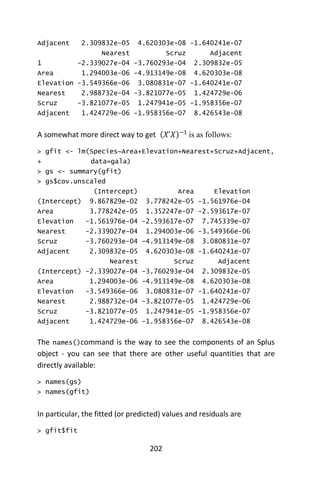
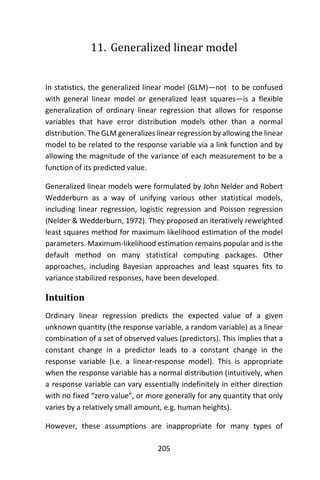
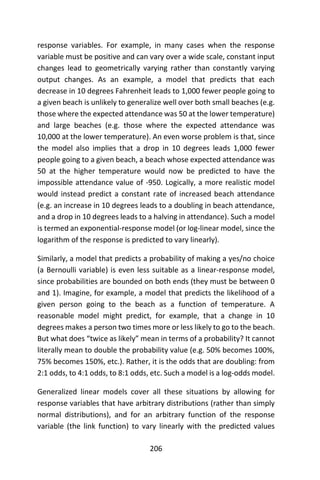
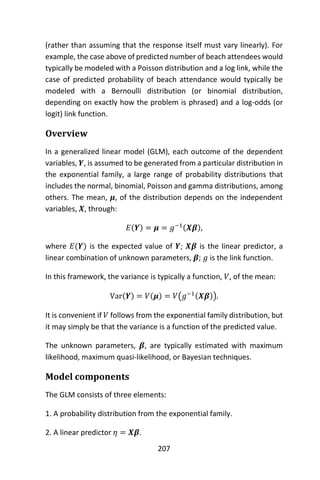
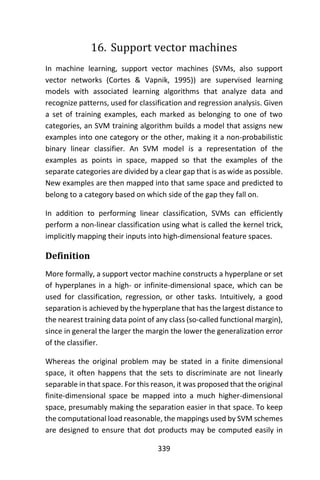
8410177813129
ISBN 978-1-312-84101-7
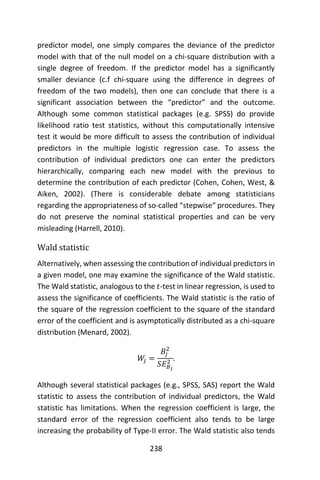
90000
Dr. Jeffrey Strickland is a Senior Predictive
Analytics Consultant with over 20 years of
expereince in multiple industiries including
financial, insurance, defense and NASA. He
is a subject matter expert on mathematical
and statistical modeling, as well as machine
learning. He has published numerous
books on modeling and simulation. Dr.
Strickland resides in Colorado.
This book is about predictive analytics. Yet, each chapter could
easily be handled by an entire volume of its own. So one might
think of this a survey of predictive modeling, both statistical
(parametric and nonparametric), as well as machine learning.
We define predictive model as a statistical model or machine
learning model used to predict future behavior based on past
behavior.
In order to use this book, one should have a basic
understanding of mathematical statistics (statistical inference,
models, tests, etc.) — this is an advanced book. Some
theoretical foundations are laid out (perhaps subtlety) but not
proven, but references are provided for additional coverage.
Every chapter culminates in an example using R. R is a free
software environment for statistical computing and graphics. It
compiles and runs on a wide variety of UNIX platforms,
Windows and MacOS. To download R, please choose your
preferred CRAN mirror at http://www.r-project.org/. An
introduction to R is also available at http://cran.r-project.org
/doc/manuals/r-release/R-intro.html.
The book is organized so that statistical models are presented
first (hopefully in a logical order), followed by machine learning
models, and then applications: uplift modeling and time series.
One could use this a textbook with problem solving in R—but
there are no “by-hand” exercises.
ID: 16206475
www.lulu.com
Jeffrey Strickland
Predictive Analytics
using R
JeffreyStricklandPredictiveAnalyticsusingR
Predictive Analytics using R
By
Jeffrey S. Strickland
Simulation Educators
Colorado Springs, CO
Predictive Analytics using R
Copyright 2014 by Jeffrey S. Strickland. All rights Reserved
ISBN 978-1-312-84101-7
Published by Lulu, Inc. All Rights Reserved
v
Acknowledgements
The author would like to thank colleagues Adam Wright, Adam Miller,
Matt Santoni. Working with them over the past two years has validated
the concepts presented herein.
A special thanks to Dr. Bob Simmonds, who mentored me as a senior
operations research analyst.
vi
vii
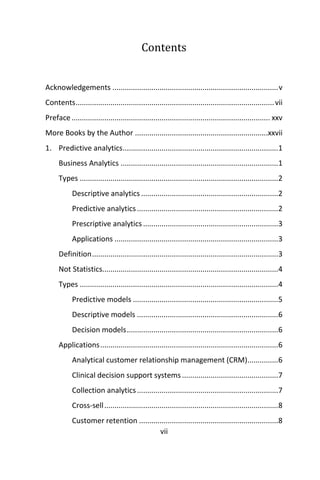
Contents
Acknowledgements .................................................................................v
Contents.................................................................................................vii
Preface................................................................................................. xxv
More Books by the Author .................................................................xxvii
1. Predictive analytics............................................................................1
Business Analytics .............................................................................1
Types .................................................................................................2
Descriptive analytics ...................................................................2
Predictive analytics.....................................................................2
Prescriptive analytics ..................................................................3
Applications ................................................................................3
Definition...........................................................................................3
Not Statistics......................................................................................4
Types .................................................................................................4
Predictive models .......................................................................5
Descriptive models .....................................................................6
Decision models..........................................................................6
Applications.......................................................................................6
Analytical customer relationship management (CRM)...............6
Clinical decision support systems...............................................7
Collection analytics.....................................................................7
Cross-sell.....................................................................................8
Customer retention ....................................................................8
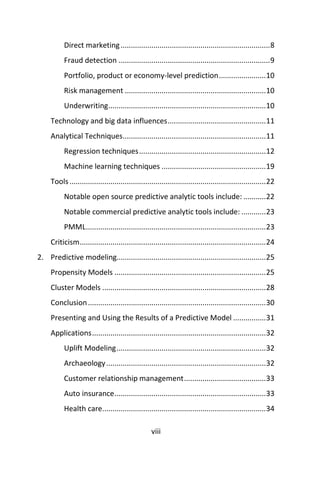
viii
Direct marketing.........................................................................8
Fraud detection ..........................................................................9
Portfolio, product or economy-level prediction.......................10
Risk management .....................................................................10
Underwriting.............................................................................10
Technology and big data influences................................................11
Analytical Techniques......................................................................11
Regression techniques..............................................................12
Machine learning techniques ...................................................19
Tools................................................................................................22
Notable open source predictive analytic tools include: ...........22
Notable commercial predictive analytic tools include: ............23
PMML........................................................................................23
Criticism...........................................................................................24
2. Predictive modeling.........................................................................25
Propensity Models ..........................................................................25
Cluster Models ................................................................................28
Conclusion.......................................................................................30
Presenting and Using the Results of a Predictive Model ................31
Applications.....................................................................................32
Uplift Modeling.........................................................................32
Archaeology..............................................................................32
Customer relationship management........................................33
Auto insurance..........................................................................33
Health care................................................................................34
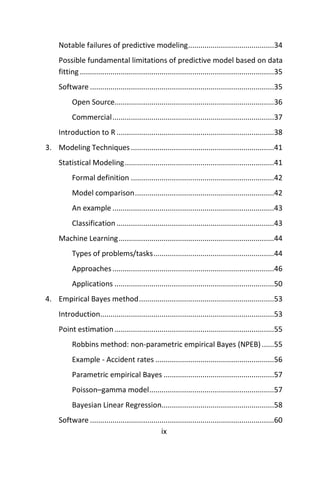
ix
Notable failures of predictive modeling..........................................34
Possible fundamental limitations of predictive model based on data
fitting...............................................................................................35
Software ..........................................................................................35
Open Source..............................................................................36
Commercial...............................................................................37
Introduction to R .............................................................................38
3. Modeling Techniques......................................................................41
Statistical Modeling.........................................................................41
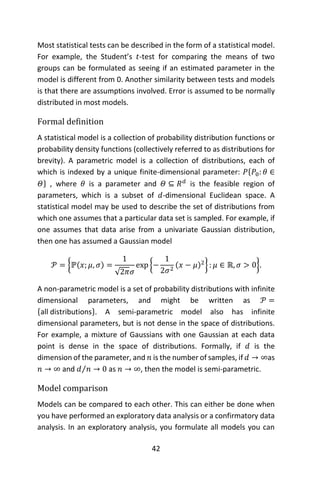
Formal definition ......................................................................42
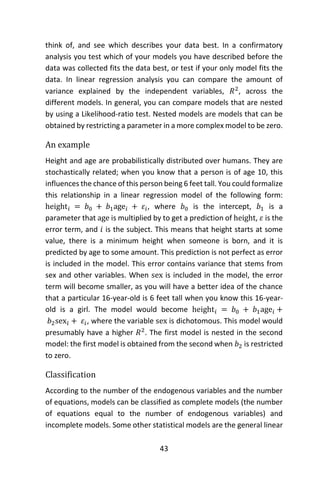
Model comparison....................................................................42
An example ...............................................................................43
Classification .............................................................................43
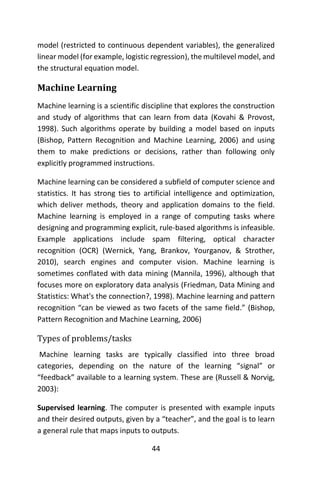
Machine Learning............................................................................44
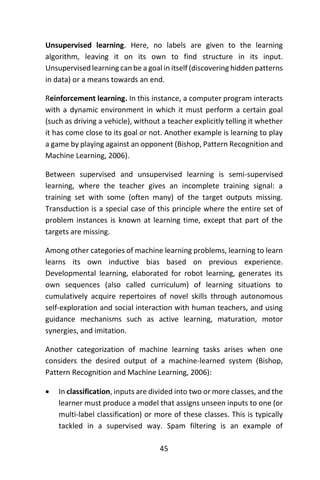
Types of problems/tasks...........................................................44
Approaches...............................................................................46
Applications ..............................................................................50
4. Empirical Bayes method..................................................................53
Introduction.....................................................................................53
Point estimation..............................................................................55
Robbins method: non-parametric empirical Bayes (NPEB)......55
Example - Accident rates ..........................................................56
Parametric empirical Bayes ......................................................57
Poisson–gamma model.............................................................57
Bayesian Linear Regression.......................................................58
Software ..........................................................................................60
x
Example Using R..............................................................................60
Model Selection in Bayesian Linear Regression .......................60
Model Evaluation......................................................................62
5. Naïve Bayes classifier ......................................................................65
Introduction ....................................................................................65
Probabilistic model..........................................................................66
Constructing a classifier from the probability model ...............68
Parameter estimation and event models........................................68
Gaussian Naïve Bayes ...............................................................69
Multinomial Naïve Bayes..........................................................69
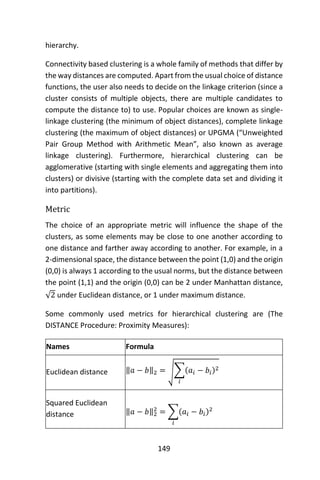
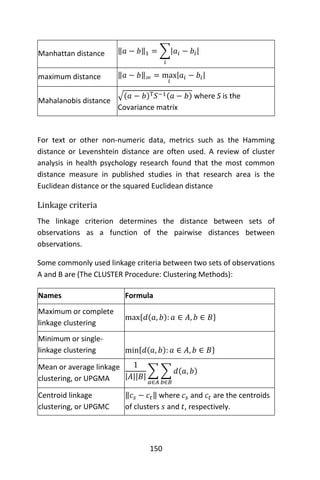
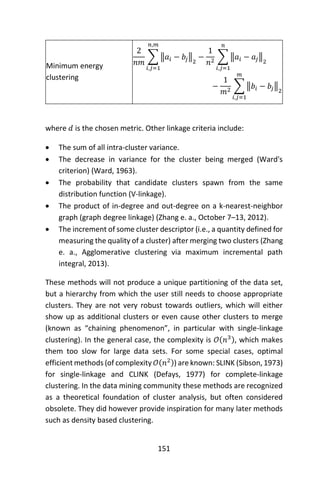
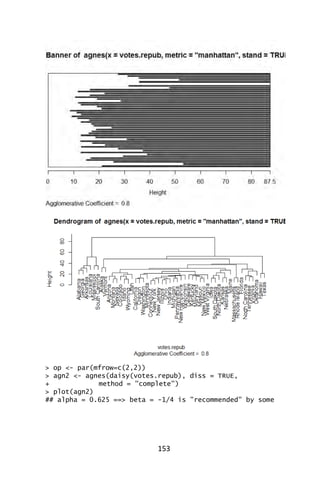
Bernoulli Naïve Bayes ...............................................................71
Discussion........................................................................................71
Examples .........................................................................................72
Sex classification.......................................................................72
Training.....................................................................................72
Testing.......................................................................................73
Document classification............................................................74
Software..........................................................................................77
Example Using R..............................................................................78
6. Decision tree learning .....................................................................87
General............................................................................................87
Types ...............................................................................................89
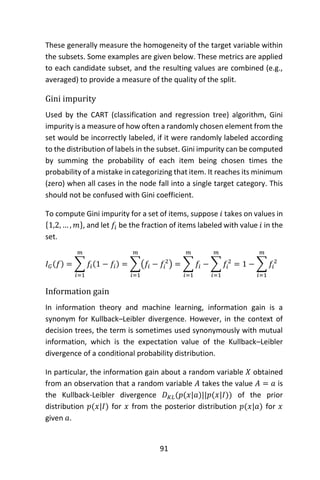
Metrics ............................................................................................90
Gini impurity.............................................................................91
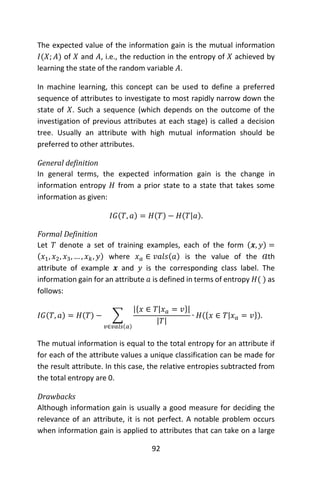
Information gain .......................................................................91
xi
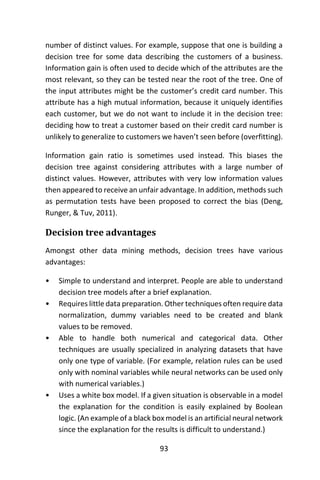
Decision tree advantages ................................................................93
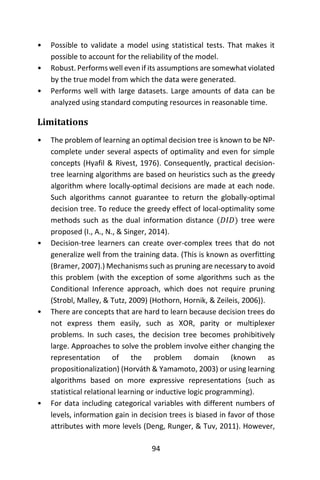
Limitations.......................................................................................94
Extensions........................................................................................95
Decision graphs.........................................................................95
Alternative search methods......................................................95
Software ..........................................................................................95
Examples Using R.............................................................................96
Classification Tree example ......................................................96
Regression Tree example........................................................104
7. Random forests .............................................................................109
History ...........................................................................................109
Algorithm.......................................................................................110
Bootstrap aggregating...................................................................111
Description of the technique..................................................111
Example: Ozone data..............................................................112
History.....................................................................................114
From bagging to random forests...................................................114
Random subspace method............................................................114
Algorithm ................................................................................115
Relationship to Nearest Neighbors ...............................................115
Variable importance......................................................................117
Variants .........................................................................................118
Software ........................................................................................118
Example Using R............................................................................119
Description..............................................................................119
xii
Model Comparison .................................................................120
8. Multivariate adaptive regression splines......................................123
The basics......................................................................................123
The MARS model...........................................................................126
Hinge functions .............................................................................127
The model building process ..........................................................128
The forward pass ....................................................................129
The backward pass..................................................................129
Generalized cross validation (GCV).........................................130
Constraints..............................................................................131
Pros and cons ................................................................................132
Software........................................................................................134
Example Using R............................................................................135
Setting up the Model..............................................................135
Model Generation ..................................................................137
9. Clustering Models .........................................................................145
Definition.......................................................................................146
Algorithms.....................................................................................147
Connectivity based clustering (hierarchical clustering)..........148
Metric......................................................................................149
Linkage criteria........................................................................150
Examples Using R ..........................................................................152
10. Ordinary least squares ..................................................................169
Linear model..................................................................................170
Assumptions ...........................................................................170
xiii
Classical linear regression model............................................171
Independent and identically distributed ................................173
Time series model...................................................................174
Estimation......................................................................................174
Simple regression model ........................................................176
Alternative derivations..................................................................177
Geometric approach...............................................................177
Maximum likelihood...............................................................178
Generalized method of moments...........................................179
Finite sample properties ...............................................................179
Assuming normality ................................................................180
Influential observations..........................................................181
Partitioned regression ............................................................182
Constrained estimation ..........................................................183
Large sample properties................................................................184
Example with real data..................................................................185
Sensitivity to rounding............................................................190
Software ........................................................................................191
Example Using R............................................................................193
11. Generalized linear model ..............................................................205
Intuition.........................................................................................205
Overview .......................................................................................207
Model components .......................................................................207
Probability distribution...........................................................208
Linear predictor ......................................................................209
xiv
Link function ...........................................................................209
Fitting ............................................................................................211
Maximum likelihood...............................................................211
Bayesian methods...................................................................212
Examples .......................................................................................212
General linear models.............................................................212
Linear regression ....................................................................212
Binomial data..........................................................................213
Multinomial regression...........................................................214
Count data ..............................................................................215
Extensions .....................................................................................215
Correlated or clustered data...................................................215
Generalized additive models ..................................................216
Generalized additive model for location, scale and shape.....217
Confusion with general linear models ..........................................219
Software........................................................................................219
Example Using R............................................................................219
Setting up the Model..............................................................219
Model Quality .........................................................................221
12. Logistic regression.........................................................................226
Fields and examples of applications..............................................226
Basics.............................................................................................227
Logistic function, odds ratio, and logit..........................................228
Multiple explanatory variables...............................................231
Model fitting..................................................................................231
xv
Estimation...............................................................................231
Evaluating goodness of fit.......................................................233
Coefficients....................................................................................237
Likelihood ratio test................................................................237
Wald statistic ..........................................................................238
Case-control sampling ............................................................239
Formal mathematical specification...............................................239
Setup.......................................................................................239
As a generalized linear model.................................................243
As a latent-variable model......................................................245
As a two-way latent-variable model.......................................247
As a “log-linear” model...........................................................250
As a single-layer perceptron...................................................253
In terms of binomial data .......................................................253
Bayesian logistic regression...........................................................254
Gibbs sampling with an approximating distribution...............256
Extensions......................................................................................261
Model suitability............................................................................261
Software ........................................................................................262
Examples Using R...........................................................................263
Logistic Regression: Multiple Numerical Predictors ...............263
Logistic Regression: Categorical Predictors ............................269
13. Robust regression..........................................................................277
Applications...................................................................................277
Heteroscedastic errors............................................................277
xvi
Presence of outliers................................................................278
History and unpopularity of robust regression.............................278
Methods for robust regression .....................................................279
Least squares alternatives ......................................................279
Parametric alternatives ..........................................................280
Unit weights............................................................................281
Example: BUPA liver data..............................................................282
Outlier detection.....................................................................282
Software........................................................................................284
Example Using R............................................................................284
14. k-nearest neighbor algorithm .......................................................293
Algorithm.......................................................................................294
Parameter selection......................................................................295
Properties......................................................................................296
Feature extraction.........................................................................297
Dimension reduction.....................................................................297
Decision boundary.........................................................................298
Data reduction...............................................................................298
Selection of class-outliers..............................................................299
CNN for data reduction.................................................................299
CNN model reduction for 𝑘-NN classifiers .............................301
k-NN regression.............................................................................303
Validation of results ......................................................................304
Algorithms for hyperparameter optimization...............................304
Grid search..............................................................................304
xvii
Alternatives.............................................................................305
Software ........................................................................................305
Example Using R............................................................................305
15. Analysis of variance.......................................................................313
Motivating example ......................................................................313
Background and terminology........................................................316
Design-of-experiments terms.................................................318
Classes of models ..........................................................................320
Fixed-effects models...............................................................320
Random-effects models..........................................................320
Mixed-effects models .............................................................320
Assumptions of ANOVA.................................................................321
Textbook analysis using a normal distribution .......................321
Randomization-based analysis ...............................................322
Summary of assumptions .......................................................324
Characteristics of ANOVA..............................................................324
Logic of ANOVA .............................................................................325
Partitioning of the sum of squares .........................................325
The F-test................................................................................326
Extended logic.........................................................................327
ANOVA for a single factor..............................................................328
ANOVA for multiple factors...........................................................328
Associated analysis........................................................................329
Preparatory analysis ...............................................................330
Followup analysis....................................................................331
xviii
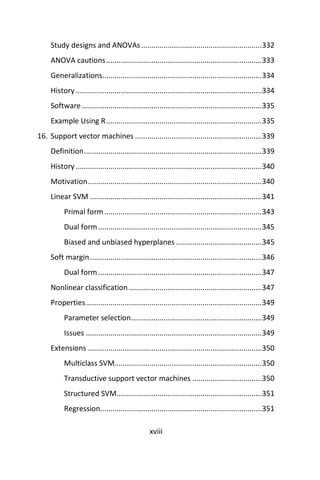
Study designs and ANOVAs...........................................................332
ANOVA cautions............................................................................333
Generalizations..............................................................................334
History...........................................................................................334
Software........................................................................................335
Example Using R............................................................................335
16. Support vector machines ..............................................................339
Definition.......................................................................................339
History...........................................................................................340
Motivation.....................................................................................340
Linear SVM ....................................................................................341
Primal form.............................................................................343
Dual form................................................................................345
Biased and unbiased hyperplanes ..........................................345
Soft margin....................................................................................346
Dual form................................................................................347
Nonlinear classification .................................................................347
Properties......................................................................................349
Parameter selection................................................................349
Issues ......................................................................................349
Extensions .....................................................................................350
Multiclass SVM........................................................................350
Transductive support vector machines ..................................350
Structured SVM.......................................................................351
Regression...............................................................................351
xix
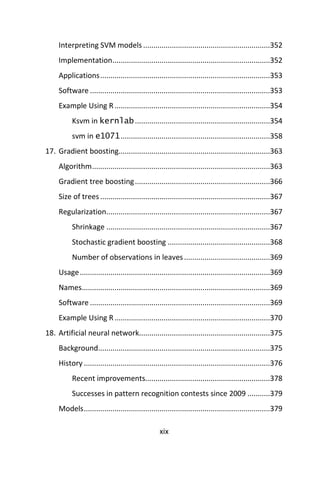
Interpreting SVM models ..............................................................352
Implementation.............................................................................352
Applications...................................................................................353
Software ........................................................................................353
Example Using R............................................................................354
Ksvm in kernlab..................................................................354
svm in e1071.........................................................................358
17. Gradient boosting..........................................................................363
Algorithm.......................................................................................363
Gradient tree boosting..................................................................366
Size of trees...................................................................................367
Regularization................................................................................367
Shrinkage ................................................................................367
Stochastic gradient boosting ..................................................368
Number of observations in leaves..........................................369
Usage.............................................................................................369
Names............................................................................................369
Software ........................................................................................369
Example Using R............................................................................370
18. Artificial neural network................................................................375
Background....................................................................................375
History ...........................................................................................376
Recent improvements.............................................................378
Successes in pattern recognition contests since 2009 ...........379
Models...........................................................................................379
xx
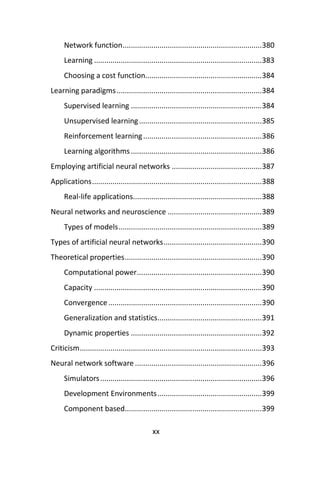
Network function....................................................................380
Learning ..................................................................................383
Choosing a cost function.........................................................384
Learning paradigms.......................................................................384
Supervised learning ................................................................384
Unsupervised learning............................................................385
Reinforcement learning..........................................................386
Learning algorithms................................................................386
Employing artificial neural networks ............................................387
Applications...................................................................................388
Real-life applications...............................................................388
Neural networks and neuroscience ..............................................389
Types of models......................................................................389
Types of artificial neural networks................................................390
Theoretical properties...................................................................390
Computational power.............................................................390
Capacity ..................................................................................390
Convergence...........................................................................390
Generalization and statistics...................................................391
Dynamic properties ................................................................392
Criticism.........................................................................................393
Neural network software ..............................................................396
Simulators...............................................................................396
Development Environments...................................................399
Component based...................................................................399
xxi
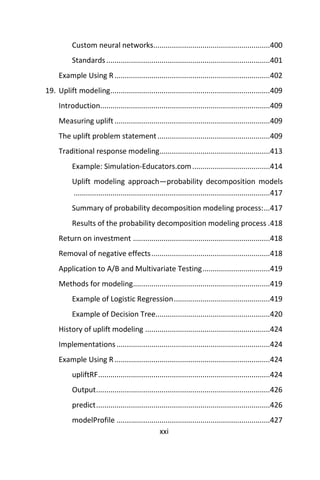
Custom neural networks.........................................................400
Standards................................................................................401
Example Using R............................................................................402
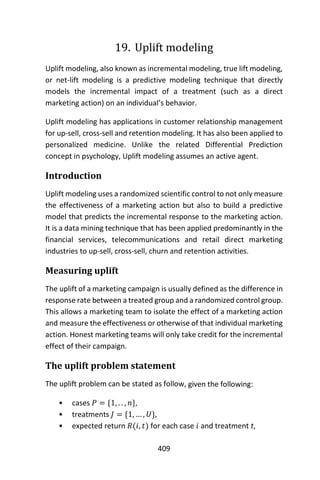
19. Uplift modeling..............................................................................409
Introduction...................................................................................409
Measuring uplift............................................................................409
The uplift problem statement.......................................................409
Traditional response modeling......................................................413
Example: Simulation-Educators.com......................................414
Uplift modeling approach—probability decomposition models
................................................................................................417
Summary of probability decomposition modeling process:...417
Results of the probability decomposition modeling process .418
Return on investment ...................................................................418
Removal of negative effects..........................................................418
Application to A/B and Multivariate Testing.................................419
Methods for modeling...................................................................419
Example of Logistic Regression...............................................419
Example of Decision Tree........................................................420
History of uplift modeling .............................................................424
Implementations...........................................................................424
Example Using R............................................................................424
upliftRF....................................................................................424
Output.....................................................................................426
predict.....................................................................................426
modelProfile ...........................................................................427
xxii
Output.....................................................................................427
varImportance ........................................................................428
Performance ...........................................................................429
20. Time Series ....................................................................................431
Methods for time series analyses .................................................432
Analysis..........................................................................................432
Motivation ..............................................................................433
Exploratory analysis................................................................433
Prediction and forecasting......................................................433
Classification...........................................................................434
Regression analysis (method of prediction) ...........................434
Signal estimation ....................................................................434
Segmentation..........................................................................435
Models...........................................................................................435
Notation..................................................................................436
Conditions...............................................................................437
Autoregressive model ...................................................................437
Definition ................................................................................437
Graphs of AR(p) processes ............................................................439
Partial autocorrelation function....................................................440
Description..............................................................................440
Example Using R............................................................................441
Notation Used......................................................................................460
Set Theory .....................................................................................460
Probability and statistics ...............................................................460
xxiii
Linear Algebra ...............................................................................461
Algebra and Calculus .....................................................................461
Glossary................................................................................................463
References ...........................................................................................477
Index ....................................................................................................513
xxiv
xxv
Preface
This book is about predictive analytics. Yet, each chapter could easily be
handled by an entire volume of its own. So one might think of this a
survey of predictive models, both statistical and machine learning. We
define predictive model as a statistical model or machine learning model
used to predict future behavior based on past behavior.
This was a three year project that started just before I ventured away
from DoD modeling and simulation. Hoping to transition to private
industry, I began to look at way in which my modeling experience would
be a good fit. I had taught statistical modeling and machine learning
(e.g., neural networks) for years, but I had not applied these on the scale
of “Big Data”. I have now done so, many times over—often dealing with
data sets containing 2000+ variables and 20 million observations
(records).
In order to use this book, one should have a basic understanding of
mathematical statistics (statistical inference, models, tests, etc.)—this is
an advanced book. Some theoretical foundations are laid out (perhaps
subtlety) but not proven, but references are provided for additional
coverage. Every chapter culminates in an example using R. R is a free
software environment for statistical computing and graphics. It compiles
and runs on a wide variety of UNIX platforms, Windows and MacOS. To
download R, please choose your preferred CRAN mirror at
http://www.r-project.org/. An introduction to R is also available at
http://cran.r-project.org/doc/manuals/r-release/R-intro.html.
The book is organized so that statistical models are presented first
(hopefully in a logical order), followed by machine learning models, and
then applications: uplift modeling and time series. One could use this a
textbook with problem solving in R—but there are no “by-hand”
exercises.
xxvi
This book is self-published and print-on-demand. I do not use an editor
in order to keep the retail cost near production cost. The best discount
is provided by the publisher, Lulu.com. If you find errors as you read,
please feel free to contact me at jeff@sumulation-educators.com.
xxvii
More Books by the Author
Discrete Event Simulation using ExtendSim 8. Copyright © 2010 by
Jeffrey S. Strickland. Lulu.com. ISBN 978-0-557-72821-3
Fundamentals of Combat Modeling. Copyright © 2010 by Jeffrey S.
Strickland. Lulu.com. ISBN 978-1-257-00583-3
Missile Flight Simulation - Surface-to-Air Missiles. Copyright © 2010 by
Jeffrey S. Strickland. Lulu.com. ISBN 978-0-557-88553-4
Systems Engineering Processes and Practice. Copyright © 2010 by
Jeffrey S. Strickland. Lulu.com. ISBN 978-1-257-09273-4
Mathematical Modeling of Warfare and Combat Phenomenon.
Copyright © 2011 by Jeffrey S. Strickland. Lulu.com. ISBN 978-1-4583-
9255-8
Simulation Conceptual Modeling. Copyright © 2011 by Jeffrey S.
Strickland. Lulu.com. ISBN 978-1-105-18162-7.
Men of Manhattan: Creators of the Nuclear Age. Copyright © 2011 by
Jeffrey S. Strickland. Lulu.com. ISBN 978-1-257-76188-3
Quantum Phaith. Copyright © 2011 by Jeffrey S. Strickland. Lulu.com.
ISBN 978-1-257-64561-9
Using Math to Defeat the Enemy: Combat Modeling for Simulation.
Copyright © 2011 by Jeffrey S. Strickland. Lulu.com. 978-1-257-83225-5
Albert Einstein: “Nobody expected me to lay golden eggs”. Copyright ©
2011 by Jeffrey S. Strickland. Lulu.com. ISBN 978-1-257-86014-2.
Knights of the Cross. Copyright © 2012 by Jeffrey S. Strickland. Lulu.com.
ISBN 978-1-105-35162-4.
Introduction to Crime Analysis and Mapping. Copyright © 2013 by
Jeffrey S. Strickland. Lulu.com. ISBN 978-1-312-19311-6.
ii
1
1. Predictive analytics
Predictive analytics—sometimes used synonymously with predictive
modeling—encompasses a variety of statistical techniques from
modeling, machine learning, and data mining that analyze current and
historical facts to make predictions about future, or otherwise unknown,
events (Nyce, 2007) (Eckerson, 2007).
In business, predictive models exploit patterns found in historical and
transactional data to identify risks and opportunities. Models capture
relationships among many factors to allow assessment of risk or
potential associated with a particular set of conditions, guiding decision
making for candidate transactions.
Predictive analytics is used in actuarial science (Conz, 2008), marketing
(Fletcher, 2011), financial services (Korn, 2011), insurance,
telecommunications (Barkin, 2011), retail (Das & Vidyashankar, 2006),
travel (McDonald, 2010), healthcare (Stevenson, 2011), pharmaceuticals
(McKay, 2009) and other fields.
One of the most well-known applications is credit scoring (Nyce, 2007),
which is used throughout financial services. Scoring models process a
customer’s credit history, loan application, customer data, etc., in order
to rank-order individuals by their likelihood of making future credit
payments on time. A well-known example is the FICO® Score.
Where does predictive analytics lie in the world of business analytics?
Business Analytics
Business analytics (BA) refers to the skills, technologies, practices for
continuous iterative exploration and investigation of past business
performance to gain insight and drive business planning. Business
analytics makes extensive use of statistical analysis, including descriptive
and predictive modeling, and fact-based management to drive decision
making. In recent years, prescriptive modeling has also taken a role in
BA. It is therefore closely related to management science and operations
2
research. Business analytics can answer questions like why is this
happening, what if these trends continue, what will happen next (that is,
predict), what is the best that can happen (that is, optimize).
Types
Business analytics is comprised of descriptive, predictive and
prescriptive analytics, these are generally understood to be descriptive
modeling, predictive modeling, and prescriptive modeling..
Descriptive analytics
Descriptive models quantify relationships in data in a way that is often
used to classify customers or prospects into groups. Unlike predictive
models that focus on predicting a single customer behavior (such as
credit risk), descriptive models identify many different relationships
between customers or products. Descriptive analytics provides simple
summaries about the sample audience and about the observations that
have been made. Such summaries may be either quantitative, i.e.
summary statistics, or visual, i.e. simple-to-understand graphs. These
summaries may either form the basis of the initial description of the data
as part of a more extensive statistical analysis, or they may be sufficient
in and of themselves for a particular investigation.
Predictive analytics
Predictive analytics encompasses a variety of statistical techniques from
modeling, machine learning, and data mining that analyze current and
historical facts to make predictions about future, or otherwise unknown,
events. Predictive models are models of the relation between the
specific performance of a unit in a sample and one or more known
attributes or features of the unit. The objective of the model is to assess
the likelihood that a similar unit in a different sample will exhibit the
specific performance. This category encompasses models that are in
many areas, such as marketing, where they seek out subtle data patterns
to answer questions about customer performance, such as fraud
detection models.
3
Prescriptive analytics
Prescriptive analytics not only anticipates what will happen and when it
will happen, but also why it will happen. Further, prescriptive analytics
suggests decision options on how to take advantage of a future
opportunity or mitigate a future risk and shows the implication of each
decision option. Prescriptive analytics can continually take in new data
to re-predict and re-prescribe, thus automatically improving prediction
accuracy and prescribing better decision options. Prescriptive analytics
ingests hybrid data, a combination of structured (numbers, categories)
and unstructured data (videos, images, sounds, texts), and business
rules to predict what lies ahead and to prescribe how to take advantage
of this predicted future without compromising other priorities
Applications
Although predictive analytics can be put to use in many applications, I
list a few here:
 Analytical customer relationship management (CRM)
 Clinical decision support systems
 Collection analytics
 Cross-sell
 Customer retention
 Direct marketing
 Fraud detection
 Portfolio, product or economy-level prediction
 Risk management
 Underwriting
Definition
Predictive analytics is an area of data mining that deals with extracting
information from data and using it to predict trends and behavior
patterns. Often the unknown event of interest is in the future, but
predictive analytics can be applied to any type of unknown whether it
be in the past, present or future. For example, identifying suspects after
4
a crime has been committed, or credit card fraud as it occurs (Strickland
J. , 2013). The core of predictive analytics relies on capturing
relationships between explanatory variables and the predicted variables
from past occurrences, and exploiting them to predict the unknown
outcome. It is important to note, however, that the accuracy and
usability of results will depend greatly on the level of data analysis and
the quality of assumptions.
Not Statistics
Predictive analytics uses statistical methods, but also machine learning
algorithms, and heuristics. Though statistical methods are important,
the Analytics professional cannot always follow the “rules of statistics to
the letter.” Instead, the analyst often implements what I call “modeler
judgment”. Unlike the statistician, the analytics professional—akin to
the operations research analyst—must understand the system,
business, or enterprise where the problem lies, and in the context of the
business processes, rules, operating procedures, budget, and so on,
make judgments about the analytical solution subject to various
constraints. This requires a certain degree of creativity, and lends itself
to being both a science and an art, For example, a pure statistical model,
say a logistic regression, may determine that the response is explained
by 30 independent variables with a significance of 0.05. However, the
analytics professional knows that 10 of the variables cannot be used
subject to legal constraints imposed for say a bank product. Moreover,
the analytics modeler is aware that variables with many degrees of
freedom can lead to overfitting the model. Thus, in their final analysis
they develop a good model with 12 explanatory variables using modeler
judgment. The regression got them near to a solution, and their intuition
carried them to the end.
Types
Generally, the term predictive analytics is used to mean predictive
modeling, “scoring” data with predictive models, and forecasting.
However, people are increasingly using the term to refer to related
5
analytical disciplines, such as descriptive modeling and decision
modeling or optimization. These disciplines also involve rigorous data
analysis, and are widely used in business for segmentation and decision
making, but have different purposes and the statistical techniques
underlying them vary.
Predictive models
Predictive models are models of the relation between the specific
performance of a unit in a sample and one or more known attributes or
features of the unit. The objective of the model is to assess the likelihood
that a similar unit in a different sample will exhibit the specific
performance. This category encompasses models that are in many areas,
such as marketing, where they seek out subtle data patterns to answer
questions about customer performance, such as fraud detection models.
Predictive models often perform calculations during live transactions,
for example, to evaluate the risk or opportunity of a given customer or
transaction, in order to guide a decision. With advancements in
computing speed, individual agent modeling systems have become
capable of simulating human behavior or reactions to given stimuli or
scenarios.
The available sample units with known attributes and known
performances is referred to as the “training sample.” The units in other
sample, with known attributes but un-known performances, are
referred to as “out of [training] sample” units. The out of sample bear
no chronological relation to the training sample units. For example, the
training sample may consists of literary attributes of writings by
Victorian authors, with known attribution, and the out-of sample unit
may be newly found writing with unknown authorship; a predictive
model may aid the attribution of the unknown author. Another example
is given by analysis of blood splatter in simulated crime scenes in which
the out-of sample unit is the actual blood splatter pattern from a crime
scene. The out of sample unit may be from the same time as the training
units, from a previous time, or from a future time.
6
Descriptive models
Descriptive models quantify relationships in data in a way that is often
used to classify customers or prospects into groups. Unlike predictive
models that focus on predicting a single customer behavior (such as
credit risk), descriptive models identify many different relationships
between customers or products. Descriptive models do not rank-order
customers by their likelihood of taking a particular action the way
predictive models do. Instead, descriptive models can be used, for
example, to categorize customers by their product preferences and life
stage. Descriptive modeling tools can be utilized to develop further
models that can simulate large number of individualized agents and
make predictions.
Decision models
Decision models describe the relationship between all the elements of a
decision—the known data (including results of predictive models), the
decision, and the forecast results of the decision—in order to predict the
results of decisions involving many variables. These models can be used
in optimization, maximizing certain outcomes while minimizing others.
Decision models are generally used to develop decision logic or a set of
business rules that will produce the desired action for every customer or
circumstance.
Applications
Although predictive analytics can be put to use in many applications, we
outline a few examples where predictive analytics has shown positive
impact in recent years.
Analytical customer relationship management (CRM)
Analytical Customer Relationship Management is a frequent commercial
application of Predictive Analysis. Methods of predictive analysis are
applied to customer data to pursue CRM objectives, which involve
constructing a holistic view of the customer no matter where their
information resides in the company or the department involved. CRM
7
uses predictive analysis in applications for marketing campaigns, sales,
and customer services to name a few. These tools are required in order
for a company to posture and focus their efforts effectively across the
breadth of their customer base. They must analyze and understand the
products in demand or have the potential for high demand, predict
customers’ buying habits in order to promote relevant products at
multiple touch points, and proactively identify and mitigate issues that
have the potential to lose customers or reduce their ability to gain new
ones. Analytical Customer Relationship Management can be applied
throughout the customer lifecycle (acquisition, relationship growth,
retention, and win-back). Several of the application areas described
below (direct marketing, cross-sell, customer retention) are part of
Customer Relationship Managements.
Clinical decision support systems
Experts use predictive analysis in health care primarily to determine
which patients are at risk of developing certain conditions, like diabetes,
asthma, heart disease, and other lifetime illnesses. Additionally,
sophisticated clinical decision support systems incorporate predictive
analytics to support medical decision making at the point of care. A
working definition has been proposed by Robert Hayward of the Centre
for Health Evidence: “Clinical Decision Support Systems link health
observations with health knowledge to influence health choices by
clinicians for improved health care.” (Hayward, 2004)
Collection analytics
Every portfolio has a set of delinquent customers who do not make their
payments on time. The financial institution has to undertake collection
activities on these customers to recover the amounts due. A lot of
collection resources are wasted on customers who are difficult or
impossible to recover. Predictive analytics can help optimize the
allocation of collection resources by identifying the most effective
collection agencies, contact strategies, legal actions and other strategies
to each customer, thus significantly increasing recovery at the same time
8
reducing collection costs.
Cross-sell
Often corporate organizations collect and maintain abundant data (e.g.
customer records, sale transactions) as exploiting hidden relationships
in the data can provide a competitive advantage. For an organization
that offers multiple products, predictive analytics can help analyze
customers’ spending, usage and other behavior, leading to efficient
cross sales, or selling additional products to current customers. This
directly leads to higher profitability per customer and stronger customer
relationships.
Customer retention
With the number of competing services available, businesses need to
focus efforts on maintaining continuous consumer satisfaction,
rewarding consumer loyalty and minimizing customer attrition.
Businesses tend to respond to customer attrition on a reactive basis,
acting only after the customer has initiated the process to terminate
service. At this stage, the chance of changing the customer’s decision is
almost impossible. Proper application of predictive analytics can lead to
a more proactive retention strategy. By a frequent examination of a
customer’s past service usage, service performance, spending and other
behavior patterns, predictive models can determine the likelihood of a
customer terminating service sometime soon (Barkin, 2011). An
intervention with lucrative offers can increase the chance of retaining
the customer. Silent attrition, the behavior of a customer to slowly but
steadily reduce usage, is another problem that many companies face.
Predictive analytics can also predict this behavior, so that the company
can take proper actions to increase customer activity.
Direct marketing
When marketing consumer products and services, there is the challenge
of keeping up with competing products and consumer behavior. Apart
from identifying prospects, predictive analytics can also help to identify
9
the most effective combination of product versions, marketing material,
communication channels and timing that should be used to target a
given consumer. The goal of predictive analytics is typically to lower the
cost per order or cost per action.
Fraud detection
Fraud is a big problem for many businesses and can be of various types:
inaccurate credit applications, fraudulent transactions (both offline and
online), identity thefts and false insurance claims. These problems
plague firms of all sizes in many industries. Some examples of likely
victims are credit card issuers, insurance companies (Schiff, 2012), retail
merchants, manufacturers, business-to-business suppliers and even
services providers. A predictive model can help weed out the “bads” and
reduce a business’s exposure to fraud.
Predictive modeling can also be used to identify high-risk fraud
candidates in business or the public sector. Mark Nigrini developed a
risk-scoring method to identify audit targets. He describes the use of this
approach to detect fraud in the franchisee sales reports of an
international fast-food chain. Each location is scored using 10 predictors.
The 10 scores are then weighted to give one final overall risk score for
each location. The same scoring approach was also used to identify high-
risk check kiting accounts, potentially fraudulent travel agents, and
questionable vendors. A reasonably complex model was used to identify
fraudulent monthly reports submitted by divisional controllers (Nigrini,
2011).
The Internal Revenue Service (IRS) of the United States also uses
predictive analytics to mine tax returns and identify tax fraud (Schiff,
2012).
Recent advancements in technology have also introduced predictive
behavior analysis for web fraud detection. This type of solution utilizes
heuristics in order to study normal web user behavior and detect
anomalies indicating fraud attempts.
10
Portfolio, product or economy-level prediction
Often the focus of analysis is not the consumer but the product,
portfolio, firm, industry or even the economy. For example, a retailer
might be interested in predicting store-level demand for inventory
management purposes. Or the Federal Reserve Board might be
interested in predicting the unemployment rate for the next year. These
types of problems can be addressed by predictive analytics using time
series techniques (see Chapter 18). They can also be addressed via
machine learning approaches which transform the original time series
into a feature vector space, where the learning algorithm finds patterns
that have predictive power.
Risk management
When employing risk management techniques, the results are always to
predict and benefit from a future scenario. The Capital asset pricing
model (CAM-P) and Probabilistic Risk Assessment (PRA) examples of
approaches that can extend from project to market, and from near to
long term. CAP-M (Chong, Jin, & Phillips, 2013) “predicts” the best
portfolio to maximize return. PRA, when combined with mini-Delphi
Techniques and statistical approaches, yields accurate forecasts (Parry,
1996). @Risk is an Excel add-in used for modeling and simulating risks
(Strickland, 2005). Underwriting (see below) and other business
approaches identify risk management as a predictive method.
Underwriting
Many businesses have to account for risk exposure due to their different
services and determine the cost needed to cover the risk. For example,
auto insurance providers need to accurately determine the amount of
premium to charge to cover each automobile and driver. A financial
company needs to assess a borrower’s potential and ability to pay before
granting a loan. For a health insurance provider, predictive analytics can
analyze a few years of past medical claims data, as well as lab, pharmacy
and other records where available, to predict how expensive an enrollee
is likely to be in the future. Predictive analytics can help underwrite
11
these quantities by predicting the chances of illness, default, bankruptcy,
etc. Predictive analytics can streamline the process of customer
acquisition by predicting the future risk behavior of a customer using
application level data. Predictive analytics in the form of credit scores
have reduced the amount of time it takes for loan approvals, especially
in the mortgage market where lending decisions are now made in a
matter of hours rather than days or even weeks. Proper predictive
analytics can lead to proper pricing decisions, which can help mitigate
future risk of default.
Technology and big data influences
Big data is a collection of data sets that are so large and complex that
they become awkward to work with using traditional database
management tools. The volume, variety and velocity of big data have
introduced challenges across the board for capture, storage, search,
sharing, analysis, and visualization. Examples of big data sources include
web logs, RFID and sensor data, social networks, Internet search
indexing, call detail records, military surveillance, and complex data in
astronomic, biogeochemical, genomics, and atmospheric sciences.
Thanks to technological advances in computer hardware—faster CPUs,
cheaper memory, and MPP architectures—and new technologies such
as Hadoop, MapReduce, and in-database and text analytics for
processing big data, it is now feasible to collect, analyze, and mine
massive amounts of structured and unstructured data for new insights
(Conz, 2008). Today, exploring big data and using predictive analytics is
within reach of more organizations than ever before and new methods
that are capable for handling such datasets are proposed (Ben-Gal I.
Dana A., 2014).
Analytical Techniques
The approaches and techniques used to conduct predictive analytics can
broadly be grouped into regression techniques and machine learning
techniques.
12
Regression techniques
Regression models are the mainstay of predictive analytics. The focus
lies on establishing a mathematical equation as a model to represent the
interactions between the different variables in consideration.
Depending on the situation, there is a wide variety of models that can
be applied while performing predictive analytics. Some of them are
briefly discussed below.
Linear regression model
The linear regression model analyzes the relationship between the
response or dependent variable and a set of independent or predictor
variables. This relationship is expressed as an equation that predicts the
response variable as a linear function of the parameters. These
parameters are adjusted so that a measure of fit is optimized. Much of
the effort in model fitting is focused on minimizing the size of the
residual, as well as ensuring that it is randomly distributed with respect
to the model predictions (Draper & Smith, 1998).
The goal of regression is to select the parameters of the model so as to
minimize the sum of the squared residuals. This is referred to as ordinary
least squares (OLS) estimation and results in best linear unbiased
estimates (BLUE) of the parameters if and only if the Gauss-Markov
assumptions are satisfied (Hayashi, 2000).
Once the model has been estimated we would be interested to know if
the predictor variables belong in the model – i.e. is the estimate of each
variable’s contribution reliable? To do this we can check the statistical
significance of the model’s coefficients which can be measured using the
𝑡-statistic. This amounts to testing whether the coefficient is significantly
different from zero. How well the model predicts the dependent variable
based on the value of the independent variables can be assessed by
using the 𝑅² statistic. It measures predictive power of the model, i.e.,
the proportion of the total variation in the dependent variable that is
“explained” (accounted for) by variation in the independent variables.
13
Discrete choice models
Multivariate regression (above) is generally used when the response
variable is continuous and has an unbounded range (Greene, 2011).
Often the response variable may not be continuous but rather discrete.
While mathematically it is feasible to apply multivariate regression to
discrete ordered dependent variables, some of the assumptions behind
the theory of multivariate linear regression no longer hold, and there are
other techniques such as discrete choice models which are better suited
for this type of analysis. If the dependent variable is discrete, some of
those superior methods are logistic regression, multinomial logit and
probit models. Logistic regression and probit models are used when the
dependent variable is binary.
Logistic regression
For more details on this topic, see Chapter 12, Logistic Regression.
In a classification setting, assigning outcome probabilities to
observations can be achieved through the use of a logistic model, which
is basically a method which transforms information about the binary
dependent variable into an unbounded continuous variable and
estimates a regular multivariate model (Hosmer & Lemeshow, 2000).
The Wald and likelihood-ratio test are used to test the statistical
significance of each coefficient 𝑏 in the model (analogous to the 𝑡-tests
used in OLS regression; see Chapter 8). A test assessing the goodness-of-
fit of a classification model is the “percentage correctly predicted”.
Multinomial logistic regression
An extension of the binary logit model to cases where the dependent
variable has more than 2 categories is the multinomial logit model. In
such cases collapsing the data into two categories might not make good
sense or may lead to loss in the richness of the data. The multinomial
logit model is the appropriate technique in these cases, especially when
the dependent variable categories are not ordered (for examples colors
like red, blue, green). Some authors have extended multinomial
regression to include feature selection/importance methods such as
14
Random multinomial logit.
Probit regression
Probit models offer an alternative to logistic regression for modeling
categorical dependent variables. Even though the outcomes tend to be
similar, the underlying distributions are different. Probit models are
popular in social sciences like economics (Bliss, 1934).
A good way to understand the key difference between probit and logit
models is to assume that there is a latent variable 𝑧. We do not observe
𝑧 but instead observe 𝑦 which takes the value 0 or 1. In the logit model
we assume that 𝑦 follows a logistic distribution. In the probit model we
assume that 𝑦 follows a standard normal distribution. Note that in social
sciences (e.g. economics), probit is often used to model situations where
the observed variable 𝑦 is continuous but takes values between 0 and 1.
Logit versus probit
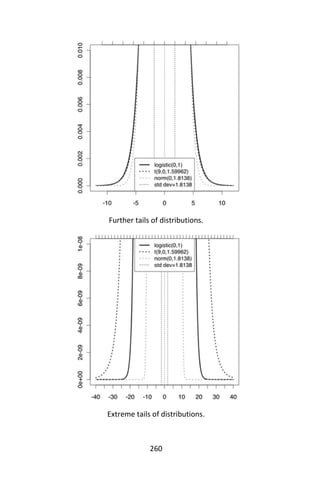
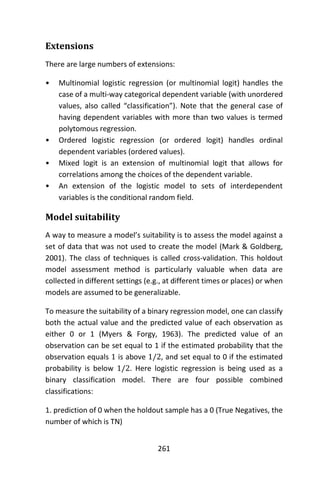
The Probit model has been around longer than the logit model (Bishop,
2006). They behave similarly, except that the logistic distribution tends
to be slightly flatter tailed. One of the reasons the logit model was
formulated was that the probit model was computationally difficult due
to the requirement of numerically calculating integrals. Modern
computing however has made this computation fairly simple. The
coefficients obtained from the logit and probit model are fairly close.
However, the odds ratio is easier to interpret in the logit model (Hosmer
& Lemeshow, 2000).
Practical reasons for choosing the probit model over the logistic model
would be:
• There is a strong belief that the underlying distribution is normal
• The actual event is not a binary outcome (e.g., bankruptcy
status) but a proportion (e.g., proportion of population at
different debt levels).
Time series models
Time series models are used for predicting or forecasting the future
15
behavior of variables. These models account for the fact that data points
taken over time may have an internal structure (such as autocorrelation,
trend or seasonal variation) that should be accounted for. As a result
standard regression techniques cannot be applied to time series data
and methodology has been developed to decompose the trend, seasonal
and cyclical component of the series. Modeling the dynamic path of a
variable can improve forecasts since the predictable component of the
series can be projected into the future (Imdadullah, 2014).
Time series models estimate difference equations containing stochastic
components. Two commonly used forms of these models are
autoregressive models (AR) and moving average (MA) models. The Box-
Jenkins methodology (1976) developed by George Box and G.M. Jenkins
combines the AR and MA models to produce the ARMA (autoregressive
moving average) model which is the cornerstone of stationary time
series analysis (Box & Jenkins, 1976). ARIMA (autoregressive integrated
moving average models) on the other hand are used to describe non-
stationary time series. Box and Jenkins suggest differencing a non-
stationary time series to obtain a stationary series to which an ARMA
model can be applied. Non stationary time series have a pronounced
trend and do not have a constant long-run mean or variance.
Box and Jenkins proposed a three stage methodology which includes:
model identification, estimation and validation. The identification stage
involves identifying if the series is stationary or not and the presence of
seasonality by examining plots of the series, autocorrelation and partial
autocorrelation functions. In the estimation stage, models are estimated
using non-linear time series or maximum likelihood estimation
procedures. Finally the validation stage involves diagnostic checking
such as plotting the residuals to detect outliers and evidence of model
fit (Box & Jenkins, 1976).
In recent years, time series models have become more sophisticated and
attempt to model conditional heteroskedasticity with models such as
ARCH (autoregressive conditional heteroskedasticity) and GARCH
(generalized autoregressive conditional heteroskedasticity) models
16
frequently used for financial time series. In addition time series models
are also used to understand inter-relationships among economic
variables represented by systems of equations using VAR (vector
autoregression) and structural VAR models.
Survival or duration analysis
Survival analysis is another name for time-to-event analysis. These
techniques were primarily developed in the medical and biological
sciences, but they are also widely used in the social sciences like
economics, as well as in engineering (reliability and failure time analysis)
(Singh & Mukhopadhyay, 2011).
Censoring and non-normality, which are characteristic of survival data,
generate difficulty when trying to analyze the data using conventional
statistical models such as multiple linear regression. The normal
distribution, being a symmetric distribution, takes positive as well as
negative values, but duration by its very nature cannot be negative and
therefore normality cannot be assumed when dealing with
duration/survival data. Hence the normality assumption of regression
models is violated.
The assumption is that if the data were not censored it would be
representative of the population of interest. In survival analysis,
censored observations arise whenever the dependent variable of
interest represents the time to a terminal event, and the duration of the
study is limited in time.
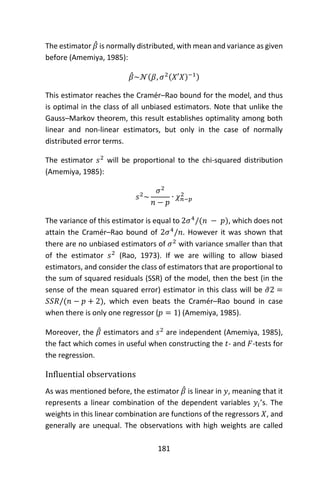
An important concept in survival analysis is the hazard rate, defined as
the probability that the event will occur at time 𝑡 conditional on surviving
until time 𝑡. Another concept related to the hazard rate is the survival
function which can be defined as the probability of surviving to time 𝑡.
Most models try to model the hazard rate by choosing the underlying
distribution depending on the shape of the hazard function. A
distribution whose hazard function slopes upward is said to have
positive duration dependence, a decreasing hazard shows negative
17
duration dependence whereas constant hazard is a process with no
memory usually characterized by the exponential distribution. Some of
the distributional choices in survival models are: 𝐹, gamma, Weibull, log
normal, inverse normal, exponential, etc. All these distributions are for
a non-negative random variable.
Duration models can be parametric, non-parametric or semi-parametric.
Some of the models commonly used are Kaplan-Meier and Cox
proportional hazard model (nonparametric) (Kaplan & Meier, 1958).
Classification and regression trees
Hierarchical Optimal Discriminant Analysis (HODA), (also called
classification tree analysis) is a generalization of Optimal Discriminant
Analysis that may be used to identify the statistical model that has
maximum accuracy for predicting the value of a categorical dependent
variable for a dataset consisting of categorical and continuous variables
(Yarnold & Soltysik, 2004). The output of HODA is a non-orthogonal tree
that combines categorical variables and cut points for continuous
variables that yields maximum predictive accuracy, an assessment of the
exact Type I error rate, and an evaluation of potential cross-
generalizability of the statistical model. Hierarchical Optimal
Discriminant analysis may be thought of as a generalization of Fisher’s
linear discriminant analysis. Optimal discriminant analysis is an
alternative to ANOVA (analysis of variance) and regression analysis,
which attempt to express one dependent variable as a linear
combination of other features or measurements. However, ANOVA and
regression analysis give a dependent variable that is a numerical
variable, while hierarchical optimal discriminant analysis gives a
dependent variable that is a class variable.
Classification and regression trees (CART) is a non-parametric decision
tree learning technique that produces either classification or regression
trees, depending on whether the dependent variable is categorical or
numeric, respectively (Rokach & Maimon, 2008).
Decision trees are formed by a collection of rules based on variables in
18
the modeling data set:
• Rules based on variables’ values are selected to get the best split
to differentiate observations based on the dependent variable
• Once a rule is selected and splits a node into two, the same
process is applied to each “child” node (i.e. it is a recursive
procedure)
• Splitting stops when CART detects no further gain can be made,
or some pre-set stopping rules are met. (Alternatively, the data
are split as much as possible and then the tree is later pruned.)
Each branch of the tree ends in a terminal node. Each observation falls
into one and exactly one terminal node, and each terminal node is
uniquely defined by a set of rules.
A very popular method for predictive analytics is Leo Breiman’s Random
forests (Breiman L. , Random Forests, 2001) or derived versions of this
technique like Random multinomial logit (Prinzie, 2008).
Multivariate adaptive regression splines
Multivariate adaptive regression splines (MARS) is a non-parametric
technique that builds flexible models by fitting piecewise linear
regressions (Friedman, 1991).
An important concept associated with regression splines is that of a
knot. Knot is where one local regression model gives way to another and
thus is the point of intersection between two splines.
In multivariate and adaptive regression splines, basis functions are the
tool used for generalizing the search for knots. Basis functions are a set
of functions used to represent the information contained in one or more
variables. MARS model almost always creates the basis functions in
pairs.
Multivariate and adaptive regression spline approach deliberately over-
fits the model and then prunes to get to the optimal model. The
algorithm is computationally very intensive and in practice we are
19
required to specify an upper limit on the number of basis functions.
Machine learning techniques
Machine learning, a branch of artificial intelligence, was originally
employed to develop techniques to enable computers to learn. Today,
since it includes a number of advanced statistical methods for regression
and classification, it finds application in a wide variety of fields including
medical diagnostics, credit card fraud detection, face and speech
recognition and analysis of the stock market. In certain applications it is
sufficient to directly predict the dependent variable without focusing on
the underlying relationships between variables. In other cases, the
underlying relationships can be very complex and the mathematical
form of the dependencies unknown. For such cases, machine learning
techniques emulate human cognition and learn from training examples
to predict future events.
A brief discussion of some of these methods used commonly for
predictive analytics is provided below. A detailed study of machine
learning can be found in Mitchell’s Machine Learning (Mitchell, 1997).
Neural networks
Neural networks are nonlinear sophisticated modeling techniques that
are able to model complex functions (Rosenblatt, 1958). They can be
applied to problems of prediction, classification or control in a wide
spectrum of fields such as finance, cognitive psychology/neuroscience,
medicine, engineering, and physics.
Neural networks are used when the exact nature of the relationship
between inputs and output is not known. A key feature of neural
networks is that they learn the relationship between inputs and output
through training. There are three types of training in neural networks
used by different networks, supervised and unsupervised training,
reinforcement learning, with supervised being the most common one.
Some examples of neural network training techniques are back
propagation, quick propagation, conjugate gradient descent, projection
20
operator, Delta-Bar-Delta etc. Some unsupervised network
architectures are multilayer perceptrons (Freund & Schapire, 1999),
Kohonen networks (Kohonen & Honkela, 2007), Hopfield networks
(Hopfield, 2007), etc.
Multilayer Perceptron (MLP)
The Multilayer Perceptron (MLP) consists of an input and an output layer
with one or more hidden layers of nonlinearly-activating nodes or
sigmoid nodes. This is determined by the weight vector and it is
necessary to adjust the weights of the network. The back-propagation
employs gradient fall to minimize the squared error between the
network output values and desired values for those outputs. The weights
adjusted by an iterative process of repetitive present of attributes. Small
changes in the weight to get the desired values are done by the process
called training the net and is done by the training set (learning rule)
(Riedmiller, 2010).
Radial basis functions
A radial basis function (RBF) is a function which has built into it a distance
criterion with respect to a center. Such functions can be used very
efficiently for interpolation and for smoothing of data. Radial basis
functions have been applied in the area of neural networks where they
are used as a replacement for the sigmoidal transfer function. Such
networks have 3 layers, the input layer, the hidden layer with the RBF
non-linearity and a linear output layer. The most popular choice for the
non-linearity is the Gaussian. RBF networks have the advantage of not
being locked into local minima as do the feedforward networks such as
the multilayer perceptron (Łukaszyk, 2004).
Support vector machines
Support Vector Machines (SVM) are used to detect and exploit complex
patterns in data by clustering, classifying and ranking the data (Cortes &
Vapnik, 1995). They are learning machines that are used to perform
binary classifications and regression estimations. They commonly use
kernel based methods to apply linear classification techniques to non-
linear classification problems. There are a number of types of SVM such
21
as linear, polynomial, sigmoid etc.
Naïve Bayes
Naïve Bayes based on Bayes conditional probability rule is used for
performing classification tasks. Naïve Bayes assumes the predictors are
statistically independent which makes it an effective classification tool
that is easy to interpret. It is best employed when faced with the
problem of ‘curse of dimensionality‘ i.e. when the number of predictors
is very high (Rennie, Shih, Teevan, & Karger, 2003).
k-nearest neighbors
The nearest neighbor algorithm 𝑘-NN belongs to the class of pattern
recognition statistical methods (Altman, 1992). The method does not
impose a priori any assumptions about the distribution from which the
modeling sample is drawn. It involves a training set with both positive
and negative values. A new sample is classified by calculating the
distance to the nearest neighboring training case. The sign of that point
will determine the classification of the sample. In the 𝑘-nearest neighbor
classifier, the 𝑘 nearest points are considered and the sign of the
majority is used to classify the sample. The performance of the 𝑘-NN
algorithm is influenced by three main factors: (1) the distance measure
used to locate the nearest neighbors; (2) the decision rule used to derive
a classification from the 𝑘-nearest neighbors; and (3) the number of
neighbors used to classify the new sample. It can be proved that, unlike
other methods, this method is universally asymptotically convergent,
i.e.: as the size of the training set increases, if the observations are
independent and identically distributed (i.i.d.), regardless of the
distribution from which the sample is drawn, the predicted class will
converge to the class assignment that minimizes misclassification error
(Devroye, Györfi, & Lugosi, 1996).
Geospatial predictive modeling
Conceptually, geospatial predictive modeling is rooted in the principle
that the occurrences of events being modeled are limited in distribution.
Occurrences of events are neither uniform nor random in distribution –
there are spatial environment factors (infrastructure, sociocultural,
22
topographic, etc.) that constrain and influence where the locations of
events occur. Geospatial predictive modeling attempts to describe those
constraints and influences by spatially correlating occurrences of
historical geospatial locations with environmental factors that represent
those constraints and influences. Geospatial predictive modeling is a
process for analyzing events through a geographic filter in order to make
statements of likelihood for event occurrence or emergence.
Tools
Historically, using predictive analytics tools—as well as understanding
the results they delivered—required advanced skills. However, modern
predictive analytics tools are no longer restricted to IT specialists. As
more organizations adopt predictive analytics into decision-making
processes and integrate it into their operations, they are creating a shift
in the market toward business users as the primary consumers of the
information. Business users want tools they can use on their own.
Vendors are responding by creating new software that removes the
mathematical complexity, provides user-friendly graphic interfaces
and/or builds in short cuts that can, for example, recognize the kind of
data available and suggest an appropriate predictive model (Halper,
2011). Predictive analytics tools have become sophisticated enough to
adequately present and dissect data problems, so that any data-savvy
information worker can utilize them to analyze data and retrieve
meaningful, useful results (Eckerson, 2007). For example, modern tools
present findings using simple charts, graphs, and scores that indicate the
likelihood of possible outcomes (MacLennan, 2012).
There are numerous tools available in the marketplace that help with
the execution of predictive analytics. These range from those that need
very little user sophistication to those that are designed for the expert
practitioner. The difference between these tools is often in the level of
customization and heavy data lifting allowed.
Notable open source predictive analytic tools include:
• scikit-learn
23
• KNIME
• OpenNN
• Orange
• R
• RapidMiner
• Weka
• GNU Octave
• Apache Mahout
Notable commercial predictive analytic tools include:
• Alpine Data Labs
• BIRT Analytics
• Angoss KnowledgeSTUDIO
• IBM SPSS Statistics and IBM SPSS Modeler
• KXEN Modeler
• Mathematica
• MATLAB
• Minitab
• Oracle Data Mining (ODM)
• Pervasive
• Predixion Software
• Revolution Analytics
• SAP
• SAS and SAS Enterprise Miner
• STATA
• STATISTICA
• TIBCO
PMML
In an attempt to provide a standard language for expressing predictive
models, the Predictive Model Markup Language (PMML) has been
proposed. Such an XML-based language provides a way for the different
tools to define predictive models and to share these between PMML
compliant applications. PMML 4.0 was released in June, 2009.
24
Criticism
There are plenty of skeptics when it comes to computers and algorithms
abilities to predict the future, including Gary King, a professor from
Harvard University and the director of the Institute for Quantitative
Social Science. People are influenced by their environment in
innumerable ways. Trying to understand what people will do next
assumes that all the influential variables can be known and measured
accurately. “People’s environments change even more quickly than they
themselves do. Everything from the weather to their relationship with
their mother can change the way people think and act. All of those
variables are unpredictable. How they will impact a person is even less
predictable. If put in the exact same situation tomorrow, they may make
a completely different decision. This means that a statistical prediction
is only valid in sterile laboratory conditions, which suddenly isn’t as
useful as it seemed before.” (King, 2014)
25
2. Predictive modeling
Predictive modeling is the process by which a model is created or chosen
to try to best predict the probability of an outcome (Geisser, 1993). In
many cases the model is chosen on the basis of detection theory to try
to guess the probability of an outcome given a set amount of input data,
for example, given an email determining how likely that it is spam.
Models can use one or more classifiers in trying to determine the
probability of a set of data belonging to another set, say spam or ‘ham’.
There are three types of predictive models marketers should know
about, but I will only talk about the first one in this article:
 Propensity models (predictions)
 Clustering models (segments)
 Collaborative filtering (recommendations)
Propensity models are what most people think of when they hear
“predictive analytics”. Propensity models make predictions about a
customer’s future behavior. With propensity models you can anticipate
a customers’ future behavior. However, keep in mind that even
propensity models are abstractions and do not necessarily predict
absolute true behavior. wewill go through six examples of propensity
models to explain the concept.
Propensity Models
Model 1: Predicted customer lifetime value
CLV (Customer Lifetime Value) is a prediction of all the value a business
will derive from their entire relationship with a customer. The Pareto
Principle states that, for many events, roughly 80% of the effects come
from 20% of the causes. When applied to e-commerce, this means that
80% of your revenue can be attributed to 20% of your customers. While
the exact percentages may not be 80/20, it is still the case that some
customers are worth a whole lot more than others, and identifying your
26
“All-Star” customers can be extremely valuable to your business.
Algorithms can predict how much a customer will spend with you long
before customers themselves realizes this.
At the moment a customer makes their first purchase you may know a
lot more than just their initial transaction record: you may have email
and web engagement data for example, as well as demographic and
geographic information. By comparing a customer to many others who
came before them, you can predict with a high degree of accuracy their
future lifetime value. This information is extremely valuable as it allows
you to make value based marketing decisions. For example, it makes
sense to invest more in those acquisition channels and campaigns that
produce customers with the highest predicted lifetime value.
Model 2: Predicted share of wallet
Predicted share of wallet refers to the amount of the customer’s total
spending that a business captures in the products and services that it
offers. Increasing the share of a customer’s wallet a company receives is
often a cheaper way of boosting revenue than increasing market share.
For example if a customer spends $100 with you on groceries, is this 10%
or 90% of their grocery spending for a given year? Knowing this allows
you to see where future revenue potential is within your existing
customer base and to design campaigns to capture this revenue.
Model 3: Propensity to engage
A propensity to engage model predicts the likelihood that a person will
engage in some activity, like unethical behavior or post purchases. For
example, a propensity to engage model can predict how likely it is that
a customer will click on your email links. Armed with this information
you can decide not to send an email to a certain “low likelihood to click”
segment.
Model 4: Propensity to unsubscribe
A propensity to unsubscribe model tells you which customers not to
27
touch: if there are high value customers you are at risk of losing to
unsubscribe, you need to find other ways to reaching out to them that
are not by email. For example, you can predict how likely it is that a
customer will unsubscribe from your email list at any given point in time.
Armed with this information you can optimize email frequency. For “high
likelihood to unsubscribe” segments, you should decrease send
frequency; whereas for “low likelihood to unsubscribe” segments, you
can increase email send frequency. You could also decide to use
different channels (like direct mail or LinkedIn) to reach out to “high
likelihood to unsubscribe” customers.
Model 5: Propensity to buy
The propensity to buy model tells you which customers are ready to
make their purchase, so you can find who to target. Moreover, once you
know who is ready and who is not helps you provide the right aggression
in your offer. Those that are likely to buy won’t need high discounts (You
can stop cannibalizing your margin) while customers who are not likely
to buy may need a more aggressive offer, thereby bringing you
incremental revenue.
For example, a “propensity to buy a new vehicle” model built with only
data the automotive manufacturer has in their database can be used to
predict percent of sales. By incorporating demographic and lifestyle data
from third parties, the accuracy of that model can be improved. That is,
if the first model predicts 50% sales in the top five deciles (there are ten
deciles), then the latter could improve the result to 70% in the top five
deciles.
Model 6: Propensity to churn
Companies often rely on customer service agents to “save” customers
who call to say they are taking their business elsewhere. But by this time,
it is often too late to save the relationship. The propensity to churn
model tells you which active customers are at risk, so you know which
high value, at risk customers to put on your watch list and reach out.
28
Armed with this information, you may be able to save those customers
with preemptive marketing programs designed to retain them.
Often propensity models can be combined to make campaign decisions.
For example, you may want to do an aggressive customer win back
campaign for customers who have both a high likelihood to unsubscribe
and a high predicted lifetime value.
Cluster Models
Clustering is the predictive analytics term for customer segmentation.
Clustering, like classification, is used to segment the data. Unlike
classification, clustering models segment data into groups that were not
previously defined. Cluster analysis itself is not one specific algorithm,
but the general task to be solved. It can be achieved by various
algorithms that differ significantly in their notion of what constitutes a
cluster and how to efficiently find them.
With clustering you let the algorithms, rather than the marketers, create
customer segments. Think of clustering as auto-segmentation.
Algorithms are able to segment customers based on many more
variables than a human being ever could. It’s not unusual for two clusters
to be different on 30 customer dimensions or more. In this article I will
talk about three different types of predictive clustering models.
Model 7: Behavioral clustering
Behavioral clustering informs you how people behave while purchasing.
Do they use the web site or the call center? Are they discount addicts?
How frequently do they buy? How much do they spend? How much time
will go buy before they purchase again? This algorithm helps set the right
tone while contacting the customer. For instance, customers that buy
frequently but with low sized orders might react well to offers like ‘Earn
double rewards points when you spend $100 or more.
29
Behavioral clustering can also informs us on other behaviors, such as
crime and is used in performing crime analysis. In the example below
there are three crime clusters (only the top ten are shown in the table):
Graphically, the clusters appear as follow:
Cluster plot created in R Studio
Model 8: Product based clustering (also called category based
clustering)
Product based clustering algorithms discover what different groupings
of products people buy from. See the example below of a category (or
product) based segment or cluster. You can see people in one customer
30
segment ONLY buy Pinot Noir, whereas those in another customer
segment buy different types of Varietal products, such as Champagne,
Chardonnay, Pinot Grigio and Prosecco – but never Cabernet Sauvignon,
Malbec or Espumante. This is useful information when deciding which
product offers or email content to send to each of these customer
segments.
Model 9: Brand based clustering
Brand-based clustering, on the other hand, focuses on the brand of
items customers purchase. Marketers can use this information to project
what other brands those customers are likely to buy. Customers are then
ordered according to Nike, Adidas, Under Armour, etc. Now you know
what specific brands to pitch to certain customers. When a brand
releases new products – you know who is likely to be interested.
Conclusion
Predictive analytics models are great, but they are ultimately useless
unless you can actually tie them to your day-to-day marketing
campaigns. This leads me to the first rule of predictive analytics:
31
“Always make sure that your predictive analytics platform is directly
integrated with your marketing execution systems such as your email
service provider, web site, call center or Point of Sell (POS) system.”
It is better to start with just one model that you use in day-to-day
marketing campaigns than to have 10 models without the data being
actionable in the hands of marketers.
Presenting and Using the Results of a Predictive Model
Predictive models can either be used directly to estimate a response
(output) given a defined set of characteristics (input), or indirectly to
drive the choice of decision rules (Steyerberg, 2010).
Depending on the methodology employed for the prediction, it is often
possible to derive a formula that may be used in a spreadsheet software.
This has some advantages for end users or decision makers, the main
one being familiarity with the software itself, hence a lower barrier to
adoption.
Nomograms are useful graphical representation of a predictive model.
As in spreadsheet software, their use depends on the methodology
chosen. The advantage of nomograms is the immediacy of computing
predictions without the aid of a computer.
Point estimates tables are one of the simplest form to represent a
predictive tool. Here combination of characteristics of interests can
either be represented via a table or a graph and the associated
prediction read off the 𝑦-axis or the table itself.
Tree based methods (e.g. CART, survival trees) provide one of the most
graphically intuitive ways to present predictions. However, their usage
is limited to those methods that use this type of modeling approach
which can have several drawbacks (Breiman L. , 1996). Trees can also be
employed to represent decision rules graphically.
Score charts are graphical tabular or graphical tools to represent either
32
predictions or decision rules.
A new class of modern tools are represented by web based applications.
For example, Shiny is a web based tool developed by Rstudio, an R IDE
(integrated development environment). With a Shiny app, a modeler has
the advantage to represent any which way he or she chooses to
represent the predictive model while allowing the user some control. A
user can choose a combination of characteristics of interest via sliders or
input boxes and results can be generated, from graphs to confidence
intervals to tables and various statistics of interests. However, these
tools often require a server installation of Rstudio.
Applications
Uplift Modeling
Uplift Modeling (see Chapter 17) is a technique for modeling the change
in probability caused by an action. Typically this is a marketing action
such as an offer to buy a product, to use a product more or to re-sign a
contract. For example in a retention campaign you wish to predict the
change in probability that a customer will remain a customer if they are
contacted. A model of the change in probability allows the retention
campaign to be targeted at those customers on whom the change in
probability will be beneficial. This allows the retention program to avoid
triggering unnecessary churn or customer attrition without wasting
money contacting people who would act anyway.
Archaeology
Predictive modeling in archaeology gets its foundations from Gordon
Willey‘s mid-fifties work in the Virú Valley of Peru (Willey, 1953).
Complete, intensive surveys were performed then covariability between
cultural remains and natural features such as slope, and vegetation were
determined. Development of quantitative methods and a greater
availability of applicable data led to growth of the discipline in the 1960s
and by the late 1980s, substantial progress had been made by major land
managers worldwide.
33
Generally, predictive modeling in archaeology is establishing statistically
valid causal or covariable relationships between natural proxies such as
soil types, elevation, slope, vegetation, proximity to water, geology,
geomorphology, etc., and the presence of archaeological features.
Through analysis of these quantifiable attributes from land that has
undergone archaeological survey, sometimes the “archaeological
sensitivity” of unsurveyed areas can be anticipated based on the natural
proxies in those areas. Large land managers in the United States, such as
the Bureau of Land Management (BLM), the Department of Defense
(DOD) (Altschul, Sebastian, & Heidelberg, 2004), and numerous highway
and parks agencies, have successfully employed this strategy. By using
predictive modeling in their cultural resource management plans, they
are capable of making more informed decisions when planning for
activities that have the potential to require ground disturbance and
subsequently affect archaeological sites.
Customer relationship management
Predictive modeling is used extensively in analytical customer
relationship management and data mining to produce customer-level
models that describe the likelihood that a customer will take a particular
action. The actions are usually sales, marketing and customer retention
related.
For example, a large consumer organization such as a mobile
telecommunications operator will have a set of predictive models for
product cross-sell, product deep-sell and churn. It is also now more
common for such an organization to have a model of “savability” using
an uplift model. This predicts the likelihood that a customer can be saved
at the end of a contract period (the change in churn probability) as
opposed to the standard churn prediction model.
Auto insurance
Predictive Modeling is utilized in vehicle insurance to assign risk of
incidents to policy holders from information obtained from policy
holders. This is extensively employed in usage-based insurance solutions
34
where predictive models utilize telemetry based data to build a model
of predictive risk for claim likelihood. Black-box auto insurance
predictive models utilize GPS or accelerometer sensor input only. Some
models include a wide range of predictive input beyond basic telemetry
including advanced driving behavior, independent crash records, road
history, and user profiles to provide improved risk models.
Health care
In 2009 Parkland Health & Hospital System began analyzing electronic
medical records in order to use predictive modeling to help identify
patients at high risk of readmission. Initially the hospital focused on
patients with congestive heart failure, but the program has expanded to
include patients with diabetes, acute myocardial infarction, and
pneumonia.
Notable failures of predictive modeling
Although not widely discussed by the mainstream predictive modeling
community, predictive modeling is a methodology that has been widely
used in the financial industry in the past and some of the spectacular
failures have contributed to the financial crisis of 2008. These failures
exemplify the danger of relying blindly on models that are essentially
backforward looking in nature. The following examples are by no mean
a complete list:
1) Bond rating. S&P, Moody’s and Fitch quantify the probability of
default of bonds with discrete variables called rating. The rating can take
on discrete values from AAA down to D. The rating is a predictor of the
risk of default based on a variety of variables associated with the
borrower and macro-economic data that are drawn from historicals. The
rating agencies failed spectacularly with their ratings on the 600 billion
USD mortgage backed CDO market. Almost the entire AAA sector (and
the super-AAA sector, a new rating the rating agencies provided to
represent super safe investment) of the CDO market defaulted or
severely downgraded during 2008, many of which obtained their ratings
less than just a year ago.
35
2) Statistical models that attempt to predict equity market prices based
on historical data. So far, no such model is considered to consistently
make correct predictions over the long term. One particularly
memorable failure is that of Long Term Capital Management, a fund that
hired highly qualified analysts, including a Nobel Prize winner in
economics, to develop a sophisticated statistical model that predicted
the price spreads between different securities. The models produced
impressive profits until a spectacular debacle that caused the then
Federal Reserve chairman Alan Greenspan to step in to broker a rescue
plan by the Wall Street broker dealers in order to prevent a meltdown
of the bond market.
Possible fundamental limitations of predictive model
based on data fitting
1) History cannot always predict future: using relations derived from
historical data to predict the future implicitly assumes there are certain
steady-state conditions or constants in the complex system. This is
almost always wrong when the system involves people.
2) The issue of unknown unknowns: in all data collection, the collector
first defines the set of variables for which data is collected. However, no
matter how extensive the collector considers his selection of the
variables, there is always the possibility of new variables that have not
been considered or even defined, yet critical to the outcome.
3) Self-defeat of an algorithm: after an algorithm becomes an accepted
standard of measurement, it can be taken advantage of by people who
understand the algorithm and have the incentive to fool or manipulate
the outcome. This is what happened to the CDO rating. The CDO dealers
actively fulfilled the rating agencies input to reach an AAA or super-AAA
on the CDO they are issuing by cleverly manipulating variables that were
“unknown” to the rating agencies’ “sophisticated” models.
Software
Throughout the main chapters (3-16) we will give examples of software
36
packages that have the functionality to perform the modeling discussed
in a chapter. The “main” software packages are discussed here, due to
the expanse of functionality. Software packages built specifically for a
functionality, like Support Vector Machines, will be addressed further in
the chapters. We will not address software for Uplift models and Time
Series models, since they are applications of methods discussed in the
main chapters.
Open Source
DAP – GNU Dap is a statistics and graphics program, that performs data
management, analysis, and graphical visualization tasks which are
commonly required in statistical consulting practice. Dap was written to
be a free replacement for SAS, but users are assumed to have a basic
familiarity with the C programming language in order to permit greater
flexibility. Unlike R it has been designed to be used on large data sets.
KNIME – GNU KNIME, the Konstanz Information Miner, is an open
source data analytics, reporting and integration platform. KNIME
integrates various components for machine learning and data mining
through its modular data pipelining concept. A graphical user interface
allows assembly of nodes for data preprocessing (ETL: Extraction,
Transformation, Loading), for modeling and data analysis and
visualization.
Octave – GNU Octave is a high-level programming language, primarily
intended for numerical computations. It provides a command-line
interface for solving linear and nonlinear problems numerically, and for
performing other numerical experiments using a language that is mostly
compatible with MATLAB. WE have used Octave extensively for
predictive modeling.
Orange – GNU Orange is a component-based data mining and machine
learning software suite, featuring a visual programming front-end for
explorative data analysis and visualization, and Python bindings and
libraries for scripting. It includes a set of components for data
preprocessing, feature scoring and filtering, modeling, model
37
evaluation, and exploration techniques. It is implemented in C++ and
Python.
PNL (Probabilistic Networks Library) – is a tool for working with graphical
models, supporting directed and undirected models, discrete and
continuous variables, various inference and learning algorithms.
R – GNU R is an open source software environment for statistical
computing. It uses “packages”, which are loaded with commands in a
console, to provide modeling functionality. As mentioned, all the
computer examples in the book are implementations of R packages. The
R language is widely used among statisticians and data miners for
developing statistical software and data analysis. R is an implementation
of the S programming language. We have used R extensively for
predictive modeling, using fairly large data sets, but not greater than
900,000 records.
scikit-learn – GNU scikit-learn (formerly scikits.learn) is an open source
machine learning library for the Python programming language. It
features various classification, regression and clustering algorithms
including support vector machines, logistic regression, naive Bayes,
random forests, gradient boosting, k-means and DBSCAN, and is
designed to interoperate with the Python numerical and scientific
libraries NumPy and SciPy.
Weka – GNU Weka (Waikato Environment for Knowledge Analysis) is a
popular suite of machine learning software written in Java, developed at
the University of Waikato, New Zealand. Weka is free software available
under the GNU General Public License.
Commercial
Analytica – by Lumina Decision Systems, is an influence diagram-based,
visual environment for creating and analyzing probabilistic models.
IBM SPSS Modeler – is a data mining and text analytics software
application built by IBM. It is used to build predictive models and
38
conduct other analytic tasks. It has a visual interface which allows users
to leverage statistical and data mining algorithms without programming.
We will refer to it later as SPSS Modeler.
MATLAB – (matrix laboratory) is a multi-paradigm numerical computing
environment and fourth-generation programming language. Developed
by MathWorks, MATLAB allows matrix manipulations, plotting of
functions and data, implementation of algorithms, creation of user
interfaces, and interfacing with programs written in other languages,
including C, C++, Java, and Fortran. An additional package, Simulink,
adds graphical multi-domain simulation and Model-Based Design for
dynamic and embedded systems. We have used MATLAB and Simulink
extensively for predictive modeling.
RapidMiner – is a software platform developed by the company of the
same name that provides an integrated environment for machine
learning, data mining, text mining, predictive analytics and business
analytics.
SAS Enterprise Miner – SAS (Statistical Analysis System) is a software
suite developed by SAS Institute for advanced analytics, business
intelligence, data management, and predictive analytics. Enterprise
Miner, as the name suggests, is the SAS data mining and modeling tool.
STATISTICA – is a statistics and analytics software package developed by
StatSoft. STATISTICA provides data analysis, data management,
statistics, data mining, and data visualization procedures.
Introduction to R
This introduction serves as background material for our examples with
R. The only hardware requirement for is a PC with the latest free open
source R software installed. R has extensive documentation and active
online community support. It is the perfect environment to get started
in predictive modeling.
Installation. R can be downloaded from one of the mirror sites in
39
http://cran.r-project.org/mirrors.html. You should pick your nearest
location.
Using External Data. R offers plenty of options for loading external
data, including Excel, Minitab and SPSS files.
R Session. After R is started, there is a console awaiting for input. At
the prompt (>), you can enter numbers and perform calculations.
> 1 + 2
[1] 3
Variable Assignment. We assign values to variables with the
assignment operator “=“. Just typing the variable by itself at the
prompt will print out the value. We should note that another form of
assignment operator “<-” is also in use.
> x = 1
> x
[1] 1
Functions. R functions are invoked by its name, then followed by the
parenthesis, and zero or more arguments. The following apply the
function c to combine three numeric values into a vector.
> c(1, 2, 3)
[1] 1 2 3
Comments. All text after the pound sign “#” within the same line is
considered a comment.
> 1 + 1 # this is a comment
[1] 2
Extension Package. Sometimes we need additional functionality
beyond those offered by the core R library. In order to install an
extension package, you should invoke the install.packages function at
the prompt and follow the instruction.
40
> install.packages()
Getting Help. R provides extensive documentation. For example,
entering ?c or help(c) at the prompt gives documentation of the
function c in R.
> help(c)
If you are not sure about the name of the function you are looking for,
you can perform a fuzzy search with the apropos function.
> apropos(“nova”)
[1] “anova” “anova.glm”
....
Finally, there is an R specific Internet search engine at
http://www.rseek.org for more assistance.
41
3. Modeling Techniques
There are many ways to construct the models that we just discussed.
Propensity models are often constructed using statistical techniques and
machine learning. Cluster models may also use statistical techniques,
but may also employ heuristic algorithms.
Statistical Modeling
Nearly any regression model (linear, logistic, general linear model (GLM),
robust regression, etc.) can be used for prediction purposes. We will
cover all of these in the chapters to follow. In particular, logistic
regression is a very popular modeling technique for propensity models
with a binary (e.g., Yes or No) response (dependent) variable.
Broadly speaking, there are two classes of predictive models: parametric
and non-parametric. A third class, semi-parametric models, includes
features of both. Parametric models make “specific assumptions with
regard to one or more of the population parameters that characterize
the underlying distribution(s)” (Sheskin, 2011), while non-parametric
regressions make fewer assumptions than their parametric
counterparts. These models fall under the class of statistical models
(Marascuilo, 1977).
A statistical model is a formalization of relationships between variables
in the form of mathematical equations. A statistical model describes
how one or more random variables are related to one or more other
variables. The model is statistical as the variables are not
deterministically but stochastically related. In mathematical terms, a
statistical model is frequently thought of as a pair (𝑌, 𝑃) where 𝑌 is the
set of possible observations and 𝑃 the set of possible probability
distributions on 𝑌. It is assumed that there is a distinct element of 𝑃
which generates the observed data. Statistical inference enables us to
make statements about which element(s) of this set are likely to be the
true one.
42
Most statistical tests can be described in the form of a statistical model.
For example, the Student’s 𝑡-test for comparing the means of two
groups can be formulated as seeing if an estimated parameter in the
model is different from 0. Another similarity between tests and models
is that there are assumptions involved. Error is assumed to be normally
distributed in most models.
Formal definition
A statistical model is a collection of probability distribution functions or
probability density functions (collectively referred to as distributions for
brevity). A parametric model is a collection of distributions, each of
which is indexed by a unique finite-dimensional parameter: 𝑃{𝑃0: 𝜃 ∈
𝛩} , where 𝜃 is a parameter and 𝛩 ⊆ 𝑅 𝑑
is the feasible region of
parameters, which is a subset of 𝑑-dimensional Euclidean space. A
statistical model may be used to describe the set of distributions from
which one assumes that a particular data set is sampled. For example, if
one assumes that data arise from a univariate Gaussian distribution,
then one has assumed a Gaussian model
𝒫 = {ℙ(𝑥; 𝜇, 𝜎) =
1
√2𝜋𝜎
exp {−
1
2𝜎2
(𝑥 − 𝜇)2
} : 𝜇 ∈ ℝ, 𝜎 > 0}.
A non-parametric model is a set of probability distributions with infinite
dimensional parameters, and might be written as 𝒫 =
{all distributions}. A semi-parametric model also has infinite
dimensional parameters, but is not dense in the space of distributions.
For example, a mixture of Gaussians with one Gaussian at each data
point is dense in the space of distributions. Formally, if 𝑑 is the
dimension of the parameter, and 𝑛 is the number of samples, if 𝑑 → ∞as
𝑛 → ∞ and 𝑑 𝑛⁄ → 0 as 𝑛 → ∞, then the model is semi-parametric.
Model comparison
Models can be compared to each other. This can either be done when
you have performed an exploratory data analysis or a confirmatory data
analysis. In an exploratory analysis, you formulate all models you can
43
think of, and see which describes your data best. In a confirmatory
analysis you test which of your models you have described before the
data was collected fits the data best, or test if your only model fits the
data. In linear regression analysis you can compare the amount of
variance explained by the independent variables, 𝑅2
, across the
different models. In general, you can compare models that are nested
by using a Likelihood-ratio test. Nested models are models that can be
obtained by restricting a parameter in a more complex model to be zero.
An example
Height and age are probabilistically distributed over humans. They are
stochastically related; when you know that a person is of age 10, this
influences the chance of this person being 6 feet tall. You could formalize
this relationship in a linear regression model of the following form:
height 𝑖 = 𝑏0 + 𝑏1age𝑖 + 𝜀𝑖, where 𝑏0 is the intercept, 𝑏1 is a
parameter that age is multiplied by to get a prediction of height, 𝜀 is the
error term, and 𝑖 is the subject. This means that height starts at some
value, there is a minimum height when someone is born, and it is
predicted by age to some amount. This prediction is not perfect as error
is included in the model. This error contains variance that stems from
sex and other variables. When sex is included in the model, the error
term will become smaller, as you will have a better idea of the chance
that a particular 16-year-old is 6 feet tall when you know this 16-year-
old is a girl. The model would become height 𝑖 = 𝑏0 + 𝑏1age𝑖 +
𝑏2sex𝑖 + 𝜀𝑖, where the variable sex is dichotomous. This model would
presumably have a higher 𝑅2
. The first model is nested in the second
model: the first model is obtained from the second when 𝑏2 is restricted
to zero.
Classification
According to the number of the endogenous variables and the number
of equations, models can be classified as complete models (the number
of equations equal to the number of endogenous variables) and
incomplete models. Some other statistical models are the general linear
44
model (restricted to continuous dependent variables), the generalized
linear model (for example, logistic regression), the multilevel model, and
the structural equation model.
Machine Learning
Machine learning is a scientific discipline that explores the construction
and study of algorithms that can learn from data (Kovahi & Provost,
1998). Such algorithms operate by building a model based on inputs
(Bishop, Pattern Recognition and Machine Learning, 2006) and using
them to make predictions or decisions, rather than following only
explicitly programmed instructions.
Machine learning can be considered a subfield of computer science and
statistics. It has strong ties to artificial intelligence and optimization,
which deliver methods, theory and application domains to the field.
Machine learning is employed in a range of computing tasks where
designing and programming explicit, rule-based algorithms is infeasible.
Example applications include spam filtering, optical character
recognition (OCR) (Wernick, Yang, Brankov, Yourganov, & Strother,
2010), search engines and computer vision. Machine learning is
sometimes conflated with data mining (Mannila, 1996), although that
focuses more on exploratory data analysis (Friedman, Data Mining and
Statistics: What's the connection?, 1998). Machine learning and pattern
recognition “can be viewed as two facets of the same field.” (Bishop,
Pattern Recognition and Machine Learning, 2006)
Types of problems/tasks
Machine learning tasks are typically classified into three broad
categories, depending on the nature of the learning “signal” or
“feedback” available to a learning system. These are (Russell & Norvig,
2003):
Supervised learning. The computer is presented with example inputs
and their desired outputs, given by a “teacher”, and the goal is to learn
a general rule that maps inputs to outputs.
45
Unsupervised learning. Here, no labels are given to the learning
algorithm, leaving it on its own to find structure in its input.
Unsupervised learning can be a goal in itself (discovering hidden patterns
in data) or a means towards an end.
Reinforcement learning. In this instance, a computer program interacts
with a dynamic environment in which it must perform a certain goal
(such as driving a vehicle), without a teacher explicitly telling it whether
it has come close to its goal or not. Another example is learning to play
a game by playing against an opponent (Bishop, Pattern Recognition and
Machine Learning, 2006).
Between supervised and unsupervised learning is semi-supervised
learning, where the teacher gives an incomplete training signal: a
training set with some (often many) of the target outputs missing.
Transduction is a special case of this principle where the entire set of
problem instances is known at learning time, except that part of the
targets are missing.
Among other categories of machine learning problems, learning to learn
learns its own inductive bias based on previous experience.
Developmental learning, elaborated for robot learning, generates its
own sequences (also called curriculum) of learning situations to
cumulatively acquire repertoires of novel skills through autonomous
self-exploration and social interaction with human teachers, and using
guidance mechanisms such as active learning, maturation, motor
synergies, and imitation.
Another categorization of machine learning tasks arises when one
considers the desired output of a machine-learned system (Bishop,
Pattern Recognition and Machine Learning, 2006):
 In classification, inputs are divided into two or more classes, and the
learner must produce a model that assigns unseen inputs to one (or
multi-label classification) or more of these classes. This is typically
tackled in a supervised way. Spam filtering is an example of
46
classification, where the inputs are email (or other) messages and
the classes are “spam” and “not spam”.
 In regression, also a supervised problem, the outputs are continuous
rather than discrete.
 In clustering, a set of inputs is to be divided into groups. Unlike in
classification, the groups are not known beforehand, making this
typically an unsupervised task.
 Density estimation finds the distribution of inputs in some space.
 Dimensionality reduction simplifies inputs by mapping them into a
lower-dimensional space. Topic modeling is a related problem,
where a program is given a list of human language documents and
is tasked to find out which documents cover similar topics.
Approaches
There are numerous approaches to machine learning. We discuss several
of these in the chapters to follow. To these we will devote less narrative
here. And describe those not in the book in more detail.
Decision tree learning
Decision tree learning uses a decision tree as a predictive model, which
maps observations about an item to conclusions about the item’s target
value.
Association rule learning
Association rule learning is a method for discovering interesting
relations between variables in large databases.
Artificial neural networks
An artificial neural network (ANN) learning algorithm, usually called
“neural network” (NN), is a learning algorithm that is inspired by the
structure and functional aspects of biological neural networks.
Computations are structured in terms of an interconnected group of
artificial neurons, processing information using a connectionist
approach to computation. Modern neural networks are non-linear
statistical data modeling tools. They are usually used to model complex
relationships between inputs and outputs, to find patterns in data, or to
47
capture the statistical structure in an unknown joint probability
distribution between observed variables.
Support vector machines
Support vector machines (SVMs) are a set of related supervised learning
methods used for classification and regression. Given a set of training
examples, each marked as belonging to one of two categories, an SVM
training algorithm builds a model that predicts whether a new example
falls into one category or the other.
Clustering
Cluster analysis is the assignment of a set of observations into subsets
(called clusters) so that observations within the same cluster are similar
according to some predesignated criterion or criteria, while
observations drawn from different clusters are dissimilar. Different
clustering techniques make different assumptions on the structure of
the data, often defined by some similarity metric and evaluated for
example by internal compactness (similarity between members of the
same cluster) and separation between different clusters. Other methods
are based on estimated density and graph connectivity. Clustering is a
method of unsupervised learning, and a common technique for
statistical data analysis.
Bayesian networks
A Bayesian network, belief network or directed acyclic graphical model
is a probabilistic graphical model that represents a set of random
variables and their conditional independencies via a directed acyclic
graph (DAG). For example, a Bayesian network could represent the
probabilistic relationships between diseases and symptoms. Given
symptoms, the network can be used to compute the probabilities of the
presence of various diseases. Efficient algorithms exist that perform
inference and learning.
Inductive logic programming
Inductive logic programming (ILP) is an approach to rule learning using
logic programming as a uniform representation for input examples,
48
background knowledge, and hypotheses. Given an encoding of the
known background knowledge and a set of examples represented as a
logical database of facts, an ILP system will derive a hypothesized logic
program that entails all positive and no negative examples. Inductive
programming is a related field that considers any kind of programming
languages for representing hypotheses (and not only logic
programming), such as functional programs.
Reinforcement learning
Reinforcement learning is concerned with how an agent ought to take
actions in an environment so as to maximize some notion of long-term
reward. Reinforcement learning algorithms attempt to find a policy that
maps states of the world to the actions the agent ought to take in those
states. Reinforcement learning differs from the supervised learning
problem in that correct input/output pairs are never presented, nor sub-
optimal actions explicitly corrected.
Representation learning
Several learning algorithms, mostly unsupervised learning algorithms,
aim at discovering better representations of the inputs provided during
training. Classical examples include principal components analysis and
cluster analysis. Representation learning algorithms often attempt to
preserve the information in their input but transform it in a way that
makes it useful, often as a pre-processing step before performing
classification or predictions, allowing to reconstruct the inputs coming
from the unknown data generating distribution, while not being
necessarily faithful for configurations that are implausible under that
distribution.
Manifold learning algorithms attempt to do so under the constraint that
the learned representation is low-dimensional. Sparse coding algorithms
attempt to do so under the constraint that the learned representation is
sparse (has many zeros). Multilinear subspace learning algorithms aim
to learn low-dimensional representations directly from tensor
representations for multidimensional data, without reshaping them into
(high-dimensional) vectors (Lu, Plataniotis, & Venetsanopoulos, 2011).
49
Deep learning algorithms discover multiple levels of representation, or a
hierarchy of features, with higher-level, more abstract features defined
in terms of (or generating) lower-level features. It has been argued that
an intelligent machine is one that learns a representation that
disentangles the underlying factors of variation that explain the
observed data (Bengio, 2009).
Similarity and metric learning
In this problem, the learning machine is given pairs of examples that are
considered similar and pairs of less similar objects. It then needs to learn
a similarity function (or a distance metric function) that can predict if
new objects are similar. It is sometimes used in Recommendation
systems.
Sparse dictionary learning
In this method, a datum is represented as a linear combination of basis
functions, and the coefficients are assumed to be sparse. Let x be a d-
dimensional datum, 𝐷 be a 𝑑 by 𝑛 matrix, where each column of 𝐷
represents a basis function. 𝑟 is the coefficient to represent 𝑥 using 𝐷.
Mathematically, sparse dictionary learning means the following 𝑥 ≈ 𝐷𝑟
where 𝑟 is sparse. Generally speaking, 𝑛 is assumed to be larger than d
to allow the freedom for a sparse representation.
Learning a dictionary along with sparse representations is strongly NP-
hard and also difficult to solve approximately (Tillmann, 2015). A popular
heuristic method for sparse dictionary learning is K-SVD.
Sparse dictionary learning has been applied in several contexts. In
classification, the problem is to determine which classes a previously
unseen datum belongs to. Suppose a dictionary for each class has
already been built. Then a new datum is associated with the class such
that it’s best sparsely represented by the corresponding dictionary.
Sparse dictionary learning has also been applied in image de-noising. The
key idea is that a clean image path can be sparsely represented by an
image dictionary, but the noise cannot (Aharon, Elad, & Bruckstein,
2006).
50
Genetic algorithms
A genetic algorithm (GA) is a search heuristic that mimics the process of
natural selection, and uses methods such as mutation and crossover to
generate new genotype in the hope of finding good solutions to a given
problem. In machine learning, genetic algorithms found some uses in the
1980s and 1990s (Goldberg & Holland, 1988).
Applications
 Applications for machine learning include:
 Machine perception
 Computer vision, including object recognition
 Natural language processing
 Syntactic pattern recognition
 Search engines
 Medical diagnosis
 Bioinformatics
 Brain-machine interfaces
 Cheminformatics
 Detecting credit card fraud
 Stock market analysis
 Sequence mining
 Speech and handwriting recognition
 Game playing
 Adaptive websites
 Computational advertising
 Computational finance
 Structural health monitoring
 Sentiment analysis (or opinion mining)
 Affective computing
 Information retrieval
 Recommender systems
 Optimization and Metaheuristic
51
In 2006, the online movie company Netflix held the first “Netflix Prize”
competition to find a program to better predict user preferences and
improve the accuracy on its existing Cinematch movie recommendation
algorithm by at least 10%. A joint team made up of researchers from
AT&T Labs-Research in collaboration with the teams Big Chaos and
Pragmatic Theory built an ensemble model to win the Grand Prize in
2009 for $1 million.
In 2010 The Wall Street Journal wrote about a money management firm
Rebellion Research’s use of machine learning to predict economic
movements, the article talks about Rebellion Research’s prediction of
the financial crisis and economic recovery.
In 2014 it has been reported that a machine learning algorithm has been
applied in Art History to study fine art paintings, and that it may have
revealed previously unrecognized influences between artists.
52
53
4. Empirical Bayes method
Empirical Bayes methods are procedures for statistical inference in
which the prior distribution is estimated from the data. This approach
stands in contrast to standard Bayesian methods, for which the prior
distribution is fixed before any data are observed. Despite this difference
in perspective, empirical Bayes may be viewed as an approximation to a
fully Bayesian treatment of a hierarchical model wherein the parameters
at the highest level of the hierarchy are set to their most likely values,
instead of being integrated out. Empirical Bayes, also known as
maximum marginal likelihood (Bishop, Neural networks for pattern
recognition, 2005), represents one approach for setting
hyperparameters.
Introduction
Empirical Bayes methods can be seen as an approximation to a fully
Bayesian treatment of a hierarchical Bayes model.
In, for example, a two-stage hierarchical Bayes model, observed data
𝑦 = {𝑦1, 𝑦2, … , 𝑦 𝑁} are assumed to be generated from an unobserved
set of parameters 𝜃 = {𝜃1, 𝜃2, … , 𝜃 𝜂} according to a probability
distribution. In turn, the parameters 𝜃 can be considered samples drawn
from a population characterized by hyperparameters 𝜂 according to a
probability distribution 𝑝(𝜃|𝜂). In the hierarchical Bayes model, though
not in the empirical Bayes approximation, the hyperparameters 𝜂 are
considered to be drawn from an unparameterized distribution 𝑝(𝜃|𝜂).
Information about a particular quantity of interest 𝜃𝑖 therefore comes
not only from the properties of those data which directly depend on it,
but also from the properties of the population of parameters 𝜃 as a
whole, inferred from the data as a whole, summarized by the
54
hyperparameters 𝜂.
Using Bayes’ theorem,
𝑝(𝜃|𝑦) =
𝑝(𝑦|𝜃)𝑝(𝜃)
𝑝(𝑦)
=
𝑝(𝑦|𝜃)𝑝
𝑝(𝑦)
∫ 𝑝(𝜃|𝜂)𝑝(𝜂)𝑑𝜂.
In general, this integral will not be tractable analytically and must be
evaluated by numerical methods. Stochastic approximations using, e.g.,
Markov Chain Monte Carlo sampling or deterministic approximations
such as quadrature are common.
Alternatively, the expression can be written as
𝑝(𝜃|𝑦) = ∫ 𝑝(𝜃|𝜂, 𝑦)𝑝(𝜂|𝑦)𝑑𝜂 = ∫
𝑝(𝑦|𝜃)𝑝(𝜃|𝜂)
𝑝(𝑦|𝜂)
𝑝(𝜂|𝑦)𝑑𝜂,
and the term in the integral can in turn be expressed as
𝑝(𝜂|𝑦) = ∫ 𝑝(𝜂|𝜃)𝑝(𝜃|𝑦)𝑑𝜃.
These suggest an iterative scheme, qualitatively similar in structure to a
Gibbs sampler, to evolve successively improved approximations to
𝑝(𝜃|𝑦) and 𝑝(𝜂|𝑦). First, we calculate an initial approximation to 𝑝(𝜃|𝑦)
ignoring the 𝜂 dependence completely; then we calculate an
approximation to 𝑝(𝜂|𝑦) based upon the initial approximate distribution
of 𝑝(𝜃|𝑦); then we use this 𝑝(𝜂|𝑦) to update the approximation for
𝑝(𝜃|𝑦); then we update 𝑝(𝜂|𝑦); and so on.
When the true distribution 𝑝(𝜂|𝑦) is sharply peaked, the integral
determining 𝑝(𝜃|𝑦) may not be changed much by replacing the
probability distribution over 𝜂 with a point estimate 𝜂∗
representing the
distribution’s peak (or, alternatively, its mean),
𝑝(𝜃|𝑦) ≈
𝑝(𝑦|𝜃)𝑝(𝜃|𝜂∗)
𝑝(𝑦|𝜂∗)
55
With this approximation, the above iterative scheme becomes the EM
algorithm.
The term “Empirical Bayes“ can cover a wide variety of methods, but
most can be regarded as an early truncation of either the above scheme
or something quite like it. Point estimates, rather than the whole
distribution, are typically used for the parameter(s) 𝜂. The estimates for
𝜂∗
are typically made from the first approximation to 𝑝(𝜃|𝑦) without
subsequent refinement. These estimates for 𝜂∗
are usually made
without considering an appropriate prior distribution for 𝜂.
Point estimation
Robbins method: non-parametric empirical Bayes (NPEB)
Robbins (Robbins, 1956) considered a case of sampling from a
compound distribution, where probability for each 𝑦𝑖 (conditional on 𝜃𝑖)
is specified by a Poisson distribution,
𝑝(𝑦𝑖|𝜃𝑖) =
𝜃𝑖
𝑦𝑖
𝑒−𝜃𝑖
𝑦𝑖!
,
while the prior is unspecified except that it is also i.i.d. from an unknown
distribution, with cumulative distribution function 𝐺(𝜃). Compound
sampling arises in a variety of statistical estimation problems, such as
accident rates and clinical trials. We simply seek a point prediction of 𝜃𝑖
given all the observed data. Because the prior is unspecified, we seek to
do this without knowledge of 𝐺 (Carlin & Louis, 2000).
Under mean squared error loss (SEL), the conditional expectation
𝐸(𝜃𝑖|𝑌𝑖) is a reasonable quantity to use for prediction (Nikulin, 2001).
For the Poisson compound sampling model, this quantity is
𝐸(𝜃𝑖|𝑦𝑖) =
∫( 𝜃 𝑦+1
𝑒−𝜃
𝑦𝑖!⁄ )𝑑𝐺(𝜃)
∫(𝜃 𝑦 𝑒−𝜃 𝑦𝑖!⁄ ) 𝑑𝐺(𝜃)
.
This can be simplified by multiplying the expression by (𝑦𝑖 + 1 𝑦𝑖 + 1⁄ ),
yielding
56
𝐸(𝜃𝑖|𝑦𝑖) =
(𝑦𝑖 + 1)𝑝 𝐺(𝑦𝑖 + 1)
𝑝 𝐺(𝑦𝑖)
,
where 𝑝 𝐺 is the marginal distribution obtained by integrating out 𝜃 over
𝐺 (Wald, 1971).
To take advantage of this, Robbins (Robbins, 1956) suggested estimating
the marginals with their empirical frequencies, yielding the fully non-
parametric estimate as:
𝐸(𝜃𝑖|𝑦𝑖) = (𝑦𝑖 + 1)
#{𝑌𝑗 = 𝑦𝑖 + 1}
#{𝑌𝑗 = 𝑦𝑖}
,
where # denotes “number of” (Good, 1953).
Example - Accident rates
Suppose each customer of an insurance company has an “accident rate”
𝛩 and is insured against accidents; the probability distribution of 𝛩 is the
underlying distribution, and is unknown. The number of accidents
suffered by each customer in a specified time period has a Poisson
distribution with expected value equal to the particular customer’s
accident rate. The actual number of accidents experienced by a
customer is the observable quantity. A crude way to estimate the
underlying probability distribution of the accident rate 𝛩 is to estimate
the proportion of members of the whole population suffering
0, 1, 2, 3, … accidents during the specified time period as the
corresponding proportion in the observed random sample. Having done
so, we then desire to predict the accident rate of each customer in the
sample. As above, one may use the conditional expected value of the
accident rate 𝛩 given the observed number of accidents during the
baseline period. Thus, if a customer suffers six accidents during the
baseline period, that customer’s estimated accident rate is
7 × [𝑡ℎ𝑒 𝑝𝑟𝑜𝑝𝑜𝑟𝑡𝑖𝑜𝑛 𝑜𝑓 𝑡ℎ𝑒 𝑠𝑎𝑚𝑝𝑙𝑒 𝑤ℎ𝑜 𝑠𝑢𝑓𝑓𝑒𝑟𝑒𝑑 7 𝑎𝑐𝑐𝑖𝑑𝑒𝑛𝑡𝑠] /
[𝑡ℎ𝑒 𝑝𝑟𝑜𝑝𝑜𝑟𝑡𝑖𝑜𝑛 𝑜𝑓 𝑡ℎ𝑒 𝑠𝑎𝑚𝑝𝑙𝑒 𝑤ℎ𝑜 𝑠𝑢𝑓𝑓𝑒𝑟𝑒𝑑 6 𝑎𝑐𝑐𝑖𝑑𝑒𝑛𝑡𝑠].
Note that if the proportion of people suffering 𝑘 accidents is a
57
decreasing function of 𝑘, the customer’s predicted accident rate will
often be lower than their observed number of accidents. This shrinkage
effect is typical of empirical Bayes analyses.
Parametric empirical Bayes
If the likelihood and its prior take on simple parametric forms (such as 1-
or 2-dimensional likelihood functions with simple conjugate priors), then
the empirical Bayes problem is only to estimate the marginal 𝑚(𝑦|𝜂)
and the hyperparameters 𝜂 using the complete set of empirical
measurements. For example, one common approach, called parametric
empirical Bayes point estimation, is to approximate the marginal using
the maximum likelihood estimate (MLE), or a Moments expansion,
which allows one to express the hyperparameters 𝜂 in terms of the
empirical mean and variance. This simplified marginal allows one to plug
in the empirical averages into a point estimate for the prior 𝜃. The
resulting equation for the prior 𝜃 is greatly simplified, as shown below.
There are several common parametric empirical Bayes models, including
the Poisson–gamma model (below), the Beta-binomial model, the
Gaussian–Gaussian model, the Dirichlet-multinomial model (Johnson,
Kotz, & Kemp, 1992), as well specific models for Bayesian linear
regression (see below) and Bayesian multivariate linear regression.
More advanced approaches include hierarchical Bayes models and
Bayesian mixture models.
Poisson–gamma model
For example, in the example above, let the likelihood be a Poisson
distribution, and let the prior now be specified by the conjugate prior,
which is a gamma distribution (𝐺(𝛼, 𝛽)) (where 𝜂 = (𝛼, 𝛽)):
𝜌(𝜃|𝛼, 𝛽) =
𝜃 𝛼−1
𝑒−𝜃 𝛽⁄
𝛽 𝛼Γ(𝛼)
, for 𝜃 > 0, 𝛼 > 0, 𝛽 > 0.
It is straightforward to show the posterior is also a gamma distribution.
Write
58
𝜌(𝜃|𝑦) ∝ 𝜌(𝑦|𝜃)𝜌(𝜃|𝛼, 𝛽),
where the marginal distribution has been omitted since it does not
depend explicitly on 𝜃. Expanding terms which do depend on 𝜃 gives the
posterior as:
𝜌(𝜃|𝑦) ∝ (𝜃 𝑦
𝑒−𝜃
)(𝜃 𝛼−1
𝑒−𝜃 𝛽⁄
) = 𝜃 𝑦+𝛼−1
𝑒−𝜃(1+1 𝛽⁄ )
.
So the posterior density is also a gamma distribution 𝐺(𝛼′, 𝛽′), where
𝛼′
= 𝑦 + 𝛼, and 𝛽′
= (1 + 1 𝛽⁄ )−1
. Also notice that the marginal is
simply the integral of the posterior over all Θ, which turns out to be a
negative binomial distribution.
To apply empirical Bayes, we will approximate the marginal using the
maximum likelihood estimate (MLE). However, since the posterior is a
gamma distribution, the MLE of the marginal turns out to be just the
mean of the posterior, which is the point estimate 𝐸(𝜃|𝑦) we need.
Recalling that the mean 𝜇 of a gamma distribution 𝐺(𝛼′, 𝛽′) is simply
𝛼′𝛽′, we have
𝐸(𝜃|𝑦) = 𝛼′
𝛽′
=
𝑦̅ + 𝛼
1 + 1 𝛽⁄
=
𝛽
1 + 𝛽
𝑦̅ +
1
1 + 𝛽
(𝛼𝛽).
To obtain the values of 𝛼 and 𝛽, empirical Bayes prescribes estimating
mean 𝛼𝛽 and variance 𝛼𝛽2
using the complete set of empirical data.
The resulting point estimate 𝐸(𝜃|𝑦) is therefore like a weighted average
of the sample mean 𝑦̅ and the prior mean 𝜇 = 𝛼𝛽. This turns out to be
a general feature of empirical Bayes; the point estimates for the prior
(i.e., mean) will look like a weighted averages of the sample estimate
and the prior estimate (likewise for estimates of the variance).
Bayesian Linear Regression
Bayesian linear regression is an approach to linear regression in which
the statistical analysis is undertaken within the context of Bayesian
inference. When the regression model has errors that have a normal
distribution, and if a particular form of prior distribution is assumed,
59
explicit results are available for the posterior probability distributions of
the model’s parameters.
Consider a standard linear regression problem, in which for 𝑖 = 1, . . . , 𝑛.
We specify the conditional distribution of 𝒚𝑖 given a 𝑘 × 1 predictor
vector 𝒙𝒊:
𝒚𝑖 = 𝑿𝑖
𝑇
𝜷 + 𝜀𝑖,
where 𝜷 is a 𝑘 × 1 vector, and the 𝜀𝑖 are independent and identical
normally distributed random variables:
𝜀𝑖~𝑁(𝜇, 𝜎2).
This corresponds to the following likelihood function:
𝜌(𝒚|𝑿, 𝜷, 𝜎2) ∝ (𝜎2)−𝑛 2⁄
exp (−
1
2𝜎2
(𝒚 − 𝑿𝜷) 𝑇(𝒚 − 𝑿𝜷)) .
The ordinary least squares solution is to estimate the coefficient vector
using the Moore-Penrose pseudoinverse (Penrose, 1955) (Ben-Israel &
Greville, 2003):
𝜷̂ = (𝑿 𝑇
𝑿)−1
𝑿 𝑇
𝒚,
Where 𝑿 is the 𝑛 × 𝑘 design matrix, each row of which is a predictor
vector 𝑿𝑖
𝑇
; and 𝒚 is the column 𝑛-vector [ 𝑦1 ⋯ 𝑦𝑛] 𝑇
.
This is a “frequentist” approach (Neyman, 1937), and it assumes that
there are enough measurements to say something meaningful about 𝜷.
In the Bayesian approach, the data are supplemented with additional
information in the form of a prior probability distribution. The prior
belief about the parameters is combined with the data’s likelihood
function according to Bayes theorem to yield the posterior belief about
the parameters 𝜷 and 𝜎. The prior can take different functional forms
depending on the domain and the information that is available a priori.
60
Software
Several software packages are available that perform Empirical Bayes,
including the Open Source software R with the limma package. Tos start
the package in R, one simply enters the following in the R console at the
prompt
>
source(“http://bioconductor.org/biocLite.R”)biocLite(“limma
”).
Commercial software includes MATLAB, SAS and SPSS.
Example Using R
Model Selection in Bayesian Linear Regression
Consider data generated by 𝑦𝑖 = 𝑏1 𝑥𝑖 + 𝑏3 𝑥𝑖
3
+ 𝜀𝑖, and suppose we
wish to fit a polynomial of degree 3 to the data. There are then 4
regression coefficients, namely, the intercept and the three coefficients
of the power of x. This yields 24
= 16 models possible models for the
data. Let 𝑏1 = 8 and 𝑏3 = −0.5 so that the data looks like this in R:
> rm(list=ls())
> x=runif(200,-10,10)
> a=c(18,0,-0.5,0)
> Y=a[1]*x^1+a[2]*x^2+a[3]*x^3+a[4]
> Y=Y+rnorm(length(Y),0,5)
> plot(x,Y)
61
The code to generate the data and calculate the log marginal likelihood
for the different models appears below.
> p=4
> X=cbind(x,x^2,x^3,1)
> tf <- c(TRUE, FALSE)
> models <- expand.grid(replicate(p,tf,simplify=FALSE))
> names(models) <- NULL
> models=as.matrix(models)
> models=models[-dim(models)[1],]
> a_0=100
> b_0=0.5
> mu_0=rep(0,p)
> lambda_0=diag(p)
> lml <- function(model){
+ n=length(Y)
+ Y=as.matrix(Y)
+ X=as.matrix(X[,model])
+ mu_0=as.matrix(mu_0[model])
62
+ lambda_0=as.matrix(lambda_0[model,model])
+ XtX=t(X)%*%X
+ lambda_n=lambda_0 + XtX
+ BMLE=solve(XtX)%*%t(X)%*%Y
+ mu_n=solve(lambda_n)%*%(t(X)%*%Y+lambda_0%*%mu_0)
+ a_n = a_0 + 0.5*n
+ b_n=b_0 + 0.5*(t(Y)%*%Y + t(mu_0)%*%lambda_0%*%mu_0 –
+ t(mu_n)%*%lambda_n%*%mu_n)
+ log_mar_lik <- -0.5*n*log(2*pi) +
+ 0.5*log(det(lambda_0)) - 0.5*log(det(lambda_n)) +
+ lgamma(a_n) - lgamma(a_0) + a_0*log(b_0) –
+ a_n*log(b_n)
+ return(mle)
+ }
> lml.all=apply(models,1,lml)
> results=cbind(lml.all, models)
> order=sort(results[,1],index=TRUE,decreasing=TRUE)
> results[order$ix,]
Model Evaluation
The models are listed in order of descending log marginal likelihood
below:
lml x x^2 x^3 c
[1,] -1339.085 1 0 1 0
[2,] -1341.611 1 0 1 1
[3,] -1345.397 1 1 1 0
[4,] -1347.116 1 1 1 1
[5,] -2188.934 0 0 1 0
[6,] -2190.195 0 0 1 1
[7,] -2194.238 0 1 1 0
[8,] -2196.109 0 1 1 1
[9,] -2393.395 1 0 0 0
[10,] -2395.309 1 0 0 1
[11,] -2399.188 1 1 0 0
[12,] -2401.248 1 1 0 1
[13,] -2477.084 0 0 0 1
[14,] -2480.784 0 1 0 0
[15,] -2483.047 0 1 0 1
63
> BMLE
[,1]
x 18.241814068
0.008942083
-0.502597759
-0.398375650
The model with the highest log marginal likelihood is the model which
includes 𝑥 and 𝑥3
only, for which the MLE of the regression coefficients
are 18.241814068 and -0.502597759 for 𝑥 and 𝑥3
respectively.
Compare this to how the data was generated.
64
65
5. Naïve Bayes classifier
In machine learning, Naïve Bayes classifiers are a family of simple
probabilistic classifiers based on applying Bayes’ theorem with strong
(naive) independence assumptions between the features.
Naïve Bayes is a popular (baseline) method for text categorization, the
problem of judging documents as belonging to one category or the other
(such as spam or legitimate, sports or politics, etc.) with word
frequencies as the features. With appropriate preprocessing, it is
competitive in this domain with more advanced methods including
support vector machines (Rennie, Shih, Teevan, & Karger, 2003).
Training Naïve Bayes can be done by evaluating an approximation
algorithm in closed form in linear time, rather than by expensive
iterative approximation.
Introduction
In simple terms, a Naïve Bayes classifier assumes that the value of a
particular feature is unrelated to the presence or absence of any other
feature, given the class variable. For example, a fruit may be considered
to be an apple if it is red, round, and about 3” in diameter. A Naïve Bayes
classifier considers each of these features to contribute independently
to the probability that this fruit is an apple, regardless of the presence
or absence of the other features.
For some types of probability models, Naïve Bayes classifiers can be
trained very efficiently in a supervised learning setting. In many practical
applications, parameter estimation for Naïve Bayes models uses the
method of maximum likelihood; in other words, one can work with the
Naïve Bayes model without accepting Bayesian probability or using any
Bayesian methods.
Despite their naive design and apparently oversimplified assumptions,
66
Naïve Bayes classifiers have worked quite well in many complex real-
world situations. In 2004, an analysis of the Bayesian classification
problem showed that there are sound theoretical reasons for the
apparently implausible efficacy of Naïve Bayes classifiers (Zhang, 2004).
Still, a comprehensive comparison with other classification algorithms in
2006 showed that Bayes classification is outperformed by other
approaches, such as boosted trees or random forests (Caruana &
Niculescu-Mizil, 2006).
An advantage of Naïve Bayes is that it only requires a small amount of
training data to estimate the parameters (means and variances of the
variables) necessary for classification. Because independent variables
are assumed, only the variances of the variables for each class need to
be determined and not the entire covariance matrix.
Probabilistic model
Abstractly, the probability model for a classifier is a conditional model
𝑝(𝐶|𝐹1, … , 𝐹𝑛)
over a dependent class variable C with a small number of outcomes or
classes, conditional on several feature variables 𝐹1 through 𝐹𝑛. The
problem is that if the number of features n is large or if a feature can
take on a large number of values, then basing such a model on
probability tables is infeasible. We therefore reformulate the model to
make it more tractable.
Using Bayes’ theorem, this can be written
𝑝(𝐶|𝐹1, … , 𝐹𝑛) =
𝑝(𝐶)𝑝(𝐹1, … , 𝐹𝑛|𝐶)
𝑝(𝐹1, … , 𝐹𝑛)
.
In plain English, using Bayesian Probability terminology, the above
equation can be written as
posterior=
prior × likelihood
evidence
.
67
In practice, there is interest only in the numerator of that fraction,
because the denominator does not depend on C and the values of the
features 𝐹𝑖 are given, so that the denominator is effectively constant.
The numerator is equivalent to the joint probability model
𝑝(𝐶|𝐹1, … , 𝐹𝑛),
which can be rewritten as follows, using the chain rule for repeated
applications of the definition of conditional probability:
𝑝(𝐶|𝐹1, … , 𝐹𝑛) = 𝑝(𝐶)𝑝(𝐹1, … , 𝐹𝑛|𝐶)
= 𝑝(𝐶)𝑝(𝐹1|𝐶)𝑝(𝐹2, … , 𝐹𝑛|𝐶, 𝐹1)
= 𝑝(𝐶)𝑝(𝐹1|𝐶)𝑝(𝐹2|𝐶, 𝐹1)𝑝(𝐹3, … , 𝐹𝑛|𝐶, 𝐹1, 𝐹2)
= 𝑝(𝐶)𝑝(𝐹1|𝐶)𝑝(𝐹2|𝐶, 𝐹1)𝑝(𝐹3|𝐶, 𝐹1, 𝐹2)
𝑝(𝐹4, … , 𝐹𝑛|𝐶, 𝐹1, 𝐹2, 𝐹3)
= 𝑝(𝐶)𝑝(𝐹1|𝐶)𝑝(𝐹2|𝐶, 𝐹1) … 𝑝(𝐹𝑛|𝐶, 𝐹1, 𝐹2, 𝐹3, … , 𝐹𝑛)
Now the “naïve” conditional independence assumptions come into play:
assume that each feature 𝐹𝑖 is conditionally independent of every other
feature 𝐹𝑗 for 𝑖 ≠ 𝑗 given the category C. This means that
𝑝(𝐹𝑖|𝐶, 𝐹𝑗) = 𝑝(𝐹𝑖|𝐶)
𝑝(𝐹𝑖|𝐶, 𝐹𝑗, 𝐹𝑘) = 𝑝(𝐹𝑖|𝐶)
𝑝(𝐹𝑖|𝐶, 𝐹𝑗, 𝐹𝑘, 𝐹𝑙) = 𝑝(𝐹𝑖|𝐶)
and so on, for 𝑖 ≠ 𝑗, 𝑘, 𝑙. Thus, the joint model can be expressed as
𝑝(𝐶|𝐹1, … , 𝐹𝑛) ∝ 𝑝(𝐶, 𝐹1, … , 𝐹𝑛)
∝ 𝑝(𝐶)𝑝(𝐹1|𝐶)𝑝(𝐹2|𝐶)𝑝(𝐹3|𝐶) ⋯
∝ 𝑝(𝐶) ∏ 𝑝(𝐹𝑖|𝐶).
𝑛
𝑖−1
This means that under the above independence assumptions, the
conditional distribution over the class variable C is:
68
𝑝(𝐶|𝐹1, … , 𝐹𝑛) =
1
𝑍
𝑝(𝐶) ∏ 𝑝(𝐹𝑖|𝐶)
𝑛
𝑖−1
,
where the evidence 𝑍 = 𝑝(𝐹1, … , 𝐹𝑛) is a scaling factor dependent only
on 𝐹1, … , 𝐹𝑛, that is, a constant if the values of the feature variables are
known (Rish, 2001).
Constructing a classifier from the probability model
The discussion so far has derived the independent feature model, that
is, the Naïve Bayes probability model. The Naïve Bayes classifier
combines this model with a decision rule. One common rule is to pick
the hypothesis that is most probable; this is known as the maximum a
posteriori or MAP decision rule. The corresponding classifier, a Bayes
classifier, is the function classify defined as follows:
classify(𝑓1, … , 𝑓𝑛) = argmax
𝐶
𝑝(𝐶 = 𝑐) ∏ 𝑝(𝐹𝑖 = 𝑓𝑖|𝐶 = 𝑐)
𝑛
𝑖=1
Parameter estimation and event models
All model parameters (i.e., class priors and feature probability
distributions) can be approximated with relative frequencies from the
training set. These are maximum likelihood estimates of the
probabilities. A class’ prior may be calculated by assuming equiprobable
classes (i.e., 𝑝𝑟𝑖𝑜𝑟𝑠 = 1 / (𝑛𝑢𝑚𝑏𝑒𝑟 𝑜𝑓 𝑐𝑙𝑎𝑠𝑠𝑒𝑠)), or by calculating an
estimate for the class probability from the training set (i.e.,
(prior for a given class) = (number of samples in the class) / (total
number of samples)). To estimate the parameters for a feature’s
distribution, we must assume a distribution or generate nonparametric
models for the features from the training set (John & Langley, 1995).
The assumptions on distributions of features are called the event model
of the Naïve Bayes classifier. For discrete features like the ones
encountered in document classification (include spam filtering),
multinomial and Bernoulli distributions are popular. These assumptions
69
lead to two distinct models, which are often confused (McCallum &
Nigam, 1998) (Metsis, Androutsopoulos, & Paliouras, 2006).
Gaussian Naïve Bayes
When dealing with continuous data, a typical assumption is that the
continuous values associated with each class are distributed according
to a Gaussian distribution. For example, suppose the training data
contain a continuous attribute, 𝑥. We first segment the data by the
class, and then compute the mean and variance of 𝑥 in each class. Let 𝜇 𝑐
be the mean of the values in associated with class 𝑐, and let 𝜎𝑐
2
be
the variance of the values in associated with class 𝑐. Then, the
probability density of some value given a class, 𝑃(𝑥 = 𝑣|𝑐), can be
computed by plugging 𝑣 into the equation for a Normal distribution
parameterized by 𝜇 𝑐 and 𝜇 𝑐. That is,
𝑃(𝑥 = 𝑣|𝑐) =
1
√2𝜋𝜎𝑐
2
𝑒
−
(𝑣−𝜇 𝑐)2
2𝜎𝑐
2
Another common technique for handling continuous values is to use
binning to discretize the feature values, to obtain a new set of Bernoulli-
distributed features. In general, the distribution method is a better
choice if there is a small amount of training data, or if the precise
distribution of the data is known. The discretization method tends to do
better if there is a large amount of training data because it will learn to
fit the distribution of the data. Since Naïve Bayes is typically used when
a large amount of data is available (as more computationally expensive
models can generally achieve better accuracy), the discretization
method is generally preferred over the distribution method.
Multinomial Naïve Bayes
With a multinomial event model, samples (feature vectors) represent
the frequencies with which certain events have been generated by a
multinomial (𝑝1, … , 𝑝 𝑛) where 𝑝𝑖is the probability that event i occurs (or
k such multinomials in the multiclass case). This is the event model
typically used for document classification; the feature values are then
70
term frequencies, generated by a multinomial that produces some
number of words (“bag of words” assumption, where word order is
ignored). The likelihood of observing a feature vector (histogram) F is
given by
𝑝(𝐹|𝐶) =
(∑ 𝐹𝑖𝑖 )!
∏ 𝐹𝑖!𝑖
∏ 𝑝𝑖
𝐹 𝑖
𝑖
The multinomial Naïve Bayes classifier becomes a linear classifier when
expressed in log-space:
log 𝑝(𝐶|𝐹) = log (𝑝(𝐶) ∏ 𝑝(𝐹𝑖|𝐶)
𝑛
𝑖=1
)
= log 𝑝(𝐶) + ∑ log 𝑝(𝐹𝑖|𝐶)
𝑛
𝑖=1
= 𝑏 + 𝒘 𝐶
𝑇
𝑭
Where 𝑏 = log 𝑝(𝐶) and 𝑤𝑐 𝑖
= log 𝑝(𝐹𝑖|𝐶).
If a given class and feature value never occur together in the training
data, then the frequency-based probability estimate will be zero. This is
problematic because it will wipe out all information in the other
probabilities when they are multiplied. Therefore, it is often desirable to
incorporate a small-sample correction, called pseudo-count, in all
probability estimates such that no probability is ever set to be exactly
zero. This way of regularizing Naïve Bayes is called Additive smoothing
when the pseudo-count is one, and Lidstone smoothing in the general
case.
Rennie et al. (Rennie, Lawrence, Teevan, & Karger, 2003) discuss
problems with the multinomial assumption in the context of document
classification and possible ways to alleviate those problems, including
the use of tf–idf weights instead of raw term frequencies and document
length normalization, to produce a Naïve Bayes classifier that is
competitive with support vector machines.
71
Bernoulli Naïve Bayes
In the multivariate Bernoulli event model, features are independent
Booleans (binary variables) describing inputs. This model is also popular
for document classification tasks, where binary term occurrence
features are used rather than term frequencies. If 𝐹𝑖 is a Boolean
expressing the occurrence or absence of the 𝑖-th term from the
vocabulary, then the likelihood of a document given a class 𝐶 is given by
𝑝(𝐹1, … , 𝐹𝑛|𝐶) = ∏[𝐹𝑖 𝑝(𝑤𝑖|𝐶) + (1 − 𝐹𝑖)(1 − 𝑝(𝑤𝑖|𝐶))]
𝑛
𝑖=1
where 𝑝(𝑤𝑖|𝐶) is the probability of class 𝐶 generating the term 𝑤𝑖. This
event model is especially popular for classifying short texts. It has the
benefit of explicitly modeling the absence of terms. Note that a Naïve
Bayes classifier with a Bernoulli event model is not the same as a
multinomial NB classifier with frequency counts truncated to one.
Discussion
Despite the fact that the far-reaching independence assumptions are
often inaccurate, the Naïve Bayes classifier has several properties that
make it surprisingly useful in practice. In particular, the decoupling of the
class conditional feature distributions means that each distribution can
be independently estimated as a one-dimensional distribution. This
helps alleviate problems stemming from the curse of dimensionality,
such as the need for data sets that scale exponentially with the number
of features. While Naïve Bayes often fails to produce a good estimate for
the correct class probabilities, this may not be a requirement for many
applications. For example, the Naïve Bayes classifier will make the
correct MAP decision rule classification so long as the correct class is
more probable than any other class. This is true regardless of whether
the probability estimate is slightly, or even grossly inaccurate. In this
manner, the overall classifier can be robust enough to ignore serious
deficiencies in its underlying naive probability model. Other reasons for
the observed success of the Naïve Bayes classifier are discussed in the
72
literature cited below.
Examples
Sex classification
Problem: classify whether a given person is a male or a female based on
the measured features. The features include height, weight, and foot
size.
Training
Example training set below.
sex height
(feet)
weight (lbs) foot
size(inch
es)
male 6 180 12
male 5.92
(5’11”)
190 11
male 5.58
(5’7”)
170 12
male 5.92
(5’11”)
165 10
female 5 100 6
female 5.5
(5’6”)
150 8
female 5.42
(5’5”)
130 7
female 5.75
(5’9”)
150 9
The classifier created from the training set using a Gaussian distribution
assumption would be (given variances are sample variances):
sex mean
(height)
variance
(height)
mean
(weight)
variance
(weight)
Mean
(foot size)
Variance
(foot size)
male 5.8550 3.50e-02 176.25 1.23e+02 11.25 9.16e-01
female 5.4175 9.72e-02 132.50 5.58e+02 7.50 1.66e+00
Let’s say we have equiprobable classes so 𝑃(male) = 𝑃(female) =
73
0.5. This prior probability distribution might be based on our knowledge
of frequencies in the larger population, or on frequency in the training
set.
Testing
Below is a sample to be classified as a male or female.
sex height
(feet)
weight
(lbs)
foot
size(inches)sample 6 130 8
We wish to determine which posterior is greater, male or female. For
the classification as male the posterior is given by
𝑝𝑜𝑠𝑡𝑒𝑟𝑖𝑜𝑟(male)
=
𝑃(male)𝑝(height|male)𝑝(weight|male)𝑝(foot size|male)
evidence
For the classification as female the posterior is given by
𝑝𝑜𝑠𝑡𝑒𝑟𝑖𝑜𝑟(female)
=
𝑃(female)𝑝(height|female)𝑝(weight|female)𝑝(foot size|female)
evidence
The evidence (also termed normalizing constant) may be calculated:
𝑒𝑣𝑖𝑑𝑒𝑛𝑐𝑒
= 𝑃(male)𝑝(height|male)𝑝(weight|male)𝑝(foot size|male)
+ 𝑃(female)𝑝(height|female)𝑝(weight|female)𝑝(foot size|female)
However, given the sample the evidence is a constant and thus scales
both posteriors equally. It therefore does not affect classification and
can be ignored. We now determine the probability distribution for the
sex of the sample.
𝑃(male) = 0.5
74
𝑝(height|male) =
1
√2𝜋𝜎2
exp (
−(6 − 𝜇)2
2𝜎3 )
where 𝜇 = 5.855 and 𝜎2
= 3.5033 ∙ 10−2
are the parameters of normal
distribution which have been previously determined from the training
set. Note that a value greater than 1 is OK here—it is a probability
density rather than a probability, because height is a continuous
variable.
𝑝(weight|male) = 5.9881 ∙ 10−6
𝑝(foot size|male) = 1.3112 ∙ 10−3
posterior numerator (male)=their product = 6.1984 ∙ 10−9
𝑃(female) = 0.5
𝑝(height|female) = 2.2346 ∙ 10−1
𝑝(weight|female) = 1.6789 ∙ 10−2
𝑝(foot size|female) = 2.8669 ∙ 10−3
posterior numerator (female)=their product = 5.3378 ∙ 10−4
Since posterior numerator is greater in the female case, we predict the
sample is female.
Document classification
Here is a worked example of Naïve Bayesian classification to the
document classification problem. Consider the problem of classifying
documents by their content, for example into spam and non-spam e-
mails. Imagine that documents are drawn from a number of classes of
documents which can be modelled as sets of words where the
(independent) probability that the 𝑖-th word of a given document occurs
in a document from class 𝐶 can be written as
𝑝(𝑤𝑖|𝐶)
75
(For this treatment, we simplify things further by assuming that words
are randomly distributed in the document—that is, words are not
dependent on the length of the document, position within the document
with relation to other words, or other document-context.)
Then the probability that a given document 𝐷 contains all of the words
𝑤𝑖, given a class 𝐶, is
𝑝(𝐷|𝐶) = ∏ 𝑝(𝑤𝑖|𝐶)
𝑖
The question that we desire to answer is: “what is the probability that a
given document 𝐷 belongs to a given class 𝐶?” In other words, what is
𝑝(𝐶|𝐷)? Now by definition
𝑝(𝐷|𝐶) =
𝑝(𝐷 ∩ 𝐶)
𝑝(𝐶)
and
𝑝(𝐶|𝐷) =
𝑝(𝐷 ∩ 𝐶)
𝑝(𝐷)
Bayes’ theorem manipulates these into a statement of probability in
terms of likelihood.
𝑝(𝐶|𝐷) =
𝑝(𝐶)
𝑝(𝐶)
𝑝(𝐷|𝐶)
Assume for the moment that there are only two mutually exclusive
classes, 𝑆 and ¬𝑆 (e.g. spam and not spam), such that every element
(email) is in either one or the other;
𝑝(𝐷|𝑆) = ∏ 𝑝(𝑤𝑖|𝑆)
𝑖
And
76
𝑝(𝐷|¬𝑆) = ∏ 𝑝(𝑤𝑖|¬𝑆)
𝑖
Using the Bayesian result above, we can write:
𝑝(𝑆|𝐷) =
𝑝(𝑆)
𝑝(𝐷)
∏ 𝑝(𝑤𝑖|𝑆)
𝑖
𝑝(¬𝑆|𝐷) =
𝑝(¬𝑆)
𝑝(𝐷)
∏ 𝑝(𝑤𝑖|¬𝑆)
𝑖
Dividing one by the other gives:
𝑝(𝑆|𝐷)
𝑝(¬𝑆|𝐷)
=
𝑝(𝑆)∏ 𝑝(𝑤𝑖|𝑆)𝑖
𝑝(¬𝑆)∏ 𝑝(𝑤𝑖|¬𝑆)𝑖
Which can be re-factored as:
𝑝(𝑆|𝐷)
𝑝(¬𝑆|𝐷)
=
𝑝(𝑆)
𝑝(¬𝑆)
∏
𝑝(𝑤𝑖|𝑆)
𝑝(𝑤𝑖|¬𝑆)
𝑖
Thus, the probability ratio 𝑝(𝑆|𝐷) 𝑝(¬𝑆|𝐷)⁄ can be expressed in terms
of a series of likelihood ratios. The actual probability 𝑝(𝑆|𝐷) can be
easily computed from log(𝑝(𝑆|𝐷) 𝑝(¬𝑆|𝐷)⁄ ) based on the observation
that 𝑝(𝑆|𝐷) + 𝑝(¬𝑆|𝐷) = 1.
Taking the logarithm of all these ratios, we have:
ln
𝑝(𝑆|𝐷)
𝑝(¬𝑆|𝐷)
= ln
𝑝(𝑆)
𝑝(¬𝑆)
= ∑ ln
𝑝(𝑤𝑖|𝑆)
𝑝(𝑤𝑖|¬𝑆)
𝑖
(This technique of “log-likelihood ratios“ is a common technique in
statistics. In the case of two mutually exclusive alternatives (such as this
example), the conversion of a log-likelihood ratio to a probability takes
the form of a sigmoid curve: see logit for details.)
Finally, the document can be classified as follows. It is spam if 𝑝(𝑆|𝐷) >
77
𝑝(¬𝑆|𝐷) (i.e., ln
𝑝( 𝑆| 𝐷)
𝑝(¬𝑆| 𝐷)
> 0), otherwise it is not spam (Kibriya, Frank,
Pfahringer, & Holmes, 2008).
Software
Open Source software packages include PNL and R. Software packages
that are specifically designed for this function include:
 Bayesian belief network software – from J. Cheng, includes:
o BN PowerConstructor: An efficient system for learning BN
structures and parameters from data;
o BN PowerPredictor: A data mining program for data
modeling/classification/prediction.
 Bayesian Network tools in Java (BNJ) – is an open-source suite of
Java tools for probabilistic learning and reasoning (Kansas State
University KDD Lab)
 GeNIe – is a decision modeling environment implementing
influence diagrams and Bayesian networks.
 JNCC2 (Naive Credal Classifier 2) – is an extension of Naive Bayes
towards imprecise probabilities; it is designed to return robust
classification, even on small and/or incomplete data sets.
Commercial software packages include:
 AgenaRisk – by Ajena, is a visual tool, combining Bayesian networks
and statistical simulation.
 BayesiaLab – by, Bayesia is a complete set of Bayesian network
tools, including supervised and unsupervised learning, and analysis
toolbox.
 BNet – by Charles River Analytics, includes BNet.Builder for rapidly
creating Belief Networks, entering information, and getting results
and BNet.EngineKit for incorporating Belief Network Technology in
your applications.
 Flint – by Logic Programming Associates, combines bayesian
networks, certainty factors and fuzzy logic within a logic
78
programming rules-based environment.
 Netica – by NORSYS, is Bayesian network development software
provides Bayesian network tools.
 PrecisionTree – by Paslisade (makers of @Risk), is an add-in for
Microsoft Excel for building decision trees and influence diagrams
directly in the spreadsheet
Example Using R
The Iris dataset is pre-installed in R, since it is in the standard datasets
package. To access its documentation, click on ‘Packages’ at the top-
level of the R documentation, then on ‘datasets’ and then on ‘iris’. As
explained, there are 150 data points and 5 variables. Each data point
concerns a particular iris flower and gives 4 measurements of the flower:
Sepal.Length, Sepal.Width, Petal.Length and Petal.Width together
with the flower’s Species. The goal is to build a classifier that predicts
species from the 4 measurements, so species is the class variable.
To get the iris dataset into your R session, do:
> data(iris)
at the R prompt. As always, it makes sense to look at the data. The
following R command (from the Wikibook) does a nice job of this.
> pairs(iris[1:4],main=“Iris Data
+ (red=setosa,green=versicolor,blue=virginica)”, pch=21,
+ bg=c(“red”,”green3”,”blue”)[unclass(iris$Species)])
The ‘pairs’ command creates a scatterplot. Each dot is a data point and
its position is determined by the values that data point has for a pair of
variables. The class determines the color of the data point. From the plot
note that Setosa irises have smaller petals than the other two species.
79
Typing:
> summary(iris)
provides a summary of the data.
Sepal.Length Sepal.Width Petal.Length Petal.Width
Min. :4.300 Min. :2.000 Min. :1.000 Min. :0.100
1st Qu.:5.100 1st Qu.:2.800 1st Qu.:1.600 1st Qu.:0.300
Median :5.800 Median :3.000 Median :4.350 Median :1.300
Mean :5.843 Mean :3.057 Mean :3.758 Mean :1.199
3rd Qu.:6.400 3rd Qu.:3.300 3rd Qu.:5.100 3rd Qu.:1.800
Max. :7.900 Max. :4.400 Max. :6.900 Max. :2.500
Species
80
setosa :50
versicolor:50
virginica :50
Typing:
> iris
prints out the entire dataset to the screen.
Sepal.Length Sepal.Width Petal.Length
Petal.Width Species
1 5.1 3.5 1.4 0.2
setosa
2 4.9 3 1.4 0.2
setosa
3 4.7 3.2 1.3 0.2
setosa
4 4.6 3.1 1.5 0.2
setosa
5 5 3.6 1.4 0.2
setosa
-----------------------------Data omitted------------------
-------
149 6.2 3.4 5.4 2.3
virginica
150 5.9 3 5.1 1.8
virginica
Constructing a Naïve Bayes classifier
We will use the e1071 R package to build a Naïve Bayes classifier. Firstly
you need to download the package (since it is not pre-installed here).
Do:
> install.packages(“e1071”)
Choose a mirror in US from the menu that will appear. You will be
prompted to create a personal R library (say yes) since you don’t have
permission to put e1071 in the standard directory for R packages.
81
To (1) load e1071 into your workspace (2) build a Naïve Bayes classifier
and (3) make some predictions on the training data, do:
> library(e1071)
> classifier<-naiveBayes(iris[,1:4], iris[,5])
> table(predict(classifier, iris[,-5]), iris[,5],
+ dnn=list(‘predicted’,’actual’))
As you should see the classifier does a pretty good job of classifying. Why
is this not surprising?
predicted setosa versicolor virginica
setosa 50 0 0
versicolor 0 47 3
virginica 0 3 47
To see what’s going on ‘behind-the-scenes’, first do:
> classifier$apriori
This gives the class distribution in the data: the prior distribution of the
classes. (‘A priori’ is Latin for ‘from before’.)
iris[, 5]
setosa versicolor virginica
50 50 50
Since the predictor variables here are all continuous, the Naïve Bayes
classifier generates three Gaussian (Normal) distributions for each
predictor variable: one for each value of the class variable Species. If you
type:
> classifier$tables$Petal.Length
You will see the mean (first column) and standard deviation (second
column) for the 3 class-dependent Gaussian distributions:
Petal.Length
iris[, 5] [,1] [,2]
setosa 1.462 0.1736640
82
versicolor 4.260 0.4699110
virginica 5.552 0.5518947
You can plot these 3 distributions against each other with the following
three R commands:
> plot(function(x) dnorm(x, 1.462, 0.1736640), 0, 8,
+ col=“red”, main=“Petal length distribution for the 3
+ different species”)
> curve(dnorm(x, 4.260, 0.4699110), add=TRUE, col=“blue”)
> curve(dnorm(x, 5.552, 0.5518947), add=TRUE, col=“green”)
Note that setosa irises (the red curve) tend to have smaller petals (mean
value = 1.462) and there is less variation in petal length (standard
deviation is only 0.1736640).
83
Understanding Naïve Bayes
In the previous example you were given a recipe which allowed you to
construct a Naïve Bayes classifier. This was for a case where we had
continuous predictor variables. In this question you have to work out
what the parameters of a Naïve Bayes model should be for some discrete
data.
The dataset in question is called HairEyeColor and has three variables:
Sex, Eye and Hair, giving values for these 3 variables for each of 592
students from the University of Delaware. First have a look at the
numbers:
84
> HairEyeColor
, , Sex = Male
Eye
Hair Brown Blue Hazel Green
Black 32 11 10 3
Brown 53 50 25 15
Red 10 10 7 7
Blond 3 30 5 8
, , Sex = Female
Eye
Hair Brown Blue Hazel Green
Black 36 9 5 2
Brown 66 34 29 14
Red 16 7 7 7
Blond 4 64 5 8
You can also plot it as a ‘mosaic’ plot which uses rectangles to represent
the numbers in the data:
> mosaicplot(HairEyeColor)
Your job here is to compute the parameters for a Naïve Bayes classifier
which attempts to predict Sex from the other two variables. The
parameters should be estimated using maximum likelihood. To save you
the tedium of manual counting, here’s how to use margin.table to get
the counts you need:
> margin.table(HairEyeColor,3)
Sex
Male Female
279 313
85
Mosaic plot
> margin.table(HairEyeColor,c(1,3))
Sex
Hair Male Female
Black 56 52
Brown 143 143
Red 34 37
Blond 46 81
Note that Sex is variable 3, and Hair is variable 1. Once you think you
have the correct parameters speak to me or one of the demonstrators
to see if you have it right. (Or if you can manage it, construct the Naïve
Bayes model using the naiveBayes function and yank out the
86
parameters from the model. Read the documentation to do this.)
87
6. Decision tree learning
Decision tree learning uses a decision tree as a predictive model which
maps observations about an item to conclusions about the item’s target
value. It is one of the predictive modeling approaches used in statistics,
data mining and machine learning. More descriptive names for such tree
models are classification trees or regression trees. In these tree
structures, leaves represent class labels and branches represent
conjunctions of features that lead to those class labels.
In decision analysis, a decision tree can be used to visually and explicitly
represent decisions and decision making. In data mining, a decision tree
describes data but not decisions; rather the resulting classification tree
can be an input for decision making. This chapter deals with decision
trees in data mining.
General
Decision tree learning is a method commonly used in data mining
(Rokach & Maimon, 2008). The goal is to create a model that predicts
the value of a target variable based on several input variables. An
example is shown on the right. Each interior node corresponds to one of
the input variables; there are edges to children for each of the possible
values of that input variable. Each leaf represents a value of the target
variable given the values of the input variables represented by the path
from the root to the leaf.
A decision tree is a simple representation for classifying examples.
Decision tree learning is one of the most successful techniques for
supervised classification learning. For this section, assume that all of the
features have finite discrete domains, and there is a single target feature
called the classification. Each element of the domain of the classification
is called a class. A decision tree or a classification tree is a tree in which
each internal (non-leaf) node is labeled with an input feature. The arcs
88
coming from a node labeled with a feature are labeled with each of the
possible values of the feature. Each leaf of the tree is labeled with a class
or a probability distribution over the classes.
A tree showing survival of passengers on the Titanic (“sibsp” is the
number of spouses or siblings aboard). The figures under the leaves
show the probability of survival and the percentage of observations in
the leaf.
A tree can be “learned” by splitting the source set into subsets based on
an attribute value test. This process is repeated on each derived subset
in a recursive manner called recursive partitioning. The recursion is
completed when the subset at a node has all the same value of the target
variable, or when splitting no longer adds value to the predictions. This
process of top-down induction of decision trees (𝑇𝐷𝐼𝐷𝑇) (Quinlan,
1986) is an example of a “greedy” algorithm, and it is by far the most
common strategy for learning decision trees from data.
In data mining, decision trees can be described also as the combination
of mathematical and computational techniques to aid the description,
categorization and generalization of a given set of data.
89
Data comes in records of the form:
(𝒙, 𝑌) = (𝑥1, 𝑥2, 𝑥3, … , 𝑥 𝑘, 𝑌).
The dependent variable, 𝑌, is the target variable that we are trying to
understand, classify or generalize. The vector 𝒙 is composed of the input
variables, 𝑥1, 𝑥2, 𝑥3, etc., that are used for that task.
Types
Decision trees used in data mining are of two main types:
• Classification tree analysis is when the predicted outcome is the
class to which the data belongs.
• Regression tree analysis is when the predicted outcome can be
considered a real number (e.g. the price of a house, or a
patient’s length of stay in a hospital).
The term Classification And Regression Tree (CART) analysis is an
umbrella term used to refer to both of the above procedures, first
introduced by Breiman et al. (Breiman, Friedman, Olshen, & Stone,
1984). Trees used for regression and trees used for classification have
some similarities—but also some differences, such as the procedure
used to determine where to split.
Some techniques, often called ensemble methods, construct more than
one decision tree:
• Bagging decision trees, an early ensemble method, builds
multiple decision trees by repeatedly resampling training data
with replacement, and voting the trees for a consensus
prediction (Breiman L. , Bagging predictors, 1996).
• A Random Forest classifier uses a number of decision trees, in
order to improve the classification rate.
• Boosted Trees can be used for regression-type and
classification-type problems (Friedman, Stochastic Gradient
Boosting, 1999) (Hastie, Tibshirani, & Friedman, The elements of
90
statistical learning : Data mining, inference, and prediction,
2001).
• Rotation forest, in which every decision tree is trained by first
applying principal component analysis (PCA) on a random subset
of the input features (Rodriguez, Kuncheva, & Alonso, 2006).
Decision tree learning is the construction of a decision tree from class-
labeled training tuples. A decision tree is a flow-chart-like structure,
where each internal (non-leaf) node denotes a test on an attribute, each
branch represents the outcome of a test, and each leaf (or terminal)
node holds a class label. The topmost node in a tree is the root node.
There are many specific decision-tree algorithms. Notable ones include:
• ID3 (Iterative Dichotomiser 3)
• C4.5 (successor of ID3)
• CART (Classification And Regression Tree)
• CHAID (CHi-squared Automatic Interaction Detector). Performs
multi-level splits when computing classification trees (Kass,
1980).
• MARS: extends decision trees to handle numerical data better.
• Conditional Inference Trees. Statistics-based approach that uses
non-parametric tests as splitting criteria, corrected for multiple
testing to avoid overfitting. This approach results in unbiased
predictor selection and does not require pruning (Hothorn,
Hornik, & Zeileis, 2006).
ID3 and CART were invented independently at around same time
(between 1970-1980), yet follow a similar approach for learning decision
tree from training tuples.
Metrics
Algorithms for constructing decision trees usually work top-down, by
choosing a variable at each step that best splits the set of items (Rokach
& Maimon, Top-down induction of decision trees classifiers-a survey,
2005). Different algorithms use different metrics for measuring “best”.
91
These generally measure the homogeneity of the target variable within
the subsets. Some examples are given below. These metrics are applied
to each candidate subset, and the resulting values are combined (e.g.,
averaged) to provide a measure of the quality of the split.
Gini impurity
Used by the CART (classification and regression tree) algorithm, Gini
impurity is a measure of how often a randomly chosen element from the
set would be incorrectly labeled, if it were randomly labeled according
to the distribution of labels in the subset. Gini impurity can be computed
by summing the probability of each item being chosen times the
probability of a mistake in categorizing that item. It reaches its minimum
(zero) when all cases in the node fall into a single target category. This
should not be confused with Gini coefficient.
To compute Gini impurity for a set of items, suppose 𝑖 takes on values in
{1,2, … , 𝑚}, and let 𝑓𝑖 be the fraction of items labeled with value 𝑖 in the
set.
𝐼 𝐺(𝑓) = ∑ 𝑓𝑖(1 − 𝑓𝑖)
𝑚
𝑖=1
= ∑(𝑓𝑖 − 𝑓𝑖
2
)
𝑚
𝑖=1
= ∑ 𝑓𝑖
𝑚
𝑖=1
− ∑ 𝑓𝑖
2
𝑚
𝑖=1
= 1 − ∑ 𝑓𝑖
2
𝑚
𝑖=1
Information gain
In information theory and machine learning, information gain is a
synonym for Kullback–Leibler divergence. However, in the context of
decision trees, the term is sometimes used synonymously with mutual
information, which is the expectation value of the Kullback–Leibler
divergence of a conditional probability distribution.
In particular, the information gain about a random variable 𝑋 obtained
from an observation that a random variable 𝐴 takes the value 𝐴 = 𝑎 is
the Kullback-Leibler divergence 𝐷 𝐾𝐿(𝑝(𝑥|𝑎)||𝑝(𝑥|𝐼)) of the prior
distribution 𝑝(𝑥|𝐼) for 𝑥 from the posterior distribution 𝑝(𝑥|𝑎) for 𝑥
given 𝑎.
92
The expected value of the information gain is the mutual information
𝐼(𝑋; 𝐴) of 𝑋 and 𝐴, i.e., the reduction in the entropy of 𝑋 achieved by
learning the state of the random variable 𝐴.
In machine learning, this concept can be used to define a preferred
sequence of attributes to investigate to most rapidly narrow down the
state of 𝑋. Such a sequence (which depends on the outcome of the
investigation of previous attributes at each stage) is called a decision
tree. Usually an attribute with high mutual information should be
preferred to other attributes.
General definition
In general terms, the expected information gain is the change in
information entropy 𝐻 from a prior state to a state that takes some
information as given:
𝐼𝐺(𝑇, 𝑎) = 𝐻(𝑇) − 𝐻(𝑇|𝑎).
Formal Definition
Let 𝑇 denote a set of training examples, each of the form (𝒙, 𝑦) =
(𝑥1, 𝑥2, 𝑥3, … , 𝑥 𝑘, 𝑦) where 𝑥 𝑎 ∈ 𝑣𝑎𝑙𝑠(𝑎) is the value of the th
attribute of example 𝒙 and 𝑦 is the corresponding class label. The
information gain for an attribute 𝑎 is defined in terms of entropy 𝐻( ) as
follows:
𝐼𝐺(𝑇, 𝑎) = 𝐻(𝑇) − ∑
|{𝑥 ∈ 𝑇|𝑥 𝑎 = 𝑣}|
|𝑇|
∙ 𝐻({𝑥 ∈ 𝑇|𝑥 𝑎 = 𝑣}).
𝑣∈𝑣𝑎𝑙𝑠(𝑎)
The mutual information is equal to the total entropy for an attribute if
for each of the attribute values a unique classification can be made for
the result attribute. In this case, the relative entropies subtracted from
the total entropy are 0.
Drawbacks
Although information gain is usually a good measure for deciding the
relevance of an attribute, it is not perfect. A notable problem occurs
when information gain is applied to attributes that can take on a large
93
number of distinct values. For example, suppose that one is building a
decision tree for some data describing the customers of a business.
Information gain is often used to decide which of the attributes are the
most relevant, so they can be tested near the root of the tree. One of
the input attributes might be the customer’s credit card number. This
attribute has a high mutual information, because it uniquely identifies
each customer, but we do not want to include it in the decision tree:
deciding how to treat a customer based on their credit card number is
unlikely to generalize to customers we haven’t seen before (overfitting).
Information gain ratio is sometimes used instead. This biases the
decision tree against considering attributes with a large number of
distinct values. However, attributes with very low information values
then appeared to receive an unfair advantage. In addition, methods such
as permutation tests have been proposed to correct the bias (Deng,
Runger, & Tuv, 2011).
Decision tree advantages
Amongst other data mining methods, decision trees have various
advantages:
• Simple to understand and interpret. People are able to understand
decision tree models after a brief explanation.
• Requires little data preparation. Other techniques often require data
normalization, dummy variables need to be created and blank
values to be removed.
• Able to handle both numerical and categorical data. Other
techniques are usually specialized in analyzing datasets that have
only one type of variable. (For example, relation rules can be used
only with nominal variables while neural networks can be used only
with numerical variables.)
• Uses a white box model. If a given situation is observable in a model
the explanation for the condition is easily explained by Boolean
logic. (An example of a black box model is an artificial neural network
since the explanation for the results is difficult to understand.)
94
• Possible to validate a model using statistical tests. That makes it
possible to account for the reliability of the model.
• Robust. Performs well even if its assumptions are somewhat violated
by the true model from which the data were generated.
• Performs well with large datasets. Large amounts of data can be
analyzed using standard computing resources in reasonable time.
Limitations
• The problem of learning an optimal decision tree is known to be NP-
complete under several aspects of optimality and even for simple
concepts (Hyafil & Rivest, 1976). Consequently, practical decision-
tree learning algorithms are based on heuristics such as the greedy
algorithm where locally-optimal decisions are made at each node.
Such algorithms cannot guarantee to return the globally-optimal
decision tree. To reduce the greedy effect of local-optimality some
methods such as the dual information distance (𝐷𝐼𝐷) tree were
proposed (I., A., N., & Singer, 2014).
• Decision-tree learners can create over-complex trees that do not
generalize well from the training data. (This is known as overfitting
(Bramer, 2007).) Mechanisms such as pruning are necessary to avoid
this problem (with the exception of some algorithms such as the
Conditional Inference approach, which does not require pruning
(Strobl, Malley, & Tutz, 2009) (Hothorn, Hornik, & Zeileis, 2006)).
• There are concepts that are hard to learn because decision trees do
not express them easily, such as XOR, parity or multiplexer
problems. In such cases, the decision tree becomes prohibitively
large. Approaches to solve the problem involve either changing the
representation of the problem domain (known as
propositionalization) (Horváth & Yamamoto, 2003) or using learning
algorithms based on more expressive representations (such as
statistical relational learning or inductive logic programming).
• For data including categorical variables with different numbers of
levels, information gain in decision trees is biased in favor of those
attributes with more levels (Deng, Runger, & Tuv, 2011). However,
95
the issue of biased predictor selection is avoided by the Conditional
Inference approach.
Extensions
Decision graphs
In a decision tree, all paths from the root node to the leaf node proceed
by way of conjunction, or AND. In a decision graph, it is possible to use
disjunctions (ORs) to join two more paths together using Minimum
message length (MML) (Tan & Dowe, 2004). Decision graphs have been
further extended to allow for previously unstated new attributes to be
learnt dynamically and used at different places within the graph. The
more general coding scheme results in better predictive accuracy and
log-loss probabilistic scoring. In general, decision graphs infer models
with fewer leaves than decision trees.
Alternative search methods
Evolutionary algorithms have been used to avoid local optimal decisions
and search the decision tree space with little a priori bias (Papagelis,
2001) (Barros, Basgalupp, Carvalho, & Freitas, 2011).
It is also possible for a tree to be sampled using MCMC in a Bayesian
paradigm (Chipman, George, & McCulloch, 1998).
The tree can be searched for in a bottom-up fashion (Barros, Cerri,
Jaskowiak, & Carvalho, 2011).
Software
Many data mining software packages provide implementations of one
or more decision tree algorithms. Open Source software packages for
decision tree modeling include KNIME, Orange, R, scikit-learn, and
Weka.
Commercial packages include RapidMiner, SAS Enterprise Miner, and
SPSS Modeler. CART, by Salford Systems, is the licensed proprietary code
of the original CART authors.
96
Examples Using R
Classification Tree example
Let’s use the data frame kyphosis to predict a type of deformation
(kyphosis) after surgery, from age in months (Age), number of vertebrae
involved (Number), and the highest vertebrae operated on (Start).
In R, call the rpart library. Recursive partitioning for classification,
regression and survival trees. An implementation of most of the
functionality of the 1984 book by Breiman, Friedman, Olshen and Stone
(Breiman, Friedman, Olshen, & Stone, 1984).
# Classification Tree with rpart
> library(rpart)
We will not grow the tree with the fit() and rpart functions.
# grow tree
> fit <- rpart(Kyphosis ~ Age + Number + Start,
+ method=“class”, data=kyphosis)
where kyphosis is the response, with variables Age, Number, and Start.
Class in the method and kyphosis is the data set. Next, we display the
results.
> printcp(fit) # display the results
Classification tree:
rpart(formula = Kyphosis~Age + Number + Start, data =
kyphosis,
method = “class”)
Variables actually used in tree construction:
[1] Age Start
Root node error: 17/81 = 0.20988
n= 81
CP nsplit rel error xerror xstd
97
1 0.176471 0 1.00000 1.0000 0.21559
2 0.019608 1 0.82353 1.2353 0.23200
3 0.010000 4 0.76471 1.2941 0.23548
Now, we plot the tree to visualize the cross validation results.
> plotcp(fit) # visualize cross-validation results
Next, we display a summary of the model.
> summary(fit) # detailed summary of splits
Call:
rpart(formula = Kyphosis ~ Age + Number + Start, data =
kyphosis,
method = “class”)
n= 81
98
CP nsplit rel error xerror xstd
1 0.17647059 0 1.0000000 1.000000 0.2155872
2 0.01960784 1 0.8235294 1.117647 0.2243268
3 0.01000000 4 0.7647059 1.117647 0.2243268
Variable importance
Start Age Number
64 24 12
Node number 1: 81 observations, complexity param=0.1764706
predicted class=absent expected loss=0.2098765 P(node)
=1
class counts: 64 17
probabilities: 0.790 0.210
left son=2 (62 obs) right son=3 (19 obs)
Primary splits:
Start < 8.5 to the right, improve=6.762330, (0
missing)
Number < 5.5 to the left, improve=2.866795, (0
missing)
Age < 39.5 to the left, improve=2.250212, (0
missing)
Surrogate splits:
Number < 6.5 to the left, agree=0.802, adj=0.158, (0
split)
Node number 2: 62 observations, complexity
param=0.01960784
predicted class=absent expected loss=0.09677419 P(node)
=0.7654321
class counts: 56 6
probabilities: 0.903 0.097
left son=4 (29 obs) right son=5 (33 obs)
Primary splits:
Start < 14.5 to the right, improve=1.0205280, (0
missing)
Age < 55 to the left, improve=0.6848635, (0
missing)
Number < 4.5 to the left, improve=0.2975332, (0
99
missing)
Surrogate splits:
Number < 3.5 to the left, agree=0.645, adj=0.241, (0
split)
Age < 16 to the left, agree=0.597, adj=0.138, (0
split)
Node number 3: 19 observations
predicted class=present expected loss=0.4210526 P(node)
=0.2345679
class counts: 8 11
probabilities: 0.421 0.579
Node number 4: 29 observations
predicted class=absent expected loss=0 P(node)
=0.3580247
class counts: 29 0
probabilities: 1.000 0.000
Node number 5: 33 observations, complexity
param=0.01960784
predicted class=absent expected loss=0.1818182 P(node)
=0.4074074
class counts: 27 6
probabilities: 0.818 0.182
left son=10 (12 obs) right son=11 (21 obs)
Primary splits:
Age < 55 to the left, improve=1.2467530, (0
missing)
Start < 12.5 to the right, improve=0.2887701, (0
missing)
Number < 3.5 to the right, improve=0.1753247, (0
missing)
Surrogate splits:
Start < 9.5 to the left, agree=0.758, adj=0.333, (0
split)
Number < 5.5 to the right, agree=0.697, adj=0.167, (0
split)
Node number 10: 12 observations
100
predicted class=absent expected loss=0 P(node)
=0.1481481
class counts: 12 0
probabilities: 1.000 0.000
Node number 11: 21 observations, complexity
param=0.01960784
predicted class=absent expected loss=0.2857143 P(node)
=0.2592593
class counts: 15 6
probabilities: 0.714 0.286
left son=22 (14 obs) right son=23 (7 obs)
Primary splits:
Age < 111 to the right, improve=1.71428600, (0
missing)
Start < 12.5 to the right, improve=0.79365080, (0
missing)
Number < 4.5 to the left, improve=0.07142857, (0
missing)
Node number 22: 14 observations
predicted class=absent expected loss=0.1428571 P(node)
=0.1728395
class counts: 12 2
probabilities: 0.857 0.143
Node number 23: 7 observations
predicted class=present expected loss=0.4285714 P(node)
=0.08641975
class counts: 3 4
probabilities: 0.429 0.571
We will now display a “rough” plot of the classification tree.
# plot tree
> plot(fit, uniform=TRUE,
+ main=“Classification Tree for Kyphosis”)
> text(fit, use.n=TRUE, all=TRUE, cex=.8)
101
Now, we display a more refined plot of the tree.
# create attractive postscript plot of tree
> post(fit, file = “c:/tree.ps”,
+ title = “Classification Tree for Kyphosis”)
102
We now “prune” the tree and display its plot.
# prune the tree
> Pfit <- prune(fit,cp= fit$cptable [which.min(
+ fit$cptable[,”xerror”]),”CP”])
# plot the pruned tree
> plot(pfit, uniform=TRUE,
+ main=“Pruned Classification Tree for Kyphosis”)
> text(pfit, use.n=TRUE, all=TRUE, cex=.8)
> post(pfit, file = “c:/ptree.ps”,
+ title = “Pruned Classification Tree for Kyphosis”)
103
104
Regression Tree example
In this example we will predict car mileage from price, country,
reliability, and car type. The data frame is cu.summary. We will only
show the R inputs and plots here.
# Regression Tree Example
> library(rpart)
# grow tree
> fit <- rpart(Mileage~Price + Country + Reliability +
+ Type, method=“anova”, data=cu.summary)
> printcp(fit) # display the results
> plotcp(fit) # visualize cross-validation results
> summary(fit) # detailed summary of splits
# create additional plots
> par(mfrow=c(1,2)) # two plots on one page
105
> rsq.rpart(fit) # visualize cross-validation results
# plot tree
> plot(fit, uniform=TRUE,
+ main=“Regression Tree for Mileage “)
> text(fit, use.n=TRUE, all=TRUE, cex=.8)
# create attractive postcript plot of tree
> post(fit, file = “c:/tree2.ps”,
+ title = “Regression Tree for Mileage “)
106
107
# prune the tree
> pfit<- prune(fit, cp=0.01160389) # from cptable
# plot the pruned tree
> plot(pfit, uniform=TRUE,
+ main=“Pruned Regression Tree for Mileage”)
> text(pfit, use.n=TRUE, all=TRUE, cex=.8)
> post(pfit, file = “c:/ptree2.ps”,
+ title = “Pruned Regression Tree for Mileage”)
It turns out that this produces the same tree as the original.
108
109
7. Random forests
Random forests are an ensemble learning method for classification (and
regression) that operate by constructing a multitude of decision trees at
training time and outputting the class that is the mode of the classes
output by individual trees. The algorithm for inducing a random forest
was developed by Leo Breiman (Breiman L. , Random Forests, 2001) and
Adele Cutler (Liaw, 2012), and “Random Forests” is their trademark. The
term came from random decision forests that was first proposed by Tin
Kam Ho of Bell Labs in 1995. The method combines Breiman’s “bagging“
idea and the random selection of features, introduced independently by
Ho (Ho T. , 1995) (Ho T. , 1998) and Amit and Geman (Amit & Geman,
1997) in order to construct a collection of decision trees with controlled
variance.
The selection of a random subset of features is an example of the
random subspace method, which, in Ho’s formulation, is a way to
implement classification proposed by Eugene Kleinberg (Kleinberg,
1996).
History
The early development of random forests was influenced by the work of
Amit and Geman (Amit & Geman, 1997) which introduced the idea of
searching over a random subset of the available decisions when splitting
a node, in the context of growing a single tree. The idea of random
subspace selection from Ho (Ho T. , 1998) was also influential in the
design of random forests. In this method a forest of trees is grown, and
variation among the trees is introduced by projecting the training data
into a randomly chosen subspace before fitting each tree. Finally, the
idea of randomized node optimization, where the decision at each node
is selected by a randomized procedure, rather than a deterministic
optimization was first introduced by Dietterich (Dietterich T. , 2000).
110
The introduction of random forests proper was first made in a paper by
Leo Breiman (Breiman L. , Random Forests, 2001). This paper describes
a method of building a forest of uncorrelated trees using a CART like
procedure, combined with randomized node optimization and bagging.
In addition, this paper combines several ingredients, some previously
known and some novel, which form the basis of the modern practice of
random forests, in particular:
1. Using out-of-bag error as an estimate of the generalization error.
2. Measuring variable importance through permutation.
The report also offers the first theoretical result for random forests in
the form of a bound on the generalization error which depends on the
strength of the trees in the forest and their correlation.
More recently several major advances in this area have come from
Microsoft Research (Criminisi, Shotton, & Konukoglu, 2011), which
incorporate and extend the earlier work from Breiman.
Algorithm
The training algorithm for random forests applies the general technique
of bootstrap aggregating (see Bootstrap aggregating), or bagging, to tree
learners. Given a training set 𝑋 = 𝑥1, … , 𝑥 𝑛 with responses 𝑌 = 𝑦1
through 𝑦𝑛, bagging repeatedly selects a bootstrap sample of the
training set and fits trees to these samples:
For 𝑏 = 1 through 𝐵:
1. Sample, with replacement, 𝑛 training examples from 𝑋, 𝑌; call these
𝑋 𝑏, 𝑌𝑏 .
2. Train a decision or regression tree 𝑓𝑏 on 𝑋 𝑏, 𝑌𝑏.
After training, predictions for unseen samples 𝑥′ can be made by
averaging the predictions from all the individual regression trees on 𝑥′:
111
𝑓̂ =
1
𝐵
∑ 𝑓̂𝑏(𝑥′)
𝐵
𝑏=1
,
or by taking the majority vote in the case of decision trees.
In the above algorithm, 𝐵 is a free parameter. Typically, a few hundred
to several thousand trees are used, depending on the size and nature of
the training set. Increasing the number of trees tends to decrease the
variance of the model, without increasing the bias. As a result, the
training and test error tend to level off after some number of trees have
been fit. An optimal number of trees 𝐵 can be found using cross-
validation, or by observing the out-of-bag error: the mean prediction
error on each training sample 𝑥ᵢ, using only the trees that did not have
𝑥ᵢ in their bootstrap sample (James, Witten, Hastie, & Tibshirani, 2013).
Bootstrap aggregating
Bootstrap aggregating, also called bagging, is a machine learning
ensemble meta-algorithm designed to improve the stability and
accuracy of machine learning algorithms used in statistical classification
and regression. It also reduces variance and helps to avoid overfitting.
Although it is usually applied to decision tree methods, it can be used
with any type of method. Bagging is a special case of the model
averaging approach.
Description of the technique
Given a standard training set 𝐷 of size 𝑛, bagging generates m new
training sets 𝐷𝑖, each of size 𝑛′, by sampling from 𝐷 uniformly and with
replacement. By sampling with replacement, some observations may be
repeated in each. If 𝑛′ = 𝑛, then for large n the set is expected to have
the fraction (1 − 1/𝑒) (≈ 63.2%) of the unique examples of 𝐷, the
rest being duplicates (Aslam, Popa, & Rivest, 2007). This kind of sample
is known as a bootstrap sample. The 𝑚 models are fitted using the above
𝑚 bootstrap samples and combined by averaging the output (for
regression) or voting (for classification). Bagging leads to “improvements
112
for unstable procedures” (Breiman L. , Random Forests, 2001), which
include, for example, neural nets, classification and regression trees, and
subset selection in linear regression (Breiman L. , 1996). An interesting
application of bagging showing improvement in preimage learning is
provided here (Sahu, Runger, & Apley, 2011) (Shinde, Sahu, Apley, &
Runger, 2014). On the other hand, it can mildly degrade the
performance of stable methods such as 𝐾-nearest neighbors (Breiman,
1996).
Example: Ozone data
To illustrate the basic principles of bagging, below is an analysis on the
relationship between ozone and temperature (data from Rousseeuw
and Leroy (Rousseeuw & Leroy, 2003), available at classic data sets,
analysis done in R).
The relationship between temperature and ozone in this data set is
apparently non-linear, based on the scatter plot. To mathematically
describe this relationship, LOESS smoothers (with span 0.5) are used.
Instead of building a single smoother from the complete data set, 100
bootstrap samples of the data were drawn. Each sample is different from
the original data set, yet resembles it in distribution and variability. For
each bootstrap sample, a LOESS smoother was fit. Predictions from
these 100 smoothers were then made across the range of the data. The
first 10 predicted smooth fits appear as grey lines in the figure below.
The lines are clearly very wiggly and they overfit the data - a result of the
span being too low.
But taking the average of 100 smoothers, each fitted to a subset of the
original data set, we arrive at one bagged predictor (red line). Clearly,
the mean is more stable and there is less overfit.
113
Bagging for nearest neighbor classifiers
It is well known that the risk of a 1 nearest neighbor (1NN) classifier is at
most twice the risk of the Bayes classifier, but there are no guarantees
that this classifier will be consistent. By careful choice of the size of the
resamples, bagging can lead to substantial improvements of the
performance of the 1NN classifier. By taking a large number of
resamples of the data of size 𝑛’ , the bagged nearest neighbor classifier
will be consistent provided 𝑛′ → ∞ diverges but 𝑛′ 𝑛 → 0⁄ as the sample
size 𝑛 → ∞.
Under infinite simulation, the bagged nearest neighbor classifier can be
viewed as a weighted nearest neighbor classifier. Suppose that the
feature space is 𝑑 dimensional and denote by 𝐶 𝑛,𝑛′
𝑏𝑛𝑛
the bagged nearest
neighbor classifier based on a training set of size 𝑛, with resamples of
size 𝑛′. In the infinite sampling case, under certain regularity conditions
on the class distributions, the excess risk has the following asymptotic
114
expansion
ℛℛ(𝐶 𝑛,𝑛′
𝑏𝑛𝑛
) − ℛℛ(𝐶 𝑏𝑎𝑦𝑒𝑠
) = (𝐵1
𝑛′
𝑛
+ 𝐵2
1
(𝑛′)4 𝑑⁄
) {1 + 𝑜(1)},
for some constants 𝐵1 and 𝐵2. The optimal choice of 𝑛′
, that balances
the two terms in the asymptotic expansion, is given by 𝑛′
=
𝐵𝑛 𝑑 (𝑑+4)⁄
for some constant 𝐵.
History
Bagging (Bootstrap aggregating) was proposed by Leo Breiman in 1994
to improve the classification by combining classifications of randomly
generated training sets. See Breiman (Breiman L. , Bagging Predictors,
1994).
From bagging to random forests
The above procedure describes the original bagging algorithm for trees.
Random forests differ in only one way from this general scheme: they
use a modified tree learning algorithm that selects, at each candidate
split in the learning process, a random subset of the features. The reason
for doing this is the correlation of the trees in an ordinary bootstrap
sample: if one or a few features are very strong predictors for the
response variable (target output), these features will be selected in
many of the 𝐵 trees, causing them to become correlated.
Typically, for a dataset with 𝑝 features, √𝑝 features are used in each
split.
Random subspace method
Random subspace method (or attribute bagging (Bryll, 2003)) is an
ensemble classifier that consists of several classifiers and outputs the
class based on the outputs of these individual classifiers. Random
subspace method is a generalization of the random forest algorithm (Ho
T. , 1998). Whereas random forests are composed of decision trees, a
random subspace classifier can be composed from any underlying
115
classifiers. Random subspace method has been used for linear classifiers
(Skurichina, 2002), support vector machines (Tao, 2006), nearest
neighbors (Tremblay, 2004) and other types of classifiers. This method
is also applicable to one-class classifiers.
The algorithm is an attractive choice for classification problems where
the number of features is much larger than the number of training
objects, such as fMRI data or gene expression data (Kuncheva,
Rodríguez, Plumpton, Linden, & Johnston, 2010).
Algorithm
The ensemble classifier is constructed using the following algorithm:
1. Let the number of training objects be 𝑁 and the number of features
in the training data be 𝐷.
2. Choose 𝐿 to be the number of individual classifiers in the ensemble.
3. For each individual classifier, 𝑙, Choose 𝑑𝑙(𝑑𝑙 < 𝐷) to be the number
of input variables for 𝑙. It is common to have only one value of 𝑑𝑙 for all
the individual classifiers
4. For each individual classifier, 𝑙, create a training set by choosing 𝑑𝑙
features from 𝐷 without replacement and train the classifier.
5. For classifying a new object, combine the outputs of the L individual
classifiers by majority voting or by combining the posterior probabilities.
Relationship to Nearest Neighbors
Given a set of training data
𝒟 𝑛 = {(𝑋𝑖, 𝑌𝑖)}𝑖=1
𝑛
a weighted neighborhood scheme makes a prediction for a query point
𝑋, by computing
116
𝑌̂ = ∑ 𝑊𝑖(𝑋)
𝑛
𝑖=1
𝑌𝑖,
for some set of non-negative weights {𝑊𝑖(𝑋)}𝑖=1
𝑛
which sum to 1. The
set of points 𝑋𝑖 where 𝑊𝑖(𝑋) > 0 are called the neighbors of 𝑋. A
common example of a weighted neighborhood scheme is the k-NN
algorithm which sets 𝑊𝑖(𝑋) = 1 𝑘⁄ if 𝑋𝑖 is among the 𝑘 closest points to
𝑋 in 𝒟 𝑛 and 0 otherwise.
Random forests with constant leaf predictors can be interpreted as a
weighted neighborhood scheme in the following way. Given a forest of
𝑀 trees, the prediction that the 𝑚-th tree makes for 𝑋 can be written as
𝑇 𝑚(𝑋) = ∑ 𝑊𝑖𝑚(𝑋)𝑌𝑖,
𝑛
𝑖=1
where 𝑊𝑖𝑚(𝑋) is equal to 1 𝑘 𝑚⁄ if 𝑋 and 𝑋𝑖 are in the same leaf in the
𝑚-th tree and 0 otherwise, and 𝑘 𝑚 is the number of training data which
fall in the same leaf as 𝑋 in the 𝑚-th tree. The prediction of the whole
forest is
𝐹(𝑋) = ∑ 𝑇 𝑚(𝑋)
𝑛
𝑖=1
=
1
𝑀
∑ ∑ 𝑊𝑖𝑚(𝑋)
𝑛
𝑖=1
𝑌𝑖
𝑀
𝑚=1
= ∑ (
1
𝑀
∑ 𝑊𝑖𝑚(𝑋)
𝑀
𝑚=1
) 𝑌𝑖
𝑛
𝑖=1
,
which shows that the random forest prediction is a weighted average of
the 𝑌𝑖’s, with weights
𝑊𝑖(𝑋) =
1
𝑀
∑ 𝑊𝑖𝑚(𝑋)
𝑀
𝑚=1
.
The neighbors of 𝑋 in this interpretation are the points 𝑋𝑖 which fall in
the same leaf as 𝑋 in at least one tree of the forest. In this way, the
neighborhood of 𝑋 depends in a complex way on the structure of the
trees, and thus on the structure of the training set.
This connection was first described by Lin and Jeon in a technical report
117
from 2001 where they show that the shape of the neighborhood used
by a random forest adapts to the local importance of each feature (Lin &
Jeon, 2001).
Variable importance
Random forests can be used to rank the importance of variables in a
regression or classification problem in a natural way. The following
technique was described in Breiman’s original paper (Breiman L. ,
Random Forests, 2001) and is implemented in the R package
randomForest (Liaw, 2012).
The first step in measuring the variable importance in a data set
𝒟 𝑛 = {(𝑋𝑖, 𝑌𝑖)}𝑖=1
𝑛
is to fit a random forest to the data. During the fitting
process the out-of-bag error for each data point is recorded and
averaged over the forest (errors on an independent test set can be
substituted if bagging is not used during training).
To measure the importance of the 𝑗-th feature after training, the values
of the 𝑗-th feature are permuted among the training data and the out-
of-bag error is again computed on this perturbed data set. The
importance score for the 𝑗-th feature is computed by averaging the
difference in out-of-bag error before and after the permutation over all
trees. The score is normalized by the standard deviation of these
differences.
Features which produce large values for this score are ranked as more
important than features which produce small values.
This method of determining variable importance has some drawbacks.
For data including categorical variables with different number of levels,
random forests are biased in favor of those attributes with more levels.
Methods such as partial permutations can be used to solve the problem
(Deng, Runger, & Tuv, 2011) (Altmann, Tolosi, Sander, & Lengauer,
2010). If the data contain groups of correlated features of similar
relevance for the output, then smaller groups are favored over larger
groups (Tolosi & Lengauer, 2011).
118
Variants
Instead of decision trees, linear models have been proposed and
evaluated as base estimators in random forests, in particular
multinomial logistic regression and Naïve Bayes classifiers (Prinzie & Van
den Poel, 2008).
Software
Open Source software package that have random forest functionality
include R, and one specifically designed for this purpose:
 R – GNU R has several packages that perform random forest.
Specifically, cforest() from library “party” or randomForest()
from library “randomForest”.
 Random Forest™ - GNU Random Forests(tm) is a trademark of Leo
Breiman and Adele Cutler. Runs can be set up with no knowledge of
FORTRAN 77. The user is required only to set the right zero-one
switches and give names to input and output files. This is done at the
start of the program. It is licensed exclusively to Salford Systems for
the commercial release of the software (see below). Their
trademarks also include RF™, RandomForests™, RandomForest™
and Random Forest™.
Commercial software package that have random forest functionality
include SPSS Modeler, and two specifically designed for this purpose:
 Random Forests – by Salford Systems, is a bagging tool that apply
methods applied after the trees are grown and include new
technology for identifying clusters or segments in data as well as
new methods for ranking the importance of variables.
 RapidMiner – is a software platform developed by the company of
the same name that provides an integrated environment for
machine learning, data mining, text mining, predictive analytics and
business analytics. It performs random forest.
119
Example Using R
Description
randomForest implements Breiman’s random forest algorithm (based
on Breiman and Cutler’s original Fortran code) for classification and
regression in R. It can also be used in unsupervised mode for assessing
proximities among data points.
We use the Forensic Glass data set was used in Chapter 12 of MASS4
(Venables and Ripley, 2002) to show how random forests work:
> library(randomForest)
> library(MASS)
> data(fgl)
> set.seed(17)
> fgl.rf <- randomForest(type ~ ., data = fgl,
+ mtry = 2, importance = TRUE,
+ do.trace = 100)
ntree OOB 1 2 3 4 5 6
100: 21.50% 14.29% 21.05% 64.71% 30.77% 11.11% 13.79%
200: 19.63% 11.43% 21.05% 58.82% 23.08% 11.11% 13.79%
300: 19.16% 11.43% 19.74% 58.82% 23.08% 11.11% 13.79%
400: 18.69% 10.00% 18.42% 64.71% 23.08% 11.11% 13.79%
500: 18.69% 10.00% 18.42% 64.71% 23.08% 11.11% 13.79%
> print(fgl.rf)
Call:
randomForest(formula = type ~ ., data = fgl, mtry = 2,
+ importance = TRUE, do.trace = 100)
Type of random forest: classification
Number of trees: 500
No. of variables tried at each split: 2
OOB estimate of error rate: 18.69%
Confusion matrix:
WinF WinNF Veh Con Tabl Head class.error
WinF 63 6 1 0 0 0 0.1000000
WinNF 10 62 1 1 2 0 0.1842105
Veh 9 2 6 0 0 0 0.6470588
Con 0 2 0 10 0 1 0.2307692
120
Tabl 0 1 0 0 8 0 0.1111111
Head 1 3 0 0 0 25 0.1379310
Model Comparison
We can compare random forests with support vector machines by doing
ten repetitions of 10-fold cross-validation, using the errorest functions
in the ipred package:
> library(ipred)
> set.seed(131)
> error.RF <- numeric(10)
> for(i in 1:10) error.RF[i] <-
+ errorest(type ~ ., data = fgl,
+ model = randomForest, mtry = 2)$error
> summary(error.RF)
Min. 1st Qu. Median Mean 3rd Qu. Max.
0.1869 0.1974 0.2009 0.2009 0.2044 0.2103
> library(e1071)
> set.seed(563)
> error.SVM <- numeric(10)
> for (i in 1:10) error.SVM[i] <-
+ errorest(type ~ ., data = fgl,
+ model = svm, cost = 10, gamma = 1.5)$error
> summary(error.SVM)
Min. 1st Qu. Median Mean 3rd Qu. Max.
0.1822 0.1974 0.2079 0.2051 0.2138 0.2290
We see that the random forest compares quite favorably with SVM. We
have found that the variable importance measures produced by random
forests can sometimes be useful for model reduction (e.g., use the
“important” variables to build simpler, more readily interpretable
models). Figure 1 shows the variable importance of the Forensic Glass
data set, based on the fgl.rf object created above. Roughly, it is
created by
> par(mfrow = c(2, 2))
> for (i in 1:4)
+ plot(sort(fgl.rf$importance[,i], dec = TRUE),
121
+ type = “h”, main = paste(“Measure”, i))
We can see that measure 1 most clearly differentiates the variables. If
we run random forest again dropping Na, K, and Fe from the model, the
error rate remains below 20%.
Figure 1: Variable importance for the Forensic Glass data.
122
123
8. Multivariate adaptive regression splines
Multivariate adaptive regression splines (MARS) is a form of regression
analysis introduced by Jerome H. Friedman in 1991 (Friedman,
Multivariate Adaptive Regression Splines, 1991). It is a non-parametric
regression technique and can be seen as an extension of linear models
that automatically models non-linearities and interactions between
variables.
The term “MARS“ is trademarked and licensed to Salford Systems. In
order to avoid trademark infringements, many open source
implementations of MARS are called “Earth“ (Milborrow, Multivariate
Adaptive Regression Spline Models, 2011) (Milborrow, 2014).
The basics
This section introduces MARS using a few examples. We start with a set
of data: a matrix of input variables 𝒙, and a vector of the observed
responses y, with a response for each row in 𝒙. For example, the data
could be:
𝒙 𝒚
10.5 16.4
10.7 18.8
10.8 19.7
... ...
20.6 77.0
Here there is only one independent variable, so the 𝒙 matrix is just a
single column. Given these measurements, we would like to build a
model which predicts the expected 𝒚 for a given 𝒙.
A linear model for the above data is
124
𝑦̂ = −37 + 5.1𝑥.
The hat on the 𝑦̂ indicates that 𝑦̂ is estimated from the data. The figure
on the right shows a plot of this function: a line giving the predicted 𝑦̂
versus 𝑥, with the original values of 𝑦 shown as red dots. The data at the
extremes of x indicates that the relationship between 𝑦 and 𝑥 may be
non-linear (look at the red dots relative to the regression line at low and
high values of 𝑥).
A liner model
We thus turn to MARS to automatically build a model taking into account
non-linearities. MARS software constructs a model from the given x and
y as follows
𝑦̂ = 25 + 6.1 𝑚𝑎𝑥(0, 𝑥 − 13) − 3.1 𝑚𝑎𝑥(0,13 − 𝑥).
The figure on the right shows a plot of this function: the predicted 𝑦̂
versus 𝑥, with the original values of 𝑦 once again shown as red dots. The
predicted response is now a better fit to the original 𝑦 values.
125
A simple MARS model of the same data
MARS has automatically produced a kink in the predicted 𝑦 to take into
account non-linearity. The kink is produced by hinge functions. The hinge
functions are the expressions starting with (where 𝑚𝑎𝑥(𝑎, 𝑏) is 𝑎 if 𝑎 >
𝑏, else 𝑏). Hinge functions are described in more detail below.
In this simple example, we can easily see from the plot that 𝑦 has a non-
linear relationship with 𝑥 (and might perhaps guess that 𝑦 varies with
the square of 𝑥). However, in general there will be multiple independent
variables, and the relationship between 𝑦 and these variables will be
unclear and not easily visible by plotting. We can use MARS to discover
that non-linear relationship.
An example MARS expression with multiple variables is
𝑂𝑧𝑜𝑛𝑒 = 5.2
+0.93 max(0, 𝑡𝑒𝑚𝑝 − 58)
−0.64 max(0, 𝑡𝑒𝑚𝑝 − 68)
−0.046 max(0,234 − 𝑖𝑏𝑡)
−0.016 𝑚𝑎𝑥(0, 𝑤𝑖𝑛𝑑 − 7)𝑚𝑎𝑥(0,200 − 𝑣𝑖𝑠).
This expression models air pollution (the ozone level) as a function of the
temperature and a few other variables. Note that the last term in the
formula (on the last line) incorporates an interaction between wind and
vis.
126
The figure on the right plots the predicted 𝑜𝑧𝑜𝑛𝑒 as 𝑤𝑖𝑛𝑑 and 𝑣𝑖𝑠 vary,
with the other variables fixed at their median values. The figure shows
that wind does not affect the ozone level unless visibility is low. We see
that MARS can build quite flexible regression surfaces by combining
hinge functions.
Variable interaction in a MARS model
To obtain the above expression, the MARS model building procedure
automatically selects which variables to use (some variables are
important, others not), the positions of the kinks in the hinge functions,
and how the hinge functions are combined.
The MARS model
MARS builds models of the form
𝑓̂(𝑥) = ∑ 𝑐𝑖 𝐵𝑖(𝑥)
𝑘
𝑖=1
.
The model is a weighted sum of basis functions 𝐵𝑖(𝑥). Each 𝑐𝑖 is a
constant coefficient. For example, each line in the formula for ozone
127
above is one basis function multiplied by its coefficient.
Each basis function 𝐵𝑖(𝑥) takes one of the following three forms:
1) a constant 1. There is just one such term, the intercept. In the ozone
formula above, the intercept term is 5.2.
2) a hinge function. A hinge function has the form 𝑚𝑎𝑥(0, 𝑥 − 𝑐𝑜𝑛𝑠𝑡) or
𝑚𝑎𝑥(0, 𝑐𝑜𝑛𝑠𝑡 − 𝑥). MARS automatically selects variables and values of
those variables for knots of the hinge functions. Examples of such basis
functions can be seen in the middle three lines of the ozone formula.
3) a product of two or more hinge functions. These basis function can
model interaction between two or more variables. An example is the last
line of the ozone formula.
Hinge functions
Hinge functions are a key part of MARS models. A hinge function takes
the form
𝑚𝑎𝑥(0, 𝑥 − 𝑐),
or
𝑚𝑎𝑥(0, 𝑐 − 𝑥),
where is 𝑐 a constant, called the knot. The figure below shows a mirrored
pair of hinge functions with a knot at 3.1.
128
A mirrored pair of hinge functions with a knot at 𝑥 = 3.1
A hinge function is zero for part of its range, so can be used to partition
the data into disjoint regions, each of which can be treated
independently. Thus for example a mirrored pair of hinge functions in
the expression
6.1 𝑚𝑎𝑥(0, 𝑥 − 13) − 3.1 𝑚𝑎𝑥(0,13 − 𝑥)
creates the piecewise linear graph shown for the simple MARS model in
the previous section.
One might assume that only piecewise linear functions can be formed
from hinge functions, but hinge functions can be multiplied together to
form non-linear functions.
Hinge functions are also called hockey stick functions. Instead of the
𝑚𝑎𝑥 notation used in this article, hinge functions are often represented
by [±(𝑥𝑖 − 𝑐)]+ where means [. ]+ take the positive part.
The model building process
MARS builds a model in two phases: the forward and the backward pass.
This two stage approach is the same as that used by recursive
partitioning trees.
129
The forward pass
MARS starts with a model which consists of just the intercept term
(which is the mean of the response values). MARS then repeatedly adds
basis function in pairs to the model. At each step it finds the pair of basis
functions that gives the maximum reduction in sum-of-squares residual
error (it is a greedy algorithm). The two basis functions in the pair are
identical except that a different side of a mirrored hinge function is used
for each function. Each new basis function consists of a term already in
the model (which could perhaps be the intercept i.e. a constant 1)
multiplied by a new hinge function. A hinge function is defined by a
variable and a knot, so to add a new basis function, MARS must search
over all combinations of the following:
1) existing terms (called parent terms in this context)
2) all variables (to select one for the new basis function)
3) all values of each variable (for the knot of the new hinge function).
This process of adding terms continues until the change in residual error
is too small to continue or until the maximum number of terms is
reached. The maximum number of terms is specified by the user before
model building starts.
The search at each step is done in a brute force fashion, but a key aspect
of MARS is that because of the nature of hinge functions the search can
be done relatively quickly using a fast least-squares update technique.
Actually, the search is not quite brute force. The search can be sped up
with a heuristic that reduces the number of parent terms to consider at
each step (“Fast MARS” (Friedman, Fast MARS, 1993)).
The backward pass
The forward pass usually builds an overfit model. (An overfit model has
a good fit to the data used to build the model but will not generalize well
to new data.) To build a model with better generalization ability, the
backward pass prunes the model. It removes terms one by one, deleting
130
the least effective term at each step until it finds the best submodel.
Model subsets are compared using the GCV criterion described below.
The backward pass has an advantage over the forward pass: at any step
it can choose any term to delete, whereas the forward pass at each step
can only see the next pair of terms.
The forward pass adds terms in pairs, but the backward pass typically
discards one side of the pair and so terms are often not seen in pairs in
the final model. A paired hinge can be seen in the equation for 𝑦̂ in the
first MARS example above; there are no complete pairs retained in the
ozone example.
Generalized cross validation (GCV)
The backward pass uses generalized cross validation (GCV) to compare
the performance of model subsets in order to choose the best subset:
lower values of GCV are better. The GCV is a form of regularization: it
trades off goodness-of-fit against model complexity.
(We want to estimate how well a model performs on new data, not on
the training data. Such new data is usually not available at the time of
model building, so instead we use GCV to estimate what performance
would be on new data. The raw residual sum-of-squares (RSS) on the
training data is inadequate for comparing models, because the RSS
always increases as MARS terms are dropped. In other words, if the RSS
were used to compare models, the backward pass would always choose
the largest model—but the largest model typically does not have the
best generalization performance.)
The formula for the GCV is
𝐺𝐶𝑉 =
𝑅𝑆𝑆
𝑁 ∙ (1 −
𝐸𝑓𝑓𝑒𝑐𝑡𝑖𝑣𝑒𝑁𝑢𝑚𝑏𝑒𝑟𝑂𝑓𝑃𝑎𝑟𝑎𝑚𝑒𝑡𝑒𝑟𝑠
𝑁 )
2,
where 𝑅𝑆𝑆 is the residual sum-of-squares measured on the training data
and 𝑁 is the number of observations (the number of rows in the 𝒙
131
matrix).
The 𝐸𝑓𝑓𝑒𝑐𝑡𝑖𝑣𝑒𝑁𝑢𝑚𝑏𝑒𝑟𝑂𝑓𝑃𝑎𝑟𝑎𝑚𝑒𝑡𝑒𝑟𝑠 is defined in the MARS context
as
𝐸𝑓𝑓𝑒𝑐𝑡𝑖𝑣𝑒𝑁𝑢𝑚𝑏𝑒𝑟𝑂𝑓𝑃𝑎𝑟𝑎𝑚𝑒𝑡𝑒𝑟𝑠
= 𝑁𝑢𝑚𝑏𝑒𝑟𝑂𝑓𝑀𝑎𝑟𝑠𝑇𝑒𝑟𝑚𝑠 + 𝑃𝑒𝑛𝑎𝑙𝑡𝑦
×
(𝑁𝑢𝑚𝑏𝑒𝑟𝑂𝑓𝑀𝑎𝑟𝑠𝑇𝑒𝑟𝑚𝑠 − 1)
2
,
where 𝑃𝑒𝑛𝑎𝑙𝑡𝑦 is about 2 or 3 (the MARS software allows the user to
preset 𝑃𝑒𝑛𝑎𝑙𝑡𝑦).
Note that (𝑁𝑢𝑚𝑏𝑒𝑟𝑂𝑓𝑀𝑎𝑟𝑠𝑇𝑒𝑟𝑚𝑠 − 1)/2 is the number of hinge-
function knots, so the formula penalizes the addition of knots. Thus the
GCV formula adjusts (i.e. increases) the training 𝑅𝑆𝑆 to take into account
the flexibility of the model. We penalize flexibility because models that
are too flexible will model the specific realization of noise in the data
instead of just the systematic structure of the data.
Generalized Cross Validation is so named because it uses a formula to
approximate the error that would be determined by leave-one-out
validation. It is just an approximation but works well in practice. GCVs
were introduced by Craven and Wahba and extended by Friedman for
MARS.
Constraints
One constraint has already been mentioned: the user can specify the
maximum number of terms in the forward pass. A further constraint can
be placed on the forward pass by specifying a maximum allowable
degree of interaction.
Typically only one or two degrees of interaction are allowed, but higher
degrees can be used when the data warrants it. The maximum degree of
interaction in the first MARS example above is one (i.e. no interactions
or an additive model); in the ozone example it is two.
132
Other constraints on the forward pass are possible. For example, the
user can specify that interactions are allowed only for certain input
variables. Such constraints could make sense because of knowledge of
the process that generated the data.
Pros and cons
No regression modeling technique is best for all situations. The
guidelines below are intended to give an idea of the pros and cons of
MARS, but there will be exceptions to the guidelines. It is useful to
compare MARS to recursive partitioning and this is done below.
(Recursive partitioning is also commonly called regression trees,
decision trees, or CART; see the recursive partitioning article for details).
• MARS models are more flexible than linear regression models.
• MARS models are simple to understand and interpret. Compare the
equation for ozone concentration above to, say, the innards of a
trained neural network or a random forest.
• MARS can handle both continuous and categorical data (Friedman,
Estimating Functions of Mixed Ordinal and Categorical Variables
Using Adaptive Splines, 1993). MARS tends to be better than
recursive partitioning for numeric data because hinges are more
appropriate for numeric variables than the piecewise constant
segmentation used by recursive partitioning.
• Building MARS models often requires little or no data preparation.
The hinge functions automatically partition the input data, so the
effect of outliers is contained. In this respect MARS is similar to
recursive partitioning which also partitions the data into disjoint
regions, although using a different method. (Nevertheless, as with
most statistical modeling techniques, known outliers should be
considered for removal before training a MARS model.)
• MARS (like recursive partitioning) does automatic variable selection
(meaning it includes important variables in the model and excludes
unimportant ones). However, bear in mind that variable selection is
not a clean problem and there is usually some arbitrariness in the
selection, especially in the presence of collinearity and ‘concurvity’.
133
• MARS models tend to have a good bias-variance trade-off. The
models are flexible enough to model non-linearity and variable
interactions (thus MARS models have fairly low bias), yet the
constrained form of MARS basis functions prevents too much
flexibility (thus MARS models have fairly low variance).
• MARS is suitable for handling fairly large datasets. It is a routine
matter to build a MARS model from an input matrix with, say, 100
predictors and 105 observations. Such a model can be built in about
a minute on a 1 GHz machine, assuming the maximum degree of
interaction of MARS terms is limited to one (i.e. additive terms only).
A degree two model with the same data on the same 1 GHz machine
takes longer—about 12 minutes. Be aware that these times are
highly data dependent. Recursive partitioning is much faster than
MARS.
• With MARS models, as with any non-parametric regression,
parameter confidence intervals and other checks on the model
cannot be calculated directly (unlike linear regression models).
Cross-validation and related techniques must be used for validating
the model instead.
• MARS models do not give as good fits as boosted trees, but can be
built much more quickly and are more interpretable. (An
‘interpretable’ model is in a form that makes it clear what the effect
of each predictor is.)
• The earth, mda, and polspline implementations do not allow
missing values in predictors, but free implementations of regression
trees (such as rpart and party) do allow missing values using a
technique called surrogate splits.
• MARS models can make predictions quickly. The prediction function
simply has to evaluate the MARS model formula. Compare that to
making a prediction with say a Support Vector Machine, where every
variable has to be multiplied by the corresponding element of every
support vector. That can be a slow process if there are many
variables and many support vectors.
134
Software
Open Source software package that have MARS functionality include:
 R – GNU R has several R packages fit MARS-type models:
• earth function in the earth (Milborrow, Multivariate Adaptive
Regression Spline Models, 2011) package
• mars function in the mda (Leisch, Hornik, & Ripley, 2013)
package
• polymars function in the polspline package (Kooperberg,
2013). Not Friedman’s MARS.
• Matlab code:
• ARESLab: Adaptive Regression Splines toolbox for Matlab
(Jekabsons, 2011)
• Python
• Earth - Multivariate adaptive regression splines (Milborrow,
Earth - Multivariate adaptive regression splines , 2011)
• py-earth (Rudy, 2013)
Commercial software package that have MARS functionality include:
• MARS (MARS - Multivariate Adaptive Regression Splines , n.d.) from
Salford Systems. Based on Friedman’s implementation (Friedman,
Multivariate Adaptive Regression Splines, 1991).
• MARSSpines from StatSoft (Multivariate Adaptive Regression
Splines (MARSplines), n.d.)
• STATISTICA Data Miner from StatSoft (STATISTICA Data Miner ,
2012)
• ADAPTIVEREG from SAS (The ADAPTIVEREG Procedure, n.d.).
135
Example Using R
This exercise uses multivariate adaptive regression splines (MARS) to
develop an additive model allowing the estimation of body fat for men.
The body fat data was sourced from the “fat” dataset contained in the
R library “faraway”. The R library “mda” was used as open-source
implementation of MARS. The outcome variable was “siri”, which
represents a gold standard body fat measurement using the Siri
underwater technique. Fourteen feature variables were considered
during model development. These variables included age, weight,
height, adiposity index, and the circumference measurements of various
limbs and body areas such as the abdomen, biceps, and hip.
Setting up the Model
We first load the required libraries, and perform some basic data
management.
### Instructions
# Download the faraway library which has the ‘fat’ dataset
# Develop an additive model that allows estimation of body
# fat for men using only a scale and a measuring tape.
# Your model should predict %bodyfat according to the Siri
# method.
# Do not use the Brozek %bodyfat, density or fat free
# weight as predictors.
> library(faraway) # Functions and datasets for books by
# Julian Faraway
> library(mda) # Mixture and flexible discriminant analysis
### ---- Dataset ‘fat’ ----
> data(fat) # Percentage of Body Fat and Body Measurements
### Description:
# Age, weight, height, and 10 body circumference
# measurements are recorded for 252 men. Each
# manâs percentage of body fat was accurately estimated by
# an underwater weighing technique.
### Format:
136
# A data frame with 252 observations on the following 18
# variables.
# brozek Percent body fat using Brozekâs equation, #
457/Density - 414.2
# siri Percent body fat using Siriâs equation,
# 495/Density - 450
# density Density (gm/$cm^3$)
# age Age (yrs)
# weight Weight (lbs)
# height Height (inches)
# adipos Adiposity index = Weight/Height$^2$ (kg/$m^2$)
# free Fat Free Weight = (1 - fraction of body fat) *
# Weight, using Brozek’s formula (lbs)
# neck Neck circumference (cm)
# chest Chest circumference (cm)
# abdom Abdomen circumference (cm) at the umbilicus and
# level with the iliac crest
# hip Hip circumference (cm)
# thigh Thigh circumference (cm)
# knee Knee circumference (cm)
# ankle Ankle circumference (cm)
# biceps Extended biceps circumference (cm)
# forearm Forearm circumference (cm)
# wrist Wrist circumference (cm) distal to the styloid
# processes
### Outcome variable of interest: siri
# ---- remove unwanted variables ----
> df <- fat[c(-1, -3, -8)] # Remove Brozek measurement,
+ density, and fat free weight
> head(df)
siri age weight height
adipos neck chest abdom
1 12.3 23 154.25 67.75 23.7
36.2 93.1 85.2
2 6.1 22 173.25 72.25 23.4
38.5 93.6 83
3 25.3 22 154 66.25 24.7
34 95.8 87.9
137
4 10.4 26 184.75 72.25 24.9
37.4 101.8 86.4
5 28.7 24 184.25 71.25 25.6
34.4 97.3 100
6 20.9 24 210.25 74.75 26.5
39 104.5 94.4
hip thigh knee ankle
biceps forearm wrist
1 94.5 59 37.3 21.9
32 27.4 17.1
2 98.7 58.7 37.3 23.4
30.5 28.9 18.2
3 99.2 59.6 38.9 24
28.8 25.2 16.6
4 101.2 60.1 37.3 22.8
32.4 29.4 18.2
5 101.9 63.2 42.2 24
32.2 27.7 17.7
6 107.8 66 42 25.6
35.7 30.6 18.8
Next, we use the default parameters for MARS. Specifically, an additive
model was desired, which calls for degree to be one. We also wanted to
enable pruning; thus, prune = T.
Model Generation
# ---- apply mars to fat dataset ----
# default choice is only additive (first order) predictors
# and chooses the
# model size using a GCV criterion. The basis functions
# can be
# used as predictors in a linear regression model
> fatfit <- mars(df[, -1], # matrix containing the
> # independent variables
+ df[, 1], # vector containing the response variable
+ degree = 1, # default: 1 -- no interaction terms
+ prune = T) # default: TRUE -- backward-selection-
> # like pruning
> summary(lm(df[,1] ~ fatfit$x-1))
138
Call:
lm(formula = df[, 1] ~ fatfit$x - 1)
Residuals:
Min 1Q Median 3Q Max
-12.7595 -2.5925 -0.0623 2.5263 10.9438
Coefficients:
Estimate Std. Error t value Pr(>|t|)
fatfit$x1 14.80796 1.26879 11.671 < 2e-16 ***
fatfit$x2 -0.10716 0.03394 -3.158 0.00179 **
fatfit$x3 2.84378 0.58813 4.835 2.38e-06 ***
fatfit$x4 -1.26743 0.46615 -2.719 0.00703 **
fatfit$x5 -0.43375 0.15061 -2.880 0.00434 **
fatfit$x6 1.81931 0.76495 2.378 0.01817 *
fatfit$x7 -0.08755 0.02843 -3.079 0.00232 **
fatfit$x8 -1.50179 0.27705 -5.421 1.45e-07 ***
fatfit$x9 1.15735 0.09021 12.830 < 2e-16 ***
fatfit$x10 -0.57252 0.14433 -3.967 9.62e-05 ***
fatfit$x11 0.65233 0.27658 2.359 0.01915 *
fatfit$x12 -1.94923 0.64968 -3.000 0.00298 **
---
Signif. codes: 0 ‘***’ 0.001 ‘**’ 0.01 ‘*’ 0.05 ‘.’ 0.1 ‘
‘ 1
Residual standard error: 3.922 on 240 degrees of freedom
Multiple R-squared: 0.9664, Adjusted R-squared: 0.9648
F-statistic: 575.9 on 12 and 240 DF, p-value: < 2.2e-16
> fatfit$gcv
[1] 17.74072
> sum(fatfit$res^2)
[1] 3691.83 # fit is good in terms of R2
With the default parameters, we note that MARS has generated a model
with twelve basis functions, with a generalized cross-validation (GCV)
error of 17.74072 and a total sum of squared residuals (SSR) of 3691.83.
139
These basis functions can be tabulated.
# ---- Visualize the cut points
> cuts <- fatfit$cuts[fatfit$selected.terms, ]
> dimnames(cuts) <- list(NULL, names(df[-1]))
# dimnames must be a list
> cuts
age weight height
adipos neck chest abdom
[1,] 0 0 0 0
0 0 0
[2,] 0 166.75 0 0
0 0 0
[3,] 0 0 0 0
0 0 0
[4,] 0 0 0 0
0 0 0
[5,] 0 0 0 0
0 0 0
[6,] 0 0 0 0
37 0 0
[7,] 57 0 0 0
0 0 0
[8,] 0 0 0 0
0 0 0
[9,] 0 0 0 0
0 0 83.3
[10,] 0 0 0 0
0 0 94.1
[11,] 0 0 0 25
0 0 0
[12,] 0 0 0 0
35.6 0 0
hip thigh knee ankle
biceps forearm wrist
[1,] 0 0 0 0
0 0 0
[2,] 0 0 0 0
0 0 0
[3,] 0 0 0 0
140
0 0 18.5
[4,] 0 0 0 0
35.7 0 0
[5,] 0 0 0 0
35.7 0 0
[6,] 0 0 0 0
0 0 0
[7,] 0 0 0 0
0 0 0
[8,] 0 54.7 0 0
0 0 0
[9,] 0 0 0 0
0 0 0
[10,] 0 0 0 0
0 0 0
[11,] 0 0 0 0
0 0 0
[12,] 0 0 0 0
0 0 0
> factor <- fatfit$factor[fatfit$selected.terms, ]
dimnames(factor) <- list(NULL, names(df[-1])) # dimnames
must be a list
factor
age weight height
adipos neck chest abdom
[1,] 0 0 0 0
0 0 0
[2,] 0 1 0 0
0 0 0
[3,] 0 0 0 0
0 0 0
[4,] 0 0 0 0
0 0 0
[5,] 0 0 0 0
0 0 0
[6,] 0 0 0 0
1 0 0
[7,] -1 0 0 0
0 0 0
141
[8,] 0 0 0 0
0 0 0
[9,] 0 0 0 0
0 0 1
[10,] 0 0 0 0
0 0 1
[11,] 0 0 0 1
0 0 0
[12,] 0 0 0 0
1 0 0
hip thigh knee ankle
biceps forearm wrist
[1,] 0 0 0 0
0 0 0
[2,] 0 0 0 0
0 0 0
[3,] 0 0 0 0
0 0 -1
[4,] 0 0 0 0
1 0 0
[5,] 0 0 0 0
-1 0 0
[6,] 0 0 0 0
0 0 0
[7,] 0 0 0 0
0 0 0
[8,] 0 -1 0 0
0 0 0
[9,] 0 0 0 0
0 0 0
[10,] 0 0 0 0
0 0 0
[11,] 0 0 0 0
0 0 0
[12,] 0 0 0 0
0 0 0
This gives us the model:
siri = 14.69871 1 ***
142
- 0.10716 * [166.75 - weight] 2 **
+ 2.84378 * [wrist - 18.5] 3 ***
- 1.26743 * [35.7 - biceps] 4 **
- 0.43375 * [35.7 - biceps] 5 **
+ 1.81931 * [necck -37] 6 *
- 0.08755 * [57 - age] 7 **
- 1.50179 * [54.7 - thigh] 8 ***
+ 1.15735 * [abdom - 83.3] 9 ***
- 0.57252 * [abdom - 94.1] 10 ***
+ 0.65233 * [adips - 25 ] 11 *
- 1.94923 * [neck - 35.6] 12 ***
These basis functions can also be plotted, individually.
> par(mfrow = c(3, 5), # c(nrows, ncols)
+ mar = c(2, 2, 2, 2), # margin: bottom-left-top-right
+ pty = “s”)
> for (i in 2:15) {
+ j <- i – 1} # adjust index for matrices below
# Next is a 252x14 double matrix
> xp <- matrix(sapply(df[2:15], mean),
+ nrow(df),
+ ncol(df) - 1,
+ byrow = TRUE);
> colnames(xp) <- names(df[2:15])
> xr <- sapply(df, range); # 2x15 double matrix
> xp[, j] <- seq(xr[1, i], # minimum of variable i
+ xr[2, i], # maximum of variable i
+ len = nrow(df));
> xf <- predict(fatfit, xp);
> plot(xp[, j], xf,
+ xlab = names(df)[i],
+ ylab = ““,
+ ylim = c(0, 50),
+ type = “l”);
143
144
145
9. Clustering Models
Cluster analysis or clustering is the task of grouping a set of objects in
such a way that objects in the same group (called a cluster) are more
similar (in some sense or another) to each other than to those in other
groups (clusters). It is a main task of exploratory data mining, and a
common technique for statistical data analysis, used in many fields,
including machine learning, pattern recognition, image analysis,
information retrieval, and bioinformatics.
Cluster analysis itself is not one specific algorithm, but the general task
to be solved. It can be achieved by various algorithms that differ
significantly in their notion of what constitutes a cluster and how to
efficiently find them. Popular notions of clusters include groups with
small distances among the cluster members, dense areas of the data
space, intervals or particular statistical distributions. Clustering can
therefore be formulated as a multi-objective optimization problem. The
appropriate clustering algorithm and parameter settings (including
values such as the distance function to use, a density threshold or the
number of expected clusters) depend on the individual data set and
intended use of the results. Cluster analysis as such is not an automatic
task, but an iterative process of knowledge discovery or interactive
multi-objective optimization that involves trial and failure. It will often
be necessary to modify data preprocessing and model parameters until
the result achieves the desired properties.
Besides the term clustering, there are a number of terms with similar
meanings, including automatic classification, numerical taxonomy,
botryology (from Greek βότρυς “grape”) and typological analysis. The
subtle differences are often in the usage of the results: while in data
mining, the resulting groups are the matter of interest, in automatic
classification the resulting discriminative power is of interest. This often
leads to misunderstandings between researchers coming from the fields
of data mining and machine learning, since they use the same terms and
often the same algorithms, but have different goals.
146
Cluster analysis was originated in anthropology by Driver and Kroeber in
1932 and introduced to psychology by Zubin in 1938 and Robert Tryon
in 1939 (Bailey K. , 1994) (Tryon, 1939) and famously used by Cattell
beginning in 1943 (Cattell, 1943) for trait theory classification in
personality psychology.
Definition
According to Vladimir Estivill-Castro, the notion of a “cluster” cannot be
precisely defined, which is one of the reasons why there are so many
clustering algorithms (Estivill-Castro, 2002). There is a common
denominator: a group of data objects. However, different researchers
employ different cluster models, and for each of these cluster models
again different algorithms can be given. The notion of a cluster, as found
by different algorithms, varies significantly in its properties.
Understanding these “cluster models” is key to understanding the
differences between the various algorithms. Typical cluster models
include:
Connectivity models: for example hierarchical clustering builds models
based on distance connectivity.
Centroid models: for example the 𝑘-means algorithm represents each
cluster by a single mean vector.
Distribution models: clusters are modeled using statistical distributions,
such as multivariate normal distributions used by the Expectation-
maximization algorithm.
Density models: for example DBSCAN and OPTICS defines clusters as
connected dense regions in the data space.
Subspace models: in Biclustering (also known as Co-clustering or two-
mode-clustering), clusters are modeled with both cluster members and
relevant attributes.
Group models: some algorithms do not provide a refined model for their
147
results and just provide the grouping information.
Graph-based models: a clique, i.e., a subset of nodes in a graph such that
every two nodes in the subset are connected by an edge can be
considered as a prototypical form of cluster. Relaxations of the complete
connectivity requirement (a fraction of the edges can be missing) are
known as quasi-cliques.
A "clustering" is essentially a set of such clusters, usually containing all
objects in the data set. Additionally, it may specify the relationship of the
clusters to each other, for example a hierarchy of clusters embedded in
each other. Clusterings can be roughly distinguished as:
 hard clustering: each object belongs to a cluster or not
 soft clustering (also: fuzzy clustering): each object belongs to
each cluster to a certain degree (e.g. a likelihood of belonging to
the cluster)
There are also finer distinctions possible, for example:
 strict partitioning clustering: here each object belongs to exactly
one cluster
 strict partitioning clustering with outliers: objects can also
belong to no cluster, and are considered outliers.
 overlapping clustering (also: alternative clustering, multi-view
clustering): while usually a hard clustering, objects may belong
to more than one cluster.
 hierarchical clustering: objects that belong to a child cluster also
belong to the parent cluster
 subspace clustering: while an overlapping clustering, within a
uniquely defined subspace, clusters are not expected to overlap.
Algorithms
Clustering algorithms can be categorized based on their cluster model,
as listed above. The following overview will only list the most prominent
examples of clustering algorithms, as there are possibly over 100
148
published clustering algorithms. Not all provide models for their clusters
and can thus not easily be categorized. An overview of algorithms
explained in Wikipedia can be found in the list of statistics algorithms.
There is no objectively “correct” clustering algorithm, but as it was
noted, “clustering is in the eye of the beholder.” (Estivill-Castro, 2002)
The most appropriate clustering algorithm for a particular problem often
needs to be chosen experimentally, unless there is a mathematical
reason to prefer one cluster model over another. It should be noted that
an algorithm that is designed for one kind of model has no chance on a
data set that contains a radically different kind of model. For example,
𝑘-means cannot find non-convex clusters (Estivill-Castro, 2002).
Connectivity based clustering (hierarchical clustering)
Connectivity based clustering, also known as hierarchical clustering, is
based on the core idea of objects being more related to nearby objects
than to objects farther away. These algorithms connect “objects” to
form "clusters" based on their distance. A cluster can be described
largely by the maximum distance needed to connect parts of the cluster.
At different distances, different clusters will form, which can be
represented using a dendrogram, which explains where the common
name “hierarchical clustering” comes from: these algorithms do not
provide a single partitioning of the data set, but instead provide an
extensive hierarchy of clusters that merge with each other at certain
distances. In a dendrogram, the 𝑦-axis marks the distance at which the
clusters merge, while the objects are placed along the 𝑥-axis such that
the clusters don’t mix.
Strategies for hierarchical clustering generally fall into two types:
Agglomerative: This is a "bottom up" approach: each observation starts
in its own cluster, and pairs of clusters are merged as one moves up the
hierarchy.
Divisive: This is a "top down" approach: all observations start in one
cluster, and splits are performed recursively as one moves down the
149
hierarchy.
Connectivity based clustering is a whole family of methods that differ by
the way distances are computed. Apart from the usual choice of distance
functions, the user also needs to decide on the linkage criterion (since a
cluster consists of multiple objects, there are multiple candidates to
compute the distance to) to use. Popular choices are known as single-
linkage clustering (the minimum of object distances), complete linkage
clustering (the maximum of object distances) or UPGMA (“Unweighted
Pair Group Method with Arithmetic Mean”, also known as average
linkage clustering). Furthermore, hierarchical clustering can be
agglomerative (starting with single elements and aggregating them into
clusters) or divisive (starting with the complete data set and dividing it
into partitions).
Metric
The choice of an appropriate metric will influence the shape of the
clusters, as some elements may be close to one another according to
one distance and farther away according to another. For example, in a
2-dimensional space, the distance between the point (1,0) and the origin
(0,0) is always 1 according to the usual norms, but the distance between
the point (1,1) and the origin (0,0) can be 2 under Manhattan distance,
√2 under Euclidean distance, or 1 under maximum distance.
Some commonly used metrics for hierarchical clustering are (The
DISTANCE Procedure: Proximity Measures):
Names Formula
Euclidean distance ‖𝑎 − 𝑏‖2 = √∑(𝑎𝑖 − 𝑏𝑖)2
𝑖
Squared Euclidean
distance ‖𝑎 − 𝑏‖2
2
= ∑(𝑎𝑖 − 𝑏𝑖)2
𝑖
150
Manhattan distance ‖𝑎 − 𝑏‖1 = ∑|𝑎𝑖 − 𝑏𝑖|
𝑖
maximum distance ‖𝑎 − 𝑏‖∞ = max
𝑖
|𝑎𝑖 − 𝑏𝑖|
Mahalanobis distance
√(𝑎 − 𝑏)T 𝑆−1(𝑎 − 𝑏) where S is the
Covariance matrix
For text or other non-numeric data, metrics such as the Hamming
distance or Levenshtein distance are often used. A review of cluster
analysis in health psychology research found that the most common
distance measure in published studies in that research area is the
Euclidean distance or the squared Euclidean distance
Linkage criteria
The linkage criterion determines the distance between sets of
observations as a function of the pairwise distances between
observations.
Some commonly used linkage criteria between two sets of observations
A and B are (The CLUSTER Procedure: Clustering Methods):
Names Formula
Maximum or complete
linkage clustering
max{𝑑(𝑎, 𝑏): 𝑎 ∈ 𝐴, 𝑏 ∈ 𝐵}
Minimum or single-
linkage clustering min{𝑑(𝑎, 𝑏): 𝑎 ∈ 𝐴, 𝑏 ∈ 𝐵}
Mean or average linkage
clustering, or UPGMA
1
|𝐴||𝐵|
∑ ∑ 𝑑(𝑎, 𝑏)
𝑏∈𝐵𝑎∈𝐴
Centroid linkage
clustering, or UPGMC
‖𝑐 𝑠 − 𝑐𝑡‖ where 𝑐 𝑠 and 𝑐𝑡 are the centroids
of clusters 𝑠 and 𝑡, respectively.
151
Minimum energy
clustering
2
𝑛𝑚
∑ ‖𝑎𝑖 − 𝑏𝑗‖2
𝑛,𝑚
𝑖,𝑗=1
−
1
𝑛2
∑ ‖𝑎𝑖 − 𝑎𝑗‖2
𝑛
𝑖,𝑗=1
−
1
𝑚2
∑ ‖𝑏𝑖 − 𝑏𝑗‖2
𝑚
𝑖,𝑗=1
where 𝑑 is the chosen metric. Other linkage criteria include:
 The sum of all intra-cluster variance.
 The decrease in variance for the cluster being merged (Ward's
criterion) (Ward, 1963).
 The probability that candidate clusters spawn from the same
distribution function (V-linkage).
 The product of in-degree and out-degree on a k-nearest-neighbor
graph (graph degree linkage) (Zhang e. a., October 7–13, 2012).
 The increment of some cluster descriptor (i.e., a quantity defined for
measuring the quality of a cluster) after merging two clusters (Zhang
e. a., Agglomerative clustering via maximum incremental path
integral, 2013).
These methods will not produce a unique partitioning of the data set,
but a hierarchy from which the user still needs to choose appropriate
clusters. They are not very robust towards outliers, which will either
show up as additional clusters or even cause other clusters to merge
(known as “chaining phenomenon”, in particular with single-linkage
clustering). In the general case, the complexity is 𝒪(𝑛3), which makes
them too slow for large data sets. For some special cases, optimal
efficient methods (of complexity 𝒪(𝑛2)) are known: SLINK (Sibson, 1973)
for single-linkage and CLINK (Defays, 1977) for complete-linkage
clustering. In the data mining community these methods are recognized
as a theoretical foundation of cluster analysis, but often considered
obsolete. They did however provide inspiration for many later methods
such as density based clustering.
152
Examples Using R
The ‘cluster’ package provides several useful functions for clustering
analysis. We will use one here called ‘agnes’, which performs
agglomerative hierarchical clustering of a dataset. The dataset we will
use, ‘votes.repub’ is included in the package.
## First load the package.
> library(cluster)
> data(votes.repub)
> agn1 <- agnes(votes.repub, metric = "manhattan",
+ stand = TRUE)
agn1
Call: agnes(x = votes.repub, metric = "manhattan", stand =
TRUE)
Agglomerative coefficient: 0.7977555
Order of objects:
[1] Alabama Georgia Arkansas Louisiana
Mississippi South Carolina
[7] Alaska Vermont Arizona Montana
Nevada Colorado
[13] Idaho Wyoming Utah California
Oregon Washington
[19] Minnesota Connecticut New York New Jersey
Illinois Ohio
[25] Indiana Michigan Pennsylvania New
Hampshire Wisconsin Delaware
[31] Kentucky Maryland Missouri New Mexico
West Virginia Iowa
[37] South Dakota North Dakota Kansas Nebraska
Maine Massachusetts
[43] Rhode Island Florida North Carolina Tennessee
Virginia Oklahoma
[49] Hawaii Texas
Height (summary):
Min. 1st Qu. Median Mean 3rd Qu. Max.
8.382 12.800 18.530 23.120 28.410 87.460
Available components:
[1] "order" "height" "ac" "merge" "diss"
"call" "method" "order.lab"
[9] "data"
> plot(agn1)
153
> op <- par(mfrow=c(2,2))
> agn2 <- agnes(daisy(votes.repub), diss = TRUE,
+ method = "complete")
> plot(agn2)
## alpha = 0.625 ==> beta = -1/4 is "recommended" by some
154
> agnS <- agnes(votes.repub, method = "flexible",
+ par.meth = 0.625)
> plot(agnS)
155
par(op)
## "show" equivalence of three "flexible" special cases
> d.vr <- daisy(votes.repub)
> a.wgt <- agnes(d.vr, method = "weighted")
> a.sing <- agnes(d.vr, method = "single")
> a.comp <- agnes(d.vr, method = "complete")
> iC <- -(6:7) # not using 'call' and 'method' for
+ comparisons
156
> stopifnot(
+ all.equal(a.wgt [iC], agnes(d.vr, method="flexible",
+ par.method = 0.5)[iC]) ,
+ all.equal(a.sing[iC], agnes(d.vr, method="flex",
+ par.method= c(.5,.5,0, -.5))[iC]),
+ all.equal(a.comp[iC], agnes(d.vr, method="flex",
+ par.method= c(.5,.5,0, +.5))[iC]))
If you choose any height along the y-axis of the dendrogram, and move
across the dendrogram counting the number of lines that you cross, each
line represents a group that was identified when objects were joined
together into clusters. The observations in that group are represented
by the branches of the dendrogram that spread out below the line. For
example, if we look at a height of 60, and move across the 𝑥-axis at that
height, we'll cross two lines. That defines a two-cluster solution; by
following the line down through all its branches, we can see the names
of the states that are included in these two clusters. Since the 𝑦-axis
represents how close together observations were when they were
merged into clusters, clusters whose branches are very close together
(in terms of the heights at which they were merged) probably aren’t very
reliable. But if there is a big difference along the 𝑦-axis between the last
merged cluster and the currently merged one, which indicates that the
clusters formed are probably doing a good job in showing us the
structure of the data. Looking at the dendrogram for the voting data,
there are (maybe not clearly) five distinct groups at the 20-level; at the
0-level there seems to be nine distinct groups.
For this data set, it looks like either five or six groups might be an
interesting place to start investigating. This is not to imply that looking
at solutions with more clusters would be meaningless, but the data
seems to suggest that five or six clusters might be a good start. For a
problem of this size, we can see the names of the states, so we could
start interpreting the results immediately from the dendrogram, but
when there are larger numbers of observations, this won't be possible.
157
## Exploring the dendrogram structure
> (d2 <- as.dendrogram(agn2)) # two main branches
'dendrogram' with 2 branches and 50 members total, at
height 281.9508
> d2[[1]] # the first branch
'dendrogram' with 2 branches and 8 members total, at height
116.7048
> d2[[2]] # the 2nd one { 8 + 42 = 50 }
'dendrogram' with 2 branches and 42 members total, at
height 178.4119
> d2[[1]][[1]]# first sub-branch of branch 1 .. and shorter
form
'dendrogram' with 2 branches and 6 members total, at height
72.92212
> identical(d2[[c(1,1)]], d2[[1]][[1]])
[1] TRUE
## a "textual picture" of the dendrogram :
str(d2)
158
--[dendrogram w/ 2 branches and 50 members at h = 282]
|--[dendrogram w/ 2 branches and 8 members at h = 117]
| |--[dendrogram w/ 2 branches and 6 members at h = 72.9]
| | |--[dendrogram w/ 2 branches and 3 members at h = 60.9]
| | | |--[dendrogram w/ 2 branches and 2 members at h = 48.2]
| | | | |--leaf "Alabama"
| | | | `--leaf "Georgia"
| | | `--leaf "Louisiana"
| | `--[dendrogram w/ 2 branches and 3 members at h = 58.8]
| | |--[dendrogram w/ 2 branches and 2 members at h = 56.1]
| | | |--leaf "Arkansas"
| | | `--leaf "Florida"
| | `--leaf "Texas"
| `--[dendrogram w/ 2 branches and 2 members at h = 63.1]
| |--leaf "Mississippi"
| `--leaf "South Carolina"
`--[dendrogram w/ 2 branches and 42 members at h = 178]
|--[dendrogram w/ 2 branches and 37 members at h = 121]
| |--[dendrogram w/ 2 branches and 31 members at h = 80.5]
| | |--[dendrogram w/ 2 branches and 17 members at h = 64.5]
| | | |--[dendrogram w/ 2 branches and 13 members at h = 56.4]
| | | | |--[dendrogram w/ 2 branches and 10 members at h = 47.2]
| | | | | |--[dendrogram w/ 2 branches and 2 members at h = 28.1]
| | | | | | |--leaf "Alaska"
| | | | | | `--leaf "Michigan"
| | | | | `--[dendrogram w/ 2 branches and 8 members at h = 39.2]
| | | | | |--[dendrogram w/ 2 branches and 5 members at h = 36.8]
| | | | | | |--[dendrogram w/ 2 branches and 3 members at h = 32.9]
| | | | | | | |--[dendrogram w/ 2 branches and 2 members at h = 19.4]
| | | | | | | | |--leaf "Connecticut"
| | | | | | | | `--leaf "New York"
| | | | | | | `--leaf "New Hampshire"
| | | | | | `--[dendrogram w/ 2 branches and 2 members at h = 20.2]
| | | | | | |--leaf "Indiana"
| | | | | | `--leaf "Ohio"
| | | | | `--[dendrogram w/ 2 branches and 3 members at h = 25.3]
| | | | | |--[dendrogram w/ 2 branches and 2 members at h = 20.9]
| | | | | | |--leaf "Illinois"
| | | | | | `--leaf "New Jersey"
| | | | | `--leaf "Pennsylvania"
| | | | `--[dendrogram w/ 2 branches and 3 members at h = 42.2]
| | | | |--leaf "Minnesota"
| | | | `--[dendrogram w/ 2 branches and 2 members at h = 33.7]
| | | | |--leaf "North Dakota"
| | | | `--leaf "Wisconsin"
| | | `--[dendrogram w/ 2 branches and 4 members at h = 37.5]
| | | |--[dendrogram w/ 2 branches and 2 members at h = 26.2]
| | | | |--leaf "Iowa"
| | | | `--leaf "South Dakota"
| | | `--[dendrogram w/ 2 branches and 2 members at h = 25.9]
| | | |--leaf "Kansas"
| | | `--leaf "Nebraska"
| | `--[dendrogram w/ 2 branches and 14 members at h = 70.5]
| | |--[dendrogram w/ 2 branches and 8 members at h = 48]
| | | |--[dendrogram w/ 2 branches and 4 members at h = 43.4]
| | | | |--[dendrogram w/ 2 branches and 3 members at h = 27.8]
| | | | | |--[dendrogram w/ 2 branches and 2 members at h = 23.4]
| | | | | | |--leaf "Arizona"
| | | | | | `--leaf "Nevada"
| | | | | `--leaf "Montana"
| | | | `--leaf "Oklahoma"
| | | `--[dendrogram w/ 2 branches and 4 members at h = 43.7]
| | | |--leaf "Colorado"
| | | `--[dendrogram w/ 2 branches and 3 members at h = 31.2]
| | | |--[dendrogram w/ 2 branches and 2 members at h = 17.2]
| | | | |--leaf "Idaho"
| | | | `--leaf "Wyoming"
| | | `--leaf "Utah"
| | `--[dendrogram w/ 2 branches and 6 members at h = 54.3]
| | |--[dendrogram w/ 2 branches and 3 members at h = 33.2]
| | | |--leaf "California"
| | | `--[dendrogram w/ 2 branches and 2 members at h = 22.2]
| | | |--leaf "Oregon"
| | | `--leaf "Washington"
| | `--[dendrogram w/ 2 branches and 3 members at h = 35.1]
| | |--[dendrogram w/ 2 branches and 2 members at h = 21.1]
| | | |--leaf "Missouri"
| | | `--leaf "New Mexico"
| | `--leaf "West Virginia"
| `--[dendrogram w/ 2 branches and 6 members at h = 66.8]
| |--[dendrogram w/ 2 branches and 3 members at h = 43.4]
| | |--leaf "Delaware"
| | `--[dendrogram w/ 2 branches and 2 members at h = 33.5]
| | |--leaf "Kentucky"
| | `--leaf "Maryland"
| `--[dendrogram w/ 2 branches and 3 members at h = 30.2]
| |--[dendrogram w/ 2 branches and 2 members at h = 29.5]
| | |--leaf "North Carolina"
| | `--leaf "Tennessee"
| `--leaf "Virginia"
159
`--[dendrogram w/ 2 branches and 5 members at h = 83.1]
|--[dendrogram w/ 2 branches and 4 members at h = 55.4]
| |--[dendrogram w/ 2 branches and 2 members at h = 32.8]
| | |--leaf "Hawaii"
| | `--leaf "Maine"
| `--[dendrogram w/ 2 branches and 2 members at h = 22.6]
| |--leaf "Massachusetts"
| `--leaf "Rhode Island"
`--leaf "Vermont"
Now, we need to interpret the results of this analysis. From the
dendrogram we can see some logical clustering at the 0-level. For
instance, California, Oregon and Washington are clustered together as
we would expect. Also, at the 40-level Georgia, Alabama, Mississippi,
Arkansas, South Carolina and Louisiana are grouped together. What
other clusters make sense?
The next
plot(agnes(agriculture), ask = TRUE)
> data(animals)
> aa.a <- agnes(animals) # default method = "average"
> aa.ga <- agnes(animals, method = "gaverage")
> op <- par(mfcol=1:2, mgp=c(1.5, 0.6, 0),
+ mar=c(.1+ > c(4,3,2,1)),cex.main=0.8)
> plot(aa.a, which.plot = 2)
plot(agnes(agriculture), ask = TRUE)
160
Make a plot selection (or 0 to exit):
1: plot All
2: plot Banner
3: plot Clustering Tree
Selection:
Enter an item from the menu, or 0 to exit
Selection: 2
161
> plot(aa.ga, which.plot = 2)
> par(op)
## Show how "gaverage" is a "generalized average":
> aa.ga.0 <- agnes(animals, method = "gaverage",
+ par.method = 0)
> stopifnot(all.equal(aa.ga.0[iC], aa.a[iC]))
162
> plot(aa.ga.0, which.plot=2) plot(aa.ga.0, which.plot=2)
We next introduce another popular clustering technique, 𝑘-means. The
163
format of the 𝑘-means function in R is 𝑘𝑚𝑒𝑎𝑛𝑠(𝑥, 𝑐𝑒𝑛𝑡𝑒𝑟𝑠) where 𝑥 is
a numeric dataset (matrix or data frame) and centers is the number of
clusters to extract. The function returns the cluster memberships,
centroids, sums of squares (within, between, total), and cluster sizes.
𝐾-means cluster analysis starts with 𝑘 randomly chosen centroids, a
different solution can be obtained each time the function is invoked. Use
the set.seed() function to guarantee that the results are
reproducible. Additionally, this clustering approach can be sensitive to
the initial selection of centroids. The kmeans() function has an nstart
option that attempts multiple initial configurations and reports on the
best one. For example, adding nstart=25 will generate 25 initial
configurations. This approach is often recommended.
Unlike hierarchical clustering, 𝑘-means clustering requires that the
number of clusters to extract be specified in advance. Here, a dataset
containing 13 chemical measurements on 178 Italian wine samples is
analyzed. The data originally come from the UCI Machine Learning
Repository (http://www.ics.uci.edu/~mlearn/MLRepository.html) but
we will access it via the rattle package.
> library(rattle)
> data(wine)
> head(wine)
Type Alcohol Malic Ash Alcalinity Magnesium Phenols Flavanoids
1 1 14.23 1.71 2.43 15.6 127 2.80 3.06
2 1 13.20 1.78 2.14 11.2 100 2.65 2.76
3 1 13.16 2.36 2.67 18.6 101 2.80 3.24
4 1 14.37 1.95 2.50 16.8 113 3.85 3.49
5 1 13.24 2.59 2.87 21.0 118 2.80 2.69
6 1 14.20 1.76 2.45 15.2 112 3.27 3.39
It looks like the variables are measured on different scales, so we will
likely want to standardize the data before proceeding. The ‘scale’
function will do this. Additionally, a plot of the total within-groups sums
of squares against the number of clusters in a k-means solution can be
helpful. A bend in the graph can suggest the appropriate number of
clusters. The graph can be produced by the following function. We also
use the NbClust package here. NbClust package provides 30 indices
164
for determining the number of clusters and proposes to user the best
clustering scheme from the different results obtained by varying all
combinations of number of clusters, distance measures, and clustering
methods.
> df <- scale(wine)
> wssplot(df)
> Library(NbClust)
> set.seed(1234)
> nc <- NbClust(df, min.nc=2, max.nc=15, method="kmeans")
*** : The Hubert index is a graphical method of determining
the number of clusters.
In the plot of Hubert index, we seek a significant
knee that corresponds to a significant increase of
the value of the measure i.e. the significant peak
in Hubert index second differences plot.
*** : The D index is a graphical method of determining the
number of clusters.
In the plot of D index, we seek a significant knee
(the significant peak in Dindex second differences
plot) that corresponds to a significant increase of
the value of the measure.
All 178 observations were used.
***********************************************************
* Among all indices:
* 4 proposed 2 as the best number of clusters
* 16 proposed 3 as the best number of clusters
* 1 proposed 11 as the best number of clusters
165
* 2 proposed 15 as the best number of clusters
***** Conclusion *****
* According to the majority rule, the best number of
clusters is 3
***********************************************************
> table(nc$Best.n[1,])
0 1 2 3 11 15
166
2 1 4 16 1 2
> barplot(table(nc$Best.n[1,]),
+ xlab="Numer of Clusters", ylab="Number of Criteria",
+ main="Number of Clusters Chosen by 26 Criteria")
> set.seed(1234)
> fit.km <- kmeans(df, 3, nstart=25)
> fit.km$size
[1] 61 68 49
> fit.km$centers
V1 V2 V3 V4 V5
V6 V7 V8
1 -1.16822514 0.8756272 -0.3037196 0.3180446 -0.6626544
0.56329925 0.87403990 0.94098462
2 0.07973544 -0.9195318 -0.3778231 -0.4643776 0.1750133 -
0.46892793 -0.07372644 0.04416309
3 1.34366784 0.1860184 0.9024258 0.2485092 0.5820616 -
0.05049296 -0.98577624 -1.23271740
V9 V10 V11 V12 V13
V14
1 -0.583942581 0.58014642 0.1667181 0.4823674 0.7648958
1.1550888
2 0.008736157 0.01821349 -0.8598525 0.4233092 0.2490794
-0.7630972
3 0.714825281 -0.74749896 0.9857177 -1.1879477 -1.2978785
-0.3789756
167
> aggregate(wine[-1], by=list(cluster=fit.km$cluster),
mean)
cluster V2 V3 V4 V5 V6
V7 V8 V9 V10 V11
1 1 13.71148 1.997049 2.453770 17.28197 107.78689
2.842131 2.9691803 0.2891803 1.922951 5.444590
2 2 12.25412 1.914265 2.239118 20.07941 93.04412
2.248971 2.0733824 0.3629412 1.601324 3.064706
3 3 13.15163 3.344490 2.434694 21.43878 99.02041
1.678163 0.7979592 0.4508163 1.163061 7.343265
V12 V13 V14
1 1.0677049 3.154754 1110.6393
2 1.0542059 2.788529 506.5882
3 0.6859184 1.690204 627.5510
Two additional cluster plot may be useful in your analysis.
> clusplot(wine, fit.km$cluster, color=TRUE, shade=TRUE,
+ labels=2, lines=0)
168
> plotcluster(wine, fit.km$cluster)
169
10. Ordinary least squares
In statistics, ordinary least squares (OLS) or linear least squares is a
method for estimating the unknown parameters in a linear regression
model. This method minimizes the sum of squared vertical distances
between the observed responses in the dataset and the responses
predicted by the linear approximation. The resulting estimator can be
expressed by a simple formula, especially in the case of a single regressor
on the right-hand side.
The OLS estimator is consistent when the regressors are exogenous and
there is no perfect multicollinearity, and optimal in the class of linear
unbiased estimators when the errors are homoscedastic and serially
uncorrelated. Under these conditions, the method of OLS provides
minimum-variance mean-unbiased estimation when the errors have
finite variances. Under the additional assumption that the errors be
normally distributed, OLS is the maximum likelihood estimator. OLS is
used in economics (econometrics), political science and electrical
engineering (control theory and signal processing), among many areas
of application.
Okun’s law in macroeconomics states that in an economy the GDP
growth should depend linearly on the changes in the unemployment
170
rate. Here the ordinary least squares method is used to construct the
regression line describing this law.
Linear model
Suppose the data consists of 𝑛 observations {𝑦𝑖, 𝑥𝑖}𝑖=1
𝑛
. Each
observation includes a scalar response 𝑦𝑖 and a vector of 𝒑 predictors
(or regressors) 𝑥𝑖. In a linear regression model the response variable is a
linear function of the regressors:
𝑦𝑖 = 𝑥𝑖
′
𝛽 + 𝜀𝑖,
where 𝛽 is a 𝑝 × 1 vector of unknown parameters; 𝜀𝑖 ‘s are unobserved
scalar random variables (errors) which account for the discrepancy
between the actually observed responses 𝑦𝑖 and the “predicted
outcomes” 𝑥𝑖
′
𝛽; and 𝒙′ denotes matrix transpose, so that 𝒙′𝜷 is the dot
product between the vectors 𝒙 and 𝜷. This model can also be written in
matrix notation as
𝑦 = 𝑿𝛽 + 𝜀,
where 𝒚 and 𝜺 are 𝑛 × 1 vectors, and 𝑿 is an 𝑛 × 𝑝 matrix of regressors,
which is also sometimes called the design matrix.
As a rule, the constant term is always included in the set of regressors 𝑿,
say, by taking 𝑥𝑖1 = 11 for all 𝑖 = 1, … , 𝑛.
The coefficient 𝛽1 corresponding to this regressor is called the intercept.
There may be some relationship between the regressors. For instance,
the third regressor may be the square of the second regressor. In this
case (assuming that the first regressor is constant) we have a quadratic
model in the second regressor. But this is still considered a linear model
because it is linear in the 𝛽s.
Assumptions
There are several different frameworks in which the linear regression
model can be cast in order to make the OLS technique applicable. Each
171
of these settings produces the same formulas and same results. The only
difference is the interpretation and the assumptions which have to be
imposed in order for the method to give meaningful results. The choice
of the applicable framework depends mostly on the nature of data in
hand, and on the inference task which has to be performed.
One of the lines of difference in interpretation is whether to treat the
regressors as random variables, or as predefined constants. In the first
case (random design) the regressors 𝑥𝑖 are random and sampled
together with the 𝑦𝑖 ‘s from some population, as in an observational
study. This approach allows for more natural study of the asymptotic
properties of the estimators. In the other interpretation (fixed design),
the regressors 𝑋 are treated as known constants set by a design, and 𝑦
is sampled conditionally on the values of 𝑋 as in an experiment. For
practical purposes, this distinction is often unimportant, since
estimation and inference is carried out while conditioning on 𝑋. All
results stated in this article are within the random design framework.
The primary assumption of OLS is that there is zero or negligible errors
in the independent variable, since this method only attempts to
minimize the mean squared error in the dependent variable.
Classical linear regression model
The classical model focuses on the “finite sample” estimation and
inference, meaning that the number of observations n is fixed. This
contrasts with the other approaches, which study the asymptotic
behavior of OLS, and in which the number of observations is allowed to
grow to infinity.
• Correct specification. The linear functional form is correctly
specified.
• Strict exogeneity. The errors in the regression should have
conditional mean zero (Hayashi, 2000):
𝐸[𝜀|𝑋] = 0.
172
The immediate consequence of the exogeneity assumption is that
the errors have mean zero: 𝐸[𝜀] = 0, and that the regressors are
uncorrelated with the errors: 𝐸[𝑋′𝜀] = 0.
The exogeneity assumption is critical for the OLS theory. If it holds
then the regressor variables are called exogenous (Hayashi, 2000). If
it doesn’t, then those regressors that are correlated with the error
term are called endogenous, and then the OLS estimates become
invalid. In such case the method of instrumental variables may be
used to carry out inference.
• No linear dependence. The regressors in 𝑋 must all be linearly
independent. Mathematically it means that the matrix 𝑋 must have
full column rank almost surely (Hayashi, 2000):
𝑃𝑟[rank(𝑋) = 𝑝] = 1
Usually, it is also assumed that the regressors have finite moments
up to at least second. In such case the matrix 𝑄 𝑥𝑥 = 𝐸[𝑋′𝑋/𝑛] will
be finite and positive semi-definite. When this assumption is
violated the regressors are called linearly dependent or perfectly
multicollinear. In such case the value of the regression coefficient 𝛽
cannot be learned, although prediction of 𝑦 values is still possible for
new values of the regressors that lie in the same linearly dependent
subspace.
• Spherical errors:
𝑉𝑎𝑟[𝜀|𝑋] = 𝜎2
𝐼 𝑛
where 𝐼 𝑛 is an 𝑛 × 𝑛 identity matrix, and 𝜎2
is a parameter which
determines the variance of each observation. This 𝜎2
is considered
a nuisance parameter in the model, although usually it is also
estimated. If this assumption is violated then the OLS estimates are
still valid, but no longer efficient. It is customary to split this
assumption into two parts:
173
• Homoscedasticity: 𝐸[𝜀𝑖
2
|𝑋] = 𝜎2
, which means that the error
term has the same variance 𝜎2
in each 𝑖 observation. When this
requirement is violated this is called heteroscedasticity, in such
case a more efficient estimator would be weighted least
squares. If the errors have infinite variance then the OLS
estimates will also have infinite variance (although by the law of
large numbers they will nonetheless tend toward the true values
so long as the errors have zero mean). In this case, robust
estimation techniques are recommended.
• Nonautocorrelation: the errors are uncorrelated between
observations: 𝐸[𝜀𝑖 𝜀𝑗|𝑋] = 0 for 𝑖 ≠ 𝑗. This assumption may be
violated in the context of time series data, panel data, cluster
samples, hierarchical data, repeated measures data,
longitudinal data, and other data with dependencies. In such
cases generalized least squares provides a better alternative
than the OLS.
• Normality. It is sometimes additionally assumed that the errors have
normal distribution conditional on the regressors (Hayashi, 2000):
𝜀|𝑋~𝒩(0, 𝜎2
𝐼 𝑛).
This assumption is not needed for the validity of the OLS method,
although certain additional finite-sample properties can be
established in case when it does (especially in the area of hypotheses
testing). Also when the errors are normal, the OLS estimator is
equivalent to the maximum likelihood estimator (MLE), and
therefore it is asymptotically efficient in the class of all regular
estimators.
Independent and identically distributed
In some applications, especially with cross-sectional data, an additional
assumption is imposed — that all observations are independent and
identically distributed (iid). This means that all observations are taken
from a random sample which makes all the assumptions listed earlier
174
simpler and easier to interpret. Also this framework allows one to state
asymptotic results (as the sample size 𝑛 → ∞), which are understood
as a theoretical possibility of fetching new independent observations
from the data generating process. The list of assumptions in this case is:
• iid observations: (𝑥𝑖, 𝑦𝑖) is independent from, and has the same
distribution as, (𝑥𝑗, 𝑦𝑗) for all 𝑖 ≠ 𝑗;
• no perfect multicollinearity: 𝑄 𝑥𝑥 = 𝐸[𝑥𝑖 𝑥𝑗
′
]is a positive-definite
matrix;
• exogeneity: 𝐸[𝜀𝑖|𝑥𝑖] = 0
• homoscedasticity: 𝑉𝑎𝑟[𝜀𝑖|𝑥𝑖] = 𝜎2
Time series model
• The stochastic process {𝑥𝑖, 𝑦𝑖} is stationary and ergodic;
• The regressors are predetermined: 𝐸[𝑥𝑖 𝜀𝑖] = 0 for all 𝑖 = 1, … , 𝑛;
• The 𝑝 × 𝑝 matrix 𝑄 𝑥𝑥 = 𝐸[𝑥𝑖 𝑥𝑗
′
] is of full rank, and hence positive-
definite;
• {𝑥𝑖 𝜀𝑖} is a martingale difference sequence, with a finite matrix of
second moments 𝑄 𝑥𝑥𝜀2 = 𝐸[𝜀𝑖
2
𝑥𝑖 𝑥𝑗
′
]
Estimation
Suppose 𝑏 is a “candidate” value for the parameter 𝛽. The quantity 𝑦𝑖 −
𝑥𝑖
′
𝑏 is called the residual for the 𝑖-th observation, it measures the vertical
distance between the data point (𝑥𝑖, 𝑦𝑖) and the hyperplane 𝑦 = 𝑥′𝑏,
and thus assesses the degree of fit between the actual data and the
model. The sum of squared residuals (SSR) (also called the error sum of
squares (ESS) or residual sum of squares (RSS)) (Hayashi, 2000) is a
measure of the overall model fit:
𝑆(𝑏) = ∑(𝑦𝑖 − 𝑥𝑖
′
𝑏)2
𝑛
𝑖=1
= (𝑦 − 𝑋𝑏) 𝑇(𝑦 − 𝑋𝑏),
where 𝑇 denotes the matrix transpose. The value of 𝑏 which minimizes
this sum is called the OLS estimator for 𝛽. The function 𝑆(𝑏) is quadratic
175
in 𝑏 with positive-definite Hessian, and therefore this function possesses
a unique global minimum at 𝑏 = 𝛽̂, which can be given by the explicit
formula (Hayashi, 2000):
𝛽̂ = arg min
𝑏∈ℝ 𝑝
𝑆(𝑏) = (
1
𝑛
∑ 𝑥𝑖 𝑥𝑖
′
𝑛
𝑖=1
)
−1
∙
1
𝑛
∑ 𝑥𝑖 𝑦𝑖
𝑛
𝑖=1
or equivalently in matrix form,
𝛽̂ = (𝑋 𝑇
𝑋)−1
𝑋 𝑇
𝑦.
After we have estimated 𝛽, the fitted values (or predicted values) from
the regression will be
𝑦̂ = 𝑋𝛽̂ = 𝑃𝑦,
where 𝑃 = 𝑋(𝑋 𝑇
𝑋)−1
𝑋 𝑇
is the projection matrix onto the space
spanned by the columns of 𝑋. This matrix 𝑃 is also sometimes called the
hat matrix because it “puts a hat” onto the variable 𝑦. Another matrix,
closely related to 𝑃 is the annihilator matrix 𝑀 = 𝐼 𝑛 − 𝑃, this is a
projection matrix onto the space orthogonal to 𝑋. Both matrices 𝑃 and
𝑀 are symmetric and idempotent (meaning that 𝑃2
= 𝑃), and relate to
the data matrix 𝑋 via identities 𝑃𝑋 = 𝑋 and 𝑀𝑋 = 0 (Hayashi, 2000).
Matrix 𝑀 creates the residuals from the regression:
𝜀̂ = 𝑦 − 𝑋𝛽̂ = 𝑀𝑦 = 𝑀𝜀
Using these residuals we can estimate the value of 𝜎2
:
𝑠2
=
𝜀̂′ 𝜀̂
𝑛 − 𝑝
=
𝑦′𝑀𝑦
𝑛 − 𝑝
=
𝑆(𝛽̂)
𝑛 − 𝑝
, 𝜎̂2
=
𝑛 − 𝑝
𝑛
𝑠2
The numerator, 𝑛 − 𝑝, is the statistical degrees of freedom. The first
quantity, 𝑠2
, is the OLS estimate for 𝜎2
, whereas the second, 𝜎̂2
, is the
MLE estimate for 𝜎2
. The two estimators are quite similar in large
176
samples; the first one is always unbiased, while the second is biased but
minimizes the mean squared error of the estimator. In practice 𝑠2
is used
more often, since it is more convenient for the hypothesis testing. The
square root of 𝑠2
is called the standard error of the regression (SER), or
standard error of the equation (SEE).
It is common to assess the goodness-of-fit of the OLS regression by
comparing how much the initial variation in the sample can be reduced
by regressing onto 𝑋. The coefficient of determination 𝑅2
is defined as
a ratio of “explained” variance to the “total” variance of the dependent
variable 𝑦 (Hayashi, 2000):
𝑅2
=
∑(𝑦̂𝑖 − 𝑦̅)2
∑(𝑦𝑖 − 𝑦̅)2
=
𝑦′𝑃′𝐿𝑃𝑦
𝑦′𝐿𝑦
= 1 −
𝑦′𝑀𝑦
𝑦′𝐿𝑦
= 1 −
𝑆𝑆𝑅
𝑇𝑆𝑆
where TSS is the total sum of squares for the dependent variable, 𝐿 =
𝐼 𝑛 − 𝟏𝟏′/𝑛, and 𝟏 is an 𝑛 × 1 vector of ones. (𝐿 is a “centering matrix”
which is equivalent to regression on a constant; it simply subtracts the
mean from a variable.)
In order for 𝑅2
to be meaningful, the matrix 𝑋 of data on regressors must
contain a column vector of ones to represent the constant whose
coefficient is the regression intercept. In that case, 𝑅2
will always be a
number between 0 and 1, with values close to 1 indicating a good degree
of fit.
Simple regression model
If the data matrix 𝑋 contains only two variables: a constant, and a scalar
regressor 𝑥𝑖, then this is called the “simple regression model” (Hayashi,
2000). This case is often considered in the beginner statistics classes, as
it provides much simpler formulas even suitable for manual calculation.
The vectors of parameters in such model is 2-dimensional, and is
commonly denoted as (𝛼, 𝛽):
𝑦𝑖 = 𝛼 + 𝛽𝑥𝑖 + 𝜀𝑖.
The least squares estimates in this case are given by simple formulas
177
𝛽̂ =
∑ 𝑥𝑖 𝑦𝑖 −
1
𝑛
∑ 𝑥𝑖 ∑ 𝑦𝑖
∑ 𝑥𝑖
2
−
1
𝑛
(∑ 𝑥𝑖)2
=
Cov[𝑥, 𝑦]
Var[𝑥]
, 𝛼̂ = 𝑦̅ − 𝛽̂ 𝑥̅
Alternative derivations
In the previous section the least squares estimator 𝛽̂ was obtained as a
value that minimizes the sum of squared residuals of the model.
However it is also possible to derive the same estimator from other
approaches. In all cases the formula for OLS estimator remains the same:
𝛽̂ = (𝑋′𝑋)−1
𝑋′𝑦, the only difference is in how we interpret this result.
Geometric approach
For mathematicians, OLS is an approximate solution to an
overdetermined system of linear equations 𝑋𝛽 ≈ 𝑦, where 𝛽 is the
unknown. Assuming the system cannot be solved exactly (the number of
equations 𝑛 is much larger than the number of unknowns 𝑝), we are
looking for a solution that could provide the smallest discrepancy
between the right- and left- hand sides. In other words, we are looking
for the solution that satisfies
𝛽̂ = arg min
𝛽
‖𝑦 − 𝑋𝛽‖
where || · || is the standard 𝐿2
norm in the 𝑛-dimensional Euclidean
space 𝑅 𝑛
. The predicted quantity 𝑋𝛽 is just a certain linear combination
of the vectors of regressors. Thus, the residual vector 𝑦 − 𝑋𝛽 will have
the smallest length when 𝑦 is projected orthogonally onto the linear
subspace spanned by the columns of 𝑋. The OLS estimator in this case
can be interpreted as the coefficients of vector decomposition of 𝑦̂ =
𝑃𝑦 along the basis of 𝑋.
178
OLS estimation can be viewed as a projection onto the linear space
spanned by the regressors.
Another way of looking at it is to consider the regression line to be a
weighted average of the lines passing through the combination of any
two points in the dataset (Akbarzadeh, 2013). Although this way of
calculation is more computationally expensive, it provides a better
intuition on OLS.
Maximum likelihood
The OLS estimator is identical to the maximum likelihood estimator
(MLE) under the normality assumption for the error terms (Hayashi,
2000). This normality assumption has historical importance, as it
provided the basis for the early work in linear regression analysis by Yule
and Pearson. From the properties of MLE, we can infer that the OLS
estimator is asymptotically efficient (in the sense of attaining the
Cramér-Rao bound for variance) if the normality assumption is satisfied
(Hayashi, 2000).
179
Generalized method of moments
In iid case the OLS estimator can also be viewed as a GMM estimator
arising from the moment conditions
𝐸[𝑥𝑖(𝑦𝑖 − 𝑥𝑖
′
𝛽)] = 0.
These moment conditions state that the regressors should be
uncorrelated with the errors. Since 𝑥𝑖 is a 𝑝-vector, the number of
moment conditions is equal to the dimension of the parameter vector
𝛽, and thus the system is exactly identified. This is the so-called classical
GMM case, when the estimator does not depend on the choice of the
weighting matrix.
Note that the original strict exogeneity assumption 𝐸[𝜀𝑖|𝑥] = 0 implies
a far richer set of moment conditions than stated above. In particular,
this assumption implies that for any vector-function ƒ, the moment
condition 𝐸[ƒ(𝑥𝑖) · 𝜀𝑖] = 0 will hold. However it can be shown using the
Gauss–Markov theorem that the optimal choice of function ƒ is to take
ƒ(𝑥) = 𝑥, which results in the moment equation posted above.
Finite sample properties
First of all, under the strict exogeneity assumption the OLS estimators 𝛽̂
and 𝑠2
are unbiased, meaning that their expected values coincide with
the true values of the parameters (Hayashi, 2000):
𝐸[𝛽̂|𝑋] = 𝛽, 𝐸[𝑠2|𝑋] = 𝜎2
.
If the strict exogeneity does not hold (as is the case with many time
series models, where exogeneity is assumed only with respect to the
past shocks but not the future ones), then these estimators will be
biased in finite samples.
The variance-covariance matrix of 𝛽̂ is equal to (Hayashi, 2000)
Var[𝛽̂|𝑋] = 𝜎2(𝑋′𝑋)−1
.
180
In particular, the standard error of each coefficient 𝛽̂𝑗 is equal to square
root of the 𝑗-th diagonal element of this matrix. The estimate of this
standard error is obtained by replacing the unknown quantity 𝜎2
with
its estimate 𝑠2
.
Thus,
𝑠𝑒̂(𝛽̂𝑗) = √ 𝑠2(𝑋′𝑋) 𝑗𝑗
−1
It can also be easily shown that the estimator is 𝛽̂ uncorrelated with the
residuals from the model (Hayashi, 2000):
Cov[𝛽̂, 𝜀̂ |𝑋] = 0.
The Gauss–Markov theorem states that under the spherical errors
assumption (that is, the errors should be uncorrelated and
homoscedastic) the estimator is efficient in the class of linear unbiased
estimators. This is called the best linear unbiased estimator (BLUE).
Efficiency should be understood as if we were to find some other
estimator 𝛽̂ which would be linear in y and unbiased, then (Hayashi,
2000)
Var[𝛽̃|𝑋] − Var[𝛽̂|𝑋]
in the sense that this is a nonnegative-definite matrix. This theorem
establishes optimality only in the class of linear unbiased estimators,
which is quite restrictive. Depending on the distribution of the error
terms 𝜀, other, non-linear estimators may provide better results than
OLS.
Assuming normality
The properties listed so far are all valid regardless of the underlying
distribution of the error terms. However if you are willing to assume that
the normality assumption holds (that is, that 𝜀~𝑁(0, 𝜎2
𝐼 𝑛)), then
additional properties of the OLS estimators can be stated.
181
The estimator 𝛽̂ is normally distributed, with mean and variance as given
before (Amemiya, 1985):
𝛽̂~𝒩(𝛽, 𝜎2(𝑋′𝑋)−1)
This estimator reaches the Cramér–Rao bound for the model, and thus
is optimal in the class of all unbiased estimators. Note that unlike the
Gauss–Markov theorem, this result establishes optimality among both
linear and non-linear estimators, but only in the case of normally
distributed error terms.
The estimator 𝑠2
will be proportional to the chi-squared distribution
(Amemiya, 1985):
𝑠2
~
𝜎2
𝑛 − 𝑝
∙ 𝜒 𝑛−𝑝
2
The variance of this estimator is equal to 2𝜎4
/(𝑛 − 𝑝), which does not
attain the Cramér–Rao bound of 2𝜎4
/𝑛. However it was shown that
there are no unbiased estimators of 𝜎2
with variance smaller than that
of the estimator 𝑠2
(Rao, 1973). If we are willing to allow biased
estimators, and consider the class of estimators that are proportional to
the sum of squared residuals (SSR) of the model, then the best (in the
sense of the mean squared error) estimator in this class will be 𝜎̃2 =
𝑆𝑆𝑅/(𝑛 − 𝑝 + 2), which even beats the Cramér–Rao bound in case
when there is only one regressor (𝑝 = 1) (Amemiya, 1985).
Moreover, the 𝛽̂ estimators and 𝑠2
are independent (Amemiya, 1985),
the fact which comes in useful when constructing the 𝑡- and 𝐹-tests for
the regression.
Influential observations
As was mentioned before, the estimator 𝛽̂ is linear in 𝑦, meaning that it
represents a linear combination of the dependent variables 𝑦𝑖’s. The
weights in this linear combination are functions of the regressors 𝑋, and
generally are unequal. The observations with high weights are called
182
influential because they have a more pronounced effect on the value of
the estimator.
To analyze which observations are influential we remove a specific 𝑗-th
observation and consider how much the estimated quantities are going
to change (similarly to the jackknife method). It can be shown that the
change in the OLS estimator for 𝛽 will be equal to (Davidson &
Mackinnon, 1993)
𝛽̂(𝑗)
− 𝛽̂ = −
1
1 − ℎ𝑗
(𝑋′
𝑋)−1
𝑥𝑗
′
𝜀𝑗,
where ℎ = 𝑥𝑗(𝑋′𝑋)−1
𝑥𝑗 is the 𝑗-th diagonal element of the hat matrix 𝑃,
and 𝑥𝑗 is the vector of regressors corresponding to the 𝑗-th observation.
Similarly, the change in the predicted value for 𝑗-th observation resulting
from omitting that observation from the dataset will be equal to
(Davidson & Mackinnon, 1993)
𝑦̂𝑗
(𝑗)
− 𝑦̂𝑗 = 𝑥𝑗
′
𝛽̂(𝑗)
− 𝑥𝑗
′
𝛽̂ = −
ℎ𝑗
1 − ℎ𝑗
𝜀̂𝑗
From the properties of the hat matrix, 0 ≤ ℎ𝑗 ≤ 1, and they sum up to
𝑝, so that on average ℎ𝑗 ≈ 𝑝/𝑛. These quantities ℎ𝑗 are called the
leverages, and observations with high 𝒉𝒋’s — leverage points (Davidson
& Mackinnon, 1993). Usually the observations with high leverage ought
to be scrutinized more carefully, in case they are erroneous, or outliers,
or in some other way atypical of the rest of the dataset.
Partitioned regression
Sometimes the variables and corresponding parameters in the
regression can be logically split into two groups, so that the regression
takes form
𝑦 = 𝑋1 𝛽1 + 𝑋2 𝛽2 + 𝜀,
where 𝑋1 and 𝑋2 have dimensions 𝑛 × 𝑝 , 𝑛 × 𝑝 , and 𝛽1, 𝛽2 are 𝑝 × 1
and 𝑝 × 1 vectors, with 𝑝1 + 𝑝2 = 𝑝.
183
The Frisch–Waugh–Lovell theorem states that in this regression the
residuals 𝜀̂ and the OLS estimate 𝛽̂2 will be numerically identical to the
residuals and the OLS estimate for 𝛽2 in the following regression
(Davidson & Mackinnon, 1993):
𝑀1 𝑦 = 𝑀1 𝑋2 𝛽2 + 𝜂,
where 𝑀1 is the annihilator matrix for regressors 𝑋1 .
The theorem can be used to establish a number of theoretical results.
For example, having a regression with a constant and another regressor
is equivalent to subtracting the means from the dependent variable and
the regressor and then running the regression for the demeaned
variables but without the constant term.
Constrained estimation
Suppose it is known that the coefficients in the regression satisfy a
system of linear equations
𝐻0: 𝑄′
𝛽 = 𝒄
where 𝑄 is a 𝑝 × 𝑞 matrix of full rank, and 𝒄 is a 𝑞 × 1 vector of known
constants, where 𝑞 < 𝑝. In this case least squares estimation is
equivalent to minimizing the sum of squared residuals of the model
subject to the constraint 𝐻0 .The constrained least squares (CLS)
estimator can be given by an explicit formula (Amemiya, 1985):
𝛽̂ 𝑐
= 𝛽̂ − (𝑋′𝑋)−1
𝑄(𝑄′(𝑋′𝑋)−1
𝑄)−1
(𝑄′𝛽̂
− 𝑐)
This expression for the constrained estimator is valid as long as the
matrix 𝑋′𝑋 is invertible. It was assumed from the beginning of this article
that this matrix is of full rank, and it was noted that when the rank
condition fails, 𝛽 will not be identifiable. However it may happen that
adding the restriction 𝐻0 makes 𝛽 identifiable, in which case one would
like to find the formula for the estimator. The estimator is equal to
(Amemiya, 1985)
184
𝛽̂ 𝑐
= 𝑅(𝑅′𝑋′𝑋𝑅)−1
𝑅′
𝑋′
𝑦 + (𝐼 𝑝 − 𝑅(𝑅′
𝑋′
𝑋𝑅)−1
𝑅′𝑋′𝑋)𝑄(𝑄′𝑄)−1
𝑐,
where 𝑅 is a 𝑝 × (𝑝 − 𝑞) matrix such that the matrix [𝑄𝑅] is non-
singular, and 𝑅′𝑄 = 0. Such a matrix can always be found, although
generally it is not unique. The second formula coincides with the first in
case when 𝑋′𝑋 is invertible (Amemiya, 1985).
Large sample properties
The least squares estimators are point estimates of the linear regression
model parameters 𝛽. However, generally we also want to know how
close those estimates might be to the true values of parameters. In other
words, we want to construct the interval estimates.
Since we haven’t made any assumption about the distribution of error
term 𝜀𝑖, it is impossible to infer the distribution of the estimators 𝛽̂ and
𝜎̂2
. Nevertheless, we can apply the law of large numbers and central
limit theorem to derive their asymptotic properties as sample size n goes
to infinity. While the sample size is necessarily finite, it is customary to
assume that 𝑛 is “large enough” so that the true distribution of the OLS
estimator is close to its asymptotic limit, and the former may be
approximately replaced by the latter.
We can show that under the model assumptions, the least squares
estimator for 𝛽 is consistent (that is 𝛽̂ converges in probability to 𝛽) and
asymptotically normal:
√ 𝑛(𝛽̂ − 𝛽)
𝑑
→ 𝒩(0, 𝜎2
𝑄 𝑥𝑥
−1),
where 𝑄 𝑥𝑥 = 𝑋′𝑋.
Using this asymptotic distribution, approximate two-sided confidence
intervals for the 𝑗-th component of the vector 𝛽̂ can be constructed as
at the 1 − 𝛼 confidence level,
185
𝛽𝑗 ∈ [𝛽̂𝑗 ± 𝑞1−𝛼 2⁄
𝒩(0,1)
√
1
𝑛
𝜎̂2[𝑄 𝑥𝑥
−1] 𝑗𝑗]
where 𝑞 denotes the quantile function of standard normal distribution,
and [·] 𝑗𝑗 is the 𝑗-th diagonal element of a matrix.
Similarly, the least squares estimator for 𝜎2
is also consistent and
asymptotically normal (provided that the fourth moment of 𝜀𝑖 exists)
with limiting distribution
√ 𝑛(𝜎̂2
− 𝜎2)
𝑑
→ 𝒩(0, 𝐸[𝜀𝑖
4
] − 𝜎4
).
These asymptotic distributions can be used for prediction, testing
hypotheses, constructing other estimators, etc. As an example consider
the problem of prediction. Suppose 𝑥0 is some point within the domain
of distribution of the regressors, and one wants to know what the
response variable would have been at that point. The mean response is
the quantity 𝒚0 = 𝒙0
′
𝜷, whereas the predicted response is 𝒚̂0 = 𝒙0
′
𝜷̂.
Clearly the predicted response is a random variable, its distribution can
be derived from that of :
√ 𝑛(𝑦̂0 − 𝑦0)
𝑑
→ 𝒩(0, 𝜎2
𝑥0
′
𝑄 𝑥𝑥
−1
𝑥0),
which allows construct confidence intervals for mean response 𝑦0 to be
constructed:
𝑦0 ∈ [𝑥0
′
𝛽̂ ± 𝑞1−𝛼 2⁄
𝒩(0,1)
√
1
𝑛
𝜎̂2 𝑥0
′
𝑄 𝑥𝑥
−1 𝑥0]
at the 1 − 𝛼 confidence level.
Example with real data
This example exhibits the common mistake of ignoring the condition of
having zero error in the dependent variable.
186
The following data set gives average heights and weights for American
women aged 30–39 (source: The World Almanac and Book of Facts,
1975).
n 1 2 3 4 5 6 7 8
Height (m): 1.47 1.50 1.52 1.55 1.57 1.60 1.63 1.65
Weight (kg): 52.21 53.12 54.48 55.84 57.20 58.57 59.93 61.29
n 9 10 11 12 13 14 15
Height (m): 1.68 1.70 1.73 1.75 1.78 1.80 1.83
Weight (kg): 63.11 64.47 66.28 68.10 69.92 72.19 74.46
Scatterplot of the data; the relationship is slightly curved but close to
linear.
When only one dependent variable is being modeled, a scatterplot will
suggest the form and strength of the relationship between the
dependent variable and regressors. It might also reveal outliers,
187
heteroscedasticity, and other aspects of the data that may complicate
the interpretation of a fitted regression model. The scatterplot suggests
that the relationship is strong and can be approximated as a quadratic
function. OLS can handle non-linear relationships by introducing the
regressor 𝐻𝐸𝐼𝐺𝐻𝑇2
. The regression model then becomes a multiple
linear model:
𝑤𝑖 = 𝛽1 + 𝛽2ℎ𝑖 + 𝛽𝑒ℎ𝑖
2
+ 𝜀𝑖.
The output from most popular statistical packages will look similar to
this:
Method: Least Squares Dependent variable: WEIGHT
Included observations: 15
Variable Coefficient Std. Error 𝑡-statistic 𝑝-value
𝛽 128.8128 16.3083 7.8986 0.0000
ℎ –143.1620 19.8332 –7.2183 0.0000
ℎ2 61.9603 6.0084 10.3122 0.0000
𝑅2 0.9989 S.E. of regression 0.2516
Adjusted 𝑅2 0.9987 Model sum-of-sq 692.61
Log-likelihood 1.0890 Residual sum-of-sq 0.7595
Durbin–Watson stats. 2.1013 Total sum-of-sq 693.37
Akaike criterion 0.2548 F-statistic 5471.2
Schwarz criterion 0.3964 p-value (F-stat) 0.0000
In this table:
• The Coefficient column gives the least squares estimates of
parameters 𝛽𝑗
• The Std. errors column shows standard errors of each coefficient
188
estimate: (
1
𝑛
𝜎̂2[𝑄 𝑥𝑥
−1] 𝑗𝑗)
1 2⁄
• The 𝑡-statistic and 𝑝-value columns are testing whether any of the
coefficients might be equal to zero. The 𝑡-statistic is calculated
simply as 𝑡 = 𝛽̂𝑗 𝜎̂𝑗⁄ . If the errors ε follow a normal distribution, 𝑡
follows a Student-t distribution. Under weaker conditions, 𝑡 is
asymptotically normal. Large values of 𝑡 indicate that the null
hypothesis can be rejected and that the corresponding coefficient is
not zero. The second column, p-value, expresses the results of the
hypothesis test as a significance level. Conventionally, 𝑝-values
smaller than 0.05 are taken as evidence that the population
coefficient is nonzero.
• 𝑅-squared𝑅2
is the coefficient of determination indicating
goodness-of-fit of the regression. This statistic will be equal to one if
fit is perfect, and to zero when regressors 𝑋 have no explanatory
power whatsoever. This is a biased estimate of the population R-
squared, and will never decrease if additional regressors are added,
even if they are irrelevant.
• Adjusted 𝑅-squared𝑅2
is a slightly modified version of 𝑅2
, designed
to penalize for the excess number of regressors which do not add to
the explanatory power of the regression. This statistic is always
smaller than 𝑅2
𝑅2
, can decrease as new regressors are added, and
even be negative for poorly fitting models:
𝑅̅2
= 1 −
𝑛 − 1
𝑛 − 𝑝
(1 − 𝑅2)
• Log-likelihood is calculated under the assumption that errors follow
normal distribution. Even though the assumption is not very
reasonable, this statistic may still find its use in conducting LR tests.
• Durbin–Watson statistic tests whether there is any evidence of serial
correlation between the residuals. As a rule of thumb, the value
smaller than 2 will be an evidence of positive correlation.
• Akaike information criterion and Schwarz criterion are both used for
model selection. Generally when comparing two alternative models,
smaller values of one of these criteria will indicate a better model
189
(Burnham & Anderson, 2002).
• Standard error of regression is an estimate of 𝜎, standard error of
the error term.
• Total sum of squares, model sum of squared, and residual sum of
squares tell us how much of the initial variation in the sample were
explained by the regression.
• 𝐹-statistic tries to test the hypothesis that all coefficients (except the
intercept) are equal to zero. This statistic has 𝐹(𝑝– 1, 𝑛– 𝑝)
distribution under the null hypothesis and normality assumption,
and its 𝑝-value indicates probability that the hypothesis is indeed
true. Note that when errors are not normal this statistic becomes
invalid, and other tests such as for example Wald test or LR test
should be used.
Fitted Regression
Ordinary least squares analysis often includes the use of diagnostic plots
designed to detect departures of the data from the assumed form of the
model. These are some of the common diagnostic plots:
• Residuals against the explanatory variables in the model. A non-
linear relation between these variables suggests that the linearity of
the conditional mean function may not hold. Different levels of
190
variability in the residuals for different levels of the explanatory
variables suggests possible heteroscedasticity.
• Residuals against explanatory variables not in the model. Any
relation of the residuals to these variables would suggest
considering these variables for inclusion in the model.
• Residuals against the fitted values, 𝑦̂.
• Residuals against the preceding residual. This plot may identify serial
correlations in the residuals.
Residuals plot
An important consideration when carrying out statistical inference using
regression models is how the data were sampled. In this example, the
data are averages rather than measurements on individual women. The
fit of the model is very good, but this does not imply that the weight of
an individual woman can be predicted with high accuracy based only on
her height.
Sensitivity to rounding
This example also demonstrates that coefficients determined by these
calculations are sensitive to how the data is prepared. The heights were
originally given rounded to the nearest inch and have been converted
and rounded to the nearest centimeter. Since the conversion factor is
191
one inch to 2.54 cm this is not an exact conversion. The original inches
can be recovered by Round(x/0.0254) and then re-converted to metric
without rounding. If this is done the results become:
Constant Height Height2
128.8128 -143.1620 61.96033 Converted to metric with rounding.
119.0205 -131.5076 58.50460 Converted to metric without rounding.
Using either of these equations to predict the weight of a 5’ 6” (1.6764m)
woman gives similar values: 62.94 kg with rounding vs. 62.98 kg without
rounding. Thus a seemingly small variation in the data has a real effect
on the coefficients but a small effect on the results of the equation.
While this may look innocuous in the middle of the data range it could
become significant at the extremes or in the case where the fitted model
is used to project outside the data range (extrapolation).
This highlights a common error: this example is an abuse of OLS which
inherently requires that the errors in the dependent variable (in this case
height) are zero or at least negligible. The initial rounding to nearest inch
plus any actual measurement errors constitute a finite and non-
negligible error. As a result the fitted parameters are not the best
estimates they are presumed to be. Though not totally spurious the
error in the estimation will depend upon relative size of the 𝑥 and 𝑦
errors.
Software
All major statistical software packages perform least squares regression
analysis and inference. Simple linear regression and multiple regression
using least squares can be done in some spreadsheet applications and
on some calculators. While many statistical software packages can
perform various types of nonparametric and robust regression, these
methods are less standardized; different software packages implement
different methods, and a method with a given name may be
implemented differently in different packages. Specialized regression
192
software has been developed for use in fields such as survey analysis and
neuroimaging.
Open Source software that perform OLS include DAP, Octave, R, and
Weke. Commercial software that perform OLS include Analytica, SPSS
Modeler, MATLAB, SAS Enterprise and STATISTICA.
193
Example Using R
Now let’s look at an example concerning the number of species of
tortoise on the various Galapagos Islands. There are 30 cases (Islands)
and 7 variables in the dataset. We start by reading the data into R and
examining it. Copy the following data and save it as a text file: gala.txt
(tab delimited) in a directory, like “C/mydata/”.
Species Endemics Area
Elevation Nearest Scruz
Adjacent
Baltra 58 23 25.09 346
0.6 0.6 1.84
Bartolome 31 21 1.24 109
0.6 26.3 572.33
Caldwell 3 3 0.21 114
2.8 58.7 0.78
Champion 25 9 0.10 46
1.9 47.4 0.18
Coamano 2 1 0.05 77
1.9 1.9 903.82
Daphne.Major 18 11 0.34 119
8.0 8.0 1.84
Daphne.Minor 24 0 0.08 93
6.0 12.0 0.34
Darwin 10 7 2.33 168
34.1 290.2 2.85
Eden 8 4 0.03 71
0.4 0.4 17.95
Enderby 2 2 0.18 112
2.6 50.2 0.10
Espanola 97 26 58.27 198
1.1 88.3 0.57
Fernandina 93 35 634.49 1494
4.3 95.3 4669.32
Gardner1 58 17 0.57 49
1.1 93.1 58.27
Gardner2 5 4 0.78 227
4.6 62.2 0.21
Genovesa 40 19 17.35 76
47.4 92.2 129.49
Isabela 347 89 4669.32 1707
0.7 28.1 634.49
Marchena 51 23 129.49 343
29.1 85.9 59.56
Onslow 2 2 0.01 25
194
3.3 45.9 0.10
Pinta 104 37 59.56 777
29.1 119.6 129.49
Pinzon 108 33 17.95 458
10.7 10.7 0.03
Las.Plazas 12 9 0.23 94
0.5 0.6 25.09
Rabida 70 30 4.89 367
4.4 24.4 572.33
SanCristobal 280 65 551.62 716
45.2 66.6 0.57
SanSalvador 237 81 572.33 906
0.2 19.8 4.89
SantaCruz 444 95 903.82 864
0.6 0.0 0.52
SantaFe 62 28 24.08 259
16.5 16.5 0.52
SantaMaria 285 73 170.92 640
2.6 49.2 0.10
Seymour 44 16 1.84 147
0.6 9.6 25.09
Tortuga 16 8 1.24 186
6.8 50.9 17.95
Wolf 21 12 2.85 253
34.1 254.7 2.33
Change the working directory to “c:/mydata” (do this by choosing “File”-
>“Change directory”, and then inputting the directory name). And now
you can simply read the data into R by:
> gala <- read.table(“gala.txt”) # read the data into R
Now we can take a look at the data.
> data(gala)
> gala
Species Endemics Area Elevation Nearest Scruz Adjacent
Baltra 58 23 25.09 346 0.6 0.6 1.84
Bartolome 31 21 1.24 109 0.6 26.3 572.33
--- cases deleted ---
Tortuga 16 8 1.24 186 6.8 50.9 17.95
Wolf 21 12 2.85 253 34.1 254.7 2.33
The variables are
195
Species The number of species of tortoise found on the island
Endemics The number of endemic species
Elevation The highest elevation of the island (m)
Nearest The distance from the nearest island (km)
Scruz The distance from Santa Cruz island
(km)
Adjacent The area of the adjacent island (km2)
The data were presented by Johnson and Raven (Johnson & Raven,
1973) and also appear in Weisberg (Weisberg, 2005). We have filled in
some missing values for simplicity. Fitting a linear model in R is done
using the lm() command. Notice the syntax for specifying the predictors
in the model. This is the so-called Wilkinson-Rogers notation. In this
case, since all the variables are in the gala data frame, we must use the
data= argument.
First, we generate a series of plots of various species-area relations. We
consider three models: Linear, Gleason, and log-Arrhenius.
1. Linear model: 𝑆~Normal(𝜇, 𝜎2
) with identity link such that 𝜇 = 𝛽0 +
𝛽1 𝐴.
2. Gleason model: 𝑆~Normal(𝜇, 𝜎2
) with identity link such that 𝜇 =
𝛽0 + 𝛽1log𝐴.
3. log-Arrhenius model: 𝑆~Normal(𝜇, 𝜎2
) with identity link such that
𝜇 = 𝛽0 𝐴 𝛽1.
Model 1 is a Linear Model. We fit a linear model on the original scale,
model 1 above and obtain the log-likelihood (with logLik) and the AIC
(with AIC).
> model1<-lm(Species~Area,data=gala)
> logLik(model1)
‘log Lik.’ -177.0993 (df=3)
> AIC(model1)
[1] 360.1985
We superimpose the fitted model on a scatter plot of the data.
> plot(gala$Area,gala$Species, xlab=‘Area’, ylab=‘Species’)
196
> abline(model1,col=2, lty=2)
> mtext(‘Model 1: linear model’, side=3, line=.5)
Model 2 is a Gleason Model. The Gleason model requires a log-
transformed predictor, but an untransformed response.
> model2<-lm(Species~log(Area),data=gala)
> logLik(model2)
‘log Lik.’ -169.9574 (df=3)
> AIC(model2)
[1] 345.9147
> plot(log(gala$Area), gala$Species, xlab=‘log(Area)’,
+ ylab=‘Species’)
> abline(model2,col=2,lty=2)
> mtext( ‘Model 2: Gleason model‘, side=3, line=.5)
197
Model 3 is a log-Arrhenius. The log-Arrhenius model is just an ordinary
regression model in which both the response and predictor are log-
transformed.
> model3<-lm(log(Species)~log(Area), data=gala)
> logLik(model3)
‘log Lik.’ -34.23973 (df=3)
> AIC(model3)
[1] 74.47946
> plot(log(gala$Area), log(gala$Species), xlab=‘log(Area)’,
+ ylab=‘log(Species)’)
> abline(model3,col=2,lty=2)
> mtext(‘Model 3: log-Arrhenius model‘, side=3, line=.5)
198
Now we want to compare the models. We begin by collecting the names
of our models.
> model.names<-c(‘Linear’, ‘Gleason’, ‘Log-Arrhenius’)
Next we concatenate all the calculated log-likelihoods together.
> loglike <-c(logLik(model1),logLik(model2),logLik(model3))
Next we concatenate a list of the number of parameters estimated for
each model. Each model has three parameters—𝛽0, 𝛽1, and 𝜎2
.
> numparms<-c(3,3,3)
Finally, we create our function to carry out the calculations.
# LL is loglikelihood,
# K is number of estimated parameters
199
# n is the sample size
> AIC.func<-function(LL,K,n,modelnames)
+ {
+ AIC<- -2*LL + 2*K
+ AICc<-AIC + 2*K*(K+1)/(n-K-1)
+ output<-cbind(LL,K,AIC,AICc)
+ colnames(output)<-c(‘LogL’,’K’,’AIC’,’AICc’)
+ minAICc<-min(output[,”AICc”])
+ deltai<-output[,”AICc”]-minAICc
+ rel.like<-exp(-deltai/2)
+ wi<-round(rel.like/sum(rel.like),3)
+ out<-data.frame(modelnames,output,deltai,wi)
+ out
+ }
> AIC.func(loglike,numparms,dim(gala)[1],model.names)
modelnames LogL K AIC AICc deltai wi
1 Linear -177.09927 3 360.19853 361.12161 285.7191 0
2 Gleason -169.95737 3 345.91473 346.83781 271.4353 0
3 Log-Arrhenius -34.23973 3 74.47946 75.40253 0.0000 1
Based on the output we see there is only one model that has any
empirical support, the log-Arrhenius model. For reasons we will not
explain here, although the log-Arrhenius model fits well, it is not
guaranteed to be optimal. For the Galapagos data, a model that allows
there to be heteroscedasticity on the scale of the original response is to
be preferred.
The previous models only examine the Species-Area relationship. We
now consider additional variables: Endemics, Elevation, Nearest,
Scruz, and Adjacent. We will call our model gfit.
> gfit <- lm(Species~Area + Elevation + Nearest + Scruz +
+ Adjacent, data=gala)
> summary(gfit)
Call:
> lm(formula = Species~Area + Elevation + Nearest + Scruz +
+ Adjacent, data=gala)
> summary(gfit)
200
Call:
lm(formula = Species ~ Area + Elevation + Nearest + Scruz +
Adjacent,
data = gala)
Residuals:
Min 1Q Median 3Q Max
-111.679 -34.898 -7.862 33.460 182.584
Coefficients:
Estimate Std. Error t value Pr(>|t|)
(Intercept) 7.068221 19.154198 0.369 0.715351
Area -0.023938 0.022422 -1.068 0.296318
Elevation 0.319465 0.053663 5.953 3.82e-06 ***
Nearest 0.009144 1.054136 0.009 0.993151
Scruz -0.240524 0.215402 -1.117 0.275208
Adjacent -0.074805 0.017700 -4.226 0.000297 ***
---
Signif. codes: 0 ‘***’ 0.001 ‘**’ 0.01 ‘*’ 0.05 ‘.’ 0.1 ‘ ‘
1
Residual standard error: 60.98 on 24 degrees of freedom
Multiple R-squared: 0.7658, Adjusted R-squared: 0.7171
F-statistic: 15.7 on 5 and 24 DF, p-value: 6.838e-07
We can identify several useful quantities in this output. Other statistical
packages tend to produce output quite similar to this. One useful feature
of R is that it is possible to directly calculate quantities of interest. Of
course, it is not necessary here because the lm() function does the job
but it is very useful when the statistic you want is not part of the pre-
packaged functions.
First we make the 𝑋-matrix
> x <- cbind(1,gala[,-c(1,2)])
and here’s the response 𝑦:
> y <- gala$Species
201
Now let’s construct 𝑋’𝑋: t() does transpose and %*% does matrix
multiplication:
> t(x) %*% x
Error: %*% requires numeric matrix/vector arguments
Gives a somewhat cryptic error. The problem is that matrix arithmetic
can only be done with numeric values but 𝑥 here derives from the data
frame type. Data frames are allowed to contain character variables,
which would disallow matrix arithmetic. We need to force 𝑥 into the
matrix form:
> x <- as.matrix(x)
> t(x) %*% x
1 Area Elevation Nearest
1 30.00 7851.26 11041.0 301.80
Area 7851.26 23708665.46 10852798.5 39240.84
Elevation 11041.00 10852798.53 9218227.0 109139.20
Nearest 301.80 39240.84 109139.2 8945.30
Scruz 1709.30 275516.84 616237.8 34527.34
Adjacent 7832.95 5950313.65 8553187.9 37196.67
Scruz Adjacent
1 1709.30 7832.95
Area 275516.84 5950313.65
Elevation 616237.80 8553187.95
Nearest 34527.34 37196.67
Scruz 231613.77 534409.98
Adjacent 534409.98 23719568.46
Inverses can be taken using the solve() command:
> xtxi <- solve(t(x) %*% x)
> xtxi
1 Area Elevation
1 9.867829e-02 3.778242e-05 -1.561976e-04
Area 3.778242e-05 1.352247e-07 -2.593617e-07
Elevation -1.561976e-04 -2.593617e-07 7.745339e-07
Nearest -2.339027e-04 1.294003e-06 -3.549366e-06
Scruz -3.760293e-04 -4.913149e-08 3.080831e-07
202
Adjacent 2.309832e-05 4.620303e-08 -1.640241e-07
Nearest Scruz Adjacent
1 -2.339027e-04 -3.760293e-04 2.309832e-05
Area 1.294003e-06 -4.913149e-08 4.620303e-08
Elevation -3.549366e-06 3.080831e-07 -1.640241e-07
Nearest 2.988732e-04 -3.821077e-05 1.424729e-06
Scruz -3.821077e-05 1.247941e-05 -1.958356e-07
Adjacent 1.424729e-06 -1.958356e-07 8.426543e-08
A somewhat more direct way to get _ (𝑋’𝑋)−1
is as follows:
> gfit <- lm(Species~Area+Elevation+Nearest+Scruz+Adjacent,
+ data=gala)
> gs <- summary(gfit)
> gs$cov.unscaled
(Intercept) Area Elevation
(Intercept) 9.867829e-02 3.778242e-05 -1.561976e-04
Area 3.778242e-05 1.352247e-07 -2.593617e-07
Elevation -1.561976e-04 -2.593617e-07 7.745339e-07
Nearest -2.339027e-04 1.294003e-06 -3.549366e-06
Scruz -3.760293e-04 -4.913149e-08 3.080831e-07
Adjacent 2.309832e-05 4.620303e-08 -1.640241e-07
Nearest Scruz Adjacent
(Intercept) -2.339027e-04 -3.760293e-04 2.309832e-05
Area 1.294003e-06 -4.913149e-08 4.620303e-08
Elevation -3.549366e-06 3.080831e-07 -1.640241e-07
Nearest 2.988732e-04 -3.821077e-05 1.424729e-06
Scruz -3.821077e-05 1.247941e-05 -1.958356e-07
Adjacent 1.424729e-06 -1.958356e-07 8.426543e-08
The names()command is the way to see the components of an Splus
object - you can see that there are other useful quantities that are
directly available:
> names(gs)
> names(gfit)
In particular, the fitted (or predicted) values and residuals are
> gfit$fit
203
Baltra Bartolome Caldwell Champion
116.7259460 -7.2731544 29.3306594 10.3642660
Coamano Daphne.Major Daphne.Minor Darwin
-36.3839155 43.0877052 33.9196678 -9.0189919
Eden Enderby Espanola Fernandina
28.3142017 30.7859425 47.6564865 96.9895982
Gardner1 Gardner2 Genovesa Isabela
-4.0332759 64.6337956 -0.4971756 386.4035578
Marchena Onslow Pinta Pinzon
88.6945404 4.0372328 215.6794862 150.4753750
Las.Plazas Rabida SanCristobal SanSalvador
35.0758066 75.5531221 206.9518779 277.6763183
SantaCruz SantaFe SantaMaria Seymour
261.4164131 85.3764857 195.6166286 49.8050946
Tortuga Wolf
52.9357316 26.7005735
> gfit$res
Baltra Bartolome Caldwell Champion
-58.725946 38.273154 -26.330659 14.635734
Coamano Daphne.Major Daphne.Minor Darwin
38.383916 -25.087705 -9.919668 19.018992
Eden Enderby Espanola Fernandina
-20.314202 -28.785943 49.343513 -3.989598
Gardner1 Gardner2 Genovesa Isabela
62.033276 -59.633796 40.497176 -39.403558
Marchena Onslow Pinta Pinzon
-37.694540 -2.037233 -111.679486 -42.475375
Las.Plazas Rabida SanCristobal SanSalvador
-23.075807 -5.553122 73.048122 -40.676318
SantaCruz SantaFe SantaMaria Seymour
182.583587 -23.376486 89.383371 -5.805095
Tortuga Wolf
-36.935732 -5.700573
We can get 𝛽̂directly:
> xtxi %*% t(x) %*% y
[,1]
1 7.068220709
204
Area -0.023938338
Elevation 0.319464761
Nearest 0.009143961
Scruz -0.240524230
Adjacent -0.074804832
or in a computationally efficient and stable manner:
> solve(t(x) %*% x, t(x) %*% y)
[,1]
[1,] 7.068220709
[2,] -0.023938338
[3,] 0.319464761
[4,] 0.009143961
[5,] -0.240524230
[6,] -0.074804832
We can estimate 𝜎using the estimator in the text:
> root1<-sum((gfit$res)^2)
> sqrt(root1/(30-6))
[1] 60.97519
Compare this to the results above (Residual standard error).
We may also obtain the standard errors for the coefficients. Also diag()
returns the diagonal of a matrix):
> sqrt(diag(xtxi))*60.97519
1 Area Elevation Nearest
19.15419834 0.02242235 0.05366281 1.05413598
Scruz Adjacent
0.21540225 0.01770019
Finally we may compute 𝑅2
:
> 1-sum((gfit$res)ˆ2)/sum((y-mean(y))ˆ2)
[1] 0.7658469
205
11. Generalized linear model
In statistics, the generalized linear model (GLM)—not to be confused
with general linear model or generalized least squares—is a flexible
generalization of ordinary linear regression that allows for response
variables that have error distribution models other than a normal
distribution. The GLM generalizes linear regression by allowing the linear
model to be related to the response variable via a link function and by
allowing the magnitude of the variance of each measurement to be a
function of its predicted value.
Generalized linear models were formulated by John Nelder and Robert
Wedderburn as a way of unifying various other statistical models,
including linear regression, logistic regression and Poisson regression
(Nelder & Wedderburn, 1972). They proposed an iteratively reweighted
least squares method for maximum likelihood estimation of the model
parameters. Maximum-likelihood estimation remains popular and is the
default method on many statistical computing packages. Other
approaches, including Bayesian approaches and least squares fits to
variance stabilized responses, have been developed.
Intuition
Ordinary linear regression predicts the expected value of a given
unknown quantity (the response variable, a random variable) as a linear
combination of a set of observed values (predictors). This implies that a
constant change in a predictor leads to a constant change in the
response variable (i.e. a linear-response model). This is appropriate
when the response variable has a normal distribution (intuitively, when
a response variable can vary essentially indefinitely in either direction
with no fixed “zero value”, or more generally for any quantity that only
varies by a relatively small amount, e.g. human heights).
However, these assumptions are inappropriate for many types of
206
response variables. For example, in many cases when the response
variable must be positive and can vary over a wide scale, constant input
changes lead to geometrically varying rather than constantly varying
output changes. As an example, a model that predicts that each
decrease in 10 degrees Fahrenheit leads to 1,000 fewer people going to
a given beach is unlikely to generalize well over both small beaches (e.g.
those where the expected attendance was 50 at the lower temperature)
and large beaches (e.g. those where the expected attendance was
10,000 at the lower temperature). An even worse problem is that, since
the model also implies that a drop in 10 degrees leads 1,000 fewer
people going to a given beach, a beach whose expected attendance was
50 at the higher temperature would now be predicted to have the
impossible attendance value of -950. Logically, a more realistic model
would instead predict a constant rate of increased beach attendance
(e.g. an increase in 10 degrees leads to a doubling in beach attendance,
and a drop in 10 degrees leads to a halving in attendance). Such a model
is termed an exponential-response model (or log-linear model, since the
logarithm of the response is predicted to vary linearly).
Similarly, a model that predicts a probability of making a yes/no choice
(a Bernoulli variable) is even less suitable as a linear-response model,
since probabilities are bounded on both ends (they must be between 0
and 1). Imagine, for example, a model that predicts the likelihood of a
given person going to the beach as a function of temperature. A
reasonable model might predict, for example, that a change in 10
degrees makes a person two times more or less likely to go to the beach.
But what does “twice as likely” mean in terms of a probability? It cannot
literally mean to double the probability value (e.g. 50% becomes 100%,
75% becomes 150%, etc.). Rather, it is the odds that are doubling: from
2:1 odds, to 4:1 odds, to 8:1 odds, etc. Such a model is a log-odds model.
Generalized linear models cover all these situations by allowing for
response variables that have arbitrary distributions (rather than simply
normal distributions), and for an arbitrary function of the response
variable (the link function) to vary linearly with the predicted values
207
(rather than assuming that the response itself must vary linearly). For
example, the case above of predicted number of beach attendees would
typically be modeled with a Poisson distribution and a log link, while the
case of predicted probability of beach attendance would typically be
modeled with a Bernoulli distribution (or binomial distribution,
depending on exactly how the problem is phrased) and a log-odds (or
logit) link function.
Overview
In a generalized linear model (GLM), each outcome of the dependent
variables, 𝒀, is assumed to be generated from a particular distribution in
the exponential family, a large range of probability distributions that
includes the normal, binomial, Poisson and gamma distributions, among
others. The mean, 𝝁, of the distribution depends on the independent
variables, 𝑿, through:
𝐸(𝒀) = 𝝁 = 𝑔−1(𝑿𝜷),
where 𝐸(𝒀) is the expected value of 𝒀; 𝑿𝜷 is the linear predictor, a
linear combination of unknown parameters, 𝜷; 𝑔 is the link function.
In this framework, the variance is typically a function, 𝑉, of the mean:
Var(𝒀) = 𝑉(𝝁) = 𝑉(𝑔−1(𝑿𝜷)).
It is convenient if 𝑉 follows from the exponential family distribution, but
it may simply be that the variance is a function of the predicted value.
The unknown parameters, 𝜷, are typically estimated with maximum
likelihood, maximum quasi-likelihood, or Bayesian techniques.
Model components
The GLM consists of three elements:
1. A probability distribution from the exponential family.
2. A linear predictor 𝜂 = 𝑿𝜷.
208
3. A link function g such that 𝐸(𝒀) = 𝝁 = 𝑔 − 1(𝜂).
Probability distribution
The overdispersed exponential family of distributions is a generalization
of the exponential family and exponential dispersion model of
distributions and includes those probability distributions, parameterized
by 𝜽 and , whose density functions f (or probability mass
function, for the case of a discrete distribution) can be expressed in the
form
𝑓𝑌(𝒚|𝜽, 𝜏) = ℎ(𝒚, 𝜏)exp (
𝒃(𝜽)𝑻(𝑦) − 𝐴(𝜽)
𝑑(𝜏)
).
𝜏, called the dispersion parameter, typically is known and is usually
related to the variance of the distribution. The functions ℎ(𝒚, 𝜏), 𝒃(𝜽),
𝑻(𝑦), 𝑨(𝜽), and 𝑑(𝜏) are known. Many common distributions are in this
family.
For scalar 𝑌 and 𝜃, this reduces to
𝑓𝑌(𝑦|𝜃, 𝜏) = ℎ(𝑦, 𝜏)exp (
𝑏(𝜃)𝑇(𝑦) − 𝐴(𝜃)
𝑑(𝜏)
).
𝜽 is related to the mean of the distribution. If 𝒃(𝜽) is the identity
function, then the distribution is said to be in canonical form (or natural
form). Note that any distribution can be converted to canonical form by
rewriting 𝜽 as 𝜽′ and then applying the transformation 𝜽 = 𝒃(𝜽′). It is
always possible to convert 𝑨(𝜽) in terms of the new parameterization,
even if 𝒃(𝜽′)is not a one-to-one function; see comments in the page on
the exponential family. If, in addition, 𝑻(𝑦)is the identity and 𝝉 is known,
then 𝜽 is called the canonical parameter (or natural parameter) and is
related to the mean through
𝝁 = 𝐸(𝒀) = ∇𝐴(𝜽).
For scalar 𝑌 and 𝜃, this reduces to
209
𝜇 = 𝐸(𝑌) = 𝐴′(𝜃)
.
Under this scenario, the variance of the distribution can be shown to be
(McCullagh & Nelder, 1989)
Var(𝒀) = ∇∇ 𝑇
𝐴(𝜽)𝑑(𝜏).
For scalar 𝑌 and 𝜃, this reduces to
Var(𝑌) = 𝐴′′(𝜃)𝑑(𝜏).
Linear predictor
The linear predictor is the quantity which incorporates the information
about the independent variables into the model. The symbol 𝜂 (Greek
“eta”) denotes a linear predictor. It is related to the expected value of
the data (thus, “predictor”) through the link function.
𝜂 is expressed as linear combinations (thus, “linear”) of unknown
parameters 𝜷. The coefficients of the linear combination are
represented as the matrix of independent variables 𝑿. 𝜂 can thus be
expressed as
𝜂 = 𝑿𝜷.
Link function
The link function provides the relationship between the linear predictor
and the mean of the distribution function. There are many commonly
used link functions, and their choice can be somewhat arbitrary. It makes
sense to try to match the domain of the link function to the range of the
distribution function’s mean.
When using a distribution function with a canonical parameter 𝜃, the
canonical link function is the function that expresses 𝜃 in terms of 𝜇, i.e.
𝜃 = 𝑏(𝜇). For the most common distributions, the mean 𝜇 is one of the
parameters in the standard form of the distribution’s density function,
and then 𝑏(𝜇) is the function as defined above that maps the density
function into its canonical form. When using the canonical link function,
210
𝑏(𝜇) = 𝜃 = 𝑿𝜷, which allows 𝑿 𝑇
Y to be a sufficient statistic for
𝜷.
Following is a table of several exponential-family distributions in
common use and the data they are typically used for, along with the
canonical link functions and their inverses (sometimes referred to as the
mean function, as done here).
Common distributions with typical uses and canonical link functions
Distribution Supportofdistribution Typicaluses Link
name
Linkfunction Meanfunction
Normal real:(−∞, ∞) Linear-responsedata Identity 𝑿𝜷 = 𝜇 𝜇 = 𝑿𝜷
Exponentialreal:(0, ∞) Exponential-response
data,scaleparameters
Inverse 𝑿𝜷 = −𝜇−1
𝜇 = (−𝑿𝜷)−1
Gamma
Inverse
Gaussian
real:(0, ∞) Inverse
squared
𝑿𝜷 = −𝜇−2 𝜇
= (−𝑿𝜷)−1 2⁄
Poisson integer:(0, ∞) countofoccurrencesin
fixedamountof
time/space
Log 𝑿𝜷 = ln(𝜇) 𝜇 = 𝑒 𝑿𝜷
Bernoulli integer:[0,1] outcomeofsingleyes/no
occurrence
Logit 𝑿𝜷
= ln (
𝜇
1 − 𝜇
)
𝜇 =
1
1 + 𝑒 𝑿𝜷
Binomial integer:[0, 𝑁] countof#of“yes”
occurrencesoutofN
yes/nooccurrences
Categorical integer:[0, 𝐾] outcomeofsingleK-way
occurrenceK-vectorofinteger:
[0,1],whereexactly
oneelementinthe
vectorhasthe
value1
MultinomialK-vectorof[0, 𝑁] countofoccurrencesof
differenttypes(1..K)out
ofNtotalK-way
occurrences
In the cases of the exponential and gamma distributions, the domain of
the canonical link function is not the same as the permitted range of the
mean. In particular, the linear predictor may be negative, which would
give an impossible negative mean. When maximizing the likelihood,
precautions must be taken to avoid this. An alternative is to use a
211
noncanonical link function.
Note also that in the case of the Bernoulli, binomial, categorical and
multinomial distributions, the support of the distributions is not the
same type of data as the parameter being predicted. In all of these cases,
the predicted parameter is one or more probabilities, i.e. real numbers
in the range [0,1]. The resulting model is known as logistic regression (or
multinomial logistic regression in the case that 𝐾-way rather than binary
values are being predicted).
For the Bernoulli and binomial distributions, the parameter is a single
probability, indicating the likelihood of occurrence of a single event. The
Bernoulli still satisfies the basic condition of the generalized linear model
in that, even though a single outcome will always be either 0 or 1, the
expected value will nonetheless be a real-valued probability, i.e. the
probability of occurrence of a “yes” (or 1) outcome. Similarly, in a
binomial distribution, the expected value is 𝑁𝑝, i.e. the expected
proportion of “yes” outcomes will be the probability to be predicted.
For categorical and multinomial distributions, the parameter to be
predicted is a 𝐾-vector of probabilities, with the further restriction that
all probabilities must add up to 1. Each probability indicates the
likelihood of occurrence of one of the 𝐾 possible values. For the
multinomial distribution, and for the vector form of the categorical
distribution, the expected values of the elements of the vector can be
related to the predicted probabilities similarly to the binomial and
Bernoulli distributions.
Fitting
Maximum likelihood
The maximum likelihood estimates can be found using an iteratively
reweighted least squares algorithm using either a Newton–Raphson
method with updates of the form:
𝜷(𝑡+1)
= 𝜷(𝑡)
+ 𝒥−1
(𝜷(𝑡)
)𝑢(𝜷(𝑡)
),
212
where 𝒥(𝜷(𝑡)
)is the observed information matrix (the negative of the
Hessian matrix) and 𝑢(𝜷(𝑡)
) is the score function; or a Fisher’s scoring
method:
𝜷(𝑡+1)
= 𝜷(𝑡)
+ 𝐼−1
(𝜷(𝑡)
)𝑢(𝜷(𝑡)
),
where 𝐼(𝜷(𝑡)
) is the Fisher information matrix. Note that if the canonical
link function is used, then they are the same.
Bayesian methods
In general, the posterior distribution cannot be found in closed form and
so must be approximated, usually using Laplace approximations or some
type of Markov chain Monte Carlo method such as Gibbs sampling.
Examples
General linear models
A possible point of confusion has to do with the distinction between
generalized linear models and the general linear model, two broad
statistical models. The general linear model may be viewed as a special
case of the generalized linear model with identity link and responses
normally distributed. As most exact results of interest are obtained only
for the general linear model, the general linear model has undergone a
somewhat longer historical development. Results for the generalized
linear model with non-identity link are asymptotic (tending to work well
with large samples).
Linear regression
A simple, very important example of a generalized linear model (also an
example of a general linear model) is linear regression. In linear
regression, the use of the least-squares estimator is justified by the
Gauss-Markov theorem, which does not assume that the distribution is
normal.
From the perspective of generalized linear models, however, it is useful
213
to suppose that the distribution function is the normal distribution with
constant variance and the link function is the identity, which is the
canonical link if the variance is known.
For the normal distribution, the generalized linear model has a closed
form expression for the maximum-likelihood estimates, which is
convenient. Most other GLMs lack closed form estimates.
Binomial data
When the response data, Y, are binary (taking on only values 0 and 1),
the distribution function is generally chosen to be the Bernoulli
distribution and the interpretation of 𝜇𝑖 is then the probability, 𝑝, of 𝑌𝑖
taking on the value one.
There are several popular link functions for binomial functions; the most
typical is the canonical logit link:
𝑔(𝑝) = ln (
𝑝
1 − 𝑝
).
GLMs with this setup are logistic regression models (or logit models).
In addition, the inverse of any continuous cumulative distribution
function (CDF) can be used for the link since the CDF‘s range is [0,1], the
range of the binomial mean. The normal CDF Φ is a popular choice and
yields the probit model. Its link is
𝑔(𝑝) = Φ−1(𝑝).
The reason for the use of the probit model is that a constant scaling of
the input variable to a normal CDF (which can be absorbed through
equivalent scaling of all of the parameters) yields a function that is
practically identical to the logit function, but probit models are more
tractable in some situations than logit models. (In a Bayesian setting in
which normally distributed prior distributions are placed on the
parameters, the relationship between the normal priors and the normal
CDF link function means that a probit model can be computed using
214
Gibbs sampling, while a logit model generally cannot.)
The complementary log-log function log(−log(1 − 𝑝)) may also be
used. This link function is asymmetric and will often produce different
results from the probit and logit link functions.
The identity link is also sometimes used for binomial data to yield the
linear probability model, but a drawback of this model is that the
predicted probabilities can be greater than one or less than zero. In
implementation it is possible to fix the nonsensical probabilities outside
of [0,1], but interpreting the coefficients can be difficult. The model’s
primary merit is that near 𝑝 = 0.5 it is approximately a linear
transformation of the probit and logit―econometricians sometimes call
this the Harvard model.
The variance function for binomial data is given by:
Var(𝑌𝑖) = 𝜏𝜇𝑖(1 − 𝜇𝑖),
where the dispersion parameter 𝜏 is typically fixed at exactly one. When
it is not, the resulting quasi-likelihood model often described as binomial
with overdispersion or quasi-binomial.
Multinomial regression
The binomial case may be easily extended to allow for a multinomial
distribution as the response (also, a Generalized Linear Model for
counts, with a constrained total). There are two ways in which this is
usually done:
Ordered response
If the response variable is an ordinal measurement, then one may fit a
model function of the form:
𝑔(𝜇 𝑚) = 𝜂 𝑚 = 𝛽0 + 𝑋1 𝛽1 + ⋯ + 𝑋 𝑝 𝛽 𝑝 + 𝛾2 + ⋯ + 𝛾 𝑚
= 𝜂1 + 𝛾2 + ⋯ + 𝛾 𝑚,
where 𝜇 𝑚 = 𝑃(𝑌 ≤ 𝑚), for 𝑚 > 2. Different links 𝑔 lead to
215
proportional odds models or ordered probit models.
Unordered response
If the response variable is a nominal measurement, or the data do not
satisfy the assumptions of an ordered model, one may fit a model of the
following form:
𝑔(𝜇 𝑚) = 𝜂 𝑚 = 𝛽 𝑚,0 + 𝑋1 𝛽 𝑚,1 + ⋯ + 𝑋 𝑝 𝛽 𝑚,𝑝,
where 𝜇 𝑚 = 𝑃(𝑌 = 𝑚|𝑌 ∈ {1, 𝑚}), for 𝑚 > 2. Different links g lead to
multinomial logit or multinomial probit models. These are more general
than the ordered response models, and more parameters are estimated.
Count data
Another example of generalized linear models includes Poisson
regression which models count data using the Poisson distribution. The
link is typically the logarithm, the canonical link. The variance function is
proportional to the mean
var(𝑌𝑖) = 𝜏𝜇𝑖,
where the dispersion parameter 𝜏 is typically fixed at exactly one. When
it is not, the resulting quasi-likelihood model is often described as
Poisson with overdispersion or quasi-Poisson.
Extensions
Correlated or clustered data
The standard GLM assumes that the observations are uncorrelated.
Extensions have been developed to allow for correlation between
observations, as occurs for example in longitudinal studies and clustered
designs:
• Generalized estimating equations (GEEs) allow for the correlation
between observations without the use of an explicit probability model
for the origin of the correlations, so there is no explicit likelihood. They
are suitable when the random effects and their variances are not of
216
inherent interest, as they allow for the correlation without explaining its
origin. The focus is on estimating the average response over the
population (“population-averaged” effects) rather than the regression
parameters that would enable prediction of the effect of changing one
or more components of 𝑿 on a given individual. GEEs are usually used in
conjunction with Huber-White standard errors (Zeger, Liang, & Albert,
1988) (Hardin & Hilbe, 2003).
• Generalized linear mixed models (GLMMs) are an extension to GLMs
that includes random effects in the linear predictor, giving an explicit
probability model that explains the origin of the correlations. The
resulting “subject-specific” parameter estimates are suitable when the
focus is on estimating the effect of changing one or more components
of 𝑿 on a given individual. GLMMs are also referred to as multilevel
models and as mixed model. In general, fitting GLMMs is more
computationally complex and intensive than fitting GEEs.
Generalized additive models
Generalized additive models (GAMs) are another extension to GLMs in
which the linear predictor 𝜂 is not restricted to be linear in the covariates
𝑿 but is the sum of smoothing functions applied to the 𝑥𝑖’s:
𝜂 = 𝛽0 + 𝑓1(𝑥1) + 𝑓2(𝑥2) + ⋯.
The smoothing functions 𝑓𝑖 are estimated from the data. In general this
requires a large number of data points and is computationally intensive
(Hastie & Tibshirani, 1990) (Wood, 2006).
The model relates a univariate response variable, 𝑌, to some predictor
variables, 𝑥𝑖. An exponential family distribution is specified for 𝑌 (for
example normal, binomial or Poisson distributions) along with a link
function 𝑔 (for example the identity or log functions) relating the
expected value of 𝑌 to the predictor variables via a structure such as
𝑔(𝐸(𝑌)) = 𝜂 = 𝛽0 + 𝑓1(𝑥1) + 𝑓2(𝑥2) + ⋯ 𝑓𝑚(𝑥 𝑚).
The functions 𝑓𝑖(𝑥𝑖) may be functions with a specified parametric form
217
(for example a polynomial, or a coefficient depending on the levels of a
factor variable) or maybe specified non-parametrically, or semi-
parametrically, simply as ‘smooth functions’, to be estimated by non-
parametric means. So a typical GAM might use a scatterplot smoothing
function, such as a locally weighted mean, for 𝑓1(𝑥1), and then use a
factor model for 𝑓2(𝑥2). This flexibility to allow non-parametric fits with
relaxed assumptions on the actual relationship between response and
predictor, provides the potential for better fits to data than purely
parametric models, but arguably with some loss of interpretablity.
Generalized additive model for location, scale and shape
The generalized additive model location, scale and shape (GAMLSS) is a
class of statistical model that provides extended capabilities compared
to the simpler generalized linear models and generalized additive
models. These simpler models allow the typical values of a quantity
being modelled to be related to whatever explanatory variables are
available. Here the “typical value” is more formally a location parameter,
which only describes a limited aspect of the probability distribution of
the dependent variable. The GAMLSS approach allows other parameters
of the distribution to be related to the explanatory variables; where
these other parameters might be interpreted as scale and shape
parameters of the distribution, although the approach is not limited to
such parameters.
In GAMLSS the exponential family distribution assumption for the
response variable, (𝑌), (essential in GLMs and GAMs), is relaxed and
replaced by a general distribution family, including highly skew and/or
kurtotic continuous and discrete distributions.
The systematic part of the model is expanded to allow modeling not only
of the mean (or location) but other parameters of the distribution of Y
as linear and/or nonlinear, parametric and/or additive non-parametric
functions of explanatory variables and/or random effects.
GAMLSS is especially suited for modeling leptokurtic or platykurtic
and/or positive or negative skew response variable. For count type
218
response variable data it deals with over-dispersion by using proper
over-dispersed discrete distributions. Heterogeneity also is dealt with by
modeling the scale or shape parameters using explanatory variables.
There are several packages written in R related to GAMLSS models
(Stasinopoulos & Rigby, 2007).
A GAMLSS model assumes independent observations 𝑦𝑖 for 𝑖 = 1, … , 𝑛
with probability (density) function 𝑓(𝑦𝑖|𝜇𝑖, 𝜎𝑖, 𝜈𝑖, 𝜏𝑖) conditional on
(𝜇𝑖, 𝜎𝑖, 𝜈𝑖, 𝜏𝑖) a vector of four distribution parameters, each of which can
be a function to the explanatory variables. The first two population
distribution parameters 𝜇𝑖 and 𝜎𝑖 are usually characterized as location
and scale parameters, while the remaining parameter(s), if any, are
characterized as shape parameters, e.g. skewness and kurtosis
parameters, although the model may be applied more generally to the
parameters of any population distribution with up to four distribution
parameters, and can be generalized to more than four distribution
parameters (Stasinopoulos & Rigby, 2007).
𝑔1(𝜇) = 𝜂1 = 𝑋1 𝛽1 + ∑ ℎ𝑗1(𝑥𝑗1)
𝐽1
𝑗=1
𝑔2(𝜇) = 𝜂2 = 𝑋2 𝛽2 + ∑ ℎ𝑗2(𝑥𝑗2)
𝐽2
𝑗=1
𝑔3(𝜇) = 𝜂23 = 𝑋3 𝛽3 + ∑ ℎ𝑗3(𝑥𝑗3)
𝐽3
𝑗=1
𝑔4(𝜇) = 𝜂4 = 𝑋4 𝛽4 + ∑ ℎ𝑗4(𝑥𝑗4)
𝐽4
𝑗=1
.
Where 𝜇, 𝜎, 𝜈, 𝜏 and 𝑛 𝑘 are vectors of length 𝑛, 𝛽 𝑘
𝑇
= (𝛽1𝑘, 𝛽2𝑘, … , 𝛽𝐽 𝑘
′
𝑘)
is a parameter vector of length 𝐽 𝑘
′
, 𝑋 𝑘 is a fixed known design matrix of
order 𝑛 × 𝐽 𝑘
′
and ℎ𝑗𝑘 is a smooth non-parametric function of explanatory
219
variable 𝑥𝑗𝑘, 𝑗 = 1, … , 𝑗 𝑘 and 𝑘 = 1,2,3,4 (Nelder & Wedderburn, 1972).
Confusion with general linear models
The term “generalized linear model“, and especially its abbreviation
GLM, can be confused with general linear model. John Nelder has
expressed regret about this in a conversation with Stephen Senn:
Senn: I must confess to having some confusion when I was a young
statistician between general linear models and generalized linear
models. Do you regret the terminology?
Nelder: I think probably I do. I suspect we should have found some
more fancy name for it that would have stuck and not been confused
with the general linear model, although general and generalized are
not quite the same. I can see why it might have been better to have
thought of something else (Senn, 2003).
Software
All the primary software packages discussed in Chapter 2 have this
functionality.
Example Using R
Setting up the Model
Use data “rats” from “survival” package in R.
Data on 150 rats contain identifying “litter”, ““rx” (indicator of
injection of drug after initial administration of carcinogen), time in days
on study (ignored initially, and “status” which is indicator of tumor,
our binary response variable.
> library(survival)
> fitB1 = glm(cbind(status,1-status) ~ rx, family=binomial,
+ data = rats)
220
NOTE you can use the column headers as variable names if you specify
the data-frame using “data=“
> fitB1
Call: glm(formula = cbind(status, 1 - status) ~ rx, family
= binomial,
data = rats)
Coefficients:
(Intercept) rx
-1.450 1.127
Degrees of Freedom: 149 Total (i.e. Null); 148 Residual
Null Deviance: 174
Residual Deviance: 165.3 AIC: 169.3
> summary(fitB1)$coef
Estimate Std. Error z value Pr(>|z|)
(Intercept) -1.450010 0.2549063 -5.688404 1.282324e-08
rx 1.127237 0.3835089 2.939272 3.289845e-03
Coefficients fitted by MLE, link=“logit“ is default for binomial-family
data: this is logistic regression.
The standard error is found as sqrt of diagonal in variance:
> sqrt(diag(summary(fitB1)$cov.scaled))
(Intercept) rx
0.2549063 0.3835089
“Deviance” = “Residual Deviance” = -2*logLik
> c(fitB1$deviance, -2*logLik(fitB1))
[1] 165.2738 165.2738
“Null.deviance” is -2 times the logLik for the same model with only a
constant term
> c(fitB1$null.dev,
221
+ -2*logLik(update(fitB1, formula = .~ 1))
+ )
[1] 173.9746 173.9746
NOTE the use of the “update” function to refit a model of the same type
as the one previously done: in the model formula, the left-hand side
term is a “.” to indicate that it is the same as before. We have changed
the right-hand side from rx (which automatically included intercept
along with rx predictor) to one with “1” or intercept alone.
Next use “update” to change the fitB1 model not in its model formula
but in its specified link within the binomial “family”.
> fitB2 = update(fitB1, family=binomial(link=“probit”))
> rbind(logit= fitB1$coef, probit= fitB2$coef,
+ rescal.probit = fitB2$coef/0.5513)
(Intercept) rx
logit -1.4500102 1.1272368
probit -0.8778963 0.6760028
rescal.probit -1.5924112 1.2261977
Recall that we use deviance and differences between them because
Wilks’ Theorem says that 2 times the difference between logLik for a
model with 𝑝 extra parameter dimensions versus logLik for a base
model is equal to approximately a chi-square (𝑝, df) variate when the
base model is the true one (see Chapter 10).
Model Quality
LET’s use this idea to examine the quality of the model with predictor
log(time) in the model along with rx.
NOTE that we must put the expression log(time) within I( ) to have it
evaluated and constructed as a new predictor within the glm fitting
function.
> fitB3 = update(fitB1, formula= . ~ . + I(log(time)))
The “data” is the same now as in fitB1, so “time” is the column in the
222
data-frame, and a log(time) predictor is created under “glm”
It is reasonable to use “time” as a predictor, because the range of times
is not too different for rats who generate tumors, so “time” is not really
a response variable.
> summary(rats$time[rats$status==1])
Min. 1st Qu. Median Mean 3rd Qu. Max.
34.00 66.75 80.00 77.28 92.50 104.00
> summary(rats$time[rats$status==0])
Min. 1st Qu. Median Mean 3rd Qu. Max.
45.00 83.50 104.00 93.85 104.00 104.00
> cbind(rats[1:10,], model.matrix(fitB3)[1:10,])
litter rx time status (Intercept) rx I(log(time))
1 1 1 101 0 1 1 4.615121
2 1 0 49 1 1 0 3.891820
3 1 0 104 0 1 0 4.644391
4 2 1 104 0 1 1 4.644391
5 2 0 102 0 1 0 4.624973
6 2 0 104 0 1 0 4.644391
7 3 1 104 0 1 1 4.644391
8 3 0 104 0 1 0 4.644391
9 3 0 104 0 1 0 4.644391
10 4 1 77 0 1 1 4.343805
The first 4 columns are the original “rats” data. The last 3 are the design
matrix columns created by glm. So we can look at the new model fit for
significance of coefficients:
> summary(fitB3)$coef
Estimate Std. Error z value Pr(>|z|)
(Intercept) 17.868661 4.4924813 3.977459 6.965559e-05
rx 1.194019 0.4284626 2.786751 5.323935e-03
I(log(time)) -4.355407 1.0180848 -4.278040 1.885462e-05
Or alternatvely compare deviances or logLik’s with fitB1
> c(2*(logLik(fitB3)-logLik(fitB1)), fitB1$dev-fitB3$dev)
223
[1] 24.37307 24.37307
This is LRT stat to be compared with chisq 1 df.
> 1-pchisq(24.373,1)
[1] 7.937339e-07
This is still highly significant but somewhat different p-value from the
I(log(time)) coef probably because the model is still far from the
right one.
We could try to enter additional terms like log(time)^2 or rx *
log(time)
> fitB4 = update(fitB3, .~. + I(rx*log(time)) +
+ I(log(time)^2))
> summary(fitB4)$coef
Estimate Std. Error z value
(Intercept) -9.784968 52.690740 -0.1857056
rx -13.501206 8.732837 -1.5460274
I(log(time)) 10.179730 24.364938 0.4178024
I(rx * log(time)) 3.324780 1.973389 1.6848069
I(log(time)^2) -1.871215 2.819823 -0.6635932
Pr(>|z|)
(Intercept) 0.85267560
rx 0.12209794
I(log(time)) 0.67609159
I(rx * log(time)) 0.09202582
I(log(time)^2) 0.50695069
This time, the new variables do NOT look significant which we can check
also through deviances:
> fitB3$dev - fitB4$dev
[1] 3.901065
This result is to be compared with chisq 2df, so it is not at all significant.
We can also do these deviance comparisons all at once by looking at an
“analysis of deviance” table
224
> anova(fitB4)
Analysis of Deviance Table
Model: binomial, link: logit
Response: cbind(status, 1 - status)
Terms added sequentially (first to last)
Df Deviance Resid. Df Resid. Dev
NULL 149 173.97
rx 1 8.7008 148 165.27
I(log(time)) 1 24.3731 147 140.90
I(rx * log(time)) 1 3.4784 146 137.42
I(log(time)^2) 1 0.4226 145 137.00
As in an ANOVA table, in which RSS replaced Deviance these “Deviance
values” are the amounts by which the current model-fitting line
decreases the deviance: (recall that fitB1 uses rx only, fitB3 augments
by log(time), and fitB4 by log(time) plus the 2 additional
rx*log(tim) and log(time)^2 terms.
> Devs = c(fitB1$null.dev, fitB1$dev, fitB3$dev,
+ update(fitB3, .~.+I(rx*log(time)))$dev,
+ fitB4$dev)
> Devs
[1] 173.9746 165.2738 140.9007 137.4223 136.9997
> round (-diff(Devs), 3 )### successive differences of llks
[1] 8.701 24.373 3.478 0.423 ### give Deviance col
in “anova”
225
226
12. Logistic regression
In statistics, logistic regression, or logit regression, is a type of
probabilistic statistical classification model (Bishop, 2006). It is also used
to predict a binary response from a binary predictor, used for predicting
the outcome of a categorical dependent variable (i.e., a class label)
based on one or more predictor variables (features). That is, it is used in
estimating the parameters of a qualitative response model. The
probabilities describing the possible outcomes of a single trial are
modeled, as a function of the explanatory (predictor) variables, using a
logistic function. Frequently (and subsequently in this article) “logistic
regression” is used to refer specifically to the problem in which the
dependent variable is binary—that is, the number of available categories
is two—while problems with more than two categories are referred to
as multinomial logistic regression or, if the multiple categories are
ordered, as ordered logistic regression.
Logistic regression measures the relationship between a categorical
dependent variable and one or more independent variables, which are
usually (but not necessarily) continuous, by using probability scores as
the predicted values of the dependent variable (Bhandari & Joensson,
2008). As such it treats the same set of problems as does probit
regression using similar techniques.
Fields and examples of applications
Logistic regression was put forth in the 1940s as an alternative to Fisher’s
1936 classification method, linear discriminant analysis (James, Witten,
Hastie, & Tibshirani, 2013). It is used extensively in numerous disciplines,
including the medical and social science fields. For example, the Trauma
and Injury Severity Score (TRISS), which is widely used to predict
mortality in injured patients, was originally developed by Boyd et al.
using logistic regression (Boyd, Tolson, & Copes, 1987). Logistic
regression might be used to predict whether a patient has a given
227
disease (e.g. diabetes), based on observed characteristics of the patient
(age, gender, body mass index, results of various blood tests, etc.).
Another example, a propensity model, might be to predict whether an
American voter will vote Democratic or Republican, based on age,
income, gender, race, state of residence, votes in previous elections, etc.
(Harrell, 2010). The technique can also be used in engineering, especially
for predicting the probability of failure of a given process, system or
product (Strano & Colosimo, 2006) (Palei & Das, 2009). It is also used in
marketing applications such as prediction of a customer’s propensity to
purchase a product or cease a subscription, etc. In economics it can be
used to predict the likelihood of a person’s choosing to be in the labor
force, and a business application would be to predict the likelihood of a
homeowner defaulting on a mortgage. Conditional random fields, an
extension of logistic regression to sequential data, are used in natural
language processing.
Basics
Logistic regression can be binomial or multinomial. Binomial or binary
logistic regression deals with situations in which the observed outcome
for a dependent variable can have only two possible types (for example,
“dead” vs. “alive”). Multinomial logistic regression deals with situations
where the outcome can have three or more possible types (e.g., “disease
A” vs. “disease B” vs. “disease C”). In binary logistic regression, the
outcome is usually coded as “0”or “1”, as this leads to the most
straightforward interpretation (Hosmer & Lemeshow, 2000). If a
particular observed outcome for the dependent variable is the
noteworthy possible outcome (referred to as a “success” or a “case”) it
is usually coded as “1” and the contrary outcome (referred to as a
“failure” or a “noncase”) as “0”. Logistic regression is used to predict the
odds of being a case based on the values of the independent variables
(predictors). The odds are defined as the probability that a particular
outcome is a case divided by the probability that it is a noncase.
Like other forms of regression analysis, logistic regression makes use of
one or more predictor variables that may be either continuous or
228
categorical data. Unlike ordinary linear regression, however, logistic
regression is used for predicting binary outcomes of the dependent
variable (treating the dependent variable as the outcome of a Bernoulli
trial) rather than continuous outcomes. Given this difference, it is
necessary that logistic regression take the natural logarithm of the odds
of the dependent variable being a case (referred to as the logit or log-
odds) to create a continuous criterion as a transformed version of the
dependent variable. Thus the logit transformation is referred to as the
link function in logistic regression—although the dependent variable in
logistic regression is binomial, the logit is the continuous criterion upon
which linear regression is conducted (Hosmer & Lemeshow, 2000).
The logit of success is then fit to the predictors using linear regression
analysis. The predicted value of the logit is converted back into predicted
odds via the inverse of the natural logarithm, namely the exponential
function. Therefore, although the observed dependent variable in
logistic regression is a zero-or-one variable, the logistic regression
estimates the odds, as a continuous variable, that the dependent
variable is a success (a case). In some applications the odds are all that
is needed. In others, a specific yes-or-no prediction is needed for
whether the dependent variable is or is not a case; this categorical
prediction can be based on the computed odds of a success, with
predicted odds above some chosen cut-off value being translated into a
prediction of a success.
Logistic function, odds ratio, and logit
An explanation of logistic regression begins with an explanation of the
logistic function, which always takes on values between zero and one
(Hosmer & Lemeshow, 2000):
𝐹(𝑡) =
𝑒 𝑡
𝑒 𝑡 + 1
=
1
1 + 𝑒 𝑡
,
and viewing 𝑡 as a linear function of an explanatory variable 𝑥 (or of a
linear combination of explanatory variables), the logistic function can be
written as:
229
𝐹(𝑥) =
1
1 + 𝑒−(𝛽0+𝛽1 𝑥)
.
This will be interpreted as the probability of the dependent variable
equaling a “success” or “case” rather than a failure or non-case. We also
define the inverse of the logistic function, the logit:
𝑔(𝑥) = ln
𝐹(𝑥)
1 − 𝐹(𝑥)
= 𝛽0 + 𝛽1 𝑥,
and equivalently:
𝐹(𝑥)
1 − 𝐹(𝑥)
= 𝑒(𝛽0+𝛽1 𝑥)
.
A graph of the logistic function is shown in Figure 1. The input is the value
of and the output is 𝐹(𝑥). The logistic function is useful because it can
take an input with any value from negative infinity to positive infinity,
whereas the output is confined to values between 0 and 1 and hence is
interpretable as a probability. In the above equations, refers to the logit
function of some given linear combination of the predictors, denotes the
natural logarithm, is the probability that the dependent variable equals
a case, is the intercept from the linear regression equation (the value of
the criterion when the predictor is equal to zero), is the regression
coefficient multiplied by some value of the predictor, and base e denotes
the exponential function.
230
Figure 1. The logistic function, with 𝛽0 + 𝛽1 on the horizontal axis and
𝐹(𝑥) on the vertical axis
The formula for 𝐹(𝑥) illustrates that the probability of the dependent
variable equaling a case is equal to the value of the logistic function of
the linear regression expression. This is important in that it shows that
the value of the linear regression expression can vary from negative to
positive infinity and yet, after transformation, the resulting expression
for the probability 𝐹(𝑥) ranges between 0 and 1. The equation for 𝑔(𝑥)
illustrates that the logit (i.e., log-odds or natural logarithm of the odds)
is equivalent to the linear regression expression. Likewise, the next
equation illustrates that the odds of the dependent variable equaling a
case is equivalent to the exponential function of the linear regression
expression. This illustrates how the logit serves as a link function
between the probability and the linear regression expression. Given that
the logit ranges between negative infinity and positive infinity, it
provides an adequate criterion upon which to conduct linear regression
and the logit is easily converted back into the odds (Hosmer &
Lemeshow, 2000).
231
Multiple explanatory variables
If there are multiple explanatory variables, then the above expression
𝛽0 + 𝛽1 𝑥 can be revised to 𝛽0 + 𝛽1 𝑥1 + 𝛽2 𝑥1 + ⋯ + 𝛽 𝑚 𝑥 𝑚. Then when
this is used in the equation relating the logged odds of a success to the
values of the predictors, the linear regression will be a multiple
regression with 𝑚 explanators; the parameters 𝛽𝑗 for all 𝑗 = 0,1,2, . . . , 𝑚
are all estimated.
Model fitting
Estimation
Maximum likelihood estimation
The regression coefficients are usually estimated using maximum
likelihood estimation (Menard, 2002). Unlike linear regression with
normally distributed residuals, it is not possible to find a closed-form
expression for the coefficient values that maximizes the likelihood
function, so an iterative process must be used instead, for example
Newton’s method. This process begins with a tentative solution, revises
it slightly to see if it can be improved, and repeats this revision until
improvement is minute, at which point the process is said to have
converged (Menard, 2002).
In some instances the model may not reach convergence. When a model
does not converge this indicates that the coefficients are not meaningful
because the iterative process was unable to find appropriate solutions.
A failure to converge may occur for a number of reasons: having a large
proportion of predictors to cases, multicollinearity, sparseness, or
complete separation.
• Having a large proportion of variables to cases results in an overly
conservative Wald statistic (discussed below) and can lead to
nonconvergence.
• Multicollinearity refers to unacceptably high correlations between
predictors. As multicollinearity increases, coefficients remain
unbiased but standard errors increase and the likelihood of model
232
convergence decreases. To detect multicollinearity amongst the
predictors, one can conduct a linear regression analysis with the
predictors of interest for the sole purpose of examining the
tolerance statistic used to assess whether multicollinearity is
unacceptably high (Menard, 2002).
• Sparseness in the data refers to having a large proportion of empty
cells (cells with zero counts). Zero cell counts are particularly
problematic with categorical predictors. With continuous
predictors, the model can infer values for the zero cell counts, but
this is not the case with categorical predictors. The reason the model
will not converge with zero cell counts for categorical predictors is
because the natural logarithm of zero is an undefined value, so final
solutions to the model cannot be reached. To remedy this problem,
researchers may collapse categories in a theoretically meaningful
way or may consider adding a constant to all cells (Menard, 2002).
• Another numerical problem that may lead to a lack of convergence
is complete separation, which refers to the instance in which the
predictors perfectly predict the criterion – all cases are accurately
classified. In such instances, one should reexamine the data, as there
is likely some kind of error (Hosmer & Lemeshow, 2000).
Although not a precise number, as a general rule of thumb, logistic
regression models require a minimum of 10 events per explaining
variable (where event denotes the cases belonging to the less frequent
category in the dependent variable) (Peduzzi, Concato, Kemper, Holford,
& Feinstein, 1996).
Minimum chi-squared estimator for grouped data
While individual data will have a dependent variable with a value of zero
or one for every observation, with grouped data one observation is on a
group of people who all share the same characteristics (e.g.,
demographic characteristics); in this case the researcher observes the
proportion of people in the group for whom the response variable falls
into one category or the other. If this proportion is neither zero nor one
for any group, the minimum chi-squared estimator involves using
233
weighted least squares to estimate a linear model in which the
dependent variable is the logit of the proportion: that is, the log of the
ratio of the fraction in one group to the fraction in the other group
(Greene, 2011).
Evaluating goodness of fit
Goodness of fit in linear regression models is generally measured using
the 𝑅2
. Since this has no direct analog in logistic regression, various
methods (Greene, 2011) including the following can be used instead.
Deviance and likelihood ratio tests
In linear regression analysis, one is concerned with partitioning variance
via the sum of squares calculations – variance in the criterion is
essentially divided into variance accounted for by the predictors and
residual variance. In logistic regression analysis, deviance is used in lieu
of sum of squares calculations (Cohen, Cohen, West, & Aiken, 2002).
Deviance is analogous to the sum of squares calculations in linear
regression (Hosmer & Lemeshow, 2000) and is a measure of the lack of
fit to the data in a logistic regression model (Cohen, Cohen, West, &
Aiken, 2002). Deviance is calculated by comparing a given model with
the saturated model—a model with a theoretically perfect fit. This
computation is called the likelihood-ratio test (Hosmer & Lemeshow,
2000):
𝐷 = −2ln𝜆(𝑦𝑖) = −2 ln
likelihood of the fitted model
likelihood of the saturated model
In the above equation 𝐷 represents the deviance and ln represents the
natural logarithm, and Λ = 𝜆(𝑦𝑖). The log of the likelihood ratio (the
ratio of the fitted model to the saturated model) will produce a negative
value, so the product is multiplied by negative two times its natural
logarithm to produce a value with an approximate 𝜒2
-squared
distribution (Hosmer & Lemeshow, 2000). Smaller values indicate better
fit as the fitted model deviates less from the saturated model. When
assessed upon a chi-square distribution, nonsignificant chi-square values
indicate very little unexplained variance and thus, good model fit.
234
Conversely, a significant chi-square value indicates that a significant
amount of the variance is unexplained.
Two measures of deviance are particularly important in logistic
regression: null deviance and model deviance. The null deviance
represents the difference between a model with only the intercept
(which means “no predictors“) and the saturated model (Cohen, Cohen,
West, & Aiken, 2002). And, the model deviance represents the
difference between a model with at least one predictor and the
saturated model. In this respect, the null model provides a baseline upon
which to compare predictor models. Given that deviance is a measure of
the difference between a given model and the saturated model, smaller
values indicate better fit. Therefore, to assess the contribution of a
predictor or set of predictors, one can subtract the model deviance from
the null deviance and assess the difference on a 𝜒𝑠−𝑝
2
chi-square
distribution with degree of freedom (Hosmer & Lemeshow, 2000) equal
to the difference in the number of parameters estimated.
Let
𝐷 𝑛𝑢𝑙𝑙 = −2ln
likelihood of the null model
likelihood of the saturated model
𝐷𝑓𝑖𝑡𝑡𝑒𝑑 = −2 ln
likelihood of the fitted model
likelihood of the saturated model
Then
𝐷𝑓𝑖𝑡𝑡𝑒𝑑−𝐷 𝑛𝑢𝑙𝑙
= (−2 ln
likelihood of the fitted model
likelihood of the saturated model
)
− (2ln
likelihood of the null model
likelihood of the saturated model
)
= −2 (ln
likelihood of the fitted model
likelihood of the saturated model
− ln
likelihood of the null model
likelihood of the saturated model
)
235
= −2 ln
likelihood of the fitted model
likelihood of the saturated model
likelihood of the null model
likelihood of the saturated model
= −2 ln
likelihood of the fitted model
likelihood of the null model
.
If the model deviance is significantly smaller than the null deviance then
one can conclude that the predictor or set of predictors significantly
improved model fit. This is analogous to the 𝐹-test used in linear
regression analysis to assess the significance of prediction (Cohen,
Cohen, West, & Aiken, 2002). A convenient result, attributed to Samuel
S. Wilks, says that as the sample size 𝑛 approaches∞, the test statistic
−2ln(Λ) for a nested model will be asymptotically 𝜒2
-distributed with
degrees of freedom equal to the difference in dimensionality of the
saturated model and null model (Wilks, 1938). This means that for a
great variety of hypotheses, a practitioner can compute the likelihood
ratio Λ for the data and compare −2ln(Λ) to the 𝜒2
value corresponding
to a desired statistical significance as an approximate statistical test. This
is often referred to a Wilks’ Theorem.
Pseudo-𝑅2
s
In linear regression the squared multiple correlation, 𝑅2
is used to assess
goodness-of-fit as it represents the proportion of variance in the
criterion that is explained by the predictors (Cohen, Cohen, West, &
Aiken, 2002). In logistic regression analysis, there is no agreed upon
analogous measure, but there are several competing measures each
with limitations. Three of the most commonly used indices are examined
on this section beginning with the likelihood ratio 𝑅2
, 𝑅 𝐿
2
(Cohen, Cohen,
West, & Aiken, 2002):
𝑅 𝐿
2
𝐷 𝑛𝑢𝑙𝑙 − 𝐷 𝑚𝑜𝑑𝑒𝑙
𝐷 𝑛𝑢𝑙𝑙
.
This is the most analogous index to the squared multiple correlation in
linear regression (Menard, 2002). It represents the proportional
reduction in the deviance, wherein the deviance is treated as a measure
236
of variation analogous but not identical to the variance in linear
regression analysis (Menard, 2002). One limitation of the likelihood ratio
𝑅2
is that it is not monotonically related to the odds ratio (Cohen, Cohen,
West, & Aiken, 2002), meaning that it does not necessarily increase as
the odds ratio increases, and does not necessarily decrease as the odds
ratio decreases.
The Cox and Snell 𝑅2
is an alternative index of goodness-of-fit related to
the 𝑅2
value from linear regression. The Cox and Snell index is
problematic as its maximum value is 0.75, when the variance is at its
maximum (0.25). The Nagelkerke 𝑅2
provides a correction to the Cox
and Snell 𝑅2
so that the maximum value is equal to one. Nevertheless,
the Cox and Snell and likelihood ratio 𝑅2
s show greater agreement with
each other than either does with the Nagelkerke 𝑅2
(Cohen, Cohen,
West, & Aiken, 2002). Of course, this might not be the case for values
exceeding 0.75 as the Cox and Snell index is capped at this value. The
likelihood ratio 𝑅2
is often preferred to the alternatives as it is most
analogous to 𝑅2
in linear regression, is independent of the base rate
(both Cox and Snell and Nagelkerke 𝑅2
s increase as the proportion of
cases increase from 0 to 0.5) and varies between 0 and 1.
A word of caution is in order when interpreting pseudo-𝑅2
statistics. The
reason these indices of fit are referred to as pseudo 𝑅2
is because they
do not represent the proportionate reduction in error as the 𝑅2
in linear
regression does (Cohen, Cohen, West, & Aiken, 2002). Linear regression
assumes homoscedasticity, that the error variance is the same for all
values of the criterion. Logistic regression will always be heteroscedastic
– the error variances differ for each value of the predicted score. For
each value of the predicted score there would be a different value of the
proportionate reduction in error. Therefore, it is inappropriate to think
of 𝑅2
as a proportionate reduction in error in a universal sense in logistic
regression (Cohen, Cohen, West, & Aiken, 2002).
Hosmer–Lemeshow test
The Hosmer–Lemeshow test uses a test statistic that asymptotically
237
follows a 𝜒2
distribution to assess whether or not the observed event
rates match expected event rates in subgroups of the model population
(Hosmer & Lemeshow, 2000).
Evaluating binary classification performance
If the estimated probabilities are to be used to classify each observation
of independent variable values as predicting the category that the
dependent variable is found in, the various methods below for judging
the model’s suitability in out-of-sample forecasting can also be used on
the data that were used for estimation—accuracy, precision (also called
positive predictive value), recall (also called sensitivity), specificity and
negative predictive value. In each of these evaluative methods, an
aspect of the model’s effectiveness in assigning instances to the correct
categories is measured.
Coefficients
After fitting the model, it is likely that researchers will want to examine
the contribution of individual predictors. To do so, they will want to
examine the regression coefficients. In linear regression, the regression
coefficients represent the change in the criterion for each unit change in
the predictor (Cohen, Cohen, West, & Aiken, 2002). In logistic regression,
however, the regression coefficients represent the change in the logit
for each unit change in the predictor. Given that the logit is not intuitive,
researchers are likely to focus on a predictor’s effect on the exponential
function of the regression coefficient – the odds ratio (see definition). In
linear regression, the significance of a regression coefficient is assessed
by computing a 𝑡-test. In logistic regression, there are several different
tests designed to assess the significance of an individual predictor, most
notably the likelihood ratio test and the Wald statistic.
Likelihood ratio test
The likelihood-ratio test discussed above to assess model fit is also the
recommended procedure to assess the contribution of individual
“predictors“ to a given model (Cohen, Cohen, West, & Aiken, 2002)
(Hosmer & Lemeshow, 2000) (Menard, 2002). In the case of a single
238
predictor model, one simply compares the deviance of the predictor
model with that of the null model on a chi-square distribution with a
single degree of freedom. If the predictor model has a significantly
smaller deviance (c.f chi-square using the difference in degrees of
freedom of the two models), then one can conclude that there is a
significant association between the “predictor” and the outcome.
Although some common statistical packages (e.g. SPSS) do provide
likelihood ratio test statistics, without this computationally intensive
test it would be more difficult to assess the contribution of individual
predictors in the multiple logistic regression case. To assess the
contribution of individual predictors one can enter the predictors
hierarchically, comparing each new model with the previous to
determine the contribution of each predictor (Cohen, Cohen, West, &
Aiken, 2002). (There is considerable debate among statisticians
regarding the appropriateness of so-called “stepwise“ procedures. They
do not preserve the nominal statistical properties and can be very
misleading (Harrell, 2010).
Wald statistic
Alternatively, when assessing the contribution of individual predictors in
a given model, one may examine the significance of the Wald statistic.
The Wald statistic, analogous to the 𝑡-test in linear regression, is used to
assess the significance of coefficients. The Wald statistic is the ratio of
the square of the regression coefficient to the square of the standard
error of the coefficient and is asymptotically distributed as a chi-square
distribution (Menard, 2002).
𝑊𝑗 =
𝐵𝑗
2
𝑆𝐸 𝐵 𝑗
2 .
Although several statistical packages (e.g., SPSS, SAS) report the Wald
statistic to assess the contribution of individual predictors, the Wald
statistic has limitations. When the regression coefficient is large, the
standard error of the regression coefficient also tends to be large
increasing the probability of Type-II error. The Wald statistic also tends
239
to be biased when data are sparse (Cohen, Cohen, West, & Aiken, 2002).
Case-control sampling
Suppose cases are rare. Then we might wish to sample them more
frequently than their prevalence in the population. For example,
suppose there is a disease that affects 1 person in 10,000 and to collect
our data we need to do a complete physical. It may be too expensive to
do thousands of physicals of healthy people in order to get data on only
a few diseased individuals. Thus, we may evaluate more diseased
individuals. This is also called unbalanced data. As a rule of thumb,
sampling controls at a rate of five times the number of cases is sufficient
to get enough control data (Prentice & Pyke, 1979).
If we form a logistic model from such data, if the model is correct, the 𝛽𝑗
parameters are all correct except for 𝛽0. We can correct 𝛽0 if we know
the true prevalence as follows (Prentice & Pyke, 1979):
𝛽̂0
∗
= 𝛽̂0 + log
𝜋
1 − 𝜋
log
𝜋̂
1 − 𝜋̂
,
where 𝜋 is the true prevalence and 𝜋̂ is the prevalence in the sample.
Formal mathematical specification
There are various equivalent specifications of logistic regression, which
fit into different types of more general models. These different
specifications allow for different sorts of useful generalizations.
Setup
The basic setup of logistic regression is the same as for standard linear
regression.
It is assumed that we have a series of 𝑁 observed data points. Each data
point 𝑖 consists of a set of 𝑚 explanatory variables 𝑥1,𝑖, … , 𝑥 𝑚,𝑖 (also
called independent variables, predictor variables, input variables,
features, or attributes), and an associated binary-valued outcome
variable 𝑌𝑖 (also known as a dependent variable, response variable,
240
output variable, outcome variable or class variable), i.e. it can assume
only the two possible values 0 (often meaning “no” or “failure”) or 1
(often meaning “yes” or “success”). The goal of logistic regression is to
explain the relationship between the explanatory variables and the
outcome, so that an outcome can be predicted for a new set of
explanatory variables.
Some examples:
• The observed outcomes are the presence or absence of a given
disease (e.g. diabetes) in a set of patients, and the explanatory
variables might be characteristics of the patients thought to be
pertinent (sex, race, age, blood pressure, body-mass index, etc.).
• The observed outcomes are the votes (e.g. Democratic or
Republican) of a set of people in an election, and the explanatory
variables are the demographic characteristics of each person (e.g.
sex, race, age, income, etc.). In such a case, one of the two outcomes
is arbitrarily coded as 1, and the other as 0.
As in linear regression, the outcome variables 𝑌 are assumed to depend
on the explanatory variables 𝑥1,𝑖, … , 𝑥 𝑚,𝑖.
Explanatory variables
As shown above in the above examples, the explanatory variables may
be of any type: real-valued, binary, categorical, etc. The main distinction
is between continuous variables (such as income, age and blood
pressure) and discrete variables (such as sex or race). Discrete variables
referring to more than two possible choices are typically coded using
dummy variables (or indicator variables), that is, separate explanatory
variables taking the value 0 or 1 are created for each possible value of
the discrete variable, with a 1 meaning “variable does have the given
value” and a 0 meaning “variable does not have that value”. For
example, a four-way discrete variable of blood type with the possible
values “A, B, AB, O” can be converted to four separate two-way dummy
variables, “is-A, is-B, is-AB, is-O”, where only one of them has the value
1 and all the rest have the value 0. This allows for separate regression
241
coefficients to be matched for each possible value of the discrete
variable. (In a case like this, only three of the four dummy variables are
independent of each other, in the sense that once the values of three of
the variables are known, the fourth is automatically determined. Thus,
it is only necessary to encode three of the four possibilities as dummy
variables. This also means that when all four possibilities are encoded,
the overall model is not identifiable in the absence of additional
constraints such as a regularization constraint. Theoretically, this could
cause problems, but in reality almost all logistic regression models are
fit with regularization constraints.)
Outcome variables
Formally, the outcomes 𝑌𝑖 are described as being Bernoulli-distributed
data, where each outcome is determined by an unobserved probability
𝑝𝑖 that is specific to the outcome at hand, but related to the explanatory
variables. This can be expressed in any of the following equivalent forms:
𝑌𝑖|𝑥1,𝑖, … , 𝑥 𝑚,𝑖~Bernoulli(𝑝𝑖)
𝐸[𝑌𝑖|𝑥1,𝑖, … , 𝑥 𝑚,𝑖] = 𝑝𝑖
Pr(𝑌𝑖 = 𝑦𝑖|𝑥1,𝑖, … , 𝑥 𝑚,𝑖) = {
𝑝𝑖 if 𝑦𝑖 = 1
1 − 𝑝𝑖 if 𝑦𝑖 = 0
Pr(𝑌𝑖 = 𝑦𝑖|𝑥1,𝑖, … , 𝑥 𝑚,𝑖) = 𝑝𝑖
𝑦𝑖
(1 − 𝑝𝑖)(1−𝑦𝑖)
The meanings of these four lines are:
1. The first line expresses the probability distribution of each 𝑌𝑖:
Conditioned on the explanatory variables, it follows a Bernoulli
distribution with parameters 𝑝𝑖, the probability of the outcome of 1 for
trial 𝑖. As noted above, each separate trial has its own probability of
success, just as each trial has its own explanatory variables. The
probability of success 𝑝𝑖 is not observed, only the outcome of an
individual Bernoulli trial using that probability.
2. The second line expresses the fact that the expected value of each 𝑌𝑖
is equal to the probability of success 𝑝𝑖, which is a general property of
the Bernoulli distribution. In other words, if we run a large number of
242
Bernoulli trials using the same probability of success 𝑝𝑖, then take the
average of all the 1 and 0 outcomes, then the result would be close to
𝑝𝑖. This is because doing an average this way simply computes the
proportion of successes seen, which we expect to converge to the
underlying probability of success.
3. The third line writes out the probability mass function of the Bernoulli
distribution, specifying the probability of seeing each of the two possible
outcomes.
4. The fourth line is another way of writing the probability mass function,
which avoids having to write separate cases and is more convenient for
certain types of calculations. This relies on the fact that 𝑌𝑖 can take only
the value 0 or 1. In each case, one of the exponents will be 1, “choosing”
the value under it, while the other is 0, “canceling out” the value under
it. Hence, the outcome is either 𝑝𝑖 or 1 − 𝑝𝑖 , as in the previous line.
Linear predictor function
The basic idea of logistic regression is to use the mechanism already
developed for linear regression by modeling the probability 𝑝𝑖 using a
linear predictor function, i.e. a linear combination of the explanatory
variables and a set of regression coefficients that are specific to the
model at hand but the same for all trials. The linear predictor function
𝑓(𝑖) for a particular data point 𝑖 is written as:
𝑓(𝑖) = 𝛽0 + 𝛽1 𝑥1,𝑖 + 𝛽2 𝑥1,𝑖 + ⋯ + 𝛽 𝑚 𝑥 𝑚,𝑖,
where 𝛽0, … , 𝛽 𝑚are regression coefficients indicating the relative effect
of a particular explanatory variable on the outcome.
The model is usually put into a more compact form as follows:
• The regression coefficients𝛽0, 𝛽1, … , 𝛽 𝑚 β , β , ..., β are grouped into
a single vector 𝜷 of size 𝑚 + 1.
• For each data point 𝑖, an additional explanatory pseudo-variable 𝑥0,𝑖
is added, with a fixed value of 1, corresponding to the intercept
coefficient 𝛽0 .
243
• The resulting explanatory variables 𝑥0,𝑖, 𝑥1,𝑖, … , 𝑥 𝑚,𝑖 are then
grouped into a single vector 𝑿𝑖 of size 𝑚 +1.
This makes it possible to write the linear predictor function as follows:
𝒇(𝑖) = 𝜷 ∙ 𝑿𝑖,
using the notation for a dot product between two vectors.
As a generalized linear model
The particular model used by logistic regression, which distinguishes it
from standard linear regression and from other types of regression
analysis used for binary-valued outcomes, is the way the probability of a
particular outcome is linked to the linear predictor function:
logit(𝐸[𝑌𝑖|𝑥1,𝑖, … , 𝑥 𝑚,𝑖]) = logit(𝑝𝑖)
= ln (
𝑝𝑖
1 − 𝑝𝑖
) = 𝛽1 𝑥1,𝑖 + 𝛽2 𝑥1,𝑖 + ⋯ + 𝛽 𝑚 𝑥 𝑚,𝑖
Written using the more compact notation described above, this is:
logit(𝐸[𝑌𝑖|𝑿𝑖]) = logit(𝑝𝑖) = ln (
𝑝𝑖
1 − 𝑝𝑖
) = 𝜷 ∙ 𝑿𝑖.
This formulation expresses logistic regression as a type of generalized
linear model, which predicts variables with various types of probability
distributions by fitting a linear predictor function of the above form to
some sort of arbitrary transformation of the expected value of the
variable.
The intuition for transforming using the logit function (the natural log of
the odds) was explained above. It also has the practical effect of
converting the probability (which is bounded to be between 0 and 1) to
a variable that ranges over (−∞, +∞) — thereby matching the potential
range of the linear prediction function on the right side of the equation.
Note that both the probabilities 𝑝𝑖 and the regression coefficients are
unobserved, and the means of determining them is not part of the model
244
itself. They are typically determined by some sort of optimization
procedure, e.g. maximum likelihood estimation, which finds values that
best fit the observed data (i.e. that give the most accurate predictions
for the data already observed), usually subject to regularization
conditions that seek to exclude unlikely values, e.g. extremely large
values for any of the regression coefficients. The use of a regularization
condition is equivalent to doing maximum a posteriori (MAP) estimation,
an extension of maximum likelihood. (Regularization is most commonly
done using a squared regularizing function, which is equivalent to
placing a zero-mean Gaussian prior distribution on the coefficients, but
other regularizers are also possible.) Whether or not regularization is
used, it is usually not possible to find a closed-form solution; instead, an
iterative numerical method must be used, such as iteratively reweighted
least squares (IRLS) or, more commonly these days, a quasi-Newton
method such as the L-BFGS method.
The interpretation of the 𝛽𝑗 parameter estimates is as the additive effect
on the log of the odds for a unit change in the 𝑗th explanatory variable.
In the case of a dichotomous explanatory variable, for instance gender,
𝑒 𝛽
is the estimate of the odds of having the outcome for, say, males
compared with females.
An equivalent formula uses the inverse of the logit function, which is the
logistic function, i.e.:
𝐸[𝑌𝑖|𝑿𝑖] = 𝑝𝑖 = (𝜷 ∙ 𝑿𝑖) =
1
1 + 𝑒−𝜷∙𝑿𝑖
.
The formula can also be written (somewhat awkwardly) as a probability
distribution (specifically, using a probability mass function):
Pr(𝑌𝑖 = 𝑦𝑖|𝑿𝑖) = 𝑝𝑖
𝑦𝑖
(1 − 𝑝𝑖)(1−𝑦𝑖)
= (
1
1 + 𝑒−𝜷∙𝑿𝑖
)
𝑦𝑖
(1 −
1
1 + 𝑒−𝜷∙𝑿𝑖
)
1−𝑦𝑖
.
245
As a latent-variable model
The above model has an equivalent formulation as a latent-variable
model. This formulation is common in the theory of discrete choice
models, and makes it easier to extend to certain more complicated
models with multiple, correlated choices, as well as to compare logistic
regression to the closely related probit model.
Imagine that, for each trial 𝑖, there is a continuous latent variable 𝑌𝑖
∗
(i.e.
an unobserved random variable) that is distributed as follows:
𝑌𝑖
∗
= 𝜷 ∙ 𝑿𝑖 + 𝜀,
Where
𝜀~Logistic(0,1),
i.e., the latent variable can be written directly in terms of the linear
predictor function and an additive random error variable that is
distributed according to a standard logistic distribution.
Then 𝑌𝑖 can be viewed as an indicator for whether this latent variable is
positive:
𝑌𝑖 = {
1 if 𝑌𝑖
∗
> 0, 𝑖. 𝑒. −𝜀 < 𝜷 ∙ 𝑿𝑖
0 otherwise
.
The choice of modeling the error variable specifically with a standard
logistic distribution, rather than a general logistic distribution with the
location and scale set to arbitrary values, seems restrictive, but in fact it
is not. It must be kept in mind that we can choose the regression
coefficients ourselves, and very often can use them to offset changes in
the parameters of the error variable’s distribution. For example, a
logistic error-variable distribution with a non-zero location parameter 𝜇
(which sets the mean) is equivalent to a distribution with a zero location
parameter, where 𝜇 has been added to the intercept coefficient. Both
situations produce the same value for 𝑌𝑖
∗
regardless of settings of
246
explanatory variables. Similarly, an arbitrary scale parameter s is
equivalent to setting the scale parameter to 1 and then dividing all
regression coefficients by s. In the latter case, the resulting value of 𝑌𝑖
∗
will be smaller by a factor of s than in the former case, for all sets of
explanatory variables — but critically, it will always remain on the same
side of 0, and hence lead to the same 𝑌𝑖 choice.
(Note that this predicts that the irrelevancy of the scale parameter may
not carry over into more complex models where more than two choices
are available.)
It turns out that this formulation is exactly equivalent to the preceding
one, phrased in terms of the generalized linear model and without any
latent variables. This can be shown as follows, using the fact that the
cumulative distribution function (CDF) of the standard logistic
distribution is the logistic function, which is the inverse of the logit
function, i.e.
𝑃𝑟(𝜀 < 𝑥) = (𝑥).
Then:
Pr(𝑌𝑖 = 1|𝑿𝑖) = Pr((𝑌𝑖
∗
> 0)|𝑿𝑖)
= Pr(𝜷 ∙ 𝑿𝑖 + 𝜀 > 0)
= Pr(𝜀 > −𝜷 ∙ 𝑿𝑖)
= Pr(𝜀 < 𝜷 ∙ 𝑿𝑖)
= (𝜷 ∙ 𝑿𝑖)
= 𝑝𝑖.
This formulation — which is standard in discrete choice models — makes
clear the relationship between logistic regression (the “logit model“) and
the probit model, which uses an error variable distributed according to
a standard normal distribution instead of a standard logistic distribution.
Both the logistic and normal distributions are symmetric with a basic
unimodal, “bell curve” shape. The only difference is that the logistic
distribution has somewhat heavier tails, which means that it is less
sensitive to outlying data (and hence somewhat more robust to model
247
misspecifications or erroneous data).
As a two-way latent-variable model
Yet another formulation uses two separate latent variables:
𝑌𝑖
0∗
= 𝜷 𝟎 ∙ 𝑿𝒊 + 𝜀0,
𝑌𝑖
1∗
= 𝜷 𝟎𝟏 ∙ 𝑿𝒊 + 𝜀1,
where
𝜀0~𝐸𝑉1(0,1),
𝜀1~𝐸𝑉1(0,1),
where 𝐸𝑉1(0,1) is a standard type-1 extreme value distribution: i.e.
𝑃𝑟(𝜀0 = 𝑥) = 𝑃𝑟(𝜀1 = 𝑥) = 𝑒−𝑥
𝑒−𝑒−𝑥
,
Then
𝑌𝑖 = {1 if 𝑌𝑖
1∗
> 𝑌𝑖
0∗
0 otherwise
.
This model has a separate latent variable and a separate set of
regression coefficients for each possible outcome of the dependent
variable. The reason for this separation is that it makes it easy to extend
logistic regression to multi-outcome categorical variables, as in the
multinomial logit model. In such a model, it is natural to model each
possible outcome using a different set of regression coefficients. It is also
possible to motivate each of the separate latent variables as the
theoretical utility associated with making the associated choice, and
thus motivate logistic regression in terms of utility theory. (In terms of
utility theory, a rational actor always chooses the choice with the
greatest associated utility.) This is the approach taken by economists
when formulating discrete choice models, because it both provides a
theoretically strong foundation and facilitates intuitions about the
model, which in turn makes it easy to consider various sorts of
248
extensions. (See the example below.)
The choice of the type-1 extreme value distribution seems fairly
arbitrary, but it makes the mathematics work out, and it may be possible
to justify its use through rational choice theory.
It turns out that this model is equivalent to the previous model, although
this seems non-obvious, since there are now two sets of regression
coefficients and error variables, and the error variables have a different
distribution. In fact, this model reduces directly to the previous one with
the following substitutions:
𝛽 = 𝛽1 − 𝛽0,
𝜀 = 𝜀1 − 𝜀0.
An intuition for this comes from the fact that, since we choose based on
the maximum of two values, only their difference matters, not the exact
values — and this effectively removes one degree of freedom. Another
critical fact is that the difference of two type-1 extreme-value-
distributed variables is a logistic distribution, i.e. if
𝜀 = 𝜀1 − 𝜀0~Logistic(0,1).
We can demonstrate the equivalent as follows:
Pr(𝑌𝑖 = 1|𝑿𝑖) = Pr(𝑌𝑖
1∗
> 𝑌𝑖
0∗
|𝑿𝑖)
= Pr(𝑌𝑖
1∗
− 𝑌𝑖
0∗
> 0|𝑿𝑖)
= Pr(𝜷 𝟏 ∙ 𝑿𝑖 + 𝜀1 − (𝜷 𝟎 ∙ 𝑿𝑖 + 𝜀0) > 0)
= Pr((𝜷 𝟏 ∙ 𝑿𝑖 − 𝜷 𝟎 ∙ 𝑿𝑖) + (𝜀1 − 𝜀0) > 0)
= Pr((𝜷 𝟏 − 𝜷 𝟎) ∙ 𝑿𝑖 + (𝜀1 − 𝜀0) > 0)
= Pr((𝜷 𝟏 − 𝜷 𝟎) ∙ 𝑿𝑖 + 𝜀 > 0)
= Pr(𝜷 ∙ 𝑿𝑖 + 𝜀 > 0)
= Pr(𝜀 > −𝜷 ∙ 𝑿𝑖)
= Pr(𝜀 < 𝜷 ∙ 𝑿𝑖)
= (𝜷 ∙ 𝑿𝑖)
= 𝑝𝑖.
249
Example
As an example, consider a province-level election where the choice is
between a right-of-center party, a left-of-center party, and a secessionist
party (e.g. the Parti Québécois, which wants Quebec to secede from
Canada (Hale & Hale, 2006)). We would then use three latent variables,
one for each choice. Then, in accordance with utility theory, we can then
interpret the latent variables as expressing the utility that results from
making each of the choices. We can also interpret the regression
coefficients as indicating the strength that the associated factor (i.e.
explanatory variable) has in contributing to the utility — or more
correctly, the amount by which a unit change in an explanatory variable
changes the utility of a given choice. A voter might expect that the right-
of-center party would lower taxes, especially on rich people. This would
give low-income people no benefit, i.e. no change in utility (since they
usually don’t pay taxes); would cause moderate benefit (i.e. somewhat
more money, or moderate utility increase) for middle-incoming people;
and would cause significant benefits for high-income people. On the
other hand, the left-of-center party might be expected to raise taxes and
offset it with increased welfare and other assistance for the lower and
middle classes. This would cause significant positive benefit to low-
income people, perhaps weak benefit to middle-income people, and
significant negative benefit to high-income people. Finally, the
secessionist party would take no direct actions on the economy, but
simply secede. A low-income or middle-income voter might expect
basically no clear utility gain or loss from this, but a high-income voter
might expect negative utility, since he/she is likely to own companies,
which will have a harder time doing business in such an environment and
probably lose money.
These intuitions can be expressed as follows:
250
Estimated strength of regression coefficient for different outcomes
(party choices) and different values of explanatory variables
This clearly shows that
1. Separate sets of regression coefficients need to exist for each choice.
When phrased in terms of utility, this can be seen very easily. Different
choices have different effects on net utility; furthermore, the effects
vary in complex ways that depend on the characteristics of each
individual, so there need to be separate sets of coefficients for each
characteristic, not simply a single extra per-choice characteristic.
2. Even though income is a continuous variable, its effect on utility is too
complex for it to be treated as a single variable. Either it needs to be
directly split up into ranges, or higher powers of income need to be
added so that polynomial regression on income is effectively done.
As a “log-linear” model
Yet another formulation combines the two-way latent variable
formulation above with the original formulation higher up without latent
variables, and in the process provides a link to one of the standard
formulations of the multinomial logit (Greene, 2011).
Here, instead of writing the logit of the probabilities 𝑝𝑖 as a linear
predictor, we separate the linear predictor into two, one for each of the
two outcomes:
ln Pr(𝑌𝑖 = 0) = 𝜷 𝟎 ∙ 𝑿𝑖 − ln 𝑍
ln Pr(𝑌𝑖 = 0) = 𝜷 𝟏 ∙ 𝑿𝑖 − ln 𝑍.
Center-right Center-left Secessionist
High-income strong + strong − strong −
Middle-income moderate + weak + none
Low-income none strong + none
251
Note that two separate sets of regression coefficients have been
introduced, just as in the two-way latent variable model, and the two
equations appear a form that writes the logarithm of the associated
probability as a linear predictor, with an extra term – ln𝑍 at the end. This
term, as it turns out, serves as the normalizing factor ensuring that the
result is a distribution. This can be seen by exponentiating both sides:
Pr(𝑌𝑖 = 0) =
1
𝑍
𝑒 𝜷 𝟎∙𝑿𝑖
Pr(𝑌𝑖 = 1) =
1
𝑍
𝑒 𝜷 𝟏∙𝑿𝑖.
In this form it is clear that the purpose of 𝑍 is to ensure that the resulting
distribution over 𝑌𝑖 is in fact a probability distribution, i.e. it sums to 1.
This means that 𝑍 is simply the sum of all un-normalized probabilities,
and by dividing each probability by 𝑍, the probabilities become
“normalized”. That is:
𝑍 = 𝑒 𝜷 𝟎∙𝑿𝑖 + 𝑒 𝜷 𝟏∙𝑿𝑖,
and the resulting equations are
Pr(𝑌𝑖 = 0) =
𝑒 𝜷 𝟎∙𝑿𝑖
𝑒 𝜷 𝟎∙𝑿𝑖 + 𝑒 𝜷 𝟏∙𝑿𝑖
Pr(𝑌𝑖 = 1) =
𝑒 𝜷 𝟏∙𝑿𝑖
𝑒 𝜷 𝟎∙𝑿𝑖 + 𝑒 𝜷 𝟏∙𝑿𝑖
.
Or generally:
Pr(𝑌𝑖 = 𝑐) =
𝑒 𝜷 𝒄∙𝑿𝑖
∑ 𝑒 𝜷 𝒉∙𝑿𝑖
ℎ
.
This shows clearly how to generalize this formulation to more than two
outcomes, as in multinomial logit (Greene, 2011).
In order to prove that this is equivalent to the previous model, note that
the above model is over specified, in that Pr(𝑌𝑖 = 0) and Pr(𝑌𝑖 = 1)
252
cannot be independently specified: Pr(𝑌𝑖 = 0) + Pr(𝑌𝑖 = 1) = 1 rather
so knowing one automatically determines the other. As a result, the
model is nonidentifiable, in that multiple combinations of 𝛽0 and 𝛽1 will
produce the same probabilities for all possible explanatory variables. In
fact, it can be seen that adding any constant vector to both of them will
produce the same probabilities:
Pr(𝑌𝑖 = 1) =
𝑒(𝜷 𝟏+𝑪)∙𝑿𝑖
𝑒(𝜷 𝟎+𝑪)∙𝑿𝑖 + 𝑒(𝜷 𝟏+𝑪)∙𝑿𝑖
=
𝑒 𝜷 𝟏∙𝑿𝑖 𝑒 𝑪∙𝑿𝑖
𝑒 𝜷 𝟎∙𝑿𝑖 𝑒 𝑪∙𝑿𝑖 + 𝑒 𝜷 𝟏∙𝑿𝑖 𝑒 𝑪∙𝑿𝑖
=
𝑒 𝜷 𝟏∙𝑿𝑖 𝑒 𝑪∙𝑿𝑖
𝑒 𝑪∙𝑿𝑖(𝑒 𝜷 𝟎∙𝑿𝑖 + 𝑒 𝜷 𝟏∙𝑿𝑖)
=
𝑒 𝜷 𝟏∙𝑿𝑖
(𝑒 𝜷 𝟎∙𝑿𝑖 + 𝑒 𝜷 𝟏∙𝑿𝑖)
.
As a result, we can simplify matters, and restore identifiability, by picking
an arbitrary value for one of the two vectors. We choose to set 𝛽0 = 0.
Then,
𝑒 𝜷 𝟎∙𝑿𝑖 = 𝑒 𝟎∙𝑿𝑖 = 1,
and so
Pr(𝑌𝑖 = 1) =
𝑒 𝜷 𝟏∙𝑿𝑖
1 + 𝑒 𝜷 𝟏∙𝑿𝑖
=
1
1 + 𝑒−𝜷 𝟏∙𝑿𝑖
= 𝑝𝑖,
which shows that this formulation is indeed equivalent to the previous
formulation. (As in the two-way latent variable formulation, any settings
where 𝛽 = 𝛽1 − 𝛽0 will produce equivalent results.)
Note that most treatments of the multinomial logit model start out
either by extending the “log-linear” formulation presented here or the
two-way latent variable formulation presented above, since both clearly
show the way that the model could be extended to multi-way outcomes
(Greene, 2011). In general, the presentation with latent variables is more
common in econometrics and political science, where discrete choice
253
models and utility theory reign, while the “log-linear” formulation here
is more common in computer science, e.g. machine learning and natural
language processing.
As a single-layer perceptron
The model has an equivalent formulation
𝑝𝑖 =
1
1 + 𝑒−(𝜷 𝟏𝟎+𝜷 𝟏∙𝑿1,𝑖+⋯+𝒌∙𝑿 𝑘,𝑖)
.
This functional form is commonly called a single-layer perceptron or
single-layer artificial neural network (Da & Xiurun, 2005). A single-layer
neural network computes a continuous output instead of a step
function. The derivative of 𝑝𝑖 with respect to 𝑋 = (𝑥1, . . . , 𝑥 𝑘) is
computed from the general form:
𝑦 =
1
1 + 𝑒−𝑓(𝑥)
,
where 𝑓(𝑋) is an analytic function in 𝑋. With this choice, the single-layer
neural network is identical to the logistic regression model. This function
has a continuous derivative, which allows it to be used in
backpropagation. This function is also preferred because its derivative is
easily calculated:
𝑑𝑦
𝑑𝑋
= 𝑦(1 − 4)
𝑑𝑓
𝑑𝑋
.
In terms of binomial data
A closely related model assumes that each 𝑖 is associated not with a
single Bernoulli trial but with 𝑛𝑖 independent identically distributed
trials, where the observation 𝑌𝑖 is the number of successes observed (the
sum of the individual Bernoulli-distributed random variables), and hence
follows a binomial distribution:
𝑌𝑖~𝐵𝑖𝑛(𝑛𝑖, 𝑝 𝑝), for 𝑖 = 1, … , 𝑛.
254
An example of this distribution is the fraction of seeds (𝑝𝑖) that
germinate after 𝑛𝑖 are planted. In terms of expected values, this model
is expressed as follows:
𝑝𝑖 = 𝐸 [
𝑌𝑖
𝑛𝑖
| 𝑿𝑖],
so that
logit (𝐸 [
𝑌𝑖
𝑛𝑖
| 𝑿𝑖]) = logit(𝑝𝑖) = ln (
𝑝𝑖
1 − 𝑝𝑖
) = 𝜷 ∙ 𝑿𝑖,
Or equivalently:
Pr(𝑌𝑖 = 𝑦𝑖|𝑿𝒊) = (
𝑛𝑖
𝑘𝑖
) 𝑝𝑖
𝑦𝑖
(1 − 𝑝𝑖) 𝑛 𝑖−𝑦𝑖
= (
𝑛𝑖
𝑘𝑖
) (
1
1 + 𝑒−𝜷∙𝑿𝑖
)
𝑦𝑖
(1 −
1
1 + 𝑒−𝜷∙𝑿𝑖
)
1−𝑦𝑖
.
This model can be fit using the same sorts of methods as the above more
basic model.
Bayesian logistic regression
In a Bayesian statistics context, prior distributions are normally placed
on the regression coefficients, usually in the form of Gaussian
distributions. Unfortunately, the Gaussian distribution is not the
conjugate prior of the likelihood function in logistic regression; in fact,
the likelihood function is not an exponential family and thus does not
have a conjugate prior at all. As a result, the posterior distribution is
difficult to calculate, even using standard simulation algorithms (e.g.
Gibbs sampling).
There are various possibilities:
• Don’t do a proper Bayesian analysis, but simply compute a maximum
a posteriori point estimate of the parameters. This is common, for
example, in “maximum entropy” classifiers in machine learning.
• Use a more general approximation method such as the Metropolis–
255
Hastings algorithm.
• Draw a Markov chain Monte Carlo sample from the exact posterior
by using the Independent Metropolis–Hastings algorithm with
heavy-tailed multivariate candidate distribution found by matching
the mode and curvature at the mode of the normal approximation
to the posterior and then using the Student’s 𝑡 shape with low
degrees of freedom. This is shown to have excellent convergence
properties.
• Use a latent variable model and approximate the logistic distribution
using a more tractable distribution, e.g. a Student’s 𝑡-distribution or
a mixture of normal distributions.
• Do probit regression instead of logistic regression. This is actually a
special case of the previous situation, using a normal distribution in
place of a Student’s 𝑡, mixture of normals, etc. This will be less
accurate but has the advantage that probit regression is extremely
common, and a ready-made Bayesian implementation may already
be available.
• Use the Laplace approximation of the posterior distribution. This
approximates the posterior with a Gaussian distribution. This is not
a terribly good approximation, but it suffices if all that is desired is
an estimate of the posterior mean and variance. In such a case, an
approximation scheme such as variational Bayes can be used
(Bishop, 2006).
256
Comparison of logistic function with a scaled inverse probit function (i.e.
the CDF of the normal distribution), comparing 𝜎(𝑥) vs. Φ = (√
𝜋
8
𝑥),
which makes the slopes the same at the origin. This shows the heavier
tails of the logistic distribution.
Gibbs sampling with an approximating distribution
As shown above, logistic regression is equivalent to a latent variable
model with an error variable distributed according to a standard logistic
distribution. The overall distribution of the latent variable 𝒀𝒊
∗
is also a
logistic distribution, with the mean equal to 𝜷 ∙ 𝑿𝒊 (i.e. the fixed quantity
added to the error variable). This model considerably simplifies the
application of techniques such as Gibbs sampling (George & McCullochb,
257
1993). However, sampling the regression coefficients is still difficult,
because of the lack of conjugacy between the normal and logistic
distributions. Changing the prior distribution over the regression
coefficients is of no help, because the logistic distribution is not in the
exponential family and thus has no conjugate prior.
One possibility is to use a more general Markov chain Monte Carlo
technique (Walsh, 2004), such as the Metropolis–Hastings algorithm
(Chib & Greenberg, 1995), which can sample arbitrary distributions.
Another possibility, however, is to replace the logistic distribution with
a similar-shaped distribution that is easier to work with using Gibbs
sampling. In fact, the logistic and normal distributions have a similar
shape, and thus one possibility is simply to have normally distributed
errors. Because the normal distribution is conjugate to itself, sampling
the regression coefficients becomes easy. In fact, this model is exactly
the model used in probit regression.
However, the normal and logistic distributions differ in that the logistic
has heavier tails. As a result, it is more robust to inaccuracies in the
underlying model (which are inevitable, in that the model is essentially
always an approximation) or to errors in the data. Probit regression loses
some of this robustness.
Another alternative is to use errors distributed as a Student’s 𝑡-
distribution. The Student’s 𝑡-distribution has heavy tails, and is easy to
sample from because it is the compound distribution of a normal
distribution with variance distributed as an inverse gamma distribution.
In other words, if a normal distribution is used for the error variable, and
another latent variable, following an inverse gamma distribution, is
added corresponding to the variance of this error variable, the marginal
distribution of the error variable will follow a Student’s 𝑡-distribution.
Because of the various conjugacy relationships, all variables in this
model are easy to sample from.
The Student’s 𝑡-distribution that best approximates a standard logistic
distribution can be determined by matching the moments of the two
258
distributions. The Student’s t-distribution has three parameters, and
since the skewness of both distributions is always 0, the first four
moments can all be matched, using the following equations:
𝜇 = 0
𝜈
𝜈 − 2
𝑠2
=
𝜋2
3
6
𝜈 − 4
=
6
5
.
This yields the following values:
𝜇 = 0
𝑠 = √
7
9
𝜋2
3
𝜈 = 9.
The following graphs compare the standard logistic distribution with the
Student’s 𝑡-distribution that matches the first four moments using the
above-determined values, as well as the normal distribution that
matches the first two moments. Note how much closer the Student’s 𝑡-
distribution agrees, especially in the tails. Beyond about two standard
deviations from the mean, the logistic and normal distributions diverge
rapidly, but the logistic and Student’s 𝑡-distributions don’t start
diverging significantly until more than 5 standard deviations away.
(Another possibility, also amenable to Gibbs sampling, is to approximate
the logistic distribution using a mixture density of normal distributions
(Chen, Zhu, Wang, Zheng, & Zhang, 2013).)
259
Comparison of logistic and approximating distributions (𝑡, normal).
Tails of distributions.
260
Further tails of distributions.
Extreme tails of distributions.
261
Extensions
There are large numbers of extensions:
• Multinomial logistic regression (or multinomial logit) handles the
case of a multi-way categorical dependent variable (with unordered
values, also called “classification”). Note that the general case of
having dependent variables with more than two values is termed
polytomous regression.
• Ordered logistic regression (or ordered logit) handles ordinal
dependent variables (ordered values).
• Mixed logit is an extension of multinomial logit that allows for
correlations among the choices of the dependent variable.
• An extension of the logistic model to sets of interdependent
variables is the conditional random field.
Model suitability
A way to measure a model’s suitability is to assess the model against a
set of data that was not used to create the model (Mark & Goldberg,
2001). The class of techniques is called cross-validation. This holdout
model assessment method is particularly valuable when data are
collected in different settings (e.g., at different times or places) or when
models are assumed to be generalizable.
To measure the suitability of a binary regression model, one can classify
both the actual value and the predicted value of each observation as
either 0 or 1 (Myers & Forgy, 1963). The predicted value of an
observation can be set equal to 1 if the estimated probability that the
observation equals 1 is above 1/2, and set equal to 0 if the estimated
probability is below 1/2. Here logistic regression is being used as a
binary classification model. There are four possible combined
classifications:
1. prediction of 0 when the holdout sample has a 0 (True Negatives, the
number of which is TN)
262
2. prediction of 0 when the holdout sample has a 1 (False Negatives, the
number of which is FN)
3. prediction of 1 when the holdout sample has a 0 (False Positives, the
number of which is FP)
4. prediction of 1 when the holdout sample has a 1 (True Positives, the
number of which is TP)
These classifications are used to calculate accuracy, precision (also called
positive predictive value), recall (also called sensitivity), specificity and
negative predictive value:
Accuracy =
𝑇𝑃 + 𝑇𝑁
𝑇𝑃 + 𝐹𝑃 + 𝐹𝑁 + 𝑇𝑁
= fraction of observations with correct predicted classification
𝑃𝑟𝑒𝑐𝑖𝑠𝑖𝑜𝑛 = 𝑃𝑜𝑠𝑖𝑡𝑖𝑣𝑒𝑃𝑟𝑒𝑑𝑖𝑐𝑡𝑖𝑣𝑒𝑉𝑎𝑙𝑢𝑒 =
𝑇𝑃
𝑇𝑃 + 𝐹𝑃
= Fraction of predicted positives that are correct
𝑁𝑒𝑔𝑎𝑡𝑖𝑣𝑒𝑃𝑟𝑒𝑑𝑖𝑐𝑡𝑖𝑣𝑒𝑉𝑙𝑎𝑢𝑒 =
𝑇𝑁
𝑇𝑁 + 𝐹𝑁
= fraction of predicted negatives that are correct
𝑅𝑒𝑐𝑎𝑙𝑙 = 𝑆𝑒𝑛𝑠𝑖𝑡𝑖𝑣𝑖𝑡𝑦 =
𝑇𝑃
𝑇𝑃 + 𝐹𝑁
= fraction of observations that are actually 1 with
a correct predicted classification
𝑆𝑝𝑒𝑐𝑖𝑓𝑖𝑐𝑖𝑡𝑦 =
𝑇𝑁
𝑇𝑁 + 𝐹𝑃
= fraction of observations that are actually 0 with a correct predicted
Software
All the primary software packages discussed in Chapter 2 have this
functionality.
263
Examples Using R
Logistic Regression: Multiple Numerical Predictors
Inattentional Blindness (IB) refers to situations in which a person fails to
see an obvious stimulus right in front of his eyes. It is hypothesized that
IB could be predicted from performance on the Stroop Color Word test.
This test produces three scores: “W” (word alone, i.e., a score derived
from reading a list of color words such as red, green, black), “C” (color
alone, in which a score is derived from naming the color in which a series
of 𝑋s are printed), and “CW” (the Stroop task, in which a score is derived
from the subject’s attempt to name the color in which a color word is
printed when the word and the color do not agree). The data are in the
following table, in which the response, “seen”, is coded as 0=no and
1=yes...
seen W C CW
1 0 126 86 64
2 0 118 76 54
3 0 61 66 44
4 0 69 48 32
5 0 57 59 42
6 0 78 64 53
7 0 114 61 41
8 0 81 85 47
9 0 73 57 33
10 0 93 50 45
11 0 116 92 49
12 0 156 70 45
13 0 90 66 48
14 0 120 73 49
15 0 99 68 44
16 0 113 110 47
17 0 103 78 52
18 0 123 61 28
19 0 86 65 42
20 0 99 77 51
21 0 102 77 54
22 0 120 74 53
264
23 0 128 100 56
24 0 100 89 56
25 0 95 61 37
26 0 80 55 36
27 0 98 92 51
28 0 111 90 52
29 0 101 85 45
30 0 102 78 51
31 1 100 66 48
32 1 112 78 55
33 1 82 84 37
34 1 72 63 46
35 1 72 65 47
36 1 89 71 49
37 1 108 46 29
38 1 88 70 49
39 1 116 83 67
40 1 100 69 39
41 1 99 70 43
42 1 93 63 36
43 1 100 93 62
44 1 110 76 56
45 1 100 83 36
46 1 106 71 49
47 1 115 112 66
48 1 120 87 54
49 1 97 82 41
To get them into R, try this first...
> file = “http://ww2.coastal.edu/kingw/statistics/R-
+ tutorials/text/gorilla.csv”
> read.csv(file) -> gorilla
> str(gorilla)
‘data.frame’: 49 obs. of 4 variables:
$ seen: int 0 0 0 0 0 0 0 0 0 0 ...
$ W : int 126 118 61 69 57 78 114 81 73 93 ...
$ C : int 86 76 66 48 59 64 61 85 57 50 ...
$ CW : int 64 54 44 32 42 53 41 47 33 45 ...
265
If that doesn’t work (and it should), try copying and pasting this script
into R at the command prompt...
### Begin copying here.
gorilla = data.frame(rep(c(0,1),c(30,19)),
c(126,118,61,69,57,78,114,81,73,93,116,156,90,120,99,113,10
3,123,
86,99,102,120,128,100,95,80,98,111,101,102,100,112,82,72,72
,
89,108,88,116,100,99,93,100,110,100,106,115,120,97),
c(86,76,66,48,59,64,61,85,57,50,92,70,66,73,68,110,78,61,65
,
77,77,74,100,89,61,55,92,90,85,78,66,78,84,63,65,71,46,70,
83,69,70,63,93,76,83,71,112,87,82),
c(64,54,44,32,42,53,41,47,33,45,49,45,48,49,44,47,52,28,42,
51,54,
53,56,56,37,36,51,52,45,51,48,55,37,46,47,49,29,49,67,39,43
,36,
62,56,36,49,66,54,41))
colnames(gorilla) = c(“seen”,”W”,”C”,”CW”)
str(gorilla)
### End copying here.
And if that does not work, well, you know what you have to do! We
might begin like this...
> cor(gorilla) ### a correlation matrix
seen W C CW
seen 1.00000000 -0.03922667 0.05437115 0.06300865
W -0.03922667 1.00000000 0.43044418 0.35943580
C 0.05437115 0.43044418 1.00000000 0.64463361
CW 0.06300865 0.35943580 0.64463361 1.00000000
266
...or like this...
> with(gorilla, tapply(W, seen, mean))
0 1
100.40000 98.89474
> with(gorilla, tapply(C, seen, mean))
0 1
73.76667 75.36842
> with(gorilla, tapply(CW, seen, mean))
0 1
46.70000 47.84211
The Stroop scale scores are moderately positively correlated with each
other, but none of them appears to be related to the “seen” response
variable, at least not to any impressive extent. There doesn’t appear to
be much here to look at. Let’s have a go at it anyway.
Since the response is a binomial variable, a logistic regression can be
done as follows...
> glm.out = glm(seen ~ W * C * CW, family=binomial(logit),
+ data=gorilla)
> summary(glm.out)
Call:
glm(formula = seen ~ W * C * CW, family = binomial(logit),
data = gorilla)
Deviance Residuals:
Min 1Q Median 3Q Max
-1.8073 -0.9897 -0.5740 1.2368 1.7362
Coefficients:
Estimate Std. Error z value Pr(>|z|)
(Intercept) -1.323e+02 8.037e+01 -1.646 0.0998 .
W 1.316e+00 7.514e-01 1.751 0.0799 .
C 2.129e+00 1.215e+00 1.753 0.0797 .
CW 2.206e+00 1.659e+00 1.329 0.1837
W:C -2.128e-02 1.140e-02 -1.866 0.0621 .
W:CW -2.201e-02 1.530e-02 -1.439 0.1502
267
C:CW -3.582e-02 2.413e-02 -1.485 0.1376
W:C:CW 3.579e-04 2.225e-04 1.608 0.1078
---
Signif.codes:0 ‘***’ 0.001 ‘**’ 0.01 ‘*’ 0.05 ‘.’ 0.1 ‘ ‘ 1
(Dispersion parameter for binomial family taken to be 1)
Null deviance: 65.438 on 48 degrees of freedom
Residual deviance: 57.281 on 41 degrees of freedom
AIC: 73.281
Number of Fisher Scoring iterations: 5
> anova(glm.out, test=“Chisq”)
Analysis of Deviance Table
Model: binomial, link: logit
Response: seen
Terms added sequentially (first to last)
Df Deviance Resid. Df Resid. Dev Pr(>Chi)
NULL 48 65.438
W 1 0.0755 47 65.362 0.78351
C 1 0.3099 46 65.052 0.57775
CW 1 0.1061 45 64.946 0.74467
W:C 1 2.3632 44 62.583 0.12423
W:CW 1 0.5681 43 62.015 0.45103
C:CW 1 1.4290 42 60.586 0.23193
W:C:CW 1 3.3053 41 57.281 0.06906 .
---
Signif.codes:0 ‘***’ 0.001 ‘**’ 0.01 ‘*’ 0.05 ‘.’ 0.1 ‘ ‘ 1
Two different extractor functions have been used to see the results of
our analysis. What do they mean?
The first gives us what amount to regression coefficients with standard
errors and a 𝑧-test, as we saw in the single variable example above. None
268
of the coefficients are significantly different from zero (but a few are
close). The deviance was reduced by 8.157 points on 7 degrees of
freedom, for a p-value of...
> 1 - pchisq(8.157, df=7)
[1] 0.3189537
Overall, the model appears to have performed poorly, showing no
significant reduction in deviance (no significant difference from the null
model).
The second print out shows the same overall reduction in deviance, from
65.438 to 57.281 on 7 degrees of freedom. In this print out, however,
the reduction in deviance is shown for each term, added sequentially
first to last. Of note is the three-way interaction term, which produced a
nearly significant reduction in deviance of 3.305 on 1 degree of freedom
(p = 0.069).
In the event you are encouraged by any of this, the following graph might
be revealing...
> plot(glm.out$fitted)
> abline(v=30.5,col=“red”)
> abline(h=.3,col=“green”)
> abline(h=.5,col=“green”)
> text(15,.9,”seen = 0”)
> text(40,.9,”seen = 1”)
269
We leave it up to you to interpret this.
Logistic Regression: Categorical Predictors
Categorical data are commonly encountered in three forms: a frequency
table or cross-tabulation, a flat table, or a case-by-case data frame. Let’s
begin with the last of these. Copy and paste the following lines ALL AT
ONCE into R. That is, highlight these lines with your mouse, hit Ctrl-C on
your keyboard, click at a command prompt in R, and hit Ctrl-V on your
keyboard, and hit Enter if necessary, i.e., if R hasn’t returned to a
command prompt. On the Mac, use Command-C and Command-V. This
will execute these lines as a script and create a data frame called “ucb”
in your workspace. WARNING: Your workspace will also be cleared, so
save anything you don’t want to lose first.
# Begin copying here.
rm(list=ls())
270
gender = rep(c(“female”,”male”),c(1835,2691))
admitted =
rep(c(“yes”,”no”,”yes”,”no”),c(557,1278,1198,1493))
dept =
rep(c(“A”,”B”,”C”,”D”,”E”,”F”,”A”,”B”,”C”,”D”,”E”,”F”),
c(89,17,202,131,94,24,19,8,391,244,299,317))
dept2 =
rep(c(“A”,”B”,”C”,”D”,”E”,”F”,”A”,”B”,”C”,”D”,”E”,”F”),
c(512,353,120,138,53,22,313,207,205,279,138,351))
department = c(dept,dept2)
ucb = data.frame(gender,admitted,department)
rm(gender,admitted,dept,dept2,department)
ls()
# End copying here.
[1] “ucb”
Data sets that are purely categorical are not economically represented
in case-by-case data frames, and so the built-in data sets that are purely
categorical come in the form of tables (contingency tables or
crosstabulations). We have just taken the data from one of these (the
“UCBAdmissions” built-in data set) and turned it into a case-by-case
data frame. It’s the classic University of California, Berkeley, admissions
data from 1973 describing admissions into six different graduate
programs broken down by gender. Let’s examine the “UCBAdmissions”
data set.
> ftable(UCBAdmissions, col.vars=“Admit”)
Admit Admitted Rejected
Gender Dept
Male A 512 313
B 353 207
C 120 205
D 138 279
E 53 138
F 22 351
Female A 89 19
B 17 8
C 202 391
271
D 131 244
E 94 299
F 24 317
The data are from 1973 and show admissions by gender to the top six
grad programs at the University of California, Berkeley. Looked at as a
two-way table, there appears to be a bias against admitting women...
> dimnames(UCBAdmissions)
$Admit
[1] “Admitted” “Rejected”
$Gender
[1] “Male” “Female”
$Dept
[1] “A” “B” “C” “D” “E” “F”
> margin.table(UCBAdmissions, c(2,1))
Admit
Gender Admitted Rejected
Male 1198 1493
Female 557 1278
However, there are also relationships between “Gender” and “Dept” as
well as between “Dept” and “Admit”, which means the above
relationship may be confounded by “Dept” (or “Dept” might be a
lurking variable, in the language of traditional regression analysis).
Perhaps a logistic regression with the binomial variable “Admit” as the
response can tease these variables apart.
If there is a way to conveniently get that flat table into a data frame
(without splitting an infinitive), I do not know it. So I had to do this...
> ucb.df =
+ data.frame(gender=rep(c(“Male”,”Female”),c(6,6)),
+ dept=rep(LETTERS[1:6],2),
+ yes=c(512,353,120,138,53,22,89,17,202,131,94,24),
+ no=c(313,207,205,279,138,351,19,8,391,244,299,317))
272
> ucb.df
gender dept yes no
1 Male A 512 313
2 Male B 353 207
3 Male C 120 205
4 Male D 138 279
5 Male E 53 138
6 Male F 22 351
7 Female A 89 19
8 Female B 17 8
9 Female C 202 391
10 Female D 131 244
11 Female E 94 299
12 Female F 24 317
Once again, we do not have a binary coded response variable, so the last
two columns of this data frame will have to be bound into the columns
of a table to serve as the response in the model formula...
> mod.form = “cbind(yes,no) ~ gender * dept”
> glm.out = glm(mod.form, family=binomial(logit),
+ data=ucb.df)
We used a trick here of storing the model formula in a data object, and
then entering the name of this object into the glm( ) function. That way,
if we made a mistake in the model formula (or want to run an alternative
model), we have only to edit the “mod.form” object to do it.
Let’s see what we have found...
> options(show.signif.stars=F) # turn off significance
# stars (optional)
> anova(glm.out, test=“Chisq”)
Analysis of Deviance Table
Model: binomial, link: logit
Response: cbind(yes, no)
Terms added sequentially (first to last)
273
Df Deviance Resid. Df Resid. Dev Pr(>Chi)
NULL 11 877.06
gender 1 93.45 10 783.61 < 2.2e-16
dept 5 763.40 5 20.20 < 2.2e-16
gender:dept 5 20.20 0 0.00 0.001144
This is a saturated model, meaning we have used up all our degrees of
freedom, and there is no residual deviance left over at the end.
Saturated models always fit the data perfectly. In this case, it appears
the saturated model is required to explain the data adequately. If we
leave off the interaction term, for example, we will be left with a residual
deviance of 20.2 on 5 degrees of freedom, and the model will be rejected
(𝑝 = 0.001144). It appears all three terms are making a significant
contribution to the model.
How they are contributing appears if we use the other extractor...
> summary(glm.out)
Call:
glm(formula = mod.form, family = binomial(logit), data =
ucb.df)
Deviance Residuals:
[1] 0 0 0 0 0 0 0 0 0 0 0 0
Coefficients:
Estimate Std. Error z value Pr(>|z|)
(Intercept) 1.5442 0.2527 6.110 9.94e-10
genderMale -1.0521 0.2627 -4.005 6.21e-05
deptB -0.7904 0.4977 -1.588 0.11224
deptC -2.2046 0.2672 -8.252 < 2e-16
deptD -2.1662 0.2750 -7.878 3.32e-15
deptE -2.7013 0.2790 -9.682 < 2e-16
deptF -4.1250 0.3297 -12.512 < 2e-16
genderMale:deptB 0.8321 0.5104 1.630 0.10306
genderMale:deptC 1.1770 0.2996 3.929 8.53e-05
274
genderMale:deptD 0.9701 0.3026 3.206 0.00135
genderMale:deptE 1.2523 0.3303 3.791 0.00015
genderMale:deptF 0.8632 0.4027 2.144 0.03206
(Dispersion parameter for binomial family taken to be 1)
Null deviance: 8.7706e+02 on 11 degrees of freedom
Residual deviance: -1.6676e-13 on 0 degrees of freedom
AIC: 92.94
Number of Fisher Scoring iterations: 3
These are the regression coefficients for each predictor in the model,
with the base level of each factor being suppressed. Remember, we are
predicting log odd”...
> exp(-1.0521) # antilog of the genderMale coefficient
[1] 0.3492037
> 1/exp(-1.0521)
[1] 2.863658
This shows that men were actually at a significant disadvantage when
department and the interaction are controlled. The odds of a male being
admitted were only 0.35 times the odds of a female being admitted. The
reciprocal of this turns it on its head. All else being equal, the odds of
female being admitted were 2.86 times the odds of a male being
admitted.
Each coefficient compares the corresponding predictor to the base level.
So...
> exp(-2.2046)
[1] 0.1102946
...the odds of being admitted to department C were only about 1/9th the
odds of being admitted to department A, all else being equal. If you want
to compare, for example, department C to department D, do this...
> exp(-2.2046) / exp(-2.1662) # C:A / D:A leaves C:D
275
[1] 0.9623279
All else equal, the odds of being admitted to department C were 0.96
times the odds of being admitted to department D. (To be honest, I am
not sure I am comfortable with the interaction in this model. You might
want to examine the interaction, and if you think it doesn’t merit
inclusion, run the model again without it. Statistics are nice, but in the
end it’s what makes sense that should rule the day.)
276
277
13. Robust regression
In robust statistics, robust regression is a form of regression analysis
designed to circumvent some limitations of traditional parametric and
non-parametric methods. Regression analysis seeks to find the
relationship between one or more independent variables and a
dependent variable. Certain widely used methods of regression, such as
ordinary least squares, have favorable properties if their underlying
assumptions are true, but can give misleading results if those
assumptions are not true; thus ordinary least squares is said to be not
robust to violations of its assumptions. Robust regression methods are
designed to be not overly affected by violations of assumptions by the
underlying data-generating process (Andersen, 2008).
In particular, least squares estimates for regression models are highly
sensitive to (not robust against) outliers. While there is no precise
definition of an outlier, outliers are observations which do not follow the
pattern of the other observations. This is not normally a problem if the
outlier is simply an extreme observation drawn from the tail of a normal
distribution, but if the outlier results from non-normal measurement
error or some other violation of standard ordinary least squares
assumptions, then it compromises the validity of the regression results
if a non-robust regression technique is used.
Applications
Heteroscedastic errors
One instance in which robust estimation should be considered is when
there is a strong suspicion of heteroscedasticity. In the homoscedastic
model, it is assumed that the variance of the error term is constant for
all values of x. Heteroscedasticity allows the variance to be dependent
on x, which is more accurate for many real scenarios. For example, the
variance of expenditure is often larger for individuals with higher income
than for individuals with lower incomes. Software packages usually
278
default to a homoscedastic model, even though such a model may be
less accurate than a heteroscedastic model. One simple approach
(Tofallis, 2008) is to apply least squares to percentage errors as this
reduces the influence of the larger values of the dependent variable
compared to ordinary least squares.
Presence of outliers
Another common situation in which robust estimation is used occurs
when the data contain outliers. In the presence of outliers that do not
come from the same data-generating process as the rest of the data,
least squares estimation is inefficient and can be biased. Because the
least squares predictions are dragged towards the outliers, and because
the variance of the estimates is artificially inflated, the result is that
outliers can be masked. (In many situations, including some areas of
geostatistics and medical statistics, it is precisely the outliers that are of
interest.)
Although it is sometimes claimed that least squares (or classical
statistical methods in general) are robust, they are only robust in the
sense that the type I error rate does not increase under violations of the
model. In fact, the type I error rate tends to be lower than the nominal
level when outliers are present, and there is often a dramatic increase in
the type II error rate. The reduction of the type I error rate has been
labelled as the conservatism of classical methods. Other labels might
include inefficiency or inadmissibility.
History and unpopularity of robust regression
Despite their superior performance over least squares estimation in
many situations, robust methods for regression are still not widely used.
Several reasons may help explain their unpopularity (Hampel, Ronchetti,
Rousseeuw, & Stahel, 2005). One possible reason is that there are
several competing methods and the field got off to many false starts.
Also, computation of robust estimates is much more computationally
intensive than least squares estimation; in recent years however, this
objection has become less relevant as computing power has increased
279
greatly. Another reason may be that some popular statistical software
packages failed to implement the methods (Stromberg, 2004). The
belief of many statisticians that classical methods are robust may be
another reason.
Although uptake of robust methods has been slow, modern mainstream
statistics text books often include discussion of these methods (for
example, the books by Seber and Lee (Seber, Lee, & J., 2003), and by
Faraway (Faraway, 2004); for a good general description of how the
various robust regression methods developed from one another see
Andersen’s book (Andersen, 2008)). Also, modern statistical software
packages such as R, Stata and S-PLUS include considerable functionality
for robust estimation (see, for example, the books by Venables and
Ripley (Venables & Ripley, 2002), and by Maronna et al. (Maronna,
Martin, & Yohai, 2006)).
Methods for robust regression
Least squares alternatives
The simplest methods of estimating parameters in a regression model
that are less sensitive to outliers than the least squares estimates, is to
use least absolute deviations. Even then, gross outliers can still have a
considerable impact on the model, motivating research into even more
robust approaches.
In 1973, Huber introduced M-estimation for regression. The M in M-
estimation stands for “maximum likelihood type“. The method is robust
to outliers in the response variable, but turned out not to be resistant to
outliers in the explanatory variables (leverage points). In fact, when
there are outliers in the explanatory variables, the method has no
advantage over least squares.
In the 1980s, several alternatives to M-estimation were proposed as
attempts to overcome the lack of resistance. See the book by Rousseeuw
and Leroy for a very practical review. Least trimmed squares (LTS) is a
viable alternative and is currently (2007) the preferred choice of
280
Rousseeuw and Leroy (Rousseeuw & Leroy, 2003). The Theil–Sen
estimator has a lower breakdown point than LTS but is statistically
efficient and popular. Another proposed solution was S-estimation. This
method finds a line (plane or hyperplane) that minimizes a robust
estimate of the scale (from which the method gets the S in its name) of
the residuals. This method is highly resistant to leverage points, and is
robust to outliers in the response. However, this method was also found
to be inefficient.
MM-estimation attempts to retain the robustness and resistance of S-
estimation, whilst gaining the efficiency of M-estimation. The method
proceeds by finding a highly robust and resistant S-estimate that
minimizes an M-estimate of the scale of the residuals (the first M in the
method’s name). The estimated scale is then held constant whilst a
close-by M-estimate of the parameters is located (the second M).
Parametric alternatives
Another approach to robust estimation of regression models is to
replace the normal distribution with a heavy-tailed distribution. A 𝑡-
distribution with between 4 and 6 degrees of freedom has been
reported to be a good choice in various practical situations. Bayesian
robust regression, being fully parametric, relies heavily on such
distributions.
Under the assumption of t-distributed residuals, the distribution is a
location-scale family. That is, 𝑥 ← (𝑥 − 𝜇) 𝜎⁄ . The degrees of freedom
of the 𝑡-distribution is sometimes called the kurtosis parameter. Lange,
Little and Taylor (1989) discuss this model in some depth from a non-
Bayesian point of view. A Bayesian account appears in Gelman et al.
(Gelman, 2005).
An alternative parametric approach is to assume that the residuals
follow a mixture of normal distributions; in particular, a contaminated
normal distribution in which the majority of observations are from a
specified normal distribution, but a small proportion are from a normal
distribution with much higher variance. That is, residuals have
281
probability 1 − 𝜀 of coming from a normal distribution with variance 𝜎2
,
where 𝜀 is small, and probability 𝜀 of coming from a normal distribution
with variance 𝑐𝜎2
for some 𝑐 > 1
𝑒𝑖~(1 − 𝜀)𝑁(0, 𝜎2) + 𝜀𝑁(0, 𝑐𝜎2).
Typically, 𝜀 < 0.1. This is sometimes called the 𝜀-contamination model.
Parametric approaches have the advantage that likelihood theory
provides an ‘off the shelf’ approach to inference (although for mixture
models such as the 𝜀-contamination model, the usual regularity
conditions might not apply), and it is possible to build simulation models
from the fit. However, such parametric models still assume that the
underlying model is literally true. As such, they do not account for
skewed residual distributions or finite observation precisions.
Unit weights
Another robust method is the use of unit weights (Wainer & Thissen,
1976), a method that can be applied when there are multiple predictors
of a single outcome. Ernest Burgess (Burgess, 1928) used unit weights to
predict success on parole. He scored 21 positive factors as present (e.g.,
“no prior arrest” = 1) or absent (“prior arrest” = 0), then summed to yield
a predictor score, which was shown to be a useful predictor of parole
success. Samuel S. Wilks (Wilks, 1938) showed that nearly all sets of
regression weights sum to composites that are very highly correlated
with one another, including unit weights, a result referred to as Wilk’s
theorem (Ree, Carretta, & Earles, 1998). Robyn Dawes (Dawes, 1979)
examined decision making in applied settings, showing that simple
models with unit weights often outperformed human experts. Bobko,
Roth, and Buster (Bobko, Roth, & Buster, 2007) reviewed the literature
on unit weights, and they concluded that decades of empirical studies
show that unit weights perform similar to ordinary regression weights
on cross validation.
282
Example: BUPA liver data
The BUPA liver data have been studied by various authors, including
Breiman (Breiman L. , Statistical Modeling: the Two Cultures, 2001). The
data can be found via the classic data sets page and there is some
discussion in the article on the Box-Cox transformation. A plot of the logs
of ALT versus the logs of 𝛾𝐺𝑇 appears below. The two regression lines
are those estimated by ordinary least squares (OLS) and by robust MM-
estimation. The analysis was performed in R using software made
available by Venables and Ripley (Venables & Ripley, 2002).
The two regression lines appear to be very similar (and this is not unusual
in a data set of this size). However, the advantage of the robust approach
comes to light when the estimates of residual scale are considered. For
ordinary least squares, the estimate of scale is 0.420, compared to 0.373
for the robust method. Thus, the relative efficiency of ordinary least
squares to MM-estimation in this example is 1.266. This inefficiency
leads to loss of power in hypothesis tests, and to unnecessarily wide
confidence intervals on estimated parameters.
Outlier detection
Another consequence of the inefficiency of the ordinary least squares fit
283
is that several outliers are masked. Because the estimate of residual
scale is inflated, the scaled residuals are pushed closer to zero than when
a more appropriate estimate of scale is used. The plots of the scaled
residuals from the two models appear below. The variable on the x-axis
is just the observation number as it appeared in the data set. Rousseeuw
and Leroy (Rousseeuw & Leroy, 2003) contains many such plots.
The horizontal reference lines are at 2 and -2 so that any observed scaled
residual beyond these boundaries can be considered to be an outlier.
Clearly, the least squares method leads to many interesting observations
being masked.
While in one or two dimensions outlier detection using classical methods
can be performed manually, with large data sets and in high dimensions
the problem of masking can make identification of many outliers
impossible. Robust methods automatically detect these observations,
offering a serious advantage over classical methods when outliers are
present.
284
Software
The best packages for this functionality include R, MATLAB, and SAS.
Example Using R
For our data analysis in R below, we will use the crime dataset that
appears in Statistical Methods for Social Sciences, Fourth Edition by Alan
Agresti and Barbara Finlay (Argresti & Finlay, 2008). The variables are
state id (sid), state name (state), violent crimes per 100,000 people
(crime), murders per 1,000,000 (murder), the percent of the population
living in metropolitan areas (pctmetro), the percent of the population
that is white (pctwhite), percent of population with a high school
education or above (pcths), percent of population living under poverty
line (poverty), and percent of population that are single parents
(single). It has 51 observations. We are going to use poverty and
single to predict crime.
> library(foreign)
> cdata <-
+ read.dta(“http://www.ats.ucla.edu/stat/data/crime.dta”)
> summary(cdata)
sid state crime
Min. : 1.0 Length:51 Min. : 82.0
1st Qu.:13.5 Class :character 1st Qu.: 326.5
Median :26.0 Mode :character Median : 515.0
Mean :26.0 Mean : 612.8
3rd Qu.:38.5 3rd Qu.: 773.0
Max. :51.0 Max. :2922.0
murder pctmetro pctwhite
Min. : 1.600 Min. : 24.00 Min. :31.80
1st Qu.: 3.900 1st Qu.: 49.55 1st Qu.:79.35
Median : 6.800 Median : 69.80 Median :87.60
Mean : 8.727 Mean : 67.39 Mean :84.12
3rd Qu.:10.350 3rd Qu.: 83.95 3rd Qu.:92.60
Max. :78.500 Max. :100.00 Max. :98.50
pcths poverty single
Min. :64.30 Min. : 8.00 Min. : 8.40
1st Qu.:73.50 1st Qu.:10.70 1st Qu.:10.05
285
Median :76.70 Median :13.10 Median :10.90
Mean :76.22 Mean :14.26 Mean :11.33
3rd Qu.:80.10 3rd Qu.:17.40 3rd Qu.:12.05
Max. :86.60 Max. :26.40 Max. :22.10
In most cases, we begin by running an OLS regression and doing some
diagnostics. We will begin by running an OLS regression and looking at
diagnostic plots examining residuals, fitted values, Cook’s distance, and
leverage.
> summary(ols <- lm(crime ~ poverty + single, data =
+ cdata))
Call:
lm(formula = crime ~ poverty + single, data = cdata)
Residuals:
Min 1Q Median 3Q Max
-811.14 -114.27 -22.44 121.86 689.82
Coefficients:
Estimate Std. Error t value Pr(>|t|)
(Intercept) -1368.189 187.205 -7.308 2.48e-09
poverty 6.787 8.989 0.755 0.454
single 166.373 19.423 8.566 3.12e-11
Residual standard error: 243.6 on 48 degrees of freedom
Multiple R-squared: 0.7072, Adjusted R-squared: 0.695
F-statistic: 57.96 on 2 and 48 DF, p-value: 1.578e-13
> opar <- par(mfrow = c(2, 2), oma = c(0, 0, 1.1, 0))
> plot(ols, las = 1)
286
From these plots, we can identify observations 9, 25, and 51as possibly
problematic to our model. We can look at these observations to see
which states they represent.
> cdata[c(9, 25, 51), 1:2]
sid state
9 9 fl
25 25 ms
51 51 dc
DC, Florida and Mississippi have either high leverage or large residuals.
We can display the observations that have relatively large values of
Cook’s D. A conventional cut-off point is (frac{4}{n}), where n is the
number of observations in the data set. We will use this criterion to
287
select the values to display.
> library(MASS)
> d1 <- cooks.distance(ols)
> r <- stdres(ols)
> a <- cbind(cdata, d1, r)
> a[d1 > 4/51, ]
sid state crime murder pctmetro pctwhite pcths poverty
1 1 ak 761 9.0 41.8 75.2 86.6 9.1
9 9 fl 1206 8.9 93.0 83.5 74.4 17.8
25 25 ms 434 13.5 30.7 63.3 64.3 24.7
51 51 dc 2922 78.5 100.0 31.8 73.1 26.4
single d1 r
1 14.3 0.1254750 -1.397418
9 10.6 0.1425891 2.902663
25 14.7 0.6138721 -3.562990
51 22.1 2.6362519 2.616447
We probably should drop DC to begin with since it is not even a state.
We include it in the analysis just to show that it has large Cook’s D and
demonstrate how it will be handled by rlm. Now we will look at the
residuals. We will generate a new variable called absr1, which is the
absolute value of the residuals (because the sign of the residual doesn’t
matter). We then print the ten observations with the highest absolute
residual values.
> rabs <- abs(r)
> a <- cbind(cdata, d1, r, rabs)
> asorted <- a[order(-rabs), ]
> asorted[1:10, ]
sid state crime murder pctmetro pctwhite pcths poverty
25 25 ms 434 13.5 30.7 63.3 64.3 24.7
9 9 fl 1206 8.9 93.0 83.5 74.4 17.8
51 51 dc 2922 78.5 100.0 31.8 73.1 26.4
46 46 vt 114 3.6 27.0 98.4 80.8 10.0
26 26 mt 178 3.0 24.0 92.6 81.0 14.9
21 21 me 126 1.6 35.7 98.5 78.8 10.7
1 1 ak 761 9.0 41.8 75.2 86.6 9.1
31 31 nj 627 5.3 100.0 80.8 76.7 10.9
288
14 14 il 960 11.4 84.0 81.0 76.2 13.6
20 20 md 998 12.7 92.8 68.9 78.4 9.7
single d1 r rabs
25 14.7 0.61387212 -3.562990 3.562990
9 10.6 0.14258909 2.902663 2.902663
51 22.1 2.63625193 2.616447 2.616447
46 11.0 0.04271548 -1.742409 1.742409
26 10.8 0.01675501 -1.460885 1.460885
21 10.6 0.02233128 -1.426741 1.426741
1 14.3 0.12547500 -1.397418 1.397418
31 9.6 0.02229184 1.354149 1.354149
14 11.5 0.01265689 1.338192 1.338192
20 12.0 0.03569623 1.287087 1.287087
Now let’s run our first robust regression. Robust regression is done by
iterated re-weighted least squares (IRLS). The command for running
robust regression is rlm in the MASS package. There are several
weighting functions that can be used for IRLS. We are going to first use
the Huber weights in this example. We will then look at the final weights
created by the IRLS process. This can be very useful.
> summary(rr.huber <- rlm(crime ~ poverty + single, data =
+ cdata))
Call: rlm(formula = crime ~ poverty + single, data = cdata)
Residuals:
Min 1Q Median 3Q Max
-846.09 -125.80 -16.49 119.15 679.94
Coefficients:
Value Std. Error t value
(Intercept) -1423.0373 167.5899 -8.4912
poverty 8.8677 8.0467 1.1020
single 168.9858 17.3878 9.7186
Residual standard error: 181.8 on 48 degrees of freedom
> hweights <- data.frame(state = cdata$state, resid =
+ rr.huber$resid, weight = rr.huber$w)
289
> hweights2 <- hweights[order(rr.huber$w), ]
> hweights2[1:15, ]
state resid weight
25 ms -846.08536 0.2889618
9 fl 679.94327 0.3595480
46 vt -410.48310 0.5955740
51 dc 376.34468 0.6494131
26 mt -356.13760 0.6864625
21 me -337.09622 0.7252263
31 nj 331.11603 0.7383578
14 il 319.10036 0.7661169
1 ak -313.15532 0.7807432
20 md 307.19142 0.7958154
19 ma 291.20817 0.8395172
18 la -266.95752 0.9159411
2 al 105.40319 1.0000000
3 ar 30.53589 1.0000000
4 az -43.25299 1.0000000
We can see that roughly, as the absolute residual goes down, the weight
goes up. In other words, cases with a large residuals tend to be down-
weighted. This output shows us that the observation for Mississippi will
be down-weighted the most. Florida will also be substantially down-
weighted. All observations not shown above have a weight of 1. In OLS
regression, all cases have a weight of 1. Hence, the more cases in the
robust regression that have a weight close to one, the closer the results
of the OLS and robust regressions.
Next, let’s run the same model, but using the bisquare weighting
function. Again, we can look at the weights.
> rr.bisquare <- rlm(crime ~ poverty + single, data =
+ cdata, psi = psi.bisquare)
> summary(rr.bisquare)
Call: rlm(formula = crime ~ poverty + single, data = cdata,
psi = psi.bisquare)
Residuals:
Min 1Q Median 3Q Max
290
-905.59 -140.97 -14.98 114.65 668.38
Coefficients:
Value Std. Error t value
(Intercept) -1535.3338 164.5062 -9.3330
poverty 11.6903 7.8987 1.4800
single 175.9303 17.0678 10.3077
Residual standard error: 202.3 on 48 degrees of freedom
> biweights <- data.frame(state = cdata$state, resid =
+ rr.bisquare$resid, weight = rr.bisquare$w)
> biweights2 <- biweights[order(rr.bisquare$w), ]
> biweights2[1:15, ]
state resid weight
25 ms -905.5931 0.007652565
9 fl 668.3844 0.252870542
46 vt -402.8031 0.671495418
26 mt -360.8997 0.731136908
31 nj 345.9780 0.751347695
18 la -332.6527 0.768938330
21 me -328.6143 0.774103322
1 ak -325.8519 0.777662383
14 il 313.1466 0.793658594
20 md 308.7737 0.799065530
19 ma 297.6068 0.812596833
51 dc 260.6489 0.854441716
50 wy -234.1952 0.881660897
5 ca 201.4407 0.911713981
10 ga -186.5799 0.924033113
We can see that the weight given to Mississippi is dramatically lower
using the bisquare weighting function than the Huber weighting function
and the parameter estimates from these two different weighting
methods differ. When comparing the results of a regular OLS regression
and a robust regression, if the results are very different, you will most
likely want to use the results from the robust regression. Large
differences suggest that the model parameters are being highly
influenced by outliers. Different functions have advantages and
291
drawbacks. Huber weights can have difficulties with severe outliers, and
bisquare weights can have difficulties converging or may yield multiple
solutions.
As you can see, the results from the two analyses are fairly different,
especially with respect to the coefficients of single and the constant
(intercept). While normally we are not interested in the constant, if
you had centered one or both of the predictor variables, the constant
would be useful. On the other hand, you will notice that poverty is not
statistically significant in either analysis, whereas single is significant
in both analyses.
292
293
14. k-nearest neighbor algorithm
In pattern recognition, the 𝑘-Nearest Neighbors algorithm (or k-NN for
short) is a non-parametric method used for classification and regression
(Altman N. , 1992). In both cases, the input consists of the 𝑘 closest
training examples in the feature space. The output depends on whether
𝑘-NN is used for classification or regression:
• In 𝑘-NN classification, the output is a class membership. An object
is classified by a majority vote of its neighbors, with the object being
assigned to the class most common among its k nearest neighbors
(𝑘 is a positive integer, typically small). If 𝑘 = 1, then the object is
simply assigned to the class of that single nearest neighbor.
• In 𝑘-NN regression, the output is the property value for the object.
This value is the average of the values of its k nearest neighbors.
𝑘-NN is a type of instance-based learning, or lazy learning, where the
function is only approximated locally and all computation is deferred
until classification. The 𝑘-NN algorithm is among the simplest of all
294
machine learning algorithms.
Both for classification and regression, it can be useful to weight the
contributions of the neighbors, so that the nearer neighbors contribute
more to the average than the more distant ones. For example, a
common weighting scheme consists in giving each neighbor a weight of
1/d, where d is the distance to the neighbor.
The neighbors are taken from a set of objects for which the class (for 𝑘-
NN classification) or the object property value (for 𝑘-NN regression) is
known. This can be thought of as the training set for the algorithm,
though no explicit training step is required.
A shortcoming of the 𝑘-NN algorithm is that it is sensitive to the local
structure of the data.
Algorithm
The training examples are vectors in a multidimensional feature space,
each with a class label. The training phase of the algorithm consists only
of storing the feature vectors and class labels of the training samples.
In the classification phase, k is a user-defined constant, and an unlabeled
vector (a query or test point) is classified by assigning the label which is
most frequent among the k training samples nearest to that query point.
A commonly used distance metric for continuous variables is Euclidean
distance. For discrete variables, such as for text classification, another
metric can be used, such as the overlap metric (or Hamming distance).
Often, the classification accuracy of 𝑘-NN can be improved significantly
if the distance metric is learned with specialized algorithms such as Large
Margin Nearest Neighbor or Neighborhood components analysis.
A drawback of the basic “majority voting” classification occurs when the
class distribution is skewed. That is, examples of a more frequent class
tend to dominate the prediction of the new example, because they tend
to be common among the k nearest neighbors due to their large number
295
(Coomans & Massart, 1982). One way to overcome this problem is to
weight the classification, taking into account the distance from the test
point to each of its k nearest neighbors. The class (or value, in regression
problems) of each of the k nearest points is multiplied by a weight
proportional to the inverse of the distance from that point to the test
point. Another way to overcome skew is by abstraction in data
representation. For example in a self-organizing map (SOM), each node
is a representative (a center) of a cluster of similar points, regardless of
their density in the original training data. 𝑘-NN can then be applied to
the SOM.
Example of k-NN classification.
The test sample (green circle) should be classified either to the first class
of blue squares or to the second class of red triangles. If k = 3 (solid line
circle) it is assigned to the second class because there are 2 triangles and
only 1 square inside the inner circle. If k = 5 (dashed line circle) it is
assigned to the first class (3 squares vs. 2 triangles inside the outer
circle).
Parameter selection
The best choice of k depends upon the data; generally, larger values of
k reduce the effect of noise on the classification (Everitt, Landau, Leese,
& Stahl), but make boundaries between classes less distinct. A good k
can be selected by various heuristic techniques (see hyperparameter
296
optimization). The special case where the class is predicted to be the
class of the closest training sample (i.e. when k = 1) is called the nearest
neighbor algorithm.
The accuracy of the 𝑘-NN algorithm can be severely degraded by the
presence of noisy or irrelevant features, or if the feature scales are not
consistent with their importance. Much research effort has been put
into selecting or scaling features to improve classification. A particularly
popular approach is the use of evolutionary algorithms to optimize
feature scaling (Nigsch, et al., 2006). Another popular approach is to
scale features by the mutual information of the training data with the
training classes.
In binary (two class) classification problems, it is helpful to choose k to
be an odd number as this avoids tied votes. One popular way of choosing
the empirically optimal k in this setting is via bootstrap method (Hall,
Park, & Samworth, 2008).
Properties
𝑘-NN is a special case of a variable-bandwidth, kernel density “balloon”
estimator with a uniform kernel (Terrell & Scott, 1992).
The naive version of the algorithm is easy to implement by computing
the distances from the test example to all stored examples, but it is
computationally intensive for large training sets. Using an appropriate
nearest neighbor search algorithm makes 𝑘-NN computationally
tractable even for large data sets. Many nearest neighbor search
algorithms have been proposed over the years; these generally seek to
reduce the number of distance evaluations actually performed.
𝑘-NN has some strong consistency results. As the amount of data
approaches infinity, the algorithm is guaranteed to yield an error rate no
worse than twice the Bayes error rate (the minimum achievable error
rate given the distribution of the data) (Cover & Hart, 1967). 𝑘-NN is
guaranteed to approach the Bayes error rate for some value of k (where
k increases as a function of the number of data points). Various
297
improvements to 𝑘-NN are possible by using proximity graphs
(Toussaint, 2005).
Feature extraction
When the input data to an algorithm is too large to be processed and it
is suspected to be notoriously redundant (e.g. the same measurement
in both feet and meters) then the input data will be transformed into a
reduced representation set of features (also named features vector).
Transforming the input data into the set of features is called Feature
extraction. If the features extracted are carefully chosen it is expected
that the features set will extract the relevant information from the input
data in order to perform the desired task using this reduced
representation instead of the full size input. Feature extraction is
performed on raw data prior to applying 𝑘-NN algorithm on the
transformed data in feature space.
An example of a typical Computer vision computation pipeline for face
recognition using 𝑘-NN including feature extraction and dimension
reduction pre-processing steps (usually implemented with OpenCV):
1. Haar face detection
2. Mean-shift tracking analysis
3. PCA or Fisher LDA projection into feature space, followed by 𝑘-NN
classification
Dimension reduction
For high-dimensional data (e.g., with number of dimensions more than
10) dimension reduction is usually performed prior to applying the 𝑘-NN
algorithm in order to avoid the effects of the curse of dimensionality
(Beyer, 1999).
The curse of dimensionality in the 𝑘-NN context basically means that
Euclidean distance is unhelpful in high dimensions because all vectors
are almost equidistant to the search query vector (imagine multiple
298
points lying more or less on a circle of with the query point at the center;
the distance from the query to all data points in the search space is
almost the same).
Feature extraction and dimension reduction can be combined in one
step using principal component analysis (PCA), linear discriminant
analysis (LDA), or canonical correlation analysis (CCA) techniques as a
pre-processing step, followed by clustering by 𝑘-NN on feature vectors
in reduced-dimension space. In machine learning this process is also
called low-dimensional embedding (Shaw & Jebara, 2009).
For very-high-dimensional datasets (e.g. when performing a similarity
search on live video streams, DNA data or high-dimensional time series)
running a fast approximate 𝑘-NN search using locality sensitive hashing,
“random projections” (Bingham & M., 2001), “sketches” (Shasha, 2004)
or other high-dimensional similarity search techniques from VLDB
toolbox might be the only feasible option.
Decision boundary
Nearest neighbor rules in effect implicitly compute the decision
boundary. It is also possible to compute the decision boundary explicitly,
and to do so efficiently, so that the computational complexity is a
function of the boundary complexity (Bremne, et al., 2005).
Data reduction
Data reduction is one of the most important problems for work with
huge data sets. Usually, only some of the data points are needed for
accurate classification. Those data are called the prototypes and can be
found as follows:
1. Select the class-outliers, that is, training data that are classified
incorrectly by 𝑘-NN (for a given 𝑘)
2. Separate the rest of the data into two sets: (i) the prototypes that are
used for the classification decisions and (ii) the absorbed points that can
299
be correctly classified by 𝑘-NN using prototypes. The absorbed points
can then be removed from the training set.
Selection of class-outliers
A training example surrounded by examples of other classes is called a
class outlier. Causes of class outliers include:
• random error
• insufficient training examples of this class (an isolated example
appears instead of a cluster)
• missing important features (the classes are separated in other
dimensions which we do not know)
• too many training examples of other classes (unbalanced
classes) that create a “hostile” background for the given small
class
Class outliers with 𝑘-NN produce noise. They can be detected and
separated for future analysis. Given two natural numbers, 𝑘 > 𝑟 > 0, a
training example is called a (𝑘, 𝑟)NN class-outlier if its 𝑘 nearest
neighbors include more than r examples of other classes.
CNN for data reduction
Condensed nearest neighbor (CNN, the Hart algorithm) is an algorithm
designed to reduce the data set for 𝑘-NN classification (Hart, 1968). It
selects the set of prototypes 𝑈 from the training data, such that 1NN
with 𝑈 can classify the examples almost as accurately as 1NN does with
the whole data set.
Given a training set 𝑋, CNN works iteratively:
1. Scan all elements of 𝑋, looking for an element 𝑥 whose nearest
prototype from 𝑈 has a different label than 𝑥.
2. Remove 𝑥 from 𝑋 and add it to 𝑈
3. Repeat the scan until no more prototypes are added to 𝑈.
300
Use 𝑈 instead of 𝑋 for classification. The examples that are not
prototypes are called “absorbed” points.
It is efficient to scan the training examples in order of decreasing border
ratio (Mirkes, 2011).
The border ratio of a training example 𝑥 is defined as
𝑎(𝑥) = ‖𝑥′
− 𝑦‖ ‖𝑥 − 𝑦‖⁄
where ‖𝑥 − 𝑦‖ is the distance to the closest example 𝑦 having a
different color than x, and ‖𝑥′
− 𝑦‖is the distance from y to its closest
example 𝑥′ with the same label as 𝑥.
The border ratio is in the interval [0,1] because ‖𝑥′
− 𝑦‖ never exceeds
‖𝑥 − 𝑦‖. This ordering gives preference to the borders of the classes for
inclusion in the set of prototypes 𝑈. A point of a different label than x is
called external to 𝑥. The calculation of the border ratio is illustrated by
the figure on the right. The data points are labeled by colors: the initial
point is 𝑥 and its label is red. External points are blue and green. The
closest to x external point is 𝑦. The closest to y red point is 𝑥′. The border
ratio 𝑎(𝑥) = ‖𝑥′
− 𝑦‖ ‖𝑥 − 𝑦‖⁄ is the attribute of the initial point 𝑥.
Calculation of the border ratio.
Three types of points: prototypes, class-outliers, and absorbed points.
301
Below is an illustration of CNN in a series of figures. There are three
classes (red, green and blue). Figure 1: initially there are 60 points in
each class. Figure 2 shows the 1NN classification map: each pixel is
classified by 1NN using all the data. Figure 3 shows the 5NN classification
map. White areas correspond to the unclassified regions, where 5NN
voting is tied (for example, if there are two green, two red and one blue
points among 5 nearest neighbors). Figure 4 shows the reduced data set.
The crosses are the class-outliers selected by the (3,2)NN rule (all the
three nearest neighbors of these instances belong to other classes); the
squares are the prototypes, and the empty circles are the absorbed
points. The left bottom corner shows the numbers of the class-outliers,
prototypes and absorbed points for all three classes. The number of
prototypes varies from 15% to 20% for different classes in this example.
Figure 5 shows that the 1NN classification map with the prototypes is
very similar to that with the initial data set. The figures were produced
using the Mirkes applet (Mirkes, 2011).
CNN model reduction for 𝑘-NN classifiers
Figure 1. The data Set
302
Figure 2. The 1NN classification map.
Figure 3. The 5NN classification map.
303
Figure 4. The CNN reduced dataset.
Figure 5. The 1NN classification map based on the CNN extracted
prototypes.
k-NN regression
In 𝑘-NN regression, the 𝑘-NN algorithm is used for estimating
continuous variables. One such algorithm uses a weighted average of the
k nearest neighbors, weighted by the inverse of their distance. This
304
algorithm works as follows:
1. Compute the Euclidean or Mahalanobis distance from the query
example to the labeled examples.
2. Order the labeled examples by increasing distance.
3. Find a heuristically optimal number 𝑘 of nearest neighbors, based on
RMSE. This is done using cross validation.
4. Calculate an inverse distance weighted average with the 𝑘-nearest
multivariate neighbors.
Validation of results
A confusion matrix or “matching matrix” is often used as a tool to
validate the accuracy of 𝑘-NN classification. More robust statistical
methods such as likelihood-ratio test can also be applied.
Algorithms for hyperparameter optimization
Grid search
The de facto standard way of performing hyperparameter optimization
is grid search, which is simply an exhaustive searching through a
manually specified subset of the hyperparameter space of a learning
algorithm. A grid search algorithm must be guided by some performance
metric, typically measured by cross-validation on the training set (Hsu,
Chang, & Lin, 2010) or evaluation on a held-out validation set.
Since the parameter space of a machine learner may include real-valued
or unbounded value spaces for certain parameters, manually set bounds
and discretization may be necessary before applying grid search.
For example, a typical soft-margin SVM classifier equipped with an RBF
kernel has at least two hyperparameters that need to be tuned for good
performance on unseen data: a regularization constant 𝐶 and a kernel
hyperparameter 𝛾. Both parameters are continuous, so to perform grid
search, one selects a finite set of “reasonable” values for each, say
305
𝐶 ∈ {10,100,1000}
𝛾 ∈ {0.1,0.2,0.5,1.0}
Grid search then trains an SVM with each pair (𝐶, 𝛾) in the Cartesian
product of these two sets and evaluates their performance on a held-
out validation set (or by internal cross-validation on the training set, in
which case multiple SVMs are trained per pair). Finally, the grid search
algorithm outputs the settings that achieved the highest score in the
validation procedure.
Grid search suffers from the curse of dimensionality, but is often
embarrassingly parallel because typically the hyperparameter settings it
evaluates are independent of each other (Bergstra & Bengio, 2012).
Alternatives
Since grid searching is an exhaustive and therefore potentially expensive
method, several alternatives have been proposed. In particular, a
randomized search that simply samples parameter settings a fixed
number of times has been found to be more effective in high-
dimensional spaces than exhaustive search (Bergstra & Bengio, 2012).
For specific learning algorithms, specialized model selection algorithms
can be used. E.g., Chapelle et al. present a gradient descent algorithm
for minimizing the estimated generalization error of a support vector
machine (Chapelle, Vapnik, Bousquet, & Mukherjee, 2002).
Software
To perform the k-NN method, it is best to use R, k-NN Forest, or SPSS
Modeler.
Example Using R
In this example, we will show how to use R‘s knn() function which
implements the k-Nearest Neighbors (𝑘𝑁𝑁) algorithm in a simple
scenario which you can extend to cover your more complex and practical
306
scenarios. The function knn() is part of the class package.
To simplify the demonstration of 𝑘𝑁𝑁 and make it easy to follow, we
will have only two classes used in object classification, which we label 𝐴
and 𝐵.
Objects in classes 𝐴 and 𝐵 have two numeric attributes/properties that
we map to 𝑋 and 𝑌 Cartesian coordinates so that we can plot class
instances (cases) as points on a 2-D chart. In other words, our cases are
represented as points with 𝑋 and 𝑌 coordinates (𝑝(𝑋, 𝑌)).
Our simple classes 𝐴 and 𝐵 will have 3 object instances (cases) each.
Class 𝐴 will include points with coordinates (0,0), (1,1), and (2,2).
Class 𝐵 will include points with coordinates (6,6), (5.5, 7), and (6.5, 5).
In R, we can write down the above arrangement as follows:
# Class 𝐴 training object instances (cases)
> A1=c(0,0)
> A2=c(1,1)
> A3=c(2,2)
# Class 𝐵 training objects instances (cases)
> B1=c(6,6)
> B2=c(5.5,7)
> B3=c(6.5,5)
Here is how the classification training objects for class 𝐴 and class 𝐵 are
arranged on the chart.
307
Figure 6. Classification Training Data Set, using plot(train ,main =
“The knn Algorithm Demo”, xlab = “X-coordinate”, ylab = “Y-
coordionate”)
The knn() function is housed in the class package (it is also in the FNN
package) and is invoked as follows:
knn(train, test, cl, k),
where
• 𝐭𝐫𝐚𝐢𝐧 is a matrix or a data frame of training (classification) cases
• 𝐭𝐞𝐬𝐭 is a matrix or a data frame of test case(s) (one or more rows)
• 𝐜𝐥 is a vector of classification labels (with the number of elements
matching the number of classes in the training data set)
• 𝐤 is an integer value of closest cases (the k in the k-Nearest Neighbor
Algorithm); normally, it is a small odd integer number
For full description of the knn() function, read its help page that you can
308
see by typing ?knn in the R console.
The points (cases) from both classification classes 𝐴 and 𝐵 must be
packed in the same matrix used in the classification exercise.
In R you do this with a one-liner:
> train=rbind(A1,A2,A3, B1,B2,B3)
This command will build the following matrix:
A1: 0.0 0
A2: 1.0 1
A3: 2.0 2
B1: 6.0 6
B2: 5.5 7
B3: 6.5 5
Now, when we try out classification of a test object (with properties
expressed as 𝑋 and 𝑌 coordinates), the 𝑘𝑁𝑁 algorithm will use the
Euclidean distance metric calculated for every row (case) in the training
matrix to find the closest one for 𝑘 = 1 and the majority of closest ones
for 𝑘 > 1 (where 𝑘 should be an odd number).
We also need to construct the cl parameter (the vector of classification
labels). We can do this with this command:
> cl=factor(c(rep(“A”,3),rep(“B”,3)))
This command uses the factor() function to create a vector of factors
(discrete, enumerated values) that are used as class literals. In our setup,
we have two factors (a.k.a. levels): 𝐴 and 𝐵.
The rep() function replicates the first parameter (a printable symbol)
the number of times passed on to it as the second parameter.
The resulting factor vector has the following content: A A A B B B (3
A’s followed by 3 B’s to match the layout of our train cases – we have 3
cases of A followed by 3 cases of B).
309
To run the knn() function, we need to supply the test
case(s). In our runs, we will start with a single test object
that we create as follows:
> test=c(4,4)
which corresponds to a point sitting approximately in the middle of the
distance between A and B.
At this point, we have everything in place to run knn(). Let’s do it for
𝑘 = 1 (classification by its proximity to a single neighbor).
For more informative reports of test object classification results, we are
going to use the summary() function that can polymorphically act on its
input parameter depending on its type. In our case, the input parameter
to the summary() function is the output of the knn() function.
This is how the nested call looks like:
> summary(knn(train, test, cl, k = 1))
Here is the complete code listing that you can copy and paste into the R
console.
# Class A cases
A1=c(0,0)
A2=c(1,1)
A3=c(2,2)
# Class B cases
B1=c(6,6)
B2=c(5.5,7)
B3=c(6.5,5)
# Build the classification matrix
train=rbind(A1,A2,A3, B1,B2,B3)
# Class labels vector (attached to each class instance)
cl=factor(c(rep(“A”,3),rep(“B”,3)))
310
# The object to be classified
test=c(4, 4)
# Load the class package that holds the knn() function
library(class)
# call knn() and get its summary
summary(knn(train, test, cl, k = 1))
# End of listing
After pasting the above code in the R console, press ENTER to submit it
to the R interpreter for execution.
You should see the following output in your console:
A B
0 1
This result indicates that the test case has been classified as belonging
to class 𝐵.
Type in the following command in console:
> test=c(3.5, 3.5)
Visually, this test case point looks to be closer to the cluster of the 𝐴 class
cases (points). Let’s verify our assumption.
Repeat the same knn summary command as we did a moment ago:
> summary(knn(train, test, cl, k = 1))
The result comes back as we expected:
A B
1 0
The point has been classified as belonging to class A.
311
Let’s increase the number of closest neighbors that are involved in
voting during the classification step.
Type in the following command:
> summary(knn(train, test, cl, k = 3))
Now, the positions of class 𝐵 points make them closer as a whole
(according to the Euclidean distance metric) to the test point, so the (3.5,
3.5) case is classified as belonging to class 𝐵 this time.
A B
0 1
If you wish, you can further experiment with the k number (this is one of
the exercises data scientists perform trying out better fitting
classification models).
Now, let’s build a matrix of test cases containing four points:
(4,4) - should be classified as B
(3,3) - should be classified as A
(5,6) - should be classified as B
(7,7) - should be classified as B
As a result, we should be expecting our test batch to have 3 cases
(points) classified as belonging to the 𝐵 class and one 𝐴 case.
Type in the following code:
> test = matrix (c(4,4,3,3,5,6,7,7), ncol=2, byrow=TRUE)
This command will help us map our points into a two-column matrix
containing the 𝑋 and 𝑌 coordinates of our test points.
Now run again the previous knn summary command:
> summary(knn(train, test, cl, k = 3))
312
R should print the following summary of its classification job:
A B
1 3
Which supports our assumptions.
313
15. Analysis of variance
Analysis of variance (ANOVA) is a collection of statistical models used to
analyze the differences between group means and their associated
procedures (such as “variation” among and between groups), developed
by R.A. Fisher. In the ANOVA setting, the observed variance in a
particular variable is partitioned into components attributable to
different sources of variation. In its simplest form, ANOVA provides a
statistical test of whether or not the means of several groups are equal,
and therefore generalizes the 𝑡-test to more than two groups. As doing
multiple two-sample 𝑡-tests would result in an increased chance of
committing a statistical type I error, ANOVAs are useful in comparing
(testing) three or more means (groups or variables) for statistical
significance.
Motivating example
The analysis of variance can be used as an exploratory tool to explain
observations. A dog show provides an example. A dog show is not a
random sampling of the breed: it is typically limited to dogs that are
male, adult, pure-bred and exemplary. A histogram of dog weights from
a show might plausibly be rather complex, like the yellow-orange
distribution shown in the illustrations. Suppose we wanted to predict the
weight of a dog based on a certain set of characteristics of each dog.
Before we could do that, we would need to explain the distribution of
weights by dividing the dog population into groups based on those
characteristics. A successful grouping will split dogs such that a) each
group has a low variance of dog weights (meaning the group is relatively
homogeneous) and b) the mean of each group is distinct (if two groups
have the same mean, then it isn’t reasonable to conclude that the groups
are, in fact, separate in any meaningful way).
In the illustrations below, each group is identified as 𝑋1 , 𝑋2 , etc. In the
first illustration, we divide the dogs according to the product
(interaction) of two binary groupings: young vs old, and short-haired vs
long-haired (thus, group 1 is young, short-haired dogs, group 2 is young,
314
long-haired dogs, etc.). Since the distributions of dog weight within each
of the groups (shown in blue) has a large variance, and since the means
are very close across groups, grouping dogs by these characteristics does
not produce an effective way to explain the variation in dog weights:
knowing which group a dog is in does not allow us to make any
reasonable statements as to what that dog’s weight is likely to be. Thus,
this grouping fails to fit the distribution we are trying to explain (yellow-
orange).
No fit.
An attempt to explain the weight distribution by grouping dogs as (pet
vs working breed) and (less athletic vs more athletic) would probably be
somewhat more successful (fair fit). The heaviest show dogs are likely to
be big strong working breeds, while breeds kept as pets tend to be
smaller and thus lighter. As shown by the second illustration, the
distributions have variances that are considerably smaller than in the
first case, and the means are more reasonably distinguishable.
315
Fair fit
Very good fit
However, the significant overlap of distributions, for example, means
that we cannot reliably say that 𝑋1 and 𝑋2 are truly distinct (i.e., it is
perhaps reasonably likely that splitting dogs according to the flip of a
coin—by pure chance—might produce distributions that look similar).
316
An attempt to explain weight by breed is likely to produce a very good
fit. All Chihuahuas are light and all St. Bernards are heavy. The difference
in weights between Setters and Pointers does not justify separate
breeds. The analysis of variance provides the formal tools to justify these
intuitive judgments. A common use of the method is the analysis of
experimental data or the development of models. The method has some
advantages over correlation: not all of the data must be numeric and one
result of the method is a judgment in the confidence in an explanatory
relationship.
Background and terminology
ANOVA is a particular form of statistical hypothesis testing heavily used
in the analysis of experimental data. A statistical hypothesis test is a
method of making decisions using data. A test result (calculated from
the null hypothesis and the sample) is called statistically significant if it
is deemed unlikely to have occurred by chance, assuming the truth of
the null hypothesis. A statistically significant result, when a probability
(𝑝-value) is less than a threshold (significance level), justifies the
rejection of the null hypothesis, but only if the a priori probability of the
null hypothesis is not high.
In the typical application of ANOVA, the null hypothesis is that all groups
are simply random samples of the same population. For example, when
studying the effect of different treatments on similar samples of
patients, the null hypothesis would be that all treatments have the same
effect (perhaps none). Rejecting the null hypothesis would imply that
different treatments result in altered effects.
By construction, hypothesis testing limits the rate of Type I errors (false
positives leading to false scientific claims) to a significance level.
Experimenters also wish to limit Type-II errors (false negatives resulting
in missed scientific discoveries). The Type II error rate is a function of
several things including sample size (positively correlated with
experiment cost), significance level (when the standard of proof is high,
the chances of overlooking a discovery are also high) and effect size
317
(when the effect is obvious to the casual observer, Type II error rates are
low).
The terminology of ANOVA is largely from the statistical design of
experiments. The experimenter adjusts factors and measures responses
in an attempt to determine an effect. Factors are assigned to
experimental units by a combination of randomization and blocking to
ensure the validity of the results. Blinding keeps the weighing impartial.
Responses show a variability that is partially the result of the effect and
is partially random error.
ANOVA is the synthesis of several ideas and it is used for multiple
purposes. As a consequence, it is difficult to define concisely or precisely.
Classical ANOVA for balanced data does three things at once:
1. As exploratory data analysis, an ANOVA is an organization of an
additive data decomposition, and its sums of squares indicate the
variance of each component of the decomposition (or, equivalently,
each set of terms of a linear model).
2. Comparisons of mean squares, along with 𝐹-tests ... allow testing of a
nested sequence of models.
3. Closely related to the ANOVA is a linear model fit with coefficient
estimates and standard errors (Gelman, 2005).
In short, ANOVA is a statistical tool used in several ways to develop and
confirm an explanation for the observed data.
Additionally:
1. It is computationally elegant and relatively robust against violations of
its assumptions.
2. ANOVA provides industrial strength (multiple sample comparison)
statistical analysis.
318
3. It has been adapted to the analysis of a variety of experimental
designs.
As a result: ANOVA “has long enjoyed the status of being the most used
(some would say abused) statistical technique in psychological
research.” (Howell, 2002) ANOVA “is probably the most useful technique
in the field of statistical inference.” (Montgomery, 2001)
ANOVA is difficult to teach, particularly for complex experiments, with
split-plot designs being notorious (Gelman, 2005). In some cases the
proper application of the method is best determined by problem pattern
recognition followed by the consultation of a classic authoritative test
(Gelman, 2005).
Design-of-experiments terms
(Condensed from the NIST Engineering Statistics handbook: Section 5.7.
A Glossary of DOE Terminology.) (NIST, 2012)
Balanced design
An experimental design where all cells (i.e. treatment combinations)
have the same number of observations.
Blocking
A schedule for conducting treatment combinations in an experimental
study such that any effects on the experimental results due to a known
change in raw materials, operators, machines, etc., become
concentrated in the levels of the blocking variable. The reason for
blocking is to isolate a systematic effect and prevent it from obscuring
the main effects. Blocking is achieved by restricting randomization.
Design
A set of experimental runs which allows the fit of a particular model and
the estimate of effects.
DOE
Design of experiments. An approach to problem solving involving
collection of data that will support valid, defensible, and supportable
319
conclusions (NIST, 2012).
Effect
How changing the settings of a factor changes the response. The effect
of a single factor is also called a main effect.
Error
Unexplained variation in a collection of observations. DOE’s typically
require understanding of both random error and lack of fit error.
Experimental unit
The entity to which a specific treatment combination is applied.
Factors
Process inputs an investigator manipulates to cause a change in the
output.
Lack-of-fit error
Error that occurs when the analysis omits one or more important terms
or factors from the process model. Including replication in a DOE allows
separation of experimental error into its components: lack of fit and
random (pure) error.
Model
Mathematical relationship which relates changes in a given response to
changes in one or more factors.
Random error
Error that occurs due to natural variation in the process. Random error
is typically assumed to be normally distributed with zero mean and a
constant variance. Random error is also called experimental error.
Randomization
A schedule for allocating treatment material and for conducting
treatment combinations in a DOE such that the conditions in one run
neither depend on the conditions of the previous run nor predict the
conditions in the subsequent runs.
320
Replication
Performing the same treatment combination more than once. Including
replication allows an estimate of the random error independent of any
lack of fit error.
Responses
The output(s) of a process. Sometimes called dependent variable(s).
Treatment
A treatment is a specific combination of factor levels whose effect is to
be compared with other treatments.
Classes of models
There are three classes of models used in the analysis of variance, and
these are outlined here.
Fixed-effects models
The fixed-effects model of analysis of variance applies to situations in
which the experimenter applies one or more treatments to the subjects
of the experiment to see if the response variable values change. This
allows the experimenter to estimate the ranges of response variable
values that the treatment would generate in the population as a whole.
Random-effects models
Random effects models are used when the treatments are not fixed. This
occurs when the various factor levels are sampled from a larger
population. Because the levels themselves are random variables, some
assumptions and the method of contrasting the treatments (a multi-
variable generalization of simple differences) differ from the fixed-
effects model (Montgomery, 2001).
Mixed-effects models
A mixed-effects model contains experimental factors of both fixed and
random-effects types, with appropriately different interpretations and
analysis for the two types.
321
Example: Teaching experiments could be performed by a university
department to find a good introductory textbook, with each text
considered a treatment. The fixed-effects model would compare a list of
candidate texts. The random-effects model would determine whether
important differences exist among a list of randomly selected texts. The
mixed-effects model would compare the (fixed) incumbent texts to
randomly selected alternatives.
Defining fixed and random effects has proven elusive, with competing
definitions arguably leading toward a linguistic quagmire (Gelman,
2005).
Assumptions of ANOVA
The analysis of variance has been studied from several approaches, the
most common of which uses a linear model that relates the response to
the treatments and blocks. Note that the model is linear in parameters
but may be nonlinear across factor levels. Interpretation is easy when
data is balanced across factors but much deeper understanding is
needed for unbalanced data.
Textbook analysis using a normal distribution
The analysis of variance can be presented in terms of a linear model,
which makes the following assumptions about the probability
distribution of the responses (Snedecor & Cochran, 1989) (Cochran &
Cox, 1992):
• Independence of observations – this is an assumption of the model
that simplifies the statistical analysis.
• Normality – the distributions of the residuals are normal.
• Equality (or “homogeneity”) of variances, called homoscedasticity —
the variance of data in groups should be the same.
The separate assumptions of the textbook model imply that the errors
are independently, identically, and normally distributed for fixed effects
models, that is, that the errors (𝜀’s) are independent and 𝜀~𝑁(0, 𝜎2).
322
Randomization-based analysis
In a randomized controlled experiment, the treatments are randomly
assigned to experimental units, following the experimental protocol.
This randomization is objective and declared before the experiment is
carried out. The objective random-assignment is used to test the
significance of the null hypothesis, following the ideas of C. S. Peirce
(Peirce, 1992) and Ronald A. Fisher (Fisher & Prance, 1974). This design-
based analysis was discussed and developed by Francis J. Anscombe at
Rothamsted Experimental Station and by Oscar Kempthorne
(Hinkelmann & Kempthorne, 2008) at Iowa State University (Anscombe,
1948). Kempthorne and his students make an assumption of unit
treatment additivity, which is discussed in the books of Kempthorne and
David R. Cox (Cox, 1992).
Unit-treatment additivity
In its simplest form, the assumption of unit-treatment additivity[ states
that the observed response 𝑦𝑖,𝑗 from experimental unit 𝑖 when receiving
treatment 𝑗 can be written as the sum of the unit’s response and the
treatment-effect 𝑡𝑗, that is (Kempthorne, 1979) (Cox, 1992) (Hinkelmann
& Kempthorne, 2008)
𝑦𝑖,𝑗 = 𝑦𝑖 + 𝑡𝑗.
The assumption of unit-treatment additivity implies that, for every
treatment 𝑗, the 𝑗th treatment have exactly the same effect 𝑡𝑗 on every
experiment unit.
The assumption of unit treatment additivity usually cannot be directly
falsified, according to Cox and Kempthorne (Cox, 1992) (Kempthorne,
1979). However, many consequences of treatment-unit additivity can be
falsified. For a randomized experiment, the assumption of unit-
treatment additivity implies that the variance is constant for all
treatments. Therefore, by contraposition, a necessary condition for unit-
treatment additivity is that the variance is constant.
The use of unit treatment additivity and randomization is similar to the
323
design-based inference that is standard in finite-population survey
sampling.
Derived linear model
Kempthorne uses the randomization-distribution and the assumption of
unit-treatment additivity to produce a derived linear model, very similar
to the textbook model discussed previously (Hinkelmann & Kempthorne,
2008).] The test statistics of this derived linear model are closely
approximated by the test statistics of an appropriate normal linear
model, according to approximation theorems and simulation studies
(Hinkelmann & Kempthorne, 2008). However, there are differences. For
example, the randomization-based analysis results in a small but
(strictly) negative correlation between the observations (Bailey, 2008)
(Hinkelmann & Kempthorne, 2008). In the randomization-based
analysis, there is no assumption of a normal distribution and certainly no
assumption of independence. On the contrary, the observations are
dependent.
The randomization-based analysis has the disadvantage that its
exposition involves tedious algebra and extensive time. Since the
randomization-based analysis is complicated and is closely
approximated by the approach using a normal linear model, most
teachers emphasize the normal linear model approach. Few statisticians
object to model-based analysis of balanced randomized experiments.
Statistical models for observational data
However, when applied to data from non-randomized experiments or
observational studies, model-based analysis lacks the warrant of
randomization (Kempthorne, 1979). For observational data, the
derivation of confidence intervals must use subjective models, as
emphasized by Ronald A. Fisher and his followers. In practice, the
estimates of treatment-effects from observational studies generally are
often inconsistent. In practice, “statistical models” and observational
data are useful for suggesting hypotheses that should be treated very
cautiously by the public (Freedman, 2005).
324
Summary of assumptions
The normal-model based ANOVA analysis assumes the independence,
normality and homogeneity of the variances of the residuals. The
randomization-based analysis assumes only the homogeneity of the
variances of the residuals (as a consequence of unit-treatment
additivity) and uses the randomization procedure of the experiment.
Both these analyses require homoscedasticity, as an assumption for the
normal-model analysis and as a consequence of randomization and
additivity for the randomization-based analysis.
However, studies of processes that change variances rather than means
(called dispersion effects) have been successfully conducted using
ANOVA (Montgomery, 2001). There are no necessary assumptions for
ANOVA in its full generality, but the 𝐹-test used for ANOVA hypothesis
testing has assumptions and practical limitations which are of continuing
interest.
Problems which do not satisfy the assumptions of ANOVA can often be
transformed to satisfy the assumptions. The property of unit-treatment
additivity is not invariant under a “change of scale”, so statisticians often
use transformations to achieve unit-treatment additivity. If the response
variable is expected to follow a parametric family of probability
distributions, then the statistician may specify (in the protocol for the
experiment or observational study) that the responses be transformed
to stabilize the variance (Hinkelmann & Kempthorne, 2008). Also, a
statistician may specify that logarithmic transforms be applied to the
responses, which are believed to follow a multiplicative model (Cox,
1992) (Bailey, 2008). According to Cauchy’s functional equation
theorem, the logarithm is the only continuous transformation that
transforms real multiplication to addition.
Characteristics of ANOVA
ANOVA is used in the analysis of comparative experiments, those in
which only the difference in outcomes is of interest. The statistical
significance of the experiment is determined by a ratio of two variances.
325
This ratio is independent of several possible alterations to the
experimental observations: Adding a constant to all observations does
not alter significance. Multiplying all observations by a constant does not
alter significance. So ANOVA statistical significance results are
independent of constant bias and scaling errors as well as the units used
in expressing observations. In the era of mechanical calculation it was
common to subtract a constant from all observations (when equivalent
to dropping leading digits) to simplify data entry (Montgomery, 2001)
(Cochran & Cox, 1992). This is an example of data coding.
Logic of ANOVA
The calculations of ANOVA can be characterized as computing a number
of means and variances, dividing two variances and comparing the ratio
to a handbook value to determine statistical significance. Calculating a
treatment effect is then trivial, “the effect of any treatment is estimated
by taking the difference between the mean of the observations which
receive the treatment and the general mean.” (Cochran & Cox, 1992)
Partitioning of the sum of squares
ANOVA uses traditional standardized terminology. The definitional
equation of sample variance is 𝑠2
=
1
𝑛−𝑞
∑(𝑦𝑖 − 𝑦̅)2
, where the divisor
is called the degrees of freedom (DF), the summation is called the sum
of squares (SS), the result is called the mean square (MS) and the
squared terms are deviations from the sample mean. ANOVA estimates
3 sample variances: a total variance based on all the observation
deviations from the grand mean, an error variance based on all the
observation deviations from their appropriate treatment means and a
treatment variance. The treatment variance is based on the deviations
of treatment means from the grand mean, the result being multiplied by
the number of observations in each treatment to account for the
difference between the variance of observations and the variance of
means.
The fundamental technique is a partitioning of the total sum of squares
326
SS into components related to the effects used in the model. For
example, the model for a simplified ANOVA with one type of treatment
at different levels:
𝑆𝑆Total = 𝑆𝑆Error + 𝑆𝑆Treatments.
The number of degrees of freedom DF can be partitioned in a similar
way: one of these components (that for error) specifies a chi-squared
distribution which describes the associated sum of squares, while the
same is true for “treatments” if there is no treatment effect:
𝐷𝐹Total = 𝐷𝐹Error + 𝐷𝐹Treatments.
The F-test
The 𝐹-test is used for comparing the factors of the total deviation. For
example, in one-way, or single-factor ANOVA, statistical significance is
tested for by comparing the F test statistic
𝐹 =
variance between treatments/variance within treatments
𝐹 =
𝑀𝑆Treatments
𝑀𝑆Error
=
𝑆𝑆Treatments (𝐼 − 1)⁄
𝑆𝑆Error (𝑛 𝑇 − 𝐼)⁄
where 𝑀𝑆 is mean square, 𝐼 = number of treatments and 𝑛 𝑇 = total
number of cases to the 𝐹-distribution with 𝐼 − 1, 𝑛 𝑇 − 𝐼 degrees of
freedom. Using the 𝐹-distribution is a natural candidate because the test
statistic is the ratio of two scaled sums of squares each of which follows
a scaled chi-squared distribution.
The expected value of 𝐹 is 1 + 𝑛𝜎Treatment
2
𝜎Error
2⁄ (where 𝑛 is the
treatment sample size) which is 1 for no treatment effect. As values of
𝐹 increase above 1, the evidence is increasingly inconsistent with the
null hypothesis. Two apparent experimental methods of increasing 𝐹 are
increasing the sample size and reducing the error variance by tight
experimental controls.
There are two methods of concluding the ANOVA hypothesis test, both
327
of which produce the same result:
• The textbook method is to compare the observed value of 𝐹 with
the critical value of F determined from tables. The critical value of 𝐹
is a function of the degrees of freedom of the numerator and the
denominator and the significance level (𝛼). If 𝐹 ≥ 𝐹Critical, the null
hypothesis is rejected.
• The computer method calculates the probability (𝑝-value) of a value
of F greater than or equal to the observed value. The null hypothesis
is rejected if this probability is less than or equal to the significance
level (𝛼).
The ANOVA 𝐹-test is known to be nearly optimal in the sense of
minimizing false negative errors for a fixed rate of false positive errors
(i.e. maximizing power for a fixed significance level). For example, to test
the hypothesis that various medical treatments have exactly the same
effect, the 𝐹-test’s 𝑝-values closely approximate the permutation test’s
𝑝-values: The approximation is particularly close when the design is
balanced (Hinkelmann & Kempthorne, 2008). Such permutation tests
characterize tests with maximum power against all alternative
hypotheses, as observed by Rosenbaum (Rosenbaum, 2002). The
ANOVA 𝐹–test (of the null-hypothesis that all treatments have exactly
the same effect) is recommended as a practical test, because of its
robustness against many alternative distributions (Moore & McCabe,
2003).
Extended logic
ANOVA consists of separable parts; partitioning sources of variance and
hypothesis testing can be used individually. ANOVA is used to support
other statistical tools. Regression is first used to fit more complex models
to data, then ANOVA is used to compare models with the objective of
selecting simple(r) models that adequately describe the data. “Such
models could be fit without any reference to ANOVA, but ANOVA tools
could then be used to make some sense of the fitted models, and to test
hypotheses about batches of coefficients.” (Gelman, 2005) “[W]e think
328
of the analysis of variance as a way of understanding and structuring
multilevel models—not as an alternative to regression but as a tool for
summarizing complex high-dimensional inferences ...” (Gelman, 2005)
ANOVA for a single factor
The simplest experiment suitable for ANOVA analysis is the completely
randomized experiment with a single factor. More complex experiments
with a single factor involve constraints on randomization and include
completely randomized blocks and Latin squares (and variants: Graeco-
Latin squares, etc.). The more complex experiments share many of the
complexities of multiple factors. A relatively complete discussion of the
analysis (models, data summaries, ANOVA table) of the completely
randomized experiment is available.
ANOVA for multiple factors
ANOVA generalizes to the study of the effects of multiple factors. When
the experiment includes observations at all combinations of levels of
each factor, it is termed factorial. Factorial experiments are more
efficient than a series of single factor experiments and the efficiency
grows as the number of factors increases (Montgomery, 2001).
Consequently, factorial designs are heavily used.
The use of ANOVA to study the effects of multiple factors has a
complication. In a 3-way ANOVA with factors 𝑥, 𝑦 and 𝑧, the ANOVA
model includes terms for the main effects (𝑥, 𝑦, 𝑧) and terms for
interactions (𝑥𝑦, 𝑥𝑧, 𝑦𝑧, 𝑥𝑦𝑧). All terms require hypothesis tests. The
proliferation of interaction terms increases the risk that some
hypothesis test will produce a false positive by chance. Fortunately,
experience says that high order interactions are rare (Belle, 2008). The
ability to detect interactions is a major advantage of multiple factor
ANOVA. Testing one factor at a time hides interactions, but produces
apparently inconsistent experimental results (Montgomery, 2001).
Caution is advised when encountering interactions; Test interaction
terms first and expand the analysis beyond ANOVA if interactions are
329
found. Texts vary in their recommendations regarding the continuation
of the ANOVA procedure after encountering an interaction. Interactions
complicate the interpretation of experimental data. Neither the
calculations of significance nor the estimated treatment effects can be
taken at face value. “A significant interaction will often mask the
significance of main effects.” (Montgomery, 2001) Graphical methods
are recommended to enhance understanding. Regression is often useful.
A lengthy discussion of interactions is available in Cox (1958) (Cox, 1992).
Some interactions can be removed (by transformations) while others
cannot.
A variety of techniques are used with multiple factor ANOVA to reduce
expense. One technique used in factorial designs is to minimize
replication (possibly no replication with support of analytical trickery)
and to combine groups when effects are found to be statistically (or
practically) insignificant. An experiment with many insignificant factors
may collapse into one with a few factors supported by many replications
(Montgomery, 2001).
Worked numeric examples
Several fully worked numerical examples are available in Neter, J., et al,
Applied Linear Statistical Models. A simple case uses one-way (a single
factor) analysis. A more complex case uses two-way (two-factor)
analysis.
Associated analysis
Some analysis is required in support of the design of the experiment
while other analysis is performed after changes in the factors are
formally found to produce statistically significant changes in the
responses. Because experimentation is iterative, the results of one
experiment alter plans for following experiments.
330
Preparatory analysis
The number of experimental units
In the design of an experiment, the number of experimental units is
planned to satisfy the goals of the experiment. Experimentation is often
sequential.
Early experiments are often designed to provide mean-unbiased
estimates of treatment effects and of experimental error. Later
experiments are often designed to test a hypothesis that a treatment
effect has an important magnitude; in this case, the number of
experimental units is chosen so that the experiment is within budget and
has adequate power, among other goals.
Reporting sample size analysis is generally required in psychology.
“Provide information on sample size and the process that led to sample
size decisions.” (Wilkinson, 1999) The analysis, which is written in the
experimental protocol before the experiment is conducted, is examined
in grant applications and administrative review boards.
Besides the power analysis, there are less formal methods for selecting
the number of experimental units. These include graphical methods
based on limiting the probability of false negative errors, graphical
methods based on an expected variation increase (above the residuals)
and methods based on achieving a desired confident interval
(Montgomery, 2001).
Power analysis
Power analysis is often applied in the context of ANOVA in order to
assess the probability of successfully rejecting the null hypothesis if we
assume a certain ANOVA design, effect size in the population, sample
size and significance level. Power analysis can assist in study design by
determining what sample size would be required in order to have a
reasonable chance of rejecting the null hypothesis when the alternative
hypothesis is true (Moore & McCabe, 2003) (Howell, 2002).
331
Effect size
Several standardized measures of effect have been proposed for ANOVA
to summarize the strength of the association between a predictor(s) and
the dependent variable (e.g., 𝜂2
, 𝜔2
, or ƒ2
) or the overall standardized
difference (𝛹) of the complete model. Standardized effect-size
estimates facilitate comparison of findings across studies and disciplines.
However, while standardized effect sizes are commonly used in much of
the professional literature, a non-standardized measure of effect size
that has immediately “meaningful” units may be preferable for reporting
purposes (Wilkinson, 1999).
Followup analysis
It is always appropriate to carefully consider outliers. They have a
disproportionate impact on statistical conclusions and are often the
result of errors.
Model confirmation
It is prudent to verify that the assumptions of ANOVA have been met.
Residuals are examined or analyzed to confirm homoscedasticity and
gross normality (Montgomery, 2001). Residuals should have the
appearance of (zero mean normal distribution) noise when plotted as a
function of anything including time and modeled data values. Trends
hint at interactions among factors or among observations. One rule of
thumb: “If the largest standard deviation is less than twice the smallest
standard deviation, we can use methods based on the assumption of
equal standard deviations and our results will still be approximately
correct.” (Moore & McCabe, 2003)
Follow-up tests
A statistically significant effect in ANOVA is often followed up with one
or more different follow-up tests. This can be done in order to assess
which groups are different from which other groups or to test various
other focused hypotheses. Follow-up tests are often distinguished in
terms of whether they are planned (a priori) or post hoc. Planned tests
are determined before looking at the data and post hoc tests are
332
performed after looking at the data.
Often one of the “treatments” is none, so the treatment group can act
as a control. Dunnett’s test (a modification of the 𝑡-test) tests whether
each of the other treatment groups has the same mean as the control
(Montgomery, 2001).
Post hoc tests such as Tukey’s range test most commonly compare every
group mean with every other group mean and typically incorporate
some method of controlling for Type I errors. Comparisons, which are
most commonly planned, can be either simple or compound. Simple
comparisons compare one group mean with one other group mean.
Compound comparisons typically compare two sets of group means
where one set has two or more groups (e.g., compare average group
means of group A, B and C with group D). Comparisons can also look at
tests of trend, such as linear and quadratic relationships, when the
independent variable involves ordered levels.
Following ANOVA with pair-wise multiple-comparison tests has been
criticized on several grounds (Hinkelmann & Kempthorne, 2008)
(Wilkinson, 1999). There are many such tests (10 in one table) and
recommendations regarding their use are vague or conflicting (Howell,
2002) (Montgomery, 2001).
Study designs and ANOVAs
There are several types of ANOVA. Many statisticians base ANOVA on
the design of the experiment (Cochran & Cox, 1992), especially on the
protocol that specifies the random assignment of treatments to
subjects; the protocol’s description of the assignment mechanism
should include a specification of the structure of the treatments and of
any blocking. It is also common to apply ANOVA to observational data
using an appropriate statistical model.
Some popular designs use the following types of ANOVA:
• One-way ANOVA is used to test for differences among two or more
333
independent groups (means), e.g., different levels of urea
application in a crop. Typically, however, the one-way ANOVA is
used to test for differences among at least three groups, since the
two-group case can be covered by a t-test. When there are only two
means to compare, the 𝑡-test and the ANOVA 𝐹-test are equivalent;
the relation between ANOVA and t is given by 𝐹 = 𝑡2
.
• Factorial ANOVA is used when the experimenter wants to study the
interaction effects among the treatments.
• Repeated measures ANOVA is used when the same subjects are
used for each treatment (e.g., in a longitudinal study).
• Multivariate analysis of variance (MANOVA) is used when there is
more than one response variable.
ANOVA cautions
Balanced experiments (those with an equal sample size for each
treatment) are relatively easy to interpret; unbalanced experiments
offer more complexity. For single factor (one way) ANOVA, the
adjustment for unbalanced data is easy, but the unbalanced analysis
lacks both robustness and power (Montgomery, 2001). For more
complex designs the lack of balance leads to further complications. “The
orthogonality property of main effects and interactions present in
balanced data does not carry over to the unbalanced case. This means
that the usual analysis of variance techniques do not apply.
Consequently, the analysis of unbalanced factorials is much more
difficult than that for balanced designs.” (Montgomery, 2001) In the
general case, “The analysis of variance can also be applied to unbalanced
data, but then the sums of squares, mean squares, and F-ratios will
depend on the order in which the sources of variation are considered.”
(Gelman, 2005) The simplest techniques for handling unbalanced data
restore balance by either throwing out data or by synthesizing missing
data. More complex techniques use regression.
ANOVA is (in part) a significance test. The American Psychological
Association holds the view that simply reporting significance is
insufficient and that reporting confidence bounds is preferred
334
(Wilkinson, 1999).
While ANOVA is conservative (in maintaining a significance level) against
multiple comparisons in one dimension, it is not conservative against
comparisons in multiple dimensions (Wilkinson, 1999).
Generalizations
ANOVA is considered to be a special case of linear regression (Gelman,
2005) which in turn is a special case of the general linear model (Howell,
2002). All consider the observations to be the sum of a model (fit) and a
residual (error) to be minimized. The Kruskal–Wallis test and the
Friedman test are nonparametric tests, which do not rely on an
assumption of normality (Montgomery, 2001).
History
While the analysis of variance reached fruition in the 20th century,
antecedents extend centuries into the past according to Stigler (Stigler,
1986). These include hypothesis testing, the partitioning of sums of
squares, experimental techniques and the additive model. Laplace was
performing hypothesis testing in the 1770s. The development of least-
squares methods by Laplace and Gauss circa 1800 provided an improved
method of combining observations (over the existing practices of
astronomy and geodesy). It also initiated much study of the
contributions to sums of squares. Laplace soon knew how to estimate a
variance from a residual (rather than a total) sum of squares. By 1827
Laplace was using least squares methods to address ANOVA problems
regarding measurements of atmospheric tides. Before 1800
astronomers had isolated observational errors resulting from reaction
times (the “personal equation”) and had developed methods of reducing
the errors. The experimental methods used in the study of the personal
equation were later accepted by the emerging field of psychology which
developed strong (full factorial) experimental methods to which
randomization and blinding were soon added. An eloquent non-
mathematical explanation of the additive effects model was available in
335
1885 (Stigler, 1986).
Sir Ronald Fisher introduced the term “variance“ and proposed a formal
analysis of variance in a 1918 article The Correlation Between Relatives
on the Supposition of Mendelian Inheritance (Fisher R. A., 1918). His first
application of the analysis of variance was published in 1921 (Fisher R.
A., Probable Error" of a Coefficient of Correlation Deduced from a Small
Sample, 1921). Analysis of variance became widely known after being
included in Fisher’s 1925 book, Statistical Methods for Research Workers
(Edwards, 1925).
Randomization models were developed by several researchers. The first
was published in Polish by Neyman in 1923 (Scheffé, 1959).
One of the attributes of ANOVA which ensured its early popularity was
computational elegance. The structure of the additive model allows
solution for the additive coefficients by simple algebra rather than by
matrix calculations. In the era of mechanical calculators this simplicity
was critical. The determination of statistical significance also required
access to tables of the 𝐹 function which were supplied by early statistics
texts.
Software
All the primary software packages discussed in Chapter 2 have this
functionality.
Example Using R
This example requires the R stats package. There are three groups
with seven observations per group. We denote group 𝑖 values by 𝑦𝑖:
> y1 = c(18.2, 20.1, 17.6, 16.8, 18.8, 19.7, 19.1)
> y2 = c(17.4, 18.7, 19.1, 16.4, 15.9, 18.4, 17.7)
> y3 = c(15.2, 18.8, 17.7, 16.5, 15.9, 17.1, 16.7)
> local({pkg <- select.list(sort(.packages(all.available =
+ TRUE)), graphics=TRUE)
+ if(nchar(pkg)) library(pkg, character.only=TRUE)})
336
Now we combine them into one long vector, with a second vector,
group, identifying group membership:
> y = c(y1, y2, y3)
> n = rep(7, 3)
> n
[1] 7 7 7
> group = rep(1:3, n)
> group
[1] 1 1 1 1 1 1 1 2 2 2 2 2 2 2 3 3 3 3 3 3 3
Here are summaries by group and for the combined data. First we show
stem-leaf diagrams.
> tmp = tapply(y, group, stem)
The decimal point is at the |
16 | 8
17 | 6
18 | 28
19 | 17
20 | 1
The decimal point is at the |
15 | 9
16 | 4
17 | 47
18 | 47
19 | 1
The decimal point is at the |
15 | 29
16 | 57
17 | 17
337
18 | 8
> stem(y)
The decimal point is at the |
15 | 299
16 | 4578
17 | 14677
18 | 24788
19 | 117
20 | 1
Now we show summary statistics by group and overall. We locally define
a temporary function, tmpfn, to make this easier.
> tmpfn = function(x) c(sum = sum(x), mean = mean(x),
+ var = var(x),n = length(x))
> tapply(y, group, tmpfn)
$`1`
sum mean var n
130.300000 18.614286 1.358095 7.000000
$`2`
sum mean var n
123.600000 17.657143 1.409524 7.000000
$`3`
sum mean var n
117.900000 16.842857 1.392857 7.000000
> tmpfn(y)
sum mean var n
371.800000 17.704762 1.798476 21.000000
While we could show you how to use R to mimic the computation of SS
by hand, it is more natural to go directly to the ANOVA table.
> data = data.frame(y = y, group = factor(group))
> fit = lm(y ~ group, data)
338
> anova(fit)
Analysis of Variance Table
Response: y
Df Sum Sq Mean Sq F value Pr(>F)
group 2 11.007 5.5033 3.9683 0.03735 *
Residuals 18 24.963 1.3868
---
Signif. codes: 0 ‘***’ 0.001 ‘**’ 0.01 ‘*’ 0.05 ‘.’ 0.1 ‘
‘ 1
The anova(fit) object can be used for other computations on the
handout and in class. For instance, the tabled F values can be found by
the following. First we extract the treatment and error degrees of
freedom. Then we use qt to get the tabled 𝐹 values.
> df = anova(fit)[, “Df”]
> names(df) = c(“trt”, “err”)
> df
trt err
2 18
> alpha = c(0.05, 0.01)
> qf(alpha, df[“trt”], df[“err”], lower.tail = FALSE)
[1] 3.554557 6.012905
A confidence interval on the pooled variance can be computed as well
using the anova(fit) object. First we get the residual sum of squares,
SSTrt, then we divide by the appropriate chi-square tabled values.
> anova(fit)[“Residuals”, “Sum Sq”]
[1] 24.96286
> anova(fit)[“Residuals”, “Sum Sq”]/qchisq(c(0.025, 0.975),
18)
[1] 3.0328790 0.7918086
anova(fit)[“Residuals”, “Sum Sq”]/qchisq(c(0.025, 0.975),
18,lower.tail = FALSE)
[1] 0.7918086 3.0328790
339
16. Support vector machines
In machine learning, support vector machines (SVMs, also support
vector networks (Cortes & Vapnik, 1995)) are supervised learning
models with associated learning algorithms that analyze data and
recognize patterns, used for classification and regression analysis. Given
a set of training examples, each marked as belonging to one of two
categories, an SVM training algorithm builds a model that assigns new
examples into one category or the other, making it a non-probabilistic
binary linear classifier. An SVM model is a representation of the
examples as points in space, mapped so that the examples of the
separate categories are divided by a clear gap that is as wide as possible.
New examples are then mapped into that same space and predicted to
belong to a category based on which side of the gap they fall on.
In addition to performing linear classification, SVMs can efficiently
perform a non-linear classification using what is called the kernel trick,
implicitly mapping their inputs into high-dimensional feature spaces.
Definition
More formally, a support vector machine constructs a hyperplane or set
of hyperplanes in a high- or infinite-dimensional space, which can be
used for classification, regression, or other tasks. Intuitively, a good
separation is achieved by the hyperplane that has the largest distance to
the nearest training data point of any class (so-called functional margin),
since in general the larger the margin the lower the generalization error
of the classifier.
Whereas the original problem may be stated in a finite dimensional
space, it often happens that the sets to discriminate are not linearly
separable in that space. For this reason, it was proposed that the original
finite-dimensional space be mapped into a much higher-dimensional
space, presumably making the separation easier in that space. To keep
the computational load reasonable, the mappings used by SVM schemes
are designed to ensure that dot products may be computed easily in
340
terms of the variables in the original space, by defining them in terms of
a kernel function 𝐾(𝑥, 𝑦) selected to suit the problem (Press, Teukolsky,
Vetterling, & Flannery, 2007). The hyperplanes in the higher-
dimensional space are defined as the set of points whose dot product
with a vector in that space is constant. The vectors defining the
hyperplanes can be chosen to be linear combinations with parameters
𝛼𝑖 of images of feature vectors that occur in the data base. With this
choice of a hyperplane, the points in the feature space that are mapped
into the hyperplane are defined by the relation: ∑ 𝛼𝑖 𝐾(𝑥𝑖, 𝑥) =𝑖
constant. Note that if 𝐾(𝑥, 𝑦) becomes small as grows further away
from, each term in the sum measures the degree of closeness of the test
point to the corresponding data base point 𝑥𝑖. In this way, the sum of
kernels above can be used to measure the relative nearness of each test
point to the data points originating in one or the other of the sets to be
discriminated. Note the fact that the set of points mapped into any
hyperplane can be quite convoluted as a result, allowing much more
complex discrimination between sets which are not convex at all in the
original space.
History
The original SVM algorithm was invented by Vladimir N. Vapnik and the
current standard incarnation (soft margin) was proposed by Corinna
Cortes and Vapnik in 1993 and published in 1995 (Cortes & Vapnik,
1995).
Motivation
Classifying data is a common task in machine learning. Suppose some
given data points each belong to one of two classes, and the goal is to
decide which class a new data point will be in. In the case of support
vector machines, a data point is viewed as a 𝑝-dimensional vector (a list
of 𝑝 numbers), and we want to know whether we can separate such
points with a (𝑝 − 1)-dimensional hyperplane. This is called a linear
classifier. There are many hyperplanes that might classify the data. One
reasonable choice as the best hyperplane is the one that represents the
341
largest separation, or margin, between the two classes. So we choose
the hyperplane so that the distance from it to the nearest data point on
each side is maximized. If such a hyperplane exists, it is known as the
maximum-margin hyperplane and the linear classifier it defines is known
as a maximum margin classifier; or equivalently, the perceptron of
optimal stability.
𝐻1 does not separate the classes. 𝐻2 does, but small margin. 𝐻3
separates them with the maximum margin.
Linear SVM
Given some training data 𝒟 a set of n points of the form only with a
𝒟 = {(𝑥𝑖, 𝑦𝑖)|𝑥𝑖 ∈ ℝ 𝑝
, 𝑦𝑖 ∈ {−1,1}}𝑖=1
𝑛
where the 𝑦𝑖 is either 1 or −1, indicating the class to which the point 𝑥𝑖
belongs. Each 𝑥𝑖 is a p-dimensional real vector. We want to find the
maximum-margin hyperplane that divides the points having 𝑦𝑖 = 1 from
those having 𝑦𝑖 = −1. Any hyperplane can be written as the set of points
𝒙 satisfying
𝒘 ⋅ 𝒙 − 𝑏 = 0,
342
where ⋅ denotes the dot product and 𝒘 the (not necessarily normalized)
normal vector to the hyperplane. The parameter
𝑏
‖𝑤‖
determines the
offset of the from the origin along the normal vector 𝒘.
If the training data are linearly separable, we can select two hyperplanes
in a way that they separate the data and there are no points between
them, and then try to maximize their distance. The region bounded by
them is called “the margin”. These hyperplanes can be described by the
equations
𝒘 ⋅ 𝒙 − 𝑏 = 1,
and
𝒘 ⋅ 𝒙 − 𝑏 = −1,
Maximum-margin hyperplane and margins for an SVM trained with
samples from two classes. Samples on the margin are called the
support vectors.
343
By using geometry, we find the distance between these two hyperplanes
is
2
‖𝒘‖
, so we want to minimize ‖𝒘‖. As we also have to prevent data
points from falling into the margin, we add the following constraint: for
each 𝑖 either
𝒘 ⋅ 𝒙 − 𝑏 ≥ 1, for 𝑥𝑖 of the first class,
or
This can be rewritten as:
𝒘 ⋅ 𝒙 − 𝑏 ≤ 1, for 𝑥𝑖 of the second class.
This can be written as:
𝑦𝑖(𝒘 ⋅ 𝒙𝑖 − 𝑏) ≥ 1, for all 1 ≤ 𝑖 ≤ 𝑛. (1)
We can put this together to get the optimization problem:
Minimize (in 𝒘, 𝑏)
‖𝒘‖
subject to (for any 𝑖 = 1, … , 𝑛 )
𝑦𝑖(𝒘 ⋅ 𝒙𝑖 − 𝑏) ≥ 1.
Primal form
The optimization problem presented in the preceding section is difficult
to solve because it depends on ||𝑤||, the norm of 𝒘, which involves a
square root. Fortunately it is possible to alter the equation by
substituting ‖𝒘‖ with
1
2
‖𝒘‖2
(the factor of 1/2 being used for
mathematical convenience) without changing the solution (the
minimum of the original and the modified equation have the same 𝒘
and 𝑏). This is a quadratic programming optimization problem. More
clearly:
344
arg min
(𝒘,𝑏)
1
2
‖𝒘‖2
,
subject to (for any 𝑖 = 1, … , 𝑛)
𝑦𝑖(𝒘 ⋅ 𝒙𝑖 − 𝑏) ≥ 1.
By introducing Lagrange multipliers 𝜶, the previous constrained problem
can be expressed as
arg min
𝒘,𝑏
max
𝜶≥0
{
1
2
‖𝑤‖2
− ∑ 𝜶𝑖[𝑦𝑖(𝒘 ⋅ 𝒙𝑖 − 𝑏) − 1]
𝑛
𝑖=1
},
that is, we look for a saddle point. In doing so all the points which can be
separated as 𝑦𝑖(𝒘 ⋅ 𝒙𝑖 − 𝑏) > 1 do not matter since we must set the
corresponding 𝜶𝑖 to zero.
This problem can now be solved by standard quadratic programming
techniques and programs. The “stationary” Karush–Kuhn–Tucker
condition implies that the solution can be expressed as a linear
combination of the training vectors
𝒘 = ∑ 𝛼𝑖 𝑦𝑖 𝒙𝑖
𝑛
𝑖=1
.
Only a few 𝛼𝑖 will be greater than zero. The corresponding 𝒙𝒊 are exactly
the support vectors, which lie on the margin and satisfy
𝑦𝑖(𝒘 ⋅ 𝒙𝑖 − 𝑏) = 1. From this one can derive that the support vectors
also satisfy
𝒘 ⋅ 𝒙𝑖 − 𝑏 = 1 𝑦𝑖 = 𝑦𝑖 ⟺ 𝑏 = 𝒘 ⋅ 𝒙𝒊 − 𝑦𝑖⁄ ,
which allows one to define the offset b. In practice, it is more robust to
average over all support vectors:
𝑏 =
1
𝑁𝑆𝑉
∑(𝒘 ⋅ 𝒙𝒊 − 𝑦𝑖).
𝑁 𝑆𝑉
𝑖=1
345
Dual form
Writing the classification rule in its unconstrained dual form reveals that
the maximum-margin hyperplane and therefore the classification task is
only a function of the support vectors, the subset of the training data
that lie on the margin.
Using the fact that ‖𝑤‖2
= 𝑤 ⋅ 𝑤 and substituting
𝒘 = ∑ 𝛼𝑖 𝑦𝑖 𝒙𝑖
𝑛
𝑖=1 , one can show that the dual of the SVM reduces to the
following optimization problem: Maximize (in 𝛼𝑖)
𝐿̃(𝛼) = ∑ 𝛼𝑖
𝑛
𝑖=1
−
1
2
∑ 𝛼𝑖 𝛼𝑗 𝑦𝑖 𝑦𝑗 𝒙𝑖
𝑇
𝒙𝑗
𝑖,𝑗
= ∑ 𝛼𝑖
𝑛
𝑖=1
−
1
2
∑ 𝛼𝑖 𝛼𝑗 𝑦𝑖 𝑦𝑗 𝑘(𝑥𝑖 𝒙𝑗)
𝑖,𝑗
,
subject to (for any 𝑖 = 1, … , 𝑛)
𝛼𝑖 ≥ 0,
and to the constraint from the minimization in 𝑏
∑ 𝛼𝑖 𝑦𝑖 = 0
𝑛
𝑖=1
.
Here the kernel is defined by 𝑘(𝒙𝑖, 𝒙𝑗) = 𝒙𝑖 ⋅ 𝒙𝑗. 𝑾 can be computed
thanks to the 𝛼 terms:
𝒘 = ∑ 𝛼𝑖 𝑦𝑖 𝒙𝑖
𝑖
.
Biased and unbiased hyperplanes
For simplicity reasons, sometimes it is required that the hyperplane pass
through the origin of the coordinate system. Such hyperplanes are called
unbiased, whereas general hyperplanes not necessarily passing through
the origin are called biased. An unbiased hyperplane can be enforced by
setting 𝑏 = 0 in the primal optimization problem. The corresponding
dual is identical to the dual given above without the equality constraint
346
∑ 𝛼𝑖 𝑦𝑖 = 0
𝑛
𝑖=1
.
Soft margin
In 1995, Corinna Cortes and Vladimir N. Vapnik suggested a modified
maximum margin idea that allows for mislabeled examples (Cortes &
Vapnik, 1995). If there exists no hyperplane that can split the “yes” and
“no” examples, the Soft Margin method will choose a hyperplane that
splits the examples as cleanly as possible, while still maximizing the
distance to the nearest cleanly split examples. The method introduces
non-negative slack variables, 𝜉𝑖, which measure the degree of
misclassification of the data 𝑥𝑖
𝑦𝑖(𝒘 ⋅ 𝒙𝑖 − 𝑏) ≥ 1 − 𝜉𝑖, 1 ≤ 𝑖 ≤ 𝑛. (2)
The objective function is then increased by a function which penalizes
non-zero 𝜉𝑖, and the optimization becomes a trade-off between a large
margin and a small error penalty. If the penalty function is linear, the
optimization problem becomes:
arg min
𝒘,𝜉,𝑏
{
1
2
‖𝒘‖2
+ 𝐶 ∑ 𝜉𝑖
𝑛
𝑖=1
},
subject to (for any 𝑖 = 1, … , 𝑛)
𝑦𝑖(𝒘 ⋅ 𝒙𝑖 − 𝑏) ≥ 1 − 𝜉𝑖, 𝜉𝑖 ≥ 0.
This constraint along with the objective of minimizing ‖𝒘‖ can be solved
using Lagrange multipliers as done above. One has then to solve the
following problem:
arg min
𝒘,𝜉,𝑏
max
𝜶,𝜷
{
1
2
‖𝒘‖2
+ 𝐶 ∑ 𝜉𝑖
𝑛
𝑖=1
− ∑ 𝛼𝑖[𝑦𝑖(𝒘 ⋅ 𝒙𝒊 − 𝑏) − 1 + 𝜉𝑖] − ∑ 𝛽𝑖 𝜉𝑖
𝑛
𝑖=1
𝑛
𝑖=1
},
347
with 𝛼𝑖, 𝛽𝑖 ≥ 0. .
Dual form
Maximize (in 𝛼𝑖)
𝐿̃(𝛼) = ∑ 𝛼𝑖
𝑛
𝑖=1
−
1
2
∑ 𝛼𝑖 𝛼𝑗 𝑦𝑖 𝑦𝑗 𝑘(𝑥𝑖 𝒙𝑗)
𝑖,𝑗
,
subject to (for any 𝑖 = 1, … , 𝑛)
0 ≤ 𝛼𝑖 ≤ 𝐶,
and
∑ 𝛼𝑖 𝑦𝑖 = 0
𝑛
𝑖=1
.
The key advantage of a linear penalty function is that the slack variables
vanish from the dual problem, with the constant 𝐶 appearing only as an
additional constraint on the Lagrange multipliers. For the above
formulation and its huge impact in practice, Cortes and Vapnik received
the 2008 ACM Paris Kanellakis Award. Nonlinear penalty functions have
been used, particularly to reduce the effect of outliers on the classifier,
but unless care is taken the problem becomes non-convex, and thus it is
considerably more difficult to find a global solution.
Nonlinear classification
The original optimal hyperplane algorithm proposed by Vapnik in 1963
was a linear classifier. However, in 1992, Bernhard E. Boser, Isabelle M.
Guyon and Vladimir N. Vapnik suggested a way to create nonlinear
classifiers by applying the kernel trick (originally proposed by Aizerman
et al. (Aizerman, Braverman, & Rozonoer, 1964)) to maximum-margin
hyperplanes (Boser, Guyon, & Vapnik, 1992). The resulting algorithm is
formally similar, except that every dot product is replaced by a nonlinear
kernel function. This allows the algorithm to fit the maximum-margin
348
hyperplane in a transformed feature space. The transformation may be
nonlinear and the transformed space high dimensional; thus though the
classifier is a hyperplane in the high-dimensional feature space, it may
be nonlinear in the original input space.
Figure 1. Kernel machine
If the kernel used is a Gaussian radial basis function, the corresponding
feature space is a Hilbert space of infinite dimensions. Maximum margin
classifiers are well regularized, so the infinite dimensions do not spoil
the results. Some common kernels include:
• Polynomial (homogeneous): 𝑘(𝒙𝑖, 𝒙𝑗) = (𝒙𝑖 ⋅ 𝒙𝑗)
𝑑
• Polynomial (inhomogeneous): 𝑘(𝒙𝑖, 𝒙𝑗) = (𝒙𝑖 ⋅ 𝒙𝑗 + 1)
𝑑
• Gaussian radial basis function: 𝑘(𝒙𝑖, 𝒙𝑗) = exp (−𝛾‖𝒙𝑖 − 𝒙𝑗‖
2
)
, for 𝛾 > 0. Sometimes parametrized using 𝛾 = 1 2𝜎2⁄
• Hyperbolic tangent:, 𝑘(𝒙𝑖, 𝒙𝑗) = tanh(𝜅𝒙𝑖 ⋅ 𝒙𝑗 + 𝑐) for some
(not every) 𝜅 > 0 and 𝑐 > 0.
The kernel is related to the transform 𝜑(𝒙𝑖) by the equation 𝑘(𝒙𝑖, 𝒙𝑗) =
𝜑(𝒙𝑖) ⋅ 𝜑(𝒙𝑗). The value 𝒘 is also in the transformed space, with 𝑤 =
∑ 𝛼𝑖 𝑦𝑖 𝜑(𝒙𝑖)𝑖 . Dot products with w for classification can again be
computed by the kernel trick, i.e. 𝒘 ⋅ 𝜑(𝒙𝑖) = ∑ 𝛼𝑖 𝑦𝑖 𝑘(𝒙𝑖, 𝒙)𝑖 .
However, there does not in general exist a value w’ such that 𝒘 ⋅
349
𝜑(𝒙𝑖) = 𝑘(𝒘′
, 𝒘) .
Properties
SVMs belong to a family of generalized linear classifiers and can be
interpreted as an extension of the perceptron. They can also be
considered a special case of Tikhonov regularization. A special property
is that they simultaneously minimize the empirical classification error
and maximize the geometric margin; hence they are also known as
maximum margin classifiers.
A comparison of the SVM to other classifiers has been made by Meyer,
Leisch and Hornik (Meyer, Leisch, & Hornik, 2003).
Parameter selection
The effectiveness of SVM depends on the selection of kernel, the
kernel’s parameters, and soft margin parameter C. A common choice is
a Gaussian kernel, which has a single parameter 𝛾. The best combination
of 𝐶 and 𝛾 is often selected by a grid search with exponentially growing
sequences of 𝐶 and 𝛾, for example, 𝐶 ∈ {2−5
, 2−3
, … , 213
, 215}; 𝛾 ∈
{2−15
, 2−13
, … , 21
, 23}. Typically, each combination of parameter
choices is checked using cross validation, and the parameters with best
cross-validation accuracy are picked. The final model, which is used for
testing and for classifying new data, is then trained on the whole training
set using the selected parameters (Hsu, Chang, & Lin, 2010).
Issues
Potential drawbacks of the SVM are the following three aspects:
• Uncalibrated class membership probabilities
• The SVM is only directly applicable for two-class tasks. Therefore,
algorithms that reduce the multi-class task to several binary
problems have to be applied; see the multi-class SVM section.
• Parameters of a solved model are difficult to interpret.
350
Extensions
Multiclass SVM
Multiclass SVM aims to assign labels to instances by using support vector
machines, where the labels are drawn from a finite set of several
elements.
The dominant approach for doing so is to reduce the single multiclass
problem into multiple binary classification problems (Duan & Keerthi,
2005). Common methods for such reduction include (Hsu, Chang, & Lin,
2010):
• Building binary classifiers which distinguish between (i) one of the
labels and the rest (one-versus-all) or (ii) between every pair of
classes (one-versus-one). Classification of new instances for the one-
versus-all case is done by a winner-takes-all strategy, in which the
classifier with the highest output function assigns the class (it is
important that the output functions be calibrated to produce
comparable scores). For the one-versus-one approach, classification
is done by a max-wins voting strategy, in which every classifier
assigns the instance to one of the two classes, then the vote for the
assigned class is increased by one vote, and finally the class with the
most votes determines the instance classification.
• Directed acyclic graph SVM (DAGSVM) (Platt, Cristianini, & Shawe-
Taylor, 2000).
• Error-correcting output codes (Dietterich & Bakiri, 1995).
Crammer and Singer proposed a multiclass SVM method which casts the
multiclass classification problem into a single optimization problem,
rather than decomposing it into multiple binary classification problems
(Crammer & Singer, 2001). See also Lee, Lin and Wahba (Lee, Lin, &
Wahba, 2001).
Transductive support vector machines
Transductive support vector machines extend SVMs in that they could
351
also treat partially labeled data in semi-supervised learning by following
the principles of transduction (Joachims, 1999). Here, in addition to the
training set 𝒟, the learner is also given a set
𝒟∗
= {𝒙𝑖
∗
|𝒙𝑖
∗
∈ ℝ 𝑝}𝑖=1
𝑘
of test examples to be classified. Formally, a transductive support vector
machine is defined by the following primal optimization problem:[2]
Minimize (in 𝒘, 𝑏, 𝒚∗
)
1
2
‖𝒘‖ 𝟐
subject to (for any 𝑖 = 1, … , 𝑛 and any𝑗 = 1, … , 𝑘)
𝑦𝑖(𝒘 ⋅ 𝒙𝑖 − 𝑏) ≥ 1,
𝑦𝑗
∗
(𝒘 ⋅ 𝒙𝒋
∗
− 𝑏) ≥ 1,
and
𝑦𝑗
∗
∈ {−1,1}.
Transductive support vector machines were introduced by Vladimir N.
Vapnik in 1998.
Structured SVM
SVMs have been generalized to structured SVMs, where the label space
is structured and of possibly infinite size.
Regression
A version of SVM for regression was proposed in 1996 by Vladimir N.
Vapnik, Harris Drucker, Christopher J. C. Burges, Linda Kaufman and
Alexander J. Smola (Drucker, Burges, Kaufman, Smola, & Vapnik, 1996).
This method is called support vector regression (SVR). The model
produced by support vector classification (as described above) depends
only on a subset of the training data, because the cost function for
352
building the model does not care about training points that lie beyond
the margin. Analogously, the model produced by SVR depends only on a
subset of the training data, because the cost function for building the
model ignores any training data close to the model prediction (within a
threshold). Another SVM version known as least squares support vector
machine (LS-SVM) has been proposed by Suykens and Vandewalle
(Suykens & Vandewalle, 1999).
Interpreting SVM models
The SVM algorithm has been widely applied in the biological and other
sciences. Permutation tests based on SVM weights have been suggested
as a mechanism for interpretation of SVM models (Cuingnet, et al.,
2011). Support vector machine weights have also been used to interpret
SVM models in the past. Posthoc interpretation of support vector
machine models in order to identify features used by the model to make
predictions is a relatively new area of research with special significance
in the biological sciences.
Implementation
The parameters of the maximum-margin hyperplane are derived by
solving the optimization. There exist several specialized algorithms for
quickly solving the QP problem that arises from SVMs, mostly relying on
heuristics for breaking the problem down into smaller, more-
manageable chunks. A common method is Platt’s sequential minimal
optimization (SMO) algorithm, which breaks the problem down into 2-
dimensional sub-problems that may be solved analytically, eliminating
the need for a numerical optimization algorithm (Platt J. , 1999).
Another approach is to use an interior point method that uses Newton-
like iterations to find a solution of the Karush–Kuhn–Tucker conditions
of the primal and dual problems (Ferris & Munson, 2002). Instead of
solving a sequence of broken down problems, this approach directly
solves the problem as a whole. To avoid solving a linear system involving
the large kernel matrix, a low rank approximation to the matrix is often
353
used in the kernel trick.
The special case of linear support vector machines can be solved more
efficiently by the same kind of algorithms used to optimize its close
cousin, logistic regression; this class of algorithms includes sub-gradient
descent (e.g., PEGASOS (Shalev-Shwartz, Singer, & Srebro, 2007)) and
coordinate descent (e.g., LIBLINEAR (Fan, Chang, Hsieh, Wang, & C.J.,
2008)). The general kernel SVMs can also be solved more efficiently
using sub-gradient descent (e.g. P-packSVM (Zhu, Chen, Wang, Zhu, &
Chen, 2009)), especially when parallelization is allowed.
Kernel SVMs are available in many machine learning toolkits, including
LIBSVM, MATLAB, SVMlight, scikit-learn, Shogun, Weka, Shark [8],
JKernelMachines [9] and others.
Applications
SVMs can be used to solve various real world problems:
• SVMs are helpful in text and hypertext categorization as their
application can significantly reduce the need for labeled training
instances in both the standard inductive and transductive settings.
• Classification of images can also be performed using SVMs.
Experimental results show that SVMs achieve significantly higher
search accuracy than traditional query refinement schemes after
just three to four rounds of relevance feedback.
• SVMs are also useful in medical science to classify proteins with up
to 90% of the compounds classified correctly.
• Hand-written characters can be recognized using SVM
Software
Software for SVM modeling include Gini-SVM in Octave, kernlab in R,
SVMlight, SPSS Modeler, and MATLAB.
354
Example Using R
Ksvm in kernlab
Package kernlab (Karatzoglou, Smola, Hornik, & Zeileis, 2004) aims to
provide the R user with basic kernel functionality (e.g., like computing a
kernel matrix using a particular kernel), along with some utility functions
commonly used in kernel-based methods like a quadratic programming
solver, and modern kernel-based algorithms based on the functionality
that the package provides. It also takes advantage of the inherent
modularity of kernel-based methods, aiming to allow the user to switch
between kernels on an existing algorithm and even create and use own
kernel functions for the various kernel methods provided in the package.
kernlab uses R’s new object model described in “Programming with
Data” (Chambers, 1998) which is known as the S4 class system and is
implemented in package methods. In contrast to the older S3 model for
objects in R, classes, slots, and methods relationships must be declared
explicitly when using the S4 system. The number and types of slots in an
instance of a class have to be established at the time the class is defined.
The objects from the class are validated against this definition and have
to comply with it at any time. S4 also requires formal declarations of
methods, unlike the informal system of using function names to identify
a certain method in S3. Package kernlab is available from CRAN
(http://CRAN.R-project. org/) under the GPL license.
The ksvm() function, kernlab’s implementation of SVMs, provides a
standard formula interface along with a matrix interface. ksvm() is
mostly programmed in R but uses, through the .Call interface, the
optimizers found in bsvm and libsvm (Chang & Lin, 2011) which provide
a very efficient C++ version of the Sequential Minimization
Optimization (SMO). The SMO algorithm solves the SVM quadratic
problem (QP) without using any numerical QP optimization steps.
Instead, it chooses to solve the smallest possible optimization problem
involving two elements of 𝛼1 because the must obey one linear equality
constraint. At every step, SMO chooses two 𝛼1 to jointly optimize and
355
finds the optimal values for these 𝛼1 analytically, thus avoiding
numerical QP optimization, and updates the SVM to reflect the new
optimal values.
The SVM implementations available in ksvm() include the C-SVM
classification algorithm along with the ν-SVM classification. Also
included is a bound constraint version of C classification (C-BSVM) which
solves a slightly different QP problem ( (Mangasarian & Musicant, 1999),
including the offset 𝛽 in the objective function) using a modified version
of the TRON (Lin & More, 1999) optimization software. For regression,
ksvm() includes the E-SVM regression algorithm along with the ν-SVM
regression formulation. In addition, a bound constraint version (E-BSVM)
is provided, and novelty detection (one-class classification) is supported.
For classification problems which include more than two classes (multi-
class case) two options are available: a one-against-one (pairwise)
classification method or the native multi-class formulation of the SVM
(spocsvc). The optimization problem of the native multi-class SVM
implementation is solved by a decomposition method proposed in Hsu
and Lin (Hsu & Lin, 2002) where optimal working sets are found (that is,
sets of 𝛼1 values which have a high probability of being non-zero). The
QP sub-problems are then solved by a modified version of the TRON
optimization software.
The ksvm() implementation can also compute class-probability output
by using Platt’s probability methods along with the multi-class extension
of the method in Wu et al. (Wu, Lin, & Weng, 2003). The prediction
method can also return the raw decision values of the support vector
model:
> library(“kernlab”)
> data(“iris”)
> irismodel <- ksvm(Species ~ ., data = iris,
+ type = “C-bsvc”, kernel = “rbfdot”,
+ kpar = list(sigma = 0.1), C = 10,
+ prob.model = TRUE)
> irismodel
356
Support Vector Machine object of class “ksvm”
SV type: C-bsvc (classification)
parameter : cost C = 10
Gaussian Radial Basis kernel function.
Hyperparameter : sigma = 0.1
Number of Support Vectors : 32
Objective Function Value : -5.8442 -3.0652 -136.9786
Training error : 0.02
Probability model included.
> predict(irismodel, iris[c(3, 10, 56, 68, 107, 120), -5]
+ , type = “probabilities”)
setosa versicolor virginica
[1,] 0.985040508 0.007941886 0.007017606
[2,] 0.981634222 0.010962854 0.007402924
[3,] 0.004004929 0.970726183 0.025268888
[4,] 0.007777874 0.990465191 0.001756935
[5,] 0.012370962 0.103044282 0.884584756
[6,] 0.010869688 0.205778364 0.783351948
> predict(irismodel, iris[c(3, 10, 56, 68, 107, 120), -5]
+ , type = “decision”)
[,1] [,2] [,3]
[1,] -1.460398 -1.1910251 -3.8868836
[2,] -1.357355 -1.1749491 -4.2107843
[3,] 1.647272 0.7655001 -1.3205306
[4,] 1.412721 0.4736201 -2.7521640
[5,] 1.844763 1.0000000 1.0000019
[6,] 1.848985 1.0069010 0.6742889
ksvm allows for the use of any valid user defined kernel function by just
defining a function which takes two vector arguments and returns its
Hilbert Space dot product in scalar form.
> k <- function(x, y) { (sum(x * y) + 1) * exp(0.001
+ * sum((x - y)^2))}
357
> class(k) <- “kernel“
> data(“promotergene”)
> gene <- ksvm(Class ~ ., data = promotergene,
+ kernel = k, C = 10, cross = 5)
> gene
Support Vector Machine object of class “ksvm”
SV type: C-svc (classification)
parameter : cost C = 10
Number of Support Vectors : 44
Objective Function Value : -23.3052
Training error : 0.084906
Cross validation error : 0.151082
The implementation also includes the following computationally
efficiently implemented kernels: Gaussian RBF, polynomial, linear,
sigmoid, Laplace, Bessel RBF, spline, and ANOVA RBF.
N -fold cross-validation of an SVM model is also supported by ksvm, and
the training error is reported by default.
The problem of model selection is partially addressed by an empirical
observation for the popular Gaussian RBF kernel (Caputo, Sim, Furesjo,
& Smola), where the optimal values of the width hyper-parameter 𝜎 are
shown to lie in between the 0.1 and 0.9 quantile of the ‖𝑥 − 𝑥′‖2
statistics. The sigest() function uses a sample of the training set to
estimate the quantiles and returns a vector containing the values of the
quantiles. Pretty much any value within this interval leads to good
performance.
The object returned by the ksvm() function is an S4 object of class ksvm
with slots containing the coefficients of the model (support vectors),
the parameters used (𝐶 , 𝜈, etc.), test and cross-validation error, the
kernel function, information on the problem type, the data scaling
parameters, etc. There are accessor functions for the information
contained in the slots of the ksvm object.
358
The decision values of binary classification problems can also be
visualized via a contour plot with the plot() method for the ksvm
objects. This function is mainly for simple problems. An example is
shown in Figure 2.
> x <- rbind(matrix(rnorm(120), , 2), matrix(rnorm(120,
+ mean = 3), , 2))
> y <- matrix(c(rep(1, 60), rep(-1, 60)))
> svp <- ksvm(x, y, type = “C-svc”, kernel = “rbfdot”,
+ kpar = list(sigma = 2))
> plot(svp)
Figure 2: A contour plot of the fitted decision values for a simple binary
classification problem.
svm in e1071
Package e1071 provides an interface to libsvm (Chang and Lin 2001,
359
current version: 2.8 (Chang & Lin, 2011)), complemented by visualization
and tuning functions. libsvm is a fast and easy-to-use implementation
of the most popular SVM formulations (C and ν classification, E and ν
regression, and novelty detection). It includes the most common kernels
(linear, polynomial, RBF, and sigmoid), only extensible by changing the
C++ source code of libsvm. Multi-class classification is provided using
the one-against-one voting scheme. Other features include the
computation of decision and probability values for predictions (for both
classification and regression), shrinking heuristics during the fitting
process, class weighting in the classification mode, handling of sparse
data, and the computation of the training error using cross-validation.
libsvm is distributed under a very permissive, BSD-like license.
The R implementation is based on the S3 class mechanisms. It basically
provides a training function with standard and formula interfaces, and a
predict() method. In addition, a plot() method visualizing data,
support vectors, and decision boundaries if provided. Hyper- parameter
tuning is done using the tune() framework in e1071 performing a grid
search over specified parameter ranges.
The sample session starts with a 𝐶 classification task on the iris data,
using the radial basis function kernel with fixed hyperparameters 𝐶 and
𝛾:
> library(“e1071”)
> model <- svm(Species ~ ., data = iris_train,
+ method = “C-classification”, kernel = “radial”,
+ cost = 10, gamma = 0.1)
> summary(model)
Call:
svm(formula = Species ~ ., data = iris_train, method =
+ “C-classification”, kernel = “radial”, cost
= 10, + gamma = 0.1)
Parameters:
SVM-Type: C-classification
360
SVM-Kernel: radial cost: 10 gamma:
0.1
Number of Support Vectors: 27 ( 12 12 3 )
Number of Classes: 3
Levels:
setosa versicolor virginica
We can visualize a 2-dimensional projection of the data with highlighting
classes and support vectors (see Figure 3.)
> plot(model, iris_train, Petal.Width ~ Petal.Length
+ , slice = list(Sepal.Width = 3, Sepal.Length = 4))
Predictions from the model, as well as decision values from the binary
classifiers, are obtained using the predict() method:
> (pred <- predict(model, head(iris), decision.values =
TRUE))
[1] setosa setosa setosa setosa setosa setosa
Levels: setosa versicolor virginica
> attr(pred, “decision.values”)
setosa/versicolor setosa/virginica
versicolor/virginica
1 1.401032 1.185293 4.242854
2 1.27702 1.149088 4.240565
3 1.466205 1.191251 3.904643
4 1.376632 1.149488 3.799572
5 1.437044 1.191163 3.953461
6 1.168084 1.091338 3.86014
Levels: setosa versicolor virginica
361
Figure 3: SVM plot visualizing the iris data. Support vectors are shown
as ‘𝑋’, true classes are highlighted through symbol color, predicted
class regions are visualized using colored background.
Probability values can be obtained in a similar way.
362
363
17. Gradient boosting
Gradient boosting is a machine learning technique for regression
problems, which produces a prediction model in the form of an
ensemble of weak prediction models, typically decision trees. It builds
the model in a stage-wise fashion like other boosting methods do, and it
generalizes them by allowing optimization of an arbitrary differentiable
loss function. The gradient boosting method can also be used for
classification problems by reducing them to regression with a suitable
loss function.
The method was invented by Jerome H. Friedman in 1999 and was
published in a series of two papers, the first of which (Friedman, Greedy
Function Approximation: A Gradient Boosting Machine, 1995)
introduced the method, and the second one (Friedman, Stochastic
Gradient Boosting, 1999) described an important tweak to the
algorithm, which improves its accuracy and performance.
Algorithm
In many supervised learning problems one has an output variable y and
a vector of input variables 𝑥 connected together via a joint probability
distribution 𝑃(𝑥, 𝑦). Using a training set of known values of 𝑥 and
corresponding values of 𝑦, the goal is to find an approximation 𝐹̂(𝑥) to
a function 𝐹∗
(𝑥) that minimizes the expected value of some specified
loss function 𝐿(𝑦, 𝐹(𝑥)):
𝐹∗
= arg min
𝐹
𝔼 𝑥,𝑦[𝐿(𝑦, 𝐹(𝑥))]
Gradient boosting method assumes a real-valued 𝑦 and seeks an
approximation 𝐹̂(𝑥) in the form of a weighted sum of functions ℎᵢ(𝑥)
from some class ℋ, called base (or weak) learners:
𝐹(𝑥) = ∑ 𝛾𝑖ℎ𝑖(𝑥) + constant
𝑀
𝑖=1
.
364
In accordance with the empirical risk minimization principle, the method
tries to find an approximation 𝐹̂(𝑥) that minimizes the average value of
the loss function on the training set. It does so by starting with a model,
consisting of a constant function 𝐹0(𝑥), and incrementally expanding it
in a greedy fashion:
𝐹0(𝑥) = arg min
𝛾
∑ 𝐿(𝑦𝑖, 𝛾)
𝑛
𝑖=1
,
𝐹𝑚(𝑥) = 𝐹 𝑚−1(𝑥) + arg min
𝑓∈ℋ
∑ 𝐿(𝑦𝑖, 𝐹 𝑚−1(𝑥𝑖) + 𝑓(𝑥𝑖)),
𝑛
𝑖=1
where 𝑓 is restricted to be a function from the class ℋ of base learner
functions.
However, the problem of choosing at each step the best 𝑓 for an
arbitrary loss function 𝐿 is a hard optimization problem in general, and
so we will “cheat” by solving a much easier problem instead.
The idea is to apply a steepest descent step to this minimization
problem. If we only cared about predictions at the points of the training
set, and 𝑓 were unrestricted, we’d update the model per the following
equation, where we view 𝐿(𝑦, 𝑓) not as a functional of 𝑓, but as a
function of a vector of values 𝑓(𝑥1), … , 𝑓(𝑥 𝑛):
𝐹𝑚(𝑥) = 𝐹 𝑚−1(𝑥) − 𝛾 𝑚 ∑ ∇ 𝑓 𝐿
𝑛
𝑖=1
(𝑦𝑖, 𝐹 𝑚−1(𝑥𝑖)),
𝛾 𝑚 = arg min
𝛾
∑ 𝐿 (𝑦𝑖, 𝐹 𝑚−1(𝑥𝑖) − 𝛾
𝜕𝐿(𝑦𝑖, 𝐹 𝑚−1(𝑥𝑖))
𝜕𝑓(𝑥𝑖)
)
𝑛
𝑖=1
.
But as 𝑓 must come from a restricted class of functions (that’s what
allows us to generalize), we will just choose the one that most closely
approximates the gradient of 𝐿. Having chosen 𝑓, the multiplier 𝛾 is then
selected using line search just as shown in the second equation above.
365
In pseudocode, the generic gradient boosting method is (Friedman,
Greedy Function Approximation: A Gradient Boosting Machine, 1995)
(Hastie, Tibshirani, & Friedman, 2009):
Input: training set {(𝑥𝑖, 𝑦𝑖)}𝑖=1
𝑛
, a differentiable loss function 𝐿(𝑦, 𝐹(𝑥))
number of iterations 𝑀.
Algorithm:
1. Initialize model with a constant value:
𝐹0(𝑥) = arg min
𝛾
∑ 𝐿(𝑦𝑖, 𝛾)
𝑛
𝑖=1
,
2. For 𝑚 = 1 to 𝑀:
a. Compute so-called pseudo-residuals:
𝑟𝑖𝑚 = − [
𝜕𝐿(𝑦𝑖, 𝐹(𝑥𝑖))
𝜕𝐹(𝑥𝑖)
]
𝐹(𝑥)=𝐹 𝑚−1(𝑥)
, 𝑓𝑜𝑟 𝑖 = 1, … 𝑛.
b. Fit a base learner ℎ 𝑚(𝑥) to pseudo-residuals, i.e. train it using
the training set {(𝑥𝑖, 𝑟𝑖𝑚)}𝑖=1
𝑛
.
c. Compute multiplier 𝛾 𝑚 by solving the following one-
dimensional optimization problem:
𝛾 𝑚 = arg min
𝛾
∑ 𝐿(𝑦𝑖, 𝐹 𝑚−1(𝑥𝑖) + 𝛾ℎ 𝑚(𝑥𝑖))
𝑛
𝑖=1
.
d. Update the model:
𝐹𝑚(𝑥) = 𝐹 𝑚−1(𝑥) + 𝛾 𝑚ℎ 𝑚(𝑥).
3. Output 𝐹𝑚(𝑥).
366
Gradient tree boosting
Gradient boosting is typically used with decision trees (especially CART
trees) of a fixed size as base learners. For this special case Friedman
proposes a modification to gradient boosting method which improves
the quality of fit of each base learner.
Generic gradient boosting at the 𝑚-th step would fit a decision tree
ℎ 𝑚(𝑥) to pseudo-residuals. Let 𝐽 be the number of its leaves. The tree
partitions the input space into 𝐽 disjoint regions 𝑅1𝑚, … , 𝑅𝐽𝑚 and
predicts a constant value in each region. Using the indicator notation,
the output of ℎ 𝑚(𝑥) for input 𝑥 can be written as the sum:
ℎ 𝑚(𝑥) = ∑ 𝑏𝑗𝑚 𝐼(𝑥 ∈ 𝑅𝑗𝑚),
𝐽
𝑗=1
Where 𝑏𝑗𝑚 is the value predicted in the region 𝑅𝑗𝑚.
Then the coefficients 𝑏𝑗𝑚 are multiplied by some value 𝛾 𝑚, chosen using
line search so as to minimize the loss function, and the model is updated
as follows:
𝐹𝑚(𝑥) = 𝐹 𝑚−1(𝑥) + 𝛾 𝑚ℎ 𝑚(𝑥),
𝛾 𝑚 = arg min
𝛾
∑ 𝐿(𝑦𝑖, 𝐹 𝑚−1(𝑥𝑖) + 𝛾ℎ 𝑚(𝑥𝑖))
𝑛
𝑖=1
.
Friedman proposes to modify this algorithm so that it chooses a separate
optimal value 𝛾𝑗𝑚 for each of the tree’s regions, instead of a single 𝛾 𝑚
for the whole tree. He calls the modified algorithm “TreeBoost“. The
coefficients from the tree-fitting procedure can be then simply discarded
and the model update rule becomes:
𝐹𝑚(𝑥) = 𝐹 𝑚−1(𝑥) + ∑ 𝛾𝑗𝑚 𝐼(𝑥 ∈ 𝑅𝑗𝑚),
𝐽
𝑗=1
367
𝛾𝑗𝑚 = arg min
𝛾
∑ 𝐿(𝑦𝑖, 𝐹 𝑚−1(𝑥𝑖) + 𝛾ℎ 𝑚(𝑥𝑖))
𝑛
𝑥 𝑖∈𝑅 𝑗𝑚
.
Size of trees
𝐽, the number of terminal nodes in trees, is the method’s parameter
which can be adjusted for a data set at hand. It controls the maximum
allowed level of interaction between variables in the model. With 𝐽 = 2
(decision stumps), no interaction between variables is allowed. With 𝐽 =
3 the model may include effects of the interaction between up to two
variables, and so on.
Hastie et al. (Hastie, Tibshirani, & Friedman, 2009) comment that
typically 4 ≤ 𝐽 ≤ 8 work well for boosting and results are fairly
insensitive to the choice of 𝐽 in this range, 𝐽 = 2 is insufficient for many
applications, and 𝐽 > 10 is unlikely to be required.
Regularization
Fitting the training set too closely can lead to degradation of the model’s
generalization ability. Several so-called regularization techniques reduce
this overfitting effect by constraining the fitting procedure.
One natural regularization parameter is the number of gradient boosting
iterations 𝑀 (i.e. the number of trees in the model when the base learner
is a decision tree). Increasing 𝑀 reduces the error on training set, but
setting it too high may lead to overfitting. An optimal value of 𝑀 is often
selected by monitoring prediction error on a separate validation data
set. Besides controlling 𝑀, several other regularization techniques are
used.
Shrinkage
An important part of gradient boosting method is regularization by
shrinkage which consists in modifying the update rule as follows:
𝐹𝑚(𝑥) = 𝐹 𝑚−1(𝑥) + 𝜈 ⋅ 𝛾 𝑚ℎ 𝑚(𝑥), 0 < 𝜈 ≤ 1,
368
where parameter 𝜈 is called the “learning rate”.
Empirically it has been found that using small learning rates (such as 𝜈 <
0.1) yields dramatic improvements in model’s generalization ability over
gradient boosting without shrinking (𝜈 = 1) (Hastie, Tibshirani, &
Friedman, 2009). However, it comes at the price of increasing
computational time both during training and querying: lower learning
rate requires more iterations.
Stochastic gradient boosting
Soon after the introduction of gradient boosting Friedman proposed a
minor modification to the algorithm, motivated by Breiman’s bagging
method (Friedman, Stochastic Gradient Boosting, 1999). Specifically, he
proposed that at each iteration of the algorithm, a base learner should
be fit on a subsample of the training set drawn at random without
replacement. Friedman observed a substantial improvement in gradient
boosting‘s accuracy with this modification.
Subsample size is some constant fraction 𝑓 of the size of the training set.
When 𝑓 = 1, the algorithm is deterministic and identical to the one
described above. Smaller values of 𝑓 introduce randomness into the
algorithm and help prevent overfitting, acting as a kind of regularization.
The algorithm also becomes faster, because regression trees have to be
fit to smaller datasets at each iteration. Friedman (Friedman, Stochastic
Gradient Boosting, 1999) obtained that 0.5 ≤ 𝑓 ≤ 0.8 leads to good
results for small and moderate sized training sets. Therefore, 𝑓 is
typically set to 0.5, meaning that one half of the training set is used to
build each base learner.
Also, like in bagging, subsampling allows one to define an out-of-bag
estimate of the prediction performance improvement by evaluating
predictions on those observations which were not used in the building
of the next base learner. Out-of-bag estimates help avoid the need for
an independent validation dataset, but often underestimate actual
performance improvement and the optimal number of iterations
(Ridgeway, 2007).
369
Number of observations in leaves
Gradient tree boosting implementations often also use regularization by
limiting the minimum number of observations in trees’ terminal nodes
(this parameter is called n.minobsinnode in the R gbm package). It
is used in the tree building process by ignoring any splits that lead to
nodes containing fewer than this number of training set instances.
Imposing this limit helps to reduce variance in predictions at leaves.
Usage
Recently, gradient boosting has gained some popularity in the field of
learning to rank. The commercial web search engines Yahoo (Ridgeway,
2007) and Yandex (Cossock & Zhang, 2008) use variants of gradient
boosting in their machine-learned ranking engines.
Names
The method goes by a wide variety of names. The title of the original
publication refers to it as a “Gradient Boosting Machine“ (GBM). That
same publication and a later one by J. Friedman also use the names
“Gradient Boost”, “Stochastic Gradient Boosting” (emphasizing the
random subsampling technique), “Gradient Tree Boosting” and
“TreeBoost“ (for specialization of the method to the case of decision
trees as base learners.)
A popular open-source implementation for R calls it “Generalized
Boosting Model”. Sometimes the method is referred to as “functional
gradient boosting“, “Gradient Boosted Models” and its tree version is
also called “Gradient Boosted Decision Trees” (GBDT) or “Gradient
Boosted Regression Trees“ (GBRT). Commercial implementations from
Salford Systems use the names “Multiple Additive Regression Trees“
(MART) and TreeNet, both trademarked.
Software
Software packages for gradient boosting include Mboost in R,
370
sklearn.ensemble in scikit-learn, MATLAB, SPSS Modeler, and
STATISTICA.
Example Using R
The aim of this example is to compute accurate predictions for the body
fat of women based on available anthropometric measurements.
Observations of 71 German women are available with the data set
bodyfat (Nieto-Garcia, Bush, & Keyl, 1990) included in R‘s mboost-
package. We first load the package and the data set.
> library(“mboost”) ## load package
> data(“bodyfat”, package = “TH.data”) ## load data
The response variable is the body fat measured by DXA (DEXfat), which
can be seen as the gold standard to measure body fat. However, DXA
measurements are too expensive and complicated for a broad use.
Anthropometric measurements as waist or hip circumferences are in
comparison very easy to measure in a standard screening. A prediction
formula only based on these measures could therefore be a valuable
alternative with high clinical relevance for daily usage. The available
variables and anthropometric measurements in the data set are
presented in Table 1.
Table 1: Available variables in the bodyfat data, for details see (Nieto-
Garcia, Bush, & Keyl, 1990).
Name Description
DEXfat body fat measured by DXA (response variable)
age age of the women in years
waistcirc waist circumference
hipcirc hip circumference
elbowbreadth breadth of the elbow
kneebreadth breadth of the knee
anthro3a sum of logarithm of three anthropometric measurements
anthro3b sum of logarithm of three anthropometric measurements
anthro3c sum of logarithm of three anthropometric measurements
anthro4 sum of logarithm of four anthropometric measurements
In the original publication, the presented prediction formula was based
371
on a linear model with backward-elimination for variable selection. The
resulting final model utilized hip circumference (hipcirc), knee breadth
(kneebreadth) and a compound covariate (anthro3a), which is defined
as the sum of the logarithmic measurements of chin skinfold, triceps
skinfold and subscapular skinfold:
> ## Reproduce formula of Garcia et al., 2005
> lm1 <- lm(DEXfat ~ hipcirc + kneebreadth + anthro3a, data
+ = bodyfat)
> coef(lm1)
(Intercept) hipcirc kneebreadth anthro3a
-75.2347840 0.5115264 1.9019904 8.9096375
A very similar model can be easily fitted by boosting, applying
glmboost() with default settings:
> ## Estimate same model by glmboost
> glm1 <- glmboost(DEXfat ~ hipcirc + kneebreadth +
+ anthro3a, data = bodyfat)
> coef(glm1, off2int=TRUE) ## off2int adds the offset to the
intercept
(Intercept) hipcirc kneebreadth anthro3a
-75.2073365 0.5114861 1.9005386 8.9071301
Note that in this case we used the default settings in control and the
default family Gaussian() leading to boosting with the 𝐿2 loss.
We now want to consider all available variables as potential predictors.
One way is to simply specify “.” on the right side of the formula:
> glm2 <- glmboost(DEXfat ~ ., data = bodyfat)
As an alternative one can explicitly provide the whole formula by using
the paste() function. Therefore, one could essentially call:
> preds <- names(bodyfat[, names(bodyfat) != “DEXfat”])
##names of predictors
> fm <- as.formula(paste(“DEXfat ~”, paste(preds, collapse
+ = “+”)))
## build formula
372
> fm
+ DEXfat ~ age+waistcirc + hipcirc + elbowbreadth
+
+ kneebreadth + anthro3a + anthro3b + anthro3c +
+ anthro4
and provide fm to the formula argument in glmboost(). Note that a
solution using the paste() function is somewhat unavoidable when we
intend to combine different base-learners for plenty of predictors in
gamboost(). Note that at this iteration (mstop is still 100 as it is the
default value) anthro4a is not included in the resulting model as the
corresponding base-learner was never selected in the update step. The
function coef() by default only displays the selected variables but can
be forced to show all effects by specifying which = ““:
> coef(glm2, ## usually the argument ‘which’ is used to
## specify single base-
+ which = ““) ## learners via partial matching; With which
## = ““ we select all.
(Intercept) age waistcirc hipcirc elbowbreadth kneebreadth
-98.816608 0.0136 0.1897 0.3516 -0.384 1.7366
anthro3a anthro3b anthro3c anthro4
3.326860 3.6565 0.5954 0
attr(,”offset”)
[1] 30.78282
A plot of the coefficient paths, similar to the ones commonly known from
the LARS algorithm (Efron et al. 2004), can be easily produced by using
plot() on the glmboost object (see Figure 1):
> plot(glm2, off2int = TRUE) ## default plot, offset added
> ## to intercept
> ## now change ylim to the range of the coefficients
> ## without intercept (zoom-in)
> plot(glm2, ylim = range(coef(glm2, which = preds)))
373
374
Figure 1: Coefficients paths for the body fat data: Here, the default plot
on the left leads to hardly readable variable names due to the inclusion
of the intercept. For the plot on the right we therefore adjusted the 𝑦-
scale to avoid this problem.
375
18. Artificial neural network
In computer science and related fields, artificial neural networks (ANNs)
are computational models inspired by an animal’s central nervous
systems (in particular the brain) which is capable of machine learning as
well as pattern recognition. Artificial neural networks are generally
presented as systems of interconnected “neurons” which can compute
values from inputs.
For example, a neural network for handwriting recognition is defined by
a set of input neurons which may be activated by the pixels of an input
image. After being weighted and transformed by a function (determined
by the network’s designer), the activations of these neurons are then
passed on to other neurons. This process is repeated until finally, an
output neuron is activated. This determines which character was read.
Like other machine learning methods - systems that learn from data -
neural networks have been used to solve a wide variety of tasks that are
hard to solve using ordinary rule-based programming, including
computer vision and speech recognition.
Background
An artificial neural network is an interconnected group of nodes, akin to
the vast network of neurons in a brain. Here, each circular node
represents an artificial neuron and an arrow represents a connection
from the output of one neuron to the input of another.
Examinations of the human’s central nervous system inspired the
concept of neural networks. In an Artificial Neural Network, simple
artificial nodes, known as “neurons“, “neurodes”, “processing elements”
or “units”, are connected together to form a network which mimics a
biological neural network.
There is no single formal definition of what an artificial neural network
is. However, a class of statistical models may commonly be called
“Neural” if they possess the following characteristics:
376
1. consist of sets of adaptive weights, i.e. numerical parameters that are
tuned by a learning algorithm, and
2. are capable of approximating non-linear functions of their inputs.
The adaptive weights are conceptually connection strengths between
neurons, which are activated during training and prediction.
Neural networks are similar to biological neural networks in performing
functions collectively and in parallel by the units, rather than there being
a clear delineation of subtasks to which various units are assigned. The
term “neural network” usually refers to models employed in statistics,
cognitive psychology and artificial intelligence. Neural network models
which emulate the central nervous system are part of theoretical
neuroscience and computational neuroscience.
In modern software implementations of artificial neural networks, the
approach inspired by biology has been largely abandoned for a more
practical approach based on statistics and signal processing. In some of
these systems, neural networks or parts of neural networks (like artificial
neurons) form components in larger systems that combine both
adaptive and non-adaptive elements. While the more general approach
of such systems is more suitable for real-world problem solving, it has
little to do with the traditional artificial intelligence connectionist
models. What they do have in common, however, is the principle of non-
linear, distributed, parallel and local processing and adaptation.
Historically, the use of neural networks models marked a paradigm shift
in the late eighties from high-level (symbolic) artificial intelligence,
characterized by expert systems with knowledge embodied in if-then
rules, to low-level (sub-symbolic) machine learning, characterized by
knowledge embodied in the parameters of a dynamical system.
History
Warren McCulloch and Walter Pitts (McCulloch & Pitts, 1943) created a
computational model for neural networks based on mathematics and
algorithms. They called this model threshold logic. The model paved the
377
way for neural network research to split into two distinct approaches.
One approach focused on biological processes in the brain and the other
focused on the application of neural networks to artificial intelligence.
In the late 1940s psychologist Donald Hebb (Hebb, 1949) created a
hypothesis of learning based on the mechanism of neural plasticity that
is now known as Hebbian learning. Hebbian learning is considered to be
a ‘typical’ unsupervised learning rule and its later variants were early
models for long term potentiation. These ideas started being applied to
computational models in 1948 with Turing’s B-type machines.
Farley and Wesley A. Clark first used computational machines, then
called calculators, to simulate a Hebbian network at MIT (Farley & Clark,
1954). Other neural network computational machines were created by
Rochester, Holland, Habit, and Duda (Rochester, Holland, Habit, & Duda,
1956) .
Frank Rosenblatt created the perceptron, an algorithm for pattern
recognition based on a two-layer learning computer network using
simple addition and subtraction (Rosenblatt, 1958). With mathematical
notation, Rosenblatt also described circuitry not in the basic perceptron,
such as the exclusive-or circuit, a circuit whose mathematical
computation could not be processed until after the backpropagation
algorithm was created by Paul Werbos (Werbos, 1975).
Neural network research stagnated after the publication of machine
learning research by Marvin Minsky and Seymour Papert (Minsky &
Papert, 1969) . They discovered two key issues with the computational
machines that processed neural networks. The first issue was that single-
layer neural networks were incapable of processing the exclusive-or
circuit. The second significant issue was that computers were not
sophisticated enough to effectively handle the long run time required by
large neural networks. Neural network research slowed until computers
achieved greater processing power. Also key later advances was the
backpropagation algorithm which effectively solved the exclusive-or
problem (Werbos, 1975).
378
The parallel distributed processing of the mid-1980s became popular
under the name connectionism. The text by David E. Rumelhart and
James McClelland (Rumelhart & McClelland, 1986) provided a full
exposition on the use of connectionism in computers to simulate neural
processes.
Neural networks, as used in artificial intelligence, have traditionally been
viewed as simplified models of neural processing in the brain, even
though the relation between this model and brain biological architecture
is debated, as it is not clear to what degree artificial neural networks
mirror brain function (Russell, 1996).
In the 1990s, neural networks were overtaken in popularity in machine
learning by support vector machines and other, much simpler methods
such as linear classifiers. Renewed interest in neural nets was sparked in
the 2000s by the advent of deep learning.
Recent improvements
Computational devices have been created in CMOS, for both biophysical
simulation and neuromorphic computing. More recent efforts show
promise for creating nanodevices (Yang, et al., 2008) for very large scale
principal components analyses and convolution. If successful, these
efforts could usher in a new era of neural computing (Strukov, Snider,
Stewart, & Williams, 2008) that is a step beyond digital computing,
because it depends on learning rather than programming and because it
is fundamentally analog rather than digital even though the first
instantiations may in fact be with CMOS digital devices.
Variants of the back-propagation algorithm as well as unsupervised
methods by Geoff Hinton and colleagues at the University of Toronto
(Hinton, Osindero, & Teh, 2006) can be used to train deep, highly
nonlinear neural architectures similar to the 1980 Neocognitron by
Kunihiko Fukushima (Fukushima, 1980), and the “standard architecture
of vision” (Riesenhuber & Poggio, 1999), inspired by the simple and
complex cells identified by David H. Hubel and Torsten Wiesel in the
primary visual cortex. Deep learning feedforward networks, such as
379
convolutional neural networks, alternate convolutional layers and max-
pooling layers, topped by several pure classification layers.
Successes in pattern recognition contests since 2009
Between 2009 and 2012, the recurrent neural networks and deep
feedforward neural networks developed in the research group of Jürgen
Schmidhuber at the Swiss AI Lab IDSIA have won eight international
competitions in pattern recognition and machine learning
(Schmidhuber, 2012). For example, multi-dimensional long short term
memory (LSTM) (Graves & Schmidhuber, 2009) won three competitions
in connected handwriting recognition at the 2009 International
Conference on Document Analysis and Recognition (ICDAR), without any
prior knowledge about the three different languages to be learned.
Fast GPU-based implementations of this approach by Dan Ciresan and
colleagues at IDSIA have won several pattern recognition contests,
including the IJCNN 2011 Traffic Sign Recognition Competition (Ciresan,
Meier, & Schmidhuber, 2012), the ISBI 2012 Segmentation of Neuronal
Structures in Electron Microscopy Stacks challenge (Ciresan, Giusti,
Gambardella, & Schmidhuber, 2012), and others. Their neural networks
also were the first artificial pattern recognizers to achieve human-
competitive or even superhuman performance (Ciresan, Giusti,
Gambardella, & Schmidhuber, 2012) on important benchmarks such as
traffic sign recognition (IJCNN 2012), or the MNIST handwritten digits
problem of Yann LeCun at NYU. Deep, highly nonlinear neural
architectures similar to the 1980 neocognitron by Kunihiko Fukushima
(Fukushima, 1980) and the “standard architecture of vision (Riesenhuber
& Poggio, 1999)“ can also be pre-trained by unsupervised methods
(Hinton, Osindero, & Teh, 2006) of Geoff Hinton’s lab at University of
Toronto. A team from this lab won a 2012 contest sponsored by Merck
to design software to help find molecules that might lead to new drugs
(Markoff, 2012).
Models
Neural network models in artificial intelligence are usually referred to as
380
artificial neural networks (ANNs); these are essentially simple
mathematical models defining a function 𝑓: 𝑥 → 𝑦 or a distribution over
𝑥 or both 𝑥 and 𝑦, but sometimes models are also intimately associated
with a particular learning algorithm or learning rule. A common use of
the phrase ANN model really means the definition of a class of such
functions (where members of the class are obtained by varying
parameters, connection weights, or specifics of the architecture such as
the number of neurons or their connectivity).
Network function
The word network in the term ‘artificial neural network‘ refers to the
inter–connections between the neurons in the different layers of each
system. An example system has three layers. The first layer has input
neurons which send data via synapses to the second layer of neurons,
and then via more synapses to the third layer of output neurons. More
complex systems will have more layers of neurons with some having
increased layers of input neurons and output neurons. The synapses
store parameters called “weights” that manipulate the data in the
calculations.
An ANN is typically defined by three types of parameters:
1. The interconnection pattern between the different layers of neurons
2. The learning process for updating the weights of the interconnections
3. The activation function that converts a neuron’s weighted input to its
output activation
381
ANN dependency graph
Mathematically, a neuron’s network function 𝑓(𝑥) is defined as a
composition of other functions 𝑔𝑖(𝑥), which can further be defined as a
composition of other functions. This can be conveniently represented as
a network structure, with arrows depicting the dependencies between
variables. A widely used type of composition is the nonlinear weighted
sum, where 𝑓(𝑥) = 𝜅(∑ 𝑤𝑖 𝑔𝑖(𝑥)𝑖 ), where 𝜅 (commonly referred to as
the activation function) is some predefined function, such as the
hyperbolic tangent. It will be convenient for the following to refer to a
collection of functions 𝑔𝑖 as simply a vector 𝑔 = (𝑔1, 𝑔2, … , 𝑔 𝑛).
This figure depicts such a decomposition of 𝑓, with dependencies
between variables indicated by arrows. These can be interpreted in two
ways.
Two separate depictions of the recurrent ANN dependency graph
The first view is the functional view: the input 𝒙 is transformed into a 3-
382
dimensional vector 𝒉, which is then transformed into a 2-dimensional
vector 𝒈, which is finally transformed into 𝒇. This view is most commonly
encountered in the context of optimization.
The second view is the probabilistic view: the random variable 𝐹 = 𝑓(𝐺)
depends upon the random variable 𝐺 = 𝑔(𝐻), which depends upon
𝐻 = ℎ(𝑥), which depends upon the random variable 𝑥. This view is most
commonly encountered in the context of graphical models.
383
The two views are largely equivalent. In either case, for this particular
network architecture, the components of individual layers are
independent of each other (e.g., the components of 𝑔 are independent
of each other given their input ℎ). This naturally enables a degree of
parallelism in the implementation.
Networks such as the previous one are commonly called feedforward,
because their graph is a directed acyclic graph. Networks with cycles are
commonly called recurrent. Such networks are commonly depicted in
the manner shown at the top of the figure, where 𝑓 is shown as being
dependent upon itself. However, an implied temporal dependence is not
shown.
Learning
What has attracted the most interest in neural networks is the possibility
of learning. Given a specific task to solve, and a class of functions 𝐹,
learning means using a set of observations to find 𝑓∗
∈ 𝐹 which solves
the task in some optimal sense.
This entails defining a cost function 𝐶: 𝐹 → ℝ such that, for the optimal
solution 𝑓∗
, 𝐶(𝑓∗) ≤ 𝐶(𝑓) ∀𝑓 ∈ 𝐹– i.e., no solution has a cost less than
the cost of the optimal solution.
The cost function 𝐶 is an important concept in learning, as it is a measure
of how far away a particular solution is from an optimal solution to the
problem to be solved. Learning algorithms search through the solution
space to find a function that has the smallest possible cost.
For applications where the solution is dependent on some data, the cost
must necessarily be a function of the observations, otherwise we would
not be modeling anything related to the data. It is frequently defined as
a statistic to which only approximations can be made. As a simple
example, consider the problem of finding the model 𝑓, which minimizes
𝐶 = 𝐸[(𝑓(𝑥) − 𝑦)2
], for data pairs (𝑥, 𝑦) drawn from some distribution
𝒟. In practical situations we would only have 𝑁 samples from 𝒟 and
thus, for the above example, we would only minimize 𝐶̂ =
384
1
𝑁
∑ (𝑓(𝑥𝑖) − 𝑦𝑖)2𝑁
𝑖=1 . Thus, the cost is minimized over a sample of the
data rather than the entire data set.
When 𝑁 → ∞ some form of online machine learning must be used,
where the cost is partially minimized as each new example is seen. While
online machine learning is often used when 𝒟 is fixed, it is most useful
in the case where the distribution changes slowly over time. In neural
network methods, some form of online machine learning is frequently
used for finite datasets.
Choosing a cost function
While it is possible to define some arbitrary ad hoc cost function,
frequently a particular cost will be used, either because it has desirable
properties (such as convexity) or because it arises naturally from a
particular formulation of the problem (e.g., in a probabilistic formulation
the posterior probability of the model can be used as an inverse cost).
Ultimately, the cost function will depend on the desired task. An
overview of the three main categories of learning tasks is provided
below:
Learning paradigms
There are three major learning paradigms, each corresponding to a
particular abstract learning task. These are supervised learning,
unsupervised learning and reinforcement learning.
Supervised learning
In supervised learning, we are given a set of example pairs (𝑥, 𝑦), 𝑥 ∈
𝑋, 𝑦 ∈ 𝑌and the aim is to find a function 𝑓: 𝑋 → 𝑌 in the allowed class of
functions that matches the examples. In other words, we wish to infer
the mapping implied by the data; the cost function is related to the
mismatch between our mapping and the data and it implicitly contains
prior knowledge about the problem domain.
A commonly used cost is the mean-square error, which tries to minimize
the average squared error between the network’s output, 𝑓(𝑥), and the
385
target value 𝑦 over all the example pairs. When one tries to minimize
this cost using gradient descent for the class of neural networks called
multilayer perceptrons, one obtains the common and well-known
backpropagation algorithm for training neural networks.
Tasks that fall within the paradigm of supervised learning are pattern
recognition (also known as classification) and regression (also known as
function approximation). The supervised learning paradigm is also
applicable to sequential data (e.g., for speech and gesture recognition).
This can be thought of as learning with a “teacher,” in the form of a
function that provides continuous feedback on the quality of solutions
obtained thus far.
Unsupervised learning
In unsupervised learning, some data 𝑥 is given and the cost function to
be minimized, that can be any function of the data 𝑥 and the network’s
output, 𝑓.
The cost function is dependent on the task (what we are trying to model)
and our a priori assumptions (the implicit properties of our model, its
parameters and the observed variables).
As a trivial example, consider the model 𝑓(𝑥) = 𝑎 where 𝑎 is a constant
and the cost 𝐶 = 𝐸[(𝑓(𝑥) − 𝑦)2
]. Minimizing this cost will give us a
value of 𝑎 that is equal to the mean of the data. The cost function can
be much more complicated. Its form depends on the application: for
example, in compression it could be related to the mutual information
between 𝑥 and 𝑓(𝑥), whereas in statistical modeling, it could be related
to the posterior probability of the model given the data. (Note that in
both of those examples those quantities would be maximized rather
than minimized).
Tasks that fall within the paradigm of unsupervised learning are in
general estimation problems; the applications include clustering, the
estimation of statistical distributions, compression and filtering.
386
Reinforcement learning
In reinforcement learning, data 𝑥 are usually not given, but generated
by an agent’s interactions with the environment. At each point in time 𝑡,
the agent performs an action 𝑦𝑡 and the environment generates an
observation 𝑥𝑡 and an instantaneous cost 𝑐𝑡, according to some (usually
unknown) dynamics. The aim is to discover a policy for selecting actions
that minimizes some measure of a long-term cost; i.e., the expected
cumulative cost. The environment’s dynamics and the long-term cost for
each policy are usually unknown, but can be estimated.
More formally the environment is modelled as a Markov decision
process (MDP) with states 𝑠1, … , 𝑠 𝑛 ∈ 𝑆 and actions 𝑎1, … , 𝑎 𝑚 ∈ 𝐴 with
the following probability distributions: the instantaneous cost
distribution 𝑃(𝑐𝑡|𝑠𝑡), the observation distribution 𝑃(𝑥𝑡|𝑠𝑡) and the
transition 𝑃(𝑠𝑡+1|𝑠𝑡, 𝑎 𝑡), while a policy is defined as conditional
distribution over actions given the observations. Taken together, the
two then define a Markov chain (MC). The aim is to discover the policy
that minimizes the cost; i.e., the MC for which the cost is minimal.
ANNs are frequently used in reinforcement learning as part of the overall
algorithm (Hoskins & Himmelblau, 1992). Dynamic programming has
been coupled with ANNs (Neuro dynamic programming) by Bertsekas
and Tsitsiklis and applied to multi-dimensional nonlinear problems
(Bertsekas, 1996) such as those involved in vehicle routing (Secomandi,
2000), natural resources management (de Rigo, Rizzoli, Soncini-Sessa,
Weber, & Zenesi, 2001) (Damas, et al., 2000) or medicine (Deng &
Ferris, 2008) because of the ability of ANNs to mitigate losses of accuracy
even when reducing the discretization grid density for numerically
approximating the solution of the original control problems.
Tasks that fall within the paradigm of reinforcement learning are control
problems, games and other sequential decision making tasks.
Learning algorithms
Training a neural network model essentially means selecting one model
387
from the set of allowed models (or, in a Bayesian framework,
determining a distribution over the set of allowed models) that
minimizes the cost criterion. There are numerous algorithms available
for training neural network models; most of them can be viewed as a
straightforward application of optimization theory and statistical
estimation.
Most of the algorithms used in training artificial neural networks employ
some form of gradient descent. This is done by simply taking the
derivative of the cost function with respect to the network parameters
and then changing those parameters in a gradient-related direction.
Evolutionary methods (de Rigo, Castelletti, Rizzoli, Soncini-Sessa, &
Weber, 2005), gene expression programming (Ferreira, 2006), simulated
annealing (Da & Xiurun, 2005), expectation-maximization, non-
parametric methods and particle swarm optimization (Wu & Chen, 2009)
are some commonly used methods for training neural networks.
Employing artificial neural networks
Perhaps the greatest advantage of ANNs is their ability to be used as an
arbitrary function approximation mechanism that ‘learns’ from
observed data. However, using them is not so straightforward, and a
relatively good understanding of the underlying theory is essential.
• Choice of model: This will depend on the data representation and
the application. Overly complex models tend to lead to problems
with learning.
• Learning algorithm: There are numerous trade-offs between
learning algorithms. Almost any algorithm will work well with the
correct hyperparameters for training on a particular fixed data set.
However, selecting and tuning an algorithm for training on unseen
data requires a significant amount of experimentation.
• Robustness: If the model, cost function and learning algorithm are
selected appropriately the resulting ANN can be extremely robust.
With the correct implementation, ANNs can be used naturally in online
388
learning and large data set applications. Their simple implementation
and the existence of mostly local dependencies exhibited in the
structure allows for fast, parallel implementations in hardware.
Applications
The utility of artificial neural network models lies in the fact that they
can be used to infer a function from observations. This is particularly
useful in applications where the complexity of the data or task makes
the design of such a function by hand impractical.
Real-life applications
The tasks artificial neural networks are applied to tend to fall within the
following broad categories:
• Function approximation, or regression analysis, including time
series prediction, fitness approximation and modeling.
• Classification, including pattern and sequence recognition,
novelty detection and sequential decision making.
• Data processing, including filtering, clustering, blind source
separation and compression.
• Robotics, including directing manipulators, prosthesis.
• Control, including Computer numerical control.
Application areas include the system identification and control (vehicle
control, process control, natural resources management), quantum
chemistry (Balabin & Lomakina, 2009), game-playing and decision
making (backgammon, chess, poker), pattern recognition (radar
systems, face identification, object recognition and more), sequence
recognition (gesture, speech, handwritten text recognition), medical
diagnosis, financial applications (e.g. automated trading systems), data
mining (or knowledge discovery in databases, “KDD”), visualization and
e-mail spam filtering.
Artificial neural networks have also been used to diagnose several
cancers. An ANN based hybrid lung cancer detection system named
389
HLND improves the accuracy of diagnosis and the speed of lung cancer
radiology (Ganesan, 2010). These networks have also been used to
diagnose prostate cancer. The diagnoses can be used to make specific
models taken from a large group of patients compared to information of
one given patient. The models do not depend on assumptions about
correlations of different variables. Colorectal cancer has also been
predicted using the neural networks. Neural networks could predict the
outcome for a patient with colorectal cancer with more accuracy than
the current clinical methods. After training, the networks could predict
multiple patient outcomes from unrelated institutions (Bottaci, 1997).
Neural networks and neuroscience
Theoretical and computational neuroscience is the field concerned with
the theoretical analysis and the computational modeling of biological
neural systems. Since neural systems are intimately related to cognitive
processes and behavior, the field is closely related to cognitive and
behavioral modeling.
The aim of the field is to create models of biological neural systems in
order to understand how biological systems work. To gain this
understanding, neuroscientists strive to make a link between observed
biological processes (data), biologically plausible mechanisms for neural
processing and learning (biological neural network models) and theory
(statistical learning theory and information theory).
Types of models
Many models are used in the field, defined at different levels of
abstraction and modeling different aspects of neural systems. They
range from models of the short-term behavior of individual neurons,
models of how the dynamics of neural circuitry arise from interactions
between individual neurons and finally to models of how behavior can
arise from abstract neural modules that represent complete subsystems.
These include models of the long-term, and short-term plasticity, of
neural systems and their relations to learning and memory from the
individual neuron to the system level.
390
Types of artificial neural networks
Artificial neural network types vary from those with only one or two
layers of single direction logic, to complicated multi–input many
directional feedback loops and layers. On the whole, these systems use
algorithms in their programming to determine control and organization
of their functions. Most systems use “weights” to change the parameters
of the throughput and the varying connections to the neurons. Artificial
neural networks can be autonomous and learn by input from outside
“teachers” or even self-teaching from written-in rules.
Theoretical properties
Computational power
The multi-layer perceptron (MLP) is a universal function approximator,
as proven by the Cybenko theorem. However, the proof is not
constructive regarding the number of neurons required or the settings
of the weights. Work by Hava Siegelmann and Eduardo D. Sontag has
provided a proof that a specific recurrent architecture with rational
valued weights (as opposed to full precision real number-valued
weights) has the full power of a Universal Turing Machine (Siegelmann
& Sontag, 1991) using a finite number of neurons and standard linear
connections. They have further shown that the use of irrational values
for weights results in a machine with super-Turing power.
Capacity
Artificial neural network models have a property called ‘capacity’, which
roughly corresponds to their ability to model any given function. It is
related to the amount of information that can be stored in the network
and to the notion of complexity.
Convergence
Nothing can be said in general about convergence since it depends on a
number of factors. Firstly, there may exist many local minima. This
depends on the cost function and the model. Secondly, the optimization
391
method used might not be guaranteed to converge when far away from
a local minimum. Thirdly, for a very large amount of data or parameters,
some methods become impractical. In general, it has been found that
theoretical guarantees regarding convergence are an unreliable guide to
practical application.
Generalization and statistics
In applications where the goal is to create a system that generalizes well
in unseen examples, the problem of over-training has emerged. This
arises in convoluted or over-specified systems when the capacity of the
network significantly exceeds the needed free parameters. There are
two schools of thought for avoiding this problem: The first is to use cross-
validation and similar techniques to check for the presence of
overtraining and optimally select hyperparameters such as to minimize
the generalization error. The second is to use some form of
regularization. This is a concept that emerges naturally in a probabilistic
(Bayesian) framework, where the regularization can be performed by
selecting a larger prior probability over simpler models; but also in
statistical learning theory, where the goal is to minimize over two
quantities: the ‘empirical risk’ and the ‘structural risk’, which roughly
corresponds to the error over the training set and the predicted error in
unseen data due to overfitting.
Supervised neural networks that use an MSE cost function can use
formal statistical methods to determine the confidence of the trained
model. The MSE on a validation set can be used as an estimate for
variance. This value can then be used to calculate the confidence interval
of the output of the network, assuming a normal distribution. A
confidence analysis made this way is statistically valid as long as the
output probability distribution stays the same and the network is not
modified.
392
Confidence analysis of a neural network
By assigning a softmax activation function, a generalization of the logistic
function, on the output layer of the neural network (or a softmax
component in a component-based neural network) for categorical target
variables, the outputs can be interpreted as posterior probabilities. This
is very useful in classification as it gives a certainty measure on
classifications. The softmax activation function is:
𝑦𝑖 =
𝑒 𝑥 𝑖
∑ 𝑒 𝑥 𝑗𝑐
𝑖=1
.
Dynamic properties
Various techniques originally developed for studying disordered
magnetic systems (i.e., the spin glass) have been successfully applied to
simple neural network architectures, such as the Hopfield network.
393
Influential work by E. Gardner and B. Derrida has revealed many
interesting properties about perceptrons with real-valued synaptic
weights, while later work by W. Krauth and M. Mezard has extended
these principles to binary-valued synapses.
Criticism
A common criticism of neural networks, particularly in robotics, is that
they require a large diversity of training for real-world operation. This is
not surprising, since any learning machine needs sufficient
representative examples in order to capture the underlying structure
that allows it to generalize to new cases. Dean Pomerleau, in his research
presented in the paper “Knowledge-based Training of Artificial Neural
Networks for Autonomous Robot Driving,” uses a neural network to train
a robotic vehicle to drive on multiple types of roads (single lane, multi-
lane, dirt, etc.). A large amount of his research is devoted to (1)
extrapolating multiple training scenarios from a single training
experience, and (2) preserving past training diversity so that the system
does not become overtrained (if, for example, it is presented with a
series of right turns – it should not learn to always turn right). These
issues are common in neural networks that must decide from amongst
a wide variety of responses, but can be dealt with in several ways, for
example by randomly shuffling the training examples, by using a
numerical optimization algorithm that does not take too large steps
when changing the network connections following an example, or by
grouping examples in so-called mini-batches.
A. K. Dewdney, a former Scientific American columnist, wrote in 1997,
“Although neural nets do solve a few toy problems, their powers of
computation are so limited that I am surprised anyone takes them
seriously as a general problem-solving tool.” (Dewdney, p. 82)
Arguments for Dewdney’s position are that to implement large and
effective software neural networks, much processing and storage
resources need to be committed. While the brain has hardware tailored
to the task of processing signals through a graph of neurons, simulating
394
even a most simplified form on Von Neumann technology may compel a
neural network designer to fill many millions of database rows for its
connections – which can consume vast amounts of computer memory
and hard disk space. Furthermore, the designer of neural network
systems will often need to simulate the transmission of signals through
many of these connections and their associated neurons – which must
often be matched with incredible amounts of CPU processing power and
time. While neural networks often yield effective programs, they too
often do so at the cost of efficiency (they tend to consume considerable
amounts of time and money).
Arguments against Dewdney’s position are that neural nets have been
successfully used to solve many complex and diverse tasks, ranging from
autonomously flying aircraft (NASA, 2003) to detecting credit card fraud.
Technology writer Roger Bridgman commented on Dewdney’s
statements about neural nets:
Neural networks, for instance, are in the dock not only because they
have been hyped to high heaven, (what hasn’t?) but also because you
could create a successful net without understanding how it worked: the
bunch of numbers that captures its behavior would in all probability be
“an opaque, unreadable table...valueless as a scientific resource”.
In spite of his emphatic declaration that science is not technology,
Dewdney seems here to pillory neural nets as bad science when most
of those devising them are just trying to be good engineers. An
unreadable table that a useful machine could read would still be well
worth having (Bridgman).
In response to this kind of criticism, one should note that although it is
true that analyzing what has been learned by an artificial neural network
is difficult, it is much easier to do so than to analyze what has been
learned by a biological neural network. Furthermore, researchers
involved in exploring learning algorithms for neural networks are
gradually uncovering generic principles which allow a learning machine
395
to be successful. For example, Bengio and LeCun (2007) wrote an article
regarding local vs non-local learning, as well as shallow vs deep
architecture. Some other criticisms came from believers of hybrid
models (combining neural networks and symbolic approaches). They
advocate the intermix of these two approaches and believe that hybrid
models can better capture the mechanisms of the human mind (Sun and
Bookman, 1990).
A single-layer feedforward artificial neural network. Arrows originating
from 𝑥2 are omitted for clarity. There are p inputs to this network and 𝑞
outputs. In this system, the value of the 𝑞th output, 𝑦𝑞 would be
calculated as 𝑦𝑞 = ∑(𝑥𝑖 ∗ 𝑤𝑖𝑞)
396
A two-layer feedforward artificial neural network.
Neural network software
Simulators
Neural network simulators are software applications that are used to
simulate the behavior of artificial or biological neural networks. They
focus on one or a limited number of specific types of neural networks.
They are typically stand-alone and not intended to produce general
neural networks that can be integrated in other software. Simulators
usually have some form of built-in visualization to monitor the training
process. Some simulators also visualize the physical structure of the
neural network.
397
Research simulators
SNNS research neural network simulator
Historically, the most common type of neural network software was
intended for researching neural network structures and algorithms. The
primary purpose of this type of software is, through simulation, to gain
a better understanding of the behavior and properties of neural
networks. Today in the study of artificial neural networks, simulators
have largely been replaced by more general component based
development environments as research platforms.
Commonly used artificial neural network simulators include the
Stuttgart Neural Network Simulator (SNNS), Emergent, JavaNNS, Neural
Lab and NetMaker
In the study of biological neural networks however, simulation software
is still the only available approach. In such simulators the physical
biological and chemical properties of neural tissue, as well as the
398
electromagnetic impulses between the neurons are studied.
Commonly used biological network simulators include Neuron, GENESIS,
NEST and Brian. Other simulators are XNBC and the NN Toolbox for
MATLAB.
Data analysis simulators
Unlike the research simulators, the data analysis simulators are intended
for practical applications of artificial neural networks. Their primary
focus is on data mining and forecasting. Data analysis simulators usually
have some form of preprocessing capabilities. Unlike the more general
development environments data analysis simulators use a relatively
simple static neural network that can be configured. A majority of the
data analysis simulators on the market use back propagating networks
or self-organizing maps as their core. The advantage of this type of
software is that it is relatively easy to use. Some data analysis simulators
are dedicated neural network packages, such as Neural Designer. Some
others work in conjunction with other computational environments,
such as NeuralTools for Microsoft Excel.
Simulators for teaching neural network theory
When the Parallel Distributed Processing volumes[1] [2][3] were
released in 1986-87, they provided some relatively simple software. The
original PDP software did not require any programming skills, which led
to its adoption by a wide variety of researchers in diverse fields. The
original PDP software was developed into a more powerful package
called PDP++, which in turn has become an even more powerful platform
called Emergent. With each development, the software has become
more powerful, but also more daunting for use by beginners.
In 1997, the tLearn software was released to accompany a book.[4] This
was a return to the idea of providing a small, user-friendly, simulator
that was designed with the novice in mind. tLearn allowed basic feed
forward networks, along with simple recurrent networks, both of which
can be trained by the simple back propagation algorithm. tLearn has not
been updated since 1999.
399
In 2011, the Basic Prop simulator was released. Basic Prop is a self-
contained application, distributed as a platform neutral JAR file, that
provides much of the same simple functionality as tLearn.
Development Environments
Development environments for neural networks differ from the
software described above primarily on two accounts – they can be used
to develop custom types of neural networks and they support
deployment of the neural network outside the environment. In some
cases they have advanced preprocessing, analysis and visualization
capabilities.
Component based
A more modern type of development environments that are currently
favored in both industrial and scientific use are based on a component
based paradigm. The neural network is constructed by connecting
adaptive filter components in a pipe filter flow. This allows for greater
flexibility as custom networks can be built as well as custom components
used by the network. In many cases this allows a combination of
adaptive and non-adaptive components to work together. The data flow
is controlled by a control system which is exchangeable as well as the
adaptation algorithms. The other important feature is deployment
capabilities. With the advent of component-based frameworks such as
.NET and Java, component based development environments are
capable of deploying the developed neural network to these frameworks
as inheritable components. In addition some software can also deploy
these components to several platforms, such as embedded systems.
400
Peltarion Synapse component based development environment.
Component based development environments include: Peltarion
Synapse, NeuroDimension NeuroSolutions, Scientific Software Neuro
Laboratory, and the LIONsolver integrated software. Free open source
component based environments include Encog and Neuroph.
Criticism
A disadvantage of component-based development environments is that
they are more complex than simulators. They require more learning to
fully operate and are more complicated to develop.
Custom neural networks
The majority implementations of neural networks available are however
custom implementations in various programming languages and on
various platforms. Basic types of neural networks are simple to
401
implement directly. There are also many programming libraries that
contain neural network functionality and that can be used in custom
implementations.
Standards
In order for neural network models to be shared by different
applications, a common language is necessary. Recently, the Predictive
Model Markup Language (PMML) has been proposed to address this
need.
PMML is an XML-based language which provides a way for applications
to define and share neural network models (and other data mining
models) between PMML compliant applications.
PMML provides applications a vendor-independent method of defining
models so that proprietary issues and incompatibilities are no longer a
barrier to the exchange of models between applications. It allows users
to develop models within one vendor’s application, and use other
vendors’ applications to visualize, analyze, evaluate or otherwise use the
models. Previously, this was very difficult, but with PMML, the exchange
of models between compliant applications is now straightforward.
PMML Consumers and Producers
A range of products are being offered to produce and consume PMML.
This ever growing list includes the following neural network products:
• R: produces PMML for neural nets and other machine learning
models via the package pmml.
• SAS Enterprise Miner: produces PMML for several mining models,
including neural networks, linear and logistic regression, decision
trees, and other data mining models.
• SPSS: produces PMML for neural networks as well as many other
mining models.
• STATISTICA: produces PMML for neural networks, data mining
models and traditional statistical models.
402
Example Using R
In this example a neural network (or Multilayer perceptron depending
on naming convention) will be build that is able to take a number and
calculate the square root (or as close to as possible). The R library
‘neuralnet’ will be used to train and build the neural network.
The example will produce the neural network shown in the image below.
It is going to take a single input (the number that you want square
rooting) and produce a single output (the square root of the input). The
middle of the image contains 10 hidden neurons which will be trained.
The output of the script will look like:
403
Input Expected Output Neural Net Output
1 1 0.9623402772
4 2 2.0083461217
9 3 2.9958221776
16 4 4.0009548085
25 5 5.0028838579
36 6 5.9975810435
49 7 6.9968278722
64 8 8.0070028670
81 9 9.0019220736
100 10 9.9222007864
As you can see the neural network does a reasonable job at finding the
square root, the largest error in in finding the square root of 1 which is
out by ~4%
Onto the code:
install.packages(‘neuralnet’)
library(“neuralnet”)
#Going to create a neural network to perform sqare
#rooting
#Type ?neuralnet for more information on the
#neuralnet library
#Generate 50 random numbers uniformly distributed
#between 0 and 100
#And store them as a dataframe
> traininginput <- as.data.frame(runif(50, min=0,
+ max=100))
> trainingoutput <- sqrt(traininginput)
#Column bind the data into one variable
> trainingdata <- cbind(traininginput,trainingoutput)
> colnames(trainingdata) <- c(“Input”,”Output”)
#Train the neural network
#Going to have 10 hidden layers
#Threshold is a numeric value specifying the threshold for
404
the partial
#derivatives of the error function as stopping criteria.
> net.sqrt <- neuralnet(Output~Input,trainingdata,
hidden=10, threshold=0.01)
> print(net.sqrt)
Call: neuralnet(formula = Output ~ Input, data =
trainingdata, hidden = 10, threshold = 0.01)
1 repetition was calculated.
Error Reached Threshold Steps
1 0.0003125347103 0.009401234527 7413
#Plot the neural network
> plot(net.sqrt)
405
#Test the neural network on some training data
> testdata <- as.data.frame((1:10)^2)
#Generate some squared numbers through the neural #network
#Lets see what properties net.sqrt has
> ls(net.results)
[1] “act.fct” “call” “covariate”
[4] “data” “err.fct” “generalized.weights”
[7] “linear.output” “model.list” “net.result”
[10] “response“ “result.matrix” “startweights”
[13] “weights”
#Lets see the results
> print(net.results$net.result)
[[1]]
[,1]
1 5.0490045485
2 7.4625475299
3 5.4268560491
4 9.3944183247
5 7.3261826045
6 9.7116754748
7 7.7005230133
8 6.1877876553
9 9.0208308800
10 5.7323789090
11 8.8662469974
12 9.6321471501
13 5.5556127899
14 8.8963448461
15 6.5228214924
16 4.6004103084
17 5.1903750160
18 7.4088926123
19 4.6820958475
20 8.7562521802
21 8.9002614981
22 9.9683150949
23 0.8709360456
406
24 5.7191690479
25 9.5527300575
26 4.2271915852
27 9.3130169284
28 6.6324229956
29 6.4189621322
30 9.0096296704
31 5.7399327728
32 3.5851960402
33 8.0773241098
34 9.3700866302
35 2.7618057270
36 8.8809443763
37 7.2225438175
38 3.5564655707
39 8.2756946858
40 4.2854133636
41 8.8574145651
42 5.8292858082
43 6.3127094368
44 2.6722212606
45 7.0154300338
46 8.3787559152
47 9.5958246251
48 4.8688678386
49 6.5017337465
50 8.3502796644
#Lets display a better version of the results
> cleanoutput <- cbind(testdata,sqrt(testdata),
+ as.data.frame(net.results$net.result))
> colnames(cleanoutput) <- c(“Input”,”Expected
+ Output”,”Neural Net Output”)
> print(cleanoutput)
Input Expected Output Neural Net Output
1 1 1 5.0490045485
2 4 2 7.4625475299
3 9 3 5.4268560491
4 16 4 9.3944183247
5 25 5 7.3261826045
407
6 36 6 9.7116754748
7 49 7 7.7005230133
8 64 8 6.1877876553
9 81 9 9.0208308800
10 100 10 5.7323789090
11 1 1 8.8662469974
12 4 2 9.6321471501
13 9 3 5.5556127899
14 16 4 8.8963448461
15 25 5 6.5228214924
16 36 6 4.6004103084
17 49 7 5.1903750160
18 64 8 7.4088926123
19 81 9 4.6820958475
20 100 10 8.7562521802
21 1 1 8.9002614981
22 4 2 9.9683150949
23 9 3 0.8709360456
24 16 4 5.7191690479
25 25 5 9.5527300575
26 36 6 4.2271915852
27 49 7 9.3130169284
28 64 8 6.6324229956
29 81 9 6.4189621322
30 100 10 9.0096296704
31 1 1 5.7399327728
32 4 2 3.5851960402
33 9 3 8.0773241098
34 16 4 9.3700866302
35 25 5 2.7618057270
36 36 6 8.8809443763
37 49 7 7.2225438175
38 64 8 3.5564655707
39 81 9 8.2756946858
40 100 10 4.2854133636
41 1 1 8.8574145651
42 4 2 5.8292858082
43 9 3 6.3127094368
44 16 4 2.6722212606
45 25 5 7.0154300338
408
46 36 6 8.3787559152
47 49 7 9.5958246251
48 64 8 4.8688678386
49 81 9 6.5017337465
50 100 10 8.3502796644
409
19. Uplift modeling
Uplift modeling, also known as incremental modeling, true lift modeling,
or net-lift modeling is a predictive modeling technique that directly
models the incremental impact of a treatment (such as a direct
marketing action) on an individual’s behavior.
Uplift modeling has applications in customer relationship management
for up-sell, cross-sell and retention modeling. It has also been applied to
personalized medicine. Unlike the related Differential Prediction
concept in psychology, Uplift modeling assumes an active agent.
Introduction
Uplift modeling uses a randomized scientific control to not only measure
the effectiveness of a marketing action but also to build a predictive
model that predicts the incremental response to the marketing action.
It is a data mining technique that has been applied predominantly in the
financial services, telecommunications and retail direct marketing
industries to up-sell, cross-sell, churn and retention activities.
Measuring uplift
The uplift of a marketing campaign is usually defined as the difference in
response rate between a treated group and a randomized control group.
This allows a marketing team to isolate the effect of a marketing action
and measure the effectiveness or otherwise of that individual marketing
action. Honest marketing teams will only take credit for the incremental
effect of their campaign.
The uplift problem statement
The uplift problem can be stated as follow, given the following:
• cases 𝑃 = {1, . . , 𝑛},
• treatments 𝐽 = {1, … , 𝑈},
• expected return 𝑅(𝑖, 𝑡) for each case 𝑖 and treatment t,
410
• non-negative integers 𝑛1, … , 𝑛 𝑈 such that
𝑛1 + ⋯ + 𝑛 𝑈 = 𝑛
find a treatment assignment
𝑓: 𝑃 → 𝐽
So that the total return
∑ 𝑅𝑖𝑓(𝑖)
𝑛
𝑖=1
is maximized, subject to the constraints that the number of cases
assigned to treatment j is not to exceed 𝑛𝑗, (𝑗 = 1, . . , 𝑈).
Example: Marketing action case
• P: a group of customers,
• two treatments:
1. treatment 1: exercise some marketing action; 𝑅𝑖1 is the
expected return if treatment 1 is given to customer 𝑖,
2. treatment 2: exercise no the marketing action; let 𝑅𝑖2 be the
expected return if treatment 2 is given to customer 𝑖.
Solution to the maximization problem:
∑ 𝑅𝑖𝑓(𝑖)
𝑛
𝑖=1
= ( ∑ 𝑅𝑖1
𝑖∈(𝑓=1)
) + ( ∑ 𝑅𝑖2
𝑖∈(𝑓=2)
)
= ( ∑ 𝑅𝑖1
𝑖∈(𝑓=1)
) + (∑ 𝑅𝑖2
𝑛
𝑖=1
− ∑ 𝑅𝑖2
𝑖∈(𝑓=1)
)
= ( ∑ 𝑅𝑖1
𝑖∈(𝑓=1)
− 𝑅𝑖2) + (∑ 𝑅𝑖2
𝑛
𝑖=1
)
The second sum does not involve f, so maximizing total return is
411
equivalent to maximizing the first term
∑ (𝑅𝑖1 − 𝑅𝑖2)
𝑖∈(𝑓=1)
As for to the solution to the problem when we consider only the
reponses to treatment 1, to attain the maximum return:
• assign treatment 1 to the customers with the 𝑛1 largest values
of 𝑅𝑖1– 𝑅𝑖2
• assign treatment 2 to the remaining customers
The difference 𝑅𝑖1– 𝑅𝑖2 is called net lift, uplift, incremental response,
differential response, etc.
If we consider only the response to treatment 1, and base targeting on
a model built out of responses to previous marketing actions, we are not
proceeding as if to maximize ∑ 𝑅𝑖𝑓(𝑖)
𝑛
𝑖=1 . Such maximization would not
412
yield the maximum return. We need to consider the return from cases
subjected to no marketing action.
Now, consider a model with a binary response, e.g., Yes = 1, No = 0. Then
the netlift is:
𝑃𝑟𝑜𝑏(1) =
exp(𝑠𝑐𝑜𝑟𝑒1)
1 + exp(𝑠𝑐𝑜𝑟𝑒1)
;
𝑃𝑟𝑜𝑏(0) =
exp(𝑠𝑐𝑜𝑟𝑒0)
1 + exp(𝑠𝑐𝑜𝑟𝑒0)
;
𝑛𝑒𝑡𝑙𝑖𝑓𝑡 = 𝑃𝑟𝑜𝑏(1)– 𝑃𝑟𝑜𝑏(0),
where 𝑃𝑟𝑜𝑏(1) is the probability of a response equal to 1, 𝑃𝑟𝑜𝑏(0) is
the probability of a response = 0, 𝑠𝑐𝑜𝑟𝑒1 is the model scores for
responses equal to 1, and 𝑠𝑐𝑜𝑟𝑒0 is the model scores for responses equal
to 0.
The incremental response lift, with all initial vales set to 0, can be
obtained using the following pseudo code:
prob1 = exp(score_1)/(1+exp(score_1));
prob0 = exp(score_0)/(1+exp(score_0));
netlift = prob1 – prob0;
if treatment flag = 1 then
mail total = mail total + 1;
if response = 1 then mail response = mail response + 1;
expected netlift mailed = expected netlift mailed + netlift;
expected anyway mailed = expected anyway mailed + prob(0);
expected mail response = expected mail response + prob(1);
end;
else do;
nomail totoal = nomail total + 1;
if response = 1 then nomail response = nomail response + 1;
end;
The associated probabilities and netlift pseudo code is:
413
if last pentile;
empirical prob mail = mail response/mail total;
empirical prob nomail = nomail response/nomail total;
empirical netlift = empirical prob mail - empirical prob
nomail;
percent gain = 100* empirical netlift/ empirical prob nomail;
empirical expected buyanyway mailed = mail total* empirical
prob nomail;
empirical expected netlift = mailresp - empirical expected
buyanyway mailed;
The table below shows the details of a campaign showing the number of
responses and calculated response rate for a hypothetical marketing
campaign. This campaign would be defined as having a response rate
uplift of 5%. It has created 50,000 incremental responses (100,000 -
50,000).
Group Number of Customers Responses Response Rate
Treated 1,000,000 100,000 10%
Control 1,000,000 50,000 5%
Traditional response modeling
Traditional response modeling typically takes a group of treated
customers and attempts to build a predictive model that separates the
likely responders from the non-responders through the use of one of a
number of predictive modeling techniques. Typically this would use
decision trees or regression analysis.
This model would only use the treated customers to build the model.
In contrast uplift modeling uses both the treated and control customers
to build a predictive model that focuses on the incremental response. To
understand this type of model it is proposed that there is a fundamental
segmentation that separates customers into the following groups (Lo,
2002):
414
• The Persuadables : customers who only respond to the
marketing action because they were targeted
• The Sure Things : customers who would have responded
whether they were targeted or not
• The Lost Causes : customers who will not respond irrespective
of whether or not they are targeted
• The Do Not Disturbs or Sleeping Dogs : customers who are less
likely to respond because they were targeted
The only segment that provides true incremental responses is the
Persuadables.
Uplift modeling provides a scoring technique that can separate
customers into the groups described above. Traditional response
modeling often targets the Sure Things being unable to distinguish them
from the Persuadables.
Example: Simulation-Educators.com
Majority of direct marketing campaigns are based on purchase
propensity models, selecting customer email, paper mail or other
marketing contact lists based on customers’ probability to make a
purchase. Simulation-Educators.com offers training courses in modeling
and simulation topics. The following is an example of a of standard
purchase propensity model output for a mailing campaign for such
courses.
Scoring Rank Response Rate Lift
1 28.1% 3.41
2 17.3% 2.10
3 9.6% 1.17
4 8.4% 1.02
5 4.8% 0.58
6 3.9% 0.47
7 3.3% 0.40
8 3.4% 0.41
9 3.5% 0.42
415
Scoring Rank Response Rate Lift
10 0.1% 0.01
Total 8.2%
Table 1. Example of standard purchase propensity model output
used to generate direct campaign mailing list at Simulation-
Educators.com
This purchase propensity model had a ‘nice’ lift (rank’s response rate
over total response rate) for the top 4 ranks on the validation data set.
Consequently, we would contact customers included in top 4 ranks.
After the catalog campaign had been completed, we conducted post
analysis of mailing list performance vs. control group. The control group
consisted of customers who were not contacted, grouped by the same
purchase probability scoring ranks.
Mailing Group Control Group
Scoring Rank Response Rate Response Rate Incremental
Response Rate
1 26.99% 27.90% -0.91%
2 20.34% 20.90% -0.56%
3 10.70% 10.04% 0.66%
4 8.90% 7.52% 1.38%
Total 16.70% 16.55% 0.15%
Table 2. Campaign Post analysis
As shown the table 2, the top four customer ranks selected by
propensity model perform well for both mailing group and control
group. However, even though mailing/test group response rate was at
decent level – 16.7%, our incremental response rate (mailing group net
of control group) for combined top 4 ranks was only 0.15%. With such
low incremental response rate, our undertaking would be likely
generating a negative ROI.
What was the reason that our campaign shown such poor incremental
results? The purchase propensity model did its job well and we did send
416
an offer to people who were likely to make a purchase. Apparently,
modeling based on expected purchase propensity is not always the right
solution for a successful direct marking campaign. Since there was no
increase in response rate over control group, we could have been
contacting customers who would have bought our product without
promotional direct mail. Customers in top ranks of purchase propensity
model may not need a nudge or they are buying in response to a contact
via other channels. If that is the case, the customers in the lower
purchase propensity ranks would be more ‘responsive’ to a marketing
contact.
We should be predicting incremental impact – additional purchases
generated by a campaign, not purchases that would be made without
the contact. Our marketing mailing can be substantially more cost
efficient if we don’t mail customers who are going to buy anyway.
Since customers very rarely use promo codes from catalogs or click on
web display ads, it is difficult to identify undecided, swing customer
based on the promotion codes or web display click-throughs.
Net lift models predict which customer segments are likely to make a
purchase ONLY if prompted by a marketing undertaking.
Purchasers from mailing group include customers that needed a nudge,
however, all purchasers in the holdout/control group did not need our
catalog to make their purchasing decision. All purchasers in the control
group can be classified as ‘need no contact’. Since we need a model that
would separate ‘need contact’ purchasers from ‘no contact’ purchasers,
the net lift models look at differences in purchasers in mailing (contact)
group versus purchasers from control group.
In order to classify our customers into these groups we need mailing
group and control group purchases results from similar prior campaigns.
If there are no comparable historic undertakings, we have to create a
small scale trial before the main rollout.
417
Uplift modeling approach—probability decomposition models
Segments used in probability decomposition models:
Contacted
Group
Control
Group
Purchasers prompted by contact A D
Purchasers not needing contact B E
Non Purchasers C F
Figure 2. Segments in probability decomposition models
Standard purchase propensity models are only capable of predicting all
purchasers (combined segments A and B). The probability
decomposition model predicts purchasers segments that need to be
contacted (segment A) by leveraging two logistic regression models, as
shown in the formula below (Zhong, 2009).
P(A I AUBUC) = P(AUB I AUBUC) x (2 - 1/P(AUB I AUBUE))
Probability of
purchase prompted
by contact
Probability of
purchase out of
contact group
Probability of purchaser
being in contact group
out of all purchasers
Summary of probability decomposition modeling process:
1. Build stepwise logistic regression purchase propensity model (M1)
and record model score for every customer in a modeled population.
2. Use past campaign results or small scale trial campaign results to
create a dataset with two equal size sections of purchasers from
contact group and control group. Build a stepwise regression logistic
model predicting which purchasers are from the contact group. The
main task of this model will be to penalize the score of model built
in the step 1 when purchaser is not likely to need contact.
3. Calculate net purchasers score based on probability decomposition
formula
418
Results of the probability decomposition modeling process
Scoring
Rank
Contact Group
Response %
Control Group
Response %
Incremental Response
Rate
1 18.8% 12.9% 5.9%
2 7.8% 5.4% 2.4%
3 6.9% 4.5% 2.5%
4 4.3% 3.6% 0.7%
5 3.9% 3.5% 0.4%
6 4.1% 4.1% 0.0%
7 3.7% 4.0% -0.2%
8 4.7% 4.1% 0.6%
9 5.0% 6.7% -1.7%
10 11.0% 15.7% -4.7%
Table 3. Post analysis of campaign leveraging probability
decomposition model for Simulation-Educators.com
Scoring Ranks 1 thru 6 show positive incremental response rates. The
scoring ranks are ordered based on the incremental response rates.
Return on investment
Because uplift modeling focuses on incremental responses only, it
provides very strong return on investment cases when applied to
traditional demand generation and retention activities. For example, by
only targeting the persuadable customers in an outbound marketing
campaign, the contact costs and hence the return per unit spend can be
dramatically improved (Radcliffe & Surry, 2011).
Removal of negative effects
One of the most effective uses of uplift modeling is in the removal of
negative effects from retention campaigns. Both in the
telecommunications and financial services industries often retention
campaigns can trigger customers to cancel a contract or policy. Uplift
modeling allows these customers, the Do Not Disturbs, to be removed
from the campaign.
419
Application to A/B and Multivariate Testing
It is rarely the case that there is a single treatment and control group.
Often the “treatment” can be a variety of simple variations of a message
or a multi-stage contact strategy that is classed as a single treatment. In
the case of A/B or multivariate testing, uplift modeling can help in
understanding whether the variations in tests provide any significant
uplift compared to other targeting criteria such as behavioral or
demographic indicators.
Methods for modeling
Example of Logistic Regression
We now use a special case of binary response variable to describe our
proposed methodology. If 𝑌𝑖 is a binary response variable representing
whether customer 𝑖 responds to a campaign, we consider the following
set of independent variables: 𝑋𝑖, 𝑇𝑖, and 𝑋𝑖 ∗ 𝑇𝑖 where 𝑇𝑖 = 1 if 𝑖 is in the
treatment group and 𝑇𝑖 = 0 if 𝑖 is in the control group. We may model
the response rate using a linear logistic regression
𝑃𝑖 𝐸(𝑌𝑖|𝑋𝑖) =
exp(𝛼 + 𝛽′
𝑋𝑖 + 𝛾𝑇𝑖 + 𝛿′
𝑋𝑖 𝑇𝑖)
1 + exp(𝛼 + 𝛽′ 𝑋𝑖 + 𝛾𝑇𝑖 + 𝛿′ 𝑋𝑖 𝑇𝑖)
,
where 𝛼, 𝛽, 𝛾, 𝛿 are parameters to be estimated.
In the logistic equation, 𝛼 denotes the intercept, 𝛽 is a vector of
parameters measuring the main effects of the independent variables, 𝛾
denotes the main treatment effect, and 𝛿 measures additional effects of
the independent variables due to treatment. In reality, some variable
reduction procedure will usually be applied to narrow down the list of
𝑋𝑖, 𝑇𝑖, and 𝑋𝑖 ∗ 𝑇𝑖 first before estimating the parameters in the equation.
Then
𝑃𝑖|treatment − 𝑃𝑖|control
=
exp(𝛼 + 𝛾 + 𝛽′
𝑋𝑖 + 𝛿′
𝑋𝑖)
1 + exp(𝛼 + 𝛾 + 𝛽′ 𝑋𝑖 + 𝛿′ 𝑋𝑖)
−
exp(𝛼 + 𝛽′
𝑋𝑖)
1 + exp(𝛼 + 𝛽′ 𝑋𝑖)
.
420
That is, the parameter estimates obtained in first equation can be used
in this equation to predict the treatment and control difference in
response rate for each 𝑖 in a new data set. Then the data set can be
sorted by the predicted difference between treatment and control.
Those with high positive predicted differences will be selected for next
campaign targeting.
The procedure then is to build a logistic regression model for the
treatment sample and a separate one for the control sample. Then the
uplift model subtracts probabilities predicted by both.
Example of Decision Tree
Rzepakowski and Jaroszewicz (Rzepakowski & Jaroszewicz, 2010)
propose an approach that employs decision trees with:
• Spliting criteria based on Information Theory
• Pruning strategy designed for uplift modeling
• Multiclass problems and multiway splits possible
• If the control group is empty, the criterion should reduce to one
of classical splitting criteria used for decision tree learning
The approach uses splitting criteria based on three distribution
divergences. A distribution divergence is a measure of how much two
probability distributions differ. The Kullback-Leibler divergence is a well-
known and widely used information theoretic measure. It can be used
to measure the difference between treatment and control groups:
𝐾𝐿(𝑃𝑇(𝐶𝑙𝑎𝑠𝑠): 𝑃𝐶(𝐶𝑙𝑎𝑠𝑠)) = 𝐾𝐿(𝑃𝑇(𝑌)|𝑃𝐶(𝑌))
= ∑ 𝑃𝑇(𝑦) log
𝑃𝑇(𝑦)
𝑃𝐶(𝑦)
𝑦∈Y
.
The squared Euclidean distance is less frequently applied to compare
distributions, but has been used in literature, and applied for example to
Schema Matching:
421
𝐸𝑢𝑐𝑙𝑖𝑑(𝑃𝑇(𝑌)|𝑃𝐶(𝑌)) = ∑ (𝑃 𝑇
𝑇
(𝑦) − 𝑃𝐶(𝑦))
2
𝑦∈Dom (𝐶𝑙𝑎𝑠𝑠)
.
The third, Chi-squared divergence has been used, e.g., to measure
interestingness of rules:
𝜒2
(𝑃𝑇(𝑌)|𝑃𝐶(𝑌)) = ∑
(𝑃 𝑇(𝑦) − 𝑃𝐶(𝑦))
2
𝑃𝐶(𝑦)
𝑦∈Dom (𝐶𝑙𝑎𝑠𝑠)
.
Rzepakowski and Jaroszewicz (Rzepakowski & Jaroszewicz, 2010) argue
that the squared Euclidean distance has some important advantages
that make it an attractive alternative to the Kullback-Leibler and chi-
squared measures.
KL-divergence is conditional on a split Ω. The KL becomes
𝐾𝐿(𝑃𝑇(𝑌)|𝑃𝐶(𝑌)|Ω) = ∑
𝑀(Ω)
𝑀
𝐾𝐿(𝑃𝑇(𝑌|𝜔)|𝑃𝐶(𝑌|𝜔))
𝜔∈Ω
,
where 𝑀 = 𝑀 𝑇 + 𝑀 𝐶 (the sum of the training cases in the treatment
and control groups) and 𝑀(Ω) = 𝑀 𝑇(Ω) + 𝑀 𝐶(Ω) (the sum of the
number of training cases in which the outcome of the uplift Ω is 𝜔 in
treatment and control groups) (Rzepakowski & Jaroszewicz, 2010).
We then define 𝐾𝐿 𝑔𝑎𝑖𝑛 as the increase in the KL divergence from a split
Ω relative to the KL-divergence in the parent node
𝐾𝐿 𝑔𝑎𝑖𝑛(Ω) = 𝐾𝐿(𝑃𝑇(𝑌)|𝑃𝐶(𝑌)|Ω) − 𝐾𝐿(𝑃𝑇(𝑌)|𝑃𝐶(𝑌)).
The final split criterion is (Rzepakowski & Jaroszewicz, 2010)
𝐾𝐿 𝑟𝑎𝑡𝑖𝑜(Ω) =
𝐾𝐿 𝑔𝑎𝑖𝑛(Ω)
𝐾𝐿 𝑛𝑜𝑟𝑚 (Ω)
,
where 𝐾𝐿 𝑛𝑜𝑟𝑚 (Ω) is a normalization factor that punishes:
• splits with different treatment/control proportions on each
branch
422
• splits with unbalanced number of cases on each branch
Decision tree pruning is a step which has decisive influence on the
generalization performance of the model. There are several pruning
methods, based on statistical tests, minimum description length
principle, etc.
The authors devised the maximum class probability difference which can
be viewed as a generalization of classification accuracy to the uplift case.
The idea is to look at the differences between treatment and control
probabilities in the root of the subtree and in its leaves, and prune if,
overall, the differences in leaves are not greater than the difference in
the root. In each node, they only look at the class for which the
difference was largest on the training set, and in addition, remember the
sign of that difference such that only differences that have the same sign
in the training and validation sets contribute to the increase in our
analog of accuracy. This procedure is consistent with the goal of
maximizing the difference between treatment and control probabilities
(Rzepakowski & Jaroszewicz, 2010). They define
𝐷𝑖𝑓𝑓 (𝐶𝑙𝑎𝑠𝑠, 𝑛𝑜𝑑𝑒) = 𝑃𝑇(𝐶𝑙𝑎𝑠𝑠|𝑛𝑜𝑑𝑒)– 𝑃𝐶(𝐶𝑙𝑎𝑠𝑠|𝑛𝑜𝑑𝑒)
Maximum class probability difference (MD) is
𝑀𝐷(𝑛𝑜𝑑𝑒) = 𝑚𝑎𝑥 𝐶𝑙𝑎𝑠𝑠 |Diff (𝐶𝑙𝑎𝑠𝑠|𝑛𝑜𝑑𝑒)|,
and the sign of this difference
𝑠𝑖𝑔𝑛(𝑛𝑜𝑑𝑒) = 𝑠𝑔𝑛(Diff (𝐶𝑙𝑎𝑠𝑠∗
, 𝑛𝑜𝑑𝑒)).
These are employed on separate validation sets using a bottom up
procedure. The subtree kept if
 On validation set: MD of the subtree is greater than if it was
replaced with a leaf
 And the sign of MD is the same in training and validation sets
In their experimental evaluation, Rzepakowski and Jaroszewicz
423
(Rzepakowski & Jaroszewicz, 2010) produce the following uplift curves
using for the splice dataset (The SPLICE dataset: Classification, 2010).
Note: The R package entropy provides the functionality for performing
Kullback-Leibler (KL.plugin) and chi-squared (chi2.plugin) measures.
Given two samples from splice, we have:
> data1<-mydata[sample(1:nrow(mydata),100,replace=FALSE),]
> data2<-mydata[sample(1:nrow(mydata),100,replace=FALSE),]
> colnames(data1)[colnames(data1)==“RESP”] <- “RESP1”
> colnames(data2)[colnames(data2)==“RESP”] <- “RESP2”
> RESP1 = c(0.21, 0.24, 0.55)
> RESP2 = c(0.26, 0.25, 0.49)
> KL.plugin(RESP1, RESP2)
[1] 0.008884248 # the KL-distance
> chi2.plugin(RESP1,RESP2)
[1] 0.01736232 # the Chi2-distance
424
History of uplift modeling
The first appearance of true response modeling appears to be in the
work of Radcliffe and Surry (Radcliffe & Surry, 1999).
Victor Lo also published on this topic in The True Lift Model (Lo, 2002),
and more recently Radcliffe (Radcliffe, Using Control Groups to Target
on Predicted Lift: Building and Assessing Uplift Models, 2007). Radcliffe
also provides a very useful frequently asked questions (FAQ) section on
his web site, Scientific Marketer (Uplift Modelling FAQ, 2007).
Similar approaches have been explored in personalized medicine (Cai,
Tian, Wong, & Wei, 2009).
Uplift modeling is a special case of the older psychology concept of
Differential Prediction. In contrast to differential prediction, uplift
modeling assumes an active agent, and uses the uplift measure as an
optimization metric.
Implementations
• uplift package for R
• JMP by SAS
• Portrait Uplift by Pitney Bowes
• Uplift node for KNIME by Dymatrix
Example Using R
upliftRF
This example shows the function modelProfile (‘uplift’ package in R),
which can be used to profile a fitted uplift model—we use upliftRF for
this example. Given a vector of scores (uplift predictions), it computes
basic summary statistics for each predictor by score quantile.
> library(uplift)
> ### Simulate data
> set.seed(12345)
> dd <- sim_pte(n = 1000, p = 5, rho = 0, sigma = sqrt(2),
425
+ beta.den = 4)
> dd$treat <- ifelse(dd$treat == 1, 1, 0) # required coding
# for upliftRF
upliftRF is the model used for predictions from a Fitted Uplift
Random Forest Model (CRAN-project, 2012):
> ### Fit upliftRF model
> fit1 <- upliftRF(y ~ X1 + X2 + X3 + X4 + X5 + trt(treat),
+ data = dd,
+ mtry = 3,
+ ntree = 50,
+ split_method = “KL”,
+ minsplit = 100,
+ verbose = TRUE)
where
data A data frame containing the variables in the model. It
should include a variable reflecting the binary treatment
assignment of each observation (coded as 0/1).
x, formula a data frame of predictors or a formula describing the
model to be fitted. A special term of the form trt() must
be used in the model equation to identify the binary
treatment variable. For example, if the treatment is
represented by a variable named treat, then the right hand
side of the formula must include the term +trt(treat).
y a binary response (numeric) vector.
ct a binary (numeric) vector representing the treatment
assignment (coded as 0/1).
mtry the number of variables to be tested in each node; the
default is floor(sqrt(ncol(x))).
ntree the number of trees to generate in the forest; default is
ntree = 100.
split_method the split criteria used at each node of each tree; Possible
values are: “ED” (Euclidean distance), “Chisq” (Chi-
squared divergence), “KL” (Kullback-Leibler divergence),
“Int” (Interaction method).
interaction.
depth
The maximum depth of variable interactions. 1 implies an
additive model, 2 implies a model with up to 2-way
interactions, etc. The default is to grow trees to maximal
426
depth, constrained on the arguments specified in
minsplit and minbucket.
bag.fraction the fraction of the training set observations randomly
selected for the purpose of fitting each tree in the forest.
minsplit the minimum number of observations that must exist in a
node in order for a split to be attempted.
minbucket_ct0 the minimum number of control observations in any
terminal <leaf> node.
minbucket_ct1 the minimum number of treatment observations in any
terminal <leaf> node.
keep.inbag if set to TRUE, an nrow(x) by ntree matrix is returned,
whose entries are the “in-bag” samples in each tree.
verbose print status messages?
Output
uplift: status messages enabled; set “verbose” to false to
disable
upliftRF: starting. Sat Jul 12 16:11:35 2014
10 out of 50 trees so far...
20 out of 50 trees so far...
30 out of 50 trees so far...
40 out of 50 trees so far...
predict
predict is a generic function for predictions from the results of various
model fitting functions. In this instance we use fit1 derived from fitting
the data with the upliftRF model.
> ### Fitted values on train data
> pred <- predict(fit1, dd)
> ### Compute uplift predictions
> uplift_pred <- pred[, 1] - pred[, 2]
> ### Put together data, predictions and add some dummy
> ### factors for illustration only
> dd2 <- data.frame(dd, uplift_pred, F1 = gl(2, 50, labels
+ = c(“A”, “B”)),
+ F2 = gl(4, 25, labels = c(“a”, “b”, “c”, “d”)))
427
modelProfile
This function can be used to profile a fitted uplift model. Given a vector
of scores (uplift predictions), it computes basic summary statistics for
each predictor by score quantile (CRAN-project, 2012).
> ### Profile data based on fitted model
> modelProfile(uplift_pred ~ X1 + X2 + X3 + F1 + F2,
+ data = dd2,
+ groups = 10,
+ group_label = “D”,
+ digits_numeric = 2,
+ digits_factor = 4,
+ exclude_na = FALSE,
+ LaTex = FALSE)
where,
uplift_pred ~
X1 + X2 + X3
+ F1 + F2
a formula expression of the form score ~ predictors,
where the LHS of the model formula should include the
predictions from a fitted model.
data a data.frame in which to interpret the variables named in
the formula.
groups number of groups of equal observations in which to
partition the data set to show results. The default value is
10 (deciles). Other possible values are 5 and 20.
group_label possible values are “I” or “D”, for group number labels
which are increasing or decreasing with the model score,
respectively.
digits_numeric number of digits to show for numeric predictors.
digits_factor number of digits to show for factor predictors.
exclude_na should the results exclude observations with missing
values in any of the variables named in the formula?
LaTex should the function output LaTex code?
Output
Group
1 2 3 4 5
n 102 98 100 100 100
428
uplift_pred Avg. 0.329 0.229 0.154 0.070 0.011
X1 Avg. 0.853 0.642 0.327 0.296 0.137
X2 Avg. -0.637 -0.483 -0.139 -0.133 -0.155
X3 Avg. 0.834 0.523 0.320 0.114 -0.103
F1 A Pctn. 43.140 48.980 52.000 54.000 50.000
B Pctn. 56.860 51.020 48.000 46.000 50.000
F2 a Pctn. 24.510 24.490 21.000 26.000 26.000
b Pctn. 18.630 24.490 31.000 28.000 24.000
c Pctn. 27.450 25.510 27.000 22.000 25.000
d Pctn. 29.410 25.510 21.000 24.000 25.000
6 7 8 9 10 All
100 100 100 100 100 1000
-0.054 -0.117 -0.194 -0.273 -0.387 -0.023
0.001 -0.266 -0.593 -0.676 -0.779 -0.005
0.287 0.067 0.056 0.346 0.957 0.016
-0.038 -0.339 -0.325 -0.499 -0.748 -0.026
48.00 51.000 52.000 51.000 50.000 50.000
52.00 49.000 48.000 49.000 50.000 50.000
24.00 34.000 21.000 20.000 29.000 25.000
24.00 17.000 31.000 31.000 21.000 25.000
27.00 22.000 20.000 29.000 25.000 25.000
25.00 27.000 28.000 20.000 25.000 25.000
The netlift for this model appears on the line labeled “uplift_pred”,
with the first four entries represent quantiles and the last entry
represent the overall model netlift of 1.1%
varImportance
This function extracts variable importance from upliftRF or ccif fitted
objects (CRAN-project, 2012).
> varImportance(fit1, plotit = TRUE, normalize = TRUE)
429
var rel.imp
1 X1 28.436811
2 X3 25.067272
3 X2 24.001705
4 X4 21.240306
5 X5 1.253906
Performance
This function provides a method for assessing performance for uplift
models (CRAN-project, 2012).
> dd_new <- sim_pte(n = 1000, p = 20, rho = 0, sigma =
+ sqrt(2), beta.den = 4)
> dd_new$treat <- ifelse(dd_new$treat == 1, 1, 0)
>
> pred <- predict(fit1, dd_new)
> perf <- performance(pred[, 1], pred[, 2], dd_new$y,
+ dd_new$treat, direction = 1)
> plot(perf[, 8] ~ perf[, 1], type =“l”, xlab = “Decile”,
+ ylab = “uplift”)
430
431
20. Time Series
A time series is a sequence of data points, measured typically at
successive points in time spaced at uniform time intervals. Examples of
time series are the daily closing value of the Dow Jones Industrial
Average and the annual flow volume of the Nile River at Aswan. Time
series are very frequently plotted via line charts. Time series are used in
statistics, signal processing, pattern recognition, econometrics,
mathematical finance, weather forecasting, earthquake prediction,
electroencephalography, control engineering, astronomy, and
communications engineering.
Time series analysis comprises methods for analyzing time series data in
order to extract meaningful statistics and other characteristics of the
data. Time series forecasting is the use of a model to predict future
values based on previously observed values. While regression analysis is
often employed in such a way as to test theories that the current values
of one or more independent time series affect the current value of
another time series, this type of analysis of time series is not called “time
series analysis“, which focuses on comparing values of a single time
series or multiple dependent time series at different points in time
(Imdadullah, 2014).
Time series data have a natural temporal ordering. This makes time
series analysis distinct from other common data analysis problems, in
which there is no natural ordering of the observations (e.g. explaining
people’s wages by reference to their respective education levels, where
the individuals’ data could be entered in any order). Time series analysis
is also distinct from spatial data analysis where the observations typically
relate to geographical locations (e.g. accounting for house prices by the
location as well as the intrinsic characteristics of the houses). A
stochastic model for a time series will generally reflect the fact that
432
observations close together in time will be more closely related than
observations further apart. In addition, time series models will often
make use of the natural one-way ordering of time so that values for a
given period will be expressed as deriving in some way from past values,
rather than from future values (see time reversibility.)
Time series analysis can be applied to real-valued, continuous data,
discrete numeric data, or discrete symbolic data (i.e. sequences of
characters, such as letters and words in the English language) (Lin,
Keogh, Lonardi, & Chiu, 2003).
Methods for time series analyses
Methods for time series analyses may be divided into two classes:
frequency-domain methods and time-domain methods. The former
include spectral analysis and recently wavelet analysis; the latter include
auto-correlation and cross-correlation analysis. In time domain
correlation analyses can be made in a filter-like manner using scaled
correlation, thereby mitigating the need to operate in frequency
domain.
Additionally, time series analysis techniques may be divided into
parametric and non-parametric methods. The parametric approaches
assume that the underlying stationary stochastic process has a certain
structure which can be described using a small number of parameters
(for example, using an autoregressive or moving average model). In
these approaches, the task is to estimate the parameters of the model
that describes the stochastic process. By contrast, non-parametric
approaches explicitly estimate the covariance or the spectrum of the
process without assuming that the process has any particular structure.
Methods of time series analysis may also be divided into linear and non-
linear, and univariate and multivariate.
Analysis
There are several types of motivation and data analysis available for time
433
series which are appropriate for different purposes.
Motivation
In the context of statistics, econometrics, quantitative finance,
seismology, meteorology, and geophysics the primary goal of time series
analysis is forecasting. In the context of signal processing, control
engineering and communication engineering it is used for signal
detection and estimation, while in the context of data mining, pattern
recognition and machine learning time series analysis can be used for
clustering, classification, query by content, anomaly detection as well as
forecasting.
Exploratory analysis
The clearest way to examine a regular time series manually is with a line
chart such as the one shown for tuberculosis in the United States, made
with a spreadsheet program. The number of cases was standardized to
a rate per 100,000 and the percent change per year in this rate was
calculated. The nearly steadily dropping line shows that the TB incidence
was decreasing in most years, but the percent change in this rate varied
by as much as +/- 10%, with ‘surges’ in 1975 and around the early 1990s.
The use of both vertical axes allows the comparison of two time series
in one graphic. Other techniques include:
 Autocorrelation analysis to examine serial dependence
 Spectral analysis to examine cyclic behavior which need not be
related to seasonality. For example, sun spot activity varies over 11
year cycles (Bloomfield, 1976). Other common examples include
celestial phenomena, weather patterns, neural activity, commodity
prices, and economic activity.
 Separation into components representing trend, seasonality, slow
and fast variation, and cyclical irregularity: see trend estimation and
decomposition of time series
Prediction and forecasting
 Fully formed statistical models for stochastic simulation purposes,
434
so as to generate alternative versions of the time series,
representing what might happen over non-specific time-periods in
the future
 Simple or fully formed statistical models to describe the likely
outcome of the time series in the immediate future, given
knowledge of the most recent outcomes (forecasting).
 Forecasting on time series is usually done using automated
statistical software packages and programming languages, such as
R, S, SAS, SPSS, Minitab, Pandas (Python) and many others.
Classification
 Assigning time series pattern to a specific category, for example
identify a word based on series of hand movements in sign language.
Regression analysis (method of prediction)
 Estimating future value of a signal based on its previous behavior,
e.g. predict the price of AAPL stock based on its previous price
movements for that hour, day or month, or predict position of
Apollo 11 spacecraft at a certain future moment based on its current
trajectory (i.e. time series of its previous locations) (Lawson &
Hanson, 1995).
 Regression analysis is usually based on statistical interpretation of
time series properties in time domain, pioneered by statisticians
George Box and Gwilym Jenkins in the 50s: see Box–Jenkins in
Chapter 1.
Signal estimation
 This approach is based on harmonic analysis and filtering of signals
in the frequency domain using the Fourier transform, and spectral
density estimation, the development of which was significantly
accelerated during World War II by mathematician Norbert Wiener
(Wiener, 1942), electrical engineers Rudolf E. Kálmán (Kálmán,
1960), Dennis Gabor (Allibone, 1980) and others for filtering signals
from noise and predicting signal values at a certain point in time.
435
Segmentation
 Splitting a time-series into a sequence of segments. It is often the
case that a time-series can be represented as a sequence of
individual segments, each with its own characteristic properties. For
example, the audio signal from a conference call can be partitioned
into pieces corresponding to the times during which each person
was speaking. In time-series segmentation, the goal is to identify the
segment boundary points in the time-series, and to characterize the
dynamical properties associated with each segment. One can
approach this problem using change-point detection, or by modeling
the time-series as a more sophisticated system, such as a Markov
jump linear system.
Models
Models for time series data can have many forms and represent
different stochastic processes. When modeling variations in the level of
a process, three broad classes of practical importance are the
autoregressive (AR) models, the integrated (I) models, and the moving
average (MA) models. These three classes depend linearly on previous
data points (Gershenfeld, 1999). Combinations of these ideas produce
autoregressive moving average (ARMA) and autoregressive integrated
moving average (ARIMA) models. The autoregressive fractionally
integrated moving average (ARFIMA) model generalizes the former
three. Extensions of these classes to deal with vector-valued data are
available under the heading of multivariate time-series models and
sometimes the preceding acronyms are extended by including an initial
“V” for “vector”, as in VAR for vector autoregression. An additional set
of extensions of these models is available for use where the observed
time-series is driven by some “forcing” time-series (which may not have
a causal effect on the observed series): the distinction from the
multivariate case is that the forcing series may be deterministic or under
the experimenter’s control. For these models, the acronyms are
extended with a final “X” for “exogenous”.
436
Non-linear dependence of the level of a series on previous data points is
of interest, partly because of the possibility of producing a chaotic time
series. However, more importantly, empirical investigations can indicate
the advantage of using predictions derived from non-linear models, over
those from linear models, as for example in nonlinear autoregressive
exogenous models.
Among other types of non-linear time series models, there are models
to represent the changes of variance over time (heteroskedasticity).
These models represent autoregressive conditional heteroskedasticity
(ARCH) and the collection comprises a wide variety of representation
(GARCH, TARCH, EGARCH, FIGARCH, CGARCH, etc.). Here changes in
variability are related to, or predicted by, recent past values of the
observed series. This is in contrast to other possible representations of
locally varying variability, where the variability might be modelled as
being driven by a separate time-varying process, as in a doubly
stochastic model.
In recent work on model-free analyses, wavelet transform based
methods (for example locally stationary wavelets and wavelet
decomposed neural networks) have gained favor. Multiscale (often
referred to as multiresolution) techniques decompose a given time
series, attempting to illustrate time dependence at multiple scales. See
also Markov switching multifractal (MSMF) techniques for modeling
volatility evolution.
A Hidden Markov model (HMM) is a statistical Markov model in which
the system being modeled is assumed to be a Markov process with
unobserved (hidden) states. An HMM can be considered as the simplest
dynamic Bayesian network. HMM models are widely used in speech
recognition, for translating a time series of spoken words into text.
Notation
A number of different notations are in use for time-series analysis. A
common notation specifying a time series 𝑋 that is indexed by the
natural numbers is written
437
𝑋 = {𝑋1, 𝑋2, … }.
Another common notation is
𝑌 = {𝑌1: 𝑡 ∈ 𝑇},
where 𝑇 is the index set.
Conditions
There are two sets of conditions under which much of the theory is built:
 Stationary process
 Ergodic process
However, ideas of stationarity must be expanded to consider two
important ideas: strict stationarity and second-order stationarity. Both
models and applications can be developed under each of these
conditions, although the models in the latter case might be considered
as only partly specified.
In addition, time-series analysis can be applied where the series are
seasonally stationary or non-stationary. Situations where the amplitudes
of frequency components change with time can be dealt with in time-
frequency analysis which makes use of a time–frequency representation
of a time-series or signal (Boashash, 2003).
Autoregressive model
An autoregressive (AR) model is a representation of a type of random
process; as such, it describes certain time-varying processes in nature,
economics, etc. The autoregressive model specifies that the output
variable depends linearly on its own previous values. It is a special case
of the more general ARMA model of time series.
Definition
The notation AR(𝑝) indicates an autoregressive model of order 𝑝. The
AR(𝑝) model is defined as
438
𝑋𝑡 = 𝑐 ∑ 𝜑𝑖 𝑋𝑡−1 + 𝜀𝑡
𝑝
𝑖=1
,
where 𝜑1, … , 𝜑 𝑝 are the parameters of the model, 𝑐 is a constant, and
𝜀𝑡 is white noise. This can be equivalently written using the backshift
operator 𝐵 as
𝑋𝑡 = 𝑐 ∑ 𝜑𝑖 𝐵𝑖
𝑋𝑡 + 𝜀𝑡
𝑝
𝑖=1
,
so that, moving the summation term to the left side and using
polynomial notation, we have
𝜙(𝐵)𝑋𝑡 = 𝑐 + 𝜀𝑡.
An autoregressive model can thus be viewed as the output of an all-pole
infinite impulse response filter whose input is white noise.
Some constraints are necessary on the values of the parameters of this
model in order that the model remains wide-sense stationary. For
example, processes in the AR(1) model with |𝜑1| ≥ 1 are not stationary.
More generally, for an AR(𝑝) model to be wide-sense stationary, the
roots of the polynomial 𝑧 𝑝
− ∑ 𝜑𝑖 𝑧 𝑝−1𝑝
𝑖=1 must lie within the unit circle,
i.e., each root 𝑧𝑖 must satisfy |𝑧𝑖| < 1.
Characteristic polynomial
The autocorrelation function of an AR(p) process can be expressed as
𝜌(𝜏) = ∑ 𝑎 𝑘 𝑦𝑘
−|𝜏|
𝑝
𝑘=1
,
Where 𝑦 𝑘 are the roots of the polynomial
𝜙(𝐵) = 1 − ∑ 𝜑 𝑘 𝐵 𝑘
𝑝
𝑘=1
,
439
where 𝐵 is the backshift operator, where 𝜑(. ) is the function defining
the autoregression, and where 𝜑 𝑘 are the coefficients in the
autoregression.
Graphs of AR(p) processes
The simplest AR process is AR(0), which has no dependence between the
terms. Only the error/innovation/noise term contributes to the output
of the process, so in the figure, AR(0) corresponds to white noise.
For an AR(1) process with a positive 𝜑, only the previous term in the
process and the noise term contribute to the output. If 𝜑 is close to 0,
then the process still looks like white noise, but as 𝜑 approaches 1, the
output gets a larger contribution from the previous term relative to the
noise. This results in a “smoothing” or integration of the output, similar
to a low pass filter.
For an AR(2) process, the previous two terms and the noise term
contribute to the output. If both 𝜑1 and 𝜑2 are positive, the output will
resemble a low pass filter, with the high frequency part of the noise
decreased. If 𝜑1 is positive while 𝜑2 is negative, then the process favors
changes in sign between terms of the process. The output oscillates. This
can be likened to edge detection or detection of change in direction.
440
AR(0); AR(1) with AR parameter 0.3; AR(1) with AR parameter 0.9; AR(2)
with AR parameters 0.3 and 0.3; and AR(2) with AR parameters 0.9 and
−0.8.
Partial autocorrelation function
The partial autocorrelation function (PACF) plays an important role in
data analyses aimed at identifying the extent of the lag in an
autoregressive model. The use of this function was introduced as part of
the Box–Jenkins approach to time series modelling, where by plotting
the partial autocorrelative functions one could determine the
appropriate lags 𝑝 in an AR (𝑝) model or in an extended ARIMA (𝑝, 𝑑, 𝑞)
model.
Description
Given a time series 𝑧𝑡, the partial autocorrelation of lag 𝑘, denoted 𝛼(𝑘),
is the autocorrelation between 𝑧𝑡 and 𝑧{𝑡+𝑘} with the linear dependence
of 𝑧{𝑡+1} through to 𝑧{𝑡+𝑘−1} removed; equivalently, it is the
autocorrelation between 𝑧𝑡 and 𝑧{𝑡+𝑘} that is not accounted for by lags
1 to 𝑘 − 1, inclusive.
441
𝛼(1) = Cor(𝑧𝑡, 𝑧𝑡+1)
𝛼(𝑘) = Cor (𝑧𝑡+𝑘 − 𝑃𝑡,𝑘(𝑧𝑡+𝑘), 𝑧𝑡 − 𝑃𝑡,𝑘(𝑧𝑡)) , for 𝑘 ≥ 2.
where 𝑃𝑡,𝑘(𝑥) denotes the projection of x onto the space spanned by
𝑧{𝑡+1}, … , 𝑧{𝑡+𝑘−1}.
There are algorithms, not discussed here, for estimating the partial
autocorrelation based on the sample autocorrelations. See (Box,
Jenkins, & Reinsel, 2008) for the mathematical details. These algorithms
derive from the exact theoretical relation between the partial
autocorrelation function and the autocorrelation function.
Partial autocorrelation plots (Box & Jenkins, 1976) are a commonly used
tool for identifying the order of an autoregressive model. The partial
autocorrelation of an AR(𝑝) process is zero at lag 𝑝 + 1 and greater. If
the sample autocorrelation plot indicates that an AR model may be
appropriate, then the sample partial autocorrelation plot is examined to
help identify the order. One looks for the point on the plot where the
partial autocorrelations for all higher lags are essentially zero. Placing on
the plot an indication of the sampling uncertainty of the sample PACF is
helpful for this purpose: this is usually constructed on the basis that the
true value of the PACF, at any given positive lag, is zero. This can be
formalized as described below.
An approximate test that a given partial correlation is zero (at a 5%
significance level) is given by comparing the sample partial
autocorrelations against the critical region with upper and lower limits
given by±√1.96, where n is the record length (number of points) of the
time-series being analyzed. This approximation relies on the assumption
that the record length is moderately large (say 𝑛 > 30) and that the
underlying process has finite second moment.
Example Using R
The data sets used in this example are available in astsa, the R package.
We’re going to get astsa by loading the package:
442
> install.packages(“astsa”) # install it ... you’ll be
# asked to choose the closest
# CRAN mirror
> require(astsa) # then load it (has to be done at
# the start of each session)
We will examine the Johnson & Johnson data set. It is included in astsa
as jj. First, look at it.
> data(jj) # load the data - you don’t have to do this
# anymore with astsa, but you do in general
> jj # print it to the screen
Qtr1 Qtr2 Qtr3 Qtr4
1960 0.710000 0.630000 0.850000 0.440000
1961 0.610000 0.690000 0.920000 0.550000
1962 0.720000 0.770000 0.920000 0.600000
1963 0.830000 0.800000 1.000000 0.770000
1964 0.920000 1.000000 1.240000 1.000000
1965 1.160000 1.300000 1.450000 1.250000
1966 1.260000 1.380000 1.860000 1.560000
1967 1.530000 1.590000 1.830000 1.860000
1968 1.530000 2.070000 2.340000 2.250000
1969 2.160000 2.430000 2.700000 2.250000
1970 2.790000 3.420000 3.690000 3.600000
1971 3.600000 4.320000 4.320000 4.050000
1972 4.860000 5.040000 5.040000 4.410000
1973 5.580000 5.850000 6.570000 5.310000
1974 6.030000 6.390000 6.930000 5.850000
1975 6.930000 7.740000 7.830000 6.120000
1976 7.740000 8.910000 8.280000 6.840000
1977 9.540000 10.260000 9.540000 8.729999
1978 11.880000 12.060000 12.150000 8.910000
1979 14.040000 12.960000 14.850000 9.990000
1980 16.200000 14.670000 16.020000 11.610000
and you see that jj is a collection of 84 numbers called a time series
object.
If you’re a Matlab (or similar) user, you may think jj is an 84 × 1 vector,
443
but it’s not. It has order and length, but no dimensions (no rows, no
columns). R calls these kinds of objects “vectors” so you have to be
careful. In R, “matrices” have dimensions but “vectors” do not.
> jj[1] # the first element
[1] 0.71
> jj[84] # the last element
[1] 11.61
> jj[1:4] # the first 4 elements
[1] 0.71 0.63 0.85 0.44
> jj[-(1:80)] # everything EXCEPT the first 80 elements
[1] 16.20 14.67 16.02 11.61
> length(jj) # the number of elements
[1] 84
> dim(jj) # but no dimensions ...
NULL
> nrow(jj) # ... no rows
NULL
> ncol(jj) # ... and no columns
NULL
#-- if you want it to be a column vector (in R, a matrix),
# an easy way to go is:
> jjm = as.matrix(jj)
> dim(jjm)
[1] 84 1
Now, we will make a monthly time series object that starts in June of the
year 2293.
> options(digits=2) # the default is 7, but it’s
# more than I want now
> ?options # to see your options (it’s the
# help file)
> ?rnorm # we’re using it on the next line
> (zardoz = ts(rnorm(48), start=c(2293,6), frequency=12))
Jan Feb Mar Apr May Jun
2293 0.7068
2294 -0.7945 -0.3213 -0.6600 -1.7642 -0.1160 1.0249
444
2295 0.9165 -0.6305 0.1905 -0.6670 1.6646 1.3500
2296 0.1763 -1.1184 0.2646 0.4811 0.4172 -0.5041
2297 -0.5879 -0.5253 0.3565 0.1063 1.6780
Jul Aug Sep Oct Nov Dec
2293 0.5821 1.0142 -0.4541 2.0240 2.1897 0.0094
2294 0.1773 -0.1605 -0.3028 1.1558 0.6289 -0.4785
2295 0.8064 0.5731 -0.9938 -0.4923 1.5854 -0.1910
2296 -0.2051 -0.3705 -0.4146 0.7438 -1.3559 0.7894
2297
# use window() if you want a part of a ts object
(oz = window(zardoz, start=2293, end=c(2295,12)))
Jan Feb Mar Apr May Jun
2293 0.7068
2294 -0.7945 -0.3213 -0.6600 -1.7642 -0.1160 1.0249
2295 0.9165 -0.6305 0.1905 -0.6670 1.6646 1.3500
Jul Aug Sep Oct Nov Dec
2293 0.5821 1.0142 -0.4541 2.0240 2.1897 0.0094
2294 0.1773 -0.1605 -0.3028 1.1558 0.6289 -0.4785
2295 0.8064 0.5731 -0.9938 -0.4923 1.5854 -0.1910
Note that the Johnson and Johnson data are quarterly earnings, hence it
has frequency=4. The time series zardoz is monthly data, hence it has
frequency=12. You also get some nice things with the ts object, for
example:
> time(jj)
Qtr1 Qtr2 Qtr3 Qtr4
1960 1960 1960 1960 1961
1961 1961 1961 1962 1962
1962 1962 1962 1962 1963
1963 1963 1963 1964 1964
1964 1964 1964 1964 1965
1965 1965 1965 1966 1966
1966 1966 1966 1966 1967
1967 1967 1967 1968 1968
1968 1968 1968 1968 1969
1969 1969 1969 1970 1970
1970 1970 1970 1970 1971
445
1971 1971 1971 1972 1972
1972 1972 1972 1972 1973
1973 1973 1973 1974 1974
1974 1974 1974 1974 1975
1975 1975 1975 1976 1976
1976 1976 1976 1976 1977
1977 1977 1977 1978 1978
1978 1978 1978 1978 1979
1979 1979 1979 1980 1980
1980 1980 1980 1980 1981
> cycle(jj)
Qtr1 Qtr2 Qtr3 Qtr4
1960 1 2 3 4
1961 1 2 3 4
1962 1 2 3 4
1963 1 2 3 4
1964 1 2 3 4
1965 1 2 3 4
1966 1 2 3 4
1967 1 2 3 4
1968 1 2 3 4
1969 1 2 3 4
1970 1 2 3 4
1971 1 2 3 4
1972 1 2 3 4
1973 1 2 3 4
1974 1 2 3 4
1975 1 2 3 4
1976 1 2 3 4
1977 1 2 3 4
1978 1 2 3 4
1979 1 2 3 4
1980 1 2 3 4
Now try a plot of the Johnson and Johnson data:
> plot(jj, ylab=“Earnings per Share”, main=“J & J”)
446
Try these and see what happens:
> plot(jj, ylab=“Earnings per Share”, main=“J & J”)
> plot(jj, type=“o”, col=“blue”, lty=“dashed”)
447
448
and while you’re here try plot.ts and ts.plot:
> x = -5:5 # sequence of integers from -5 to 5
> y = 5*cos(x) # guess
> par(mfrow=c(3,2)) # multifigure setup:3 rows,2 cols
#--- plot:
> plot(x, main=“plot(x)”)
> plot(x, y, main=“plot(x,y)”)
#--- plot.ts:
> plot.ts(x, main=“plot.ts(x)”)
> plot.ts(x, y, main=“plot.ts(x,y)”)
#--- ts.plot:
> ts.plot(x, main=“ts.plot(x)”)
> ts.plot(ts(x), ts(y), col=1:2, main=“ts.plot(x,y)”)
449
# note- x and y are ts objects
#--- the help files [? and help() are the same]:
> ?plot.ts
> help(ts.plot)
> ?par # might as well skim the graphical
# parameters help file while you’re here
Note that if your data are a time series object, plot() will do the trick
(for a simple time plot, that is). Otherwise, plot.ts() will coerce the
graphic into a time plot.
We now look at filtering/smoothing the Johnson & Johnson series using
a two-sided moving average? Try this:
fjj(t)= ⅛ jj(t-2)+¼ jj(t-1)+¼ jj(t)+¼ jj(t+1)+⅛ jj(t+2)
and we’ll add a lowess (?lowess) fit for fun.
> k = c(.5,1,1,1,.5) # k is the vector of
# weights
> (k = k/sum(k))
[1] 0.12 0.25 0.25 0.25 0.12
> fjj = filter(jj, sides=2, k) # ?filter for help
> plot(jj)
> lines(fjj, col=“red”) # adds a line to the
# existing plot
> lines(lowess(jj), col=“blue”, lty=“dashed”)
450
We difference the logged data and call it dljj. Then we examine dljj:
> dljj = diff(log(jj)) # difference the logged data
> plot(dljj) # plot it (not shown)
> shapiro.test(dljj) # test for normality
Shapiro-Wilk normality test
data: dljj
W = 0.97, p-value = 0.07211
> par(mfrow=c(2,1)) # set up the graphics
> hist(dljj, prob=TRUE, 12) # histogram
> lines(density(dljj)) # smooth it - ?density for
# details
> qqnorm(dljj) # normal Q-Q plot
451
qqline(dljj) # add a line
Let’s check out the correlation structure of dljj using various
techniques. First, we’ll look at a grid of scatterplots of dljj(t-lag) vs
dljj(t) for lag=1,2,...,9.
> lag.plot(dljj, 9, do.lines=FALSE)
> lag1.plot(dljj, 9) # if you have astsa loaded (not
# shown)
# why the do.lines=FALSE? Because you get a phase
# plane if it’s TRUE
Notice the large positive correlation at lags 4 and 8 and the negative
correlations at a few other lags:
452
Now let’s take a look at the ACF and PACF of dljj:
> par(mfrow=c(2,1)) # The power of accurate observation is
commonly called cynicism
# by those who have not got it. –
# George Bernard Shaw
> acf(dljj, 20) # ACF to lag 20 - no graph shown...
# keep reading
> pacf(dljj, 20) # PACF to lag 20 - no graph shown...
# keep reading
# !!NOTE!! acf2 on the line below is ONLY available in
# astsa and tsa3
> acf2(dljj) # this is what you’ll see below
ACF PACF
[1,] -0.51 -0.51
[2,] 0.07 -0.26
453
[3,] -0.40 -0.70
[4,] 0.73 0.27
[5,] -0.37 0.16
[6,] 0.00 -0.11
[7,] -0.25 -0.01
[8,] 0.56 0.11
[9,] -0.28 0.05
[10,] -0.01 0.12
[11,] -0.22 -0.03
[12,] 0.45 -0.03
[13,] -0.21 0.04
[14,] -0.04 -0.08
[15,] -0.15 -0.04
[16,] 0.35 -0.04
[17,] -0.14 -0.04
[18,] -0.08 -0.06
[19,] -0.09 -0.02
[20,] 0.27 0.01
454
Note that the LAG axis is in terms of frequency, so 1,2,3,4,5 correspond
to lags 4,8,12,16,20 because frequency=4 here. If you don’t like this
type of labeling, you can replace dljj in any of the above by ts(dljj,
freq=1); e.g., acf(ts(dljj, freq=1), 20)
Moving on, we will try a structural decomposition of log(jj) = trend
+ season + error using lowess. stl decomposes a time series into
seasonal, trend and irregular components using loess:
> plot(dog <- stl(log(jj), “per”))
455
Now we inspect the residuals. The third column of the resulting series
(the seasonal and trend components are in columns 1 and 2). Also, check
out the ACF of the residuals, acf(dog$time.series[,3]); the residuals
aren’t white—not even close. You can do a little (very little) better using
a local seasonal window, plot(dog <- stl(log(jj), s.win=4)), as
opposed to the global one used by specifying “per”. Type ?stl for
details. There is also something called StructTS that will fit parametric
structural models.
> dog$time.series[,3]
Qtr1 Qtr2 Qtr3 Qtr4
1960 0.02215 -0.08811 0.17311 -0.19320
1961 -0.02563 0.00128 0.15874 -0.11700
1962 -0.00070 0.00594 0.07749 -0.10622
1963 0.06021 -0.05831 0.03865 -0.00231
456
1964 -0.01744 -0.03189 0.03428 0.02085
1965 -0.02364 0.00713 -0.01013 0.08639
1966 -0.07779 -0.07984 0.06758 0.11055
1967 -0.05578 -0.06423 -0.04485 0.19954
1968 -0.19148 0.02416 -0.02055 0.14136
1969 -0.07448 -0.00568 -0.01975 -0.01118
1970 -0.02523 0.04521 -0.05630 0.12087
1971 -0.07094 0.04718 -0.08955 0.04868
1972 0.04208 0.02030 -0.08487 0.00411
1973 0.03857 -0.00395 -0.00329 0.02490
1974 -0.00825 -0.00284 -0.03440 0.01659
1975 -0.00061 0.05262 -0.03305 -0.04415
1976 0.01273 0.09466 -0.08980 -0.06100
1977 0.07734 0.06977 -0.13041 -0.00992
1978 0.09135 0.04030 -0.04335 -0.12358
1979 0.14248 -0.01616 0.02089 -0.14976
1980 0.15572 0.00999 0.01320 -0.03985
> acf(dog$time.series[,3])
> (dog <- stl(log(jj), s.win=4))
Call:
stl(x = log(jj), s.window = 4)
Components
seasonal trend remainder
1960 Q1 0.01916 -0.4519 0.09023
1960 Q2 0.01526 -0.4462 -0.03109
1960 Q3 0.26000 -0.4405 0.01801
457
1961 Q4 -0.28969 -0.4313 -0.09997
1961 Q1 0.01511 -0.4221 -0.08730
1961 Q2 0.01780 -0.4005 0.01163
1962 Q3 0.25312 -0.3789 0.04238
1962 Q4 -0.27300 -0.3492 0.02432
1962 Q1 -0.00453 -0.3194 -0.00455
1962 Q2 0.02202 -0.2988 0.01545
1962 Q3 0.21718 -0.2782 -0.02233
1963 Q4 -0.22169 -0.2524 -0.03669
1963 Q1 0.01153 -0.2266 0.02878
1963 Q2 0.00073 -0.1889 -0.03501
1964 Q3 0.16983 -0.1511 -0.01875
1964 Q4 -0.17003 -0.1023 0.01097
1964 Q1 -0.00309 -0.0535 -0.02677
1964 Q2 0.00602 0.0042 -0.01017
1964 Q3 0.14459 0.0618 0.00869
1965 Q4 -0.11427 0.1141 0.00018
1965 Q1 -0.04741 0.1664 0.02947
1965 Q2 0.00316 0.2085 0.05070
1966 Q3 0.14976 0.2507 -0.02886
1966 Q4 -0.06786 0.2918 -0.00078
1966 Q1 -0.06882 0.3329 -0.03298
1966 Q2 -0.02312 0.3742 -0.02902
1966 Q3 0.13941 0.4155 0.06564
1967 Q4 -0.01120 0.4497 0.00618
1967 Q1 -0.11103 0.4839 0.05242
1967 Q2 -0.02181 0.5131 -0.02753
1968 Q3 0.11854 0.5423 -0.05649
1968 Q4 0.02228 0.5864 0.01193
1968 Q1 -0.11897 0.6304 -0.08621
1968 Q2 0.01133 0.6855 0.03071
1968 Q3 0.08966 0.7406 0.01993
1969 Q4 -0.02660 0.7874 0.05012
1969 Q1 -0.09150 0.8343 0.02735
1969 Q2 0.04411 0.8823 -0.03847
1970 Q3 0.08638 0.9302 -0.02338
1970 Q4 -0.07156 0.9976 -0.11510
1970 Q1 -0.05319 1.0649 0.01429
1970 Q2 0.05824 1.1411 0.03030
1970 Q3 0.05955 1.2173 0.02882
458
1971 Q4 -0.08087 1.2810 0.08078
1971 Q1 -0.02609 1.3448 -0.03778
1971 Q2 0.06553 1.3931 0.00465
1972 Q3 0.03255 1.4414 -0.01064
1972 Q4 -0.08781 1.4816 0.00492
1972 Q1 0.01104 1.5219 0.04814
1972 Q2 0.05223 1.5619 0.00329
1972 Q3 0.04568 1.6019 -0.03018
1973 Q4 -0.12674 1.6418 -0.03116
1973 Q1 0.02589 1.6817 0.01164
1973 Q2 0.03871 1.7178 0.00992
1974 Q3 0.07733 1.7540 0.05121
1974 Q4 -0.13238 1.7827 0.01926
1974 Q1 0.00579 1.8115 -0.02051
1974 Q2 0.04614 1.8376 -0.02902
1974 Q3 0.08777 1.8638 -0.01568
1975 Q4 -0.14423 1.8943 0.01639
1975 Q1 0.00430 1.9248 0.00678
1975 Q2 0.08107 1.9535 0.01186
1976 Q3 0.06046 1.9822 0.01534
1976 Q4 -0.17937 2.0086 -0.01767
1976 Q1 0.03279 2.0350 -0.02141
1976 Q2 0.10977 2.0668 0.01060
1976 Q3 0.02502 2.0986 -0.00978
1977 Q4 -0.19056 2.1400 -0.02663
1977 Q1 0.06892 2.1814 0.00521
1977 Q2 0.10404 2.2287 -0.00448
1978 Q3 0.01320 2.2760 -0.03373
1978 Q4 -0.20842 2.3194 0.05578
1978 Q1 0.10866 2.3628 0.00340
1978 Q2 0.07325 2.3992 0.01741
1978 Q3 0.05540 2.4357 0.00627
1979 Q4 -0.24968 2.4681 -0.03123
1979 Q1 0.12905 2.5005 0.01236
1979 Q2 0.05291 2.5328 -0.02389
1980 Q3 0.08080 2.5652 0.05200
1980 Q4 -0.26610 2.5961 -0.02845
1980 Q1 0.13433 2.6271 0.02360
1980 Q2 0.04708 2.6576 -0.01892
1980 Q3 0.08768 2.6882 -0.00204
459
1981 Q4 -0.27051 2.7183 0.00406
460
Notation Used
Set Theory
Set: { }
A set: 𝐴
Element of a set: A 𝑎𝑖 for 𝑖 =
1, … , 𝑛
Set union: 𝐴 ∪ 𝐵
Set intersection: 𝐴 ∩ 𝐵
Set complement: 𝐴 𝑐
, ¬𝐴
Element of: 𝑎 ∈ 𝐴
Such that: |
Natural numbers: ℕ
Integers: ℤ
Real numbers: ℝ
Indexed set: {𝑦𝑖, 𝑥𝑖}𝑖=1
𝑛
Probability and
statistics
Probability function: 𝑃(𝐴),
𝑃𝑟(𝑎), 𝑃𝑟𝑜𝑏(𝐴)
Conditional probability: 𝑃(𝐴|𝐵)
Probability of events
intersection: 𝑃(𝐴 ∩ 𝐵)
Probability of events union:
𝑃(𝐴 ∪ 𝐵)
probability density function
(pdf): 𝑓(𝑥)
Cumulative distribution
function (cdf): 𝐹(𝑥)
Paramete:r 𝑦
Parameter estimate: 𝑦̂
population mean: 𝜇
expectation value: 𝐸(𝑥)
conditional expectation:
𝐸(𝑋|𝑌)
variance: 𝑉𝑎𝑟(𝑋)
variance: 𝜎2
standard deviation: 𝜎 𝑋
covariance: 𝑐𝑜𝑣(𝑋, 𝑌)
correlation: 𝑐𝑜𝑟𝑟(𝑋, 𝑌)
correlation: 𝜌 𝑋𝑌
lower / first quartile: Q1
median / second quartile: Q2
upper / third quartile: Q3
Sample mean: 𝑥̅
461
Sample variance: 𝑠2
Sample standard deviation: 𝑠
Error: 𝜀
Regression coefficient: 𝛽𝑖
Regression coefficient
estimate: 𝛽̂𝑖
distribution of X: 𝑋~
Normal (Gaussian) distribution:
𝑁(𝜇, 𝜎2)
uniform distribution: 𝑈(𝑎, 𝑏)
exponential distribution:
𝑒𝑥𝑝(𝜆) or 𝑒 𝜆
gamma distribution:
𝑔𝑎𝑚𝑚𝑎(𝑐, 𝜆) or Γ(𝜆)
chi-square distribution: 𝜒2
F distribution: 𝐹(𝑘1, 𝑘2)
Poisson distribution:
𝑃𝑜𝑖𝑠𝑠𝑜𝑛(𝜆)
Bernoulli distribution: 𝐵𝑒𝑟𝑛(𝑝)
Linear Algebra
Vector 𝒙, 𝑥⃗
Matrix 𝑋
Element of a vector 𝑥𝑖 for 𝑖 =
1, … , 𝑛
Element of a matrix 𝑥 𝑚𝑛 for
𝑚=number of rows, 𝑛=number
of columns
Matrix size (dimension): 𝑚 × 𝑛
Vector cross product: ×
Vector dot product: ⋅
Norm: ‖𝑥‖
Rank of a matrix: 𝑟𝑎𝑛𝑘(𝐴)
Matrix transpose: 𝐴 𝑇
or 𝐴′
Matrix inverse: 𝐴−1
Hermitian matrix: 𝐴∗
Matrix dimension: 𝑑𝑖𝑚(𝐴)
j-th diagonal of a matrix: 𝑎(𝑗)
Algebra and Calculus
generic argument: (. )
Very small number: 𝜀
Mapping: 𝑓 → 𝑔
Maps over 𝑑:
𝑑
→
Derivative:
𝑑𝑦
𝑑𝑥
Partial derivative:
𝜕𝑓(𝑥,𝑦)
𝜕𝑥
Integral: ∫(. )
462
Double integral: ∬(. )
closed interval: [𝑎, 𝑏]
open interval: (𝑎, 𝑏)
maximize: 𝑚𝑎𝑥(𝑎, 𝑏)
maximize subject to:
𝑚𝑖𝑛 𝑥
| 𝑐𝑜𝑛𝑑𝑖𝑡𝑖𝑜𝑛
minimize: 𝑚𝑖𝑛(𝑎, 𝑏)
Argument of the minimum:
arg min
𝑎∈𝐴
(. ) (.)
Laplace transform: ℒ
Weierstrass elliptic function: ℘
Natural logarithm: 𝑙𝑛(. )
Function: 𝑓(𝑥)
Composite function: 𝑓(𝑔(𝑥)),
𝑓 ∘ 𝑔
Iteration 𝑖 of 𝐹(𝑥): 𝐹𝑖(𝑥)
Combination: (
𝑛
𝑘
)
Factoiral: !
Distance between x and y:
||𝑥 − 𝑦||
If and only if: Iff, ↔, ⇔
approximately equal: ≈
Proportional to: ∝
Plur or minus: ±
Such that: :
Summation: ∑(. )
Double summation: ∑ ∑(. )
Sum from i=1,…,n: ∑ (. )𝑛
𝑖=1
Sum of all 𝑖 ∈ 𝑓(𝑖): ∑ (. )𝑖∈𝑓(𝑖)
Gradient: ∇
Not sign: ¬
463
Glossary
A Priori Probability: A priori probability is the probability estimate prior
to receiving new information. See also Bayes Theorem and posterior
probability.
Attribute: In data analysis or data mining, an attribute is a characteristic
or feature that is measured for each observation (record) and can vary
from one observation to another. It might be measured in continuous
values (e.g. time spent on a web site), or in categorical values (e.g. red,
yellow, green). The terms “attribute” and “feature” are used in the
machine learning community, “variable” is used in the statistics
community. They are synonyms.
Autoregression: Autoregression refers to a special branch of regression
analysis aimed at analysis of time series. It rests on autoregressive
models - that is, models where the dependent variable is the current
value and the independent variables are N previous values of the time
series. The N is called “the order of the autoregression”.
Autoregression and Moving Average (ARMA) Models: The
autoregression and moving average (ARMA) models are used in time
series analysis to describe stationary time series. These models
represent time series that are generated by passing white noise through
a recursive and through a nonrecursive linear filter, consecutively. In
other words, the ARMA model is a combination of an autoregressive
(AR) model and a moving average (MA) model.
Autoregressive (AR) Models: The autoregressive (AR) models are used in
time series analysis to describe stationary time series. These models
represent time series that are generated by passing the white noise
through a recursive linear filter. The output of such a filter at the
moment 𝑡 image is a weighted sum of 𝑚 image previous values of the
filter output. The integer parameter 𝑚 image is called the order of the
AR-model.
464
Average Deviation: The average deviation or the average absolute
deviation is a measure of dispersion. It is the average of absolute
deviations of the individual values from the median or from the mean.
Bagging: In predictive modeling, bagging is an ensemble method that
uses bootstrap replicates of the original training data to fit predictive
models. For each record, the predictions from all available models are
then averaged for the final prediction. For a classification problem, a
majority vote of the models is used. Bagging is short for “bootstrap
aggregating.”
Bayes´ Theorem: Bayes theorem is a formula for revising a priori
probabilities after receiving new information. The revised probabilities
are called posterior probabilities. For example, consider the probability
that you will develop a specific cancer in the next year. An estimate of
this probability based on general population data would be a prior
estimate; a revised (posterior) estimate would be based on both on the
population data and the results of a specific test for cancer.
Boosting: In predictive modeling, boosting is an iterative ensemble
method that starts out by applying a classification algorithm and
generating classifications. The classifications are then assessed, and a
second round of model-fitting occurs in which the records classified
incorrectly in the first round are given a higher weight in the second
round. This procedure is repeated a number of times, and the final
classifier results from a merger of the various iterations, with lesser
weights typically accorded to the very last rounds. The idea is to
concentrate the iterative learning process on the hard-to-classify cases.
Chi-Square Test: Chi-square test (or 𝜒2
-test) is a statistical test for testing
the null hypothesis that the distribution of a discrete random variable
coincides with a given distribution. It is one of the most popular
goodness-of-fit tests.
Classification and Regression Trees (CART): Classification and regression
trees (CART) are a set of techniques for classification and prediction. The
465
technique is aimed at producing rules that predict the value of an
outcome (target) variable from known values of predictor (explanatory)
variables. The predictor variables may be a mixture of categorical and
continuous variables.
Classification Trees: Classification trees are one of the CART techniques.
The main distinction from regression trees (another CART technique) is
that the dependent variable 𝑌 image is categorical.
Coefficient of Determination: In regression analysis, the coefficient of
determination is a measure of goodness-of-fit (i.e. how well or tightly
the data fit the estimated model). The coefficient is defined as the ratio
of two sums of squares: 𝑅2
= 𝑆𝑆𝑅 /𝑆𝑆𝐸 , where 𝑆𝑆𝑅 is the sum of
squares due to regression, 𝑆𝑆𝑇 is the total sum of squares. By “sum of
squares” we mean the sum of squared deviations between actual values
and the mean (𝑆𝑆𝑇), or between predicted values and the mean (𝑆𝑆𝑅).
The coefficient of determination takes on values between 0 and 1, with
values closer to 1 implying a better fit.
Collinearity: In regression analysis, collinearity of two variables means
that strong correlation exists between them, making it difficult or
impossible to estimate their individual regression coefficients reliably.
Conditional Probability: When probabilities are quoted without
specification of the sample space, it could result in ambiguity when the
sample space is not self-evident. To avoid this, the sample space can be
explicitly made known. The probability of an event 𝐴 given sample space
𝑆, denoted by 𝑃(𝐴|𝑆), is nothing but the conditional probability of 𝐴
given 𝑆.
Covariance: covariance is a measure of how much two random variables
change together. If the greater values of one variable mainly correspond
with the greater values of the other variable, and the same holds for the
smaller values, i.e., the variables tend to show similar behavior, the
covariance is positive. In the opposite case, when the greater values of
one variable mainly correspond to the smaller values of the other, i.e.,
466
the variables tend to show opposite behavior, the covariance is negative.
The sign of the covariance therefore shows the tendency in the linear
relationship between the variables.
Data Mining: Data mining is concerned with finding latent patterns in
large data bases. The goal is to discover unsuspected relationships that
are of practical importance, e.g., in business.
Degrees of Freedom: For a set of data points in a given situation (e.g.
with mean or other parameter specified, or not), degrees of freedom is
the minimal number of values which should be specified to determine
all the data points.
Dependent variable: Dependent variables are also called response
variables, outcome variables, target variables or output variables. The
terms “dependent” and “independent” here have no direct relation to
the concept of statistical dependence or independence of events.
Deviance: Deviance is a quality of fit statistic for a model that is often
used for statistical hypothesis testing. It is a generalization of the idea of
using the sum of squares of residuals in ordinary least squares to cases
where model-fitting is achieved by maximum likelihood.
Effect: In design of experiments, the effect of a factor is an additive term
of the model, reflecting the contribution of the factor to the response.
Estimator: A statistic, measure, or model, applied to a sample, intended
to estimate some parameter of the population that the sample came
from.
Explanatory Variable: Explanatory variable is a synonym for independent
variable.
Factor: In design of experiments, factor is an independent variable
manipulated by the experimenter.
Failure rate: The failure rate is defined for non-repairable populations as
the (instantaneous) rate of failure for the survivors to time 𝑡 during the
467
next instant of time. The failure rate (or hazard rate) ℎ(𝑡) and is:
ℎ(𝑡) = 𝑓(𝑡)/(1 − 𝐹(𝑡)) = 𝑓(𝑡)/𝑅(𝑡) = instantaneous failure rate.
Filter: A filter is an algorithm for processing a time series or random
process.
General Linear Model: General (or generalized) linear models (GLM), in
contrast to linear models, allow you to describe both additive and non-
additive relationship between a dependent variable and 𝑁 independent
variables. The independent variables in GLM may be continuous as well
as discrete.
Hazard function: The hazard function, conventionally denoted 𝜆, is
defined as the event rate at time 𝑡 conditional on survival until time 𝑡 or
later (that is, 𝑇 ≥ 𝑡).
Hazard rate: see failure rate.
Heteroscedasticity: Heteroscedasticity generally means unequal
variation of data, e.g. unequal variance.
Heteroscedasticity in regression: In regression analysis,
heteroscedasticity means a situation in which the variance of the
dependent variable varies across the data. Heteroscedasticity
complicates analysis because many methods in regression analysis are
based on an assumption of equal variance.
Independent Events: Two events 𝐴 and 𝐵 are said to be independent if
𝑃(𝐴𝐵) = 𝑃(𝐴)𝑃(𝐵). To put it differently, events 𝐴 and 𝐵 are
independent if the occurrence or non-occurrence of 𝐴 does not
influence the occurrence of non-occurrence of 𝐵 and vice-versa.
Independent Variables: Statistical models normally specify how one set
of variables, called dependent variables, functionally depend on another
set of variables, called independent variables. The term “independent”
reflects only the functional relationship between variables within a
model. Several models based on the same set of variables may differ by
468
how the variables are subdivided into dependent and independent
variables. Alternative names for independent variables (especially in
data mining and predictive modeling) are input variables, predictors or
features.
Inferential Statistics: Inferential statistics is the body of statistical
techniques that deal with the question “How reliable is the conclusion
or estimate that we derive from a set of data?” The two main techniques
are confidence intervals and hypothesis tests.
k-Nearest Neighbors Prediction: The k-nearest neighbors (k-NN)
prediction is a method to predict a value of a target variable in a given
record, using as a reference point a training set of similar objects. The
basic idea is to choose k objects from the training set that are closest to
the given object in terms of the predictor variables, then to form the
weighted average of target variable for those k objects. The weights are
usually chosen inversely proportionally to the distances from the target
object.
Kurtosis: Kurtosis measures the “heaviness of the tails” of a distribution
(in compared to a normal distribution). Kurtosis is positive if the tails are
“heavier” then for a normal distribution, and negative if the tails are
“lighter” than for a normal distribution. The normal distribution has
kurtosis of zero.
Latent Variable: A latent variable describes an unobservable construct
and cannot be observed or measured directly.
Least Squares Method: In a narrow sense, the Least Squares Method is
a technique for fitting a straight line through a set of points in such a way
that the sum of the squared vertical distances from the observed points
to the fitted line is minimized. In a wider sense, the Least Squares
Method is a general approach to fitting a model of the data-generating
mechanism to the observed data.
Likelihood Function: Likelihood function is a fundamental concept in
statistical inference. It indicates how likely a particular population is to
469
produce an observed sample.
Likelihood ratio test: a likelihood ratio test is a statistical test used to
compare the fit of two models, one of which (the null model) is a special
case of the other (the alternative model). The test is based on the
likelihood ratio, which expresses how many times more likely the data
are under one model than the other.
Linear regression: In statistics, linear regression is an approach for
modeling the relationship between a scalar dependent variable 𝑦 and
one or more explanatory variables denoted 𝑋. The case of one
explanatory variable is called simple linear regression. For more than
one explanatory variable, the process is called multiple linear regression.
Linkage Function: A linkage function is an essential prerequisite for
hierarchical cluster analysis. Its value is a measure of the “distance”
between two groups of objects (i.e. between two clusters).
Logit: Logit is a nonlinear function of probability. If 𝑝 is the probability of
an event, then the corresponding logit is given by the formula:
𝑙𝑜𝑔𝑖𝑡(𝑝)𝑙𝑜𝑔(𝑝/(1 − 𝑝)).
Logistic regression: In statistics, logistic regression, or logit regression, is
a type of probabilistic statistical classification model. It is also used to
predict a binary response from a binary predictor, used for predicting
the outcome of a categorical dependent variable (i.e., a class label)
based on one or more predictor variables (features). That is, it is used in
estimating the parameters of a qualitative response model.
Machine Learning: Analytics in which computers “learn” from data to
produce models or rules that apply to those data and to other similar
data. Predictive modeling techniques such as neural nets, classification
and regression trees (decision trees), naive Bayes, k-nearest neighbor,
and support vector machines are generally included. One characteristic
of these techniques is that the form of the resulting model is flexible,
and adapts to the data.
470
Markov chain: A Markov chain, named after Andrey Markov, is a
mathematical system that undergoes transitions from one state to
another on a state space. It is a random process usually characterized as
memoryless: the next state depends only on the current state and not
on the sequence of events that preceded it. This specific kind of
“memorylessness” is called the Markov property.
Mean Squared Error (MLE): The mean squared error is a measure of
performance of a point estimator. It measures the average squared
difference between the estimator and the parameter. For an unbiased
estimator, the mean squared error is equal to the variance of the
estimator.
Multicollinearity: In regression analysis, multicollinearity refers to a
situation of collinearity of independent variables, often involving more
than two independent variables, or more than one pair of collinear
variables. Multicollinearity means redundancy in the set of variables.
Naive Bayes Classification: The Naive Bayes method is a method of
classification applicable to categorical data, based on Bayes theorem.
For a record to be classified, the categories of the predictor variables are
noted and the record is classified according to the most frequent class
among the same values of those predictor variables in the training set.
A rigorous application of the Bayes theorem would require availability of
all possible combinations of the values of the predictor variables. When
the number of variables is large enough, this requires a training set of
unrealistically large size (and, indeed, even a huge training set is unlikely
to cover all possible combinations). The naive Bayes method overcomes
this practical limitation of the rigorous Bayes approach to classification.
Neural Network: A neural network (NN) is a network of many simple
processors (“units”), each possibly having a small amount of local
memory. The units are connected by communication channels
(“connections”) which usually carry numeric (as opposed to symbolic)
data, encoded by any of various means. The units operate only on their
local data and on the inputs they receive via the connections. The
471
restriction to local operations is often relaxed during training.
Null Hypothesis: In hypothesis testing, the null hypothesis is the one you
are hoping can be disproven by the observed data. Typically, it asserts
that chance variation is responsible for an effect seen in observed data
(for example, a difference between treatment and placebo, an apparent
correlation between one variable and another, a divergence between a
sample measure and some benchmark, etc.)
Odds ratio: In statistics, the odds ratio (usually abbreviated “OR”) is one
of three main ways to quantify how strongly the presence or absence of
property 𝐴 is associated with the presence or absence of property 𝐵 in
a given population.
𝑝-value: The 𝑝-value is the probability that the null model could, by
random chance variation, produce a sample as extreme as the observed
sample (as measured by some sample statistic of interest.)
Parameter: A Parameter is a numerical value that describes one of the
characteristics of a probability distribution or population. For example,
a binomial distribution is completely specified if the number of trials and
probability of success are known. Here, the number of trials and the
probability of success are two parameters. A normal distribution is
completely specified if its mean and standard deviation are known.
Posterior Probability: Posterior probability is a revised probability that
takes into account new available information. For example, let there be
two urns, urn 𝐴 having 5 black balls and 10 red balls and urn 𝐵 having 10
black balls and 5 red balls. Now if an urn is selected at random, the
probability that urn 𝐴 is chosen is 0.5. This is the a priori probability. If
we are given an additional piece of information that a ball was drawn at
random from the selected urn, and that ball was black, what is the
probability that the chosen urn is urn 𝐴? Posterior probability takes into
account this additional information and revises the probability
downward from 0.5 to 0.333 according to Bayes´ theorem, because a
black ball is more probable from urn 𝐵 than urn 𝐴.
472
Probit: Probit is a nonlinear function of probability 𝑝: 𝑝𝑟𝑜𝑏𝑖𝑡(𝑝) =
Θ−1
(𝑝), where Θ−1(. ) is the function inverse to the cumulative
distribution function Θ(. ) of the standard normal distribution. In
contrast to the probability p itsef (which takes on values from 0 to 1),
the values of the probit of p are from minus- to plus-infinity.
R-squared: See Coefficient of determination.
Random Error: The random error is the fluctuating part of the overall
error that varies from measurement to measurement. Normally, the
random error is defined as the deviation of the total error from its mean
value.
Random variable: a random variable is a variable whose value is subject
to variations due to chance (i.e. randomness, in a mathematical sense).
A random variable can take on a set of possible different values, each
with an associated probability (if discrete) or a probability density
function (if continuous), in contrast to other mathematical variables.
Regression Analysis: Regression analysis provides a “best-fit”
mathematical equation for the relationship between the dependent
variable (response) and independent variable(s) (covariates).
Regression Trees: Regression trees is one of the CART techniques. The
main distinction from classification trees (another CART technique) is
that the dependent variable 𝑌 image is continuous.
Regularization: Regularization refers to a wide variety of techniques
used to bring structure to statistical models in the face of data size,
complexity and sparseness. Advances in digital processing, storage and
retrieval have led to huge and growing data sets (“Big Data”).
Regularization is used to allow models to usefully model such data
without overfitting. A very simple example is linear regression; other
examples are smoothing techniques.
Residuals: Residuals are differences between the observed values and
the values predicted by some model. Analysis of residuals allows you to
473
estimate the adequacy of a model for particular data; it is widely used in
regression analysis.
Sample: A sample is a portion of the elements of a population. A sample
is chosen to make inferences about the population by examining or
measuring the elements in the sample.
Sample Space: The set of all possible outcomes of a particular
experiment is called the sample space for the experiment. If a coin is
tossed twice, the sample space is {HH, HT, TH, TT}, where TH, for
example, means getting tails on the first toss and heads on the second
toss.
Seasonal Decomposition: The seasonal decomposition is a method used
in time series analysis to represent a time series as a sum (or, sometimes,
a product) of three components—the linear trend, the periodic
(seasonal) component, and random residuals.
Serial Correlation: In analysis of time series, the 𝑁th order serial
correlation is the correlation between the current value and the Nth
previous value of the same time series. For this reason serial correlation
is often called “autocorrelation”.
Simple Linear Regression: The simple linear regression is aimed at finding
the “best-fit” values of two parameters - 𝐴 and 𝐵 in the following
regression equation: 𝑌𝑖 = 𝐴 𝑋𝑖 + 𝐵 + 𝐸𝑖, 𝑖 = 1, 𝓅‚ℛ, 𝑁, where 𝑌𝑖, 𝑋𝑖,
and 𝐸𝑖 are the values of the dependent variable, of the independent
variable, and of the random error, respectively. Parameter 𝐴 is called
“the slope of the regression line”, 𝐵 - “the y-intercept of the regression
line”.
Singularity: In regression analysis, singularity is the extreme form of
multicollinearity - when a perfect linear relationship exists between
variables or, in other terms, when the correlation coefficient is equal to
1.0 or -1.0.
Standard error: The standard error measures the variability of an
474
estimator (or sample statistic) from sample to sample. By formula,
𝑆𝑇𝐷𝐸𝐸𝑅 = 𝑆𝑇𝐷𝐸𝑉/√𝑁.
Stationary process: a stationary process is a stochastic process whose
joint probability distribution does not change when shifted in time.
Consequently, parameters such as the mean and variance, if they are
present, also do not change over time and do not follow any trends.
Statistical inference: statistical inference is the process of drawing
conclusions from data that are subject to random variation, for example,
observational errors or sampling variation.
Statistical Significance: Outcomes to an experiment or repeated events
are statistically significant if they differ from what chance variation
might produce.
Stochastic process: a stochastic process, or sometimes random process
is a collection of random variables, representing the evolution of some
system of random values over time.
𝑡-test: A 𝑡-test is a statistical hypothesis test based on a test statistic
whose sampling distribution is a 𝑡-distribution. Various 𝑡-tests, strictly
speaking, are aimed at testing hypotheses about populations with
normal probability distribution. However, statistical research has shown
that 𝑡-tests often provide quite adequate results for non-normally
distributed populations too.
Time Series: A time series is a sequence of data points, measured
typically at successive points in time spaced at uniform time intervals.
Examples of time series are the daily closing value of the Dow Jones
Industrial Average and the annual flow volume of the Nile River at
Aswan.
Training Set: A training set is a portion of a data set used to fit (train) a
model for prediction or classification of values that are known in the
training set, but unknown in other (future) data. The training set is used
in conjunction with validation and/or test sets that are used to evaluate
475
different models.
Type I Error: In a test of significance, Type I error is the error of rejecting
the null hypothesis when it is true -- of saying an effect or event is
statistically significant when it is not. The projected probability of
committing type I error is called the level of significance.
Type II Error: In a test of significance, Type II error is the error of
accepting the null hypothesis when it is false -- of failing to declare a real
difference as statistically significant. Obviously, the bigger your samples,
the more likely your test is to detect any difference that exists. The
probability of detecting a real difference of specified size (i.e. of not
committing a Type II error) is called the power of the test.
Validation Set: A validation set is a portion of a data set used in data
mining to assess the performance of prediction or classification models
that have been fit on a separate portion of the same data set (the
training set). Typically both the training and validation set are randomly
selected, and the validation set is used as a more objective measure of
the performance of various models that have been fit to the training
data (and whose performance with the training set is therefore not likely
to be a good guide to their performance with data that they were not fit
to).
Variance: Variance is a measure of dispersion. It is the average squared
distance between the mean and each item in the population or in the
sample.
476
477
References
Aharon, M., Elad, M., & Bruckstein, A. (2006). K-SVD: An Algorithm for
Designing Overcomplete Dictionaries for Sparse Representation.
IEEE Transactions onSignal Processing, 54(11), 4311-4322.
Aizerman, M., Braverman, E., & Rozonoer, L. (1964). Theoretical
foundations of the potential function method in pattern
recognition learning. Automation and Remote Control, 25, 821–
837.
Akbarzadeh, V. (2013). Line Estimation. Retrieved from Machine
Learning Made Simple:
http://mlmadesimple.com/2014/05/07/line-estimation/
Allibone, T. E. (1980). Dennis Gabor. 5 June 1900-9 February 1979.
Biographical Memoirs of Fellows of the Royal Society, 26, 106.
doi:10.1098/rsbm.1980.0004
Altman, N. (1992). An introduction to kernel and nearest-neighbor
nonparametric regression. The American Statistician, 46(3),
175–185. doi:10.1080/00031305.1992.10475879
Altman, N. S. (1992). An introduction to kernel and nearest-neighbor
nonparametric regression. The American Statistician, 46(3),
175–185. doi:10.1080/00031305.1992.10475879
Altmann, A., Tolosi, L., Sander, O., & Lengauer, T. (2010). Permutation
importance:a corrected feature importance measure.
Bioinformatics. doi:10.1093/bioinformatics/btq134
Altschul, J. H., Sebastian, L., & Heidelberg, K. (2004). Predictive Modeling
in the Military: Similar Goals, Divergent Paths. SRI Foundation.
Amemiya, T. (1985). Advanced econometrics. Boston: Harvard University
Press.
478
Amit, Y., & Geman, D. (1997). Shape quantization and recognition with
randomized trees. Neural Computation, 9(7), 1545–1588.
doi:10.1162/neco.1997.9.7.1545
(2010). Analysis of Alternatives (AoA) Handbook. Air Force Materiel
Command. Kirtland AFB: Office of Aerospace Studies. Retrieved
2014, from
http://www.prim.osd.mil/Documents/AoA_Handbook.pdf
Andersen, R. (2008). Modern Methods for Robust Regression. Sage
University Paper Series on Quantitative Applications in the
Social Sciences.
Anscombe, F. J. (1948). The Validity of Comparative Experiments. Journal
of the Royal Statistical Society. Series A (General) , 111(3), 181–
211. doi:10.2307/2984159
Argresti, A., & Finlay, B. (2008). Statistical Methods for the Social
Sciences (4th ed.). Pearson.
Aslam, J. A., Popa, R. A., & Rivest, R. (2007). On Estimating the Size and
Confidence of a Statistical Audit. Proceedings of the Electronic
Voting Technology Workshop (EVT '07). Boston, MA. Retrieved
from http://people.csail.mit.edu/rivest/pubs/APR07.pdf
Bailey, K. (1994). Numerical Taxonomy and Cluster Analysis. In
Typologies and Taxonomies (p. 34).
Bailey, R. A. (2008). Design of Comparative Experiments. Cambridge
University Press.
Balabin, R., & Lomakina, E. (2009). Neural network approach to
quantum-chemistry data: Accurate prediction of density
functional theory energies. J. Chem. Phys, 131(7).
doi:10.1063/1.3206326
Barkin, E. (2011). CRM + Predictive Analytics: Why It All Adds Up. New
York: Destination CRM. Retrieved 2014, from
479
http://www.destinationcrm.com/Articles/Editorial/Magazine-
Features/CRM---Predictive-Analytics-Why-It-All-Adds-Up-
74700.aspx
Barros, R. C., Cerri, R., Jaskowiak, P. A., & Carvalho, A. C. (2011). A
bottom-up oblique decision tree induction algorithm.
Proceedings of the 11th International Conference on Intelligent
Systems Design and Applications (ISDA 2011) (pp. 450 - 456).
IEEE. doi:10.1109/ISDA.2011.6121697
Barros, R., Basgalupp, M., Carvalho, A., & Freitas, A. (2011). A Survey of
Evolutionary Algorithms for Decision-Tree Induction. IEEE
Transactions on Systems, Man and Cybernetics, Part C:
Applications and Reviews, 42(3), 291-312.
Belle, G. v. (2008). Statistical rules of thumb (2nd ed.). Hoboken, N.J:
Wiley.
Ben-Gal I. Dana A., S. N. (2014). Efficient Construction of Decision Trees
by the Dual Information Distance Method. Quality Technology &
Quantitative Management (QTQM), 11(1), 133-147. Retrieved
from http://www.eng.tau.ac.il/~bengal/DID.pdf
Bengio, Y. (2009). Learning Deep Architectures for AI. Now Publishers
Inc.: 1-3.
Ben-Israel, A., & Greville, T. (2003). Generalized Inverses. New York:
Springer-Verlag. Retrieved from
http://books.google.com/books?id=o3-
97W8vCdIC&printsec=frontcover&dq=isbn:038700293
Bergstra, J., & Bengio, Y. (2012). Random Search for Hyper-Parameter
Optimization. J. Machine Learning Research, 13, 281–305.
Retrieved from
http://jmlr.org/papers/volume13/bergstra12a/bergstra12a.pdf
Bertsekas, D. T. (1996). Neuro-dynamic programming. Athena Scientific,
480
152.
Beyer, K. (1999). When is “nearest neighbor” meaningful? Database
Theory—ICDT’99, (pp. 217-235).
Bhandari, M., & Joensson, A. (2008). Clinical Research for Surgeons.
Thieme.
Bingham, E., & M., H. (2001). Random projection in dimensionality
reduction: applications to image and text data. of the seventh
ACM SIGKDD international conference on Knowledge discovery
and data mining. ACM.
Bishop, C. (2005). Neural networks for pattern recognition. Oxford
University Press.
Bishop, C. (2006). Pattern Recognition and Machine Learning. New York:
Springer. Retrieved from http://www.hua.edu.vn/khoa/fita/wp-
content/uploads/2013/08/Pattern-Recognition-and-Machine-
Learning-Christophe-M-Bishop.pdf
Bliss, C. I. (1934). The Method of Probits. Science, 79(2037), 38–39.
doi:10.1126/science.79.2037.38
Bloomfield, P. (1976). Fourier analysis of time series: An introduction.
New York: Wiley.
Boashash, B. (2003). Time-Frequency Signal Analysis and Processing: A
Comprehensive Reference. Oxford: Elsevier Science.
Bobko, P., Roth, P. L., & Buster, M. A. (2007). The usefulness of unit
weights in creating composite scores: A literature review,
application to content validity, and meta-analysis.
Organizational Research Methods, 10, 689-709.
doi:10.1177/1094428106294734
Boser, B., Guyon, I., & Vapnik, V. (1992). A training algorithm for optimal
margin classifiers. Proceedings of the fifth annual workshop on
481
Computational learning theory - COLT '92, (p. 144).
doi:10.1145/130385.130401
Bottaci, L. (1997). Artificial Neural Networks Applied to Outcome
Prediction for Colorectal Cancer Patients in Separate
Institutions. The Lancet, 350. Retrieved from
http://www.lcc.uma.es/~jja/recidiva/042.pdf
Box, G. E., Jenkins, G. M., & Reinsel, G. C. (2008). Time Series Analysis,
Forecasting and Control (4th ed.). Hoboken, NJ: Wiulley.
Box, G., & Jenkins, G. (1976). Time Series Analysis: forecasting and
control (Revised ed.). Oakland, CA: Holden-Day.
Boyd, C. R., Tolson, M. A., & Copes, W. S. (1987). Evaluating trauma care:
The TRISS method. Trauma Score and the Injury Severity Score.
The Journal of trauma, 27(4), 370–378.
Bramer, M. (2007). Principles of Data Mining. London: Springer London.
doi:10.1007/978-1-84628-766-4
Breiman, L. (1994). Bagging Predictors. Technical Report No. 421,
University of California, Department of Statistics, Berkeley.
Retrieved from
http://statistics.berkeley.edu/sites/default/files/tech-
reports/421.pdf
Breiman, L. (1996). Bagging predictors. Machine Learning, 24(2), 123-
140. Retrieved from
http://link.springer.com/article/10.1023%2FA%3A1018054314
350
Breiman, L. (2001). Random Forests. Machine Learning, 45(1), 5-32.
doi:10.1023/A:1010933404324
Breiman, L. (2001). Statistical Modeling: the Two Cultures. Statistical
Science, 16(3), 199–231. doi:10.1214/ss/1009213725
482
Breiman, L., Friedman, J. H., Olshen, R. A., & Stone, C. J. (1984).
Classification and regression trees. Monterey, CA: Wadsworth &
Brooks/Cole Advanced Books & Software.
Bremne, r. D., Demaine E, Erickson, J., Iacono, J., Langerman, S., P., M.,
& Toussaint, G. (2005). Output-sensitive algorithms for
computing nearest-neighbor decision boundaries. Discrete and
Computational Geometry, 33(4), 593–604. doi:10.1007/s00454-
004-1152-0
Bridgman, R. (n.d.). Defence of neural networks.
Bryll, R. (2003). Attribute bagging: improving accuracy of classifier
ensembles by using random feature subsets. Pattern
Recognition, 20(6), 1291–1302.
Buck, D. (2005). A Hands-On Introduction to SAS DATA Step
Programming. Proceedings of the Thirtieth Annual SAS® Users
Group International Conference. SAS Institute. Retrieved from
http://www2.sas.com/proceedings/sugi30/134-30.pdf
Burgess, E. W. (1928). Factors determining success or failure on parole.
In A. Bruce, The Workings of the Indeterminate Sentence Law
and Parole in Illinois (pp. 205-249). Springfield, IL: Illinois State
Parole Board.
Burnham, K. P., & Anderson, D. (2002). Model Selection and Multi-Model
Inference. New York: Springer.
Cai, T., Tian, L., Wong, P. H., & Wei, L. J. (2009). Analysis of Randomized
Comparative Clinical Trial Data for Personalized Treatment
Selections. Harvard University Biostatistics Working Paper
Series, Paper 97.
Caputo, B., Sim, K., Furesjo, F., & Smola, A. (n.d.). Appearance-based
Object Recognition using SVMs: Which Kernel Should I Use?
Proceedings of NIPS Workshop on Statistical Methods for
483
Computational Experiments in Visual Processing and Computer
Vision (p. 2002). Whistler.
Carlin, B., & Louis, T. (2000). Bayes and Empirical Bayes Methods for Data
Analysis. Chapman & Hall/CRC.
Caruana, R., & Niculescu-Mizil, A. (2006). empirical comparison of
supervised learning algorithms. Proceedings of the 23rd
international conference on Machine learning.
doi:10.1.1.122.5901
Cattell, R. B. (1943). The description of personality: Basic traits resolved
into clusters. Journal of Abnormal and Social Psychology, 38,
476–506. doi:doi:10.1037/h0054116
Chambers, J. (1998). Programming with Data. New York: Springer-
Verlag.
Chang, C., & Lin, C. (2011). LIBSVM : a library for support vector
machines. ACM Transactions on Intelligent Systems and
Technology, 2, 27:1-27:27.
Chapelle, O., Vapnik, V., Bousquet, O., & Mukherjee, S. (2002). Choosing
multiple parameters for support vector machines. Machine
Learning, 46, 131–159.
Chen, J., Zhu, J., Wang, Z., Zheng, X., & Zhang, B. (2013). Scalable
Inference for Logistic-Normal Topic Models. In Advances in
Neural Information Processing Systems (p. 2445{2453).
Chib, S., & Greenberg, E. (1995). Understanding the metropolis-hastings
algorithm. The American Statistician, 49(4).
doi:10.1080/00031305.1995.10476177
Chipman, H., George, E., & McCulloch, R. (1998). Bayesian CART model
search. Journal of the American Statistical Association, 93(443),
935-948.
484
Chong, J., Jin, Y., & Phillips, M. (2013). The Entrepreneur's Cost of Capital:
Incorporating Downside Risk in the Buildup Method. Pasadena:
MacroRisk.com. Retrieved 2014, from
http://www.macrorisk.com/wp-
content/uploads/2013/04/MRA-WP-2013-e.pdf
Ciresan, D. C., Meier, U. J., & Schmidhuber, J. (2012). Multi-Column Deep
Neural Network for Traffic Sign Classification. Neural Networks.
Ciresan, D., Giusti, A., Gambardella, L., & Schmidhuber, J. (2012). Deep
Neural Networks Segment Neuronal Membranes in Electron
Microscopy Images. Advances in Neural Information Processing
Systems (NIPS 2012), . Lake Tahoe.
Ciresan, D., Meier, U., & Schmidhuber, J. (2012). Multi-column Deep
Neural Networks for Image Classification. IEEE Conf. on
Computer Vision and Pattern Recognition CVPR 2012.
Cochran, W., & Cox, G. (1992). Experimental designs (2nd ed.). New York:
Wiley.
Cohen, J., Cohen, P., West, S., & Aiken, L. (2002). Applied Multiple
Regression/Correlation Analysis for the Behavioral Sciences (3rd
ed.). Routledge.
Conz, N. (2008). Insurers Shift to Customer-focused Predictive Analytics
Technologies. New York: Insurance & Technology. Retrieved
2014, from http://www.insurancetech.com/business-
intelligence/insurers-shift-to-customer-focused-
predi/210600271
Coomans, D., & Massart, D. (1982). Alternative k-nearest neighbour
rules in supervised pattern recognition : Part 1. k-Nearest
neighbour classification by using alternative voting rules.
Analytica Chimica Acta, 136, 15-27.
Cortes, C., & Vapnik, V. (1995). Support-vector networks. Machine
485
Learning, 20(3), 273. doi:10.1007/BF00994018
Cossock, D., & Zhang, T. (2008). Statistical Analysis of Bayes Optimal
Subset Ranking. Retrieved from
http://www.stat.rutgers.edu/home/tzhang/papers/it08-
ranking.pdf
Cover, T., & Hart, P. (1967). Nearest neighbor pattern classification. IEEE
Transactions on Information Theory, 13(1), 21–27.
doi:10.1109/TIT.1967.1053964
Cox, D. (1992). Planning of experiments. New York: Wiley.
Crammer, K., & Singer, Y. (2001). On the Algorithmic Implementation of
Multiclass Kernel-based Vector Machines. J. of Machine
Learning Research, 2, 265–292. Retrieved from
http://jmlr.org/papers/volume2/crammer01a/crammer01a.pdf
CRAN-project. (2012). R uplift-package help. Retrieved from R Statistical
Data Analysis:
http://127.0.0.1:24928/doc/html/Search?pattern=uplift
Criminisi, A., Shotton, J., & Konukoglu, E. (2011). Forests: A Unified
Framework for Classification, Regression, Density Estimation,
Manifold Learning and Semi-Supervised Learning. Foundations
and Trends in Computer Vision, 7, 81–227.
doi:10.1561/0600000035
Cuingnet, R., C., R., Chupin, M., Lehéricy, S., Dormont, D., Benali, H., . . .
Colliot, O. (2011). Spatial regularization of SVM for the detection
of diffusion alterations associated with stroke outcome. Medical
Image Analysis, 15(5), 729-737.
Da, Y., & Xiurun, G. (2005). An improved PSO-based ANN with simulated
annealing technique. In T. e. Villmann, New Aspects in
Neurocomputing: 11th European Symposium on Artificial Neural
Networks. New York: Elsevier.
486
doi:10.1016/j.neucom.2004.07.002
Damas, M., Salmeron, M., Diaz, A., Ortega, J., Prieto, A., & Olivares, G.
(2000). Genetic algorithms and neuro-dynamic programming:
application to water supply networks. Proceedings of 2000
Congress on Evolutionary Computation. La Jolla, Ca: IEEE.
doi:10.1109/CEC.2000.870269
Das, K., & Vidyashankar, G. (2006). Competitive Advantage in Retail
Through Analytics: Developing Insights, Creating Value. New
York: Information Management. Retrieved 2014, from
http://www.information-
management.com/infodirect/20060707/1057744-1.html
Davidson, R., & Mackinnon, .. G. (1993). Estimation and inference in
econometrics. Oxford University Press.
Dawes, R. M. (1979). The robust beauty of improper linear models in
decision making. American Psychologist, 34, 571-582.
doi:10.1037/0003-066X.34.7.571
de Rigo, D., Castelletti, A., Rizzoli, A., Soncini-Sessa, R., & Weber, E.
(2005). A selective improvement technique for fastening Neuro-
Dynamic Programming in Water Resources Network
Management. Proceedings of the 16th IFAC World Congress –
IFAC-PapersOnLine. Prague, Czech Republic: IFAC.
doi:10.3182/20050703-6-CZ-1902.02172
de Rigo, D., Rizzoli, A. E., Soncini-Sessa, R., Weber, E., & Zenesi, P. (2001).
Neuro-dynamic programming for the efficient management of
reservoir networks. Proceedings of MODSIM 2001, International
Congress on Modelling and Simulation. Canberra, Australia.
doi:10.5281/zenodo.7481
Defays, D. (1977). An efficient algorithm for a complete link method. The
Computer Journal (British Computer Society), 20(4), 364–366.
doi:doi:10.1093/comjnl/20.4.364
487
Deng, G., & Ferris, M. (2008). Neuro-dynamic programming for
fractionated radiotherapy planning. Springer Optimization and
Its Applications, 12, 47–70. doi:10.1007/978-0-387-73299-2_3
Deng, H., Runger, G., & Tuv, E. (2011). Bias of importance measures for
multi-valued attributes and solutions. Proceedings of the 21st
International Conference on Artificial Neural Networks (ICANN),
(pp. 293–300).
Devroye, L., Györfi, L., & Lugosi, G. (1996). A Probabilistic Theory of
Pattern Recognition. New York: Springer-Verlag.
Dietterich, T. (2000). An Experimental Comparison of Three Methods for
Constructing Ensembles of Decision Trees: Bagging, Boosting,
and Randomization. Machine Learning, 139–157.
Dietterich, T., & Bakiri, G. (1995). Solving Multiclass Learning Problems
via Error-Correcting Output Codes. Journal of Artificial
Intelligence Research, 2(2), 263–286. Retrieved from
http://www.jair.org/media/105/live-105-1426-jair.pdf
Draper, N., & Smith, H. (1998). Applied Regression Analysis (3rd ed.).
New Tork: John Wiley.
Drucker, H., Burges, C. J., Kaufman, L., Smola, A., & Vapnik, V. N. (1996).
Support Vector Regression Machines. Advances in Neural
Information Processing Systems 9, NIPS 1996 (pp. 155–161). MIT
Press.
Duan, K., & Keerthi, S. (2005). Which Is the Best Multiclass SVM Method?
An Empirical Study. Lecture Notes in Computer Science, 3541,
278. doi:10.1007/11494683_28
Eckerson, W. (2007). Extending the Value of Your Data Warehousing
Investment. The Data Warehouse Institute. Retrieved 2014,
from http://tdwi.org/articles/2007/05/10/predictive-
analytics.aspx?sc_lang=en
488
Edwards, A. (1925). R. A. Fisher, Statistical Methods for Research
Workers. In I. Grattan-Guinness (Ed.), Landmark Writings in
Western Mathematics: Case Studies, 1640-1940. Amsterdam:
Elsevier.
Estivill-Castro, V. (2002, June 20). Why so many clustering algorithms —
A Position Paper. ACM SIGKDD Explorations Newsletter, 4(1),
65–75. doi:doi:10.1145/568574.568575
Everitt, B. S., Landau, S., Leese, M., & Stahl, D. (n.d.). Miscellaneous
Clustering Methods. In Cluster Analysis (5th ed.). Chichester, UK:
John Wiley & Sons, Ltd.
Fan, R., Chang, K., Hsieh, C., Wang, K., & C.J., L. (2008). LIBLINEAR: A
library for large linear classification. Journal of Machine Learning
Research, 9, 1871–1874.
Faraway, J. J. (2004). Linear Models with R. Chapman & Hall/CRC.
Farley, B., & Clark, W. (1954). Simulation of Self-Organizing Systems by
Digital Computer. IRE Transactions on Information Theory, 4(4),
76–84. doi:10.1109/TIT.1954.1057468
Ferreira, C. (2006). Designing Neural Networks Using Gene Expression
Programming. In A. Abraham, B. de Baets, M. Köppen, & B.
Nickolay, Applied Soft Computing Technologies: The Challenge of
Complexity (pp. 517–536). Springer-Verlag. Retrieved from
http://www.gene-expression-
programming.com/webpapers/Ferreira-ASCT2006.pdf
Ferris, M. C., & Munson, T. S. (2002). Interior-Point Methods for Massive
Support Vector Machines. SIAM Journal on Op, 13(3), 783.
doi:10.1137/S1052623400374379
Fisher, R. A. (1918). The Correlation Between Relatives on the
Supposition of Mendelian Inheritance. Philosophical
Transactions of the Royal Society of Edinburgh, 52, 399–433.
489
Fisher, R. A. (1921). Probable Error" of a Coefficient of Correlation
Deduced from a Small Sample. 1, 3-32. Retrieved from
http://hdl.handle.net/2440/15169
Fisher, R., & Prance, G. (1974). The Design of Experiments (9th ed.).
Hafner Press.
Fletcher, H. (2011). The 7 Best Uses for Predictive Analytics in
Multichannel Marketing. Philadelphia: Target Marketing.
Retrieved 2014, from
http://www.targetmarketingmag.com/article/7-best-uses-
predictive-analytics-modeling-multichannel-marketing/1#
Freedman, D. A. (2005). Statistical Models: Theory and Practice.
Cambridge University Press.
Freund, Y., & Schapire, R. E. (1999). Large Margin Classification Using the
Perceptron Algorithm. Machine Learning, 37(3), 277.
doi:10.1023/A:1007662407062
Friedman, J. H. (1991). Multivariate Adaptive Regression Splines. The
Annals of Statistics, 19(1), 1-67. doi:10.1214/aos/1176347963
Friedman, J. H. (1993). Estimating Functions of Mixed Ordinal and
Categorical Variables Using Adaptive Splines. In Morgenthaler,
Ronchetti, & Stahel, New Directions in Statistical Data Analysis
and Robustness. Birkhauser.
Friedman, J. H. (1993). Fast MARS. Stanford University Department of
Statistics.
Friedman, J. H. (1995). Greedy Function Approximation: A Gradient
Boosting Machine. IMS 1999. Retrieved from
http://statweb.stanford.edu/~jhf/ftp/trebst.pdf
Friedman, J. H. (1998). Data Mining and Statistics: What's the
connection? Computing Science and Statistics, 29(1), 3–9.
490
Friedman, J. H. (1999). Stochastic Gradient Boosting. Retrieved from
https://statweb.stanford.edu/~jhf/ftp/stobst.pdf
Fukushima, K. (1980). Neocognitron: A self-organizing neural network
model for a mechanism of pattern recognition unaffected by
shift in position. Biological Cybernetics, 36(4), 93–202.
doi:10.1007/BF00344251
Ganesan, N. (2010). Application of Neural Networks in Diagnosing
Cancer Disease Using Demographic Data. International Journal
of Computer Applications, 1(26), 76-85. Retrieved from
http://www.ijcaonline.org/journal/number26/pxc387783.pdf
Geisser, S. (1993). Predictive Inference: An Introduction. New York:
Chapman & Hall.
Gelman, A. (2005). Analysis of variance? Why it is more important than
ever. The Annals of Statistics, 33, 1–53.
doi:10.1214/009053604000001048
George, E., & McCullochb, R. (1993). Variable Selection via Gibbs
Sampling. Journal of the American Statistical Association,
88(423). doi:10.1080/01621459.1993.10476353
Gershenfeld, N. (1999). The Nature of Mathematical Modeling. New
York: Cambridge University Press.
Goldberg, D. E., & Holland, J. H. (1988). Genetic algorithms and machine
learning. Machine Learning, 3(2), 95–99.
Good, I. (1953). The population frequencies of species and the
estimation of population parameters. Biometrika, 40(3-4), 237–
264. doi:10.1093/biomet/40.3-4.237
Graves, A., & Schmidhuber, J. (2009). Handwriting Recognition with
Multidimensional Recurrent Neural Networks. In Y. Bengio, D. S.,
J. Lafferty, C. K. Williams, & A. Culotta, Advances in Neural
Information Processing Systems 22 (NIPS'22) (pp. 545–552).
491
Vancouver, BC.
Greene, W. (2011). Econometric Analysis (7th ed.). New York: Prentice
Hall.
Hale, G., & Hale, G. (2006). Uneasy Partnership: The Politics of Business
and Government in Canada. Toronto: University of Toronto
Press.
Hall, P., Park, B., & Samworth, R. (2008). Choice of neighbor order in
nearest-neighbor classification. Annals of Statistics, 36(5), 2135–
2152. doi:10.1214/07-AOS537
Halper, F. (2011, November 1). The Top 5 Trends in Predictive Analytics.
Information Management. Retrieved 2014, from
http://www.information-management.com/issues/21_6/the-
top-5-trends-in-redictive-an-alytics-10021460-1.html
Hampel, F. R., Ronchetti, E. M., Rousseeuw, P. J., & Stahel, W. A. (2005).
Robust Statistics: The Approach Based on Influence Functions.
New York: Wiley.
Hardin, J., & Hilbe, J. (2003). Generalized Estimating Equations. London:
Chapman and Hall/CRC.
Harrell, F. (2010). Regression Modeling Strategies: With Applications to
Linear Models, Logistic Regression, and Survival Analysis. New
York: Springer-Verlag.
Hart, P. (1968). The Condensed Nearest Neighbor Rule. IEEE
Transactions on Information Theory, 18, 515-516.
doi:10.1109/TIT.1968.1054155
Hastie, T. J., & Tibshirani, R. J. (1990). Generalized Additive Models.
London: Chapman & Hall/CRC.
Hastie, T., Tibshirani, R., & Friedman, J. H. (2001). The elements of
statistical learning : Data mining, inference, and prediction. New
492
York: Springer Verlag.
Hastie, T., Tibshirani, R., & Friedman, J. H. (2009). 10. Boosting and
Additive Trees. In The Elements of Statistical Learning (pp. 337–
384). New York: Springer.
Hayashi, F. (2000). Econometrics. Princeton: Princeton University Press.
Hayward, R. (2004). Clinical decision support tools: Do they support
clinicians? FUTURE Practice, 66-68.
Hebb, D. (1949). The Organization of Behavior. New York: Wiley.
Henschen, D. (2009, February 9). Oh My Darling! SPSS Says Goodbye
Clementine, Hello 'PASW'. Information Week. Retrieved from
http://www.informationweek.com/software/information-
management/oh-my-darling!-spss-says-goodbye-clementine-
hello-pasw/d/d-id/1078486?
Hinkelmann, K., & Kempthorne, O. (2008). The Design and Analysis of
Experiments (2nd ed.). New York: Wiley.
Hinton, G. E., Osindero, S., & Teh, Y. (2006). A fast learning algorithm for
deep belief nets. Neural Computation, 18(7), 1527–1554.
doi:10.1162/neco.2006.18.7.1527
Ho, T. (1995). Random Decision Forest. Proceedings of the 3rd
International Conference on Document Analysis and
Recognition, (pp. 278–282). Montreal, QC. Retrieved from
http://cm.bell-labs.com/cm/cs/who/tkh/papers/odt.pdf
Ho, T. (1998). The Random Subspace Method for Constructing Decision
Forests. IEEE Transactions on Pattern Analysis and Machine
Intelligence, 832–844. doi:10.1109/34.709601
Hofmann, M., & Klinkenberg, R. (2013). RapidMiner: Data Mining Use
Cases and Business Analytics Applications (Vols. Chapman &
Hall/CRC Data Mining and Knowledge Discovery Series, 33). CRC
493
Press.
Hopfield, J. (2007). Hopfield network. Scholarpedia, 2(5), 1977.
doi:10.4249
Horváth, T., & Yamamoto, A. (2003). Inductive Logic Programming. In
Lecture Notes in Computer Science (Vol. 2835).
doi:10.1007/b13700
Hoskins, J., & Himmelblau, D. (1992). Process control via artificial neural
networks and reinforcement learning. Computers & Chemical
Engineering, 16(4), 241–251. doi:10.1016/0098-1354(92)80045-
B
Hosmer, D. W., & Lemeshow, S. (2000). Applied Logistic Regression (2nd
ed.). New York: Wiley-Interscience Publication.
Hothorn, T., Hornik, A., & Zeileis. (2006). Unbiased Recursive
Partitioning: A Conditional Inference Framework. Journal of
Computational and Graphical Statistics, 15(3), 651–674.
doi:10.1198/106186006X133933
Howell, D. C. (2002). Statistical methods for psychology. Pacific Grove,
CA: Duxbury/Thomson Learning.
Hsu, C., & Lin, C. (2002). A Simple Decomposition Method for Support
Vector Machines. Machine Learning, 46, 291–314. Retrieved
from http://www.csie.ntu.edu.tw/~cjlin/papers/decomp.ps.gz.
Hsu, C.-W., Chang, C.-C., & Lin, C.-J. (2010). A practical guide to support
vector classification. National Taiwan University. Retrieved from
http://www.csie.ntu.edu.tw/~cjlin/papers/guide/guide.pdf
Hyafil, L., & Rivest, R. (1976). Constructing Optimal Binary Decision Trees
is NP-complete. Information Processing Letters, 5(1), 15–17.
doi:10.1016/0020-0190(76)90095-8
I., B.-G., A., D., N., S., & Singer, G. (2014). Efficient Construction of
494
Decision Trees by the Dual Information Distance Method.
Quality Technology & Quantitative Management (QTQM), 11(1),
133-147. Retrieved from
http://www.eng.tau.ac.il/~bengal/DID.pdf
Imdadullah, M. (2014). Time Series Analysis. Basic Statistics and Data
Analysis. Retrieved 2014, from http://itfeature.com/time-
series-analysis-and-forecasting/time-series-analysis-forecasting
James, G., Witten, D., Hastie, T., & Tibshirani, R. (2013). An Introduction
to Statistical Learning. New York: Springer.
Jekabsons, G. (2011). ARESLab: Adaptive Regression Splines toolbox.
Retrieved from Open source regression software for
Matlab/Octave:
http://www.cs.rtu.lv/jekabsons/regression.html
Joachims, T. (1999). Transductive Inference for Text Classification using
Support Vector Machines. Proceedings of the 1999 International
Conference on Machine Learning, (pp. 200-209).
John, G. H., & Langley, P. (1995). Estimating Continuous Distributions in
Bayesian Classifiers. Proc. Eleventh Conf. on Uncertainty in
Artificial Intelligence (pp. 338–345). Morgan Kaufmann.
Johnson, M., & Raven, P. (1973). Species number and endemism: The
Galapagos Archipelago revisited. Science, 179, 893-895.
Johnson, N. L., Kotz, S., & Kemp, A. (1992). Discrete multivariate
distributions (2nd ed.). New York: John Wiley & Sons.
Kálmán, R. (1960). A new approach to linear filtering and prediction
problems. Journal of Basic Engineering, 82(1), 35–45.
doi:10.1115/1.3662552
Kaplan, E. L., & Meier, P. (1958). Nonparametric estimation from
incomplete observations. J. Amer. Statist. Assn., 53(282), 457–
481. Retrieved from http://www.jstor.org/stable/2281868
495
Karatzoglou, A., Smola, A., Hornik, K., & Zeileis, A. (2004). kernlab – An
S4 Package for Kernel. Journal of Statistical Software, 11(9).
Retrieved from
http://www.jstatsoft.org/counter.php?id=105&url=v11/i09/v1
1i09.pdf&ct=1
Kass, G. V. (1980). An exploratory technique for investigating large
quantities of categorical data. Applied Statistics, 29(2), 119–127.
doi:10.2307/2986296
Kempthorne, O. (1979). The Design and Analysis of Experiments
((Corrected reprint of (1952) Wiley ed.) ed.). (R. Krieger, Ed.)
New York: Wiley.
Kibriya, A., Frank, E., Pfahringer, B., & Holmes, G. (2008). Multinomial
Naive Bayes for Text Categorization Revisited. University of
Vaikato, Department of Computer Science, Hamilton, New
Zealand.
King, G. (2014, January). Restructuring the Social Sciences: Reflections
from Harvard’s Institute for Quantitative Social Science. PS, 165-
172. doi:doi:10.1017/S1049096513001534
Kleinberg, E. (1996). An Overtraining-Resistant Stochastic Modeling
Method for Pattern Recognition. Annals of Statistics, 24(6),
2319–2349. doi:10.1214/aos/1032181157
Kohonen, T., & Honkela, T. (2007). Kohonen Network. Scholarpedia, 2(1),
1568. doi:10.4249
Kooperberg, C. (2013). Polynomial spline routines. Retrieved from CRAN
Project: http://cran.r-
project.org/web/packages/polspline/index.html
Korn, S. (2011). The Opportunity for Predictive Analytics in Finance. San
Diego: HPC Wire. Retrieved 2014, from
http://www.hpcwire.com/2011/04/21/the_opportunity_for_pr
496
edictive_analytics_in_finance/
Kovahi, R., & Provost, F. (1998). Glossary of terms. Machine Learning, 30,
271–274.
Kuncheva, L., Rodríguez, J., Plumpton, C., Linden, D., & Johnston, S.
(2010). Random subspace ensembles for fMRI classification.
IEEE Transactions on Medical Imaging, 29(2), 531–542.
Retrieved from
http://pages.bangor.ac.uk/~mas00a/papers/lkjrcpdlsjtmi10.pdf
Lawson, C. L., & Hanson, R. J. (1995). Solving Least Squares Problems.
Philadelphia: Society for Industrial and Applied Mathematics.
Lee, Y., Lin, Y., & Wahba, G. (2001). Multicategory Support Vector
Machines. Computing Science and Statistics, 33. Retrieved from
http://www.interfacesymposia.org/I01/I2001Proceedings/YLee
/YLee.pdf
Leisch, F., Hornik, K., & Ripley, B. (2013). Mixture and flexible
discriminant analysis, multivariate adaptive regression splines
(MARS). Retrieved from CRAN Project: http://cran.r-
project.org/web/packages/mda/index.html
Liaw, A. (2012, October 16). Documentation for R package
randomForest. Retrieved from The Comprehensive R Archive
Network: http://cran.r-
project.org/web/packages/randomForest/randomForest.pdf
Lin, C., & More, J. (1999). Newton’s Method for Large-scale Bound
Constrained Problems. SIAM Journal on Optimization,, 9, 1100–
1127. Retrieved from http://www-
unix.mcs.anl.gov/~more/tron/
Lin, J., Keogh, E., Lonardi, S., & Chiu, B. (2003). A symbolic representation
of time series, with implications for streaming algorithms.
Proceedings of the 8th ACM SIGMOD workshop on Research
497
issues in data mining and knowledge discovery. New York: ACM
Pr. doi:10.1145/882082.882086
Lin, Y., & Jeon, Y. (2001). Random forests and adaptive nearest
neighbors. Technical Report No. 1055, University of Wisconsin.
Retrieved from
http://citeseerx.ist.psu.edu/viewdoc/summary?doi=10.1.1.153.
9168
Lo, V. S. (2002). The True Lift Model. ACM SIGKDD Explorations
Newsletter, 4(2), 78–86.
Lu, H., Plataniotis, K., & Venetsanopoulos, A. (2011). A Survey of
Multilinear Subspace Learning for Tensor Data. Pattern
Recognition, 44(7), 1540–1551.
doi:10.1016/j.patcog.2011.01.004
Łukaszyk, S. (2004). A new concept of probability metric and its
applications in approximation of scattered data sets.
Computational Mechanics, 33, 299-300. Retrieved 2014
MacLennan, J. (2012, September). Polling and Statistical Models Can't
Predict the Future. Cameron Alverson. Retrieved 2014
Mangasarian, O., & Musicant, D. (1999). Successive Overrelaxation for
Support Vector Machines. IEEE Transactions on Neural
Networks, 10, 1032–1037. Retrieved from
ftp://ftp.cs.wisc.edu/math-prog/tech-reports/98-18.ps
Mannila, H. (1996). Data mining: machine learning, statistics, and
databases. Int'l Conf. Scientific and Statistical Database
Management. IEEE Computer Society.
Marascuilo, L. A. (1977). Nonparametric and distribution-free methods
for the social sciences. Brooks/Cole Publishing Co.
Mark, J., & Goldberg, M. (2001). Multiple Regression Analysis and Mass
Assessment: A Review of the Issues. The Appraisal Journal, 89–
498
109.
Markoff, J. (2012, November 23). Scientists See Promise in Deep-
Learning Programs. New York Times. Retrieved from
http://www.nytimes.com/2012/11/24/science/scientists-see-
advances-in-deep-learning-a-part-of-artificial-
intelligence.html?_r=0
Maronna, R., Martin, D., & Yohai, V. Y. (2006). Robust Statistics: Theory
and Methods. New York: Wiley.
MARS - Multivariate Adaptive Regression Splines . (n.d.). Retrieved from
Salford Systems.
McCallum, A., & Nigam, K. (1998). A comparison of event models for
Naive Bayes text classification. AAAI-98 workshop on learning
for text categorization , (p. 752).
McCullagh, P., & Nelder, J. (1989). Generalized Linear Models (2nd ed.).
Boca Raton: Chapman and Hall/CRC.
McCulloch, W., & Pitts, W. (1943). A Logical Calculus of Ideas Immanent
in Nervous Activity. Bulletin of Mathematical Biophysics, 5(4),
115–133. doi:10.1007/BF02478259
McDonald, M. (2010). New Technology Taps 'Predictive Analytics' to
Target Travel Recommendations. Oyster Bay: Travel Market
Report. Retrieved 2014, from
http://www.travelmarketreport.com/technology?articleID=425
9&LP=1,
McKay, L. (2009, August). The New Prescription for Pharma. Destination
CRM. Retrieved 2014, from
http://www.destinationcrm.com/articles/Web-
Exclusives/Web-Only-Bonus-Articles/The-New-Prescription-for-
Pharma-55774.aspx
Menard, S. (2002). Applied Logistic Regression (2nd ed.). SAGE.
499
Metsis, V., Androutsopoulos, I., & Paliouras, G. (2006). Spam filtering
with Naive Bayes—which Naive Bayes? Third conference on
email and anti-spam (CEAS), (p. 17).
Meyer, D., Leisch, F., & Hornik, K. (2003). The support vector machine
under test. Neurocomputing, 55, 169. doi:10.1016/S0925-
2312(03)00431-4
Microsoft Decision Trees Algorithm Technical Reference. (2014).
Retrieved from Microsoft Technet:
http://technet.microsoft.com/en-us/library/cc645868.aspx
Milborrow, S. (2011). Earth - Multivariate adaptive regression splines .
Retrieved from Orange:
http://orange.biolab.si/blog/2011/12/20/earth-multivariate-
adaptive-regression-splines/
Milborrow, S. (2011). Multivariate Adaptive Regression Spline Models.
Retrieved from CRAN Project: http://cran.r-
project.org/web/packages/earth/index.html
Milborrow, S. (2014). Notes on the earth package. CRAN.org.
Minsky, M., & Papert, S. (1969). An Introduction to Computational
Geometry. Boston: MIT Press.
Mirkes, E. (2011). KNN and Potential Energy: applet. University of
Leicester.
Mitchell, T. (1997). Machine Learning. New York: McGraw-Hill.
Montgomery, D. C. (2001). Design and Analysis of Experiments (5th ed.).
New York: Wiley.
Moore, D., & McCabe, G. (2003). Introduction to the Practice of Statistics
(4e ed.). W H Freeman & Co.
Multivariate Adaptive Regression Splines (MARSplines). (n.d.). Retrieved
500
from StatSoft:
http://www.statsoft.com/Textbook/Multivariate-Adaptive-
Regression-Splines
Myers, J. H., & Forgy, E. W. (1963). The Development of Numerical Credit
Evaluation Systems. J. Amer. Statist. Assoc., 49(12), 799–806.
doi:10.1080/01621459.1963.10500889
NASA. (2003). NASA - Dryden Flight Research Center - News Room: News
Releases: NASA NEURAL NETWORK PROJECT PASSES
MILESTONE. Nasa.gov.
Nelder, J., & Wedderburn, R. (1972). Generalized Linear Models. Journal
of the Royal Statistical Society. Series A (General), 135(3), 370–
384. doi:10.2307/2344614
Neyman, J. (1937). Outline of a Theory of Statistical Estimation Based on
the Classical Theory of Probability. Philosophical Transactions of
the Royal Society of London A, 236, 333–380. Retrieved from
http://www.jstor.org/discover/10.2307/91337
Nieto-Garcia, F., Bush, T., & Keyl, P. (1990). Body mass definitions of
obesity: sensitivity and specificity using self-reported weight and
height. Epidemiology, 1(2), 146–152.
Nigrini, M. (2011). Forensic Analytics: Methods and Techniques for
Forensic Accounting Investigations. Hoboken, NJ: John Wiley &
Sons Inc.
Nigsch, F., Bender, A., van Buuren, B., Tissen, J., Nigsch, E., & Mitchell, J.
(2006). Melting point prediction employing k-nearest neighbor
algorithms and genetic parameter optimization. Journal of
Chemical Information and Modeling, 46(6), 2412–2422.
doi:10.1021/ci060149f
Nikulin, M. (2001). Loss function. In M. Hazewinkel, Encyclopedia of
Mathematics. New York: Springer.
501
NIST. (2012). Section 4.3.1 A Glossary of DOE Terminology. In
NIST/SEMATECH e-Handbook of Statistical Methods. NIST.org.
NIST. (2012). Section 5.7 A Glossary of DOE Terminology. In
NIST/SEMATECH e-Handbook of Statistical Methods. NIST.gov.
Retrieved from http://www.itl.nist.gov/div898/handbook/
Nyce, C. (2007). Predictive Analytics White Paper. Malvern: American
Institute for Chartered Property Casualty
Underwriters/Insurance Institute of America. Retrieved 2014,
from
http://www.theinstitutes.org/doc/predictivemodelingwhitepa
per.pdf
Palei, S. K., & Das, S. K. (2009). Logistic regression model for prediction
of roof fall risks in bord and pillar workings in coal mines: An
approach. Safety Science, 47, 88. doi:10.1016/j.ssci.2008.01.002
Papagelis, A. D. (2001). Breeding Decision Trees Using Evolutionary
Techniques. Proceedings of the Eighteenth International
Conference on Machine Learning, (pp. 393-400).
Parry, G. (1996, November–December). The characterization of
uncertainty in Probabilistic Risk Assessments of complex
systems. Reliability Engineering & System Safety, 54(2-3), 119–
1. Retrieved 2014, from
http://www.sciencedirect.com/science/article/pii/S095183209
6000695
Pedregosa, F., Varoquaux, G., Gramfort, A., Michel, V., Thirion, B., Grisel,
O., . . . Cournapeau, D. (2011). Scikit-learn: Machine Learning in
Python. Journal of Machine Learning Research, 12, 2825–2830.
Peduzzi, P., Concato, J., Kemper, E., Holford, T., & Feinstein, A. (1996). A
simulation study of the number of events per variable in logistic
regression analysis. Journal of Clinical Epidemiology, 49(12),
1373–9. doi:10.1016/s0895-4356(96)00236-3
502
Peirce, C. S. (1992). Reasoning and the Logic of Things, The Cambridge
Conference Lectures of 1898. (K. Ketner, Ed.) Cambridge, MA:
Harvard University Press.
Penrose, R. (1955). A generalized inverse for matrices. Proceedings of
the Cambridge Philosophical Society, 51, 406–413.
doi:10.1017/S0305004100030401
Platt, J. (1999). Using Analytic QP and Sparseness to Speed Training of
Support Vector Machines. NIPS'99. Retrieved from
http://research.microsoft.com/en-us/um/people/jplatt/smo-
nips.pdf
Platt, J., Cristianini, N., & Shawe-Taylor, J. (2000). Large margin DAGs for
multiclass classification. In S. Solla, T. Leen, & K.-R. Müller,
Neural Information Processing Systems (pp. 547–553). Boston:
MIT Press.
Prentice, R., & Pyke, R. (1979). Logistic disease incidence models and
case-control studies. Biometrika, 66(3), 403-411.
doi:10.1093/biomet/66.3.403
Press, W., Teukolsky, S., Vetterling, W., & Flannery, B. (2007). Section
16.5. Support Vector Machines. In Recipes: The Art of Scientific
Computing (3rd ed.). New York: Cambridge University Press.
Prinzie, A. V. (2008). Random Forests for multiclass classification:
Random MultiNomial Logit. Expert Systems with Applications,
34(3), 1721–1732. doi:10.1016/j.eswa.2007.01.029
Prinzie, A., & Van den Poel, D. (2008). Random Forests for multiclass
classification: Random MultiNomial Logit". Expert Systems with
Applications, 34(3), 1721–1732.
Quinlan, J. R. (1986). Induction of Decision Trees. Machine Learning, 1,
81-106.
Radcliffe, N. J. (2007). Using Control Groups to Target on Predicted Lift:
503
Building and Assessing Uplift Models. Direct Marketing Analytics
Journal, Direct Marketing Association, 14-21.
Radcliffe, N. J., & Surry, P. D. (1999). Differential response analysis:
Modelling true response by isolating the effect of a single action.
In Proceedings of Credit Scoring and Credit Control VI.
Edinburgh: Credit Research Centre, University of Edinburgh
Management School.
Radcliffe, N., & Surry, P. (2011). Real-World Uplift Modelling with
Significance-Based Uplift Trees. Stochastic Solutions White
Paper 2011.
Rao, C. (1973). Linear statistical inference and its applications (2nd ed.).
New York: John Wiley & Sons.
Ree, M. J., Carretta, T. R., & Earles, J. A. (1998). In top-down decisions,
weighting variables does not matter: A consequence of Wilk's
theorem. Organizational Research Methods, 1(4), 407-420.
doi:10.1177/109442819814003
Rennie, J., Lawrence, S., Teevan, J., & Karger, D. (2003). Tackling the Poor
Assumptions of Naive Bayes Text Classi. Proceedings of the
Twentieth International Conference on Machine Learning (ICML-
2003). Washington, DC.
Rennie, J., Shih, L., Teevan, J., & Karger, D. (2003). Tackling the poor
assumptions of Naive Bayes classifiers. ICML. Retrieved 2014,
from http://people.csail.mit.edu/jrennie/papers/icml03-nb.pdf
Rexer, K., Allen, H., & Gearan, P. (2011). 2011 Data Miner Survey
Summary. Procedings of Predictive Analytics World.
Ridgeway, G. (2007). Generalized Boosted Models: A guide to the gbm
package. Retrieved from http://cran.r-
project.org/web/packages/gbm/gbm.pdf
Riedmiller, M. (2010). Machine Learning: Multi Layer Perceptrons.
504
Albert-Ludwigs-University. Freiburg: AG Maschinelles Lernen.
Retrieved 2014, from http://ml.informatik.uni-
freiburg.de/_media/teaching/ss10/05_mlps.printer.pdf
Riesenhuber, M., & Poggio, T. (1999). Hierarchical models of object
recognition in cortex. Nature neuroscience.
Rish, I. (2001). An empirical study of the naive Bayes classifier. IJCAI 2001
workshop on empirical methods in artificial intelligence, 3, pp.
41-46.
Robbins, H. (1956). An Empirical Bayes Approach to Statistics.
Proceedings of the Third Berkeley Symposium on Mathematical
Statistics and Probability, Volume 1: Contributions to the Theory
of Statistics (pp. 157–163). Berkeley, CA: University of California
Press. Retrieved from
http://projecteuclid.org/euclid.bsmsp/1200501653
Rochester, N., Holland, J., Habit, L., & Duda, W. (1956). Tests on a cell
assembly theory of the action of the brain, using a large digital
computer. IRE Transactions on Information Theory, 2(3), 80–93.
doi:10.1109/TIT.1956.1056810
Rodriguez, J., Kuncheva, L., & Alonso, C. (2006). Rotation forest: A new
classifier ensemble method. IEEE Transactions on Pattern
Analysis and Machine Intelligence, 28(10), 1619-1630.
Rokach, L., & Maimon, O. (2005). Top-down induction of decision trees
classifiers-a survey. IEEE Transactions on Systems, Man, and
Cybernetics, Part C, 35(4), 476–487.
doi:10.1109/TSMCC.2004.843247
Rokach, L., & Maimon, O. (2008). Data mining with decision trees: theory
and applications. World Scientific Pub Co Inc.
Rosenbaum, P. R. (2002). Observational Studies (2nd ed.). New York:
Springer-Verlag.
505
Rosenblatt, F. (1958). Perceptron: A Probalistic Model For Information
Storage And Organization In The Brain. Psychological Review,
65(6), 386–408. doi:10.1037/h0042519
Rousseeuw, P. J., & Leroy, A. M. (2003). Robust Regression and Outlier
Detection. New York: Wiley.
Rudy, J. (2013). py-earth . Retrieved from jcrudy:
https://github.com/jcrudy/py-earth/
Rumelhart, D., & McClelland, J. (1986). Parallel Distributed Processing:
Explorations in the Microstructure of Cognition. Boston: MIT
Press.
Russell, I. (1996). Neural Networks Module. Retrieved from University of
Hartford : http://uhaweb.hartford.edu/compsci/neural-
networks-definition.html
Russell, S., & Norvig, P. (2003). Artificial Intelligence: A Modern Approach
(2nd ed.). Prentice Hall.
Rzepakowski, P., & Jaroszewicz, S. (2010). Decision trees for uplift
modeling with single and multiple treatments. The 10th IEEE
International Conference on Data Mining. Sydney, Australia.
doi:10.1109/ICDM.2010.62
Sahu, A., Runger, G., & Apley, D. (2011). Image denoising with a multi-
phase kernel principal component approach and an ensemble
version. IEEE Applied Imagery Pattern Recognition Workshop,
(pp. 1-7).
Scheffé, H. (1959). The Analysis of Variance. New York: Wiley.
Schiff, M. (2012, March 6). BI Experts: Why Predictive Analytics Will
Continue to Grow. Renton: The Data Warehouse Institute.
Retrieved 2014, from
http://tdwi.org/Articles/2012/03/06/Predictive-Analytics-
Growth.aspx?Page=1
506
Schmidhuber, J. (2012). On the eight competitions won by his Deep
Learning team 2009–2012. (A. Kurzweil, Interviewer) Retrieved
from http://www.kurzweilai.net/how-bio-inspired-deep-
learning-keeps-winning-competitions
Seber, G. A., Lee, & J., A. (2003). Linear Regression Analysis . New York:
Wiley.
Secomandi, N. (2000). Comparing neuro-dynamic programming
algorithms for the vehicle routing problem with stochastic
demands. Computers & Operations Research, 27(11-12), 1201–
1225. doi:10.1016/S0305-0548(99)00146-X
Senn, S. (2003). A conversation with John Nelder. Statistical Science,
18(1), 118–131. doi:10.1214/ss/1056397489
Shalev-Shwartz, S., Singer, Y., & Srebro, N. (2007). Pegasos: Primal
Estimated sub-GrAdient SOlver for SVM. ICML'07. Retrieved
from http://ttic.uchicago.edu/~shai/papers/ShalevSiSr07.pdf
Shasha, D. (2004). Performance Discovery in Time Series. Berlin: Springer.
Shaw, B., & Jebara, T. (2009). Structure preserving embedding.
Proceedings of the 26th Annual International Conference on
Machine Learning. ACM.
Sheskin, D. J. (2011). Handbook of Parametric and Nonparametric
Statistical Procedures. Boca Raton, FL: CRC Press.
Shinde, A., Sahu, A., Apley, D., & Runger, G. (2014). Preimages for
Variation Patterns from Kernel PCA and Bagging. IIE
Transactions, 46(5).
Sibson, R. (1973). SLINK: an optimally efficient algorithm for the single-
link cluster method. The Computer Journal (British Computer
Society), 16(1), 30–34. doi:doi:10.1093/comjnl/16.1.30
Siegelmann, H., & Sontag, E. (1991). Turing computability with neural
507
nets. Appl. Math. Lett., 4(6), 77-80. doi:10.1016/0893-
9659(91)90080-F
Singh, R., & Mukhopadhyay, K. (2011). Survival analysis in clinical trials:
Basics and must know areas. Perspect Clin Res, 2(4), 145–148.
doi:doi:10.4103/2229-3485.86872
Skurichina, M. (2002). Bagging, boosting and the random subspace
method for linear classifiers. Pattern Analysis and Applications,
5(2), 121–135. doi:10.1007/s100440200011
Snedecor, G., & Cochran, W. (1989). Statistical Methods (8th ed.). Iowa
State University Press.
Stasinopoulos, M., & Rigby, R. (2007). Generalized additive models for
location scale and shape (GAMLSS) in R. Journal of Statistical
Software, 23(7). Retrieved from
http://www.jstatsoft.org/v23/i07
STATISTICA Data Miner . (2012). Retrieved from STATISTICA:
http://www.statsoft.com/Products/STATISTICA/Data-Miner
Stevenson, E. (2011, December 16). Tech Beat: Can you pronounce
health care predictive analytics? Times-Standard. Retrieved
2014, from http://www.times-
standard.com/business/ci_19561141
Steyerberg, E. W. (2010). Clinical Prediction Models. New York: Springer.
Stigler, S. M. (1986). The history of statistics : the measurement of
uncertainty before 1900. Cambridge, MA: Belknap Press of
Harvard University Press.
Strano, M., & Colosimo, B. (2006). Logistic regression analysis for
experimental determination of forming limit diagrams.
International Journal of Machine Tools and Manufacture, 46(6).
doi:10.1016/j.ijmachtools.2005.07.005
508
Strickland, J. (2005). Random Variate Generation: @Risk Simulation
Modeling. Fort Lee: US ALMC. Retrieved from http://simulation-
educators.com/uploads/2/7/7/2/2772366/sim_04.pdf
Strickland, J. (2013). Introduction toe Crime Analysis and Mapping.
Lulu.com. Retrieved from http://www.lulu.com/shop/jeffrey-
strickland/introduction-to-crime-analysis-and-
mapping/paperback/product-21628219.html
Strobl, C., Malley, G., & Tutz. (2009). An Introduction to Recursive
Partitioning: Rationale, Application and Characteristics of
Classification and Regression Trees, Bagging and Random
Forests. Psychological Methods, 14(4), 323–348.
doi:10.1037/a0016973
Stromberg, A. J. (2004). Why write statistical software? The case of
robust statistical methods. Journal of Statistical Software.
Retrieved from http://www.jstatsoft.org/v10/i05/paper
Strukov, D. B., Snider, G. S., Stewart, D. R., & Williams, R. S. (2008).
Nature 2008. 453, 80–83.
Suykens, J. A., & Vandewalle, J. P. (1999). Least squares support vector
machine classifiers. Neural Processing Letters, 9(3), 293–300.
Tan, J., & Dowe, D. (2004). MML Inference of Decision Graphs with Multi-
Way Joins and Dynamic Attributes. Retrieved from
http://www.csse.monash.edu.au/~dld/Publications/2003/Tan+
Dowe2003_MMLDecisionGraphs.pdf
Tao, D. (2006). Asymmetric bagging and random subspace for support
vector machines-based relevance feedback in image retrieval.
IEEE Transactions on Pattern Analysis and Machine Intelligence.
Terrell, D., & Scott, D. (1992). Variable kernel density estimation. Annals
of Statistics, 20(3), 1236–1265. doi:10.1214/aos/1176348768
The ADAPTIVEREG Procedure. (n.d.). Retrieved from SAS Support.
509
The CLUSTER Procedure: Clustering Methods. (n.d.). In SAS/STAT 9.2
Users Guide. SAS Institute. Retrieved Retrieved 2014-12-26
The DISTANCE Procedure: Proximity Measures. (n.d.). In SAS/STAT 9.2
Users Guide. SAS Institute. Retrieved Retrieved 2014-12-26
The SPLICE dataset: Classification. (2010, October 19). Retrieved from
Journal of Machine Learning Research:
http://jmlr.org/papers/volume1/meila00a/html/node32.html
Tillmann, A. M. (2015). On the Computational Intractability of Exact and
Approximate Dictionary Learning. IEEE Signal Processing Letters,
22(1), 45-19.
Tiwaria, A., & Sekhar, A. (2007). Workflow based framework for life
science informatics. Computational Biology and Chemistry, 31(5-
6), 305–319. doi:doi:10.1016/j.compbiolchem.2007.08.009
Tofallis, C. (2008). Least Squares Percentage Regression. Journal of
Modern Applied Statistical Methods, 7, 526–534.
doi:10.2139/ssrn.1406472
Tolosi, L., & Lengauer, T. (2011). Classification with correlated features:
unreliability of feature ranking and solutions. Bioinformatics.
doi:10.1093/bioinformatics/btr300
Toussaint, G. .. (2005). Geometric proximity graphs for improving
nearest neighbor methods in instance-based learning and data
mining. International Journal of Computational Geometry and
Applications, 15(2), 101–150. doi:10.1142/S0218195905001622
Tremblay, G. (2004). Optimizing Nearest Neighbour in Random
Subspaces using a Multi-Objective Genetic Algorithm. 17th
International Conference on Pattern Recognition, (pp. 208–211).
Tryon, R. C. (1939). Cluster Analysis: Correlation Profile and Orthometric
(factor) Analysis for the Isolation of Unities in Mind and
Personality. Edwards Brothers.
510
Uplift Modelling FAQ. (2007, September 27). Retrieved from The
Scientific Marketer:
http://scientificmarketer.com/2007/09/uplift-modelling-
faq.html
Venables, W. N., & Ripley, B. D. (2002). Modern Applied Statistics with S.
New York: Springer.
Wainer, H., & Thissen, D. (1976). Three steps toward robust regression.
Psychometrika, 41(1), 9-34. doi:10.1007/BF02291695
Wald, A. (1971). Statistical decision functions (2nd ed.). Chelsea Pub Co.
Walsh, B. (2004, April 26). Markov Chain Monte Carlo and Gibbs
Sampling. Retrieved from Lecture Notes for EEB 581:
http://web.mit.edu/~wingated/www/introductions/mcmc-
gibbs-intro.pdf
Ward, J. H. (1963). Hierarchical Grouping to Optimize an Objective
Function. Journal of the American Statistical Association,
50(301), 236–244. doi:doi:10.2307/2282967
Weisberg, S. (2005). Applied Linear Regression (3rd ed.). New York:
Wiley.
Werbos, P. (1975). Beyond Regression: New Tools for Prediction and
Analysis in the Behavioral Sciences.
Wernick, Yang, Brankov, Yourganov, & Strother. (2010, July 4). Machine
Learning in Medical Imaging. EEE Signal Processing Magazine,
27(4), 25-38.
Wiener, W. (1942). Extrapolation, Interpolation and Smoothing of
Stationary Time Series. Boston: MIT Press.
Wilkinson, L. (1999). Statistical Methods in Psychology Journals:
Guidelines and Explanations. American Psychologist, 54(8), 594–
604. doi:10.1037/0003-066X.54.8.594
511
Wilks, S. S. (1938). Weighting systems for linear functions of correlated
variables when there is no dependent variable. Psychometrika,
3(1), 23-40. doi:10.1007/BF02287917
Willey, G. R. (1953). Prehistoric Settlement Patterns in the Virú Valley,
Peru. Bureau of American Ethnology.
Witten, I., Frank, E., & Hall, M. (2011). Data Mining: Practical machine
learning tools and techniques (3rd ed.). San Francisco: Morgan
Kaufmann.
Wood, S. (2006). Generalized Additive Models: An Introduction with R.
London: Chapman & Hall/CRC.
Wu, J., & Chen, E. (2009). "A Novel Nonparametric Regression Ensemble
for Rainfall Forecasting Using Particle Swarm Optimization
Technique Coupled with Artificial Neural Network. In H. Wang,
Y. Shen, T. Huang, & Z. Zeng, 6th International Symposium on
Neural Networks, ISNN 2009. New York: Springer.
doi:10.1007/978-3-642-01513-7_6
Wu, T., Lin, C., & Weng, R. (2003). Probability Estimates for Multi-class
Classification by Pairwise Coupling. Advances in Neural
Information Processing, 16. Retrieved from
http://books.nips.cc/papers/files/nips16/NIPS2003_0538.pdf
Yang, J. J., Pickett, M. D., Li, X. M., Ohlberg, D. A., Stewart, D. R., &
Williams, R. S. (2008). Nat. Nanotechnol. 3, 429–433.
Yarnold, P. R., & Soltysik, R. C. (2004). Optimal Data Analysis. American
Psychological Association.
Zeger, S., Liang, K., & Albert, P. (1988). Models for Longitudinal Data: A
Generalized Estimating Equation Approach. Biometrics, 44(4),
1049–1060. doi:10.2307/2531734
Zhang, e. a. (2013). Agglomerative clustering via maximum incremental
path integral. In Pattern Recognition.
512
Zhang, e. a. (October 7–13, 2012). Graph degree linkage: Agglomerative
clustering on a directed graph. 12th European Conference on
Computer Vision. Florence, Italy. Retrieved from
http://arxiv.org/abs/1208.5092
Zhang, H. (2004). The Optimality of Naive Bayes. FLAIRS2004 conference.
Zhong, J. (2009). Predictive Modeling & Today’s Growing Data Challnges.
Predictive Analytics World. San Francisco.
Zhu, Z., Chen, W., Wang, G., Zhu, C., & Chen, Z. (2009). P-packSVM:
Parallel Primal grAdient desCent Kernel SVM. ICDM'09.
Retrieved from
http://people.csail.mit.edu/zeyuan/paper/2009-ICDM-
Parallel.pdf
513
Index
A
acquisition.............................. 7, 11
adjusted R^2............................197
Akaike information criterion....197
Analysis ...................................xxvii
analysis of variance......See ANOVA
Analytical Customer Relationship
Management ...............See CRM
ANN... 97, 267, 393, 394, 396, 398,
399, 400, 404, 405, 406, 407,
413, 414, 415, 416
annihilator matrix ............183, 191
ANOVA ...... 19, 235, 327, 330, 331,
332, 338, 339, 340, 341, 342,
343, 344, 345, 346, 347, 348,
349, 350, 353, 374
ARCH ..........................................17
artificial neural networks. See ANN
attributes .5, 22, 35, 95, 96, 98, 99,
122, 253, 319, 350
autocorrelation ..........................16
autoregressive moving average 16
autoregressive conditional
heteroskedasticity ......See ARCH
autoregressive model 16, 453, 456,
458
autoregressive moving average456
B
backforward...............................37
bagging...... 92, 113, 114, 115, 116,
117, 118, 119, 121, 386, 387
basis functions .... 20, 22, 132, 134,
138, 143, 145, 148
Bayes classifier .. 71, 84, 85, 86, 87,
117
Bayes’ theorem ....................69, 79
Bayesian inference.....................62
Bayesian linear regression....61, 62
Bayesian logistic regression .....268
Bernoulli......72, 74, 216, 220, 221,
223, 240, 254, 255, 267
best linear unbiased estimates See
BLUE
binary classification model.......276
binary outcome..........................15
binary predictor........................238
binary variables..........................74
binomial distribution 216, 221, 268
blocking....................331, 332, 347
BLUE ...................................13, 188
bootstrap aggregating..............114
Box-Jenkins method...................16
Box-Jenkins methodology ..........16
C
canonical correlation analysis ..311
Capital asset pricing model ...... See
CAP-M
CAP-M ........................................11
CART.. 19, 34, 92, 93, 94, 114, 137,
384
chi-square distribution....246, 247,
251
chi-square value .......................246
Chi-squared divergence............441
class outlier ..............................312
Classification and regression trees
514
....................................See CART
classification tree ...18, 90, 91, 104
classification tree analysis..........18
class-outlier......................312, 314
cluster analysis .....30, 50, 151, 152
clusteringxii, 22, 30, 31, 32, 40, 49,
50, 151, 152, 153, 154, 155,
156, 157, 158, 166, 169, 170,
171, 311, 404, 406, 454
clustering algorithms...32, 40, 152,
154
compound sampling...................58
confidence level ...............193, 194
constrained least squares........192
constraints..........24, 137, 254, 343
continuous variable.....14, 77, 240,
264, 307
control group...428, 435, 436, 437,
438, 439, 440
convergence.....243, 244, 269, 409
correlation.......114, 118, 197, 226,
248, 280, 311, 330, 337
cost function ...369, 401, 402, 403,
405, 406, 409, 410
Cox and Snell R2 ......................249
Cramér–Rao bound ..................189
critical value .............................342
CRM..............................................7
cross-sell.........................7, 36, 428
cumulative distribution function
.......................58, 224, 260, 270
customer attrition ..................8, 34
Customer Lifetime Value............27
customer relationships.................8
D
data mining ..... 1, 3, 35, 90, 92, 97,
407, 416, 419, 420, 428
data reduction......................... 312
decision modeling........................ 5
decision models........................... 6
decision tree learning...........90, 93
decision trees ....19, 90, 91, 92, 93,
94, 95, 96, 97, 98, 99, 113, 115,
119, 122, 137, 381, 384, 385,
388, 420, 433, 440, 441, 491
degrees of freedom.144, 183, 209,
251, 269, 281, 282, 287, 288,
294, 299, 303, 304, 340, 341,
342, 353
dependent variable .12, 13, 14, 18,
19, 21, 92, 178, 183, 184, 191,
194, 195, 200, 228, 238, 239,
240, 241, 242, 245, 250, 253,
261, 275, 291, 292, 334, 346
descriptive modeling ................... 5
descriptive models ...................... 6
design matrix......63, 177, 229, 233
design of experiments ......331, 333
deviance ..231, 232, 235, 245, 246,
247, 248, 250, 281, 282, 287,
288
dimension reduction ........310, 311
dimensionality ......23, 75, 311, 319
direct marketing ...........7, 428, 434
document classification.72, 73, 74,
78
dual.............98, 361, 362, 364, 370
dummy variables ................97, 254
Durbin–Watson statistic.......... 197
E
Earth .................................128, 139
effect ................................331, 333
empirical Bayes...56, 58, 60, 61, 62
ergodic process........................ 458
515
error sum of squares................182
Euclidean distance .. 156, 307, 311,
322, 325, 441, 445
exogeneity................ 179, 181, 187
expected value.... 59, 95, 215, 217,
219, 221, 227, 255, 257, 341,
381
explanatory variables.. 4, 198, 228,
229, 241, 243, 253, 254, 255,
256, 259, 266, 293
exponential distribution.... 18, 218,
221
F
factorial.................... 343, 344, 350
factors ...................... 331, 333, 335
F-distribution ...........................341
Feature extraction ...........310, 311
feature scaling..........................309
feature space .. 118, 306, 307, 310,
311, 356, 364, 365
feedforward ....... 22, 397, 401, 414
Fisher’s linear discriminant
analysis ..................................19
fitted values ............. 182, 198, 299
fixed-effects model..........334, 335
forecasting ............. 5, 16, 250, 416
F-statistic.......... 144, 197, 209, 299
F-test189, 247, 331, 339, 341, 342,
348
G
gamma distribution... 61, 217, 221,
271
GARCH........................................17
Gaussian distribution .... 45, 72, 76,
268, 269
Gaussian kernel........................366
Gaussian model....................45, 61
Gauss–Markov theorem..187, 188,
189
GCV...................135, 136, 143, 145
general linear model .47, 214, 222,
223, 230, 349
generalized additive model......227
generalized additive model
location, scale and shape.....228
Generalized additive models....227
generalized autoregressive
conditional heteroskedasticity
.................................See GARCH
generalized cross validation..... See
GCV
Generalized estimating equations
.............................................226
Generalized linear mixed models
.............................................226
generalized linear model...47, 214,
217, 221, 222, 223, 226, 230,
257, 260
geospatial predictive modeling..24
Gibbs sampling 222, 224, 269, 270,
271, 273
Gini impurity...............................94
Gleason model .........204, 205, 206
goodness-of-fit..14, 135, 183, 196,
245, 248
Gradient Boosted Regression
Trees ....................................388
Gradient boosting ...381, 383, 384,
385, 386, 387, 388
Gradient Boosting Machine .....387
grid search ...............318, 319, 377
H
hazard function ..........................18
516
hazard rate.................................18
heteroscedasticity...180, 195, 198,
208, 291
heteroskedasticity..............17, 457
hierarchical clusteringxii, 152, 153,
154, 155, 158
Hierarchical Optimal Discriminant
Analysis ... See classification tree
analysis
hinge functions 130, 131, 132, 133,
134, 138
homoscedastic .........176, 188, 291
Hosmer–Lemeshow tes............249
hyperparameter optimization.309,
318
hyperparameters...56, 57, 60, 309,
318, 319, 377, 406, 409
hyperplane ......182, 294, 355, 356,
357, 358, 359, 361, 362, 364,
369
I
i.i.d........................................23, 58
independence.........68, 70, 74, 338
independent and identically
distributed ..................... See idd
independent variables.....128, 178,
249, 347, See explanatory
variables
information gain.............95, 96, 98
input variables......See explanatory
variables
instance-based learning ...........307
K
kernel 22, 309, 318, 355, 356, 362,
364, 365, 366, 370, 371, 373,
374, 375, 377
kernel function .364, 373, 374, 375
kernel hyperparameter ........... 318
kernel trick........355, 364, 365, 370
k-nearest neighbor ..........See k-NN
k-NN...23, 120, 306, 307, 308, 309,
310, 311, 312, 313, 315, 317,
318
k-NN regression .......306, 307, 317
Kullback-Leibler divergence..... 440
kurtosis .............................229, 295
L
Lagrange multipliers.360, 363, 364
latent variable....15, 259, 261, 264,
265, 266, 269, 270, 271
least squares estimators.......... 192
least squares method ......177, 214,
297
Least trimmed squares............ 294
Levenshtein distance............... 156
leverage points ........190, 293, 294
likelihood function......63, 243, 268
likelihood ratio.245, 246, 248, 250,
251
likelihood ratio R2............248, 249
likelihood-ratio test ...14, 246, 250,
318
linear classifier...73, 355, 357, 364,
366, 396
linear combination ....19, 185, 190,
215, 217, 219, 241, 242, 256,
361
linear discriminant analysis .... 238,
311
linear predictor217, 219, 221, 226,
227, 256, 257, 259, 264, 265
linear regression model.......12, 46,
143, 176, 177, 178, 192
517
link function .... 214, 216, 217, 219,
221, 222, 223, 224, 227, 240,
243
linkage...... 155, 156, 157, 158, 491
LOESS smoothers .....................116
log-Arrhenius model204, 206, 207,
208
logistic distribution ... 15, 259, 260,
262, 269, 270, 271, 272, 273
logistic function238, 241, 242, 258,
260, 270, 411
logistic regression 14, 47, 122, 214,
221, 223, 231, 238, 239, 240,
241, 245, 246, 248, 249, 250,
251, 252, 253, 254, 256, 257,
258, 260, 261, 267, 268, 269,
270, 275, 276, 281, 286, 370,
420, 437, 439, 440
logit ..... 14, 20, 216, 223, 224, 225,
231, 232, 235, 240, 241, 245,
250, 257, 258, 260, 261, 264,
265, 275, 281, 282, 287, 288
logit function....................241, 242
logit model..... 14, 15, 80, 224, 260
logit regression ............ See logistic
regression
log-likelihood ...................196, 197
log-likelihood ratios ...................80
log-log function........................224
loss function..... 381, 382, 383, 384
M
machine learning 1, 10, 12, 20, 21,
68, 90, 95, 115, 267, 269, 307,
311, 355, 356, 370, 381, 393,
394, 395, 396, 397, 402, 419
MAP decision .......................71, 75
marginal distribution .... 59, 60, 61,
62, 272
Markov chain....222, 269, 271, 404
Markov decision process..........404
MARS... 20, 93, 128, 129, 130, 131,
132, 133, 134, 135, 136, 137,
138, 139, 140, 141, 143, 145
maximum a posteriori 71, 257, 269
maximum likelihood...................68
maximum likelihood estimates .71,
222
maximum likelihood estimation17,
215, 243, 257
maximum likelihood estimator .60,
61, 62, 66, 176, 181, 183, 186,
231
maximum likelihood type....See M-
estimation
maximum marginal likelihood.. See
empirical Bayes
maximum-margin hyperplanes 364
mean square error ...........403, 410
mean squares...................331, 348
M-estimation....................293, 294
mixed-effects model ................335
MLP ....................................22, 408
model fitting.......................13, 446
model sum of squared .............197
Monte Carlo .......57, 222, 269, 271
MSE ........... See mean square error
multicollinearity .......176, 181, 244
Multilayer Perceptron...... See MLP
multinomial logit model....14, 261,
266
Multiple Additive Regression Trees
.............................................388
Multivariate adaptive regression
splines ........................See MARS
518
N
Nagelkerke R2..........................249
Naïve Bayes . 23, 68, 69, 71, 72, 73,
75, 84, 85, 86, 87, 88, 122
Naïve Bayes classifier ....68, 69, 71,
72, 73, 74, 75, 78
Naïve Bayes model.....................68
n-dimensional parameters.........45
negative binomial distribution ...61
net-lift modeling..............See uplift
modeling
neural networks 21, 394, 396, 407,
412
neuroscience..............21, 394, 407
Newton–Raphson method .......222
Newton's method.....................243
nomograms ................................33
nonlinear classifiers..................364
non-parametric ...18, 44, 227, 228,
291
normal vector...........................358
normalized ...............121, 265, 358
nuisance parameter .................180
null hypothesis 196, 198, 330, 336,
341, 342, 345
null model ................246, 251, 282
O
objective function ............363, 372
odds ratio ...........15, 241, 248, 250
OLS ...... 13, 14, 176, 178, 179, 180,
181, 182, 183, 184, 185, 186,
187, 188, 189, 190, 191, 192,
195, 200, 296, 299, 303, 305
Optimal Discriminant Analysis ...18
optimization .... 5, 6, 113, 257, 360,
361, 362, 363, 367, 368, 369,
372, 381, 382, 383, 400, 405,
409, 412, 444
ordinary least squares .......See OLS
outcome probabilities ............... 14
outcome variable... See dependent
variables
output variable...... See dependent
variables
P
Parallel Distributed Processing 416
parametric ...18, 19, 20, 44, 45, 59,
60, 93, 128, 138, 227, 228, 229,
291, 294, 295, 306, 339, 405
parametric empirical Bayes....... 60
partial autocorrelation function
.....................................461, 462
partitioning 91, 100, 134, 137, 138,
153, 154, 158, 245, 340, 342,
349
penalty function ...............363, 364
perceptrons ................21, 403, 411
PMML .........................26, 419, 420
point estimates.....................33, 58
Poisson distribution.......58, 59, 61,
216, 226
Poisson–gamma model ............. 60
posterior 61, 62, 63, 76, 77, 78, 95,
120, 222, 268, 269, 402, 403,
411
posterior distributionSee posterior
predictive analytics..1, 3, 5, 7, 8, 9,
10, 11, 12, 20, 21, 24, 25
Predictive Model Markup
Language.................. See PMML
predictive modeling.....5, 9, 24, 27,
35, 36, 90, 428, 433
predictive models 1, 5, 6, 9, 26, 33,
36, 44
519
predictor model .......................250
predictor variablesSee explanatory
variables
predictors.... 10, 23, 118, 120, 138,
139, 141, 143, 177, 204, 215,
240, 242, 243, 244, 245, 246,
247, 248, 250, 251, 295, 390,
445, 447
principal component analysis ...93,
311
prior distribution56, 58, 60, 61, 62,
63, 76, 84, 95, 258, 271
probability density functions .....45
probability mass function218, 255,
258
probability of an outcome .........27
probability of success...............255
probit models14, 15, 224, 258, 260
propensity models 27, 30, 44, 434,
437
propensity to buy.......................29
propensity to churn ...................30
propensity to engage .................28
propensity to unsubscribe .........29
pruning......... 94, 98, 143, 144, 441
pseudo-R2 .......................248, 249
pseudo-residuals..............383, 384
purchase propensity model ....434,
435, 437
p-values............ 196, 198, 330, 342
Q
quadratic programming .. 360, 361,
371
R
R 25, 64, 81, 100, 116, 123, 141,
202, 230, 279, 284, 298, 319,
351, 353, 371, 387, 388, 420,
444, 462
R^2.............46, 196, 197, 248, 249
radial basis function .......... See RBF
random error............................333
Random forests...20, 69, 113, 114,
118, 119, 120, 121, 122, 123,
124, 125, 137
random variables 44, 62, 177, 178,
268, 335
randomization.331, 332, 334, 336,
337, 338, 343, 350
randomized node optimization 114
RBF .....................22, 318, 374, 376
regression coefficient......179, 242,
250, 251, 252
regression intercept .................184
regression models......................12
regressor .176, 177, 178, 179, 180,
181, 184, 185, 186, 187, 189,
190, 191, 193, 195, 197
residual sum of squares ..182, 197,
354
residuals ....13, 134, 135, 136, 182,
185, 197, 199, 245, 287, 295,
297, 301, 303, 349, 354
response modeling...433, 434, 444
response variable .12, 13, 33, 100,
118, 128, 129, 134, 143, 177,
193, 194, 205, 206, 208, 210,
214, 215, 216, 220, 223, 225,
226, 227, 228, 230, 233, 238,
245, 253, 277, 280, 281, 286,
293, 294, 333, 334, 335, 337,
339, 348, 388, 389, 423, 428,
432, 433, 443, 445
retention ...... 7, 9, 34, 35, 428, 438
Robbins method.........................58
520
robust regression ....291, 293, 294,
302, 303, 305
S
saturated model.......................246
scale parameter................259, 260
scaling factor ..............................71
Schwarz criterion..............196, 197
scoring............ 1, 5, 9, 99, 222, 434
self-organizing map......... See SOM
semi-parametric.............18, 44, 45
share of wallet............................28
sigmoid curve .............................80
skewness ..........................229, 272
smoothing ....................22, 73, 227
Soft Margin method.................362
software ......24, 33, 129, 136, 293,
296, 372, 394, 398, 412, 414,
415, 416, 417, 418
SOM..........................................308
sparseness................................244
splitting. 91, 93, 113, 286, 329, 440
squared error loss ......................59
squared Euclidean distance......440
SSR...See sum of squared residuals
standard error .144, 183, 188, 197,
209, 213, 231, 251, 252, 299,
303, 304
standard normal distribution ....15,
193, 260
stationary process....................458
statistical inference.....44, 56, 199,
332
statistical model ......18, 37, 44, 45,
228, 347
stepwise ...................................251
Student’s t-distribution ...269, 271,
272
Student’s t-test.......................... 45
subtree .................................... 442
sum of squared residuals.145, 182,
184, 189, 191
sum of squares 184, 197, 245, 340,
341, 349
Support Vector Machines.See SVM
support vectors139, 359, 361, 377,
378
Survival analysis......................... 17
SVM ...22, 124, 125, 318, 355, 356,
357, 359, 361, 366, 367, 368,
369, 371, 372, 374, 376, 377,
379
T
t-distribution............................ 294
terminal node............................ 20
test sample .............................. 308
Tikhonov regularization........... 366
time series analysis....16, 452, 453,
454
time series data ....................... 452
time series model 16, 17, 187, 453,
457
training sample.....5, 115, 307, 309
training set...22, 23, 71, 75, 76, 77,
114, 115, 116, 118, 119, 121,
307, 312, 313, 318, 366, 368,
374, 381, 382, 383, 385, 386,
387, 410, 446
transductive support vector
machine............................... 368
treated group ...428, 433, 437, 440
treatment ....56, 78, 330, 332, 333,
334, 335, 336, 338, 339, 340,
341, 344, 345, 347, 348, 353,
428, 429, 438, 445, 446
521
TreeBoost.........................385, 388
t-statistic ............................13, 196
t-test......... 250, 251, 327, 347, 348
Tukey’s range test....................347
Type-II error .....................252, 330
U
unbalanced data ...... 252, 336, 348
unbiased estimators 176, 188, 189
unit-treatment additivity 336, 337,
338, 339
uplift modeling. 428, 434, 438, 444
Uplift Modeling ..........................34
V
validation set............................434
variance16, 46, 60, 62, 72, 76, 113,
115, 138, 176, 180, 183, 186,
187, 189, 214, 215, 217, 218,
219, 223, 225, 226, 231, 245,
246, 248, 249, 269, 271, 291,
292, 295, 327, 328, 330, 331,
334, 335, 336, 337, 339, 340,
341, 342, 348, 349, 350, 354,
387, 410
vector autoregression ................17
W
Wald statistic............244, 250, 251
Ward's criterion........................157
weight distribution...................328
weighted sum...........132, 381, 399
Wilks’ Theorem ................232, 248
k-means....................152, 154, 170
Predictive Analytics using R

Predictive Analytics using R

  • 1.
    8410177813129 ISBN 978-1-312-84101-7 90000 Dr. JeffreyStrickland is a Senior Predictive Analytics Consultant with over 20 years of expereince in multiple industiries including financial, insurance, defense and NASA. He is a subject matter expert on mathematical and statistical modeling, as well as machine learning. He has published numerous books on modeling and simulation. Dr. Strickland resides in Colorado. This book is about predictive analytics. Yet, each chapter could easily be handled by an entire volume of its own. So one might think of this a survey of predictive modeling, both statistical (parametric and nonparametric), as well as machine learning. We define predictive model as a statistical model or machine learning model used to predict future behavior based on past behavior. In order to use this book, one should have a basic understanding of mathematical statistics (statistical inference, models, tests, etc.) — this is an advanced book. Some theoretical foundations are laid out (perhaps subtlety) but not proven, but references are provided for additional coverage. Every chapter culminates in an example using R. R is a free software environment for statistical computing and graphics. It compiles and runs on a wide variety of UNIX platforms, Windows and MacOS. To download R, please choose your preferred CRAN mirror at http://www.r-project.org/. An introduction to R is also available at http://cran.r-project.org /doc/manuals/r-release/R-intro.html. The book is organized so that statistical models are presented first (hopefully in a logical order), followed by machine learning models, and then applications: uplift modeling and time series. One could use this a textbook with problem solving in R—but there are no “by-hand” exercises. ID: 16206475 www.lulu.com Jeffrey Strickland Predictive Analytics using R JeffreyStricklandPredictiveAnalyticsusingR
  • 4.
    Predictive Analytics usingR By Jeffrey S. Strickland Simulation Educators Colorado Springs, CO
  • 6.
    Predictive Analytics usingR Copyright 2014 by Jeffrey S. Strickland. All rights Reserved ISBN 978-1-312-84101-7 Published by Lulu, Inc. All Rights Reserved
  • 8.
    v Acknowledgements The author wouldlike to thank colleagues Adam Wright, Adam Miller, Matt Santoni. Working with them over the past two years has validated the concepts presented herein. A special thanks to Dr. Bob Simmonds, who mentored me as a senior operations research analyst.
  • 9.
  • 10.
    vii Contents Acknowledgements .................................................................................v Contents.................................................................................................vii Preface................................................................................................. xxv MoreBooks by the Author .................................................................xxvii 1. Predictive analytics............................................................................1 Business Analytics .............................................................................1 Types .................................................................................................2 Descriptive analytics ...................................................................2 Predictive analytics.....................................................................2 Prescriptive analytics ..................................................................3 Applications ................................................................................3 Definition...........................................................................................3 Not Statistics......................................................................................4 Types .................................................................................................4 Predictive models .......................................................................5 Descriptive models .....................................................................6 Decision models..........................................................................6 Applications.......................................................................................6 Analytical customer relationship management (CRM)...............6 Clinical decision support systems...............................................7 Collection analytics.....................................................................7 Cross-sell.....................................................................................8 Customer retention ....................................................................8
  • 11.
    viii Direct marketing.........................................................................8 Fraud detection..........................................................................9 Portfolio, product or economy-level prediction.......................10 Risk management .....................................................................10 Underwriting.............................................................................10 Technology and big data influences................................................11 Analytical Techniques......................................................................11 Regression techniques..............................................................12 Machine learning techniques ...................................................19 Tools................................................................................................22 Notable open source predictive analytic tools include: ...........22 Notable commercial predictive analytic tools include: ............23 PMML........................................................................................23 Criticism...........................................................................................24 2. Predictive modeling.........................................................................25 Propensity Models ..........................................................................25 Cluster Models ................................................................................28 Conclusion.......................................................................................30 Presenting and Using the Results of a Predictive Model ................31 Applications.....................................................................................32 Uplift Modeling.........................................................................32 Archaeology..............................................................................32 Customer relationship management........................................33 Auto insurance..........................................................................33 Health care................................................................................34
  • 12.
    ix Notable failures ofpredictive modeling..........................................34 Possible fundamental limitations of predictive model based on data fitting...............................................................................................35 Software ..........................................................................................35 Open Source..............................................................................36 Commercial...............................................................................37 Introduction to R .............................................................................38 3. Modeling Techniques......................................................................41 Statistical Modeling.........................................................................41 Formal definition ......................................................................42 Model comparison....................................................................42 An example ...............................................................................43 Classification .............................................................................43 Machine Learning............................................................................44 Types of problems/tasks...........................................................44 Approaches...............................................................................46 Applications ..............................................................................50 4. Empirical Bayes method..................................................................53 Introduction.....................................................................................53 Point estimation..............................................................................55 Robbins method: non-parametric empirical Bayes (NPEB)......55 Example - Accident rates ..........................................................56 Parametric empirical Bayes ......................................................57 Poisson–gamma model.............................................................57 Bayesian Linear Regression.......................................................58 Software ..........................................................................................60
  • 13.
    x Example Using R..............................................................................60 ModelSelection in Bayesian Linear Regression .......................60 Model Evaluation......................................................................62 5. Naïve Bayes classifier ......................................................................65 Introduction ....................................................................................65 Probabilistic model..........................................................................66 Constructing a classifier from the probability model ...............68 Parameter estimation and event models........................................68 Gaussian Naïve Bayes ...............................................................69 Multinomial Naïve Bayes..........................................................69 Bernoulli Naïve Bayes ...............................................................71 Discussion........................................................................................71 Examples .........................................................................................72 Sex classification.......................................................................72 Training.....................................................................................72 Testing.......................................................................................73 Document classification............................................................74 Software..........................................................................................77 Example Using R..............................................................................78 6. Decision tree learning .....................................................................87 General............................................................................................87 Types ...............................................................................................89 Metrics ............................................................................................90 Gini impurity.............................................................................91 Information gain .......................................................................91
  • 14.
    xi Decision tree advantages................................................................93 Limitations.......................................................................................94 Extensions........................................................................................95 Decision graphs.........................................................................95 Alternative search methods......................................................95 Software ..........................................................................................95 Examples Using R.............................................................................96 Classification Tree example ......................................................96 Regression Tree example........................................................104 7. Random forests .............................................................................109 History ...........................................................................................109 Algorithm.......................................................................................110 Bootstrap aggregating...................................................................111 Description of the technique..................................................111 Example: Ozone data..............................................................112 History.....................................................................................114 From bagging to random forests...................................................114 Random subspace method............................................................114 Algorithm ................................................................................115 Relationship to Nearest Neighbors ...............................................115 Variable importance......................................................................117 Variants .........................................................................................118 Software ........................................................................................118 Example Using R............................................................................119 Description..............................................................................119
  • 15.
    xii Model Comparison .................................................................120 8.Multivariate adaptive regression splines......................................123 The basics......................................................................................123 The MARS model...........................................................................126 Hinge functions .............................................................................127 The model building process ..........................................................128 The forward pass ....................................................................129 The backward pass..................................................................129 Generalized cross validation (GCV).........................................130 Constraints..............................................................................131 Pros and cons ................................................................................132 Software........................................................................................134 Example Using R............................................................................135 Setting up the Model..............................................................135 Model Generation ..................................................................137 9. Clustering Models .........................................................................145 Definition.......................................................................................146 Algorithms.....................................................................................147 Connectivity based clustering (hierarchical clustering)..........148 Metric......................................................................................149 Linkage criteria........................................................................150 Examples Using R ..........................................................................152 10. Ordinary least squares ..................................................................169 Linear model..................................................................................170 Assumptions ...........................................................................170
  • 16.
    xiii Classical linear regressionmodel............................................171 Independent and identically distributed ................................173 Time series model...................................................................174 Estimation......................................................................................174 Simple regression model ........................................................176 Alternative derivations..................................................................177 Geometric approach...............................................................177 Maximum likelihood...............................................................178 Generalized method of moments...........................................179 Finite sample properties ...............................................................179 Assuming normality ................................................................180 Influential observations..........................................................181 Partitioned regression ............................................................182 Constrained estimation ..........................................................183 Large sample properties................................................................184 Example with real data..................................................................185 Sensitivity to rounding............................................................190 Software ........................................................................................191 Example Using R............................................................................193 11. Generalized linear model ..............................................................205 Intuition.........................................................................................205 Overview .......................................................................................207 Model components .......................................................................207 Probability distribution...........................................................208 Linear predictor ......................................................................209
  • 17.
    xiv Link function ...........................................................................209 Fitting............................................................................................211 Maximum likelihood...............................................................211 Bayesian methods...................................................................212 Examples .......................................................................................212 General linear models.............................................................212 Linear regression ....................................................................212 Binomial data..........................................................................213 Multinomial regression...........................................................214 Count data ..............................................................................215 Extensions .....................................................................................215 Correlated or clustered data...................................................215 Generalized additive models ..................................................216 Generalized additive model for location, scale and shape.....217 Confusion with general linear models ..........................................219 Software........................................................................................219 Example Using R............................................................................219 Setting up the Model..............................................................219 Model Quality .........................................................................221 12. Logistic regression.........................................................................226 Fields and examples of applications..............................................226 Basics.............................................................................................227 Logistic function, odds ratio, and logit..........................................228 Multiple explanatory variables...............................................231 Model fitting..................................................................................231
  • 18.
    xv Estimation...............................................................................231 Evaluating goodness offit.......................................................233 Coefficients....................................................................................237 Likelihood ratio test................................................................237 Wald statistic ..........................................................................238 Case-control sampling ............................................................239 Formal mathematical specification...............................................239 Setup.......................................................................................239 As a generalized linear model.................................................243 As a latent-variable model......................................................245 As a two-way latent-variable model.......................................247 As a “log-linear” model...........................................................250 As a single-layer perceptron...................................................253 In terms of binomial data .......................................................253 Bayesian logistic regression...........................................................254 Gibbs sampling with an approximating distribution...............256 Extensions......................................................................................261 Model suitability............................................................................261 Software ........................................................................................262 Examples Using R...........................................................................263 Logistic Regression: Multiple Numerical Predictors ...............263 Logistic Regression: Categorical Predictors ............................269 13. Robust regression..........................................................................277 Applications...................................................................................277 Heteroscedastic errors............................................................277
  • 19.
    xvi Presence of outliers................................................................278 Historyand unpopularity of robust regression.............................278 Methods for robust regression .....................................................279 Least squares alternatives ......................................................279 Parametric alternatives ..........................................................280 Unit weights............................................................................281 Example: BUPA liver data..............................................................282 Outlier detection.....................................................................282 Software........................................................................................284 Example Using R............................................................................284 14. k-nearest neighbor algorithm .......................................................293 Algorithm.......................................................................................294 Parameter selection......................................................................295 Properties......................................................................................296 Feature extraction.........................................................................297 Dimension reduction.....................................................................297 Decision boundary.........................................................................298 Data reduction...............................................................................298 Selection of class-outliers..............................................................299 CNN for data reduction.................................................................299 CNN model reduction for 𝑘-NN classifiers .............................301 k-NN regression.............................................................................303 Validation of results ......................................................................304 Algorithms for hyperparameter optimization...............................304 Grid search..............................................................................304
  • 20.
    xvii Alternatives.............................................................................305 Software ........................................................................................305 Example UsingR............................................................................305 15. Analysis of variance.......................................................................313 Motivating example ......................................................................313 Background and terminology........................................................316 Design-of-experiments terms.................................................318 Classes of models ..........................................................................320 Fixed-effects models...............................................................320 Random-effects models..........................................................320 Mixed-effects models .............................................................320 Assumptions of ANOVA.................................................................321 Textbook analysis using a normal distribution .......................321 Randomization-based analysis ...............................................322 Summary of assumptions .......................................................324 Characteristics of ANOVA..............................................................324 Logic of ANOVA .............................................................................325 Partitioning of the sum of squares .........................................325 The F-test................................................................................326 Extended logic.........................................................................327 ANOVA for a single factor..............................................................328 ANOVA for multiple factors...........................................................328 Associated analysis........................................................................329 Preparatory analysis ...............................................................330 Followup analysis....................................................................331
  • 21.
    xviii Study designs andANOVAs...........................................................332 ANOVA cautions............................................................................333 Generalizations..............................................................................334 History...........................................................................................334 Software........................................................................................335 Example Using R............................................................................335 16. Support vector machines ..............................................................339 Definition.......................................................................................339 History...........................................................................................340 Motivation.....................................................................................340 Linear SVM ....................................................................................341 Primal form.............................................................................343 Dual form................................................................................345 Biased and unbiased hyperplanes ..........................................345 Soft margin....................................................................................346 Dual form................................................................................347 Nonlinear classification .................................................................347 Properties......................................................................................349 Parameter selection................................................................349 Issues ......................................................................................349 Extensions .....................................................................................350 Multiclass SVM........................................................................350 Transductive support vector machines ..................................350 Structured SVM.......................................................................351 Regression...............................................................................351
  • 22.
    xix Interpreting SVM models..............................................................352 Implementation.............................................................................352 Applications...................................................................................353 Software ........................................................................................353 Example Using R............................................................................354 Ksvm in kernlab..................................................................354 svm in e1071.........................................................................358 17. Gradient boosting..........................................................................363 Algorithm.......................................................................................363 Gradient tree boosting..................................................................366 Size of trees...................................................................................367 Regularization................................................................................367 Shrinkage ................................................................................367 Stochastic gradient boosting ..................................................368 Number of observations in leaves..........................................369 Usage.............................................................................................369 Names............................................................................................369 Software ........................................................................................369 Example Using R............................................................................370 18. Artificial neural network................................................................375 Background....................................................................................375 History ...........................................................................................376 Recent improvements.............................................................378 Successes in pattern recognition contests since 2009 ...........379 Models...........................................................................................379
  • 23.
    xx Network function....................................................................380 Learning ..................................................................................383 Choosinga cost function.........................................................384 Learning paradigms.......................................................................384 Supervised learning ................................................................384 Unsupervised learning............................................................385 Reinforcement learning..........................................................386 Learning algorithms................................................................386 Employing artificial neural networks ............................................387 Applications...................................................................................388 Real-life applications...............................................................388 Neural networks and neuroscience ..............................................389 Types of models......................................................................389 Types of artificial neural networks................................................390 Theoretical properties...................................................................390 Computational power.............................................................390 Capacity ..................................................................................390 Convergence...........................................................................390 Generalization and statistics...................................................391 Dynamic properties ................................................................392 Criticism.........................................................................................393 Neural network software ..............................................................396 Simulators...............................................................................396 Development Environments...................................................399 Component based...................................................................399
  • 24.
    xxi Custom neural networks.........................................................400 Standards................................................................................401 ExampleUsing R............................................................................402 19. Uplift modeling..............................................................................409 Introduction...................................................................................409 Measuring uplift............................................................................409 The uplift problem statement.......................................................409 Traditional response modeling......................................................413 Example: Simulation-Educators.com......................................414 Uplift modeling approach—probability decomposition models ................................................................................................417 Summary of probability decomposition modeling process:...417 Results of the probability decomposition modeling process .418 Return on investment ...................................................................418 Removal of negative effects..........................................................418 Application to A/B and Multivariate Testing.................................419 Methods for modeling...................................................................419 Example of Logistic Regression...............................................419 Example of Decision Tree........................................................420 History of uplift modeling .............................................................424 Implementations...........................................................................424 Example Using R............................................................................424 upliftRF....................................................................................424 Output.....................................................................................426 predict.....................................................................................426 modelProfile ...........................................................................427
  • 25.
    xxii Output.....................................................................................427 varImportance ........................................................................428 Performance ...........................................................................429 20.Time Series ....................................................................................431 Methods for time series analyses .................................................432 Analysis..........................................................................................432 Motivation ..............................................................................433 Exploratory analysis................................................................433 Prediction and forecasting......................................................433 Classification...........................................................................434 Regression analysis (method of prediction) ...........................434 Signal estimation ....................................................................434 Segmentation..........................................................................435 Models...........................................................................................435 Notation..................................................................................436 Conditions...............................................................................437 Autoregressive model ...................................................................437 Definition ................................................................................437 Graphs of AR(p) processes ............................................................439 Partial autocorrelation function....................................................440 Description..............................................................................440 Example Using R............................................................................441 Notation Used......................................................................................460 Set Theory .....................................................................................460 Probability and statistics ...............................................................460
  • 26.
    xxiii Linear Algebra ...............................................................................461 Algebraand Calculus .....................................................................461 Glossary................................................................................................463 References ...........................................................................................477 Index ....................................................................................................513
  • 27.
  • 28.
    xxv Preface This book isabout predictive analytics. Yet, each chapter could easily be handled by an entire volume of its own. So one might think of this a survey of predictive models, both statistical and machine learning. We define predictive model as a statistical model or machine learning model used to predict future behavior based on past behavior. This was a three year project that started just before I ventured away from DoD modeling and simulation. Hoping to transition to private industry, I began to look at way in which my modeling experience would be a good fit. I had taught statistical modeling and machine learning (e.g., neural networks) for years, but I had not applied these on the scale of “Big Data”. I have now done so, many times over—often dealing with data sets containing 2000+ variables and 20 million observations (records). In order to use this book, one should have a basic understanding of mathematical statistics (statistical inference, models, tests, etc.)—this is an advanced book. Some theoretical foundations are laid out (perhaps subtlety) but not proven, but references are provided for additional coverage. Every chapter culminates in an example using R. R is a free software environment for statistical computing and graphics. It compiles and runs on a wide variety of UNIX platforms, Windows and MacOS. To download R, please choose your preferred CRAN mirror at http://www.r-project.org/. An introduction to R is also available at http://cran.r-project.org/doc/manuals/r-release/R-intro.html. The book is organized so that statistical models are presented first (hopefully in a logical order), followed by machine learning models, and then applications: uplift modeling and time series. One could use this a textbook with problem solving in R—but there are no “by-hand” exercises.
  • 29.
    xxvi This book isself-published and print-on-demand. I do not use an editor in order to keep the retail cost near production cost. The best discount is provided by the publisher, Lulu.com. If you find errors as you read, please feel free to contact me at jeff@sumulation-educators.com.
  • 30.
    xxvii More Books bythe Author Discrete Event Simulation using ExtendSim 8. Copyright © 2010 by Jeffrey S. Strickland. Lulu.com. ISBN 978-0-557-72821-3 Fundamentals of Combat Modeling. Copyright © 2010 by Jeffrey S. Strickland. Lulu.com. ISBN 978-1-257-00583-3 Missile Flight Simulation - Surface-to-Air Missiles. Copyright © 2010 by Jeffrey S. Strickland. Lulu.com. ISBN 978-0-557-88553-4 Systems Engineering Processes and Practice. Copyright © 2010 by Jeffrey S. Strickland. Lulu.com. ISBN 978-1-257-09273-4 Mathematical Modeling of Warfare and Combat Phenomenon. Copyright © 2011 by Jeffrey S. Strickland. Lulu.com. ISBN 978-1-4583- 9255-8 Simulation Conceptual Modeling. Copyright © 2011 by Jeffrey S. Strickland. Lulu.com. ISBN 978-1-105-18162-7. Men of Manhattan: Creators of the Nuclear Age. Copyright © 2011 by Jeffrey S. Strickland. Lulu.com. ISBN 978-1-257-76188-3 Quantum Phaith. Copyright © 2011 by Jeffrey S. Strickland. Lulu.com. ISBN 978-1-257-64561-9 Using Math to Defeat the Enemy: Combat Modeling for Simulation. Copyright © 2011 by Jeffrey S. Strickland. Lulu.com. 978-1-257-83225-5 Albert Einstein: “Nobody expected me to lay golden eggs”. Copyright © 2011 by Jeffrey S. Strickland. Lulu.com. ISBN 978-1-257-86014-2. Knights of the Cross. Copyright © 2012 by Jeffrey S. Strickland. Lulu.com. ISBN 978-1-105-35162-4. Introduction to Crime Analysis and Mapping. Copyright © 2013 by Jeffrey S. Strickland. Lulu.com. ISBN 978-1-312-19311-6.
  • 31.
  • 32.
    1 1. Predictive analytics Predictiveanalytics—sometimes used synonymously with predictive modeling—encompasses a variety of statistical techniques from modeling, machine learning, and data mining that analyze current and historical facts to make predictions about future, or otherwise unknown, events (Nyce, 2007) (Eckerson, 2007). In business, predictive models exploit patterns found in historical and transactional data to identify risks and opportunities. Models capture relationships among many factors to allow assessment of risk or potential associated with a particular set of conditions, guiding decision making for candidate transactions. Predictive analytics is used in actuarial science (Conz, 2008), marketing (Fletcher, 2011), financial services (Korn, 2011), insurance, telecommunications (Barkin, 2011), retail (Das & Vidyashankar, 2006), travel (McDonald, 2010), healthcare (Stevenson, 2011), pharmaceuticals (McKay, 2009) and other fields. One of the most well-known applications is credit scoring (Nyce, 2007), which is used throughout financial services. Scoring models process a customer’s credit history, loan application, customer data, etc., in order to rank-order individuals by their likelihood of making future credit payments on time. A well-known example is the FICO® Score. Where does predictive analytics lie in the world of business analytics? Business Analytics Business analytics (BA) refers to the skills, technologies, practices for continuous iterative exploration and investigation of past business performance to gain insight and drive business planning. Business analytics makes extensive use of statistical analysis, including descriptive and predictive modeling, and fact-based management to drive decision making. In recent years, prescriptive modeling has also taken a role in BA. It is therefore closely related to management science and operations
  • 33.
    2 research. Business analyticscan answer questions like why is this happening, what if these trends continue, what will happen next (that is, predict), what is the best that can happen (that is, optimize). Types Business analytics is comprised of descriptive, predictive and prescriptive analytics, these are generally understood to be descriptive modeling, predictive modeling, and prescriptive modeling.. Descriptive analytics Descriptive models quantify relationships in data in a way that is often used to classify customers or prospects into groups. Unlike predictive models that focus on predicting a single customer behavior (such as credit risk), descriptive models identify many different relationships between customers or products. Descriptive analytics provides simple summaries about the sample audience and about the observations that have been made. Such summaries may be either quantitative, i.e. summary statistics, or visual, i.e. simple-to-understand graphs. These summaries may either form the basis of the initial description of the data as part of a more extensive statistical analysis, or they may be sufficient in and of themselves for a particular investigation. Predictive analytics Predictive analytics encompasses a variety of statistical techniques from modeling, machine learning, and data mining that analyze current and historical facts to make predictions about future, or otherwise unknown, events. Predictive models are models of the relation between the specific performance of a unit in a sample and one or more known attributes or features of the unit. The objective of the model is to assess the likelihood that a similar unit in a different sample will exhibit the specific performance. This category encompasses models that are in many areas, such as marketing, where they seek out subtle data patterns to answer questions about customer performance, such as fraud detection models.
  • 34.
    3 Prescriptive analytics Prescriptive analyticsnot only anticipates what will happen and when it will happen, but also why it will happen. Further, prescriptive analytics suggests decision options on how to take advantage of a future opportunity or mitigate a future risk and shows the implication of each decision option. Prescriptive analytics can continually take in new data to re-predict and re-prescribe, thus automatically improving prediction accuracy and prescribing better decision options. Prescriptive analytics ingests hybrid data, a combination of structured (numbers, categories) and unstructured data (videos, images, sounds, texts), and business rules to predict what lies ahead and to prescribe how to take advantage of this predicted future without compromising other priorities Applications Although predictive analytics can be put to use in many applications, I list a few here:  Analytical customer relationship management (CRM)  Clinical decision support systems  Collection analytics  Cross-sell  Customer retention  Direct marketing  Fraud detection  Portfolio, product or economy-level prediction  Risk management  Underwriting Definition Predictive analytics is an area of data mining that deals with extracting information from data and using it to predict trends and behavior patterns. Often the unknown event of interest is in the future, but predictive analytics can be applied to any type of unknown whether it be in the past, present or future. For example, identifying suspects after
  • 35.
    4 a crime hasbeen committed, or credit card fraud as it occurs (Strickland J. , 2013). The core of predictive analytics relies on capturing relationships between explanatory variables and the predicted variables from past occurrences, and exploiting them to predict the unknown outcome. It is important to note, however, that the accuracy and usability of results will depend greatly on the level of data analysis and the quality of assumptions. Not Statistics Predictive analytics uses statistical methods, but also machine learning algorithms, and heuristics. Though statistical methods are important, the Analytics professional cannot always follow the “rules of statistics to the letter.” Instead, the analyst often implements what I call “modeler judgment”. Unlike the statistician, the analytics professional—akin to the operations research analyst—must understand the system, business, or enterprise where the problem lies, and in the context of the business processes, rules, operating procedures, budget, and so on, make judgments about the analytical solution subject to various constraints. This requires a certain degree of creativity, and lends itself to being both a science and an art, For example, a pure statistical model, say a logistic regression, may determine that the response is explained by 30 independent variables with a significance of 0.05. However, the analytics professional knows that 10 of the variables cannot be used subject to legal constraints imposed for say a bank product. Moreover, the analytics modeler is aware that variables with many degrees of freedom can lead to overfitting the model. Thus, in their final analysis they develop a good model with 12 explanatory variables using modeler judgment. The regression got them near to a solution, and their intuition carried them to the end. Types Generally, the term predictive analytics is used to mean predictive modeling, “scoring” data with predictive models, and forecasting. However, people are increasingly using the term to refer to related
  • 36.
    5 analytical disciplines, suchas descriptive modeling and decision modeling or optimization. These disciplines also involve rigorous data analysis, and are widely used in business for segmentation and decision making, but have different purposes and the statistical techniques underlying them vary. Predictive models Predictive models are models of the relation between the specific performance of a unit in a sample and one or more known attributes or features of the unit. The objective of the model is to assess the likelihood that a similar unit in a different sample will exhibit the specific performance. This category encompasses models that are in many areas, such as marketing, where they seek out subtle data patterns to answer questions about customer performance, such as fraud detection models. Predictive models often perform calculations during live transactions, for example, to evaluate the risk or opportunity of a given customer or transaction, in order to guide a decision. With advancements in computing speed, individual agent modeling systems have become capable of simulating human behavior or reactions to given stimuli or scenarios. The available sample units with known attributes and known performances is referred to as the “training sample.” The units in other sample, with known attributes but un-known performances, are referred to as “out of [training] sample” units. The out of sample bear no chronological relation to the training sample units. For example, the training sample may consists of literary attributes of writings by Victorian authors, with known attribution, and the out-of sample unit may be newly found writing with unknown authorship; a predictive model may aid the attribution of the unknown author. Another example is given by analysis of blood splatter in simulated crime scenes in which the out-of sample unit is the actual blood splatter pattern from a crime scene. The out of sample unit may be from the same time as the training units, from a previous time, or from a future time.
  • 37.
    6 Descriptive models Descriptive modelsquantify relationships in data in a way that is often used to classify customers or prospects into groups. Unlike predictive models that focus on predicting a single customer behavior (such as credit risk), descriptive models identify many different relationships between customers or products. Descriptive models do not rank-order customers by their likelihood of taking a particular action the way predictive models do. Instead, descriptive models can be used, for example, to categorize customers by their product preferences and life stage. Descriptive modeling tools can be utilized to develop further models that can simulate large number of individualized agents and make predictions. Decision models Decision models describe the relationship between all the elements of a decision—the known data (including results of predictive models), the decision, and the forecast results of the decision—in order to predict the results of decisions involving many variables. These models can be used in optimization, maximizing certain outcomes while minimizing others. Decision models are generally used to develop decision logic or a set of business rules that will produce the desired action for every customer or circumstance. Applications Although predictive analytics can be put to use in many applications, we outline a few examples where predictive analytics has shown positive impact in recent years. Analytical customer relationship management (CRM) Analytical Customer Relationship Management is a frequent commercial application of Predictive Analysis. Methods of predictive analysis are applied to customer data to pursue CRM objectives, which involve constructing a holistic view of the customer no matter where their information resides in the company or the department involved. CRM
  • 38.
    7 uses predictive analysisin applications for marketing campaigns, sales, and customer services to name a few. These tools are required in order for a company to posture and focus their efforts effectively across the breadth of their customer base. They must analyze and understand the products in demand or have the potential for high demand, predict customers’ buying habits in order to promote relevant products at multiple touch points, and proactively identify and mitigate issues that have the potential to lose customers or reduce their ability to gain new ones. Analytical Customer Relationship Management can be applied throughout the customer lifecycle (acquisition, relationship growth, retention, and win-back). Several of the application areas described below (direct marketing, cross-sell, customer retention) are part of Customer Relationship Managements. Clinical decision support systems Experts use predictive analysis in health care primarily to determine which patients are at risk of developing certain conditions, like diabetes, asthma, heart disease, and other lifetime illnesses. Additionally, sophisticated clinical decision support systems incorporate predictive analytics to support medical decision making at the point of care. A working definition has been proposed by Robert Hayward of the Centre for Health Evidence: “Clinical Decision Support Systems link health observations with health knowledge to influence health choices by clinicians for improved health care.” (Hayward, 2004) Collection analytics Every portfolio has a set of delinquent customers who do not make their payments on time. The financial institution has to undertake collection activities on these customers to recover the amounts due. A lot of collection resources are wasted on customers who are difficult or impossible to recover. Predictive analytics can help optimize the allocation of collection resources by identifying the most effective collection agencies, contact strategies, legal actions and other strategies to each customer, thus significantly increasing recovery at the same time
  • 39.
    8 reducing collection costs. Cross-sell Oftencorporate organizations collect and maintain abundant data (e.g. customer records, sale transactions) as exploiting hidden relationships in the data can provide a competitive advantage. For an organization that offers multiple products, predictive analytics can help analyze customers’ spending, usage and other behavior, leading to efficient cross sales, or selling additional products to current customers. This directly leads to higher profitability per customer and stronger customer relationships. Customer retention With the number of competing services available, businesses need to focus efforts on maintaining continuous consumer satisfaction, rewarding consumer loyalty and minimizing customer attrition. Businesses tend to respond to customer attrition on a reactive basis, acting only after the customer has initiated the process to terminate service. At this stage, the chance of changing the customer’s decision is almost impossible. Proper application of predictive analytics can lead to a more proactive retention strategy. By a frequent examination of a customer’s past service usage, service performance, spending and other behavior patterns, predictive models can determine the likelihood of a customer terminating service sometime soon (Barkin, 2011). An intervention with lucrative offers can increase the chance of retaining the customer. Silent attrition, the behavior of a customer to slowly but steadily reduce usage, is another problem that many companies face. Predictive analytics can also predict this behavior, so that the company can take proper actions to increase customer activity. Direct marketing When marketing consumer products and services, there is the challenge of keeping up with competing products and consumer behavior. Apart from identifying prospects, predictive analytics can also help to identify
  • 40.
    9 the most effectivecombination of product versions, marketing material, communication channels and timing that should be used to target a given consumer. The goal of predictive analytics is typically to lower the cost per order or cost per action. Fraud detection Fraud is a big problem for many businesses and can be of various types: inaccurate credit applications, fraudulent transactions (both offline and online), identity thefts and false insurance claims. These problems plague firms of all sizes in many industries. Some examples of likely victims are credit card issuers, insurance companies (Schiff, 2012), retail merchants, manufacturers, business-to-business suppliers and even services providers. A predictive model can help weed out the “bads” and reduce a business’s exposure to fraud. Predictive modeling can also be used to identify high-risk fraud candidates in business or the public sector. Mark Nigrini developed a risk-scoring method to identify audit targets. He describes the use of this approach to detect fraud in the franchisee sales reports of an international fast-food chain. Each location is scored using 10 predictors. The 10 scores are then weighted to give one final overall risk score for each location. The same scoring approach was also used to identify high- risk check kiting accounts, potentially fraudulent travel agents, and questionable vendors. A reasonably complex model was used to identify fraudulent monthly reports submitted by divisional controllers (Nigrini, 2011). The Internal Revenue Service (IRS) of the United States also uses predictive analytics to mine tax returns and identify tax fraud (Schiff, 2012). Recent advancements in technology have also introduced predictive behavior analysis for web fraud detection. This type of solution utilizes heuristics in order to study normal web user behavior and detect anomalies indicating fraud attempts.
  • 41.
    10 Portfolio, product oreconomy-level prediction Often the focus of analysis is not the consumer but the product, portfolio, firm, industry or even the economy. For example, a retailer might be interested in predicting store-level demand for inventory management purposes. Or the Federal Reserve Board might be interested in predicting the unemployment rate for the next year. These types of problems can be addressed by predictive analytics using time series techniques (see Chapter 18). They can also be addressed via machine learning approaches which transform the original time series into a feature vector space, where the learning algorithm finds patterns that have predictive power. Risk management When employing risk management techniques, the results are always to predict and benefit from a future scenario. The Capital asset pricing model (CAM-P) and Probabilistic Risk Assessment (PRA) examples of approaches that can extend from project to market, and from near to long term. CAP-M (Chong, Jin, & Phillips, 2013) “predicts” the best portfolio to maximize return. PRA, when combined with mini-Delphi Techniques and statistical approaches, yields accurate forecasts (Parry, 1996). @Risk is an Excel add-in used for modeling and simulating risks (Strickland, 2005). Underwriting (see below) and other business approaches identify risk management as a predictive method. Underwriting Many businesses have to account for risk exposure due to their different services and determine the cost needed to cover the risk. For example, auto insurance providers need to accurately determine the amount of premium to charge to cover each automobile and driver. A financial company needs to assess a borrower’s potential and ability to pay before granting a loan. For a health insurance provider, predictive analytics can analyze a few years of past medical claims data, as well as lab, pharmacy and other records where available, to predict how expensive an enrollee is likely to be in the future. Predictive analytics can help underwrite
  • 42.
    11 these quantities bypredicting the chances of illness, default, bankruptcy, etc. Predictive analytics can streamline the process of customer acquisition by predicting the future risk behavior of a customer using application level data. Predictive analytics in the form of credit scores have reduced the amount of time it takes for loan approvals, especially in the mortgage market where lending decisions are now made in a matter of hours rather than days or even weeks. Proper predictive analytics can lead to proper pricing decisions, which can help mitigate future risk of default. Technology and big data influences Big data is a collection of data sets that are so large and complex that they become awkward to work with using traditional database management tools. The volume, variety and velocity of big data have introduced challenges across the board for capture, storage, search, sharing, analysis, and visualization. Examples of big data sources include web logs, RFID and sensor data, social networks, Internet search indexing, call detail records, military surveillance, and complex data in astronomic, biogeochemical, genomics, and atmospheric sciences. Thanks to technological advances in computer hardware—faster CPUs, cheaper memory, and MPP architectures—and new technologies such as Hadoop, MapReduce, and in-database and text analytics for processing big data, it is now feasible to collect, analyze, and mine massive amounts of structured and unstructured data for new insights (Conz, 2008). Today, exploring big data and using predictive analytics is within reach of more organizations than ever before and new methods that are capable for handling such datasets are proposed (Ben-Gal I. Dana A., 2014). Analytical Techniques The approaches and techniques used to conduct predictive analytics can broadly be grouped into regression techniques and machine learning techniques.
  • 43.
    12 Regression techniques Regression modelsare the mainstay of predictive analytics. The focus lies on establishing a mathematical equation as a model to represent the interactions between the different variables in consideration. Depending on the situation, there is a wide variety of models that can be applied while performing predictive analytics. Some of them are briefly discussed below. Linear regression model The linear regression model analyzes the relationship between the response or dependent variable and a set of independent or predictor variables. This relationship is expressed as an equation that predicts the response variable as a linear function of the parameters. These parameters are adjusted so that a measure of fit is optimized. Much of the effort in model fitting is focused on minimizing the size of the residual, as well as ensuring that it is randomly distributed with respect to the model predictions (Draper & Smith, 1998). The goal of regression is to select the parameters of the model so as to minimize the sum of the squared residuals. This is referred to as ordinary least squares (OLS) estimation and results in best linear unbiased estimates (BLUE) of the parameters if and only if the Gauss-Markov assumptions are satisfied (Hayashi, 2000). Once the model has been estimated we would be interested to know if the predictor variables belong in the model – i.e. is the estimate of each variable’s contribution reliable? To do this we can check the statistical significance of the model’s coefficients which can be measured using the 𝑡-statistic. This amounts to testing whether the coefficient is significantly different from zero. How well the model predicts the dependent variable based on the value of the independent variables can be assessed by using the 𝑅² statistic. It measures predictive power of the model, i.e., the proportion of the total variation in the dependent variable that is “explained” (accounted for) by variation in the independent variables.
  • 44.
    13 Discrete choice models Multivariateregression (above) is generally used when the response variable is continuous and has an unbounded range (Greene, 2011). Often the response variable may not be continuous but rather discrete. While mathematically it is feasible to apply multivariate regression to discrete ordered dependent variables, some of the assumptions behind the theory of multivariate linear regression no longer hold, and there are other techniques such as discrete choice models which are better suited for this type of analysis. If the dependent variable is discrete, some of those superior methods are logistic regression, multinomial logit and probit models. Logistic regression and probit models are used when the dependent variable is binary. Logistic regression For more details on this topic, see Chapter 12, Logistic Regression. In a classification setting, assigning outcome probabilities to observations can be achieved through the use of a logistic model, which is basically a method which transforms information about the binary dependent variable into an unbounded continuous variable and estimates a regular multivariate model (Hosmer & Lemeshow, 2000). The Wald and likelihood-ratio test are used to test the statistical significance of each coefficient 𝑏 in the model (analogous to the 𝑡-tests used in OLS regression; see Chapter 8). A test assessing the goodness-of- fit of a classification model is the “percentage correctly predicted”. Multinomial logistic regression An extension of the binary logit model to cases where the dependent variable has more than 2 categories is the multinomial logit model. In such cases collapsing the data into two categories might not make good sense or may lead to loss in the richness of the data. The multinomial logit model is the appropriate technique in these cases, especially when the dependent variable categories are not ordered (for examples colors like red, blue, green). Some authors have extended multinomial regression to include feature selection/importance methods such as
  • 45.
    14 Random multinomial logit. Probitregression Probit models offer an alternative to logistic regression for modeling categorical dependent variables. Even though the outcomes tend to be similar, the underlying distributions are different. Probit models are popular in social sciences like economics (Bliss, 1934). A good way to understand the key difference between probit and logit models is to assume that there is a latent variable 𝑧. We do not observe 𝑧 but instead observe 𝑦 which takes the value 0 or 1. In the logit model we assume that 𝑦 follows a logistic distribution. In the probit model we assume that 𝑦 follows a standard normal distribution. Note that in social sciences (e.g. economics), probit is often used to model situations where the observed variable 𝑦 is continuous but takes values between 0 and 1. Logit versus probit The Probit model has been around longer than the logit model (Bishop, 2006). They behave similarly, except that the logistic distribution tends to be slightly flatter tailed. One of the reasons the logit model was formulated was that the probit model was computationally difficult due to the requirement of numerically calculating integrals. Modern computing however has made this computation fairly simple. The coefficients obtained from the logit and probit model are fairly close. However, the odds ratio is easier to interpret in the logit model (Hosmer & Lemeshow, 2000). Practical reasons for choosing the probit model over the logistic model would be: • There is a strong belief that the underlying distribution is normal • The actual event is not a binary outcome (e.g., bankruptcy status) but a proportion (e.g., proportion of population at different debt levels). Time series models Time series models are used for predicting or forecasting the future
  • 46.
    15 behavior of variables.These models account for the fact that data points taken over time may have an internal structure (such as autocorrelation, trend or seasonal variation) that should be accounted for. As a result standard regression techniques cannot be applied to time series data and methodology has been developed to decompose the trend, seasonal and cyclical component of the series. Modeling the dynamic path of a variable can improve forecasts since the predictable component of the series can be projected into the future (Imdadullah, 2014). Time series models estimate difference equations containing stochastic components. Two commonly used forms of these models are autoregressive models (AR) and moving average (MA) models. The Box- Jenkins methodology (1976) developed by George Box and G.M. Jenkins combines the AR and MA models to produce the ARMA (autoregressive moving average) model which is the cornerstone of stationary time series analysis (Box & Jenkins, 1976). ARIMA (autoregressive integrated moving average models) on the other hand are used to describe non- stationary time series. Box and Jenkins suggest differencing a non- stationary time series to obtain a stationary series to which an ARMA model can be applied. Non stationary time series have a pronounced trend and do not have a constant long-run mean or variance. Box and Jenkins proposed a three stage methodology which includes: model identification, estimation and validation. The identification stage involves identifying if the series is stationary or not and the presence of seasonality by examining plots of the series, autocorrelation and partial autocorrelation functions. In the estimation stage, models are estimated using non-linear time series or maximum likelihood estimation procedures. Finally the validation stage involves diagnostic checking such as plotting the residuals to detect outliers and evidence of model fit (Box & Jenkins, 1976). In recent years, time series models have become more sophisticated and attempt to model conditional heteroskedasticity with models such as ARCH (autoregressive conditional heteroskedasticity) and GARCH (generalized autoregressive conditional heteroskedasticity) models
  • 47.
    16 frequently used forfinancial time series. In addition time series models are also used to understand inter-relationships among economic variables represented by systems of equations using VAR (vector autoregression) and structural VAR models. Survival or duration analysis Survival analysis is another name for time-to-event analysis. These techniques were primarily developed in the medical and biological sciences, but they are also widely used in the social sciences like economics, as well as in engineering (reliability and failure time analysis) (Singh & Mukhopadhyay, 2011). Censoring and non-normality, which are characteristic of survival data, generate difficulty when trying to analyze the data using conventional statistical models such as multiple linear regression. The normal distribution, being a symmetric distribution, takes positive as well as negative values, but duration by its very nature cannot be negative and therefore normality cannot be assumed when dealing with duration/survival data. Hence the normality assumption of regression models is violated. The assumption is that if the data were not censored it would be representative of the population of interest. In survival analysis, censored observations arise whenever the dependent variable of interest represents the time to a terminal event, and the duration of the study is limited in time. An important concept in survival analysis is the hazard rate, defined as the probability that the event will occur at time 𝑡 conditional on surviving until time 𝑡. Another concept related to the hazard rate is the survival function which can be defined as the probability of surviving to time 𝑡. Most models try to model the hazard rate by choosing the underlying distribution depending on the shape of the hazard function. A distribution whose hazard function slopes upward is said to have positive duration dependence, a decreasing hazard shows negative
  • 48.
    17 duration dependence whereasconstant hazard is a process with no memory usually characterized by the exponential distribution. Some of the distributional choices in survival models are: 𝐹, gamma, Weibull, log normal, inverse normal, exponential, etc. All these distributions are for a non-negative random variable. Duration models can be parametric, non-parametric or semi-parametric. Some of the models commonly used are Kaplan-Meier and Cox proportional hazard model (nonparametric) (Kaplan & Meier, 1958). Classification and regression trees Hierarchical Optimal Discriminant Analysis (HODA), (also called classification tree analysis) is a generalization of Optimal Discriminant Analysis that may be used to identify the statistical model that has maximum accuracy for predicting the value of a categorical dependent variable for a dataset consisting of categorical and continuous variables (Yarnold & Soltysik, 2004). The output of HODA is a non-orthogonal tree that combines categorical variables and cut points for continuous variables that yields maximum predictive accuracy, an assessment of the exact Type I error rate, and an evaluation of potential cross- generalizability of the statistical model. Hierarchical Optimal Discriminant analysis may be thought of as a generalization of Fisher’s linear discriminant analysis. Optimal discriminant analysis is an alternative to ANOVA (analysis of variance) and regression analysis, which attempt to express one dependent variable as a linear combination of other features or measurements. However, ANOVA and regression analysis give a dependent variable that is a numerical variable, while hierarchical optimal discriminant analysis gives a dependent variable that is a class variable. Classification and regression trees (CART) is a non-parametric decision tree learning technique that produces either classification or regression trees, depending on whether the dependent variable is categorical or numeric, respectively (Rokach & Maimon, 2008). Decision trees are formed by a collection of rules based on variables in
  • 49.
    18 the modeling dataset: • Rules based on variables’ values are selected to get the best split to differentiate observations based on the dependent variable • Once a rule is selected and splits a node into two, the same process is applied to each “child” node (i.e. it is a recursive procedure) • Splitting stops when CART detects no further gain can be made, or some pre-set stopping rules are met. (Alternatively, the data are split as much as possible and then the tree is later pruned.) Each branch of the tree ends in a terminal node. Each observation falls into one and exactly one terminal node, and each terminal node is uniquely defined by a set of rules. A very popular method for predictive analytics is Leo Breiman’s Random forests (Breiman L. , Random Forests, 2001) or derived versions of this technique like Random multinomial logit (Prinzie, 2008). Multivariate adaptive regression splines Multivariate adaptive regression splines (MARS) is a non-parametric technique that builds flexible models by fitting piecewise linear regressions (Friedman, 1991). An important concept associated with regression splines is that of a knot. Knot is where one local regression model gives way to another and thus is the point of intersection between two splines. In multivariate and adaptive regression splines, basis functions are the tool used for generalizing the search for knots. Basis functions are a set of functions used to represent the information contained in one or more variables. MARS model almost always creates the basis functions in pairs. Multivariate and adaptive regression spline approach deliberately over- fits the model and then prunes to get to the optimal model. The algorithm is computationally very intensive and in practice we are
  • 50.
    19 required to specifyan upper limit on the number of basis functions. Machine learning techniques Machine learning, a branch of artificial intelligence, was originally employed to develop techniques to enable computers to learn. Today, since it includes a number of advanced statistical methods for regression and classification, it finds application in a wide variety of fields including medical diagnostics, credit card fraud detection, face and speech recognition and analysis of the stock market. In certain applications it is sufficient to directly predict the dependent variable without focusing on the underlying relationships between variables. In other cases, the underlying relationships can be very complex and the mathematical form of the dependencies unknown. For such cases, machine learning techniques emulate human cognition and learn from training examples to predict future events. A brief discussion of some of these methods used commonly for predictive analytics is provided below. A detailed study of machine learning can be found in Mitchell’s Machine Learning (Mitchell, 1997). Neural networks Neural networks are nonlinear sophisticated modeling techniques that are able to model complex functions (Rosenblatt, 1958). They can be applied to problems of prediction, classification or control in a wide spectrum of fields such as finance, cognitive psychology/neuroscience, medicine, engineering, and physics. Neural networks are used when the exact nature of the relationship between inputs and output is not known. A key feature of neural networks is that they learn the relationship between inputs and output through training. There are three types of training in neural networks used by different networks, supervised and unsupervised training, reinforcement learning, with supervised being the most common one. Some examples of neural network training techniques are back propagation, quick propagation, conjugate gradient descent, projection
  • 51.
    20 operator, Delta-Bar-Delta etc.Some unsupervised network architectures are multilayer perceptrons (Freund & Schapire, 1999), Kohonen networks (Kohonen & Honkela, 2007), Hopfield networks (Hopfield, 2007), etc. Multilayer Perceptron (MLP) The Multilayer Perceptron (MLP) consists of an input and an output layer with one or more hidden layers of nonlinearly-activating nodes or sigmoid nodes. This is determined by the weight vector and it is necessary to adjust the weights of the network. The back-propagation employs gradient fall to minimize the squared error between the network output values and desired values for those outputs. The weights adjusted by an iterative process of repetitive present of attributes. Small changes in the weight to get the desired values are done by the process called training the net and is done by the training set (learning rule) (Riedmiller, 2010). Radial basis functions A radial basis function (RBF) is a function which has built into it a distance criterion with respect to a center. Such functions can be used very efficiently for interpolation and for smoothing of data. Radial basis functions have been applied in the area of neural networks where they are used as a replacement for the sigmoidal transfer function. Such networks have 3 layers, the input layer, the hidden layer with the RBF non-linearity and a linear output layer. The most popular choice for the non-linearity is the Gaussian. RBF networks have the advantage of not being locked into local minima as do the feedforward networks such as the multilayer perceptron (Łukaszyk, 2004). Support vector machines Support Vector Machines (SVM) are used to detect and exploit complex patterns in data by clustering, classifying and ranking the data (Cortes & Vapnik, 1995). They are learning machines that are used to perform binary classifications and regression estimations. They commonly use kernel based methods to apply linear classification techniques to non- linear classification problems. There are a number of types of SVM such
  • 52.
    21 as linear, polynomial,sigmoid etc. Naïve Bayes Naïve Bayes based on Bayes conditional probability rule is used for performing classification tasks. Naïve Bayes assumes the predictors are statistically independent which makes it an effective classification tool that is easy to interpret. It is best employed when faced with the problem of ‘curse of dimensionality‘ i.e. when the number of predictors is very high (Rennie, Shih, Teevan, & Karger, 2003). k-nearest neighbors The nearest neighbor algorithm 𝑘-NN belongs to the class of pattern recognition statistical methods (Altman, 1992). The method does not impose a priori any assumptions about the distribution from which the modeling sample is drawn. It involves a training set with both positive and negative values. A new sample is classified by calculating the distance to the nearest neighboring training case. The sign of that point will determine the classification of the sample. In the 𝑘-nearest neighbor classifier, the 𝑘 nearest points are considered and the sign of the majority is used to classify the sample. The performance of the 𝑘-NN algorithm is influenced by three main factors: (1) the distance measure used to locate the nearest neighbors; (2) the decision rule used to derive a classification from the 𝑘-nearest neighbors; and (3) the number of neighbors used to classify the new sample. It can be proved that, unlike other methods, this method is universally asymptotically convergent, i.e.: as the size of the training set increases, if the observations are independent and identically distributed (i.i.d.), regardless of the distribution from which the sample is drawn, the predicted class will converge to the class assignment that minimizes misclassification error (Devroye, Györfi, & Lugosi, 1996). Geospatial predictive modeling Conceptually, geospatial predictive modeling is rooted in the principle that the occurrences of events being modeled are limited in distribution. Occurrences of events are neither uniform nor random in distribution – there are spatial environment factors (infrastructure, sociocultural,
  • 53.
    22 topographic, etc.) thatconstrain and influence where the locations of events occur. Geospatial predictive modeling attempts to describe those constraints and influences by spatially correlating occurrences of historical geospatial locations with environmental factors that represent those constraints and influences. Geospatial predictive modeling is a process for analyzing events through a geographic filter in order to make statements of likelihood for event occurrence or emergence. Tools Historically, using predictive analytics tools—as well as understanding the results they delivered—required advanced skills. However, modern predictive analytics tools are no longer restricted to IT specialists. As more organizations adopt predictive analytics into decision-making processes and integrate it into their operations, they are creating a shift in the market toward business users as the primary consumers of the information. Business users want tools they can use on their own. Vendors are responding by creating new software that removes the mathematical complexity, provides user-friendly graphic interfaces and/or builds in short cuts that can, for example, recognize the kind of data available and suggest an appropriate predictive model (Halper, 2011). Predictive analytics tools have become sophisticated enough to adequately present and dissect data problems, so that any data-savvy information worker can utilize them to analyze data and retrieve meaningful, useful results (Eckerson, 2007). For example, modern tools present findings using simple charts, graphs, and scores that indicate the likelihood of possible outcomes (MacLennan, 2012). There are numerous tools available in the marketplace that help with the execution of predictive analytics. These range from those that need very little user sophistication to those that are designed for the expert practitioner. The difference between these tools is often in the level of customization and heavy data lifting allowed. Notable open source predictive analytic tools include: • scikit-learn
  • 54.
    23 • KNIME • OpenNN •Orange • R • RapidMiner • Weka • GNU Octave • Apache Mahout Notable commercial predictive analytic tools include: • Alpine Data Labs • BIRT Analytics • Angoss KnowledgeSTUDIO • IBM SPSS Statistics and IBM SPSS Modeler • KXEN Modeler • Mathematica • MATLAB • Minitab • Oracle Data Mining (ODM) • Pervasive • Predixion Software • Revolution Analytics • SAP • SAS and SAS Enterprise Miner • STATA • STATISTICA • TIBCO PMML In an attempt to provide a standard language for expressing predictive models, the Predictive Model Markup Language (PMML) has been proposed. Such an XML-based language provides a way for the different tools to define predictive models and to share these between PMML compliant applications. PMML 4.0 was released in June, 2009.
  • 55.
    24 Criticism There are plentyof skeptics when it comes to computers and algorithms abilities to predict the future, including Gary King, a professor from Harvard University and the director of the Institute for Quantitative Social Science. People are influenced by their environment in innumerable ways. Trying to understand what people will do next assumes that all the influential variables can be known and measured accurately. “People’s environments change even more quickly than they themselves do. Everything from the weather to their relationship with their mother can change the way people think and act. All of those variables are unpredictable. How they will impact a person is even less predictable. If put in the exact same situation tomorrow, they may make a completely different decision. This means that a statistical prediction is only valid in sterile laboratory conditions, which suddenly isn’t as useful as it seemed before.” (King, 2014)
  • 56.
    25 2. Predictive modeling Predictivemodeling is the process by which a model is created or chosen to try to best predict the probability of an outcome (Geisser, 1993). In many cases the model is chosen on the basis of detection theory to try to guess the probability of an outcome given a set amount of input data, for example, given an email determining how likely that it is spam. Models can use one or more classifiers in trying to determine the probability of a set of data belonging to another set, say spam or ‘ham’. There are three types of predictive models marketers should know about, but I will only talk about the first one in this article:  Propensity models (predictions)  Clustering models (segments)  Collaborative filtering (recommendations) Propensity models are what most people think of when they hear “predictive analytics”. Propensity models make predictions about a customer’s future behavior. With propensity models you can anticipate a customers’ future behavior. However, keep in mind that even propensity models are abstractions and do not necessarily predict absolute true behavior. wewill go through six examples of propensity models to explain the concept. Propensity Models Model 1: Predicted customer lifetime value CLV (Customer Lifetime Value) is a prediction of all the value a business will derive from their entire relationship with a customer. The Pareto Principle states that, for many events, roughly 80% of the effects come from 20% of the causes. When applied to e-commerce, this means that 80% of your revenue can be attributed to 20% of your customers. While the exact percentages may not be 80/20, it is still the case that some customers are worth a whole lot more than others, and identifying your
  • 57.
    26 “All-Star” customers canbe extremely valuable to your business. Algorithms can predict how much a customer will spend with you long before customers themselves realizes this. At the moment a customer makes their first purchase you may know a lot more than just their initial transaction record: you may have email and web engagement data for example, as well as demographic and geographic information. By comparing a customer to many others who came before them, you can predict with a high degree of accuracy their future lifetime value. This information is extremely valuable as it allows you to make value based marketing decisions. For example, it makes sense to invest more in those acquisition channels and campaigns that produce customers with the highest predicted lifetime value. Model 2: Predicted share of wallet Predicted share of wallet refers to the amount of the customer’s total spending that a business captures in the products and services that it offers. Increasing the share of a customer’s wallet a company receives is often a cheaper way of boosting revenue than increasing market share. For example if a customer spends $100 with you on groceries, is this 10% or 90% of their grocery spending for a given year? Knowing this allows you to see where future revenue potential is within your existing customer base and to design campaigns to capture this revenue. Model 3: Propensity to engage A propensity to engage model predicts the likelihood that a person will engage in some activity, like unethical behavior or post purchases. For example, a propensity to engage model can predict how likely it is that a customer will click on your email links. Armed with this information you can decide not to send an email to a certain “low likelihood to click” segment. Model 4: Propensity to unsubscribe A propensity to unsubscribe model tells you which customers not to
  • 58.
    27 touch: if thereare high value customers you are at risk of losing to unsubscribe, you need to find other ways to reaching out to them that are not by email. For example, you can predict how likely it is that a customer will unsubscribe from your email list at any given point in time. Armed with this information you can optimize email frequency. For “high likelihood to unsubscribe” segments, you should decrease send frequency; whereas for “low likelihood to unsubscribe” segments, you can increase email send frequency. You could also decide to use different channels (like direct mail or LinkedIn) to reach out to “high likelihood to unsubscribe” customers. Model 5: Propensity to buy The propensity to buy model tells you which customers are ready to make their purchase, so you can find who to target. Moreover, once you know who is ready and who is not helps you provide the right aggression in your offer. Those that are likely to buy won’t need high discounts (You can stop cannibalizing your margin) while customers who are not likely to buy may need a more aggressive offer, thereby bringing you incremental revenue. For example, a “propensity to buy a new vehicle” model built with only data the automotive manufacturer has in their database can be used to predict percent of sales. By incorporating demographic and lifestyle data from third parties, the accuracy of that model can be improved. That is, if the first model predicts 50% sales in the top five deciles (there are ten deciles), then the latter could improve the result to 70% in the top five deciles. Model 6: Propensity to churn Companies often rely on customer service agents to “save” customers who call to say they are taking their business elsewhere. But by this time, it is often too late to save the relationship. The propensity to churn model tells you which active customers are at risk, so you know which high value, at risk customers to put on your watch list and reach out.
  • 59.
    28 Armed with thisinformation, you may be able to save those customers with preemptive marketing programs designed to retain them. Often propensity models can be combined to make campaign decisions. For example, you may want to do an aggressive customer win back campaign for customers who have both a high likelihood to unsubscribe and a high predicted lifetime value. Cluster Models Clustering is the predictive analytics term for customer segmentation. Clustering, like classification, is used to segment the data. Unlike classification, clustering models segment data into groups that were not previously defined. Cluster analysis itself is not one specific algorithm, but the general task to be solved. It can be achieved by various algorithms that differ significantly in their notion of what constitutes a cluster and how to efficiently find them. With clustering you let the algorithms, rather than the marketers, create customer segments. Think of clustering as auto-segmentation. Algorithms are able to segment customers based on many more variables than a human being ever could. It’s not unusual for two clusters to be different on 30 customer dimensions or more. In this article I will talk about three different types of predictive clustering models. Model 7: Behavioral clustering Behavioral clustering informs you how people behave while purchasing. Do they use the web site or the call center? Are they discount addicts? How frequently do they buy? How much do they spend? How much time will go buy before they purchase again? This algorithm helps set the right tone while contacting the customer. For instance, customers that buy frequently but with low sized orders might react well to offers like ‘Earn double rewards points when you spend $100 or more.
  • 60.
    29 Behavioral clustering canalso informs us on other behaviors, such as crime and is used in performing crime analysis. In the example below there are three crime clusters (only the top ten are shown in the table): Graphically, the clusters appear as follow: Cluster plot created in R Studio Model 8: Product based clustering (also called category based clustering) Product based clustering algorithms discover what different groupings of products people buy from. See the example below of a category (or product) based segment or cluster. You can see people in one customer
  • 61.
    30 segment ONLY buyPinot Noir, whereas those in another customer segment buy different types of Varietal products, such as Champagne, Chardonnay, Pinot Grigio and Prosecco – but never Cabernet Sauvignon, Malbec or Espumante. This is useful information when deciding which product offers or email content to send to each of these customer segments. Model 9: Brand based clustering Brand-based clustering, on the other hand, focuses on the brand of items customers purchase. Marketers can use this information to project what other brands those customers are likely to buy. Customers are then ordered according to Nike, Adidas, Under Armour, etc. Now you know what specific brands to pitch to certain customers. When a brand releases new products – you know who is likely to be interested. Conclusion Predictive analytics models are great, but they are ultimately useless unless you can actually tie them to your day-to-day marketing campaigns. This leads me to the first rule of predictive analytics:
  • 62.
    31 “Always make surethat your predictive analytics platform is directly integrated with your marketing execution systems such as your email service provider, web site, call center or Point of Sell (POS) system.” It is better to start with just one model that you use in day-to-day marketing campaigns than to have 10 models without the data being actionable in the hands of marketers. Presenting and Using the Results of a Predictive Model Predictive models can either be used directly to estimate a response (output) given a defined set of characteristics (input), or indirectly to drive the choice of decision rules (Steyerberg, 2010). Depending on the methodology employed for the prediction, it is often possible to derive a formula that may be used in a spreadsheet software. This has some advantages for end users or decision makers, the main one being familiarity with the software itself, hence a lower barrier to adoption. Nomograms are useful graphical representation of a predictive model. As in spreadsheet software, their use depends on the methodology chosen. The advantage of nomograms is the immediacy of computing predictions without the aid of a computer. Point estimates tables are one of the simplest form to represent a predictive tool. Here combination of characteristics of interests can either be represented via a table or a graph and the associated prediction read off the 𝑦-axis or the table itself. Tree based methods (e.g. CART, survival trees) provide one of the most graphically intuitive ways to present predictions. However, their usage is limited to those methods that use this type of modeling approach which can have several drawbacks (Breiman L. , 1996). Trees can also be employed to represent decision rules graphically. Score charts are graphical tabular or graphical tools to represent either
  • 63.
    32 predictions or decisionrules. A new class of modern tools are represented by web based applications. For example, Shiny is a web based tool developed by Rstudio, an R IDE (integrated development environment). With a Shiny app, a modeler has the advantage to represent any which way he or she chooses to represent the predictive model while allowing the user some control. A user can choose a combination of characteristics of interest via sliders or input boxes and results can be generated, from graphs to confidence intervals to tables and various statistics of interests. However, these tools often require a server installation of Rstudio. Applications Uplift Modeling Uplift Modeling (see Chapter 17) is a technique for modeling the change in probability caused by an action. Typically this is a marketing action such as an offer to buy a product, to use a product more or to re-sign a contract. For example in a retention campaign you wish to predict the change in probability that a customer will remain a customer if they are contacted. A model of the change in probability allows the retention campaign to be targeted at those customers on whom the change in probability will be beneficial. This allows the retention program to avoid triggering unnecessary churn or customer attrition without wasting money contacting people who would act anyway. Archaeology Predictive modeling in archaeology gets its foundations from Gordon Willey‘s mid-fifties work in the Virú Valley of Peru (Willey, 1953). Complete, intensive surveys were performed then covariability between cultural remains and natural features such as slope, and vegetation were determined. Development of quantitative methods and a greater availability of applicable data led to growth of the discipline in the 1960s and by the late 1980s, substantial progress had been made by major land managers worldwide.
  • 64.
    33 Generally, predictive modelingin archaeology is establishing statistically valid causal or covariable relationships between natural proxies such as soil types, elevation, slope, vegetation, proximity to water, geology, geomorphology, etc., and the presence of archaeological features. Through analysis of these quantifiable attributes from land that has undergone archaeological survey, sometimes the “archaeological sensitivity” of unsurveyed areas can be anticipated based on the natural proxies in those areas. Large land managers in the United States, such as the Bureau of Land Management (BLM), the Department of Defense (DOD) (Altschul, Sebastian, & Heidelberg, 2004), and numerous highway and parks agencies, have successfully employed this strategy. By using predictive modeling in their cultural resource management plans, they are capable of making more informed decisions when planning for activities that have the potential to require ground disturbance and subsequently affect archaeological sites. Customer relationship management Predictive modeling is used extensively in analytical customer relationship management and data mining to produce customer-level models that describe the likelihood that a customer will take a particular action. The actions are usually sales, marketing and customer retention related. For example, a large consumer organization such as a mobile telecommunications operator will have a set of predictive models for product cross-sell, product deep-sell and churn. It is also now more common for such an organization to have a model of “savability” using an uplift model. This predicts the likelihood that a customer can be saved at the end of a contract period (the change in churn probability) as opposed to the standard churn prediction model. Auto insurance Predictive Modeling is utilized in vehicle insurance to assign risk of incidents to policy holders from information obtained from policy holders. This is extensively employed in usage-based insurance solutions
  • 65.
    34 where predictive modelsutilize telemetry based data to build a model of predictive risk for claim likelihood. Black-box auto insurance predictive models utilize GPS or accelerometer sensor input only. Some models include a wide range of predictive input beyond basic telemetry including advanced driving behavior, independent crash records, road history, and user profiles to provide improved risk models. Health care In 2009 Parkland Health & Hospital System began analyzing electronic medical records in order to use predictive modeling to help identify patients at high risk of readmission. Initially the hospital focused on patients with congestive heart failure, but the program has expanded to include patients with diabetes, acute myocardial infarction, and pneumonia. Notable failures of predictive modeling Although not widely discussed by the mainstream predictive modeling community, predictive modeling is a methodology that has been widely used in the financial industry in the past and some of the spectacular failures have contributed to the financial crisis of 2008. These failures exemplify the danger of relying blindly on models that are essentially backforward looking in nature. The following examples are by no mean a complete list: 1) Bond rating. S&P, Moody’s and Fitch quantify the probability of default of bonds with discrete variables called rating. The rating can take on discrete values from AAA down to D. The rating is a predictor of the risk of default based on a variety of variables associated with the borrower and macro-economic data that are drawn from historicals. The rating agencies failed spectacularly with their ratings on the 600 billion USD mortgage backed CDO market. Almost the entire AAA sector (and the super-AAA sector, a new rating the rating agencies provided to represent super safe investment) of the CDO market defaulted or severely downgraded during 2008, many of which obtained their ratings less than just a year ago.
  • 66.
    35 2) Statistical modelsthat attempt to predict equity market prices based on historical data. So far, no such model is considered to consistently make correct predictions over the long term. One particularly memorable failure is that of Long Term Capital Management, a fund that hired highly qualified analysts, including a Nobel Prize winner in economics, to develop a sophisticated statistical model that predicted the price spreads between different securities. The models produced impressive profits until a spectacular debacle that caused the then Federal Reserve chairman Alan Greenspan to step in to broker a rescue plan by the Wall Street broker dealers in order to prevent a meltdown of the bond market. Possible fundamental limitations of predictive model based on data fitting 1) History cannot always predict future: using relations derived from historical data to predict the future implicitly assumes there are certain steady-state conditions or constants in the complex system. This is almost always wrong when the system involves people. 2) The issue of unknown unknowns: in all data collection, the collector first defines the set of variables for which data is collected. However, no matter how extensive the collector considers his selection of the variables, there is always the possibility of new variables that have not been considered or even defined, yet critical to the outcome. 3) Self-defeat of an algorithm: after an algorithm becomes an accepted standard of measurement, it can be taken advantage of by people who understand the algorithm and have the incentive to fool or manipulate the outcome. This is what happened to the CDO rating. The CDO dealers actively fulfilled the rating agencies input to reach an AAA or super-AAA on the CDO they are issuing by cleverly manipulating variables that were “unknown” to the rating agencies’ “sophisticated” models. Software Throughout the main chapters (3-16) we will give examples of software
  • 67.
    36 packages that havethe functionality to perform the modeling discussed in a chapter. The “main” software packages are discussed here, due to the expanse of functionality. Software packages built specifically for a functionality, like Support Vector Machines, will be addressed further in the chapters. We will not address software for Uplift models and Time Series models, since they are applications of methods discussed in the main chapters. Open Source DAP – GNU Dap is a statistics and graphics program, that performs data management, analysis, and graphical visualization tasks which are commonly required in statistical consulting practice. Dap was written to be a free replacement for SAS, but users are assumed to have a basic familiarity with the C programming language in order to permit greater flexibility. Unlike R it has been designed to be used on large data sets. KNIME – GNU KNIME, the Konstanz Information Miner, is an open source data analytics, reporting and integration platform. KNIME integrates various components for machine learning and data mining through its modular data pipelining concept. A graphical user interface allows assembly of nodes for data preprocessing (ETL: Extraction, Transformation, Loading), for modeling and data analysis and visualization. Octave – GNU Octave is a high-level programming language, primarily intended for numerical computations. It provides a command-line interface for solving linear and nonlinear problems numerically, and for performing other numerical experiments using a language that is mostly compatible with MATLAB. WE have used Octave extensively for predictive modeling. Orange – GNU Orange is a component-based data mining and machine learning software suite, featuring a visual programming front-end for explorative data analysis and visualization, and Python bindings and libraries for scripting. It includes a set of components for data preprocessing, feature scoring and filtering, modeling, model
  • 68.
    37 evaluation, and explorationtechniques. It is implemented in C++ and Python. PNL (Probabilistic Networks Library) – is a tool for working with graphical models, supporting directed and undirected models, discrete and continuous variables, various inference and learning algorithms. R – GNU R is an open source software environment for statistical computing. It uses “packages”, which are loaded with commands in a console, to provide modeling functionality. As mentioned, all the computer examples in the book are implementations of R packages. The R language is widely used among statisticians and data miners for developing statistical software and data analysis. R is an implementation of the S programming language. We have used R extensively for predictive modeling, using fairly large data sets, but not greater than 900,000 records. scikit-learn – GNU scikit-learn (formerly scikits.learn) is an open source machine learning library for the Python programming language. It features various classification, regression and clustering algorithms including support vector machines, logistic regression, naive Bayes, random forests, gradient boosting, k-means and DBSCAN, and is designed to interoperate with the Python numerical and scientific libraries NumPy and SciPy. Weka – GNU Weka (Waikato Environment for Knowledge Analysis) is a popular suite of machine learning software written in Java, developed at the University of Waikato, New Zealand. Weka is free software available under the GNU General Public License. Commercial Analytica – by Lumina Decision Systems, is an influence diagram-based, visual environment for creating and analyzing probabilistic models. IBM SPSS Modeler – is a data mining and text analytics software application built by IBM. It is used to build predictive models and
  • 69.
    38 conduct other analytictasks. It has a visual interface which allows users to leverage statistical and data mining algorithms without programming. We will refer to it later as SPSS Modeler. MATLAB – (matrix laboratory) is a multi-paradigm numerical computing environment and fourth-generation programming language. Developed by MathWorks, MATLAB allows matrix manipulations, plotting of functions and data, implementation of algorithms, creation of user interfaces, and interfacing with programs written in other languages, including C, C++, Java, and Fortran. An additional package, Simulink, adds graphical multi-domain simulation and Model-Based Design for dynamic and embedded systems. We have used MATLAB and Simulink extensively for predictive modeling. RapidMiner – is a software platform developed by the company of the same name that provides an integrated environment for machine learning, data mining, text mining, predictive analytics and business analytics. SAS Enterprise Miner – SAS (Statistical Analysis System) is a software suite developed by SAS Institute for advanced analytics, business intelligence, data management, and predictive analytics. Enterprise Miner, as the name suggests, is the SAS data mining and modeling tool. STATISTICA – is a statistics and analytics software package developed by StatSoft. STATISTICA provides data analysis, data management, statistics, data mining, and data visualization procedures. Introduction to R This introduction serves as background material for our examples with R. The only hardware requirement for is a PC with the latest free open source R software installed. R has extensive documentation and active online community support. It is the perfect environment to get started in predictive modeling. Installation. R can be downloaded from one of the mirror sites in
  • 70.
    39 http://cran.r-project.org/mirrors.html. You shouldpick your nearest location. Using External Data. R offers plenty of options for loading external data, including Excel, Minitab and SPSS files. R Session. After R is started, there is a console awaiting for input. At the prompt (>), you can enter numbers and perform calculations. > 1 + 2 [1] 3 Variable Assignment. We assign values to variables with the assignment operator “=“. Just typing the variable by itself at the prompt will print out the value. We should note that another form of assignment operator “<-” is also in use. > x = 1 > x [1] 1 Functions. R functions are invoked by its name, then followed by the parenthesis, and zero or more arguments. The following apply the function c to combine three numeric values into a vector. > c(1, 2, 3) [1] 1 2 3 Comments. All text after the pound sign “#” within the same line is considered a comment. > 1 + 1 # this is a comment [1] 2 Extension Package. Sometimes we need additional functionality beyond those offered by the core R library. In order to install an extension package, you should invoke the install.packages function at the prompt and follow the instruction.
  • 71.
    40 > install.packages() Getting Help.R provides extensive documentation. For example, entering ?c or help(c) at the prompt gives documentation of the function c in R. > help(c) If you are not sure about the name of the function you are looking for, you can perform a fuzzy search with the apropos function. > apropos(“nova”) [1] “anova” “anova.glm” .... Finally, there is an R specific Internet search engine at http://www.rseek.org for more assistance.
  • 72.
    41 3. Modeling Techniques Thereare many ways to construct the models that we just discussed. Propensity models are often constructed using statistical techniques and machine learning. Cluster models may also use statistical techniques, but may also employ heuristic algorithms. Statistical Modeling Nearly any regression model (linear, logistic, general linear model (GLM), robust regression, etc.) can be used for prediction purposes. We will cover all of these in the chapters to follow. In particular, logistic regression is a very popular modeling technique for propensity models with a binary (e.g., Yes or No) response (dependent) variable. Broadly speaking, there are two classes of predictive models: parametric and non-parametric. A third class, semi-parametric models, includes features of both. Parametric models make “specific assumptions with regard to one or more of the population parameters that characterize the underlying distribution(s)” (Sheskin, 2011), while non-parametric regressions make fewer assumptions than their parametric counterparts. These models fall under the class of statistical models (Marascuilo, 1977). A statistical model is a formalization of relationships between variables in the form of mathematical equations. A statistical model describes how one or more random variables are related to one or more other variables. The model is statistical as the variables are not deterministically but stochastically related. In mathematical terms, a statistical model is frequently thought of as a pair (𝑌, 𝑃) where 𝑌 is the set of possible observations and 𝑃 the set of possible probability distributions on 𝑌. It is assumed that there is a distinct element of 𝑃 which generates the observed data. Statistical inference enables us to make statements about which element(s) of this set are likely to be the true one.
  • 73.
    42 Most statistical testscan be described in the form of a statistical model. For example, the Student’s 𝑡-test for comparing the means of two groups can be formulated as seeing if an estimated parameter in the model is different from 0. Another similarity between tests and models is that there are assumptions involved. Error is assumed to be normally distributed in most models. Formal definition A statistical model is a collection of probability distribution functions or probability density functions (collectively referred to as distributions for brevity). A parametric model is a collection of distributions, each of which is indexed by a unique finite-dimensional parameter: 𝑃{𝑃0: 𝜃 ∈ 𝛩} , where 𝜃 is a parameter and 𝛩 ⊆ 𝑅 𝑑 is the feasible region of parameters, which is a subset of 𝑑-dimensional Euclidean space. A statistical model may be used to describe the set of distributions from which one assumes that a particular data set is sampled. For example, if one assumes that data arise from a univariate Gaussian distribution, then one has assumed a Gaussian model 𝒫 = {ℙ(𝑥; 𝜇, 𝜎) = 1 √2𝜋𝜎 exp {− 1 2𝜎2 (𝑥 − 𝜇)2 } : 𝜇 ∈ ℝ, 𝜎 > 0}. A non-parametric model is a set of probability distributions with infinite dimensional parameters, and might be written as 𝒫 = {all distributions}. A semi-parametric model also has infinite dimensional parameters, but is not dense in the space of distributions. For example, a mixture of Gaussians with one Gaussian at each data point is dense in the space of distributions. Formally, if 𝑑 is the dimension of the parameter, and 𝑛 is the number of samples, if 𝑑 → ∞as 𝑛 → ∞ and 𝑑 𝑛⁄ → 0 as 𝑛 → ∞, then the model is semi-parametric. Model comparison Models can be compared to each other. This can either be done when you have performed an exploratory data analysis or a confirmatory data analysis. In an exploratory analysis, you formulate all models you can
  • 74.
    43 think of, andsee which describes your data best. In a confirmatory analysis you test which of your models you have described before the data was collected fits the data best, or test if your only model fits the data. In linear regression analysis you can compare the amount of variance explained by the independent variables, 𝑅2 , across the different models. In general, you can compare models that are nested by using a Likelihood-ratio test. Nested models are models that can be obtained by restricting a parameter in a more complex model to be zero. An example Height and age are probabilistically distributed over humans. They are stochastically related; when you know that a person is of age 10, this influences the chance of this person being 6 feet tall. You could formalize this relationship in a linear regression model of the following form: height 𝑖 = 𝑏0 + 𝑏1age𝑖 + 𝜀𝑖, where 𝑏0 is the intercept, 𝑏1 is a parameter that age is multiplied by to get a prediction of height, 𝜀 is the error term, and 𝑖 is the subject. This means that height starts at some value, there is a minimum height when someone is born, and it is predicted by age to some amount. This prediction is not perfect as error is included in the model. This error contains variance that stems from sex and other variables. When sex is included in the model, the error term will become smaller, as you will have a better idea of the chance that a particular 16-year-old is 6 feet tall when you know this 16-year- old is a girl. The model would become height 𝑖 = 𝑏0 + 𝑏1age𝑖 + 𝑏2sex𝑖 + 𝜀𝑖, where the variable sex is dichotomous. This model would presumably have a higher 𝑅2 . The first model is nested in the second model: the first model is obtained from the second when 𝑏2 is restricted to zero. Classification According to the number of the endogenous variables and the number of equations, models can be classified as complete models (the number of equations equal to the number of endogenous variables) and incomplete models. Some other statistical models are the general linear
  • 75.
    44 model (restricted tocontinuous dependent variables), the generalized linear model (for example, logistic regression), the multilevel model, and the structural equation model. Machine Learning Machine learning is a scientific discipline that explores the construction and study of algorithms that can learn from data (Kovahi & Provost, 1998). Such algorithms operate by building a model based on inputs (Bishop, Pattern Recognition and Machine Learning, 2006) and using them to make predictions or decisions, rather than following only explicitly programmed instructions. Machine learning can be considered a subfield of computer science and statistics. It has strong ties to artificial intelligence and optimization, which deliver methods, theory and application domains to the field. Machine learning is employed in a range of computing tasks where designing and programming explicit, rule-based algorithms is infeasible. Example applications include spam filtering, optical character recognition (OCR) (Wernick, Yang, Brankov, Yourganov, & Strother, 2010), search engines and computer vision. Machine learning is sometimes conflated with data mining (Mannila, 1996), although that focuses more on exploratory data analysis (Friedman, Data Mining and Statistics: What's the connection?, 1998). Machine learning and pattern recognition “can be viewed as two facets of the same field.” (Bishop, Pattern Recognition and Machine Learning, 2006) Types of problems/tasks Machine learning tasks are typically classified into three broad categories, depending on the nature of the learning “signal” or “feedback” available to a learning system. These are (Russell & Norvig, 2003): Supervised learning. The computer is presented with example inputs and their desired outputs, given by a “teacher”, and the goal is to learn a general rule that maps inputs to outputs.
  • 76.
    45 Unsupervised learning. Here,no labels are given to the learning algorithm, leaving it on its own to find structure in its input. Unsupervised learning can be a goal in itself (discovering hidden patterns in data) or a means towards an end. Reinforcement learning. In this instance, a computer program interacts with a dynamic environment in which it must perform a certain goal (such as driving a vehicle), without a teacher explicitly telling it whether it has come close to its goal or not. Another example is learning to play a game by playing against an opponent (Bishop, Pattern Recognition and Machine Learning, 2006). Between supervised and unsupervised learning is semi-supervised learning, where the teacher gives an incomplete training signal: a training set with some (often many) of the target outputs missing. Transduction is a special case of this principle where the entire set of problem instances is known at learning time, except that part of the targets are missing. Among other categories of machine learning problems, learning to learn learns its own inductive bias based on previous experience. Developmental learning, elaborated for robot learning, generates its own sequences (also called curriculum) of learning situations to cumulatively acquire repertoires of novel skills through autonomous self-exploration and social interaction with human teachers, and using guidance mechanisms such as active learning, maturation, motor synergies, and imitation. Another categorization of machine learning tasks arises when one considers the desired output of a machine-learned system (Bishop, Pattern Recognition and Machine Learning, 2006):  In classification, inputs are divided into two or more classes, and the learner must produce a model that assigns unseen inputs to one (or multi-label classification) or more of these classes. This is typically tackled in a supervised way. Spam filtering is an example of
  • 77.
    46 classification, where theinputs are email (or other) messages and the classes are “spam” and “not spam”.  In regression, also a supervised problem, the outputs are continuous rather than discrete.  In clustering, a set of inputs is to be divided into groups. Unlike in classification, the groups are not known beforehand, making this typically an unsupervised task.  Density estimation finds the distribution of inputs in some space.  Dimensionality reduction simplifies inputs by mapping them into a lower-dimensional space. Topic modeling is a related problem, where a program is given a list of human language documents and is tasked to find out which documents cover similar topics. Approaches There are numerous approaches to machine learning. We discuss several of these in the chapters to follow. To these we will devote less narrative here. And describe those not in the book in more detail. Decision tree learning Decision tree learning uses a decision tree as a predictive model, which maps observations about an item to conclusions about the item’s target value. Association rule learning Association rule learning is a method for discovering interesting relations between variables in large databases. Artificial neural networks An artificial neural network (ANN) learning algorithm, usually called “neural network” (NN), is a learning algorithm that is inspired by the structure and functional aspects of biological neural networks. Computations are structured in terms of an interconnected group of artificial neurons, processing information using a connectionist approach to computation. Modern neural networks are non-linear statistical data modeling tools. They are usually used to model complex relationships between inputs and outputs, to find patterns in data, or to
  • 78.
    47 capture the statisticalstructure in an unknown joint probability distribution between observed variables. Support vector machines Support vector machines (SVMs) are a set of related supervised learning methods used for classification and regression. Given a set of training examples, each marked as belonging to one of two categories, an SVM training algorithm builds a model that predicts whether a new example falls into one category or the other. Clustering Cluster analysis is the assignment of a set of observations into subsets (called clusters) so that observations within the same cluster are similar according to some predesignated criterion or criteria, while observations drawn from different clusters are dissimilar. Different clustering techniques make different assumptions on the structure of the data, often defined by some similarity metric and evaluated for example by internal compactness (similarity between members of the same cluster) and separation between different clusters. Other methods are based on estimated density and graph connectivity. Clustering is a method of unsupervised learning, and a common technique for statistical data analysis. Bayesian networks A Bayesian network, belief network or directed acyclic graphical model is a probabilistic graphical model that represents a set of random variables and their conditional independencies via a directed acyclic graph (DAG). For example, a Bayesian network could represent the probabilistic relationships between diseases and symptoms. Given symptoms, the network can be used to compute the probabilities of the presence of various diseases. Efficient algorithms exist that perform inference and learning. Inductive logic programming Inductive logic programming (ILP) is an approach to rule learning using logic programming as a uniform representation for input examples,
  • 79.
    48 background knowledge, andhypotheses. Given an encoding of the known background knowledge and a set of examples represented as a logical database of facts, an ILP system will derive a hypothesized logic program that entails all positive and no negative examples. Inductive programming is a related field that considers any kind of programming languages for representing hypotheses (and not only logic programming), such as functional programs. Reinforcement learning Reinforcement learning is concerned with how an agent ought to take actions in an environment so as to maximize some notion of long-term reward. Reinforcement learning algorithms attempt to find a policy that maps states of the world to the actions the agent ought to take in those states. Reinforcement learning differs from the supervised learning problem in that correct input/output pairs are never presented, nor sub- optimal actions explicitly corrected. Representation learning Several learning algorithms, mostly unsupervised learning algorithms, aim at discovering better representations of the inputs provided during training. Classical examples include principal components analysis and cluster analysis. Representation learning algorithms often attempt to preserve the information in their input but transform it in a way that makes it useful, often as a pre-processing step before performing classification or predictions, allowing to reconstruct the inputs coming from the unknown data generating distribution, while not being necessarily faithful for configurations that are implausible under that distribution. Manifold learning algorithms attempt to do so under the constraint that the learned representation is low-dimensional. Sparse coding algorithms attempt to do so under the constraint that the learned representation is sparse (has many zeros). Multilinear subspace learning algorithms aim to learn low-dimensional representations directly from tensor representations for multidimensional data, without reshaping them into (high-dimensional) vectors (Lu, Plataniotis, & Venetsanopoulos, 2011).
  • 80.
    49 Deep learning algorithmsdiscover multiple levels of representation, or a hierarchy of features, with higher-level, more abstract features defined in terms of (or generating) lower-level features. It has been argued that an intelligent machine is one that learns a representation that disentangles the underlying factors of variation that explain the observed data (Bengio, 2009). Similarity and metric learning In this problem, the learning machine is given pairs of examples that are considered similar and pairs of less similar objects. It then needs to learn a similarity function (or a distance metric function) that can predict if new objects are similar. It is sometimes used in Recommendation systems. Sparse dictionary learning In this method, a datum is represented as a linear combination of basis functions, and the coefficients are assumed to be sparse. Let x be a d- dimensional datum, 𝐷 be a 𝑑 by 𝑛 matrix, where each column of 𝐷 represents a basis function. 𝑟 is the coefficient to represent 𝑥 using 𝐷. Mathematically, sparse dictionary learning means the following 𝑥 ≈ 𝐷𝑟 where 𝑟 is sparse. Generally speaking, 𝑛 is assumed to be larger than d to allow the freedom for a sparse representation. Learning a dictionary along with sparse representations is strongly NP- hard and also difficult to solve approximately (Tillmann, 2015). A popular heuristic method for sparse dictionary learning is K-SVD. Sparse dictionary learning has been applied in several contexts. In classification, the problem is to determine which classes a previously unseen datum belongs to. Suppose a dictionary for each class has already been built. Then a new datum is associated with the class such that it’s best sparsely represented by the corresponding dictionary. Sparse dictionary learning has also been applied in image de-noising. The key idea is that a clean image path can be sparsely represented by an image dictionary, but the noise cannot (Aharon, Elad, & Bruckstein, 2006).
  • 81.
    50 Genetic algorithms A geneticalgorithm (GA) is a search heuristic that mimics the process of natural selection, and uses methods such as mutation and crossover to generate new genotype in the hope of finding good solutions to a given problem. In machine learning, genetic algorithms found some uses in the 1980s and 1990s (Goldberg & Holland, 1988). Applications  Applications for machine learning include:  Machine perception  Computer vision, including object recognition  Natural language processing  Syntactic pattern recognition  Search engines  Medical diagnosis  Bioinformatics  Brain-machine interfaces  Cheminformatics  Detecting credit card fraud  Stock market analysis  Sequence mining  Speech and handwriting recognition  Game playing  Adaptive websites  Computational advertising  Computational finance  Structural health monitoring  Sentiment analysis (or opinion mining)  Affective computing  Information retrieval  Recommender systems  Optimization and Metaheuristic
  • 82.
    51 In 2006, theonline movie company Netflix held the first “Netflix Prize” competition to find a program to better predict user preferences and improve the accuracy on its existing Cinematch movie recommendation algorithm by at least 10%. A joint team made up of researchers from AT&T Labs-Research in collaboration with the teams Big Chaos and Pragmatic Theory built an ensemble model to win the Grand Prize in 2009 for $1 million. In 2010 The Wall Street Journal wrote about a money management firm Rebellion Research’s use of machine learning to predict economic movements, the article talks about Rebellion Research’s prediction of the financial crisis and economic recovery. In 2014 it has been reported that a machine learning algorithm has been applied in Art History to study fine art paintings, and that it may have revealed previously unrecognized influences between artists.
  • 83.
  • 84.
    53 4. Empirical Bayesmethod Empirical Bayes methods are procedures for statistical inference in which the prior distribution is estimated from the data. This approach stands in contrast to standard Bayesian methods, for which the prior distribution is fixed before any data are observed. Despite this difference in perspective, empirical Bayes may be viewed as an approximation to a fully Bayesian treatment of a hierarchical model wherein the parameters at the highest level of the hierarchy are set to their most likely values, instead of being integrated out. Empirical Bayes, also known as maximum marginal likelihood (Bishop, Neural networks for pattern recognition, 2005), represents one approach for setting hyperparameters. Introduction Empirical Bayes methods can be seen as an approximation to a fully Bayesian treatment of a hierarchical Bayes model. In, for example, a two-stage hierarchical Bayes model, observed data 𝑦 = {𝑦1, 𝑦2, … , 𝑦 𝑁} are assumed to be generated from an unobserved set of parameters 𝜃 = {𝜃1, 𝜃2, … , 𝜃 𝜂} according to a probability distribution. In turn, the parameters 𝜃 can be considered samples drawn from a population characterized by hyperparameters 𝜂 according to a probability distribution 𝑝(𝜃|𝜂). In the hierarchical Bayes model, though not in the empirical Bayes approximation, the hyperparameters 𝜂 are considered to be drawn from an unparameterized distribution 𝑝(𝜃|𝜂). Information about a particular quantity of interest 𝜃𝑖 therefore comes not only from the properties of those data which directly depend on it, but also from the properties of the population of parameters 𝜃 as a whole, inferred from the data as a whole, summarized by the
  • 85.
    54 hyperparameters 𝜂. Using Bayes’theorem, 𝑝(𝜃|𝑦) = 𝑝(𝑦|𝜃)𝑝(𝜃) 𝑝(𝑦) = 𝑝(𝑦|𝜃)𝑝 𝑝(𝑦) ∫ 𝑝(𝜃|𝜂)𝑝(𝜂)𝑑𝜂. In general, this integral will not be tractable analytically and must be evaluated by numerical methods. Stochastic approximations using, e.g., Markov Chain Monte Carlo sampling or deterministic approximations such as quadrature are common. Alternatively, the expression can be written as 𝑝(𝜃|𝑦) = ∫ 𝑝(𝜃|𝜂, 𝑦)𝑝(𝜂|𝑦)𝑑𝜂 = ∫ 𝑝(𝑦|𝜃)𝑝(𝜃|𝜂) 𝑝(𝑦|𝜂) 𝑝(𝜂|𝑦)𝑑𝜂, and the term in the integral can in turn be expressed as 𝑝(𝜂|𝑦) = ∫ 𝑝(𝜂|𝜃)𝑝(𝜃|𝑦)𝑑𝜃. These suggest an iterative scheme, qualitatively similar in structure to a Gibbs sampler, to evolve successively improved approximations to 𝑝(𝜃|𝑦) and 𝑝(𝜂|𝑦). First, we calculate an initial approximation to 𝑝(𝜃|𝑦) ignoring the 𝜂 dependence completely; then we calculate an approximation to 𝑝(𝜂|𝑦) based upon the initial approximate distribution of 𝑝(𝜃|𝑦); then we use this 𝑝(𝜂|𝑦) to update the approximation for 𝑝(𝜃|𝑦); then we update 𝑝(𝜂|𝑦); and so on. When the true distribution 𝑝(𝜂|𝑦) is sharply peaked, the integral determining 𝑝(𝜃|𝑦) may not be changed much by replacing the probability distribution over 𝜂 with a point estimate 𝜂∗ representing the distribution’s peak (or, alternatively, its mean), 𝑝(𝜃|𝑦) ≈ 𝑝(𝑦|𝜃)𝑝(𝜃|𝜂∗) 𝑝(𝑦|𝜂∗)
  • 86.
    55 With this approximation,the above iterative scheme becomes the EM algorithm. The term “Empirical Bayes“ can cover a wide variety of methods, but most can be regarded as an early truncation of either the above scheme or something quite like it. Point estimates, rather than the whole distribution, are typically used for the parameter(s) 𝜂. The estimates for 𝜂∗ are typically made from the first approximation to 𝑝(𝜃|𝑦) without subsequent refinement. These estimates for 𝜂∗ are usually made without considering an appropriate prior distribution for 𝜂. Point estimation Robbins method: non-parametric empirical Bayes (NPEB) Robbins (Robbins, 1956) considered a case of sampling from a compound distribution, where probability for each 𝑦𝑖 (conditional on 𝜃𝑖) is specified by a Poisson distribution, 𝑝(𝑦𝑖|𝜃𝑖) = 𝜃𝑖 𝑦𝑖 𝑒−𝜃𝑖 𝑦𝑖! , while the prior is unspecified except that it is also i.i.d. from an unknown distribution, with cumulative distribution function 𝐺(𝜃). Compound sampling arises in a variety of statistical estimation problems, such as accident rates and clinical trials. We simply seek a point prediction of 𝜃𝑖 given all the observed data. Because the prior is unspecified, we seek to do this without knowledge of 𝐺 (Carlin & Louis, 2000). Under mean squared error loss (SEL), the conditional expectation 𝐸(𝜃𝑖|𝑌𝑖) is a reasonable quantity to use for prediction (Nikulin, 2001). For the Poisson compound sampling model, this quantity is 𝐸(𝜃𝑖|𝑦𝑖) = ∫( 𝜃 𝑦+1 𝑒−𝜃 𝑦𝑖!⁄ )𝑑𝐺(𝜃) ∫(𝜃 𝑦 𝑒−𝜃 𝑦𝑖!⁄ ) 𝑑𝐺(𝜃) . This can be simplified by multiplying the expression by (𝑦𝑖 + 1 𝑦𝑖 + 1⁄ ), yielding
  • 87.
    56 𝐸(𝜃𝑖|𝑦𝑖) = (𝑦𝑖 +1)𝑝 𝐺(𝑦𝑖 + 1) 𝑝 𝐺(𝑦𝑖) , where 𝑝 𝐺 is the marginal distribution obtained by integrating out 𝜃 over 𝐺 (Wald, 1971). To take advantage of this, Robbins (Robbins, 1956) suggested estimating the marginals with their empirical frequencies, yielding the fully non- parametric estimate as: 𝐸(𝜃𝑖|𝑦𝑖) = (𝑦𝑖 + 1) #{𝑌𝑗 = 𝑦𝑖 + 1} #{𝑌𝑗 = 𝑦𝑖} , where # denotes “number of” (Good, 1953). Example - Accident rates Suppose each customer of an insurance company has an “accident rate” 𝛩 and is insured against accidents; the probability distribution of 𝛩 is the underlying distribution, and is unknown. The number of accidents suffered by each customer in a specified time period has a Poisson distribution with expected value equal to the particular customer’s accident rate. The actual number of accidents experienced by a customer is the observable quantity. A crude way to estimate the underlying probability distribution of the accident rate 𝛩 is to estimate the proportion of members of the whole population suffering 0, 1, 2, 3, … accidents during the specified time period as the corresponding proportion in the observed random sample. Having done so, we then desire to predict the accident rate of each customer in the sample. As above, one may use the conditional expected value of the accident rate 𝛩 given the observed number of accidents during the baseline period. Thus, if a customer suffers six accidents during the baseline period, that customer’s estimated accident rate is 7 × [𝑡ℎ𝑒 𝑝𝑟𝑜𝑝𝑜𝑟𝑡𝑖𝑜𝑛 𝑜𝑓 𝑡ℎ𝑒 𝑠𝑎𝑚𝑝𝑙𝑒 𝑤ℎ𝑜 𝑠𝑢𝑓𝑓𝑒𝑟𝑒𝑑 7 𝑎𝑐𝑐𝑖𝑑𝑒𝑛𝑡𝑠] / [𝑡ℎ𝑒 𝑝𝑟𝑜𝑝𝑜𝑟𝑡𝑖𝑜𝑛 𝑜𝑓 𝑡ℎ𝑒 𝑠𝑎𝑚𝑝𝑙𝑒 𝑤ℎ𝑜 𝑠𝑢𝑓𝑓𝑒𝑟𝑒𝑑 6 𝑎𝑐𝑐𝑖𝑑𝑒𝑛𝑡𝑠]. Note that if the proportion of people suffering 𝑘 accidents is a
  • 88.
    57 decreasing function of𝑘, the customer’s predicted accident rate will often be lower than their observed number of accidents. This shrinkage effect is typical of empirical Bayes analyses. Parametric empirical Bayes If the likelihood and its prior take on simple parametric forms (such as 1- or 2-dimensional likelihood functions with simple conjugate priors), then the empirical Bayes problem is only to estimate the marginal 𝑚(𝑦|𝜂) and the hyperparameters 𝜂 using the complete set of empirical measurements. For example, one common approach, called parametric empirical Bayes point estimation, is to approximate the marginal using the maximum likelihood estimate (MLE), or a Moments expansion, which allows one to express the hyperparameters 𝜂 in terms of the empirical mean and variance. This simplified marginal allows one to plug in the empirical averages into a point estimate for the prior 𝜃. The resulting equation for the prior 𝜃 is greatly simplified, as shown below. There are several common parametric empirical Bayes models, including the Poisson–gamma model (below), the Beta-binomial model, the Gaussian–Gaussian model, the Dirichlet-multinomial model (Johnson, Kotz, & Kemp, 1992), as well specific models for Bayesian linear regression (see below) and Bayesian multivariate linear regression. More advanced approaches include hierarchical Bayes models and Bayesian mixture models. Poisson–gamma model For example, in the example above, let the likelihood be a Poisson distribution, and let the prior now be specified by the conjugate prior, which is a gamma distribution (𝐺(𝛼, 𝛽)) (where 𝜂 = (𝛼, 𝛽)): 𝜌(𝜃|𝛼, 𝛽) = 𝜃 𝛼−1 𝑒−𝜃 𝛽⁄ 𝛽 𝛼Γ(𝛼) , for 𝜃 > 0, 𝛼 > 0, 𝛽 > 0. It is straightforward to show the posterior is also a gamma distribution. Write
  • 89.
    58 𝜌(𝜃|𝑦) ∝ 𝜌(𝑦|𝜃)𝜌(𝜃|𝛼,𝛽), where the marginal distribution has been omitted since it does not depend explicitly on 𝜃. Expanding terms which do depend on 𝜃 gives the posterior as: 𝜌(𝜃|𝑦) ∝ (𝜃 𝑦 𝑒−𝜃 )(𝜃 𝛼−1 𝑒−𝜃 𝛽⁄ ) = 𝜃 𝑦+𝛼−1 𝑒−𝜃(1+1 𝛽⁄ ) . So the posterior density is also a gamma distribution 𝐺(𝛼′, 𝛽′), where 𝛼′ = 𝑦 + 𝛼, and 𝛽′ = (1 + 1 𝛽⁄ )−1 . Also notice that the marginal is simply the integral of the posterior over all Θ, which turns out to be a negative binomial distribution. To apply empirical Bayes, we will approximate the marginal using the maximum likelihood estimate (MLE). However, since the posterior is a gamma distribution, the MLE of the marginal turns out to be just the mean of the posterior, which is the point estimate 𝐸(𝜃|𝑦) we need. Recalling that the mean 𝜇 of a gamma distribution 𝐺(𝛼′, 𝛽′) is simply 𝛼′𝛽′, we have 𝐸(𝜃|𝑦) = 𝛼′ 𝛽′ = 𝑦̅ + 𝛼 1 + 1 𝛽⁄ = 𝛽 1 + 𝛽 𝑦̅ + 1 1 + 𝛽 (𝛼𝛽). To obtain the values of 𝛼 and 𝛽, empirical Bayes prescribes estimating mean 𝛼𝛽 and variance 𝛼𝛽2 using the complete set of empirical data. The resulting point estimate 𝐸(𝜃|𝑦) is therefore like a weighted average of the sample mean 𝑦̅ and the prior mean 𝜇 = 𝛼𝛽. This turns out to be a general feature of empirical Bayes; the point estimates for the prior (i.e., mean) will look like a weighted averages of the sample estimate and the prior estimate (likewise for estimates of the variance). Bayesian Linear Regression Bayesian linear regression is an approach to linear regression in which the statistical analysis is undertaken within the context of Bayesian inference. When the regression model has errors that have a normal distribution, and if a particular form of prior distribution is assumed,
  • 90.
    59 explicit results areavailable for the posterior probability distributions of the model’s parameters. Consider a standard linear regression problem, in which for 𝑖 = 1, . . . , 𝑛. We specify the conditional distribution of 𝒚𝑖 given a 𝑘 × 1 predictor vector 𝒙𝒊: 𝒚𝑖 = 𝑿𝑖 𝑇 𝜷 + 𝜀𝑖, where 𝜷 is a 𝑘 × 1 vector, and the 𝜀𝑖 are independent and identical normally distributed random variables: 𝜀𝑖~𝑁(𝜇, 𝜎2). This corresponds to the following likelihood function: 𝜌(𝒚|𝑿, 𝜷, 𝜎2) ∝ (𝜎2)−𝑛 2⁄ exp (− 1 2𝜎2 (𝒚 − 𝑿𝜷) 𝑇(𝒚 − 𝑿𝜷)) . The ordinary least squares solution is to estimate the coefficient vector using the Moore-Penrose pseudoinverse (Penrose, 1955) (Ben-Israel & Greville, 2003): 𝜷̂ = (𝑿 𝑇 𝑿)−1 𝑿 𝑇 𝒚, Where 𝑿 is the 𝑛 × 𝑘 design matrix, each row of which is a predictor vector 𝑿𝑖 𝑇 ; and 𝒚 is the column 𝑛-vector [ 𝑦1 ⋯ 𝑦𝑛] 𝑇 . This is a “frequentist” approach (Neyman, 1937), and it assumes that there are enough measurements to say something meaningful about 𝜷. In the Bayesian approach, the data are supplemented with additional information in the form of a prior probability distribution. The prior belief about the parameters is combined with the data’s likelihood function according to Bayes theorem to yield the posterior belief about the parameters 𝜷 and 𝜎. The prior can take different functional forms depending on the domain and the information that is available a priori.
  • 91.
    60 Software Several software packagesare available that perform Empirical Bayes, including the Open Source software R with the limma package. Tos start the package in R, one simply enters the following in the R console at the prompt > source(“http://bioconductor.org/biocLite.R”)biocLite(“limma ”). Commercial software includes MATLAB, SAS and SPSS. Example Using R Model Selection in Bayesian Linear Regression Consider data generated by 𝑦𝑖 = 𝑏1 𝑥𝑖 + 𝑏3 𝑥𝑖 3 + 𝜀𝑖, and suppose we wish to fit a polynomial of degree 3 to the data. There are then 4 regression coefficients, namely, the intercept and the three coefficients of the power of x. This yields 24 = 16 models possible models for the data. Let 𝑏1 = 8 and 𝑏3 = −0.5 so that the data looks like this in R: > rm(list=ls()) > x=runif(200,-10,10) > a=c(18,0,-0.5,0) > Y=a[1]*x^1+a[2]*x^2+a[3]*x^3+a[4] > Y=Y+rnorm(length(Y),0,5) > plot(x,Y)
  • 92.
    61 The code togenerate the data and calculate the log marginal likelihood for the different models appears below. > p=4 > X=cbind(x,x^2,x^3,1) > tf <- c(TRUE, FALSE) > models <- expand.grid(replicate(p,tf,simplify=FALSE)) > names(models) <- NULL > models=as.matrix(models) > models=models[-dim(models)[1],] > a_0=100 > b_0=0.5 > mu_0=rep(0,p) > lambda_0=diag(p) > lml <- function(model){ + n=length(Y) + Y=as.matrix(Y) + X=as.matrix(X[,model]) + mu_0=as.matrix(mu_0[model])
  • 93.
    62 + lambda_0=as.matrix(lambda_0[model,model]) + XtX=t(X)%*%X +lambda_n=lambda_0 + XtX + BMLE=solve(XtX)%*%t(X)%*%Y + mu_n=solve(lambda_n)%*%(t(X)%*%Y+lambda_0%*%mu_0) + a_n = a_0 + 0.5*n + b_n=b_0 + 0.5*(t(Y)%*%Y + t(mu_0)%*%lambda_0%*%mu_0 – + t(mu_n)%*%lambda_n%*%mu_n) + log_mar_lik <- -0.5*n*log(2*pi) + + 0.5*log(det(lambda_0)) - 0.5*log(det(lambda_n)) + + lgamma(a_n) - lgamma(a_0) + a_0*log(b_0) – + a_n*log(b_n) + return(mle) + } > lml.all=apply(models,1,lml) > results=cbind(lml.all, models) > order=sort(results[,1],index=TRUE,decreasing=TRUE) > results[order$ix,] Model Evaluation The models are listed in order of descending log marginal likelihood below: lml x x^2 x^3 c [1,] -1339.085 1 0 1 0 [2,] -1341.611 1 0 1 1 [3,] -1345.397 1 1 1 0 [4,] -1347.116 1 1 1 1 [5,] -2188.934 0 0 1 0 [6,] -2190.195 0 0 1 1 [7,] -2194.238 0 1 1 0 [8,] -2196.109 0 1 1 1 [9,] -2393.395 1 0 0 0 [10,] -2395.309 1 0 0 1 [11,] -2399.188 1 1 0 0 [12,] -2401.248 1 1 0 1 [13,] -2477.084 0 0 0 1 [14,] -2480.784 0 1 0 0 [15,] -2483.047 0 1 0 1
  • 94.
    63 > BMLE [,1] x 18.241814068 0.008942083 -0.502597759 -0.398375650 Themodel with the highest log marginal likelihood is the model which includes 𝑥 and 𝑥3 only, for which the MLE of the regression coefficients are 18.241814068 and -0.502597759 for 𝑥 and 𝑥3 respectively. Compare this to how the data was generated.
  • 95.
  • 96.
    65 5. Naïve Bayesclassifier In machine learning, Naïve Bayes classifiers are a family of simple probabilistic classifiers based on applying Bayes’ theorem with strong (naive) independence assumptions between the features. Naïve Bayes is a popular (baseline) method for text categorization, the problem of judging documents as belonging to one category or the other (such as spam or legitimate, sports or politics, etc.) with word frequencies as the features. With appropriate preprocessing, it is competitive in this domain with more advanced methods including support vector machines (Rennie, Shih, Teevan, & Karger, 2003). Training Naïve Bayes can be done by evaluating an approximation algorithm in closed form in linear time, rather than by expensive iterative approximation. Introduction In simple terms, a Naïve Bayes classifier assumes that the value of a particular feature is unrelated to the presence or absence of any other feature, given the class variable. For example, a fruit may be considered to be an apple if it is red, round, and about 3” in diameter. A Naïve Bayes classifier considers each of these features to contribute independently to the probability that this fruit is an apple, regardless of the presence or absence of the other features. For some types of probability models, Naïve Bayes classifiers can be trained very efficiently in a supervised learning setting. In many practical applications, parameter estimation for Naïve Bayes models uses the method of maximum likelihood; in other words, one can work with the Naïve Bayes model without accepting Bayesian probability or using any Bayesian methods. Despite their naive design and apparently oversimplified assumptions,
  • 97.
    66 Naïve Bayes classifiershave worked quite well in many complex real- world situations. In 2004, an analysis of the Bayesian classification problem showed that there are sound theoretical reasons for the apparently implausible efficacy of Naïve Bayes classifiers (Zhang, 2004). Still, a comprehensive comparison with other classification algorithms in 2006 showed that Bayes classification is outperformed by other approaches, such as boosted trees or random forests (Caruana & Niculescu-Mizil, 2006). An advantage of Naïve Bayes is that it only requires a small amount of training data to estimate the parameters (means and variances of the variables) necessary for classification. Because independent variables are assumed, only the variances of the variables for each class need to be determined and not the entire covariance matrix. Probabilistic model Abstractly, the probability model for a classifier is a conditional model 𝑝(𝐶|𝐹1, … , 𝐹𝑛) over a dependent class variable C with a small number of outcomes or classes, conditional on several feature variables 𝐹1 through 𝐹𝑛. The problem is that if the number of features n is large or if a feature can take on a large number of values, then basing such a model on probability tables is infeasible. We therefore reformulate the model to make it more tractable. Using Bayes’ theorem, this can be written 𝑝(𝐶|𝐹1, … , 𝐹𝑛) = 𝑝(𝐶)𝑝(𝐹1, … , 𝐹𝑛|𝐶) 𝑝(𝐹1, … , 𝐹𝑛) . In plain English, using Bayesian Probability terminology, the above equation can be written as posterior= prior × likelihood evidence .
  • 98.
    67 In practice, thereis interest only in the numerator of that fraction, because the denominator does not depend on C and the values of the features 𝐹𝑖 are given, so that the denominator is effectively constant. The numerator is equivalent to the joint probability model 𝑝(𝐶|𝐹1, … , 𝐹𝑛), which can be rewritten as follows, using the chain rule for repeated applications of the definition of conditional probability: 𝑝(𝐶|𝐹1, … , 𝐹𝑛) = 𝑝(𝐶)𝑝(𝐹1, … , 𝐹𝑛|𝐶) = 𝑝(𝐶)𝑝(𝐹1|𝐶)𝑝(𝐹2, … , 𝐹𝑛|𝐶, 𝐹1) = 𝑝(𝐶)𝑝(𝐹1|𝐶)𝑝(𝐹2|𝐶, 𝐹1)𝑝(𝐹3, … , 𝐹𝑛|𝐶, 𝐹1, 𝐹2) = 𝑝(𝐶)𝑝(𝐹1|𝐶)𝑝(𝐹2|𝐶, 𝐹1)𝑝(𝐹3|𝐶, 𝐹1, 𝐹2) 𝑝(𝐹4, … , 𝐹𝑛|𝐶, 𝐹1, 𝐹2, 𝐹3) = 𝑝(𝐶)𝑝(𝐹1|𝐶)𝑝(𝐹2|𝐶, 𝐹1) … 𝑝(𝐹𝑛|𝐶, 𝐹1, 𝐹2, 𝐹3, … , 𝐹𝑛) Now the “naïve” conditional independence assumptions come into play: assume that each feature 𝐹𝑖 is conditionally independent of every other feature 𝐹𝑗 for 𝑖 ≠ 𝑗 given the category C. This means that 𝑝(𝐹𝑖|𝐶, 𝐹𝑗) = 𝑝(𝐹𝑖|𝐶) 𝑝(𝐹𝑖|𝐶, 𝐹𝑗, 𝐹𝑘) = 𝑝(𝐹𝑖|𝐶) 𝑝(𝐹𝑖|𝐶, 𝐹𝑗, 𝐹𝑘, 𝐹𝑙) = 𝑝(𝐹𝑖|𝐶) and so on, for 𝑖 ≠ 𝑗, 𝑘, 𝑙. Thus, the joint model can be expressed as 𝑝(𝐶|𝐹1, … , 𝐹𝑛) ∝ 𝑝(𝐶, 𝐹1, … , 𝐹𝑛) ∝ 𝑝(𝐶)𝑝(𝐹1|𝐶)𝑝(𝐹2|𝐶)𝑝(𝐹3|𝐶) ⋯ ∝ 𝑝(𝐶) ∏ 𝑝(𝐹𝑖|𝐶). 𝑛 𝑖−1 This means that under the above independence assumptions, the conditional distribution over the class variable C is:
  • 99.
    68 𝑝(𝐶|𝐹1, … ,𝐹𝑛) = 1 𝑍 𝑝(𝐶) ∏ 𝑝(𝐹𝑖|𝐶) 𝑛 𝑖−1 , where the evidence 𝑍 = 𝑝(𝐹1, … , 𝐹𝑛) is a scaling factor dependent only on 𝐹1, … , 𝐹𝑛, that is, a constant if the values of the feature variables are known (Rish, 2001). Constructing a classifier from the probability model The discussion so far has derived the independent feature model, that is, the Naïve Bayes probability model. The Naïve Bayes classifier combines this model with a decision rule. One common rule is to pick the hypothesis that is most probable; this is known as the maximum a posteriori or MAP decision rule. The corresponding classifier, a Bayes classifier, is the function classify defined as follows: classify(𝑓1, … , 𝑓𝑛) = argmax 𝐶 𝑝(𝐶 = 𝑐) ∏ 𝑝(𝐹𝑖 = 𝑓𝑖|𝐶 = 𝑐) 𝑛 𝑖=1 Parameter estimation and event models All model parameters (i.e., class priors and feature probability distributions) can be approximated with relative frequencies from the training set. These are maximum likelihood estimates of the probabilities. A class’ prior may be calculated by assuming equiprobable classes (i.e., 𝑝𝑟𝑖𝑜𝑟𝑠 = 1 / (𝑛𝑢𝑚𝑏𝑒𝑟 𝑜𝑓 𝑐𝑙𝑎𝑠𝑠𝑒𝑠)), or by calculating an estimate for the class probability from the training set (i.e., (prior for a given class) = (number of samples in the class) / (total number of samples)). To estimate the parameters for a feature’s distribution, we must assume a distribution or generate nonparametric models for the features from the training set (John & Langley, 1995). The assumptions on distributions of features are called the event model of the Naïve Bayes classifier. For discrete features like the ones encountered in document classification (include spam filtering), multinomial and Bernoulli distributions are popular. These assumptions
  • 100.
    69 lead to twodistinct models, which are often confused (McCallum & Nigam, 1998) (Metsis, Androutsopoulos, & Paliouras, 2006). Gaussian Naïve Bayes When dealing with continuous data, a typical assumption is that the continuous values associated with each class are distributed according to a Gaussian distribution. For example, suppose the training data contain a continuous attribute, 𝑥. We first segment the data by the class, and then compute the mean and variance of 𝑥 in each class. Let 𝜇 𝑐 be the mean of the values in associated with class 𝑐, and let 𝜎𝑐 2 be the variance of the values in associated with class 𝑐. Then, the probability density of some value given a class, 𝑃(𝑥 = 𝑣|𝑐), can be computed by plugging 𝑣 into the equation for a Normal distribution parameterized by 𝜇 𝑐 and 𝜇 𝑐. That is, 𝑃(𝑥 = 𝑣|𝑐) = 1 √2𝜋𝜎𝑐 2 𝑒 − (𝑣−𝜇 𝑐)2 2𝜎𝑐 2 Another common technique for handling continuous values is to use binning to discretize the feature values, to obtain a new set of Bernoulli- distributed features. In general, the distribution method is a better choice if there is a small amount of training data, or if the precise distribution of the data is known. The discretization method tends to do better if there is a large amount of training data because it will learn to fit the distribution of the data. Since Naïve Bayes is typically used when a large amount of data is available (as more computationally expensive models can generally achieve better accuracy), the discretization method is generally preferred over the distribution method. Multinomial Naïve Bayes With a multinomial event model, samples (feature vectors) represent the frequencies with which certain events have been generated by a multinomial (𝑝1, … , 𝑝 𝑛) where 𝑝𝑖is the probability that event i occurs (or k such multinomials in the multiclass case). This is the event model typically used for document classification; the feature values are then
  • 101.
    70 term frequencies, generatedby a multinomial that produces some number of words (“bag of words” assumption, where word order is ignored). The likelihood of observing a feature vector (histogram) F is given by 𝑝(𝐹|𝐶) = (∑ 𝐹𝑖𝑖 )! ∏ 𝐹𝑖!𝑖 ∏ 𝑝𝑖 𝐹 𝑖 𝑖 The multinomial Naïve Bayes classifier becomes a linear classifier when expressed in log-space: log 𝑝(𝐶|𝐹) = log (𝑝(𝐶) ∏ 𝑝(𝐹𝑖|𝐶) 𝑛 𝑖=1 ) = log 𝑝(𝐶) + ∑ log 𝑝(𝐹𝑖|𝐶) 𝑛 𝑖=1 = 𝑏 + 𝒘 𝐶 𝑇 𝑭 Where 𝑏 = log 𝑝(𝐶) and 𝑤𝑐 𝑖 = log 𝑝(𝐹𝑖|𝐶). If a given class and feature value never occur together in the training data, then the frequency-based probability estimate will be zero. This is problematic because it will wipe out all information in the other probabilities when they are multiplied. Therefore, it is often desirable to incorporate a small-sample correction, called pseudo-count, in all probability estimates such that no probability is ever set to be exactly zero. This way of regularizing Naïve Bayes is called Additive smoothing when the pseudo-count is one, and Lidstone smoothing in the general case. Rennie et al. (Rennie, Lawrence, Teevan, & Karger, 2003) discuss problems with the multinomial assumption in the context of document classification and possible ways to alleviate those problems, including the use of tf–idf weights instead of raw term frequencies and document length normalization, to produce a Naïve Bayes classifier that is competitive with support vector machines.
  • 102.
    71 Bernoulli Naïve Bayes Inthe multivariate Bernoulli event model, features are independent Booleans (binary variables) describing inputs. This model is also popular for document classification tasks, where binary term occurrence features are used rather than term frequencies. If 𝐹𝑖 is a Boolean expressing the occurrence or absence of the 𝑖-th term from the vocabulary, then the likelihood of a document given a class 𝐶 is given by 𝑝(𝐹1, … , 𝐹𝑛|𝐶) = ∏[𝐹𝑖 𝑝(𝑤𝑖|𝐶) + (1 − 𝐹𝑖)(1 − 𝑝(𝑤𝑖|𝐶))] 𝑛 𝑖=1 where 𝑝(𝑤𝑖|𝐶) is the probability of class 𝐶 generating the term 𝑤𝑖. This event model is especially popular for classifying short texts. It has the benefit of explicitly modeling the absence of terms. Note that a Naïve Bayes classifier with a Bernoulli event model is not the same as a multinomial NB classifier with frequency counts truncated to one. Discussion Despite the fact that the far-reaching independence assumptions are often inaccurate, the Naïve Bayes classifier has several properties that make it surprisingly useful in practice. In particular, the decoupling of the class conditional feature distributions means that each distribution can be independently estimated as a one-dimensional distribution. This helps alleviate problems stemming from the curse of dimensionality, such as the need for data sets that scale exponentially with the number of features. While Naïve Bayes often fails to produce a good estimate for the correct class probabilities, this may not be a requirement for many applications. For example, the Naïve Bayes classifier will make the correct MAP decision rule classification so long as the correct class is more probable than any other class. This is true regardless of whether the probability estimate is slightly, or even grossly inaccurate. In this manner, the overall classifier can be robust enough to ignore serious deficiencies in its underlying naive probability model. Other reasons for the observed success of the Naïve Bayes classifier are discussed in the
  • 103.
    72 literature cited below. Examples Sexclassification Problem: classify whether a given person is a male or a female based on the measured features. The features include height, weight, and foot size. Training Example training set below. sex height (feet) weight (lbs) foot size(inch es) male 6 180 12 male 5.92 (5’11”) 190 11 male 5.58 (5’7”) 170 12 male 5.92 (5’11”) 165 10 female 5 100 6 female 5.5 (5’6”) 150 8 female 5.42 (5’5”) 130 7 female 5.75 (5’9”) 150 9 The classifier created from the training set using a Gaussian distribution assumption would be (given variances are sample variances): sex mean (height) variance (height) mean (weight) variance (weight) Mean (foot size) Variance (foot size) male 5.8550 3.50e-02 176.25 1.23e+02 11.25 9.16e-01 female 5.4175 9.72e-02 132.50 5.58e+02 7.50 1.66e+00 Let’s say we have equiprobable classes so 𝑃(male) = 𝑃(female) =
  • 104.
    73 0.5. This priorprobability distribution might be based on our knowledge of frequencies in the larger population, or on frequency in the training set. Testing Below is a sample to be classified as a male or female. sex height (feet) weight (lbs) foot size(inches)sample 6 130 8 We wish to determine which posterior is greater, male or female. For the classification as male the posterior is given by 𝑝𝑜𝑠𝑡𝑒𝑟𝑖𝑜𝑟(male) = 𝑃(male)𝑝(height|male)𝑝(weight|male)𝑝(foot size|male) evidence For the classification as female the posterior is given by 𝑝𝑜𝑠𝑡𝑒𝑟𝑖𝑜𝑟(female) = 𝑃(female)𝑝(height|female)𝑝(weight|female)𝑝(foot size|female) evidence The evidence (also termed normalizing constant) may be calculated: 𝑒𝑣𝑖𝑑𝑒𝑛𝑐𝑒 = 𝑃(male)𝑝(height|male)𝑝(weight|male)𝑝(foot size|male) + 𝑃(female)𝑝(height|female)𝑝(weight|female)𝑝(foot size|female) However, given the sample the evidence is a constant and thus scales both posteriors equally. It therefore does not affect classification and can be ignored. We now determine the probability distribution for the sex of the sample. 𝑃(male) = 0.5
  • 105.
    74 𝑝(height|male) = 1 √2𝜋𝜎2 exp ( −(6− 𝜇)2 2𝜎3 ) where 𝜇 = 5.855 and 𝜎2 = 3.5033 ∙ 10−2 are the parameters of normal distribution which have been previously determined from the training set. Note that a value greater than 1 is OK here—it is a probability density rather than a probability, because height is a continuous variable. 𝑝(weight|male) = 5.9881 ∙ 10−6 𝑝(foot size|male) = 1.3112 ∙ 10−3 posterior numerator (male)=their product = 6.1984 ∙ 10−9 𝑃(female) = 0.5 𝑝(height|female) = 2.2346 ∙ 10−1 𝑝(weight|female) = 1.6789 ∙ 10−2 𝑝(foot size|female) = 2.8669 ∙ 10−3 posterior numerator (female)=their product = 5.3378 ∙ 10−4 Since posterior numerator is greater in the female case, we predict the sample is female. Document classification Here is a worked example of Naïve Bayesian classification to the document classification problem. Consider the problem of classifying documents by their content, for example into spam and non-spam e- mails. Imagine that documents are drawn from a number of classes of documents which can be modelled as sets of words where the (independent) probability that the 𝑖-th word of a given document occurs in a document from class 𝐶 can be written as 𝑝(𝑤𝑖|𝐶)
  • 106.
    75 (For this treatment,we simplify things further by assuming that words are randomly distributed in the document—that is, words are not dependent on the length of the document, position within the document with relation to other words, or other document-context.) Then the probability that a given document 𝐷 contains all of the words 𝑤𝑖, given a class 𝐶, is 𝑝(𝐷|𝐶) = ∏ 𝑝(𝑤𝑖|𝐶) 𝑖 The question that we desire to answer is: “what is the probability that a given document 𝐷 belongs to a given class 𝐶?” In other words, what is 𝑝(𝐶|𝐷)? Now by definition 𝑝(𝐷|𝐶) = 𝑝(𝐷 ∩ 𝐶) 𝑝(𝐶) and 𝑝(𝐶|𝐷) = 𝑝(𝐷 ∩ 𝐶) 𝑝(𝐷) Bayes’ theorem manipulates these into a statement of probability in terms of likelihood. 𝑝(𝐶|𝐷) = 𝑝(𝐶) 𝑝(𝐶) 𝑝(𝐷|𝐶) Assume for the moment that there are only two mutually exclusive classes, 𝑆 and ¬𝑆 (e.g. spam and not spam), such that every element (email) is in either one or the other; 𝑝(𝐷|𝑆) = ∏ 𝑝(𝑤𝑖|𝑆) 𝑖 And
  • 107.
    76 𝑝(𝐷|¬𝑆) = ∏𝑝(𝑤𝑖|¬𝑆) 𝑖 Using the Bayesian result above, we can write: 𝑝(𝑆|𝐷) = 𝑝(𝑆) 𝑝(𝐷) ∏ 𝑝(𝑤𝑖|𝑆) 𝑖 𝑝(¬𝑆|𝐷) = 𝑝(¬𝑆) 𝑝(𝐷) ∏ 𝑝(𝑤𝑖|¬𝑆) 𝑖 Dividing one by the other gives: 𝑝(𝑆|𝐷) 𝑝(¬𝑆|𝐷) = 𝑝(𝑆)∏ 𝑝(𝑤𝑖|𝑆)𝑖 𝑝(¬𝑆)∏ 𝑝(𝑤𝑖|¬𝑆)𝑖 Which can be re-factored as: 𝑝(𝑆|𝐷) 𝑝(¬𝑆|𝐷) = 𝑝(𝑆) 𝑝(¬𝑆) ∏ 𝑝(𝑤𝑖|𝑆) 𝑝(𝑤𝑖|¬𝑆) 𝑖 Thus, the probability ratio 𝑝(𝑆|𝐷) 𝑝(¬𝑆|𝐷)⁄ can be expressed in terms of a series of likelihood ratios. The actual probability 𝑝(𝑆|𝐷) can be easily computed from log(𝑝(𝑆|𝐷) 𝑝(¬𝑆|𝐷)⁄ ) based on the observation that 𝑝(𝑆|𝐷) + 𝑝(¬𝑆|𝐷) = 1. Taking the logarithm of all these ratios, we have: ln 𝑝(𝑆|𝐷) 𝑝(¬𝑆|𝐷) = ln 𝑝(𝑆) 𝑝(¬𝑆) = ∑ ln 𝑝(𝑤𝑖|𝑆) 𝑝(𝑤𝑖|¬𝑆) 𝑖 (This technique of “log-likelihood ratios“ is a common technique in statistics. In the case of two mutually exclusive alternatives (such as this example), the conversion of a log-likelihood ratio to a probability takes the form of a sigmoid curve: see logit for details.) Finally, the document can be classified as follows. It is spam if 𝑝(𝑆|𝐷) >
  • 108.
    77 𝑝(¬𝑆|𝐷) (i.e., ln 𝑝(𝑆| 𝐷) 𝑝(¬𝑆| 𝐷) > 0), otherwise it is not spam (Kibriya, Frank, Pfahringer, & Holmes, 2008). Software Open Source software packages include PNL and R. Software packages that are specifically designed for this function include:  Bayesian belief network software – from J. Cheng, includes: o BN PowerConstructor: An efficient system for learning BN structures and parameters from data; o BN PowerPredictor: A data mining program for data modeling/classification/prediction.  Bayesian Network tools in Java (BNJ) – is an open-source suite of Java tools for probabilistic learning and reasoning (Kansas State University KDD Lab)  GeNIe – is a decision modeling environment implementing influence diagrams and Bayesian networks.  JNCC2 (Naive Credal Classifier 2) – is an extension of Naive Bayes towards imprecise probabilities; it is designed to return robust classification, even on small and/or incomplete data sets. Commercial software packages include:  AgenaRisk – by Ajena, is a visual tool, combining Bayesian networks and statistical simulation.  BayesiaLab – by, Bayesia is a complete set of Bayesian network tools, including supervised and unsupervised learning, and analysis toolbox.  BNet – by Charles River Analytics, includes BNet.Builder for rapidly creating Belief Networks, entering information, and getting results and BNet.EngineKit for incorporating Belief Network Technology in your applications.  Flint – by Logic Programming Associates, combines bayesian networks, certainty factors and fuzzy logic within a logic
  • 109.
    78 programming rules-based environment. Netica – by NORSYS, is Bayesian network development software provides Bayesian network tools.  PrecisionTree – by Paslisade (makers of @Risk), is an add-in for Microsoft Excel for building decision trees and influence diagrams directly in the spreadsheet Example Using R The Iris dataset is pre-installed in R, since it is in the standard datasets package. To access its documentation, click on ‘Packages’ at the top- level of the R documentation, then on ‘datasets’ and then on ‘iris’. As explained, there are 150 data points and 5 variables. Each data point concerns a particular iris flower and gives 4 measurements of the flower: Sepal.Length, Sepal.Width, Petal.Length and Petal.Width together with the flower’s Species. The goal is to build a classifier that predicts species from the 4 measurements, so species is the class variable. To get the iris dataset into your R session, do: > data(iris) at the R prompt. As always, it makes sense to look at the data. The following R command (from the Wikibook) does a nice job of this. > pairs(iris[1:4],main=“Iris Data + (red=setosa,green=versicolor,blue=virginica)”, pch=21, + bg=c(“red”,”green3”,”blue”)[unclass(iris$Species)]) The ‘pairs’ command creates a scatterplot. Each dot is a data point and its position is determined by the values that data point has for a pair of variables. The class determines the color of the data point. From the plot note that Setosa irises have smaller petals than the other two species.
  • 110.
    79 Typing: > summary(iris) provides asummary of the data. Sepal.Length Sepal.Width Petal.Length Petal.Width Min. :4.300 Min. :2.000 Min. :1.000 Min. :0.100 1st Qu.:5.100 1st Qu.:2.800 1st Qu.:1.600 1st Qu.:0.300 Median :5.800 Median :3.000 Median :4.350 Median :1.300 Mean :5.843 Mean :3.057 Mean :3.758 Mean :1.199 3rd Qu.:6.400 3rd Qu.:3.300 3rd Qu.:5.100 3rd Qu.:1.800 Max. :7.900 Max. :4.400 Max. :6.900 Max. :2.500 Species
  • 111.
    80 setosa :50 versicolor:50 virginica :50 Typing: >iris prints out the entire dataset to the screen. Sepal.Length Sepal.Width Petal.Length Petal.Width Species 1 5.1 3.5 1.4 0.2 setosa 2 4.9 3 1.4 0.2 setosa 3 4.7 3.2 1.3 0.2 setosa 4 4.6 3.1 1.5 0.2 setosa 5 5 3.6 1.4 0.2 setosa -----------------------------Data omitted------------------ ------- 149 6.2 3.4 5.4 2.3 virginica 150 5.9 3 5.1 1.8 virginica Constructing a Naïve Bayes classifier We will use the e1071 R package to build a Naïve Bayes classifier. Firstly you need to download the package (since it is not pre-installed here). Do: > install.packages(“e1071”) Choose a mirror in US from the menu that will appear. You will be prompted to create a personal R library (say yes) since you don’t have permission to put e1071 in the standard directory for R packages.
  • 112.
    81 To (1) loade1071 into your workspace (2) build a Naïve Bayes classifier and (3) make some predictions on the training data, do: > library(e1071) > classifier<-naiveBayes(iris[,1:4], iris[,5]) > table(predict(classifier, iris[,-5]), iris[,5], + dnn=list(‘predicted’,’actual’)) As you should see the classifier does a pretty good job of classifying. Why is this not surprising? predicted setosa versicolor virginica setosa 50 0 0 versicolor 0 47 3 virginica 0 3 47 To see what’s going on ‘behind-the-scenes’, first do: > classifier$apriori This gives the class distribution in the data: the prior distribution of the classes. (‘A priori’ is Latin for ‘from before’.) iris[, 5] setosa versicolor virginica 50 50 50 Since the predictor variables here are all continuous, the Naïve Bayes classifier generates three Gaussian (Normal) distributions for each predictor variable: one for each value of the class variable Species. If you type: > classifier$tables$Petal.Length You will see the mean (first column) and standard deviation (second column) for the 3 class-dependent Gaussian distributions: Petal.Length iris[, 5] [,1] [,2] setosa 1.462 0.1736640
  • 113.
    82 versicolor 4.260 0.4699110 virginica5.552 0.5518947 You can plot these 3 distributions against each other with the following three R commands: > plot(function(x) dnorm(x, 1.462, 0.1736640), 0, 8, + col=“red”, main=“Petal length distribution for the 3 + different species”) > curve(dnorm(x, 4.260, 0.4699110), add=TRUE, col=“blue”) > curve(dnorm(x, 5.552, 0.5518947), add=TRUE, col=“green”) Note that setosa irises (the red curve) tend to have smaller petals (mean value = 1.462) and there is less variation in petal length (standard deviation is only 0.1736640).
  • 114.
    83 Understanding Naïve Bayes Inthe previous example you were given a recipe which allowed you to construct a Naïve Bayes classifier. This was for a case where we had continuous predictor variables. In this question you have to work out what the parameters of a Naïve Bayes model should be for some discrete data. The dataset in question is called HairEyeColor and has three variables: Sex, Eye and Hair, giving values for these 3 variables for each of 592 students from the University of Delaware. First have a look at the numbers:
  • 115.
    84 > HairEyeColor , ,Sex = Male Eye Hair Brown Blue Hazel Green Black 32 11 10 3 Brown 53 50 25 15 Red 10 10 7 7 Blond 3 30 5 8 , , Sex = Female Eye Hair Brown Blue Hazel Green Black 36 9 5 2 Brown 66 34 29 14 Red 16 7 7 7 Blond 4 64 5 8 You can also plot it as a ‘mosaic’ plot which uses rectangles to represent the numbers in the data: > mosaicplot(HairEyeColor) Your job here is to compute the parameters for a Naïve Bayes classifier which attempts to predict Sex from the other two variables. The parameters should be estimated using maximum likelihood. To save you the tedium of manual counting, here’s how to use margin.table to get the counts you need: > margin.table(HairEyeColor,3) Sex Male Female 279 313
  • 116.
    85 Mosaic plot > margin.table(HairEyeColor,c(1,3)) Sex HairMale Female Black 56 52 Brown 143 143 Red 34 37 Blond 46 81 Note that Sex is variable 3, and Hair is variable 1. Once you think you have the correct parameters speak to me or one of the demonstrators to see if you have it right. (Or if you can manage it, construct the Naïve Bayes model using the naiveBayes function and yank out the
  • 117.
    86 parameters from themodel. Read the documentation to do this.)
  • 118.
    87 6. Decision treelearning Decision tree learning uses a decision tree as a predictive model which maps observations about an item to conclusions about the item’s target value. It is one of the predictive modeling approaches used in statistics, data mining and machine learning. More descriptive names for such tree models are classification trees or regression trees. In these tree structures, leaves represent class labels and branches represent conjunctions of features that lead to those class labels. In decision analysis, a decision tree can be used to visually and explicitly represent decisions and decision making. In data mining, a decision tree describes data but not decisions; rather the resulting classification tree can be an input for decision making. This chapter deals with decision trees in data mining. General Decision tree learning is a method commonly used in data mining (Rokach & Maimon, 2008). The goal is to create a model that predicts the value of a target variable based on several input variables. An example is shown on the right. Each interior node corresponds to one of the input variables; there are edges to children for each of the possible values of that input variable. Each leaf represents a value of the target variable given the values of the input variables represented by the path from the root to the leaf. A decision tree is a simple representation for classifying examples. Decision tree learning is one of the most successful techniques for supervised classification learning. For this section, assume that all of the features have finite discrete domains, and there is a single target feature called the classification. Each element of the domain of the classification is called a class. A decision tree or a classification tree is a tree in which each internal (non-leaf) node is labeled with an input feature. The arcs
  • 119.
    88 coming from anode labeled with a feature are labeled with each of the possible values of the feature. Each leaf of the tree is labeled with a class or a probability distribution over the classes. A tree showing survival of passengers on the Titanic (“sibsp” is the number of spouses or siblings aboard). The figures under the leaves show the probability of survival and the percentage of observations in the leaf. A tree can be “learned” by splitting the source set into subsets based on an attribute value test. This process is repeated on each derived subset in a recursive manner called recursive partitioning. The recursion is completed when the subset at a node has all the same value of the target variable, or when splitting no longer adds value to the predictions. This process of top-down induction of decision trees (𝑇𝐷𝐼𝐷𝑇) (Quinlan, 1986) is an example of a “greedy” algorithm, and it is by far the most common strategy for learning decision trees from data. In data mining, decision trees can be described also as the combination of mathematical and computational techniques to aid the description, categorization and generalization of a given set of data.
  • 120.
    89 Data comes inrecords of the form: (𝒙, 𝑌) = (𝑥1, 𝑥2, 𝑥3, … , 𝑥 𝑘, 𝑌). The dependent variable, 𝑌, is the target variable that we are trying to understand, classify or generalize. The vector 𝒙 is composed of the input variables, 𝑥1, 𝑥2, 𝑥3, etc., that are used for that task. Types Decision trees used in data mining are of two main types: • Classification tree analysis is when the predicted outcome is the class to which the data belongs. • Regression tree analysis is when the predicted outcome can be considered a real number (e.g. the price of a house, or a patient’s length of stay in a hospital). The term Classification And Regression Tree (CART) analysis is an umbrella term used to refer to both of the above procedures, first introduced by Breiman et al. (Breiman, Friedman, Olshen, & Stone, 1984). Trees used for regression and trees used for classification have some similarities—but also some differences, such as the procedure used to determine where to split. Some techniques, often called ensemble methods, construct more than one decision tree: • Bagging decision trees, an early ensemble method, builds multiple decision trees by repeatedly resampling training data with replacement, and voting the trees for a consensus prediction (Breiman L. , Bagging predictors, 1996). • A Random Forest classifier uses a number of decision trees, in order to improve the classification rate. • Boosted Trees can be used for regression-type and classification-type problems (Friedman, Stochastic Gradient Boosting, 1999) (Hastie, Tibshirani, & Friedman, The elements of
  • 121.
    90 statistical learning :Data mining, inference, and prediction, 2001). • Rotation forest, in which every decision tree is trained by first applying principal component analysis (PCA) on a random subset of the input features (Rodriguez, Kuncheva, & Alonso, 2006). Decision tree learning is the construction of a decision tree from class- labeled training tuples. A decision tree is a flow-chart-like structure, where each internal (non-leaf) node denotes a test on an attribute, each branch represents the outcome of a test, and each leaf (or terminal) node holds a class label. The topmost node in a tree is the root node. There are many specific decision-tree algorithms. Notable ones include: • ID3 (Iterative Dichotomiser 3) • C4.5 (successor of ID3) • CART (Classification And Regression Tree) • CHAID (CHi-squared Automatic Interaction Detector). Performs multi-level splits when computing classification trees (Kass, 1980). • MARS: extends decision trees to handle numerical data better. • Conditional Inference Trees. Statistics-based approach that uses non-parametric tests as splitting criteria, corrected for multiple testing to avoid overfitting. This approach results in unbiased predictor selection and does not require pruning (Hothorn, Hornik, & Zeileis, 2006). ID3 and CART were invented independently at around same time (between 1970-1980), yet follow a similar approach for learning decision tree from training tuples. Metrics Algorithms for constructing decision trees usually work top-down, by choosing a variable at each step that best splits the set of items (Rokach & Maimon, Top-down induction of decision trees classifiers-a survey, 2005). Different algorithms use different metrics for measuring “best”.
  • 122.
    91 These generally measurethe homogeneity of the target variable within the subsets. Some examples are given below. These metrics are applied to each candidate subset, and the resulting values are combined (e.g., averaged) to provide a measure of the quality of the split. Gini impurity Used by the CART (classification and regression tree) algorithm, Gini impurity is a measure of how often a randomly chosen element from the set would be incorrectly labeled, if it were randomly labeled according to the distribution of labels in the subset. Gini impurity can be computed by summing the probability of each item being chosen times the probability of a mistake in categorizing that item. It reaches its minimum (zero) when all cases in the node fall into a single target category. This should not be confused with Gini coefficient. To compute Gini impurity for a set of items, suppose 𝑖 takes on values in {1,2, … , 𝑚}, and let 𝑓𝑖 be the fraction of items labeled with value 𝑖 in the set. 𝐼 𝐺(𝑓) = ∑ 𝑓𝑖(1 − 𝑓𝑖) 𝑚 𝑖=1 = ∑(𝑓𝑖 − 𝑓𝑖 2 ) 𝑚 𝑖=1 = ∑ 𝑓𝑖 𝑚 𝑖=1 − ∑ 𝑓𝑖 2 𝑚 𝑖=1 = 1 − ∑ 𝑓𝑖 2 𝑚 𝑖=1 Information gain In information theory and machine learning, information gain is a synonym for Kullback–Leibler divergence. However, in the context of decision trees, the term is sometimes used synonymously with mutual information, which is the expectation value of the Kullback–Leibler divergence of a conditional probability distribution. In particular, the information gain about a random variable 𝑋 obtained from an observation that a random variable 𝐴 takes the value 𝐴 = 𝑎 is the Kullback-Leibler divergence 𝐷 𝐾𝐿(𝑝(𝑥|𝑎)||𝑝(𝑥|𝐼)) of the prior distribution 𝑝(𝑥|𝐼) for 𝑥 from the posterior distribution 𝑝(𝑥|𝑎) for 𝑥 given 𝑎.
  • 123.
    92 The expected valueof the information gain is the mutual information 𝐼(𝑋; 𝐴) of 𝑋 and 𝐴, i.e., the reduction in the entropy of 𝑋 achieved by learning the state of the random variable 𝐴. In machine learning, this concept can be used to define a preferred sequence of attributes to investigate to most rapidly narrow down the state of 𝑋. Such a sequence (which depends on the outcome of the investigation of previous attributes at each stage) is called a decision tree. Usually an attribute with high mutual information should be preferred to other attributes. General definition In general terms, the expected information gain is the change in information entropy 𝐻 from a prior state to a state that takes some information as given: 𝐼𝐺(𝑇, 𝑎) = 𝐻(𝑇) − 𝐻(𝑇|𝑎). Formal Definition Let 𝑇 denote a set of training examples, each of the form (𝒙, 𝑦) = (𝑥1, 𝑥2, 𝑥3, … , 𝑥 𝑘, 𝑦) where 𝑥 𝑎 ∈ 𝑣𝑎𝑙𝑠(𝑎) is the value of the th attribute of example 𝒙 and 𝑦 is the corresponding class label. The information gain for an attribute 𝑎 is defined in terms of entropy 𝐻( ) as follows: 𝐼𝐺(𝑇, 𝑎) = 𝐻(𝑇) − ∑ |{𝑥 ∈ 𝑇|𝑥 𝑎 = 𝑣}| |𝑇| ∙ 𝐻({𝑥 ∈ 𝑇|𝑥 𝑎 = 𝑣}). 𝑣∈𝑣𝑎𝑙𝑠(𝑎) The mutual information is equal to the total entropy for an attribute if for each of the attribute values a unique classification can be made for the result attribute. In this case, the relative entropies subtracted from the total entropy are 0. Drawbacks Although information gain is usually a good measure for deciding the relevance of an attribute, it is not perfect. A notable problem occurs when information gain is applied to attributes that can take on a large
  • 124.
    93 number of distinctvalues. For example, suppose that one is building a decision tree for some data describing the customers of a business. Information gain is often used to decide which of the attributes are the most relevant, so they can be tested near the root of the tree. One of the input attributes might be the customer’s credit card number. This attribute has a high mutual information, because it uniquely identifies each customer, but we do not want to include it in the decision tree: deciding how to treat a customer based on their credit card number is unlikely to generalize to customers we haven’t seen before (overfitting). Information gain ratio is sometimes used instead. This biases the decision tree against considering attributes with a large number of distinct values. However, attributes with very low information values then appeared to receive an unfair advantage. In addition, methods such as permutation tests have been proposed to correct the bias (Deng, Runger, & Tuv, 2011). Decision tree advantages Amongst other data mining methods, decision trees have various advantages: • Simple to understand and interpret. People are able to understand decision tree models after a brief explanation. • Requires little data preparation. Other techniques often require data normalization, dummy variables need to be created and blank values to be removed. • Able to handle both numerical and categorical data. Other techniques are usually specialized in analyzing datasets that have only one type of variable. (For example, relation rules can be used only with nominal variables while neural networks can be used only with numerical variables.) • Uses a white box model. If a given situation is observable in a model the explanation for the condition is easily explained by Boolean logic. (An example of a black box model is an artificial neural network since the explanation for the results is difficult to understand.)
  • 125.
    94 • Possible tovalidate a model using statistical tests. That makes it possible to account for the reliability of the model. • Robust. Performs well even if its assumptions are somewhat violated by the true model from which the data were generated. • Performs well with large datasets. Large amounts of data can be analyzed using standard computing resources in reasonable time. Limitations • The problem of learning an optimal decision tree is known to be NP- complete under several aspects of optimality and even for simple concepts (Hyafil & Rivest, 1976). Consequently, practical decision- tree learning algorithms are based on heuristics such as the greedy algorithm where locally-optimal decisions are made at each node. Such algorithms cannot guarantee to return the globally-optimal decision tree. To reduce the greedy effect of local-optimality some methods such as the dual information distance (𝐷𝐼𝐷) tree were proposed (I., A., N., & Singer, 2014). • Decision-tree learners can create over-complex trees that do not generalize well from the training data. (This is known as overfitting (Bramer, 2007).) Mechanisms such as pruning are necessary to avoid this problem (with the exception of some algorithms such as the Conditional Inference approach, which does not require pruning (Strobl, Malley, & Tutz, 2009) (Hothorn, Hornik, & Zeileis, 2006)). • There are concepts that are hard to learn because decision trees do not express them easily, such as XOR, parity or multiplexer problems. In such cases, the decision tree becomes prohibitively large. Approaches to solve the problem involve either changing the representation of the problem domain (known as propositionalization) (Horváth & Yamamoto, 2003) or using learning algorithms based on more expressive representations (such as statistical relational learning or inductive logic programming). • For data including categorical variables with different numbers of levels, information gain in decision trees is biased in favor of those attributes with more levels (Deng, Runger, & Tuv, 2011). However,
  • 126.
    95 the issue ofbiased predictor selection is avoided by the Conditional Inference approach. Extensions Decision graphs In a decision tree, all paths from the root node to the leaf node proceed by way of conjunction, or AND. In a decision graph, it is possible to use disjunctions (ORs) to join two more paths together using Minimum message length (MML) (Tan & Dowe, 2004). Decision graphs have been further extended to allow for previously unstated new attributes to be learnt dynamically and used at different places within the graph. The more general coding scheme results in better predictive accuracy and log-loss probabilistic scoring. In general, decision graphs infer models with fewer leaves than decision trees. Alternative search methods Evolutionary algorithms have been used to avoid local optimal decisions and search the decision tree space with little a priori bias (Papagelis, 2001) (Barros, Basgalupp, Carvalho, & Freitas, 2011). It is also possible for a tree to be sampled using MCMC in a Bayesian paradigm (Chipman, George, & McCulloch, 1998). The tree can be searched for in a bottom-up fashion (Barros, Cerri, Jaskowiak, & Carvalho, 2011). Software Many data mining software packages provide implementations of one or more decision tree algorithms. Open Source software packages for decision tree modeling include KNIME, Orange, R, scikit-learn, and Weka. Commercial packages include RapidMiner, SAS Enterprise Miner, and SPSS Modeler. CART, by Salford Systems, is the licensed proprietary code of the original CART authors.
  • 127.
    96 Examples Using R ClassificationTree example Let’s use the data frame kyphosis to predict a type of deformation (kyphosis) after surgery, from age in months (Age), number of vertebrae involved (Number), and the highest vertebrae operated on (Start). In R, call the rpart library. Recursive partitioning for classification, regression and survival trees. An implementation of most of the functionality of the 1984 book by Breiman, Friedman, Olshen and Stone (Breiman, Friedman, Olshen, & Stone, 1984). # Classification Tree with rpart > library(rpart) We will not grow the tree with the fit() and rpart functions. # grow tree > fit <- rpart(Kyphosis ~ Age + Number + Start, + method=“class”, data=kyphosis) where kyphosis is the response, with variables Age, Number, and Start. Class in the method and kyphosis is the data set. Next, we display the results. > printcp(fit) # display the results Classification tree: rpart(formula = Kyphosis~Age + Number + Start, data = kyphosis, method = “class”) Variables actually used in tree construction: [1] Age Start Root node error: 17/81 = 0.20988 n= 81 CP nsplit rel error xerror xstd
  • 128.
    97 1 0.176471 01.00000 1.0000 0.21559 2 0.019608 1 0.82353 1.2353 0.23200 3 0.010000 4 0.76471 1.2941 0.23548 Now, we plot the tree to visualize the cross validation results. > plotcp(fit) # visualize cross-validation results Next, we display a summary of the model. > summary(fit) # detailed summary of splits Call: rpart(formula = Kyphosis ~ Age + Number + Start, data = kyphosis, method = “class”) n= 81
  • 129.
    98 CP nsplit relerror xerror xstd 1 0.17647059 0 1.0000000 1.000000 0.2155872 2 0.01960784 1 0.8235294 1.117647 0.2243268 3 0.01000000 4 0.7647059 1.117647 0.2243268 Variable importance Start Age Number 64 24 12 Node number 1: 81 observations, complexity param=0.1764706 predicted class=absent expected loss=0.2098765 P(node) =1 class counts: 64 17 probabilities: 0.790 0.210 left son=2 (62 obs) right son=3 (19 obs) Primary splits: Start < 8.5 to the right, improve=6.762330, (0 missing) Number < 5.5 to the left, improve=2.866795, (0 missing) Age < 39.5 to the left, improve=2.250212, (0 missing) Surrogate splits: Number < 6.5 to the left, agree=0.802, adj=0.158, (0 split) Node number 2: 62 observations, complexity param=0.01960784 predicted class=absent expected loss=0.09677419 P(node) =0.7654321 class counts: 56 6 probabilities: 0.903 0.097 left son=4 (29 obs) right son=5 (33 obs) Primary splits: Start < 14.5 to the right, improve=1.0205280, (0 missing) Age < 55 to the left, improve=0.6848635, (0 missing) Number < 4.5 to the left, improve=0.2975332, (0
  • 130.
    99 missing) Surrogate splits: Number <3.5 to the left, agree=0.645, adj=0.241, (0 split) Age < 16 to the left, agree=0.597, adj=0.138, (0 split) Node number 3: 19 observations predicted class=present expected loss=0.4210526 P(node) =0.2345679 class counts: 8 11 probabilities: 0.421 0.579 Node number 4: 29 observations predicted class=absent expected loss=0 P(node) =0.3580247 class counts: 29 0 probabilities: 1.000 0.000 Node number 5: 33 observations, complexity param=0.01960784 predicted class=absent expected loss=0.1818182 P(node) =0.4074074 class counts: 27 6 probabilities: 0.818 0.182 left son=10 (12 obs) right son=11 (21 obs) Primary splits: Age < 55 to the left, improve=1.2467530, (0 missing) Start < 12.5 to the right, improve=0.2887701, (0 missing) Number < 3.5 to the right, improve=0.1753247, (0 missing) Surrogate splits: Start < 9.5 to the left, agree=0.758, adj=0.333, (0 split) Number < 5.5 to the right, agree=0.697, adj=0.167, (0 split) Node number 10: 12 observations
  • 131.
    100 predicted class=absent expectedloss=0 P(node) =0.1481481 class counts: 12 0 probabilities: 1.000 0.000 Node number 11: 21 observations, complexity param=0.01960784 predicted class=absent expected loss=0.2857143 P(node) =0.2592593 class counts: 15 6 probabilities: 0.714 0.286 left son=22 (14 obs) right son=23 (7 obs) Primary splits: Age < 111 to the right, improve=1.71428600, (0 missing) Start < 12.5 to the right, improve=0.79365080, (0 missing) Number < 4.5 to the left, improve=0.07142857, (0 missing) Node number 22: 14 observations predicted class=absent expected loss=0.1428571 P(node) =0.1728395 class counts: 12 2 probabilities: 0.857 0.143 Node number 23: 7 observations predicted class=present expected loss=0.4285714 P(node) =0.08641975 class counts: 3 4 probabilities: 0.429 0.571 We will now display a “rough” plot of the classification tree. # plot tree > plot(fit, uniform=TRUE, + main=“Classification Tree for Kyphosis”) > text(fit, use.n=TRUE, all=TRUE, cex=.8)
  • 132.
    101 Now, we displaya more refined plot of the tree. # create attractive postscript plot of tree > post(fit, file = “c:/tree.ps”, + title = “Classification Tree for Kyphosis”)
  • 133.
    102 We now “prune”the tree and display its plot. # prune the tree > Pfit <- prune(fit,cp= fit$cptable [which.min( + fit$cptable[,”xerror”]),”CP”]) # plot the pruned tree > plot(pfit, uniform=TRUE, + main=“Pruned Classification Tree for Kyphosis”) > text(pfit, use.n=TRUE, all=TRUE, cex=.8) > post(pfit, file = “c:/ptree.ps”, + title = “Pruned Classification Tree for Kyphosis”)
  • 134.
  • 135.
    104 Regression Tree example Inthis example we will predict car mileage from price, country, reliability, and car type. The data frame is cu.summary. We will only show the R inputs and plots here. # Regression Tree Example > library(rpart) # grow tree > fit <- rpart(Mileage~Price + Country + Reliability + + Type, method=“anova”, data=cu.summary) > printcp(fit) # display the results > plotcp(fit) # visualize cross-validation results > summary(fit) # detailed summary of splits # create additional plots > par(mfrow=c(1,2)) # two plots on one page
  • 136.
    105 > rsq.rpart(fit) #visualize cross-validation results # plot tree > plot(fit, uniform=TRUE, + main=“Regression Tree for Mileage “) > text(fit, use.n=TRUE, all=TRUE, cex=.8) # create attractive postcript plot of tree > post(fit, file = “c:/tree2.ps”, + title = “Regression Tree for Mileage “)
  • 137.
  • 138.
    107 # prune thetree > pfit<- prune(fit, cp=0.01160389) # from cptable # plot the pruned tree > plot(pfit, uniform=TRUE, + main=“Pruned Regression Tree for Mileage”) > text(pfit, use.n=TRUE, all=TRUE, cex=.8) > post(pfit, file = “c:/ptree2.ps”, + title = “Pruned Regression Tree for Mileage”) It turns out that this produces the same tree as the original.
  • 139.
  • 140.
    109 7. Random forests Randomforests are an ensemble learning method for classification (and regression) that operate by constructing a multitude of decision trees at training time and outputting the class that is the mode of the classes output by individual trees. The algorithm for inducing a random forest was developed by Leo Breiman (Breiman L. , Random Forests, 2001) and Adele Cutler (Liaw, 2012), and “Random Forests” is their trademark. The term came from random decision forests that was first proposed by Tin Kam Ho of Bell Labs in 1995. The method combines Breiman’s “bagging“ idea and the random selection of features, introduced independently by Ho (Ho T. , 1995) (Ho T. , 1998) and Amit and Geman (Amit & Geman, 1997) in order to construct a collection of decision trees with controlled variance. The selection of a random subset of features is an example of the random subspace method, which, in Ho’s formulation, is a way to implement classification proposed by Eugene Kleinberg (Kleinberg, 1996). History The early development of random forests was influenced by the work of Amit and Geman (Amit & Geman, 1997) which introduced the idea of searching over a random subset of the available decisions when splitting a node, in the context of growing a single tree. The idea of random subspace selection from Ho (Ho T. , 1998) was also influential in the design of random forests. In this method a forest of trees is grown, and variation among the trees is introduced by projecting the training data into a randomly chosen subspace before fitting each tree. Finally, the idea of randomized node optimization, where the decision at each node is selected by a randomized procedure, rather than a deterministic optimization was first introduced by Dietterich (Dietterich T. , 2000).
  • 141.
    110 The introduction ofrandom forests proper was first made in a paper by Leo Breiman (Breiman L. , Random Forests, 2001). This paper describes a method of building a forest of uncorrelated trees using a CART like procedure, combined with randomized node optimization and bagging. In addition, this paper combines several ingredients, some previously known and some novel, which form the basis of the modern practice of random forests, in particular: 1. Using out-of-bag error as an estimate of the generalization error. 2. Measuring variable importance through permutation. The report also offers the first theoretical result for random forests in the form of a bound on the generalization error which depends on the strength of the trees in the forest and their correlation. More recently several major advances in this area have come from Microsoft Research (Criminisi, Shotton, & Konukoglu, 2011), which incorporate and extend the earlier work from Breiman. Algorithm The training algorithm for random forests applies the general technique of bootstrap aggregating (see Bootstrap aggregating), or bagging, to tree learners. Given a training set 𝑋 = 𝑥1, … , 𝑥 𝑛 with responses 𝑌 = 𝑦1 through 𝑦𝑛, bagging repeatedly selects a bootstrap sample of the training set and fits trees to these samples: For 𝑏 = 1 through 𝐵: 1. Sample, with replacement, 𝑛 training examples from 𝑋, 𝑌; call these 𝑋 𝑏, 𝑌𝑏 . 2. Train a decision or regression tree 𝑓𝑏 on 𝑋 𝑏, 𝑌𝑏. After training, predictions for unseen samples 𝑥′ can be made by averaging the predictions from all the individual regression trees on 𝑥′:
  • 142.
    111 𝑓̂ = 1 𝐵 ∑ 𝑓̂𝑏(𝑥′) 𝐵 𝑏=1 , orby taking the majority vote in the case of decision trees. In the above algorithm, 𝐵 is a free parameter. Typically, a few hundred to several thousand trees are used, depending on the size and nature of the training set. Increasing the number of trees tends to decrease the variance of the model, without increasing the bias. As a result, the training and test error tend to level off after some number of trees have been fit. An optimal number of trees 𝐵 can be found using cross- validation, or by observing the out-of-bag error: the mean prediction error on each training sample 𝑥ᵢ, using only the trees that did not have 𝑥ᵢ in their bootstrap sample (James, Witten, Hastie, & Tibshirani, 2013). Bootstrap aggregating Bootstrap aggregating, also called bagging, is a machine learning ensemble meta-algorithm designed to improve the stability and accuracy of machine learning algorithms used in statistical classification and regression. It also reduces variance and helps to avoid overfitting. Although it is usually applied to decision tree methods, it can be used with any type of method. Bagging is a special case of the model averaging approach. Description of the technique Given a standard training set 𝐷 of size 𝑛, bagging generates m new training sets 𝐷𝑖, each of size 𝑛′, by sampling from 𝐷 uniformly and with replacement. By sampling with replacement, some observations may be repeated in each. If 𝑛′ = 𝑛, then for large n the set is expected to have the fraction (1 − 1/𝑒) (≈ 63.2%) of the unique examples of 𝐷, the rest being duplicates (Aslam, Popa, & Rivest, 2007). This kind of sample is known as a bootstrap sample. The 𝑚 models are fitted using the above 𝑚 bootstrap samples and combined by averaging the output (for regression) or voting (for classification). Bagging leads to “improvements
  • 143.
    112 for unstable procedures”(Breiman L. , Random Forests, 2001), which include, for example, neural nets, classification and regression trees, and subset selection in linear regression (Breiman L. , 1996). An interesting application of bagging showing improvement in preimage learning is provided here (Sahu, Runger, & Apley, 2011) (Shinde, Sahu, Apley, & Runger, 2014). On the other hand, it can mildly degrade the performance of stable methods such as 𝐾-nearest neighbors (Breiman, 1996). Example: Ozone data To illustrate the basic principles of bagging, below is an analysis on the relationship between ozone and temperature (data from Rousseeuw and Leroy (Rousseeuw & Leroy, 2003), available at classic data sets, analysis done in R). The relationship between temperature and ozone in this data set is apparently non-linear, based on the scatter plot. To mathematically describe this relationship, LOESS smoothers (with span 0.5) are used. Instead of building a single smoother from the complete data set, 100 bootstrap samples of the data were drawn. Each sample is different from the original data set, yet resembles it in distribution and variability. For each bootstrap sample, a LOESS smoother was fit. Predictions from these 100 smoothers were then made across the range of the data. The first 10 predicted smooth fits appear as grey lines in the figure below. The lines are clearly very wiggly and they overfit the data - a result of the span being too low. But taking the average of 100 smoothers, each fitted to a subset of the original data set, we arrive at one bagged predictor (red line). Clearly, the mean is more stable and there is less overfit.
  • 144.
    113 Bagging for nearestneighbor classifiers It is well known that the risk of a 1 nearest neighbor (1NN) classifier is at most twice the risk of the Bayes classifier, but there are no guarantees that this classifier will be consistent. By careful choice of the size of the resamples, bagging can lead to substantial improvements of the performance of the 1NN classifier. By taking a large number of resamples of the data of size 𝑛’ , the bagged nearest neighbor classifier will be consistent provided 𝑛′ → ∞ diverges but 𝑛′ 𝑛 → 0⁄ as the sample size 𝑛 → ∞. Under infinite simulation, the bagged nearest neighbor classifier can be viewed as a weighted nearest neighbor classifier. Suppose that the feature space is 𝑑 dimensional and denote by 𝐶 𝑛,𝑛′ 𝑏𝑛𝑛 the bagged nearest neighbor classifier based on a training set of size 𝑛, with resamples of size 𝑛′. In the infinite sampling case, under certain regularity conditions on the class distributions, the excess risk has the following asymptotic
  • 145.
    114 expansion ℛℛ(𝐶 𝑛,𝑛′ 𝑏𝑛𝑛 ) −ℛℛ(𝐶 𝑏𝑎𝑦𝑒𝑠 ) = (𝐵1 𝑛′ 𝑛 + 𝐵2 1 (𝑛′)4 𝑑⁄ ) {1 + 𝑜(1)}, for some constants 𝐵1 and 𝐵2. The optimal choice of 𝑛′ , that balances the two terms in the asymptotic expansion, is given by 𝑛′ = 𝐵𝑛 𝑑 (𝑑+4)⁄ for some constant 𝐵. History Bagging (Bootstrap aggregating) was proposed by Leo Breiman in 1994 to improve the classification by combining classifications of randomly generated training sets. See Breiman (Breiman L. , Bagging Predictors, 1994). From bagging to random forests The above procedure describes the original bagging algorithm for trees. Random forests differ in only one way from this general scheme: they use a modified tree learning algorithm that selects, at each candidate split in the learning process, a random subset of the features. The reason for doing this is the correlation of the trees in an ordinary bootstrap sample: if one or a few features are very strong predictors for the response variable (target output), these features will be selected in many of the 𝐵 trees, causing them to become correlated. Typically, for a dataset with 𝑝 features, √𝑝 features are used in each split. Random subspace method Random subspace method (or attribute bagging (Bryll, 2003)) is an ensemble classifier that consists of several classifiers and outputs the class based on the outputs of these individual classifiers. Random subspace method is a generalization of the random forest algorithm (Ho T. , 1998). Whereas random forests are composed of decision trees, a random subspace classifier can be composed from any underlying
  • 146.
    115 classifiers. Random subspacemethod has been used for linear classifiers (Skurichina, 2002), support vector machines (Tao, 2006), nearest neighbors (Tremblay, 2004) and other types of classifiers. This method is also applicable to one-class classifiers. The algorithm is an attractive choice for classification problems where the number of features is much larger than the number of training objects, such as fMRI data or gene expression data (Kuncheva, Rodríguez, Plumpton, Linden, & Johnston, 2010). Algorithm The ensemble classifier is constructed using the following algorithm: 1. Let the number of training objects be 𝑁 and the number of features in the training data be 𝐷. 2. Choose 𝐿 to be the number of individual classifiers in the ensemble. 3. For each individual classifier, 𝑙, Choose 𝑑𝑙(𝑑𝑙 < 𝐷) to be the number of input variables for 𝑙. It is common to have only one value of 𝑑𝑙 for all the individual classifiers 4. For each individual classifier, 𝑙, create a training set by choosing 𝑑𝑙 features from 𝐷 without replacement and train the classifier. 5. For classifying a new object, combine the outputs of the L individual classifiers by majority voting or by combining the posterior probabilities. Relationship to Nearest Neighbors Given a set of training data 𝒟 𝑛 = {(𝑋𝑖, 𝑌𝑖)}𝑖=1 𝑛 a weighted neighborhood scheme makes a prediction for a query point 𝑋, by computing
  • 147.
    116 𝑌̂ = ∑𝑊𝑖(𝑋) 𝑛 𝑖=1 𝑌𝑖, for some set of non-negative weights {𝑊𝑖(𝑋)}𝑖=1 𝑛 which sum to 1. The set of points 𝑋𝑖 where 𝑊𝑖(𝑋) > 0 are called the neighbors of 𝑋. A common example of a weighted neighborhood scheme is the k-NN algorithm which sets 𝑊𝑖(𝑋) = 1 𝑘⁄ if 𝑋𝑖 is among the 𝑘 closest points to 𝑋 in 𝒟 𝑛 and 0 otherwise. Random forests with constant leaf predictors can be interpreted as a weighted neighborhood scheme in the following way. Given a forest of 𝑀 trees, the prediction that the 𝑚-th tree makes for 𝑋 can be written as 𝑇 𝑚(𝑋) = ∑ 𝑊𝑖𝑚(𝑋)𝑌𝑖, 𝑛 𝑖=1 where 𝑊𝑖𝑚(𝑋) is equal to 1 𝑘 𝑚⁄ if 𝑋 and 𝑋𝑖 are in the same leaf in the 𝑚-th tree and 0 otherwise, and 𝑘 𝑚 is the number of training data which fall in the same leaf as 𝑋 in the 𝑚-th tree. The prediction of the whole forest is 𝐹(𝑋) = ∑ 𝑇 𝑚(𝑋) 𝑛 𝑖=1 = 1 𝑀 ∑ ∑ 𝑊𝑖𝑚(𝑋) 𝑛 𝑖=1 𝑌𝑖 𝑀 𝑚=1 = ∑ ( 1 𝑀 ∑ 𝑊𝑖𝑚(𝑋) 𝑀 𝑚=1 ) 𝑌𝑖 𝑛 𝑖=1 , which shows that the random forest prediction is a weighted average of the 𝑌𝑖’s, with weights 𝑊𝑖(𝑋) = 1 𝑀 ∑ 𝑊𝑖𝑚(𝑋) 𝑀 𝑚=1 . The neighbors of 𝑋 in this interpretation are the points 𝑋𝑖 which fall in the same leaf as 𝑋 in at least one tree of the forest. In this way, the neighborhood of 𝑋 depends in a complex way on the structure of the trees, and thus on the structure of the training set. This connection was first described by Lin and Jeon in a technical report
  • 148.
    117 from 2001 wherethey show that the shape of the neighborhood used by a random forest adapts to the local importance of each feature (Lin & Jeon, 2001). Variable importance Random forests can be used to rank the importance of variables in a regression or classification problem in a natural way. The following technique was described in Breiman’s original paper (Breiman L. , Random Forests, 2001) and is implemented in the R package randomForest (Liaw, 2012). The first step in measuring the variable importance in a data set 𝒟 𝑛 = {(𝑋𝑖, 𝑌𝑖)}𝑖=1 𝑛 is to fit a random forest to the data. During the fitting process the out-of-bag error for each data point is recorded and averaged over the forest (errors on an independent test set can be substituted if bagging is not used during training). To measure the importance of the 𝑗-th feature after training, the values of the 𝑗-th feature are permuted among the training data and the out- of-bag error is again computed on this perturbed data set. The importance score for the 𝑗-th feature is computed by averaging the difference in out-of-bag error before and after the permutation over all trees. The score is normalized by the standard deviation of these differences. Features which produce large values for this score are ranked as more important than features which produce small values. This method of determining variable importance has some drawbacks. For data including categorical variables with different number of levels, random forests are biased in favor of those attributes with more levels. Methods such as partial permutations can be used to solve the problem (Deng, Runger, & Tuv, 2011) (Altmann, Tolosi, Sander, & Lengauer, 2010). If the data contain groups of correlated features of similar relevance for the output, then smaller groups are favored over larger groups (Tolosi & Lengauer, 2011).
  • 149.
    118 Variants Instead of decisiontrees, linear models have been proposed and evaluated as base estimators in random forests, in particular multinomial logistic regression and Naïve Bayes classifiers (Prinzie & Van den Poel, 2008). Software Open Source software package that have random forest functionality include R, and one specifically designed for this purpose:  R – GNU R has several packages that perform random forest. Specifically, cforest() from library “party” or randomForest() from library “randomForest”.  Random Forest™ - GNU Random Forests(tm) is a trademark of Leo Breiman and Adele Cutler. Runs can be set up with no knowledge of FORTRAN 77. The user is required only to set the right zero-one switches and give names to input and output files. This is done at the start of the program. It is licensed exclusively to Salford Systems for the commercial release of the software (see below). Their trademarks also include RF™, RandomForests™, RandomForest™ and Random Forest™. Commercial software package that have random forest functionality include SPSS Modeler, and two specifically designed for this purpose:  Random Forests – by Salford Systems, is a bagging tool that apply methods applied after the trees are grown and include new technology for identifying clusters or segments in data as well as new methods for ranking the importance of variables.  RapidMiner – is a software platform developed by the company of the same name that provides an integrated environment for machine learning, data mining, text mining, predictive analytics and business analytics. It performs random forest.
  • 150.
    119 Example Using R Description randomForestimplements Breiman’s random forest algorithm (based on Breiman and Cutler’s original Fortran code) for classification and regression in R. It can also be used in unsupervised mode for assessing proximities among data points. We use the Forensic Glass data set was used in Chapter 12 of MASS4 (Venables and Ripley, 2002) to show how random forests work: > library(randomForest) > library(MASS) > data(fgl) > set.seed(17) > fgl.rf <- randomForest(type ~ ., data = fgl, + mtry = 2, importance = TRUE, + do.trace = 100) ntree OOB 1 2 3 4 5 6 100: 21.50% 14.29% 21.05% 64.71% 30.77% 11.11% 13.79% 200: 19.63% 11.43% 21.05% 58.82% 23.08% 11.11% 13.79% 300: 19.16% 11.43% 19.74% 58.82% 23.08% 11.11% 13.79% 400: 18.69% 10.00% 18.42% 64.71% 23.08% 11.11% 13.79% 500: 18.69% 10.00% 18.42% 64.71% 23.08% 11.11% 13.79% > print(fgl.rf) Call: randomForest(formula = type ~ ., data = fgl, mtry = 2, + importance = TRUE, do.trace = 100) Type of random forest: classification Number of trees: 500 No. of variables tried at each split: 2 OOB estimate of error rate: 18.69% Confusion matrix: WinF WinNF Veh Con Tabl Head class.error WinF 63 6 1 0 0 0 0.1000000 WinNF 10 62 1 1 2 0 0.1842105 Veh 9 2 6 0 0 0 0.6470588 Con 0 2 0 10 0 1 0.2307692
  • 151.
    120 Tabl 0 10 0 8 0 0.1111111 Head 1 3 0 0 0 25 0.1379310 Model Comparison We can compare random forests with support vector machines by doing ten repetitions of 10-fold cross-validation, using the errorest functions in the ipred package: > library(ipred) > set.seed(131) > error.RF <- numeric(10) > for(i in 1:10) error.RF[i] <- + errorest(type ~ ., data = fgl, + model = randomForest, mtry = 2)$error > summary(error.RF) Min. 1st Qu. Median Mean 3rd Qu. Max. 0.1869 0.1974 0.2009 0.2009 0.2044 0.2103 > library(e1071) > set.seed(563) > error.SVM <- numeric(10) > for (i in 1:10) error.SVM[i] <- + errorest(type ~ ., data = fgl, + model = svm, cost = 10, gamma = 1.5)$error > summary(error.SVM) Min. 1st Qu. Median Mean 3rd Qu. Max. 0.1822 0.1974 0.2079 0.2051 0.2138 0.2290 We see that the random forest compares quite favorably with SVM. We have found that the variable importance measures produced by random forests can sometimes be useful for model reduction (e.g., use the “important” variables to build simpler, more readily interpretable models). Figure 1 shows the variable importance of the Forensic Glass data set, based on the fgl.rf object created above. Roughly, it is created by > par(mfrow = c(2, 2)) > for (i in 1:4) + plot(sort(fgl.rf$importance[,i], dec = TRUE),
  • 152.
    121 + type =“h”, main = paste(“Measure”, i)) We can see that measure 1 most clearly differentiates the variables. If we run random forest again dropping Na, K, and Fe from the model, the error rate remains below 20%. Figure 1: Variable importance for the Forensic Glass data.
  • 153.
  • 154.
    123 8. Multivariate adaptiveregression splines Multivariate adaptive regression splines (MARS) is a form of regression analysis introduced by Jerome H. Friedman in 1991 (Friedman, Multivariate Adaptive Regression Splines, 1991). It is a non-parametric regression technique and can be seen as an extension of linear models that automatically models non-linearities and interactions between variables. The term “MARS“ is trademarked and licensed to Salford Systems. In order to avoid trademark infringements, many open source implementations of MARS are called “Earth“ (Milborrow, Multivariate Adaptive Regression Spline Models, 2011) (Milborrow, 2014). The basics This section introduces MARS using a few examples. We start with a set of data: a matrix of input variables 𝒙, and a vector of the observed responses y, with a response for each row in 𝒙. For example, the data could be: 𝒙 𝒚 10.5 16.4 10.7 18.8 10.8 19.7 ... ... 20.6 77.0 Here there is only one independent variable, so the 𝒙 matrix is just a single column. Given these measurements, we would like to build a model which predicts the expected 𝒚 for a given 𝒙. A linear model for the above data is
  • 155.
    124 𝑦̂ = −37+ 5.1𝑥. The hat on the 𝑦̂ indicates that 𝑦̂ is estimated from the data. The figure on the right shows a plot of this function: a line giving the predicted 𝑦̂ versus 𝑥, with the original values of 𝑦 shown as red dots. The data at the extremes of x indicates that the relationship between 𝑦 and 𝑥 may be non-linear (look at the red dots relative to the regression line at low and high values of 𝑥). A liner model We thus turn to MARS to automatically build a model taking into account non-linearities. MARS software constructs a model from the given x and y as follows 𝑦̂ = 25 + 6.1 𝑚𝑎𝑥(0, 𝑥 − 13) − 3.1 𝑚𝑎𝑥(0,13 − 𝑥). The figure on the right shows a plot of this function: the predicted 𝑦̂ versus 𝑥, with the original values of 𝑦 once again shown as red dots. The predicted response is now a better fit to the original 𝑦 values.
  • 156.
    125 A simple MARSmodel of the same data MARS has automatically produced a kink in the predicted 𝑦 to take into account non-linearity. The kink is produced by hinge functions. The hinge functions are the expressions starting with (where 𝑚𝑎𝑥(𝑎, 𝑏) is 𝑎 if 𝑎 > 𝑏, else 𝑏). Hinge functions are described in more detail below. In this simple example, we can easily see from the plot that 𝑦 has a non- linear relationship with 𝑥 (and might perhaps guess that 𝑦 varies with the square of 𝑥). However, in general there will be multiple independent variables, and the relationship between 𝑦 and these variables will be unclear and not easily visible by plotting. We can use MARS to discover that non-linear relationship. An example MARS expression with multiple variables is 𝑂𝑧𝑜𝑛𝑒 = 5.2 +0.93 max(0, 𝑡𝑒𝑚𝑝 − 58) −0.64 max(0, 𝑡𝑒𝑚𝑝 − 68) −0.046 max(0,234 − 𝑖𝑏𝑡) −0.016 𝑚𝑎𝑥(0, 𝑤𝑖𝑛𝑑 − 7)𝑚𝑎𝑥(0,200 − 𝑣𝑖𝑠). This expression models air pollution (the ozone level) as a function of the temperature and a few other variables. Note that the last term in the formula (on the last line) incorporates an interaction between wind and vis.
  • 157.
    126 The figure onthe right plots the predicted 𝑜𝑧𝑜𝑛𝑒 as 𝑤𝑖𝑛𝑑 and 𝑣𝑖𝑠 vary, with the other variables fixed at their median values. The figure shows that wind does not affect the ozone level unless visibility is low. We see that MARS can build quite flexible regression surfaces by combining hinge functions. Variable interaction in a MARS model To obtain the above expression, the MARS model building procedure automatically selects which variables to use (some variables are important, others not), the positions of the kinks in the hinge functions, and how the hinge functions are combined. The MARS model MARS builds models of the form 𝑓̂(𝑥) = ∑ 𝑐𝑖 𝐵𝑖(𝑥) 𝑘 𝑖=1 . The model is a weighted sum of basis functions 𝐵𝑖(𝑥). Each 𝑐𝑖 is a constant coefficient. For example, each line in the formula for ozone
  • 158.
    127 above is onebasis function multiplied by its coefficient. Each basis function 𝐵𝑖(𝑥) takes one of the following three forms: 1) a constant 1. There is just one such term, the intercept. In the ozone formula above, the intercept term is 5.2. 2) a hinge function. A hinge function has the form 𝑚𝑎𝑥(0, 𝑥 − 𝑐𝑜𝑛𝑠𝑡) or 𝑚𝑎𝑥(0, 𝑐𝑜𝑛𝑠𝑡 − 𝑥). MARS automatically selects variables and values of those variables for knots of the hinge functions. Examples of such basis functions can be seen in the middle three lines of the ozone formula. 3) a product of two or more hinge functions. These basis function can model interaction between two or more variables. An example is the last line of the ozone formula. Hinge functions Hinge functions are a key part of MARS models. A hinge function takes the form 𝑚𝑎𝑥(0, 𝑥 − 𝑐), or 𝑚𝑎𝑥(0, 𝑐 − 𝑥), where is 𝑐 a constant, called the knot. The figure below shows a mirrored pair of hinge functions with a knot at 3.1.
  • 159.
    128 A mirrored pairof hinge functions with a knot at 𝑥 = 3.1 A hinge function is zero for part of its range, so can be used to partition the data into disjoint regions, each of which can be treated independently. Thus for example a mirrored pair of hinge functions in the expression 6.1 𝑚𝑎𝑥(0, 𝑥 − 13) − 3.1 𝑚𝑎𝑥(0,13 − 𝑥) creates the piecewise linear graph shown for the simple MARS model in the previous section. One might assume that only piecewise linear functions can be formed from hinge functions, but hinge functions can be multiplied together to form non-linear functions. Hinge functions are also called hockey stick functions. Instead of the 𝑚𝑎𝑥 notation used in this article, hinge functions are often represented by [±(𝑥𝑖 − 𝑐)]+ where means [. ]+ take the positive part. The model building process MARS builds a model in two phases: the forward and the backward pass. This two stage approach is the same as that used by recursive partitioning trees.
  • 160.
    129 The forward pass MARSstarts with a model which consists of just the intercept term (which is the mean of the response values). MARS then repeatedly adds basis function in pairs to the model. At each step it finds the pair of basis functions that gives the maximum reduction in sum-of-squares residual error (it is a greedy algorithm). The two basis functions in the pair are identical except that a different side of a mirrored hinge function is used for each function. Each new basis function consists of a term already in the model (which could perhaps be the intercept i.e. a constant 1) multiplied by a new hinge function. A hinge function is defined by a variable and a knot, so to add a new basis function, MARS must search over all combinations of the following: 1) existing terms (called parent terms in this context) 2) all variables (to select one for the new basis function) 3) all values of each variable (for the knot of the new hinge function). This process of adding terms continues until the change in residual error is too small to continue or until the maximum number of terms is reached. The maximum number of terms is specified by the user before model building starts. The search at each step is done in a brute force fashion, but a key aspect of MARS is that because of the nature of hinge functions the search can be done relatively quickly using a fast least-squares update technique. Actually, the search is not quite brute force. The search can be sped up with a heuristic that reduces the number of parent terms to consider at each step (“Fast MARS” (Friedman, Fast MARS, 1993)). The backward pass The forward pass usually builds an overfit model. (An overfit model has a good fit to the data used to build the model but will not generalize well to new data.) To build a model with better generalization ability, the backward pass prunes the model. It removes terms one by one, deleting
  • 161.
    130 the least effectiveterm at each step until it finds the best submodel. Model subsets are compared using the GCV criterion described below. The backward pass has an advantage over the forward pass: at any step it can choose any term to delete, whereas the forward pass at each step can only see the next pair of terms. The forward pass adds terms in pairs, but the backward pass typically discards one side of the pair and so terms are often not seen in pairs in the final model. A paired hinge can be seen in the equation for 𝑦̂ in the first MARS example above; there are no complete pairs retained in the ozone example. Generalized cross validation (GCV) The backward pass uses generalized cross validation (GCV) to compare the performance of model subsets in order to choose the best subset: lower values of GCV are better. The GCV is a form of regularization: it trades off goodness-of-fit against model complexity. (We want to estimate how well a model performs on new data, not on the training data. Such new data is usually not available at the time of model building, so instead we use GCV to estimate what performance would be on new data. The raw residual sum-of-squares (RSS) on the training data is inadequate for comparing models, because the RSS always increases as MARS terms are dropped. In other words, if the RSS were used to compare models, the backward pass would always choose the largest model—but the largest model typically does not have the best generalization performance.) The formula for the GCV is 𝐺𝐶𝑉 = 𝑅𝑆𝑆 𝑁 ∙ (1 − 𝐸𝑓𝑓𝑒𝑐𝑡𝑖𝑣𝑒𝑁𝑢𝑚𝑏𝑒𝑟𝑂𝑓𝑃𝑎𝑟𝑎𝑚𝑒𝑡𝑒𝑟𝑠 𝑁 ) 2, where 𝑅𝑆𝑆 is the residual sum-of-squares measured on the training data and 𝑁 is the number of observations (the number of rows in the 𝒙
  • 162.
    131 matrix). The 𝐸𝑓𝑓𝑒𝑐𝑡𝑖𝑣𝑒𝑁𝑢𝑚𝑏𝑒𝑟𝑂𝑓𝑃𝑎𝑟𝑎𝑚𝑒𝑡𝑒𝑟𝑠 isdefined in the MARS context as 𝐸𝑓𝑓𝑒𝑐𝑡𝑖𝑣𝑒𝑁𝑢𝑚𝑏𝑒𝑟𝑂𝑓𝑃𝑎𝑟𝑎𝑚𝑒𝑡𝑒𝑟𝑠 = 𝑁𝑢𝑚𝑏𝑒𝑟𝑂𝑓𝑀𝑎𝑟𝑠𝑇𝑒𝑟𝑚𝑠 + 𝑃𝑒𝑛𝑎𝑙𝑡𝑦 × (𝑁𝑢𝑚𝑏𝑒𝑟𝑂𝑓𝑀𝑎𝑟𝑠𝑇𝑒𝑟𝑚𝑠 − 1) 2 , where 𝑃𝑒𝑛𝑎𝑙𝑡𝑦 is about 2 or 3 (the MARS software allows the user to preset 𝑃𝑒𝑛𝑎𝑙𝑡𝑦). Note that (𝑁𝑢𝑚𝑏𝑒𝑟𝑂𝑓𝑀𝑎𝑟𝑠𝑇𝑒𝑟𝑚𝑠 − 1)/2 is the number of hinge- function knots, so the formula penalizes the addition of knots. Thus the GCV formula adjusts (i.e. increases) the training 𝑅𝑆𝑆 to take into account the flexibility of the model. We penalize flexibility because models that are too flexible will model the specific realization of noise in the data instead of just the systematic structure of the data. Generalized Cross Validation is so named because it uses a formula to approximate the error that would be determined by leave-one-out validation. It is just an approximation but works well in practice. GCVs were introduced by Craven and Wahba and extended by Friedman for MARS. Constraints One constraint has already been mentioned: the user can specify the maximum number of terms in the forward pass. A further constraint can be placed on the forward pass by specifying a maximum allowable degree of interaction. Typically only one or two degrees of interaction are allowed, but higher degrees can be used when the data warrants it. The maximum degree of interaction in the first MARS example above is one (i.e. no interactions or an additive model); in the ozone example it is two.
  • 163.
    132 Other constraints onthe forward pass are possible. For example, the user can specify that interactions are allowed only for certain input variables. Such constraints could make sense because of knowledge of the process that generated the data. Pros and cons No regression modeling technique is best for all situations. The guidelines below are intended to give an idea of the pros and cons of MARS, but there will be exceptions to the guidelines. It is useful to compare MARS to recursive partitioning and this is done below. (Recursive partitioning is also commonly called regression trees, decision trees, or CART; see the recursive partitioning article for details). • MARS models are more flexible than linear regression models. • MARS models are simple to understand and interpret. Compare the equation for ozone concentration above to, say, the innards of a trained neural network or a random forest. • MARS can handle both continuous and categorical data (Friedman, Estimating Functions of Mixed Ordinal and Categorical Variables Using Adaptive Splines, 1993). MARS tends to be better than recursive partitioning for numeric data because hinges are more appropriate for numeric variables than the piecewise constant segmentation used by recursive partitioning. • Building MARS models often requires little or no data preparation. The hinge functions automatically partition the input data, so the effect of outliers is contained. In this respect MARS is similar to recursive partitioning which also partitions the data into disjoint regions, although using a different method. (Nevertheless, as with most statistical modeling techniques, known outliers should be considered for removal before training a MARS model.) • MARS (like recursive partitioning) does automatic variable selection (meaning it includes important variables in the model and excludes unimportant ones). However, bear in mind that variable selection is not a clean problem and there is usually some arbitrariness in the selection, especially in the presence of collinearity and ‘concurvity’.
  • 164.
    133 • MARS modelstend to have a good bias-variance trade-off. The models are flexible enough to model non-linearity and variable interactions (thus MARS models have fairly low bias), yet the constrained form of MARS basis functions prevents too much flexibility (thus MARS models have fairly low variance). • MARS is suitable for handling fairly large datasets. It is a routine matter to build a MARS model from an input matrix with, say, 100 predictors and 105 observations. Such a model can be built in about a minute on a 1 GHz machine, assuming the maximum degree of interaction of MARS terms is limited to one (i.e. additive terms only). A degree two model with the same data on the same 1 GHz machine takes longer—about 12 minutes. Be aware that these times are highly data dependent. Recursive partitioning is much faster than MARS. • With MARS models, as with any non-parametric regression, parameter confidence intervals and other checks on the model cannot be calculated directly (unlike linear regression models). Cross-validation and related techniques must be used for validating the model instead. • MARS models do not give as good fits as boosted trees, but can be built much more quickly and are more interpretable. (An ‘interpretable’ model is in a form that makes it clear what the effect of each predictor is.) • The earth, mda, and polspline implementations do not allow missing values in predictors, but free implementations of regression trees (such as rpart and party) do allow missing values using a technique called surrogate splits. • MARS models can make predictions quickly. The prediction function simply has to evaluate the MARS model formula. Compare that to making a prediction with say a Support Vector Machine, where every variable has to be multiplied by the corresponding element of every support vector. That can be a slow process if there are many variables and many support vectors.
  • 165.
    134 Software Open Source softwarepackage that have MARS functionality include:  R – GNU R has several R packages fit MARS-type models: • earth function in the earth (Milborrow, Multivariate Adaptive Regression Spline Models, 2011) package • mars function in the mda (Leisch, Hornik, & Ripley, 2013) package • polymars function in the polspline package (Kooperberg, 2013). Not Friedman’s MARS. • Matlab code: • ARESLab: Adaptive Regression Splines toolbox for Matlab (Jekabsons, 2011) • Python • Earth - Multivariate adaptive regression splines (Milborrow, Earth - Multivariate adaptive regression splines , 2011) • py-earth (Rudy, 2013) Commercial software package that have MARS functionality include: • MARS (MARS - Multivariate Adaptive Regression Splines , n.d.) from Salford Systems. Based on Friedman’s implementation (Friedman, Multivariate Adaptive Regression Splines, 1991). • MARSSpines from StatSoft (Multivariate Adaptive Regression Splines (MARSplines), n.d.) • STATISTICA Data Miner from StatSoft (STATISTICA Data Miner , 2012) • ADAPTIVEREG from SAS (The ADAPTIVEREG Procedure, n.d.).
  • 166.
    135 Example Using R Thisexercise uses multivariate adaptive regression splines (MARS) to develop an additive model allowing the estimation of body fat for men. The body fat data was sourced from the “fat” dataset contained in the R library “faraway”. The R library “mda” was used as open-source implementation of MARS. The outcome variable was “siri”, which represents a gold standard body fat measurement using the Siri underwater technique. Fourteen feature variables were considered during model development. These variables included age, weight, height, adiposity index, and the circumference measurements of various limbs and body areas such as the abdomen, biceps, and hip. Setting up the Model We first load the required libraries, and perform some basic data management. ### Instructions # Download the faraway library which has the ‘fat’ dataset # Develop an additive model that allows estimation of body # fat for men using only a scale and a measuring tape. # Your model should predict %bodyfat according to the Siri # method. # Do not use the Brozek %bodyfat, density or fat free # weight as predictors. > library(faraway) # Functions and datasets for books by # Julian Faraway > library(mda) # Mixture and flexible discriminant analysis ### ---- Dataset ‘fat’ ---- > data(fat) # Percentage of Body Fat and Body Measurements ### Description: # Age, weight, height, and 10 body circumference # measurements are recorded for 252 men. Each # manâs percentage of body fat was accurately estimated by # an underwater weighing technique. ### Format:
  • 167.
    136 # A dataframe with 252 observations on the following 18 # variables. # brozek Percent body fat using Brozekâs equation, # 457/Density - 414.2 # siri Percent body fat using Siriâs equation, # 495/Density - 450 # density Density (gm/$cm^3$) # age Age (yrs) # weight Weight (lbs) # height Height (inches) # adipos Adiposity index = Weight/Height$^2$ (kg/$m^2$) # free Fat Free Weight = (1 - fraction of body fat) * # Weight, using Brozek’s formula (lbs) # neck Neck circumference (cm) # chest Chest circumference (cm) # abdom Abdomen circumference (cm) at the umbilicus and # level with the iliac crest # hip Hip circumference (cm) # thigh Thigh circumference (cm) # knee Knee circumference (cm) # ankle Ankle circumference (cm) # biceps Extended biceps circumference (cm) # forearm Forearm circumference (cm) # wrist Wrist circumference (cm) distal to the styloid # processes ### Outcome variable of interest: siri # ---- remove unwanted variables ---- > df <- fat[c(-1, -3, -8)] # Remove Brozek measurement, + density, and fat free weight > head(df) siri age weight height adipos neck chest abdom 1 12.3 23 154.25 67.75 23.7 36.2 93.1 85.2 2 6.1 22 173.25 72.25 23.4 38.5 93.6 83 3 25.3 22 154 66.25 24.7 34 95.8 87.9
  • 168.
    137 4 10.4 26184.75 72.25 24.9 37.4 101.8 86.4 5 28.7 24 184.25 71.25 25.6 34.4 97.3 100 6 20.9 24 210.25 74.75 26.5 39 104.5 94.4 hip thigh knee ankle biceps forearm wrist 1 94.5 59 37.3 21.9 32 27.4 17.1 2 98.7 58.7 37.3 23.4 30.5 28.9 18.2 3 99.2 59.6 38.9 24 28.8 25.2 16.6 4 101.2 60.1 37.3 22.8 32.4 29.4 18.2 5 101.9 63.2 42.2 24 32.2 27.7 17.7 6 107.8 66 42 25.6 35.7 30.6 18.8 Next, we use the default parameters for MARS. Specifically, an additive model was desired, which calls for degree to be one. We also wanted to enable pruning; thus, prune = T. Model Generation # ---- apply mars to fat dataset ---- # default choice is only additive (first order) predictors # and chooses the # model size using a GCV criterion. The basis functions # can be # used as predictors in a linear regression model > fatfit <- mars(df[, -1], # matrix containing the > # independent variables + df[, 1], # vector containing the response variable + degree = 1, # default: 1 -- no interaction terms + prune = T) # default: TRUE -- backward-selection- > # like pruning > summary(lm(df[,1] ~ fatfit$x-1))
  • 169.
    138 Call: lm(formula = df[,1] ~ fatfit$x - 1) Residuals: Min 1Q Median 3Q Max -12.7595 -2.5925 -0.0623 2.5263 10.9438 Coefficients: Estimate Std. Error t value Pr(>|t|) fatfit$x1 14.80796 1.26879 11.671 < 2e-16 *** fatfit$x2 -0.10716 0.03394 -3.158 0.00179 ** fatfit$x3 2.84378 0.58813 4.835 2.38e-06 *** fatfit$x4 -1.26743 0.46615 -2.719 0.00703 ** fatfit$x5 -0.43375 0.15061 -2.880 0.00434 ** fatfit$x6 1.81931 0.76495 2.378 0.01817 * fatfit$x7 -0.08755 0.02843 -3.079 0.00232 ** fatfit$x8 -1.50179 0.27705 -5.421 1.45e-07 *** fatfit$x9 1.15735 0.09021 12.830 < 2e-16 *** fatfit$x10 -0.57252 0.14433 -3.967 9.62e-05 *** fatfit$x11 0.65233 0.27658 2.359 0.01915 * fatfit$x12 -1.94923 0.64968 -3.000 0.00298 ** --- Signif. codes: 0 ‘***’ 0.001 ‘**’ 0.01 ‘*’ 0.05 ‘.’ 0.1 ‘ ‘ 1 Residual standard error: 3.922 on 240 degrees of freedom Multiple R-squared: 0.9664, Adjusted R-squared: 0.9648 F-statistic: 575.9 on 12 and 240 DF, p-value: < 2.2e-16 > fatfit$gcv [1] 17.74072 > sum(fatfit$res^2) [1] 3691.83 # fit is good in terms of R2 With the default parameters, we note that MARS has generated a model with twelve basis functions, with a generalized cross-validation (GCV) error of 17.74072 and a total sum of squared residuals (SSR) of 3691.83.
  • 170.
    139 These basis functionscan be tabulated. # ---- Visualize the cut points > cuts <- fatfit$cuts[fatfit$selected.terms, ] > dimnames(cuts) <- list(NULL, names(df[-1])) # dimnames must be a list > cuts age weight height adipos neck chest abdom [1,] 0 0 0 0 0 0 0 [2,] 0 166.75 0 0 0 0 0 [3,] 0 0 0 0 0 0 0 [4,] 0 0 0 0 0 0 0 [5,] 0 0 0 0 0 0 0 [6,] 0 0 0 0 37 0 0 [7,] 57 0 0 0 0 0 0 [8,] 0 0 0 0 0 0 0 [9,] 0 0 0 0 0 0 83.3 [10,] 0 0 0 0 0 0 94.1 [11,] 0 0 0 25 0 0 0 [12,] 0 0 0 0 35.6 0 0 hip thigh knee ankle biceps forearm wrist [1,] 0 0 0 0 0 0 0 [2,] 0 0 0 0 0 0 0 [3,] 0 0 0 0
  • 171.
    140 0 0 18.5 [4,]0 0 0 0 35.7 0 0 [5,] 0 0 0 0 35.7 0 0 [6,] 0 0 0 0 0 0 0 [7,] 0 0 0 0 0 0 0 [8,] 0 54.7 0 0 0 0 0 [9,] 0 0 0 0 0 0 0 [10,] 0 0 0 0 0 0 0 [11,] 0 0 0 0 0 0 0 [12,] 0 0 0 0 0 0 0 > factor <- fatfit$factor[fatfit$selected.terms, ] dimnames(factor) <- list(NULL, names(df[-1])) # dimnames must be a list factor age weight height adipos neck chest abdom [1,] 0 0 0 0 0 0 0 [2,] 0 1 0 0 0 0 0 [3,] 0 0 0 0 0 0 0 [4,] 0 0 0 0 0 0 0 [5,] 0 0 0 0 0 0 0 [6,] 0 0 0 0 1 0 0 [7,] -1 0 0 0 0 0 0
  • 172.
    141 [8,] 0 00 0 0 0 0 [9,] 0 0 0 0 0 0 1 [10,] 0 0 0 0 0 0 1 [11,] 0 0 0 1 0 0 0 [12,] 0 0 0 0 1 0 0 hip thigh knee ankle biceps forearm wrist [1,] 0 0 0 0 0 0 0 [2,] 0 0 0 0 0 0 0 [3,] 0 0 0 0 0 0 -1 [4,] 0 0 0 0 1 0 0 [5,] 0 0 0 0 -1 0 0 [6,] 0 0 0 0 0 0 0 [7,] 0 0 0 0 0 0 0 [8,] 0 -1 0 0 0 0 0 [9,] 0 0 0 0 0 0 0 [10,] 0 0 0 0 0 0 0 [11,] 0 0 0 0 0 0 0 [12,] 0 0 0 0 0 0 0 This gives us the model: siri = 14.69871 1 ***
  • 173.
    142 - 0.10716 *[166.75 - weight] 2 ** + 2.84378 * [wrist - 18.5] 3 *** - 1.26743 * [35.7 - biceps] 4 ** - 0.43375 * [35.7 - biceps] 5 ** + 1.81931 * [necck -37] 6 * - 0.08755 * [57 - age] 7 ** - 1.50179 * [54.7 - thigh] 8 *** + 1.15735 * [abdom - 83.3] 9 *** - 0.57252 * [abdom - 94.1] 10 *** + 0.65233 * [adips - 25 ] 11 * - 1.94923 * [neck - 35.6] 12 *** These basis functions can also be plotted, individually. > par(mfrow = c(3, 5), # c(nrows, ncols) + mar = c(2, 2, 2, 2), # margin: bottom-left-top-right + pty = “s”) > for (i in 2:15) { + j <- i – 1} # adjust index for matrices below # Next is a 252x14 double matrix > xp <- matrix(sapply(df[2:15], mean), + nrow(df), + ncol(df) - 1, + byrow = TRUE); > colnames(xp) <- names(df[2:15]) > xr <- sapply(df, range); # 2x15 double matrix > xp[, j] <- seq(xr[1, i], # minimum of variable i + xr[2, i], # maximum of variable i + len = nrow(df)); > xf <- predict(fatfit, xp); > plot(xp[, j], xf, + xlab = names(df)[i], + ylab = ““, + ylim = c(0, 50), + type = “l”);
  • 174.
  • 175.
  • 176.
    145 9. Clustering Models Clusteranalysis or clustering is the task of grouping a set of objects in such a way that objects in the same group (called a cluster) are more similar (in some sense or another) to each other than to those in other groups (clusters). It is a main task of exploratory data mining, and a common technique for statistical data analysis, used in many fields, including machine learning, pattern recognition, image analysis, information retrieval, and bioinformatics. Cluster analysis itself is not one specific algorithm, but the general task to be solved. It can be achieved by various algorithms that differ significantly in their notion of what constitutes a cluster and how to efficiently find them. Popular notions of clusters include groups with small distances among the cluster members, dense areas of the data space, intervals or particular statistical distributions. Clustering can therefore be formulated as a multi-objective optimization problem. The appropriate clustering algorithm and parameter settings (including values such as the distance function to use, a density threshold or the number of expected clusters) depend on the individual data set and intended use of the results. Cluster analysis as such is not an automatic task, but an iterative process of knowledge discovery or interactive multi-objective optimization that involves trial and failure. It will often be necessary to modify data preprocessing and model parameters until the result achieves the desired properties. Besides the term clustering, there are a number of terms with similar meanings, including automatic classification, numerical taxonomy, botryology (from Greek βότρυς “grape”) and typological analysis. The subtle differences are often in the usage of the results: while in data mining, the resulting groups are the matter of interest, in automatic classification the resulting discriminative power is of interest. This often leads to misunderstandings between researchers coming from the fields of data mining and machine learning, since they use the same terms and often the same algorithms, but have different goals.
  • 177.
    146 Cluster analysis wasoriginated in anthropology by Driver and Kroeber in 1932 and introduced to psychology by Zubin in 1938 and Robert Tryon in 1939 (Bailey K. , 1994) (Tryon, 1939) and famously used by Cattell beginning in 1943 (Cattell, 1943) for trait theory classification in personality psychology. Definition According to Vladimir Estivill-Castro, the notion of a “cluster” cannot be precisely defined, which is one of the reasons why there are so many clustering algorithms (Estivill-Castro, 2002). There is a common denominator: a group of data objects. However, different researchers employ different cluster models, and for each of these cluster models again different algorithms can be given. The notion of a cluster, as found by different algorithms, varies significantly in its properties. Understanding these “cluster models” is key to understanding the differences between the various algorithms. Typical cluster models include: Connectivity models: for example hierarchical clustering builds models based on distance connectivity. Centroid models: for example the 𝑘-means algorithm represents each cluster by a single mean vector. Distribution models: clusters are modeled using statistical distributions, such as multivariate normal distributions used by the Expectation- maximization algorithm. Density models: for example DBSCAN and OPTICS defines clusters as connected dense regions in the data space. Subspace models: in Biclustering (also known as Co-clustering or two- mode-clustering), clusters are modeled with both cluster members and relevant attributes. Group models: some algorithms do not provide a refined model for their
  • 178.
    147 results and justprovide the grouping information. Graph-based models: a clique, i.e., a subset of nodes in a graph such that every two nodes in the subset are connected by an edge can be considered as a prototypical form of cluster. Relaxations of the complete connectivity requirement (a fraction of the edges can be missing) are known as quasi-cliques. A "clustering" is essentially a set of such clusters, usually containing all objects in the data set. Additionally, it may specify the relationship of the clusters to each other, for example a hierarchy of clusters embedded in each other. Clusterings can be roughly distinguished as:  hard clustering: each object belongs to a cluster or not  soft clustering (also: fuzzy clustering): each object belongs to each cluster to a certain degree (e.g. a likelihood of belonging to the cluster) There are also finer distinctions possible, for example:  strict partitioning clustering: here each object belongs to exactly one cluster  strict partitioning clustering with outliers: objects can also belong to no cluster, and are considered outliers.  overlapping clustering (also: alternative clustering, multi-view clustering): while usually a hard clustering, objects may belong to more than one cluster.  hierarchical clustering: objects that belong to a child cluster also belong to the parent cluster  subspace clustering: while an overlapping clustering, within a uniquely defined subspace, clusters are not expected to overlap. Algorithms Clustering algorithms can be categorized based on their cluster model, as listed above. The following overview will only list the most prominent examples of clustering algorithms, as there are possibly over 100
  • 179.
    148 published clustering algorithms.Not all provide models for their clusters and can thus not easily be categorized. An overview of algorithms explained in Wikipedia can be found in the list of statistics algorithms. There is no objectively “correct” clustering algorithm, but as it was noted, “clustering is in the eye of the beholder.” (Estivill-Castro, 2002) The most appropriate clustering algorithm for a particular problem often needs to be chosen experimentally, unless there is a mathematical reason to prefer one cluster model over another. It should be noted that an algorithm that is designed for one kind of model has no chance on a data set that contains a radically different kind of model. For example, 𝑘-means cannot find non-convex clusters (Estivill-Castro, 2002). Connectivity based clustering (hierarchical clustering) Connectivity based clustering, also known as hierarchical clustering, is based on the core idea of objects being more related to nearby objects than to objects farther away. These algorithms connect “objects” to form "clusters" based on their distance. A cluster can be described largely by the maximum distance needed to connect parts of the cluster. At different distances, different clusters will form, which can be represented using a dendrogram, which explains where the common name “hierarchical clustering” comes from: these algorithms do not provide a single partitioning of the data set, but instead provide an extensive hierarchy of clusters that merge with each other at certain distances. In a dendrogram, the 𝑦-axis marks the distance at which the clusters merge, while the objects are placed along the 𝑥-axis such that the clusters don’t mix. Strategies for hierarchical clustering generally fall into two types: Agglomerative: This is a "bottom up" approach: each observation starts in its own cluster, and pairs of clusters are merged as one moves up the hierarchy. Divisive: This is a "top down" approach: all observations start in one cluster, and splits are performed recursively as one moves down the
  • 180.
    149 hierarchy. Connectivity based clusteringis a whole family of methods that differ by the way distances are computed. Apart from the usual choice of distance functions, the user also needs to decide on the linkage criterion (since a cluster consists of multiple objects, there are multiple candidates to compute the distance to) to use. Popular choices are known as single- linkage clustering (the minimum of object distances), complete linkage clustering (the maximum of object distances) or UPGMA (“Unweighted Pair Group Method with Arithmetic Mean”, also known as average linkage clustering). Furthermore, hierarchical clustering can be agglomerative (starting with single elements and aggregating them into clusters) or divisive (starting with the complete data set and dividing it into partitions). Metric The choice of an appropriate metric will influence the shape of the clusters, as some elements may be close to one another according to one distance and farther away according to another. For example, in a 2-dimensional space, the distance between the point (1,0) and the origin (0,0) is always 1 according to the usual norms, but the distance between the point (1,1) and the origin (0,0) can be 2 under Manhattan distance, √2 under Euclidean distance, or 1 under maximum distance. Some commonly used metrics for hierarchical clustering are (The DISTANCE Procedure: Proximity Measures): Names Formula Euclidean distance ‖𝑎 − 𝑏‖2 = √∑(𝑎𝑖 − 𝑏𝑖)2 𝑖 Squared Euclidean distance ‖𝑎 − 𝑏‖2 2 = ∑(𝑎𝑖 − 𝑏𝑖)2 𝑖
  • 181.
    150 Manhattan distance ‖𝑎− 𝑏‖1 = ∑|𝑎𝑖 − 𝑏𝑖| 𝑖 maximum distance ‖𝑎 − 𝑏‖∞ = max 𝑖 |𝑎𝑖 − 𝑏𝑖| Mahalanobis distance √(𝑎 − 𝑏)T 𝑆−1(𝑎 − 𝑏) where S is the Covariance matrix For text or other non-numeric data, metrics such as the Hamming distance or Levenshtein distance are often used. A review of cluster analysis in health psychology research found that the most common distance measure in published studies in that research area is the Euclidean distance or the squared Euclidean distance Linkage criteria The linkage criterion determines the distance between sets of observations as a function of the pairwise distances between observations. Some commonly used linkage criteria between two sets of observations A and B are (The CLUSTER Procedure: Clustering Methods): Names Formula Maximum or complete linkage clustering max{𝑑(𝑎, 𝑏): 𝑎 ∈ 𝐴, 𝑏 ∈ 𝐵} Minimum or single- linkage clustering min{𝑑(𝑎, 𝑏): 𝑎 ∈ 𝐴, 𝑏 ∈ 𝐵} Mean or average linkage clustering, or UPGMA 1 |𝐴||𝐵| ∑ ∑ 𝑑(𝑎, 𝑏) 𝑏∈𝐵𝑎∈𝐴 Centroid linkage clustering, or UPGMC ‖𝑐 𝑠 − 𝑐𝑡‖ where 𝑐 𝑠 and 𝑐𝑡 are the centroids of clusters 𝑠 and 𝑡, respectively.
  • 182.
    151 Minimum energy clustering 2 𝑛𝑚 ∑ ‖𝑎𝑖− 𝑏𝑗‖2 𝑛,𝑚 𝑖,𝑗=1 − 1 𝑛2 ∑ ‖𝑎𝑖 − 𝑎𝑗‖2 𝑛 𝑖,𝑗=1 − 1 𝑚2 ∑ ‖𝑏𝑖 − 𝑏𝑗‖2 𝑚 𝑖,𝑗=1 where 𝑑 is the chosen metric. Other linkage criteria include:  The sum of all intra-cluster variance.  The decrease in variance for the cluster being merged (Ward's criterion) (Ward, 1963).  The probability that candidate clusters spawn from the same distribution function (V-linkage).  The product of in-degree and out-degree on a k-nearest-neighbor graph (graph degree linkage) (Zhang e. a., October 7–13, 2012).  The increment of some cluster descriptor (i.e., a quantity defined for measuring the quality of a cluster) after merging two clusters (Zhang e. a., Agglomerative clustering via maximum incremental path integral, 2013). These methods will not produce a unique partitioning of the data set, but a hierarchy from which the user still needs to choose appropriate clusters. They are not very robust towards outliers, which will either show up as additional clusters or even cause other clusters to merge (known as “chaining phenomenon”, in particular with single-linkage clustering). In the general case, the complexity is 𝒪(𝑛3), which makes them too slow for large data sets. For some special cases, optimal efficient methods (of complexity 𝒪(𝑛2)) are known: SLINK (Sibson, 1973) for single-linkage and CLINK (Defays, 1977) for complete-linkage clustering. In the data mining community these methods are recognized as a theoretical foundation of cluster analysis, but often considered obsolete. They did however provide inspiration for many later methods such as density based clustering.
  • 183.
    152 Examples Using R The‘cluster’ package provides several useful functions for clustering analysis. We will use one here called ‘agnes’, which performs agglomerative hierarchical clustering of a dataset. The dataset we will use, ‘votes.repub’ is included in the package. ## First load the package. > library(cluster) > data(votes.repub) > agn1 <- agnes(votes.repub, metric = "manhattan", + stand = TRUE) agn1 Call: agnes(x = votes.repub, metric = "manhattan", stand = TRUE) Agglomerative coefficient: 0.7977555 Order of objects: [1] Alabama Georgia Arkansas Louisiana Mississippi South Carolina [7] Alaska Vermont Arizona Montana Nevada Colorado [13] Idaho Wyoming Utah California Oregon Washington [19] Minnesota Connecticut New York New Jersey Illinois Ohio [25] Indiana Michigan Pennsylvania New Hampshire Wisconsin Delaware [31] Kentucky Maryland Missouri New Mexico West Virginia Iowa [37] South Dakota North Dakota Kansas Nebraska Maine Massachusetts [43] Rhode Island Florida North Carolina Tennessee Virginia Oklahoma [49] Hawaii Texas Height (summary): Min. 1st Qu. Median Mean 3rd Qu. Max. 8.382 12.800 18.530 23.120 28.410 87.460 Available components: [1] "order" "height" "ac" "merge" "diss" "call" "method" "order.lab" [9] "data" > plot(agn1)
  • 184.
    153 > op <-par(mfrow=c(2,2)) > agn2 <- agnes(daisy(votes.repub), diss = TRUE, + method = "complete") > plot(agn2) ## alpha = 0.625 ==> beta = -1/4 is "recommended" by some
  • 185.
    154 > agnS <-agnes(votes.repub, method = "flexible", + par.meth = 0.625) > plot(agnS)
  • 186.
    155 par(op) ## "show" equivalenceof three "flexible" special cases > d.vr <- daisy(votes.repub) > a.wgt <- agnes(d.vr, method = "weighted") > a.sing <- agnes(d.vr, method = "single") > a.comp <- agnes(d.vr, method = "complete") > iC <- -(6:7) # not using 'call' and 'method' for + comparisons
  • 187.
    156 > stopifnot( + all.equal(a.wgt[iC], agnes(d.vr, method="flexible", + par.method = 0.5)[iC]) , + all.equal(a.sing[iC], agnes(d.vr, method="flex", + par.method= c(.5,.5,0, -.5))[iC]), + all.equal(a.comp[iC], agnes(d.vr, method="flex", + par.method= c(.5,.5,0, +.5))[iC])) If you choose any height along the y-axis of the dendrogram, and move across the dendrogram counting the number of lines that you cross, each line represents a group that was identified when objects were joined together into clusters. The observations in that group are represented by the branches of the dendrogram that spread out below the line. For example, if we look at a height of 60, and move across the 𝑥-axis at that height, we'll cross two lines. That defines a two-cluster solution; by following the line down through all its branches, we can see the names of the states that are included in these two clusters. Since the 𝑦-axis represents how close together observations were when they were merged into clusters, clusters whose branches are very close together (in terms of the heights at which they were merged) probably aren’t very reliable. But if there is a big difference along the 𝑦-axis between the last merged cluster and the currently merged one, which indicates that the clusters formed are probably doing a good job in showing us the structure of the data. Looking at the dendrogram for the voting data, there are (maybe not clearly) five distinct groups at the 20-level; at the 0-level there seems to be nine distinct groups. For this data set, it looks like either five or six groups might be an interesting place to start investigating. This is not to imply that looking at solutions with more clusters would be meaningless, but the data seems to suggest that five or six clusters might be a good start. For a problem of this size, we can see the names of the states, so we could start interpreting the results immediately from the dendrogram, but when there are larger numbers of observations, this won't be possible.
  • 188.
    157 ## Exploring thedendrogram structure > (d2 <- as.dendrogram(agn2)) # two main branches 'dendrogram' with 2 branches and 50 members total, at height 281.9508 > d2[[1]] # the first branch 'dendrogram' with 2 branches and 8 members total, at height 116.7048 > d2[[2]] # the 2nd one { 8 + 42 = 50 } 'dendrogram' with 2 branches and 42 members total, at height 178.4119 > d2[[1]][[1]]# first sub-branch of branch 1 .. and shorter form 'dendrogram' with 2 branches and 6 members total, at height 72.92212 > identical(d2[[c(1,1)]], d2[[1]][[1]]) [1] TRUE ## a "textual picture" of the dendrogram : str(d2)
  • 189.
    158 --[dendrogram w/ 2branches and 50 members at h = 282] |--[dendrogram w/ 2 branches and 8 members at h = 117] | |--[dendrogram w/ 2 branches and 6 members at h = 72.9] | | |--[dendrogram w/ 2 branches and 3 members at h = 60.9] | | | |--[dendrogram w/ 2 branches and 2 members at h = 48.2] | | | | |--leaf "Alabama" | | | | `--leaf "Georgia" | | | `--leaf "Louisiana" | | `--[dendrogram w/ 2 branches and 3 members at h = 58.8] | | |--[dendrogram w/ 2 branches and 2 members at h = 56.1] | | | |--leaf "Arkansas" | | | `--leaf "Florida" | | `--leaf "Texas" | `--[dendrogram w/ 2 branches and 2 members at h = 63.1] | |--leaf "Mississippi" | `--leaf "South Carolina" `--[dendrogram w/ 2 branches and 42 members at h = 178] |--[dendrogram w/ 2 branches and 37 members at h = 121] | |--[dendrogram w/ 2 branches and 31 members at h = 80.5] | | |--[dendrogram w/ 2 branches and 17 members at h = 64.5] | | | |--[dendrogram w/ 2 branches and 13 members at h = 56.4] | | | | |--[dendrogram w/ 2 branches and 10 members at h = 47.2] | | | | | |--[dendrogram w/ 2 branches and 2 members at h = 28.1] | | | | | | |--leaf "Alaska" | | | | | | `--leaf "Michigan" | | | | | `--[dendrogram w/ 2 branches and 8 members at h = 39.2] | | | | | |--[dendrogram w/ 2 branches and 5 members at h = 36.8] | | | | | | |--[dendrogram w/ 2 branches and 3 members at h = 32.9] | | | | | | | |--[dendrogram w/ 2 branches and 2 members at h = 19.4] | | | | | | | | |--leaf "Connecticut" | | | | | | | | `--leaf "New York" | | | | | | | `--leaf "New Hampshire" | | | | | | `--[dendrogram w/ 2 branches and 2 members at h = 20.2] | | | | | | |--leaf "Indiana" | | | | | | `--leaf "Ohio" | | | | | `--[dendrogram w/ 2 branches and 3 members at h = 25.3] | | | | | |--[dendrogram w/ 2 branches and 2 members at h = 20.9] | | | | | | |--leaf "Illinois" | | | | | | `--leaf "New Jersey" | | | | | `--leaf "Pennsylvania" | | | | `--[dendrogram w/ 2 branches and 3 members at h = 42.2] | | | | |--leaf "Minnesota" | | | | `--[dendrogram w/ 2 branches and 2 members at h = 33.7] | | | | |--leaf "North Dakota" | | | | `--leaf "Wisconsin" | | | `--[dendrogram w/ 2 branches and 4 members at h = 37.5] | | | |--[dendrogram w/ 2 branches and 2 members at h = 26.2] | | | | |--leaf "Iowa" | | | | `--leaf "South Dakota" | | | `--[dendrogram w/ 2 branches and 2 members at h = 25.9] | | | |--leaf "Kansas" | | | `--leaf "Nebraska" | | `--[dendrogram w/ 2 branches and 14 members at h = 70.5] | | |--[dendrogram w/ 2 branches and 8 members at h = 48] | | | |--[dendrogram w/ 2 branches and 4 members at h = 43.4] | | | | |--[dendrogram w/ 2 branches and 3 members at h = 27.8] | | | | | |--[dendrogram w/ 2 branches and 2 members at h = 23.4] | | | | | | |--leaf "Arizona" | | | | | | `--leaf "Nevada" | | | | | `--leaf "Montana" | | | | `--leaf "Oklahoma" | | | `--[dendrogram w/ 2 branches and 4 members at h = 43.7] | | | |--leaf "Colorado" | | | `--[dendrogram w/ 2 branches and 3 members at h = 31.2] | | | |--[dendrogram w/ 2 branches and 2 members at h = 17.2] | | | | |--leaf "Idaho" | | | | `--leaf "Wyoming" | | | `--leaf "Utah" | | `--[dendrogram w/ 2 branches and 6 members at h = 54.3] | | |--[dendrogram w/ 2 branches and 3 members at h = 33.2] | | | |--leaf "California" | | | `--[dendrogram w/ 2 branches and 2 members at h = 22.2] | | | |--leaf "Oregon" | | | `--leaf "Washington" | | `--[dendrogram w/ 2 branches and 3 members at h = 35.1] | | |--[dendrogram w/ 2 branches and 2 members at h = 21.1] | | | |--leaf "Missouri" | | | `--leaf "New Mexico" | | `--leaf "West Virginia" | `--[dendrogram w/ 2 branches and 6 members at h = 66.8] | |--[dendrogram w/ 2 branches and 3 members at h = 43.4] | | |--leaf "Delaware" | | `--[dendrogram w/ 2 branches and 2 members at h = 33.5] | | |--leaf "Kentucky" | | `--leaf "Maryland" | `--[dendrogram w/ 2 branches and 3 members at h = 30.2] | |--[dendrogram w/ 2 branches and 2 members at h = 29.5] | | |--leaf "North Carolina" | | `--leaf "Tennessee" | `--leaf "Virginia"
  • 190.
    159 `--[dendrogram w/ 2branches and 5 members at h = 83.1] |--[dendrogram w/ 2 branches and 4 members at h = 55.4] | |--[dendrogram w/ 2 branches and 2 members at h = 32.8] | | |--leaf "Hawaii" | | `--leaf "Maine" | `--[dendrogram w/ 2 branches and 2 members at h = 22.6] | |--leaf "Massachusetts" | `--leaf "Rhode Island" `--leaf "Vermont" Now, we need to interpret the results of this analysis. From the dendrogram we can see some logical clustering at the 0-level. For instance, California, Oregon and Washington are clustered together as we would expect. Also, at the 40-level Georgia, Alabama, Mississippi, Arkansas, South Carolina and Louisiana are grouped together. What other clusters make sense? The next plot(agnes(agriculture), ask = TRUE) > data(animals) > aa.a <- agnes(animals) # default method = "average" > aa.ga <- agnes(animals, method = "gaverage") > op <- par(mfcol=1:2, mgp=c(1.5, 0.6, 0), + mar=c(.1+ > c(4,3,2,1)),cex.main=0.8) > plot(aa.a, which.plot = 2) plot(agnes(agriculture), ask = TRUE)
  • 191.
    160 Make a plotselection (or 0 to exit): 1: plot All 2: plot Banner 3: plot Clustering Tree Selection: Enter an item from the menu, or 0 to exit Selection: 2
  • 192.
    161 > plot(aa.ga, which.plot= 2) > par(op) ## Show how "gaverage" is a "generalized average": > aa.ga.0 <- agnes(animals, method = "gaverage", + par.method = 0) > stopifnot(all.equal(aa.ga.0[iC], aa.a[iC]))
  • 193.
    162 > plot(aa.ga.0, which.plot=2)plot(aa.ga.0, which.plot=2) We next introduce another popular clustering technique, 𝑘-means. The
  • 194.
    163 format of the𝑘-means function in R is 𝑘𝑚𝑒𝑎𝑛𝑠(𝑥, 𝑐𝑒𝑛𝑡𝑒𝑟𝑠) where 𝑥 is a numeric dataset (matrix or data frame) and centers is the number of clusters to extract. The function returns the cluster memberships, centroids, sums of squares (within, between, total), and cluster sizes. 𝐾-means cluster analysis starts with 𝑘 randomly chosen centroids, a different solution can be obtained each time the function is invoked. Use the set.seed() function to guarantee that the results are reproducible. Additionally, this clustering approach can be sensitive to the initial selection of centroids. The kmeans() function has an nstart option that attempts multiple initial configurations and reports on the best one. For example, adding nstart=25 will generate 25 initial configurations. This approach is often recommended. Unlike hierarchical clustering, 𝑘-means clustering requires that the number of clusters to extract be specified in advance. Here, a dataset containing 13 chemical measurements on 178 Italian wine samples is analyzed. The data originally come from the UCI Machine Learning Repository (http://www.ics.uci.edu/~mlearn/MLRepository.html) but we will access it via the rattle package. > library(rattle) > data(wine) > head(wine) Type Alcohol Malic Ash Alcalinity Magnesium Phenols Flavanoids 1 1 14.23 1.71 2.43 15.6 127 2.80 3.06 2 1 13.20 1.78 2.14 11.2 100 2.65 2.76 3 1 13.16 2.36 2.67 18.6 101 2.80 3.24 4 1 14.37 1.95 2.50 16.8 113 3.85 3.49 5 1 13.24 2.59 2.87 21.0 118 2.80 2.69 6 1 14.20 1.76 2.45 15.2 112 3.27 3.39 It looks like the variables are measured on different scales, so we will likely want to standardize the data before proceeding. The ‘scale’ function will do this. Additionally, a plot of the total within-groups sums of squares against the number of clusters in a k-means solution can be helpful. A bend in the graph can suggest the appropriate number of clusters. The graph can be produced by the following function. We also use the NbClust package here. NbClust package provides 30 indices
  • 195.
    164 for determining thenumber of clusters and proposes to user the best clustering scheme from the different results obtained by varying all combinations of number of clusters, distance measures, and clustering methods. > df <- scale(wine) > wssplot(df) > Library(NbClust) > set.seed(1234) > nc <- NbClust(df, min.nc=2, max.nc=15, method="kmeans") *** : The Hubert index is a graphical method of determining the number of clusters. In the plot of Hubert index, we seek a significant knee that corresponds to a significant increase of the value of the measure i.e. the significant peak in Hubert index second differences plot. *** : The D index is a graphical method of determining the number of clusters. In the plot of D index, we seek a significant knee (the significant peak in Dindex second differences plot) that corresponds to a significant increase of the value of the measure. All 178 observations were used. *********************************************************** * Among all indices: * 4 proposed 2 as the best number of clusters * 16 proposed 3 as the best number of clusters * 1 proposed 11 as the best number of clusters
  • 196.
    165 * 2 proposed15 as the best number of clusters ***** Conclusion ***** * According to the majority rule, the best number of clusters is 3 *********************************************************** > table(nc$Best.n[1,]) 0 1 2 3 11 15
  • 197.
    166 2 1 416 1 2 > barplot(table(nc$Best.n[1,]), + xlab="Numer of Clusters", ylab="Number of Criteria", + main="Number of Clusters Chosen by 26 Criteria") > set.seed(1234) > fit.km <- kmeans(df, 3, nstart=25) > fit.km$size [1] 61 68 49 > fit.km$centers V1 V2 V3 V4 V5 V6 V7 V8 1 -1.16822514 0.8756272 -0.3037196 0.3180446 -0.6626544 0.56329925 0.87403990 0.94098462 2 0.07973544 -0.9195318 -0.3778231 -0.4643776 0.1750133 - 0.46892793 -0.07372644 0.04416309 3 1.34366784 0.1860184 0.9024258 0.2485092 0.5820616 - 0.05049296 -0.98577624 -1.23271740 V9 V10 V11 V12 V13 V14 1 -0.583942581 0.58014642 0.1667181 0.4823674 0.7648958 1.1550888 2 0.008736157 0.01821349 -0.8598525 0.4233092 0.2490794 -0.7630972 3 0.714825281 -0.74749896 0.9857177 -1.1879477 -1.2978785 -0.3789756
  • 198.
    167 > aggregate(wine[-1], by=list(cluster=fit.km$cluster), mean) clusterV2 V3 V4 V5 V6 V7 V8 V9 V10 V11 1 1 13.71148 1.997049 2.453770 17.28197 107.78689 2.842131 2.9691803 0.2891803 1.922951 5.444590 2 2 12.25412 1.914265 2.239118 20.07941 93.04412 2.248971 2.0733824 0.3629412 1.601324 3.064706 3 3 13.15163 3.344490 2.434694 21.43878 99.02041 1.678163 0.7979592 0.4508163 1.163061 7.343265 V12 V13 V14 1 1.0677049 3.154754 1110.6393 2 1.0542059 2.788529 506.5882 3 0.6859184 1.690204 627.5510 Two additional cluster plot may be useful in your analysis. > clusplot(wine, fit.km$cluster, color=TRUE, shade=TRUE, + labels=2, lines=0)
  • 199.
  • 200.
    169 10. Ordinary leastsquares In statistics, ordinary least squares (OLS) or linear least squares is a method for estimating the unknown parameters in a linear regression model. This method minimizes the sum of squared vertical distances between the observed responses in the dataset and the responses predicted by the linear approximation. The resulting estimator can be expressed by a simple formula, especially in the case of a single regressor on the right-hand side. The OLS estimator is consistent when the regressors are exogenous and there is no perfect multicollinearity, and optimal in the class of linear unbiased estimators when the errors are homoscedastic and serially uncorrelated. Under these conditions, the method of OLS provides minimum-variance mean-unbiased estimation when the errors have finite variances. Under the additional assumption that the errors be normally distributed, OLS is the maximum likelihood estimator. OLS is used in economics (econometrics), political science and electrical engineering (control theory and signal processing), among many areas of application. Okun’s law in macroeconomics states that in an economy the GDP growth should depend linearly on the changes in the unemployment
  • 201.
    170 rate. Here theordinary least squares method is used to construct the regression line describing this law. Linear model Suppose the data consists of 𝑛 observations {𝑦𝑖, 𝑥𝑖}𝑖=1 𝑛 . Each observation includes a scalar response 𝑦𝑖 and a vector of 𝒑 predictors (or regressors) 𝑥𝑖. In a linear regression model the response variable is a linear function of the regressors: 𝑦𝑖 = 𝑥𝑖 ′ 𝛽 + 𝜀𝑖, where 𝛽 is a 𝑝 × 1 vector of unknown parameters; 𝜀𝑖 ‘s are unobserved scalar random variables (errors) which account for the discrepancy between the actually observed responses 𝑦𝑖 and the “predicted outcomes” 𝑥𝑖 ′ 𝛽; and 𝒙′ denotes matrix transpose, so that 𝒙′𝜷 is the dot product between the vectors 𝒙 and 𝜷. This model can also be written in matrix notation as 𝑦 = 𝑿𝛽 + 𝜀, where 𝒚 and 𝜺 are 𝑛 × 1 vectors, and 𝑿 is an 𝑛 × 𝑝 matrix of regressors, which is also sometimes called the design matrix. As a rule, the constant term is always included in the set of regressors 𝑿, say, by taking 𝑥𝑖1 = 11 for all 𝑖 = 1, … , 𝑛. The coefficient 𝛽1 corresponding to this regressor is called the intercept. There may be some relationship between the regressors. For instance, the third regressor may be the square of the second regressor. In this case (assuming that the first regressor is constant) we have a quadratic model in the second regressor. But this is still considered a linear model because it is linear in the 𝛽s. Assumptions There are several different frameworks in which the linear regression model can be cast in order to make the OLS technique applicable. Each
  • 202.
    171 of these settingsproduces the same formulas and same results. The only difference is the interpretation and the assumptions which have to be imposed in order for the method to give meaningful results. The choice of the applicable framework depends mostly on the nature of data in hand, and on the inference task which has to be performed. One of the lines of difference in interpretation is whether to treat the regressors as random variables, or as predefined constants. In the first case (random design) the regressors 𝑥𝑖 are random and sampled together with the 𝑦𝑖 ‘s from some population, as in an observational study. This approach allows for more natural study of the asymptotic properties of the estimators. In the other interpretation (fixed design), the regressors 𝑋 are treated as known constants set by a design, and 𝑦 is sampled conditionally on the values of 𝑋 as in an experiment. For practical purposes, this distinction is often unimportant, since estimation and inference is carried out while conditioning on 𝑋. All results stated in this article are within the random design framework. The primary assumption of OLS is that there is zero or negligible errors in the independent variable, since this method only attempts to minimize the mean squared error in the dependent variable. Classical linear regression model The classical model focuses on the “finite sample” estimation and inference, meaning that the number of observations n is fixed. This contrasts with the other approaches, which study the asymptotic behavior of OLS, and in which the number of observations is allowed to grow to infinity. • Correct specification. The linear functional form is correctly specified. • Strict exogeneity. The errors in the regression should have conditional mean zero (Hayashi, 2000): 𝐸[𝜀|𝑋] = 0.
  • 203.
    172 The immediate consequenceof the exogeneity assumption is that the errors have mean zero: 𝐸[𝜀] = 0, and that the regressors are uncorrelated with the errors: 𝐸[𝑋′𝜀] = 0. The exogeneity assumption is critical for the OLS theory. If it holds then the regressor variables are called exogenous (Hayashi, 2000). If it doesn’t, then those regressors that are correlated with the error term are called endogenous, and then the OLS estimates become invalid. In such case the method of instrumental variables may be used to carry out inference. • No linear dependence. The regressors in 𝑋 must all be linearly independent. Mathematically it means that the matrix 𝑋 must have full column rank almost surely (Hayashi, 2000): 𝑃𝑟[rank(𝑋) = 𝑝] = 1 Usually, it is also assumed that the regressors have finite moments up to at least second. In such case the matrix 𝑄 𝑥𝑥 = 𝐸[𝑋′𝑋/𝑛] will be finite and positive semi-definite. When this assumption is violated the regressors are called linearly dependent or perfectly multicollinear. In such case the value of the regression coefficient 𝛽 cannot be learned, although prediction of 𝑦 values is still possible for new values of the regressors that lie in the same linearly dependent subspace. • Spherical errors: 𝑉𝑎𝑟[𝜀|𝑋] = 𝜎2 𝐼 𝑛 where 𝐼 𝑛 is an 𝑛 × 𝑛 identity matrix, and 𝜎2 is a parameter which determines the variance of each observation. This 𝜎2 is considered a nuisance parameter in the model, although usually it is also estimated. If this assumption is violated then the OLS estimates are still valid, but no longer efficient. It is customary to split this assumption into two parts:
  • 204.
    173 • Homoscedasticity: 𝐸[𝜀𝑖 2 |𝑋]= 𝜎2 , which means that the error term has the same variance 𝜎2 in each 𝑖 observation. When this requirement is violated this is called heteroscedasticity, in such case a more efficient estimator would be weighted least squares. If the errors have infinite variance then the OLS estimates will also have infinite variance (although by the law of large numbers they will nonetheless tend toward the true values so long as the errors have zero mean). In this case, robust estimation techniques are recommended. • Nonautocorrelation: the errors are uncorrelated between observations: 𝐸[𝜀𝑖 𝜀𝑗|𝑋] = 0 for 𝑖 ≠ 𝑗. This assumption may be violated in the context of time series data, panel data, cluster samples, hierarchical data, repeated measures data, longitudinal data, and other data with dependencies. In such cases generalized least squares provides a better alternative than the OLS. • Normality. It is sometimes additionally assumed that the errors have normal distribution conditional on the regressors (Hayashi, 2000): 𝜀|𝑋~𝒩(0, 𝜎2 𝐼 𝑛). This assumption is not needed for the validity of the OLS method, although certain additional finite-sample properties can be established in case when it does (especially in the area of hypotheses testing). Also when the errors are normal, the OLS estimator is equivalent to the maximum likelihood estimator (MLE), and therefore it is asymptotically efficient in the class of all regular estimators. Independent and identically distributed In some applications, especially with cross-sectional data, an additional assumption is imposed — that all observations are independent and identically distributed (iid). This means that all observations are taken from a random sample which makes all the assumptions listed earlier
  • 205.
    174 simpler and easierto interpret. Also this framework allows one to state asymptotic results (as the sample size 𝑛 → ∞), which are understood as a theoretical possibility of fetching new independent observations from the data generating process. The list of assumptions in this case is: • iid observations: (𝑥𝑖, 𝑦𝑖) is independent from, and has the same distribution as, (𝑥𝑗, 𝑦𝑗) for all 𝑖 ≠ 𝑗; • no perfect multicollinearity: 𝑄 𝑥𝑥 = 𝐸[𝑥𝑖 𝑥𝑗 ′ ]is a positive-definite matrix; • exogeneity: 𝐸[𝜀𝑖|𝑥𝑖] = 0 • homoscedasticity: 𝑉𝑎𝑟[𝜀𝑖|𝑥𝑖] = 𝜎2 Time series model • The stochastic process {𝑥𝑖, 𝑦𝑖} is stationary and ergodic; • The regressors are predetermined: 𝐸[𝑥𝑖 𝜀𝑖] = 0 for all 𝑖 = 1, … , 𝑛; • The 𝑝 × 𝑝 matrix 𝑄 𝑥𝑥 = 𝐸[𝑥𝑖 𝑥𝑗 ′ ] is of full rank, and hence positive- definite; • {𝑥𝑖 𝜀𝑖} is a martingale difference sequence, with a finite matrix of second moments 𝑄 𝑥𝑥𝜀2 = 𝐸[𝜀𝑖 2 𝑥𝑖 𝑥𝑗 ′ ] Estimation Suppose 𝑏 is a “candidate” value for the parameter 𝛽. The quantity 𝑦𝑖 − 𝑥𝑖 ′ 𝑏 is called the residual for the 𝑖-th observation, it measures the vertical distance between the data point (𝑥𝑖, 𝑦𝑖) and the hyperplane 𝑦 = 𝑥′𝑏, and thus assesses the degree of fit between the actual data and the model. The sum of squared residuals (SSR) (also called the error sum of squares (ESS) or residual sum of squares (RSS)) (Hayashi, 2000) is a measure of the overall model fit: 𝑆(𝑏) = ∑(𝑦𝑖 − 𝑥𝑖 ′ 𝑏)2 𝑛 𝑖=1 = (𝑦 − 𝑋𝑏) 𝑇(𝑦 − 𝑋𝑏), where 𝑇 denotes the matrix transpose. The value of 𝑏 which minimizes this sum is called the OLS estimator for 𝛽. The function 𝑆(𝑏) is quadratic
  • 206.
    175 in 𝑏 withpositive-definite Hessian, and therefore this function possesses a unique global minimum at 𝑏 = 𝛽̂, which can be given by the explicit formula (Hayashi, 2000): 𝛽̂ = arg min 𝑏∈ℝ 𝑝 𝑆(𝑏) = ( 1 𝑛 ∑ 𝑥𝑖 𝑥𝑖 ′ 𝑛 𝑖=1 ) −1 ∙ 1 𝑛 ∑ 𝑥𝑖 𝑦𝑖 𝑛 𝑖=1 or equivalently in matrix form, 𝛽̂ = (𝑋 𝑇 𝑋)−1 𝑋 𝑇 𝑦. After we have estimated 𝛽, the fitted values (or predicted values) from the regression will be 𝑦̂ = 𝑋𝛽̂ = 𝑃𝑦, where 𝑃 = 𝑋(𝑋 𝑇 𝑋)−1 𝑋 𝑇 is the projection matrix onto the space spanned by the columns of 𝑋. This matrix 𝑃 is also sometimes called the hat matrix because it “puts a hat” onto the variable 𝑦. Another matrix, closely related to 𝑃 is the annihilator matrix 𝑀 = 𝐼 𝑛 − 𝑃, this is a projection matrix onto the space orthogonal to 𝑋. Both matrices 𝑃 and 𝑀 are symmetric and idempotent (meaning that 𝑃2 = 𝑃), and relate to the data matrix 𝑋 via identities 𝑃𝑋 = 𝑋 and 𝑀𝑋 = 0 (Hayashi, 2000). Matrix 𝑀 creates the residuals from the regression: 𝜀̂ = 𝑦 − 𝑋𝛽̂ = 𝑀𝑦 = 𝑀𝜀 Using these residuals we can estimate the value of 𝜎2 : 𝑠2 = 𝜀̂′ 𝜀̂ 𝑛 − 𝑝 = 𝑦′𝑀𝑦 𝑛 − 𝑝 = 𝑆(𝛽̂) 𝑛 − 𝑝 , 𝜎̂2 = 𝑛 − 𝑝 𝑛 𝑠2 The numerator, 𝑛 − 𝑝, is the statistical degrees of freedom. The first quantity, 𝑠2 , is the OLS estimate for 𝜎2 , whereas the second, 𝜎̂2 , is the MLE estimate for 𝜎2 . The two estimators are quite similar in large
  • 207.
    176 samples; the firstone is always unbiased, while the second is biased but minimizes the mean squared error of the estimator. In practice 𝑠2 is used more often, since it is more convenient for the hypothesis testing. The square root of 𝑠2 is called the standard error of the regression (SER), or standard error of the equation (SEE). It is common to assess the goodness-of-fit of the OLS regression by comparing how much the initial variation in the sample can be reduced by regressing onto 𝑋. The coefficient of determination 𝑅2 is defined as a ratio of “explained” variance to the “total” variance of the dependent variable 𝑦 (Hayashi, 2000): 𝑅2 = ∑(𝑦̂𝑖 − 𝑦̅)2 ∑(𝑦𝑖 − 𝑦̅)2 = 𝑦′𝑃′𝐿𝑃𝑦 𝑦′𝐿𝑦 = 1 − 𝑦′𝑀𝑦 𝑦′𝐿𝑦 = 1 − 𝑆𝑆𝑅 𝑇𝑆𝑆 where TSS is the total sum of squares for the dependent variable, 𝐿 = 𝐼 𝑛 − 𝟏𝟏′/𝑛, and 𝟏 is an 𝑛 × 1 vector of ones. (𝐿 is a “centering matrix” which is equivalent to regression on a constant; it simply subtracts the mean from a variable.) In order for 𝑅2 to be meaningful, the matrix 𝑋 of data on regressors must contain a column vector of ones to represent the constant whose coefficient is the regression intercept. In that case, 𝑅2 will always be a number between 0 and 1, with values close to 1 indicating a good degree of fit. Simple regression model If the data matrix 𝑋 contains only two variables: a constant, and a scalar regressor 𝑥𝑖, then this is called the “simple regression model” (Hayashi, 2000). This case is often considered in the beginner statistics classes, as it provides much simpler formulas even suitable for manual calculation. The vectors of parameters in such model is 2-dimensional, and is commonly denoted as (𝛼, 𝛽): 𝑦𝑖 = 𝛼 + 𝛽𝑥𝑖 + 𝜀𝑖. The least squares estimates in this case are given by simple formulas
  • 208.
    177 𝛽̂ = ∑ 𝑥𝑖𝑦𝑖 − 1 𝑛 ∑ 𝑥𝑖 ∑ 𝑦𝑖 ∑ 𝑥𝑖 2 − 1 𝑛 (∑ 𝑥𝑖)2 = Cov[𝑥, 𝑦] Var[𝑥] , 𝛼̂ = 𝑦̅ − 𝛽̂ 𝑥̅ Alternative derivations In the previous section the least squares estimator 𝛽̂ was obtained as a value that minimizes the sum of squared residuals of the model. However it is also possible to derive the same estimator from other approaches. In all cases the formula for OLS estimator remains the same: 𝛽̂ = (𝑋′𝑋)−1 𝑋′𝑦, the only difference is in how we interpret this result. Geometric approach For mathematicians, OLS is an approximate solution to an overdetermined system of linear equations 𝑋𝛽 ≈ 𝑦, where 𝛽 is the unknown. Assuming the system cannot be solved exactly (the number of equations 𝑛 is much larger than the number of unknowns 𝑝), we are looking for a solution that could provide the smallest discrepancy between the right- and left- hand sides. In other words, we are looking for the solution that satisfies 𝛽̂ = arg min 𝛽 ‖𝑦 − 𝑋𝛽‖ where || · || is the standard 𝐿2 norm in the 𝑛-dimensional Euclidean space 𝑅 𝑛 . The predicted quantity 𝑋𝛽 is just a certain linear combination of the vectors of regressors. Thus, the residual vector 𝑦 − 𝑋𝛽 will have the smallest length when 𝑦 is projected orthogonally onto the linear subspace spanned by the columns of 𝑋. The OLS estimator in this case can be interpreted as the coefficients of vector decomposition of 𝑦̂ = 𝑃𝑦 along the basis of 𝑋.
  • 209.
    178 OLS estimation canbe viewed as a projection onto the linear space spanned by the regressors. Another way of looking at it is to consider the regression line to be a weighted average of the lines passing through the combination of any two points in the dataset (Akbarzadeh, 2013). Although this way of calculation is more computationally expensive, it provides a better intuition on OLS. Maximum likelihood The OLS estimator is identical to the maximum likelihood estimator (MLE) under the normality assumption for the error terms (Hayashi, 2000). This normality assumption has historical importance, as it provided the basis for the early work in linear regression analysis by Yule and Pearson. From the properties of MLE, we can infer that the OLS estimator is asymptotically efficient (in the sense of attaining the Cramér-Rao bound for variance) if the normality assumption is satisfied (Hayashi, 2000).
  • 210.
    179 Generalized method ofmoments In iid case the OLS estimator can also be viewed as a GMM estimator arising from the moment conditions 𝐸[𝑥𝑖(𝑦𝑖 − 𝑥𝑖 ′ 𝛽)] = 0. These moment conditions state that the regressors should be uncorrelated with the errors. Since 𝑥𝑖 is a 𝑝-vector, the number of moment conditions is equal to the dimension of the parameter vector 𝛽, and thus the system is exactly identified. This is the so-called classical GMM case, when the estimator does not depend on the choice of the weighting matrix. Note that the original strict exogeneity assumption 𝐸[𝜀𝑖|𝑥] = 0 implies a far richer set of moment conditions than stated above. In particular, this assumption implies that for any vector-function ƒ, the moment condition 𝐸[ƒ(𝑥𝑖) · 𝜀𝑖] = 0 will hold. However it can be shown using the Gauss–Markov theorem that the optimal choice of function ƒ is to take ƒ(𝑥) = 𝑥, which results in the moment equation posted above. Finite sample properties First of all, under the strict exogeneity assumption the OLS estimators 𝛽̂ and 𝑠2 are unbiased, meaning that their expected values coincide with the true values of the parameters (Hayashi, 2000): 𝐸[𝛽̂|𝑋] = 𝛽, 𝐸[𝑠2|𝑋] = 𝜎2 . If the strict exogeneity does not hold (as is the case with many time series models, where exogeneity is assumed only with respect to the past shocks but not the future ones), then these estimators will be biased in finite samples. The variance-covariance matrix of 𝛽̂ is equal to (Hayashi, 2000) Var[𝛽̂|𝑋] = 𝜎2(𝑋′𝑋)−1 .
  • 211.
    180 In particular, thestandard error of each coefficient 𝛽̂𝑗 is equal to square root of the 𝑗-th diagonal element of this matrix. The estimate of this standard error is obtained by replacing the unknown quantity 𝜎2 with its estimate 𝑠2 . Thus, 𝑠𝑒̂(𝛽̂𝑗) = √ 𝑠2(𝑋′𝑋) 𝑗𝑗 −1 It can also be easily shown that the estimator is 𝛽̂ uncorrelated with the residuals from the model (Hayashi, 2000): Cov[𝛽̂, 𝜀̂ |𝑋] = 0. The Gauss–Markov theorem states that under the spherical errors assumption (that is, the errors should be uncorrelated and homoscedastic) the estimator is efficient in the class of linear unbiased estimators. This is called the best linear unbiased estimator (BLUE). Efficiency should be understood as if we were to find some other estimator 𝛽̂ which would be linear in y and unbiased, then (Hayashi, 2000) Var[𝛽̃|𝑋] − Var[𝛽̂|𝑋] in the sense that this is a nonnegative-definite matrix. This theorem establishes optimality only in the class of linear unbiased estimators, which is quite restrictive. Depending on the distribution of the error terms 𝜀, other, non-linear estimators may provide better results than OLS. Assuming normality The properties listed so far are all valid regardless of the underlying distribution of the error terms. However if you are willing to assume that the normality assumption holds (that is, that 𝜀~𝑁(0, 𝜎2 𝐼 𝑛)), then additional properties of the OLS estimators can be stated.
  • 212.
    181 The estimator 𝛽̂is normally distributed, with mean and variance as given before (Amemiya, 1985): 𝛽̂~𝒩(𝛽, 𝜎2(𝑋′𝑋)−1) This estimator reaches the Cramér–Rao bound for the model, and thus is optimal in the class of all unbiased estimators. Note that unlike the Gauss–Markov theorem, this result establishes optimality among both linear and non-linear estimators, but only in the case of normally distributed error terms. The estimator 𝑠2 will be proportional to the chi-squared distribution (Amemiya, 1985): 𝑠2 ~ 𝜎2 𝑛 − 𝑝 ∙ 𝜒 𝑛−𝑝 2 The variance of this estimator is equal to 2𝜎4 /(𝑛 − 𝑝), which does not attain the Cramér–Rao bound of 2𝜎4 /𝑛. However it was shown that there are no unbiased estimators of 𝜎2 with variance smaller than that of the estimator 𝑠2 (Rao, 1973). If we are willing to allow biased estimators, and consider the class of estimators that are proportional to the sum of squared residuals (SSR) of the model, then the best (in the sense of the mean squared error) estimator in this class will be 𝜎̃2 = 𝑆𝑆𝑅/(𝑛 − 𝑝 + 2), which even beats the Cramér–Rao bound in case when there is only one regressor (𝑝 = 1) (Amemiya, 1985). Moreover, the 𝛽̂ estimators and 𝑠2 are independent (Amemiya, 1985), the fact which comes in useful when constructing the 𝑡- and 𝐹-tests for the regression. Influential observations As was mentioned before, the estimator 𝛽̂ is linear in 𝑦, meaning that it represents a linear combination of the dependent variables 𝑦𝑖’s. The weights in this linear combination are functions of the regressors 𝑋, and generally are unequal. The observations with high weights are called
  • 213.
    182 influential because theyhave a more pronounced effect on the value of the estimator. To analyze which observations are influential we remove a specific 𝑗-th observation and consider how much the estimated quantities are going to change (similarly to the jackknife method). It can be shown that the change in the OLS estimator for 𝛽 will be equal to (Davidson & Mackinnon, 1993) 𝛽̂(𝑗) − 𝛽̂ = − 1 1 − ℎ𝑗 (𝑋′ 𝑋)−1 𝑥𝑗 ′ 𝜀𝑗, where ℎ = 𝑥𝑗(𝑋′𝑋)−1 𝑥𝑗 is the 𝑗-th diagonal element of the hat matrix 𝑃, and 𝑥𝑗 is the vector of regressors corresponding to the 𝑗-th observation. Similarly, the change in the predicted value for 𝑗-th observation resulting from omitting that observation from the dataset will be equal to (Davidson & Mackinnon, 1993) 𝑦̂𝑗 (𝑗) − 𝑦̂𝑗 = 𝑥𝑗 ′ 𝛽̂(𝑗) − 𝑥𝑗 ′ 𝛽̂ = − ℎ𝑗 1 − ℎ𝑗 𝜀̂𝑗 From the properties of the hat matrix, 0 ≤ ℎ𝑗 ≤ 1, and they sum up to 𝑝, so that on average ℎ𝑗 ≈ 𝑝/𝑛. These quantities ℎ𝑗 are called the leverages, and observations with high 𝒉𝒋’s — leverage points (Davidson & Mackinnon, 1993). Usually the observations with high leverage ought to be scrutinized more carefully, in case they are erroneous, or outliers, or in some other way atypical of the rest of the dataset. Partitioned regression Sometimes the variables and corresponding parameters in the regression can be logically split into two groups, so that the regression takes form 𝑦 = 𝑋1 𝛽1 + 𝑋2 𝛽2 + 𝜀, where 𝑋1 and 𝑋2 have dimensions 𝑛 × 𝑝 , 𝑛 × 𝑝 , and 𝛽1, 𝛽2 are 𝑝 × 1 and 𝑝 × 1 vectors, with 𝑝1 + 𝑝2 = 𝑝.
  • 214.
    183 The Frisch–Waugh–Lovell theoremstates that in this regression the residuals 𝜀̂ and the OLS estimate 𝛽̂2 will be numerically identical to the residuals and the OLS estimate for 𝛽2 in the following regression (Davidson & Mackinnon, 1993): 𝑀1 𝑦 = 𝑀1 𝑋2 𝛽2 + 𝜂, where 𝑀1 is the annihilator matrix for regressors 𝑋1 . The theorem can be used to establish a number of theoretical results. For example, having a regression with a constant and another regressor is equivalent to subtracting the means from the dependent variable and the regressor and then running the regression for the demeaned variables but without the constant term. Constrained estimation Suppose it is known that the coefficients in the regression satisfy a system of linear equations 𝐻0: 𝑄′ 𝛽 = 𝒄 where 𝑄 is a 𝑝 × 𝑞 matrix of full rank, and 𝒄 is a 𝑞 × 1 vector of known constants, where 𝑞 < 𝑝. In this case least squares estimation is equivalent to minimizing the sum of squared residuals of the model subject to the constraint 𝐻0 .The constrained least squares (CLS) estimator can be given by an explicit formula (Amemiya, 1985): 𝛽̂ 𝑐 = 𝛽̂ − (𝑋′𝑋)−1 𝑄(𝑄′(𝑋′𝑋)−1 𝑄)−1 (𝑄′𝛽̂ − 𝑐) This expression for the constrained estimator is valid as long as the matrix 𝑋′𝑋 is invertible. It was assumed from the beginning of this article that this matrix is of full rank, and it was noted that when the rank condition fails, 𝛽 will not be identifiable. However it may happen that adding the restriction 𝐻0 makes 𝛽 identifiable, in which case one would like to find the formula for the estimator. The estimator is equal to (Amemiya, 1985)
  • 215.
    184 𝛽̂ 𝑐 = 𝑅(𝑅′𝑋′𝑋𝑅)−1 𝑅′ 𝑋′ 𝑦+ (𝐼 𝑝 − 𝑅(𝑅′ 𝑋′ 𝑋𝑅)−1 𝑅′𝑋′𝑋)𝑄(𝑄′𝑄)−1 𝑐, where 𝑅 is a 𝑝 × (𝑝 − 𝑞) matrix such that the matrix [𝑄𝑅] is non- singular, and 𝑅′𝑄 = 0. Such a matrix can always be found, although generally it is not unique. The second formula coincides with the first in case when 𝑋′𝑋 is invertible (Amemiya, 1985). Large sample properties The least squares estimators are point estimates of the linear regression model parameters 𝛽. However, generally we also want to know how close those estimates might be to the true values of parameters. In other words, we want to construct the interval estimates. Since we haven’t made any assumption about the distribution of error term 𝜀𝑖, it is impossible to infer the distribution of the estimators 𝛽̂ and 𝜎̂2 . Nevertheless, we can apply the law of large numbers and central limit theorem to derive their asymptotic properties as sample size n goes to infinity. While the sample size is necessarily finite, it is customary to assume that 𝑛 is “large enough” so that the true distribution of the OLS estimator is close to its asymptotic limit, and the former may be approximately replaced by the latter. We can show that under the model assumptions, the least squares estimator for 𝛽 is consistent (that is 𝛽̂ converges in probability to 𝛽) and asymptotically normal: √ 𝑛(𝛽̂ − 𝛽) 𝑑 → 𝒩(0, 𝜎2 𝑄 𝑥𝑥 −1), where 𝑄 𝑥𝑥 = 𝑋′𝑋. Using this asymptotic distribution, approximate two-sided confidence intervals for the 𝑗-th component of the vector 𝛽̂ can be constructed as at the 1 − 𝛼 confidence level,
  • 216.
    185 𝛽𝑗 ∈ [𝛽̂𝑗± 𝑞1−𝛼 2⁄ 𝒩(0,1) √ 1 𝑛 𝜎̂2[𝑄 𝑥𝑥 −1] 𝑗𝑗] where 𝑞 denotes the quantile function of standard normal distribution, and [·] 𝑗𝑗 is the 𝑗-th diagonal element of a matrix. Similarly, the least squares estimator for 𝜎2 is also consistent and asymptotically normal (provided that the fourth moment of 𝜀𝑖 exists) with limiting distribution √ 𝑛(𝜎̂2 − 𝜎2) 𝑑 → 𝒩(0, 𝐸[𝜀𝑖 4 ] − 𝜎4 ). These asymptotic distributions can be used for prediction, testing hypotheses, constructing other estimators, etc. As an example consider the problem of prediction. Suppose 𝑥0 is some point within the domain of distribution of the regressors, and one wants to know what the response variable would have been at that point. The mean response is the quantity 𝒚0 = 𝒙0 ′ 𝜷, whereas the predicted response is 𝒚̂0 = 𝒙0 ′ 𝜷̂. Clearly the predicted response is a random variable, its distribution can be derived from that of : √ 𝑛(𝑦̂0 − 𝑦0) 𝑑 → 𝒩(0, 𝜎2 𝑥0 ′ 𝑄 𝑥𝑥 −1 𝑥0), which allows construct confidence intervals for mean response 𝑦0 to be constructed: 𝑦0 ∈ [𝑥0 ′ 𝛽̂ ± 𝑞1−𝛼 2⁄ 𝒩(0,1) √ 1 𝑛 𝜎̂2 𝑥0 ′ 𝑄 𝑥𝑥 −1 𝑥0] at the 1 − 𝛼 confidence level. Example with real data This example exhibits the common mistake of ignoring the condition of having zero error in the dependent variable.
  • 217.
    186 The following dataset gives average heights and weights for American women aged 30–39 (source: The World Almanac and Book of Facts, 1975). n 1 2 3 4 5 6 7 8 Height (m): 1.47 1.50 1.52 1.55 1.57 1.60 1.63 1.65 Weight (kg): 52.21 53.12 54.48 55.84 57.20 58.57 59.93 61.29 n 9 10 11 12 13 14 15 Height (m): 1.68 1.70 1.73 1.75 1.78 1.80 1.83 Weight (kg): 63.11 64.47 66.28 68.10 69.92 72.19 74.46 Scatterplot of the data; the relationship is slightly curved but close to linear. When only one dependent variable is being modeled, a scatterplot will suggest the form and strength of the relationship between the dependent variable and regressors. It might also reveal outliers,
  • 218.
    187 heteroscedasticity, and otheraspects of the data that may complicate the interpretation of a fitted regression model. The scatterplot suggests that the relationship is strong and can be approximated as a quadratic function. OLS can handle non-linear relationships by introducing the regressor 𝐻𝐸𝐼𝐺𝐻𝑇2 . The regression model then becomes a multiple linear model: 𝑤𝑖 = 𝛽1 + 𝛽2ℎ𝑖 + 𝛽𝑒ℎ𝑖 2 + 𝜀𝑖. The output from most popular statistical packages will look similar to this: Method: Least Squares Dependent variable: WEIGHT Included observations: 15 Variable Coefficient Std. Error 𝑡-statistic 𝑝-value 𝛽 128.8128 16.3083 7.8986 0.0000 ℎ –143.1620 19.8332 –7.2183 0.0000 ℎ2 61.9603 6.0084 10.3122 0.0000 𝑅2 0.9989 S.E. of regression 0.2516 Adjusted 𝑅2 0.9987 Model sum-of-sq 692.61 Log-likelihood 1.0890 Residual sum-of-sq 0.7595 Durbin–Watson stats. 2.1013 Total sum-of-sq 693.37 Akaike criterion 0.2548 F-statistic 5471.2 Schwarz criterion 0.3964 p-value (F-stat) 0.0000 In this table: • The Coefficient column gives the least squares estimates of parameters 𝛽𝑗 • The Std. errors column shows standard errors of each coefficient
  • 219.
    188 estimate: ( 1 𝑛 𝜎̂2[𝑄 𝑥𝑥 −1]𝑗𝑗) 1 2⁄ • The 𝑡-statistic and 𝑝-value columns are testing whether any of the coefficients might be equal to zero. The 𝑡-statistic is calculated simply as 𝑡 = 𝛽̂𝑗 𝜎̂𝑗⁄ . If the errors ε follow a normal distribution, 𝑡 follows a Student-t distribution. Under weaker conditions, 𝑡 is asymptotically normal. Large values of 𝑡 indicate that the null hypothesis can be rejected and that the corresponding coefficient is not zero. The second column, p-value, expresses the results of the hypothesis test as a significance level. Conventionally, 𝑝-values smaller than 0.05 are taken as evidence that the population coefficient is nonzero. • 𝑅-squared𝑅2 is the coefficient of determination indicating goodness-of-fit of the regression. This statistic will be equal to one if fit is perfect, and to zero when regressors 𝑋 have no explanatory power whatsoever. This is a biased estimate of the population R- squared, and will never decrease if additional regressors are added, even if they are irrelevant. • Adjusted 𝑅-squared𝑅2 is a slightly modified version of 𝑅2 , designed to penalize for the excess number of regressors which do not add to the explanatory power of the regression. This statistic is always smaller than 𝑅2 𝑅2 , can decrease as new regressors are added, and even be negative for poorly fitting models: 𝑅̅2 = 1 − 𝑛 − 1 𝑛 − 𝑝 (1 − 𝑅2) • Log-likelihood is calculated under the assumption that errors follow normal distribution. Even though the assumption is not very reasonable, this statistic may still find its use in conducting LR tests. • Durbin–Watson statistic tests whether there is any evidence of serial correlation between the residuals. As a rule of thumb, the value smaller than 2 will be an evidence of positive correlation. • Akaike information criterion and Schwarz criterion are both used for model selection. Generally when comparing two alternative models, smaller values of one of these criteria will indicate a better model
  • 220.
    189 (Burnham & Anderson,2002). • Standard error of regression is an estimate of 𝜎, standard error of the error term. • Total sum of squares, model sum of squared, and residual sum of squares tell us how much of the initial variation in the sample were explained by the regression. • 𝐹-statistic tries to test the hypothesis that all coefficients (except the intercept) are equal to zero. This statistic has 𝐹(𝑝– 1, 𝑛– 𝑝) distribution under the null hypothesis and normality assumption, and its 𝑝-value indicates probability that the hypothesis is indeed true. Note that when errors are not normal this statistic becomes invalid, and other tests such as for example Wald test or LR test should be used. Fitted Regression Ordinary least squares analysis often includes the use of diagnostic plots designed to detect departures of the data from the assumed form of the model. These are some of the common diagnostic plots: • Residuals against the explanatory variables in the model. A non- linear relation between these variables suggests that the linearity of the conditional mean function may not hold. Different levels of
  • 221.
    190 variability in theresiduals for different levels of the explanatory variables suggests possible heteroscedasticity. • Residuals against explanatory variables not in the model. Any relation of the residuals to these variables would suggest considering these variables for inclusion in the model. • Residuals against the fitted values, 𝑦̂. • Residuals against the preceding residual. This plot may identify serial correlations in the residuals. Residuals plot An important consideration when carrying out statistical inference using regression models is how the data were sampled. In this example, the data are averages rather than measurements on individual women. The fit of the model is very good, but this does not imply that the weight of an individual woman can be predicted with high accuracy based only on her height. Sensitivity to rounding This example also demonstrates that coefficients determined by these calculations are sensitive to how the data is prepared. The heights were originally given rounded to the nearest inch and have been converted and rounded to the nearest centimeter. Since the conversion factor is
  • 222.
    191 one inch to2.54 cm this is not an exact conversion. The original inches can be recovered by Round(x/0.0254) and then re-converted to metric without rounding. If this is done the results become: Constant Height Height2 128.8128 -143.1620 61.96033 Converted to metric with rounding. 119.0205 -131.5076 58.50460 Converted to metric without rounding. Using either of these equations to predict the weight of a 5’ 6” (1.6764m) woman gives similar values: 62.94 kg with rounding vs. 62.98 kg without rounding. Thus a seemingly small variation in the data has a real effect on the coefficients but a small effect on the results of the equation. While this may look innocuous in the middle of the data range it could become significant at the extremes or in the case where the fitted model is used to project outside the data range (extrapolation). This highlights a common error: this example is an abuse of OLS which inherently requires that the errors in the dependent variable (in this case height) are zero or at least negligible. The initial rounding to nearest inch plus any actual measurement errors constitute a finite and non- negligible error. As a result the fitted parameters are not the best estimates they are presumed to be. Though not totally spurious the error in the estimation will depend upon relative size of the 𝑥 and 𝑦 errors. Software All major statistical software packages perform least squares regression analysis and inference. Simple linear regression and multiple regression using least squares can be done in some spreadsheet applications and on some calculators. While many statistical software packages can perform various types of nonparametric and robust regression, these methods are less standardized; different software packages implement different methods, and a method with a given name may be implemented differently in different packages. Specialized regression
  • 223.
    192 software has beendeveloped for use in fields such as survey analysis and neuroimaging. Open Source software that perform OLS include DAP, Octave, R, and Weke. Commercial software that perform OLS include Analytica, SPSS Modeler, MATLAB, SAS Enterprise and STATISTICA.
  • 224.
    193 Example Using R Nowlet’s look at an example concerning the number of species of tortoise on the various Galapagos Islands. There are 30 cases (Islands) and 7 variables in the dataset. We start by reading the data into R and examining it. Copy the following data and save it as a text file: gala.txt (tab delimited) in a directory, like “C/mydata/”. Species Endemics Area Elevation Nearest Scruz Adjacent Baltra 58 23 25.09 346 0.6 0.6 1.84 Bartolome 31 21 1.24 109 0.6 26.3 572.33 Caldwell 3 3 0.21 114 2.8 58.7 0.78 Champion 25 9 0.10 46 1.9 47.4 0.18 Coamano 2 1 0.05 77 1.9 1.9 903.82 Daphne.Major 18 11 0.34 119 8.0 8.0 1.84 Daphne.Minor 24 0 0.08 93 6.0 12.0 0.34 Darwin 10 7 2.33 168 34.1 290.2 2.85 Eden 8 4 0.03 71 0.4 0.4 17.95 Enderby 2 2 0.18 112 2.6 50.2 0.10 Espanola 97 26 58.27 198 1.1 88.3 0.57 Fernandina 93 35 634.49 1494 4.3 95.3 4669.32 Gardner1 58 17 0.57 49 1.1 93.1 58.27 Gardner2 5 4 0.78 227 4.6 62.2 0.21 Genovesa 40 19 17.35 76 47.4 92.2 129.49 Isabela 347 89 4669.32 1707 0.7 28.1 634.49 Marchena 51 23 129.49 343 29.1 85.9 59.56 Onslow 2 2 0.01 25
  • 225.
    194 3.3 45.9 0.10 Pinta104 37 59.56 777 29.1 119.6 129.49 Pinzon 108 33 17.95 458 10.7 10.7 0.03 Las.Plazas 12 9 0.23 94 0.5 0.6 25.09 Rabida 70 30 4.89 367 4.4 24.4 572.33 SanCristobal 280 65 551.62 716 45.2 66.6 0.57 SanSalvador 237 81 572.33 906 0.2 19.8 4.89 SantaCruz 444 95 903.82 864 0.6 0.0 0.52 SantaFe 62 28 24.08 259 16.5 16.5 0.52 SantaMaria 285 73 170.92 640 2.6 49.2 0.10 Seymour 44 16 1.84 147 0.6 9.6 25.09 Tortuga 16 8 1.24 186 6.8 50.9 17.95 Wolf 21 12 2.85 253 34.1 254.7 2.33 Change the working directory to “c:/mydata” (do this by choosing “File”- >“Change directory”, and then inputting the directory name). And now you can simply read the data into R by: > gala <- read.table(“gala.txt”) # read the data into R Now we can take a look at the data. > data(gala) > gala Species Endemics Area Elevation Nearest Scruz Adjacent Baltra 58 23 25.09 346 0.6 0.6 1.84 Bartolome 31 21 1.24 109 0.6 26.3 572.33 --- cases deleted --- Tortuga 16 8 1.24 186 6.8 50.9 17.95 Wolf 21 12 2.85 253 34.1 254.7 2.33 The variables are
  • 226.
    195 Species The numberof species of tortoise found on the island Endemics The number of endemic species Elevation The highest elevation of the island (m) Nearest The distance from the nearest island (km) Scruz The distance from Santa Cruz island (km) Adjacent The area of the adjacent island (km2) The data were presented by Johnson and Raven (Johnson & Raven, 1973) and also appear in Weisberg (Weisberg, 2005). We have filled in some missing values for simplicity. Fitting a linear model in R is done using the lm() command. Notice the syntax for specifying the predictors in the model. This is the so-called Wilkinson-Rogers notation. In this case, since all the variables are in the gala data frame, we must use the data= argument. First, we generate a series of plots of various species-area relations. We consider three models: Linear, Gleason, and log-Arrhenius. 1. Linear model: 𝑆~Normal(𝜇, 𝜎2 ) with identity link such that 𝜇 = 𝛽0 + 𝛽1 𝐴. 2. Gleason model: 𝑆~Normal(𝜇, 𝜎2 ) with identity link such that 𝜇 = 𝛽0 + 𝛽1log𝐴. 3. log-Arrhenius model: 𝑆~Normal(𝜇, 𝜎2 ) with identity link such that 𝜇 = 𝛽0 𝐴 𝛽1. Model 1 is a Linear Model. We fit a linear model on the original scale, model 1 above and obtain the log-likelihood (with logLik) and the AIC (with AIC). > model1<-lm(Species~Area,data=gala) > logLik(model1) ‘log Lik.’ -177.0993 (df=3) > AIC(model1) [1] 360.1985 We superimpose the fitted model on a scatter plot of the data. > plot(gala$Area,gala$Species, xlab=‘Area’, ylab=‘Species’)
  • 227.
    196 > abline(model1,col=2, lty=2) >mtext(‘Model 1: linear model’, side=3, line=.5) Model 2 is a Gleason Model. The Gleason model requires a log- transformed predictor, but an untransformed response. > model2<-lm(Species~log(Area),data=gala) > logLik(model2) ‘log Lik.’ -169.9574 (df=3) > AIC(model2) [1] 345.9147 > plot(log(gala$Area), gala$Species, xlab=‘log(Area)’, + ylab=‘Species’) > abline(model2,col=2,lty=2) > mtext( ‘Model 2: Gleason model‘, side=3, line=.5)
  • 228.
    197 Model 3 isa log-Arrhenius. The log-Arrhenius model is just an ordinary regression model in which both the response and predictor are log- transformed. > model3<-lm(log(Species)~log(Area), data=gala) > logLik(model3) ‘log Lik.’ -34.23973 (df=3) > AIC(model3) [1] 74.47946 > plot(log(gala$Area), log(gala$Species), xlab=‘log(Area)’, + ylab=‘log(Species)’) > abline(model3,col=2,lty=2) > mtext(‘Model 3: log-Arrhenius model‘, side=3, line=.5)
  • 229.
    198 Now we wantto compare the models. We begin by collecting the names of our models. > model.names<-c(‘Linear’, ‘Gleason’, ‘Log-Arrhenius’) Next we concatenate all the calculated log-likelihoods together. > loglike <-c(logLik(model1),logLik(model2),logLik(model3)) Next we concatenate a list of the number of parameters estimated for each model. Each model has three parameters—𝛽0, 𝛽1, and 𝜎2 . > numparms<-c(3,3,3) Finally, we create our function to carry out the calculations. # LL is loglikelihood, # K is number of estimated parameters
  • 230.
    199 # n isthe sample size > AIC.func<-function(LL,K,n,modelnames) + { + AIC<- -2*LL + 2*K + AICc<-AIC + 2*K*(K+1)/(n-K-1) + output<-cbind(LL,K,AIC,AICc) + colnames(output)<-c(‘LogL’,’K’,’AIC’,’AICc’) + minAICc<-min(output[,”AICc”]) + deltai<-output[,”AICc”]-minAICc + rel.like<-exp(-deltai/2) + wi<-round(rel.like/sum(rel.like),3) + out<-data.frame(modelnames,output,deltai,wi) + out + } > AIC.func(loglike,numparms,dim(gala)[1],model.names) modelnames LogL K AIC AICc deltai wi 1 Linear -177.09927 3 360.19853 361.12161 285.7191 0 2 Gleason -169.95737 3 345.91473 346.83781 271.4353 0 3 Log-Arrhenius -34.23973 3 74.47946 75.40253 0.0000 1 Based on the output we see there is only one model that has any empirical support, the log-Arrhenius model. For reasons we will not explain here, although the log-Arrhenius model fits well, it is not guaranteed to be optimal. For the Galapagos data, a model that allows there to be heteroscedasticity on the scale of the original response is to be preferred. The previous models only examine the Species-Area relationship. We now consider additional variables: Endemics, Elevation, Nearest, Scruz, and Adjacent. We will call our model gfit. > gfit <- lm(Species~Area + Elevation + Nearest + Scruz + + Adjacent, data=gala) > summary(gfit) Call: > lm(formula = Species~Area + Elevation + Nearest + Scruz + + Adjacent, data=gala) > summary(gfit)
  • 231.
    200 Call: lm(formula = Species~ Area + Elevation + Nearest + Scruz + Adjacent, data = gala) Residuals: Min 1Q Median 3Q Max -111.679 -34.898 -7.862 33.460 182.584 Coefficients: Estimate Std. Error t value Pr(>|t|) (Intercept) 7.068221 19.154198 0.369 0.715351 Area -0.023938 0.022422 -1.068 0.296318 Elevation 0.319465 0.053663 5.953 3.82e-06 *** Nearest 0.009144 1.054136 0.009 0.993151 Scruz -0.240524 0.215402 -1.117 0.275208 Adjacent -0.074805 0.017700 -4.226 0.000297 *** --- Signif. codes: 0 ‘***’ 0.001 ‘**’ 0.01 ‘*’ 0.05 ‘.’ 0.1 ‘ ‘ 1 Residual standard error: 60.98 on 24 degrees of freedom Multiple R-squared: 0.7658, Adjusted R-squared: 0.7171 F-statistic: 15.7 on 5 and 24 DF, p-value: 6.838e-07 We can identify several useful quantities in this output. Other statistical packages tend to produce output quite similar to this. One useful feature of R is that it is possible to directly calculate quantities of interest. Of course, it is not necessary here because the lm() function does the job but it is very useful when the statistic you want is not part of the pre- packaged functions. First we make the 𝑋-matrix > x <- cbind(1,gala[,-c(1,2)]) and here’s the response 𝑦: > y <- gala$Species
  • 232.
    201 Now let’s construct𝑋’𝑋: t() does transpose and %*% does matrix multiplication: > t(x) %*% x Error: %*% requires numeric matrix/vector arguments Gives a somewhat cryptic error. The problem is that matrix arithmetic can only be done with numeric values but 𝑥 here derives from the data frame type. Data frames are allowed to contain character variables, which would disallow matrix arithmetic. We need to force 𝑥 into the matrix form: > x <- as.matrix(x) > t(x) %*% x 1 Area Elevation Nearest 1 30.00 7851.26 11041.0 301.80 Area 7851.26 23708665.46 10852798.5 39240.84 Elevation 11041.00 10852798.53 9218227.0 109139.20 Nearest 301.80 39240.84 109139.2 8945.30 Scruz 1709.30 275516.84 616237.8 34527.34 Adjacent 7832.95 5950313.65 8553187.9 37196.67 Scruz Adjacent 1 1709.30 7832.95 Area 275516.84 5950313.65 Elevation 616237.80 8553187.95 Nearest 34527.34 37196.67 Scruz 231613.77 534409.98 Adjacent 534409.98 23719568.46 Inverses can be taken using the solve() command: > xtxi <- solve(t(x) %*% x) > xtxi 1 Area Elevation 1 9.867829e-02 3.778242e-05 -1.561976e-04 Area 3.778242e-05 1.352247e-07 -2.593617e-07 Elevation -1.561976e-04 -2.593617e-07 7.745339e-07 Nearest -2.339027e-04 1.294003e-06 -3.549366e-06 Scruz -3.760293e-04 -4.913149e-08 3.080831e-07
  • 233.
    202 Adjacent 2.309832e-05 4.620303e-08-1.640241e-07 Nearest Scruz Adjacent 1 -2.339027e-04 -3.760293e-04 2.309832e-05 Area 1.294003e-06 -4.913149e-08 4.620303e-08 Elevation -3.549366e-06 3.080831e-07 -1.640241e-07 Nearest 2.988732e-04 -3.821077e-05 1.424729e-06 Scruz -3.821077e-05 1.247941e-05 -1.958356e-07 Adjacent 1.424729e-06 -1.958356e-07 8.426543e-08 A somewhat more direct way to get _ (𝑋’𝑋)−1 is as follows: > gfit <- lm(Species~Area+Elevation+Nearest+Scruz+Adjacent, + data=gala) > gs <- summary(gfit) > gs$cov.unscaled (Intercept) Area Elevation (Intercept) 9.867829e-02 3.778242e-05 -1.561976e-04 Area 3.778242e-05 1.352247e-07 -2.593617e-07 Elevation -1.561976e-04 -2.593617e-07 7.745339e-07 Nearest -2.339027e-04 1.294003e-06 -3.549366e-06 Scruz -3.760293e-04 -4.913149e-08 3.080831e-07 Adjacent 2.309832e-05 4.620303e-08 -1.640241e-07 Nearest Scruz Adjacent (Intercept) -2.339027e-04 -3.760293e-04 2.309832e-05 Area 1.294003e-06 -4.913149e-08 4.620303e-08 Elevation -3.549366e-06 3.080831e-07 -1.640241e-07 Nearest 2.988732e-04 -3.821077e-05 1.424729e-06 Scruz -3.821077e-05 1.247941e-05 -1.958356e-07 Adjacent 1.424729e-06 -1.958356e-07 8.426543e-08 The names()command is the way to see the components of an Splus object - you can see that there are other useful quantities that are directly available: > names(gs) > names(gfit) In particular, the fitted (or predicted) values and residuals are > gfit$fit
  • 234.
    203 Baltra Bartolome CaldwellChampion 116.7259460 -7.2731544 29.3306594 10.3642660 Coamano Daphne.Major Daphne.Minor Darwin -36.3839155 43.0877052 33.9196678 -9.0189919 Eden Enderby Espanola Fernandina 28.3142017 30.7859425 47.6564865 96.9895982 Gardner1 Gardner2 Genovesa Isabela -4.0332759 64.6337956 -0.4971756 386.4035578 Marchena Onslow Pinta Pinzon 88.6945404 4.0372328 215.6794862 150.4753750 Las.Plazas Rabida SanCristobal SanSalvador 35.0758066 75.5531221 206.9518779 277.6763183 SantaCruz SantaFe SantaMaria Seymour 261.4164131 85.3764857 195.6166286 49.8050946 Tortuga Wolf 52.9357316 26.7005735 > gfit$res Baltra Bartolome Caldwell Champion -58.725946 38.273154 -26.330659 14.635734 Coamano Daphne.Major Daphne.Minor Darwin 38.383916 -25.087705 -9.919668 19.018992 Eden Enderby Espanola Fernandina -20.314202 -28.785943 49.343513 -3.989598 Gardner1 Gardner2 Genovesa Isabela 62.033276 -59.633796 40.497176 -39.403558 Marchena Onslow Pinta Pinzon -37.694540 -2.037233 -111.679486 -42.475375 Las.Plazas Rabida SanCristobal SanSalvador -23.075807 -5.553122 73.048122 -40.676318 SantaCruz SantaFe SantaMaria Seymour 182.583587 -23.376486 89.383371 -5.805095 Tortuga Wolf -36.935732 -5.700573 We can get 𝛽̂directly: > xtxi %*% t(x) %*% y [,1] 1 7.068220709
  • 235.
    204 Area -0.023938338 Elevation 0.319464761 Nearest0.009143961 Scruz -0.240524230 Adjacent -0.074804832 or in a computationally efficient and stable manner: > solve(t(x) %*% x, t(x) %*% y) [,1] [1,] 7.068220709 [2,] -0.023938338 [3,] 0.319464761 [4,] 0.009143961 [5,] -0.240524230 [6,] -0.074804832 We can estimate 𝜎using the estimator in the text: > root1<-sum((gfit$res)^2) > sqrt(root1/(30-6)) [1] 60.97519 Compare this to the results above (Residual standard error). We may also obtain the standard errors for the coefficients. Also diag() returns the diagonal of a matrix): > sqrt(diag(xtxi))*60.97519 1 Area Elevation Nearest 19.15419834 0.02242235 0.05366281 1.05413598 Scruz Adjacent 0.21540225 0.01770019 Finally we may compute 𝑅2 : > 1-sum((gfit$res)ˆ2)/sum((y-mean(y))ˆ2) [1] 0.7658469
  • 236.
    205 11. Generalized linearmodel In statistics, the generalized linear model (GLM)—not to be confused with general linear model or generalized least squares—is a flexible generalization of ordinary linear regression that allows for response variables that have error distribution models other than a normal distribution. The GLM generalizes linear regression by allowing the linear model to be related to the response variable via a link function and by allowing the magnitude of the variance of each measurement to be a function of its predicted value. Generalized linear models were formulated by John Nelder and Robert Wedderburn as a way of unifying various other statistical models, including linear regression, logistic regression and Poisson regression (Nelder & Wedderburn, 1972). They proposed an iteratively reweighted least squares method for maximum likelihood estimation of the model parameters. Maximum-likelihood estimation remains popular and is the default method on many statistical computing packages. Other approaches, including Bayesian approaches and least squares fits to variance stabilized responses, have been developed. Intuition Ordinary linear regression predicts the expected value of a given unknown quantity (the response variable, a random variable) as a linear combination of a set of observed values (predictors). This implies that a constant change in a predictor leads to a constant change in the response variable (i.e. a linear-response model). This is appropriate when the response variable has a normal distribution (intuitively, when a response variable can vary essentially indefinitely in either direction with no fixed “zero value”, or more generally for any quantity that only varies by a relatively small amount, e.g. human heights). However, these assumptions are inappropriate for many types of
  • 237.
    206 response variables. Forexample, in many cases when the response variable must be positive and can vary over a wide scale, constant input changes lead to geometrically varying rather than constantly varying output changes. As an example, a model that predicts that each decrease in 10 degrees Fahrenheit leads to 1,000 fewer people going to a given beach is unlikely to generalize well over both small beaches (e.g. those where the expected attendance was 50 at the lower temperature) and large beaches (e.g. those where the expected attendance was 10,000 at the lower temperature). An even worse problem is that, since the model also implies that a drop in 10 degrees leads 1,000 fewer people going to a given beach, a beach whose expected attendance was 50 at the higher temperature would now be predicted to have the impossible attendance value of -950. Logically, a more realistic model would instead predict a constant rate of increased beach attendance (e.g. an increase in 10 degrees leads to a doubling in beach attendance, and a drop in 10 degrees leads to a halving in attendance). Such a model is termed an exponential-response model (or log-linear model, since the logarithm of the response is predicted to vary linearly). Similarly, a model that predicts a probability of making a yes/no choice (a Bernoulli variable) is even less suitable as a linear-response model, since probabilities are bounded on both ends (they must be between 0 and 1). Imagine, for example, a model that predicts the likelihood of a given person going to the beach as a function of temperature. A reasonable model might predict, for example, that a change in 10 degrees makes a person two times more or less likely to go to the beach. But what does “twice as likely” mean in terms of a probability? It cannot literally mean to double the probability value (e.g. 50% becomes 100%, 75% becomes 150%, etc.). Rather, it is the odds that are doubling: from 2:1 odds, to 4:1 odds, to 8:1 odds, etc. Such a model is a log-odds model. Generalized linear models cover all these situations by allowing for response variables that have arbitrary distributions (rather than simply normal distributions), and for an arbitrary function of the response variable (the link function) to vary linearly with the predicted values
  • 238.
    207 (rather than assumingthat the response itself must vary linearly). For example, the case above of predicted number of beach attendees would typically be modeled with a Poisson distribution and a log link, while the case of predicted probability of beach attendance would typically be modeled with a Bernoulli distribution (or binomial distribution, depending on exactly how the problem is phrased) and a log-odds (or logit) link function. Overview In a generalized linear model (GLM), each outcome of the dependent variables, 𝒀, is assumed to be generated from a particular distribution in the exponential family, a large range of probability distributions that includes the normal, binomial, Poisson and gamma distributions, among others. The mean, 𝝁, of the distribution depends on the independent variables, 𝑿, through: 𝐸(𝒀) = 𝝁 = 𝑔−1(𝑿𝜷), where 𝐸(𝒀) is the expected value of 𝒀; 𝑿𝜷 is the linear predictor, a linear combination of unknown parameters, 𝜷; 𝑔 is the link function. In this framework, the variance is typically a function, 𝑉, of the mean: Var(𝒀) = 𝑉(𝝁) = 𝑉(𝑔−1(𝑿𝜷)). It is convenient if 𝑉 follows from the exponential family distribution, but it may simply be that the variance is a function of the predicted value. The unknown parameters, 𝜷, are typically estimated with maximum likelihood, maximum quasi-likelihood, or Bayesian techniques. Model components The GLM consists of three elements: 1. A probability distribution from the exponential family. 2. A linear predictor 𝜂 = 𝑿𝜷.
  • 239.
    208 3. A linkfunction g such that 𝐸(𝒀) = 𝝁 = 𝑔 − 1(𝜂). Probability distribution The overdispersed exponential family of distributions is a generalization of the exponential family and exponential dispersion model of distributions and includes those probability distributions, parameterized by 𝜽 and , whose density functions f (or probability mass function, for the case of a discrete distribution) can be expressed in the form 𝑓𝑌(𝒚|𝜽, 𝜏) = ℎ(𝒚, 𝜏)exp ( 𝒃(𝜽)𝑻(𝑦) − 𝐴(𝜽) 𝑑(𝜏) ). 𝜏, called the dispersion parameter, typically is known and is usually related to the variance of the distribution. The functions ℎ(𝒚, 𝜏), 𝒃(𝜽), 𝑻(𝑦), 𝑨(𝜽), and 𝑑(𝜏) are known. Many common distributions are in this family. For scalar 𝑌 and 𝜃, this reduces to 𝑓𝑌(𝑦|𝜃, 𝜏) = ℎ(𝑦, 𝜏)exp ( 𝑏(𝜃)𝑇(𝑦) − 𝐴(𝜃) 𝑑(𝜏) ). 𝜽 is related to the mean of the distribution. If 𝒃(𝜽) is the identity function, then the distribution is said to be in canonical form (or natural form). Note that any distribution can be converted to canonical form by rewriting 𝜽 as 𝜽′ and then applying the transformation 𝜽 = 𝒃(𝜽′). It is always possible to convert 𝑨(𝜽) in terms of the new parameterization, even if 𝒃(𝜽′)is not a one-to-one function; see comments in the page on the exponential family. If, in addition, 𝑻(𝑦)is the identity and 𝝉 is known, then 𝜽 is called the canonical parameter (or natural parameter) and is related to the mean through 𝝁 = 𝐸(𝒀) = ∇𝐴(𝜽). For scalar 𝑌 and 𝜃, this reduces to
  • 240.
    209 𝜇 = 𝐸(𝑌)= 𝐴′(𝜃) . Under this scenario, the variance of the distribution can be shown to be (McCullagh & Nelder, 1989) Var(𝒀) = ∇∇ 𝑇 𝐴(𝜽)𝑑(𝜏). For scalar 𝑌 and 𝜃, this reduces to Var(𝑌) = 𝐴′′(𝜃)𝑑(𝜏). Linear predictor The linear predictor is the quantity which incorporates the information about the independent variables into the model. The symbol 𝜂 (Greek “eta”) denotes a linear predictor. It is related to the expected value of the data (thus, “predictor”) through the link function. 𝜂 is expressed as linear combinations (thus, “linear”) of unknown parameters 𝜷. The coefficients of the linear combination are represented as the matrix of independent variables 𝑿. 𝜂 can thus be expressed as 𝜂 = 𝑿𝜷. Link function The link function provides the relationship between the linear predictor and the mean of the distribution function. There are many commonly used link functions, and their choice can be somewhat arbitrary. It makes sense to try to match the domain of the link function to the range of the distribution function’s mean. When using a distribution function with a canonical parameter 𝜃, the canonical link function is the function that expresses 𝜃 in terms of 𝜇, i.e. 𝜃 = 𝑏(𝜇). For the most common distributions, the mean 𝜇 is one of the parameters in the standard form of the distribution’s density function, and then 𝑏(𝜇) is the function as defined above that maps the density function into its canonical form. When using the canonical link function,
  • 241.
    210 𝑏(𝜇) = 𝜃= 𝑿𝜷, which allows 𝑿 𝑇 Y to be a sufficient statistic for 𝜷. Following is a table of several exponential-family distributions in common use and the data they are typically used for, along with the canonical link functions and their inverses (sometimes referred to as the mean function, as done here). Common distributions with typical uses and canonical link functions Distribution Supportofdistribution Typicaluses Link name Linkfunction Meanfunction Normal real:(−∞, ∞) Linear-responsedata Identity 𝑿𝜷 = 𝜇 𝜇 = 𝑿𝜷 Exponentialreal:(0, ∞) Exponential-response data,scaleparameters Inverse 𝑿𝜷 = −𝜇−1 𝜇 = (−𝑿𝜷)−1 Gamma Inverse Gaussian real:(0, ∞) Inverse squared 𝑿𝜷 = −𝜇−2 𝜇 = (−𝑿𝜷)−1 2⁄ Poisson integer:(0, ∞) countofoccurrencesin fixedamountof time/space Log 𝑿𝜷 = ln(𝜇) 𝜇 = 𝑒 𝑿𝜷 Bernoulli integer:[0,1] outcomeofsingleyes/no occurrence Logit 𝑿𝜷 = ln ( 𝜇 1 − 𝜇 ) 𝜇 = 1 1 + 𝑒 𝑿𝜷 Binomial integer:[0, 𝑁] countof#of“yes” occurrencesoutofN yes/nooccurrences Categorical integer:[0, 𝐾] outcomeofsingleK-way occurrenceK-vectorofinteger: [0,1],whereexactly oneelementinthe vectorhasthe value1 MultinomialK-vectorof[0, 𝑁] countofoccurrencesof differenttypes(1..K)out ofNtotalK-way occurrences In the cases of the exponential and gamma distributions, the domain of the canonical link function is not the same as the permitted range of the mean. In particular, the linear predictor may be negative, which would give an impossible negative mean. When maximizing the likelihood, precautions must be taken to avoid this. An alternative is to use a
  • 242.
    211 noncanonical link function. Notealso that in the case of the Bernoulli, binomial, categorical and multinomial distributions, the support of the distributions is not the same type of data as the parameter being predicted. In all of these cases, the predicted parameter is one or more probabilities, i.e. real numbers in the range [0,1]. The resulting model is known as logistic regression (or multinomial logistic regression in the case that 𝐾-way rather than binary values are being predicted). For the Bernoulli and binomial distributions, the parameter is a single probability, indicating the likelihood of occurrence of a single event. The Bernoulli still satisfies the basic condition of the generalized linear model in that, even though a single outcome will always be either 0 or 1, the expected value will nonetheless be a real-valued probability, i.e. the probability of occurrence of a “yes” (or 1) outcome. Similarly, in a binomial distribution, the expected value is 𝑁𝑝, i.e. the expected proportion of “yes” outcomes will be the probability to be predicted. For categorical and multinomial distributions, the parameter to be predicted is a 𝐾-vector of probabilities, with the further restriction that all probabilities must add up to 1. Each probability indicates the likelihood of occurrence of one of the 𝐾 possible values. For the multinomial distribution, and for the vector form of the categorical distribution, the expected values of the elements of the vector can be related to the predicted probabilities similarly to the binomial and Bernoulli distributions. Fitting Maximum likelihood The maximum likelihood estimates can be found using an iteratively reweighted least squares algorithm using either a Newton–Raphson method with updates of the form: 𝜷(𝑡+1) = 𝜷(𝑡) + 𝒥−1 (𝜷(𝑡) )𝑢(𝜷(𝑡) ),
  • 243.
    212 where 𝒥(𝜷(𝑡) )is theobserved information matrix (the negative of the Hessian matrix) and 𝑢(𝜷(𝑡) ) is the score function; or a Fisher’s scoring method: 𝜷(𝑡+1) = 𝜷(𝑡) + 𝐼−1 (𝜷(𝑡) )𝑢(𝜷(𝑡) ), where 𝐼(𝜷(𝑡) ) is the Fisher information matrix. Note that if the canonical link function is used, then they are the same. Bayesian methods In general, the posterior distribution cannot be found in closed form and so must be approximated, usually using Laplace approximations or some type of Markov chain Monte Carlo method such as Gibbs sampling. Examples General linear models A possible point of confusion has to do with the distinction between generalized linear models and the general linear model, two broad statistical models. The general linear model may be viewed as a special case of the generalized linear model with identity link and responses normally distributed. As most exact results of interest are obtained only for the general linear model, the general linear model has undergone a somewhat longer historical development. Results for the generalized linear model with non-identity link are asymptotic (tending to work well with large samples). Linear regression A simple, very important example of a generalized linear model (also an example of a general linear model) is linear regression. In linear regression, the use of the least-squares estimator is justified by the Gauss-Markov theorem, which does not assume that the distribution is normal. From the perspective of generalized linear models, however, it is useful
  • 244.
    213 to suppose thatthe distribution function is the normal distribution with constant variance and the link function is the identity, which is the canonical link if the variance is known. For the normal distribution, the generalized linear model has a closed form expression for the maximum-likelihood estimates, which is convenient. Most other GLMs lack closed form estimates. Binomial data When the response data, Y, are binary (taking on only values 0 and 1), the distribution function is generally chosen to be the Bernoulli distribution and the interpretation of 𝜇𝑖 is then the probability, 𝑝, of 𝑌𝑖 taking on the value one. There are several popular link functions for binomial functions; the most typical is the canonical logit link: 𝑔(𝑝) = ln ( 𝑝 1 − 𝑝 ). GLMs with this setup are logistic regression models (or logit models). In addition, the inverse of any continuous cumulative distribution function (CDF) can be used for the link since the CDF‘s range is [0,1], the range of the binomial mean. The normal CDF Φ is a popular choice and yields the probit model. Its link is 𝑔(𝑝) = Φ−1(𝑝). The reason for the use of the probit model is that a constant scaling of the input variable to a normal CDF (which can be absorbed through equivalent scaling of all of the parameters) yields a function that is practically identical to the logit function, but probit models are more tractable in some situations than logit models. (In a Bayesian setting in which normally distributed prior distributions are placed on the parameters, the relationship between the normal priors and the normal CDF link function means that a probit model can be computed using
  • 245.
    214 Gibbs sampling, whilea logit model generally cannot.) The complementary log-log function log(−log(1 − 𝑝)) may also be used. This link function is asymmetric and will often produce different results from the probit and logit link functions. The identity link is also sometimes used for binomial data to yield the linear probability model, but a drawback of this model is that the predicted probabilities can be greater than one or less than zero. In implementation it is possible to fix the nonsensical probabilities outside of [0,1], but interpreting the coefficients can be difficult. The model’s primary merit is that near 𝑝 = 0.5 it is approximately a linear transformation of the probit and logit―econometricians sometimes call this the Harvard model. The variance function for binomial data is given by: Var(𝑌𝑖) = 𝜏𝜇𝑖(1 − 𝜇𝑖), where the dispersion parameter 𝜏 is typically fixed at exactly one. When it is not, the resulting quasi-likelihood model often described as binomial with overdispersion or quasi-binomial. Multinomial regression The binomial case may be easily extended to allow for a multinomial distribution as the response (also, a Generalized Linear Model for counts, with a constrained total). There are two ways in which this is usually done: Ordered response If the response variable is an ordinal measurement, then one may fit a model function of the form: 𝑔(𝜇 𝑚) = 𝜂 𝑚 = 𝛽0 + 𝑋1 𝛽1 + ⋯ + 𝑋 𝑝 𝛽 𝑝 + 𝛾2 + ⋯ + 𝛾 𝑚 = 𝜂1 + 𝛾2 + ⋯ + 𝛾 𝑚, where 𝜇 𝑚 = 𝑃(𝑌 ≤ 𝑚), for 𝑚 > 2. Different links 𝑔 lead to
  • 246.
    215 proportional odds modelsor ordered probit models. Unordered response If the response variable is a nominal measurement, or the data do not satisfy the assumptions of an ordered model, one may fit a model of the following form: 𝑔(𝜇 𝑚) = 𝜂 𝑚 = 𝛽 𝑚,0 + 𝑋1 𝛽 𝑚,1 + ⋯ + 𝑋 𝑝 𝛽 𝑚,𝑝, where 𝜇 𝑚 = 𝑃(𝑌 = 𝑚|𝑌 ∈ {1, 𝑚}), for 𝑚 > 2. Different links g lead to multinomial logit or multinomial probit models. These are more general than the ordered response models, and more parameters are estimated. Count data Another example of generalized linear models includes Poisson regression which models count data using the Poisson distribution. The link is typically the logarithm, the canonical link. The variance function is proportional to the mean var(𝑌𝑖) = 𝜏𝜇𝑖, where the dispersion parameter 𝜏 is typically fixed at exactly one. When it is not, the resulting quasi-likelihood model is often described as Poisson with overdispersion or quasi-Poisson. Extensions Correlated or clustered data The standard GLM assumes that the observations are uncorrelated. Extensions have been developed to allow for correlation between observations, as occurs for example in longitudinal studies and clustered designs: • Generalized estimating equations (GEEs) allow for the correlation between observations without the use of an explicit probability model for the origin of the correlations, so there is no explicit likelihood. They are suitable when the random effects and their variances are not of
  • 247.
    216 inherent interest, asthey allow for the correlation without explaining its origin. The focus is on estimating the average response over the population (“population-averaged” effects) rather than the regression parameters that would enable prediction of the effect of changing one or more components of 𝑿 on a given individual. GEEs are usually used in conjunction with Huber-White standard errors (Zeger, Liang, & Albert, 1988) (Hardin & Hilbe, 2003). • Generalized linear mixed models (GLMMs) are an extension to GLMs that includes random effects in the linear predictor, giving an explicit probability model that explains the origin of the correlations. The resulting “subject-specific” parameter estimates are suitable when the focus is on estimating the effect of changing one or more components of 𝑿 on a given individual. GLMMs are also referred to as multilevel models and as mixed model. In general, fitting GLMMs is more computationally complex and intensive than fitting GEEs. Generalized additive models Generalized additive models (GAMs) are another extension to GLMs in which the linear predictor 𝜂 is not restricted to be linear in the covariates 𝑿 but is the sum of smoothing functions applied to the 𝑥𝑖’s: 𝜂 = 𝛽0 + 𝑓1(𝑥1) + 𝑓2(𝑥2) + ⋯. The smoothing functions 𝑓𝑖 are estimated from the data. In general this requires a large number of data points and is computationally intensive (Hastie & Tibshirani, 1990) (Wood, 2006). The model relates a univariate response variable, 𝑌, to some predictor variables, 𝑥𝑖. An exponential family distribution is specified for 𝑌 (for example normal, binomial or Poisson distributions) along with a link function 𝑔 (for example the identity or log functions) relating the expected value of 𝑌 to the predictor variables via a structure such as 𝑔(𝐸(𝑌)) = 𝜂 = 𝛽0 + 𝑓1(𝑥1) + 𝑓2(𝑥2) + ⋯ 𝑓𝑚(𝑥 𝑚). The functions 𝑓𝑖(𝑥𝑖) may be functions with a specified parametric form
  • 248.
    217 (for example apolynomial, or a coefficient depending on the levels of a factor variable) or maybe specified non-parametrically, or semi- parametrically, simply as ‘smooth functions’, to be estimated by non- parametric means. So a typical GAM might use a scatterplot smoothing function, such as a locally weighted mean, for 𝑓1(𝑥1), and then use a factor model for 𝑓2(𝑥2). This flexibility to allow non-parametric fits with relaxed assumptions on the actual relationship between response and predictor, provides the potential for better fits to data than purely parametric models, but arguably with some loss of interpretablity. Generalized additive model for location, scale and shape The generalized additive model location, scale and shape (GAMLSS) is a class of statistical model that provides extended capabilities compared to the simpler generalized linear models and generalized additive models. These simpler models allow the typical values of a quantity being modelled to be related to whatever explanatory variables are available. Here the “typical value” is more formally a location parameter, which only describes a limited aspect of the probability distribution of the dependent variable. The GAMLSS approach allows other parameters of the distribution to be related to the explanatory variables; where these other parameters might be interpreted as scale and shape parameters of the distribution, although the approach is not limited to such parameters. In GAMLSS the exponential family distribution assumption for the response variable, (𝑌), (essential in GLMs and GAMs), is relaxed and replaced by a general distribution family, including highly skew and/or kurtotic continuous and discrete distributions. The systematic part of the model is expanded to allow modeling not only of the mean (or location) but other parameters of the distribution of Y as linear and/or nonlinear, parametric and/or additive non-parametric functions of explanatory variables and/or random effects. GAMLSS is especially suited for modeling leptokurtic or platykurtic and/or positive or negative skew response variable. For count type
  • 249.
    218 response variable datait deals with over-dispersion by using proper over-dispersed discrete distributions. Heterogeneity also is dealt with by modeling the scale or shape parameters using explanatory variables. There are several packages written in R related to GAMLSS models (Stasinopoulos & Rigby, 2007). A GAMLSS model assumes independent observations 𝑦𝑖 for 𝑖 = 1, … , 𝑛 with probability (density) function 𝑓(𝑦𝑖|𝜇𝑖, 𝜎𝑖, 𝜈𝑖, 𝜏𝑖) conditional on (𝜇𝑖, 𝜎𝑖, 𝜈𝑖, 𝜏𝑖) a vector of four distribution parameters, each of which can be a function to the explanatory variables. The first two population distribution parameters 𝜇𝑖 and 𝜎𝑖 are usually characterized as location and scale parameters, while the remaining parameter(s), if any, are characterized as shape parameters, e.g. skewness and kurtosis parameters, although the model may be applied more generally to the parameters of any population distribution with up to four distribution parameters, and can be generalized to more than four distribution parameters (Stasinopoulos & Rigby, 2007). 𝑔1(𝜇) = 𝜂1 = 𝑋1 𝛽1 + ∑ ℎ𝑗1(𝑥𝑗1) 𝐽1 𝑗=1 𝑔2(𝜇) = 𝜂2 = 𝑋2 𝛽2 + ∑ ℎ𝑗2(𝑥𝑗2) 𝐽2 𝑗=1 𝑔3(𝜇) = 𝜂23 = 𝑋3 𝛽3 + ∑ ℎ𝑗3(𝑥𝑗3) 𝐽3 𝑗=1 𝑔4(𝜇) = 𝜂4 = 𝑋4 𝛽4 + ∑ ℎ𝑗4(𝑥𝑗4) 𝐽4 𝑗=1 . Where 𝜇, 𝜎, 𝜈, 𝜏 and 𝑛 𝑘 are vectors of length 𝑛, 𝛽 𝑘 𝑇 = (𝛽1𝑘, 𝛽2𝑘, … , 𝛽𝐽 𝑘 ′ 𝑘) is a parameter vector of length 𝐽 𝑘 ′ , 𝑋 𝑘 is a fixed known design matrix of order 𝑛 × 𝐽 𝑘 ′ and ℎ𝑗𝑘 is a smooth non-parametric function of explanatory
  • 250.
    219 variable 𝑥𝑗𝑘, 𝑗= 1, … , 𝑗 𝑘 and 𝑘 = 1,2,3,4 (Nelder & Wedderburn, 1972). Confusion with general linear models The term “generalized linear model“, and especially its abbreviation GLM, can be confused with general linear model. John Nelder has expressed regret about this in a conversation with Stephen Senn: Senn: I must confess to having some confusion when I was a young statistician between general linear models and generalized linear models. Do you regret the terminology? Nelder: I think probably I do. I suspect we should have found some more fancy name for it that would have stuck and not been confused with the general linear model, although general and generalized are not quite the same. I can see why it might have been better to have thought of something else (Senn, 2003). Software All the primary software packages discussed in Chapter 2 have this functionality. Example Using R Setting up the Model Use data “rats” from “survival” package in R. Data on 150 rats contain identifying “litter”, ““rx” (indicator of injection of drug after initial administration of carcinogen), time in days on study (ignored initially, and “status” which is indicator of tumor, our binary response variable. > library(survival) > fitB1 = glm(cbind(status,1-status) ~ rx, family=binomial, + data = rats)
  • 251.
    220 NOTE you canuse the column headers as variable names if you specify the data-frame using “data=“ > fitB1 Call: glm(formula = cbind(status, 1 - status) ~ rx, family = binomial, data = rats) Coefficients: (Intercept) rx -1.450 1.127 Degrees of Freedom: 149 Total (i.e. Null); 148 Residual Null Deviance: 174 Residual Deviance: 165.3 AIC: 169.3 > summary(fitB1)$coef Estimate Std. Error z value Pr(>|z|) (Intercept) -1.450010 0.2549063 -5.688404 1.282324e-08 rx 1.127237 0.3835089 2.939272 3.289845e-03 Coefficients fitted by MLE, link=“logit“ is default for binomial-family data: this is logistic regression. The standard error is found as sqrt of diagonal in variance: > sqrt(diag(summary(fitB1)$cov.scaled)) (Intercept) rx 0.2549063 0.3835089 “Deviance” = “Residual Deviance” = -2*logLik > c(fitB1$deviance, -2*logLik(fitB1)) [1] 165.2738 165.2738 “Null.deviance” is -2 times the logLik for the same model with only a constant term > c(fitB1$null.dev,
  • 252.
    221 + -2*logLik(update(fitB1, formula= .~ 1)) + ) [1] 173.9746 173.9746 NOTE the use of the “update” function to refit a model of the same type as the one previously done: in the model formula, the left-hand side term is a “.” to indicate that it is the same as before. We have changed the right-hand side from rx (which automatically included intercept along with rx predictor) to one with “1” or intercept alone. Next use “update” to change the fitB1 model not in its model formula but in its specified link within the binomial “family”. > fitB2 = update(fitB1, family=binomial(link=“probit”)) > rbind(logit= fitB1$coef, probit= fitB2$coef, + rescal.probit = fitB2$coef/0.5513) (Intercept) rx logit -1.4500102 1.1272368 probit -0.8778963 0.6760028 rescal.probit -1.5924112 1.2261977 Recall that we use deviance and differences between them because Wilks’ Theorem says that 2 times the difference between logLik for a model with 𝑝 extra parameter dimensions versus logLik for a base model is equal to approximately a chi-square (𝑝, df) variate when the base model is the true one (see Chapter 10). Model Quality LET’s use this idea to examine the quality of the model with predictor log(time) in the model along with rx. NOTE that we must put the expression log(time) within I( ) to have it evaluated and constructed as a new predictor within the glm fitting function. > fitB3 = update(fitB1, formula= . ~ . + I(log(time))) The “data” is the same now as in fitB1, so “time” is the column in the
  • 253.
    222 data-frame, and alog(time) predictor is created under “glm” It is reasonable to use “time” as a predictor, because the range of times is not too different for rats who generate tumors, so “time” is not really a response variable. > summary(rats$time[rats$status==1]) Min. 1st Qu. Median Mean 3rd Qu. Max. 34.00 66.75 80.00 77.28 92.50 104.00 > summary(rats$time[rats$status==0]) Min. 1st Qu. Median Mean 3rd Qu. Max. 45.00 83.50 104.00 93.85 104.00 104.00 > cbind(rats[1:10,], model.matrix(fitB3)[1:10,]) litter rx time status (Intercept) rx I(log(time)) 1 1 1 101 0 1 1 4.615121 2 1 0 49 1 1 0 3.891820 3 1 0 104 0 1 0 4.644391 4 2 1 104 0 1 1 4.644391 5 2 0 102 0 1 0 4.624973 6 2 0 104 0 1 0 4.644391 7 3 1 104 0 1 1 4.644391 8 3 0 104 0 1 0 4.644391 9 3 0 104 0 1 0 4.644391 10 4 1 77 0 1 1 4.343805 The first 4 columns are the original “rats” data. The last 3 are the design matrix columns created by glm. So we can look at the new model fit for significance of coefficients: > summary(fitB3)$coef Estimate Std. Error z value Pr(>|z|) (Intercept) 17.868661 4.4924813 3.977459 6.965559e-05 rx 1.194019 0.4284626 2.786751 5.323935e-03 I(log(time)) -4.355407 1.0180848 -4.278040 1.885462e-05 Or alternatvely compare deviances or logLik’s with fitB1 > c(2*(logLik(fitB3)-logLik(fitB1)), fitB1$dev-fitB3$dev)
  • 254.
    223 [1] 24.37307 24.37307 Thisis LRT stat to be compared with chisq 1 df. > 1-pchisq(24.373,1) [1] 7.937339e-07 This is still highly significant but somewhat different p-value from the I(log(time)) coef probably because the model is still far from the right one. We could try to enter additional terms like log(time)^2 or rx * log(time) > fitB4 = update(fitB3, .~. + I(rx*log(time)) + + I(log(time)^2)) > summary(fitB4)$coef Estimate Std. Error z value (Intercept) -9.784968 52.690740 -0.1857056 rx -13.501206 8.732837 -1.5460274 I(log(time)) 10.179730 24.364938 0.4178024 I(rx * log(time)) 3.324780 1.973389 1.6848069 I(log(time)^2) -1.871215 2.819823 -0.6635932 Pr(>|z|) (Intercept) 0.85267560 rx 0.12209794 I(log(time)) 0.67609159 I(rx * log(time)) 0.09202582 I(log(time)^2) 0.50695069 This time, the new variables do NOT look significant which we can check also through deviances: > fitB3$dev - fitB4$dev [1] 3.901065 This result is to be compared with chisq 2df, so it is not at all significant. We can also do these deviance comparisons all at once by looking at an “analysis of deviance” table
  • 255.
    224 > anova(fitB4) Analysis ofDeviance Table Model: binomial, link: logit Response: cbind(status, 1 - status) Terms added sequentially (first to last) Df Deviance Resid. Df Resid. Dev NULL 149 173.97 rx 1 8.7008 148 165.27 I(log(time)) 1 24.3731 147 140.90 I(rx * log(time)) 1 3.4784 146 137.42 I(log(time)^2) 1 0.4226 145 137.00 As in an ANOVA table, in which RSS replaced Deviance these “Deviance values” are the amounts by which the current model-fitting line decreases the deviance: (recall that fitB1 uses rx only, fitB3 augments by log(time), and fitB4 by log(time) plus the 2 additional rx*log(tim) and log(time)^2 terms. > Devs = c(fitB1$null.dev, fitB1$dev, fitB3$dev, + update(fitB3, .~.+I(rx*log(time)))$dev, + fitB4$dev) > Devs [1] 173.9746 165.2738 140.9007 137.4223 136.9997 > round (-diff(Devs), 3 )### successive differences of llks [1] 8.701 24.373 3.478 0.423 ### give Deviance col in “anova”
  • 256.
  • 257.
    226 12. Logistic regression Instatistics, logistic regression, or logit regression, is a type of probabilistic statistical classification model (Bishop, 2006). It is also used to predict a binary response from a binary predictor, used for predicting the outcome of a categorical dependent variable (i.e., a class label) based on one or more predictor variables (features). That is, it is used in estimating the parameters of a qualitative response model. The probabilities describing the possible outcomes of a single trial are modeled, as a function of the explanatory (predictor) variables, using a logistic function. Frequently (and subsequently in this article) “logistic regression” is used to refer specifically to the problem in which the dependent variable is binary—that is, the number of available categories is two—while problems with more than two categories are referred to as multinomial logistic regression or, if the multiple categories are ordered, as ordered logistic regression. Logistic regression measures the relationship between a categorical dependent variable and one or more independent variables, which are usually (but not necessarily) continuous, by using probability scores as the predicted values of the dependent variable (Bhandari & Joensson, 2008). As such it treats the same set of problems as does probit regression using similar techniques. Fields and examples of applications Logistic regression was put forth in the 1940s as an alternative to Fisher’s 1936 classification method, linear discriminant analysis (James, Witten, Hastie, & Tibshirani, 2013). It is used extensively in numerous disciplines, including the medical and social science fields. For example, the Trauma and Injury Severity Score (TRISS), which is widely used to predict mortality in injured patients, was originally developed by Boyd et al. using logistic regression (Boyd, Tolson, & Copes, 1987). Logistic regression might be used to predict whether a patient has a given
  • 258.
    227 disease (e.g. diabetes),based on observed characteristics of the patient (age, gender, body mass index, results of various blood tests, etc.). Another example, a propensity model, might be to predict whether an American voter will vote Democratic or Republican, based on age, income, gender, race, state of residence, votes in previous elections, etc. (Harrell, 2010). The technique can also be used in engineering, especially for predicting the probability of failure of a given process, system or product (Strano & Colosimo, 2006) (Palei & Das, 2009). It is also used in marketing applications such as prediction of a customer’s propensity to purchase a product or cease a subscription, etc. In economics it can be used to predict the likelihood of a person’s choosing to be in the labor force, and a business application would be to predict the likelihood of a homeowner defaulting on a mortgage. Conditional random fields, an extension of logistic regression to sequential data, are used in natural language processing. Basics Logistic regression can be binomial or multinomial. Binomial or binary logistic regression deals with situations in which the observed outcome for a dependent variable can have only two possible types (for example, “dead” vs. “alive”). Multinomial logistic regression deals with situations where the outcome can have three or more possible types (e.g., “disease A” vs. “disease B” vs. “disease C”). In binary logistic regression, the outcome is usually coded as “0”or “1”, as this leads to the most straightforward interpretation (Hosmer & Lemeshow, 2000). If a particular observed outcome for the dependent variable is the noteworthy possible outcome (referred to as a “success” or a “case”) it is usually coded as “1” and the contrary outcome (referred to as a “failure” or a “noncase”) as “0”. Logistic regression is used to predict the odds of being a case based on the values of the independent variables (predictors). The odds are defined as the probability that a particular outcome is a case divided by the probability that it is a noncase. Like other forms of regression analysis, logistic regression makes use of one or more predictor variables that may be either continuous or
  • 259.
    228 categorical data. Unlikeordinary linear regression, however, logistic regression is used for predicting binary outcomes of the dependent variable (treating the dependent variable as the outcome of a Bernoulli trial) rather than continuous outcomes. Given this difference, it is necessary that logistic regression take the natural logarithm of the odds of the dependent variable being a case (referred to as the logit or log- odds) to create a continuous criterion as a transformed version of the dependent variable. Thus the logit transformation is referred to as the link function in logistic regression—although the dependent variable in logistic regression is binomial, the logit is the continuous criterion upon which linear regression is conducted (Hosmer & Lemeshow, 2000). The logit of success is then fit to the predictors using linear regression analysis. The predicted value of the logit is converted back into predicted odds via the inverse of the natural logarithm, namely the exponential function. Therefore, although the observed dependent variable in logistic regression is a zero-or-one variable, the logistic regression estimates the odds, as a continuous variable, that the dependent variable is a success (a case). In some applications the odds are all that is needed. In others, a specific yes-or-no prediction is needed for whether the dependent variable is or is not a case; this categorical prediction can be based on the computed odds of a success, with predicted odds above some chosen cut-off value being translated into a prediction of a success. Logistic function, odds ratio, and logit An explanation of logistic regression begins with an explanation of the logistic function, which always takes on values between zero and one (Hosmer & Lemeshow, 2000): 𝐹(𝑡) = 𝑒 𝑡 𝑒 𝑡 + 1 = 1 1 + 𝑒 𝑡 , and viewing 𝑡 as a linear function of an explanatory variable 𝑥 (or of a linear combination of explanatory variables), the logistic function can be written as:
  • 260.
    229 𝐹(𝑥) = 1 1 +𝑒−(𝛽0+𝛽1 𝑥) . This will be interpreted as the probability of the dependent variable equaling a “success” or “case” rather than a failure or non-case. We also define the inverse of the logistic function, the logit: 𝑔(𝑥) = ln 𝐹(𝑥) 1 − 𝐹(𝑥) = 𝛽0 + 𝛽1 𝑥, and equivalently: 𝐹(𝑥) 1 − 𝐹(𝑥) = 𝑒(𝛽0+𝛽1 𝑥) . A graph of the logistic function is shown in Figure 1. The input is the value of and the output is 𝐹(𝑥). The logistic function is useful because it can take an input with any value from negative infinity to positive infinity, whereas the output is confined to values between 0 and 1 and hence is interpretable as a probability. In the above equations, refers to the logit function of some given linear combination of the predictors, denotes the natural logarithm, is the probability that the dependent variable equals a case, is the intercept from the linear regression equation (the value of the criterion when the predictor is equal to zero), is the regression coefficient multiplied by some value of the predictor, and base e denotes the exponential function.
  • 261.
    230 Figure 1. Thelogistic function, with 𝛽0 + 𝛽1 on the horizontal axis and 𝐹(𝑥) on the vertical axis The formula for 𝐹(𝑥) illustrates that the probability of the dependent variable equaling a case is equal to the value of the logistic function of the linear regression expression. This is important in that it shows that the value of the linear regression expression can vary from negative to positive infinity and yet, after transformation, the resulting expression for the probability 𝐹(𝑥) ranges between 0 and 1. The equation for 𝑔(𝑥) illustrates that the logit (i.e., log-odds or natural logarithm of the odds) is equivalent to the linear regression expression. Likewise, the next equation illustrates that the odds of the dependent variable equaling a case is equivalent to the exponential function of the linear regression expression. This illustrates how the logit serves as a link function between the probability and the linear regression expression. Given that the logit ranges between negative infinity and positive infinity, it provides an adequate criterion upon which to conduct linear regression and the logit is easily converted back into the odds (Hosmer & Lemeshow, 2000).
  • 262.
    231 Multiple explanatory variables Ifthere are multiple explanatory variables, then the above expression 𝛽0 + 𝛽1 𝑥 can be revised to 𝛽0 + 𝛽1 𝑥1 + 𝛽2 𝑥1 + ⋯ + 𝛽 𝑚 𝑥 𝑚. Then when this is used in the equation relating the logged odds of a success to the values of the predictors, the linear regression will be a multiple regression with 𝑚 explanators; the parameters 𝛽𝑗 for all 𝑗 = 0,1,2, . . . , 𝑚 are all estimated. Model fitting Estimation Maximum likelihood estimation The regression coefficients are usually estimated using maximum likelihood estimation (Menard, 2002). Unlike linear regression with normally distributed residuals, it is not possible to find a closed-form expression for the coefficient values that maximizes the likelihood function, so an iterative process must be used instead, for example Newton’s method. This process begins with a tentative solution, revises it slightly to see if it can be improved, and repeats this revision until improvement is minute, at which point the process is said to have converged (Menard, 2002). In some instances the model may not reach convergence. When a model does not converge this indicates that the coefficients are not meaningful because the iterative process was unable to find appropriate solutions. A failure to converge may occur for a number of reasons: having a large proportion of predictors to cases, multicollinearity, sparseness, or complete separation. • Having a large proportion of variables to cases results in an overly conservative Wald statistic (discussed below) and can lead to nonconvergence. • Multicollinearity refers to unacceptably high correlations between predictors. As multicollinearity increases, coefficients remain unbiased but standard errors increase and the likelihood of model
  • 263.
    232 convergence decreases. Todetect multicollinearity amongst the predictors, one can conduct a linear regression analysis with the predictors of interest for the sole purpose of examining the tolerance statistic used to assess whether multicollinearity is unacceptably high (Menard, 2002). • Sparseness in the data refers to having a large proportion of empty cells (cells with zero counts). Zero cell counts are particularly problematic with categorical predictors. With continuous predictors, the model can infer values for the zero cell counts, but this is not the case with categorical predictors. The reason the model will not converge with zero cell counts for categorical predictors is because the natural logarithm of zero is an undefined value, so final solutions to the model cannot be reached. To remedy this problem, researchers may collapse categories in a theoretically meaningful way or may consider adding a constant to all cells (Menard, 2002). • Another numerical problem that may lead to a lack of convergence is complete separation, which refers to the instance in which the predictors perfectly predict the criterion – all cases are accurately classified. In such instances, one should reexamine the data, as there is likely some kind of error (Hosmer & Lemeshow, 2000). Although not a precise number, as a general rule of thumb, logistic regression models require a minimum of 10 events per explaining variable (where event denotes the cases belonging to the less frequent category in the dependent variable) (Peduzzi, Concato, Kemper, Holford, & Feinstein, 1996). Minimum chi-squared estimator for grouped data While individual data will have a dependent variable with a value of zero or one for every observation, with grouped data one observation is on a group of people who all share the same characteristics (e.g., demographic characteristics); in this case the researcher observes the proportion of people in the group for whom the response variable falls into one category or the other. If this proportion is neither zero nor one for any group, the minimum chi-squared estimator involves using
  • 264.
    233 weighted least squaresto estimate a linear model in which the dependent variable is the logit of the proportion: that is, the log of the ratio of the fraction in one group to the fraction in the other group (Greene, 2011). Evaluating goodness of fit Goodness of fit in linear regression models is generally measured using the 𝑅2 . Since this has no direct analog in logistic regression, various methods (Greene, 2011) including the following can be used instead. Deviance and likelihood ratio tests In linear regression analysis, one is concerned with partitioning variance via the sum of squares calculations – variance in the criterion is essentially divided into variance accounted for by the predictors and residual variance. In logistic regression analysis, deviance is used in lieu of sum of squares calculations (Cohen, Cohen, West, & Aiken, 2002). Deviance is analogous to the sum of squares calculations in linear regression (Hosmer & Lemeshow, 2000) and is a measure of the lack of fit to the data in a logistic regression model (Cohen, Cohen, West, & Aiken, 2002). Deviance is calculated by comparing a given model with the saturated model—a model with a theoretically perfect fit. This computation is called the likelihood-ratio test (Hosmer & Lemeshow, 2000): 𝐷 = −2ln𝜆(𝑦𝑖) = −2 ln likelihood of the fitted model likelihood of the saturated model In the above equation 𝐷 represents the deviance and ln represents the natural logarithm, and Λ = 𝜆(𝑦𝑖). The log of the likelihood ratio (the ratio of the fitted model to the saturated model) will produce a negative value, so the product is multiplied by negative two times its natural logarithm to produce a value with an approximate 𝜒2 -squared distribution (Hosmer & Lemeshow, 2000). Smaller values indicate better fit as the fitted model deviates less from the saturated model. When assessed upon a chi-square distribution, nonsignificant chi-square values indicate very little unexplained variance and thus, good model fit.
  • 265.
    234 Conversely, a significantchi-square value indicates that a significant amount of the variance is unexplained. Two measures of deviance are particularly important in logistic regression: null deviance and model deviance. The null deviance represents the difference between a model with only the intercept (which means “no predictors“) and the saturated model (Cohen, Cohen, West, & Aiken, 2002). And, the model deviance represents the difference between a model with at least one predictor and the saturated model. In this respect, the null model provides a baseline upon which to compare predictor models. Given that deviance is a measure of the difference between a given model and the saturated model, smaller values indicate better fit. Therefore, to assess the contribution of a predictor or set of predictors, one can subtract the model deviance from the null deviance and assess the difference on a 𝜒𝑠−𝑝 2 chi-square distribution with degree of freedom (Hosmer & Lemeshow, 2000) equal to the difference in the number of parameters estimated. Let 𝐷 𝑛𝑢𝑙𝑙 = −2ln likelihood of the null model likelihood of the saturated model 𝐷𝑓𝑖𝑡𝑡𝑒𝑑 = −2 ln likelihood of the fitted model likelihood of the saturated model Then 𝐷𝑓𝑖𝑡𝑡𝑒𝑑−𝐷 𝑛𝑢𝑙𝑙 = (−2 ln likelihood of the fitted model likelihood of the saturated model ) − (2ln likelihood of the null model likelihood of the saturated model ) = −2 (ln likelihood of the fitted model likelihood of the saturated model − ln likelihood of the null model likelihood of the saturated model )
  • 266.
    235 = −2 ln likelihoodof the fitted model likelihood of the saturated model likelihood of the null model likelihood of the saturated model = −2 ln likelihood of the fitted model likelihood of the null model . If the model deviance is significantly smaller than the null deviance then one can conclude that the predictor or set of predictors significantly improved model fit. This is analogous to the 𝐹-test used in linear regression analysis to assess the significance of prediction (Cohen, Cohen, West, & Aiken, 2002). A convenient result, attributed to Samuel S. Wilks, says that as the sample size 𝑛 approaches∞, the test statistic −2ln(Λ) for a nested model will be asymptotically 𝜒2 -distributed with degrees of freedom equal to the difference in dimensionality of the saturated model and null model (Wilks, 1938). This means that for a great variety of hypotheses, a practitioner can compute the likelihood ratio Λ for the data and compare −2ln(Λ) to the 𝜒2 value corresponding to a desired statistical significance as an approximate statistical test. This is often referred to a Wilks’ Theorem. Pseudo-𝑅2 s In linear regression the squared multiple correlation, 𝑅2 is used to assess goodness-of-fit as it represents the proportion of variance in the criterion that is explained by the predictors (Cohen, Cohen, West, & Aiken, 2002). In logistic regression analysis, there is no agreed upon analogous measure, but there are several competing measures each with limitations. Three of the most commonly used indices are examined on this section beginning with the likelihood ratio 𝑅2 , 𝑅 𝐿 2 (Cohen, Cohen, West, & Aiken, 2002): 𝑅 𝐿 2 𝐷 𝑛𝑢𝑙𝑙 − 𝐷 𝑚𝑜𝑑𝑒𝑙 𝐷 𝑛𝑢𝑙𝑙 . This is the most analogous index to the squared multiple correlation in linear regression (Menard, 2002). It represents the proportional reduction in the deviance, wherein the deviance is treated as a measure
  • 267.
    236 of variation analogousbut not identical to the variance in linear regression analysis (Menard, 2002). One limitation of the likelihood ratio 𝑅2 is that it is not monotonically related to the odds ratio (Cohen, Cohen, West, & Aiken, 2002), meaning that it does not necessarily increase as the odds ratio increases, and does not necessarily decrease as the odds ratio decreases. The Cox and Snell 𝑅2 is an alternative index of goodness-of-fit related to the 𝑅2 value from linear regression. The Cox and Snell index is problematic as its maximum value is 0.75, when the variance is at its maximum (0.25). The Nagelkerke 𝑅2 provides a correction to the Cox and Snell 𝑅2 so that the maximum value is equal to one. Nevertheless, the Cox and Snell and likelihood ratio 𝑅2 s show greater agreement with each other than either does with the Nagelkerke 𝑅2 (Cohen, Cohen, West, & Aiken, 2002). Of course, this might not be the case for values exceeding 0.75 as the Cox and Snell index is capped at this value. The likelihood ratio 𝑅2 is often preferred to the alternatives as it is most analogous to 𝑅2 in linear regression, is independent of the base rate (both Cox and Snell and Nagelkerke 𝑅2 s increase as the proportion of cases increase from 0 to 0.5) and varies between 0 and 1. A word of caution is in order when interpreting pseudo-𝑅2 statistics. The reason these indices of fit are referred to as pseudo 𝑅2 is because they do not represent the proportionate reduction in error as the 𝑅2 in linear regression does (Cohen, Cohen, West, & Aiken, 2002). Linear regression assumes homoscedasticity, that the error variance is the same for all values of the criterion. Logistic regression will always be heteroscedastic – the error variances differ for each value of the predicted score. For each value of the predicted score there would be a different value of the proportionate reduction in error. Therefore, it is inappropriate to think of 𝑅2 as a proportionate reduction in error in a universal sense in logistic regression (Cohen, Cohen, West, & Aiken, 2002). Hosmer–Lemeshow test The Hosmer–Lemeshow test uses a test statistic that asymptotically
  • 268.
    237 follows a 𝜒2 distributionto assess whether or not the observed event rates match expected event rates in subgroups of the model population (Hosmer & Lemeshow, 2000). Evaluating binary classification performance If the estimated probabilities are to be used to classify each observation of independent variable values as predicting the category that the dependent variable is found in, the various methods below for judging the model’s suitability in out-of-sample forecasting can also be used on the data that were used for estimation—accuracy, precision (also called positive predictive value), recall (also called sensitivity), specificity and negative predictive value. In each of these evaluative methods, an aspect of the model’s effectiveness in assigning instances to the correct categories is measured. Coefficients After fitting the model, it is likely that researchers will want to examine the contribution of individual predictors. To do so, they will want to examine the regression coefficients. In linear regression, the regression coefficients represent the change in the criterion for each unit change in the predictor (Cohen, Cohen, West, & Aiken, 2002). In logistic regression, however, the regression coefficients represent the change in the logit for each unit change in the predictor. Given that the logit is not intuitive, researchers are likely to focus on a predictor’s effect on the exponential function of the regression coefficient – the odds ratio (see definition). In linear regression, the significance of a regression coefficient is assessed by computing a 𝑡-test. In logistic regression, there are several different tests designed to assess the significance of an individual predictor, most notably the likelihood ratio test and the Wald statistic. Likelihood ratio test The likelihood-ratio test discussed above to assess model fit is also the recommended procedure to assess the contribution of individual “predictors“ to a given model (Cohen, Cohen, West, & Aiken, 2002) (Hosmer & Lemeshow, 2000) (Menard, 2002). In the case of a single
  • 269.
    238 predictor model, onesimply compares the deviance of the predictor model with that of the null model on a chi-square distribution with a single degree of freedom. If the predictor model has a significantly smaller deviance (c.f chi-square using the difference in degrees of freedom of the two models), then one can conclude that there is a significant association between the “predictor” and the outcome. Although some common statistical packages (e.g. SPSS) do provide likelihood ratio test statistics, without this computationally intensive test it would be more difficult to assess the contribution of individual predictors in the multiple logistic regression case. To assess the contribution of individual predictors one can enter the predictors hierarchically, comparing each new model with the previous to determine the contribution of each predictor (Cohen, Cohen, West, & Aiken, 2002). (There is considerable debate among statisticians regarding the appropriateness of so-called “stepwise“ procedures. They do not preserve the nominal statistical properties and can be very misleading (Harrell, 2010). Wald statistic Alternatively, when assessing the contribution of individual predictors in a given model, one may examine the significance of the Wald statistic. The Wald statistic, analogous to the 𝑡-test in linear regression, is used to assess the significance of coefficients. The Wald statistic is the ratio of the square of the regression coefficient to the square of the standard error of the coefficient and is asymptotically distributed as a chi-square distribution (Menard, 2002). 𝑊𝑗 = 𝐵𝑗 2 𝑆𝐸 𝐵 𝑗 2 . Although several statistical packages (e.g., SPSS, SAS) report the Wald statistic to assess the contribution of individual predictors, the Wald statistic has limitations. When the regression coefficient is large, the standard error of the regression coefficient also tends to be large increasing the probability of Type-II error. The Wald statistic also tends
  • 270.
    239 to be biasedwhen data are sparse (Cohen, Cohen, West, & Aiken, 2002). Case-control sampling Suppose cases are rare. Then we might wish to sample them more frequently than their prevalence in the population. For example, suppose there is a disease that affects 1 person in 10,000 and to collect our data we need to do a complete physical. It may be too expensive to do thousands of physicals of healthy people in order to get data on only a few diseased individuals. Thus, we may evaluate more diseased individuals. This is also called unbalanced data. As a rule of thumb, sampling controls at a rate of five times the number of cases is sufficient to get enough control data (Prentice & Pyke, 1979). If we form a logistic model from such data, if the model is correct, the 𝛽𝑗 parameters are all correct except for 𝛽0. We can correct 𝛽0 if we know the true prevalence as follows (Prentice & Pyke, 1979): 𝛽̂0 ∗ = 𝛽̂0 + log 𝜋 1 − 𝜋 log 𝜋̂ 1 − 𝜋̂ , where 𝜋 is the true prevalence and 𝜋̂ is the prevalence in the sample. Formal mathematical specification There are various equivalent specifications of logistic regression, which fit into different types of more general models. These different specifications allow for different sorts of useful generalizations. Setup The basic setup of logistic regression is the same as for standard linear regression. It is assumed that we have a series of 𝑁 observed data points. Each data point 𝑖 consists of a set of 𝑚 explanatory variables 𝑥1,𝑖, … , 𝑥 𝑚,𝑖 (also called independent variables, predictor variables, input variables, features, or attributes), and an associated binary-valued outcome variable 𝑌𝑖 (also known as a dependent variable, response variable,
  • 271.
    240 output variable, outcomevariable or class variable), i.e. it can assume only the two possible values 0 (often meaning “no” or “failure”) or 1 (often meaning “yes” or “success”). The goal of logistic regression is to explain the relationship between the explanatory variables and the outcome, so that an outcome can be predicted for a new set of explanatory variables. Some examples: • The observed outcomes are the presence or absence of a given disease (e.g. diabetes) in a set of patients, and the explanatory variables might be characteristics of the patients thought to be pertinent (sex, race, age, blood pressure, body-mass index, etc.). • The observed outcomes are the votes (e.g. Democratic or Republican) of a set of people in an election, and the explanatory variables are the demographic characteristics of each person (e.g. sex, race, age, income, etc.). In such a case, one of the two outcomes is arbitrarily coded as 1, and the other as 0. As in linear regression, the outcome variables 𝑌 are assumed to depend on the explanatory variables 𝑥1,𝑖, … , 𝑥 𝑚,𝑖. Explanatory variables As shown above in the above examples, the explanatory variables may be of any type: real-valued, binary, categorical, etc. The main distinction is between continuous variables (such as income, age and blood pressure) and discrete variables (such as sex or race). Discrete variables referring to more than two possible choices are typically coded using dummy variables (or indicator variables), that is, separate explanatory variables taking the value 0 or 1 are created for each possible value of the discrete variable, with a 1 meaning “variable does have the given value” and a 0 meaning “variable does not have that value”. For example, a four-way discrete variable of blood type with the possible values “A, B, AB, O” can be converted to four separate two-way dummy variables, “is-A, is-B, is-AB, is-O”, where only one of them has the value 1 and all the rest have the value 0. This allows for separate regression
  • 272.
    241 coefficients to bematched for each possible value of the discrete variable. (In a case like this, only three of the four dummy variables are independent of each other, in the sense that once the values of three of the variables are known, the fourth is automatically determined. Thus, it is only necessary to encode three of the four possibilities as dummy variables. This also means that when all four possibilities are encoded, the overall model is not identifiable in the absence of additional constraints such as a regularization constraint. Theoretically, this could cause problems, but in reality almost all logistic regression models are fit with regularization constraints.) Outcome variables Formally, the outcomes 𝑌𝑖 are described as being Bernoulli-distributed data, where each outcome is determined by an unobserved probability 𝑝𝑖 that is specific to the outcome at hand, but related to the explanatory variables. This can be expressed in any of the following equivalent forms: 𝑌𝑖|𝑥1,𝑖, … , 𝑥 𝑚,𝑖~Bernoulli(𝑝𝑖) 𝐸[𝑌𝑖|𝑥1,𝑖, … , 𝑥 𝑚,𝑖] = 𝑝𝑖 Pr(𝑌𝑖 = 𝑦𝑖|𝑥1,𝑖, … , 𝑥 𝑚,𝑖) = { 𝑝𝑖 if 𝑦𝑖 = 1 1 − 𝑝𝑖 if 𝑦𝑖 = 0 Pr(𝑌𝑖 = 𝑦𝑖|𝑥1,𝑖, … , 𝑥 𝑚,𝑖) = 𝑝𝑖 𝑦𝑖 (1 − 𝑝𝑖)(1−𝑦𝑖) The meanings of these four lines are: 1. The first line expresses the probability distribution of each 𝑌𝑖: Conditioned on the explanatory variables, it follows a Bernoulli distribution with parameters 𝑝𝑖, the probability of the outcome of 1 for trial 𝑖. As noted above, each separate trial has its own probability of success, just as each trial has its own explanatory variables. The probability of success 𝑝𝑖 is not observed, only the outcome of an individual Bernoulli trial using that probability. 2. The second line expresses the fact that the expected value of each 𝑌𝑖 is equal to the probability of success 𝑝𝑖, which is a general property of the Bernoulli distribution. In other words, if we run a large number of
  • 273.
    242 Bernoulli trials usingthe same probability of success 𝑝𝑖, then take the average of all the 1 and 0 outcomes, then the result would be close to 𝑝𝑖. This is because doing an average this way simply computes the proportion of successes seen, which we expect to converge to the underlying probability of success. 3. The third line writes out the probability mass function of the Bernoulli distribution, specifying the probability of seeing each of the two possible outcomes. 4. The fourth line is another way of writing the probability mass function, which avoids having to write separate cases and is more convenient for certain types of calculations. This relies on the fact that 𝑌𝑖 can take only the value 0 or 1. In each case, one of the exponents will be 1, “choosing” the value under it, while the other is 0, “canceling out” the value under it. Hence, the outcome is either 𝑝𝑖 or 1 − 𝑝𝑖 , as in the previous line. Linear predictor function The basic idea of logistic regression is to use the mechanism already developed for linear regression by modeling the probability 𝑝𝑖 using a linear predictor function, i.e. a linear combination of the explanatory variables and a set of regression coefficients that are specific to the model at hand but the same for all trials. The linear predictor function 𝑓(𝑖) for a particular data point 𝑖 is written as: 𝑓(𝑖) = 𝛽0 + 𝛽1 𝑥1,𝑖 + 𝛽2 𝑥1,𝑖 + ⋯ + 𝛽 𝑚 𝑥 𝑚,𝑖, where 𝛽0, … , 𝛽 𝑚are regression coefficients indicating the relative effect of a particular explanatory variable on the outcome. The model is usually put into a more compact form as follows: • The regression coefficients𝛽0, 𝛽1, … , 𝛽 𝑚 β , β , ..., β are grouped into a single vector 𝜷 of size 𝑚 + 1. • For each data point 𝑖, an additional explanatory pseudo-variable 𝑥0,𝑖 is added, with a fixed value of 1, corresponding to the intercept coefficient 𝛽0 .
  • 274.
    243 • The resultingexplanatory variables 𝑥0,𝑖, 𝑥1,𝑖, … , 𝑥 𝑚,𝑖 are then grouped into a single vector 𝑿𝑖 of size 𝑚 +1. This makes it possible to write the linear predictor function as follows: 𝒇(𝑖) = 𝜷 ∙ 𝑿𝑖, using the notation for a dot product between two vectors. As a generalized linear model The particular model used by logistic regression, which distinguishes it from standard linear regression and from other types of regression analysis used for binary-valued outcomes, is the way the probability of a particular outcome is linked to the linear predictor function: logit(𝐸[𝑌𝑖|𝑥1,𝑖, … , 𝑥 𝑚,𝑖]) = logit(𝑝𝑖) = ln ( 𝑝𝑖 1 − 𝑝𝑖 ) = 𝛽1 𝑥1,𝑖 + 𝛽2 𝑥1,𝑖 + ⋯ + 𝛽 𝑚 𝑥 𝑚,𝑖 Written using the more compact notation described above, this is: logit(𝐸[𝑌𝑖|𝑿𝑖]) = logit(𝑝𝑖) = ln ( 𝑝𝑖 1 − 𝑝𝑖 ) = 𝜷 ∙ 𝑿𝑖. This formulation expresses logistic regression as a type of generalized linear model, which predicts variables with various types of probability distributions by fitting a linear predictor function of the above form to some sort of arbitrary transformation of the expected value of the variable. The intuition for transforming using the logit function (the natural log of the odds) was explained above. It also has the practical effect of converting the probability (which is bounded to be between 0 and 1) to a variable that ranges over (−∞, +∞) — thereby matching the potential range of the linear prediction function on the right side of the equation. Note that both the probabilities 𝑝𝑖 and the regression coefficients are unobserved, and the means of determining them is not part of the model
  • 275.
    244 itself. They aretypically determined by some sort of optimization procedure, e.g. maximum likelihood estimation, which finds values that best fit the observed data (i.e. that give the most accurate predictions for the data already observed), usually subject to regularization conditions that seek to exclude unlikely values, e.g. extremely large values for any of the regression coefficients. The use of a regularization condition is equivalent to doing maximum a posteriori (MAP) estimation, an extension of maximum likelihood. (Regularization is most commonly done using a squared regularizing function, which is equivalent to placing a zero-mean Gaussian prior distribution on the coefficients, but other regularizers are also possible.) Whether or not regularization is used, it is usually not possible to find a closed-form solution; instead, an iterative numerical method must be used, such as iteratively reweighted least squares (IRLS) or, more commonly these days, a quasi-Newton method such as the L-BFGS method. The interpretation of the 𝛽𝑗 parameter estimates is as the additive effect on the log of the odds for a unit change in the 𝑗th explanatory variable. In the case of a dichotomous explanatory variable, for instance gender, 𝑒 𝛽 is the estimate of the odds of having the outcome for, say, males compared with females. An equivalent formula uses the inverse of the logit function, which is the logistic function, i.e.: 𝐸[𝑌𝑖|𝑿𝑖] = 𝑝𝑖 = (𝜷 ∙ 𝑿𝑖) = 1 1 + 𝑒−𝜷∙𝑿𝑖 . The formula can also be written (somewhat awkwardly) as a probability distribution (specifically, using a probability mass function): Pr(𝑌𝑖 = 𝑦𝑖|𝑿𝑖) = 𝑝𝑖 𝑦𝑖 (1 − 𝑝𝑖)(1−𝑦𝑖) = ( 1 1 + 𝑒−𝜷∙𝑿𝑖 ) 𝑦𝑖 (1 − 1 1 + 𝑒−𝜷∙𝑿𝑖 ) 1−𝑦𝑖 .
  • 276.
    245 As a latent-variablemodel The above model has an equivalent formulation as a latent-variable model. This formulation is common in the theory of discrete choice models, and makes it easier to extend to certain more complicated models with multiple, correlated choices, as well as to compare logistic regression to the closely related probit model. Imagine that, for each trial 𝑖, there is a continuous latent variable 𝑌𝑖 ∗ (i.e. an unobserved random variable) that is distributed as follows: 𝑌𝑖 ∗ = 𝜷 ∙ 𝑿𝑖 + 𝜀, Where 𝜀~Logistic(0,1), i.e., the latent variable can be written directly in terms of the linear predictor function and an additive random error variable that is distributed according to a standard logistic distribution. Then 𝑌𝑖 can be viewed as an indicator for whether this latent variable is positive: 𝑌𝑖 = { 1 if 𝑌𝑖 ∗ > 0, 𝑖. 𝑒. −𝜀 < 𝜷 ∙ 𝑿𝑖 0 otherwise . The choice of modeling the error variable specifically with a standard logistic distribution, rather than a general logistic distribution with the location and scale set to arbitrary values, seems restrictive, but in fact it is not. It must be kept in mind that we can choose the regression coefficients ourselves, and very often can use them to offset changes in the parameters of the error variable’s distribution. For example, a logistic error-variable distribution with a non-zero location parameter 𝜇 (which sets the mean) is equivalent to a distribution with a zero location parameter, where 𝜇 has been added to the intercept coefficient. Both situations produce the same value for 𝑌𝑖 ∗ regardless of settings of
  • 277.
    246 explanatory variables. Similarly,an arbitrary scale parameter s is equivalent to setting the scale parameter to 1 and then dividing all regression coefficients by s. In the latter case, the resulting value of 𝑌𝑖 ∗ will be smaller by a factor of s than in the former case, for all sets of explanatory variables — but critically, it will always remain on the same side of 0, and hence lead to the same 𝑌𝑖 choice. (Note that this predicts that the irrelevancy of the scale parameter may not carry over into more complex models where more than two choices are available.) It turns out that this formulation is exactly equivalent to the preceding one, phrased in terms of the generalized linear model and without any latent variables. This can be shown as follows, using the fact that the cumulative distribution function (CDF) of the standard logistic distribution is the logistic function, which is the inverse of the logit function, i.e. 𝑃𝑟(𝜀 < 𝑥) = (𝑥). Then: Pr(𝑌𝑖 = 1|𝑿𝑖) = Pr((𝑌𝑖 ∗ > 0)|𝑿𝑖) = Pr(𝜷 ∙ 𝑿𝑖 + 𝜀 > 0) = Pr(𝜀 > −𝜷 ∙ 𝑿𝑖) = Pr(𝜀 < 𝜷 ∙ 𝑿𝑖) = (𝜷 ∙ 𝑿𝑖) = 𝑝𝑖. This formulation — which is standard in discrete choice models — makes clear the relationship between logistic regression (the “logit model“) and the probit model, which uses an error variable distributed according to a standard normal distribution instead of a standard logistic distribution. Both the logistic and normal distributions are symmetric with a basic unimodal, “bell curve” shape. The only difference is that the logistic distribution has somewhat heavier tails, which means that it is less sensitive to outlying data (and hence somewhat more robust to model
  • 278.
    247 misspecifications or erroneousdata). As a two-way latent-variable model Yet another formulation uses two separate latent variables: 𝑌𝑖 0∗ = 𝜷 𝟎 ∙ 𝑿𝒊 + 𝜀0, 𝑌𝑖 1∗ = 𝜷 𝟎𝟏 ∙ 𝑿𝒊 + 𝜀1, where 𝜀0~𝐸𝑉1(0,1), 𝜀1~𝐸𝑉1(0,1), where 𝐸𝑉1(0,1) is a standard type-1 extreme value distribution: i.e. 𝑃𝑟(𝜀0 = 𝑥) = 𝑃𝑟(𝜀1 = 𝑥) = 𝑒−𝑥 𝑒−𝑒−𝑥 , Then 𝑌𝑖 = {1 if 𝑌𝑖 1∗ > 𝑌𝑖 0∗ 0 otherwise . This model has a separate latent variable and a separate set of regression coefficients for each possible outcome of the dependent variable. The reason for this separation is that it makes it easy to extend logistic regression to multi-outcome categorical variables, as in the multinomial logit model. In such a model, it is natural to model each possible outcome using a different set of regression coefficients. It is also possible to motivate each of the separate latent variables as the theoretical utility associated with making the associated choice, and thus motivate logistic regression in terms of utility theory. (In terms of utility theory, a rational actor always chooses the choice with the greatest associated utility.) This is the approach taken by economists when formulating discrete choice models, because it both provides a theoretically strong foundation and facilitates intuitions about the model, which in turn makes it easy to consider various sorts of
  • 279.
    248 extensions. (See theexample below.) The choice of the type-1 extreme value distribution seems fairly arbitrary, but it makes the mathematics work out, and it may be possible to justify its use through rational choice theory. It turns out that this model is equivalent to the previous model, although this seems non-obvious, since there are now two sets of regression coefficients and error variables, and the error variables have a different distribution. In fact, this model reduces directly to the previous one with the following substitutions: 𝛽 = 𝛽1 − 𝛽0, 𝜀 = 𝜀1 − 𝜀0. An intuition for this comes from the fact that, since we choose based on the maximum of two values, only their difference matters, not the exact values — and this effectively removes one degree of freedom. Another critical fact is that the difference of two type-1 extreme-value- distributed variables is a logistic distribution, i.e. if 𝜀 = 𝜀1 − 𝜀0~Logistic(0,1). We can demonstrate the equivalent as follows: Pr(𝑌𝑖 = 1|𝑿𝑖) = Pr(𝑌𝑖 1∗ > 𝑌𝑖 0∗ |𝑿𝑖) = Pr(𝑌𝑖 1∗ − 𝑌𝑖 0∗ > 0|𝑿𝑖) = Pr(𝜷 𝟏 ∙ 𝑿𝑖 + 𝜀1 − (𝜷 𝟎 ∙ 𝑿𝑖 + 𝜀0) > 0) = Pr((𝜷 𝟏 ∙ 𝑿𝑖 − 𝜷 𝟎 ∙ 𝑿𝑖) + (𝜀1 − 𝜀0) > 0) = Pr((𝜷 𝟏 − 𝜷 𝟎) ∙ 𝑿𝑖 + (𝜀1 − 𝜀0) > 0) = Pr((𝜷 𝟏 − 𝜷 𝟎) ∙ 𝑿𝑖 + 𝜀 > 0) = Pr(𝜷 ∙ 𝑿𝑖 + 𝜀 > 0) = Pr(𝜀 > −𝜷 ∙ 𝑿𝑖) = Pr(𝜀 < 𝜷 ∙ 𝑿𝑖) = (𝜷 ∙ 𝑿𝑖) = 𝑝𝑖.
  • 280.
    249 Example As an example,consider a province-level election where the choice is between a right-of-center party, a left-of-center party, and a secessionist party (e.g. the Parti Québécois, which wants Quebec to secede from Canada (Hale & Hale, 2006)). We would then use three latent variables, one for each choice. Then, in accordance with utility theory, we can then interpret the latent variables as expressing the utility that results from making each of the choices. We can also interpret the regression coefficients as indicating the strength that the associated factor (i.e. explanatory variable) has in contributing to the utility — or more correctly, the amount by which a unit change in an explanatory variable changes the utility of a given choice. A voter might expect that the right- of-center party would lower taxes, especially on rich people. This would give low-income people no benefit, i.e. no change in utility (since they usually don’t pay taxes); would cause moderate benefit (i.e. somewhat more money, or moderate utility increase) for middle-incoming people; and would cause significant benefits for high-income people. On the other hand, the left-of-center party might be expected to raise taxes and offset it with increased welfare and other assistance for the lower and middle classes. This would cause significant positive benefit to low- income people, perhaps weak benefit to middle-income people, and significant negative benefit to high-income people. Finally, the secessionist party would take no direct actions on the economy, but simply secede. A low-income or middle-income voter might expect basically no clear utility gain or loss from this, but a high-income voter might expect negative utility, since he/she is likely to own companies, which will have a harder time doing business in such an environment and probably lose money. These intuitions can be expressed as follows:
  • 281.
    250 Estimated strength ofregression coefficient for different outcomes (party choices) and different values of explanatory variables This clearly shows that 1. Separate sets of regression coefficients need to exist for each choice. When phrased in terms of utility, this can be seen very easily. Different choices have different effects on net utility; furthermore, the effects vary in complex ways that depend on the characteristics of each individual, so there need to be separate sets of coefficients for each characteristic, not simply a single extra per-choice characteristic. 2. Even though income is a continuous variable, its effect on utility is too complex for it to be treated as a single variable. Either it needs to be directly split up into ranges, or higher powers of income need to be added so that polynomial regression on income is effectively done. As a “log-linear” model Yet another formulation combines the two-way latent variable formulation above with the original formulation higher up without latent variables, and in the process provides a link to one of the standard formulations of the multinomial logit (Greene, 2011). Here, instead of writing the logit of the probabilities 𝑝𝑖 as a linear predictor, we separate the linear predictor into two, one for each of the two outcomes: ln Pr(𝑌𝑖 = 0) = 𝜷 𝟎 ∙ 𝑿𝑖 − ln 𝑍 ln Pr(𝑌𝑖 = 0) = 𝜷 𝟏 ∙ 𝑿𝑖 − ln 𝑍. Center-right Center-left Secessionist High-income strong + strong − strong − Middle-income moderate + weak + none Low-income none strong + none
  • 282.
    251 Note that twoseparate sets of regression coefficients have been introduced, just as in the two-way latent variable model, and the two equations appear a form that writes the logarithm of the associated probability as a linear predictor, with an extra term – ln𝑍 at the end. This term, as it turns out, serves as the normalizing factor ensuring that the result is a distribution. This can be seen by exponentiating both sides: Pr(𝑌𝑖 = 0) = 1 𝑍 𝑒 𝜷 𝟎∙𝑿𝑖 Pr(𝑌𝑖 = 1) = 1 𝑍 𝑒 𝜷 𝟏∙𝑿𝑖. In this form it is clear that the purpose of 𝑍 is to ensure that the resulting distribution over 𝑌𝑖 is in fact a probability distribution, i.e. it sums to 1. This means that 𝑍 is simply the sum of all un-normalized probabilities, and by dividing each probability by 𝑍, the probabilities become “normalized”. That is: 𝑍 = 𝑒 𝜷 𝟎∙𝑿𝑖 + 𝑒 𝜷 𝟏∙𝑿𝑖, and the resulting equations are Pr(𝑌𝑖 = 0) = 𝑒 𝜷 𝟎∙𝑿𝑖 𝑒 𝜷 𝟎∙𝑿𝑖 + 𝑒 𝜷 𝟏∙𝑿𝑖 Pr(𝑌𝑖 = 1) = 𝑒 𝜷 𝟏∙𝑿𝑖 𝑒 𝜷 𝟎∙𝑿𝑖 + 𝑒 𝜷 𝟏∙𝑿𝑖 . Or generally: Pr(𝑌𝑖 = 𝑐) = 𝑒 𝜷 𝒄∙𝑿𝑖 ∑ 𝑒 𝜷 𝒉∙𝑿𝑖 ℎ . This shows clearly how to generalize this formulation to more than two outcomes, as in multinomial logit (Greene, 2011). In order to prove that this is equivalent to the previous model, note that the above model is over specified, in that Pr(𝑌𝑖 = 0) and Pr(𝑌𝑖 = 1)
  • 283.
    252 cannot be independentlyspecified: Pr(𝑌𝑖 = 0) + Pr(𝑌𝑖 = 1) = 1 rather so knowing one automatically determines the other. As a result, the model is nonidentifiable, in that multiple combinations of 𝛽0 and 𝛽1 will produce the same probabilities for all possible explanatory variables. In fact, it can be seen that adding any constant vector to both of them will produce the same probabilities: Pr(𝑌𝑖 = 1) = 𝑒(𝜷 𝟏+𝑪)∙𝑿𝑖 𝑒(𝜷 𝟎+𝑪)∙𝑿𝑖 + 𝑒(𝜷 𝟏+𝑪)∙𝑿𝑖 = 𝑒 𝜷 𝟏∙𝑿𝑖 𝑒 𝑪∙𝑿𝑖 𝑒 𝜷 𝟎∙𝑿𝑖 𝑒 𝑪∙𝑿𝑖 + 𝑒 𝜷 𝟏∙𝑿𝑖 𝑒 𝑪∙𝑿𝑖 = 𝑒 𝜷 𝟏∙𝑿𝑖 𝑒 𝑪∙𝑿𝑖 𝑒 𝑪∙𝑿𝑖(𝑒 𝜷 𝟎∙𝑿𝑖 + 𝑒 𝜷 𝟏∙𝑿𝑖) = 𝑒 𝜷 𝟏∙𝑿𝑖 (𝑒 𝜷 𝟎∙𝑿𝑖 + 𝑒 𝜷 𝟏∙𝑿𝑖) . As a result, we can simplify matters, and restore identifiability, by picking an arbitrary value for one of the two vectors. We choose to set 𝛽0 = 0. Then, 𝑒 𝜷 𝟎∙𝑿𝑖 = 𝑒 𝟎∙𝑿𝑖 = 1, and so Pr(𝑌𝑖 = 1) = 𝑒 𝜷 𝟏∙𝑿𝑖 1 + 𝑒 𝜷 𝟏∙𝑿𝑖 = 1 1 + 𝑒−𝜷 𝟏∙𝑿𝑖 = 𝑝𝑖, which shows that this formulation is indeed equivalent to the previous formulation. (As in the two-way latent variable formulation, any settings where 𝛽 = 𝛽1 − 𝛽0 will produce equivalent results.) Note that most treatments of the multinomial logit model start out either by extending the “log-linear” formulation presented here or the two-way latent variable formulation presented above, since both clearly show the way that the model could be extended to multi-way outcomes (Greene, 2011). In general, the presentation with latent variables is more common in econometrics and political science, where discrete choice
  • 284.
    253 models and utilitytheory reign, while the “log-linear” formulation here is more common in computer science, e.g. machine learning and natural language processing. As a single-layer perceptron The model has an equivalent formulation 𝑝𝑖 = 1 1 + 𝑒−(𝜷 𝟏𝟎+𝜷 𝟏∙𝑿1,𝑖+⋯+𝒌∙𝑿 𝑘,𝑖) . This functional form is commonly called a single-layer perceptron or single-layer artificial neural network (Da & Xiurun, 2005). A single-layer neural network computes a continuous output instead of a step function. The derivative of 𝑝𝑖 with respect to 𝑋 = (𝑥1, . . . , 𝑥 𝑘) is computed from the general form: 𝑦 = 1 1 + 𝑒−𝑓(𝑥) , where 𝑓(𝑋) is an analytic function in 𝑋. With this choice, the single-layer neural network is identical to the logistic regression model. This function has a continuous derivative, which allows it to be used in backpropagation. This function is also preferred because its derivative is easily calculated: 𝑑𝑦 𝑑𝑋 = 𝑦(1 − 4) 𝑑𝑓 𝑑𝑋 . In terms of binomial data A closely related model assumes that each 𝑖 is associated not with a single Bernoulli trial but with 𝑛𝑖 independent identically distributed trials, where the observation 𝑌𝑖 is the number of successes observed (the sum of the individual Bernoulli-distributed random variables), and hence follows a binomial distribution: 𝑌𝑖~𝐵𝑖𝑛(𝑛𝑖, 𝑝 𝑝), for 𝑖 = 1, … , 𝑛.
  • 285.
    254 An example ofthis distribution is the fraction of seeds (𝑝𝑖) that germinate after 𝑛𝑖 are planted. In terms of expected values, this model is expressed as follows: 𝑝𝑖 = 𝐸 [ 𝑌𝑖 𝑛𝑖 | 𝑿𝑖], so that logit (𝐸 [ 𝑌𝑖 𝑛𝑖 | 𝑿𝑖]) = logit(𝑝𝑖) = ln ( 𝑝𝑖 1 − 𝑝𝑖 ) = 𝜷 ∙ 𝑿𝑖, Or equivalently: Pr(𝑌𝑖 = 𝑦𝑖|𝑿𝒊) = ( 𝑛𝑖 𝑘𝑖 ) 𝑝𝑖 𝑦𝑖 (1 − 𝑝𝑖) 𝑛 𝑖−𝑦𝑖 = ( 𝑛𝑖 𝑘𝑖 ) ( 1 1 + 𝑒−𝜷∙𝑿𝑖 ) 𝑦𝑖 (1 − 1 1 + 𝑒−𝜷∙𝑿𝑖 ) 1−𝑦𝑖 . This model can be fit using the same sorts of methods as the above more basic model. Bayesian logistic regression In a Bayesian statistics context, prior distributions are normally placed on the regression coefficients, usually in the form of Gaussian distributions. Unfortunately, the Gaussian distribution is not the conjugate prior of the likelihood function in logistic regression; in fact, the likelihood function is not an exponential family and thus does not have a conjugate prior at all. As a result, the posterior distribution is difficult to calculate, even using standard simulation algorithms (e.g. Gibbs sampling). There are various possibilities: • Don’t do a proper Bayesian analysis, but simply compute a maximum a posteriori point estimate of the parameters. This is common, for example, in “maximum entropy” classifiers in machine learning. • Use a more general approximation method such as the Metropolis–
  • 286.
    255 Hastings algorithm. • Drawa Markov chain Monte Carlo sample from the exact posterior by using the Independent Metropolis–Hastings algorithm with heavy-tailed multivariate candidate distribution found by matching the mode and curvature at the mode of the normal approximation to the posterior and then using the Student’s 𝑡 shape with low degrees of freedom. This is shown to have excellent convergence properties. • Use a latent variable model and approximate the logistic distribution using a more tractable distribution, e.g. a Student’s 𝑡-distribution or a mixture of normal distributions. • Do probit regression instead of logistic regression. This is actually a special case of the previous situation, using a normal distribution in place of a Student’s 𝑡, mixture of normals, etc. This will be less accurate but has the advantage that probit regression is extremely common, and a ready-made Bayesian implementation may already be available. • Use the Laplace approximation of the posterior distribution. This approximates the posterior with a Gaussian distribution. This is not a terribly good approximation, but it suffices if all that is desired is an estimate of the posterior mean and variance. In such a case, an approximation scheme such as variational Bayes can be used (Bishop, 2006).
  • 287.
    256 Comparison of logisticfunction with a scaled inverse probit function (i.e. the CDF of the normal distribution), comparing 𝜎(𝑥) vs. Φ = (√ 𝜋 8 𝑥), which makes the slopes the same at the origin. This shows the heavier tails of the logistic distribution. Gibbs sampling with an approximating distribution As shown above, logistic regression is equivalent to a latent variable model with an error variable distributed according to a standard logistic distribution. The overall distribution of the latent variable 𝒀𝒊 ∗ is also a logistic distribution, with the mean equal to 𝜷 ∙ 𝑿𝒊 (i.e. the fixed quantity added to the error variable). This model considerably simplifies the application of techniques such as Gibbs sampling (George & McCullochb,
  • 288.
    257 1993). However, samplingthe regression coefficients is still difficult, because of the lack of conjugacy between the normal and logistic distributions. Changing the prior distribution over the regression coefficients is of no help, because the logistic distribution is not in the exponential family and thus has no conjugate prior. One possibility is to use a more general Markov chain Monte Carlo technique (Walsh, 2004), such as the Metropolis–Hastings algorithm (Chib & Greenberg, 1995), which can sample arbitrary distributions. Another possibility, however, is to replace the logistic distribution with a similar-shaped distribution that is easier to work with using Gibbs sampling. In fact, the logistic and normal distributions have a similar shape, and thus one possibility is simply to have normally distributed errors. Because the normal distribution is conjugate to itself, sampling the regression coefficients becomes easy. In fact, this model is exactly the model used in probit regression. However, the normal and logistic distributions differ in that the logistic has heavier tails. As a result, it is more robust to inaccuracies in the underlying model (which are inevitable, in that the model is essentially always an approximation) or to errors in the data. Probit regression loses some of this robustness. Another alternative is to use errors distributed as a Student’s 𝑡- distribution. The Student’s 𝑡-distribution has heavy tails, and is easy to sample from because it is the compound distribution of a normal distribution with variance distributed as an inverse gamma distribution. In other words, if a normal distribution is used for the error variable, and another latent variable, following an inverse gamma distribution, is added corresponding to the variance of this error variable, the marginal distribution of the error variable will follow a Student’s 𝑡-distribution. Because of the various conjugacy relationships, all variables in this model are easy to sample from. The Student’s 𝑡-distribution that best approximates a standard logistic distribution can be determined by matching the moments of the two
  • 289.
    258 distributions. The Student’st-distribution has three parameters, and since the skewness of both distributions is always 0, the first four moments can all be matched, using the following equations: 𝜇 = 0 𝜈 𝜈 − 2 𝑠2 = 𝜋2 3 6 𝜈 − 4 = 6 5 . This yields the following values: 𝜇 = 0 𝑠 = √ 7 9 𝜋2 3 𝜈 = 9. The following graphs compare the standard logistic distribution with the Student’s 𝑡-distribution that matches the first four moments using the above-determined values, as well as the normal distribution that matches the first two moments. Note how much closer the Student’s 𝑡- distribution agrees, especially in the tails. Beyond about two standard deviations from the mean, the logistic and normal distributions diverge rapidly, but the logistic and Student’s 𝑡-distributions don’t start diverging significantly until more than 5 standard deviations away. (Another possibility, also amenable to Gibbs sampling, is to approximate the logistic distribution using a mixture density of normal distributions (Chen, Zhu, Wang, Zheng, & Zhang, 2013).)
  • 290.
    259 Comparison of logisticand approximating distributions (𝑡, normal). Tails of distributions.
  • 291.
    260 Further tails ofdistributions. Extreme tails of distributions.
  • 292.
    261 Extensions There are largenumbers of extensions: • Multinomial logistic regression (or multinomial logit) handles the case of a multi-way categorical dependent variable (with unordered values, also called “classification”). Note that the general case of having dependent variables with more than two values is termed polytomous regression. • Ordered logistic regression (or ordered logit) handles ordinal dependent variables (ordered values). • Mixed logit is an extension of multinomial logit that allows for correlations among the choices of the dependent variable. • An extension of the logistic model to sets of interdependent variables is the conditional random field. Model suitability A way to measure a model’s suitability is to assess the model against a set of data that was not used to create the model (Mark & Goldberg, 2001). The class of techniques is called cross-validation. This holdout model assessment method is particularly valuable when data are collected in different settings (e.g., at different times or places) or when models are assumed to be generalizable. To measure the suitability of a binary regression model, one can classify both the actual value and the predicted value of each observation as either 0 or 1 (Myers & Forgy, 1963). The predicted value of an observation can be set equal to 1 if the estimated probability that the observation equals 1 is above 1/2, and set equal to 0 if the estimated probability is below 1/2. Here logistic regression is being used as a binary classification model. There are four possible combined classifications: 1. prediction of 0 when the holdout sample has a 0 (True Negatives, the number of which is TN)
  • 293.
    262 2. prediction of0 when the holdout sample has a 1 (False Negatives, the number of which is FN) 3. prediction of 1 when the holdout sample has a 0 (False Positives, the number of which is FP) 4. prediction of 1 when the holdout sample has a 1 (True Positives, the number of which is TP) These classifications are used to calculate accuracy, precision (also called positive predictive value), recall (also called sensitivity), specificity and negative predictive value: Accuracy = 𝑇𝑃 + 𝑇𝑁 𝑇𝑃 + 𝐹𝑃 + 𝐹𝑁 + 𝑇𝑁 = fraction of observations with correct predicted classification 𝑃𝑟𝑒𝑐𝑖𝑠𝑖𝑜𝑛 = 𝑃𝑜𝑠𝑖𝑡𝑖𝑣𝑒𝑃𝑟𝑒𝑑𝑖𝑐𝑡𝑖𝑣𝑒𝑉𝑎𝑙𝑢𝑒 = 𝑇𝑃 𝑇𝑃 + 𝐹𝑃 = Fraction of predicted positives that are correct 𝑁𝑒𝑔𝑎𝑡𝑖𝑣𝑒𝑃𝑟𝑒𝑑𝑖𝑐𝑡𝑖𝑣𝑒𝑉𝑙𝑎𝑢𝑒 = 𝑇𝑁 𝑇𝑁 + 𝐹𝑁 = fraction of predicted negatives that are correct 𝑅𝑒𝑐𝑎𝑙𝑙 = 𝑆𝑒𝑛𝑠𝑖𝑡𝑖𝑣𝑖𝑡𝑦 = 𝑇𝑃 𝑇𝑃 + 𝐹𝑁 = fraction of observations that are actually 1 with a correct predicted classification 𝑆𝑝𝑒𝑐𝑖𝑓𝑖𝑐𝑖𝑡𝑦 = 𝑇𝑁 𝑇𝑁 + 𝐹𝑃 = fraction of observations that are actually 0 with a correct predicted Software All the primary software packages discussed in Chapter 2 have this functionality.
  • 294.
    263 Examples Using R LogisticRegression: Multiple Numerical Predictors Inattentional Blindness (IB) refers to situations in which a person fails to see an obvious stimulus right in front of his eyes. It is hypothesized that IB could be predicted from performance on the Stroop Color Word test. This test produces three scores: “W” (word alone, i.e., a score derived from reading a list of color words such as red, green, black), “C” (color alone, in which a score is derived from naming the color in which a series of 𝑋s are printed), and “CW” (the Stroop task, in which a score is derived from the subject’s attempt to name the color in which a color word is printed when the word and the color do not agree). The data are in the following table, in which the response, “seen”, is coded as 0=no and 1=yes... seen W C CW 1 0 126 86 64 2 0 118 76 54 3 0 61 66 44 4 0 69 48 32 5 0 57 59 42 6 0 78 64 53 7 0 114 61 41 8 0 81 85 47 9 0 73 57 33 10 0 93 50 45 11 0 116 92 49 12 0 156 70 45 13 0 90 66 48 14 0 120 73 49 15 0 99 68 44 16 0 113 110 47 17 0 103 78 52 18 0 123 61 28 19 0 86 65 42 20 0 99 77 51 21 0 102 77 54 22 0 120 74 53
  • 295.
    264 23 0 128100 56 24 0 100 89 56 25 0 95 61 37 26 0 80 55 36 27 0 98 92 51 28 0 111 90 52 29 0 101 85 45 30 0 102 78 51 31 1 100 66 48 32 1 112 78 55 33 1 82 84 37 34 1 72 63 46 35 1 72 65 47 36 1 89 71 49 37 1 108 46 29 38 1 88 70 49 39 1 116 83 67 40 1 100 69 39 41 1 99 70 43 42 1 93 63 36 43 1 100 93 62 44 1 110 76 56 45 1 100 83 36 46 1 106 71 49 47 1 115 112 66 48 1 120 87 54 49 1 97 82 41 To get them into R, try this first... > file = “http://ww2.coastal.edu/kingw/statistics/R- + tutorials/text/gorilla.csv” > read.csv(file) -> gorilla > str(gorilla) ‘data.frame’: 49 obs. of 4 variables: $ seen: int 0 0 0 0 0 0 0 0 0 0 ... $ W : int 126 118 61 69 57 78 114 81 73 93 ... $ C : int 86 76 66 48 59 64 61 85 57 50 ... $ CW : int 64 54 44 32 42 53 41 47 33 45 ...
  • 296.
    265 If that doesn’twork (and it should), try copying and pasting this script into R at the command prompt... ### Begin copying here. gorilla = data.frame(rep(c(0,1),c(30,19)), c(126,118,61,69,57,78,114,81,73,93,116,156,90,120,99,113,10 3,123, 86,99,102,120,128,100,95,80,98,111,101,102,100,112,82,72,72 , 89,108,88,116,100,99,93,100,110,100,106,115,120,97), c(86,76,66,48,59,64,61,85,57,50,92,70,66,73,68,110,78,61,65 , 77,77,74,100,89,61,55,92,90,85,78,66,78,84,63,65,71,46,70, 83,69,70,63,93,76,83,71,112,87,82), c(64,54,44,32,42,53,41,47,33,45,49,45,48,49,44,47,52,28,42, 51,54, 53,56,56,37,36,51,52,45,51,48,55,37,46,47,49,29,49,67,39,43 ,36, 62,56,36,49,66,54,41)) colnames(gorilla) = c(“seen”,”W”,”C”,”CW”) str(gorilla) ### End copying here. And if that does not work, well, you know what you have to do! We might begin like this... > cor(gorilla) ### a correlation matrix seen W C CW seen 1.00000000 -0.03922667 0.05437115 0.06300865 W -0.03922667 1.00000000 0.43044418 0.35943580 C 0.05437115 0.43044418 1.00000000 0.64463361 CW 0.06300865 0.35943580 0.64463361 1.00000000
  • 297.
    266 ...or like this... >with(gorilla, tapply(W, seen, mean)) 0 1 100.40000 98.89474 > with(gorilla, tapply(C, seen, mean)) 0 1 73.76667 75.36842 > with(gorilla, tapply(CW, seen, mean)) 0 1 46.70000 47.84211 The Stroop scale scores are moderately positively correlated with each other, but none of them appears to be related to the “seen” response variable, at least not to any impressive extent. There doesn’t appear to be much here to look at. Let’s have a go at it anyway. Since the response is a binomial variable, a logistic regression can be done as follows... > glm.out = glm(seen ~ W * C * CW, family=binomial(logit), + data=gorilla) > summary(glm.out) Call: glm(formula = seen ~ W * C * CW, family = binomial(logit), data = gorilla) Deviance Residuals: Min 1Q Median 3Q Max -1.8073 -0.9897 -0.5740 1.2368 1.7362 Coefficients: Estimate Std. Error z value Pr(>|z|) (Intercept) -1.323e+02 8.037e+01 -1.646 0.0998 . W 1.316e+00 7.514e-01 1.751 0.0799 . C 2.129e+00 1.215e+00 1.753 0.0797 . CW 2.206e+00 1.659e+00 1.329 0.1837 W:C -2.128e-02 1.140e-02 -1.866 0.0621 . W:CW -2.201e-02 1.530e-02 -1.439 0.1502
  • 298.
    267 C:CW -3.582e-02 2.413e-02-1.485 0.1376 W:C:CW 3.579e-04 2.225e-04 1.608 0.1078 --- Signif.codes:0 ‘***’ 0.001 ‘**’ 0.01 ‘*’ 0.05 ‘.’ 0.1 ‘ ‘ 1 (Dispersion parameter for binomial family taken to be 1) Null deviance: 65.438 on 48 degrees of freedom Residual deviance: 57.281 on 41 degrees of freedom AIC: 73.281 Number of Fisher Scoring iterations: 5 > anova(glm.out, test=“Chisq”) Analysis of Deviance Table Model: binomial, link: logit Response: seen Terms added sequentially (first to last) Df Deviance Resid. Df Resid. Dev Pr(>Chi) NULL 48 65.438 W 1 0.0755 47 65.362 0.78351 C 1 0.3099 46 65.052 0.57775 CW 1 0.1061 45 64.946 0.74467 W:C 1 2.3632 44 62.583 0.12423 W:CW 1 0.5681 43 62.015 0.45103 C:CW 1 1.4290 42 60.586 0.23193 W:C:CW 1 3.3053 41 57.281 0.06906 . --- Signif.codes:0 ‘***’ 0.001 ‘**’ 0.01 ‘*’ 0.05 ‘.’ 0.1 ‘ ‘ 1 Two different extractor functions have been used to see the results of our analysis. What do they mean? The first gives us what amount to regression coefficients with standard errors and a 𝑧-test, as we saw in the single variable example above. None
  • 299.
    268 of the coefficientsare significantly different from zero (but a few are close). The deviance was reduced by 8.157 points on 7 degrees of freedom, for a p-value of... > 1 - pchisq(8.157, df=7) [1] 0.3189537 Overall, the model appears to have performed poorly, showing no significant reduction in deviance (no significant difference from the null model). The second print out shows the same overall reduction in deviance, from 65.438 to 57.281 on 7 degrees of freedom. In this print out, however, the reduction in deviance is shown for each term, added sequentially first to last. Of note is the three-way interaction term, which produced a nearly significant reduction in deviance of 3.305 on 1 degree of freedom (p = 0.069). In the event you are encouraged by any of this, the following graph might be revealing... > plot(glm.out$fitted) > abline(v=30.5,col=“red”) > abline(h=.3,col=“green”) > abline(h=.5,col=“green”) > text(15,.9,”seen = 0”) > text(40,.9,”seen = 1”)
  • 300.
    269 We leave itup to you to interpret this. Logistic Regression: Categorical Predictors Categorical data are commonly encountered in three forms: a frequency table or cross-tabulation, a flat table, or a case-by-case data frame. Let’s begin with the last of these. Copy and paste the following lines ALL AT ONCE into R. That is, highlight these lines with your mouse, hit Ctrl-C on your keyboard, click at a command prompt in R, and hit Ctrl-V on your keyboard, and hit Enter if necessary, i.e., if R hasn’t returned to a command prompt. On the Mac, use Command-C and Command-V. This will execute these lines as a script and create a data frame called “ucb” in your workspace. WARNING: Your workspace will also be cleared, so save anything you don’t want to lose first. # Begin copying here. rm(list=ls())
  • 301.
    270 gender = rep(c(“female”,”male”),c(1835,2691)) admitted= rep(c(“yes”,”no”,”yes”,”no”),c(557,1278,1198,1493)) dept = rep(c(“A”,”B”,”C”,”D”,”E”,”F”,”A”,”B”,”C”,”D”,”E”,”F”), c(89,17,202,131,94,24,19,8,391,244,299,317)) dept2 = rep(c(“A”,”B”,”C”,”D”,”E”,”F”,”A”,”B”,”C”,”D”,”E”,”F”), c(512,353,120,138,53,22,313,207,205,279,138,351)) department = c(dept,dept2) ucb = data.frame(gender,admitted,department) rm(gender,admitted,dept,dept2,department) ls() # End copying here. [1] “ucb” Data sets that are purely categorical are not economically represented in case-by-case data frames, and so the built-in data sets that are purely categorical come in the form of tables (contingency tables or crosstabulations). We have just taken the data from one of these (the “UCBAdmissions” built-in data set) and turned it into a case-by-case data frame. It’s the classic University of California, Berkeley, admissions data from 1973 describing admissions into six different graduate programs broken down by gender. Let’s examine the “UCBAdmissions” data set. > ftable(UCBAdmissions, col.vars=“Admit”) Admit Admitted Rejected Gender Dept Male A 512 313 B 353 207 C 120 205 D 138 279 E 53 138 F 22 351 Female A 89 19 B 17 8 C 202 391
  • 302.
    271 D 131 244 E94 299 F 24 317 The data are from 1973 and show admissions by gender to the top six grad programs at the University of California, Berkeley. Looked at as a two-way table, there appears to be a bias against admitting women... > dimnames(UCBAdmissions) $Admit [1] “Admitted” “Rejected” $Gender [1] “Male” “Female” $Dept [1] “A” “B” “C” “D” “E” “F” > margin.table(UCBAdmissions, c(2,1)) Admit Gender Admitted Rejected Male 1198 1493 Female 557 1278 However, there are also relationships between “Gender” and “Dept” as well as between “Dept” and “Admit”, which means the above relationship may be confounded by “Dept” (or “Dept” might be a lurking variable, in the language of traditional regression analysis). Perhaps a logistic regression with the binomial variable “Admit” as the response can tease these variables apart. If there is a way to conveniently get that flat table into a data frame (without splitting an infinitive), I do not know it. So I had to do this... > ucb.df = + data.frame(gender=rep(c(“Male”,”Female”),c(6,6)), + dept=rep(LETTERS[1:6],2), + yes=c(512,353,120,138,53,22,89,17,202,131,94,24), + no=c(313,207,205,279,138,351,19,8,391,244,299,317))
  • 303.
    272 > ucb.df gender deptyes no 1 Male A 512 313 2 Male B 353 207 3 Male C 120 205 4 Male D 138 279 5 Male E 53 138 6 Male F 22 351 7 Female A 89 19 8 Female B 17 8 9 Female C 202 391 10 Female D 131 244 11 Female E 94 299 12 Female F 24 317 Once again, we do not have a binary coded response variable, so the last two columns of this data frame will have to be bound into the columns of a table to serve as the response in the model formula... > mod.form = “cbind(yes,no) ~ gender * dept” > glm.out = glm(mod.form, family=binomial(logit), + data=ucb.df) We used a trick here of storing the model formula in a data object, and then entering the name of this object into the glm( ) function. That way, if we made a mistake in the model formula (or want to run an alternative model), we have only to edit the “mod.form” object to do it. Let’s see what we have found... > options(show.signif.stars=F) # turn off significance # stars (optional) > anova(glm.out, test=“Chisq”) Analysis of Deviance Table Model: binomial, link: logit Response: cbind(yes, no) Terms added sequentially (first to last)
  • 304.
    273 Df Deviance Resid.Df Resid. Dev Pr(>Chi) NULL 11 877.06 gender 1 93.45 10 783.61 < 2.2e-16 dept 5 763.40 5 20.20 < 2.2e-16 gender:dept 5 20.20 0 0.00 0.001144 This is a saturated model, meaning we have used up all our degrees of freedom, and there is no residual deviance left over at the end. Saturated models always fit the data perfectly. In this case, it appears the saturated model is required to explain the data adequately. If we leave off the interaction term, for example, we will be left with a residual deviance of 20.2 on 5 degrees of freedom, and the model will be rejected (𝑝 = 0.001144). It appears all three terms are making a significant contribution to the model. How they are contributing appears if we use the other extractor... > summary(glm.out) Call: glm(formula = mod.form, family = binomial(logit), data = ucb.df) Deviance Residuals: [1] 0 0 0 0 0 0 0 0 0 0 0 0 Coefficients: Estimate Std. Error z value Pr(>|z|) (Intercept) 1.5442 0.2527 6.110 9.94e-10 genderMale -1.0521 0.2627 -4.005 6.21e-05 deptB -0.7904 0.4977 -1.588 0.11224 deptC -2.2046 0.2672 -8.252 < 2e-16 deptD -2.1662 0.2750 -7.878 3.32e-15 deptE -2.7013 0.2790 -9.682 < 2e-16 deptF -4.1250 0.3297 -12.512 < 2e-16 genderMale:deptB 0.8321 0.5104 1.630 0.10306 genderMale:deptC 1.1770 0.2996 3.929 8.53e-05
  • 305.
    274 genderMale:deptD 0.9701 0.30263.206 0.00135 genderMale:deptE 1.2523 0.3303 3.791 0.00015 genderMale:deptF 0.8632 0.4027 2.144 0.03206 (Dispersion parameter for binomial family taken to be 1) Null deviance: 8.7706e+02 on 11 degrees of freedom Residual deviance: -1.6676e-13 on 0 degrees of freedom AIC: 92.94 Number of Fisher Scoring iterations: 3 These are the regression coefficients for each predictor in the model, with the base level of each factor being suppressed. Remember, we are predicting log odd”... > exp(-1.0521) # antilog of the genderMale coefficient [1] 0.3492037 > 1/exp(-1.0521) [1] 2.863658 This shows that men were actually at a significant disadvantage when department and the interaction are controlled. The odds of a male being admitted were only 0.35 times the odds of a female being admitted. The reciprocal of this turns it on its head. All else being equal, the odds of female being admitted were 2.86 times the odds of a male being admitted. Each coefficient compares the corresponding predictor to the base level. So... > exp(-2.2046) [1] 0.1102946 ...the odds of being admitted to department C were only about 1/9th the odds of being admitted to department A, all else being equal. If you want to compare, for example, department C to department D, do this... > exp(-2.2046) / exp(-2.1662) # C:A / D:A leaves C:D
  • 306.
    275 [1] 0.9623279 All elseequal, the odds of being admitted to department C were 0.96 times the odds of being admitted to department D. (To be honest, I am not sure I am comfortable with the interaction in this model. You might want to examine the interaction, and if you think it doesn’t merit inclusion, run the model again without it. Statistics are nice, but in the end it’s what makes sense that should rule the day.)
  • 307.
  • 308.
    277 13. Robust regression Inrobust statistics, robust regression is a form of regression analysis designed to circumvent some limitations of traditional parametric and non-parametric methods. Regression analysis seeks to find the relationship between one or more independent variables and a dependent variable. Certain widely used methods of regression, such as ordinary least squares, have favorable properties if their underlying assumptions are true, but can give misleading results if those assumptions are not true; thus ordinary least squares is said to be not robust to violations of its assumptions. Robust regression methods are designed to be not overly affected by violations of assumptions by the underlying data-generating process (Andersen, 2008). In particular, least squares estimates for regression models are highly sensitive to (not robust against) outliers. While there is no precise definition of an outlier, outliers are observations which do not follow the pattern of the other observations. This is not normally a problem if the outlier is simply an extreme observation drawn from the tail of a normal distribution, but if the outlier results from non-normal measurement error or some other violation of standard ordinary least squares assumptions, then it compromises the validity of the regression results if a non-robust regression technique is used. Applications Heteroscedastic errors One instance in which robust estimation should be considered is when there is a strong suspicion of heteroscedasticity. In the homoscedastic model, it is assumed that the variance of the error term is constant for all values of x. Heteroscedasticity allows the variance to be dependent on x, which is more accurate for many real scenarios. For example, the variance of expenditure is often larger for individuals with higher income than for individuals with lower incomes. Software packages usually
  • 309.
    278 default to ahomoscedastic model, even though such a model may be less accurate than a heteroscedastic model. One simple approach (Tofallis, 2008) is to apply least squares to percentage errors as this reduces the influence of the larger values of the dependent variable compared to ordinary least squares. Presence of outliers Another common situation in which robust estimation is used occurs when the data contain outliers. In the presence of outliers that do not come from the same data-generating process as the rest of the data, least squares estimation is inefficient and can be biased. Because the least squares predictions are dragged towards the outliers, and because the variance of the estimates is artificially inflated, the result is that outliers can be masked. (In many situations, including some areas of geostatistics and medical statistics, it is precisely the outliers that are of interest.) Although it is sometimes claimed that least squares (or classical statistical methods in general) are robust, they are only robust in the sense that the type I error rate does not increase under violations of the model. In fact, the type I error rate tends to be lower than the nominal level when outliers are present, and there is often a dramatic increase in the type II error rate. The reduction of the type I error rate has been labelled as the conservatism of classical methods. Other labels might include inefficiency or inadmissibility. History and unpopularity of robust regression Despite their superior performance over least squares estimation in many situations, robust methods for regression are still not widely used. Several reasons may help explain their unpopularity (Hampel, Ronchetti, Rousseeuw, & Stahel, 2005). One possible reason is that there are several competing methods and the field got off to many false starts. Also, computation of robust estimates is much more computationally intensive than least squares estimation; in recent years however, this objection has become less relevant as computing power has increased
  • 310.
    279 greatly. Another reasonmay be that some popular statistical software packages failed to implement the methods (Stromberg, 2004). The belief of many statisticians that classical methods are robust may be another reason. Although uptake of robust methods has been slow, modern mainstream statistics text books often include discussion of these methods (for example, the books by Seber and Lee (Seber, Lee, & J., 2003), and by Faraway (Faraway, 2004); for a good general description of how the various robust regression methods developed from one another see Andersen’s book (Andersen, 2008)). Also, modern statistical software packages such as R, Stata and S-PLUS include considerable functionality for robust estimation (see, for example, the books by Venables and Ripley (Venables & Ripley, 2002), and by Maronna et al. (Maronna, Martin, & Yohai, 2006)). Methods for robust regression Least squares alternatives The simplest methods of estimating parameters in a regression model that are less sensitive to outliers than the least squares estimates, is to use least absolute deviations. Even then, gross outliers can still have a considerable impact on the model, motivating research into even more robust approaches. In 1973, Huber introduced M-estimation for regression. The M in M- estimation stands for “maximum likelihood type“. The method is robust to outliers in the response variable, but turned out not to be resistant to outliers in the explanatory variables (leverage points). In fact, when there are outliers in the explanatory variables, the method has no advantage over least squares. In the 1980s, several alternatives to M-estimation were proposed as attempts to overcome the lack of resistance. See the book by Rousseeuw and Leroy for a very practical review. Least trimmed squares (LTS) is a viable alternative and is currently (2007) the preferred choice of
  • 311.
    280 Rousseeuw and Leroy(Rousseeuw & Leroy, 2003). The Theil–Sen estimator has a lower breakdown point than LTS but is statistically efficient and popular. Another proposed solution was S-estimation. This method finds a line (plane or hyperplane) that minimizes a robust estimate of the scale (from which the method gets the S in its name) of the residuals. This method is highly resistant to leverage points, and is robust to outliers in the response. However, this method was also found to be inefficient. MM-estimation attempts to retain the robustness and resistance of S- estimation, whilst gaining the efficiency of M-estimation. The method proceeds by finding a highly robust and resistant S-estimate that minimizes an M-estimate of the scale of the residuals (the first M in the method’s name). The estimated scale is then held constant whilst a close-by M-estimate of the parameters is located (the second M). Parametric alternatives Another approach to robust estimation of regression models is to replace the normal distribution with a heavy-tailed distribution. A 𝑡- distribution with between 4 and 6 degrees of freedom has been reported to be a good choice in various practical situations. Bayesian robust regression, being fully parametric, relies heavily on such distributions. Under the assumption of t-distributed residuals, the distribution is a location-scale family. That is, 𝑥 ← (𝑥 − 𝜇) 𝜎⁄ . The degrees of freedom of the 𝑡-distribution is sometimes called the kurtosis parameter. Lange, Little and Taylor (1989) discuss this model in some depth from a non- Bayesian point of view. A Bayesian account appears in Gelman et al. (Gelman, 2005). An alternative parametric approach is to assume that the residuals follow a mixture of normal distributions; in particular, a contaminated normal distribution in which the majority of observations are from a specified normal distribution, but a small proportion are from a normal distribution with much higher variance. That is, residuals have
  • 312.
    281 probability 1 −𝜀 of coming from a normal distribution with variance 𝜎2 , where 𝜀 is small, and probability 𝜀 of coming from a normal distribution with variance 𝑐𝜎2 for some 𝑐 > 1 𝑒𝑖~(1 − 𝜀)𝑁(0, 𝜎2) + 𝜀𝑁(0, 𝑐𝜎2). Typically, 𝜀 < 0.1. This is sometimes called the 𝜀-contamination model. Parametric approaches have the advantage that likelihood theory provides an ‘off the shelf’ approach to inference (although for mixture models such as the 𝜀-contamination model, the usual regularity conditions might not apply), and it is possible to build simulation models from the fit. However, such parametric models still assume that the underlying model is literally true. As such, they do not account for skewed residual distributions or finite observation precisions. Unit weights Another robust method is the use of unit weights (Wainer & Thissen, 1976), a method that can be applied when there are multiple predictors of a single outcome. Ernest Burgess (Burgess, 1928) used unit weights to predict success on parole. He scored 21 positive factors as present (e.g., “no prior arrest” = 1) or absent (“prior arrest” = 0), then summed to yield a predictor score, which was shown to be a useful predictor of parole success. Samuel S. Wilks (Wilks, 1938) showed that nearly all sets of regression weights sum to composites that are very highly correlated with one another, including unit weights, a result referred to as Wilk’s theorem (Ree, Carretta, & Earles, 1998). Robyn Dawes (Dawes, 1979) examined decision making in applied settings, showing that simple models with unit weights often outperformed human experts. Bobko, Roth, and Buster (Bobko, Roth, & Buster, 2007) reviewed the literature on unit weights, and they concluded that decades of empirical studies show that unit weights perform similar to ordinary regression weights on cross validation.
  • 313.
    282 Example: BUPA liverdata The BUPA liver data have been studied by various authors, including Breiman (Breiman L. , Statistical Modeling: the Two Cultures, 2001). The data can be found via the classic data sets page and there is some discussion in the article on the Box-Cox transformation. A plot of the logs of ALT versus the logs of 𝛾𝐺𝑇 appears below. The two regression lines are those estimated by ordinary least squares (OLS) and by robust MM- estimation. The analysis was performed in R using software made available by Venables and Ripley (Venables & Ripley, 2002). The two regression lines appear to be very similar (and this is not unusual in a data set of this size). However, the advantage of the robust approach comes to light when the estimates of residual scale are considered. For ordinary least squares, the estimate of scale is 0.420, compared to 0.373 for the robust method. Thus, the relative efficiency of ordinary least squares to MM-estimation in this example is 1.266. This inefficiency leads to loss of power in hypothesis tests, and to unnecessarily wide confidence intervals on estimated parameters. Outlier detection Another consequence of the inefficiency of the ordinary least squares fit
  • 314.
    283 is that severaloutliers are masked. Because the estimate of residual scale is inflated, the scaled residuals are pushed closer to zero than when a more appropriate estimate of scale is used. The plots of the scaled residuals from the two models appear below. The variable on the x-axis is just the observation number as it appeared in the data set. Rousseeuw and Leroy (Rousseeuw & Leroy, 2003) contains many such plots. The horizontal reference lines are at 2 and -2 so that any observed scaled residual beyond these boundaries can be considered to be an outlier. Clearly, the least squares method leads to many interesting observations being masked. While in one or two dimensions outlier detection using classical methods can be performed manually, with large data sets and in high dimensions the problem of masking can make identification of many outliers impossible. Robust methods automatically detect these observations, offering a serious advantage over classical methods when outliers are present.
  • 315.
    284 Software The best packagesfor this functionality include R, MATLAB, and SAS. Example Using R For our data analysis in R below, we will use the crime dataset that appears in Statistical Methods for Social Sciences, Fourth Edition by Alan Agresti and Barbara Finlay (Argresti & Finlay, 2008). The variables are state id (sid), state name (state), violent crimes per 100,000 people (crime), murders per 1,000,000 (murder), the percent of the population living in metropolitan areas (pctmetro), the percent of the population that is white (pctwhite), percent of population with a high school education or above (pcths), percent of population living under poverty line (poverty), and percent of population that are single parents (single). It has 51 observations. We are going to use poverty and single to predict crime. > library(foreign) > cdata <- + read.dta(“http://www.ats.ucla.edu/stat/data/crime.dta”) > summary(cdata) sid state crime Min. : 1.0 Length:51 Min. : 82.0 1st Qu.:13.5 Class :character 1st Qu.: 326.5 Median :26.0 Mode :character Median : 515.0 Mean :26.0 Mean : 612.8 3rd Qu.:38.5 3rd Qu.: 773.0 Max. :51.0 Max. :2922.0 murder pctmetro pctwhite Min. : 1.600 Min. : 24.00 Min. :31.80 1st Qu.: 3.900 1st Qu.: 49.55 1st Qu.:79.35 Median : 6.800 Median : 69.80 Median :87.60 Mean : 8.727 Mean : 67.39 Mean :84.12 3rd Qu.:10.350 3rd Qu.: 83.95 3rd Qu.:92.60 Max. :78.500 Max. :100.00 Max. :98.50 pcths poverty single Min. :64.30 Min. : 8.00 Min. : 8.40 1st Qu.:73.50 1st Qu.:10.70 1st Qu.:10.05
  • 316.
    285 Median :76.70 Median:13.10 Median :10.90 Mean :76.22 Mean :14.26 Mean :11.33 3rd Qu.:80.10 3rd Qu.:17.40 3rd Qu.:12.05 Max. :86.60 Max. :26.40 Max. :22.10 In most cases, we begin by running an OLS regression and doing some diagnostics. We will begin by running an OLS regression and looking at diagnostic plots examining residuals, fitted values, Cook’s distance, and leverage. > summary(ols <- lm(crime ~ poverty + single, data = + cdata)) Call: lm(formula = crime ~ poverty + single, data = cdata) Residuals: Min 1Q Median 3Q Max -811.14 -114.27 -22.44 121.86 689.82 Coefficients: Estimate Std. Error t value Pr(>|t|) (Intercept) -1368.189 187.205 -7.308 2.48e-09 poverty 6.787 8.989 0.755 0.454 single 166.373 19.423 8.566 3.12e-11 Residual standard error: 243.6 on 48 degrees of freedom Multiple R-squared: 0.7072, Adjusted R-squared: 0.695 F-statistic: 57.96 on 2 and 48 DF, p-value: 1.578e-13 > opar <- par(mfrow = c(2, 2), oma = c(0, 0, 1.1, 0)) > plot(ols, las = 1)
  • 317.
    286 From these plots,we can identify observations 9, 25, and 51as possibly problematic to our model. We can look at these observations to see which states they represent. > cdata[c(9, 25, 51), 1:2] sid state 9 9 fl 25 25 ms 51 51 dc DC, Florida and Mississippi have either high leverage or large residuals. We can display the observations that have relatively large values of Cook’s D. A conventional cut-off point is (frac{4}{n}), where n is the number of observations in the data set. We will use this criterion to
  • 318.
    287 select the valuesto display. > library(MASS) > d1 <- cooks.distance(ols) > r <- stdres(ols) > a <- cbind(cdata, d1, r) > a[d1 > 4/51, ] sid state crime murder pctmetro pctwhite pcths poverty 1 1 ak 761 9.0 41.8 75.2 86.6 9.1 9 9 fl 1206 8.9 93.0 83.5 74.4 17.8 25 25 ms 434 13.5 30.7 63.3 64.3 24.7 51 51 dc 2922 78.5 100.0 31.8 73.1 26.4 single d1 r 1 14.3 0.1254750 -1.397418 9 10.6 0.1425891 2.902663 25 14.7 0.6138721 -3.562990 51 22.1 2.6362519 2.616447 We probably should drop DC to begin with since it is not even a state. We include it in the analysis just to show that it has large Cook’s D and demonstrate how it will be handled by rlm. Now we will look at the residuals. We will generate a new variable called absr1, which is the absolute value of the residuals (because the sign of the residual doesn’t matter). We then print the ten observations with the highest absolute residual values. > rabs <- abs(r) > a <- cbind(cdata, d1, r, rabs) > asorted <- a[order(-rabs), ] > asorted[1:10, ] sid state crime murder pctmetro pctwhite pcths poverty 25 25 ms 434 13.5 30.7 63.3 64.3 24.7 9 9 fl 1206 8.9 93.0 83.5 74.4 17.8 51 51 dc 2922 78.5 100.0 31.8 73.1 26.4 46 46 vt 114 3.6 27.0 98.4 80.8 10.0 26 26 mt 178 3.0 24.0 92.6 81.0 14.9 21 21 me 126 1.6 35.7 98.5 78.8 10.7 1 1 ak 761 9.0 41.8 75.2 86.6 9.1 31 31 nj 627 5.3 100.0 80.8 76.7 10.9
  • 319.
    288 14 14 il960 11.4 84.0 81.0 76.2 13.6 20 20 md 998 12.7 92.8 68.9 78.4 9.7 single d1 r rabs 25 14.7 0.61387212 -3.562990 3.562990 9 10.6 0.14258909 2.902663 2.902663 51 22.1 2.63625193 2.616447 2.616447 46 11.0 0.04271548 -1.742409 1.742409 26 10.8 0.01675501 -1.460885 1.460885 21 10.6 0.02233128 -1.426741 1.426741 1 14.3 0.12547500 -1.397418 1.397418 31 9.6 0.02229184 1.354149 1.354149 14 11.5 0.01265689 1.338192 1.338192 20 12.0 0.03569623 1.287087 1.287087 Now let’s run our first robust regression. Robust regression is done by iterated re-weighted least squares (IRLS). The command for running robust regression is rlm in the MASS package. There are several weighting functions that can be used for IRLS. We are going to first use the Huber weights in this example. We will then look at the final weights created by the IRLS process. This can be very useful. > summary(rr.huber <- rlm(crime ~ poverty + single, data = + cdata)) Call: rlm(formula = crime ~ poverty + single, data = cdata) Residuals: Min 1Q Median 3Q Max -846.09 -125.80 -16.49 119.15 679.94 Coefficients: Value Std. Error t value (Intercept) -1423.0373 167.5899 -8.4912 poverty 8.8677 8.0467 1.1020 single 168.9858 17.3878 9.7186 Residual standard error: 181.8 on 48 degrees of freedom > hweights <- data.frame(state = cdata$state, resid = + rr.huber$resid, weight = rr.huber$w)
  • 320.
    289 > hweights2 <-hweights[order(rr.huber$w), ] > hweights2[1:15, ] state resid weight 25 ms -846.08536 0.2889618 9 fl 679.94327 0.3595480 46 vt -410.48310 0.5955740 51 dc 376.34468 0.6494131 26 mt -356.13760 0.6864625 21 me -337.09622 0.7252263 31 nj 331.11603 0.7383578 14 il 319.10036 0.7661169 1 ak -313.15532 0.7807432 20 md 307.19142 0.7958154 19 ma 291.20817 0.8395172 18 la -266.95752 0.9159411 2 al 105.40319 1.0000000 3 ar 30.53589 1.0000000 4 az -43.25299 1.0000000 We can see that roughly, as the absolute residual goes down, the weight goes up. In other words, cases with a large residuals tend to be down- weighted. This output shows us that the observation for Mississippi will be down-weighted the most. Florida will also be substantially down- weighted. All observations not shown above have a weight of 1. In OLS regression, all cases have a weight of 1. Hence, the more cases in the robust regression that have a weight close to one, the closer the results of the OLS and robust regressions. Next, let’s run the same model, but using the bisquare weighting function. Again, we can look at the weights. > rr.bisquare <- rlm(crime ~ poverty + single, data = + cdata, psi = psi.bisquare) > summary(rr.bisquare) Call: rlm(formula = crime ~ poverty + single, data = cdata, psi = psi.bisquare) Residuals: Min 1Q Median 3Q Max
  • 321.
    290 -905.59 -140.97 -14.98114.65 668.38 Coefficients: Value Std. Error t value (Intercept) -1535.3338 164.5062 -9.3330 poverty 11.6903 7.8987 1.4800 single 175.9303 17.0678 10.3077 Residual standard error: 202.3 on 48 degrees of freedom > biweights <- data.frame(state = cdata$state, resid = + rr.bisquare$resid, weight = rr.bisquare$w) > biweights2 <- biweights[order(rr.bisquare$w), ] > biweights2[1:15, ] state resid weight 25 ms -905.5931 0.007652565 9 fl 668.3844 0.252870542 46 vt -402.8031 0.671495418 26 mt -360.8997 0.731136908 31 nj 345.9780 0.751347695 18 la -332.6527 0.768938330 21 me -328.6143 0.774103322 1 ak -325.8519 0.777662383 14 il 313.1466 0.793658594 20 md 308.7737 0.799065530 19 ma 297.6068 0.812596833 51 dc 260.6489 0.854441716 50 wy -234.1952 0.881660897 5 ca 201.4407 0.911713981 10 ga -186.5799 0.924033113 We can see that the weight given to Mississippi is dramatically lower using the bisquare weighting function than the Huber weighting function and the parameter estimates from these two different weighting methods differ. When comparing the results of a regular OLS regression and a robust regression, if the results are very different, you will most likely want to use the results from the robust regression. Large differences suggest that the model parameters are being highly influenced by outliers. Different functions have advantages and
  • 322.
    291 drawbacks. Huber weightscan have difficulties with severe outliers, and bisquare weights can have difficulties converging or may yield multiple solutions. As you can see, the results from the two analyses are fairly different, especially with respect to the coefficients of single and the constant (intercept). While normally we are not interested in the constant, if you had centered one or both of the predictor variables, the constant would be useful. On the other hand, you will notice that poverty is not statistically significant in either analysis, whereas single is significant in both analyses.
  • 323.
  • 324.
    293 14. k-nearest neighboralgorithm In pattern recognition, the 𝑘-Nearest Neighbors algorithm (or k-NN for short) is a non-parametric method used for classification and regression (Altman N. , 1992). In both cases, the input consists of the 𝑘 closest training examples in the feature space. The output depends on whether 𝑘-NN is used for classification or regression: • In 𝑘-NN classification, the output is a class membership. An object is classified by a majority vote of its neighbors, with the object being assigned to the class most common among its k nearest neighbors (𝑘 is a positive integer, typically small). If 𝑘 = 1, then the object is simply assigned to the class of that single nearest neighbor. • In 𝑘-NN regression, the output is the property value for the object. This value is the average of the values of its k nearest neighbors. 𝑘-NN is a type of instance-based learning, or lazy learning, where the function is only approximated locally and all computation is deferred until classification. The 𝑘-NN algorithm is among the simplest of all
  • 325.
    294 machine learning algorithms. Bothfor classification and regression, it can be useful to weight the contributions of the neighbors, so that the nearer neighbors contribute more to the average than the more distant ones. For example, a common weighting scheme consists in giving each neighbor a weight of 1/d, where d is the distance to the neighbor. The neighbors are taken from a set of objects for which the class (for 𝑘- NN classification) or the object property value (for 𝑘-NN regression) is known. This can be thought of as the training set for the algorithm, though no explicit training step is required. A shortcoming of the 𝑘-NN algorithm is that it is sensitive to the local structure of the data. Algorithm The training examples are vectors in a multidimensional feature space, each with a class label. The training phase of the algorithm consists only of storing the feature vectors and class labels of the training samples. In the classification phase, k is a user-defined constant, and an unlabeled vector (a query or test point) is classified by assigning the label which is most frequent among the k training samples nearest to that query point. A commonly used distance metric for continuous variables is Euclidean distance. For discrete variables, such as for text classification, another metric can be used, such as the overlap metric (or Hamming distance). Often, the classification accuracy of 𝑘-NN can be improved significantly if the distance metric is learned with specialized algorithms such as Large Margin Nearest Neighbor or Neighborhood components analysis. A drawback of the basic “majority voting” classification occurs when the class distribution is skewed. That is, examples of a more frequent class tend to dominate the prediction of the new example, because they tend to be common among the k nearest neighbors due to their large number
  • 326.
    295 (Coomans & Massart,1982). One way to overcome this problem is to weight the classification, taking into account the distance from the test point to each of its k nearest neighbors. The class (or value, in regression problems) of each of the k nearest points is multiplied by a weight proportional to the inverse of the distance from that point to the test point. Another way to overcome skew is by abstraction in data representation. For example in a self-organizing map (SOM), each node is a representative (a center) of a cluster of similar points, regardless of their density in the original training data. 𝑘-NN can then be applied to the SOM. Example of k-NN classification. The test sample (green circle) should be classified either to the first class of blue squares or to the second class of red triangles. If k = 3 (solid line circle) it is assigned to the second class because there are 2 triangles and only 1 square inside the inner circle. If k = 5 (dashed line circle) it is assigned to the first class (3 squares vs. 2 triangles inside the outer circle). Parameter selection The best choice of k depends upon the data; generally, larger values of k reduce the effect of noise on the classification (Everitt, Landau, Leese, & Stahl), but make boundaries between classes less distinct. A good k can be selected by various heuristic techniques (see hyperparameter
  • 327.
    296 optimization). The specialcase where the class is predicted to be the class of the closest training sample (i.e. when k = 1) is called the nearest neighbor algorithm. The accuracy of the 𝑘-NN algorithm can be severely degraded by the presence of noisy or irrelevant features, or if the feature scales are not consistent with their importance. Much research effort has been put into selecting or scaling features to improve classification. A particularly popular approach is the use of evolutionary algorithms to optimize feature scaling (Nigsch, et al., 2006). Another popular approach is to scale features by the mutual information of the training data with the training classes. In binary (two class) classification problems, it is helpful to choose k to be an odd number as this avoids tied votes. One popular way of choosing the empirically optimal k in this setting is via bootstrap method (Hall, Park, & Samworth, 2008). Properties 𝑘-NN is a special case of a variable-bandwidth, kernel density “balloon” estimator with a uniform kernel (Terrell & Scott, 1992). The naive version of the algorithm is easy to implement by computing the distances from the test example to all stored examples, but it is computationally intensive for large training sets. Using an appropriate nearest neighbor search algorithm makes 𝑘-NN computationally tractable even for large data sets. Many nearest neighbor search algorithms have been proposed over the years; these generally seek to reduce the number of distance evaluations actually performed. 𝑘-NN has some strong consistency results. As the amount of data approaches infinity, the algorithm is guaranteed to yield an error rate no worse than twice the Bayes error rate (the minimum achievable error rate given the distribution of the data) (Cover & Hart, 1967). 𝑘-NN is guaranteed to approach the Bayes error rate for some value of k (where k increases as a function of the number of data points). Various
  • 328.
    297 improvements to 𝑘-NNare possible by using proximity graphs (Toussaint, 2005). Feature extraction When the input data to an algorithm is too large to be processed and it is suspected to be notoriously redundant (e.g. the same measurement in both feet and meters) then the input data will be transformed into a reduced representation set of features (also named features vector). Transforming the input data into the set of features is called Feature extraction. If the features extracted are carefully chosen it is expected that the features set will extract the relevant information from the input data in order to perform the desired task using this reduced representation instead of the full size input. Feature extraction is performed on raw data prior to applying 𝑘-NN algorithm on the transformed data in feature space. An example of a typical Computer vision computation pipeline for face recognition using 𝑘-NN including feature extraction and dimension reduction pre-processing steps (usually implemented with OpenCV): 1. Haar face detection 2. Mean-shift tracking analysis 3. PCA or Fisher LDA projection into feature space, followed by 𝑘-NN classification Dimension reduction For high-dimensional data (e.g., with number of dimensions more than 10) dimension reduction is usually performed prior to applying the 𝑘-NN algorithm in order to avoid the effects of the curse of dimensionality (Beyer, 1999). The curse of dimensionality in the 𝑘-NN context basically means that Euclidean distance is unhelpful in high dimensions because all vectors are almost equidistant to the search query vector (imagine multiple
  • 329.
    298 points lying moreor less on a circle of with the query point at the center; the distance from the query to all data points in the search space is almost the same). Feature extraction and dimension reduction can be combined in one step using principal component analysis (PCA), linear discriminant analysis (LDA), or canonical correlation analysis (CCA) techniques as a pre-processing step, followed by clustering by 𝑘-NN on feature vectors in reduced-dimension space. In machine learning this process is also called low-dimensional embedding (Shaw & Jebara, 2009). For very-high-dimensional datasets (e.g. when performing a similarity search on live video streams, DNA data or high-dimensional time series) running a fast approximate 𝑘-NN search using locality sensitive hashing, “random projections” (Bingham & M., 2001), “sketches” (Shasha, 2004) or other high-dimensional similarity search techniques from VLDB toolbox might be the only feasible option. Decision boundary Nearest neighbor rules in effect implicitly compute the decision boundary. It is also possible to compute the decision boundary explicitly, and to do so efficiently, so that the computational complexity is a function of the boundary complexity (Bremne, et al., 2005). Data reduction Data reduction is one of the most important problems for work with huge data sets. Usually, only some of the data points are needed for accurate classification. Those data are called the prototypes and can be found as follows: 1. Select the class-outliers, that is, training data that are classified incorrectly by 𝑘-NN (for a given 𝑘) 2. Separate the rest of the data into two sets: (i) the prototypes that are used for the classification decisions and (ii) the absorbed points that can
  • 330.
    299 be correctly classifiedby 𝑘-NN using prototypes. The absorbed points can then be removed from the training set. Selection of class-outliers A training example surrounded by examples of other classes is called a class outlier. Causes of class outliers include: • random error • insufficient training examples of this class (an isolated example appears instead of a cluster) • missing important features (the classes are separated in other dimensions which we do not know) • too many training examples of other classes (unbalanced classes) that create a “hostile” background for the given small class Class outliers with 𝑘-NN produce noise. They can be detected and separated for future analysis. Given two natural numbers, 𝑘 > 𝑟 > 0, a training example is called a (𝑘, 𝑟)NN class-outlier if its 𝑘 nearest neighbors include more than r examples of other classes. CNN for data reduction Condensed nearest neighbor (CNN, the Hart algorithm) is an algorithm designed to reduce the data set for 𝑘-NN classification (Hart, 1968). It selects the set of prototypes 𝑈 from the training data, such that 1NN with 𝑈 can classify the examples almost as accurately as 1NN does with the whole data set. Given a training set 𝑋, CNN works iteratively: 1. Scan all elements of 𝑋, looking for an element 𝑥 whose nearest prototype from 𝑈 has a different label than 𝑥. 2. Remove 𝑥 from 𝑋 and add it to 𝑈 3. Repeat the scan until no more prototypes are added to 𝑈.
  • 331.
    300 Use 𝑈 insteadof 𝑋 for classification. The examples that are not prototypes are called “absorbed” points. It is efficient to scan the training examples in order of decreasing border ratio (Mirkes, 2011). The border ratio of a training example 𝑥 is defined as 𝑎(𝑥) = ‖𝑥′ − 𝑦‖ ‖𝑥 − 𝑦‖⁄ where ‖𝑥 − 𝑦‖ is the distance to the closest example 𝑦 having a different color than x, and ‖𝑥′ − 𝑦‖is the distance from y to its closest example 𝑥′ with the same label as 𝑥. The border ratio is in the interval [0,1] because ‖𝑥′ − 𝑦‖ never exceeds ‖𝑥 − 𝑦‖. This ordering gives preference to the borders of the classes for inclusion in the set of prototypes 𝑈. A point of a different label than x is called external to 𝑥. The calculation of the border ratio is illustrated by the figure on the right. The data points are labeled by colors: the initial point is 𝑥 and its label is red. External points are blue and green. The closest to x external point is 𝑦. The closest to y red point is 𝑥′. The border ratio 𝑎(𝑥) = ‖𝑥′ − 𝑦‖ ‖𝑥 − 𝑦‖⁄ is the attribute of the initial point 𝑥. Calculation of the border ratio. Three types of points: prototypes, class-outliers, and absorbed points.
  • 332.
    301 Below is anillustration of CNN in a series of figures. There are three classes (red, green and blue). Figure 1: initially there are 60 points in each class. Figure 2 shows the 1NN classification map: each pixel is classified by 1NN using all the data. Figure 3 shows the 5NN classification map. White areas correspond to the unclassified regions, where 5NN voting is tied (for example, if there are two green, two red and one blue points among 5 nearest neighbors). Figure 4 shows the reduced data set. The crosses are the class-outliers selected by the (3,2)NN rule (all the three nearest neighbors of these instances belong to other classes); the squares are the prototypes, and the empty circles are the absorbed points. The left bottom corner shows the numbers of the class-outliers, prototypes and absorbed points for all three classes. The number of prototypes varies from 15% to 20% for different classes in this example. Figure 5 shows that the 1NN classification map with the prototypes is very similar to that with the initial data set. The figures were produced using the Mirkes applet (Mirkes, 2011). CNN model reduction for 𝑘-NN classifiers Figure 1. The data Set
  • 333.
    302 Figure 2. The1NN classification map. Figure 3. The 5NN classification map.
  • 334.
    303 Figure 4. TheCNN reduced dataset. Figure 5. The 1NN classification map based on the CNN extracted prototypes. k-NN regression In 𝑘-NN regression, the 𝑘-NN algorithm is used for estimating continuous variables. One such algorithm uses a weighted average of the k nearest neighbors, weighted by the inverse of their distance. This
  • 335.
    304 algorithm works asfollows: 1. Compute the Euclidean or Mahalanobis distance from the query example to the labeled examples. 2. Order the labeled examples by increasing distance. 3. Find a heuristically optimal number 𝑘 of nearest neighbors, based on RMSE. This is done using cross validation. 4. Calculate an inverse distance weighted average with the 𝑘-nearest multivariate neighbors. Validation of results A confusion matrix or “matching matrix” is often used as a tool to validate the accuracy of 𝑘-NN classification. More robust statistical methods such as likelihood-ratio test can also be applied. Algorithms for hyperparameter optimization Grid search The de facto standard way of performing hyperparameter optimization is grid search, which is simply an exhaustive searching through a manually specified subset of the hyperparameter space of a learning algorithm. A grid search algorithm must be guided by some performance metric, typically measured by cross-validation on the training set (Hsu, Chang, & Lin, 2010) or evaluation on a held-out validation set. Since the parameter space of a machine learner may include real-valued or unbounded value spaces for certain parameters, manually set bounds and discretization may be necessary before applying grid search. For example, a typical soft-margin SVM classifier equipped with an RBF kernel has at least two hyperparameters that need to be tuned for good performance on unseen data: a regularization constant 𝐶 and a kernel hyperparameter 𝛾. Both parameters are continuous, so to perform grid search, one selects a finite set of “reasonable” values for each, say
  • 336.
    305 𝐶 ∈ {10,100,1000} 𝛾∈ {0.1,0.2,0.5,1.0} Grid search then trains an SVM with each pair (𝐶, 𝛾) in the Cartesian product of these two sets and evaluates their performance on a held- out validation set (or by internal cross-validation on the training set, in which case multiple SVMs are trained per pair). Finally, the grid search algorithm outputs the settings that achieved the highest score in the validation procedure. Grid search suffers from the curse of dimensionality, but is often embarrassingly parallel because typically the hyperparameter settings it evaluates are independent of each other (Bergstra & Bengio, 2012). Alternatives Since grid searching is an exhaustive and therefore potentially expensive method, several alternatives have been proposed. In particular, a randomized search that simply samples parameter settings a fixed number of times has been found to be more effective in high- dimensional spaces than exhaustive search (Bergstra & Bengio, 2012). For specific learning algorithms, specialized model selection algorithms can be used. E.g., Chapelle et al. present a gradient descent algorithm for minimizing the estimated generalization error of a support vector machine (Chapelle, Vapnik, Bousquet, & Mukherjee, 2002). Software To perform the k-NN method, it is best to use R, k-NN Forest, or SPSS Modeler. Example Using R In this example, we will show how to use R‘s knn() function which implements the k-Nearest Neighbors (𝑘𝑁𝑁) algorithm in a simple scenario which you can extend to cover your more complex and practical
  • 337.
    306 scenarios. The functionknn() is part of the class package. To simplify the demonstration of 𝑘𝑁𝑁 and make it easy to follow, we will have only two classes used in object classification, which we label 𝐴 and 𝐵. Objects in classes 𝐴 and 𝐵 have two numeric attributes/properties that we map to 𝑋 and 𝑌 Cartesian coordinates so that we can plot class instances (cases) as points on a 2-D chart. In other words, our cases are represented as points with 𝑋 and 𝑌 coordinates (𝑝(𝑋, 𝑌)). Our simple classes 𝐴 and 𝐵 will have 3 object instances (cases) each. Class 𝐴 will include points with coordinates (0,0), (1,1), and (2,2). Class 𝐵 will include points with coordinates (6,6), (5.5, 7), and (6.5, 5). In R, we can write down the above arrangement as follows: # Class 𝐴 training object instances (cases) > A1=c(0,0) > A2=c(1,1) > A3=c(2,2) # Class 𝐵 training objects instances (cases) > B1=c(6,6) > B2=c(5.5,7) > B3=c(6.5,5) Here is how the classification training objects for class 𝐴 and class 𝐵 are arranged on the chart.
  • 338.
    307 Figure 6. ClassificationTraining Data Set, using plot(train ,main = “The knn Algorithm Demo”, xlab = “X-coordinate”, ylab = “Y- coordionate”) The knn() function is housed in the class package (it is also in the FNN package) and is invoked as follows: knn(train, test, cl, k), where • 𝐭𝐫𝐚𝐢𝐧 is a matrix or a data frame of training (classification) cases • 𝐭𝐞𝐬𝐭 is a matrix or a data frame of test case(s) (one or more rows) • 𝐜𝐥 is a vector of classification labels (with the number of elements matching the number of classes in the training data set) • 𝐤 is an integer value of closest cases (the k in the k-Nearest Neighbor Algorithm); normally, it is a small odd integer number For full description of the knn() function, read its help page that you can
  • 339.
    308 see by typing?knn in the R console. The points (cases) from both classification classes 𝐴 and 𝐵 must be packed in the same matrix used in the classification exercise. In R you do this with a one-liner: > train=rbind(A1,A2,A3, B1,B2,B3) This command will build the following matrix: A1: 0.0 0 A2: 1.0 1 A3: 2.0 2 B1: 6.0 6 B2: 5.5 7 B3: 6.5 5 Now, when we try out classification of a test object (with properties expressed as 𝑋 and 𝑌 coordinates), the 𝑘𝑁𝑁 algorithm will use the Euclidean distance metric calculated for every row (case) in the training matrix to find the closest one for 𝑘 = 1 and the majority of closest ones for 𝑘 > 1 (where 𝑘 should be an odd number). We also need to construct the cl parameter (the vector of classification labels). We can do this with this command: > cl=factor(c(rep(“A”,3),rep(“B”,3))) This command uses the factor() function to create a vector of factors (discrete, enumerated values) that are used as class literals. In our setup, we have two factors (a.k.a. levels): 𝐴 and 𝐵. The rep() function replicates the first parameter (a printable symbol) the number of times passed on to it as the second parameter. The resulting factor vector has the following content: A A A B B B (3 A’s followed by 3 B’s to match the layout of our train cases – we have 3 cases of A followed by 3 cases of B).
  • 340.
    309 To run theknn() function, we need to supply the test case(s). In our runs, we will start with a single test object that we create as follows: > test=c(4,4) which corresponds to a point sitting approximately in the middle of the distance between A and B. At this point, we have everything in place to run knn(). Let’s do it for 𝑘 = 1 (classification by its proximity to a single neighbor). For more informative reports of test object classification results, we are going to use the summary() function that can polymorphically act on its input parameter depending on its type. In our case, the input parameter to the summary() function is the output of the knn() function. This is how the nested call looks like: > summary(knn(train, test, cl, k = 1)) Here is the complete code listing that you can copy and paste into the R console. # Class A cases A1=c(0,0) A2=c(1,1) A3=c(2,2) # Class B cases B1=c(6,6) B2=c(5.5,7) B3=c(6.5,5) # Build the classification matrix train=rbind(A1,A2,A3, B1,B2,B3) # Class labels vector (attached to each class instance) cl=factor(c(rep(“A”,3),rep(“B”,3)))
  • 341.
    310 # The objectto be classified test=c(4, 4) # Load the class package that holds the knn() function library(class) # call knn() and get its summary summary(knn(train, test, cl, k = 1)) # End of listing After pasting the above code in the R console, press ENTER to submit it to the R interpreter for execution. You should see the following output in your console: A B 0 1 This result indicates that the test case has been classified as belonging to class 𝐵. Type in the following command in console: > test=c(3.5, 3.5) Visually, this test case point looks to be closer to the cluster of the 𝐴 class cases (points). Let’s verify our assumption. Repeat the same knn summary command as we did a moment ago: > summary(knn(train, test, cl, k = 1)) The result comes back as we expected: A B 1 0 The point has been classified as belonging to class A.
  • 342.
    311 Let’s increase thenumber of closest neighbors that are involved in voting during the classification step. Type in the following command: > summary(knn(train, test, cl, k = 3)) Now, the positions of class 𝐵 points make them closer as a whole (according to the Euclidean distance metric) to the test point, so the (3.5, 3.5) case is classified as belonging to class 𝐵 this time. A B 0 1 If you wish, you can further experiment with the k number (this is one of the exercises data scientists perform trying out better fitting classification models). Now, let’s build a matrix of test cases containing four points: (4,4) - should be classified as B (3,3) - should be classified as A (5,6) - should be classified as B (7,7) - should be classified as B As a result, we should be expecting our test batch to have 3 cases (points) classified as belonging to the 𝐵 class and one 𝐴 case. Type in the following code: > test = matrix (c(4,4,3,3,5,6,7,7), ncol=2, byrow=TRUE) This command will help us map our points into a two-column matrix containing the 𝑋 and 𝑌 coordinates of our test points. Now run again the previous knn summary command: > summary(knn(train, test, cl, k = 3))
  • 343.
    312 R should printthe following summary of its classification job: A B 1 3 Which supports our assumptions.
  • 344.
    313 15. Analysis ofvariance Analysis of variance (ANOVA) is a collection of statistical models used to analyze the differences between group means and their associated procedures (such as “variation” among and between groups), developed by R.A. Fisher. In the ANOVA setting, the observed variance in a particular variable is partitioned into components attributable to different sources of variation. In its simplest form, ANOVA provides a statistical test of whether or not the means of several groups are equal, and therefore generalizes the 𝑡-test to more than two groups. As doing multiple two-sample 𝑡-tests would result in an increased chance of committing a statistical type I error, ANOVAs are useful in comparing (testing) three or more means (groups or variables) for statistical significance. Motivating example The analysis of variance can be used as an exploratory tool to explain observations. A dog show provides an example. A dog show is not a random sampling of the breed: it is typically limited to dogs that are male, adult, pure-bred and exemplary. A histogram of dog weights from a show might plausibly be rather complex, like the yellow-orange distribution shown in the illustrations. Suppose we wanted to predict the weight of a dog based on a certain set of characteristics of each dog. Before we could do that, we would need to explain the distribution of weights by dividing the dog population into groups based on those characteristics. A successful grouping will split dogs such that a) each group has a low variance of dog weights (meaning the group is relatively homogeneous) and b) the mean of each group is distinct (if two groups have the same mean, then it isn’t reasonable to conclude that the groups are, in fact, separate in any meaningful way). In the illustrations below, each group is identified as 𝑋1 , 𝑋2 , etc. In the first illustration, we divide the dogs according to the product (interaction) of two binary groupings: young vs old, and short-haired vs long-haired (thus, group 1 is young, short-haired dogs, group 2 is young,
  • 345.
    314 long-haired dogs, etc.).Since the distributions of dog weight within each of the groups (shown in blue) has a large variance, and since the means are very close across groups, grouping dogs by these characteristics does not produce an effective way to explain the variation in dog weights: knowing which group a dog is in does not allow us to make any reasonable statements as to what that dog’s weight is likely to be. Thus, this grouping fails to fit the distribution we are trying to explain (yellow- orange). No fit. An attempt to explain the weight distribution by grouping dogs as (pet vs working breed) and (less athletic vs more athletic) would probably be somewhat more successful (fair fit). The heaviest show dogs are likely to be big strong working breeds, while breeds kept as pets tend to be smaller and thus lighter. As shown by the second illustration, the distributions have variances that are considerably smaller than in the first case, and the means are more reasonably distinguishable.
  • 346.
    315 Fair fit Very goodfit However, the significant overlap of distributions, for example, means that we cannot reliably say that 𝑋1 and 𝑋2 are truly distinct (i.e., it is perhaps reasonably likely that splitting dogs according to the flip of a coin—by pure chance—might produce distributions that look similar).
  • 347.
    316 An attempt toexplain weight by breed is likely to produce a very good fit. All Chihuahuas are light and all St. Bernards are heavy. The difference in weights between Setters and Pointers does not justify separate breeds. The analysis of variance provides the formal tools to justify these intuitive judgments. A common use of the method is the analysis of experimental data or the development of models. The method has some advantages over correlation: not all of the data must be numeric and one result of the method is a judgment in the confidence in an explanatory relationship. Background and terminology ANOVA is a particular form of statistical hypothesis testing heavily used in the analysis of experimental data. A statistical hypothesis test is a method of making decisions using data. A test result (calculated from the null hypothesis and the sample) is called statistically significant if it is deemed unlikely to have occurred by chance, assuming the truth of the null hypothesis. A statistically significant result, when a probability (𝑝-value) is less than a threshold (significance level), justifies the rejection of the null hypothesis, but only if the a priori probability of the null hypothesis is not high. In the typical application of ANOVA, the null hypothesis is that all groups are simply random samples of the same population. For example, when studying the effect of different treatments on similar samples of patients, the null hypothesis would be that all treatments have the same effect (perhaps none). Rejecting the null hypothesis would imply that different treatments result in altered effects. By construction, hypothesis testing limits the rate of Type I errors (false positives leading to false scientific claims) to a significance level. Experimenters also wish to limit Type-II errors (false negatives resulting in missed scientific discoveries). The Type II error rate is a function of several things including sample size (positively correlated with experiment cost), significance level (when the standard of proof is high, the chances of overlooking a discovery are also high) and effect size
  • 348.
    317 (when the effectis obvious to the casual observer, Type II error rates are low). The terminology of ANOVA is largely from the statistical design of experiments. The experimenter adjusts factors and measures responses in an attempt to determine an effect. Factors are assigned to experimental units by a combination of randomization and blocking to ensure the validity of the results. Blinding keeps the weighing impartial. Responses show a variability that is partially the result of the effect and is partially random error. ANOVA is the synthesis of several ideas and it is used for multiple purposes. As a consequence, it is difficult to define concisely or precisely. Classical ANOVA for balanced data does three things at once: 1. As exploratory data analysis, an ANOVA is an organization of an additive data decomposition, and its sums of squares indicate the variance of each component of the decomposition (or, equivalently, each set of terms of a linear model). 2. Comparisons of mean squares, along with 𝐹-tests ... allow testing of a nested sequence of models. 3. Closely related to the ANOVA is a linear model fit with coefficient estimates and standard errors (Gelman, 2005). In short, ANOVA is a statistical tool used in several ways to develop and confirm an explanation for the observed data. Additionally: 1. It is computationally elegant and relatively robust against violations of its assumptions. 2. ANOVA provides industrial strength (multiple sample comparison) statistical analysis.
  • 349.
    318 3. It hasbeen adapted to the analysis of a variety of experimental designs. As a result: ANOVA “has long enjoyed the status of being the most used (some would say abused) statistical technique in psychological research.” (Howell, 2002) ANOVA “is probably the most useful technique in the field of statistical inference.” (Montgomery, 2001) ANOVA is difficult to teach, particularly for complex experiments, with split-plot designs being notorious (Gelman, 2005). In some cases the proper application of the method is best determined by problem pattern recognition followed by the consultation of a classic authoritative test (Gelman, 2005). Design-of-experiments terms (Condensed from the NIST Engineering Statistics handbook: Section 5.7. A Glossary of DOE Terminology.) (NIST, 2012) Balanced design An experimental design where all cells (i.e. treatment combinations) have the same number of observations. Blocking A schedule for conducting treatment combinations in an experimental study such that any effects on the experimental results due to a known change in raw materials, operators, machines, etc., become concentrated in the levels of the blocking variable. The reason for blocking is to isolate a systematic effect and prevent it from obscuring the main effects. Blocking is achieved by restricting randomization. Design A set of experimental runs which allows the fit of a particular model and the estimate of effects. DOE Design of experiments. An approach to problem solving involving collection of data that will support valid, defensible, and supportable
  • 350.
    319 conclusions (NIST, 2012). Effect Howchanging the settings of a factor changes the response. The effect of a single factor is also called a main effect. Error Unexplained variation in a collection of observations. DOE’s typically require understanding of both random error and lack of fit error. Experimental unit The entity to which a specific treatment combination is applied. Factors Process inputs an investigator manipulates to cause a change in the output. Lack-of-fit error Error that occurs when the analysis omits one or more important terms or factors from the process model. Including replication in a DOE allows separation of experimental error into its components: lack of fit and random (pure) error. Model Mathematical relationship which relates changes in a given response to changes in one or more factors. Random error Error that occurs due to natural variation in the process. Random error is typically assumed to be normally distributed with zero mean and a constant variance. Random error is also called experimental error. Randomization A schedule for allocating treatment material and for conducting treatment combinations in a DOE such that the conditions in one run neither depend on the conditions of the previous run nor predict the conditions in the subsequent runs.
  • 351.
    320 Replication Performing the sametreatment combination more than once. Including replication allows an estimate of the random error independent of any lack of fit error. Responses The output(s) of a process. Sometimes called dependent variable(s). Treatment A treatment is a specific combination of factor levels whose effect is to be compared with other treatments. Classes of models There are three classes of models used in the analysis of variance, and these are outlined here. Fixed-effects models The fixed-effects model of analysis of variance applies to situations in which the experimenter applies one or more treatments to the subjects of the experiment to see if the response variable values change. This allows the experimenter to estimate the ranges of response variable values that the treatment would generate in the population as a whole. Random-effects models Random effects models are used when the treatments are not fixed. This occurs when the various factor levels are sampled from a larger population. Because the levels themselves are random variables, some assumptions and the method of contrasting the treatments (a multi- variable generalization of simple differences) differ from the fixed- effects model (Montgomery, 2001). Mixed-effects models A mixed-effects model contains experimental factors of both fixed and random-effects types, with appropriately different interpretations and analysis for the two types.
  • 352.
    321 Example: Teaching experimentscould be performed by a university department to find a good introductory textbook, with each text considered a treatment. The fixed-effects model would compare a list of candidate texts. The random-effects model would determine whether important differences exist among a list of randomly selected texts. The mixed-effects model would compare the (fixed) incumbent texts to randomly selected alternatives. Defining fixed and random effects has proven elusive, with competing definitions arguably leading toward a linguistic quagmire (Gelman, 2005). Assumptions of ANOVA The analysis of variance has been studied from several approaches, the most common of which uses a linear model that relates the response to the treatments and blocks. Note that the model is linear in parameters but may be nonlinear across factor levels. Interpretation is easy when data is balanced across factors but much deeper understanding is needed for unbalanced data. Textbook analysis using a normal distribution The analysis of variance can be presented in terms of a linear model, which makes the following assumptions about the probability distribution of the responses (Snedecor & Cochran, 1989) (Cochran & Cox, 1992): • Independence of observations – this is an assumption of the model that simplifies the statistical analysis. • Normality – the distributions of the residuals are normal. • Equality (or “homogeneity”) of variances, called homoscedasticity — the variance of data in groups should be the same. The separate assumptions of the textbook model imply that the errors are independently, identically, and normally distributed for fixed effects models, that is, that the errors (𝜀’s) are independent and 𝜀~𝑁(0, 𝜎2).
  • 353.
    322 Randomization-based analysis In arandomized controlled experiment, the treatments are randomly assigned to experimental units, following the experimental protocol. This randomization is objective and declared before the experiment is carried out. The objective random-assignment is used to test the significance of the null hypothesis, following the ideas of C. S. Peirce (Peirce, 1992) and Ronald A. Fisher (Fisher & Prance, 1974). This design- based analysis was discussed and developed by Francis J. Anscombe at Rothamsted Experimental Station and by Oscar Kempthorne (Hinkelmann & Kempthorne, 2008) at Iowa State University (Anscombe, 1948). Kempthorne and his students make an assumption of unit treatment additivity, which is discussed in the books of Kempthorne and David R. Cox (Cox, 1992). Unit-treatment additivity In its simplest form, the assumption of unit-treatment additivity[ states that the observed response 𝑦𝑖,𝑗 from experimental unit 𝑖 when receiving treatment 𝑗 can be written as the sum of the unit’s response and the treatment-effect 𝑡𝑗, that is (Kempthorne, 1979) (Cox, 1992) (Hinkelmann & Kempthorne, 2008) 𝑦𝑖,𝑗 = 𝑦𝑖 + 𝑡𝑗. The assumption of unit-treatment additivity implies that, for every treatment 𝑗, the 𝑗th treatment have exactly the same effect 𝑡𝑗 on every experiment unit. The assumption of unit treatment additivity usually cannot be directly falsified, according to Cox and Kempthorne (Cox, 1992) (Kempthorne, 1979). However, many consequences of treatment-unit additivity can be falsified. For a randomized experiment, the assumption of unit- treatment additivity implies that the variance is constant for all treatments. Therefore, by contraposition, a necessary condition for unit- treatment additivity is that the variance is constant. The use of unit treatment additivity and randomization is similar to the
  • 354.
    323 design-based inference thatis standard in finite-population survey sampling. Derived linear model Kempthorne uses the randomization-distribution and the assumption of unit-treatment additivity to produce a derived linear model, very similar to the textbook model discussed previously (Hinkelmann & Kempthorne, 2008).] The test statistics of this derived linear model are closely approximated by the test statistics of an appropriate normal linear model, according to approximation theorems and simulation studies (Hinkelmann & Kempthorne, 2008). However, there are differences. For example, the randomization-based analysis results in a small but (strictly) negative correlation between the observations (Bailey, 2008) (Hinkelmann & Kempthorne, 2008). In the randomization-based analysis, there is no assumption of a normal distribution and certainly no assumption of independence. On the contrary, the observations are dependent. The randomization-based analysis has the disadvantage that its exposition involves tedious algebra and extensive time. Since the randomization-based analysis is complicated and is closely approximated by the approach using a normal linear model, most teachers emphasize the normal linear model approach. Few statisticians object to model-based analysis of balanced randomized experiments. Statistical models for observational data However, when applied to data from non-randomized experiments or observational studies, model-based analysis lacks the warrant of randomization (Kempthorne, 1979). For observational data, the derivation of confidence intervals must use subjective models, as emphasized by Ronald A. Fisher and his followers. In practice, the estimates of treatment-effects from observational studies generally are often inconsistent. In practice, “statistical models” and observational data are useful for suggesting hypotheses that should be treated very cautiously by the public (Freedman, 2005).
  • 355.
    324 Summary of assumptions Thenormal-model based ANOVA analysis assumes the independence, normality and homogeneity of the variances of the residuals. The randomization-based analysis assumes only the homogeneity of the variances of the residuals (as a consequence of unit-treatment additivity) and uses the randomization procedure of the experiment. Both these analyses require homoscedasticity, as an assumption for the normal-model analysis and as a consequence of randomization and additivity for the randomization-based analysis. However, studies of processes that change variances rather than means (called dispersion effects) have been successfully conducted using ANOVA (Montgomery, 2001). There are no necessary assumptions for ANOVA in its full generality, but the 𝐹-test used for ANOVA hypothesis testing has assumptions and practical limitations which are of continuing interest. Problems which do not satisfy the assumptions of ANOVA can often be transformed to satisfy the assumptions. The property of unit-treatment additivity is not invariant under a “change of scale”, so statisticians often use transformations to achieve unit-treatment additivity. If the response variable is expected to follow a parametric family of probability distributions, then the statistician may specify (in the protocol for the experiment or observational study) that the responses be transformed to stabilize the variance (Hinkelmann & Kempthorne, 2008). Also, a statistician may specify that logarithmic transforms be applied to the responses, which are believed to follow a multiplicative model (Cox, 1992) (Bailey, 2008). According to Cauchy’s functional equation theorem, the logarithm is the only continuous transformation that transforms real multiplication to addition. Characteristics of ANOVA ANOVA is used in the analysis of comparative experiments, those in which only the difference in outcomes is of interest. The statistical significance of the experiment is determined by a ratio of two variances.
  • 356.
    325 This ratio isindependent of several possible alterations to the experimental observations: Adding a constant to all observations does not alter significance. Multiplying all observations by a constant does not alter significance. So ANOVA statistical significance results are independent of constant bias and scaling errors as well as the units used in expressing observations. In the era of mechanical calculation it was common to subtract a constant from all observations (when equivalent to dropping leading digits) to simplify data entry (Montgomery, 2001) (Cochran & Cox, 1992). This is an example of data coding. Logic of ANOVA The calculations of ANOVA can be characterized as computing a number of means and variances, dividing two variances and comparing the ratio to a handbook value to determine statistical significance. Calculating a treatment effect is then trivial, “the effect of any treatment is estimated by taking the difference between the mean of the observations which receive the treatment and the general mean.” (Cochran & Cox, 1992) Partitioning of the sum of squares ANOVA uses traditional standardized terminology. The definitional equation of sample variance is 𝑠2 = 1 𝑛−𝑞 ∑(𝑦𝑖 − 𝑦̅)2 , where the divisor is called the degrees of freedom (DF), the summation is called the sum of squares (SS), the result is called the mean square (MS) and the squared terms are deviations from the sample mean. ANOVA estimates 3 sample variances: a total variance based on all the observation deviations from the grand mean, an error variance based on all the observation deviations from their appropriate treatment means and a treatment variance. The treatment variance is based on the deviations of treatment means from the grand mean, the result being multiplied by the number of observations in each treatment to account for the difference between the variance of observations and the variance of means. The fundamental technique is a partitioning of the total sum of squares
  • 357.
    326 SS into componentsrelated to the effects used in the model. For example, the model for a simplified ANOVA with one type of treatment at different levels: 𝑆𝑆Total = 𝑆𝑆Error + 𝑆𝑆Treatments. The number of degrees of freedom DF can be partitioned in a similar way: one of these components (that for error) specifies a chi-squared distribution which describes the associated sum of squares, while the same is true for “treatments” if there is no treatment effect: 𝐷𝐹Total = 𝐷𝐹Error + 𝐷𝐹Treatments. The F-test The 𝐹-test is used for comparing the factors of the total deviation. For example, in one-way, or single-factor ANOVA, statistical significance is tested for by comparing the F test statistic 𝐹 = variance between treatments/variance within treatments 𝐹 = 𝑀𝑆Treatments 𝑀𝑆Error = 𝑆𝑆Treatments (𝐼 − 1)⁄ 𝑆𝑆Error (𝑛 𝑇 − 𝐼)⁄ where 𝑀𝑆 is mean square, 𝐼 = number of treatments and 𝑛 𝑇 = total number of cases to the 𝐹-distribution with 𝐼 − 1, 𝑛 𝑇 − 𝐼 degrees of freedom. Using the 𝐹-distribution is a natural candidate because the test statistic is the ratio of two scaled sums of squares each of which follows a scaled chi-squared distribution. The expected value of 𝐹 is 1 + 𝑛𝜎Treatment 2 𝜎Error 2⁄ (where 𝑛 is the treatment sample size) which is 1 for no treatment effect. As values of 𝐹 increase above 1, the evidence is increasingly inconsistent with the null hypothesis. Two apparent experimental methods of increasing 𝐹 are increasing the sample size and reducing the error variance by tight experimental controls. There are two methods of concluding the ANOVA hypothesis test, both
  • 358.
    327 of which producethe same result: • The textbook method is to compare the observed value of 𝐹 with the critical value of F determined from tables. The critical value of 𝐹 is a function of the degrees of freedom of the numerator and the denominator and the significance level (𝛼). If 𝐹 ≥ 𝐹Critical, the null hypothesis is rejected. • The computer method calculates the probability (𝑝-value) of a value of F greater than or equal to the observed value. The null hypothesis is rejected if this probability is less than or equal to the significance level (𝛼). The ANOVA 𝐹-test is known to be nearly optimal in the sense of minimizing false negative errors for a fixed rate of false positive errors (i.e. maximizing power for a fixed significance level). For example, to test the hypothesis that various medical treatments have exactly the same effect, the 𝐹-test’s 𝑝-values closely approximate the permutation test’s 𝑝-values: The approximation is particularly close when the design is balanced (Hinkelmann & Kempthorne, 2008). Such permutation tests characterize tests with maximum power against all alternative hypotheses, as observed by Rosenbaum (Rosenbaum, 2002). The ANOVA 𝐹–test (of the null-hypothesis that all treatments have exactly the same effect) is recommended as a practical test, because of its robustness against many alternative distributions (Moore & McCabe, 2003). Extended logic ANOVA consists of separable parts; partitioning sources of variance and hypothesis testing can be used individually. ANOVA is used to support other statistical tools. Regression is first used to fit more complex models to data, then ANOVA is used to compare models with the objective of selecting simple(r) models that adequately describe the data. “Such models could be fit without any reference to ANOVA, but ANOVA tools could then be used to make some sense of the fitted models, and to test hypotheses about batches of coefficients.” (Gelman, 2005) “[W]e think
  • 359.
    328 of the analysisof variance as a way of understanding and structuring multilevel models—not as an alternative to regression but as a tool for summarizing complex high-dimensional inferences ...” (Gelman, 2005) ANOVA for a single factor The simplest experiment suitable for ANOVA analysis is the completely randomized experiment with a single factor. More complex experiments with a single factor involve constraints on randomization and include completely randomized blocks and Latin squares (and variants: Graeco- Latin squares, etc.). The more complex experiments share many of the complexities of multiple factors. A relatively complete discussion of the analysis (models, data summaries, ANOVA table) of the completely randomized experiment is available. ANOVA for multiple factors ANOVA generalizes to the study of the effects of multiple factors. When the experiment includes observations at all combinations of levels of each factor, it is termed factorial. Factorial experiments are more efficient than a series of single factor experiments and the efficiency grows as the number of factors increases (Montgomery, 2001). Consequently, factorial designs are heavily used. The use of ANOVA to study the effects of multiple factors has a complication. In a 3-way ANOVA with factors 𝑥, 𝑦 and 𝑧, the ANOVA model includes terms for the main effects (𝑥, 𝑦, 𝑧) and terms for interactions (𝑥𝑦, 𝑥𝑧, 𝑦𝑧, 𝑥𝑦𝑧). All terms require hypothesis tests. The proliferation of interaction terms increases the risk that some hypothesis test will produce a false positive by chance. Fortunately, experience says that high order interactions are rare (Belle, 2008). The ability to detect interactions is a major advantage of multiple factor ANOVA. Testing one factor at a time hides interactions, but produces apparently inconsistent experimental results (Montgomery, 2001). Caution is advised when encountering interactions; Test interaction terms first and expand the analysis beyond ANOVA if interactions are
  • 360.
    329 found. Texts varyin their recommendations regarding the continuation of the ANOVA procedure after encountering an interaction. Interactions complicate the interpretation of experimental data. Neither the calculations of significance nor the estimated treatment effects can be taken at face value. “A significant interaction will often mask the significance of main effects.” (Montgomery, 2001) Graphical methods are recommended to enhance understanding. Regression is often useful. A lengthy discussion of interactions is available in Cox (1958) (Cox, 1992). Some interactions can be removed (by transformations) while others cannot. A variety of techniques are used with multiple factor ANOVA to reduce expense. One technique used in factorial designs is to minimize replication (possibly no replication with support of analytical trickery) and to combine groups when effects are found to be statistically (or practically) insignificant. An experiment with many insignificant factors may collapse into one with a few factors supported by many replications (Montgomery, 2001). Worked numeric examples Several fully worked numerical examples are available in Neter, J., et al, Applied Linear Statistical Models. A simple case uses one-way (a single factor) analysis. A more complex case uses two-way (two-factor) analysis. Associated analysis Some analysis is required in support of the design of the experiment while other analysis is performed after changes in the factors are formally found to produce statistically significant changes in the responses. Because experimentation is iterative, the results of one experiment alter plans for following experiments.
  • 361.
    330 Preparatory analysis The numberof experimental units In the design of an experiment, the number of experimental units is planned to satisfy the goals of the experiment. Experimentation is often sequential. Early experiments are often designed to provide mean-unbiased estimates of treatment effects and of experimental error. Later experiments are often designed to test a hypothesis that a treatment effect has an important magnitude; in this case, the number of experimental units is chosen so that the experiment is within budget and has adequate power, among other goals. Reporting sample size analysis is generally required in psychology. “Provide information on sample size and the process that led to sample size decisions.” (Wilkinson, 1999) The analysis, which is written in the experimental protocol before the experiment is conducted, is examined in grant applications and administrative review boards. Besides the power analysis, there are less formal methods for selecting the number of experimental units. These include graphical methods based on limiting the probability of false negative errors, graphical methods based on an expected variation increase (above the residuals) and methods based on achieving a desired confident interval (Montgomery, 2001). Power analysis Power analysis is often applied in the context of ANOVA in order to assess the probability of successfully rejecting the null hypothesis if we assume a certain ANOVA design, effect size in the population, sample size and significance level. Power analysis can assist in study design by determining what sample size would be required in order to have a reasonable chance of rejecting the null hypothesis when the alternative hypothesis is true (Moore & McCabe, 2003) (Howell, 2002).
  • 362.
    331 Effect size Several standardizedmeasures of effect have been proposed for ANOVA to summarize the strength of the association between a predictor(s) and the dependent variable (e.g., 𝜂2 , 𝜔2 , or ƒ2 ) or the overall standardized difference (𝛹) of the complete model. Standardized effect-size estimates facilitate comparison of findings across studies and disciplines. However, while standardized effect sizes are commonly used in much of the professional literature, a non-standardized measure of effect size that has immediately “meaningful” units may be preferable for reporting purposes (Wilkinson, 1999). Followup analysis It is always appropriate to carefully consider outliers. They have a disproportionate impact on statistical conclusions and are often the result of errors. Model confirmation It is prudent to verify that the assumptions of ANOVA have been met. Residuals are examined or analyzed to confirm homoscedasticity and gross normality (Montgomery, 2001). Residuals should have the appearance of (zero mean normal distribution) noise when plotted as a function of anything including time and modeled data values. Trends hint at interactions among factors or among observations. One rule of thumb: “If the largest standard deviation is less than twice the smallest standard deviation, we can use methods based on the assumption of equal standard deviations and our results will still be approximately correct.” (Moore & McCabe, 2003) Follow-up tests A statistically significant effect in ANOVA is often followed up with one or more different follow-up tests. This can be done in order to assess which groups are different from which other groups or to test various other focused hypotheses. Follow-up tests are often distinguished in terms of whether they are planned (a priori) or post hoc. Planned tests are determined before looking at the data and post hoc tests are
  • 363.
    332 performed after lookingat the data. Often one of the “treatments” is none, so the treatment group can act as a control. Dunnett’s test (a modification of the 𝑡-test) tests whether each of the other treatment groups has the same mean as the control (Montgomery, 2001). Post hoc tests such as Tukey’s range test most commonly compare every group mean with every other group mean and typically incorporate some method of controlling for Type I errors. Comparisons, which are most commonly planned, can be either simple or compound. Simple comparisons compare one group mean with one other group mean. Compound comparisons typically compare two sets of group means where one set has two or more groups (e.g., compare average group means of group A, B and C with group D). Comparisons can also look at tests of trend, such as linear and quadratic relationships, when the independent variable involves ordered levels. Following ANOVA with pair-wise multiple-comparison tests has been criticized on several grounds (Hinkelmann & Kempthorne, 2008) (Wilkinson, 1999). There are many such tests (10 in one table) and recommendations regarding their use are vague or conflicting (Howell, 2002) (Montgomery, 2001). Study designs and ANOVAs There are several types of ANOVA. Many statisticians base ANOVA on the design of the experiment (Cochran & Cox, 1992), especially on the protocol that specifies the random assignment of treatments to subjects; the protocol’s description of the assignment mechanism should include a specification of the structure of the treatments and of any blocking. It is also common to apply ANOVA to observational data using an appropriate statistical model. Some popular designs use the following types of ANOVA: • One-way ANOVA is used to test for differences among two or more
  • 364.
    333 independent groups (means),e.g., different levels of urea application in a crop. Typically, however, the one-way ANOVA is used to test for differences among at least three groups, since the two-group case can be covered by a t-test. When there are only two means to compare, the 𝑡-test and the ANOVA 𝐹-test are equivalent; the relation between ANOVA and t is given by 𝐹 = 𝑡2 . • Factorial ANOVA is used when the experimenter wants to study the interaction effects among the treatments. • Repeated measures ANOVA is used when the same subjects are used for each treatment (e.g., in a longitudinal study). • Multivariate analysis of variance (MANOVA) is used when there is more than one response variable. ANOVA cautions Balanced experiments (those with an equal sample size for each treatment) are relatively easy to interpret; unbalanced experiments offer more complexity. For single factor (one way) ANOVA, the adjustment for unbalanced data is easy, but the unbalanced analysis lacks both robustness and power (Montgomery, 2001). For more complex designs the lack of balance leads to further complications. “The orthogonality property of main effects and interactions present in balanced data does not carry over to the unbalanced case. This means that the usual analysis of variance techniques do not apply. Consequently, the analysis of unbalanced factorials is much more difficult than that for balanced designs.” (Montgomery, 2001) In the general case, “The analysis of variance can also be applied to unbalanced data, but then the sums of squares, mean squares, and F-ratios will depend on the order in which the sources of variation are considered.” (Gelman, 2005) The simplest techniques for handling unbalanced data restore balance by either throwing out data or by synthesizing missing data. More complex techniques use regression. ANOVA is (in part) a significance test. The American Psychological Association holds the view that simply reporting significance is insufficient and that reporting confidence bounds is preferred
  • 365.
    334 (Wilkinson, 1999). While ANOVAis conservative (in maintaining a significance level) against multiple comparisons in one dimension, it is not conservative against comparisons in multiple dimensions (Wilkinson, 1999). Generalizations ANOVA is considered to be a special case of linear regression (Gelman, 2005) which in turn is a special case of the general linear model (Howell, 2002). All consider the observations to be the sum of a model (fit) and a residual (error) to be minimized. The Kruskal–Wallis test and the Friedman test are nonparametric tests, which do not rely on an assumption of normality (Montgomery, 2001). History While the analysis of variance reached fruition in the 20th century, antecedents extend centuries into the past according to Stigler (Stigler, 1986). These include hypothesis testing, the partitioning of sums of squares, experimental techniques and the additive model. Laplace was performing hypothesis testing in the 1770s. The development of least- squares methods by Laplace and Gauss circa 1800 provided an improved method of combining observations (over the existing practices of astronomy and geodesy). It also initiated much study of the contributions to sums of squares. Laplace soon knew how to estimate a variance from a residual (rather than a total) sum of squares. By 1827 Laplace was using least squares methods to address ANOVA problems regarding measurements of atmospheric tides. Before 1800 astronomers had isolated observational errors resulting from reaction times (the “personal equation”) and had developed methods of reducing the errors. The experimental methods used in the study of the personal equation were later accepted by the emerging field of psychology which developed strong (full factorial) experimental methods to which randomization and blinding were soon added. An eloquent non- mathematical explanation of the additive effects model was available in
  • 366.
    335 1885 (Stigler, 1986). SirRonald Fisher introduced the term “variance“ and proposed a formal analysis of variance in a 1918 article The Correlation Between Relatives on the Supposition of Mendelian Inheritance (Fisher R. A., 1918). His first application of the analysis of variance was published in 1921 (Fisher R. A., Probable Error" of a Coefficient of Correlation Deduced from a Small Sample, 1921). Analysis of variance became widely known after being included in Fisher’s 1925 book, Statistical Methods for Research Workers (Edwards, 1925). Randomization models were developed by several researchers. The first was published in Polish by Neyman in 1923 (Scheffé, 1959). One of the attributes of ANOVA which ensured its early popularity was computational elegance. The structure of the additive model allows solution for the additive coefficients by simple algebra rather than by matrix calculations. In the era of mechanical calculators this simplicity was critical. The determination of statistical significance also required access to tables of the 𝐹 function which were supplied by early statistics texts. Software All the primary software packages discussed in Chapter 2 have this functionality. Example Using R This example requires the R stats package. There are three groups with seven observations per group. We denote group 𝑖 values by 𝑦𝑖: > y1 = c(18.2, 20.1, 17.6, 16.8, 18.8, 19.7, 19.1) > y2 = c(17.4, 18.7, 19.1, 16.4, 15.9, 18.4, 17.7) > y3 = c(15.2, 18.8, 17.7, 16.5, 15.9, 17.1, 16.7) > local({pkg <- select.list(sort(.packages(all.available = + TRUE)), graphics=TRUE) + if(nchar(pkg)) library(pkg, character.only=TRUE)})
  • 367.
    336 Now we combinethem into one long vector, with a second vector, group, identifying group membership: > y = c(y1, y2, y3) > n = rep(7, 3) > n [1] 7 7 7 > group = rep(1:3, n) > group [1] 1 1 1 1 1 1 1 2 2 2 2 2 2 2 3 3 3 3 3 3 3 Here are summaries by group and for the combined data. First we show stem-leaf diagrams. > tmp = tapply(y, group, stem) The decimal point is at the | 16 | 8 17 | 6 18 | 28 19 | 17 20 | 1 The decimal point is at the | 15 | 9 16 | 4 17 | 47 18 | 47 19 | 1 The decimal point is at the | 15 | 29 16 | 57 17 | 17
  • 368.
    337 18 | 8 >stem(y) The decimal point is at the | 15 | 299 16 | 4578 17 | 14677 18 | 24788 19 | 117 20 | 1 Now we show summary statistics by group and overall. We locally define a temporary function, tmpfn, to make this easier. > tmpfn = function(x) c(sum = sum(x), mean = mean(x), + var = var(x),n = length(x)) > tapply(y, group, tmpfn) $`1` sum mean var n 130.300000 18.614286 1.358095 7.000000 $`2` sum mean var n 123.600000 17.657143 1.409524 7.000000 $`3` sum mean var n 117.900000 16.842857 1.392857 7.000000 > tmpfn(y) sum mean var n 371.800000 17.704762 1.798476 21.000000 While we could show you how to use R to mimic the computation of SS by hand, it is more natural to go directly to the ANOVA table. > data = data.frame(y = y, group = factor(group)) > fit = lm(y ~ group, data)
  • 369.
    338 > anova(fit) Analysis ofVariance Table Response: y Df Sum Sq Mean Sq F value Pr(>F) group 2 11.007 5.5033 3.9683 0.03735 * Residuals 18 24.963 1.3868 --- Signif. codes: 0 ‘***’ 0.001 ‘**’ 0.01 ‘*’ 0.05 ‘.’ 0.1 ‘ ‘ 1 The anova(fit) object can be used for other computations on the handout and in class. For instance, the tabled F values can be found by the following. First we extract the treatment and error degrees of freedom. Then we use qt to get the tabled 𝐹 values. > df = anova(fit)[, “Df”] > names(df) = c(“trt”, “err”) > df trt err 2 18 > alpha = c(0.05, 0.01) > qf(alpha, df[“trt”], df[“err”], lower.tail = FALSE) [1] 3.554557 6.012905 A confidence interval on the pooled variance can be computed as well using the anova(fit) object. First we get the residual sum of squares, SSTrt, then we divide by the appropriate chi-square tabled values. > anova(fit)[“Residuals”, “Sum Sq”] [1] 24.96286 > anova(fit)[“Residuals”, “Sum Sq”]/qchisq(c(0.025, 0.975), 18) [1] 3.0328790 0.7918086 anova(fit)[“Residuals”, “Sum Sq”]/qchisq(c(0.025, 0.975), 18,lower.tail = FALSE) [1] 0.7918086 3.0328790
  • 370.
    339 16. Support vectormachines In machine learning, support vector machines (SVMs, also support vector networks (Cortes & Vapnik, 1995)) are supervised learning models with associated learning algorithms that analyze data and recognize patterns, used for classification and regression analysis. Given a set of training examples, each marked as belonging to one of two categories, an SVM training algorithm builds a model that assigns new examples into one category or the other, making it a non-probabilistic binary linear classifier. An SVM model is a representation of the examples as points in space, mapped so that the examples of the separate categories are divided by a clear gap that is as wide as possible. New examples are then mapped into that same space and predicted to belong to a category based on which side of the gap they fall on. In addition to performing linear classification, SVMs can efficiently perform a non-linear classification using what is called the kernel trick, implicitly mapping their inputs into high-dimensional feature spaces. Definition More formally, a support vector machine constructs a hyperplane or set of hyperplanes in a high- or infinite-dimensional space, which can be used for classification, regression, or other tasks. Intuitively, a good separation is achieved by the hyperplane that has the largest distance to the nearest training data point of any class (so-called functional margin), since in general the larger the margin the lower the generalization error of the classifier. Whereas the original problem may be stated in a finite dimensional space, it often happens that the sets to discriminate are not linearly separable in that space. For this reason, it was proposed that the original finite-dimensional space be mapped into a much higher-dimensional space, presumably making the separation easier in that space. To keep the computational load reasonable, the mappings used by SVM schemes are designed to ensure that dot products may be computed easily in
  • 371.
    340 terms of thevariables in the original space, by defining them in terms of a kernel function 𝐾(𝑥, 𝑦) selected to suit the problem (Press, Teukolsky, Vetterling, & Flannery, 2007). The hyperplanes in the higher- dimensional space are defined as the set of points whose dot product with a vector in that space is constant. The vectors defining the hyperplanes can be chosen to be linear combinations with parameters 𝛼𝑖 of images of feature vectors that occur in the data base. With this choice of a hyperplane, the points in the feature space that are mapped into the hyperplane are defined by the relation: ∑ 𝛼𝑖 𝐾(𝑥𝑖, 𝑥) =𝑖 constant. Note that if 𝐾(𝑥, 𝑦) becomes small as grows further away from, each term in the sum measures the degree of closeness of the test point to the corresponding data base point 𝑥𝑖. In this way, the sum of kernels above can be used to measure the relative nearness of each test point to the data points originating in one or the other of the sets to be discriminated. Note the fact that the set of points mapped into any hyperplane can be quite convoluted as a result, allowing much more complex discrimination between sets which are not convex at all in the original space. History The original SVM algorithm was invented by Vladimir N. Vapnik and the current standard incarnation (soft margin) was proposed by Corinna Cortes and Vapnik in 1993 and published in 1995 (Cortes & Vapnik, 1995). Motivation Classifying data is a common task in machine learning. Suppose some given data points each belong to one of two classes, and the goal is to decide which class a new data point will be in. In the case of support vector machines, a data point is viewed as a 𝑝-dimensional vector (a list of 𝑝 numbers), and we want to know whether we can separate such points with a (𝑝 − 1)-dimensional hyperplane. This is called a linear classifier. There are many hyperplanes that might classify the data. One reasonable choice as the best hyperplane is the one that represents the
  • 372.
    341 largest separation, ormargin, between the two classes. So we choose the hyperplane so that the distance from it to the nearest data point on each side is maximized. If such a hyperplane exists, it is known as the maximum-margin hyperplane and the linear classifier it defines is known as a maximum margin classifier; or equivalently, the perceptron of optimal stability. 𝐻1 does not separate the classes. 𝐻2 does, but small margin. 𝐻3 separates them with the maximum margin. Linear SVM Given some training data 𝒟 a set of n points of the form only with a 𝒟 = {(𝑥𝑖, 𝑦𝑖)|𝑥𝑖 ∈ ℝ 𝑝 , 𝑦𝑖 ∈ {−1,1}}𝑖=1 𝑛 where the 𝑦𝑖 is either 1 or −1, indicating the class to which the point 𝑥𝑖 belongs. Each 𝑥𝑖 is a p-dimensional real vector. We want to find the maximum-margin hyperplane that divides the points having 𝑦𝑖 = 1 from those having 𝑦𝑖 = −1. Any hyperplane can be written as the set of points 𝒙 satisfying 𝒘 ⋅ 𝒙 − 𝑏 = 0,
  • 373.
    342 where ⋅ denotesthe dot product and 𝒘 the (not necessarily normalized) normal vector to the hyperplane. The parameter 𝑏 ‖𝑤‖ determines the offset of the from the origin along the normal vector 𝒘. If the training data are linearly separable, we can select two hyperplanes in a way that they separate the data and there are no points between them, and then try to maximize their distance. The region bounded by them is called “the margin”. These hyperplanes can be described by the equations 𝒘 ⋅ 𝒙 − 𝑏 = 1, and 𝒘 ⋅ 𝒙 − 𝑏 = −1, Maximum-margin hyperplane and margins for an SVM trained with samples from two classes. Samples on the margin are called the support vectors.
  • 374.
    343 By using geometry,we find the distance between these two hyperplanes is 2 ‖𝒘‖ , so we want to minimize ‖𝒘‖. As we also have to prevent data points from falling into the margin, we add the following constraint: for each 𝑖 either 𝒘 ⋅ 𝒙 − 𝑏 ≥ 1, for 𝑥𝑖 of the first class, or This can be rewritten as: 𝒘 ⋅ 𝒙 − 𝑏 ≤ 1, for 𝑥𝑖 of the second class. This can be written as: 𝑦𝑖(𝒘 ⋅ 𝒙𝑖 − 𝑏) ≥ 1, for all 1 ≤ 𝑖 ≤ 𝑛. (1) We can put this together to get the optimization problem: Minimize (in 𝒘, 𝑏) ‖𝒘‖ subject to (for any 𝑖 = 1, … , 𝑛 ) 𝑦𝑖(𝒘 ⋅ 𝒙𝑖 − 𝑏) ≥ 1. Primal form The optimization problem presented in the preceding section is difficult to solve because it depends on ||𝑤||, the norm of 𝒘, which involves a square root. Fortunately it is possible to alter the equation by substituting ‖𝒘‖ with 1 2 ‖𝒘‖2 (the factor of 1/2 being used for mathematical convenience) without changing the solution (the minimum of the original and the modified equation have the same 𝒘 and 𝑏). This is a quadratic programming optimization problem. More clearly:
  • 375.
    344 arg min (𝒘,𝑏) 1 2 ‖𝒘‖2 , subject to(for any 𝑖 = 1, … , 𝑛) 𝑦𝑖(𝒘 ⋅ 𝒙𝑖 − 𝑏) ≥ 1. By introducing Lagrange multipliers 𝜶, the previous constrained problem can be expressed as arg min 𝒘,𝑏 max 𝜶≥0 { 1 2 ‖𝑤‖2 − ∑ 𝜶𝑖[𝑦𝑖(𝒘 ⋅ 𝒙𝑖 − 𝑏) − 1] 𝑛 𝑖=1 }, that is, we look for a saddle point. In doing so all the points which can be separated as 𝑦𝑖(𝒘 ⋅ 𝒙𝑖 − 𝑏) > 1 do not matter since we must set the corresponding 𝜶𝑖 to zero. This problem can now be solved by standard quadratic programming techniques and programs. The “stationary” Karush–Kuhn–Tucker condition implies that the solution can be expressed as a linear combination of the training vectors 𝒘 = ∑ 𝛼𝑖 𝑦𝑖 𝒙𝑖 𝑛 𝑖=1 . Only a few 𝛼𝑖 will be greater than zero. The corresponding 𝒙𝒊 are exactly the support vectors, which lie on the margin and satisfy 𝑦𝑖(𝒘 ⋅ 𝒙𝑖 − 𝑏) = 1. From this one can derive that the support vectors also satisfy 𝒘 ⋅ 𝒙𝑖 − 𝑏 = 1 𝑦𝑖 = 𝑦𝑖 ⟺ 𝑏 = 𝒘 ⋅ 𝒙𝒊 − 𝑦𝑖⁄ , which allows one to define the offset b. In practice, it is more robust to average over all support vectors: 𝑏 = 1 𝑁𝑆𝑉 ∑(𝒘 ⋅ 𝒙𝒊 − 𝑦𝑖). 𝑁 𝑆𝑉 𝑖=1
  • 376.
    345 Dual form Writing theclassification rule in its unconstrained dual form reveals that the maximum-margin hyperplane and therefore the classification task is only a function of the support vectors, the subset of the training data that lie on the margin. Using the fact that ‖𝑤‖2 = 𝑤 ⋅ 𝑤 and substituting 𝒘 = ∑ 𝛼𝑖 𝑦𝑖 𝒙𝑖 𝑛 𝑖=1 , one can show that the dual of the SVM reduces to the following optimization problem: Maximize (in 𝛼𝑖) 𝐿̃(𝛼) = ∑ 𝛼𝑖 𝑛 𝑖=1 − 1 2 ∑ 𝛼𝑖 𝛼𝑗 𝑦𝑖 𝑦𝑗 𝒙𝑖 𝑇 𝒙𝑗 𝑖,𝑗 = ∑ 𝛼𝑖 𝑛 𝑖=1 − 1 2 ∑ 𝛼𝑖 𝛼𝑗 𝑦𝑖 𝑦𝑗 𝑘(𝑥𝑖 𝒙𝑗) 𝑖,𝑗 , subject to (for any 𝑖 = 1, … , 𝑛) 𝛼𝑖 ≥ 0, and to the constraint from the minimization in 𝑏 ∑ 𝛼𝑖 𝑦𝑖 = 0 𝑛 𝑖=1 . Here the kernel is defined by 𝑘(𝒙𝑖, 𝒙𝑗) = 𝒙𝑖 ⋅ 𝒙𝑗. 𝑾 can be computed thanks to the 𝛼 terms: 𝒘 = ∑ 𝛼𝑖 𝑦𝑖 𝒙𝑖 𝑖 . Biased and unbiased hyperplanes For simplicity reasons, sometimes it is required that the hyperplane pass through the origin of the coordinate system. Such hyperplanes are called unbiased, whereas general hyperplanes not necessarily passing through the origin are called biased. An unbiased hyperplane can be enforced by setting 𝑏 = 0 in the primal optimization problem. The corresponding dual is identical to the dual given above without the equality constraint
  • 377.
    346 ∑ 𝛼𝑖 𝑦𝑖= 0 𝑛 𝑖=1 . Soft margin In 1995, Corinna Cortes and Vladimir N. Vapnik suggested a modified maximum margin idea that allows for mislabeled examples (Cortes & Vapnik, 1995). If there exists no hyperplane that can split the “yes” and “no” examples, the Soft Margin method will choose a hyperplane that splits the examples as cleanly as possible, while still maximizing the distance to the nearest cleanly split examples. The method introduces non-negative slack variables, 𝜉𝑖, which measure the degree of misclassification of the data 𝑥𝑖 𝑦𝑖(𝒘 ⋅ 𝒙𝑖 − 𝑏) ≥ 1 − 𝜉𝑖, 1 ≤ 𝑖 ≤ 𝑛. (2) The objective function is then increased by a function which penalizes non-zero 𝜉𝑖, and the optimization becomes a trade-off between a large margin and a small error penalty. If the penalty function is linear, the optimization problem becomes: arg min 𝒘,𝜉,𝑏 { 1 2 ‖𝒘‖2 + 𝐶 ∑ 𝜉𝑖 𝑛 𝑖=1 }, subject to (for any 𝑖 = 1, … , 𝑛) 𝑦𝑖(𝒘 ⋅ 𝒙𝑖 − 𝑏) ≥ 1 − 𝜉𝑖, 𝜉𝑖 ≥ 0. This constraint along with the objective of minimizing ‖𝒘‖ can be solved using Lagrange multipliers as done above. One has then to solve the following problem: arg min 𝒘,𝜉,𝑏 max 𝜶,𝜷 { 1 2 ‖𝒘‖2 + 𝐶 ∑ 𝜉𝑖 𝑛 𝑖=1 − ∑ 𝛼𝑖[𝑦𝑖(𝒘 ⋅ 𝒙𝒊 − 𝑏) − 1 + 𝜉𝑖] − ∑ 𝛽𝑖 𝜉𝑖 𝑛 𝑖=1 𝑛 𝑖=1 },
  • 378.
    347 with 𝛼𝑖, 𝛽𝑖≥ 0. . Dual form Maximize (in 𝛼𝑖) 𝐿̃(𝛼) = ∑ 𝛼𝑖 𝑛 𝑖=1 − 1 2 ∑ 𝛼𝑖 𝛼𝑗 𝑦𝑖 𝑦𝑗 𝑘(𝑥𝑖 𝒙𝑗) 𝑖,𝑗 , subject to (for any 𝑖 = 1, … , 𝑛) 0 ≤ 𝛼𝑖 ≤ 𝐶, and ∑ 𝛼𝑖 𝑦𝑖 = 0 𝑛 𝑖=1 . The key advantage of a linear penalty function is that the slack variables vanish from the dual problem, with the constant 𝐶 appearing only as an additional constraint on the Lagrange multipliers. For the above formulation and its huge impact in practice, Cortes and Vapnik received the 2008 ACM Paris Kanellakis Award. Nonlinear penalty functions have been used, particularly to reduce the effect of outliers on the classifier, but unless care is taken the problem becomes non-convex, and thus it is considerably more difficult to find a global solution. Nonlinear classification The original optimal hyperplane algorithm proposed by Vapnik in 1963 was a linear classifier. However, in 1992, Bernhard E. Boser, Isabelle M. Guyon and Vladimir N. Vapnik suggested a way to create nonlinear classifiers by applying the kernel trick (originally proposed by Aizerman et al. (Aizerman, Braverman, & Rozonoer, 1964)) to maximum-margin hyperplanes (Boser, Guyon, & Vapnik, 1992). The resulting algorithm is formally similar, except that every dot product is replaced by a nonlinear kernel function. This allows the algorithm to fit the maximum-margin
  • 379.
    348 hyperplane in atransformed feature space. The transformation may be nonlinear and the transformed space high dimensional; thus though the classifier is a hyperplane in the high-dimensional feature space, it may be nonlinear in the original input space. Figure 1. Kernel machine If the kernel used is a Gaussian radial basis function, the corresponding feature space is a Hilbert space of infinite dimensions. Maximum margin classifiers are well regularized, so the infinite dimensions do not spoil the results. Some common kernels include: • Polynomial (homogeneous): 𝑘(𝒙𝑖, 𝒙𝑗) = (𝒙𝑖 ⋅ 𝒙𝑗) 𝑑 • Polynomial (inhomogeneous): 𝑘(𝒙𝑖, 𝒙𝑗) = (𝒙𝑖 ⋅ 𝒙𝑗 + 1) 𝑑 • Gaussian radial basis function: 𝑘(𝒙𝑖, 𝒙𝑗) = exp (−𝛾‖𝒙𝑖 − 𝒙𝑗‖ 2 ) , for 𝛾 > 0. Sometimes parametrized using 𝛾 = 1 2𝜎2⁄ • Hyperbolic tangent:, 𝑘(𝒙𝑖, 𝒙𝑗) = tanh(𝜅𝒙𝑖 ⋅ 𝒙𝑗 + 𝑐) for some (not every) 𝜅 > 0 and 𝑐 > 0. The kernel is related to the transform 𝜑(𝒙𝑖) by the equation 𝑘(𝒙𝑖, 𝒙𝑗) = 𝜑(𝒙𝑖) ⋅ 𝜑(𝒙𝑗). The value 𝒘 is also in the transformed space, with 𝑤 = ∑ 𝛼𝑖 𝑦𝑖 𝜑(𝒙𝑖)𝑖 . Dot products with w for classification can again be computed by the kernel trick, i.e. 𝒘 ⋅ 𝜑(𝒙𝑖) = ∑ 𝛼𝑖 𝑦𝑖 𝑘(𝒙𝑖, 𝒙)𝑖 . However, there does not in general exist a value w’ such that 𝒘 ⋅
  • 380.
    349 𝜑(𝒙𝑖) = 𝑘(𝒘′ ,𝒘) . Properties SVMs belong to a family of generalized linear classifiers and can be interpreted as an extension of the perceptron. They can also be considered a special case of Tikhonov regularization. A special property is that they simultaneously minimize the empirical classification error and maximize the geometric margin; hence they are also known as maximum margin classifiers. A comparison of the SVM to other classifiers has been made by Meyer, Leisch and Hornik (Meyer, Leisch, & Hornik, 2003). Parameter selection The effectiveness of SVM depends on the selection of kernel, the kernel’s parameters, and soft margin parameter C. A common choice is a Gaussian kernel, which has a single parameter 𝛾. The best combination of 𝐶 and 𝛾 is often selected by a grid search with exponentially growing sequences of 𝐶 and 𝛾, for example, 𝐶 ∈ {2−5 , 2−3 , … , 213 , 215}; 𝛾 ∈ {2−15 , 2−13 , … , 21 , 23}. Typically, each combination of parameter choices is checked using cross validation, and the parameters with best cross-validation accuracy are picked. The final model, which is used for testing and for classifying new data, is then trained on the whole training set using the selected parameters (Hsu, Chang, & Lin, 2010). Issues Potential drawbacks of the SVM are the following three aspects: • Uncalibrated class membership probabilities • The SVM is only directly applicable for two-class tasks. Therefore, algorithms that reduce the multi-class task to several binary problems have to be applied; see the multi-class SVM section. • Parameters of a solved model are difficult to interpret.
  • 381.
    350 Extensions Multiclass SVM Multiclass SVMaims to assign labels to instances by using support vector machines, where the labels are drawn from a finite set of several elements. The dominant approach for doing so is to reduce the single multiclass problem into multiple binary classification problems (Duan & Keerthi, 2005). Common methods for such reduction include (Hsu, Chang, & Lin, 2010): • Building binary classifiers which distinguish between (i) one of the labels and the rest (one-versus-all) or (ii) between every pair of classes (one-versus-one). Classification of new instances for the one- versus-all case is done by a winner-takes-all strategy, in which the classifier with the highest output function assigns the class (it is important that the output functions be calibrated to produce comparable scores). For the one-versus-one approach, classification is done by a max-wins voting strategy, in which every classifier assigns the instance to one of the two classes, then the vote for the assigned class is increased by one vote, and finally the class with the most votes determines the instance classification. • Directed acyclic graph SVM (DAGSVM) (Platt, Cristianini, & Shawe- Taylor, 2000). • Error-correcting output codes (Dietterich & Bakiri, 1995). Crammer and Singer proposed a multiclass SVM method which casts the multiclass classification problem into a single optimization problem, rather than decomposing it into multiple binary classification problems (Crammer & Singer, 2001). See also Lee, Lin and Wahba (Lee, Lin, & Wahba, 2001). Transductive support vector machines Transductive support vector machines extend SVMs in that they could
  • 382.
    351 also treat partiallylabeled data in semi-supervised learning by following the principles of transduction (Joachims, 1999). Here, in addition to the training set 𝒟, the learner is also given a set 𝒟∗ = {𝒙𝑖 ∗ |𝒙𝑖 ∗ ∈ ℝ 𝑝}𝑖=1 𝑘 of test examples to be classified. Formally, a transductive support vector machine is defined by the following primal optimization problem:[2] Minimize (in 𝒘, 𝑏, 𝒚∗ ) 1 2 ‖𝒘‖ 𝟐 subject to (for any 𝑖 = 1, … , 𝑛 and any𝑗 = 1, … , 𝑘) 𝑦𝑖(𝒘 ⋅ 𝒙𝑖 − 𝑏) ≥ 1, 𝑦𝑗 ∗ (𝒘 ⋅ 𝒙𝒋 ∗ − 𝑏) ≥ 1, and 𝑦𝑗 ∗ ∈ {−1,1}. Transductive support vector machines were introduced by Vladimir N. Vapnik in 1998. Structured SVM SVMs have been generalized to structured SVMs, where the label space is structured and of possibly infinite size. Regression A version of SVM for regression was proposed in 1996 by Vladimir N. Vapnik, Harris Drucker, Christopher J. C. Burges, Linda Kaufman and Alexander J. Smola (Drucker, Burges, Kaufman, Smola, & Vapnik, 1996). This method is called support vector regression (SVR). The model produced by support vector classification (as described above) depends only on a subset of the training data, because the cost function for
  • 383.
    352 building the modeldoes not care about training points that lie beyond the margin. Analogously, the model produced by SVR depends only on a subset of the training data, because the cost function for building the model ignores any training data close to the model prediction (within a threshold). Another SVM version known as least squares support vector machine (LS-SVM) has been proposed by Suykens and Vandewalle (Suykens & Vandewalle, 1999). Interpreting SVM models The SVM algorithm has been widely applied in the biological and other sciences. Permutation tests based on SVM weights have been suggested as a mechanism for interpretation of SVM models (Cuingnet, et al., 2011). Support vector machine weights have also been used to interpret SVM models in the past. Posthoc interpretation of support vector machine models in order to identify features used by the model to make predictions is a relatively new area of research with special significance in the biological sciences. Implementation The parameters of the maximum-margin hyperplane are derived by solving the optimization. There exist several specialized algorithms for quickly solving the QP problem that arises from SVMs, mostly relying on heuristics for breaking the problem down into smaller, more- manageable chunks. A common method is Platt’s sequential minimal optimization (SMO) algorithm, which breaks the problem down into 2- dimensional sub-problems that may be solved analytically, eliminating the need for a numerical optimization algorithm (Platt J. , 1999). Another approach is to use an interior point method that uses Newton- like iterations to find a solution of the Karush–Kuhn–Tucker conditions of the primal and dual problems (Ferris & Munson, 2002). Instead of solving a sequence of broken down problems, this approach directly solves the problem as a whole. To avoid solving a linear system involving the large kernel matrix, a low rank approximation to the matrix is often
  • 384.
    353 used in thekernel trick. The special case of linear support vector machines can be solved more efficiently by the same kind of algorithms used to optimize its close cousin, logistic regression; this class of algorithms includes sub-gradient descent (e.g., PEGASOS (Shalev-Shwartz, Singer, & Srebro, 2007)) and coordinate descent (e.g., LIBLINEAR (Fan, Chang, Hsieh, Wang, & C.J., 2008)). The general kernel SVMs can also be solved more efficiently using sub-gradient descent (e.g. P-packSVM (Zhu, Chen, Wang, Zhu, & Chen, 2009)), especially when parallelization is allowed. Kernel SVMs are available in many machine learning toolkits, including LIBSVM, MATLAB, SVMlight, scikit-learn, Shogun, Weka, Shark [8], JKernelMachines [9] and others. Applications SVMs can be used to solve various real world problems: • SVMs are helpful in text and hypertext categorization as their application can significantly reduce the need for labeled training instances in both the standard inductive and transductive settings. • Classification of images can also be performed using SVMs. Experimental results show that SVMs achieve significantly higher search accuracy than traditional query refinement schemes after just three to four rounds of relevance feedback. • SVMs are also useful in medical science to classify proteins with up to 90% of the compounds classified correctly. • Hand-written characters can be recognized using SVM Software Software for SVM modeling include Gini-SVM in Octave, kernlab in R, SVMlight, SPSS Modeler, and MATLAB.
  • 385.
    354 Example Using R Ksvmin kernlab Package kernlab (Karatzoglou, Smola, Hornik, & Zeileis, 2004) aims to provide the R user with basic kernel functionality (e.g., like computing a kernel matrix using a particular kernel), along with some utility functions commonly used in kernel-based methods like a quadratic programming solver, and modern kernel-based algorithms based on the functionality that the package provides. It also takes advantage of the inherent modularity of kernel-based methods, aiming to allow the user to switch between kernels on an existing algorithm and even create and use own kernel functions for the various kernel methods provided in the package. kernlab uses R’s new object model described in “Programming with Data” (Chambers, 1998) which is known as the S4 class system and is implemented in package methods. In contrast to the older S3 model for objects in R, classes, slots, and methods relationships must be declared explicitly when using the S4 system. The number and types of slots in an instance of a class have to be established at the time the class is defined. The objects from the class are validated against this definition and have to comply with it at any time. S4 also requires formal declarations of methods, unlike the informal system of using function names to identify a certain method in S3. Package kernlab is available from CRAN (http://CRAN.R-project. org/) under the GPL license. The ksvm() function, kernlab’s implementation of SVMs, provides a standard formula interface along with a matrix interface. ksvm() is mostly programmed in R but uses, through the .Call interface, the optimizers found in bsvm and libsvm (Chang & Lin, 2011) which provide a very efficient C++ version of the Sequential Minimization Optimization (SMO). The SMO algorithm solves the SVM quadratic problem (QP) without using any numerical QP optimization steps. Instead, it chooses to solve the smallest possible optimization problem involving two elements of 𝛼1 because the must obey one linear equality constraint. At every step, SMO chooses two 𝛼1 to jointly optimize and
  • 386.
    355 finds the optimalvalues for these 𝛼1 analytically, thus avoiding numerical QP optimization, and updates the SVM to reflect the new optimal values. The SVM implementations available in ksvm() include the C-SVM classification algorithm along with the ν-SVM classification. Also included is a bound constraint version of C classification (C-BSVM) which solves a slightly different QP problem ( (Mangasarian & Musicant, 1999), including the offset 𝛽 in the objective function) using a modified version of the TRON (Lin & More, 1999) optimization software. For regression, ksvm() includes the E-SVM regression algorithm along with the ν-SVM regression formulation. In addition, a bound constraint version (E-BSVM) is provided, and novelty detection (one-class classification) is supported. For classification problems which include more than two classes (multi- class case) two options are available: a one-against-one (pairwise) classification method or the native multi-class formulation of the SVM (spocsvc). The optimization problem of the native multi-class SVM implementation is solved by a decomposition method proposed in Hsu and Lin (Hsu & Lin, 2002) where optimal working sets are found (that is, sets of 𝛼1 values which have a high probability of being non-zero). The QP sub-problems are then solved by a modified version of the TRON optimization software. The ksvm() implementation can also compute class-probability output by using Platt’s probability methods along with the multi-class extension of the method in Wu et al. (Wu, Lin, & Weng, 2003). The prediction method can also return the raw decision values of the support vector model: > library(“kernlab”) > data(“iris”) > irismodel <- ksvm(Species ~ ., data = iris, + type = “C-bsvc”, kernel = “rbfdot”, + kpar = list(sigma = 0.1), C = 10, + prob.model = TRUE) > irismodel
  • 387.
    356 Support Vector Machineobject of class “ksvm” SV type: C-bsvc (classification) parameter : cost C = 10 Gaussian Radial Basis kernel function. Hyperparameter : sigma = 0.1 Number of Support Vectors : 32 Objective Function Value : -5.8442 -3.0652 -136.9786 Training error : 0.02 Probability model included. > predict(irismodel, iris[c(3, 10, 56, 68, 107, 120), -5] + , type = “probabilities”) setosa versicolor virginica [1,] 0.985040508 0.007941886 0.007017606 [2,] 0.981634222 0.010962854 0.007402924 [3,] 0.004004929 0.970726183 0.025268888 [4,] 0.007777874 0.990465191 0.001756935 [5,] 0.012370962 0.103044282 0.884584756 [6,] 0.010869688 0.205778364 0.783351948 > predict(irismodel, iris[c(3, 10, 56, 68, 107, 120), -5] + , type = “decision”) [,1] [,2] [,3] [1,] -1.460398 -1.1910251 -3.8868836 [2,] -1.357355 -1.1749491 -4.2107843 [3,] 1.647272 0.7655001 -1.3205306 [4,] 1.412721 0.4736201 -2.7521640 [5,] 1.844763 1.0000000 1.0000019 [6,] 1.848985 1.0069010 0.6742889 ksvm allows for the use of any valid user defined kernel function by just defining a function which takes two vector arguments and returns its Hilbert Space dot product in scalar form. > k <- function(x, y) { (sum(x * y) + 1) * exp(0.001 + * sum((x - y)^2))}
  • 388.
    357 > class(k) <-“kernel“ > data(“promotergene”) > gene <- ksvm(Class ~ ., data = promotergene, + kernel = k, C = 10, cross = 5) > gene Support Vector Machine object of class “ksvm” SV type: C-svc (classification) parameter : cost C = 10 Number of Support Vectors : 44 Objective Function Value : -23.3052 Training error : 0.084906 Cross validation error : 0.151082 The implementation also includes the following computationally efficiently implemented kernels: Gaussian RBF, polynomial, linear, sigmoid, Laplace, Bessel RBF, spline, and ANOVA RBF. N -fold cross-validation of an SVM model is also supported by ksvm, and the training error is reported by default. The problem of model selection is partially addressed by an empirical observation for the popular Gaussian RBF kernel (Caputo, Sim, Furesjo, & Smola), where the optimal values of the width hyper-parameter 𝜎 are shown to lie in between the 0.1 and 0.9 quantile of the ‖𝑥 − 𝑥′‖2 statistics. The sigest() function uses a sample of the training set to estimate the quantiles and returns a vector containing the values of the quantiles. Pretty much any value within this interval leads to good performance. The object returned by the ksvm() function is an S4 object of class ksvm with slots containing the coefficients of the model (support vectors), the parameters used (𝐶 , 𝜈, etc.), test and cross-validation error, the kernel function, information on the problem type, the data scaling parameters, etc. There are accessor functions for the information contained in the slots of the ksvm object.
  • 389.
    358 The decision valuesof binary classification problems can also be visualized via a contour plot with the plot() method for the ksvm objects. This function is mainly for simple problems. An example is shown in Figure 2. > x <- rbind(matrix(rnorm(120), , 2), matrix(rnorm(120, + mean = 3), , 2)) > y <- matrix(c(rep(1, 60), rep(-1, 60))) > svp <- ksvm(x, y, type = “C-svc”, kernel = “rbfdot”, + kpar = list(sigma = 2)) > plot(svp) Figure 2: A contour plot of the fitted decision values for a simple binary classification problem. svm in e1071 Package e1071 provides an interface to libsvm (Chang and Lin 2001,
  • 390.
    359 current version: 2.8(Chang & Lin, 2011)), complemented by visualization and tuning functions. libsvm is a fast and easy-to-use implementation of the most popular SVM formulations (C and ν classification, E and ν regression, and novelty detection). It includes the most common kernels (linear, polynomial, RBF, and sigmoid), only extensible by changing the C++ source code of libsvm. Multi-class classification is provided using the one-against-one voting scheme. Other features include the computation of decision and probability values for predictions (for both classification and regression), shrinking heuristics during the fitting process, class weighting in the classification mode, handling of sparse data, and the computation of the training error using cross-validation. libsvm is distributed under a very permissive, BSD-like license. The R implementation is based on the S3 class mechanisms. It basically provides a training function with standard and formula interfaces, and a predict() method. In addition, a plot() method visualizing data, support vectors, and decision boundaries if provided. Hyper- parameter tuning is done using the tune() framework in e1071 performing a grid search over specified parameter ranges. The sample session starts with a 𝐶 classification task on the iris data, using the radial basis function kernel with fixed hyperparameters 𝐶 and 𝛾: > library(“e1071”) > model <- svm(Species ~ ., data = iris_train, + method = “C-classification”, kernel = “radial”, + cost = 10, gamma = 0.1) > summary(model) Call: svm(formula = Species ~ ., data = iris_train, method = + “C-classification”, kernel = “radial”, cost = 10, + gamma = 0.1) Parameters: SVM-Type: C-classification
  • 391.
    360 SVM-Kernel: radial cost:10 gamma: 0.1 Number of Support Vectors: 27 ( 12 12 3 ) Number of Classes: 3 Levels: setosa versicolor virginica We can visualize a 2-dimensional projection of the data with highlighting classes and support vectors (see Figure 3.) > plot(model, iris_train, Petal.Width ~ Petal.Length + , slice = list(Sepal.Width = 3, Sepal.Length = 4)) Predictions from the model, as well as decision values from the binary classifiers, are obtained using the predict() method: > (pred <- predict(model, head(iris), decision.values = TRUE)) [1] setosa setosa setosa setosa setosa setosa Levels: setosa versicolor virginica > attr(pred, “decision.values”) setosa/versicolor setosa/virginica versicolor/virginica 1 1.401032 1.185293 4.242854 2 1.27702 1.149088 4.240565 3 1.466205 1.191251 3.904643 4 1.376632 1.149488 3.799572 5 1.437044 1.191163 3.953461 6 1.168084 1.091338 3.86014 Levels: setosa versicolor virginica
  • 392.
    361 Figure 3: SVMplot visualizing the iris data. Support vectors are shown as ‘𝑋’, true classes are highlighted through symbol color, predicted class regions are visualized using colored background. Probability values can be obtained in a similar way.
  • 393.
  • 394.
    363 17. Gradient boosting Gradientboosting is a machine learning technique for regression problems, which produces a prediction model in the form of an ensemble of weak prediction models, typically decision trees. It builds the model in a stage-wise fashion like other boosting methods do, and it generalizes them by allowing optimization of an arbitrary differentiable loss function. The gradient boosting method can also be used for classification problems by reducing them to regression with a suitable loss function. The method was invented by Jerome H. Friedman in 1999 and was published in a series of two papers, the first of which (Friedman, Greedy Function Approximation: A Gradient Boosting Machine, 1995) introduced the method, and the second one (Friedman, Stochastic Gradient Boosting, 1999) described an important tweak to the algorithm, which improves its accuracy and performance. Algorithm In many supervised learning problems one has an output variable y and a vector of input variables 𝑥 connected together via a joint probability distribution 𝑃(𝑥, 𝑦). Using a training set of known values of 𝑥 and corresponding values of 𝑦, the goal is to find an approximation 𝐹̂(𝑥) to a function 𝐹∗ (𝑥) that minimizes the expected value of some specified loss function 𝐿(𝑦, 𝐹(𝑥)): 𝐹∗ = arg min 𝐹 𝔼 𝑥,𝑦[𝐿(𝑦, 𝐹(𝑥))] Gradient boosting method assumes a real-valued 𝑦 and seeks an approximation 𝐹̂(𝑥) in the form of a weighted sum of functions ℎᵢ(𝑥) from some class ℋ, called base (or weak) learners: 𝐹(𝑥) = ∑ 𝛾𝑖ℎ𝑖(𝑥) + constant 𝑀 𝑖=1 .
  • 395.
    364 In accordance withthe empirical risk minimization principle, the method tries to find an approximation 𝐹̂(𝑥) that minimizes the average value of the loss function on the training set. It does so by starting with a model, consisting of a constant function 𝐹0(𝑥), and incrementally expanding it in a greedy fashion: 𝐹0(𝑥) = arg min 𝛾 ∑ 𝐿(𝑦𝑖, 𝛾) 𝑛 𝑖=1 , 𝐹𝑚(𝑥) = 𝐹 𝑚−1(𝑥) + arg min 𝑓∈ℋ ∑ 𝐿(𝑦𝑖, 𝐹 𝑚−1(𝑥𝑖) + 𝑓(𝑥𝑖)), 𝑛 𝑖=1 where 𝑓 is restricted to be a function from the class ℋ of base learner functions. However, the problem of choosing at each step the best 𝑓 for an arbitrary loss function 𝐿 is a hard optimization problem in general, and so we will “cheat” by solving a much easier problem instead. The idea is to apply a steepest descent step to this minimization problem. If we only cared about predictions at the points of the training set, and 𝑓 were unrestricted, we’d update the model per the following equation, where we view 𝐿(𝑦, 𝑓) not as a functional of 𝑓, but as a function of a vector of values 𝑓(𝑥1), … , 𝑓(𝑥 𝑛): 𝐹𝑚(𝑥) = 𝐹 𝑚−1(𝑥) − 𝛾 𝑚 ∑ ∇ 𝑓 𝐿 𝑛 𝑖=1 (𝑦𝑖, 𝐹 𝑚−1(𝑥𝑖)), 𝛾 𝑚 = arg min 𝛾 ∑ 𝐿 (𝑦𝑖, 𝐹 𝑚−1(𝑥𝑖) − 𝛾 𝜕𝐿(𝑦𝑖, 𝐹 𝑚−1(𝑥𝑖)) 𝜕𝑓(𝑥𝑖) ) 𝑛 𝑖=1 . But as 𝑓 must come from a restricted class of functions (that’s what allows us to generalize), we will just choose the one that most closely approximates the gradient of 𝐿. Having chosen 𝑓, the multiplier 𝛾 is then selected using line search just as shown in the second equation above.
  • 396.
    365 In pseudocode, thegeneric gradient boosting method is (Friedman, Greedy Function Approximation: A Gradient Boosting Machine, 1995) (Hastie, Tibshirani, & Friedman, 2009): Input: training set {(𝑥𝑖, 𝑦𝑖)}𝑖=1 𝑛 , a differentiable loss function 𝐿(𝑦, 𝐹(𝑥)) number of iterations 𝑀. Algorithm: 1. Initialize model with a constant value: 𝐹0(𝑥) = arg min 𝛾 ∑ 𝐿(𝑦𝑖, 𝛾) 𝑛 𝑖=1 , 2. For 𝑚 = 1 to 𝑀: a. Compute so-called pseudo-residuals: 𝑟𝑖𝑚 = − [ 𝜕𝐿(𝑦𝑖, 𝐹(𝑥𝑖)) 𝜕𝐹(𝑥𝑖) ] 𝐹(𝑥)=𝐹 𝑚−1(𝑥) , 𝑓𝑜𝑟 𝑖 = 1, … 𝑛. b. Fit a base learner ℎ 𝑚(𝑥) to pseudo-residuals, i.e. train it using the training set {(𝑥𝑖, 𝑟𝑖𝑚)}𝑖=1 𝑛 . c. Compute multiplier 𝛾 𝑚 by solving the following one- dimensional optimization problem: 𝛾 𝑚 = arg min 𝛾 ∑ 𝐿(𝑦𝑖, 𝐹 𝑚−1(𝑥𝑖) + 𝛾ℎ 𝑚(𝑥𝑖)) 𝑛 𝑖=1 . d. Update the model: 𝐹𝑚(𝑥) = 𝐹 𝑚−1(𝑥) + 𝛾 𝑚ℎ 𝑚(𝑥). 3. Output 𝐹𝑚(𝑥).
  • 397.
    366 Gradient tree boosting Gradientboosting is typically used with decision trees (especially CART trees) of a fixed size as base learners. For this special case Friedman proposes a modification to gradient boosting method which improves the quality of fit of each base learner. Generic gradient boosting at the 𝑚-th step would fit a decision tree ℎ 𝑚(𝑥) to pseudo-residuals. Let 𝐽 be the number of its leaves. The tree partitions the input space into 𝐽 disjoint regions 𝑅1𝑚, … , 𝑅𝐽𝑚 and predicts a constant value in each region. Using the indicator notation, the output of ℎ 𝑚(𝑥) for input 𝑥 can be written as the sum: ℎ 𝑚(𝑥) = ∑ 𝑏𝑗𝑚 𝐼(𝑥 ∈ 𝑅𝑗𝑚), 𝐽 𝑗=1 Where 𝑏𝑗𝑚 is the value predicted in the region 𝑅𝑗𝑚. Then the coefficients 𝑏𝑗𝑚 are multiplied by some value 𝛾 𝑚, chosen using line search so as to minimize the loss function, and the model is updated as follows: 𝐹𝑚(𝑥) = 𝐹 𝑚−1(𝑥) + 𝛾 𝑚ℎ 𝑚(𝑥), 𝛾 𝑚 = arg min 𝛾 ∑ 𝐿(𝑦𝑖, 𝐹 𝑚−1(𝑥𝑖) + 𝛾ℎ 𝑚(𝑥𝑖)) 𝑛 𝑖=1 . Friedman proposes to modify this algorithm so that it chooses a separate optimal value 𝛾𝑗𝑚 for each of the tree’s regions, instead of a single 𝛾 𝑚 for the whole tree. He calls the modified algorithm “TreeBoost“. The coefficients from the tree-fitting procedure can be then simply discarded and the model update rule becomes: 𝐹𝑚(𝑥) = 𝐹 𝑚−1(𝑥) + ∑ 𝛾𝑗𝑚 𝐼(𝑥 ∈ 𝑅𝑗𝑚), 𝐽 𝑗=1
  • 398.
    367 𝛾𝑗𝑚 = argmin 𝛾 ∑ 𝐿(𝑦𝑖, 𝐹 𝑚−1(𝑥𝑖) + 𝛾ℎ 𝑚(𝑥𝑖)) 𝑛 𝑥 𝑖∈𝑅 𝑗𝑚 . Size of trees 𝐽, the number of terminal nodes in trees, is the method’s parameter which can be adjusted for a data set at hand. It controls the maximum allowed level of interaction between variables in the model. With 𝐽 = 2 (decision stumps), no interaction between variables is allowed. With 𝐽 = 3 the model may include effects of the interaction between up to two variables, and so on. Hastie et al. (Hastie, Tibshirani, & Friedman, 2009) comment that typically 4 ≤ 𝐽 ≤ 8 work well for boosting and results are fairly insensitive to the choice of 𝐽 in this range, 𝐽 = 2 is insufficient for many applications, and 𝐽 > 10 is unlikely to be required. Regularization Fitting the training set too closely can lead to degradation of the model’s generalization ability. Several so-called regularization techniques reduce this overfitting effect by constraining the fitting procedure. One natural regularization parameter is the number of gradient boosting iterations 𝑀 (i.e. the number of trees in the model when the base learner is a decision tree). Increasing 𝑀 reduces the error on training set, but setting it too high may lead to overfitting. An optimal value of 𝑀 is often selected by monitoring prediction error on a separate validation data set. Besides controlling 𝑀, several other regularization techniques are used. Shrinkage An important part of gradient boosting method is regularization by shrinkage which consists in modifying the update rule as follows: 𝐹𝑚(𝑥) = 𝐹 𝑚−1(𝑥) + 𝜈 ⋅ 𝛾 𝑚ℎ 𝑚(𝑥), 0 < 𝜈 ≤ 1,
  • 399.
    368 where parameter 𝜈is called the “learning rate”. Empirically it has been found that using small learning rates (such as 𝜈 < 0.1) yields dramatic improvements in model’s generalization ability over gradient boosting without shrinking (𝜈 = 1) (Hastie, Tibshirani, & Friedman, 2009). However, it comes at the price of increasing computational time both during training and querying: lower learning rate requires more iterations. Stochastic gradient boosting Soon after the introduction of gradient boosting Friedman proposed a minor modification to the algorithm, motivated by Breiman’s bagging method (Friedman, Stochastic Gradient Boosting, 1999). Specifically, he proposed that at each iteration of the algorithm, a base learner should be fit on a subsample of the training set drawn at random without replacement. Friedman observed a substantial improvement in gradient boosting‘s accuracy with this modification. Subsample size is some constant fraction 𝑓 of the size of the training set. When 𝑓 = 1, the algorithm is deterministic and identical to the one described above. Smaller values of 𝑓 introduce randomness into the algorithm and help prevent overfitting, acting as a kind of regularization. The algorithm also becomes faster, because regression trees have to be fit to smaller datasets at each iteration. Friedman (Friedman, Stochastic Gradient Boosting, 1999) obtained that 0.5 ≤ 𝑓 ≤ 0.8 leads to good results for small and moderate sized training sets. Therefore, 𝑓 is typically set to 0.5, meaning that one half of the training set is used to build each base learner. Also, like in bagging, subsampling allows one to define an out-of-bag estimate of the prediction performance improvement by evaluating predictions on those observations which were not used in the building of the next base learner. Out-of-bag estimates help avoid the need for an independent validation dataset, but often underestimate actual performance improvement and the optimal number of iterations (Ridgeway, 2007).
  • 400.
    369 Number of observationsin leaves Gradient tree boosting implementations often also use regularization by limiting the minimum number of observations in trees’ terminal nodes (this parameter is called n.minobsinnode in the R gbm package). It is used in the tree building process by ignoring any splits that lead to nodes containing fewer than this number of training set instances. Imposing this limit helps to reduce variance in predictions at leaves. Usage Recently, gradient boosting has gained some popularity in the field of learning to rank. The commercial web search engines Yahoo (Ridgeway, 2007) and Yandex (Cossock & Zhang, 2008) use variants of gradient boosting in their machine-learned ranking engines. Names The method goes by a wide variety of names. The title of the original publication refers to it as a “Gradient Boosting Machine“ (GBM). That same publication and a later one by J. Friedman also use the names “Gradient Boost”, “Stochastic Gradient Boosting” (emphasizing the random subsampling technique), “Gradient Tree Boosting” and “TreeBoost“ (for specialization of the method to the case of decision trees as base learners.) A popular open-source implementation for R calls it “Generalized Boosting Model”. Sometimes the method is referred to as “functional gradient boosting“, “Gradient Boosted Models” and its tree version is also called “Gradient Boosted Decision Trees” (GBDT) or “Gradient Boosted Regression Trees“ (GBRT). Commercial implementations from Salford Systems use the names “Multiple Additive Regression Trees“ (MART) and TreeNet, both trademarked. Software Software packages for gradient boosting include Mboost in R,
  • 401.
    370 sklearn.ensemble in scikit-learn,MATLAB, SPSS Modeler, and STATISTICA. Example Using R The aim of this example is to compute accurate predictions for the body fat of women based on available anthropometric measurements. Observations of 71 German women are available with the data set bodyfat (Nieto-Garcia, Bush, & Keyl, 1990) included in R‘s mboost- package. We first load the package and the data set. > library(“mboost”) ## load package > data(“bodyfat”, package = “TH.data”) ## load data The response variable is the body fat measured by DXA (DEXfat), which can be seen as the gold standard to measure body fat. However, DXA measurements are too expensive and complicated for a broad use. Anthropometric measurements as waist or hip circumferences are in comparison very easy to measure in a standard screening. A prediction formula only based on these measures could therefore be a valuable alternative with high clinical relevance for daily usage. The available variables and anthropometric measurements in the data set are presented in Table 1. Table 1: Available variables in the bodyfat data, for details see (Nieto- Garcia, Bush, & Keyl, 1990). Name Description DEXfat body fat measured by DXA (response variable) age age of the women in years waistcirc waist circumference hipcirc hip circumference elbowbreadth breadth of the elbow kneebreadth breadth of the knee anthro3a sum of logarithm of three anthropometric measurements anthro3b sum of logarithm of three anthropometric measurements anthro3c sum of logarithm of three anthropometric measurements anthro4 sum of logarithm of four anthropometric measurements In the original publication, the presented prediction formula was based
  • 402.
    371 on a linearmodel with backward-elimination for variable selection. The resulting final model utilized hip circumference (hipcirc), knee breadth (kneebreadth) and a compound covariate (anthro3a), which is defined as the sum of the logarithmic measurements of chin skinfold, triceps skinfold and subscapular skinfold: > ## Reproduce formula of Garcia et al., 2005 > lm1 <- lm(DEXfat ~ hipcirc + kneebreadth + anthro3a, data + = bodyfat) > coef(lm1) (Intercept) hipcirc kneebreadth anthro3a -75.2347840 0.5115264 1.9019904 8.9096375 A very similar model can be easily fitted by boosting, applying glmboost() with default settings: > ## Estimate same model by glmboost > glm1 <- glmboost(DEXfat ~ hipcirc + kneebreadth + + anthro3a, data = bodyfat) > coef(glm1, off2int=TRUE) ## off2int adds the offset to the intercept (Intercept) hipcirc kneebreadth anthro3a -75.2073365 0.5114861 1.9005386 8.9071301 Note that in this case we used the default settings in control and the default family Gaussian() leading to boosting with the 𝐿2 loss. We now want to consider all available variables as potential predictors. One way is to simply specify “.” on the right side of the formula: > glm2 <- glmboost(DEXfat ~ ., data = bodyfat) As an alternative one can explicitly provide the whole formula by using the paste() function. Therefore, one could essentially call: > preds <- names(bodyfat[, names(bodyfat) != “DEXfat”]) ##names of predictors > fm <- as.formula(paste(“DEXfat ~”, paste(preds, collapse + = “+”))) ## build formula
  • 403.
    372 > fm + DEXfat~ age+waistcirc + hipcirc + elbowbreadth + + kneebreadth + anthro3a + anthro3b + anthro3c + + anthro4 and provide fm to the formula argument in glmboost(). Note that a solution using the paste() function is somewhat unavoidable when we intend to combine different base-learners for plenty of predictors in gamboost(). Note that at this iteration (mstop is still 100 as it is the default value) anthro4a is not included in the resulting model as the corresponding base-learner was never selected in the update step. The function coef() by default only displays the selected variables but can be forced to show all effects by specifying which = ““: > coef(glm2, ## usually the argument ‘which’ is used to ## specify single base- + which = ““) ## learners via partial matching; With which ## = ““ we select all. (Intercept) age waistcirc hipcirc elbowbreadth kneebreadth -98.816608 0.0136 0.1897 0.3516 -0.384 1.7366 anthro3a anthro3b anthro3c anthro4 3.326860 3.6565 0.5954 0 attr(,”offset”) [1] 30.78282 A plot of the coefficient paths, similar to the ones commonly known from the LARS algorithm (Efron et al. 2004), can be easily produced by using plot() on the glmboost object (see Figure 1): > plot(glm2, off2int = TRUE) ## default plot, offset added > ## to intercept > ## now change ylim to the range of the coefficients > ## without intercept (zoom-in) > plot(glm2, ylim = range(coef(glm2, which = preds)))
  • 404.
  • 405.
    374 Figure 1: Coefficientspaths for the body fat data: Here, the default plot on the left leads to hardly readable variable names due to the inclusion of the intercept. For the plot on the right we therefore adjusted the 𝑦- scale to avoid this problem.
  • 406.
    375 18. Artificial neuralnetwork In computer science and related fields, artificial neural networks (ANNs) are computational models inspired by an animal’s central nervous systems (in particular the brain) which is capable of machine learning as well as pattern recognition. Artificial neural networks are generally presented as systems of interconnected “neurons” which can compute values from inputs. For example, a neural network for handwriting recognition is defined by a set of input neurons which may be activated by the pixels of an input image. After being weighted and transformed by a function (determined by the network’s designer), the activations of these neurons are then passed on to other neurons. This process is repeated until finally, an output neuron is activated. This determines which character was read. Like other machine learning methods - systems that learn from data - neural networks have been used to solve a wide variety of tasks that are hard to solve using ordinary rule-based programming, including computer vision and speech recognition. Background An artificial neural network is an interconnected group of nodes, akin to the vast network of neurons in a brain. Here, each circular node represents an artificial neuron and an arrow represents a connection from the output of one neuron to the input of another. Examinations of the human’s central nervous system inspired the concept of neural networks. In an Artificial Neural Network, simple artificial nodes, known as “neurons“, “neurodes”, “processing elements” or “units”, are connected together to form a network which mimics a biological neural network. There is no single formal definition of what an artificial neural network is. However, a class of statistical models may commonly be called “Neural” if they possess the following characteristics:
  • 407.
    376 1. consist ofsets of adaptive weights, i.e. numerical parameters that are tuned by a learning algorithm, and 2. are capable of approximating non-linear functions of their inputs. The adaptive weights are conceptually connection strengths between neurons, which are activated during training and prediction. Neural networks are similar to biological neural networks in performing functions collectively and in parallel by the units, rather than there being a clear delineation of subtasks to which various units are assigned. The term “neural network” usually refers to models employed in statistics, cognitive psychology and artificial intelligence. Neural network models which emulate the central nervous system are part of theoretical neuroscience and computational neuroscience. In modern software implementations of artificial neural networks, the approach inspired by biology has been largely abandoned for a more practical approach based on statistics and signal processing. In some of these systems, neural networks or parts of neural networks (like artificial neurons) form components in larger systems that combine both adaptive and non-adaptive elements. While the more general approach of such systems is more suitable for real-world problem solving, it has little to do with the traditional artificial intelligence connectionist models. What they do have in common, however, is the principle of non- linear, distributed, parallel and local processing and adaptation. Historically, the use of neural networks models marked a paradigm shift in the late eighties from high-level (symbolic) artificial intelligence, characterized by expert systems with knowledge embodied in if-then rules, to low-level (sub-symbolic) machine learning, characterized by knowledge embodied in the parameters of a dynamical system. History Warren McCulloch and Walter Pitts (McCulloch & Pitts, 1943) created a computational model for neural networks based on mathematics and algorithms. They called this model threshold logic. The model paved the
  • 408.
    377 way for neuralnetwork research to split into two distinct approaches. One approach focused on biological processes in the brain and the other focused on the application of neural networks to artificial intelligence. In the late 1940s psychologist Donald Hebb (Hebb, 1949) created a hypothesis of learning based on the mechanism of neural plasticity that is now known as Hebbian learning. Hebbian learning is considered to be a ‘typical’ unsupervised learning rule and its later variants were early models for long term potentiation. These ideas started being applied to computational models in 1948 with Turing’s B-type machines. Farley and Wesley A. Clark first used computational machines, then called calculators, to simulate a Hebbian network at MIT (Farley & Clark, 1954). Other neural network computational machines were created by Rochester, Holland, Habit, and Duda (Rochester, Holland, Habit, & Duda, 1956) . Frank Rosenblatt created the perceptron, an algorithm for pattern recognition based on a two-layer learning computer network using simple addition and subtraction (Rosenblatt, 1958). With mathematical notation, Rosenblatt also described circuitry not in the basic perceptron, such as the exclusive-or circuit, a circuit whose mathematical computation could not be processed until after the backpropagation algorithm was created by Paul Werbos (Werbos, 1975). Neural network research stagnated after the publication of machine learning research by Marvin Minsky and Seymour Papert (Minsky & Papert, 1969) . They discovered two key issues with the computational machines that processed neural networks. The first issue was that single- layer neural networks were incapable of processing the exclusive-or circuit. The second significant issue was that computers were not sophisticated enough to effectively handle the long run time required by large neural networks. Neural network research slowed until computers achieved greater processing power. Also key later advances was the backpropagation algorithm which effectively solved the exclusive-or problem (Werbos, 1975).
  • 409.
    378 The parallel distributedprocessing of the mid-1980s became popular under the name connectionism. The text by David E. Rumelhart and James McClelland (Rumelhart & McClelland, 1986) provided a full exposition on the use of connectionism in computers to simulate neural processes. Neural networks, as used in artificial intelligence, have traditionally been viewed as simplified models of neural processing in the brain, even though the relation between this model and brain biological architecture is debated, as it is not clear to what degree artificial neural networks mirror brain function (Russell, 1996). In the 1990s, neural networks were overtaken in popularity in machine learning by support vector machines and other, much simpler methods such as linear classifiers. Renewed interest in neural nets was sparked in the 2000s by the advent of deep learning. Recent improvements Computational devices have been created in CMOS, for both biophysical simulation and neuromorphic computing. More recent efforts show promise for creating nanodevices (Yang, et al., 2008) for very large scale principal components analyses and convolution. If successful, these efforts could usher in a new era of neural computing (Strukov, Snider, Stewart, & Williams, 2008) that is a step beyond digital computing, because it depends on learning rather than programming and because it is fundamentally analog rather than digital even though the first instantiations may in fact be with CMOS digital devices. Variants of the back-propagation algorithm as well as unsupervised methods by Geoff Hinton and colleagues at the University of Toronto (Hinton, Osindero, & Teh, 2006) can be used to train deep, highly nonlinear neural architectures similar to the 1980 Neocognitron by Kunihiko Fukushima (Fukushima, 1980), and the “standard architecture of vision” (Riesenhuber & Poggio, 1999), inspired by the simple and complex cells identified by David H. Hubel and Torsten Wiesel in the primary visual cortex. Deep learning feedforward networks, such as
  • 410.
    379 convolutional neural networks,alternate convolutional layers and max- pooling layers, topped by several pure classification layers. Successes in pattern recognition contests since 2009 Between 2009 and 2012, the recurrent neural networks and deep feedforward neural networks developed in the research group of Jürgen Schmidhuber at the Swiss AI Lab IDSIA have won eight international competitions in pattern recognition and machine learning (Schmidhuber, 2012). For example, multi-dimensional long short term memory (LSTM) (Graves & Schmidhuber, 2009) won three competitions in connected handwriting recognition at the 2009 International Conference on Document Analysis and Recognition (ICDAR), without any prior knowledge about the three different languages to be learned. Fast GPU-based implementations of this approach by Dan Ciresan and colleagues at IDSIA have won several pattern recognition contests, including the IJCNN 2011 Traffic Sign Recognition Competition (Ciresan, Meier, & Schmidhuber, 2012), the ISBI 2012 Segmentation of Neuronal Structures in Electron Microscopy Stacks challenge (Ciresan, Giusti, Gambardella, & Schmidhuber, 2012), and others. Their neural networks also were the first artificial pattern recognizers to achieve human- competitive or even superhuman performance (Ciresan, Giusti, Gambardella, & Schmidhuber, 2012) on important benchmarks such as traffic sign recognition (IJCNN 2012), or the MNIST handwritten digits problem of Yann LeCun at NYU. Deep, highly nonlinear neural architectures similar to the 1980 neocognitron by Kunihiko Fukushima (Fukushima, 1980) and the “standard architecture of vision (Riesenhuber & Poggio, 1999)“ can also be pre-trained by unsupervised methods (Hinton, Osindero, & Teh, 2006) of Geoff Hinton’s lab at University of Toronto. A team from this lab won a 2012 contest sponsored by Merck to design software to help find molecules that might lead to new drugs (Markoff, 2012). Models Neural network models in artificial intelligence are usually referred to as
  • 411.
    380 artificial neural networks(ANNs); these are essentially simple mathematical models defining a function 𝑓: 𝑥 → 𝑦 or a distribution over 𝑥 or both 𝑥 and 𝑦, but sometimes models are also intimately associated with a particular learning algorithm or learning rule. A common use of the phrase ANN model really means the definition of a class of such functions (where members of the class are obtained by varying parameters, connection weights, or specifics of the architecture such as the number of neurons or their connectivity). Network function The word network in the term ‘artificial neural network‘ refers to the inter–connections between the neurons in the different layers of each system. An example system has three layers. The first layer has input neurons which send data via synapses to the second layer of neurons, and then via more synapses to the third layer of output neurons. More complex systems will have more layers of neurons with some having increased layers of input neurons and output neurons. The synapses store parameters called “weights” that manipulate the data in the calculations. An ANN is typically defined by three types of parameters: 1. The interconnection pattern between the different layers of neurons 2. The learning process for updating the weights of the interconnections 3. The activation function that converts a neuron’s weighted input to its output activation
  • 412.
    381 ANN dependency graph Mathematically,a neuron’s network function 𝑓(𝑥) is defined as a composition of other functions 𝑔𝑖(𝑥), which can further be defined as a composition of other functions. This can be conveniently represented as a network structure, with arrows depicting the dependencies between variables. A widely used type of composition is the nonlinear weighted sum, where 𝑓(𝑥) = 𝜅(∑ 𝑤𝑖 𝑔𝑖(𝑥)𝑖 ), where 𝜅 (commonly referred to as the activation function) is some predefined function, such as the hyperbolic tangent. It will be convenient for the following to refer to a collection of functions 𝑔𝑖 as simply a vector 𝑔 = (𝑔1, 𝑔2, … , 𝑔 𝑛). This figure depicts such a decomposition of 𝑓, with dependencies between variables indicated by arrows. These can be interpreted in two ways. Two separate depictions of the recurrent ANN dependency graph The first view is the functional view: the input 𝒙 is transformed into a 3-
  • 413.
    382 dimensional vector 𝒉,which is then transformed into a 2-dimensional vector 𝒈, which is finally transformed into 𝒇. This view is most commonly encountered in the context of optimization. The second view is the probabilistic view: the random variable 𝐹 = 𝑓(𝐺) depends upon the random variable 𝐺 = 𝑔(𝐻), which depends upon 𝐻 = ℎ(𝑥), which depends upon the random variable 𝑥. This view is most commonly encountered in the context of graphical models.
  • 414.
    383 The two viewsare largely equivalent. In either case, for this particular network architecture, the components of individual layers are independent of each other (e.g., the components of 𝑔 are independent of each other given their input ℎ). This naturally enables a degree of parallelism in the implementation. Networks such as the previous one are commonly called feedforward, because their graph is a directed acyclic graph. Networks with cycles are commonly called recurrent. Such networks are commonly depicted in the manner shown at the top of the figure, where 𝑓 is shown as being dependent upon itself. However, an implied temporal dependence is not shown. Learning What has attracted the most interest in neural networks is the possibility of learning. Given a specific task to solve, and a class of functions 𝐹, learning means using a set of observations to find 𝑓∗ ∈ 𝐹 which solves the task in some optimal sense. This entails defining a cost function 𝐶: 𝐹 → ℝ such that, for the optimal solution 𝑓∗ , 𝐶(𝑓∗) ≤ 𝐶(𝑓) ∀𝑓 ∈ 𝐹– i.e., no solution has a cost less than the cost of the optimal solution. The cost function 𝐶 is an important concept in learning, as it is a measure of how far away a particular solution is from an optimal solution to the problem to be solved. Learning algorithms search through the solution space to find a function that has the smallest possible cost. For applications where the solution is dependent on some data, the cost must necessarily be a function of the observations, otherwise we would not be modeling anything related to the data. It is frequently defined as a statistic to which only approximations can be made. As a simple example, consider the problem of finding the model 𝑓, which minimizes 𝐶 = 𝐸[(𝑓(𝑥) − 𝑦)2 ], for data pairs (𝑥, 𝑦) drawn from some distribution 𝒟. In practical situations we would only have 𝑁 samples from 𝒟 and thus, for the above example, we would only minimize 𝐶̂ =
  • 415.
    384 1 𝑁 ∑ (𝑓(𝑥𝑖) −𝑦𝑖)2𝑁 𝑖=1 . Thus, the cost is minimized over a sample of the data rather than the entire data set. When 𝑁 → ∞ some form of online machine learning must be used, where the cost is partially minimized as each new example is seen. While online machine learning is often used when 𝒟 is fixed, it is most useful in the case where the distribution changes slowly over time. In neural network methods, some form of online machine learning is frequently used for finite datasets. Choosing a cost function While it is possible to define some arbitrary ad hoc cost function, frequently a particular cost will be used, either because it has desirable properties (such as convexity) or because it arises naturally from a particular formulation of the problem (e.g., in a probabilistic formulation the posterior probability of the model can be used as an inverse cost). Ultimately, the cost function will depend on the desired task. An overview of the three main categories of learning tasks is provided below: Learning paradigms There are three major learning paradigms, each corresponding to a particular abstract learning task. These are supervised learning, unsupervised learning and reinforcement learning. Supervised learning In supervised learning, we are given a set of example pairs (𝑥, 𝑦), 𝑥 ∈ 𝑋, 𝑦 ∈ 𝑌and the aim is to find a function 𝑓: 𝑋 → 𝑌 in the allowed class of functions that matches the examples. In other words, we wish to infer the mapping implied by the data; the cost function is related to the mismatch between our mapping and the data and it implicitly contains prior knowledge about the problem domain. A commonly used cost is the mean-square error, which tries to minimize the average squared error between the network’s output, 𝑓(𝑥), and the
  • 416.
    385 target value 𝑦over all the example pairs. When one tries to minimize this cost using gradient descent for the class of neural networks called multilayer perceptrons, one obtains the common and well-known backpropagation algorithm for training neural networks. Tasks that fall within the paradigm of supervised learning are pattern recognition (also known as classification) and regression (also known as function approximation). The supervised learning paradigm is also applicable to sequential data (e.g., for speech and gesture recognition). This can be thought of as learning with a “teacher,” in the form of a function that provides continuous feedback on the quality of solutions obtained thus far. Unsupervised learning In unsupervised learning, some data 𝑥 is given and the cost function to be minimized, that can be any function of the data 𝑥 and the network’s output, 𝑓. The cost function is dependent on the task (what we are trying to model) and our a priori assumptions (the implicit properties of our model, its parameters and the observed variables). As a trivial example, consider the model 𝑓(𝑥) = 𝑎 where 𝑎 is a constant and the cost 𝐶 = 𝐸[(𝑓(𝑥) − 𝑦)2 ]. Minimizing this cost will give us a value of 𝑎 that is equal to the mean of the data. The cost function can be much more complicated. Its form depends on the application: for example, in compression it could be related to the mutual information between 𝑥 and 𝑓(𝑥), whereas in statistical modeling, it could be related to the posterior probability of the model given the data. (Note that in both of those examples those quantities would be maximized rather than minimized). Tasks that fall within the paradigm of unsupervised learning are in general estimation problems; the applications include clustering, the estimation of statistical distributions, compression and filtering.
  • 417.
    386 Reinforcement learning In reinforcementlearning, data 𝑥 are usually not given, but generated by an agent’s interactions with the environment. At each point in time 𝑡, the agent performs an action 𝑦𝑡 and the environment generates an observation 𝑥𝑡 and an instantaneous cost 𝑐𝑡, according to some (usually unknown) dynamics. The aim is to discover a policy for selecting actions that minimizes some measure of a long-term cost; i.e., the expected cumulative cost. The environment’s dynamics and the long-term cost for each policy are usually unknown, but can be estimated. More formally the environment is modelled as a Markov decision process (MDP) with states 𝑠1, … , 𝑠 𝑛 ∈ 𝑆 and actions 𝑎1, … , 𝑎 𝑚 ∈ 𝐴 with the following probability distributions: the instantaneous cost distribution 𝑃(𝑐𝑡|𝑠𝑡), the observation distribution 𝑃(𝑥𝑡|𝑠𝑡) and the transition 𝑃(𝑠𝑡+1|𝑠𝑡, 𝑎 𝑡), while a policy is defined as conditional distribution over actions given the observations. Taken together, the two then define a Markov chain (MC). The aim is to discover the policy that minimizes the cost; i.e., the MC for which the cost is minimal. ANNs are frequently used in reinforcement learning as part of the overall algorithm (Hoskins & Himmelblau, 1992). Dynamic programming has been coupled with ANNs (Neuro dynamic programming) by Bertsekas and Tsitsiklis and applied to multi-dimensional nonlinear problems (Bertsekas, 1996) such as those involved in vehicle routing (Secomandi, 2000), natural resources management (de Rigo, Rizzoli, Soncini-Sessa, Weber, & Zenesi, 2001) (Damas, et al., 2000) or medicine (Deng & Ferris, 2008) because of the ability of ANNs to mitigate losses of accuracy even when reducing the discretization grid density for numerically approximating the solution of the original control problems. Tasks that fall within the paradigm of reinforcement learning are control problems, games and other sequential decision making tasks. Learning algorithms Training a neural network model essentially means selecting one model
  • 418.
    387 from the setof allowed models (or, in a Bayesian framework, determining a distribution over the set of allowed models) that minimizes the cost criterion. There are numerous algorithms available for training neural network models; most of them can be viewed as a straightforward application of optimization theory and statistical estimation. Most of the algorithms used in training artificial neural networks employ some form of gradient descent. This is done by simply taking the derivative of the cost function with respect to the network parameters and then changing those parameters in a gradient-related direction. Evolutionary methods (de Rigo, Castelletti, Rizzoli, Soncini-Sessa, & Weber, 2005), gene expression programming (Ferreira, 2006), simulated annealing (Da & Xiurun, 2005), expectation-maximization, non- parametric methods and particle swarm optimization (Wu & Chen, 2009) are some commonly used methods for training neural networks. Employing artificial neural networks Perhaps the greatest advantage of ANNs is their ability to be used as an arbitrary function approximation mechanism that ‘learns’ from observed data. However, using them is not so straightforward, and a relatively good understanding of the underlying theory is essential. • Choice of model: This will depend on the data representation and the application. Overly complex models tend to lead to problems with learning. • Learning algorithm: There are numerous trade-offs between learning algorithms. Almost any algorithm will work well with the correct hyperparameters for training on a particular fixed data set. However, selecting and tuning an algorithm for training on unseen data requires a significant amount of experimentation. • Robustness: If the model, cost function and learning algorithm are selected appropriately the resulting ANN can be extremely robust. With the correct implementation, ANNs can be used naturally in online
  • 419.
    388 learning and largedata set applications. Their simple implementation and the existence of mostly local dependencies exhibited in the structure allows for fast, parallel implementations in hardware. Applications The utility of artificial neural network models lies in the fact that they can be used to infer a function from observations. This is particularly useful in applications where the complexity of the data or task makes the design of such a function by hand impractical. Real-life applications The tasks artificial neural networks are applied to tend to fall within the following broad categories: • Function approximation, or regression analysis, including time series prediction, fitness approximation and modeling. • Classification, including pattern and sequence recognition, novelty detection and sequential decision making. • Data processing, including filtering, clustering, blind source separation and compression. • Robotics, including directing manipulators, prosthesis. • Control, including Computer numerical control. Application areas include the system identification and control (vehicle control, process control, natural resources management), quantum chemistry (Balabin & Lomakina, 2009), game-playing and decision making (backgammon, chess, poker), pattern recognition (radar systems, face identification, object recognition and more), sequence recognition (gesture, speech, handwritten text recognition), medical diagnosis, financial applications (e.g. automated trading systems), data mining (or knowledge discovery in databases, “KDD”), visualization and e-mail spam filtering. Artificial neural networks have also been used to diagnose several cancers. An ANN based hybrid lung cancer detection system named
  • 420.
    389 HLND improves theaccuracy of diagnosis and the speed of lung cancer radiology (Ganesan, 2010). These networks have also been used to diagnose prostate cancer. The diagnoses can be used to make specific models taken from a large group of patients compared to information of one given patient. The models do not depend on assumptions about correlations of different variables. Colorectal cancer has also been predicted using the neural networks. Neural networks could predict the outcome for a patient with colorectal cancer with more accuracy than the current clinical methods. After training, the networks could predict multiple patient outcomes from unrelated institutions (Bottaci, 1997). Neural networks and neuroscience Theoretical and computational neuroscience is the field concerned with the theoretical analysis and the computational modeling of biological neural systems. Since neural systems are intimately related to cognitive processes and behavior, the field is closely related to cognitive and behavioral modeling. The aim of the field is to create models of biological neural systems in order to understand how biological systems work. To gain this understanding, neuroscientists strive to make a link between observed biological processes (data), biologically plausible mechanisms for neural processing and learning (biological neural network models) and theory (statistical learning theory and information theory). Types of models Many models are used in the field, defined at different levels of abstraction and modeling different aspects of neural systems. They range from models of the short-term behavior of individual neurons, models of how the dynamics of neural circuitry arise from interactions between individual neurons and finally to models of how behavior can arise from abstract neural modules that represent complete subsystems. These include models of the long-term, and short-term plasticity, of neural systems and their relations to learning and memory from the individual neuron to the system level.
  • 421.
    390 Types of artificialneural networks Artificial neural network types vary from those with only one or two layers of single direction logic, to complicated multi–input many directional feedback loops and layers. On the whole, these systems use algorithms in their programming to determine control and organization of their functions. Most systems use “weights” to change the parameters of the throughput and the varying connections to the neurons. Artificial neural networks can be autonomous and learn by input from outside “teachers” or even self-teaching from written-in rules. Theoretical properties Computational power The multi-layer perceptron (MLP) is a universal function approximator, as proven by the Cybenko theorem. However, the proof is not constructive regarding the number of neurons required or the settings of the weights. Work by Hava Siegelmann and Eduardo D. Sontag has provided a proof that a specific recurrent architecture with rational valued weights (as opposed to full precision real number-valued weights) has the full power of a Universal Turing Machine (Siegelmann & Sontag, 1991) using a finite number of neurons and standard linear connections. They have further shown that the use of irrational values for weights results in a machine with super-Turing power. Capacity Artificial neural network models have a property called ‘capacity’, which roughly corresponds to their ability to model any given function. It is related to the amount of information that can be stored in the network and to the notion of complexity. Convergence Nothing can be said in general about convergence since it depends on a number of factors. Firstly, there may exist many local minima. This depends on the cost function and the model. Secondly, the optimization
  • 422.
    391 method used mightnot be guaranteed to converge when far away from a local minimum. Thirdly, for a very large amount of data or parameters, some methods become impractical. In general, it has been found that theoretical guarantees regarding convergence are an unreliable guide to practical application. Generalization and statistics In applications where the goal is to create a system that generalizes well in unseen examples, the problem of over-training has emerged. This arises in convoluted or over-specified systems when the capacity of the network significantly exceeds the needed free parameters. There are two schools of thought for avoiding this problem: The first is to use cross- validation and similar techniques to check for the presence of overtraining and optimally select hyperparameters such as to minimize the generalization error. The second is to use some form of regularization. This is a concept that emerges naturally in a probabilistic (Bayesian) framework, where the regularization can be performed by selecting a larger prior probability over simpler models; but also in statistical learning theory, where the goal is to minimize over two quantities: the ‘empirical risk’ and the ‘structural risk’, which roughly corresponds to the error over the training set and the predicted error in unseen data due to overfitting. Supervised neural networks that use an MSE cost function can use formal statistical methods to determine the confidence of the trained model. The MSE on a validation set can be used as an estimate for variance. This value can then be used to calculate the confidence interval of the output of the network, assuming a normal distribution. A confidence analysis made this way is statistically valid as long as the output probability distribution stays the same and the network is not modified.
  • 423.
    392 Confidence analysis ofa neural network By assigning a softmax activation function, a generalization of the logistic function, on the output layer of the neural network (or a softmax component in a component-based neural network) for categorical target variables, the outputs can be interpreted as posterior probabilities. This is very useful in classification as it gives a certainty measure on classifications. The softmax activation function is: 𝑦𝑖 = 𝑒 𝑥 𝑖 ∑ 𝑒 𝑥 𝑗𝑐 𝑖=1 . Dynamic properties Various techniques originally developed for studying disordered magnetic systems (i.e., the spin glass) have been successfully applied to simple neural network architectures, such as the Hopfield network.
  • 424.
    393 Influential work byE. Gardner and B. Derrida has revealed many interesting properties about perceptrons with real-valued synaptic weights, while later work by W. Krauth and M. Mezard has extended these principles to binary-valued synapses. Criticism A common criticism of neural networks, particularly in robotics, is that they require a large diversity of training for real-world operation. This is not surprising, since any learning machine needs sufficient representative examples in order to capture the underlying structure that allows it to generalize to new cases. Dean Pomerleau, in his research presented in the paper “Knowledge-based Training of Artificial Neural Networks for Autonomous Robot Driving,” uses a neural network to train a robotic vehicle to drive on multiple types of roads (single lane, multi- lane, dirt, etc.). A large amount of his research is devoted to (1) extrapolating multiple training scenarios from a single training experience, and (2) preserving past training diversity so that the system does not become overtrained (if, for example, it is presented with a series of right turns – it should not learn to always turn right). These issues are common in neural networks that must decide from amongst a wide variety of responses, but can be dealt with in several ways, for example by randomly shuffling the training examples, by using a numerical optimization algorithm that does not take too large steps when changing the network connections following an example, or by grouping examples in so-called mini-batches. A. K. Dewdney, a former Scientific American columnist, wrote in 1997, “Although neural nets do solve a few toy problems, their powers of computation are so limited that I am surprised anyone takes them seriously as a general problem-solving tool.” (Dewdney, p. 82) Arguments for Dewdney’s position are that to implement large and effective software neural networks, much processing and storage resources need to be committed. While the brain has hardware tailored to the task of processing signals through a graph of neurons, simulating
  • 425.
    394 even a mostsimplified form on Von Neumann technology may compel a neural network designer to fill many millions of database rows for its connections – which can consume vast amounts of computer memory and hard disk space. Furthermore, the designer of neural network systems will often need to simulate the transmission of signals through many of these connections and their associated neurons – which must often be matched with incredible amounts of CPU processing power and time. While neural networks often yield effective programs, they too often do so at the cost of efficiency (they tend to consume considerable amounts of time and money). Arguments against Dewdney’s position are that neural nets have been successfully used to solve many complex and diverse tasks, ranging from autonomously flying aircraft (NASA, 2003) to detecting credit card fraud. Technology writer Roger Bridgman commented on Dewdney’s statements about neural nets: Neural networks, for instance, are in the dock not only because they have been hyped to high heaven, (what hasn’t?) but also because you could create a successful net without understanding how it worked: the bunch of numbers that captures its behavior would in all probability be “an opaque, unreadable table...valueless as a scientific resource”. In spite of his emphatic declaration that science is not technology, Dewdney seems here to pillory neural nets as bad science when most of those devising them are just trying to be good engineers. An unreadable table that a useful machine could read would still be well worth having (Bridgman). In response to this kind of criticism, one should note that although it is true that analyzing what has been learned by an artificial neural network is difficult, it is much easier to do so than to analyze what has been learned by a biological neural network. Furthermore, researchers involved in exploring learning algorithms for neural networks are gradually uncovering generic principles which allow a learning machine
  • 426.
    395 to be successful.For example, Bengio and LeCun (2007) wrote an article regarding local vs non-local learning, as well as shallow vs deep architecture. Some other criticisms came from believers of hybrid models (combining neural networks and symbolic approaches). They advocate the intermix of these two approaches and believe that hybrid models can better capture the mechanisms of the human mind (Sun and Bookman, 1990). A single-layer feedforward artificial neural network. Arrows originating from 𝑥2 are omitted for clarity. There are p inputs to this network and 𝑞 outputs. In this system, the value of the 𝑞th output, 𝑦𝑞 would be calculated as 𝑦𝑞 = ∑(𝑥𝑖 ∗ 𝑤𝑖𝑞)
  • 427.
    396 A two-layer feedforwardartificial neural network. Neural network software Simulators Neural network simulators are software applications that are used to simulate the behavior of artificial or biological neural networks. They focus on one or a limited number of specific types of neural networks. They are typically stand-alone and not intended to produce general neural networks that can be integrated in other software. Simulators usually have some form of built-in visualization to monitor the training process. Some simulators also visualize the physical structure of the neural network.
  • 428.
    397 Research simulators SNNS researchneural network simulator Historically, the most common type of neural network software was intended for researching neural network structures and algorithms. The primary purpose of this type of software is, through simulation, to gain a better understanding of the behavior and properties of neural networks. Today in the study of artificial neural networks, simulators have largely been replaced by more general component based development environments as research platforms. Commonly used artificial neural network simulators include the Stuttgart Neural Network Simulator (SNNS), Emergent, JavaNNS, Neural Lab and NetMaker In the study of biological neural networks however, simulation software is still the only available approach. In such simulators the physical biological and chemical properties of neural tissue, as well as the
  • 429.
    398 electromagnetic impulses betweenthe neurons are studied. Commonly used biological network simulators include Neuron, GENESIS, NEST and Brian. Other simulators are XNBC and the NN Toolbox for MATLAB. Data analysis simulators Unlike the research simulators, the data analysis simulators are intended for practical applications of artificial neural networks. Their primary focus is on data mining and forecasting. Data analysis simulators usually have some form of preprocessing capabilities. Unlike the more general development environments data analysis simulators use a relatively simple static neural network that can be configured. A majority of the data analysis simulators on the market use back propagating networks or self-organizing maps as their core. The advantage of this type of software is that it is relatively easy to use. Some data analysis simulators are dedicated neural network packages, such as Neural Designer. Some others work in conjunction with other computational environments, such as NeuralTools for Microsoft Excel. Simulators for teaching neural network theory When the Parallel Distributed Processing volumes[1] [2][3] were released in 1986-87, they provided some relatively simple software. The original PDP software did not require any programming skills, which led to its adoption by a wide variety of researchers in diverse fields. The original PDP software was developed into a more powerful package called PDP++, which in turn has become an even more powerful platform called Emergent. With each development, the software has become more powerful, but also more daunting for use by beginners. In 1997, the tLearn software was released to accompany a book.[4] This was a return to the idea of providing a small, user-friendly, simulator that was designed with the novice in mind. tLearn allowed basic feed forward networks, along with simple recurrent networks, both of which can be trained by the simple back propagation algorithm. tLearn has not been updated since 1999.
  • 430.
    399 In 2011, theBasic Prop simulator was released. Basic Prop is a self- contained application, distributed as a platform neutral JAR file, that provides much of the same simple functionality as tLearn. Development Environments Development environments for neural networks differ from the software described above primarily on two accounts – they can be used to develop custom types of neural networks and they support deployment of the neural network outside the environment. In some cases they have advanced preprocessing, analysis and visualization capabilities. Component based A more modern type of development environments that are currently favored in both industrial and scientific use are based on a component based paradigm. The neural network is constructed by connecting adaptive filter components in a pipe filter flow. This allows for greater flexibility as custom networks can be built as well as custom components used by the network. In many cases this allows a combination of adaptive and non-adaptive components to work together. The data flow is controlled by a control system which is exchangeable as well as the adaptation algorithms. The other important feature is deployment capabilities. With the advent of component-based frameworks such as .NET and Java, component based development environments are capable of deploying the developed neural network to these frameworks as inheritable components. In addition some software can also deploy these components to several platforms, such as embedded systems.
  • 431.
    400 Peltarion Synapse componentbased development environment. Component based development environments include: Peltarion Synapse, NeuroDimension NeuroSolutions, Scientific Software Neuro Laboratory, and the LIONsolver integrated software. Free open source component based environments include Encog and Neuroph. Criticism A disadvantage of component-based development environments is that they are more complex than simulators. They require more learning to fully operate and are more complicated to develop. Custom neural networks The majority implementations of neural networks available are however custom implementations in various programming languages and on various platforms. Basic types of neural networks are simple to
  • 432.
    401 implement directly. Thereare also many programming libraries that contain neural network functionality and that can be used in custom implementations. Standards In order for neural network models to be shared by different applications, a common language is necessary. Recently, the Predictive Model Markup Language (PMML) has been proposed to address this need. PMML is an XML-based language which provides a way for applications to define and share neural network models (and other data mining models) between PMML compliant applications. PMML provides applications a vendor-independent method of defining models so that proprietary issues and incompatibilities are no longer a barrier to the exchange of models between applications. It allows users to develop models within one vendor’s application, and use other vendors’ applications to visualize, analyze, evaluate or otherwise use the models. Previously, this was very difficult, but with PMML, the exchange of models between compliant applications is now straightforward. PMML Consumers and Producers A range of products are being offered to produce and consume PMML. This ever growing list includes the following neural network products: • R: produces PMML for neural nets and other machine learning models via the package pmml. • SAS Enterprise Miner: produces PMML for several mining models, including neural networks, linear and logistic regression, decision trees, and other data mining models. • SPSS: produces PMML for neural networks as well as many other mining models. • STATISTICA: produces PMML for neural networks, data mining models and traditional statistical models.
  • 433.
    402 Example Using R Inthis example a neural network (or Multilayer perceptron depending on naming convention) will be build that is able to take a number and calculate the square root (or as close to as possible). The R library ‘neuralnet’ will be used to train and build the neural network. The example will produce the neural network shown in the image below. It is going to take a single input (the number that you want square rooting) and produce a single output (the square root of the input). The middle of the image contains 10 hidden neurons which will be trained. The output of the script will look like:
  • 434.
    403 Input Expected OutputNeural Net Output Input Expected Output Neural Net Output 1 1 0.9623402772 4 2 2.0083461217 9 3 2.9958221776 16 4 4.0009548085 25 5 5.0028838579 36 6 5.9975810435 49 7 6.9968278722 64 8 8.0070028670 81 9 9.0019220736 100 10 9.9222007864 As you can see the neural network does a reasonable job at finding the square root, the largest error in in finding the square root of 1 which is out by ~4% Onto the code: install.packages(‘neuralnet’) library(“neuralnet”) #Going to create a neural network to perform sqare #rooting #Type ?neuralnet for more information on the #neuralnet library #Generate 50 random numbers uniformly distributed #between 0 and 100 #And store them as a dataframe > traininginput <- as.data.frame(runif(50, min=0, + max=100)) > trainingoutput <- sqrt(traininginput) #Column bind the data into one variable > trainingdata <- cbind(traininginput,trainingoutput) > colnames(trainingdata) <- c(“Input”,”Output”) #Train the neural network #Going to have 10 hidden layers #Threshold is a numeric value specifying the threshold for
  • 435.
    404 the partial #derivatives ofthe error function as stopping criteria. > net.sqrt <- neuralnet(Output~Input,trainingdata, hidden=10, threshold=0.01) > print(net.sqrt) Call: neuralnet(formula = Output ~ Input, data = trainingdata, hidden = 10, threshold = 0.01) 1 repetition was calculated. Error Reached Threshold Steps 1 0.0003125347103 0.009401234527 7413 #Plot the neural network > plot(net.sqrt)
  • 436.
    405 #Test the neuralnetwork on some training data > testdata <- as.data.frame((1:10)^2) #Generate some squared numbers through the neural #network #Lets see what properties net.sqrt has > ls(net.results) [1] “act.fct” “call” “covariate” [4] “data” “err.fct” “generalized.weights” [7] “linear.output” “model.list” “net.result” [10] “response“ “result.matrix” “startweights” [13] “weights” #Lets see the results > print(net.results$net.result) [[1]] [,1] 1 5.0490045485 2 7.4625475299 3 5.4268560491 4 9.3944183247 5 7.3261826045 6 9.7116754748 7 7.7005230133 8 6.1877876553 9 9.0208308800 10 5.7323789090 11 8.8662469974 12 9.6321471501 13 5.5556127899 14 8.8963448461 15 6.5228214924 16 4.6004103084 17 5.1903750160 18 7.4088926123 19 4.6820958475 20 8.7562521802 21 8.9002614981 22 9.9683150949 23 0.8709360456
  • 437.
    406 24 5.7191690479 25 9.5527300575 264.2271915852 27 9.3130169284 28 6.6324229956 29 6.4189621322 30 9.0096296704 31 5.7399327728 32 3.5851960402 33 8.0773241098 34 9.3700866302 35 2.7618057270 36 8.8809443763 37 7.2225438175 38 3.5564655707 39 8.2756946858 40 4.2854133636 41 8.8574145651 42 5.8292858082 43 6.3127094368 44 2.6722212606 45 7.0154300338 46 8.3787559152 47 9.5958246251 48 4.8688678386 49 6.5017337465 50 8.3502796644 #Lets display a better version of the results > cleanoutput <- cbind(testdata,sqrt(testdata), + as.data.frame(net.results$net.result)) > colnames(cleanoutput) <- c(“Input”,”Expected + Output”,”Neural Net Output”) > print(cleanoutput) Input Expected Output Neural Net Output 1 1 1 5.0490045485 2 4 2 7.4625475299 3 9 3 5.4268560491 4 16 4 9.3944183247 5 25 5 7.3261826045
  • 438.
    407 6 36 69.7116754748 7 49 7 7.7005230133 8 64 8 6.1877876553 9 81 9 9.0208308800 10 100 10 5.7323789090 11 1 1 8.8662469974 12 4 2 9.6321471501 13 9 3 5.5556127899 14 16 4 8.8963448461 15 25 5 6.5228214924 16 36 6 4.6004103084 17 49 7 5.1903750160 18 64 8 7.4088926123 19 81 9 4.6820958475 20 100 10 8.7562521802 21 1 1 8.9002614981 22 4 2 9.9683150949 23 9 3 0.8709360456 24 16 4 5.7191690479 25 25 5 9.5527300575 26 36 6 4.2271915852 27 49 7 9.3130169284 28 64 8 6.6324229956 29 81 9 6.4189621322 30 100 10 9.0096296704 31 1 1 5.7399327728 32 4 2 3.5851960402 33 9 3 8.0773241098 34 16 4 9.3700866302 35 25 5 2.7618057270 36 36 6 8.8809443763 37 49 7 7.2225438175 38 64 8 3.5564655707 39 81 9 8.2756946858 40 100 10 4.2854133636 41 1 1 8.8574145651 42 4 2 5.8292858082 43 9 3 6.3127094368 44 16 4 2.6722212606 45 25 5 7.0154300338
  • 439.
    408 46 36 68.3787559152 47 49 7 9.5958246251 48 64 8 4.8688678386 49 81 9 6.5017337465 50 100 10 8.3502796644
  • 440.
    409 19. Uplift modeling Upliftmodeling, also known as incremental modeling, true lift modeling, or net-lift modeling is a predictive modeling technique that directly models the incremental impact of a treatment (such as a direct marketing action) on an individual’s behavior. Uplift modeling has applications in customer relationship management for up-sell, cross-sell and retention modeling. It has also been applied to personalized medicine. Unlike the related Differential Prediction concept in psychology, Uplift modeling assumes an active agent. Introduction Uplift modeling uses a randomized scientific control to not only measure the effectiveness of a marketing action but also to build a predictive model that predicts the incremental response to the marketing action. It is a data mining technique that has been applied predominantly in the financial services, telecommunications and retail direct marketing industries to up-sell, cross-sell, churn and retention activities. Measuring uplift The uplift of a marketing campaign is usually defined as the difference in response rate between a treated group and a randomized control group. This allows a marketing team to isolate the effect of a marketing action and measure the effectiveness or otherwise of that individual marketing action. Honest marketing teams will only take credit for the incremental effect of their campaign. The uplift problem statement The uplift problem can be stated as follow, given the following: • cases 𝑃 = {1, . . , 𝑛}, • treatments 𝐽 = {1, … , 𝑈}, • expected return 𝑅(𝑖, 𝑡) for each case 𝑖 and treatment t,
  • 441.
    410 • non-negative integers𝑛1, … , 𝑛 𝑈 such that 𝑛1 + ⋯ + 𝑛 𝑈 = 𝑛 find a treatment assignment 𝑓: 𝑃 → 𝐽 So that the total return ∑ 𝑅𝑖𝑓(𝑖) 𝑛 𝑖=1 is maximized, subject to the constraints that the number of cases assigned to treatment j is not to exceed 𝑛𝑗, (𝑗 = 1, . . , 𝑈). Example: Marketing action case • P: a group of customers, • two treatments: 1. treatment 1: exercise some marketing action; 𝑅𝑖1 is the expected return if treatment 1 is given to customer 𝑖, 2. treatment 2: exercise no the marketing action; let 𝑅𝑖2 be the expected return if treatment 2 is given to customer 𝑖. Solution to the maximization problem: ∑ 𝑅𝑖𝑓(𝑖) 𝑛 𝑖=1 = ( ∑ 𝑅𝑖1 𝑖∈(𝑓=1) ) + ( ∑ 𝑅𝑖2 𝑖∈(𝑓=2) ) = ( ∑ 𝑅𝑖1 𝑖∈(𝑓=1) ) + (∑ 𝑅𝑖2 𝑛 𝑖=1 − ∑ 𝑅𝑖2 𝑖∈(𝑓=1) ) = ( ∑ 𝑅𝑖1 𝑖∈(𝑓=1) − 𝑅𝑖2) + (∑ 𝑅𝑖2 𝑛 𝑖=1 ) The second sum does not involve f, so maximizing total return is
  • 442.
    411 equivalent to maximizingthe first term ∑ (𝑅𝑖1 − 𝑅𝑖2) 𝑖∈(𝑓=1) As for to the solution to the problem when we consider only the reponses to treatment 1, to attain the maximum return: • assign treatment 1 to the customers with the 𝑛1 largest values of 𝑅𝑖1– 𝑅𝑖2 • assign treatment 2 to the remaining customers The difference 𝑅𝑖1– 𝑅𝑖2 is called net lift, uplift, incremental response, differential response, etc. If we consider only the response to treatment 1, and base targeting on a model built out of responses to previous marketing actions, we are not proceeding as if to maximize ∑ 𝑅𝑖𝑓(𝑖) 𝑛 𝑖=1 . Such maximization would not
  • 443.
    412 yield the maximumreturn. We need to consider the return from cases subjected to no marketing action. Now, consider a model with a binary response, e.g., Yes = 1, No = 0. Then the netlift is: 𝑃𝑟𝑜𝑏(1) = exp(𝑠𝑐𝑜𝑟𝑒1) 1 + exp(𝑠𝑐𝑜𝑟𝑒1) ; 𝑃𝑟𝑜𝑏(0) = exp(𝑠𝑐𝑜𝑟𝑒0) 1 + exp(𝑠𝑐𝑜𝑟𝑒0) ; 𝑛𝑒𝑡𝑙𝑖𝑓𝑡 = 𝑃𝑟𝑜𝑏(1)– 𝑃𝑟𝑜𝑏(0), where 𝑃𝑟𝑜𝑏(1) is the probability of a response equal to 1, 𝑃𝑟𝑜𝑏(0) is the probability of a response = 0, 𝑠𝑐𝑜𝑟𝑒1 is the model scores for responses equal to 1, and 𝑠𝑐𝑜𝑟𝑒0 is the model scores for responses equal to 0. The incremental response lift, with all initial vales set to 0, can be obtained using the following pseudo code: prob1 = exp(score_1)/(1+exp(score_1)); prob0 = exp(score_0)/(1+exp(score_0)); netlift = prob1 – prob0; if treatment flag = 1 then mail total = mail total + 1; if response = 1 then mail response = mail response + 1; expected netlift mailed = expected netlift mailed + netlift; expected anyway mailed = expected anyway mailed + prob(0); expected mail response = expected mail response + prob(1); end; else do; nomail totoal = nomail total + 1; if response = 1 then nomail response = nomail response + 1; end; The associated probabilities and netlift pseudo code is:
  • 444.
    413 if last pentile; empiricalprob mail = mail response/mail total; empirical prob nomail = nomail response/nomail total; empirical netlift = empirical prob mail - empirical prob nomail; percent gain = 100* empirical netlift/ empirical prob nomail; empirical expected buyanyway mailed = mail total* empirical prob nomail; empirical expected netlift = mailresp - empirical expected buyanyway mailed; The table below shows the details of a campaign showing the number of responses and calculated response rate for a hypothetical marketing campaign. This campaign would be defined as having a response rate uplift of 5%. It has created 50,000 incremental responses (100,000 - 50,000). Group Number of Customers Responses Response Rate Treated 1,000,000 100,000 10% Control 1,000,000 50,000 5% Traditional response modeling Traditional response modeling typically takes a group of treated customers and attempts to build a predictive model that separates the likely responders from the non-responders through the use of one of a number of predictive modeling techniques. Typically this would use decision trees or regression analysis. This model would only use the treated customers to build the model. In contrast uplift modeling uses both the treated and control customers to build a predictive model that focuses on the incremental response. To understand this type of model it is proposed that there is a fundamental segmentation that separates customers into the following groups (Lo, 2002):
  • 445.
    414 • The Persuadables: customers who only respond to the marketing action because they were targeted • The Sure Things : customers who would have responded whether they were targeted or not • The Lost Causes : customers who will not respond irrespective of whether or not they are targeted • The Do Not Disturbs or Sleeping Dogs : customers who are less likely to respond because they were targeted The only segment that provides true incremental responses is the Persuadables. Uplift modeling provides a scoring technique that can separate customers into the groups described above. Traditional response modeling often targets the Sure Things being unable to distinguish them from the Persuadables. Example: Simulation-Educators.com Majority of direct marketing campaigns are based on purchase propensity models, selecting customer email, paper mail or other marketing contact lists based on customers’ probability to make a purchase. Simulation-Educators.com offers training courses in modeling and simulation topics. The following is an example of a of standard purchase propensity model output for a mailing campaign for such courses. Scoring Rank Response Rate Lift 1 28.1% 3.41 2 17.3% 2.10 3 9.6% 1.17 4 8.4% 1.02 5 4.8% 0.58 6 3.9% 0.47 7 3.3% 0.40 8 3.4% 0.41 9 3.5% 0.42
  • 446.
    415 Scoring Rank ResponseRate Lift 10 0.1% 0.01 Total 8.2% Table 1. Example of standard purchase propensity model output used to generate direct campaign mailing list at Simulation- Educators.com This purchase propensity model had a ‘nice’ lift (rank’s response rate over total response rate) for the top 4 ranks on the validation data set. Consequently, we would contact customers included in top 4 ranks. After the catalog campaign had been completed, we conducted post analysis of mailing list performance vs. control group. The control group consisted of customers who were not contacted, grouped by the same purchase probability scoring ranks. Mailing Group Control Group Scoring Rank Response Rate Response Rate Incremental Response Rate 1 26.99% 27.90% -0.91% 2 20.34% 20.90% -0.56% 3 10.70% 10.04% 0.66% 4 8.90% 7.52% 1.38% Total 16.70% 16.55% 0.15% Table 2. Campaign Post analysis As shown the table 2, the top four customer ranks selected by propensity model perform well for both mailing group and control group. However, even though mailing/test group response rate was at decent level – 16.7%, our incremental response rate (mailing group net of control group) for combined top 4 ranks was only 0.15%. With such low incremental response rate, our undertaking would be likely generating a negative ROI. What was the reason that our campaign shown such poor incremental results? The purchase propensity model did its job well and we did send
  • 447.
    416 an offer topeople who were likely to make a purchase. Apparently, modeling based on expected purchase propensity is not always the right solution for a successful direct marking campaign. Since there was no increase in response rate over control group, we could have been contacting customers who would have bought our product without promotional direct mail. Customers in top ranks of purchase propensity model may not need a nudge or they are buying in response to a contact via other channels. If that is the case, the customers in the lower purchase propensity ranks would be more ‘responsive’ to a marketing contact. We should be predicting incremental impact – additional purchases generated by a campaign, not purchases that would be made without the contact. Our marketing mailing can be substantially more cost efficient if we don’t mail customers who are going to buy anyway. Since customers very rarely use promo codes from catalogs or click on web display ads, it is difficult to identify undecided, swing customer based on the promotion codes or web display click-throughs. Net lift models predict which customer segments are likely to make a purchase ONLY if prompted by a marketing undertaking. Purchasers from mailing group include customers that needed a nudge, however, all purchasers in the holdout/control group did not need our catalog to make their purchasing decision. All purchasers in the control group can be classified as ‘need no contact’. Since we need a model that would separate ‘need contact’ purchasers from ‘no contact’ purchasers, the net lift models look at differences in purchasers in mailing (contact) group versus purchasers from control group. In order to classify our customers into these groups we need mailing group and control group purchases results from similar prior campaigns. If there are no comparable historic undertakings, we have to create a small scale trial before the main rollout.
  • 448.
    417 Uplift modeling approach—probabilitydecomposition models Segments used in probability decomposition models: Contacted Group Control Group Purchasers prompted by contact A D Purchasers not needing contact B E Non Purchasers C F Figure 2. Segments in probability decomposition models Standard purchase propensity models are only capable of predicting all purchasers (combined segments A and B). The probability decomposition model predicts purchasers segments that need to be contacted (segment A) by leveraging two logistic regression models, as shown in the formula below (Zhong, 2009). P(A I AUBUC) = P(AUB I AUBUC) x (2 - 1/P(AUB I AUBUE)) Probability of purchase prompted by contact Probability of purchase out of contact group Probability of purchaser being in contact group out of all purchasers Summary of probability decomposition modeling process: 1. Build stepwise logistic regression purchase propensity model (M1) and record model score for every customer in a modeled population. 2. Use past campaign results or small scale trial campaign results to create a dataset with two equal size sections of purchasers from contact group and control group. Build a stepwise regression logistic model predicting which purchasers are from the contact group. The main task of this model will be to penalize the score of model built in the step 1 when purchaser is not likely to need contact. 3. Calculate net purchasers score based on probability decomposition formula
  • 449.
    418 Results of theprobability decomposition modeling process Scoring Rank Contact Group Response % Control Group Response % Incremental Response Rate 1 18.8% 12.9% 5.9% 2 7.8% 5.4% 2.4% 3 6.9% 4.5% 2.5% 4 4.3% 3.6% 0.7% 5 3.9% 3.5% 0.4% 6 4.1% 4.1% 0.0% 7 3.7% 4.0% -0.2% 8 4.7% 4.1% 0.6% 9 5.0% 6.7% -1.7% 10 11.0% 15.7% -4.7% Table 3. Post analysis of campaign leveraging probability decomposition model for Simulation-Educators.com Scoring Ranks 1 thru 6 show positive incremental response rates. The scoring ranks are ordered based on the incremental response rates. Return on investment Because uplift modeling focuses on incremental responses only, it provides very strong return on investment cases when applied to traditional demand generation and retention activities. For example, by only targeting the persuadable customers in an outbound marketing campaign, the contact costs and hence the return per unit spend can be dramatically improved (Radcliffe & Surry, 2011). Removal of negative effects One of the most effective uses of uplift modeling is in the removal of negative effects from retention campaigns. Both in the telecommunications and financial services industries often retention campaigns can trigger customers to cancel a contract or policy. Uplift modeling allows these customers, the Do Not Disturbs, to be removed from the campaign.
  • 450.
    419 Application to A/Band Multivariate Testing It is rarely the case that there is a single treatment and control group. Often the “treatment” can be a variety of simple variations of a message or a multi-stage contact strategy that is classed as a single treatment. In the case of A/B or multivariate testing, uplift modeling can help in understanding whether the variations in tests provide any significant uplift compared to other targeting criteria such as behavioral or demographic indicators. Methods for modeling Example of Logistic Regression We now use a special case of binary response variable to describe our proposed methodology. If 𝑌𝑖 is a binary response variable representing whether customer 𝑖 responds to a campaign, we consider the following set of independent variables: 𝑋𝑖, 𝑇𝑖, and 𝑋𝑖 ∗ 𝑇𝑖 where 𝑇𝑖 = 1 if 𝑖 is in the treatment group and 𝑇𝑖 = 0 if 𝑖 is in the control group. We may model the response rate using a linear logistic regression 𝑃𝑖 𝐸(𝑌𝑖|𝑋𝑖) = exp(𝛼 + 𝛽′ 𝑋𝑖 + 𝛾𝑇𝑖 + 𝛿′ 𝑋𝑖 𝑇𝑖) 1 + exp(𝛼 + 𝛽′ 𝑋𝑖 + 𝛾𝑇𝑖 + 𝛿′ 𝑋𝑖 𝑇𝑖) , where 𝛼, 𝛽, 𝛾, 𝛿 are parameters to be estimated. In the logistic equation, 𝛼 denotes the intercept, 𝛽 is a vector of parameters measuring the main effects of the independent variables, 𝛾 denotes the main treatment effect, and 𝛿 measures additional effects of the independent variables due to treatment. In reality, some variable reduction procedure will usually be applied to narrow down the list of 𝑋𝑖, 𝑇𝑖, and 𝑋𝑖 ∗ 𝑇𝑖 first before estimating the parameters in the equation. Then 𝑃𝑖|treatment − 𝑃𝑖|control = exp(𝛼 + 𝛾 + 𝛽′ 𝑋𝑖 + 𝛿′ 𝑋𝑖) 1 + exp(𝛼 + 𝛾 + 𝛽′ 𝑋𝑖 + 𝛿′ 𝑋𝑖) − exp(𝛼 + 𝛽′ 𝑋𝑖) 1 + exp(𝛼 + 𝛽′ 𝑋𝑖) .
  • 451.
    420 That is, theparameter estimates obtained in first equation can be used in this equation to predict the treatment and control difference in response rate for each 𝑖 in a new data set. Then the data set can be sorted by the predicted difference between treatment and control. Those with high positive predicted differences will be selected for next campaign targeting. The procedure then is to build a logistic regression model for the treatment sample and a separate one for the control sample. Then the uplift model subtracts probabilities predicted by both. Example of Decision Tree Rzepakowski and Jaroszewicz (Rzepakowski & Jaroszewicz, 2010) propose an approach that employs decision trees with: • Spliting criteria based on Information Theory • Pruning strategy designed for uplift modeling • Multiclass problems and multiway splits possible • If the control group is empty, the criterion should reduce to one of classical splitting criteria used for decision tree learning The approach uses splitting criteria based on three distribution divergences. A distribution divergence is a measure of how much two probability distributions differ. The Kullback-Leibler divergence is a well- known and widely used information theoretic measure. It can be used to measure the difference between treatment and control groups: 𝐾𝐿(𝑃𝑇(𝐶𝑙𝑎𝑠𝑠): 𝑃𝐶(𝐶𝑙𝑎𝑠𝑠)) = 𝐾𝐿(𝑃𝑇(𝑌)|𝑃𝐶(𝑌)) = ∑ 𝑃𝑇(𝑦) log 𝑃𝑇(𝑦) 𝑃𝐶(𝑦) 𝑦∈Y . The squared Euclidean distance is less frequently applied to compare distributions, but has been used in literature, and applied for example to Schema Matching:
  • 452.
    421 𝐸𝑢𝑐𝑙𝑖𝑑(𝑃𝑇(𝑌)|𝑃𝐶(𝑌)) = ∑(𝑃 𝑇 𝑇 (𝑦) − 𝑃𝐶(𝑦)) 2 𝑦∈Dom (𝐶𝑙𝑎𝑠𝑠) . The third, Chi-squared divergence has been used, e.g., to measure interestingness of rules: 𝜒2 (𝑃𝑇(𝑌)|𝑃𝐶(𝑌)) = ∑ (𝑃 𝑇(𝑦) − 𝑃𝐶(𝑦)) 2 𝑃𝐶(𝑦) 𝑦∈Dom (𝐶𝑙𝑎𝑠𝑠) . Rzepakowski and Jaroszewicz (Rzepakowski & Jaroszewicz, 2010) argue that the squared Euclidean distance has some important advantages that make it an attractive alternative to the Kullback-Leibler and chi- squared measures. KL-divergence is conditional on a split Ω. The KL becomes 𝐾𝐿(𝑃𝑇(𝑌)|𝑃𝐶(𝑌)|Ω) = ∑ 𝑀(Ω) 𝑀 𝐾𝐿(𝑃𝑇(𝑌|𝜔)|𝑃𝐶(𝑌|𝜔)) 𝜔∈Ω , where 𝑀 = 𝑀 𝑇 + 𝑀 𝐶 (the sum of the training cases in the treatment and control groups) and 𝑀(Ω) = 𝑀 𝑇(Ω) + 𝑀 𝐶(Ω) (the sum of the number of training cases in which the outcome of the uplift Ω is 𝜔 in treatment and control groups) (Rzepakowski & Jaroszewicz, 2010). We then define 𝐾𝐿 𝑔𝑎𝑖𝑛 as the increase in the KL divergence from a split Ω relative to the KL-divergence in the parent node 𝐾𝐿 𝑔𝑎𝑖𝑛(Ω) = 𝐾𝐿(𝑃𝑇(𝑌)|𝑃𝐶(𝑌)|Ω) − 𝐾𝐿(𝑃𝑇(𝑌)|𝑃𝐶(𝑌)). The final split criterion is (Rzepakowski & Jaroszewicz, 2010) 𝐾𝐿 𝑟𝑎𝑡𝑖𝑜(Ω) = 𝐾𝐿 𝑔𝑎𝑖𝑛(Ω) 𝐾𝐿 𝑛𝑜𝑟𝑚 (Ω) , where 𝐾𝐿 𝑛𝑜𝑟𝑚 (Ω) is a normalization factor that punishes: • splits with different treatment/control proportions on each branch
  • 453.
    422 • splits withunbalanced number of cases on each branch Decision tree pruning is a step which has decisive influence on the generalization performance of the model. There are several pruning methods, based on statistical tests, minimum description length principle, etc. The authors devised the maximum class probability difference which can be viewed as a generalization of classification accuracy to the uplift case. The idea is to look at the differences between treatment and control probabilities in the root of the subtree and in its leaves, and prune if, overall, the differences in leaves are not greater than the difference in the root. In each node, they only look at the class for which the difference was largest on the training set, and in addition, remember the sign of that difference such that only differences that have the same sign in the training and validation sets contribute to the increase in our analog of accuracy. This procedure is consistent with the goal of maximizing the difference between treatment and control probabilities (Rzepakowski & Jaroszewicz, 2010). They define 𝐷𝑖𝑓𝑓 (𝐶𝑙𝑎𝑠𝑠, 𝑛𝑜𝑑𝑒) = 𝑃𝑇(𝐶𝑙𝑎𝑠𝑠|𝑛𝑜𝑑𝑒)– 𝑃𝐶(𝐶𝑙𝑎𝑠𝑠|𝑛𝑜𝑑𝑒) Maximum class probability difference (MD) is 𝑀𝐷(𝑛𝑜𝑑𝑒) = 𝑚𝑎𝑥 𝐶𝑙𝑎𝑠𝑠 |Diff (𝐶𝑙𝑎𝑠𝑠|𝑛𝑜𝑑𝑒)|, and the sign of this difference 𝑠𝑖𝑔𝑛(𝑛𝑜𝑑𝑒) = 𝑠𝑔𝑛(Diff (𝐶𝑙𝑎𝑠𝑠∗ , 𝑛𝑜𝑑𝑒)). These are employed on separate validation sets using a bottom up procedure. The subtree kept if  On validation set: MD of the subtree is greater than if it was replaced with a leaf  And the sign of MD is the same in training and validation sets In their experimental evaluation, Rzepakowski and Jaroszewicz
  • 454.
    423 (Rzepakowski & Jaroszewicz,2010) produce the following uplift curves using for the splice dataset (The SPLICE dataset: Classification, 2010). Note: The R package entropy provides the functionality for performing Kullback-Leibler (KL.plugin) and chi-squared (chi2.plugin) measures. Given two samples from splice, we have: > data1<-mydata[sample(1:nrow(mydata),100,replace=FALSE),] > data2<-mydata[sample(1:nrow(mydata),100,replace=FALSE),] > colnames(data1)[colnames(data1)==“RESP”] <- “RESP1” > colnames(data2)[colnames(data2)==“RESP”] <- “RESP2” > RESP1 = c(0.21, 0.24, 0.55) > RESP2 = c(0.26, 0.25, 0.49) > KL.plugin(RESP1, RESP2) [1] 0.008884248 # the KL-distance > chi2.plugin(RESP1,RESP2) [1] 0.01736232 # the Chi2-distance
  • 455.
    424 History of upliftmodeling The first appearance of true response modeling appears to be in the work of Radcliffe and Surry (Radcliffe & Surry, 1999). Victor Lo also published on this topic in The True Lift Model (Lo, 2002), and more recently Radcliffe (Radcliffe, Using Control Groups to Target on Predicted Lift: Building and Assessing Uplift Models, 2007). Radcliffe also provides a very useful frequently asked questions (FAQ) section on his web site, Scientific Marketer (Uplift Modelling FAQ, 2007). Similar approaches have been explored in personalized medicine (Cai, Tian, Wong, & Wei, 2009). Uplift modeling is a special case of the older psychology concept of Differential Prediction. In contrast to differential prediction, uplift modeling assumes an active agent, and uses the uplift measure as an optimization metric. Implementations • uplift package for R • JMP by SAS • Portrait Uplift by Pitney Bowes • Uplift node for KNIME by Dymatrix Example Using R upliftRF This example shows the function modelProfile (‘uplift’ package in R), which can be used to profile a fitted uplift model—we use upliftRF for this example. Given a vector of scores (uplift predictions), it computes basic summary statistics for each predictor by score quantile. > library(uplift) > ### Simulate data > set.seed(12345) > dd <- sim_pte(n = 1000, p = 5, rho = 0, sigma = sqrt(2),
  • 456.
    425 + beta.den =4) > dd$treat <- ifelse(dd$treat == 1, 1, 0) # required coding # for upliftRF upliftRF is the model used for predictions from a Fitted Uplift Random Forest Model (CRAN-project, 2012): > ### Fit upliftRF model > fit1 <- upliftRF(y ~ X1 + X2 + X3 + X4 + X5 + trt(treat), + data = dd, + mtry = 3, + ntree = 50, + split_method = “KL”, + minsplit = 100, + verbose = TRUE) where data A data frame containing the variables in the model. It should include a variable reflecting the binary treatment assignment of each observation (coded as 0/1). x, formula a data frame of predictors or a formula describing the model to be fitted. A special term of the form trt() must be used in the model equation to identify the binary treatment variable. For example, if the treatment is represented by a variable named treat, then the right hand side of the formula must include the term +trt(treat). y a binary response (numeric) vector. ct a binary (numeric) vector representing the treatment assignment (coded as 0/1). mtry the number of variables to be tested in each node; the default is floor(sqrt(ncol(x))). ntree the number of trees to generate in the forest; default is ntree = 100. split_method the split criteria used at each node of each tree; Possible values are: “ED” (Euclidean distance), “Chisq” (Chi- squared divergence), “KL” (Kullback-Leibler divergence), “Int” (Interaction method). interaction. depth The maximum depth of variable interactions. 1 implies an additive model, 2 implies a model with up to 2-way interactions, etc. The default is to grow trees to maximal
  • 457.
    426 depth, constrained onthe arguments specified in minsplit and minbucket. bag.fraction the fraction of the training set observations randomly selected for the purpose of fitting each tree in the forest. minsplit the minimum number of observations that must exist in a node in order for a split to be attempted. minbucket_ct0 the minimum number of control observations in any terminal <leaf> node. minbucket_ct1 the minimum number of treatment observations in any terminal <leaf> node. keep.inbag if set to TRUE, an nrow(x) by ntree matrix is returned, whose entries are the “in-bag” samples in each tree. verbose print status messages? Output uplift: status messages enabled; set “verbose” to false to disable upliftRF: starting. Sat Jul 12 16:11:35 2014 10 out of 50 trees so far... 20 out of 50 trees so far... 30 out of 50 trees so far... 40 out of 50 trees so far... predict predict is a generic function for predictions from the results of various model fitting functions. In this instance we use fit1 derived from fitting the data with the upliftRF model. > ### Fitted values on train data > pred <- predict(fit1, dd) > ### Compute uplift predictions > uplift_pred <- pred[, 1] - pred[, 2] > ### Put together data, predictions and add some dummy > ### factors for illustration only > dd2 <- data.frame(dd, uplift_pred, F1 = gl(2, 50, labels + = c(“A”, “B”)), + F2 = gl(4, 25, labels = c(“a”, “b”, “c”, “d”)))
  • 458.
    427 modelProfile This function canbe used to profile a fitted uplift model. Given a vector of scores (uplift predictions), it computes basic summary statistics for each predictor by score quantile (CRAN-project, 2012). > ### Profile data based on fitted model > modelProfile(uplift_pred ~ X1 + X2 + X3 + F1 + F2, + data = dd2, + groups = 10, + group_label = “D”, + digits_numeric = 2, + digits_factor = 4, + exclude_na = FALSE, + LaTex = FALSE) where, uplift_pred ~ X1 + X2 + X3 + F1 + F2 a formula expression of the form score ~ predictors, where the LHS of the model formula should include the predictions from a fitted model. data a data.frame in which to interpret the variables named in the formula. groups number of groups of equal observations in which to partition the data set to show results. The default value is 10 (deciles). Other possible values are 5 and 20. group_label possible values are “I” or “D”, for group number labels which are increasing or decreasing with the model score, respectively. digits_numeric number of digits to show for numeric predictors. digits_factor number of digits to show for factor predictors. exclude_na should the results exclude observations with missing values in any of the variables named in the formula? LaTex should the function output LaTex code? Output Group 1 2 3 4 5 n 102 98 100 100 100
  • 459.
    428 uplift_pred Avg. 0.3290.229 0.154 0.070 0.011 X1 Avg. 0.853 0.642 0.327 0.296 0.137 X2 Avg. -0.637 -0.483 -0.139 -0.133 -0.155 X3 Avg. 0.834 0.523 0.320 0.114 -0.103 F1 A Pctn. 43.140 48.980 52.000 54.000 50.000 B Pctn. 56.860 51.020 48.000 46.000 50.000 F2 a Pctn. 24.510 24.490 21.000 26.000 26.000 b Pctn. 18.630 24.490 31.000 28.000 24.000 c Pctn. 27.450 25.510 27.000 22.000 25.000 d Pctn. 29.410 25.510 21.000 24.000 25.000 6 7 8 9 10 All 100 100 100 100 100 1000 -0.054 -0.117 -0.194 -0.273 -0.387 -0.023 0.001 -0.266 -0.593 -0.676 -0.779 -0.005 0.287 0.067 0.056 0.346 0.957 0.016 -0.038 -0.339 -0.325 -0.499 -0.748 -0.026 48.00 51.000 52.000 51.000 50.000 50.000 52.00 49.000 48.000 49.000 50.000 50.000 24.00 34.000 21.000 20.000 29.000 25.000 24.00 17.000 31.000 31.000 21.000 25.000 27.00 22.000 20.000 29.000 25.000 25.000 25.00 27.000 28.000 20.000 25.000 25.000 The netlift for this model appears on the line labeled “uplift_pred”, with the first four entries represent quantiles and the last entry represent the overall model netlift of 1.1% varImportance This function extracts variable importance from upliftRF or ccif fitted objects (CRAN-project, 2012). > varImportance(fit1, plotit = TRUE, normalize = TRUE)
  • 460.
    429 var rel.imp 1 X128.436811 2 X3 25.067272 3 X2 24.001705 4 X4 21.240306 5 X5 1.253906 Performance This function provides a method for assessing performance for uplift models (CRAN-project, 2012). > dd_new <- sim_pte(n = 1000, p = 20, rho = 0, sigma = + sqrt(2), beta.den = 4) > dd_new$treat <- ifelse(dd_new$treat == 1, 1, 0) > > pred <- predict(fit1, dd_new) > perf <- performance(pred[, 1], pred[, 2], dd_new$y, + dd_new$treat, direction = 1) > plot(perf[, 8] ~ perf[, 1], type =“l”, xlab = “Decile”, + ylab = “uplift”)
  • 461.
  • 462.
    431 20. Time Series Atime series is a sequence of data points, measured typically at successive points in time spaced at uniform time intervals. Examples of time series are the daily closing value of the Dow Jones Industrial Average and the annual flow volume of the Nile River at Aswan. Time series are very frequently plotted via line charts. Time series are used in statistics, signal processing, pattern recognition, econometrics, mathematical finance, weather forecasting, earthquake prediction, electroencephalography, control engineering, astronomy, and communications engineering. Time series analysis comprises methods for analyzing time series data in order to extract meaningful statistics and other characteristics of the data. Time series forecasting is the use of a model to predict future values based on previously observed values. While regression analysis is often employed in such a way as to test theories that the current values of one or more independent time series affect the current value of another time series, this type of analysis of time series is not called “time series analysis“, which focuses on comparing values of a single time series or multiple dependent time series at different points in time (Imdadullah, 2014). Time series data have a natural temporal ordering. This makes time series analysis distinct from other common data analysis problems, in which there is no natural ordering of the observations (e.g. explaining people’s wages by reference to their respective education levels, where the individuals’ data could be entered in any order). Time series analysis is also distinct from spatial data analysis where the observations typically relate to geographical locations (e.g. accounting for house prices by the location as well as the intrinsic characteristics of the houses). A stochastic model for a time series will generally reflect the fact that
  • 463.
    432 observations close togetherin time will be more closely related than observations further apart. In addition, time series models will often make use of the natural one-way ordering of time so that values for a given period will be expressed as deriving in some way from past values, rather than from future values (see time reversibility.) Time series analysis can be applied to real-valued, continuous data, discrete numeric data, or discrete symbolic data (i.e. sequences of characters, such as letters and words in the English language) (Lin, Keogh, Lonardi, & Chiu, 2003). Methods for time series analyses Methods for time series analyses may be divided into two classes: frequency-domain methods and time-domain methods. The former include spectral analysis and recently wavelet analysis; the latter include auto-correlation and cross-correlation analysis. In time domain correlation analyses can be made in a filter-like manner using scaled correlation, thereby mitigating the need to operate in frequency domain. Additionally, time series analysis techniques may be divided into parametric and non-parametric methods. The parametric approaches assume that the underlying stationary stochastic process has a certain structure which can be described using a small number of parameters (for example, using an autoregressive or moving average model). In these approaches, the task is to estimate the parameters of the model that describes the stochastic process. By contrast, non-parametric approaches explicitly estimate the covariance or the spectrum of the process without assuming that the process has any particular structure. Methods of time series analysis may also be divided into linear and non- linear, and univariate and multivariate. Analysis There are several types of motivation and data analysis available for time
  • 464.
    433 series which areappropriate for different purposes. Motivation In the context of statistics, econometrics, quantitative finance, seismology, meteorology, and geophysics the primary goal of time series analysis is forecasting. In the context of signal processing, control engineering and communication engineering it is used for signal detection and estimation, while in the context of data mining, pattern recognition and machine learning time series analysis can be used for clustering, classification, query by content, anomaly detection as well as forecasting. Exploratory analysis The clearest way to examine a regular time series manually is with a line chart such as the one shown for tuberculosis in the United States, made with a spreadsheet program. The number of cases was standardized to a rate per 100,000 and the percent change per year in this rate was calculated. The nearly steadily dropping line shows that the TB incidence was decreasing in most years, but the percent change in this rate varied by as much as +/- 10%, with ‘surges’ in 1975 and around the early 1990s. The use of both vertical axes allows the comparison of two time series in one graphic. Other techniques include:  Autocorrelation analysis to examine serial dependence  Spectral analysis to examine cyclic behavior which need not be related to seasonality. For example, sun spot activity varies over 11 year cycles (Bloomfield, 1976). Other common examples include celestial phenomena, weather patterns, neural activity, commodity prices, and economic activity.  Separation into components representing trend, seasonality, slow and fast variation, and cyclical irregularity: see trend estimation and decomposition of time series Prediction and forecasting  Fully formed statistical models for stochastic simulation purposes,
  • 465.
    434 so as togenerate alternative versions of the time series, representing what might happen over non-specific time-periods in the future  Simple or fully formed statistical models to describe the likely outcome of the time series in the immediate future, given knowledge of the most recent outcomes (forecasting).  Forecasting on time series is usually done using automated statistical software packages and programming languages, such as R, S, SAS, SPSS, Minitab, Pandas (Python) and many others. Classification  Assigning time series pattern to a specific category, for example identify a word based on series of hand movements in sign language. Regression analysis (method of prediction)  Estimating future value of a signal based on its previous behavior, e.g. predict the price of AAPL stock based on its previous price movements for that hour, day or month, or predict position of Apollo 11 spacecraft at a certain future moment based on its current trajectory (i.e. time series of its previous locations) (Lawson & Hanson, 1995).  Regression analysis is usually based on statistical interpretation of time series properties in time domain, pioneered by statisticians George Box and Gwilym Jenkins in the 50s: see Box–Jenkins in Chapter 1. Signal estimation  This approach is based on harmonic analysis and filtering of signals in the frequency domain using the Fourier transform, and spectral density estimation, the development of which was significantly accelerated during World War II by mathematician Norbert Wiener (Wiener, 1942), electrical engineers Rudolf E. Kálmán (Kálmán, 1960), Dennis Gabor (Allibone, 1980) and others for filtering signals from noise and predicting signal values at a certain point in time.
  • 466.
    435 Segmentation  Splitting atime-series into a sequence of segments. It is often the case that a time-series can be represented as a sequence of individual segments, each with its own characteristic properties. For example, the audio signal from a conference call can be partitioned into pieces corresponding to the times during which each person was speaking. In time-series segmentation, the goal is to identify the segment boundary points in the time-series, and to characterize the dynamical properties associated with each segment. One can approach this problem using change-point detection, or by modeling the time-series as a more sophisticated system, such as a Markov jump linear system. Models Models for time series data can have many forms and represent different stochastic processes. When modeling variations in the level of a process, three broad classes of practical importance are the autoregressive (AR) models, the integrated (I) models, and the moving average (MA) models. These three classes depend linearly on previous data points (Gershenfeld, 1999). Combinations of these ideas produce autoregressive moving average (ARMA) and autoregressive integrated moving average (ARIMA) models. The autoregressive fractionally integrated moving average (ARFIMA) model generalizes the former three. Extensions of these classes to deal with vector-valued data are available under the heading of multivariate time-series models and sometimes the preceding acronyms are extended by including an initial “V” for “vector”, as in VAR for vector autoregression. An additional set of extensions of these models is available for use where the observed time-series is driven by some “forcing” time-series (which may not have a causal effect on the observed series): the distinction from the multivariate case is that the forcing series may be deterministic or under the experimenter’s control. For these models, the acronyms are extended with a final “X” for “exogenous”.
  • 467.
    436 Non-linear dependence ofthe level of a series on previous data points is of interest, partly because of the possibility of producing a chaotic time series. However, more importantly, empirical investigations can indicate the advantage of using predictions derived from non-linear models, over those from linear models, as for example in nonlinear autoregressive exogenous models. Among other types of non-linear time series models, there are models to represent the changes of variance over time (heteroskedasticity). These models represent autoregressive conditional heteroskedasticity (ARCH) and the collection comprises a wide variety of representation (GARCH, TARCH, EGARCH, FIGARCH, CGARCH, etc.). Here changes in variability are related to, or predicted by, recent past values of the observed series. This is in contrast to other possible representations of locally varying variability, where the variability might be modelled as being driven by a separate time-varying process, as in a doubly stochastic model. In recent work on model-free analyses, wavelet transform based methods (for example locally stationary wavelets and wavelet decomposed neural networks) have gained favor. Multiscale (often referred to as multiresolution) techniques decompose a given time series, attempting to illustrate time dependence at multiple scales. See also Markov switching multifractal (MSMF) techniques for modeling volatility evolution. A Hidden Markov model (HMM) is a statistical Markov model in which the system being modeled is assumed to be a Markov process with unobserved (hidden) states. An HMM can be considered as the simplest dynamic Bayesian network. HMM models are widely used in speech recognition, for translating a time series of spoken words into text. Notation A number of different notations are in use for time-series analysis. A common notation specifying a time series 𝑋 that is indexed by the natural numbers is written
  • 468.
    437 𝑋 = {𝑋1,𝑋2, … }. Another common notation is 𝑌 = {𝑌1: 𝑡 ∈ 𝑇}, where 𝑇 is the index set. Conditions There are two sets of conditions under which much of the theory is built:  Stationary process  Ergodic process However, ideas of stationarity must be expanded to consider two important ideas: strict stationarity and second-order stationarity. Both models and applications can be developed under each of these conditions, although the models in the latter case might be considered as only partly specified. In addition, time-series analysis can be applied where the series are seasonally stationary or non-stationary. Situations where the amplitudes of frequency components change with time can be dealt with in time- frequency analysis which makes use of a time–frequency representation of a time-series or signal (Boashash, 2003). Autoregressive model An autoregressive (AR) model is a representation of a type of random process; as such, it describes certain time-varying processes in nature, economics, etc. The autoregressive model specifies that the output variable depends linearly on its own previous values. It is a special case of the more general ARMA model of time series. Definition The notation AR(𝑝) indicates an autoregressive model of order 𝑝. The AR(𝑝) model is defined as
  • 469.
    438 𝑋𝑡 = 𝑐∑ 𝜑𝑖 𝑋𝑡−1 + 𝜀𝑡 𝑝 𝑖=1 , where 𝜑1, … , 𝜑 𝑝 are the parameters of the model, 𝑐 is a constant, and 𝜀𝑡 is white noise. This can be equivalently written using the backshift operator 𝐵 as 𝑋𝑡 = 𝑐 ∑ 𝜑𝑖 𝐵𝑖 𝑋𝑡 + 𝜀𝑡 𝑝 𝑖=1 , so that, moving the summation term to the left side and using polynomial notation, we have 𝜙(𝐵)𝑋𝑡 = 𝑐 + 𝜀𝑡. An autoregressive model can thus be viewed as the output of an all-pole infinite impulse response filter whose input is white noise. Some constraints are necessary on the values of the parameters of this model in order that the model remains wide-sense stationary. For example, processes in the AR(1) model with |𝜑1| ≥ 1 are not stationary. More generally, for an AR(𝑝) model to be wide-sense stationary, the roots of the polynomial 𝑧 𝑝 − ∑ 𝜑𝑖 𝑧 𝑝−1𝑝 𝑖=1 must lie within the unit circle, i.e., each root 𝑧𝑖 must satisfy |𝑧𝑖| < 1. Characteristic polynomial The autocorrelation function of an AR(p) process can be expressed as 𝜌(𝜏) = ∑ 𝑎 𝑘 𝑦𝑘 −|𝜏| 𝑝 𝑘=1 , Where 𝑦 𝑘 are the roots of the polynomial 𝜙(𝐵) = 1 − ∑ 𝜑 𝑘 𝐵 𝑘 𝑝 𝑘=1 ,
  • 470.
    439 where 𝐵 isthe backshift operator, where 𝜑(. ) is the function defining the autoregression, and where 𝜑 𝑘 are the coefficients in the autoregression. Graphs of AR(p) processes The simplest AR process is AR(0), which has no dependence between the terms. Only the error/innovation/noise term contributes to the output of the process, so in the figure, AR(0) corresponds to white noise. For an AR(1) process with a positive 𝜑, only the previous term in the process and the noise term contribute to the output. If 𝜑 is close to 0, then the process still looks like white noise, but as 𝜑 approaches 1, the output gets a larger contribution from the previous term relative to the noise. This results in a “smoothing” or integration of the output, similar to a low pass filter. For an AR(2) process, the previous two terms and the noise term contribute to the output. If both 𝜑1 and 𝜑2 are positive, the output will resemble a low pass filter, with the high frequency part of the noise decreased. If 𝜑1 is positive while 𝜑2 is negative, then the process favors changes in sign between terms of the process. The output oscillates. This can be likened to edge detection or detection of change in direction.
  • 471.
    440 AR(0); AR(1) withAR parameter 0.3; AR(1) with AR parameter 0.9; AR(2) with AR parameters 0.3 and 0.3; and AR(2) with AR parameters 0.9 and −0.8. Partial autocorrelation function The partial autocorrelation function (PACF) plays an important role in data analyses aimed at identifying the extent of the lag in an autoregressive model. The use of this function was introduced as part of the Box–Jenkins approach to time series modelling, where by plotting the partial autocorrelative functions one could determine the appropriate lags 𝑝 in an AR (𝑝) model or in an extended ARIMA (𝑝, 𝑑, 𝑞) model. Description Given a time series 𝑧𝑡, the partial autocorrelation of lag 𝑘, denoted 𝛼(𝑘), is the autocorrelation between 𝑧𝑡 and 𝑧{𝑡+𝑘} with the linear dependence of 𝑧{𝑡+1} through to 𝑧{𝑡+𝑘−1} removed; equivalently, it is the autocorrelation between 𝑧𝑡 and 𝑧{𝑡+𝑘} that is not accounted for by lags 1 to 𝑘 − 1, inclusive.
  • 472.
    441 𝛼(1) = Cor(𝑧𝑡,𝑧𝑡+1) 𝛼(𝑘) = Cor (𝑧𝑡+𝑘 − 𝑃𝑡,𝑘(𝑧𝑡+𝑘), 𝑧𝑡 − 𝑃𝑡,𝑘(𝑧𝑡)) , for 𝑘 ≥ 2. where 𝑃𝑡,𝑘(𝑥) denotes the projection of x onto the space spanned by 𝑧{𝑡+1}, … , 𝑧{𝑡+𝑘−1}. There are algorithms, not discussed here, for estimating the partial autocorrelation based on the sample autocorrelations. See (Box, Jenkins, & Reinsel, 2008) for the mathematical details. These algorithms derive from the exact theoretical relation between the partial autocorrelation function and the autocorrelation function. Partial autocorrelation plots (Box & Jenkins, 1976) are a commonly used tool for identifying the order of an autoregressive model. The partial autocorrelation of an AR(𝑝) process is zero at lag 𝑝 + 1 and greater. If the sample autocorrelation plot indicates that an AR model may be appropriate, then the sample partial autocorrelation plot is examined to help identify the order. One looks for the point on the plot where the partial autocorrelations for all higher lags are essentially zero. Placing on the plot an indication of the sampling uncertainty of the sample PACF is helpful for this purpose: this is usually constructed on the basis that the true value of the PACF, at any given positive lag, is zero. This can be formalized as described below. An approximate test that a given partial correlation is zero (at a 5% significance level) is given by comparing the sample partial autocorrelations against the critical region with upper and lower limits given by±√1.96, where n is the record length (number of points) of the time-series being analyzed. This approximation relies on the assumption that the record length is moderately large (say 𝑛 > 30) and that the underlying process has finite second moment. Example Using R The data sets used in this example are available in astsa, the R package. We’re going to get astsa by loading the package:
  • 473.
    442 > install.packages(“astsa”) #install it ... you’ll be # asked to choose the closest # CRAN mirror > require(astsa) # then load it (has to be done at # the start of each session) We will examine the Johnson & Johnson data set. It is included in astsa as jj. First, look at it. > data(jj) # load the data - you don’t have to do this # anymore with astsa, but you do in general > jj # print it to the screen Qtr1 Qtr2 Qtr3 Qtr4 1960 0.710000 0.630000 0.850000 0.440000 1961 0.610000 0.690000 0.920000 0.550000 1962 0.720000 0.770000 0.920000 0.600000 1963 0.830000 0.800000 1.000000 0.770000 1964 0.920000 1.000000 1.240000 1.000000 1965 1.160000 1.300000 1.450000 1.250000 1966 1.260000 1.380000 1.860000 1.560000 1967 1.530000 1.590000 1.830000 1.860000 1968 1.530000 2.070000 2.340000 2.250000 1969 2.160000 2.430000 2.700000 2.250000 1970 2.790000 3.420000 3.690000 3.600000 1971 3.600000 4.320000 4.320000 4.050000 1972 4.860000 5.040000 5.040000 4.410000 1973 5.580000 5.850000 6.570000 5.310000 1974 6.030000 6.390000 6.930000 5.850000 1975 6.930000 7.740000 7.830000 6.120000 1976 7.740000 8.910000 8.280000 6.840000 1977 9.540000 10.260000 9.540000 8.729999 1978 11.880000 12.060000 12.150000 8.910000 1979 14.040000 12.960000 14.850000 9.990000 1980 16.200000 14.670000 16.020000 11.610000 and you see that jj is a collection of 84 numbers called a time series object. If you’re a Matlab (or similar) user, you may think jj is an 84 × 1 vector,
  • 474.
    443 but it’s not.It has order and length, but no dimensions (no rows, no columns). R calls these kinds of objects “vectors” so you have to be careful. In R, “matrices” have dimensions but “vectors” do not. > jj[1] # the first element [1] 0.71 > jj[84] # the last element [1] 11.61 > jj[1:4] # the first 4 elements [1] 0.71 0.63 0.85 0.44 > jj[-(1:80)] # everything EXCEPT the first 80 elements [1] 16.20 14.67 16.02 11.61 > length(jj) # the number of elements [1] 84 > dim(jj) # but no dimensions ... NULL > nrow(jj) # ... no rows NULL > ncol(jj) # ... and no columns NULL #-- if you want it to be a column vector (in R, a matrix), # an easy way to go is: > jjm = as.matrix(jj) > dim(jjm) [1] 84 1 Now, we will make a monthly time series object that starts in June of the year 2293. > options(digits=2) # the default is 7, but it’s # more than I want now > ?options # to see your options (it’s the # help file) > ?rnorm # we’re using it on the next line > (zardoz = ts(rnorm(48), start=c(2293,6), frequency=12)) Jan Feb Mar Apr May Jun 2293 0.7068 2294 -0.7945 -0.3213 -0.6600 -1.7642 -0.1160 1.0249
  • 475.
    444 2295 0.9165 -0.63050.1905 -0.6670 1.6646 1.3500 2296 0.1763 -1.1184 0.2646 0.4811 0.4172 -0.5041 2297 -0.5879 -0.5253 0.3565 0.1063 1.6780 Jul Aug Sep Oct Nov Dec 2293 0.5821 1.0142 -0.4541 2.0240 2.1897 0.0094 2294 0.1773 -0.1605 -0.3028 1.1558 0.6289 -0.4785 2295 0.8064 0.5731 -0.9938 -0.4923 1.5854 -0.1910 2296 -0.2051 -0.3705 -0.4146 0.7438 -1.3559 0.7894 2297 # use window() if you want a part of a ts object (oz = window(zardoz, start=2293, end=c(2295,12))) Jan Feb Mar Apr May Jun 2293 0.7068 2294 -0.7945 -0.3213 -0.6600 -1.7642 -0.1160 1.0249 2295 0.9165 -0.6305 0.1905 -0.6670 1.6646 1.3500 Jul Aug Sep Oct Nov Dec 2293 0.5821 1.0142 -0.4541 2.0240 2.1897 0.0094 2294 0.1773 -0.1605 -0.3028 1.1558 0.6289 -0.4785 2295 0.8064 0.5731 -0.9938 -0.4923 1.5854 -0.1910 Note that the Johnson and Johnson data are quarterly earnings, hence it has frequency=4. The time series zardoz is monthly data, hence it has frequency=12. You also get some nice things with the ts object, for example: > time(jj) Qtr1 Qtr2 Qtr3 Qtr4 1960 1960 1960 1960 1961 1961 1961 1961 1962 1962 1962 1962 1962 1962 1963 1963 1963 1963 1964 1964 1964 1964 1964 1964 1965 1965 1965 1965 1966 1966 1966 1966 1966 1966 1967 1967 1967 1967 1968 1968 1968 1968 1968 1968 1969 1969 1969 1969 1970 1970 1970 1970 1970 1970 1971
  • 476.
    445 1971 1971 19711972 1972 1972 1972 1972 1972 1973 1973 1973 1973 1974 1974 1974 1974 1974 1974 1975 1975 1975 1975 1976 1976 1976 1976 1976 1976 1977 1977 1977 1977 1978 1978 1978 1978 1978 1978 1979 1979 1979 1979 1980 1980 1980 1980 1980 1980 1981 > cycle(jj) Qtr1 Qtr2 Qtr3 Qtr4 1960 1 2 3 4 1961 1 2 3 4 1962 1 2 3 4 1963 1 2 3 4 1964 1 2 3 4 1965 1 2 3 4 1966 1 2 3 4 1967 1 2 3 4 1968 1 2 3 4 1969 1 2 3 4 1970 1 2 3 4 1971 1 2 3 4 1972 1 2 3 4 1973 1 2 3 4 1974 1 2 3 4 1975 1 2 3 4 1976 1 2 3 4 1977 1 2 3 4 1978 1 2 3 4 1979 1 2 3 4 1980 1 2 3 4 Now try a plot of the Johnson and Johnson data: > plot(jj, ylab=“Earnings per Share”, main=“J & J”)
  • 477.
    446 Try these andsee what happens: > plot(jj, ylab=“Earnings per Share”, main=“J & J”) > plot(jj, type=“o”, col=“blue”, lty=“dashed”)
  • 478.
  • 479.
    448 and while you’rehere try plot.ts and ts.plot: > x = -5:5 # sequence of integers from -5 to 5 > y = 5*cos(x) # guess > par(mfrow=c(3,2)) # multifigure setup:3 rows,2 cols #--- plot: > plot(x, main=“plot(x)”) > plot(x, y, main=“plot(x,y)”) #--- plot.ts: > plot.ts(x, main=“plot.ts(x)”) > plot.ts(x, y, main=“plot.ts(x,y)”) #--- ts.plot: > ts.plot(x, main=“ts.plot(x)”) > ts.plot(ts(x), ts(y), col=1:2, main=“ts.plot(x,y)”)
  • 480.
    449 # note- xand y are ts objects #--- the help files [? and help() are the same]: > ?plot.ts > help(ts.plot) > ?par # might as well skim the graphical # parameters help file while you’re here Note that if your data are a time series object, plot() will do the trick (for a simple time plot, that is). Otherwise, plot.ts() will coerce the graphic into a time plot. We now look at filtering/smoothing the Johnson & Johnson series using a two-sided moving average? Try this: fjj(t)= ⅛ jj(t-2)+¼ jj(t-1)+¼ jj(t)+¼ jj(t+1)+⅛ jj(t+2) and we’ll add a lowess (?lowess) fit for fun. > k = c(.5,1,1,1,.5) # k is the vector of # weights > (k = k/sum(k)) [1] 0.12 0.25 0.25 0.25 0.12 > fjj = filter(jj, sides=2, k) # ?filter for help > plot(jj) > lines(fjj, col=“red”) # adds a line to the # existing plot > lines(lowess(jj), col=“blue”, lty=“dashed”)
  • 481.
    450 We difference thelogged data and call it dljj. Then we examine dljj: > dljj = diff(log(jj)) # difference the logged data > plot(dljj) # plot it (not shown) > shapiro.test(dljj) # test for normality Shapiro-Wilk normality test data: dljj W = 0.97, p-value = 0.07211 > par(mfrow=c(2,1)) # set up the graphics > hist(dljj, prob=TRUE, 12) # histogram > lines(density(dljj)) # smooth it - ?density for # details > qqnorm(dljj) # normal Q-Q plot
  • 482.
    451 qqline(dljj) # adda line Let’s check out the correlation structure of dljj using various techniques. First, we’ll look at a grid of scatterplots of dljj(t-lag) vs dljj(t) for lag=1,2,...,9. > lag.plot(dljj, 9, do.lines=FALSE) > lag1.plot(dljj, 9) # if you have astsa loaded (not # shown) # why the do.lines=FALSE? Because you get a phase # plane if it’s TRUE Notice the large positive correlation at lags 4 and 8 and the negative correlations at a few other lags:
  • 483.
    452 Now let’s takea look at the ACF and PACF of dljj: > par(mfrow=c(2,1)) # The power of accurate observation is commonly called cynicism # by those who have not got it. – # George Bernard Shaw > acf(dljj, 20) # ACF to lag 20 - no graph shown... # keep reading > pacf(dljj, 20) # PACF to lag 20 - no graph shown... # keep reading # !!NOTE!! acf2 on the line below is ONLY available in # astsa and tsa3 > acf2(dljj) # this is what you’ll see below ACF PACF [1,] -0.51 -0.51 [2,] 0.07 -0.26
  • 484.
    453 [3,] -0.40 -0.70 [4,]0.73 0.27 [5,] -0.37 0.16 [6,] 0.00 -0.11 [7,] -0.25 -0.01 [8,] 0.56 0.11 [9,] -0.28 0.05 [10,] -0.01 0.12 [11,] -0.22 -0.03 [12,] 0.45 -0.03 [13,] -0.21 0.04 [14,] -0.04 -0.08 [15,] -0.15 -0.04 [16,] 0.35 -0.04 [17,] -0.14 -0.04 [18,] -0.08 -0.06 [19,] -0.09 -0.02 [20,] 0.27 0.01
  • 485.
    454 Note that theLAG axis is in terms of frequency, so 1,2,3,4,5 correspond to lags 4,8,12,16,20 because frequency=4 here. If you don’t like this type of labeling, you can replace dljj in any of the above by ts(dljj, freq=1); e.g., acf(ts(dljj, freq=1), 20) Moving on, we will try a structural decomposition of log(jj) = trend + season + error using lowess. stl decomposes a time series into seasonal, trend and irregular components using loess: > plot(dog <- stl(log(jj), “per”))
  • 486.
    455 Now we inspectthe residuals. The third column of the resulting series (the seasonal and trend components are in columns 1 and 2). Also, check out the ACF of the residuals, acf(dog$time.series[,3]); the residuals aren’t white—not even close. You can do a little (very little) better using a local seasonal window, plot(dog <- stl(log(jj), s.win=4)), as opposed to the global one used by specifying “per”. Type ?stl for details. There is also something called StructTS that will fit parametric structural models. > dog$time.series[,3] Qtr1 Qtr2 Qtr3 Qtr4 1960 0.02215 -0.08811 0.17311 -0.19320 1961 -0.02563 0.00128 0.15874 -0.11700 1962 -0.00070 0.00594 0.07749 -0.10622 1963 0.06021 -0.05831 0.03865 -0.00231
  • 487.
    456 1964 -0.01744 -0.031890.03428 0.02085 1965 -0.02364 0.00713 -0.01013 0.08639 1966 -0.07779 -0.07984 0.06758 0.11055 1967 -0.05578 -0.06423 -0.04485 0.19954 1968 -0.19148 0.02416 -0.02055 0.14136 1969 -0.07448 -0.00568 -0.01975 -0.01118 1970 -0.02523 0.04521 -0.05630 0.12087 1971 -0.07094 0.04718 -0.08955 0.04868 1972 0.04208 0.02030 -0.08487 0.00411 1973 0.03857 -0.00395 -0.00329 0.02490 1974 -0.00825 -0.00284 -0.03440 0.01659 1975 -0.00061 0.05262 -0.03305 -0.04415 1976 0.01273 0.09466 -0.08980 -0.06100 1977 0.07734 0.06977 -0.13041 -0.00992 1978 0.09135 0.04030 -0.04335 -0.12358 1979 0.14248 -0.01616 0.02089 -0.14976 1980 0.15572 0.00999 0.01320 -0.03985 > acf(dog$time.series[,3]) > (dog <- stl(log(jj), s.win=4)) Call: stl(x = log(jj), s.window = 4) Components seasonal trend remainder 1960 Q1 0.01916 -0.4519 0.09023 1960 Q2 0.01526 -0.4462 -0.03109 1960 Q3 0.26000 -0.4405 0.01801
  • 488.
    457 1961 Q4 -0.28969-0.4313 -0.09997 1961 Q1 0.01511 -0.4221 -0.08730 1961 Q2 0.01780 -0.4005 0.01163 1962 Q3 0.25312 -0.3789 0.04238 1962 Q4 -0.27300 -0.3492 0.02432 1962 Q1 -0.00453 -0.3194 -0.00455 1962 Q2 0.02202 -0.2988 0.01545 1962 Q3 0.21718 -0.2782 -0.02233 1963 Q4 -0.22169 -0.2524 -0.03669 1963 Q1 0.01153 -0.2266 0.02878 1963 Q2 0.00073 -0.1889 -0.03501 1964 Q3 0.16983 -0.1511 -0.01875 1964 Q4 -0.17003 -0.1023 0.01097 1964 Q1 -0.00309 -0.0535 -0.02677 1964 Q2 0.00602 0.0042 -0.01017 1964 Q3 0.14459 0.0618 0.00869 1965 Q4 -0.11427 0.1141 0.00018 1965 Q1 -0.04741 0.1664 0.02947 1965 Q2 0.00316 0.2085 0.05070 1966 Q3 0.14976 0.2507 -0.02886 1966 Q4 -0.06786 0.2918 -0.00078 1966 Q1 -0.06882 0.3329 -0.03298 1966 Q2 -0.02312 0.3742 -0.02902 1966 Q3 0.13941 0.4155 0.06564 1967 Q4 -0.01120 0.4497 0.00618 1967 Q1 -0.11103 0.4839 0.05242 1967 Q2 -0.02181 0.5131 -0.02753 1968 Q3 0.11854 0.5423 -0.05649 1968 Q4 0.02228 0.5864 0.01193 1968 Q1 -0.11897 0.6304 -0.08621 1968 Q2 0.01133 0.6855 0.03071 1968 Q3 0.08966 0.7406 0.01993 1969 Q4 -0.02660 0.7874 0.05012 1969 Q1 -0.09150 0.8343 0.02735 1969 Q2 0.04411 0.8823 -0.03847 1970 Q3 0.08638 0.9302 -0.02338 1970 Q4 -0.07156 0.9976 -0.11510 1970 Q1 -0.05319 1.0649 0.01429 1970 Q2 0.05824 1.1411 0.03030 1970 Q3 0.05955 1.2173 0.02882
  • 489.
    458 1971 Q4 -0.080871.2810 0.08078 1971 Q1 -0.02609 1.3448 -0.03778 1971 Q2 0.06553 1.3931 0.00465 1972 Q3 0.03255 1.4414 -0.01064 1972 Q4 -0.08781 1.4816 0.00492 1972 Q1 0.01104 1.5219 0.04814 1972 Q2 0.05223 1.5619 0.00329 1972 Q3 0.04568 1.6019 -0.03018 1973 Q4 -0.12674 1.6418 -0.03116 1973 Q1 0.02589 1.6817 0.01164 1973 Q2 0.03871 1.7178 0.00992 1974 Q3 0.07733 1.7540 0.05121 1974 Q4 -0.13238 1.7827 0.01926 1974 Q1 0.00579 1.8115 -0.02051 1974 Q2 0.04614 1.8376 -0.02902 1974 Q3 0.08777 1.8638 -0.01568 1975 Q4 -0.14423 1.8943 0.01639 1975 Q1 0.00430 1.9248 0.00678 1975 Q2 0.08107 1.9535 0.01186 1976 Q3 0.06046 1.9822 0.01534 1976 Q4 -0.17937 2.0086 -0.01767 1976 Q1 0.03279 2.0350 -0.02141 1976 Q2 0.10977 2.0668 0.01060 1976 Q3 0.02502 2.0986 -0.00978 1977 Q4 -0.19056 2.1400 -0.02663 1977 Q1 0.06892 2.1814 0.00521 1977 Q2 0.10404 2.2287 -0.00448 1978 Q3 0.01320 2.2760 -0.03373 1978 Q4 -0.20842 2.3194 0.05578 1978 Q1 0.10866 2.3628 0.00340 1978 Q2 0.07325 2.3992 0.01741 1978 Q3 0.05540 2.4357 0.00627 1979 Q4 -0.24968 2.4681 -0.03123 1979 Q1 0.12905 2.5005 0.01236 1979 Q2 0.05291 2.5328 -0.02389 1980 Q3 0.08080 2.5652 0.05200 1980 Q4 -0.26610 2.5961 -0.02845 1980 Q1 0.13433 2.6271 0.02360 1980 Q2 0.04708 2.6576 -0.01892 1980 Q3 0.08768 2.6882 -0.00204
  • 490.
    459 1981 Q4 -0.270512.7183 0.00406
  • 491.
    460 Notation Used Set Theory Set:{ } A set: 𝐴 Element of a set: A 𝑎𝑖 for 𝑖 = 1, … , 𝑛 Set union: 𝐴 ∪ 𝐵 Set intersection: 𝐴 ∩ 𝐵 Set complement: 𝐴 𝑐 , ¬𝐴 Element of: 𝑎 ∈ 𝐴 Such that: | Natural numbers: ℕ Integers: ℤ Real numbers: ℝ Indexed set: {𝑦𝑖, 𝑥𝑖}𝑖=1 𝑛 Probability and statistics Probability function: 𝑃(𝐴), 𝑃𝑟(𝑎), 𝑃𝑟𝑜𝑏(𝐴) Conditional probability: 𝑃(𝐴|𝐵) Probability of events intersection: 𝑃(𝐴 ∩ 𝐵) Probability of events union: 𝑃(𝐴 ∪ 𝐵) probability density function (pdf): 𝑓(𝑥) Cumulative distribution function (cdf): 𝐹(𝑥) Paramete:r 𝑦 Parameter estimate: 𝑦̂ population mean: 𝜇 expectation value: 𝐸(𝑥) conditional expectation: 𝐸(𝑋|𝑌) variance: 𝑉𝑎𝑟(𝑋) variance: 𝜎2 standard deviation: 𝜎 𝑋 covariance: 𝑐𝑜𝑣(𝑋, 𝑌) correlation: 𝑐𝑜𝑟𝑟(𝑋, 𝑌) correlation: 𝜌 𝑋𝑌 lower / first quartile: Q1 median / second quartile: Q2 upper / third quartile: Q3 Sample mean: 𝑥̅
  • 492.
    461 Sample variance: 𝑠2 Samplestandard deviation: 𝑠 Error: 𝜀 Regression coefficient: 𝛽𝑖 Regression coefficient estimate: 𝛽̂𝑖 distribution of X: 𝑋~ Normal (Gaussian) distribution: 𝑁(𝜇, 𝜎2) uniform distribution: 𝑈(𝑎, 𝑏) exponential distribution: 𝑒𝑥𝑝(𝜆) or 𝑒 𝜆 gamma distribution: 𝑔𝑎𝑚𝑚𝑎(𝑐, 𝜆) or Γ(𝜆) chi-square distribution: 𝜒2 F distribution: 𝐹(𝑘1, 𝑘2) Poisson distribution: 𝑃𝑜𝑖𝑠𝑠𝑜𝑛(𝜆) Bernoulli distribution: 𝐵𝑒𝑟𝑛(𝑝) Linear Algebra Vector 𝒙, 𝑥⃗ Matrix 𝑋 Element of a vector 𝑥𝑖 for 𝑖 = 1, … , 𝑛 Element of a matrix 𝑥 𝑚𝑛 for 𝑚=number of rows, 𝑛=number of columns Matrix size (dimension): 𝑚 × 𝑛 Vector cross product: × Vector dot product: ⋅ Norm: ‖𝑥‖ Rank of a matrix: 𝑟𝑎𝑛𝑘(𝐴) Matrix transpose: 𝐴 𝑇 or 𝐴′ Matrix inverse: 𝐴−1 Hermitian matrix: 𝐴∗ Matrix dimension: 𝑑𝑖𝑚(𝐴) j-th diagonal of a matrix: 𝑎(𝑗) Algebra and Calculus generic argument: (. ) Very small number: 𝜀 Mapping: 𝑓 → 𝑔 Maps over 𝑑: 𝑑 → Derivative: 𝑑𝑦 𝑑𝑥 Partial derivative: 𝜕𝑓(𝑥,𝑦) 𝜕𝑥 Integral: ∫(. )
  • 493.
    462 Double integral: ∬(.) closed interval: [𝑎, 𝑏] open interval: (𝑎, 𝑏) maximize: 𝑚𝑎𝑥(𝑎, 𝑏) maximize subject to: 𝑚𝑖𝑛 𝑥 | 𝑐𝑜𝑛𝑑𝑖𝑡𝑖𝑜𝑛 minimize: 𝑚𝑖𝑛(𝑎, 𝑏) Argument of the minimum: arg min 𝑎∈𝐴 (. ) (.) Laplace transform: ℒ Weierstrass elliptic function: ℘ Natural logarithm: 𝑙𝑛(. ) Function: 𝑓(𝑥) Composite function: 𝑓(𝑔(𝑥)), 𝑓 ∘ 𝑔 Iteration 𝑖 of 𝐹(𝑥): 𝐹𝑖(𝑥) Combination: ( 𝑛 𝑘 ) Factoiral: ! Distance between x and y: ||𝑥 − 𝑦|| If and only if: Iff, ↔, ⇔ approximately equal: ≈ Proportional to: ∝ Plur or minus: ± Such that: : Summation: ∑(. ) Double summation: ∑ ∑(. ) Sum from i=1,…,n: ∑ (. )𝑛 𝑖=1 Sum of all 𝑖 ∈ 𝑓(𝑖): ∑ (. )𝑖∈𝑓(𝑖) Gradient: ∇ Not sign: ¬
  • 494.
    463 Glossary A Priori Probability:A priori probability is the probability estimate prior to receiving new information. See also Bayes Theorem and posterior probability. Attribute: In data analysis or data mining, an attribute is a characteristic or feature that is measured for each observation (record) and can vary from one observation to another. It might be measured in continuous values (e.g. time spent on a web site), or in categorical values (e.g. red, yellow, green). The terms “attribute” and “feature” are used in the machine learning community, “variable” is used in the statistics community. They are synonyms. Autoregression: Autoregression refers to a special branch of regression analysis aimed at analysis of time series. It rests on autoregressive models - that is, models where the dependent variable is the current value and the independent variables are N previous values of the time series. The N is called “the order of the autoregression”. Autoregression and Moving Average (ARMA) Models: The autoregression and moving average (ARMA) models are used in time series analysis to describe stationary time series. These models represent time series that are generated by passing white noise through a recursive and through a nonrecursive linear filter, consecutively. In other words, the ARMA model is a combination of an autoregressive (AR) model and a moving average (MA) model. Autoregressive (AR) Models: The autoregressive (AR) models are used in time series analysis to describe stationary time series. These models represent time series that are generated by passing the white noise through a recursive linear filter. The output of such a filter at the moment 𝑡 image is a weighted sum of 𝑚 image previous values of the filter output. The integer parameter 𝑚 image is called the order of the AR-model.
  • 495.
    464 Average Deviation: Theaverage deviation or the average absolute deviation is a measure of dispersion. It is the average of absolute deviations of the individual values from the median or from the mean. Bagging: In predictive modeling, bagging is an ensemble method that uses bootstrap replicates of the original training data to fit predictive models. For each record, the predictions from all available models are then averaged for the final prediction. For a classification problem, a majority vote of the models is used. Bagging is short for “bootstrap aggregating.” Bayes´ Theorem: Bayes theorem is a formula for revising a priori probabilities after receiving new information. The revised probabilities are called posterior probabilities. For example, consider the probability that you will develop a specific cancer in the next year. An estimate of this probability based on general population data would be a prior estimate; a revised (posterior) estimate would be based on both on the population data and the results of a specific test for cancer. Boosting: In predictive modeling, boosting is an iterative ensemble method that starts out by applying a classification algorithm and generating classifications. The classifications are then assessed, and a second round of model-fitting occurs in which the records classified incorrectly in the first round are given a higher weight in the second round. This procedure is repeated a number of times, and the final classifier results from a merger of the various iterations, with lesser weights typically accorded to the very last rounds. The idea is to concentrate the iterative learning process on the hard-to-classify cases. Chi-Square Test: Chi-square test (or 𝜒2 -test) is a statistical test for testing the null hypothesis that the distribution of a discrete random variable coincides with a given distribution. It is one of the most popular goodness-of-fit tests. Classification and Regression Trees (CART): Classification and regression trees (CART) are a set of techniques for classification and prediction. The
  • 496.
    465 technique is aimedat producing rules that predict the value of an outcome (target) variable from known values of predictor (explanatory) variables. The predictor variables may be a mixture of categorical and continuous variables. Classification Trees: Classification trees are one of the CART techniques. The main distinction from regression trees (another CART technique) is that the dependent variable 𝑌 image is categorical. Coefficient of Determination: In regression analysis, the coefficient of determination is a measure of goodness-of-fit (i.e. how well or tightly the data fit the estimated model). The coefficient is defined as the ratio of two sums of squares: 𝑅2 = 𝑆𝑆𝑅 /𝑆𝑆𝐸 , where 𝑆𝑆𝑅 is the sum of squares due to regression, 𝑆𝑆𝑇 is the total sum of squares. By “sum of squares” we mean the sum of squared deviations between actual values and the mean (𝑆𝑆𝑇), or between predicted values and the mean (𝑆𝑆𝑅). The coefficient of determination takes on values between 0 and 1, with values closer to 1 implying a better fit. Collinearity: In regression analysis, collinearity of two variables means that strong correlation exists between them, making it difficult or impossible to estimate their individual regression coefficients reliably. Conditional Probability: When probabilities are quoted without specification of the sample space, it could result in ambiguity when the sample space is not self-evident. To avoid this, the sample space can be explicitly made known. The probability of an event 𝐴 given sample space 𝑆, denoted by 𝑃(𝐴|𝑆), is nothing but the conditional probability of 𝐴 given 𝑆. Covariance: covariance is a measure of how much two random variables change together. If the greater values of one variable mainly correspond with the greater values of the other variable, and the same holds for the smaller values, i.e., the variables tend to show similar behavior, the covariance is positive. In the opposite case, when the greater values of one variable mainly correspond to the smaller values of the other, i.e.,
  • 497.
    466 the variables tendto show opposite behavior, the covariance is negative. The sign of the covariance therefore shows the tendency in the linear relationship between the variables. Data Mining: Data mining is concerned with finding latent patterns in large data bases. The goal is to discover unsuspected relationships that are of practical importance, e.g., in business. Degrees of Freedom: For a set of data points in a given situation (e.g. with mean or other parameter specified, or not), degrees of freedom is the minimal number of values which should be specified to determine all the data points. Dependent variable: Dependent variables are also called response variables, outcome variables, target variables or output variables. The terms “dependent” and “independent” here have no direct relation to the concept of statistical dependence or independence of events. Deviance: Deviance is a quality of fit statistic for a model that is often used for statistical hypothesis testing. It is a generalization of the idea of using the sum of squares of residuals in ordinary least squares to cases where model-fitting is achieved by maximum likelihood. Effect: In design of experiments, the effect of a factor is an additive term of the model, reflecting the contribution of the factor to the response. Estimator: A statistic, measure, or model, applied to a sample, intended to estimate some parameter of the population that the sample came from. Explanatory Variable: Explanatory variable is a synonym for independent variable. Factor: In design of experiments, factor is an independent variable manipulated by the experimenter. Failure rate: The failure rate is defined for non-repairable populations as the (instantaneous) rate of failure for the survivors to time 𝑡 during the
  • 498.
    467 next instant oftime. The failure rate (or hazard rate) ℎ(𝑡) and is: ℎ(𝑡) = 𝑓(𝑡)/(1 − 𝐹(𝑡)) = 𝑓(𝑡)/𝑅(𝑡) = instantaneous failure rate. Filter: A filter is an algorithm for processing a time series or random process. General Linear Model: General (or generalized) linear models (GLM), in contrast to linear models, allow you to describe both additive and non- additive relationship between a dependent variable and 𝑁 independent variables. The independent variables in GLM may be continuous as well as discrete. Hazard function: The hazard function, conventionally denoted 𝜆, is defined as the event rate at time 𝑡 conditional on survival until time 𝑡 or later (that is, 𝑇 ≥ 𝑡). Hazard rate: see failure rate. Heteroscedasticity: Heteroscedasticity generally means unequal variation of data, e.g. unequal variance. Heteroscedasticity in regression: In regression analysis, heteroscedasticity means a situation in which the variance of the dependent variable varies across the data. Heteroscedasticity complicates analysis because many methods in regression analysis are based on an assumption of equal variance. Independent Events: Two events 𝐴 and 𝐵 are said to be independent if 𝑃(𝐴𝐵) = 𝑃(𝐴)𝑃(𝐵). To put it differently, events 𝐴 and 𝐵 are independent if the occurrence or non-occurrence of 𝐴 does not influence the occurrence of non-occurrence of 𝐵 and vice-versa. Independent Variables: Statistical models normally specify how one set of variables, called dependent variables, functionally depend on another set of variables, called independent variables. The term “independent” reflects only the functional relationship between variables within a model. Several models based on the same set of variables may differ by
  • 499.
    468 how the variablesare subdivided into dependent and independent variables. Alternative names for independent variables (especially in data mining and predictive modeling) are input variables, predictors or features. Inferential Statistics: Inferential statistics is the body of statistical techniques that deal with the question “How reliable is the conclusion or estimate that we derive from a set of data?” The two main techniques are confidence intervals and hypothesis tests. k-Nearest Neighbors Prediction: The k-nearest neighbors (k-NN) prediction is a method to predict a value of a target variable in a given record, using as a reference point a training set of similar objects. The basic idea is to choose k objects from the training set that are closest to the given object in terms of the predictor variables, then to form the weighted average of target variable for those k objects. The weights are usually chosen inversely proportionally to the distances from the target object. Kurtosis: Kurtosis measures the “heaviness of the tails” of a distribution (in compared to a normal distribution). Kurtosis is positive if the tails are “heavier” then for a normal distribution, and negative if the tails are “lighter” than for a normal distribution. The normal distribution has kurtosis of zero. Latent Variable: A latent variable describes an unobservable construct and cannot be observed or measured directly. Least Squares Method: In a narrow sense, the Least Squares Method is a technique for fitting a straight line through a set of points in such a way that the sum of the squared vertical distances from the observed points to the fitted line is minimized. In a wider sense, the Least Squares Method is a general approach to fitting a model of the data-generating mechanism to the observed data. Likelihood Function: Likelihood function is a fundamental concept in statistical inference. It indicates how likely a particular population is to
  • 500.
    469 produce an observedsample. Likelihood ratio test: a likelihood ratio test is a statistical test used to compare the fit of two models, one of which (the null model) is a special case of the other (the alternative model). The test is based on the likelihood ratio, which expresses how many times more likely the data are under one model than the other. Linear regression: In statistics, linear regression is an approach for modeling the relationship between a scalar dependent variable 𝑦 and one or more explanatory variables denoted 𝑋. The case of one explanatory variable is called simple linear regression. For more than one explanatory variable, the process is called multiple linear regression. Linkage Function: A linkage function is an essential prerequisite for hierarchical cluster analysis. Its value is a measure of the “distance” between two groups of objects (i.e. between two clusters). Logit: Logit is a nonlinear function of probability. If 𝑝 is the probability of an event, then the corresponding logit is given by the formula: 𝑙𝑜𝑔𝑖𝑡(𝑝)𝑙𝑜𝑔(𝑝/(1 − 𝑝)). Logistic regression: In statistics, logistic regression, or logit regression, is a type of probabilistic statistical classification model. It is also used to predict a binary response from a binary predictor, used for predicting the outcome of a categorical dependent variable (i.e., a class label) based on one or more predictor variables (features). That is, it is used in estimating the parameters of a qualitative response model. Machine Learning: Analytics in which computers “learn” from data to produce models or rules that apply to those data and to other similar data. Predictive modeling techniques such as neural nets, classification and regression trees (decision trees), naive Bayes, k-nearest neighbor, and support vector machines are generally included. One characteristic of these techniques is that the form of the resulting model is flexible, and adapts to the data.
  • 501.
    470 Markov chain: AMarkov chain, named after Andrey Markov, is a mathematical system that undergoes transitions from one state to another on a state space. It is a random process usually characterized as memoryless: the next state depends only on the current state and not on the sequence of events that preceded it. This specific kind of “memorylessness” is called the Markov property. Mean Squared Error (MLE): The mean squared error is a measure of performance of a point estimator. It measures the average squared difference between the estimator and the parameter. For an unbiased estimator, the mean squared error is equal to the variance of the estimator. Multicollinearity: In regression analysis, multicollinearity refers to a situation of collinearity of independent variables, often involving more than two independent variables, or more than one pair of collinear variables. Multicollinearity means redundancy in the set of variables. Naive Bayes Classification: The Naive Bayes method is a method of classification applicable to categorical data, based on Bayes theorem. For a record to be classified, the categories of the predictor variables are noted and the record is classified according to the most frequent class among the same values of those predictor variables in the training set. A rigorous application of the Bayes theorem would require availability of all possible combinations of the values of the predictor variables. When the number of variables is large enough, this requires a training set of unrealistically large size (and, indeed, even a huge training set is unlikely to cover all possible combinations). The naive Bayes method overcomes this practical limitation of the rigorous Bayes approach to classification. Neural Network: A neural network (NN) is a network of many simple processors (“units”), each possibly having a small amount of local memory. The units are connected by communication channels (“connections”) which usually carry numeric (as opposed to symbolic) data, encoded by any of various means. The units operate only on their local data and on the inputs they receive via the connections. The
  • 502.
    471 restriction to localoperations is often relaxed during training. Null Hypothesis: In hypothesis testing, the null hypothesis is the one you are hoping can be disproven by the observed data. Typically, it asserts that chance variation is responsible for an effect seen in observed data (for example, a difference between treatment and placebo, an apparent correlation between one variable and another, a divergence between a sample measure and some benchmark, etc.) Odds ratio: In statistics, the odds ratio (usually abbreviated “OR”) is one of three main ways to quantify how strongly the presence or absence of property 𝐴 is associated with the presence or absence of property 𝐵 in a given population. 𝑝-value: The 𝑝-value is the probability that the null model could, by random chance variation, produce a sample as extreme as the observed sample (as measured by some sample statistic of interest.) Parameter: A Parameter is a numerical value that describes one of the characteristics of a probability distribution or population. For example, a binomial distribution is completely specified if the number of trials and probability of success are known. Here, the number of trials and the probability of success are two parameters. A normal distribution is completely specified if its mean and standard deviation are known. Posterior Probability: Posterior probability is a revised probability that takes into account new available information. For example, let there be two urns, urn 𝐴 having 5 black balls and 10 red balls and urn 𝐵 having 10 black balls and 5 red balls. Now if an urn is selected at random, the probability that urn 𝐴 is chosen is 0.5. This is the a priori probability. If we are given an additional piece of information that a ball was drawn at random from the selected urn, and that ball was black, what is the probability that the chosen urn is urn 𝐴? Posterior probability takes into account this additional information and revises the probability downward from 0.5 to 0.333 according to Bayes´ theorem, because a black ball is more probable from urn 𝐵 than urn 𝐴.
  • 503.
    472 Probit: Probit isa nonlinear function of probability 𝑝: 𝑝𝑟𝑜𝑏𝑖𝑡(𝑝) = Θ−1 (𝑝), where Θ−1(. ) is the function inverse to the cumulative distribution function Θ(. ) of the standard normal distribution. In contrast to the probability p itsef (which takes on values from 0 to 1), the values of the probit of p are from minus- to plus-infinity. R-squared: See Coefficient of determination. Random Error: The random error is the fluctuating part of the overall error that varies from measurement to measurement. Normally, the random error is defined as the deviation of the total error from its mean value. Random variable: a random variable is a variable whose value is subject to variations due to chance (i.e. randomness, in a mathematical sense). A random variable can take on a set of possible different values, each with an associated probability (if discrete) or a probability density function (if continuous), in contrast to other mathematical variables. Regression Analysis: Regression analysis provides a “best-fit” mathematical equation for the relationship between the dependent variable (response) and independent variable(s) (covariates). Regression Trees: Regression trees is one of the CART techniques. The main distinction from classification trees (another CART technique) is that the dependent variable 𝑌 image is continuous. Regularization: Regularization refers to a wide variety of techniques used to bring structure to statistical models in the face of data size, complexity and sparseness. Advances in digital processing, storage and retrieval have led to huge and growing data sets (“Big Data”). Regularization is used to allow models to usefully model such data without overfitting. A very simple example is linear regression; other examples are smoothing techniques. Residuals: Residuals are differences between the observed values and the values predicted by some model. Analysis of residuals allows you to
  • 504.
    473 estimate the adequacyof a model for particular data; it is widely used in regression analysis. Sample: A sample is a portion of the elements of a population. A sample is chosen to make inferences about the population by examining or measuring the elements in the sample. Sample Space: The set of all possible outcomes of a particular experiment is called the sample space for the experiment. If a coin is tossed twice, the sample space is {HH, HT, TH, TT}, where TH, for example, means getting tails on the first toss and heads on the second toss. Seasonal Decomposition: The seasonal decomposition is a method used in time series analysis to represent a time series as a sum (or, sometimes, a product) of three components—the linear trend, the periodic (seasonal) component, and random residuals. Serial Correlation: In analysis of time series, the 𝑁th order serial correlation is the correlation between the current value and the Nth previous value of the same time series. For this reason serial correlation is often called “autocorrelation”. Simple Linear Regression: The simple linear regression is aimed at finding the “best-fit” values of two parameters - 𝐴 and 𝐵 in the following regression equation: 𝑌𝑖 = 𝐴 𝑋𝑖 + 𝐵 + 𝐸𝑖, 𝑖 = 1, 𝓅‚ℛ, 𝑁, where 𝑌𝑖, 𝑋𝑖, and 𝐸𝑖 are the values of the dependent variable, of the independent variable, and of the random error, respectively. Parameter 𝐴 is called “the slope of the regression line”, 𝐵 - “the y-intercept of the regression line”. Singularity: In regression analysis, singularity is the extreme form of multicollinearity - when a perfect linear relationship exists between variables or, in other terms, when the correlation coefficient is equal to 1.0 or -1.0. Standard error: The standard error measures the variability of an
  • 505.
    474 estimator (or samplestatistic) from sample to sample. By formula, 𝑆𝑇𝐷𝐸𝐸𝑅 = 𝑆𝑇𝐷𝐸𝑉/√𝑁. Stationary process: a stationary process is a stochastic process whose joint probability distribution does not change when shifted in time. Consequently, parameters such as the mean and variance, if they are present, also do not change over time and do not follow any trends. Statistical inference: statistical inference is the process of drawing conclusions from data that are subject to random variation, for example, observational errors or sampling variation. Statistical Significance: Outcomes to an experiment or repeated events are statistically significant if they differ from what chance variation might produce. Stochastic process: a stochastic process, or sometimes random process is a collection of random variables, representing the evolution of some system of random values over time. 𝑡-test: A 𝑡-test is a statistical hypothesis test based on a test statistic whose sampling distribution is a 𝑡-distribution. Various 𝑡-tests, strictly speaking, are aimed at testing hypotheses about populations with normal probability distribution. However, statistical research has shown that 𝑡-tests often provide quite adequate results for non-normally distributed populations too. Time Series: A time series is a sequence of data points, measured typically at successive points in time spaced at uniform time intervals. Examples of time series are the daily closing value of the Dow Jones Industrial Average and the annual flow volume of the Nile River at Aswan. Training Set: A training set is a portion of a data set used to fit (train) a model for prediction or classification of values that are known in the training set, but unknown in other (future) data. The training set is used in conjunction with validation and/or test sets that are used to evaluate
  • 506.
    475 different models. Type IError: In a test of significance, Type I error is the error of rejecting the null hypothesis when it is true -- of saying an effect or event is statistically significant when it is not. The projected probability of committing type I error is called the level of significance. Type II Error: In a test of significance, Type II error is the error of accepting the null hypothesis when it is false -- of failing to declare a real difference as statistically significant. Obviously, the bigger your samples, the more likely your test is to detect any difference that exists. The probability of detecting a real difference of specified size (i.e. of not committing a Type II error) is called the power of the test. Validation Set: A validation set is a portion of a data set used in data mining to assess the performance of prediction or classification models that have been fit on a separate portion of the same data set (the training set). Typically both the training and validation set are randomly selected, and the validation set is used as a more objective measure of the performance of various models that have been fit to the training data (and whose performance with the training set is therefore not likely to be a good guide to their performance with data that they were not fit to). Variance: Variance is a measure of dispersion. It is the average squared distance between the mean and each item in the population or in the sample.
  • 507.
  • 508.
    477 References Aharon, M., Elad,M., & Bruckstein, A. (2006). K-SVD: An Algorithm for Designing Overcomplete Dictionaries for Sparse Representation. IEEE Transactions onSignal Processing, 54(11), 4311-4322. Aizerman, M., Braverman, E., & Rozonoer, L. (1964). Theoretical foundations of the potential function method in pattern recognition learning. Automation and Remote Control, 25, 821– 837. Akbarzadeh, V. (2013). Line Estimation. Retrieved from Machine Learning Made Simple: http://mlmadesimple.com/2014/05/07/line-estimation/ Allibone, T. E. (1980). Dennis Gabor. 5 June 1900-9 February 1979. Biographical Memoirs of Fellows of the Royal Society, 26, 106. doi:10.1098/rsbm.1980.0004 Altman, N. (1992). An introduction to kernel and nearest-neighbor nonparametric regression. The American Statistician, 46(3), 175–185. doi:10.1080/00031305.1992.10475879 Altman, N. S. (1992). An introduction to kernel and nearest-neighbor nonparametric regression. The American Statistician, 46(3), 175–185. doi:10.1080/00031305.1992.10475879 Altmann, A., Tolosi, L., Sander, O., & Lengauer, T. (2010). Permutation importance:a corrected feature importance measure. Bioinformatics. doi:10.1093/bioinformatics/btq134 Altschul, J. H., Sebastian, L., & Heidelberg, K. (2004). Predictive Modeling in the Military: Similar Goals, Divergent Paths. SRI Foundation. Amemiya, T. (1985). Advanced econometrics. Boston: Harvard University Press.
  • 509.
    478 Amit, Y., &Geman, D. (1997). Shape quantization and recognition with randomized trees. Neural Computation, 9(7), 1545–1588. doi:10.1162/neco.1997.9.7.1545 (2010). Analysis of Alternatives (AoA) Handbook. Air Force Materiel Command. Kirtland AFB: Office of Aerospace Studies. Retrieved 2014, from http://www.prim.osd.mil/Documents/AoA_Handbook.pdf Andersen, R. (2008). Modern Methods for Robust Regression. Sage University Paper Series on Quantitative Applications in the Social Sciences. Anscombe, F. J. (1948). The Validity of Comparative Experiments. Journal of the Royal Statistical Society. Series A (General) , 111(3), 181– 211. doi:10.2307/2984159 Argresti, A., & Finlay, B. (2008). Statistical Methods for the Social Sciences (4th ed.). Pearson. Aslam, J. A., Popa, R. A., & Rivest, R. (2007). On Estimating the Size and Confidence of a Statistical Audit. Proceedings of the Electronic Voting Technology Workshop (EVT '07). Boston, MA. Retrieved from http://people.csail.mit.edu/rivest/pubs/APR07.pdf Bailey, K. (1994). Numerical Taxonomy and Cluster Analysis. In Typologies and Taxonomies (p. 34). Bailey, R. A. (2008). Design of Comparative Experiments. Cambridge University Press. Balabin, R., & Lomakina, E. (2009). Neural network approach to quantum-chemistry data: Accurate prediction of density functional theory energies. J. Chem. Phys, 131(7). doi:10.1063/1.3206326 Barkin, E. (2011). CRM + Predictive Analytics: Why It All Adds Up. New York: Destination CRM. Retrieved 2014, from
  • 510.
    479 http://www.destinationcrm.com/Articles/Editorial/Magazine- Features/CRM---Predictive-Analytics-Why-It-All-Adds-Up- 74700.aspx Barros, R. C.,Cerri, R., Jaskowiak, P. A., & Carvalho, A. C. (2011). A bottom-up oblique decision tree induction algorithm. Proceedings of the 11th International Conference on Intelligent Systems Design and Applications (ISDA 2011) (pp. 450 - 456). IEEE. doi:10.1109/ISDA.2011.6121697 Barros, R., Basgalupp, M., Carvalho, A., & Freitas, A. (2011). A Survey of Evolutionary Algorithms for Decision-Tree Induction. IEEE Transactions on Systems, Man and Cybernetics, Part C: Applications and Reviews, 42(3), 291-312. Belle, G. v. (2008). Statistical rules of thumb (2nd ed.). Hoboken, N.J: Wiley. Ben-Gal I. Dana A., S. N. (2014). Efficient Construction of Decision Trees by the Dual Information Distance Method. Quality Technology & Quantitative Management (QTQM), 11(1), 133-147. Retrieved from http://www.eng.tau.ac.il/~bengal/DID.pdf Bengio, Y. (2009). Learning Deep Architectures for AI. Now Publishers Inc.: 1-3. Ben-Israel, A., & Greville, T. (2003). Generalized Inverses. New York: Springer-Verlag. Retrieved from http://books.google.com/books?id=o3- 97W8vCdIC&printsec=frontcover&dq=isbn:038700293 Bergstra, J., & Bengio, Y. (2012). Random Search for Hyper-Parameter Optimization. J. Machine Learning Research, 13, 281–305. Retrieved from http://jmlr.org/papers/volume13/bergstra12a/bergstra12a.pdf Bertsekas, D. T. (1996). Neuro-dynamic programming. Athena Scientific,
  • 511.
    480 152. Beyer, K. (1999).When is “nearest neighbor” meaningful? Database Theory—ICDT’99, (pp. 217-235). Bhandari, M., & Joensson, A. (2008). Clinical Research for Surgeons. Thieme. Bingham, E., & M., H. (2001). Random projection in dimensionality reduction: applications to image and text data. of the seventh ACM SIGKDD international conference on Knowledge discovery and data mining. ACM. Bishop, C. (2005). Neural networks for pattern recognition. Oxford University Press. Bishop, C. (2006). Pattern Recognition and Machine Learning. New York: Springer. Retrieved from http://www.hua.edu.vn/khoa/fita/wp- content/uploads/2013/08/Pattern-Recognition-and-Machine- Learning-Christophe-M-Bishop.pdf Bliss, C. I. (1934). The Method of Probits. Science, 79(2037), 38–39. doi:10.1126/science.79.2037.38 Bloomfield, P. (1976). Fourier analysis of time series: An introduction. New York: Wiley. Boashash, B. (2003). Time-Frequency Signal Analysis and Processing: A Comprehensive Reference. Oxford: Elsevier Science. Bobko, P., Roth, P. L., & Buster, M. A. (2007). The usefulness of unit weights in creating composite scores: A literature review, application to content validity, and meta-analysis. Organizational Research Methods, 10, 689-709. doi:10.1177/1094428106294734 Boser, B., Guyon, I., & Vapnik, V. (1992). A training algorithm for optimal margin classifiers. Proceedings of the fifth annual workshop on
  • 512.
    481 Computational learning theory- COLT '92, (p. 144). doi:10.1145/130385.130401 Bottaci, L. (1997). Artificial Neural Networks Applied to Outcome Prediction for Colorectal Cancer Patients in Separate Institutions. The Lancet, 350. Retrieved from http://www.lcc.uma.es/~jja/recidiva/042.pdf Box, G. E., Jenkins, G. M., & Reinsel, G. C. (2008). Time Series Analysis, Forecasting and Control (4th ed.). Hoboken, NJ: Wiulley. Box, G., & Jenkins, G. (1976). Time Series Analysis: forecasting and control (Revised ed.). Oakland, CA: Holden-Day. Boyd, C. R., Tolson, M. A., & Copes, W. S. (1987). Evaluating trauma care: The TRISS method. Trauma Score and the Injury Severity Score. The Journal of trauma, 27(4), 370–378. Bramer, M. (2007). Principles of Data Mining. London: Springer London. doi:10.1007/978-1-84628-766-4 Breiman, L. (1994). Bagging Predictors. Technical Report No. 421, University of California, Department of Statistics, Berkeley. Retrieved from http://statistics.berkeley.edu/sites/default/files/tech- reports/421.pdf Breiman, L. (1996). Bagging predictors. Machine Learning, 24(2), 123- 140. Retrieved from http://link.springer.com/article/10.1023%2FA%3A1018054314 350 Breiman, L. (2001). Random Forests. Machine Learning, 45(1), 5-32. doi:10.1023/A:1010933404324 Breiman, L. (2001). Statistical Modeling: the Two Cultures. Statistical Science, 16(3), 199–231. doi:10.1214/ss/1009213725
  • 513.
    482 Breiman, L., Friedman,J. H., Olshen, R. A., & Stone, C. J. (1984). Classification and regression trees. Monterey, CA: Wadsworth & Brooks/Cole Advanced Books & Software. Bremne, r. D., Demaine E, Erickson, J., Iacono, J., Langerman, S., P., M., & Toussaint, G. (2005). Output-sensitive algorithms for computing nearest-neighbor decision boundaries. Discrete and Computational Geometry, 33(4), 593–604. doi:10.1007/s00454- 004-1152-0 Bridgman, R. (n.d.). Defence of neural networks. Bryll, R. (2003). Attribute bagging: improving accuracy of classifier ensembles by using random feature subsets. Pattern Recognition, 20(6), 1291–1302. Buck, D. (2005). A Hands-On Introduction to SAS DATA Step Programming. Proceedings of the Thirtieth Annual SAS® Users Group International Conference. SAS Institute. Retrieved from http://www2.sas.com/proceedings/sugi30/134-30.pdf Burgess, E. W. (1928). Factors determining success or failure on parole. In A. Bruce, The Workings of the Indeterminate Sentence Law and Parole in Illinois (pp. 205-249). Springfield, IL: Illinois State Parole Board. Burnham, K. P., & Anderson, D. (2002). Model Selection and Multi-Model Inference. New York: Springer. Cai, T., Tian, L., Wong, P. H., & Wei, L. J. (2009). Analysis of Randomized Comparative Clinical Trial Data for Personalized Treatment Selections. Harvard University Biostatistics Working Paper Series, Paper 97. Caputo, B., Sim, K., Furesjo, F., & Smola, A. (n.d.). Appearance-based Object Recognition using SVMs: Which Kernel Should I Use? Proceedings of NIPS Workshop on Statistical Methods for
  • 514.
    483 Computational Experiments inVisual Processing and Computer Vision (p. 2002). Whistler. Carlin, B., & Louis, T. (2000). Bayes and Empirical Bayes Methods for Data Analysis. Chapman & Hall/CRC. Caruana, R., & Niculescu-Mizil, A. (2006). empirical comparison of supervised learning algorithms. Proceedings of the 23rd international conference on Machine learning. doi:10.1.1.122.5901 Cattell, R. B. (1943). The description of personality: Basic traits resolved into clusters. Journal of Abnormal and Social Psychology, 38, 476–506. doi:doi:10.1037/h0054116 Chambers, J. (1998). Programming with Data. New York: Springer- Verlag. Chang, C., & Lin, C. (2011). LIBSVM : a library for support vector machines. ACM Transactions on Intelligent Systems and Technology, 2, 27:1-27:27. Chapelle, O., Vapnik, V., Bousquet, O., & Mukherjee, S. (2002). Choosing multiple parameters for support vector machines. Machine Learning, 46, 131–159. Chen, J., Zhu, J., Wang, Z., Zheng, X., & Zhang, B. (2013). Scalable Inference for Logistic-Normal Topic Models. In Advances in Neural Information Processing Systems (p. 2445{2453). Chib, S., & Greenberg, E. (1995). Understanding the metropolis-hastings algorithm. The American Statistician, 49(4). doi:10.1080/00031305.1995.10476177 Chipman, H., George, E., & McCulloch, R. (1998). Bayesian CART model search. Journal of the American Statistical Association, 93(443), 935-948.
  • 515.
    484 Chong, J., Jin,Y., & Phillips, M. (2013). The Entrepreneur's Cost of Capital: Incorporating Downside Risk in the Buildup Method. Pasadena: MacroRisk.com. Retrieved 2014, from http://www.macrorisk.com/wp- content/uploads/2013/04/MRA-WP-2013-e.pdf Ciresan, D. C., Meier, U. J., & Schmidhuber, J. (2012). Multi-Column Deep Neural Network for Traffic Sign Classification. Neural Networks. Ciresan, D., Giusti, A., Gambardella, L., & Schmidhuber, J. (2012). Deep Neural Networks Segment Neuronal Membranes in Electron Microscopy Images. Advances in Neural Information Processing Systems (NIPS 2012), . Lake Tahoe. Ciresan, D., Meier, U., & Schmidhuber, J. (2012). Multi-column Deep Neural Networks for Image Classification. IEEE Conf. on Computer Vision and Pattern Recognition CVPR 2012. Cochran, W., & Cox, G. (1992). Experimental designs (2nd ed.). New York: Wiley. Cohen, J., Cohen, P., West, S., & Aiken, L. (2002). Applied Multiple Regression/Correlation Analysis for the Behavioral Sciences (3rd ed.). Routledge. Conz, N. (2008). Insurers Shift to Customer-focused Predictive Analytics Technologies. New York: Insurance & Technology. Retrieved 2014, from http://www.insurancetech.com/business- intelligence/insurers-shift-to-customer-focused- predi/210600271 Coomans, D., & Massart, D. (1982). Alternative k-nearest neighbour rules in supervised pattern recognition : Part 1. k-Nearest neighbour classification by using alternative voting rules. Analytica Chimica Acta, 136, 15-27. Cortes, C., & Vapnik, V. (1995). Support-vector networks. Machine
  • 516.
    485 Learning, 20(3), 273.doi:10.1007/BF00994018 Cossock, D., & Zhang, T. (2008). Statistical Analysis of Bayes Optimal Subset Ranking. Retrieved from http://www.stat.rutgers.edu/home/tzhang/papers/it08- ranking.pdf Cover, T., & Hart, P. (1967). Nearest neighbor pattern classification. IEEE Transactions on Information Theory, 13(1), 21–27. doi:10.1109/TIT.1967.1053964 Cox, D. (1992). Planning of experiments. New York: Wiley. Crammer, K., & Singer, Y. (2001). On the Algorithmic Implementation of Multiclass Kernel-based Vector Machines. J. of Machine Learning Research, 2, 265–292. Retrieved from http://jmlr.org/papers/volume2/crammer01a/crammer01a.pdf CRAN-project. (2012). R uplift-package help. Retrieved from R Statistical Data Analysis: http://127.0.0.1:24928/doc/html/Search?pattern=uplift Criminisi, A., Shotton, J., & Konukoglu, E. (2011). Forests: A Unified Framework for Classification, Regression, Density Estimation, Manifold Learning and Semi-Supervised Learning. Foundations and Trends in Computer Vision, 7, 81–227. doi:10.1561/0600000035 Cuingnet, R., C., R., Chupin, M., Lehéricy, S., Dormont, D., Benali, H., . . . Colliot, O. (2011). Spatial regularization of SVM for the detection of diffusion alterations associated with stroke outcome. Medical Image Analysis, 15(5), 729-737. Da, Y., & Xiurun, G. (2005). An improved PSO-based ANN with simulated annealing technique. In T. e. Villmann, New Aspects in Neurocomputing: 11th European Symposium on Artificial Neural Networks. New York: Elsevier.
  • 517.
    486 doi:10.1016/j.neucom.2004.07.002 Damas, M., Salmeron,M., Diaz, A., Ortega, J., Prieto, A., & Olivares, G. (2000). Genetic algorithms and neuro-dynamic programming: application to water supply networks. Proceedings of 2000 Congress on Evolutionary Computation. La Jolla, Ca: IEEE. doi:10.1109/CEC.2000.870269 Das, K., & Vidyashankar, G. (2006). Competitive Advantage in Retail Through Analytics: Developing Insights, Creating Value. New York: Information Management. Retrieved 2014, from http://www.information- management.com/infodirect/20060707/1057744-1.html Davidson, R., & Mackinnon, .. G. (1993). Estimation and inference in econometrics. Oxford University Press. Dawes, R. M. (1979). The robust beauty of improper linear models in decision making. American Psychologist, 34, 571-582. doi:10.1037/0003-066X.34.7.571 de Rigo, D., Castelletti, A., Rizzoli, A., Soncini-Sessa, R., & Weber, E. (2005). A selective improvement technique for fastening Neuro- Dynamic Programming in Water Resources Network Management. Proceedings of the 16th IFAC World Congress – IFAC-PapersOnLine. Prague, Czech Republic: IFAC. doi:10.3182/20050703-6-CZ-1902.02172 de Rigo, D., Rizzoli, A. E., Soncini-Sessa, R., Weber, E., & Zenesi, P. (2001). Neuro-dynamic programming for the efficient management of reservoir networks. Proceedings of MODSIM 2001, International Congress on Modelling and Simulation. Canberra, Australia. doi:10.5281/zenodo.7481 Defays, D. (1977). An efficient algorithm for a complete link method. The Computer Journal (British Computer Society), 20(4), 364–366. doi:doi:10.1093/comjnl/20.4.364
  • 518.
    487 Deng, G., &Ferris, M. (2008). Neuro-dynamic programming for fractionated radiotherapy planning. Springer Optimization and Its Applications, 12, 47–70. doi:10.1007/978-0-387-73299-2_3 Deng, H., Runger, G., & Tuv, E. (2011). Bias of importance measures for multi-valued attributes and solutions. Proceedings of the 21st International Conference on Artificial Neural Networks (ICANN), (pp. 293–300). Devroye, L., Györfi, L., & Lugosi, G. (1996). A Probabilistic Theory of Pattern Recognition. New York: Springer-Verlag. Dietterich, T. (2000). An Experimental Comparison of Three Methods for Constructing Ensembles of Decision Trees: Bagging, Boosting, and Randomization. Machine Learning, 139–157. Dietterich, T., & Bakiri, G. (1995). Solving Multiclass Learning Problems via Error-Correcting Output Codes. Journal of Artificial Intelligence Research, 2(2), 263–286. Retrieved from http://www.jair.org/media/105/live-105-1426-jair.pdf Draper, N., & Smith, H. (1998). Applied Regression Analysis (3rd ed.). New Tork: John Wiley. Drucker, H., Burges, C. J., Kaufman, L., Smola, A., & Vapnik, V. N. (1996). Support Vector Regression Machines. Advances in Neural Information Processing Systems 9, NIPS 1996 (pp. 155–161). MIT Press. Duan, K., & Keerthi, S. (2005). Which Is the Best Multiclass SVM Method? An Empirical Study. Lecture Notes in Computer Science, 3541, 278. doi:10.1007/11494683_28 Eckerson, W. (2007). Extending the Value of Your Data Warehousing Investment. The Data Warehouse Institute. Retrieved 2014, from http://tdwi.org/articles/2007/05/10/predictive- analytics.aspx?sc_lang=en
  • 519.
    488 Edwards, A. (1925).R. A. Fisher, Statistical Methods for Research Workers. In I. Grattan-Guinness (Ed.), Landmark Writings in Western Mathematics: Case Studies, 1640-1940. Amsterdam: Elsevier. Estivill-Castro, V. (2002, June 20). Why so many clustering algorithms — A Position Paper. ACM SIGKDD Explorations Newsletter, 4(1), 65–75. doi:doi:10.1145/568574.568575 Everitt, B. S., Landau, S., Leese, M., & Stahl, D. (n.d.). Miscellaneous Clustering Methods. In Cluster Analysis (5th ed.). Chichester, UK: John Wiley & Sons, Ltd. Fan, R., Chang, K., Hsieh, C., Wang, K., & C.J., L. (2008). LIBLINEAR: A library for large linear classification. Journal of Machine Learning Research, 9, 1871–1874. Faraway, J. J. (2004). Linear Models with R. Chapman & Hall/CRC. Farley, B., & Clark, W. (1954). Simulation of Self-Organizing Systems by Digital Computer. IRE Transactions on Information Theory, 4(4), 76–84. doi:10.1109/TIT.1954.1057468 Ferreira, C. (2006). Designing Neural Networks Using Gene Expression Programming. In A. Abraham, B. de Baets, M. Köppen, & B. Nickolay, Applied Soft Computing Technologies: The Challenge of Complexity (pp. 517–536). Springer-Verlag. Retrieved from http://www.gene-expression- programming.com/webpapers/Ferreira-ASCT2006.pdf Ferris, M. C., & Munson, T. S. (2002). Interior-Point Methods for Massive Support Vector Machines. SIAM Journal on Op, 13(3), 783. doi:10.1137/S1052623400374379 Fisher, R. A. (1918). The Correlation Between Relatives on the Supposition of Mendelian Inheritance. Philosophical Transactions of the Royal Society of Edinburgh, 52, 399–433.
  • 520.
    489 Fisher, R. A.(1921). Probable Error" of a Coefficient of Correlation Deduced from a Small Sample. 1, 3-32. Retrieved from http://hdl.handle.net/2440/15169 Fisher, R., & Prance, G. (1974). The Design of Experiments (9th ed.). Hafner Press. Fletcher, H. (2011). The 7 Best Uses for Predictive Analytics in Multichannel Marketing. Philadelphia: Target Marketing. Retrieved 2014, from http://www.targetmarketingmag.com/article/7-best-uses- predictive-analytics-modeling-multichannel-marketing/1# Freedman, D. A. (2005). Statistical Models: Theory and Practice. Cambridge University Press. Freund, Y., & Schapire, R. E. (1999). Large Margin Classification Using the Perceptron Algorithm. Machine Learning, 37(3), 277. doi:10.1023/A:1007662407062 Friedman, J. H. (1991). Multivariate Adaptive Regression Splines. The Annals of Statistics, 19(1), 1-67. doi:10.1214/aos/1176347963 Friedman, J. H. (1993). Estimating Functions of Mixed Ordinal and Categorical Variables Using Adaptive Splines. In Morgenthaler, Ronchetti, & Stahel, New Directions in Statistical Data Analysis and Robustness. Birkhauser. Friedman, J. H. (1993). Fast MARS. Stanford University Department of Statistics. Friedman, J. H. (1995). Greedy Function Approximation: A Gradient Boosting Machine. IMS 1999. Retrieved from http://statweb.stanford.edu/~jhf/ftp/trebst.pdf Friedman, J. H. (1998). Data Mining and Statistics: What's the connection? Computing Science and Statistics, 29(1), 3–9.
  • 521.
    490 Friedman, J. H.(1999). Stochastic Gradient Boosting. Retrieved from https://statweb.stanford.edu/~jhf/ftp/stobst.pdf Fukushima, K. (1980). Neocognitron: A self-organizing neural network model for a mechanism of pattern recognition unaffected by shift in position. Biological Cybernetics, 36(4), 93–202. doi:10.1007/BF00344251 Ganesan, N. (2010). Application of Neural Networks in Diagnosing Cancer Disease Using Demographic Data. International Journal of Computer Applications, 1(26), 76-85. Retrieved from http://www.ijcaonline.org/journal/number26/pxc387783.pdf Geisser, S. (1993). Predictive Inference: An Introduction. New York: Chapman & Hall. Gelman, A. (2005). Analysis of variance? Why it is more important than ever. The Annals of Statistics, 33, 1–53. doi:10.1214/009053604000001048 George, E., & McCullochb, R. (1993). Variable Selection via Gibbs Sampling. Journal of the American Statistical Association, 88(423). doi:10.1080/01621459.1993.10476353 Gershenfeld, N. (1999). The Nature of Mathematical Modeling. New York: Cambridge University Press. Goldberg, D. E., & Holland, J. H. (1988). Genetic algorithms and machine learning. Machine Learning, 3(2), 95–99. Good, I. (1953). The population frequencies of species and the estimation of population parameters. Biometrika, 40(3-4), 237– 264. doi:10.1093/biomet/40.3-4.237 Graves, A., & Schmidhuber, J. (2009). Handwriting Recognition with Multidimensional Recurrent Neural Networks. In Y. Bengio, D. S., J. Lafferty, C. K. Williams, & A. Culotta, Advances in Neural Information Processing Systems 22 (NIPS'22) (pp. 545–552).
  • 522.
    491 Vancouver, BC. Greene, W.(2011). Econometric Analysis (7th ed.). New York: Prentice Hall. Hale, G., & Hale, G. (2006). Uneasy Partnership: The Politics of Business and Government in Canada. Toronto: University of Toronto Press. Hall, P., Park, B., & Samworth, R. (2008). Choice of neighbor order in nearest-neighbor classification. Annals of Statistics, 36(5), 2135– 2152. doi:10.1214/07-AOS537 Halper, F. (2011, November 1). The Top 5 Trends in Predictive Analytics. Information Management. Retrieved 2014, from http://www.information-management.com/issues/21_6/the- top-5-trends-in-redictive-an-alytics-10021460-1.html Hampel, F. R., Ronchetti, E. M., Rousseeuw, P. J., & Stahel, W. A. (2005). Robust Statistics: The Approach Based on Influence Functions. New York: Wiley. Hardin, J., & Hilbe, J. (2003). Generalized Estimating Equations. London: Chapman and Hall/CRC. Harrell, F. (2010). Regression Modeling Strategies: With Applications to Linear Models, Logistic Regression, and Survival Analysis. New York: Springer-Verlag. Hart, P. (1968). The Condensed Nearest Neighbor Rule. IEEE Transactions on Information Theory, 18, 515-516. doi:10.1109/TIT.1968.1054155 Hastie, T. J., & Tibshirani, R. J. (1990). Generalized Additive Models. London: Chapman & Hall/CRC. Hastie, T., Tibshirani, R., & Friedman, J. H. (2001). The elements of statistical learning : Data mining, inference, and prediction. New
  • 523.
    492 York: Springer Verlag. Hastie,T., Tibshirani, R., & Friedman, J. H. (2009). 10. Boosting and Additive Trees. In The Elements of Statistical Learning (pp. 337– 384). New York: Springer. Hayashi, F. (2000). Econometrics. Princeton: Princeton University Press. Hayward, R. (2004). Clinical decision support tools: Do they support clinicians? FUTURE Practice, 66-68. Hebb, D. (1949). The Organization of Behavior. New York: Wiley. Henschen, D. (2009, February 9). Oh My Darling! SPSS Says Goodbye Clementine, Hello 'PASW'. Information Week. Retrieved from http://www.informationweek.com/software/information- management/oh-my-darling!-spss-says-goodbye-clementine- hello-pasw/d/d-id/1078486? Hinkelmann, K., & Kempthorne, O. (2008). The Design and Analysis of Experiments (2nd ed.). New York: Wiley. Hinton, G. E., Osindero, S., & Teh, Y. (2006). A fast learning algorithm for deep belief nets. Neural Computation, 18(7), 1527–1554. doi:10.1162/neco.2006.18.7.1527 Ho, T. (1995). Random Decision Forest. Proceedings of the 3rd International Conference on Document Analysis and Recognition, (pp. 278–282). Montreal, QC. Retrieved from http://cm.bell-labs.com/cm/cs/who/tkh/papers/odt.pdf Ho, T. (1998). The Random Subspace Method for Constructing Decision Forests. IEEE Transactions on Pattern Analysis and Machine Intelligence, 832–844. doi:10.1109/34.709601 Hofmann, M., & Klinkenberg, R. (2013). RapidMiner: Data Mining Use Cases and Business Analytics Applications (Vols. Chapman & Hall/CRC Data Mining and Knowledge Discovery Series, 33). CRC
  • 524.
    493 Press. Hopfield, J. (2007).Hopfield network. Scholarpedia, 2(5), 1977. doi:10.4249 Horváth, T., & Yamamoto, A. (2003). Inductive Logic Programming. In Lecture Notes in Computer Science (Vol. 2835). doi:10.1007/b13700 Hoskins, J., & Himmelblau, D. (1992). Process control via artificial neural networks and reinforcement learning. Computers & Chemical Engineering, 16(4), 241–251. doi:10.1016/0098-1354(92)80045- B Hosmer, D. W., & Lemeshow, S. (2000). Applied Logistic Regression (2nd ed.). New York: Wiley-Interscience Publication. Hothorn, T., Hornik, A., & Zeileis. (2006). Unbiased Recursive Partitioning: A Conditional Inference Framework. Journal of Computational and Graphical Statistics, 15(3), 651–674. doi:10.1198/106186006X133933 Howell, D. C. (2002). Statistical methods for psychology. Pacific Grove, CA: Duxbury/Thomson Learning. Hsu, C., & Lin, C. (2002). A Simple Decomposition Method for Support Vector Machines. Machine Learning, 46, 291–314. Retrieved from http://www.csie.ntu.edu.tw/~cjlin/papers/decomp.ps.gz. Hsu, C.-W., Chang, C.-C., & Lin, C.-J. (2010). A practical guide to support vector classification. National Taiwan University. Retrieved from http://www.csie.ntu.edu.tw/~cjlin/papers/guide/guide.pdf Hyafil, L., & Rivest, R. (1976). Constructing Optimal Binary Decision Trees is NP-complete. Information Processing Letters, 5(1), 15–17. doi:10.1016/0020-0190(76)90095-8 I., B.-G., A., D., N., S., & Singer, G. (2014). Efficient Construction of
  • 525.
    494 Decision Trees bythe Dual Information Distance Method. Quality Technology & Quantitative Management (QTQM), 11(1), 133-147. Retrieved from http://www.eng.tau.ac.il/~bengal/DID.pdf Imdadullah, M. (2014). Time Series Analysis. Basic Statistics and Data Analysis. Retrieved 2014, from http://itfeature.com/time- series-analysis-and-forecasting/time-series-analysis-forecasting James, G., Witten, D., Hastie, T., & Tibshirani, R. (2013). An Introduction to Statistical Learning. New York: Springer. Jekabsons, G. (2011). ARESLab: Adaptive Regression Splines toolbox. Retrieved from Open source regression software for Matlab/Octave: http://www.cs.rtu.lv/jekabsons/regression.html Joachims, T. (1999). Transductive Inference for Text Classification using Support Vector Machines. Proceedings of the 1999 International Conference on Machine Learning, (pp. 200-209). John, G. H., & Langley, P. (1995). Estimating Continuous Distributions in Bayesian Classifiers. Proc. Eleventh Conf. on Uncertainty in Artificial Intelligence (pp. 338–345). Morgan Kaufmann. Johnson, M., & Raven, P. (1973). Species number and endemism: The Galapagos Archipelago revisited. Science, 179, 893-895. Johnson, N. L., Kotz, S., & Kemp, A. (1992). Discrete multivariate distributions (2nd ed.). New York: John Wiley & Sons. Kálmán, R. (1960). A new approach to linear filtering and prediction problems. Journal of Basic Engineering, 82(1), 35–45. doi:10.1115/1.3662552 Kaplan, E. L., & Meier, P. (1958). Nonparametric estimation from incomplete observations. J. Amer. Statist. Assn., 53(282), 457– 481. Retrieved from http://www.jstor.org/stable/2281868
  • 526.
    495 Karatzoglou, A., Smola,A., Hornik, K., & Zeileis, A. (2004). kernlab – An S4 Package for Kernel. Journal of Statistical Software, 11(9). Retrieved from http://www.jstatsoft.org/counter.php?id=105&url=v11/i09/v1 1i09.pdf&ct=1 Kass, G. V. (1980). An exploratory technique for investigating large quantities of categorical data. Applied Statistics, 29(2), 119–127. doi:10.2307/2986296 Kempthorne, O. (1979). The Design and Analysis of Experiments ((Corrected reprint of (1952) Wiley ed.) ed.). (R. Krieger, Ed.) New York: Wiley. Kibriya, A., Frank, E., Pfahringer, B., & Holmes, G. (2008). Multinomial Naive Bayes for Text Categorization Revisited. University of Vaikato, Department of Computer Science, Hamilton, New Zealand. King, G. (2014, January). Restructuring the Social Sciences: Reflections from Harvard’s Institute for Quantitative Social Science. PS, 165- 172. doi:doi:10.1017/S1049096513001534 Kleinberg, E. (1996). An Overtraining-Resistant Stochastic Modeling Method for Pattern Recognition. Annals of Statistics, 24(6), 2319–2349. doi:10.1214/aos/1032181157 Kohonen, T., & Honkela, T. (2007). Kohonen Network. Scholarpedia, 2(1), 1568. doi:10.4249 Kooperberg, C. (2013). Polynomial spline routines. Retrieved from CRAN Project: http://cran.r- project.org/web/packages/polspline/index.html Korn, S. (2011). The Opportunity for Predictive Analytics in Finance. San Diego: HPC Wire. Retrieved 2014, from http://www.hpcwire.com/2011/04/21/the_opportunity_for_pr
  • 527.
    496 edictive_analytics_in_finance/ Kovahi, R., &Provost, F. (1998). Glossary of terms. Machine Learning, 30, 271–274. Kuncheva, L., Rodríguez, J., Plumpton, C., Linden, D., & Johnston, S. (2010). Random subspace ensembles for fMRI classification. IEEE Transactions on Medical Imaging, 29(2), 531–542. Retrieved from http://pages.bangor.ac.uk/~mas00a/papers/lkjrcpdlsjtmi10.pdf Lawson, C. L., & Hanson, R. J. (1995). Solving Least Squares Problems. Philadelphia: Society for Industrial and Applied Mathematics. Lee, Y., Lin, Y., & Wahba, G. (2001). Multicategory Support Vector Machines. Computing Science and Statistics, 33. Retrieved from http://www.interfacesymposia.org/I01/I2001Proceedings/YLee /YLee.pdf Leisch, F., Hornik, K., & Ripley, B. (2013). Mixture and flexible discriminant analysis, multivariate adaptive regression splines (MARS). Retrieved from CRAN Project: http://cran.r- project.org/web/packages/mda/index.html Liaw, A. (2012, October 16). Documentation for R package randomForest. Retrieved from The Comprehensive R Archive Network: http://cran.r- project.org/web/packages/randomForest/randomForest.pdf Lin, C., & More, J. (1999). Newton’s Method for Large-scale Bound Constrained Problems. SIAM Journal on Optimization,, 9, 1100– 1127. Retrieved from http://www- unix.mcs.anl.gov/~more/tron/ Lin, J., Keogh, E., Lonardi, S., & Chiu, B. (2003). A symbolic representation of time series, with implications for streaming algorithms. Proceedings of the 8th ACM SIGMOD workshop on Research
  • 528.
    497 issues in datamining and knowledge discovery. New York: ACM Pr. doi:10.1145/882082.882086 Lin, Y., & Jeon, Y. (2001). Random forests and adaptive nearest neighbors. Technical Report No. 1055, University of Wisconsin. Retrieved from http://citeseerx.ist.psu.edu/viewdoc/summary?doi=10.1.1.153. 9168 Lo, V. S. (2002). The True Lift Model. ACM SIGKDD Explorations Newsletter, 4(2), 78–86. Lu, H., Plataniotis, K., & Venetsanopoulos, A. (2011). A Survey of Multilinear Subspace Learning for Tensor Data. Pattern Recognition, 44(7), 1540–1551. doi:10.1016/j.patcog.2011.01.004 Łukaszyk, S. (2004). A new concept of probability metric and its applications in approximation of scattered data sets. Computational Mechanics, 33, 299-300. Retrieved 2014 MacLennan, J. (2012, September). Polling and Statistical Models Can't Predict the Future. Cameron Alverson. Retrieved 2014 Mangasarian, O., & Musicant, D. (1999). Successive Overrelaxation for Support Vector Machines. IEEE Transactions on Neural Networks, 10, 1032–1037. Retrieved from ftp://ftp.cs.wisc.edu/math-prog/tech-reports/98-18.ps Mannila, H. (1996). Data mining: machine learning, statistics, and databases. Int'l Conf. Scientific and Statistical Database Management. IEEE Computer Society. Marascuilo, L. A. (1977). Nonparametric and distribution-free methods for the social sciences. Brooks/Cole Publishing Co. Mark, J., & Goldberg, M. (2001). Multiple Regression Analysis and Mass Assessment: A Review of the Issues. The Appraisal Journal, 89–
  • 529.
    498 109. Markoff, J. (2012,November 23). Scientists See Promise in Deep- Learning Programs. New York Times. Retrieved from http://www.nytimes.com/2012/11/24/science/scientists-see- advances-in-deep-learning-a-part-of-artificial- intelligence.html?_r=0 Maronna, R., Martin, D., & Yohai, V. Y. (2006). Robust Statistics: Theory and Methods. New York: Wiley. MARS - Multivariate Adaptive Regression Splines . (n.d.). Retrieved from Salford Systems. McCallum, A., & Nigam, K. (1998). A comparison of event models for Naive Bayes text classification. AAAI-98 workshop on learning for text categorization , (p. 752). McCullagh, P., & Nelder, J. (1989). Generalized Linear Models (2nd ed.). Boca Raton: Chapman and Hall/CRC. McCulloch, W., & Pitts, W. (1943). A Logical Calculus of Ideas Immanent in Nervous Activity. Bulletin of Mathematical Biophysics, 5(4), 115–133. doi:10.1007/BF02478259 McDonald, M. (2010). New Technology Taps 'Predictive Analytics' to Target Travel Recommendations. Oyster Bay: Travel Market Report. Retrieved 2014, from http://www.travelmarketreport.com/technology?articleID=425 9&LP=1, McKay, L. (2009, August). The New Prescription for Pharma. Destination CRM. Retrieved 2014, from http://www.destinationcrm.com/articles/Web- Exclusives/Web-Only-Bonus-Articles/The-New-Prescription-for- Pharma-55774.aspx Menard, S. (2002). Applied Logistic Regression (2nd ed.). SAGE.
  • 530.
    499 Metsis, V., Androutsopoulos,I., & Paliouras, G. (2006). Spam filtering with Naive Bayes—which Naive Bayes? Third conference on email and anti-spam (CEAS), (p. 17). Meyer, D., Leisch, F., & Hornik, K. (2003). The support vector machine under test. Neurocomputing, 55, 169. doi:10.1016/S0925- 2312(03)00431-4 Microsoft Decision Trees Algorithm Technical Reference. (2014). Retrieved from Microsoft Technet: http://technet.microsoft.com/en-us/library/cc645868.aspx Milborrow, S. (2011). Earth - Multivariate adaptive regression splines . Retrieved from Orange: http://orange.biolab.si/blog/2011/12/20/earth-multivariate- adaptive-regression-splines/ Milborrow, S. (2011). Multivariate Adaptive Regression Spline Models. Retrieved from CRAN Project: http://cran.r- project.org/web/packages/earth/index.html Milborrow, S. (2014). Notes on the earth package. CRAN.org. Minsky, M., & Papert, S. (1969). An Introduction to Computational Geometry. Boston: MIT Press. Mirkes, E. (2011). KNN and Potential Energy: applet. University of Leicester. Mitchell, T. (1997). Machine Learning. New York: McGraw-Hill. Montgomery, D. C. (2001). Design and Analysis of Experiments (5th ed.). New York: Wiley. Moore, D., & McCabe, G. (2003). Introduction to the Practice of Statistics (4e ed.). W H Freeman & Co. Multivariate Adaptive Regression Splines (MARSplines). (n.d.). Retrieved
  • 531.
    500 from StatSoft: http://www.statsoft.com/Textbook/Multivariate-Adaptive- Regression-Splines Myers, J.H., & Forgy, E. W. (1963). The Development of Numerical Credit Evaluation Systems. J. Amer. Statist. Assoc., 49(12), 799–806. doi:10.1080/01621459.1963.10500889 NASA. (2003). NASA - Dryden Flight Research Center - News Room: News Releases: NASA NEURAL NETWORK PROJECT PASSES MILESTONE. Nasa.gov. Nelder, J., & Wedderburn, R. (1972). Generalized Linear Models. Journal of the Royal Statistical Society. Series A (General), 135(3), 370– 384. doi:10.2307/2344614 Neyman, J. (1937). Outline of a Theory of Statistical Estimation Based on the Classical Theory of Probability. Philosophical Transactions of the Royal Society of London A, 236, 333–380. Retrieved from http://www.jstor.org/discover/10.2307/91337 Nieto-Garcia, F., Bush, T., & Keyl, P. (1990). Body mass definitions of obesity: sensitivity and specificity using self-reported weight and height. Epidemiology, 1(2), 146–152. Nigrini, M. (2011). Forensic Analytics: Methods and Techniques for Forensic Accounting Investigations. Hoboken, NJ: John Wiley & Sons Inc. Nigsch, F., Bender, A., van Buuren, B., Tissen, J., Nigsch, E., & Mitchell, J. (2006). Melting point prediction employing k-nearest neighbor algorithms and genetic parameter optimization. Journal of Chemical Information and Modeling, 46(6), 2412–2422. doi:10.1021/ci060149f Nikulin, M. (2001). Loss function. In M. Hazewinkel, Encyclopedia of Mathematics. New York: Springer.
  • 532.
    501 NIST. (2012). Section4.3.1 A Glossary of DOE Terminology. In NIST/SEMATECH e-Handbook of Statistical Methods. NIST.org. NIST. (2012). Section 5.7 A Glossary of DOE Terminology. In NIST/SEMATECH e-Handbook of Statistical Methods. NIST.gov. Retrieved from http://www.itl.nist.gov/div898/handbook/ Nyce, C. (2007). Predictive Analytics White Paper. Malvern: American Institute for Chartered Property Casualty Underwriters/Insurance Institute of America. Retrieved 2014, from http://www.theinstitutes.org/doc/predictivemodelingwhitepa per.pdf Palei, S. K., & Das, S. K. (2009). Logistic regression model for prediction of roof fall risks in bord and pillar workings in coal mines: An approach. Safety Science, 47, 88. doi:10.1016/j.ssci.2008.01.002 Papagelis, A. D. (2001). Breeding Decision Trees Using Evolutionary Techniques. Proceedings of the Eighteenth International Conference on Machine Learning, (pp. 393-400). Parry, G. (1996, November–December). The characterization of uncertainty in Probabilistic Risk Assessments of complex systems. Reliability Engineering & System Safety, 54(2-3), 119– 1. Retrieved 2014, from http://www.sciencedirect.com/science/article/pii/S095183209 6000695 Pedregosa, F., Varoquaux, G., Gramfort, A., Michel, V., Thirion, B., Grisel, O., . . . Cournapeau, D. (2011). Scikit-learn: Machine Learning in Python. Journal of Machine Learning Research, 12, 2825–2830. Peduzzi, P., Concato, J., Kemper, E., Holford, T., & Feinstein, A. (1996). A simulation study of the number of events per variable in logistic regression analysis. Journal of Clinical Epidemiology, 49(12), 1373–9. doi:10.1016/s0895-4356(96)00236-3
  • 533.
    502 Peirce, C. S.(1992). Reasoning and the Logic of Things, The Cambridge Conference Lectures of 1898. (K. Ketner, Ed.) Cambridge, MA: Harvard University Press. Penrose, R. (1955). A generalized inverse for matrices. Proceedings of the Cambridge Philosophical Society, 51, 406–413. doi:10.1017/S0305004100030401 Platt, J. (1999). Using Analytic QP and Sparseness to Speed Training of Support Vector Machines. NIPS'99. Retrieved from http://research.microsoft.com/en-us/um/people/jplatt/smo- nips.pdf Platt, J., Cristianini, N., & Shawe-Taylor, J. (2000). Large margin DAGs for multiclass classification. In S. Solla, T. Leen, & K.-R. Müller, Neural Information Processing Systems (pp. 547–553). Boston: MIT Press. Prentice, R., & Pyke, R. (1979). Logistic disease incidence models and case-control studies. Biometrika, 66(3), 403-411. doi:10.1093/biomet/66.3.403 Press, W., Teukolsky, S., Vetterling, W., & Flannery, B. (2007). Section 16.5. Support Vector Machines. In Recipes: The Art of Scientific Computing (3rd ed.). New York: Cambridge University Press. Prinzie, A. V. (2008). Random Forests for multiclass classification: Random MultiNomial Logit. Expert Systems with Applications, 34(3), 1721–1732. doi:10.1016/j.eswa.2007.01.029 Prinzie, A., & Van den Poel, D. (2008). Random Forests for multiclass classification: Random MultiNomial Logit". Expert Systems with Applications, 34(3), 1721–1732. Quinlan, J. R. (1986). Induction of Decision Trees. Machine Learning, 1, 81-106. Radcliffe, N. J. (2007). Using Control Groups to Target on Predicted Lift:
  • 534.
    503 Building and AssessingUplift Models. Direct Marketing Analytics Journal, Direct Marketing Association, 14-21. Radcliffe, N. J., & Surry, P. D. (1999). Differential response analysis: Modelling true response by isolating the effect of a single action. In Proceedings of Credit Scoring and Credit Control VI. Edinburgh: Credit Research Centre, University of Edinburgh Management School. Radcliffe, N., & Surry, P. (2011). Real-World Uplift Modelling with Significance-Based Uplift Trees. Stochastic Solutions White Paper 2011. Rao, C. (1973). Linear statistical inference and its applications (2nd ed.). New York: John Wiley & Sons. Ree, M. J., Carretta, T. R., & Earles, J. A. (1998). In top-down decisions, weighting variables does not matter: A consequence of Wilk's theorem. Organizational Research Methods, 1(4), 407-420. doi:10.1177/109442819814003 Rennie, J., Lawrence, S., Teevan, J., & Karger, D. (2003). Tackling the Poor Assumptions of Naive Bayes Text Classi. Proceedings of the Twentieth International Conference on Machine Learning (ICML- 2003). Washington, DC. Rennie, J., Shih, L., Teevan, J., & Karger, D. (2003). Tackling the poor assumptions of Naive Bayes classifiers. ICML. Retrieved 2014, from http://people.csail.mit.edu/jrennie/papers/icml03-nb.pdf Rexer, K., Allen, H., & Gearan, P. (2011). 2011 Data Miner Survey Summary. Procedings of Predictive Analytics World. Ridgeway, G. (2007). Generalized Boosted Models: A guide to the gbm package. Retrieved from http://cran.r- project.org/web/packages/gbm/gbm.pdf Riedmiller, M. (2010). Machine Learning: Multi Layer Perceptrons.
  • 535.
    504 Albert-Ludwigs-University. Freiburg: AGMaschinelles Lernen. Retrieved 2014, from http://ml.informatik.uni- freiburg.de/_media/teaching/ss10/05_mlps.printer.pdf Riesenhuber, M., & Poggio, T. (1999). Hierarchical models of object recognition in cortex. Nature neuroscience. Rish, I. (2001). An empirical study of the naive Bayes classifier. IJCAI 2001 workshop on empirical methods in artificial intelligence, 3, pp. 41-46. Robbins, H. (1956). An Empirical Bayes Approach to Statistics. Proceedings of the Third Berkeley Symposium on Mathematical Statistics and Probability, Volume 1: Contributions to the Theory of Statistics (pp. 157–163). Berkeley, CA: University of California Press. Retrieved from http://projecteuclid.org/euclid.bsmsp/1200501653 Rochester, N., Holland, J., Habit, L., & Duda, W. (1956). Tests on a cell assembly theory of the action of the brain, using a large digital computer. IRE Transactions on Information Theory, 2(3), 80–93. doi:10.1109/TIT.1956.1056810 Rodriguez, J., Kuncheva, L., & Alonso, C. (2006). Rotation forest: A new classifier ensemble method. IEEE Transactions on Pattern Analysis and Machine Intelligence, 28(10), 1619-1630. Rokach, L., & Maimon, O. (2005). Top-down induction of decision trees classifiers-a survey. IEEE Transactions on Systems, Man, and Cybernetics, Part C, 35(4), 476–487. doi:10.1109/TSMCC.2004.843247 Rokach, L., & Maimon, O. (2008). Data mining with decision trees: theory and applications. World Scientific Pub Co Inc. Rosenbaum, P. R. (2002). Observational Studies (2nd ed.). New York: Springer-Verlag.
  • 536.
    505 Rosenblatt, F. (1958).Perceptron: A Probalistic Model For Information Storage And Organization In The Brain. Psychological Review, 65(6), 386–408. doi:10.1037/h0042519 Rousseeuw, P. J., & Leroy, A. M. (2003). Robust Regression and Outlier Detection. New York: Wiley. Rudy, J. (2013). py-earth . Retrieved from jcrudy: https://github.com/jcrudy/py-earth/ Rumelhart, D., & McClelland, J. (1986). Parallel Distributed Processing: Explorations in the Microstructure of Cognition. Boston: MIT Press. Russell, I. (1996). Neural Networks Module. Retrieved from University of Hartford : http://uhaweb.hartford.edu/compsci/neural- networks-definition.html Russell, S., & Norvig, P. (2003). Artificial Intelligence: A Modern Approach (2nd ed.). Prentice Hall. Rzepakowski, P., & Jaroszewicz, S. (2010). Decision trees for uplift modeling with single and multiple treatments. The 10th IEEE International Conference on Data Mining. Sydney, Australia. doi:10.1109/ICDM.2010.62 Sahu, A., Runger, G., & Apley, D. (2011). Image denoising with a multi- phase kernel principal component approach and an ensemble version. IEEE Applied Imagery Pattern Recognition Workshop, (pp. 1-7). Scheffé, H. (1959). The Analysis of Variance. New York: Wiley. Schiff, M. (2012, March 6). BI Experts: Why Predictive Analytics Will Continue to Grow. Renton: The Data Warehouse Institute. Retrieved 2014, from http://tdwi.org/Articles/2012/03/06/Predictive-Analytics- Growth.aspx?Page=1
  • 537.
    506 Schmidhuber, J. (2012).On the eight competitions won by his Deep Learning team 2009–2012. (A. Kurzweil, Interviewer) Retrieved from http://www.kurzweilai.net/how-bio-inspired-deep- learning-keeps-winning-competitions Seber, G. A., Lee, & J., A. (2003). Linear Regression Analysis . New York: Wiley. Secomandi, N. (2000). Comparing neuro-dynamic programming algorithms for the vehicle routing problem with stochastic demands. Computers & Operations Research, 27(11-12), 1201– 1225. doi:10.1016/S0305-0548(99)00146-X Senn, S. (2003). A conversation with John Nelder. Statistical Science, 18(1), 118–131. doi:10.1214/ss/1056397489 Shalev-Shwartz, S., Singer, Y., & Srebro, N. (2007). Pegasos: Primal Estimated sub-GrAdient SOlver for SVM. ICML'07. Retrieved from http://ttic.uchicago.edu/~shai/papers/ShalevSiSr07.pdf Shasha, D. (2004). Performance Discovery in Time Series. Berlin: Springer. Shaw, B., & Jebara, T. (2009). Structure preserving embedding. Proceedings of the 26th Annual International Conference on Machine Learning. ACM. Sheskin, D. J. (2011). Handbook of Parametric and Nonparametric Statistical Procedures. Boca Raton, FL: CRC Press. Shinde, A., Sahu, A., Apley, D., & Runger, G. (2014). Preimages for Variation Patterns from Kernel PCA and Bagging. IIE Transactions, 46(5). Sibson, R. (1973). SLINK: an optimally efficient algorithm for the single- link cluster method. The Computer Journal (British Computer Society), 16(1), 30–34. doi:doi:10.1093/comjnl/16.1.30 Siegelmann, H., & Sontag, E. (1991). Turing computability with neural
  • 538.
    507 nets. Appl. Math.Lett., 4(6), 77-80. doi:10.1016/0893- 9659(91)90080-F Singh, R., & Mukhopadhyay, K. (2011). Survival analysis in clinical trials: Basics and must know areas. Perspect Clin Res, 2(4), 145–148. doi:doi:10.4103/2229-3485.86872 Skurichina, M. (2002). Bagging, boosting and the random subspace method for linear classifiers. Pattern Analysis and Applications, 5(2), 121–135. doi:10.1007/s100440200011 Snedecor, G., & Cochran, W. (1989). Statistical Methods (8th ed.). Iowa State University Press. Stasinopoulos, M., & Rigby, R. (2007). Generalized additive models for location scale and shape (GAMLSS) in R. Journal of Statistical Software, 23(7). Retrieved from http://www.jstatsoft.org/v23/i07 STATISTICA Data Miner . (2012). Retrieved from STATISTICA: http://www.statsoft.com/Products/STATISTICA/Data-Miner Stevenson, E. (2011, December 16). Tech Beat: Can you pronounce health care predictive analytics? Times-Standard. Retrieved 2014, from http://www.times- standard.com/business/ci_19561141 Steyerberg, E. W. (2010). Clinical Prediction Models. New York: Springer. Stigler, S. M. (1986). The history of statistics : the measurement of uncertainty before 1900. Cambridge, MA: Belknap Press of Harvard University Press. Strano, M., & Colosimo, B. (2006). Logistic regression analysis for experimental determination of forming limit diagrams. International Journal of Machine Tools and Manufacture, 46(6). doi:10.1016/j.ijmachtools.2005.07.005
  • 539.
    508 Strickland, J. (2005).Random Variate Generation: @Risk Simulation Modeling. Fort Lee: US ALMC. Retrieved from http://simulation- educators.com/uploads/2/7/7/2/2772366/sim_04.pdf Strickland, J. (2013). Introduction toe Crime Analysis and Mapping. Lulu.com. Retrieved from http://www.lulu.com/shop/jeffrey- strickland/introduction-to-crime-analysis-and- mapping/paperback/product-21628219.html Strobl, C., Malley, G., & Tutz. (2009). An Introduction to Recursive Partitioning: Rationale, Application and Characteristics of Classification and Regression Trees, Bagging and Random Forests. Psychological Methods, 14(4), 323–348. doi:10.1037/a0016973 Stromberg, A. J. (2004). Why write statistical software? The case of robust statistical methods. Journal of Statistical Software. Retrieved from http://www.jstatsoft.org/v10/i05/paper Strukov, D. B., Snider, G. S., Stewart, D. R., & Williams, R. S. (2008). Nature 2008. 453, 80–83. Suykens, J. A., & Vandewalle, J. P. (1999). Least squares support vector machine classifiers. Neural Processing Letters, 9(3), 293–300. Tan, J., & Dowe, D. (2004). MML Inference of Decision Graphs with Multi- Way Joins and Dynamic Attributes. Retrieved from http://www.csse.monash.edu.au/~dld/Publications/2003/Tan+ Dowe2003_MMLDecisionGraphs.pdf Tao, D. (2006). Asymmetric bagging and random subspace for support vector machines-based relevance feedback in image retrieval. IEEE Transactions on Pattern Analysis and Machine Intelligence. Terrell, D., & Scott, D. (1992). Variable kernel density estimation. Annals of Statistics, 20(3), 1236–1265. doi:10.1214/aos/1176348768 The ADAPTIVEREG Procedure. (n.d.). Retrieved from SAS Support.
  • 540.
    509 The CLUSTER Procedure:Clustering Methods. (n.d.). In SAS/STAT 9.2 Users Guide. SAS Institute. Retrieved Retrieved 2014-12-26 The DISTANCE Procedure: Proximity Measures. (n.d.). In SAS/STAT 9.2 Users Guide. SAS Institute. Retrieved Retrieved 2014-12-26 The SPLICE dataset: Classification. (2010, October 19). Retrieved from Journal of Machine Learning Research: http://jmlr.org/papers/volume1/meila00a/html/node32.html Tillmann, A. M. (2015). On the Computational Intractability of Exact and Approximate Dictionary Learning. IEEE Signal Processing Letters, 22(1), 45-19. Tiwaria, A., & Sekhar, A. (2007). Workflow based framework for life science informatics. Computational Biology and Chemistry, 31(5- 6), 305–319. doi:doi:10.1016/j.compbiolchem.2007.08.009 Tofallis, C. (2008). Least Squares Percentage Regression. Journal of Modern Applied Statistical Methods, 7, 526–534. doi:10.2139/ssrn.1406472 Tolosi, L., & Lengauer, T. (2011). Classification with correlated features: unreliability of feature ranking and solutions. Bioinformatics. doi:10.1093/bioinformatics/btr300 Toussaint, G. .. (2005). Geometric proximity graphs for improving nearest neighbor methods in instance-based learning and data mining. International Journal of Computational Geometry and Applications, 15(2), 101–150. doi:10.1142/S0218195905001622 Tremblay, G. (2004). Optimizing Nearest Neighbour in Random Subspaces using a Multi-Objective Genetic Algorithm. 17th International Conference on Pattern Recognition, (pp. 208–211). Tryon, R. C. (1939). Cluster Analysis: Correlation Profile and Orthometric (factor) Analysis for the Isolation of Unities in Mind and Personality. Edwards Brothers.
  • 541.
    510 Uplift Modelling FAQ.(2007, September 27). Retrieved from The Scientific Marketer: http://scientificmarketer.com/2007/09/uplift-modelling- faq.html Venables, W. N., & Ripley, B. D. (2002). Modern Applied Statistics with S. New York: Springer. Wainer, H., & Thissen, D. (1976). Three steps toward robust regression. Psychometrika, 41(1), 9-34. doi:10.1007/BF02291695 Wald, A. (1971). Statistical decision functions (2nd ed.). Chelsea Pub Co. Walsh, B. (2004, April 26). Markov Chain Monte Carlo and Gibbs Sampling. Retrieved from Lecture Notes for EEB 581: http://web.mit.edu/~wingated/www/introductions/mcmc- gibbs-intro.pdf Ward, J. H. (1963). Hierarchical Grouping to Optimize an Objective Function. Journal of the American Statistical Association, 50(301), 236–244. doi:doi:10.2307/2282967 Weisberg, S. (2005). Applied Linear Regression (3rd ed.). New York: Wiley. Werbos, P. (1975). Beyond Regression: New Tools for Prediction and Analysis in the Behavioral Sciences. Wernick, Yang, Brankov, Yourganov, & Strother. (2010, July 4). Machine Learning in Medical Imaging. EEE Signal Processing Magazine, 27(4), 25-38. Wiener, W. (1942). Extrapolation, Interpolation and Smoothing of Stationary Time Series. Boston: MIT Press. Wilkinson, L. (1999). Statistical Methods in Psychology Journals: Guidelines and Explanations. American Psychologist, 54(8), 594– 604. doi:10.1037/0003-066X.54.8.594
  • 542.
    511 Wilks, S. S.(1938). Weighting systems for linear functions of correlated variables when there is no dependent variable. Psychometrika, 3(1), 23-40. doi:10.1007/BF02287917 Willey, G. R. (1953). Prehistoric Settlement Patterns in the Virú Valley, Peru. Bureau of American Ethnology. Witten, I., Frank, E., & Hall, M. (2011). Data Mining: Practical machine learning tools and techniques (3rd ed.). San Francisco: Morgan Kaufmann. Wood, S. (2006). Generalized Additive Models: An Introduction with R. London: Chapman & Hall/CRC. Wu, J., & Chen, E. (2009). "A Novel Nonparametric Regression Ensemble for Rainfall Forecasting Using Particle Swarm Optimization Technique Coupled with Artificial Neural Network. In H. Wang, Y. Shen, T. Huang, & Z. Zeng, 6th International Symposium on Neural Networks, ISNN 2009. New York: Springer. doi:10.1007/978-3-642-01513-7_6 Wu, T., Lin, C., & Weng, R. (2003). Probability Estimates for Multi-class Classification by Pairwise Coupling. Advances in Neural Information Processing, 16. Retrieved from http://books.nips.cc/papers/files/nips16/NIPS2003_0538.pdf Yang, J. J., Pickett, M. D., Li, X. M., Ohlberg, D. A., Stewart, D. R., & Williams, R. S. (2008). Nat. Nanotechnol. 3, 429–433. Yarnold, P. R., & Soltysik, R. C. (2004). Optimal Data Analysis. American Psychological Association. Zeger, S., Liang, K., & Albert, P. (1988). Models for Longitudinal Data: A Generalized Estimating Equation Approach. Biometrics, 44(4), 1049–1060. doi:10.2307/2531734 Zhang, e. a. (2013). Agglomerative clustering via maximum incremental path integral. In Pattern Recognition.
  • 543.
    512 Zhang, e. a.(October 7–13, 2012). Graph degree linkage: Agglomerative clustering on a directed graph. 12th European Conference on Computer Vision. Florence, Italy. Retrieved from http://arxiv.org/abs/1208.5092 Zhang, H. (2004). The Optimality of Naive Bayes. FLAIRS2004 conference. Zhong, J. (2009). Predictive Modeling & Today’s Growing Data Challnges. Predictive Analytics World. San Francisco. Zhu, Z., Chen, W., Wang, G., Zhu, C., & Chen, Z. (2009). P-packSVM: Parallel Primal grAdient desCent Kernel SVM. ICDM'09. Retrieved from http://people.csail.mit.edu/zeyuan/paper/2009-ICDM- Parallel.pdf
  • 544.
    513 Index A acquisition.............................. 7, 11 adjustedR^2............................197 Akaike information criterion....197 Analysis ...................................xxvii analysis of variance......See ANOVA Analytical Customer Relationship Management ...............See CRM ANN... 97, 267, 393, 394, 396, 398, 399, 400, 404, 405, 406, 407, 413, 414, 415, 416 annihilator matrix ............183, 191 ANOVA ...... 19, 235, 327, 330, 331, 332, 338, 339, 340, 341, 342, 343, 344, 345, 346, 347, 348, 349, 350, 353, 374 ARCH ..........................................17 artificial neural networks. See ANN attributes .5, 22, 35, 95, 96, 98, 99, 122, 253, 319, 350 autocorrelation ..........................16 autoregressive moving average 16 autoregressive conditional heteroskedasticity ......See ARCH autoregressive model 16, 453, 456, 458 autoregressive moving average456 B backforward...............................37 bagging...... 92, 113, 114, 115, 116, 117, 118, 119, 121, 386, 387 basis functions .... 20, 22, 132, 134, 138, 143, 145, 148 Bayes classifier .. 71, 84, 85, 86, 87, 117 Bayes’ theorem ....................69, 79 Bayesian inference.....................62 Bayesian linear regression....61, 62 Bayesian logistic regression .....268 Bernoulli......72, 74, 216, 220, 221, 223, 240, 254, 255, 267 best linear unbiased estimates See BLUE binary classification model.......276 binary outcome..........................15 binary predictor........................238 binary variables..........................74 binomial distribution 216, 221, 268 blocking....................331, 332, 347 BLUE ...................................13, 188 bootstrap aggregating..............114 Box-Jenkins method...................16 Box-Jenkins methodology ..........16 C canonical correlation analysis ..311 Capital asset pricing model ...... See CAP-M CAP-M ........................................11 CART.. 19, 34, 92, 93, 94, 114, 137, 384 chi-square distribution....246, 247, 251 chi-square value .......................246 Chi-squared divergence............441 class outlier ..............................312 Classification and regression trees
  • 545.
    514 ....................................See CART classification tree...18, 90, 91, 104 classification tree analysis..........18 class-outlier......................312, 314 cluster analysis .....30, 50, 151, 152 clusteringxii, 22, 30, 31, 32, 40, 49, 50, 151, 152, 153, 154, 155, 156, 157, 158, 166, 169, 170, 171, 311, 404, 406, 454 clustering algorithms...32, 40, 152, 154 compound sampling...................58 confidence level ...............193, 194 constrained least squares........192 constraints..........24, 137, 254, 343 continuous variable.....14, 77, 240, 264, 307 control group...428, 435, 436, 437, 438, 439, 440 convergence.....243, 244, 269, 409 correlation.......114, 118, 197, 226, 248, 280, 311, 330, 337 cost function ...369, 401, 402, 403, 405, 406, 409, 410 Cox and Snell R2 ......................249 Cramér–Rao bound ..................189 critical value .............................342 CRM..............................................7 cross-sell.........................7, 36, 428 cumulative distribution function .......................58, 224, 260, 270 customer attrition ..................8, 34 Customer Lifetime Value............27 customer relationships.................8 D data mining ..... 1, 3, 35, 90, 92, 97, 407, 416, 419, 420, 428 data reduction......................... 312 decision modeling........................ 5 decision models........................... 6 decision tree learning...........90, 93 decision trees ....19, 90, 91, 92, 93, 94, 95, 96, 97, 98, 99, 113, 115, 119, 122, 137, 381, 384, 385, 388, 420, 433, 440, 441, 491 degrees of freedom.144, 183, 209, 251, 269, 281, 282, 287, 288, 294, 299, 303, 304, 340, 341, 342, 353 dependent variable .12, 13, 14, 18, 19, 21, 92, 178, 183, 184, 191, 194, 195, 200, 228, 238, 239, 240, 241, 242, 245, 250, 253, 261, 275, 291, 292, 334, 346 descriptive modeling ................... 5 descriptive models ...................... 6 design matrix......63, 177, 229, 233 design of experiments ......331, 333 deviance ..231, 232, 235, 245, 246, 247, 248, 250, 281, 282, 287, 288 dimension reduction ........310, 311 dimensionality ......23, 75, 311, 319 direct marketing ...........7, 428, 434 document classification.72, 73, 74, 78 dual.............98, 361, 362, 364, 370 dummy variables ................97, 254 Durbin–Watson statistic.......... 197 E Earth .................................128, 139 effect ................................331, 333 empirical Bayes...56, 58, 60, 61, 62 ergodic process........................ 458
  • 546.
    515 error sum ofsquares................182 Euclidean distance .. 156, 307, 311, 322, 325, 441, 445 exogeneity................ 179, 181, 187 expected value.... 59, 95, 215, 217, 219, 221, 227, 255, 257, 341, 381 explanatory variables.. 4, 198, 228, 229, 241, 243, 253, 254, 255, 256, 259, 266, 293 exponential distribution.... 18, 218, 221 F factorial.................... 343, 344, 350 factors ...................... 331, 333, 335 F-distribution ...........................341 Feature extraction ...........310, 311 feature scaling..........................309 feature space .. 118, 306, 307, 310, 311, 356, 364, 365 feedforward ....... 22, 397, 401, 414 Fisher’s linear discriminant analysis ..................................19 fitted values ............. 182, 198, 299 fixed-effects model..........334, 335 forecasting ............. 5, 16, 250, 416 F-statistic.......... 144, 197, 209, 299 F-test189, 247, 331, 339, 341, 342, 348 G gamma distribution... 61, 217, 221, 271 GARCH........................................17 Gaussian distribution .... 45, 72, 76, 268, 269 Gaussian kernel........................366 Gaussian model....................45, 61 Gauss–Markov theorem..187, 188, 189 GCV...................135, 136, 143, 145 general linear model .47, 214, 222, 223, 230, 349 generalized additive model......227 generalized additive model location, scale and shape.....228 Generalized additive models....227 generalized autoregressive conditional heteroskedasticity .................................See GARCH generalized cross validation..... See GCV Generalized estimating equations .............................................226 Generalized linear mixed models .............................................226 generalized linear model...47, 214, 217, 221, 222, 223, 226, 230, 257, 260 geospatial predictive modeling..24 Gibbs sampling 222, 224, 269, 270, 271, 273 Gini impurity...............................94 Gleason model .........204, 205, 206 goodness-of-fit..14, 135, 183, 196, 245, 248 Gradient Boosted Regression Trees ....................................388 Gradient boosting ...381, 383, 384, 385, 386, 387, 388 Gradient Boosting Machine .....387 grid search ...............318, 319, 377 H hazard function ..........................18
  • 547.
    516 hazard rate.................................18 heteroscedasticity...180, 195,198, 208, 291 heteroskedasticity..............17, 457 hierarchical clusteringxii, 152, 153, 154, 155, 158 Hierarchical Optimal Discriminant Analysis ... See classification tree analysis hinge functions 130, 131, 132, 133, 134, 138 homoscedastic .........176, 188, 291 Hosmer–Lemeshow tes............249 hyperparameter optimization.309, 318 hyperparameters...56, 57, 60, 309, 318, 319, 377, 406, 409 hyperplane ......182, 294, 355, 356, 357, 358, 359, 361, 362, 364, 369 I i.i.d........................................23, 58 independence.........68, 70, 74, 338 independent and identically distributed ..................... See idd independent variables.....128, 178, 249, 347, See explanatory variables information gain.............95, 96, 98 input variables......See explanatory variables instance-based learning ...........307 K kernel 22, 309, 318, 355, 356, 362, 364, 365, 366, 370, 371, 373, 374, 375, 377 kernel function .364, 373, 374, 375 kernel hyperparameter ........... 318 kernel trick........355, 364, 365, 370 k-nearest neighbor ..........See k-NN k-NN...23, 120, 306, 307, 308, 309, 310, 311, 312, 313, 315, 317, 318 k-NN regression .......306, 307, 317 Kullback-Leibler divergence..... 440 kurtosis .............................229, 295 L Lagrange multipliers.360, 363, 364 latent variable....15, 259, 261, 264, 265, 266, 269, 270, 271 least squares estimators.......... 192 least squares method ......177, 214, 297 Least trimmed squares............ 294 Levenshtein distance............... 156 leverage points ........190, 293, 294 likelihood function......63, 243, 268 likelihood ratio.245, 246, 248, 250, 251 likelihood ratio R2............248, 249 likelihood-ratio test ...14, 246, 250, 318 linear classifier...73, 355, 357, 364, 366, 396 linear combination ....19, 185, 190, 215, 217, 219, 241, 242, 256, 361 linear discriminant analysis .... 238, 311 linear predictor217, 219, 221, 226, 227, 256, 257, 259, 264, 265 linear regression model.......12, 46, 143, 176, 177, 178, 192
  • 548.
    517 link function ....214, 216, 217, 219, 221, 222, 223, 224, 227, 240, 243 linkage...... 155, 156, 157, 158, 491 LOESS smoothers .....................116 log-Arrhenius model204, 206, 207, 208 logistic distribution ... 15, 259, 260, 262, 269, 270, 271, 272, 273 logistic function238, 241, 242, 258, 260, 270, 411 logistic regression 14, 47, 122, 214, 221, 223, 231, 238, 239, 240, 241, 245, 246, 248, 249, 250, 251, 252, 253, 254, 256, 257, 258, 260, 261, 267, 268, 269, 270, 275, 276, 281, 286, 370, 420, 437, 439, 440 logit ..... 14, 20, 216, 223, 224, 225, 231, 232, 235, 240, 241, 245, 250, 257, 258, 260, 261, 264, 265, 275, 281, 282, 287, 288 logit function....................241, 242 logit model..... 14, 15, 80, 224, 260 logit regression ............ See logistic regression log-likelihood ...................196, 197 log-likelihood ratios ...................80 log-log function........................224 loss function..... 381, 382, 383, 384 M machine learning 1, 10, 12, 20, 21, 68, 90, 95, 115, 267, 269, 307, 311, 355, 356, 370, 381, 393, 394, 395, 396, 397, 402, 419 MAP decision .......................71, 75 marginal distribution .... 59, 60, 61, 62, 272 Markov chain....222, 269, 271, 404 Markov decision process..........404 MARS... 20, 93, 128, 129, 130, 131, 132, 133, 134, 135, 136, 137, 138, 139, 140, 141, 143, 145 maximum a posteriori 71, 257, 269 maximum likelihood...................68 maximum likelihood estimates .71, 222 maximum likelihood estimation17, 215, 243, 257 maximum likelihood estimator .60, 61, 62, 66, 176, 181, 183, 186, 231 maximum likelihood type....See M- estimation maximum marginal likelihood.. See empirical Bayes maximum-margin hyperplanes 364 mean square error ...........403, 410 mean squares...................331, 348 M-estimation....................293, 294 mixed-effects model ................335 MLP ....................................22, 408 model fitting.......................13, 446 model sum of squared .............197 Monte Carlo .......57, 222, 269, 271 MSE ........... See mean square error multicollinearity .......176, 181, 244 Multilayer Perceptron...... See MLP multinomial logit model....14, 261, 266 Multiple Additive Regression Trees .............................................388 Multivariate adaptive regression splines ........................See MARS
  • 549.
    518 N Nagelkerke R2..........................249 Naïve Bayes. 23, 68, 69, 71, 72, 73, 75, 84, 85, 86, 87, 88, 122 Naïve Bayes classifier ....68, 69, 71, 72, 73, 74, 75, 78 Naïve Bayes model.....................68 n-dimensional parameters.........45 negative binomial distribution ...61 net-lift modeling..............See uplift modeling neural networks 21, 394, 396, 407, 412 neuroscience..............21, 394, 407 Newton–Raphson method .......222 Newton's method.....................243 nomograms ................................33 nonlinear classifiers..................364 non-parametric ...18, 44, 227, 228, 291 normal vector...........................358 normalized ...............121, 265, 358 nuisance parameter .................180 null hypothesis 196, 198, 330, 336, 341, 342, 345 null model ................246, 251, 282 O objective function ............363, 372 odds ratio ...........15, 241, 248, 250 OLS ...... 13, 14, 176, 178, 179, 180, 181, 182, 183, 184, 185, 186, 187, 188, 189, 190, 191, 192, 195, 200, 296, 299, 303, 305 Optimal Discriminant Analysis ...18 optimization .... 5, 6, 113, 257, 360, 361, 362, 363, 367, 368, 369, 372, 381, 382, 383, 400, 405, 409, 412, 444 ordinary least squares .......See OLS outcome probabilities ............... 14 outcome variable... See dependent variables output variable...... See dependent variables P Parallel Distributed Processing 416 parametric ...18, 19, 20, 44, 45, 59, 60, 93, 128, 138, 227, 228, 229, 291, 294, 295, 306, 339, 405 parametric empirical Bayes....... 60 partial autocorrelation function .....................................461, 462 partitioning 91, 100, 134, 137, 138, 153, 154, 158, 245, 340, 342, 349 penalty function ...............363, 364 perceptrons ................21, 403, 411 PMML .........................26, 419, 420 point estimates.....................33, 58 Poisson distribution.......58, 59, 61, 216, 226 Poisson–gamma model ............. 60 posterior 61, 62, 63, 76, 77, 78, 95, 120, 222, 268, 269, 402, 403, 411 posterior distributionSee posterior predictive analytics..1, 3, 5, 7, 8, 9, 10, 11, 12, 20, 21, 24, 25 Predictive Model Markup Language.................. See PMML predictive modeling.....5, 9, 24, 27, 35, 36, 90, 428, 433 predictive models 1, 5, 6, 9, 26, 33, 36, 44
  • 550.
    519 predictor model .......................250 predictorvariablesSee explanatory variables predictors.... 10, 23, 118, 120, 138, 139, 141, 143, 177, 204, 215, 240, 242, 243, 244, 245, 246, 247, 248, 250, 251, 295, 390, 445, 447 principal component analysis ...93, 311 prior distribution56, 58, 60, 61, 62, 63, 76, 84, 95, 258, 271 probability density functions .....45 probability mass function218, 255, 258 probability of an outcome .........27 probability of success...............255 probit models14, 15, 224, 258, 260 propensity models 27, 30, 44, 434, 437 propensity to buy.......................29 propensity to churn ...................30 propensity to engage .................28 propensity to unsubscribe .........29 pruning......... 94, 98, 143, 144, 441 pseudo-R2 .......................248, 249 pseudo-residuals..............383, 384 purchase propensity model ....434, 435, 437 p-values............ 196, 198, 330, 342 Q quadratic programming .. 360, 361, 371 R R 25, 64, 81, 100, 116, 123, 141, 202, 230, 279, 284, 298, 319, 351, 353, 371, 387, 388, 420, 444, 462 R^2.............46, 196, 197, 248, 249 radial basis function .......... See RBF random error............................333 Random forests...20, 69, 113, 114, 118, 119, 120, 121, 122, 123, 124, 125, 137 random variables 44, 62, 177, 178, 268, 335 randomization.331, 332, 334, 336, 337, 338, 343, 350 randomized node optimization 114 RBF .....................22, 318, 374, 376 regression coefficient......179, 242, 250, 251, 252 regression intercept .................184 regression models......................12 regressor .176, 177, 178, 179, 180, 181, 184, 185, 186, 187, 189, 190, 191, 193, 195, 197 residual sum of squares ..182, 197, 354 residuals ....13, 134, 135, 136, 182, 185, 197, 199, 245, 287, 295, 297, 301, 303, 349, 354 response modeling...433, 434, 444 response variable .12, 13, 33, 100, 118, 128, 129, 134, 143, 177, 193, 194, 205, 206, 208, 210, 214, 215, 216, 220, 223, 225, 226, 227, 228, 230, 233, 238, 245, 253, 277, 280, 281, 286, 293, 294, 333, 334, 335, 337, 339, 348, 388, 389, 423, 428, 432, 433, 443, 445 retention ...... 7, 9, 34, 35, 428, 438 Robbins method.........................58
  • 551.
    520 robust regression ....291,293, 294, 302, 303, 305 S saturated model.......................246 scale parameter................259, 260 scaling factor ..............................71 Schwarz criterion..............196, 197 scoring............ 1, 5, 9, 99, 222, 434 self-organizing map......... See SOM semi-parametric.............18, 44, 45 share of wallet............................28 sigmoid curve .............................80 skewness ..........................229, 272 smoothing ....................22, 73, 227 Soft Margin method.................362 software ......24, 33, 129, 136, 293, 296, 372, 394, 398, 412, 414, 415, 416, 417, 418 SOM..........................................308 sparseness................................244 splitting. 91, 93, 113, 286, 329, 440 squared error loss ......................59 squared Euclidean distance......440 SSR...See sum of squared residuals standard error .144, 183, 188, 197, 209, 213, 231, 251, 252, 299, 303, 304 standard normal distribution ....15, 193, 260 stationary process....................458 statistical inference.....44, 56, 199, 332 statistical model ......18, 37, 44, 45, 228, 347 stepwise ...................................251 Student’s t-distribution ...269, 271, 272 Student’s t-test.......................... 45 subtree .................................... 442 sum of squared residuals.145, 182, 184, 189, 191 sum of squares 184, 197, 245, 340, 341, 349 Support Vector Machines.See SVM support vectors139, 359, 361, 377, 378 Survival analysis......................... 17 SVM ...22, 124, 125, 318, 355, 356, 357, 359, 361, 366, 367, 368, 369, 371, 372, 374, 376, 377, 379 T t-distribution............................ 294 terminal node............................ 20 test sample .............................. 308 Tikhonov regularization........... 366 time series analysis....16, 452, 453, 454 time series data ....................... 452 time series model 16, 17, 187, 453, 457 training sample.....5, 115, 307, 309 training set...22, 23, 71, 75, 76, 77, 114, 115, 116, 118, 119, 121, 307, 312, 313, 318, 366, 368, 374, 381, 382, 383, 385, 386, 387, 410, 446 transductive support vector machine............................... 368 treated group ...428, 433, 437, 440 treatment ....56, 78, 330, 332, 333, 334, 335, 336, 338, 339, 340, 341, 344, 345, 347, 348, 353, 428, 429, 438, 445, 446
  • 552.
    521 TreeBoost.........................385, 388 t-statistic ............................13,196 t-test......... 250, 251, 327, 347, 348 Tukey’s range test....................347 Type-II error .....................252, 330 U unbalanced data ...... 252, 336, 348 unbiased estimators 176, 188, 189 unit-treatment additivity 336, 337, 338, 339 uplift modeling. 428, 434, 438, 444 Uplift Modeling ..........................34 V validation set............................434 variance16, 46, 60, 62, 72, 76, 113, 115, 138, 176, 180, 183, 186, 187, 189, 214, 215, 217, 218, 219, 223, 225, 226, 231, 245, 246, 248, 249, 269, 271, 291, 292, 295, 327, 328, 330, 331, 334, 335, 336, 337, 339, 340, 341, 342, 348, 349, 350, 354, 387, 410 vector autoregression ................17 W Wald statistic............244, 250, 251 Ward's criterion........................157 weight distribution...................328 weighted sum...........132, 381, 399 Wilks’ Theorem ................232, 248 k-means....................152, 154, 170