© 2014 Health Catalyst
www.healthcatalyst.com
Proprietary. Feel free to share but we would appreciate a Health Catalyst citation.
© 2014 Health Catalyst
www.healthcatalyst.comProprietary. Feel free to share but we would appreciate a Health Catalyst citation.
Leveraging Healthcare Analytics to Reduce
Heart Failure Readmission Rates
By Kathleen Merkley
© 2014 Health Catalyst
www.healthcatalyst.com
Proprietary. Feel free to share but we would appreciate a Health Catalyst citation.
Heart Failure Readmissions: One of the
Most Common Sources of Readmissions
Heart failure, including what was
formerly referred to as congestive
heart failure,* is an extremely
serious problem in the United
States for many reasons.
First, there are a high number of
patients who are suffering and
dying from this disease.
Second, the financial burden to
treat heart disease patients is
becoming an alarming public
health issue.
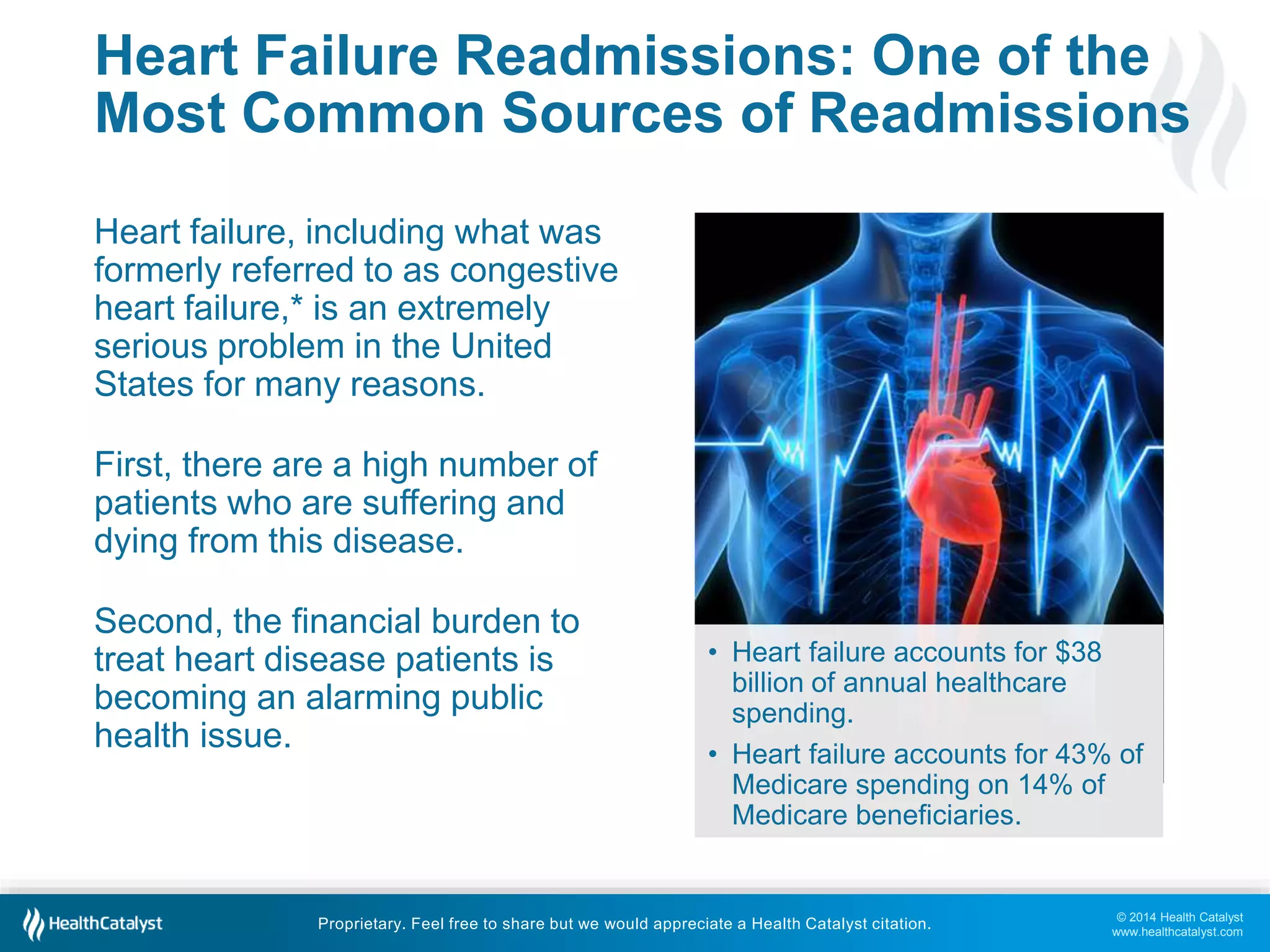
• Heart failure accounts for $38
billion of annual healthcare
spending.
• Heart failure accounts for 43% of
Medicare spending on 14% of
Medicare beneficiaries.
© 2014 Health Catalyst
www.healthcatalyst.com
Proprietary. Feel free to share but we would appreciate a Health Catalyst citation.
Heart Failure Readmissions: One of the
Most Common Sources of Readmissions
Many of these patients will be
readmitted to the hospital soon after
being seen for their heart condition
adding cost to the patient’s
treatment.
More than 25 percent of patients hospitalized for
heart failure will be readmitted to the hospital
within 30 days of discharge.
The top reason for readmission with the Medicare
fee-for-service patient population is for patients
suffering from heart failure. (2012 research)
© 2014 Health Catalyst
www.healthcatalyst.com
Proprietary. Feel free to share but we would appreciate a Health Catalyst citation.
Heart Failure Readmissions: One of the
Most Common Sources of Readmissions
Excessive readmissions tend to
indicate suboptimal care, so
government and commercial
payers are focusing on 30-day
readmission rates as a new
quality measure for hospitals.
Some proposed methods of reducing
heart related readmissions include:
• Patient education at discharge
• Appropriate medications prescribed
• Medication reconciliation
• Timely access to care after discharge
• Hand-off communications between
primary care providers and acute
care facilities
• Rapid distribution of hospital
documentation to primary care
providers
• Home health interventions
• Follow-up phone calls
© 2014 Health Catalyst
www.healthcatalyst.com
Proprietary. Feel free to share but we would appreciate a Health Catalyst citation.
Heart Failure Readmissions: One of the Most
Common Sources of Readmissions
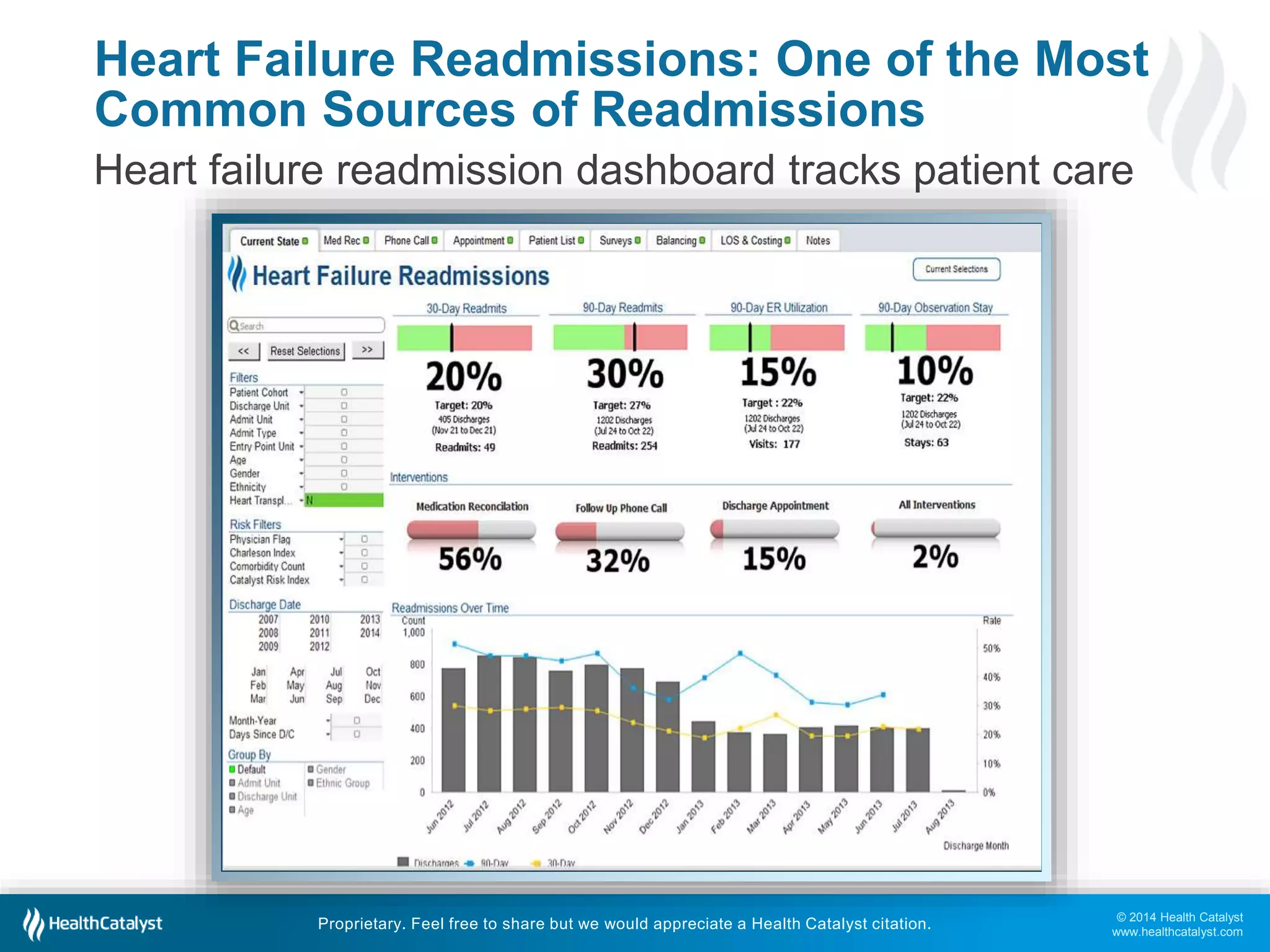
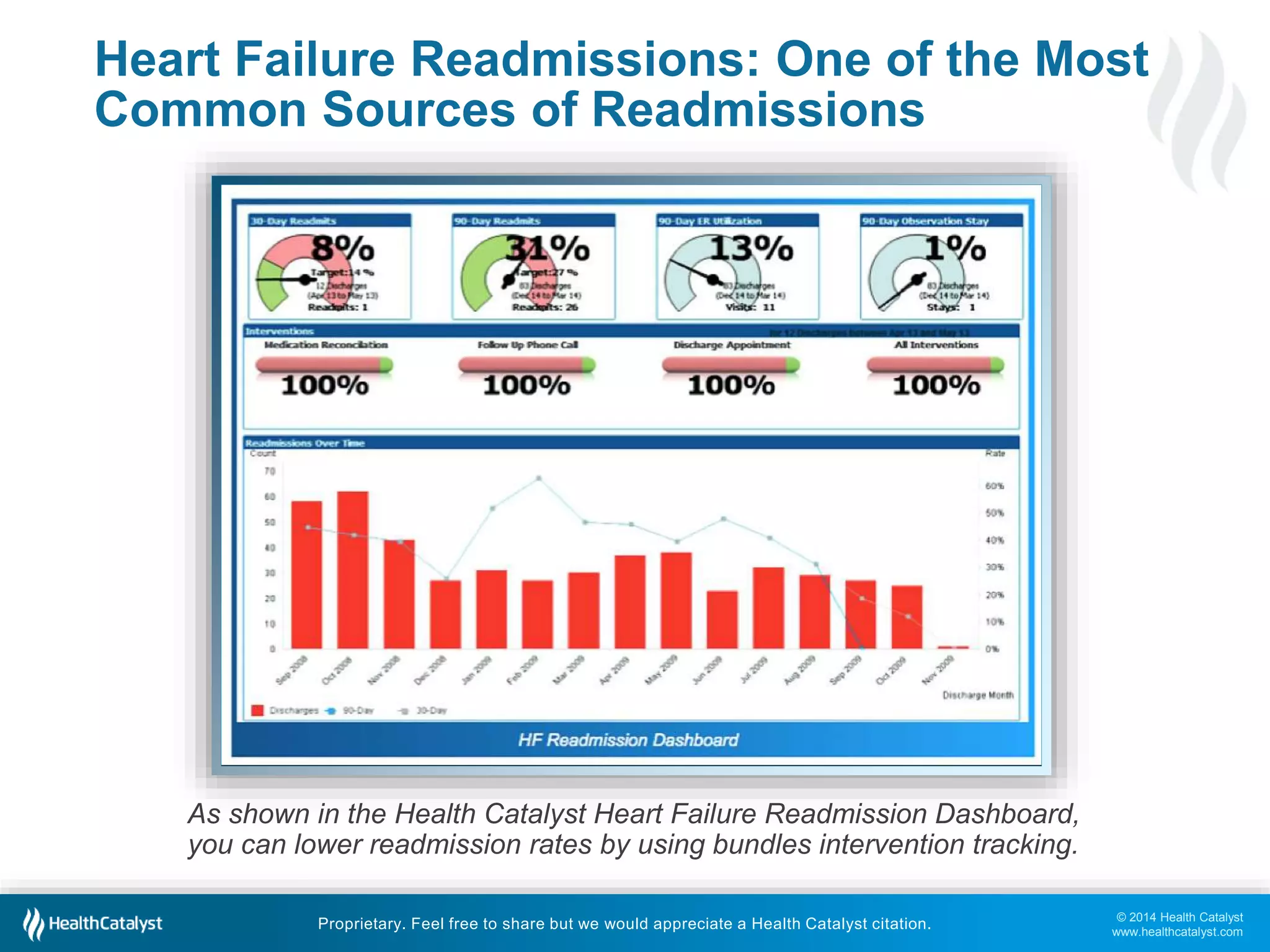
Heart failure readmission dashboard tracks patient care
© 2014 Health Catalyst
www.healthcatalyst.com
Proprietary. Feel free to share but we would appreciate a Health Catalyst citation.
4 Ways to Leverage Healthcare Analytics to
Reduce Heart Failure Readmission Rates
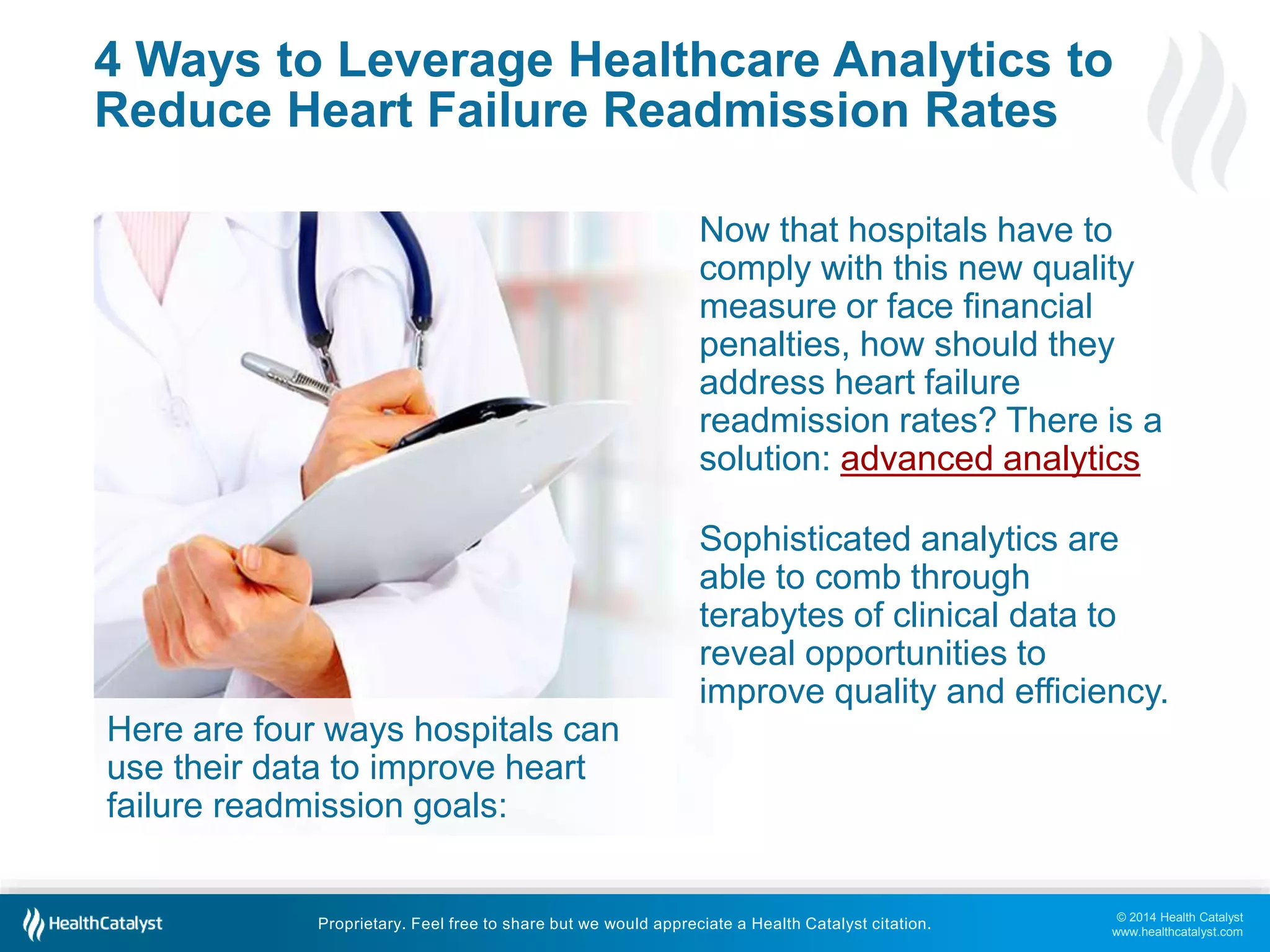
Now that hospitals have to
comply with this new quality
measure or face financial
penalties, how should they
address heart failure
readmission rates? There is a
solution: advanced analytics
Sophisticated analytics are
able to comb through
terabytes of clinical data to
reveal opportunities to
improve quality and efficiency.
Here are four ways hospitals can
use their data to improve heart
failure readmission goals:
© 2014 Health Catalyst
www.healthcatalyst.com
Proprietary. Feel free to share but we would appreciate a Health Catalyst citation.
4 Ways to Leverage Healthcare Analytics to
Reduce Heart Failure Readmission Rates
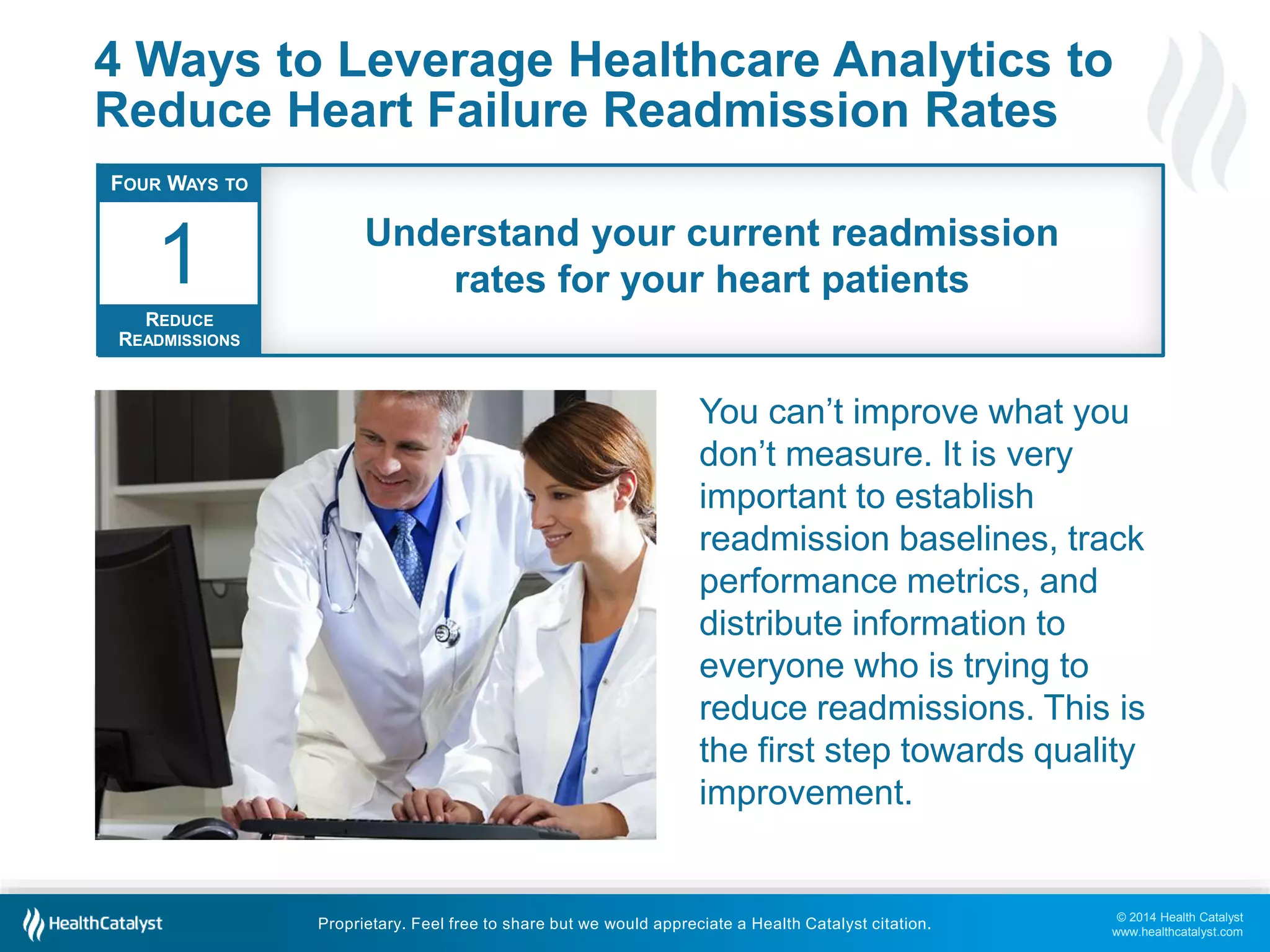
You can’t improve what you
don’t measure. It is very
important to establish
readmission baselines, track
performance metrics, and
distribute information to
everyone who is trying to
reduce readmissions. This is
the first step towards quality
improvement.
FOUR WAYS TO
REDUCE
READMISSIONS
1 Understand your current readmission
rates for your heart patients
© 2014 Health Catalyst
www.healthcatalyst.com
Proprietary. Feel free to share but we would appreciate a Health Catalyst citation.
4 Ways to Leverage Healthcare Analytics to
Reduce Heart Failure Readmission Rates
© 2014 Health Catalyst
www.healthcatalyst.com
Proprietary. Feel free to share but we would appreciate a Health Catalyst citation.
4 Ways to Leverage Healthcare Analytics to
Reduce Heart Failure Readmission Rates
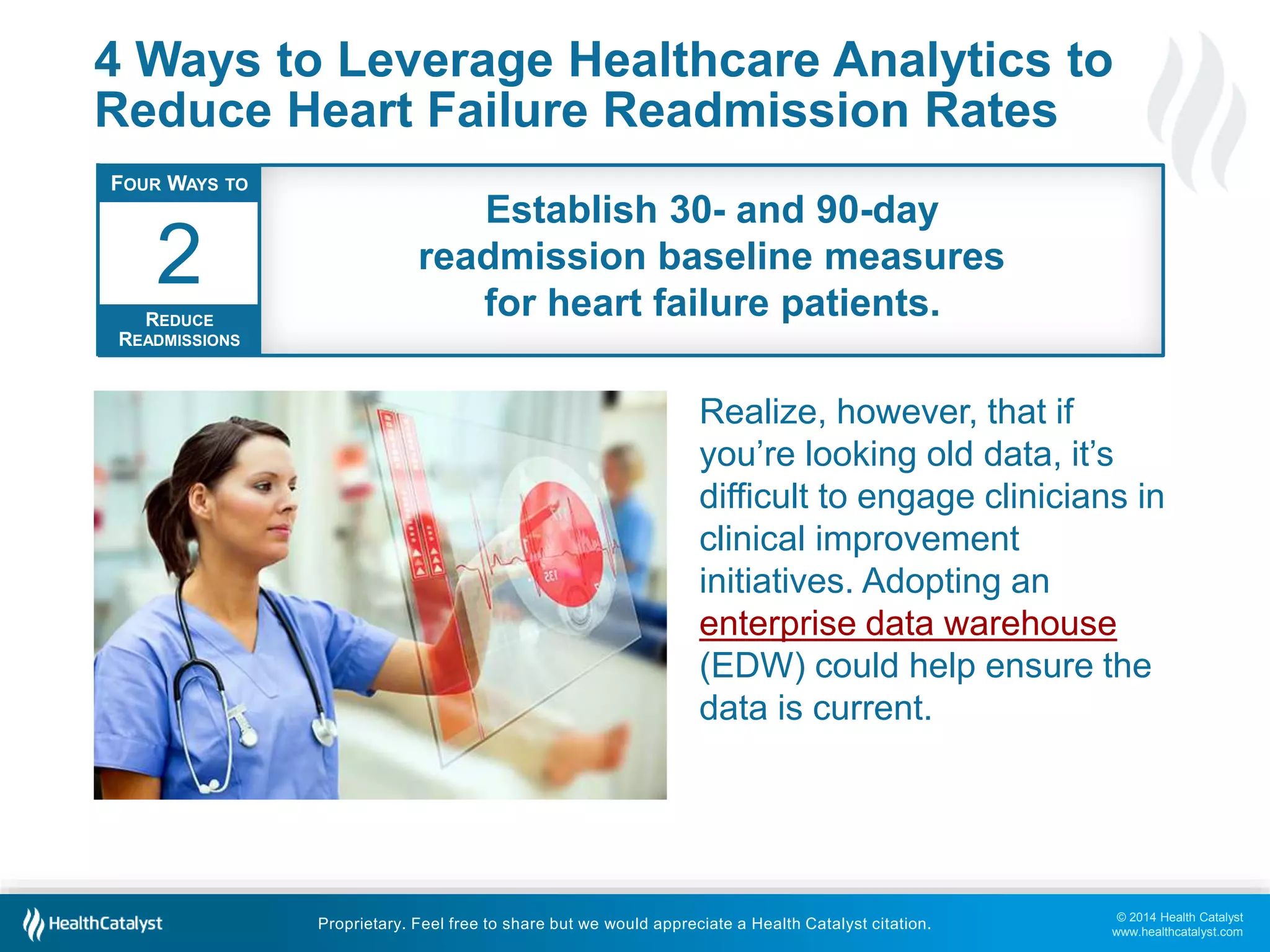
Realize, however, that if
you’re looking old data, it’s
difficult to engage clinicians in
clinical improvement
initiatives. Adopting an
enterprise data warehouse
(EDW) could help ensure the
data is current.
FOUR WAYS TO
REDUCE
READMISSIONS
2
Establish 30- and 90-day
readmission baseline measures
for heart failure patients.
© 2014 Health Catalyst
www.healthcatalyst.com
Proprietary. Feel free to share but we would appreciate a Health Catalyst citation.
4 Ways to Leverage Healthcare Analytics to
Reduce Heart Failure Readmission Rates
For heart patient readmissions,
there are three types of
balance measures:
1. Patient satisfaction rates
2. Emergency department
(ED) visits
3. Observation stays
FOUR WAYS TO
REDUCE
READMISSIONS
3
Be aware of balance measures
(changes designed to improve one part of the system
without causing new problems in another part of the system)
© 2014 Health Catalyst
www.healthcatalyst.com
Proprietary. Feel free to share but we would appreciate a Health Catalyst citation.
4 Ways to Leverage Healthcare Analytics to
Reduce Heart Failure Readmission Rates
Integrate clinical, financial, and
patient satisfaction data using
an EDW to identify all patients
with a primary diagnosis of
heart failure and then stratifies
the populations as either high-
or low-risk for readmission and
plan intervention accordingly.
FOUR WAYS TO
REDUCE
READMISSIONS
4 Use an enterprise healthcare data warehouse
© 2014 Health Catalyst
www.healthcatalyst.com
Proprietary. Feel free to share but we would appreciate a Health Catalyst citation.
Heart Failure Readmissions: One of the Most
Common Sources of Readmissions
As shown in the Health Catalyst Heart Failure Readmission Dashboard,
you can lower readmission rates by using bundles intervention tracking.
© 2014 Health Catalyst
www.healthcatalyst.com
Proprietary. Feel free to share but we would appreciate a Health Catalyst citation.
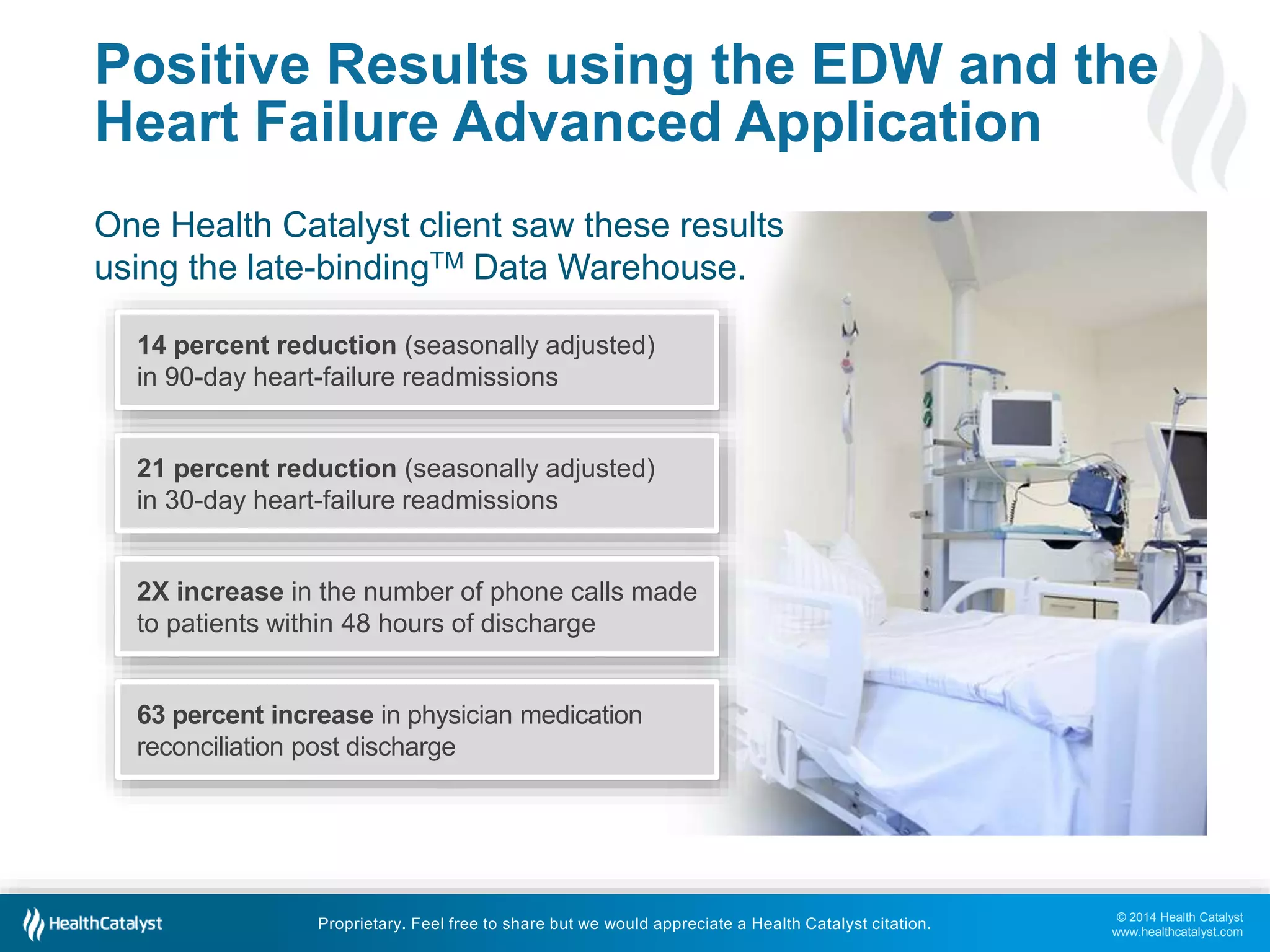
Positive Results using the EDW and the
Heart Failure Advanced Application
21 percent reduction (seasonally adjusted)
in 30-day heart-failure readmissions
2X increase in the number of phone calls made
to patients within 48 hours of discharge
63 percent increase in physician medication
reconciliation post discharge
One Health Catalyst client saw these results
using the late-bindingTM Data Warehouse.
14 percent reduction (seasonally adjusted)
in 90-day heart-failure readmissions
© 2014 Health Catalyst
www.healthcatalyst.com
Proprietary. Feel free to share but we would appreciate a Health Catalyst citation.
Gratitude for Readmissions Improvements
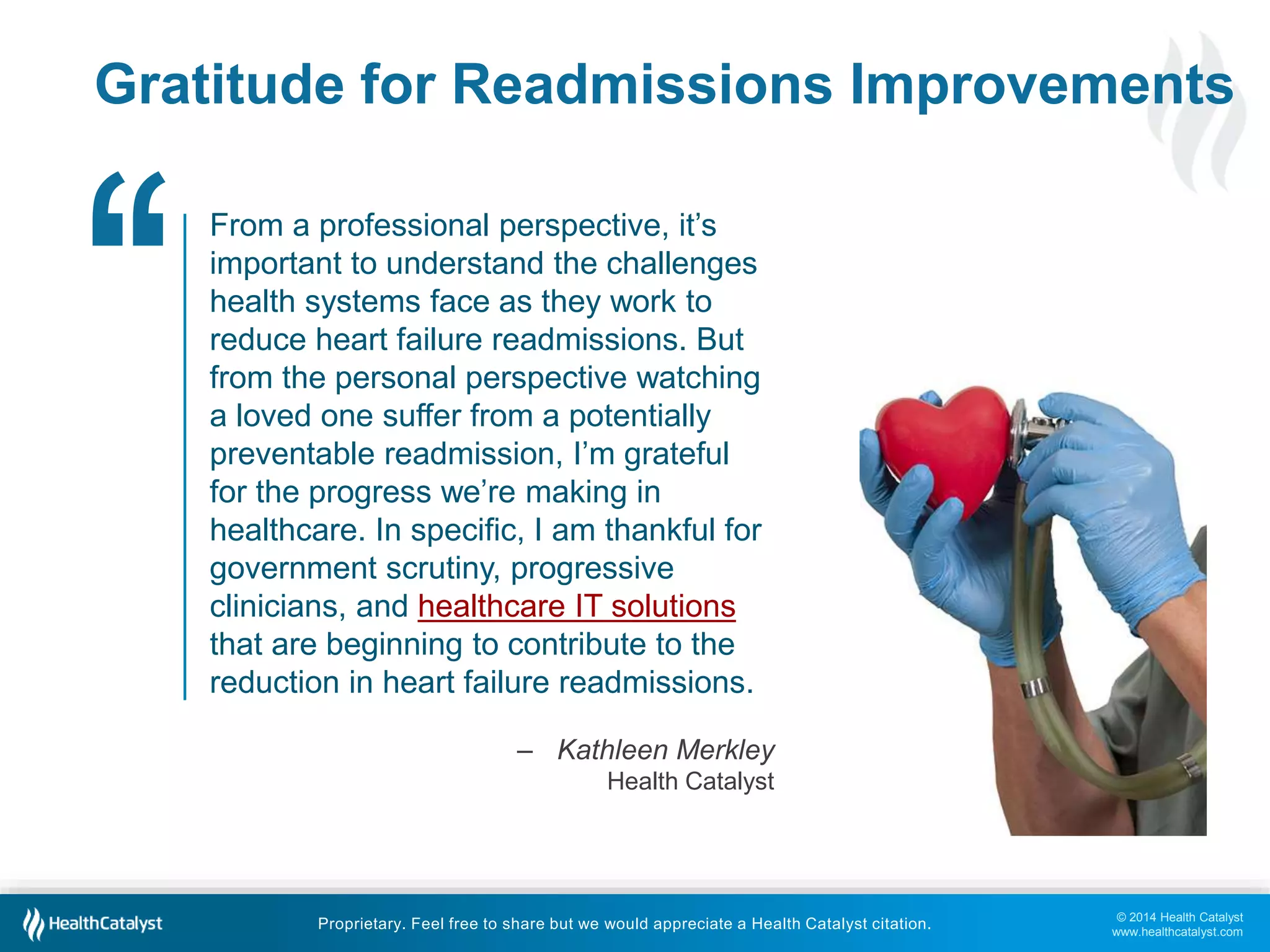
From a professional perspective, it’s
important to understand the challenges
health systems face as they work to
reduce heart failure readmissions. But
from the personal perspective watching
a loved one suffer from a potentially
preventable readmission, I’m grateful
for the progress we’re making in
healthcare. In specific, I am thankful for
government scrutiny, progressive
clinicians, and healthcare IT solutions
that are beginning to contribute to the
reduction in heart failure readmissions.
– Kathleen Merkley
Health Catalyst
‘‘
© 2014 Health Catalyst
www.healthcatalyst.com
Proprietary. Feel free to share but we would appreciate a Health Catalyst citation.
More about this topic
How to Use Analytics to Reduce 30-day Heart Failure Readmissions
An academic medical center case study
Product Demo – Heart Failure Readmissions
Watch a 7-minute demo of our heart failure readmission application
References
http://cms.hhs.gov/Research-Statistics-Data-and-
Systems/Research/HealthCareFinancingReview/Downloads/08Springpg1.pdf
http://www.ncbi.nlm.nih.gov/pubmed/22653415
*The American College of Cardiology and the American Heart Association prefer
the use of “heart failure” over “congestive heart failure.”
http://content.onlinejacc.org/article.aspx?articleID=1695825
© 2013 Health Catalyst
www.healthcatalyst.com
Other Clinical Quality Improvement Resources
Click to read additional information at www.healthcatalyst.com
Kathleen Merkley joined Health Catalyst in March 2013, as an Engagement
Executive. Prior to coming to HC, she worked for Intermountain Healthcare as
the corporate clinical IT implementation manager. Kathleen is a registered
nurse/nurse practitioner and just received her doctorate in nursing practice
from the University of Utah in May 2013.
More by this author:
Overcoming Clinical Data Problems in Quality Improvement Projects
Defining Patient Populations Using Analytical Tools: Cohort Builder and Risk
Stratification
A Key to Measurable Healthcare Quality Improvement: Use AIM Statements

Leveraging Healthcare Analytics to Reduce Heart Failure Readmission Rates

  • 1.
    © 2014 HealthCatalyst www.healthcatalyst.com Proprietary. Feel free to share but we would appreciate a Health Catalyst citation. © 2014 Health Catalyst www.healthcatalyst.comProprietary. Feel free to share but we would appreciate a Health Catalyst citation. Leveraging Healthcare Analytics to Reduce Heart Failure Readmission Rates By Kathleen Merkley
  • 2.
    © 2014 HealthCatalyst www.healthcatalyst.com Proprietary. Feel free to share but we would appreciate a Health Catalyst citation. Heart Failure Readmissions: One of the Most Common Sources of Readmissions Heart failure, including what was formerly referred to as congestive heart failure,* is an extremely serious problem in the United States for many reasons. First, there are a high number of patients who are suffering and dying from this disease. Second, the financial burden to treat heart disease patients is becoming an alarming public health issue. • Heart failure accounts for $38 billion of annual healthcare spending. • Heart failure accounts for 43% of Medicare spending on 14% of Medicare beneficiaries.
  • 3.
    © 2014 HealthCatalyst www.healthcatalyst.com Proprietary. Feel free to share but we would appreciate a Health Catalyst citation. Heart Failure Readmissions: One of the Most Common Sources of Readmissions Many of these patients will be readmitted to the hospital soon after being seen for their heart condition adding cost to the patient’s treatment. More than 25 percent of patients hospitalized for heart failure will be readmitted to the hospital within 30 days of discharge. The top reason for readmission with the Medicare fee-for-service patient population is for patients suffering from heart failure. (2012 research)
  • 4.
    © 2014 HealthCatalyst www.healthcatalyst.com Proprietary. Feel free to share but we would appreciate a Health Catalyst citation. Heart Failure Readmissions: One of the Most Common Sources of Readmissions Excessive readmissions tend to indicate suboptimal care, so government and commercial payers are focusing on 30-day readmission rates as a new quality measure for hospitals. Some proposed methods of reducing heart related readmissions include: • Patient education at discharge • Appropriate medications prescribed • Medication reconciliation • Timely access to care after discharge • Hand-off communications between primary care providers and acute care facilities • Rapid distribution of hospital documentation to primary care providers • Home health interventions • Follow-up phone calls
  • 5.
    © 2014 HealthCatalyst www.healthcatalyst.com Proprietary. Feel free to share but we would appreciate a Health Catalyst citation. Heart Failure Readmissions: One of the Most Common Sources of Readmissions Heart failure readmission dashboard tracks patient care
  • 6.
    © 2014 HealthCatalyst www.healthcatalyst.com Proprietary. Feel free to share but we would appreciate a Health Catalyst citation. 4 Ways to Leverage Healthcare Analytics to Reduce Heart Failure Readmission Rates Now that hospitals have to comply with this new quality measure or face financial penalties, how should they address heart failure readmission rates? There is a solution: advanced analytics Sophisticated analytics are able to comb through terabytes of clinical data to reveal opportunities to improve quality and efficiency. Here are four ways hospitals can use their data to improve heart failure readmission goals:
  • 7.
    © 2014 HealthCatalyst www.healthcatalyst.com Proprietary. Feel free to share but we would appreciate a Health Catalyst citation. 4 Ways to Leverage Healthcare Analytics to Reduce Heart Failure Readmission Rates You can’t improve what you don’t measure. It is very important to establish readmission baselines, track performance metrics, and distribute information to everyone who is trying to reduce readmissions. This is the first step towards quality improvement. FOUR WAYS TO REDUCE READMISSIONS 1 Understand your current readmission rates for your heart patients
  • 8.
    © 2014 HealthCatalyst www.healthcatalyst.com Proprietary. Feel free to share but we would appreciate a Health Catalyst citation. 4 Ways to Leverage Healthcare Analytics to Reduce Heart Failure Readmission Rates
  • 9.
    © 2014 HealthCatalyst www.healthcatalyst.com Proprietary. Feel free to share but we would appreciate a Health Catalyst citation. 4 Ways to Leverage Healthcare Analytics to Reduce Heart Failure Readmission Rates Realize, however, that if you’re looking old data, it’s difficult to engage clinicians in clinical improvement initiatives. Adopting an enterprise data warehouse (EDW) could help ensure the data is current. FOUR WAYS TO REDUCE READMISSIONS 2 Establish 30- and 90-day readmission baseline measures for heart failure patients.
  • 10.
    © 2014 HealthCatalyst www.healthcatalyst.com Proprietary. Feel free to share but we would appreciate a Health Catalyst citation. 4 Ways to Leverage Healthcare Analytics to Reduce Heart Failure Readmission Rates For heart patient readmissions, there are three types of balance measures: 1. Patient satisfaction rates 2. Emergency department (ED) visits 3. Observation stays FOUR WAYS TO REDUCE READMISSIONS 3 Be aware of balance measures (changes designed to improve one part of the system without causing new problems in another part of the system)
  • 11.
    © 2014 HealthCatalyst www.healthcatalyst.com Proprietary. Feel free to share but we would appreciate a Health Catalyst citation. 4 Ways to Leverage Healthcare Analytics to Reduce Heart Failure Readmission Rates Integrate clinical, financial, and patient satisfaction data using an EDW to identify all patients with a primary diagnosis of heart failure and then stratifies the populations as either high- or low-risk for readmission and plan intervention accordingly. FOUR WAYS TO REDUCE READMISSIONS 4 Use an enterprise healthcare data warehouse
  • 12.
    © 2014 HealthCatalyst www.healthcatalyst.com Proprietary. Feel free to share but we would appreciate a Health Catalyst citation. Heart Failure Readmissions: One of the Most Common Sources of Readmissions As shown in the Health Catalyst Heart Failure Readmission Dashboard, you can lower readmission rates by using bundles intervention tracking.
  • 13.
    © 2014 HealthCatalyst www.healthcatalyst.com Proprietary. Feel free to share but we would appreciate a Health Catalyst citation. Positive Results using the EDW and the Heart Failure Advanced Application 21 percent reduction (seasonally adjusted) in 30-day heart-failure readmissions 2X increase in the number of phone calls made to patients within 48 hours of discharge 63 percent increase in physician medication reconciliation post discharge One Health Catalyst client saw these results using the late-bindingTM Data Warehouse. 14 percent reduction (seasonally adjusted) in 90-day heart-failure readmissions
  • 14.
    © 2014 HealthCatalyst www.healthcatalyst.com Proprietary. Feel free to share but we would appreciate a Health Catalyst citation. Gratitude for Readmissions Improvements From a professional perspective, it’s important to understand the challenges health systems face as they work to reduce heart failure readmissions. But from the personal perspective watching a loved one suffer from a potentially preventable readmission, I’m grateful for the progress we’re making in healthcare. In specific, I am thankful for government scrutiny, progressive clinicians, and healthcare IT solutions that are beginning to contribute to the reduction in heart failure readmissions. – Kathleen Merkley Health Catalyst ‘‘
  • 15.
    © 2014 HealthCatalyst www.healthcatalyst.com Proprietary. Feel free to share but we would appreciate a Health Catalyst citation. More about this topic How to Use Analytics to Reduce 30-day Heart Failure Readmissions An academic medical center case study Product Demo – Heart Failure Readmissions Watch a 7-minute demo of our heart failure readmission application References http://cms.hhs.gov/Research-Statistics-Data-and- Systems/Research/HealthCareFinancingReview/Downloads/08Springpg1.pdf http://www.ncbi.nlm.nih.gov/pubmed/22653415 *The American College of Cardiology and the American Heart Association prefer the use of “heart failure” over “congestive heart failure.” http://content.onlinejacc.org/article.aspx?articleID=1695825
  • 16.
    © 2013 HealthCatalyst www.healthcatalyst.com Other Clinical Quality Improvement Resources Click to read additional information at www.healthcatalyst.com Kathleen Merkley joined Health Catalyst in March 2013, as an Engagement Executive. Prior to coming to HC, she worked for Intermountain Healthcare as the corporate clinical IT implementation manager. Kathleen is a registered nurse/nurse practitioner and just received her doctorate in nursing practice from the University of Utah in May 2013. More by this author: Overcoming Clinical Data Problems in Quality Improvement Projects Defining Patient Populations Using Analytical Tools: Cohort Builder and Risk Stratification A Key to Measurable Healthcare Quality Improvement: Use AIM Statements