
NEW CHANNEL SELECTION RULE FOR JPEG STEGANOGRAPHY


OBJECTIVE:

      To improve higher security performance and reducing errors, the main
role of this project as present a new channel selection rule for Joint
Photographic Experts Group Steganography.


PROBLEM DIFINITION:

      The composite signal is subject to video lossy compression to become.
The message should survive the video lossy compression and can be identically
extracted from. This robustness constrain should have low distortion effect on
the reconstructed video as well as low effect on the data size (bit rate). Given
that can be identically extracted, in this paper; we use two metrics to evaluate
data-hiding algorithms in compressed video which are:


            1. Increase in data size: representing the overhead price paid for the
            embedded data;
            2. Drop in the reconstruction quality: this reconstruction is with
            quality loss than that without data hiding and is denoted by and
            expressed as the PSNR difference which is as well that of the
            quantity of the relative error and for P- and B-frame, respectively.
ABSTRACT:

              This paper deals with data hiding in compressed video. Unlike data
hiding in images and raw video which operates on the images themselves in the
spatial or transformed domain which are vulnerable to steganalysis, we target
the motion vectors used to encode and reconstruct both the forward predictive
(P)-frame and bidirectional (B)-frames in compressed video. The choice of
candidate subset of these motion vectors are based on their associated macro
block prediction error, which is different from the approaches based on the
motion vector attributes such as the magnitude and phase angle.


      A greedy adaptive threshold is searched for every frame to achieve
robustness while maintaining a low prediction error level. The secret message
bit stream is embedded in the least significant bit of both components of the
candidate motion vectors. The method is implemented and tested for hiding data
in natural sequences of multiple groups of pictures and the results are evaluated.
The evaluation is based on two criteria: minimum distortion to the reconstructed
video and minimum overhead on the compressed video size. Based on the
aforementioned criteria, the proposed method is found to performwell and is
compared to a motion vector attribute-based method from the literature.


EXISTING SYSTEM:

      The Existing System contained only steganography process for data
transfer without any security prediction. In this system developed new channel
selection method for data hiding, but it didn’t use any advanced methods and
factors for data hiding. So that, It produce lot of errors in the timing for image
decompress.
DISADVANTAGES:

            Less Security
            High amount of Perturbation Errors
            Very difficult for Image Decompression


PROPOSED SYSTEM:

      In proposed system contain advanced Perturbed Quantization rule for
data hiding. The process of data hiding as follows,

    LSB Algorithm
    Embedding data, which is to be hidden, into an image requires two files.
    The first is an innocent looking image that will hold the hidden
      information, called the cover image.
    The second file is the message – the information to be hidden


ADVANTAGES:

          Minimal detectable distortion
          Higher security performance

ALGORITHM USED:

      1. LSB (Least Significant Bit)
      2. AES (Advanced Encryption Standard)
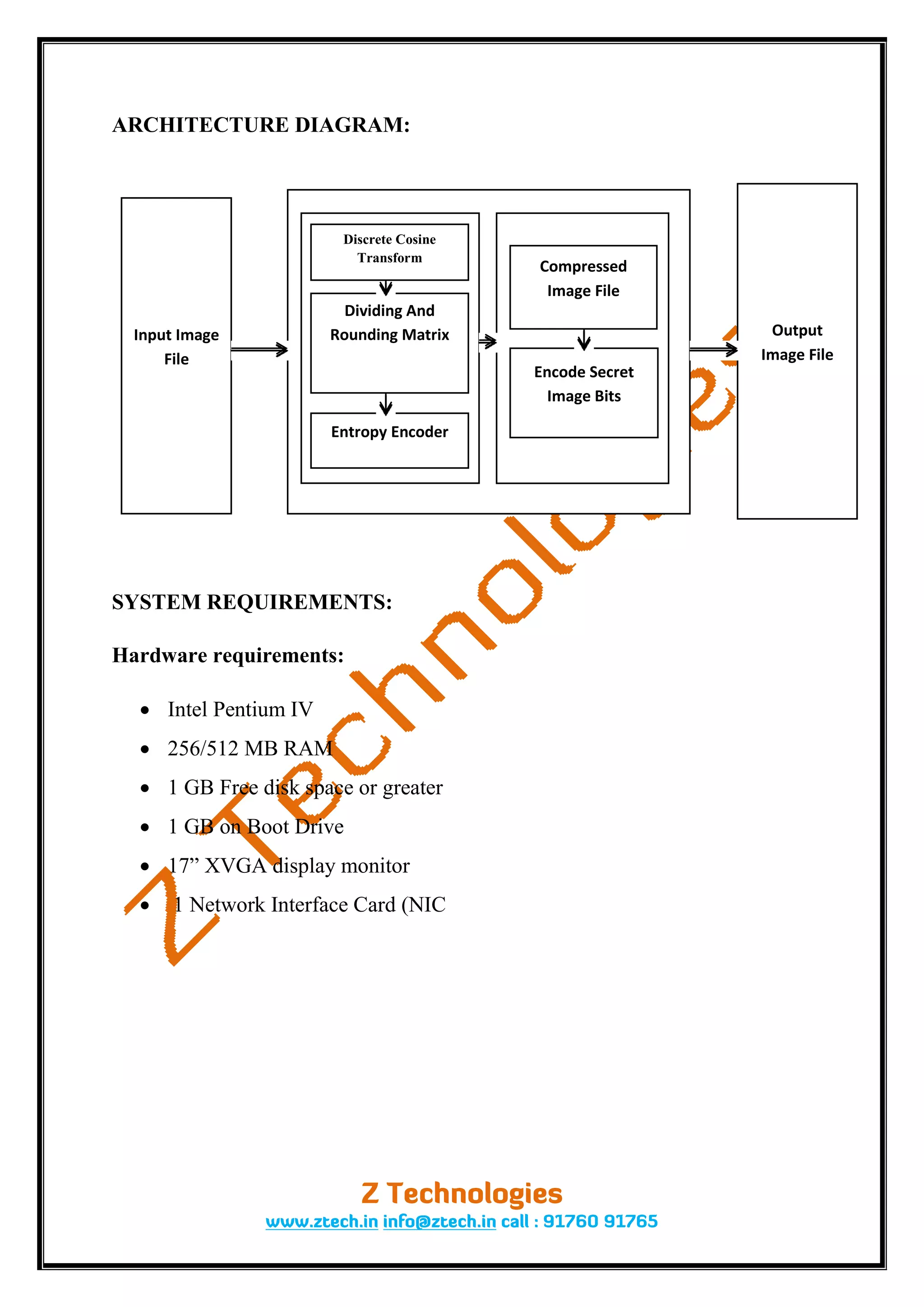
ARCHITECTURE DIAGRAM:


                         Discrete Cosine
                           Transform
                                           Compressed
                                            Image File
                         Dividing And
  Input Image          Rounding Matrix                      Output
      File                                                 Image File
                                           Encode Secret
                                             Image Bits

                       Entropy Encoder


SYSTEM REQUIREMENTS:

Hardware requirements:

   Intel Pentium IV
   256/512 MB RAM
   1 GB Free disk space or greater
   1 GB on Boot Drive
   17” XVGA display monitor
      1 Network Interface Card (NIC
Software requirements:

   MS Windows XP/2000
   MS IE Browser 6.0/later
   MS .Net Framework 4.0
   MS Visual Studio.Net 2005
   Internet Information Server (IIS)
   MS SQL Server 2005
   Windows Installer 3.1


APPLICATIONS:

     1. Deductive Agencies
     2. Government Secret Code
     3. Military Agencies

Psdot 17 new channel selection rule for jpeg steganography

  • 1.
    NEW CHANNEL SELECTIONRULE FOR JPEG STEGANOGRAPHY OBJECTIVE: To improve higher security performance and reducing errors, the main role of this project as present a new channel selection rule for Joint Photographic Experts Group Steganography. PROBLEM DIFINITION: The composite signal is subject to video lossy compression to become. The message should survive the video lossy compression and can be identically extracted from. This robustness constrain should have low distortion effect on the reconstructed video as well as low effect on the data size (bit rate). Given that can be identically extracted, in this paper; we use two metrics to evaluate data-hiding algorithms in compressed video which are: 1. Increase in data size: representing the overhead price paid for the embedded data; 2. Drop in the reconstruction quality: this reconstruction is with quality loss than that without data hiding and is denoted by and expressed as the PSNR difference which is as well that of the quantity of the relative error and for P- and B-frame, respectively.
  • 2.
    ABSTRACT: This paper deals with data hiding in compressed video. Unlike data hiding in images and raw video which operates on the images themselves in the spatial or transformed domain which are vulnerable to steganalysis, we target the motion vectors used to encode and reconstruct both the forward predictive (P)-frame and bidirectional (B)-frames in compressed video. The choice of candidate subset of these motion vectors are based on their associated macro block prediction error, which is different from the approaches based on the motion vector attributes such as the magnitude and phase angle. A greedy adaptive threshold is searched for every frame to achieve robustness while maintaining a low prediction error level. The secret message bit stream is embedded in the least significant bit of both components of the candidate motion vectors. The method is implemented and tested for hiding data in natural sequences of multiple groups of pictures and the results are evaluated. The evaluation is based on two criteria: minimum distortion to the reconstructed video and minimum overhead on the compressed video size. Based on the aforementioned criteria, the proposed method is found to performwell and is compared to a motion vector attribute-based method from the literature. EXISTING SYSTEM: The Existing System contained only steganography process for data transfer without any security prediction. In this system developed new channel selection method for data hiding, but it didn’t use any advanced methods and factors for data hiding. So that, It produce lot of errors in the timing for image decompress.
  • 3.
    DISADVANTAGES:  Less Security  High amount of Perturbation Errors  Very difficult for Image Decompression PROPOSED SYSTEM: In proposed system contain advanced Perturbed Quantization rule for data hiding. The process of data hiding as follows,  LSB Algorithm  Embedding data, which is to be hidden, into an image requires two files.  The first is an innocent looking image that will hold the hidden information, called the cover image.  The second file is the message – the information to be hidden ADVANTAGES:  Minimal detectable distortion  Higher security performance ALGORITHM USED: 1. LSB (Least Significant Bit) 2. AES (Advanced Encryption Standard)
  • 4.
    ARCHITECTURE DIAGRAM: Discrete Cosine Transform Compressed Image File Dividing And Input Image Rounding Matrix Output File Image File Encode Secret Image Bits Entropy Encoder SYSTEM REQUIREMENTS: Hardware requirements:  Intel Pentium IV  256/512 MB RAM  1 GB Free disk space or greater  1 GB on Boot Drive  17” XVGA display monitor  1 Network Interface Card (NIC
  • 5.
    Software requirements:  MS Windows XP/2000  MS IE Browser 6.0/later  MS .Net Framework 4.0  MS Visual Studio.Net 2005  Internet Information Server (IIS)  MS SQL Server 2005  Windows Installer 3.1 APPLICATIONS: 1. Deductive Agencies 2. Government Secret Code 3. Military Agencies