The document presents a survey on predicting heart disease using machine learning algorithms, highlighting the need for more accurate predictive tools beyond traditional medical methods, which only offer 67% accuracy. It reviews various machine learning approaches such as decision trees, support vector machines, and neural networks, and emphasizes the potential of deep learning to enhance predictive accuracy by utilizing large and complex datasets. The paper also discusses the challenges faced in the area, including the need for data pre-processing and feature selection to improve algorithm performance.
![International Journal on Recent and Innovation Trends in Computing and Communication ISSN: 2321-8169
Volume: 5 Issue: 8 XXX – YYY
_______________________________________________________________________________________________
99
IJRITCC | August 2017, Available @ http://www.ijritcc.org
_______________________________________________________________________________________
Prediction of Heart Disease using Machine Learning Algorithms: A Survey
Himanshu Sharma,
Department of Computer Engineering and Applications,
National Institute of Technical Teachers’ Training and
Research.
hs13867@gmail.com
M A Rizvi,
Department of Computer Engineering and Applications,
National Institute of Technical Teachers’ Training and
Research.
marizvi@nitttrbpl.ac.in
Abstract: According to recent survey by WHO organisation 17.5 million people dead each year. It will increase to 75 million in the year
2030[1].Medical professionals working in the field of heart disease have their own limitation, they can predict chance of heart attack up to 67%
accuracy[2], with the current epidemic scenario doctors need a support system for more accurate prediction of heart disease. Machine learning
algorithm and deep learning opens new door opportunities for precise predication of heart attack. Paper provideslot information about state of art
methods in Machine learning and deep learning. An analytical comparison has been provided to help new researches’ working in this field.
Keywords: Machine learning, Heart Disease, Naïve Bayes, Decision Tree, Neural Network, SVM and Deep Learning.
__________________________________________________*****_________________________________________________
I. INTRODUCTION
Heart disease has created a lot of serious concerned among
researches; one of the major challenges in heart disease is
correct detection and finding presence of it inside a human.
Early techniques have not been so much efficient in finding
it even medical professor are not so much efficient enough
in predicating the heart disease[3]. There are various
medical instrumentsavailable in the market for predicting
heart disease there are two major problems in them, the first
one is that they are very much expensive and second one is
that they are not efficiently able to calculate the chance of
heart disease in human. According to latest survey
conducted by WHO, the medical professional able to
correctly predicted only 67% of heart disease [2]so there is a
vast scope of research in area of predicating heart disease in
human.
With advancement in computer science has brought vast
opportunities in different areas, medical science is one of the
fields where the instrument of computer science can be used.
In application areas of computer science varies from
metrology to ocean engineering. Medical science also used
some of the major available tools in computer science; in
last decade artificial intelligence has gained its moment
because of advancement in computation power.
MachineLearning is one such tool which is widely utilized
in different domains because it doesn’t require different
algorithm for different dataset. Reprogrammable capacities
of machine learning bring a lot of strength and opens new
doors of opportunities for area like medical science.
In medical science heart disease is one of the major
challenges; because a lot of parameters and technicality is
involve for accurately predicating this disease. Machine
learning could be a better choice for achieving high
accuracy for predicating not only heart disease but also
another diseases because this vary tool utilizes feature vector
and its various data types under various condition for
predicating the heart disease, algorithms such as Naive
Bayes, Decision Tree, KNN, Neural Network, are used to
predicate risk of heart diseases each algorithm has its
speciality such as Naive Bayes used probability for
predicating heart disease, whereas decision tree is used to
provide classified report for the heart disease, whereas the
Neural Network provides opportunities to minimise the error
in predication of heart disease. All these techniques are
using old patient record for getting predication about new
patient. This predication system for heart disease helps
doctors to predict heart disease in the early stage of disease
resulting in saving millions of life.
This survey paper is dedicated for wide scope survey in the
field of machine learning technique in heart disease. Later
part of this survey paper will discusses about various
machine learning algorithm for heart disease and their
relative comparison on the various parameter.It also shows
future prospectus of machine learning algorithm in heart
disease. This paper also does a deep analysis on utilization
of deep learning in field of predicting heart disease.
II. LITERATURE REVIEW
Different researchers have contributed for the development
of this field. Predication of heart disease based on machine
learning algorithm is always curious case for researchers
recently there is a wave of papers and research material on
this area. Our goal in this chapter is to bring out all state of
art work by different authors and researchers.
Marjia Sultana, Afrin Haider and Mohammad
ShorifUddin[4] have illustrated about how the datasets
available for heart disease are generally a raw in nature
which is highly redundant and inconsistent. There is a need
of pre-processing of these data sets; in this phase high
dimensional data set is reduced to low data set. They also](https://image.slidesharecdn.com/20150365020525-08-2017-180112054435/75/Prediction-of-Heart-Disease-using-Machine-Learning-Algorithms-A-Survey-1-2048.jpg)
![International Journal on Recent and Innovation Trends in Computing and Communication ISSN: 2321-8169
Volume: 5 Issue: 8 XXX – YYY
_______________________________________________________________________________________________
100
IJRITCC | August 2017, Available @ http://www.ijritcc.org
_______________________________________________________________________________________
show that extraction of crucial features from the data set
because there is every kind of features. Selection of
important features reduces work of training the algorithm
and hence resulted in reduction in time complexity. Time is
not only single parameter for comparison other parameters
like accuracy also play vital role in proving effectiveness of
algorithm similar. An approach proposed in[4] have worked
to improved the accuracy and found that performance of
Bayes Net and SMO classifiers are much optimal than MLP,
J48 and KStar. Performance is measured by running
algorithms (Bayes Net and SMO) on data set collected from
WEKA software and then compared using predictive
accuracy, ROC curve, ROC value.
Different methods have their own merits and demerits in
work done by M.A.Jabbar, B.L Deekshatulu, Priti Chndra
[5], an optimisation of feature has been done to achieve
higher classification efficiency in Decision Tree . It is an
approach for early detection of heart disease by utilizing
variety of feature. These kind of approach can also be utilize
for other sphere of research. Other than decision tree various
other approach where adopt for achieving the goal of perfect
detection of heart disease in human Yogeswaran Mohan
et.al [6] have collected raw data form EEG device and used
to train neural network for pattern classification . Here input
output are depressive and non depressive categories in the
hidden layer scaled conjugate gradient algorithm is used for
training to achieve efficient result. authors have got
efficiency up to 95% with help of trained neural network
watching the success of neural network researches working
in the domain of SVM have used this technique to classify
and achieve more better result in case where the feature
vector are multi dimensional and non linear these method
defeated all other existing quantum contemporary
techniques because it has capability to work under dataset of
high dimensionality.
After going through majority of state of art technique we
have pointed out certain loop holes existed in them. Some of
them are discussed below
There is wide need for more robust algorithm
which can minimised the noise in the dataset
because medical dataset may consists of various
types of redundancy and noise in them.
Recently with advancement in deep learning there
could be chance to enhance efficiency and accuracy
for detection heart disease
Dimensionality of medical dataset is very high
these put ergs to find such algorithm which can
compress and reduce higher dimensionality,
resulting in gaining execution time.
III. MACHINE LEARNING ALGORITHM FOR
HEART DISEASE PREDICATION
Machine learning is widely used artificial intelligence tool in
all major sector of application, with advancement in
processing power machine for learning.
DECISION TREE
Decision tree is a graphical representation of specific
decision situation that used for predictive model, main
component of decision tree involves root, nodes, and
branching decision. There are few approaches for building
tree such as ID3, CART, CYT, C5.0 and J48 [7] has used
the approaches to classify the dataset using J48, similarly [8]
have compared decision tree with classification output of
other algorithm. Decision tree is used in those area of the
medical science where numerous parameters involved in
classification of data set.
Since decision tree is most compressive approach among all
machine learning algorithm. These clearly reflect important
features in the data set. In heart disease where number of
parameter affect patient such as blood pressure, blood sugar,
age, sex, genetic and other factor. By seeing decision tree,
doctor can clearly identifies the most effecting feature
among all the parameter. They can also generate the most
affecting feature in the mass of population. Decision tree is
based on entropy and Information gain clearly signifies the
importance of dataset. Drawback of decision tree is that it
suffers from two major problems over fitting and it is based
on greedy method. over fitting happened due to decision tree
spilt dataset aligned to axis it means it need a lot of nodes to
spilt data, this problem is resolved by J48 explained
in[7]based on greedy method lead to less optimal tree, if
dynamic approach is taken it lead to exponential number of
tree which is not feasible.
SUPPORT VECTOR MACHINE (SVM)
A SVM performs classification by finding the hyper plane
that maximise the margin between two classes. The vectors
that define the hyper plane are the support vectors[9]
Steps for Calculation of Hyperplane
Usage of the SVM for data set classification has its own
advantages and disadvantages. Medical data set can be non
linear of high dimensionality by observing properties. It is
clear that SVM would be one of the favourite choices for
classification. Some of the advantage to select the SVM for
classification choice.
1. Firstly regularisation parameters which avoid
problem of over fitting which one of the major
challenges is in decision tree.
2. Kernel tree is used to avoid the expert knowledge
through the knowledge of kernel
1. Set up training data
2. Set up SVM parameter
3. Train the SVM
4. Region classified by the SVM
5. Support vector](https://image.slidesharecdn.com/20150365020525-08-2017-180112054435/75/Prediction-of-Heart-Disease-using-Machine-Learning-Algorithms-A-Survey-2-2048.jpg)
![International Journal on Recent and Innovation Trends in Computing and Communication ISSN: 2321-8169
Volume: 5 Issue: 8 XXX – YYY
_______________________________________________________________________________________________
101
IJRITCC | August 2017, Available @ http://www.ijritcc.org
_______________________________________________________________________________________
3. SVM is an efficient method because it utilize
convex optimisation problem (COP) which mean it
has doesn’t local minima
4. Error rated is tested which provide a greater
support after misclassification of dataset
All the above features could be useful for medical diagnose
dataset which is resulting in building more efficient
predication system for the doctor. It doesn’t mean it has all
good side .coin has always two side on the other side it has
best feature removal of over fitting problem is quite
sensitive and it need optimizing parameter flaw in
optimisation may result in error and may cause over fitting.
Fig 1 SVM Classifier
K- NEAREST NEIGHBOUR ALGORITHM (KNN)
KNN is slow supervised learning algorithm, it take more
time to get trained classification like other algorithm is
divided into two step training from data and testing it on
new instance . The K Nearest Neighbour working principle
is based on assignment of weight to the each data point
which is called as neighbour. in K Nearest Neighbour
distance is calculate for training dataset for each of the K
Nearest data points now classification is done on basis of
majority of votes there are three types of distances need to
be measured in KNN Euclidian, Manhattan, Minkowski
distance in which Euclidian will be consider most one the
following formula is used to calculate their distance[10]:
𝐸𝑢𝑐𝑙𝑒𝑑𝑖𝑎𝑛 𝐷𝑖𝑠𝑡𝑎𝑛𝑐𝑒 = 𝐷 𝑥, 𝑦
= (𝑥𝑖 − 𝑦𝑖)2𝑘 𝑖
= 1
(1)
K=number of cluster
x , y=co-ordinate sample spaces
𝑀𝑎𝑛ℎ𝑎𝑡𝑡𝑎𝑛 𝑑𝑖𝑠𝑡𝑎𝑛𝑐𝑒 = (𝑥𝑖 − 𝑦𝑖) 𝑛 𝑖=1
(2)
x&y are co-ordinates
Minkowski distances are generally Euclidian distance
𝑀𝑖𝑛 = ( 𝑥𝑖 − 𝑦𝑖 𝑝)1
𝑝
(3)
Grouping of sample is based on super class in the KNN
reduction of sample is the result of proper grouping which is
used for further training. Selection of k value plays a pivotal
role, if the k value is large then it precise and less noisy.
The algorithm for KNN is defined in the steps given below
Rr
IV. DEEP LEARNING FOR PREDICATION IN
HEART DISEASE
Deep learning can be defined as subfield of machine
learning which is based on learning at multiple level of
representation and abstraction ,each level contains multiple
processing unit for multiple processing between the input
and output layer [10]. Deep learning work on the principle
of feature hierarchy where higher level hierarchy is formed
by composition lower level features. Deep learning bring
renaissance to the neural network model major work is
going in the field of in its implementation through stacked
restricted Boltzmann machine and auto encoder-decoder
technique[11]. This method impress researches with their
performance in field of image processing and layer wise pre
training techniques other areas of its application include
Natural language processing,acoustic processing., RNN is
consider to be best suited for sequential feature and
sequential data their exist various method working on these
two version LSTM was proposed by Hochreiter and
Schmidhuber [12], the performance is quite impressive in
the field related to sequence based task . Other
contemporary method to LSTM is gated recurrent unit
(GRU), it is simpler than LSTM but the result is quite
impressive. A temporal based heart disease prediction has
been done in paper [13]where author used GRE to achieve
the high accuracy. Researchers have begun to use deep
learning technique for medical dataset. Lasko et al. [14] is
used encoder-decoder type pattern form serum of uric acid
.similar kind of works have been discussed in great detail by
the author. In generalised approach of deep learning has
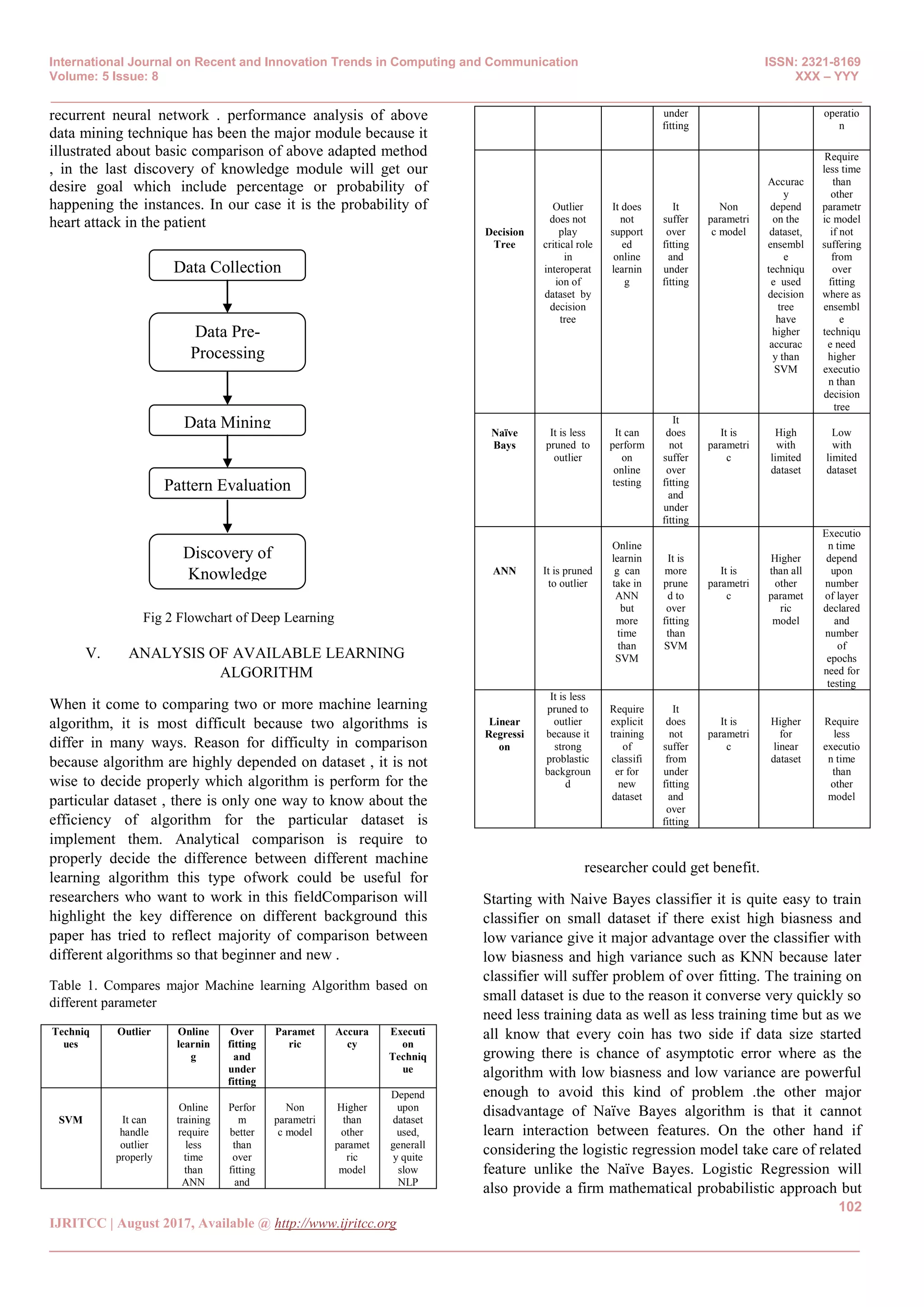
been illustrated in flow chart Fig. 2.
In the flow chart there are five modules it has their own
specific operation, the goal is to present the above flow chart
in most general way. Data collection is phase in which
dataset from standard repository is get collected followed
stage of pre-processing which include functionality of noise
reduction and feature selection. Next step is core for deep
learning because it implement the basic algorithmic
approach adapted for manipulation of data set , the
algorithms may vey from deep belief network[15] to
X1
X2
1. D represents the samples used in the
training and k denotes the number of
nearest neighbour.
2. Create super class for each sample
class.
3. Compute Euclidian distance for every
training sample
4. Based on majority of class in
neighbour, classify the sample](https://image.slidesharecdn.com/20150365020525-08-2017-180112054435/75/Prediction-of-Heart-Disease-using-Machine-Learning-Algorithms-A-Survey-3-2048.jpg)
![International Journal on Recent and Innovation Trends in Computing and Communication ISSN: 2321-8169
Volume: 5 Issue: 8 XXX – YYY
_______________________________________________________________________________________________
103
IJRITCC | August 2017, Available @ http://www.ijritcc.org
_______________________________________________________________________________________
if data type is non linear the logistic regression model fail to
provide any output. Hence it requires lot of feature
modulation before feeding the dataset to model which quite
teasing. But it is quite user friendly to update the mode if the
feature in the dataset of linear type even if new rows and
column arrives with the time. i.e. that it is perform quite well
with online dataset and temporal dataset .
Decision tree is non parametric machine learning algorithm
which is considerable if the compressibility is the major
feature because it is quite easy to explain the model internal
and external architecture. Decision tree suffers from some
of the major drawback such as it does not support online
learning and suffers from over fitting of dataset but there
exist quite few technique which can avoid the over fitting
such as J48 model. Ensemble technique such as random
forest[16] can provide quite a few impugned in decision tree
such as it solve the problem of imbalance dataset, pruning
and an accuracy it is said that random forest has potential
to replace most accurate mode of machine learning
algorithm but it is snatch the properties of compressibility of
the decision tree.
SVM and Neural network are consider to be major
competitive machine learning algorithm but they are very
much difference from each other with the same goal of
classifications or regression both of them are non linear
classification technique.
SVM is derived from algebraic and statics background it
construct a linear separable hyper plane in n dimensional
space to separate all classifier with large margin it is
consider theoretical that SVM will provide high accuracy to
each dataset with high dimensionality. ANN is also non
linear model it suffer a lot of drawbacks which SVM avoids
such as SVM converge only on global and unique minima
on the other hand ANN converge on each local minima,
since SVM has quite good mathematical background it can
be represented geometrical that does not exist any such
geometrical representation of ANN model, it is also point to
be noted ANN complexity depend a lot of dimensionality of
dataset where as SVM is free of such problem.
It does not mean SVM can overshadow every other
algorithm it has its own limitation, SVM is very hard to
interrupt and tune because it is memory intensive, SVM is
not easily for training of NLP based method because
hundred of thousand feature get created in these which will
result exponentially increase in time complexity where as
ANN model still give linear result. ANN also outperforms
SVM for online training of dataset. certain parameter along
with difference model have been relatively compared in the
tabular format in given below table which reflect the
drawback and advantages of every algorithm on each
parameters
VI. CONCLUSION
Heart attack is crucial health problem in human society. This
paper has summarised state of art techniques and available
methods for predication of this disease. Deep learning an
emerging area of artificial intelligence showed some
promising result in other field of medical diagnose with high
accuracy. It is still an open domain waiting to get
implemented in heart diseasepredication.Some methods of
deep learning has been discussed which can be implemented
for heart disease predication, along with pioneer machine
learning algorithms. An analytical comparison has been
done for finding out bestavailable algorithm for medical
dataset. In future our aim is to carry forward the work of
temporal medical dataset, where dataset varies with time and
retraining of dataset is required
REFERENCES
[1] William Carroll; G. Edward Miller, “Disease among
Elderly Americans : Estimates for the US civilian
non institutionalized population, 2010,” Med.
Expend. Panel Surv., no. June, pp. 1–8, 2013.
[2] V. Kirubha and S. M. Priya, “Survey on Data
Mining Algorithms in Disease Prediction,” vol. 38,
no. 3, pp. 124–128, 2016.
[3] M. A. Jabbar, P. Chandra, and B. L. Deekshatulu,
“Prediction of risk score for heart disease using
associative classification and hybrid feature subset
selection,” Int. Conf. Intell. Syst. Des. Appl. ISDA,
pp. 628–634, 2012.
[4] M. Sultana, A. Haider, and M. S. Uddin, “Analysis
of data mining techniques for heart disease
prediction,” 2016 3rd Int. Conf. Electr. Eng. Inf.
Commun. Technol. iCEEiCT 2016, 2017.
[5] M. Akhil, B. L. Deekshatulu, and P. Chandra,
“Classification of Heart Disease Using K- Nearest
Neighbor and Genetic Algorithm,” Procedia
Technol., vol. 10, pp. 85–94, 2013.
[6] S. Kumra, R. Saxena, and S. Mehta, “An Extensive
Review on Swarm Robotics,” pp. 140–145, 2009.
[7] T. M. Lakshmi, A. Martin, R. M. Begum, and V. P.
Venkatesan, “An Analysis on Performance of
Decision Tree Algorithms using Student’s
Qualitative Data,” Int. J. Mod. Educ. Comput. Sci.,
vol. 5, no. 5, pp. 18–27, 2013.
[8] P. Sharma and A. P. R. Bhartiya, “Implementation
of Decision Tree Algorithm to Analysis the
Performance,” Int. J. Adv. Res. Comput. Commun.
Eng., vol. 1, no. 10, pp. 861–864, 2012.
[9] D. K. Srivastava and L. Bhambhu, “Data
classification using support vector machine,” J.
Theor. Appl. Inf. Technol., 2009.
[10] N. Bhatia and C. Author, “Survey of Nearest
Neighbor Techniques,” IJCSIS) Int. J. Comput. Sci.
Inf. Secur., vol. 8, no. 2, pp. 302–305, 2010.
[11] J. Schmidhuber, “Deep Learning in neural networks:
An overview,” 2015.
[12] S. Hochreiter and J. Urgen Schmidhuber, “Long
Short-Term Memory,” Neural Comput., vol. 9, no.
8, pp. 1735–1780, 1997.](https://image.slidesharecdn.com/20150365020525-08-2017-180112054435/75/Prediction-of-Heart-Disease-using-Machine-Learning-Algorithms-A-Survey-5-2048.jpg)
![International Journal on Recent and Innovation Trends in Computing and Communication ISSN: 2321-8169
Volume: 5 Issue: 8 XXX – YYY
_______________________________________________________________________________________________
104
IJRITCC | August 2017, Available @ http://www.ijritcc.org
_______________________________________________________________________________________
[13] S. Palaniappan and R. Awang, “Intelligent heart
disease prediction system using data mining
techniques,” 2008 IEEE/ACS Int. Conf. Comput.
Syst. Appl., pp. 108–115, 2008.
[14] T. A. Lasko, J. C. Denny, and M. A. Levy,
“Computational Phenotype Discovery Using
Unsupervised Feature Learning over Noisy, Sparse,
and Irregular Clinical Data,” PLoS One, vol. 8, no.
6, 2013.
[15] Yuming Hua, Junhai Guo, and Hua Zhao, “Deep
Belief Networks and deep learning,” Proc. 2015 Int.
Conf. Intell. Comput. Internet Things, pp. 1–4, 2015.
[16] P. De, “Modified Random Forest Approach for
Resource Allocation in 5G Network,” Int. J. Adv.
Comput. Sci. Appl., vol. 7, no. 11, pp. 405–413,
2016.](https://image.slidesharecdn.com/20150365020525-08-2017-180112054435/75/Prediction-of-Heart-Disease-using-Machine-Learning-Algorithms-A-Survey-6-2048.jpg)


