New patterns of innovation in public eServices David Osimo, Clara Centeno, Jean Claude Burgelman  Institute for Prospective Technological Studies European Commission - Joint Research Centre The views expressed in the presentation are those of the authors and do not represent the official position of the EC
Outline The context: innovation in public services, and  innovation patterns in web 2.0 How do these patterns work in public services? Analysis of selected cases  Conclusions
The context: innovation in public services The public sector is an innovation actor as a service provider (to all citizens and business)  as a buyer (16% EU GDP) as an employer (of 50M Europeans) Civil society traditionally seen as “extension ladder” Need to innovate public services likely to grow in the future (due to budget restrictions, increased citizens expectations, multiculturality, ageing, etc.) But barriers exist: hierarchical organisations risk aversion lack of user orientation less pressure for innovation: monopoly, no “exit” possibility for citizens (Hirschmann)
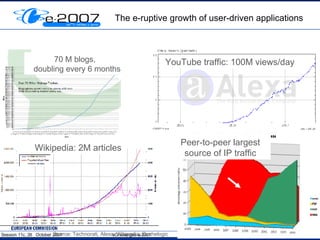
The e-ruptive growth of user-driven applications 70 M blogs,  doubling every 6 months YouTube traffic: 100M views/day Wikipedia: 2M articles Source: Technorati, Alexa, Wikipedia ,  Cachelogic   Peer-to-peer largest source of IP traffic
Innovation patterns of web 2.0 New actors emerging Better informed users demanding innovative products and services  Users driving innovation: market-led, incremental innovation Perpetual beta: iterative and continuous innovation  Bottom-up, emergent innovation rather than hierarchically planned/imposed  Open, shared innovation  Codifying and exploiting tacit knowledge
2. How do such innovation patterns apply to public services? Analysis of selected cases
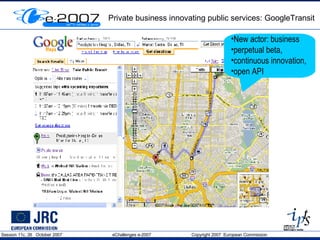
Private business innovating public services: GoogleTransit New actor: business perpetual beta, continuous innovation,  open API
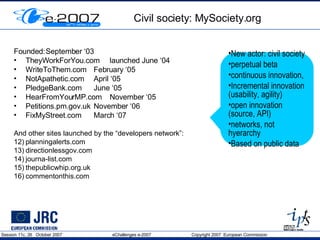
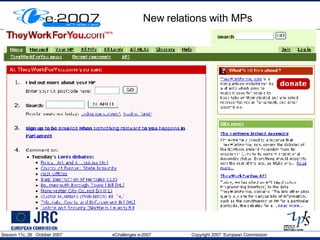
Civil society: MySociety.org Founded: September ‘03 TheyWorkForYou.com launched June ‘04 WriteToThem.com February ‘05 NotApathetic.com April ‘05 PledgeBank.com June ‘05 HearFromYourMP.com November ‘05 Petitions.pm.gov.uk  November ‘06 FixMyStreet.com March ‘07 And other sites launched by the “developers network”: planningalerts.com directionlessgov.com  journa-list.com  thepublicwhip.org.uk commentonthis.com New actor: civil society perpetual beta  continuous innovation,  Incremental innovation (usability, agility) open innovation (source, API) networks, not hyerarchy Based on public data
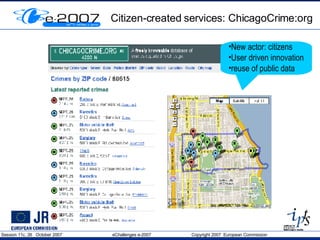
Citizen-created services: ChicagoCrime:org New actor: citizens User driven innovation reuse of public data
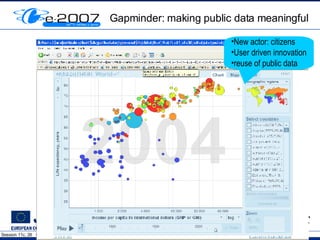
Gapminder: making public data meaningful New actor: citizens User driven innovation reuse of public data
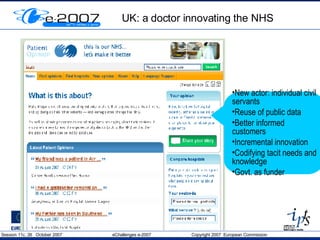
UK: a doctor innovating the NHS New actor: individual civil servants Reuse of public data Better informed customers Incremental innovation Codifying tacit needs and knowledge Govt. as funder
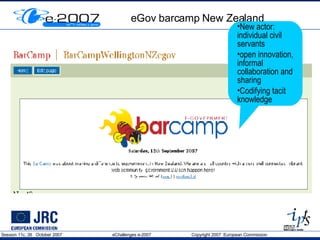
eGov barcamp New Zealand New actor: individual civil servants open innovation, informal collaboration and sharing  Codifying tacit knowledge
Conclusions
What is new for public eServices? A new WAY to innovate public services Continuous and incremental,  open and non hyerarchical not only by government: civil society, citizens, civil servants  A new effective DRIVER to address the challenges of innovating public services citizens’ ratings and reviews: democratization of  voice  where there is no  exit  possibility more openness and transparency expected wider availability of IT tools for innovation by citizens, civil servants, civil society
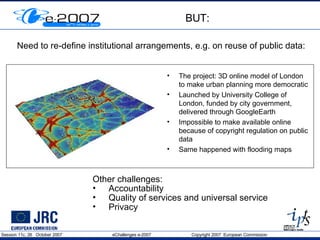
BUT: The project: 3D online model of London to make urban planning more democratic  Launched by University College of London, funded by city government, delivered through GoogleEarth Impossible to make available online because of copyright regulation on public data Same happened with flooding maps Need to re-define institutional arrangements, e.g. on reuse of public data: Other challenges: Accountability Quality of services and universal service Privacy
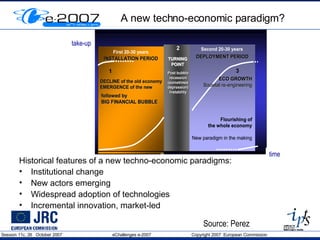
A new techno-economic paradigm? Historical features of a new techno-economic paradigms: Institutional change New actors emerging Widespread adoption of technologies Incremental innovation, market-led take-up time Source: Perez
Innovation 2.0 in public-services Useful and already applied  Addressing key challenges to innovation Very difficult to control or to stop, part of a wider socio-economic change  Open questions What is the real weight and impact?  Which new forms of governance are needed? Thanks [email_address]
Background slides
Innovation in public services Govt is an innovation actor But challenges remain Cultural resistance Risk aversion Not understanding user needs Less pressure for innovation (monopoly, no “exit” possible)
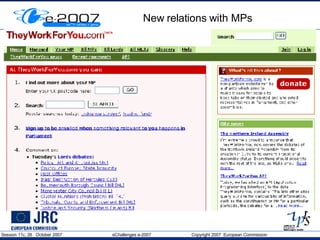
New relations with MPs
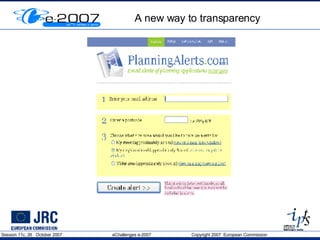
A new way to transparency
Regulating market distorsions www.aboliamoli.eu Italian citizen fighting against operators fee for recharging mobiles Protested via consumers association and authorities > no effect Collected signature via web and blogs (april 2006), sent them to EC which started procedure Finally Italian government abolishing these fees (Jan 2007)
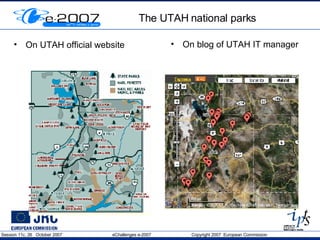
The UTAH national parks On UTAH official website On blog of UTAH IT manager
New relations with MPs
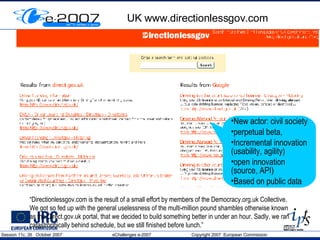
UK www.directionlessgov.com “ Directionlessgov.com is the result of a small effort by members of the Democracy.org.uk Collective.  We got so fed up with the general uselessness of the multi-million pound shambles otherwise known as the Direct.gov.uk portal, that we decided to build something better in under an hour. Sadly, we ran catastrophically behind schedule, but we still finished before lunch.” New actor: civil society perpetual beta,  Incremental innovation (usability, agility) open innovation (source, API) Based on public data
Yatsushiro: City government opened participation forum “Gorotto Yatchiro”. Final community size of 600, with 40 truly active users Japan: Promoting participation Source: complexity and social networks blog at Harvard University http://www.iq.harvard.edu/blog/netgov/ A young IT public servant programmed in 3 months a new version of Gorotto based on open source software.  No order, no permission, no budget, parallel to official city's website.  Member expansion was left to invitations of users only.  Now 2800 members, 400 contributing users .  New actor: individual civil servants open innovation Incremental innovation Govt. as funder  2002/2003 2004

user-driven innovation models in public services

  • 1.
    New patterns ofinnovation in public eServices David Osimo, Clara Centeno, Jean Claude Burgelman Institute for Prospective Technological Studies European Commission - Joint Research Centre The views expressed in the presentation are those of the authors and do not represent the official position of the EC
  • 2.
    Outline The context:innovation in public services, and innovation patterns in web 2.0 How do these patterns work in public services? Analysis of selected cases Conclusions
  • 3.
    The context: innovationin public services The public sector is an innovation actor as a service provider (to all citizens and business) as a buyer (16% EU GDP) as an employer (of 50M Europeans) Civil society traditionally seen as “extension ladder” Need to innovate public services likely to grow in the future (due to budget restrictions, increased citizens expectations, multiculturality, ageing, etc.) But barriers exist: hierarchical organisations risk aversion lack of user orientation less pressure for innovation: monopoly, no “exit” possibility for citizens (Hirschmann)
  • 4.
    The e-ruptive growthof user-driven applications 70 M blogs, doubling every 6 months YouTube traffic: 100M views/day Wikipedia: 2M articles Source: Technorati, Alexa, Wikipedia , Cachelogic Peer-to-peer largest source of IP traffic
  • 5.
    Innovation patterns ofweb 2.0 New actors emerging Better informed users demanding innovative products and services Users driving innovation: market-led, incremental innovation Perpetual beta: iterative and continuous innovation Bottom-up, emergent innovation rather than hierarchically planned/imposed Open, shared innovation Codifying and exploiting tacit knowledge
  • 6.
    2. How dosuch innovation patterns apply to public services? Analysis of selected cases
  • 7.
    Private business innovatingpublic services: GoogleTransit New actor: business perpetual beta, continuous innovation, open API
  • 8.
    Civil society: MySociety.orgFounded: September ‘03 TheyWorkForYou.com launched June ‘04 WriteToThem.com February ‘05 NotApathetic.com April ‘05 PledgeBank.com June ‘05 HearFromYourMP.com November ‘05 Petitions.pm.gov.uk November ‘06 FixMyStreet.com March ‘07 And other sites launched by the “developers network”: planningalerts.com directionlessgov.com journa-list.com thepublicwhip.org.uk commentonthis.com New actor: civil society perpetual beta continuous innovation, Incremental innovation (usability, agility) open innovation (source, API) networks, not hyerarchy Based on public data
  • 9.
    Citizen-created services: ChicagoCrime:orgNew actor: citizens User driven innovation reuse of public data
  • 10.
    Gapminder: making publicdata meaningful New actor: citizens User driven innovation reuse of public data
  • 11.
    UK: a doctorinnovating the NHS New actor: individual civil servants Reuse of public data Better informed customers Incremental innovation Codifying tacit needs and knowledge Govt. as funder
  • 12.
    eGov barcamp NewZealand New actor: individual civil servants open innovation, informal collaboration and sharing Codifying tacit knowledge
  • 13.
  • 14.
    What is newfor public eServices? A new WAY to innovate public services Continuous and incremental, open and non hyerarchical not only by government: civil society, citizens, civil servants A new effective DRIVER to address the challenges of innovating public services citizens’ ratings and reviews: democratization of voice where there is no exit possibility more openness and transparency expected wider availability of IT tools for innovation by citizens, civil servants, civil society
  • 15.
    BUT: The project:3D online model of London to make urban planning more democratic Launched by University College of London, funded by city government, delivered through GoogleEarth Impossible to make available online because of copyright regulation on public data Same happened with flooding maps Need to re-define institutional arrangements, e.g. on reuse of public data: Other challenges: Accountability Quality of services and universal service Privacy
  • 16.
    A new techno-economicparadigm? Historical features of a new techno-economic paradigms: Institutional change New actors emerging Widespread adoption of technologies Incremental innovation, market-led take-up time Source: Perez
  • 17.
    Innovation 2.0 inpublic-services Useful and already applied Addressing key challenges to innovation Very difficult to control or to stop, part of a wider socio-economic change Open questions What is the real weight and impact? Which new forms of governance are needed? Thanks [email_address]
  • 18.
  • 19.
    Innovation in publicservices Govt is an innovation actor But challenges remain Cultural resistance Risk aversion Not understanding user needs Less pressure for innovation (monopoly, no “exit” possible)
  • 20.
  • 21.
    A new wayto transparency
  • 22.
    Regulating market distorsionswww.aboliamoli.eu Italian citizen fighting against operators fee for recharging mobiles Protested via consumers association and authorities > no effect Collected signature via web and blogs (april 2006), sent them to EC which started procedure Finally Italian government abolishing these fees (Jan 2007)
  • 23.
    The UTAH nationalparks On UTAH official website On blog of UTAH IT manager
  • 24.
  • 25.
    UK www.directionlessgov.com “Directionlessgov.com is the result of a small effort by members of the Democracy.org.uk Collective. We got so fed up with the general uselessness of the multi-million pound shambles otherwise known as the Direct.gov.uk portal, that we decided to build something better in under an hour. Sadly, we ran catastrophically behind schedule, but we still finished before lunch.” New actor: civil society perpetual beta, Incremental innovation (usability, agility) open innovation (source, API) Based on public data
  • 26.
    Yatsushiro: City governmentopened participation forum “Gorotto Yatchiro”. Final community size of 600, with 40 truly active users Japan: Promoting participation Source: complexity and social networks blog at Harvard University http://www.iq.harvard.edu/blog/netgov/ A young IT public servant programmed in 3 months a new version of Gorotto based on open source software. No order, no permission, no budget, parallel to official city's website. Member expansion was left to invitations of users only. Now 2800 members, 400 contributing users . New actor: individual civil servants open innovation Incremental innovation Govt. as funder 2002/2003 2004