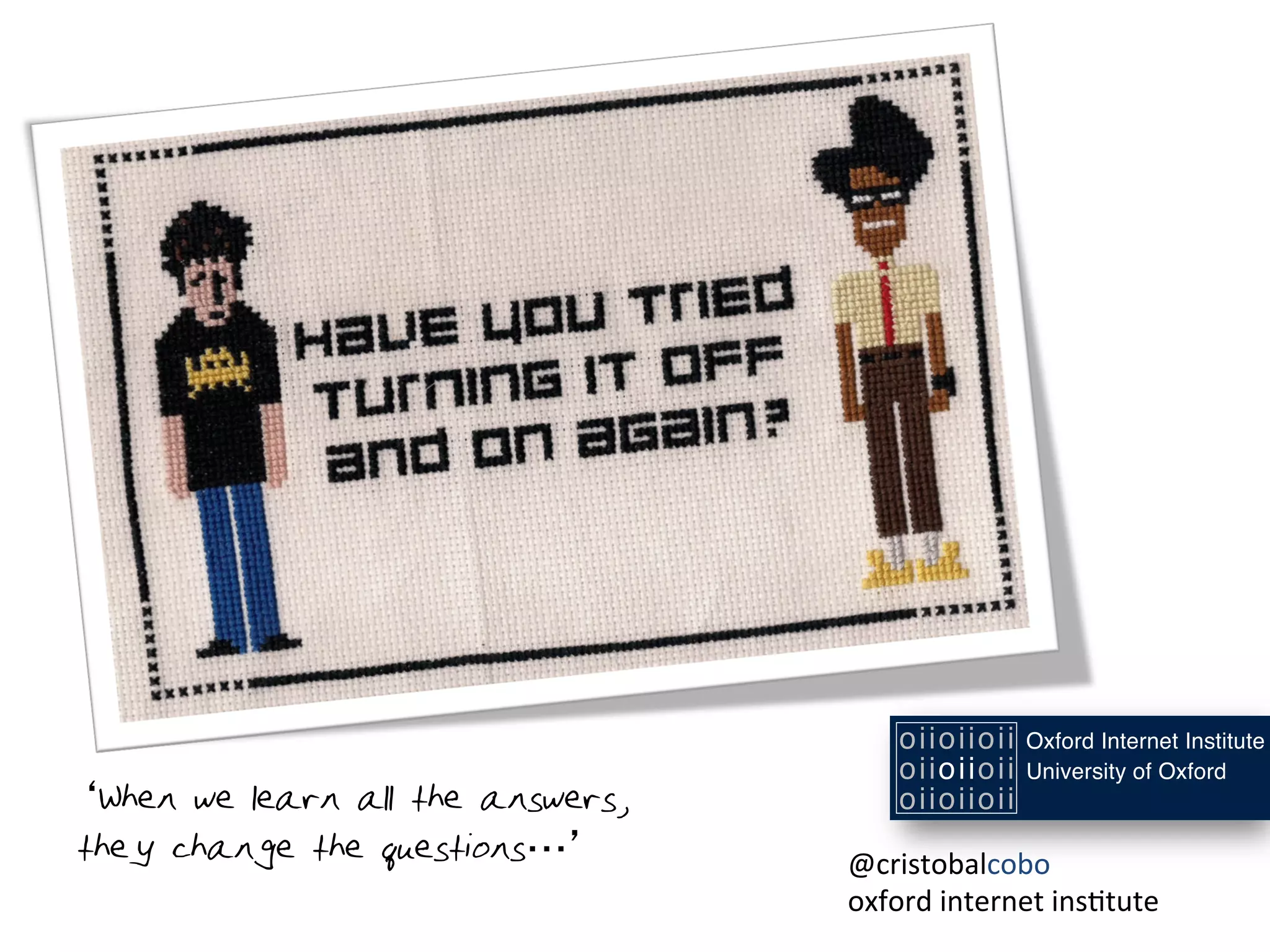
When we learn all the answers,
they change the questions @cristobalcobo	
  
oxford	
  internet	
  ins1tute	
  
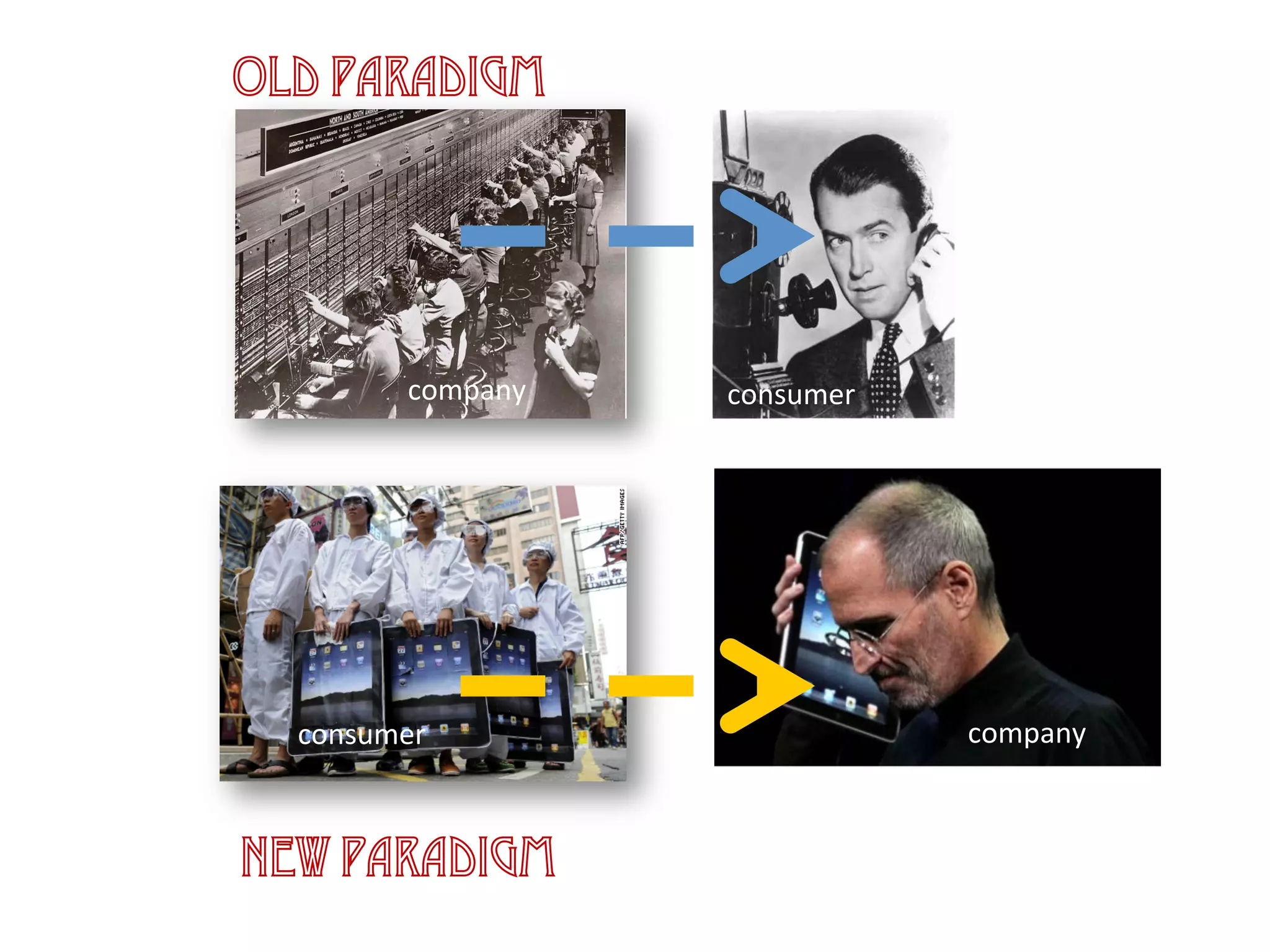
Old Paradigm
New Paradigm
consumer	
  
consumer	
  
company	
  
company	
  
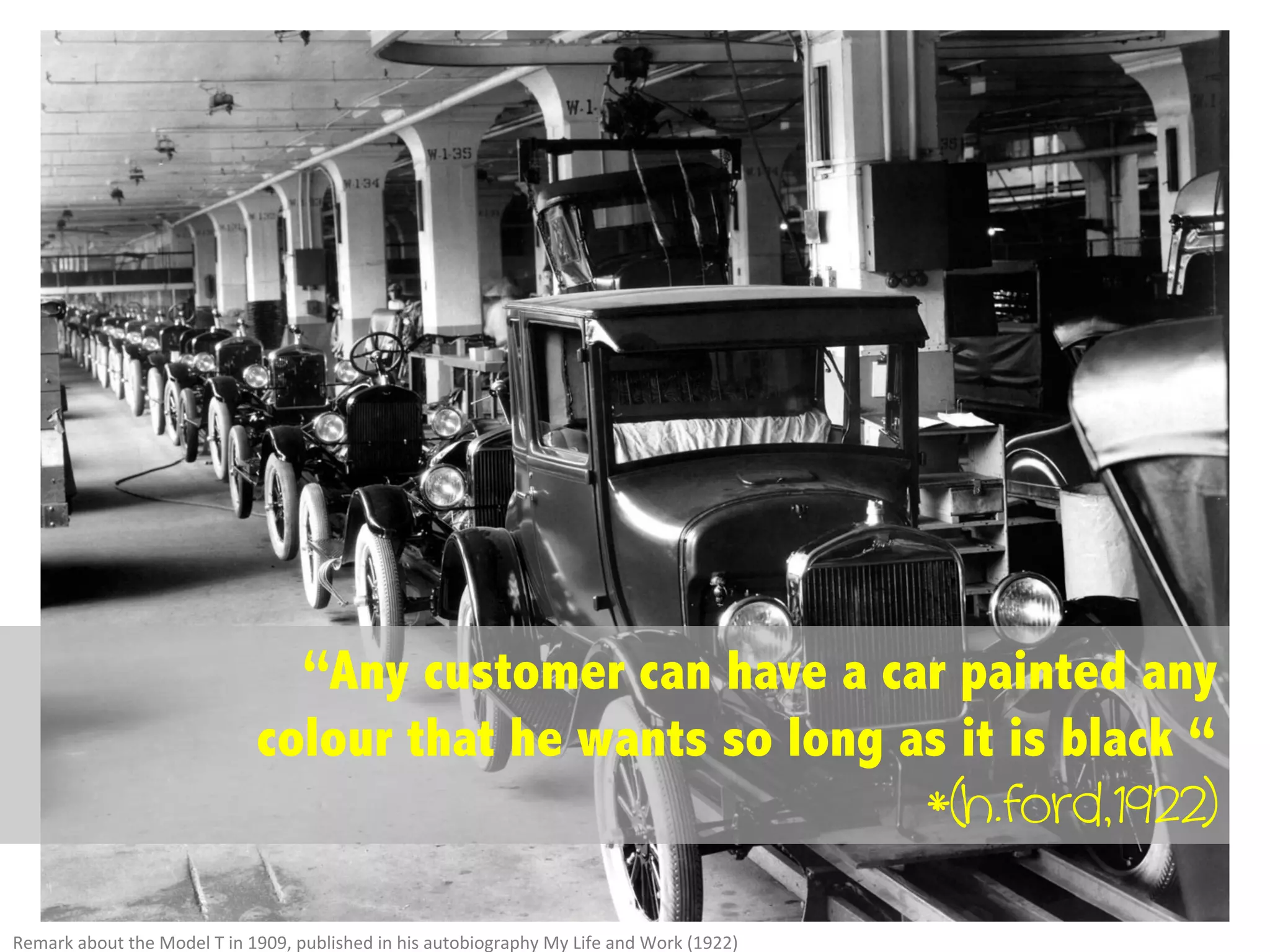
“Any customer can have a car painted any
colour that he wants so long as it is black “
*(h.ford,1922)
Remark	
  about	
  the	
  Model	
  T	
  in	
  1909,	
  published	
  in	
  his	
  autobiography	
  My	
  Life	
  and	
  Work	
  (1922)	
  
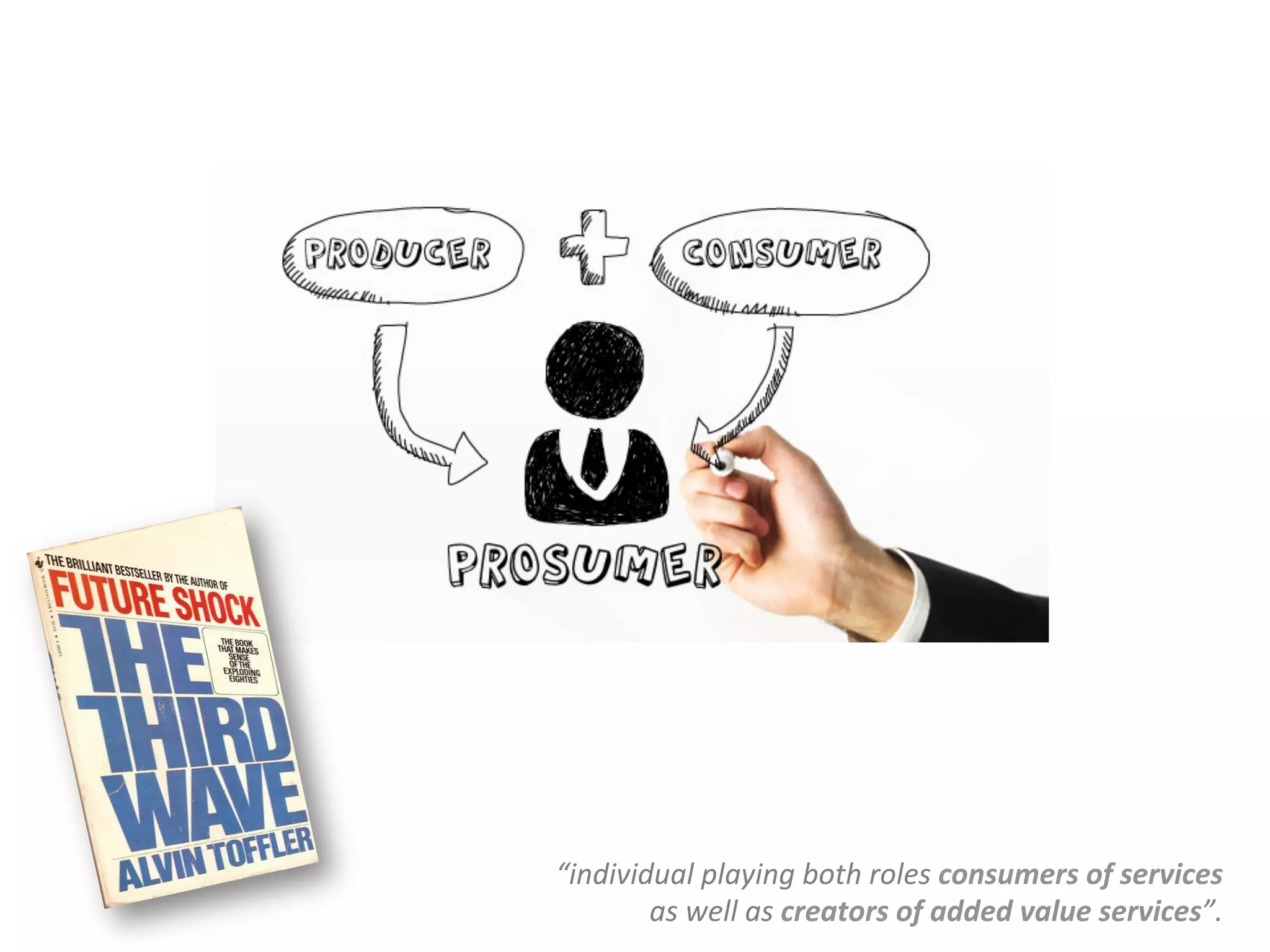
“individual	
  playing	
  both	
  roles	
  consumers	
  of	
  services	
  
as	
  well	
  as	
  creators	
  of	
  added	
  value	
  services”.	
  
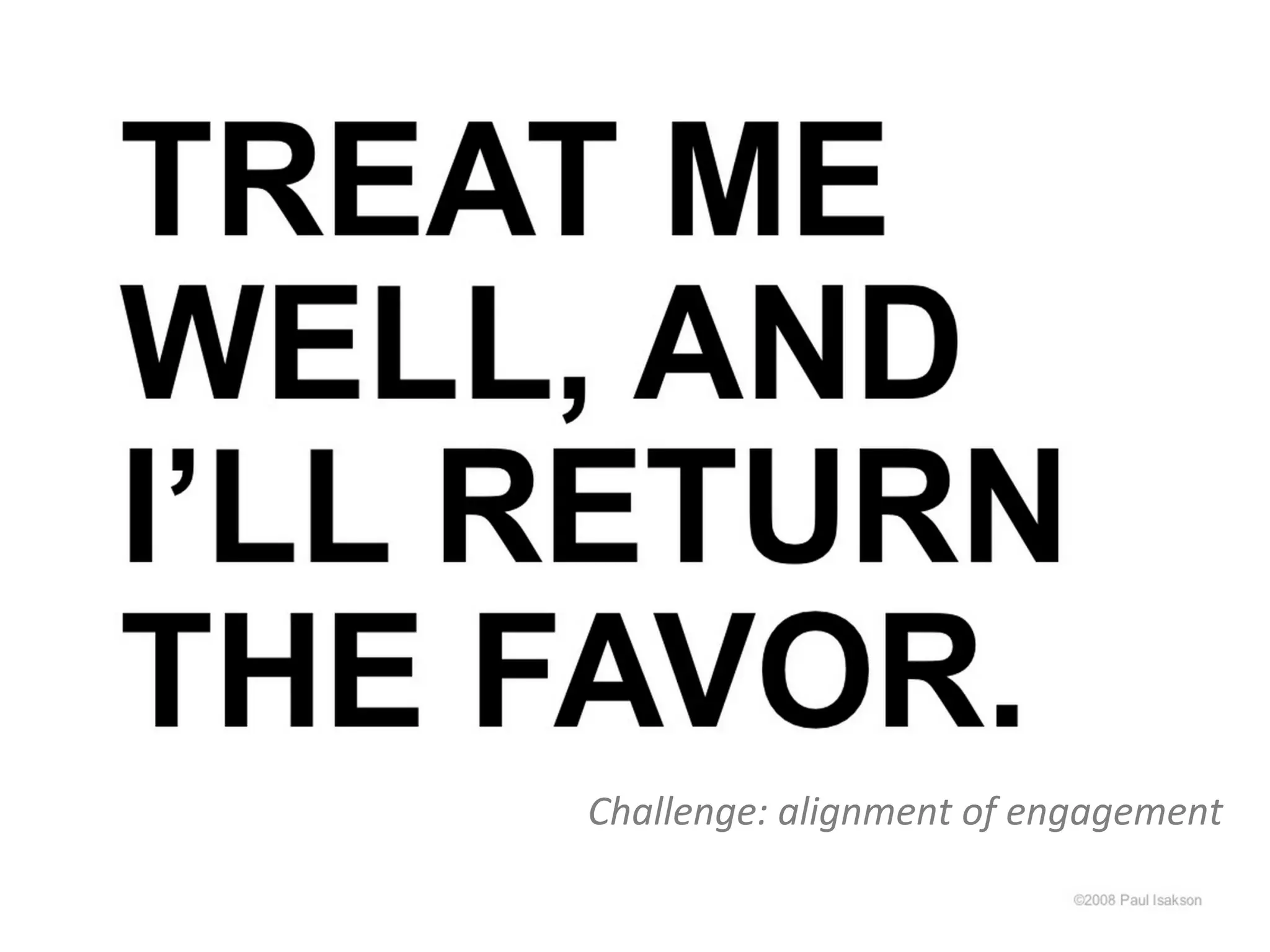
Challenge:	
  alignment	
  of	
  engagement	
  
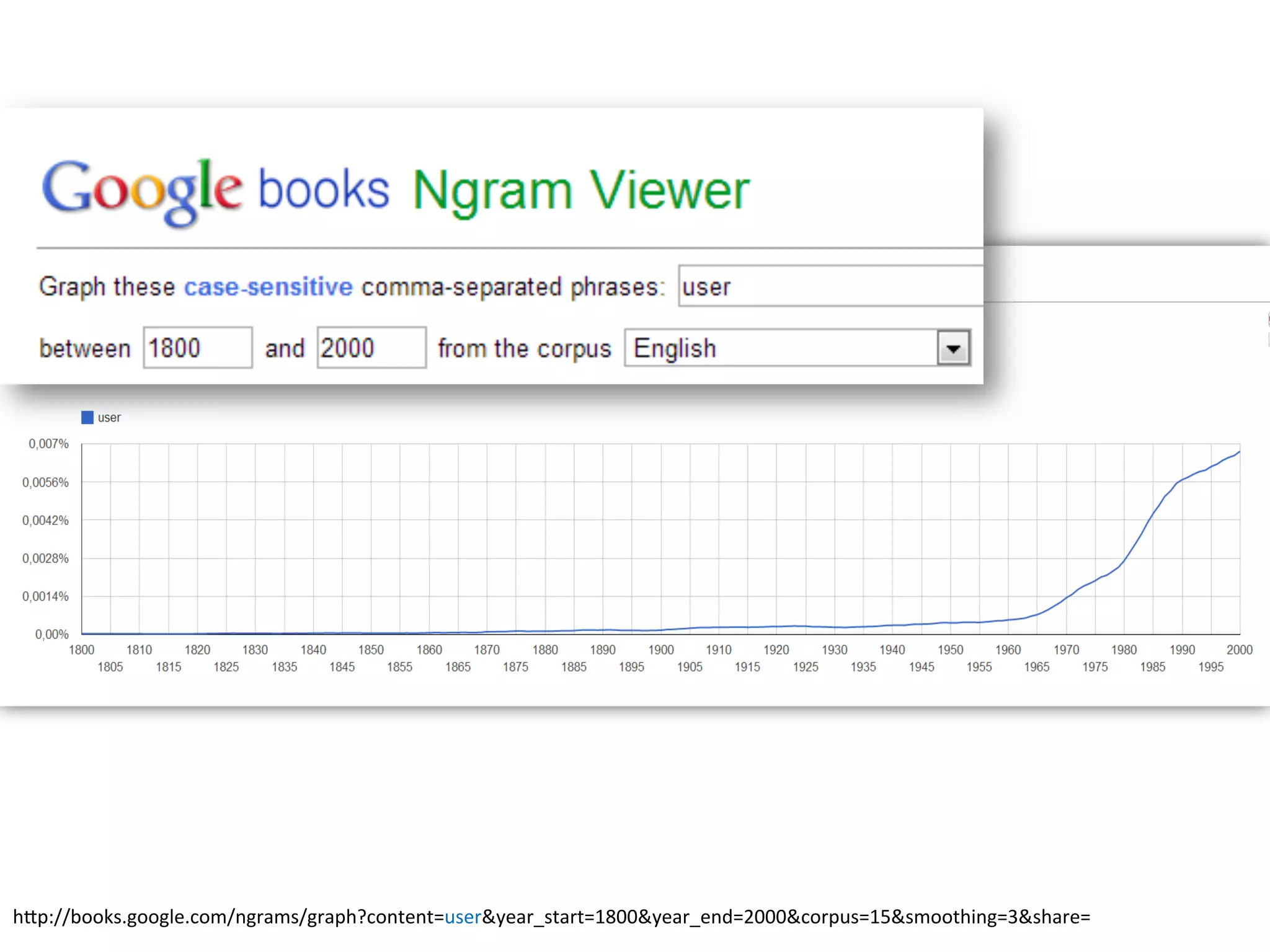
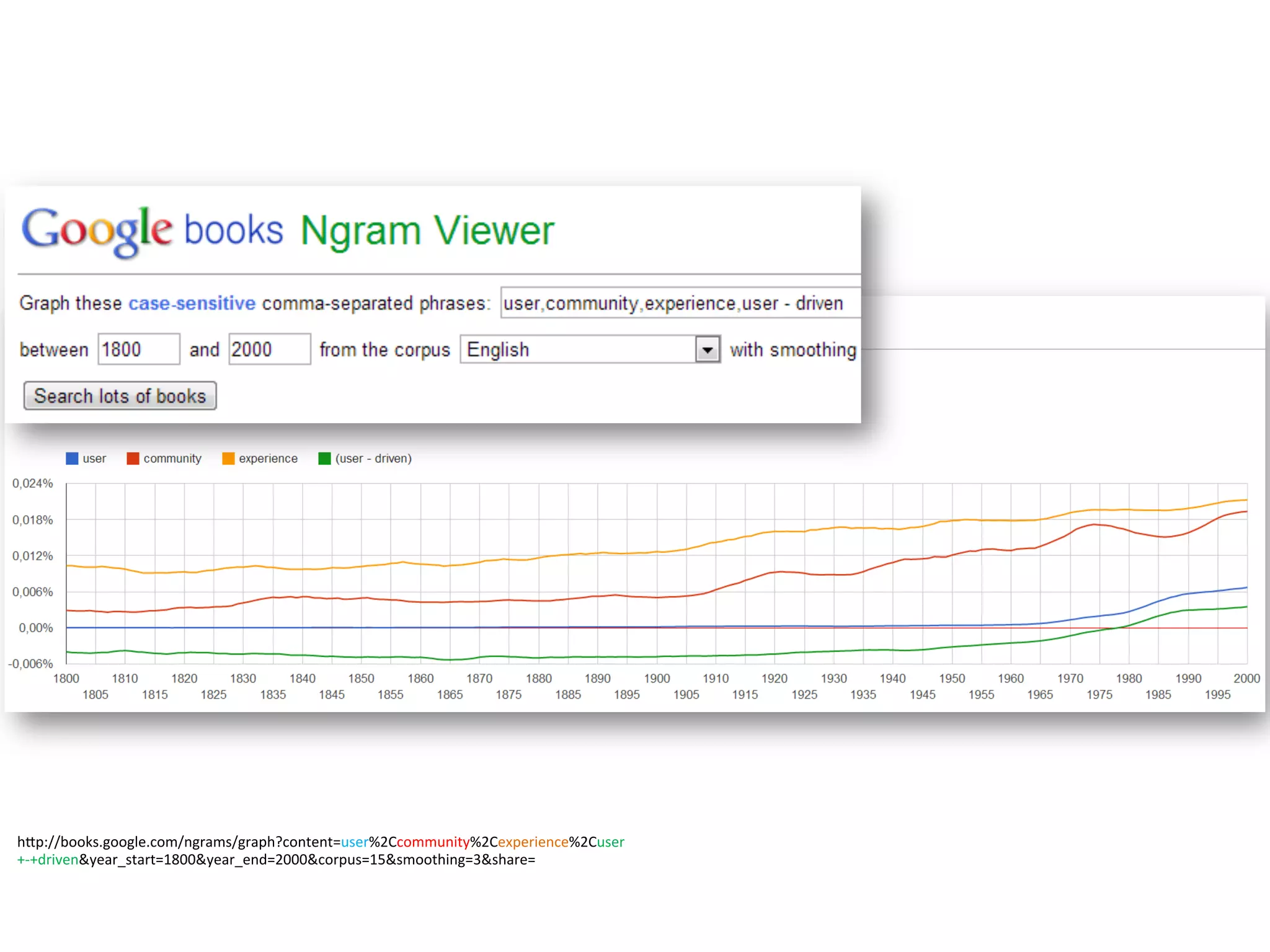
hEp://books.google.com/ngrams/graph?content=user&year_start=1800&year_end=2000&corpus=15&smoothing=3&share=	
  
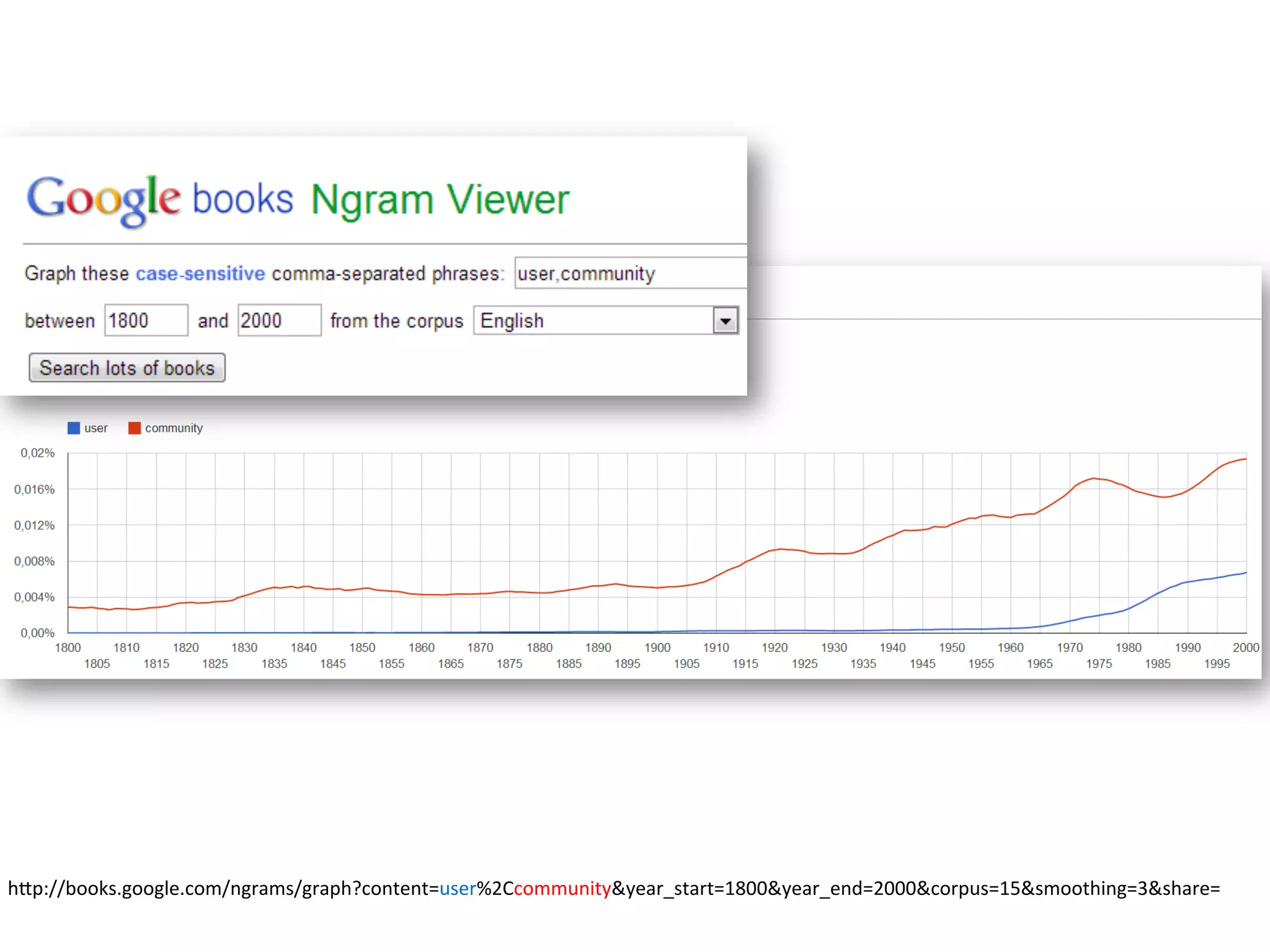
hEp://books.google.com/ngrams/graph?content=user%2Ccommunity&year_start=1800&year_end=2000&corpus=15&smoothing=3&share=	
  
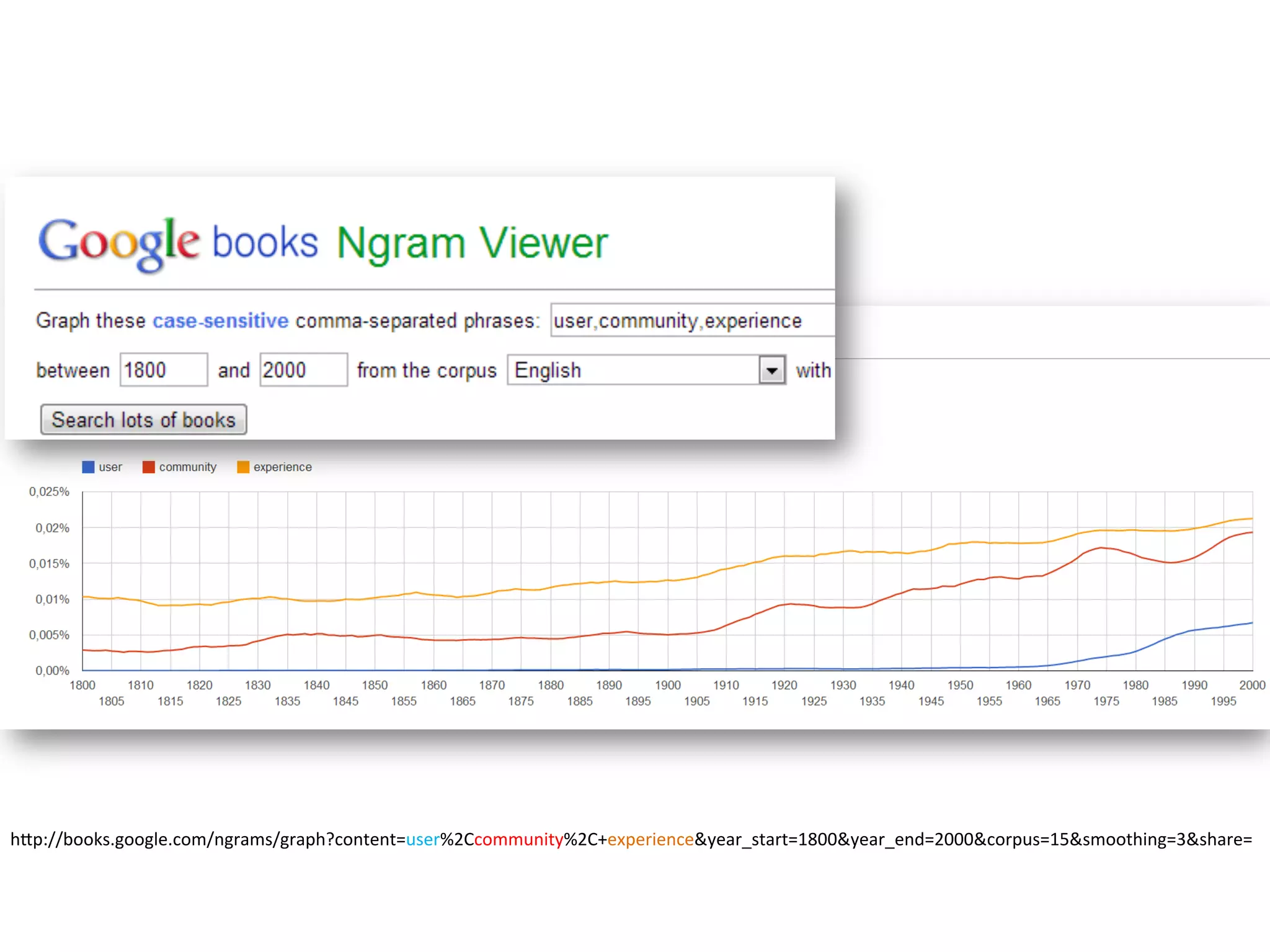
hEp://books.google.com/ngrams/graph?content=user%2Ccommunity%2C+experience&year_start=1800&year_end=2000&corpus=15&smoothing=3&share=	
  
hEp://books.google.com/ngrams/graph?content=user%2Ccommunity%2Cexperience%2Cuser
+-­‐+driven&year_start=1800&year_end=2000&corpus=15&smoothing=3&share=	
  
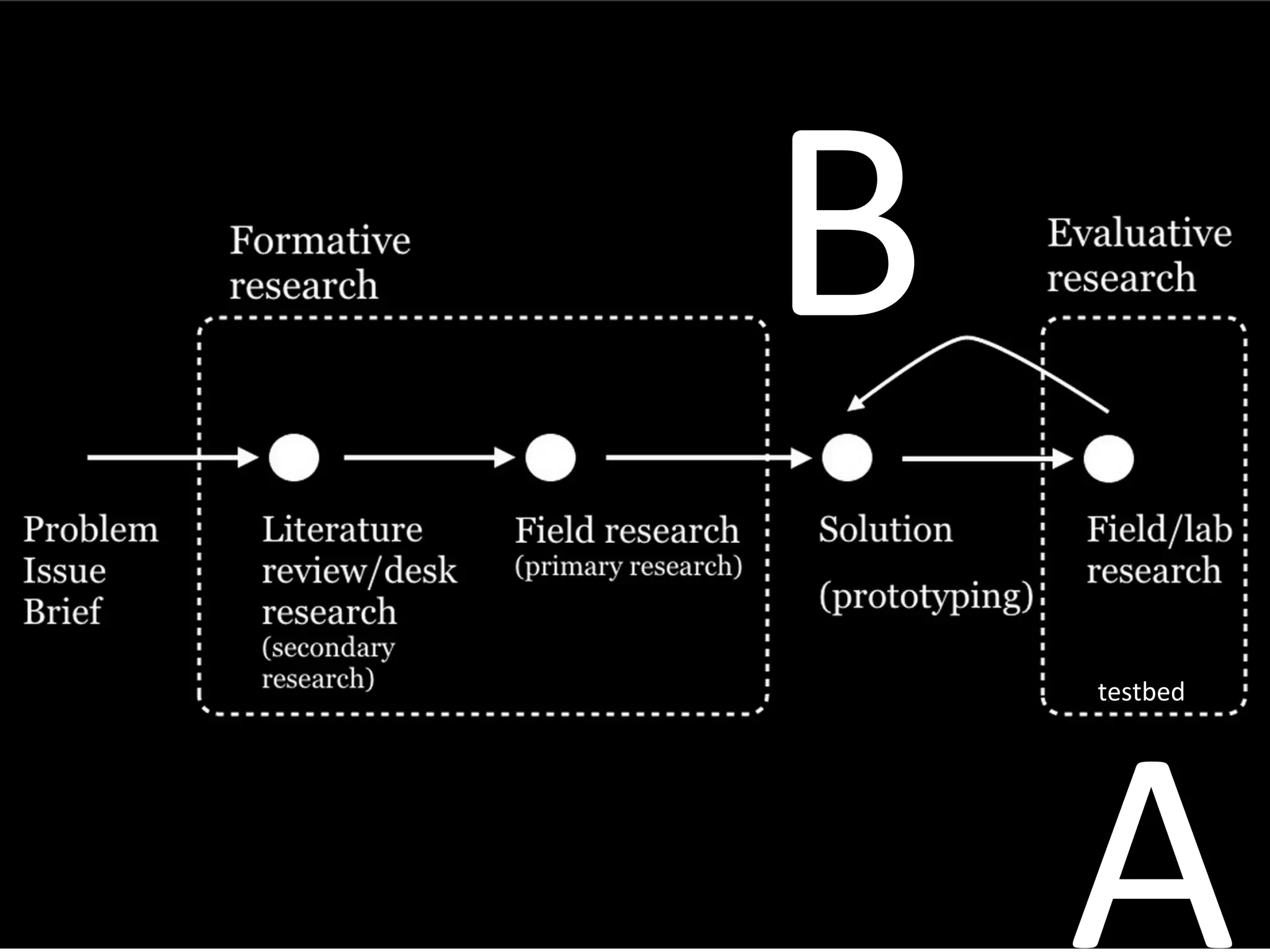
A	
  
B	
  
testbed	
  
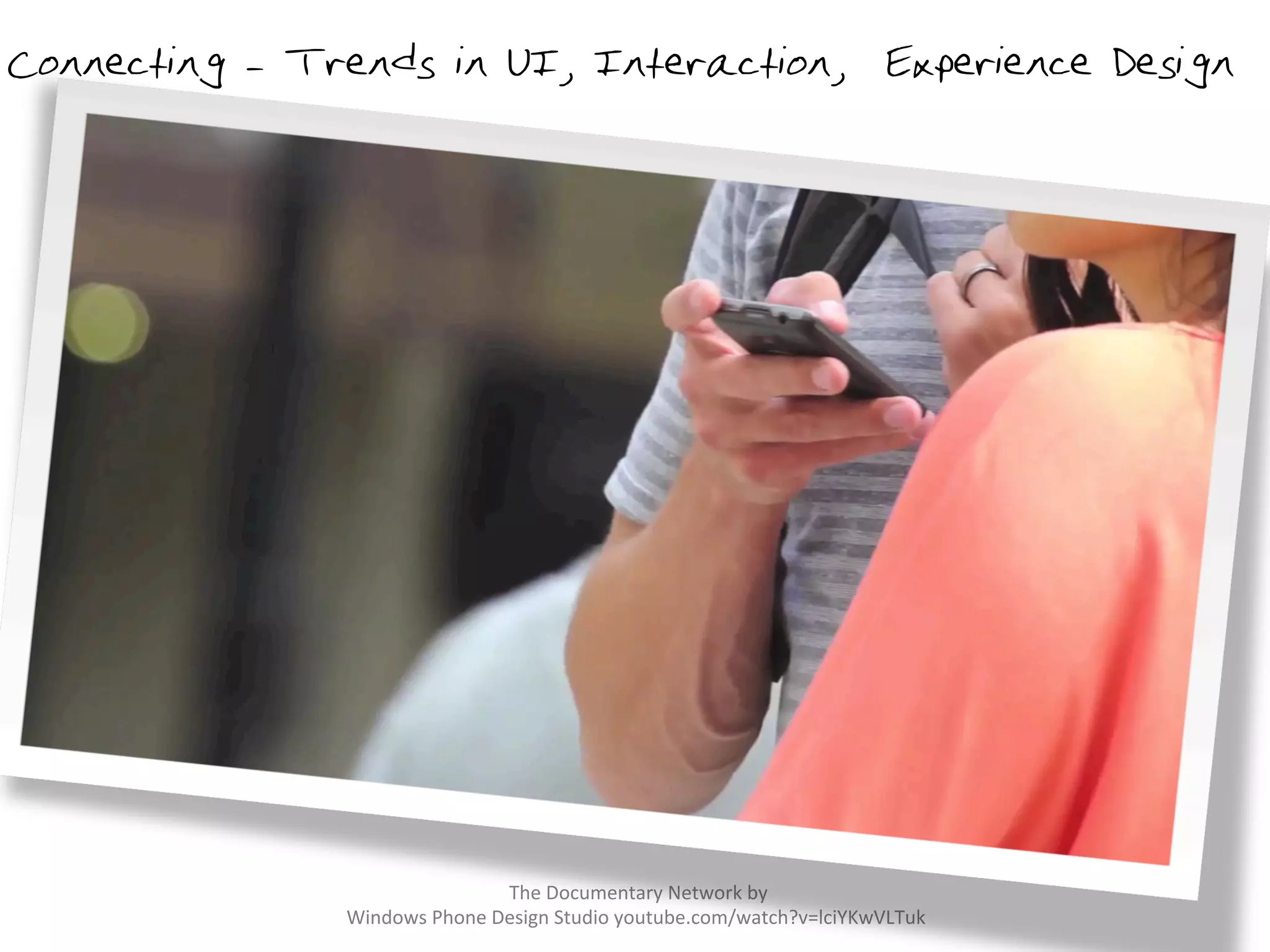
 The	
  Documentary	
  Network	
  by	
  
Windows	
  Phone	
  Design	
  Studio	
  youtube.com/watch?v=lciYKwVLTuk	
  
Connecting - Trends in UI, Interaction, Experience Design


User- center design
(‘pull’)
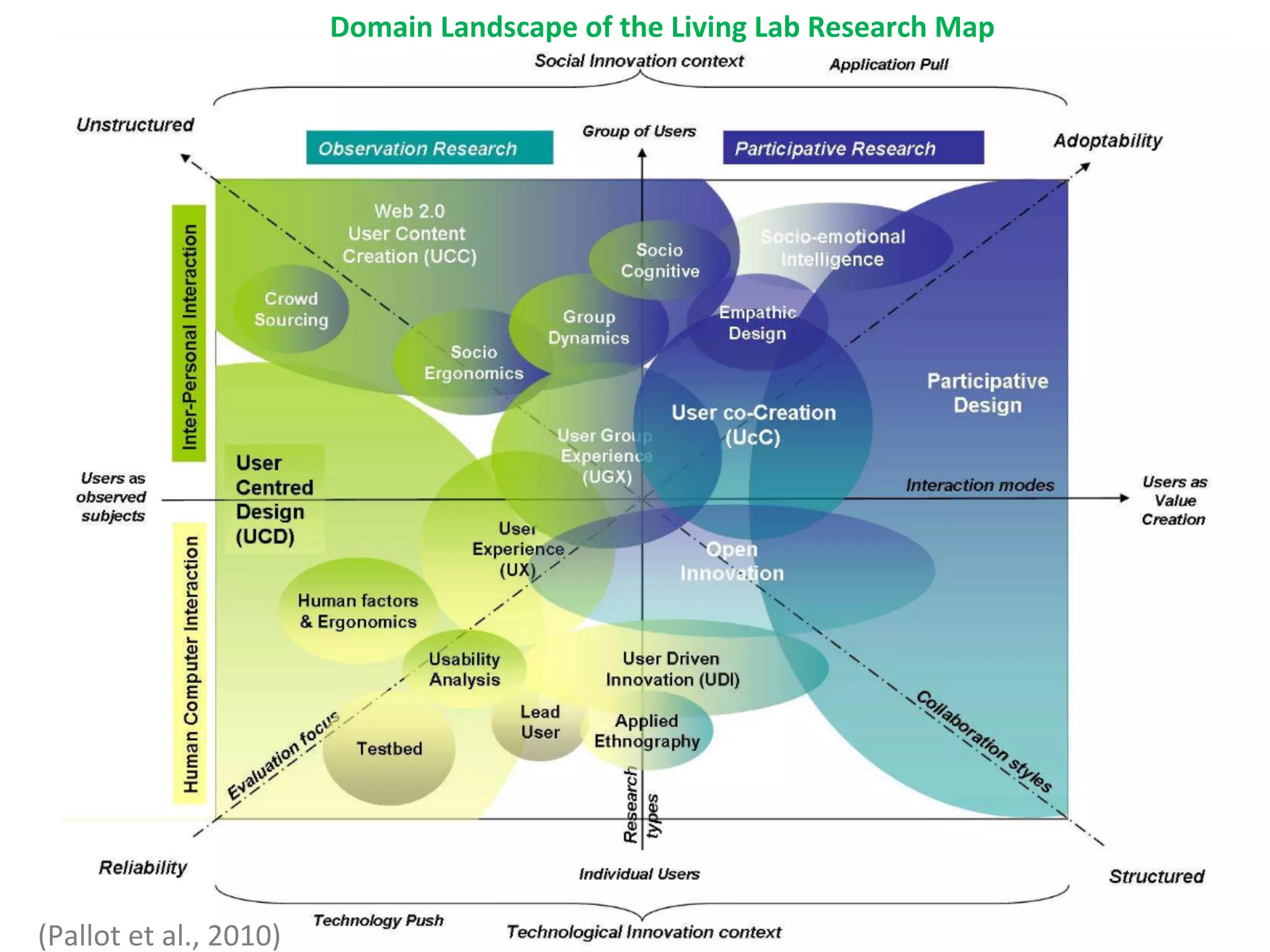
Domain	
  Landscape	
  of	
  the	
  Living	
  Lab	
  Research	
  Map	
  	
  
(Pallot	
  et	
  al.,	
  2010)	
  
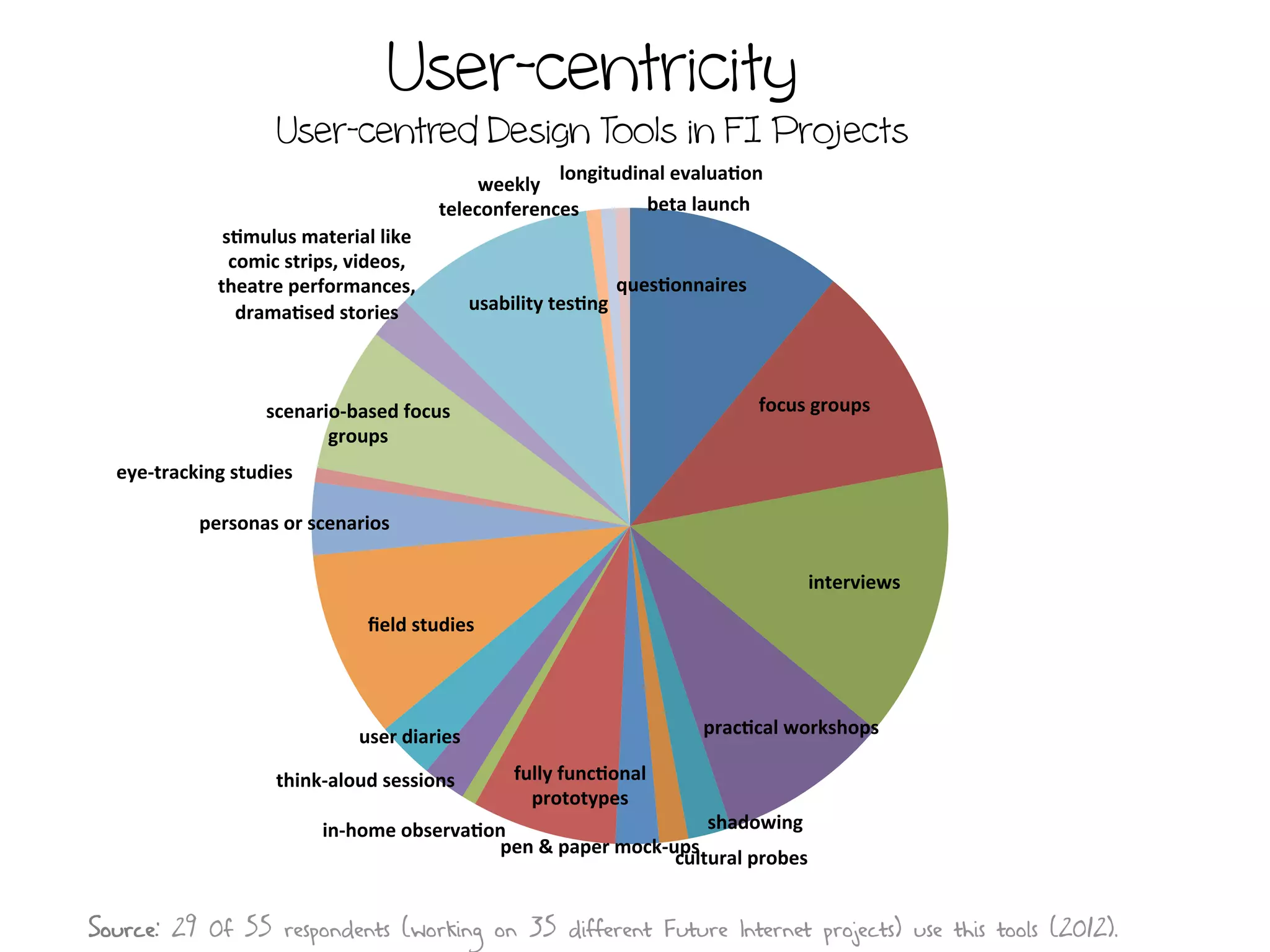
User-centricity
User-centred Design Tools in FI Projects
ques9onnaires	
  
focus	
  groups	
  
interviews	
  
prac9cal	
  workshops	
  
shadowing	
  
cultural	
  probes	
  
pen	
  &	
  paper	
  mock-­‐ups	
  
fully	
  func9onal	
  
prototypes	
  
in-­‐home	
  observa9on	
  
think-­‐aloud	
  sessions	
  
user	
  diaries	
  
field	
  studies	
  
personas	
  or	
  scenarios	
  
eye-­‐tracking	
  studies	
  
scenario-­‐based	
  focus	
  
groups	
  
s9mulus	
  material	
  like	
  
comic	
  strips,	
  videos,	
  
theatre	
  performances,	
  
drama9sed	
  stories	
   usability	
  tes9ng	
  
longitudinal	
  evalua9on	
  
weekly	
  
teleconferences	
   beta	
  launch	
  
Source: 29 0f 55 respondents (working on 35 different Future Internet projects) use this tools (2012).
bottom up innovation
(‘push’)
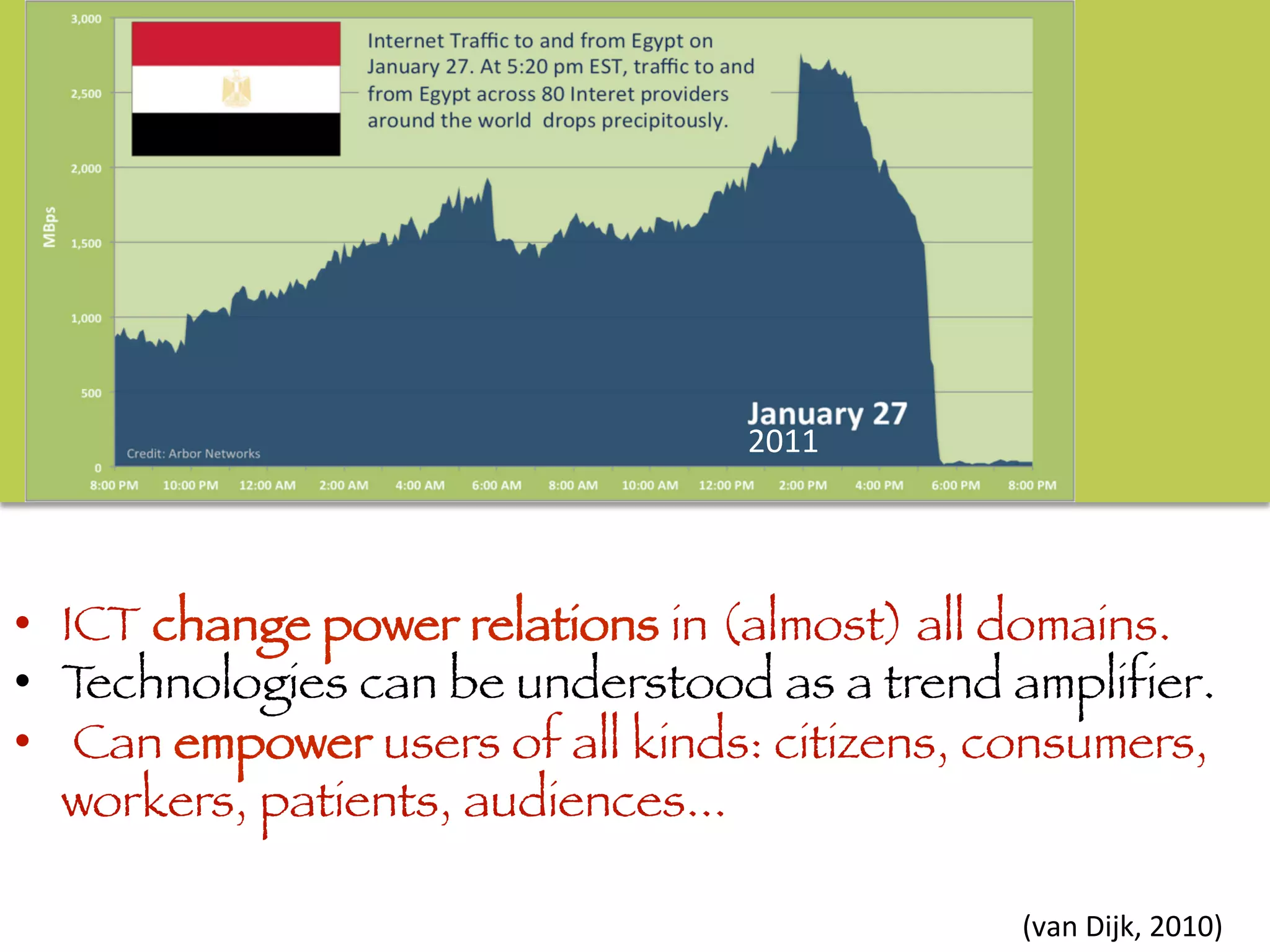
•  ICT change power relations in (almost) all domains.
•  Technologies can be understood as a trend amplifier. 
•  Can empower users of all kinds: citizens, consumers,
workers, patients, audiences...
(van	
  Dijk,	
  2010)	
  
2011	
  
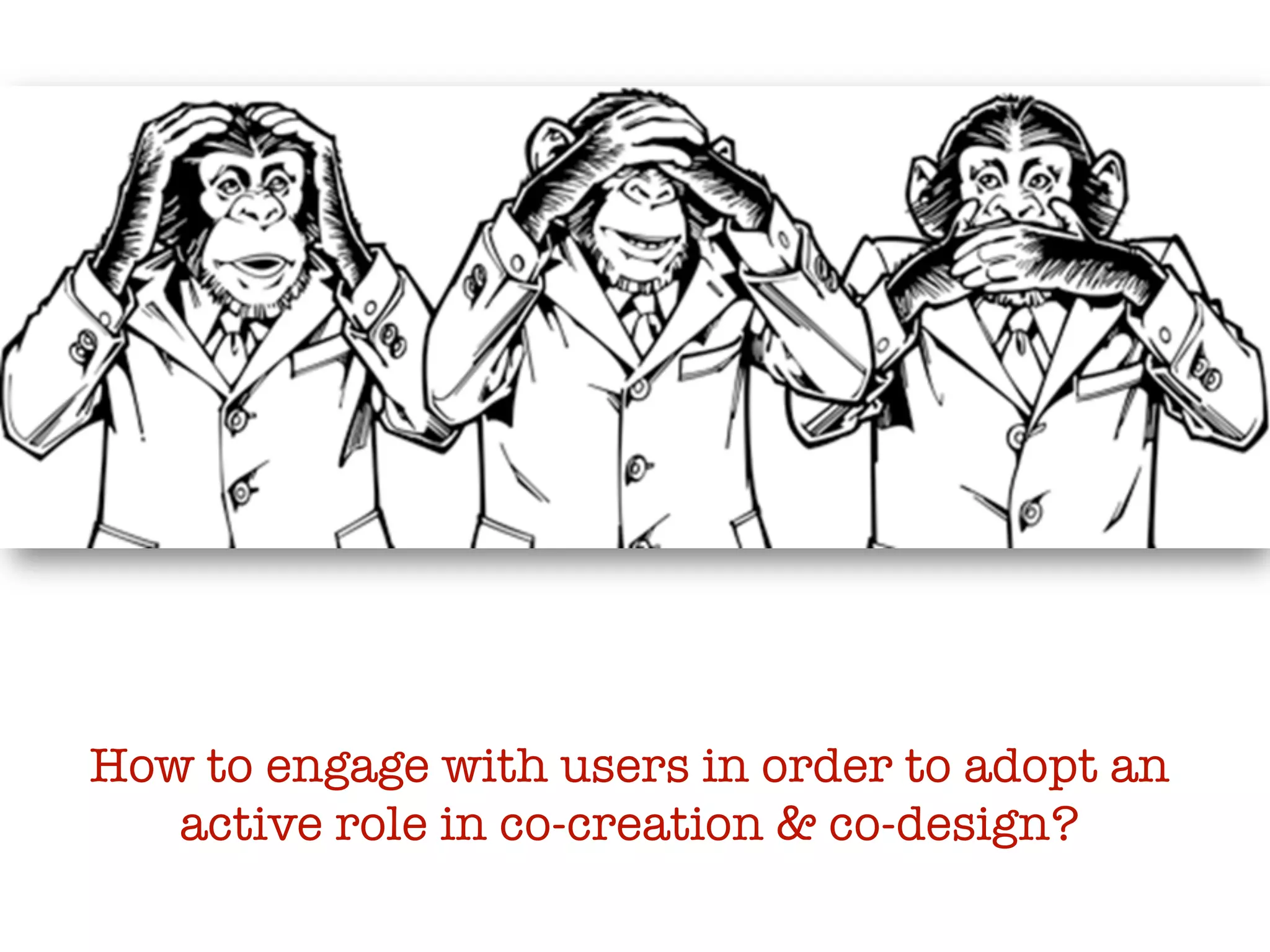
How to engage with users in order to adopt an
active role in co-creation & co-design?
•  SOPA	
  &	
  PIPA	
  protest	
  [2012]	
  	
  
•  English	
  Wikipedia	
  +~7,000	
  websites	
  coordinated	
  a	
  service	
  blackout,	
  to	
  raise	
  awareness.	
  	
  
•  160	
  million	
  people	
  viewed	
  Wikipedia's	
  banner.	
  	
  
•  Google	
  collected	
  +7	
  million	
  signatures.	
  
•  BoycoEs	
  of	
  companies	
  and	
  organiza1ons	
  that	
  support	
  the	
  legisla1on.	
  
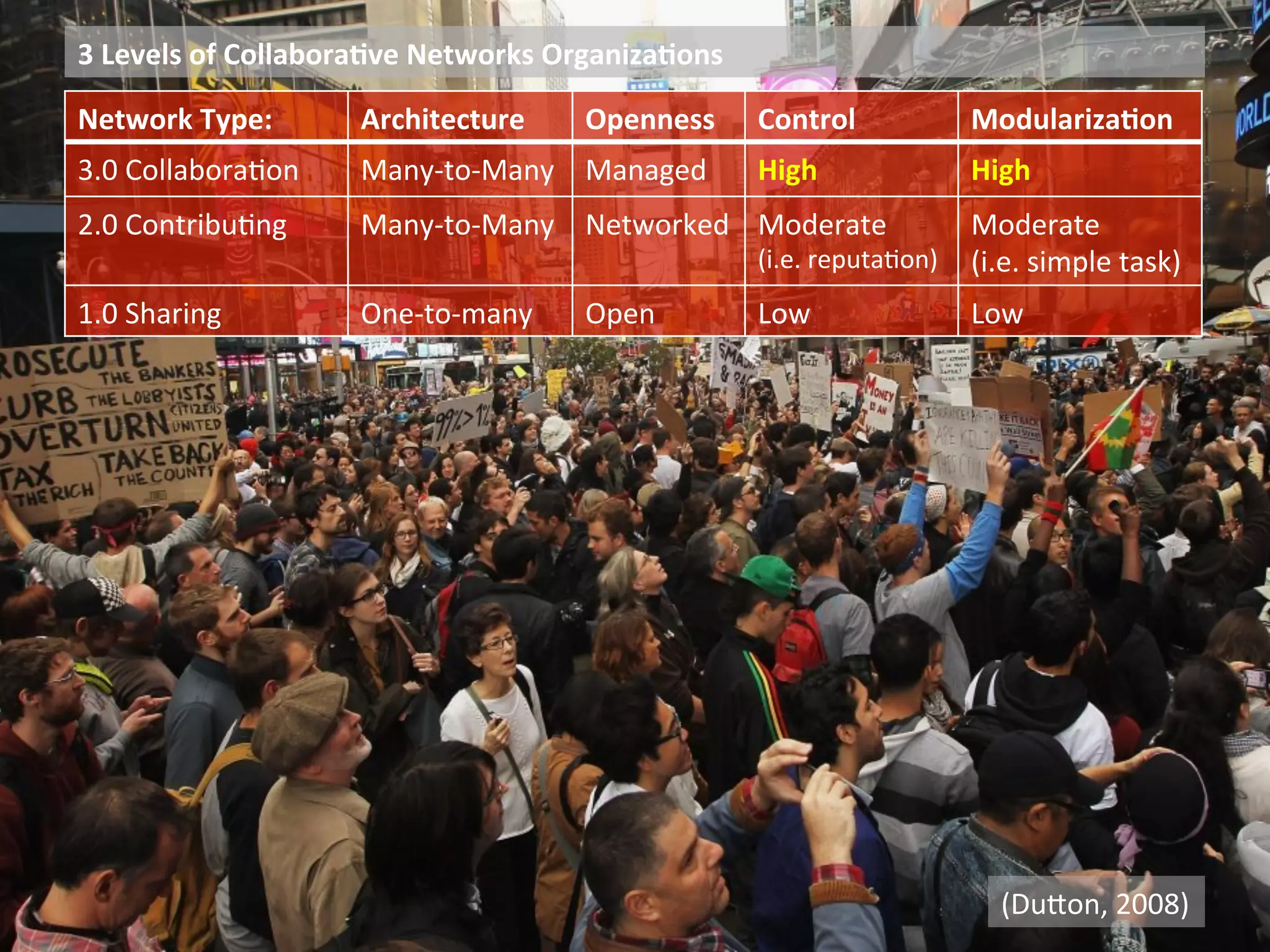
Network	
  Type:	
   Architecture	
   Openness	
   Control	
   Modulariza9on	
  
3.0	
  Collabora1on	
   	
  	
   Many-­‐to-­‐Many	
   Managed	
   High	
   High	
  	
  
2.0	
  Contribu1ng	


Many-­‐to-­‐Many	
   Networked	
   Moderate	
  	
  
(i.e.	
  reputa1on)	
  
Moderate	
  	
  
(i.e.	
  simple	
  task)	
  
1.0	
  Sharing	
  	
   One-­‐to-­‐many	
   Open	
   Low	
   Low	
  
(DuEon,	
  2008)	
  
3	
  Levels	
  of	
  Collabora9ve	
  Networks	
  Organiza9ons	
  
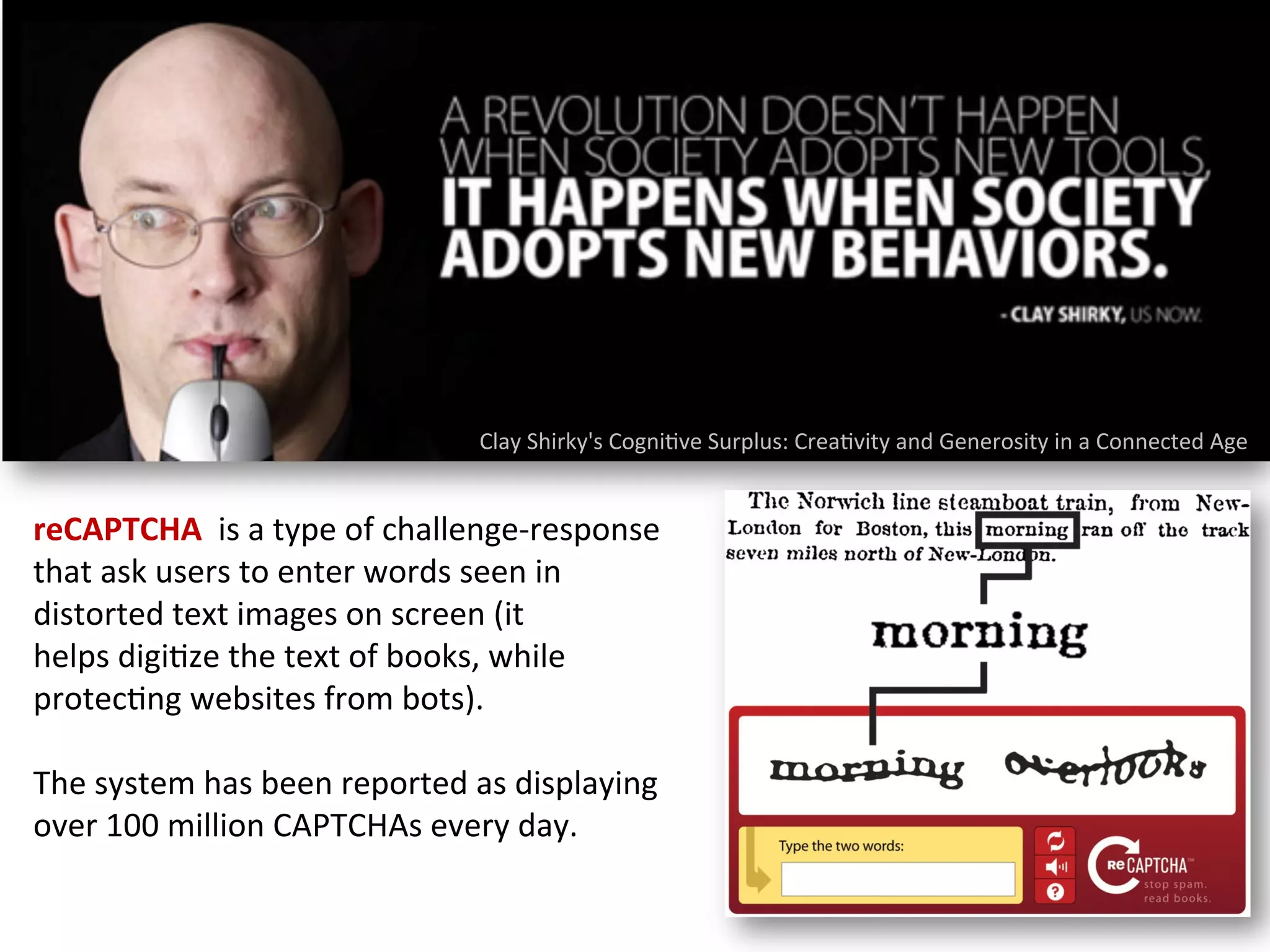
Clay	
  Shirky's	
  Cogni1ve	
  Surplus:	
  Crea1vity	
  and	
  Generosity	
  in	
  a	
  Connected	
  Age	
  
reCAPTCHA	
  	
  is	
  a	
  type	
  of	
  challenge-­‐response	
  
that	
  ask	
  users	
  to	
  enter	
  words	
  seen	
  in	
  
distorted	
  text	
  images	
  on	
  screen	
  (it	
  
helps	
  digi1ze	
  the	
  text	
  of	
  books,	
  while	
  
protec1ng	
  websites	
  from	
  bots).	


The	
  system	
  has	
  been	
  reported	
  as	
  displaying	
  
over	
  100	
  million	
  CAPTCHAs	
  every	
  day.	
  
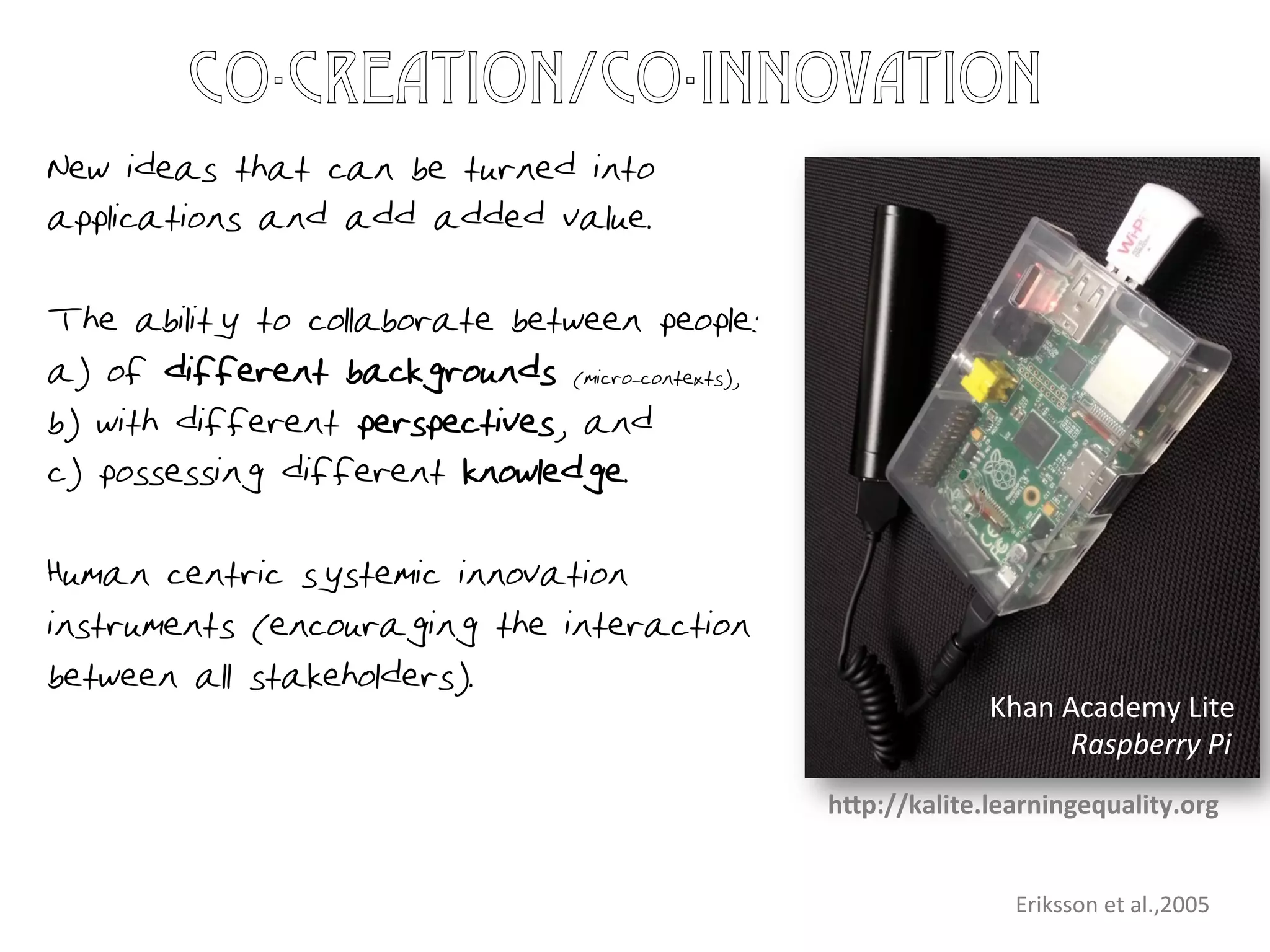
New ideas that can be turned into
applications and add added value.
The ability to collaborate between people:
a) of different backgrounds (micro-contexts),
b) with different perspectives, and
c) possessing different knowledge.
Human centric systemic innovation
instruments (encouraging the interaction
between all stakeholders).
Eriksson	
  et	
  al.,2005	
  
co-creation/co-innovation
Khan	
  Academy	
  Lite	
  
Raspberry	
  Pi	
  
hLp://kalite.learningequality.org	
  
(Pallot	
  et	
  al.,	
  2010)	
  
Contextual & social based adoption & adaptation of ICT:
•  Living	
  Labs	
  +	
  User	
  Driven	
  Innova9on	
  +	
  User	
  Centred	
  Design	
  +	
  User	
  Created	
  
Content	
  +	
  User	
  Group	
  Experience	
  (socio-­‐emo1onal)	
  
…BUT
•  The	
  principles	
  (usability,	
  accessibility	
  or	
  technology	
  customiza9on)	
  are	
  more	
  
manifested	
  in	
  theore9cal	
  considera9ons	
  rather	
  than	
  in	
  prac9ce.	
  	
  
•  Significant	
  number	
  of	
  	
  “one-­‐size-­‐fits-­‐all”	
  paradigm	
  is	
  common	
  in	
  the	
  market.	
  
40,000	
  solu1on	
  submissions	
  [200,000	
  solvers	
  -­‐200	
  countries]	
  Awards:	
  $5,000	
  to	
  $1+M	
  	
  
problems and challenges
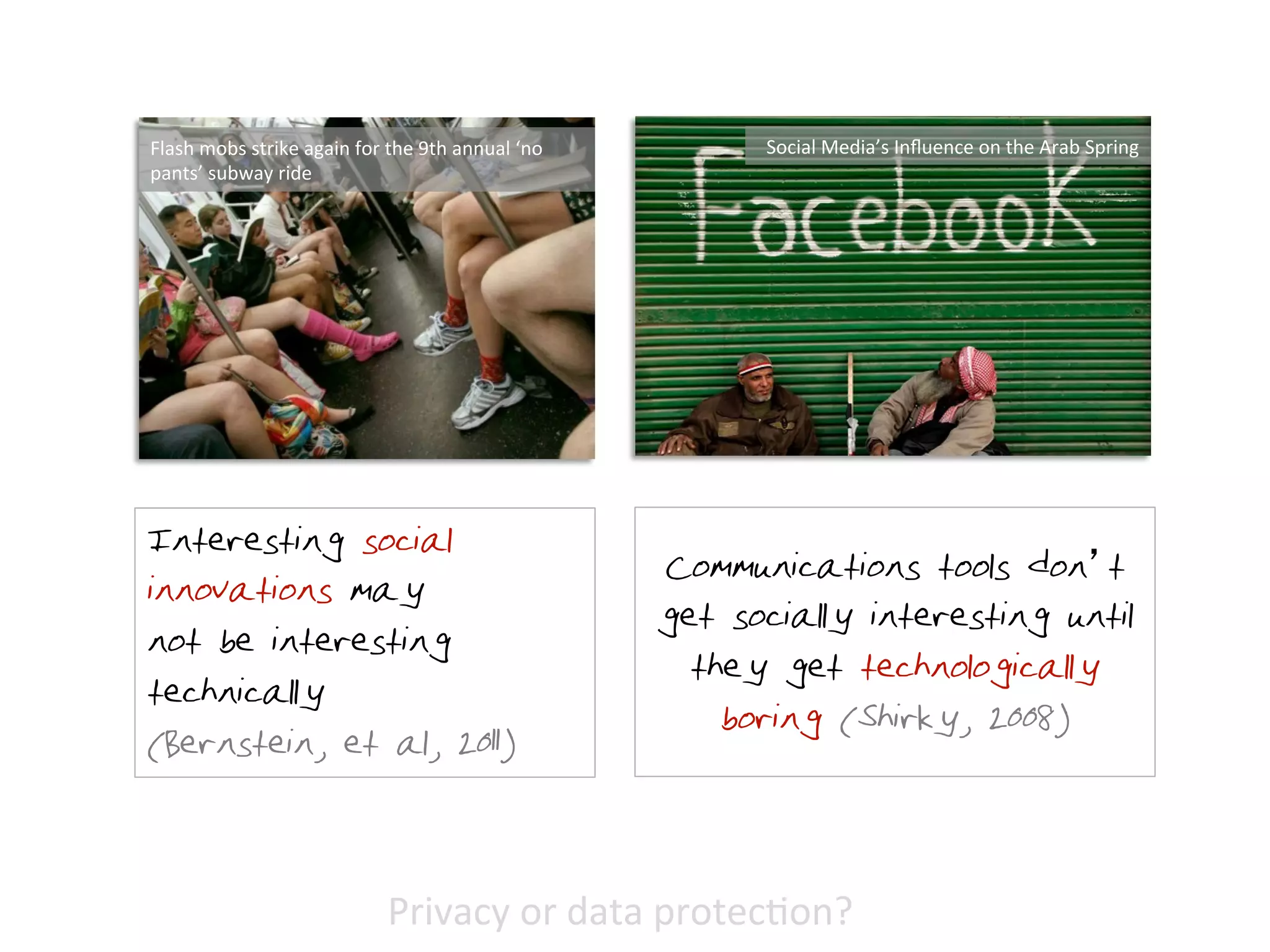
Communications tools don t
get socially interesting until
they get technologically
boring (Shirky, 2008)
Interesting social
innovations may
not be interesting
technically
(Bernstein, et al, 2011)
Flash	
  mobs	
  strike	
  again	
  for	
  the	
  9th	
  annual	
  ‘no	
  
pants’	
  subway	
  ride	
  
Social	
  Media’s	
  Influence	
  on	
  the	
  Arab	
  Spring	
  
Privacy	
  or	
  data	
  protec1on?	
  
(Bernstein,	
  Ackerman,	
  Chi	
  &	
  Miller,	
  2011).	
  
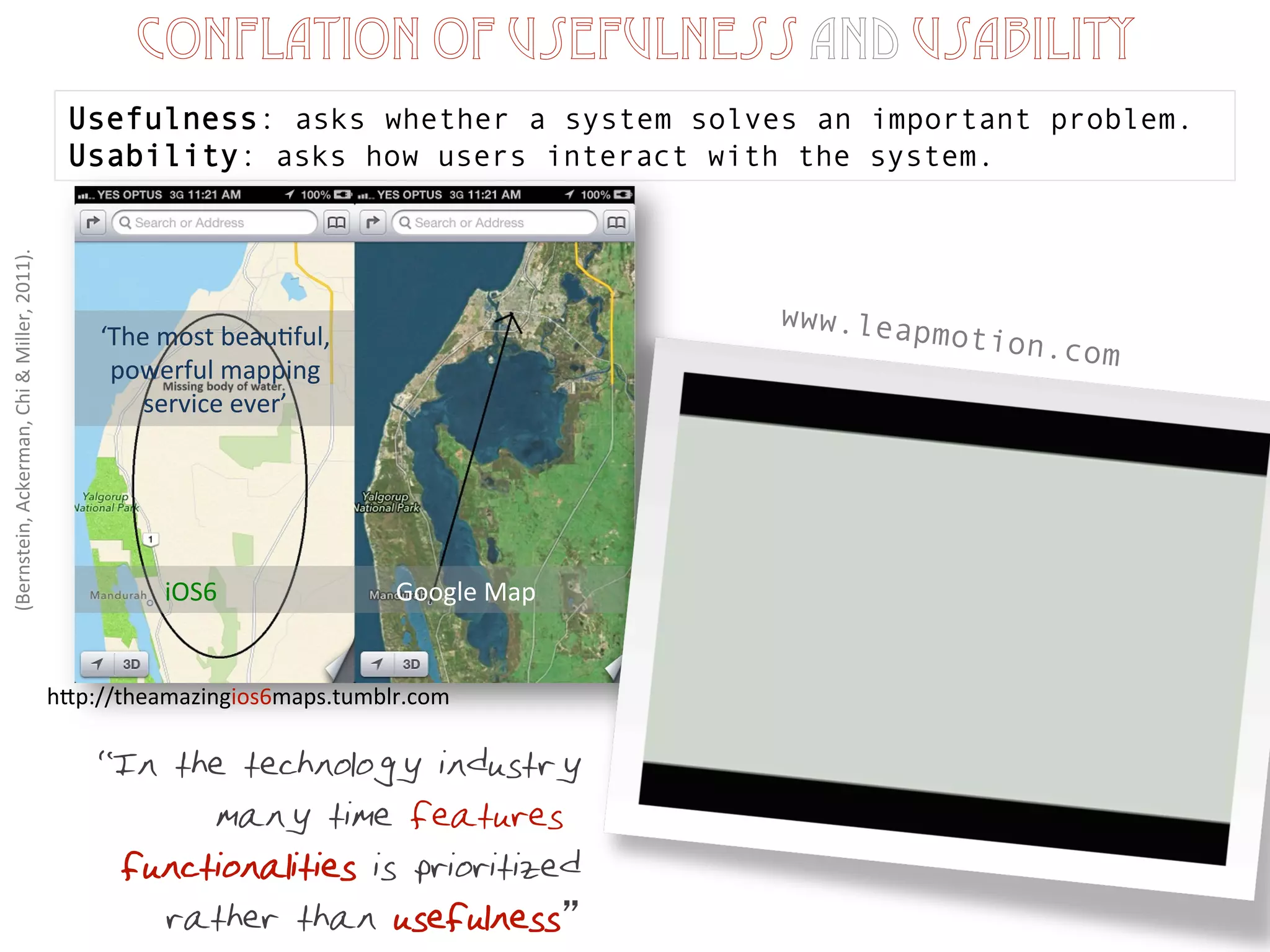
Conflation of usefulness and usability
Usefulness: asks whether a system solves an important problem.
Usability: asks how users interact with the system.
“In the technology industry
many time features &
functionalities is prioritized
rather than usefulness
www.leapmotion.com
hEp://theamazingios6maps.tumblr.com	
  
‘The	
  most	
  beau1ful,	
  
powerful	
  mapping	
  
service	
  ever’	
  
iOS6	


  Google	
  Map	
  
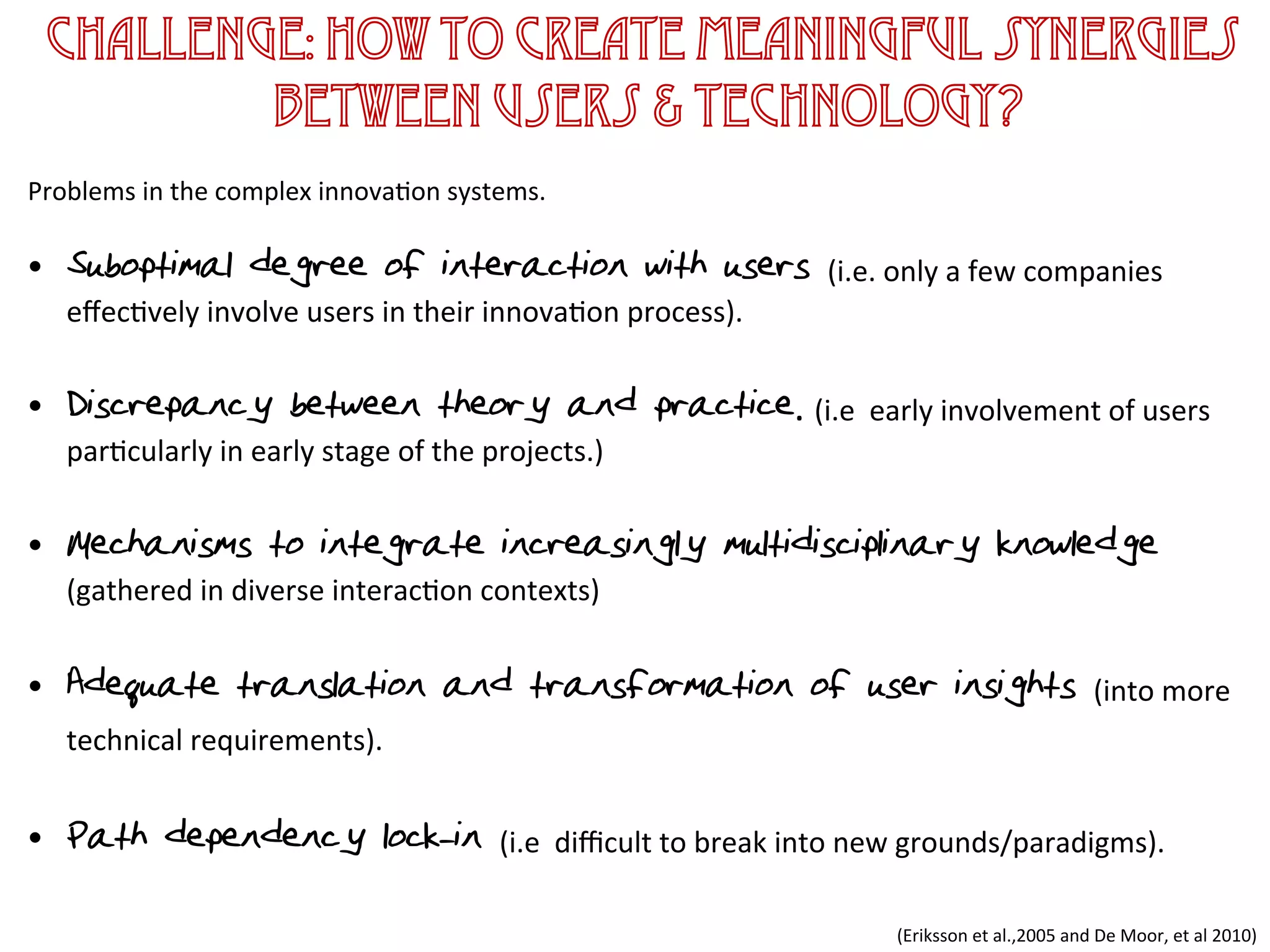
Challenge: How to create meaningful synergies
between users & technology?
	
  
Problems	
  in	
  the	
  complex	
  innova1on	
  systems.	


•  Suboptimal degree of interaction with users (i.e.	
  only	
  a	
  few	
  companies	
  
effec1vely	
  involve	
  users	
  in	
  their	
  innova1on	
  process).	


•  Discrepancy between theory and practice.	
  (i.e	
  	
  early	
  involvement	
  of	
  users	
  
par1cularly	
  in	
  early	
  stage	
  of	
  the	
  projects.)	


•  Mechanisms to integrate increasingly multidisciplinary knowledge
(gathered	
  in	
  diverse	
  interac1on	
  contexts)	


•  Adequate translation and transformation of user insights (into	
  more	
  
technical	
  requirements).	


•  Path dependency& lock-in (i.e	
  	
  difficult	
  to	
  break	
  into	
  new	
  grounds/paradigms).	
  	
  
(Eriksson	
  et	
  al.,2005	
  and	
  De	
  Moor,	
  et	
  al	
  2010)	
  
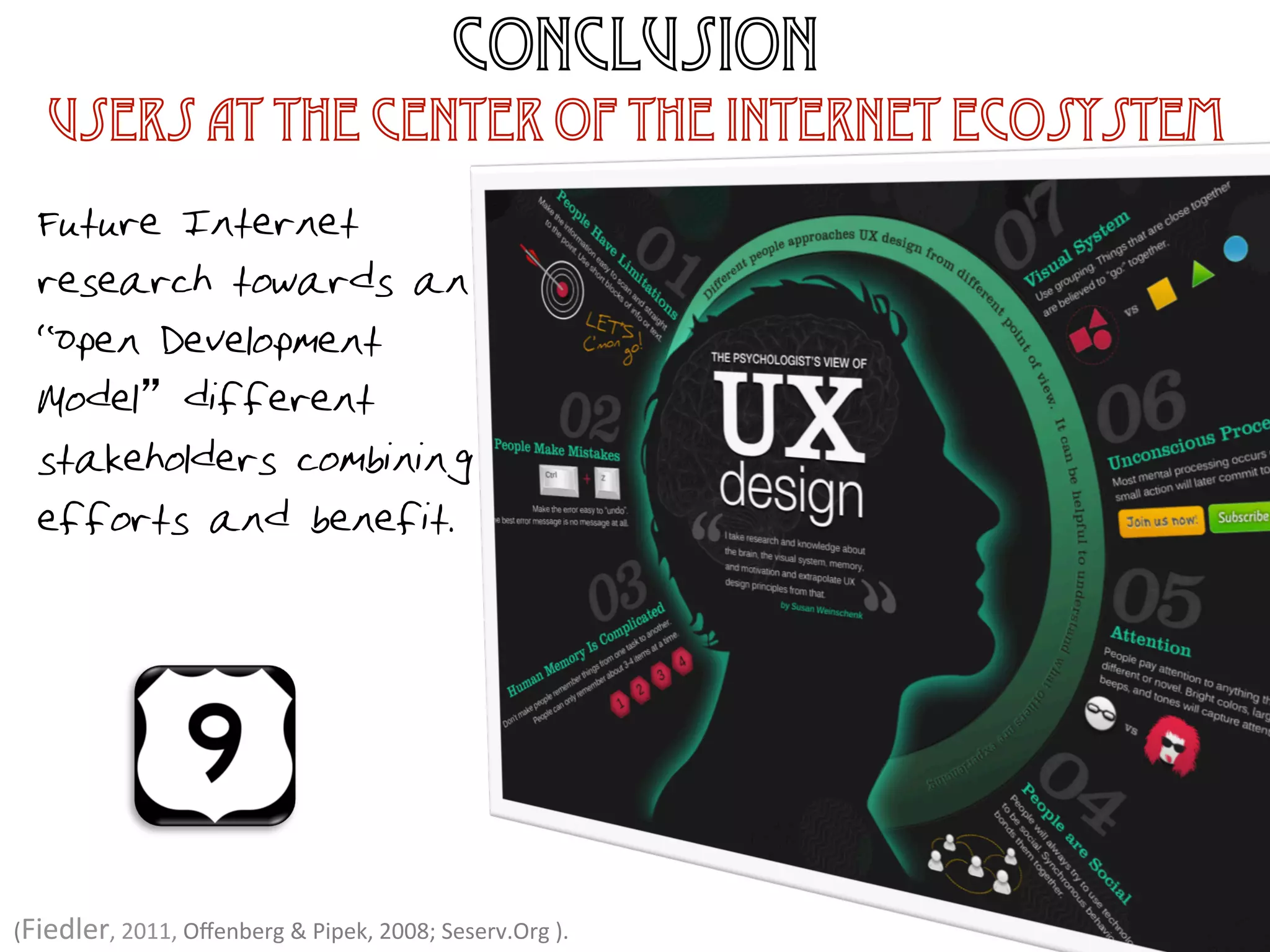
(Fiedler,	
  2011,	
  Offenberg	
  &	
  Pipek,	
  2008;	
  Seserv.Org	
  ).	
  	
  
Future Internet
research towards an
“Open Development
Model different
stakeholders combining
efforts and benefit.
conclusion
Users at the center of the Internet Ecosystem
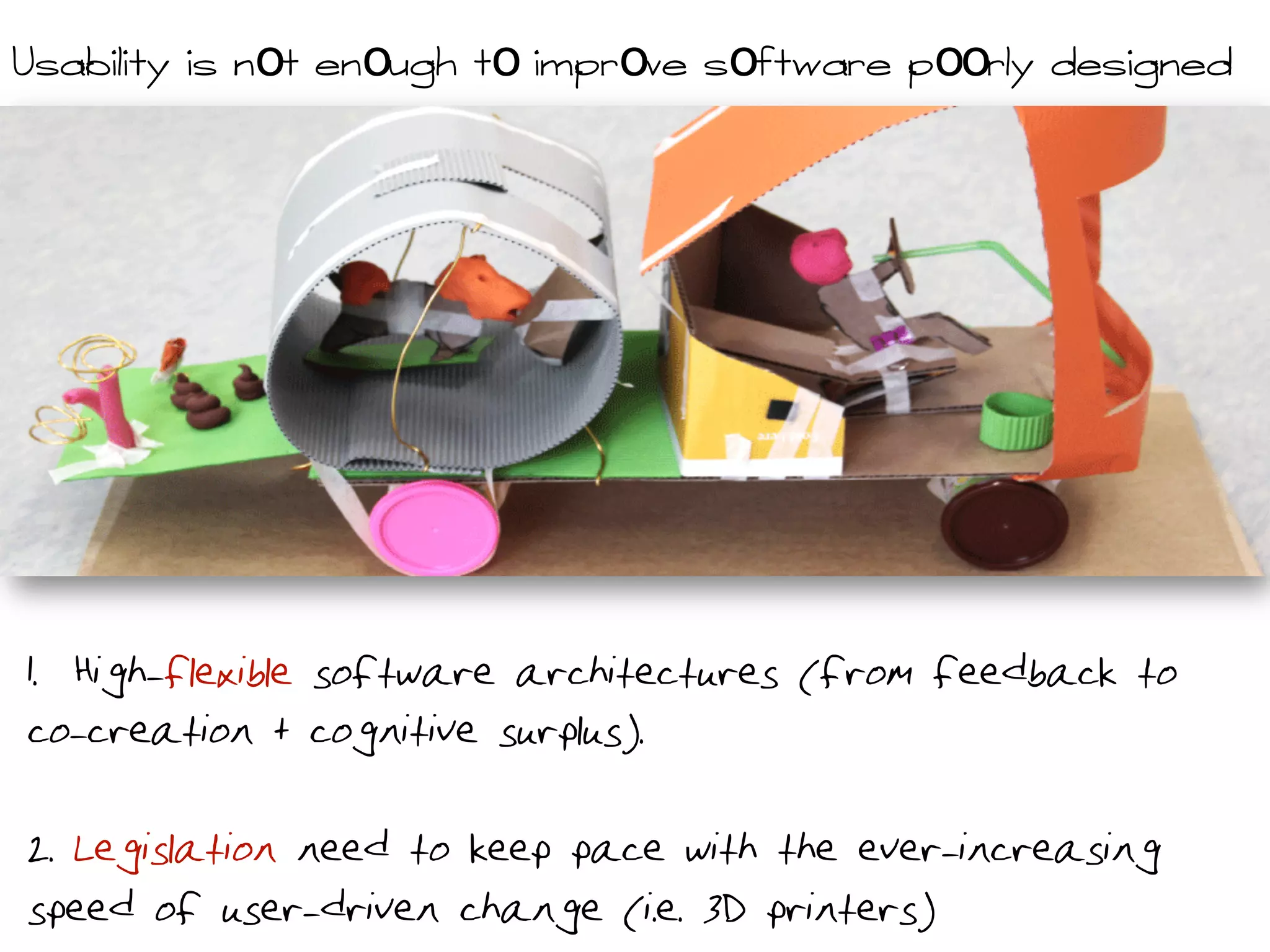
Vtbcjmjuz jt nou fnovhi uo jnqsowf toguxbsf qoosmz eftjhnfec
1.  High-flexible software architectures (from feedback to
co-creation + cognitive surplus).
2. Legislation need to keep pace with the ever-increasing
speed of user-driven change (i.e. 3D printers)
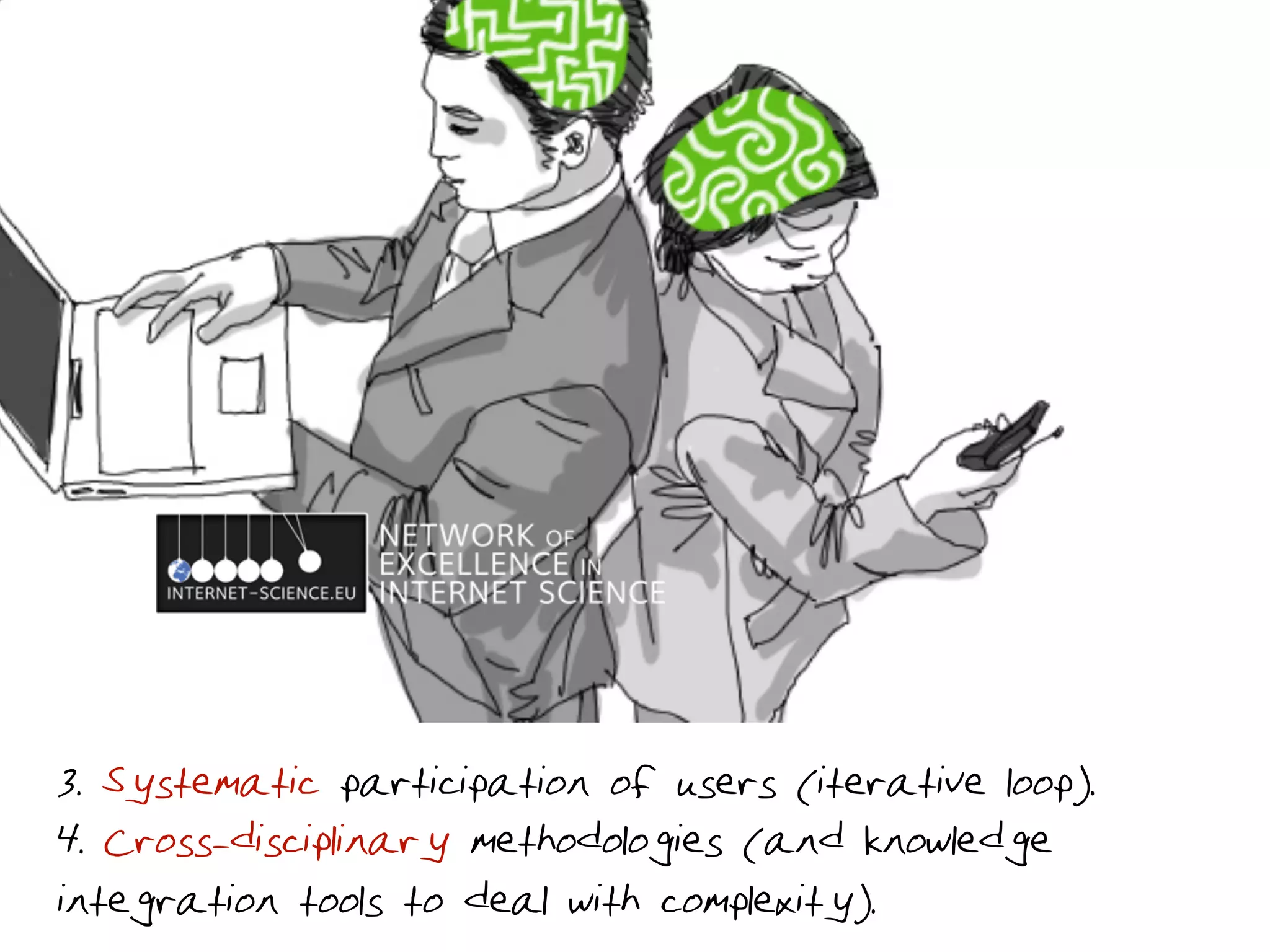
3. Systematic participation of users (iterative loop).
4. Cross-disciplinary methodologies (and knowledge
integration tools to deal with complexity).
5. Adopting various IPR
models (providing more flexible
uses).
6. Clear incentives (combining
extrinsic with intrinsic
motivation) I.e. pull-push
7. QoE matters more
than QoS to users.
8. Open to different
cultures, languages
(but localisation‐
friendly, context
based).
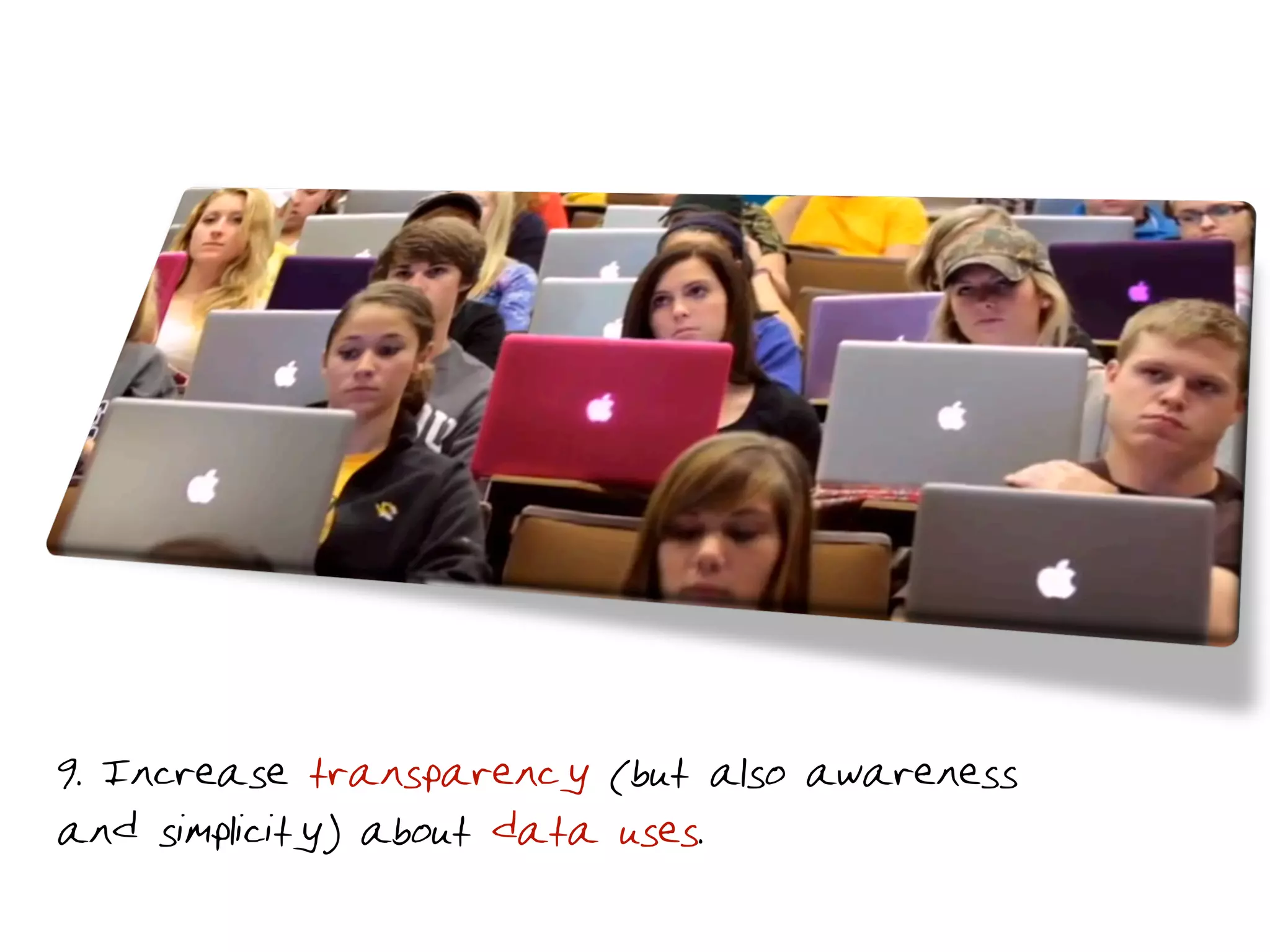
9. Increase transparency (but also awareness
and simplicity) about data uses.
@cristobalcobo	
  
hEp://1ny.cc/ppts	
  
Oxford	
  Internet	
  Ins1tute	
  Research	
  Fellow.	
  
References	
  •  Almirall,	
  E.,	
  &	
  Wareham,	
  J.	
  (2008).	
  Living	
  Labs	
  and	
  open	
  innova1on:	
  roles	
  and	
  applicability.	
  The	
  Electronic	
  Journal	
  for	
  Virtual	
  
OrganizaDons	
  and	
  Networks,	
  10(3),	
  21–46.	
  
•  Bernstein,	
  M.	
  S.,	
  Ackerman,	
  M.	
  S.,	
  Chi,	
  E.	
  H.,	
  &	
  Miller,	
  R.	
  C.	
  (2011).	
  The	
  trouble	
  with	
  social	
  compu1ng	
  systems	
  research.	
  In	
  
Proceedings	
  of	
  the	
  2011	
  annual	
  conference	
  extended	
  abstracts	
  on	
  Human	
  factors	
  in	
  compuDng	
  systems	
  (pp.	
  389–398).	
  Retrieved	
  
from	
  hEp://dl.acm.org/cita1on.cfm?id=1979618	
  
•  Coetzee,	
  H.,	
  Du	
  Toit,	
  I.-­‐M.,	
  &	
  Herselman,	
  M.	
  (2012).	
  Living	
  Labs	
  in	
  South	
  Africa:	
  An	
  analysis	
  based	
  on	
  five	
  case	
  studies.	
  Retrieved	
  
from	
  hEp://researchspace.csir.co.za/dspace/handle/10204/6082	
  
•  De	
  Moor,	
  K.,	
  Berte,	
  K.,	
  De	
  Marez,	
  L.,	
  Joseph,	
  W.,	
  Deryckere,	
  T.,	
  &	
  Martens,	
  L.	
  (2010).	
  User-­‐driven	
  innova1on?	
  Challenges	
  of	
  user	
  
involvement	
  in	
  future	
  technology	
  analysis.	
  Science	
  and	
  Public	
  Policy,	
  37(1),	
  51–61.	
  
•  DuEon,	
  W.	
  (2008).	
  Collabora1ve	
  network	
  organiza1ons:	
  new	
  technical,	
  managerial	
  and	
  social	
  infrastructures	
  to	
  capture	
  the	
  
value	
  of	
  distributed	
  intelligence.	
  Retrieved	
  from	
  hEp://papers.ssrn.com/sol3/papers.cfm?abstract_id=1302893	
  
•  Eriksson,	
  M.,	
  Niitamo,	
  V.-­‐P.,	
  &	
  Kulkki,	
  S.	
  (2005).	
  State-­‐of-­‐the-­‐art	
  in	
  u1lizing	
  Living	
  Labs	
  approach	
  to	
  user-­‐centric	
  ICT	
  innova1on-­‐a	
  
European	
  approach.	
  Lulea:	
  Center	
  for	
  Distance-­‐spanning	
  Technology.	
  Lulea	
  University	
  of	
  Technology	
  Sweden:	
  Lulea.	
  Online	
  
under:	
  hSp://www.	
  cdt.	
  ltu.	
  se/main.	
  php/SOA_LivingLabs.	
  pdf.	
  Retrieved	
  from	
  hEp://www.vinnova.se/upload/dokument/
verksamhet/1ta/stateozheart_livinglabs_eriksson2005.pdf	
  
•  Nicolas	
  nova.	
  (2009,	
  October	
  15).	
  Field	
  research	
  and	
  interacDon	
  design.	
  Retrieved	
  from	
  hEp://www.slideshare.net/nicolasnova/
field-­‐research-­‐and-­‐interac1on-­‐design	
  
•  Pallot,	
  M.,	
  Trousse,	
  B.,	
  Senach,	
  B.,	
  &	
  Scapin,	
  D.	
  (2010).	
  Living	
  Lab	
  Research	
  Landscape:	
  From	
  User	
  Centred	
  Design	
  and	
  User	
  
Experience	
  towards	
  User	
  Cocrea1on.	
  Presented	
  at	
  the	
  First	
  European	
  Summer	
  School	
  “Living	
  Labs.”	
  Retrieved	
  from	
  hEp://
hal.inria.fr/inria-­‐00612632	
  
•  Paul	
  Isakson.	
  (2008,	
  March	
  22).	
  What’s	
  Next	
  In	
  MarkeDng	
  &	
  AdverDsing.	
  News	
  &	
  Poli1cs.	
  Retrieved	
  from	
  hEp://
www.slideshare.net/paulisakson/whats-­‐next-­‐in-­‐marke1ng-­‐adver1sing-­‐318143	
  
•  J.A.G.M.	
  van	
  Dijk.	
  “Conceptual	
  Framework”.	
  In:	
  Study	
  on	
  the	
  Social	
  Impact	
  of	
  ICT	
  (2010),	
  pp.	
  1–30.	
  
•  Hess,	
  J.,	
  Offenberg,	
  S.,	
  &	
  Pipek,	
  V.	
  (2008).	
  Community	
  driven	
  development	
  as	
  par1cipa1on?:	
  involving	
  user	
  communi1es	
  in	
  a	
  
sozware	
  design	
  process.	
  In	
  Proceedings	
  of	
  the	
  Tenth	
  Anniversary	
  Conference	
  on	
  ParDcipatory	
  Design	
  2008	
  (pp.	
  31–40).	
  Retrieved	
  
from	
  hEp://dl.acm.org/cita1on.cfm?id=1795240	
  
•  Fiedler,	
  M.,	
  et	
  al.	
  Future	
  Internet	
  Assembly	
  Research	
  Roadmap–Towards	
  Framework	
  8:	
  Research	
  PrioriDes	
  for	
  the	
  Future	
  Internet.	
  
Technical	
  report,	
  Future	
  Internet	
  Assembly	
  Working	
  Group,	
  2011.	
  

‘From the lab into the real world’ [A User-Centered Approach]

  • 1.
    When we learnall the answers, they change the questions @cristobalcobo   oxford  internet  ins1tute  
  • 2.
    Old Paradigm New Paradigm consumer   consumer   company   company  
  • 3.
    “Any customer canhave a car painted any colour that he wants so long as it is black “ *(h.ford,1922) Remark  about  the  Model  T  in  1909,  published  in  his  autobiography  My  Life  and  Work  (1922)  
  • 4.
    “individual  playing  both  roles  consumers  of  services   as  well  as  creators  of  added  value  services”.  
  • 5.
  • 6.
  • 7.
  • 8.
  • 9.
  • 15.
  • 16.
     The  Documentary  Network  by   Windows  Phone  Design  Studio  youtube.com/watch?v=lciYKwVLTuk   Connecting - Trends in UI, Interaction, Experience Design    
  • 17.
  • 19.
    Domain  Landscape  of  the  Living  Lab  Research  Map     (Pallot  et  al.,  2010)  
  • 20.
    User-centricity User-centred Design Toolsin FI Projects ques9onnaires   focus  groups   interviews   prac9cal  workshops   shadowing   cultural  probes   pen  &  paper  mock-­‐ups   fully  func9onal   prototypes   in-­‐home  observa9on   think-­‐aloud  sessions   user  diaries   field  studies   personas  or  scenarios   eye-­‐tracking  studies   scenario-­‐based  focus   groups   s9mulus  material  like   comic  strips,  videos,   theatre  performances,   drama9sed  stories   usability  tes9ng   longitudinal  evalua9on   weekly   teleconferences   beta  launch   Source: 29 0f 55 respondents (working on 35 different Future Internet projects) use this tools (2012).
  • 21.
  • 22.
    •  ICT changepower relations in (almost) all domains. •  Technologies can be understood as a trend amplifier. •  Can empower users of all kinds: citizens, consumers, workers, patients, audiences... (van  Dijk,  2010)   2011  
  • 23.
    How to engagewith users in order to adopt an active role in co-creation & co-design?
  • 24.
    •  SOPA  &  PIPA  protest  [2012]     •  English  Wikipedia  +~7,000  websites  coordinated  a  service  blackout,  to  raise  awareness.     •  160  million  people  viewed  Wikipedia's  banner.     •  Google  collected  +7  million  signatures.   •  BoycoEs  of  companies  and  organiza1ons  that  support  the  legisla1on.  
  • 25.
    Network  Type:  Architecture   Openness   Control   Modulariza9on   3.0  Collabora1on       Many-­‐to-­‐Many   Managed   High   High     2.0  Contribu1ng         Many-­‐to-­‐Many   Networked   Moderate     (i.e.  reputa1on)   Moderate     (i.e.  simple  task)   1.0  Sharing     One-­‐to-­‐many   Open   Low   Low   (DuEon,  2008)   3  Levels  of  Collabora9ve  Networks  Organiza9ons  
  • 26.
    Clay  Shirky's  Cogni1ve  Surplus:  Crea1vity  and  Generosity  in  a  Connected  Age   reCAPTCHA    is  a  type  of  challenge-­‐response   that  ask  users  to  enter  words  seen  in   distorted  text  images  on  screen  (it   helps  digi1ze  the  text  of  books,  while   protec1ng  websites  from  bots).     The  system  has  been  reported  as  displaying   over  100  million  CAPTCHAs  every  day.  
  • 27.
    New ideas thatcan be turned into applications and add added value. The ability to collaborate between people: a) of different backgrounds (micro-contexts), b) with different perspectives, and c) possessing different knowledge. Human centric systemic innovation instruments (encouraging the interaction between all stakeholders). Eriksson  et  al.,2005   co-creation/co-innovation Khan  Academy  Lite   Raspberry  Pi   hLp://kalite.learningequality.org  
  • 28.
    (Pallot  et  al.,  2010)   Contextual & social based adoption & adaptation of ICT: •  Living  Labs  +  User  Driven  Innova9on  +  User  Centred  Design  +  User  Created   Content  +  User  Group  Experience  (socio-­‐emo1onal)   …BUT •  The  principles  (usability,  accessibility  or  technology  customiza9on)  are  more   manifested  in  theore9cal  considera9ons  rather  than  in  prac9ce.     •  Significant  number  of    “one-­‐size-­‐fits-­‐all”  paradigm  is  common  in  the  market.   40,000  solu1on  submissions  [200,000  solvers  -­‐200  countries]  Awards:  $5,000  to  $1+M    
  • 29.
  • 30.
    Communications tools dont get socially interesting until they get technologically boring (Shirky, 2008) Interesting social innovations may not be interesting technically (Bernstein, et al, 2011) Flash  mobs  strike  again  for  the  9th  annual  ‘no   pants’  subway  ride   Social  Media’s  Influence  on  the  Arab  Spring   Privacy  or  data  protec1on?  
  • 31.
    (Bernstein,  Ackerman,  Chi  &  Miller,  2011).   Conflation of usefulness and usability Usefulness: asks whether a system solves an important problem. Usability: asks how users interact with the system. “In the technology industry many time features & functionalities is prioritized rather than usefulness www.leapmotion.com hEp://theamazingios6maps.tumblr.com   ‘The  most  beau1ful,   powerful  mapping   service  ever’   iOS6                                                        Google  Map  
  • 32.
    Challenge: How tocreate meaningful synergies between users & technology?   Problems  in  the  complex  innova1on  systems.       •  Suboptimal degree of interaction with users (i.e.  only  a  few  companies   effec1vely  involve  users  in  their  innova1on  process).     •  Discrepancy between theory and practice.  (i.e    early  involvement  of  users   par1cularly  in  early  stage  of  the  projects.)       •  Mechanisms to integrate increasingly multidisciplinary knowledge (gathered  in  diverse  interac1on  contexts)     •  Adequate translation and transformation of user insights (into  more   technical  requirements).       •  Path dependency& lock-in (i.e    difficult  to  break  into  new  grounds/paradigms).     (Eriksson  et  al.,2005  and  De  Moor,  et  al  2010)  
  • 33.
    (Fiedler,  2011,  Offenberg  &  Pipek,  2008;  Seserv.Org  ).     Future Internet research towards an “Open Development Model different stakeholders combining efforts and benefit. conclusion Users at the center of the Internet Ecosystem
  • 34.
    Vtbcjmjuz jt noufnovhi uo jnqsowf toguxbsf qoosmz eftjhnfec 1.  High-flexible software architectures (from feedback to co-creation + cognitive surplus). 2. Legislation need to keep pace with the ever-increasing speed of user-driven change (i.e. 3D printers)
  • 35.
    3. Systematic participationof users (iterative loop). 4. Cross-disciplinary methodologies (and knowledge integration tools to deal with complexity).
  • 36.
    5. Adopting variousIPR models (providing more flexible uses). 6. Clear incentives (combining extrinsic with intrinsic motivation) I.e. pull-push
  • 37.
    7. QoE mattersmore than QoS to users. 8. Open to different cultures, languages (but localisation‐ friendly, context based).
  • 38.
    9. Increase transparency(but also awareness and simplicity) about data uses.
  • 39.
    @cristobalcobo   hEp://1ny.cc/ppts   Oxford  Internet  Ins1tute  Research  Fellow.  
  • 40.
    References  •  Almirall,  E.,  &  Wareham,  J.  (2008).  Living  Labs  and  open  innova1on:  roles  and  applicability.  The  Electronic  Journal  for  Virtual   OrganizaDons  and  Networks,  10(3),  21–46.   •  Bernstein,  M.  S.,  Ackerman,  M.  S.,  Chi,  E.  H.,  &  Miller,  R.  C.  (2011).  The  trouble  with  social  compu1ng  systems  research.  In   Proceedings  of  the  2011  annual  conference  extended  abstracts  on  Human  factors  in  compuDng  systems  (pp.  389–398).  Retrieved   from  hEp://dl.acm.org/cita1on.cfm?id=1979618   •  Coetzee,  H.,  Du  Toit,  I.-­‐M.,  &  Herselman,  M.  (2012).  Living  Labs  in  South  Africa:  An  analysis  based  on  five  case  studies.  Retrieved   from  hEp://researchspace.csir.co.za/dspace/handle/10204/6082   •  De  Moor,  K.,  Berte,  K.,  De  Marez,  L.,  Joseph,  W.,  Deryckere,  T.,  &  Martens,  L.  (2010).  User-­‐driven  innova1on?  Challenges  of  user   involvement  in  future  technology  analysis.  Science  and  Public  Policy,  37(1),  51–61.   •  DuEon,  W.  (2008).  Collabora1ve  network  organiza1ons:  new  technical,  managerial  and  social  infrastructures  to  capture  the   value  of  distributed  intelligence.  Retrieved  from  hEp://papers.ssrn.com/sol3/papers.cfm?abstract_id=1302893   •  Eriksson,  M.,  Niitamo,  V.-­‐P.,  &  Kulkki,  S.  (2005).  State-­‐of-­‐the-­‐art  in  u1lizing  Living  Labs  approach  to  user-­‐centric  ICT  innova1on-­‐a   European  approach.  Lulea:  Center  for  Distance-­‐spanning  Technology.  Lulea  University  of  Technology  Sweden:  Lulea.  Online   under:  hSp://www.  cdt.  ltu.  se/main.  php/SOA_LivingLabs.  pdf.  Retrieved  from  hEp://www.vinnova.se/upload/dokument/ verksamhet/1ta/stateozheart_livinglabs_eriksson2005.pdf   •  Nicolas  nova.  (2009,  October  15).  Field  research  and  interacDon  design.  Retrieved  from  hEp://www.slideshare.net/nicolasnova/ field-­‐research-­‐and-­‐interac1on-­‐design   •  Pallot,  M.,  Trousse,  B.,  Senach,  B.,  &  Scapin,  D.  (2010).  Living  Lab  Research  Landscape:  From  User  Centred  Design  and  User   Experience  towards  User  Cocrea1on.  Presented  at  the  First  European  Summer  School  “Living  Labs.”  Retrieved  from  hEp:// hal.inria.fr/inria-­‐00612632   •  Paul  Isakson.  (2008,  March  22).  What’s  Next  In  MarkeDng  &  AdverDsing.  News  &  Poli1cs.  Retrieved  from  hEp:// www.slideshare.net/paulisakson/whats-­‐next-­‐in-­‐marke1ng-­‐adver1sing-­‐318143   •  J.A.G.M.  van  Dijk.  “Conceptual  Framework”.  In:  Study  on  the  Social  Impact  of  ICT  (2010),  pp.  1–30.   •  Hess,  J.,  Offenberg,  S.,  &  Pipek,  V.  (2008).  Community  driven  development  as  par1cipa1on?:  involving  user  communi1es  in  a   sozware  design  process.  In  Proceedings  of  the  Tenth  Anniversary  Conference  on  ParDcipatory  Design  2008  (pp.  31–40).  Retrieved   from  hEp://dl.acm.org/cita1on.cfm?id=1795240   •  Fiedler,  M.,  et  al.  Future  Internet  Assembly  Research  Roadmap–Towards  Framework  8:  Research  PrioriDes  for  the  Future  Internet.   Technical  report,  Future  Internet  Assembly  Working  Group,  2011.