
DR.AHMED YOUSSEF
MD ORTHOPEDICS
MUBARAK ALKABEER HOSPITAL
KUWAIT
DISTAL BICEPS TENDON
RUPTURE
CASE DISCUSSION
HISTORY
▸Male pt 39 yrs
▸Accountant
▸Weight Lifting during Gym
▸Painful pop
▸Inability to carry things
TEXT
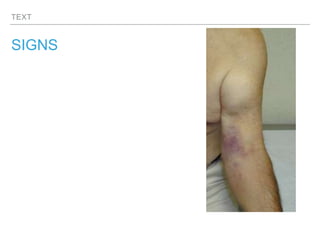
SIGNS
TEXT
PROVISIONAL DIAGNOSIS
▸Distal Biceps Tendon Rupture
TEXT
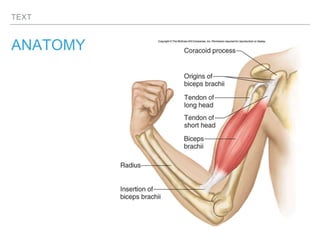
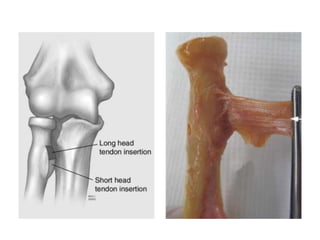
ANATOMY
TEXT
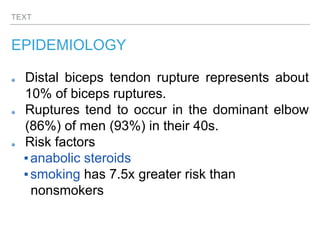
EPIDEMIOLOGY
Distal biceps tendon rupture represents about
10% of biceps ruptures.
Ruptures tend to occur in the dominant elbow
(86%) of men (93%) in their 40s.
Risk factors
▪anabolic steroids
▪smoking has 7.5x greater risk than
nonsmokers
TEXT
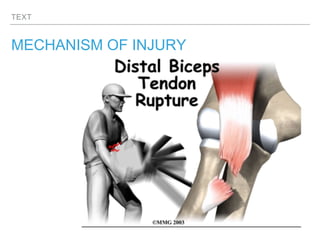
MECHANISM OF INJURY
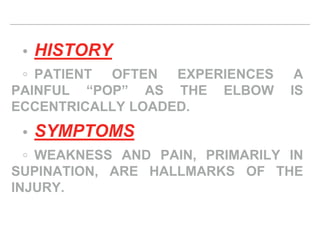
• HISTORY
◦ PATIENT OFTEN EXPERIENCES A
PAINFUL “POP” AS THE ELBOW IS
ECCENTRICALLY LOADED.
• SYMPTOMS
◦ WEAKNESS AND PAIN, PRIMARILY IN
SUPINATION, ARE HALLMARKS OF THE
INJURY.
SIGNS
REVERSE POPEYE SIGN
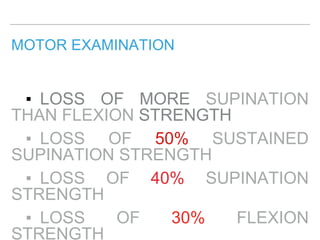
MOTOR EXAMINATION
▪ LOSS OF MORE SUPINATION
THAN FLEXION STRENGTH
▪ LOSS OF 50% SUSTAINED
SUPINATION STRENGTH
▪ LOSS OF 40% SUPINATION
STRENGTH
▪ LOSS OF 30% FLEXION
STRENGTH
TEXT
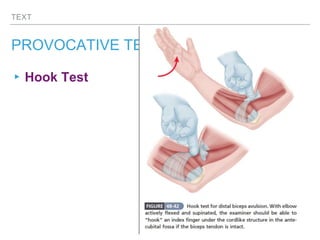
PROVOCATIVE TESTS
▸Hook Test
TEXT
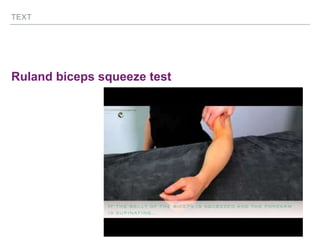
Ruland biceps squeeze test
TEXT
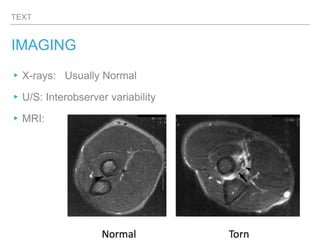
IMAGING
▸X-rays: Usually Normal
▸U/S: Interobserver variability
▸MRI:
TEXT
TREATMENT
▸Conservative: Elderly , low-demand or sedentary patients
who are willing to sacrifice function
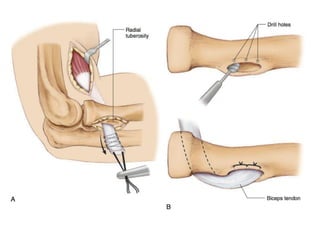
▸Operative: surgical repair of tendon to tuberosity
lndications
▪ young healthy patients who do not want to sacrifice
function
▪ partial tears that do not respond to nonoperative
management
TEXT
FIXATION TECHNIQUES
▸Suture button (400N) > suture anchor
(380N) > bone tunnel (310N) > interference
screw (230N)
▸Combination technique (suture button +
interference screw) stronger than single
technique
TEXT
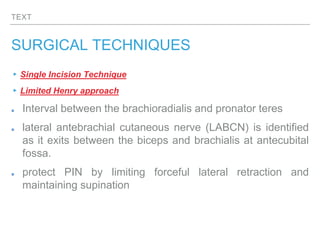
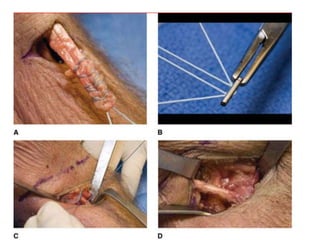
SURGICAL TECHNIQUES
▸Single Incision Technique
▸Limited Henry approach
Interval between the brachioradialis and pronator teres
lateral antebrachial cutaneous nerve (LABCN) is identified
as it exits between the biceps and brachialis at antecubital
fossa.
protect PIN by limiting forceful lateral retraction and
maintaining supination
TEXT
COMPLICATIONS
▸Injury to the LABCN is most common.more LABCN injury than 2-incision
approach.
▸Radial nerve or PIN injury is most severe
▪ risk has decreased with new tendon fixation techniques that require less
dissection in the antecubital fossa
▸Synostosis and resulting loss of pronation/supination
▪ avoid exposing periosteum of ulna
▪ avoid dissection between the radius and ulna
▸Heterotopic ossification: less common than with 2 incision technique
TEXT
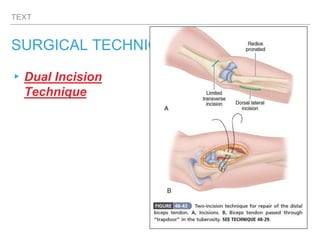
SURGICAL TECHNIQUES
▸Dual Incision
Technique
TEXT
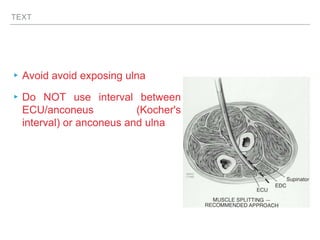
▸Avoid avoid exposing ulna
▸Do NOT use interval between
ECU/anconeus (Kocher's
interval) or anconeus and ulna
TEXT
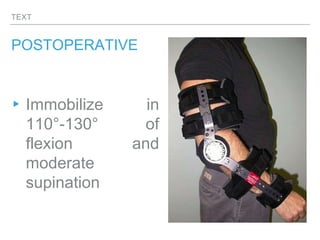
POSTOPERATIVE
▸Immobilize in
110°-130° of
flexion and
moderate
supination
TEXT
COMPLICATIONS
▸LABCN injury is most common.
▸Synostosis and heterotopic
ossification more common with 2
incision than single incision
Distal Biceps Tendon Rupture

Distal Biceps Tendon Rupture