For information purposes only   Inclusive Customer Service From Here to There: The material contained in this presentation is for information purposes only.
Customer: the person receiving the service Person with a disability: language that is respectful of the individual Person-first language: recognizes that service is to the person, not to the disability  For information purposes only   Terminology
Session AGENDA The Accessibility For Ontarians with Disabilities Act (AODA) People with Disabilities Accessible Customer Service Accessibility Directorate of Ontario Implementation and Resources For information purposes only   Inclusive Customer Service Agenda
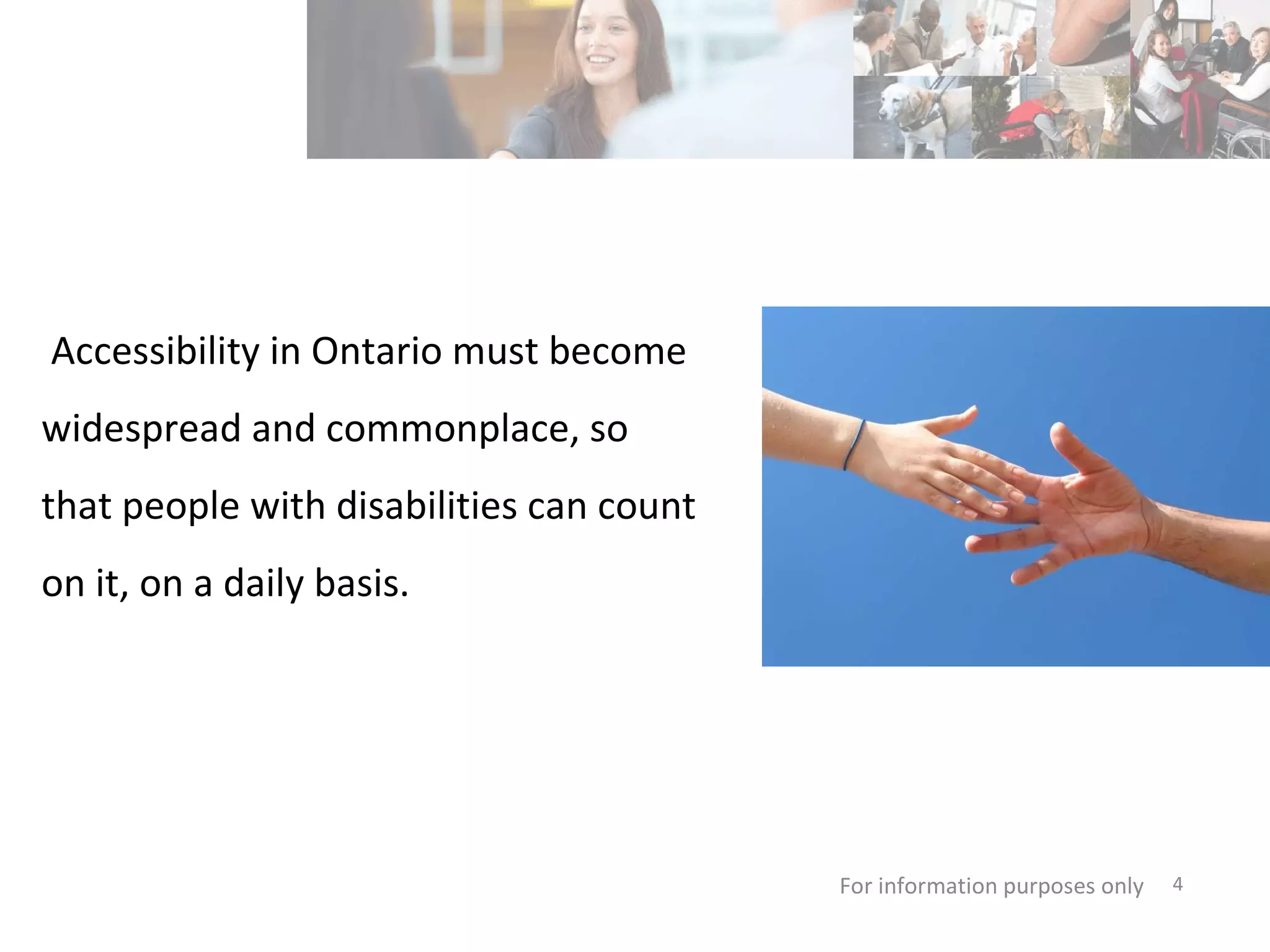
  Accessibility in Ontario must become widespread and commonplace, so that people with disabilities can count on it, on a daily basis. For information purposes only
Context Accessibility for Ontarians with Disabilities Act (AODA) became law in 2005 The Accessibility Directorate of Ontario (ADO) is  responsible for supporting and monitoring compliance As each Accessibility Standard is developed, compliance is province-wide and mandatory For information purposes only
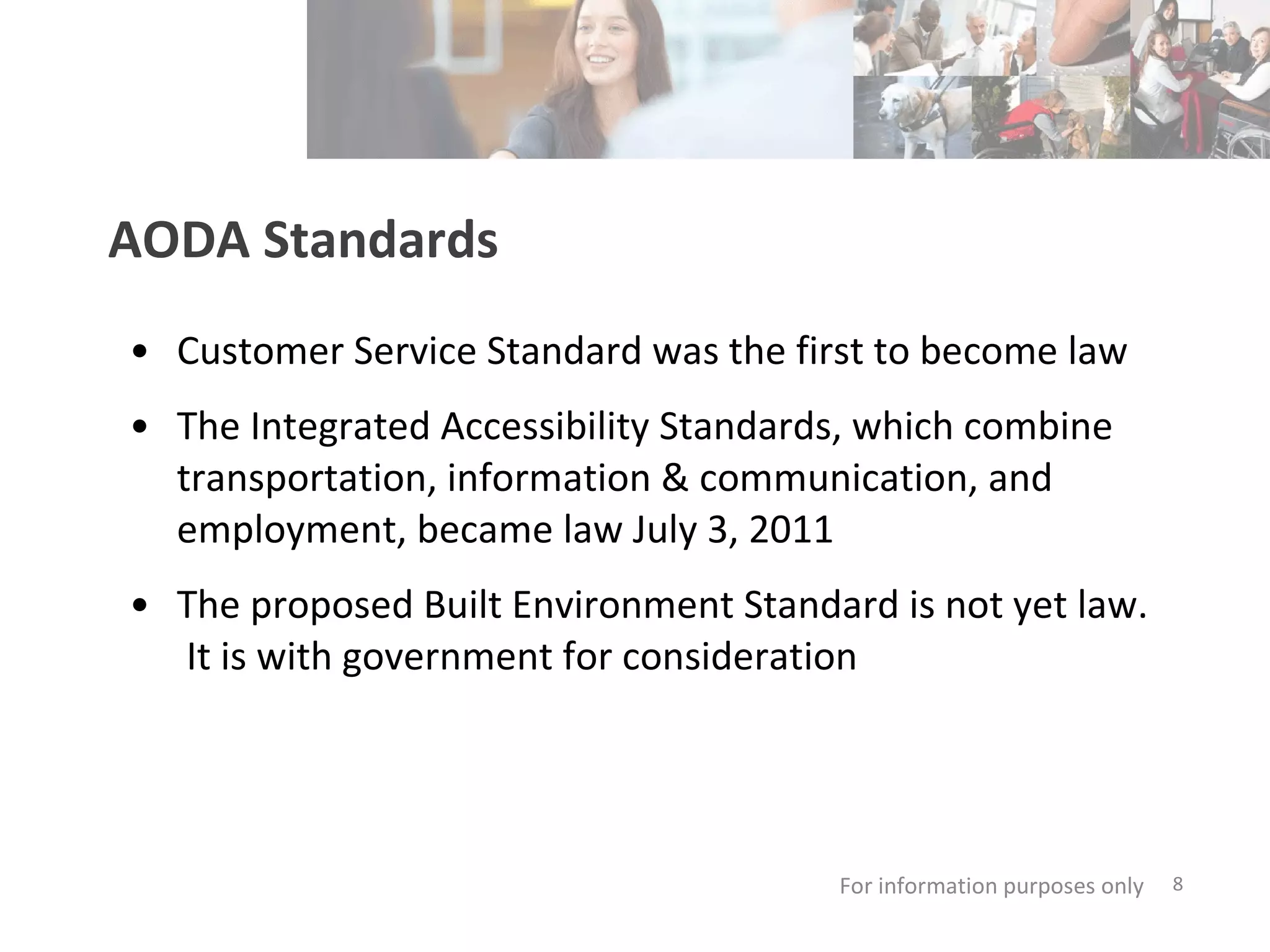
Underlying Principles of the AODA Independence Dignity Integration Equal Opportunity For information purposes only   Based on the Ontario Human Rights Code (OHRC)
The Process of  Developing the Standards The Accessibility Standards have been, and are being, developed through a transparent and inclusive process with  extensive community participation. People with disabilities, representatives from the nonprofit, business, and public sectors, as well as staff from related provincial ministries, provided input. For information purposes only
AODA Standards Customer Service Standard was the first to become law  The Integrated Accessibility Standards, which combine transportation, information & communication, and employment, became law July 3, 2011  The proposed Built Environment Standard is not yet law.  It is with government for consideration For information purposes only
The Customer Service Standard For information purposes only   By  January 1, 2012 , Nonprofit organizations in Ontario must provide goods and services in a way that makes them accessible to people with disabilities
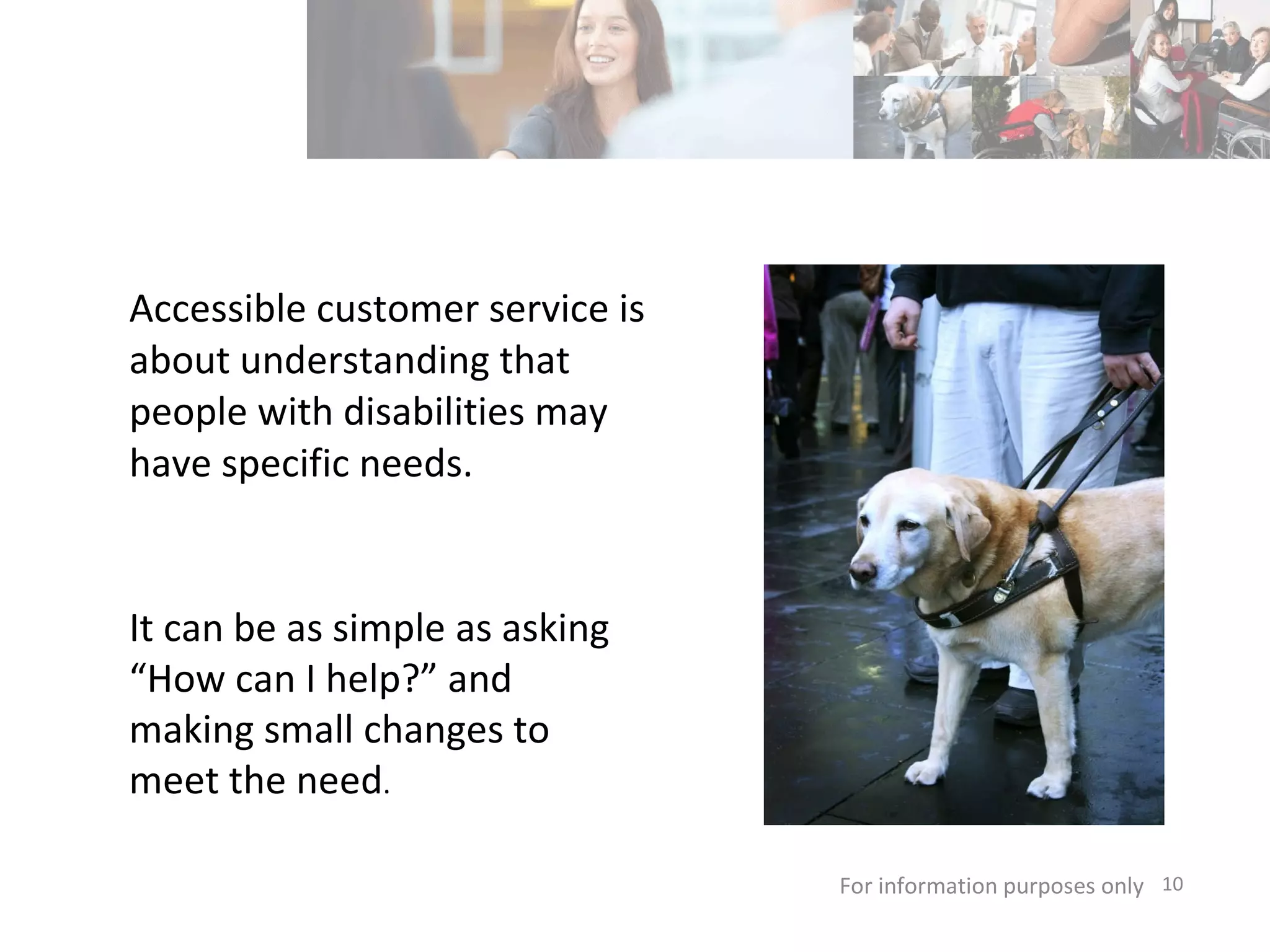
Accessible customer service is about understanding that people with disabilities may have specific needs. For information purposes only   It can be as simple as asking “How can I help?” and making small changes to meet the need .
For information purposes only   Serve-Ability e-learning Course & Tools Valuable training resource developed by the ADO 45 minute e-learning course on AccessON web site  http://www.mcss.gov.on.ca/mcss/serve-ability/splash.html   Printed material includes: Training Resource for Small Business and Organizations Compliance Manual for Businesses and Organizations
AODA Overview of Disability Any degree of physical disability Mental impairment or developmental disability A learning disability A mental disorder An injury/disability under Workplace Safety and Insurance Act, 1997  For information purposes only
For information purposes only   This material is for information purposes only.
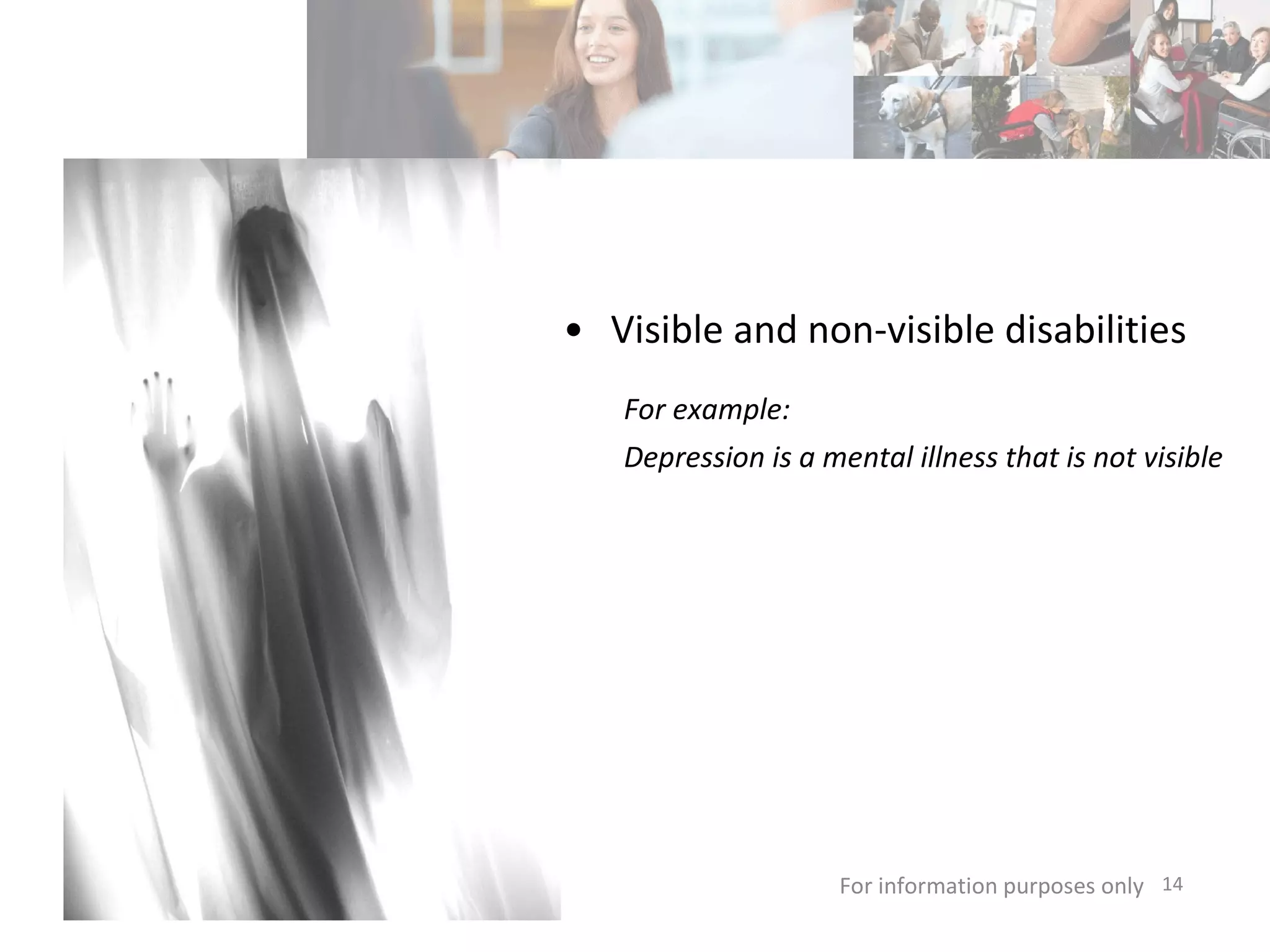
Visible and non-visible disabilities  For information purposes only   For example: Depression is a mental illness that is not visible
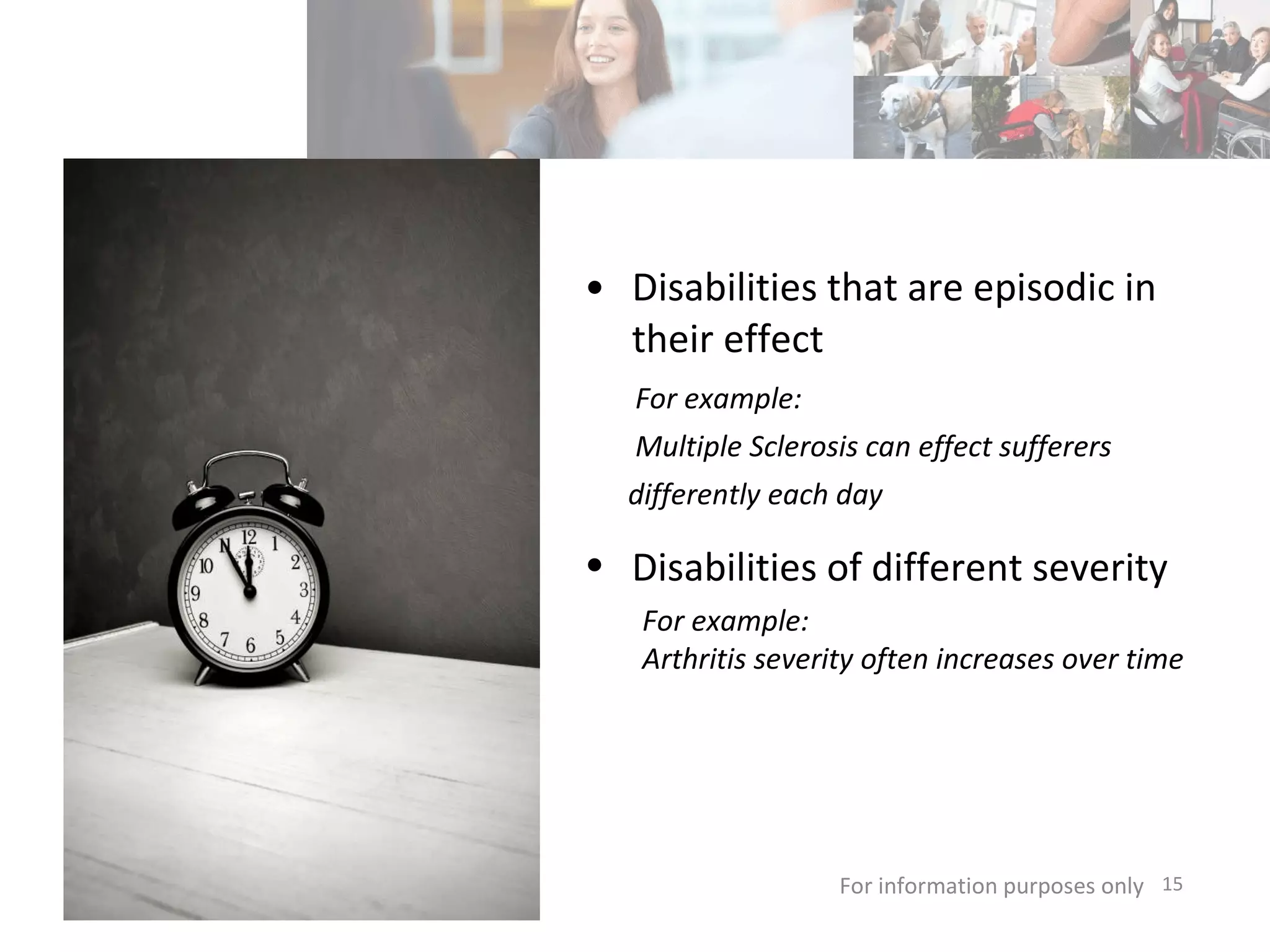
Disabilities that are episodic in their effect For information purposes only   For example: Multiple Sclerosis can effect sufferers differently each day Disabilities of different severity   For example:  Arthritis severity often increases over time
FACT:  More than 15% of Ontarians live with a disability REALITY:  The other 85% can be described as currently ‘abled’   GOAL:  Equitable and Respectful services for all Ontarians For information purposes only   As the population of Ontario ages, the percentage of Ontarians living with a disability will increase.
For information purposes only
Barriers to Accessibility Attitude: stereotypes and language that focus on a person's disability rather than on their abilities  Physical: an ‘accessible’ building where the washroom entrance is too narrow to accommodate a wheelchair  Communication: information provided only in print and only in one font size www.mcss.gov.on.ca/en/mcss/programs/accessibility/understanding_accessibility/understanding_barriers.aspx   For information purposes only
The Purpose of the  Accessibility Directorate of Ontario Develop, implement and enforce standards that will make goods, services, facilities, accommodation, employment, buildings, structures and premises accessible to Ontarians with disabilities. For information purposes only
ADO’s Role in the Compliance Process Provide ADO resources, education and guidance to organizations in Ontario as they comply with the AODA Provide the AODA Contact Centre to answer enquiries about the AODA and the Standards Support and consultation are embedded in the compliance process. Penalties are a means of last resort. For information purposes only
Compliance is Mandatory The Act gives the government the authority to set monetary penalties to enforce compliance. Penalties will be used only after all compliance assistance efforts have been exhausted.  Penalties for non-compliance can range from $200 to $15, 000; continued non-compliance up to $50,000 per day for Directors & $100,000 per day for an organization.  For information purposes only
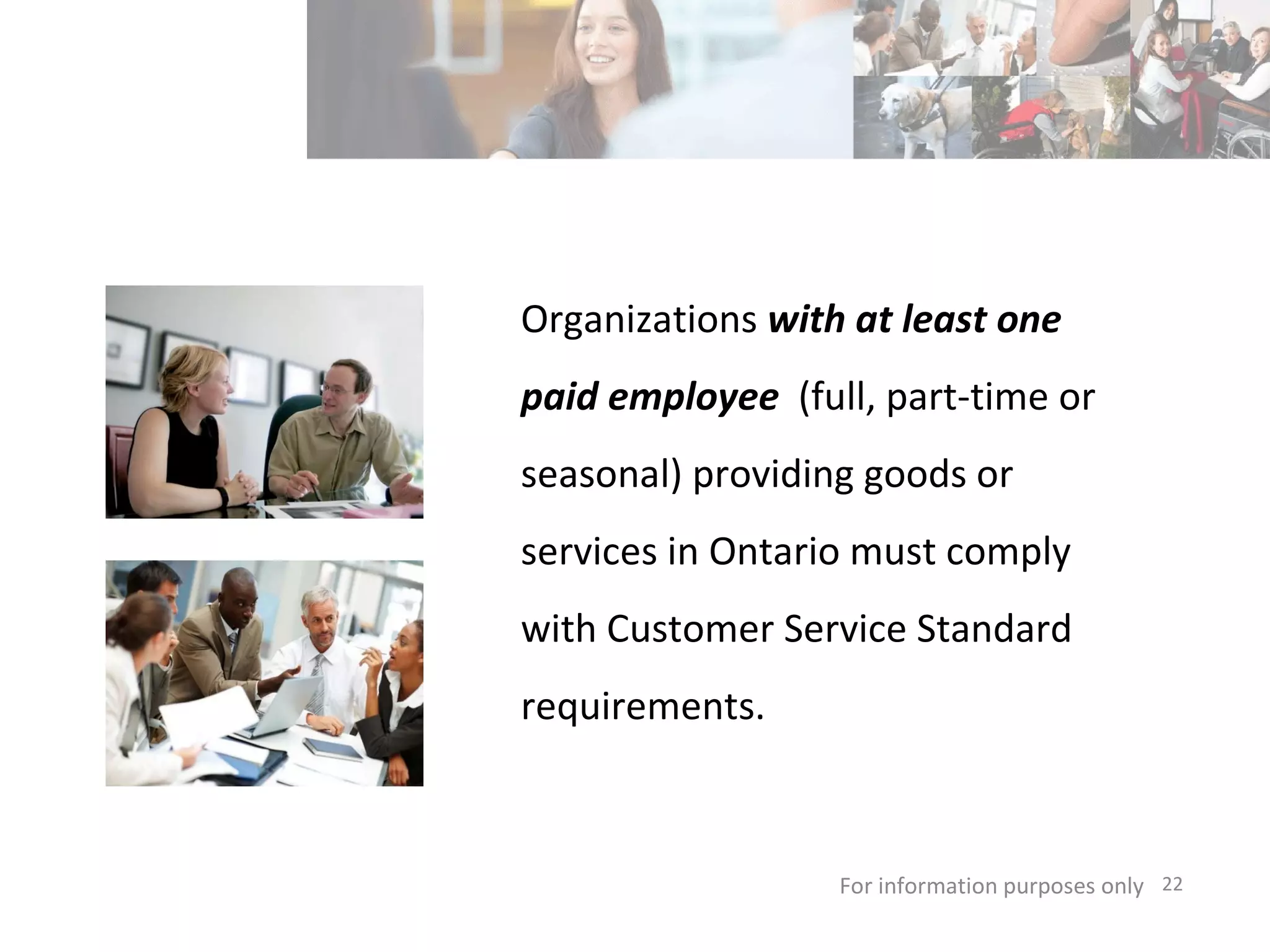
Organizations  with at least one paid employee  (full, part-time or seasonal) providing goods or services in Ontario must comply with Customer Service Standard requirements. For information purposes only
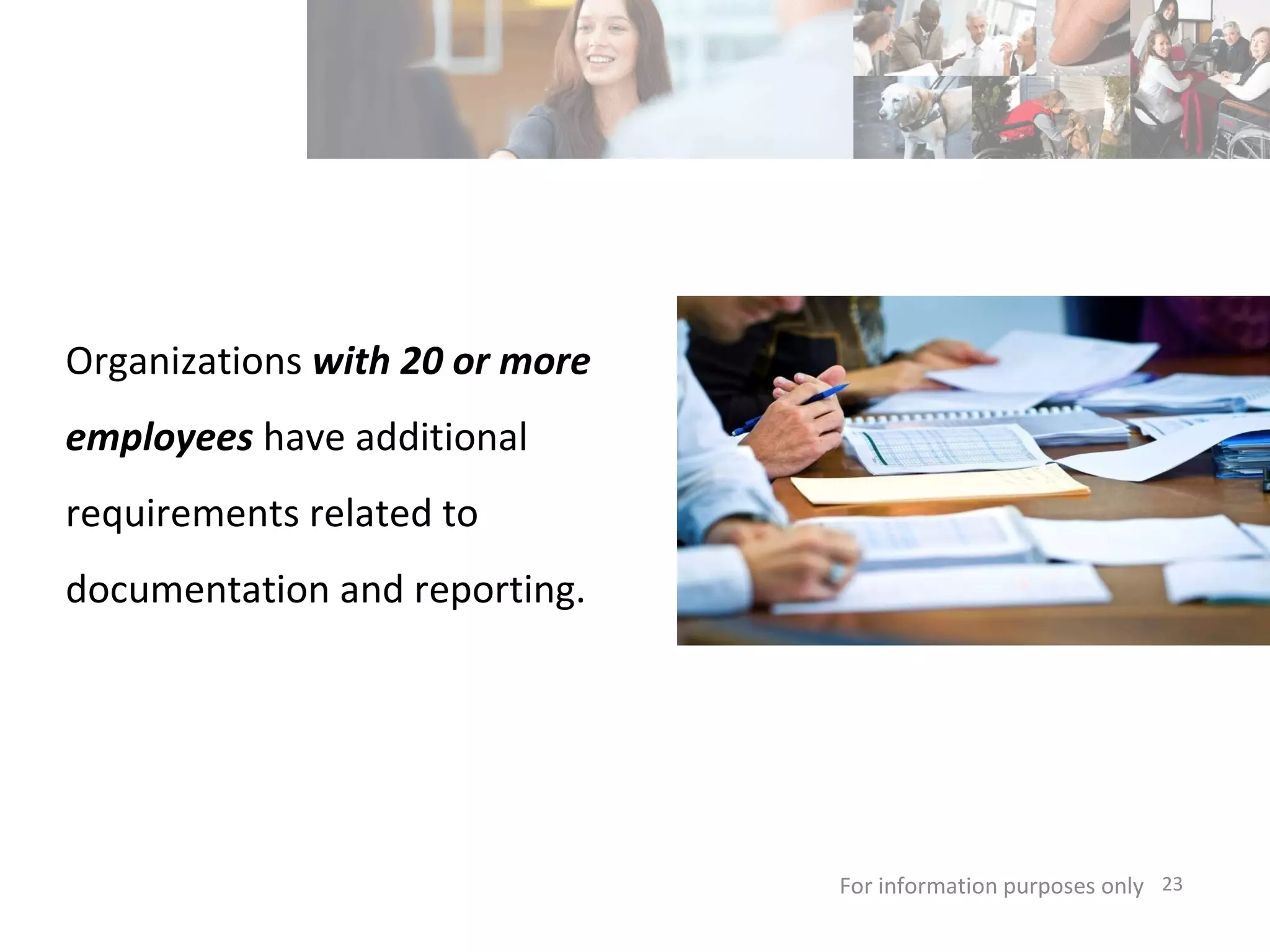
For information purposes only   Organizations  with 20 or more employees  have additional requirements related to documentation and reporting.
For information purposes only
Policies, Practices and Procedures All 11 Requirements need policies, practices and procedures. Grouped in useful categories:   Assistive devices, service animals and support person(s)  Communication Training For information purposes only
Policies, Practices and Procedures re: Assistive devices, service animals, support person(s) Permit people with disabilities to Use personal assistive devices Be accompanied by their service animal Be accompanied by a support person For information purposes only
Policies, Practices and Procedures re: Communication Communicate in a manner that takes into account a person’s disability Provide notice of temporary disruption in service Where admission fees are charged, give advance notice of admission fee for support person Provide clear accessible process for organization to receive feedback and respond to complaints For information purposes only
Policies, Practices and Procedures re: Training Train staff, volunteers and others who prepare policies, practices and procedures  who provide direct service to the public, to other organizations or businesses in Ontario  when someone is new to the organization when services or circumstances change  For information purposes only
Training Must Include Purpose of AODA and requirements of Standard Four core principles Organization-specific policies, procedures and practices for serving people with disabilities  Information about various types of disabilities and ways to provide services effectively & respectfully  For information purposes only
For information purposes only   For information purposes only.
Organizational Process Determine person(s) to be responsible for preparing policies, practices and procedures Identify who needs to be trained Establish training roster and schedule Communicate plans and progress to engage commitment from everyone in organization  For information purposes only
Becoming and Staying Compliant   Use audit tools during implementation Conduct regular review of policies & process Provide training when circumstances, policies or personnel (staff/volunteers) change Evaluate feedback received For information purposes only
Resources on USB PowerPoint slide deck August 26, 2011 H-out: Requirements of the Customer Service Standard From Here to There:  CSS Workbook Notes for Executive Director and Board of Directors AODA Information for E.D., Board, staff and volunteers Tip sheets on serving customers with disabilities AODA CSS: Guide, Compliance Manual & Training Resource For information purposes only
Topics Covered Purpose of AODA  Overview of Disabilities Role of the ADO Requirements of the Customer Service Standard Implementation Resources  For information purposes only
For information purposes only   Inclusive Customer Service From Here to There: The material contained in this presentation is for information purposes only. Web sites www.ontario.ca /AccessON   www.volunteertoronto.ca   www.search.e-laws.gov.on.ca/en/search/#LegalAdvice
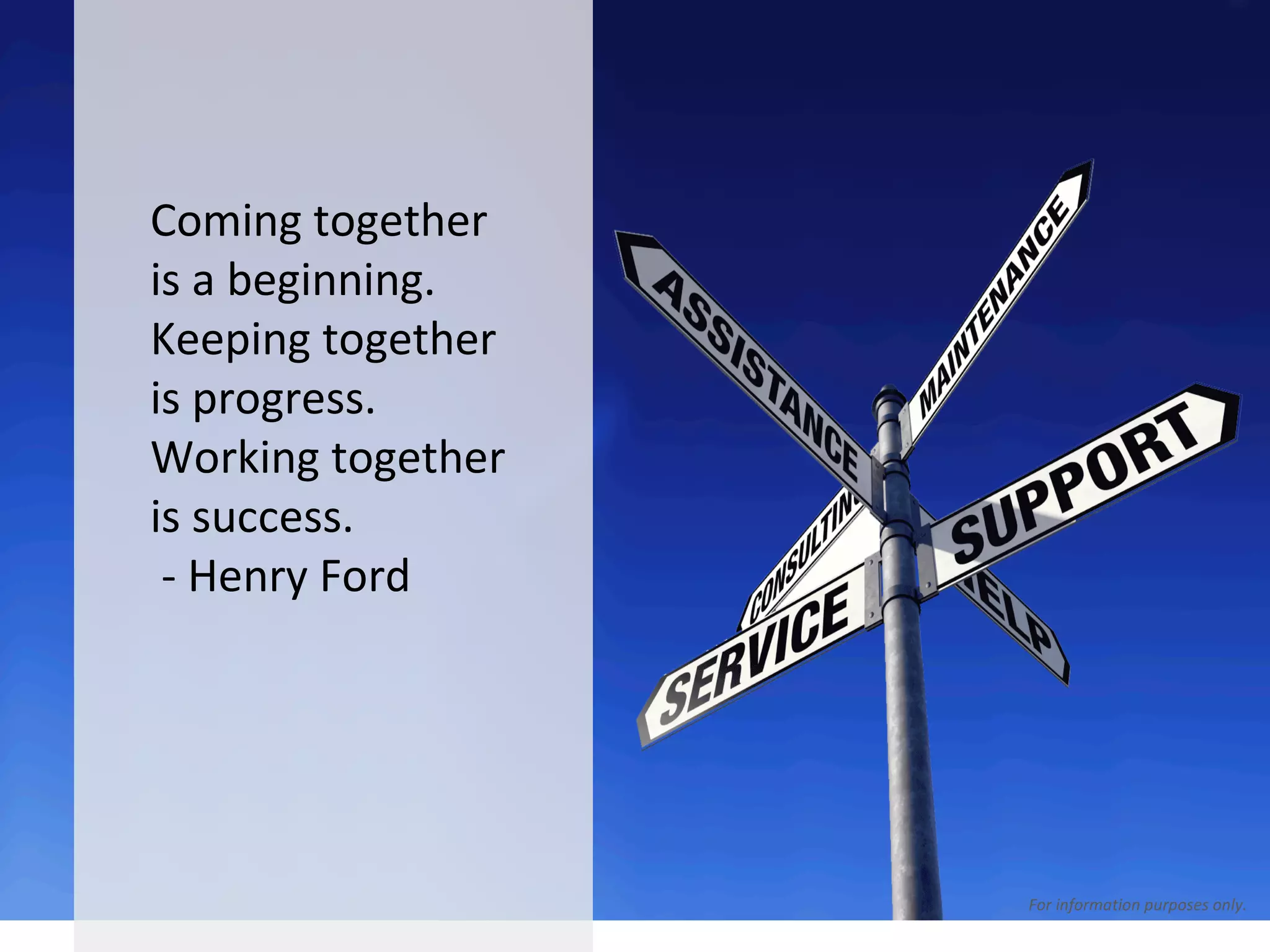
For information purposes only   Coming together is a beginning.  Keeping together is progress.  Working together is success. - Henry Ford   For information purposes only.

AODA Customer Service Standard

  • 1.
    For information purposesonly Inclusive Customer Service From Here to There: The material contained in this presentation is for information purposes only.
  • 2.
    Customer: the personreceiving the service Person with a disability: language that is respectful of the individual Person-first language: recognizes that service is to the person, not to the disability For information purposes only Terminology
  • 3.
    Session AGENDA TheAccessibility For Ontarians with Disabilities Act (AODA) People with Disabilities Accessible Customer Service Accessibility Directorate of Ontario Implementation and Resources For information purposes only Inclusive Customer Service Agenda
  • 4.
    Accessibilityin Ontario must become widespread and commonplace, so that people with disabilities can count on it, on a daily basis. For information purposes only
  • 5.
    Context Accessibility forOntarians with Disabilities Act (AODA) became law in 2005 The Accessibility Directorate of Ontario (ADO) is responsible for supporting and monitoring compliance As each Accessibility Standard is developed, compliance is province-wide and mandatory For information purposes only
  • 6.
    Underlying Principles ofthe AODA Independence Dignity Integration Equal Opportunity For information purposes only Based on the Ontario Human Rights Code (OHRC)
  • 7.
    The Process of Developing the Standards The Accessibility Standards have been, and are being, developed through a transparent and inclusive process with extensive community participation. People with disabilities, representatives from the nonprofit, business, and public sectors, as well as staff from related provincial ministries, provided input. For information purposes only
  • 8.
    AODA Standards CustomerService Standard was the first to become law The Integrated Accessibility Standards, which combine transportation, information & communication, and employment, became law July 3, 2011 The proposed Built Environment Standard is not yet law. It is with government for consideration For information purposes only
  • 9.
    The Customer ServiceStandard For information purposes only By January 1, 2012 , Nonprofit organizations in Ontario must provide goods and services in a way that makes them accessible to people with disabilities
  • 10.
    Accessible customer serviceis about understanding that people with disabilities may have specific needs. For information purposes only It can be as simple as asking “How can I help?” and making small changes to meet the need .
  • 11.
    For information purposesonly Serve-Ability e-learning Course & Tools Valuable training resource developed by the ADO 45 minute e-learning course on AccessON web site http://www.mcss.gov.on.ca/mcss/serve-ability/splash.html Printed material includes: Training Resource for Small Business and Organizations Compliance Manual for Businesses and Organizations
  • 12.
    AODA Overview ofDisability Any degree of physical disability Mental impairment or developmental disability A learning disability A mental disorder An injury/disability under Workplace Safety and Insurance Act, 1997 For information purposes only
  • 13.
    For information purposesonly This material is for information purposes only.
  • 14.
    Visible and non-visibledisabilities For information purposes only For example: Depression is a mental illness that is not visible
  • 15.
    Disabilities that areepisodic in their effect For information purposes only For example: Multiple Sclerosis can effect sufferers differently each day Disabilities of different severity For example: Arthritis severity often increases over time
  • 16.
    FACT: Morethan 15% of Ontarians live with a disability REALITY: The other 85% can be described as currently ‘abled’ GOAL: Equitable and Respectful services for all Ontarians For information purposes only As the population of Ontario ages, the percentage of Ontarians living with a disability will increase.
  • 17.
  • 18.
    Barriers to AccessibilityAttitude: stereotypes and language that focus on a person's disability rather than on their abilities Physical: an ‘accessible’ building where the washroom entrance is too narrow to accommodate a wheelchair Communication: information provided only in print and only in one font size www.mcss.gov.on.ca/en/mcss/programs/accessibility/understanding_accessibility/understanding_barriers.aspx For information purposes only
  • 19.
    The Purpose ofthe Accessibility Directorate of Ontario Develop, implement and enforce standards that will make goods, services, facilities, accommodation, employment, buildings, structures and premises accessible to Ontarians with disabilities. For information purposes only
  • 20.
    ADO’s Role inthe Compliance Process Provide ADO resources, education and guidance to organizations in Ontario as they comply with the AODA Provide the AODA Contact Centre to answer enquiries about the AODA and the Standards Support and consultation are embedded in the compliance process. Penalties are a means of last resort. For information purposes only
  • 21.
    Compliance is MandatoryThe Act gives the government the authority to set monetary penalties to enforce compliance. Penalties will be used only after all compliance assistance efforts have been exhausted. Penalties for non-compliance can range from $200 to $15, 000; continued non-compliance up to $50,000 per day for Directors & $100,000 per day for an organization. For information purposes only
  • 22.
    Organizations withat least one paid employee (full, part-time or seasonal) providing goods or services in Ontario must comply with Customer Service Standard requirements. For information purposes only
  • 23.
    For information purposesonly Organizations with 20 or more employees have additional requirements related to documentation and reporting.
  • 24.
  • 25.
    Policies, Practices andProcedures All 11 Requirements need policies, practices and procedures. Grouped in useful categories: Assistive devices, service animals and support person(s) Communication Training For information purposes only
  • 26.
    Policies, Practices andProcedures re: Assistive devices, service animals, support person(s) Permit people with disabilities to Use personal assistive devices Be accompanied by their service animal Be accompanied by a support person For information purposes only
  • 27.
    Policies, Practices andProcedures re: Communication Communicate in a manner that takes into account a person’s disability Provide notice of temporary disruption in service Where admission fees are charged, give advance notice of admission fee for support person Provide clear accessible process for organization to receive feedback and respond to complaints For information purposes only
  • 28.
    Policies, Practices andProcedures re: Training Train staff, volunteers and others who prepare policies, practices and procedures who provide direct service to the public, to other organizations or businesses in Ontario when someone is new to the organization when services or circumstances change For information purposes only
  • 29.
    Training Must IncludePurpose of AODA and requirements of Standard Four core principles Organization-specific policies, procedures and practices for serving people with disabilities Information about various types of disabilities and ways to provide services effectively & respectfully For information purposes only
  • 30.
    For information purposesonly For information purposes only.
  • 31.
    Organizational Process Determineperson(s) to be responsible for preparing policies, practices and procedures Identify who needs to be trained Establish training roster and schedule Communicate plans and progress to engage commitment from everyone in organization For information purposes only
  • 32.
    Becoming and StayingCompliant Use audit tools during implementation Conduct regular review of policies & process Provide training when circumstances, policies or personnel (staff/volunteers) change Evaluate feedback received For information purposes only
  • 33.
    Resources on USBPowerPoint slide deck August 26, 2011 H-out: Requirements of the Customer Service Standard From Here to There: CSS Workbook Notes for Executive Director and Board of Directors AODA Information for E.D., Board, staff and volunteers Tip sheets on serving customers with disabilities AODA CSS: Guide, Compliance Manual & Training Resource For information purposes only
  • 34.
    Topics Covered Purposeof AODA Overview of Disabilities Role of the ADO Requirements of the Customer Service Standard Implementation Resources For information purposes only
  • 35.
    For information purposesonly Inclusive Customer Service From Here to There: The material contained in this presentation is for information purposes only. Web sites www.ontario.ca /AccessON www.volunteertoronto.ca www.search.e-laws.gov.on.ca/en/search/#LegalAdvice
  • 36.
    For information purposesonly Coming together is a beginning. Keeping together is progress. Working together is success. - Henry Ford For information purposes only.