Provenance for Reproducible Data Science
Andreas Schreiber
German Aerospace Center (DLR)
Cologne/Berlin, Germany
PyData Seattle 2017
> PyData Seattle 2017 > A. Schreiber • Provenance for Reproducible Data Science > 06.07.2017DLR.de • Chart 1
Topics
• Introduction to provenance and PROV
• Modelling provenance for data processing
• Python APIs for provenance recording
• Provenance recording for Jupyter notebooks
• Storing provenance in graph databases
• Analysis of provenance information
> PyData Seattle 2017 > A. Schreiber • Provenance for Reproducible Data Science > 06.07.2017DLR.de • Chart 2
Introduction
> PyData Seattle 2017 > A. Schreiber • Provenance for Reproducible Data Science > 06.07.2017DLR.de • Chart 3
Study Industrial Mathematics
(dt. Technomathematik)
Soldier (SIGINT)
Scientist (Grid Computing)
Introduction
> PyData Seattle 2017 > A. Schreiber • Provenance for Reproducible Data Science > 06.07.2017DLR.de • Chart 4
Co-Founder
Data Scientist
Patient
Simulation and Software Technology, Cologne/Berlin
Head of Intelligent and Distributed Systems department
Institute of Data Science, Jena
Head of Secure Software Engineering group
Reproducibility
Reproducibility in (data) science is based on
• Open Source Software
• Code Reviews
• Code Repositories
• Publications with code
• Container (Docker etc.)
• Workflows
• (Electronic) laboratory notebooks
• Open data formats
• Data management
• Metadata and Provenance
> PyData Seattle 2017 > A. Schreiber • Provenance for Reproducible Data Science > 06.07.2017DLR.de • Chart 5
Metadata and Provenance
Each data file in data processing has two parts
• Data: Actual measured, simulated, or generated data results
• Metadata: Information that describes or relates to the data
Metadata can include a large variety of information
• Geographic information that can be used to limit a spatial search
• Quality information (“Data is bad for some reason,” “Granule is cloud obscured”)
• Instrument configuration information (“Instrument in spectral zoom mode,” “Spacecraft
maneuver in progress”)
• Extra information about the data files themselves: file size, checksum for data integrity
verification
• Provenance information (Where did I get this file? How did it come to exist?)
> PyData Seattle 2017 > A. Schreiber • Provenance for Reproducible Data Science > 06.07.2017DLR.de • Chart 6
Provenance
Basics
• Provenance refers to the source of information and the process that led to its existence
• Provenance information is critical to users trying to understand where a particular data file
came from
Other and related terms
• Traceability
• Lineage
• Logging
• Monitoring
> PyData Seattle 2017 > A. Schreiber • Provenance for Reproducible Data Science > 06.07.2017DLR.de • Chart 7
Provenance Information
Capture, archive, and distribute provenance information, for example
• The source of all externally supplied data files
• The source of the algorithms used to transform the data within the system
• Algorithm Design Documents
• A complete description of the processing environment
• A complete description of the processing framework
• A record of each job’s execution
> PyData Seattle 2017 > A. Schreiber • Provenance for Reproducible Data Science > 06.07.2017DLR.de • Chart 8
Big Data Processing
> PyData Seattle 2017 > A. Schreiber • Provenance for Reproducible Data Science > 06.07.2017DLR.de • Chart 9
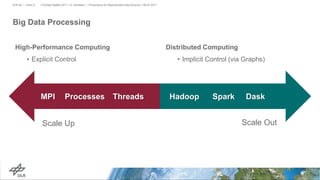
High-Performance Computing
• Explicit Control
Distributed Computing
• Implicit Control (via Graphs)
MPI Processes Threads Hadoop Spark Dask
Scale Up Scale Out
> PyData Seattle 2017 > A. Schreiber • Provenance for Reproducible Data Science > 06.07.2017DLR.de • Chart 10
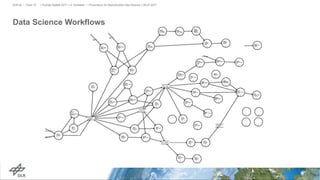
Data Science Workflows
More Formal Definition of Provenance
Provenance is
information about entities, activities, and people
involved in
producing a piece of data or thing,
which can be used to form
assessments about its quality, reliability or trustworthiness.
PROV W3C Working Group
https://www.w3.org/TR/prov-overview
> PyData Seattle 2017 > A. Schreiber • Provenance for Reproducible Data Science > 06.07.2017DLR.de • Chart 11
W3C Specification „PROV“
• PROV-O, the PROV ontology, an OWL2 ontology allowing the mapping of the PROV data
model to RDF
• PROV-DM, the PROV data model for provenance
• PROV-N, a notation for provenance aimed at human consumption
• PROV-CONSTRAINTS, a set of constraints applying to the PROV data model
• PROV-XML, an XML schema for the PROV data model
• PROV-AQ, mechanisms for accessing and querying provenance
• PROV-DICTIONARY introduces a specific type of collection, consisting of key-entity pairs
• PROV-DC provides a mapping between PROV-O and Dublin Core Terms
• PROV-SEM, a declarative specification in terms of first-order logic of the PROV data model
• PROV-LINKS introduces a mechanism to link across bundles
> PyData Seattle 2017 > A. Schreiber • Provenance for Reproducible Data Science > 06.07.2017DLR.de • Chart 12
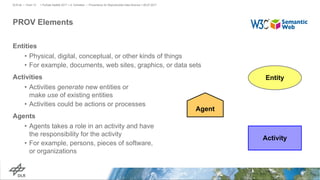
PROV Elements
Entities
• Physical, digital, conceptual, or other kinds of things
• For example, documents, web sites, graphics, or data sets
Activities
• Activities generate new entities or
make use of existing entities
• Activities could be actions or processes
Agents
• Agents takes a role in an activity and have
the responsibility for the activity
• For example, persons, pieces of software,
or organizations
> PyData Seattle 2017 > A. Schreiber • Provenance for Reproducible Data Science > 06.07.2017DLR.de • Chart 13
Activity
Entity
Agent
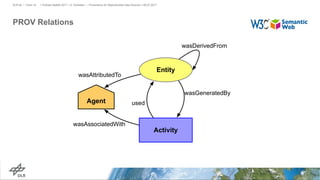
PROV Relations
> PyData Seattle 2017 > A. Schreiber • Provenance for Reproducible Data Science > 06.07.2017DLR.de • Chart 14
Activity
Entity
Agent
wasGeneratedBy
used
wasDerivedFrom
wasAttributedTo
wasAssociatedWith
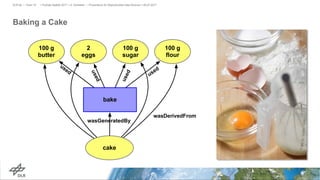
Baking a Cake
> PyData Seattle 2017 > A. Schreiber • Provenance for Reproducible Data Science > 06.07.2017DLR.de • Chart 15
100 g
butter
bake
2
eggs
100 g
sugar
100 g
flour
cake
used
used
used
used
wasGeneratedBy
wasDerivedFrom
Textual Representations Visualizations
PROV Notations and Representations
• Formats: PROV-N, JSON, Turtle, XML, …
> PyData Seattle 2017 > A. Schreiber • Provenance for Reproducible Data Science > 06.07.2017DLR.de • Chart 16
document
prefix userdata http://software.dlr.de/qs/userdata/
. . .
wasDerivedFrom(userdata:weights, userdata:WeightReport.csv,
wasDerivedFrom(qs:graphic/weights, userdata:weights,
wasAssociatedWith(qs:graphic/weights, qs:user/onyame@gmail.com, -)
used(python_method:read_csv, library:pandas, -)
used(python_method:matplotlib_plot, userdata:weights, -)
used(python_method:matplotlib_plot, library:matplotlib, -)
used(python_method:read_csv, userdata:WeightReport.csv, -)
wasAttributedTo(userdata:WeightReport.csv, qs:user/onyame@gmail.com)
agent(qs:user/onyame@gmail.com, [prov:type="prov:Person"])
entity(library:pandas, [library:version="0.17.1"])
entity(userdata:WeightReport.csv)
entity(userdata:weights)
. . .
endDocument
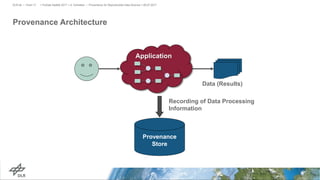
Provenance Architecture
> PyData Seattle 2017 > A. Schreiber • Provenance for Reproducible Data Science > 06.07.2017DLR.de • Chart 17
Provenance
Store
Recording of Data Processing
Information
Application
Data (Results)
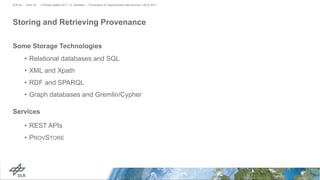
Storing and Retrieving Provenance
Some Storage Technologies
• Relational databases and SQL
• XML and Xpath
• RDF and SPARQL
• Graph databases and Gremlin/Cypher
Services
• REST APIs
• PROVSTORE
> PyData Seattle 2017 > A. Schreiber • Provenance for Reproducible Data Science > 06.07.2017DLR.de • Chart 18
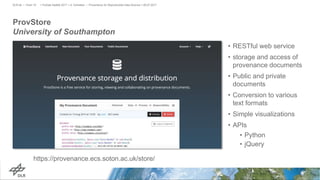
ProvStore
University of Southampton
• RESTful web service
• storage and access of
provenance documents
• Public and private
documents
• Conversion to various
text formats
• Simple visualizations
• APIs
• Python
• jQuery
> PyData Seattle 2017 > A. Schreiber • Provenance for Reproducible Data Science > 06.07.2017DLR.de • Chart 19
https://provenance.ecs.soton.ac.uk/store/
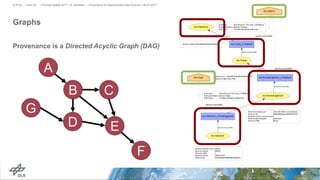
Graphs
Provenance is a Directed Acyclic Graph (DAG)
> PyData Seattle 2017 > A. Schreiber • Provenance for Reproducible Data Science > 06.07.2017DLR.de • Chart 20
A
B
E
F
G
D
C
Graph Databases
Naturally, graph databases are a good
technology for storing (Provenance) graphs
Many graph databases are available
• Neo4J
• Titan
• ArangoDB
• ...
Query languages
• Cypher
• Gremlin (TinkerPop)
• GraphQL
> PyData Seattle 2017 > A. Schreiber • Provenance for Reproducible Data Science > 06.07.2017DLR.de • Chart 21
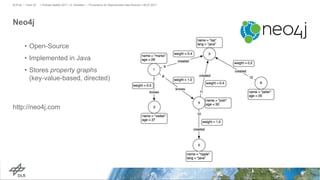
Neo4j
• Open-Source
• Implemented in Java
• Stores property graphs
(key-value-based, directed)
http://neo4j.com
> PyData Seattle 2017 > A. Schreiber • Provenance for Reproducible Data Science > 06.07.2017DLR.de • Chart 22
Storing Provenance in Graph Database
> PyData Seattle 2017 > A. Schreiber • Provenance for Reproducible Data Science > 06.07.2017DLR.de • Chart 23
Graph database Neo4j
MATCH (e:Entity)-[*]-(u:Agent) RETURN u
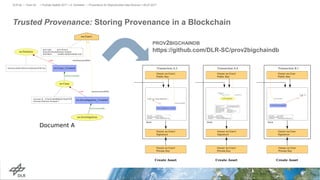
Trusted Provenance: Storing Provenance in a Blockchain
> PyData Seattle 2017 > A. Schreiber • Provenance for Reproducible Data Science > 06.07.2017DLR.de • Chart 24
PROV2BIGCHAINDB
https://github.com/DLR-SC/prov2bigchaindb
Gather or Generate Provenance
Depends on your application (tools, languages, etc.)
• Generation at run-time, compile-time, or retrospectively
Runtime
• Instrumentation of the application
• Cumbersome from software engineering perspective
• Combined with logging or with aspect-oriented approaches
Compile time
• Based on static code analysis (dependency analysis, program slicing, etc.)
Retrospectively
• Reconstructed from files or filesystem metadata
> PyData Seattle 2017 > A. Schreiber • Provenance for Reproducible Data Science > 06.07.2017DLR.de • Chart 25
Tools and Libraries for Python
Libraries for Python
• PROVPY
• PROVNEO4J
• PROV-DB-CONNECTOR
Other Tools
• NOWORKFLOW
• GIT2PROV
> PyData Seattle 2017 > A. Schreiber • Provenance for Reproducible Data Science > 06.07.2017DLR.de • Chart 26
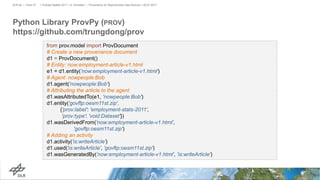
Python Library ProvPy (PROV)
https://github.com/trungdong/prov
> PyData Seattle 2017 > A. Schreiber • Provenance for Reproducible Data Science > 06.07.2017DLR.de • Chart 27
from prov.model import ProvDocument
# Create a new provenance document
d1 = ProvDocument()
# Entity: now:employment-article-v1.html
e1 = d1.entity('now:employment-article-v1.html')
# Agent: nowpeople:Bob
d1.agent('nowpeople:Bob')
# Attributing the article to the agent
d1.wasAttributedTo(e1, 'nowpeople:Bob')
d1.entity('govftp:oesm11st.zip',
{'prov:label': 'employment-stats-2011',
'prov:type': 'void:Dataset'})
d1.wasDerivedFrom('now:employment-article-v1.html',
'govftp:oesm11st.zip')
# Adding an activity
d1.activity('is:writeArticle')
d1.used('is:writeArticle', 'govftp:oesm11st.zip')
d1.wasGeneratedBy('now:employment-article-v1.html', 'is:writeArticle')
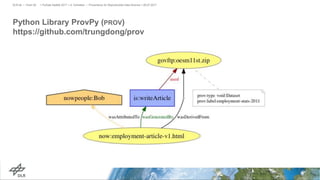
Python Library ProvPy (PROV)
https://github.com/trungdong/prov
> PyData Seattle 2017 > A. Schreiber • Provenance for Reproducible Data Science > 06.07.2017DLR.de • Chart 28
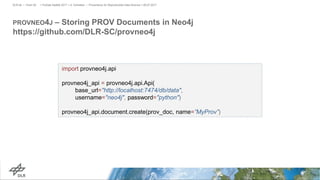
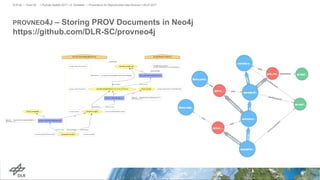
PROVNEO4J – Storing PROV Documents in Neo4j
https://github.com/DLR-SC/provneo4j
> PyData Seattle 2017 > A. Schreiber • Provenance for Reproducible Data Science > 06.07.2017DLR.de • Chart 29
import provneo4j.api
provneo4j_api = provneo4j.api.Api(
base_url="http://localhost:7474/db/data",
username="neo4j", password="python")
provneo4j_api.document.create(prov_doc, name=”MyProv”)
PROVNEO4J – Storing PROV Documents in Neo4j
https://github.com/DLR-SC/provneo4j
> PyData Seattle 2017 > A. Schreiber • Provenance for Reproducible Data Science > 06.07.2017DLR.de • Chart 30
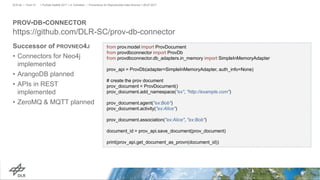
PROV-DB-CONNECTOR
https://github.com/DLR-SC/prov-db-connector
Successor of PROVNEO4J
• Connectors for Neo4j
implemented
• ArangoDB planned
• APIs in REST
implemented
• ZeroMQ & MQTT planned
> PyData Seattle 2017 > A. Schreiber • Provenance for Reproducible Data Science > 06.07.2017DLR.de • Chart 31
from prov.model import ProvDocument
from provdbconnector import ProvDb
from provdbconnector.db_adapters.in_memory import SimpleInMemoryAdapter
prov_api = ProvDb(adapter=SimpleInMemoryAdapter, auth_info=None)
# create the prov document
prov_document = ProvDocument()
prov_document.add_namespace("ex", "http://example.com")
prov_document.agent("ex:Bob")
prov_document.activity("ex:Alice")
prov_document.association("ex:Alice", "ex:Bob")
document_id = prov_api.save_document(prov_document)
print(prov_api.get_document_as_provn(document_id))
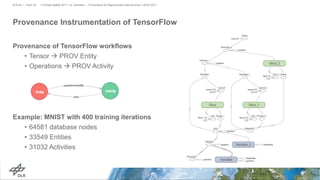
Provenance Instrumentation of TensorFlow
Provenance of TensorFlow workflows
• Tensor  PROV Entity
• Operations  PROV Activity
Example: MNIST with 400 training iterations
• 64581 database nodes
• 33549 Entities
• 31032 Activities
> PyData Seattle 2017 > A. Schreiber • Provenance for Reproducible Data Science > 06.07.2017DLR.de • Chart 32
Example Query
• Shortest paths from all tensors
in 400. iteration to init operation
> PyData Seattle 2017 > A. Schreiber • Provenance for Reproducible Data Science > 06.07.2017DLR.de • Chart 33
MATCH path=allShortestPaths((root)<-[*]-(n))
WHERE root.`tf:type`="tf:Session_init" and n.`tf:name` =~ ".*_400"
RETURN path
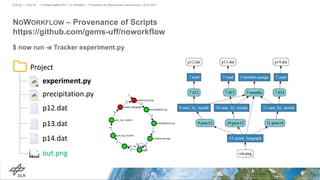
NOWORKFLOW – Provenance of Scripts
https://github.com/gems-uff/noworkflow
> PyData Seattle 2017 > A. Schreiber • Provenance for Reproducible Data Science > 06.07.2017DLR.de • Chart 34
Project
experiment.py
p12.dat
p13.dat
precipitation.py
p14.dat
out.png
$ now run -e Tracker experiment.py
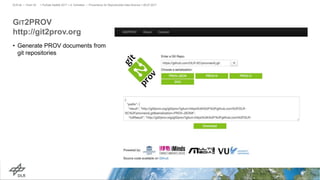
GIT2PROV
http://git2prov.org
• Generate PROV documents from
git repositories
> PyData Seattle 2017 > A. Schreiber • Provenance for Reproducible Data Science > 06.07.2017DLR.de • Chart 35
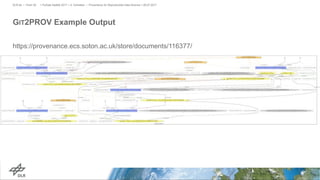
GIT2PROV Example Output
https://provenance.ecs.soton.ac.uk/store/documents/116377/
> PyData Seattle 2017 > A. Schreiber • Provenance for Reproducible Data Science > 06.07.2017DLR.de • Chart 36
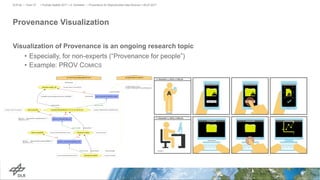
Provenance Visualization
Visualization of Provenance is an ongoing research topic
• Especially, for non-experts (“Provenance for people”)
• Example: PROV COMICS
> PyData Seattle 2017 > A. Schreiber • Provenance for Reproducible Data Science > 06.07.2017DLR.de • Chart 37
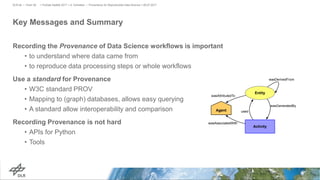
Key Messages and Summary
Recording the Provenance of Data Science workflows is important
• to understand where data came from
• to reproduce data processing steps or whole workflows
Use a standard for Provenance
• W3C standard PROV
• Mapping to (graph) databases, allows easy querying
• A standard allow interoperability and comparison
Recording Provenance is not hard
• APIs for Python
• Tools
> PyData Seattle 2017 > A. Schreiber • Provenance for Reproducible Data Science > 06.07.2017DLR.de • Chart 38
Activity
Entity
Agent
wasGeneratedBy
used
wasDerivedFrom
wasAttributedTo
wasAssociatedWith
> PyData Seattle 2017 > A. Schreiber • Provenance for Reproducible Data Science > 06.07.2017DLR.de • Chart 39
Thank You!
Questions?
Andreas.Schreiber@dlr.de
www.DLR.de/sc | @onyame

Provenance for Reproducible Data Science

  • 1.
    Provenance for ReproducibleData Science Andreas Schreiber German Aerospace Center (DLR) Cologne/Berlin, Germany PyData Seattle 2017 > PyData Seattle 2017 > A. Schreiber • Provenance for Reproducible Data Science > 06.07.2017DLR.de • Chart 1
  • 2.
    Topics • Introduction toprovenance and PROV • Modelling provenance for data processing • Python APIs for provenance recording • Provenance recording for Jupyter notebooks • Storing provenance in graph databases • Analysis of provenance information > PyData Seattle 2017 > A. Schreiber • Provenance for Reproducible Data Science > 06.07.2017DLR.de • Chart 2
  • 3.
    Introduction > PyData Seattle2017 > A. Schreiber • Provenance for Reproducible Data Science > 06.07.2017DLR.de • Chart 3 Study Industrial Mathematics (dt. Technomathematik) Soldier (SIGINT) Scientist (Grid Computing)
  • 4.
    Introduction > PyData Seattle2017 > A. Schreiber • Provenance for Reproducible Data Science > 06.07.2017DLR.de • Chart 4 Co-Founder Data Scientist Patient Simulation and Software Technology, Cologne/Berlin Head of Intelligent and Distributed Systems department Institute of Data Science, Jena Head of Secure Software Engineering group
  • 5.
    Reproducibility Reproducibility in (data)science is based on • Open Source Software • Code Reviews • Code Repositories • Publications with code • Container (Docker etc.) • Workflows • (Electronic) laboratory notebooks • Open data formats • Data management • Metadata and Provenance > PyData Seattle 2017 > A. Schreiber • Provenance for Reproducible Data Science > 06.07.2017DLR.de • Chart 5
  • 6.
    Metadata and Provenance Eachdata file in data processing has two parts • Data: Actual measured, simulated, or generated data results • Metadata: Information that describes or relates to the data Metadata can include a large variety of information • Geographic information that can be used to limit a spatial search • Quality information (“Data is bad for some reason,” “Granule is cloud obscured”) • Instrument configuration information (“Instrument in spectral zoom mode,” “Spacecraft maneuver in progress”) • Extra information about the data files themselves: file size, checksum for data integrity verification • Provenance information (Where did I get this file? How did it come to exist?) > PyData Seattle 2017 > A. Schreiber • Provenance for Reproducible Data Science > 06.07.2017DLR.de • Chart 6
  • 7.
    Provenance Basics • Provenance refersto the source of information and the process that led to its existence • Provenance information is critical to users trying to understand where a particular data file came from Other and related terms • Traceability • Lineage • Logging • Monitoring > PyData Seattle 2017 > A. Schreiber • Provenance for Reproducible Data Science > 06.07.2017DLR.de • Chart 7
  • 8.
    Provenance Information Capture, archive,and distribute provenance information, for example • The source of all externally supplied data files • The source of the algorithms used to transform the data within the system • Algorithm Design Documents • A complete description of the processing environment • A complete description of the processing framework • A record of each job’s execution > PyData Seattle 2017 > A. Schreiber • Provenance for Reproducible Data Science > 06.07.2017DLR.de • Chart 8
  • 9.
    Big Data Processing >PyData Seattle 2017 > A. Schreiber • Provenance for Reproducible Data Science > 06.07.2017DLR.de • Chart 9 High-Performance Computing • Explicit Control Distributed Computing • Implicit Control (via Graphs) MPI Processes Threads Hadoop Spark Dask Scale Up Scale Out
  • 10.
    > PyData Seattle2017 > A. Schreiber • Provenance for Reproducible Data Science > 06.07.2017DLR.de • Chart 10 Data Science Workflows
  • 11.
    More Formal Definitionof Provenance Provenance is information about entities, activities, and people involved in producing a piece of data or thing, which can be used to form assessments about its quality, reliability or trustworthiness. PROV W3C Working Group https://www.w3.org/TR/prov-overview > PyData Seattle 2017 > A. Schreiber • Provenance for Reproducible Data Science > 06.07.2017DLR.de • Chart 11
  • 12.
    W3C Specification „PROV“ •PROV-O, the PROV ontology, an OWL2 ontology allowing the mapping of the PROV data model to RDF • PROV-DM, the PROV data model for provenance • PROV-N, a notation for provenance aimed at human consumption • PROV-CONSTRAINTS, a set of constraints applying to the PROV data model • PROV-XML, an XML schema for the PROV data model • PROV-AQ, mechanisms for accessing and querying provenance • PROV-DICTIONARY introduces a specific type of collection, consisting of key-entity pairs • PROV-DC provides a mapping between PROV-O and Dublin Core Terms • PROV-SEM, a declarative specification in terms of first-order logic of the PROV data model • PROV-LINKS introduces a mechanism to link across bundles > PyData Seattle 2017 > A. Schreiber • Provenance for Reproducible Data Science > 06.07.2017DLR.de • Chart 12
  • 13.
    PROV Elements Entities • Physical,digital, conceptual, or other kinds of things • For example, documents, web sites, graphics, or data sets Activities • Activities generate new entities or make use of existing entities • Activities could be actions or processes Agents • Agents takes a role in an activity and have the responsibility for the activity • For example, persons, pieces of software, or organizations > PyData Seattle 2017 > A. Schreiber • Provenance for Reproducible Data Science > 06.07.2017DLR.de • Chart 13 Activity Entity Agent
  • 14.
    PROV Relations > PyDataSeattle 2017 > A. Schreiber • Provenance for Reproducible Data Science > 06.07.2017DLR.de • Chart 14 Activity Entity Agent wasGeneratedBy used wasDerivedFrom wasAttributedTo wasAssociatedWith
  • 15.
    Baking a Cake >PyData Seattle 2017 > A. Schreiber • Provenance for Reproducible Data Science > 06.07.2017DLR.de • Chart 15 100 g butter bake 2 eggs 100 g sugar 100 g flour cake used used used used wasGeneratedBy wasDerivedFrom
  • 16.
    Textual Representations Visualizations PROVNotations and Representations • Formats: PROV-N, JSON, Turtle, XML, … > PyData Seattle 2017 > A. Schreiber • Provenance for Reproducible Data Science > 06.07.2017DLR.de • Chart 16 document prefix userdata http://software.dlr.de/qs/userdata/ . . . wasDerivedFrom(userdata:weights, userdata:WeightReport.csv, wasDerivedFrom(qs:graphic/weights, userdata:weights, wasAssociatedWith(qs:graphic/weights, qs:user/onyame@gmail.com, -) used(python_method:read_csv, library:pandas, -) used(python_method:matplotlib_plot, userdata:weights, -) used(python_method:matplotlib_plot, library:matplotlib, -) used(python_method:read_csv, userdata:WeightReport.csv, -) wasAttributedTo(userdata:WeightReport.csv, qs:user/onyame@gmail.com) agent(qs:user/onyame@gmail.com, [prov:type="prov:Person"]) entity(library:pandas, [library:version="0.17.1"]) entity(userdata:WeightReport.csv) entity(userdata:weights) . . . endDocument
  • 17.
    Provenance Architecture > PyDataSeattle 2017 > A. Schreiber • Provenance for Reproducible Data Science > 06.07.2017DLR.de • Chart 17 Provenance Store Recording of Data Processing Information Application Data (Results)
  • 18.
    Storing and RetrievingProvenance Some Storage Technologies • Relational databases and SQL • XML and Xpath • RDF and SPARQL • Graph databases and Gremlin/Cypher Services • REST APIs • PROVSTORE > PyData Seattle 2017 > A. Schreiber • Provenance for Reproducible Data Science > 06.07.2017DLR.de • Chart 18
  • 19.
    ProvStore University of Southampton •RESTful web service • storage and access of provenance documents • Public and private documents • Conversion to various text formats • Simple visualizations • APIs • Python • jQuery > PyData Seattle 2017 > A. Schreiber • Provenance for Reproducible Data Science > 06.07.2017DLR.de • Chart 19 https://provenance.ecs.soton.ac.uk/store/
  • 20.
    Graphs Provenance is aDirected Acyclic Graph (DAG) > PyData Seattle 2017 > A. Schreiber • Provenance for Reproducible Data Science > 06.07.2017DLR.de • Chart 20 A B E F G D C
  • 21.
    Graph Databases Naturally, graphdatabases are a good technology for storing (Provenance) graphs Many graph databases are available • Neo4J • Titan • ArangoDB • ... Query languages • Cypher • Gremlin (TinkerPop) • GraphQL > PyData Seattle 2017 > A. Schreiber • Provenance for Reproducible Data Science > 06.07.2017DLR.de • Chart 21
  • 22.
    Neo4j • Open-Source • Implementedin Java • Stores property graphs (key-value-based, directed) http://neo4j.com > PyData Seattle 2017 > A. Schreiber • Provenance for Reproducible Data Science > 06.07.2017DLR.de • Chart 22
  • 23.
    Storing Provenance inGraph Database > PyData Seattle 2017 > A. Schreiber • Provenance for Reproducible Data Science > 06.07.2017DLR.de • Chart 23 Graph database Neo4j MATCH (e:Entity)-[*]-(u:Agent) RETURN u
  • 24.
    Trusted Provenance: StoringProvenance in a Blockchain > PyData Seattle 2017 > A. Schreiber • Provenance for Reproducible Data Science > 06.07.2017DLR.de • Chart 24 PROV2BIGCHAINDB https://github.com/DLR-SC/prov2bigchaindb
  • 25.
    Gather or GenerateProvenance Depends on your application (tools, languages, etc.) • Generation at run-time, compile-time, or retrospectively Runtime • Instrumentation of the application • Cumbersome from software engineering perspective • Combined with logging or with aspect-oriented approaches Compile time • Based on static code analysis (dependency analysis, program slicing, etc.) Retrospectively • Reconstructed from files or filesystem metadata > PyData Seattle 2017 > A. Schreiber • Provenance for Reproducible Data Science > 06.07.2017DLR.de • Chart 25
  • 26.
    Tools and Librariesfor Python Libraries for Python • PROVPY • PROVNEO4J • PROV-DB-CONNECTOR Other Tools • NOWORKFLOW • GIT2PROV > PyData Seattle 2017 > A. Schreiber • Provenance for Reproducible Data Science > 06.07.2017DLR.de • Chart 26
  • 27.
    Python Library ProvPy(PROV) https://github.com/trungdong/prov > PyData Seattle 2017 > A. Schreiber • Provenance for Reproducible Data Science > 06.07.2017DLR.de • Chart 27 from prov.model import ProvDocument # Create a new provenance document d1 = ProvDocument() # Entity: now:employment-article-v1.html e1 = d1.entity('now:employment-article-v1.html') # Agent: nowpeople:Bob d1.agent('nowpeople:Bob') # Attributing the article to the agent d1.wasAttributedTo(e1, 'nowpeople:Bob') d1.entity('govftp:oesm11st.zip', {'prov:label': 'employment-stats-2011', 'prov:type': 'void:Dataset'}) d1.wasDerivedFrom('now:employment-article-v1.html', 'govftp:oesm11st.zip') # Adding an activity d1.activity('is:writeArticle') d1.used('is:writeArticle', 'govftp:oesm11st.zip') d1.wasGeneratedBy('now:employment-article-v1.html', 'is:writeArticle')
  • 28.
    Python Library ProvPy(PROV) https://github.com/trungdong/prov > PyData Seattle 2017 > A. Schreiber • Provenance for Reproducible Data Science > 06.07.2017DLR.de • Chart 28
  • 29.
    PROVNEO4J – StoringPROV Documents in Neo4j https://github.com/DLR-SC/provneo4j > PyData Seattle 2017 > A. Schreiber • Provenance for Reproducible Data Science > 06.07.2017DLR.de • Chart 29 import provneo4j.api provneo4j_api = provneo4j.api.Api( base_url="http://localhost:7474/db/data", username="neo4j", password="python") provneo4j_api.document.create(prov_doc, name=”MyProv”)
  • 30.
    PROVNEO4J – StoringPROV Documents in Neo4j https://github.com/DLR-SC/provneo4j > PyData Seattle 2017 > A. Schreiber • Provenance for Reproducible Data Science > 06.07.2017DLR.de • Chart 30
  • 31.
    PROV-DB-CONNECTOR https://github.com/DLR-SC/prov-db-connector Successor of PROVNEO4J •Connectors for Neo4j implemented • ArangoDB planned • APIs in REST implemented • ZeroMQ & MQTT planned > PyData Seattle 2017 > A. Schreiber • Provenance for Reproducible Data Science > 06.07.2017DLR.de • Chart 31 from prov.model import ProvDocument from provdbconnector import ProvDb from provdbconnector.db_adapters.in_memory import SimpleInMemoryAdapter prov_api = ProvDb(adapter=SimpleInMemoryAdapter, auth_info=None) # create the prov document prov_document = ProvDocument() prov_document.add_namespace("ex", "http://example.com") prov_document.agent("ex:Bob") prov_document.activity("ex:Alice") prov_document.association("ex:Alice", "ex:Bob") document_id = prov_api.save_document(prov_document) print(prov_api.get_document_as_provn(document_id))
  • 32.
    Provenance Instrumentation ofTensorFlow Provenance of TensorFlow workflows • Tensor  PROV Entity • Operations  PROV Activity Example: MNIST with 400 training iterations • 64581 database nodes • 33549 Entities • 31032 Activities > PyData Seattle 2017 > A. Schreiber • Provenance for Reproducible Data Science > 06.07.2017DLR.de • Chart 32
  • 33.
    Example Query • Shortestpaths from all tensors in 400. iteration to init operation > PyData Seattle 2017 > A. Schreiber • Provenance for Reproducible Data Science > 06.07.2017DLR.de • Chart 33 MATCH path=allShortestPaths((root)<-[*]-(n)) WHERE root.`tf:type`="tf:Session_init" and n.`tf:name` =~ ".*_400" RETURN path
  • 34.
    NOWORKFLOW – Provenanceof Scripts https://github.com/gems-uff/noworkflow > PyData Seattle 2017 > A. Schreiber • Provenance for Reproducible Data Science > 06.07.2017DLR.de • Chart 34 Project experiment.py p12.dat p13.dat precipitation.py p14.dat out.png $ now run -e Tracker experiment.py
  • 35.
    GIT2PROV http://git2prov.org • Generate PROVdocuments from git repositories > PyData Seattle 2017 > A. Schreiber • Provenance for Reproducible Data Science > 06.07.2017DLR.de • Chart 35
  • 36.
    GIT2PROV Example Output https://provenance.ecs.soton.ac.uk/store/documents/116377/ >PyData Seattle 2017 > A. Schreiber • Provenance for Reproducible Data Science > 06.07.2017DLR.de • Chart 36
  • 37.
    Provenance Visualization Visualization ofProvenance is an ongoing research topic • Especially, for non-experts (“Provenance for people”) • Example: PROV COMICS > PyData Seattle 2017 > A. Schreiber • Provenance for Reproducible Data Science > 06.07.2017DLR.de • Chart 37
  • 38.
    Key Messages andSummary Recording the Provenance of Data Science workflows is important • to understand where data came from • to reproduce data processing steps or whole workflows Use a standard for Provenance • W3C standard PROV • Mapping to (graph) databases, allows easy querying • A standard allow interoperability and comparison Recording Provenance is not hard • APIs for Python • Tools > PyData Seattle 2017 > A. Schreiber • Provenance for Reproducible Data Science > 06.07.2017DLR.de • Chart 38 Activity Entity Agent wasGeneratedBy used wasDerivedFrom wasAttributedTo wasAssociatedWith
  • 39.
    > PyData Seattle2017 > A. Schreiber • Provenance for Reproducible Data Science > 06.07.2017DLR.de • Chart 39 Thank You! Questions? Andreas.Schreiber@dlr.de www.DLR.de/sc | @onyame