




High-Throughput Processing of
Space Debris Data
Andreas Schreiber, Michael Meinel
German Aerospace Center (DLR)
Simulation and Software Technology,
Berlin / Cologne, Germany
PyData Seattle
July 26, 2015
> PyData Seattle > A. Schreiber • High-Throughput Processing of Space Debris Data > 26.07.2015DLR.de • Chart 1
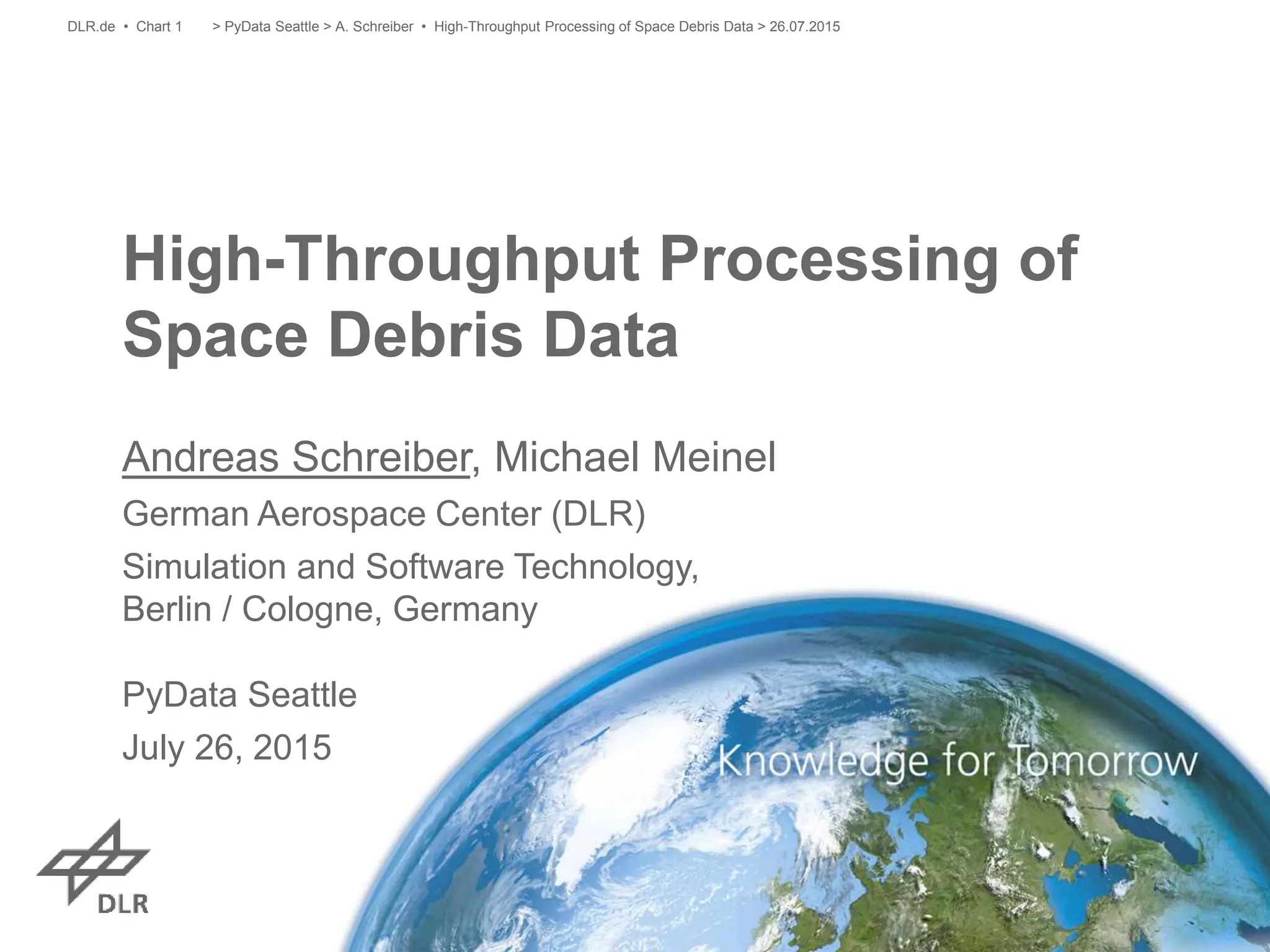
• Space Debris
• BACARDI
• Skynet
Outline
> PyData Seattle > A. Schreiber • High-Throughput Processing of Space Debris Data > 26.07.2015DLR.de • Chart 2
Major research areas of DLR
• Aeronautics
• Space
• Transportation
• Energy
• Security
Software research and dev.
• Software engineering, HPC,
distributed systems, …
DLR
Aerospace Research Center, Space Agency
> PyData Seattle > A. Schreiber • High-Throughput Processing of Space Debris Data > 26.07.2015DLR.de • Chart 3
> PyData Seattle > A. Schreiber • High-Throughput Processing of Space Debris Data > 26.07.2015DLR.de • Chart 4
Space Debris
> PyData Seattle > A. Schreiber • High-Throughput Processing of Space Debris Data > 26.07.2015DLR.de • Chart 5
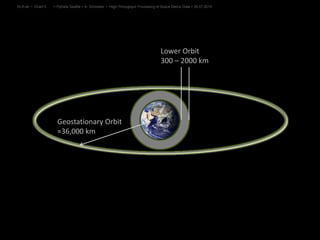
Lower Orbit
300 – 2000 km
Geostationary Orbit
≈36,000 km
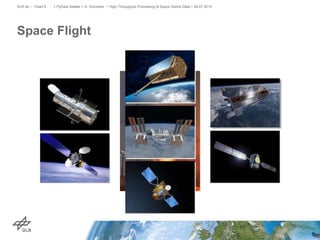
Space Flight
> PyData Seattle > A. Schreiber • High-Throughput Processing of Space Debris Data > 26.07.2015DLR.de • Chart 6
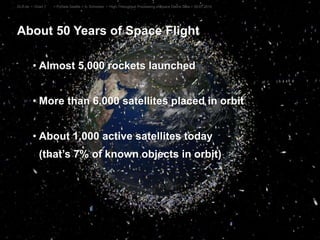
• Almost 5,000 rockets launched
• More than 6,000 satellites placed in orbit
• About 1,000 active satellites today
(that’s 7% of known objects in orbit)
About 50 Years of Space Flight
> PyData Seattle > A. Schreiber • High-Throughput Processing of Space Debris Data > 26.07.2015DLR.de • Chart 7
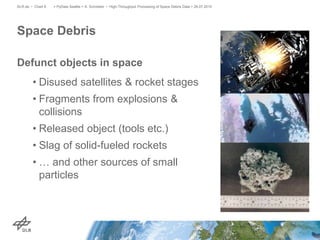
Defunct objects in space
• Disused satellites & rocket stages
• Fragments from explosions &
collisions
• Released object (tools etc.)
• Slag of solid-fueled rockets
• … and other sources of small
particles
Space Debris
> PyData Seattle > A. Schreiber • High-Throughput Processing of Space Debris Data > 26.07.2015DLR.de • Chart 8
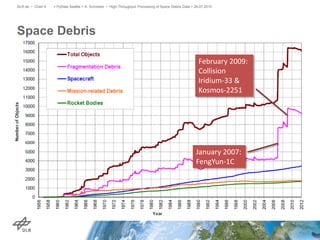
Space Debris
> PyData Seattle > A. Schreiber • High-Throughput Processing of Space Debris Data > 26.07.2015DLR.de • Chart 9
January 2007:
FengYun-1C
February 2009:
Collision
Iridium-33 &
Kosmos-2251
Space Debris
> PyData Seattle > A. Schreiber • High-Throughput Processing of Space Debris Data > 26.07.2015DLR.de • Chart 10
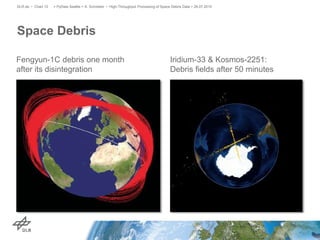
Iridium-33 & Kosmos-2251:
Debris fields after 50 minutes
Fengyun-1C debris one month
after its disintegration
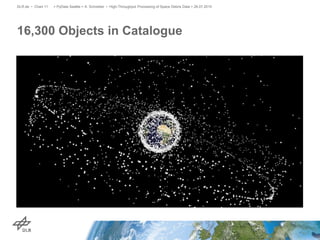
16,300 Objects in Catalogue
> PyData Seattle > A. Schreiber • High-Throughput Processing of Space Debris Data > 26.07.2015DLR.de • Chart 11
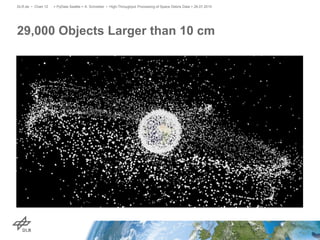
29,000 Objects Larger than 10 cm
> PyData Seattle > A. Schreiber • High-Throughput Processing of Space Debris Data > 26.07.2015DLR.de • Chart 12
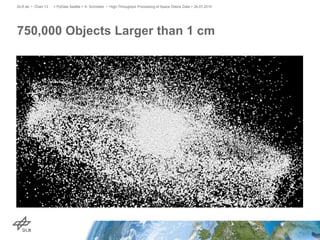
750,000 Objects Larger than 1 cm
> PyData Seattle > A. Schreiber • High-Throughput Processing of Space Debris Data > 26.07.2015DLR.de • Chart 13
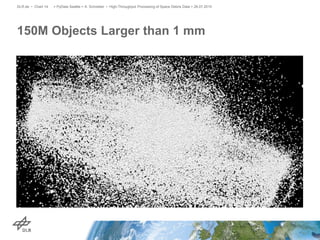
150M Objects Larger than 1 mm
> PyData Seattle > A. Schreiber • High-Throughput Processing of Space Debris Data > 26.07.2015DLR.de • Chart 14
Impact
Laboratory Impact Aluminum Sphere / Block
> PyData Seattle > A. Schreiber • High-Throughput Processing of Space Debris Data > 26.07.2015DLR.de • Chart 15
Impact
Real Debris Object on a Satellite Solar Panel
> PyData Seattle > A. Schreiber • High-Throughput Processing of Space Debris Data > 26.07.2015DLR.de • Chart 16
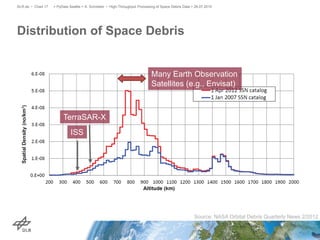
Distribution of Space Debris
> PyData Seattle > A. Schreiber • High-Throughput Processing of Space Debris Data > 26.07.2015DLR.de • Chart 17
Source: NASA Orbital Debris Quarterly News 2/2012
ISS
Many Earth Observation
Satellites (e.g., Envisat)
TerraSAR-X
Collision Prediction
International Space Station
DLR.de • Chart 18 > PyData Seattle > A. Schreiber • High-Throughput Processing of Space Debris Data > 26.07.2015
> PyData Seattle > A. Schreiber • High-Throughput Processing of Space Debris Data > 26.07.2015DLR.de • Chart 19
> PyData Seattle > A. Schreiber • High-Throughput Processing of Space Debris Data > 26.07.2015DLR.de • Chart 20
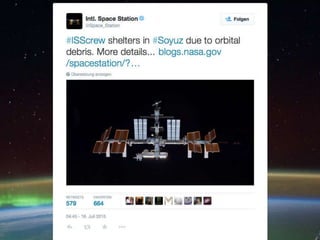
http://rbth.com/news/2015/07/26/iss_successfully_ducks_from_space_debris_48023.html
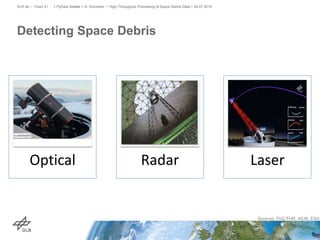
Detecting Space Debris
> PyData Seattle > A. Schreiber • High-Throughput Processing of Space Debris Data > 26.07.2015DLR.de • Chart 21
Sources: FhG FHR, AIUB, ESA
Optical Radar Laser
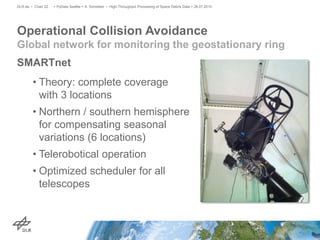
SMARTnet
• Theory: complete coverage
with 3 locations
• Northern / southern hemisphere
for compensating seasonal
variations (6 locations)
• Telerobotical operation
• Optimized scheduler for all
telescopes
Operational Collision Avoidance
Global network for monitoring the geostationary ring
> PyData Seattle > A. Schreiber • High-Throughput Processing of Space Debris Data > 26.07.2015DLR.de • Chart 22
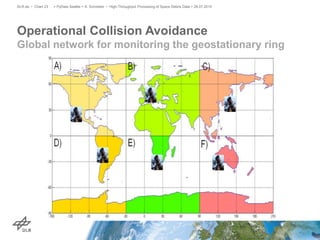
Operational Collision Avoidance
Global network for monitoring the geostationary ring
> PyData Seattle > A. Schreiber • High-Throughput Processing of Space Debris Data > 26.07.2015DLR.de • Chart 23
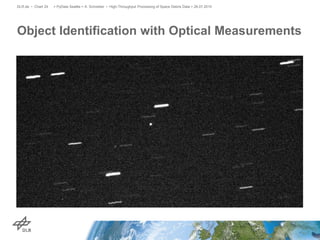
Object Identification with Optical Measurements
DLR.de • Chart 24 > PyData Seattle > A. Schreiber • High-Throughput Processing of Space Debris Data > 26.07.2015
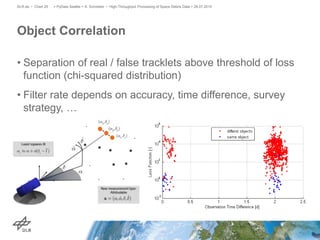
• Separation of real / false tracklets above threshold of loss
function (chi-squared distribution)
• Filter rate depends on accuracy, time difference, survey
strategy, …
Object Correlation
> PyData Seattle > A. Schreiber • High-Throughput Processing of Space Debris Data > 26.07.2015DLR.de • Chart 25
> PyData Seattle > A. Schreiber • High-Throughput Processing of Space Debris Data > 26.07.2015DLR.de • Chart 26
BACARDI
Objective
• Database with preferably high completeness and high
accuracy
• Primary source: sensor data and operator data
• Secondary source: externally generated ephemerides
BACARDI
Backbone Catalogue of Relational Debris Information
> PyData Seattle > A. Schreiber • High-Throughput Processing of Space Debris Data > 26.07.2015DLR.de • Chart 27
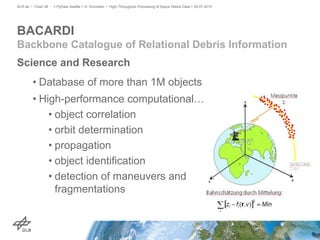
Science and Research
• Database of more than 1M objects
• High-performance computational…
• object correlation
• orbit determination
• propagation
• object identification
• detection of maneuvers and
fragmentations
BACARDI
Backbone Catalogue of Relational Debris Information
> PyData Seattle > A. Schreiber • High-Throughput Processing of Space Debris Data > 26.07.2015DLR.de • Chart 28
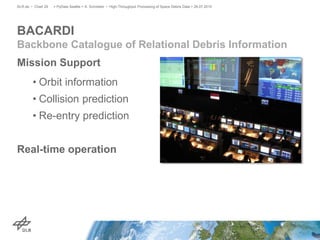
Mission Support
• Orbit information
• Collision prediction
• Re-entry prediction
Real-time operation
BACARDI
Backbone Catalogue of Relational Debris Information
> PyData Seattle > A. Schreiber • High-Throughput Processing of Space Debris Data > 26.07.2015DLR.de • Chart 29
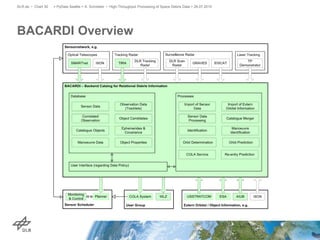
BACARDI Overview
> PyData Seattle > A. Schreiber • High-Throughput Processing of Space Debris Data > 26.07.2015DLR.de • Chart 30
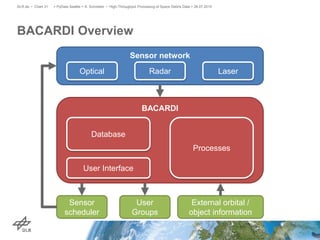
BACARDI Overview
> PyData Seattle > A. Schreiber • High-Throughput Processing of Space Debris Data > 26.07.2015DLR.de • Chart 31
Sensor network
BACARDI
Sensor
scheduler
User
Groups
External orbital /
object information
Optical Radar Laser
Database
User Interface
Processes
BACARDI
> PyData Seattle > A. Schreiber • High-Throughput Processing of Space Debris Data > 26.07.2015DLR.de • Chart 32
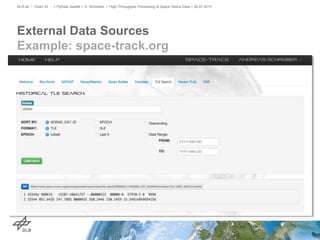
External Data Sources
Example: space-track.org
> PyData Seattle > A. Schreiber • High-Throughput Processing of Space Debris Data > 26.07.2015DLR.de • Chart 33
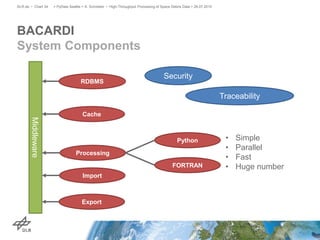
BACARDI
System Components
> PyData Seattle > A. Schreiber • High-Throughput Processing of Space Debris Data > 26.07.2015DLR.de • Chart 34
RDBMS
Cache
Import
Processing
Python
FORTRAN
Middleware
Security
Traceability
• Simple
• Parallel
• Fast
• Huge number
Export
> PyData Seattle > A. Schreiber • High-Throughput Processing of Space Debris Data > 26.07.2015DLR.de • Chart 35
Skynet
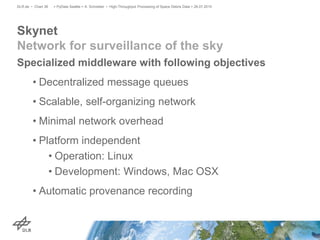
Specialized middleware with following objectives
• Decentralized message queues
• Scalable, self-organizing network
• Minimal network overhead
• Platform independent
• Operation: Linux
• Development: Windows, Mac OSX
• Automatic provenance recording
Skynet
Network for surveillance of the sky
> PyData Seattle > A. Schreiber • High-Throughput Processing of Space Debris Data > 26.07.2015DLR.de • Chart 36
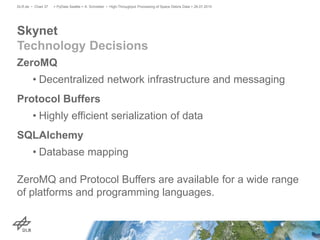
ZeroMQ
• Decentralized network infrastructure and messaging
Protocol Buffers
• Highly efficient serialization of data
SQLAlchemy
• Database mapping
ZeroMQ and Protocol Buffers are available for a wide range
of platforms and programming languages.
Skynet
Technology Decisions
> PyData Seattle > A. Schreiber • High-Throughput Processing of Space Debris Data > 26.07.2015DLR.de • Chart 37
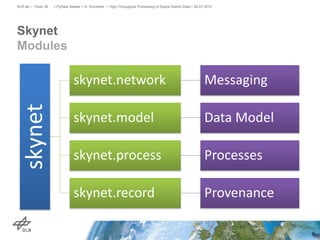
Skynet
Modules
> PyData Seattle > A. Schreiber • High-Throughput Processing of Space Debris Data > 26.07.2015DLR.de • Chart 38
skynet
skynet.network Messaging
skynet.model Data Model
skynet.process Processes
skynet.record Provenance
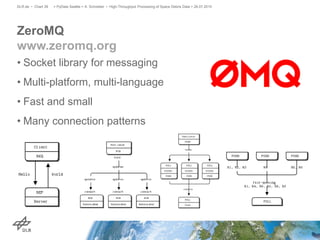
• Socket library for messaging
• Multi-platform, multi-language
• Fast and small
• Many connection patterns
ZeroMQ
www.zeromq.org
> PyData Seattle > A. Schreiber • High-Throughput Processing of Space Debris Data > 26.07.2015DLR.de • Chart 39
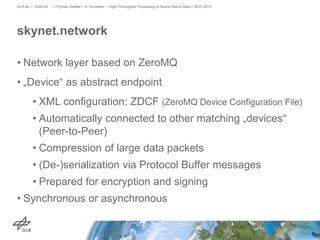
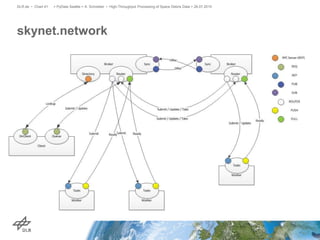
• Network layer based on ZeroMQ
• „Device“ as abstract endpoint
• XML configuration: ZDCF (ZeroMQ Device Configuration File)
• Automatically connected to other matching „devices“
(Peer-to-Peer)
• Compression of large data packets
• (De-)serialization via Protocol Buffer messages
• Prepared for encryption and signing
• Synchronous or asynchronous
skynet.network
> PyData Seattle > A. Schreiber • High-Throughput Processing of Space Debris Data > 26.07.2015DLR.de • Chart 40
skynet.network
> PyData Seattle > A. Schreiber • High-Throughput Processing of Space Debris Data > 26.07.2015DLR.de • Chart 41
• Specified by Google (https://github.com/google/protobuf)
• Serializing (encoding) structured data
• Efficient and extensible
• Language-neutral, platform-neutral
• Interface definition language to describe data structure
Protocol Buffers (“ProtoBuf”)
> PyData Seattle > A. Schreiber • High-Throughput Processing of Space Debris Data > 26.07.2015DLR.de • Chart 42
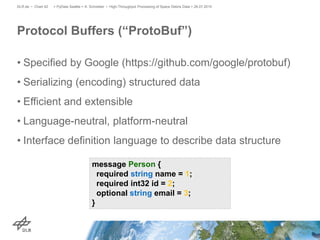
message Person {
required string name = 1;
required int32 id = 2;
optional string email = 3;
}
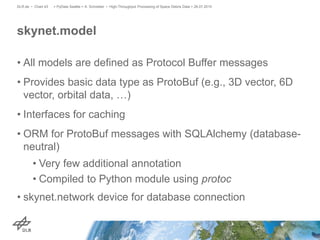
• All models are defined as Protocol Buffer messages
• Provides basic data type as ProtoBuf (e.g., 3D vector, 6D
vector, orbital data, …)
• Interfaces for caching
• ORM for ProtoBuf messages with SQLAlchemy (database-
neutral)
• Very few additional annotation
• Compiled to Python module using protoc
• skynet.network device for database connection
skynet.model
> PyData Seattle > A. Schreiber • High-Throughput Processing of Space Debris Data > 26.07.2015DLR.de • Chart 43
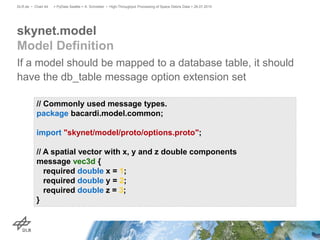
If a model should be mapped to a database table, it should
have the db_table message option extension set
skynet.model
Model Definition
> PyData Seattle > A. Schreiber • High-Throughput Processing of Space Debris Data > 26.07.2015DLR.de • Chart 44
// Commonly used message types.
package bacardi.model.common;
import "skynet/model/proto/options.proto";
// A spatial vector with x, y and z double components
message vec3d {
required double x = 1;
required double y = 2;
required double z = 3;
}
skynet.model
> PyData Seattle > A. Schreiber • High-Throughput Processing of Space Debris Data > 26.07.2015DLR.de • Chart 45
BACARDI Network Message
HEADER BLOCK 1 BLOCK 2 BLOCK N NULL…
DEST NULL SOURCE NULL… …
TYPE COMMAND NULL [SIG]…[KEY]
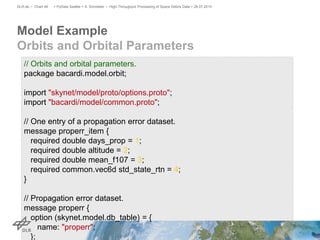
// Orbits and orbital parameters.
package bacardi.model.orbit;
import "skynet/model/proto/options.proto";
import "bacardi/model/common.proto";
// One entry of a propagation error dataset.
message properr_item {
required double days_prop = 1;
required double altitude = 2;
required double mean_f107 = 3;
required common.vec6d std_state_rtn = 4;
}
// Propagation error dataset.
message properr {
option (skynet.model.db_table) = {
name: "properr";
};
Model Example
Orbits and Orbital Parameters
> PyData Seattle > A. Schreiber • High-Throughput Processing of Space Debris Data > 26.07.2015DLR.de • Chart 46
skynet.model
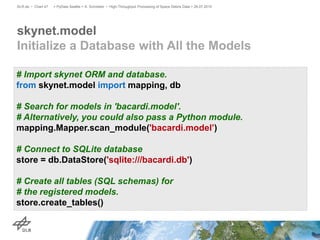
Initialize a Database with All the Models
> PyData Seattle > A. Schreiber • High-Throughput Processing of Space Debris Data > 26.07.2015DLR.de • Chart 47
# Import skynet ORM and database.
from skynet.model import mapping, db
# Search for models in 'bacardi.model'.
# Alternatively, you could also pass a Python module.
mapping.Mapper.scan_module('bacardi.model’)
# Connect to SQLite database
store = db.DataStore('sqlite:///bacardi.db')
# Create all tables (SQL schemas) for
# the registered models.
store.create_tables()
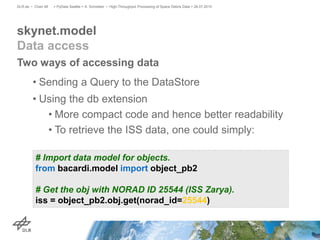
Two ways of accessing data
• Sending a Query to the DataStore
• Using the db extension
• More compact code and hence better readability
• To retrieve the ISS data, one could simply:
skynet.model
Data access
> PyData Seattle > A. Schreiber • High-Throughput Processing of Space Debris Data > 26.07.2015DLR.de • Chart 48
# Import data model for objects.
from bacardi.model import object_pb2
# Get the obj with NORAD ID 25544 (ISS Zarya).
iss = object_pb2.obj.get(norad_id=25544)
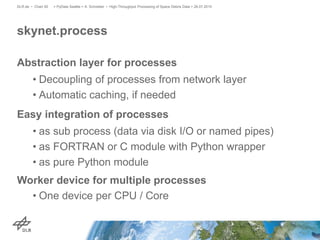
Abstraction layer for processes
• Decoupling of processes from network layer
• Automatic caching, if needed
Easy integration of processes
• as sub process (data via disk I/O or named pipes)
• as FORTRAN or C module with Python wrapper
• as pure Python module
Worker device for multiple processes
• One device per CPU / Core
skynet.process
> PyData Seattle > A. Schreiber • High-Throughput Processing of Space Debris Data > 26.07.2015DLR.de • Chart 50
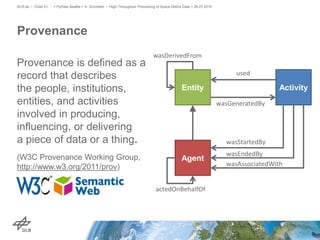
Provenance is defined as a
record that describes
the people, institutions,
entities, and activities
involved in producing,
influencing, or delivering
a piece of data or a thing.
(W3C Provenance Working Group,
http://www.w3.org/2011/prov)
Provenance
> PyData Seattle > A. Schreiber • High-Throughput Processing of Space Debris Data > 26.07.2015DLR.de • Chart 51
Agent
Entity Activity
used
wasGeneratedBy
wasDerivedFrom
wasStartedBy
wasEndedBy
wasAssociatedWith
actedOnBehalfOf
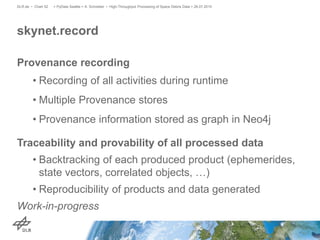
Provenance recording
• Recording of all activities during runtime
• Multiple Provenance stores
• Provenance information stored as graph in Neo4j
Traceability and provability of all processed data
• Backtracking of each produced product (ephemerides,
state vectors, correlated objects, …)
• Reproducibility of products and data generated
Work-in-progress
skynet.record
> PyData Seattle > A. Schreiber • High-Throughput Processing of Space Debris Data > 26.07.2015DLR.de • Chart 52
Technical
• Graphical User Interfaces
• Web (Django) and desktop (PyQt)
• Workflow
Organizational
• Operational for simple workflows end of 2015 at DLR
• Extended SSA versions for DLR and German Army
• Other use cases for Skynet (e.g., data acquisition for
rocket motors)
BACARDI and Skynet
Current and Future Work
> PyData Seattle > A. Schreiber • High-Throughput Processing of Space Debris Data > 26.07.2015DLR.de • Chart 53
> PyData Seattle > A. Schreiber • High-Throughput Processing of Space Debris Data > 26.07.2015DLR.de • Chart 54
Thank You!
Questions?
Andreas.Schreiber@dlr.de
www.DLR.de/sc | @onyame

High Throughput Processing of Space Debris Data

  • 1.
    High-Throughput Processing of SpaceDebris Data Andreas Schreiber, Michael Meinel German Aerospace Center (DLR) Simulation and Software Technology, Berlin / Cologne, Germany PyData Seattle July 26, 2015 > PyData Seattle > A. Schreiber • High-Throughput Processing of Space Debris Data > 26.07.2015DLR.de • Chart 1
  • 2.
    • Space Debris •BACARDI • Skynet Outline > PyData Seattle > A. Schreiber • High-Throughput Processing of Space Debris Data > 26.07.2015DLR.de • Chart 2
  • 3.
    Major research areasof DLR • Aeronautics • Space • Transportation • Energy • Security Software research and dev. • Software engineering, HPC, distributed systems, … DLR Aerospace Research Center, Space Agency > PyData Seattle > A. Schreiber • High-Throughput Processing of Space Debris Data > 26.07.2015DLR.de • Chart 3
  • 4.
    > PyData Seattle> A. Schreiber • High-Throughput Processing of Space Debris Data > 26.07.2015DLR.de • Chart 4 Space Debris
  • 5.
    > PyData Seattle> A. Schreiber • High-Throughput Processing of Space Debris Data > 26.07.2015DLR.de • Chart 5 Lower Orbit 300 – 2000 km Geostationary Orbit ≈36,000 km
  • 6.
    Space Flight > PyDataSeattle > A. Schreiber • High-Throughput Processing of Space Debris Data > 26.07.2015DLR.de • Chart 6
  • 7.
    • Almost 5,000rockets launched • More than 6,000 satellites placed in orbit • About 1,000 active satellites today (that’s 7% of known objects in orbit) About 50 Years of Space Flight > PyData Seattle > A. Schreiber • High-Throughput Processing of Space Debris Data > 26.07.2015DLR.de • Chart 7
  • 8.
    Defunct objects inspace • Disused satellites & rocket stages • Fragments from explosions & collisions • Released object (tools etc.) • Slag of solid-fueled rockets • … and other sources of small particles Space Debris > PyData Seattle > A. Schreiber • High-Throughput Processing of Space Debris Data > 26.07.2015DLR.de • Chart 8
  • 9.
    Space Debris > PyDataSeattle > A. Schreiber • High-Throughput Processing of Space Debris Data > 26.07.2015DLR.de • Chart 9 January 2007: FengYun-1C February 2009: Collision Iridium-33 & Kosmos-2251
  • 10.
    Space Debris > PyDataSeattle > A. Schreiber • High-Throughput Processing of Space Debris Data > 26.07.2015DLR.de • Chart 10 Iridium-33 & Kosmos-2251: Debris fields after 50 minutes Fengyun-1C debris one month after its disintegration
  • 11.
    16,300 Objects inCatalogue > PyData Seattle > A. Schreiber • High-Throughput Processing of Space Debris Data > 26.07.2015DLR.de • Chart 11
  • 12.
    29,000 Objects Largerthan 10 cm > PyData Seattle > A. Schreiber • High-Throughput Processing of Space Debris Data > 26.07.2015DLR.de • Chart 12
  • 13.
    750,000 Objects Largerthan 1 cm > PyData Seattle > A. Schreiber • High-Throughput Processing of Space Debris Data > 26.07.2015DLR.de • Chart 13
  • 14.
    150M Objects Largerthan 1 mm > PyData Seattle > A. Schreiber • High-Throughput Processing of Space Debris Data > 26.07.2015DLR.de • Chart 14
  • 15.
    Impact Laboratory Impact AluminumSphere / Block > PyData Seattle > A. Schreiber • High-Throughput Processing of Space Debris Data > 26.07.2015DLR.de • Chart 15
  • 16.
    Impact Real Debris Objecton a Satellite Solar Panel > PyData Seattle > A. Schreiber • High-Throughput Processing of Space Debris Data > 26.07.2015DLR.de • Chart 16
  • 17.
    Distribution of SpaceDebris > PyData Seattle > A. Schreiber • High-Throughput Processing of Space Debris Data > 26.07.2015DLR.de • Chart 17 Source: NASA Orbital Debris Quarterly News 2/2012 ISS Many Earth Observation Satellites (e.g., Envisat) TerraSAR-X
  • 18.
    Collision Prediction International SpaceStation DLR.de • Chart 18 > PyData Seattle > A. Schreiber • High-Throughput Processing of Space Debris Data > 26.07.2015
  • 19.
    > PyData Seattle> A. Schreiber • High-Throughput Processing of Space Debris Data > 26.07.2015DLR.de • Chart 19
  • 20.
    > PyData Seattle> A. Schreiber • High-Throughput Processing of Space Debris Data > 26.07.2015DLR.de • Chart 20 http://rbth.com/news/2015/07/26/iss_successfully_ducks_from_space_debris_48023.html
  • 21.
    Detecting Space Debris >PyData Seattle > A. Schreiber • High-Throughput Processing of Space Debris Data > 26.07.2015DLR.de • Chart 21 Sources: FhG FHR, AIUB, ESA Optical Radar Laser
  • 22.
    SMARTnet • Theory: completecoverage with 3 locations • Northern / southern hemisphere for compensating seasonal variations (6 locations) • Telerobotical operation • Optimized scheduler for all telescopes Operational Collision Avoidance Global network for monitoring the geostationary ring > PyData Seattle > A. Schreiber • High-Throughput Processing of Space Debris Data > 26.07.2015DLR.de • Chart 22
  • 23.
    Operational Collision Avoidance Globalnetwork for monitoring the geostationary ring > PyData Seattle > A. Schreiber • High-Throughput Processing of Space Debris Data > 26.07.2015DLR.de • Chart 23
  • 24.
    Object Identification withOptical Measurements DLR.de • Chart 24 > PyData Seattle > A. Schreiber • High-Throughput Processing of Space Debris Data > 26.07.2015
  • 25.
    • Separation ofreal / false tracklets above threshold of loss function (chi-squared distribution) • Filter rate depends on accuracy, time difference, survey strategy, … Object Correlation > PyData Seattle > A. Schreiber • High-Throughput Processing of Space Debris Data > 26.07.2015DLR.de • Chart 25
  • 26.
    > PyData Seattle> A. Schreiber • High-Throughput Processing of Space Debris Data > 26.07.2015DLR.de • Chart 26 BACARDI
  • 27.
    Objective • Database withpreferably high completeness and high accuracy • Primary source: sensor data and operator data • Secondary source: externally generated ephemerides BACARDI Backbone Catalogue of Relational Debris Information > PyData Seattle > A. Schreiber • High-Throughput Processing of Space Debris Data > 26.07.2015DLR.de • Chart 27
  • 28.
    Science and Research •Database of more than 1M objects • High-performance computational… • object correlation • orbit determination • propagation • object identification • detection of maneuvers and fragmentations BACARDI Backbone Catalogue of Relational Debris Information > PyData Seattle > A. Schreiber • High-Throughput Processing of Space Debris Data > 26.07.2015DLR.de • Chart 28
  • 29.
    Mission Support • Orbitinformation • Collision prediction • Re-entry prediction Real-time operation BACARDI Backbone Catalogue of Relational Debris Information > PyData Seattle > A. Schreiber • High-Throughput Processing of Space Debris Data > 26.07.2015DLR.de • Chart 29
  • 30.
    BACARDI Overview > PyDataSeattle > A. Schreiber • High-Throughput Processing of Space Debris Data > 26.07.2015DLR.de • Chart 30
  • 31.
    BACARDI Overview > PyDataSeattle > A. Schreiber • High-Throughput Processing of Space Debris Data > 26.07.2015DLR.de • Chart 31 Sensor network BACARDI Sensor scheduler User Groups External orbital / object information Optical Radar Laser Database User Interface Processes
  • 32.
    BACARDI > PyData Seattle> A. Schreiber • High-Throughput Processing of Space Debris Data > 26.07.2015DLR.de • Chart 32
  • 33.
    External Data Sources Example:space-track.org > PyData Seattle > A. Schreiber • High-Throughput Processing of Space Debris Data > 26.07.2015DLR.de • Chart 33
  • 34.
    BACARDI System Components > PyDataSeattle > A. Schreiber • High-Throughput Processing of Space Debris Data > 26.07.2015DLR.de • Chart 34 RDBMS Cache Import Processing Python FORTRAN Middleware Security Traceability • Simple • Parallel • Fast • Huge number Export
  • 35.
    > PyData Seattle> A. Schreiber • High-Throughput Processing of Space Debris Data > 26.07.2015DLR.de • Chart 35 Skynet
  • 36.
    Specialized middleware withfollowing objectives • Decentralized message queues • Scalable, self-organizing network • Minimal network overhead • Platform independent • Operation: Linux • Development: Windows, Mac OSX • Automatic provenance recording Skynet Network for surveillance of the sky > PyData Seattle > A. Schreiber • High-Throughput Processing of Space Debris Data > 26.07.2015DLR.de • Chart 36
  • 37.
    ZeroMQ • Decentralized networkinfrastructure and messaging Protocol Buffers • Highly efficient serialization of data SQLAlchemy • Database mapping ZeroMQ and Protocol Buffers are available for a wide range of platforms and programming languages. Skynet Technology Decisions > PyData Seattle > A. Schreiber • High-Throughput Processing of Space Debris Data > 26.07.2015DLR.de • Chart 37
  • 38.
    Skynet Modules > PyData Seattle> A. Schreiber • High-Throughput Processing of Space Debris Data > 26.07.2015DLR.de • Chart 38 skynet skynet.network Messaging skynet.model Data Model skynet.process Processes skynet.record Provenance
  • 39.
    • Socket libraryfor messaging • Multi-platform, multi-language • Fast and small • Many connection patterns ZeroMQ www.zeromq.org > PyData Seattle > A. Schreiber • High-Throughput Processing of Space Debris Data > 26.07.2015DLR.de • Chart 39
  • 40.
    • Network layerbased on ZeroMQ • „Device“ as abstract endpoint • XML configuration: ZDCF (ZeroMQ Device Configuration File) • Automatically connected to other matching „devices“ (Peer-to-Peer) • Compression of large data packets • (De-)serialization via Protocol Buffer messages • Prepared for encryption and signing • Synchronous or asynchronous skynet.network > PyData Seattle > A. Schreiber • High-Throughput Processing of Space Debris Data > 26.07.2015DLR.de • Chart 40
  • 41.
    skynet.network > PyData Seattle> A. Schreiber • High-Throughput Processing of Space Debris Data > 26.07.2015DLR.de • Chart 41
  • 42.
    • Specified byGoogle (https://github.com/google/protobuf) • Serializing (encoding) structured data • Efficient and extensible • Language-neutral, platform-neutral • Interface definition language to describe data structure Protocol Buffers (“ProtoBuf”) > PyData Seattle > A. Schreiber • High-Throughput Processing of Space Debris Data > 26.07.2015DLR.de • Chart 42 message Person { required string name = 1; required int32 id = 2; optional string email = 3; }
  • 43.
    • All modelsare defined as Protocol Buffer messages • Provides basic data type as ProtoBuf (e.g., 3D vector, 6D vector, orbital data, …) • Interfaces for caching • ORM for ProtoBuf messages with SQLAlchemy (database- neutral) • Very few additional annotation • Compiled to Python module using protoc • skynet.network device for database connection skynet.model > PyData Seattle > A. Schreiber • High-Throughput Processing of Space Debris Data > 26.07.2015DLR.de • Chart 43
  • 44.
    If a modelshould be mapped to a database table, it should have the db_table message option extension set skynet.model Model Definition > PyData Seattle > A. Schreiber • High-Throughput Processing of Space Debris Data > 26.07.2015DLR.de • Chart 44 // Commonly used message types. package bacardi.model.common; import "skynet/model/proto/options.proto"; // A spatial vector with x, y and z double components message vec3d { required double x = 1; required double y = 2; required double z = 3; }
  • 45.
    skynet.model > PyData Seattle> A. Schreiber • High-Throughput Processing of Space Debris Data > 26.07.2015DLR.de • Chart 45 BACARDI Network Message HEADER BLOCK 1 BLOCK 2 BLOCK N NULL… DEST NULL SOURCE NULL… … TYPE COMMAND NULL [SIG]…[KEY]
  • 46.
    // Orbits andorbital parameters. package bacardi.model.orbit; import "skynet/model/proto/options.proto"; import "bacardi/model/common.proto"; // One entry of a propagation error dataset. message properr_item { required double days_prop = 1; required double altitude = 2; required double mean_f107 = 3; required common.vec6d std_state_rtn = 4; } // Propagation error dataset. message properr { option (skynet.model.db_table) = { name: "properr"; }; Model Example Orbits and Orbital Parameters > PyData Seattle > A. Schreiber • High-Throughput Processing of Space Debris Data > 26.07.2015DLR.de • Chart 46
  • 47.
    skynet.model Initialize a Databasewith All the Models > PyData Seattle > A. Schreiber • High-Throughput Processing of Space Debris Data > 26.07.2015DLR.de • Chart 47 # Import skynet ORM and database. from skynet.model import mapping, db # Search for models in 'bacardi.model'. # Alternatively, you could also pass a Python module. mapping.Mapper.scan_module('bacardi.model’) # Connect to SQLite database store = db.DataStore('sqlite:///bacardi.db') # Create all tables (SQL schemas) for # the registered models. store.create_tables()
  • 48.
    Two ways ofaccessing data • Sending a Query to the DataStore • Using the db extension • More compact code and hence better readability • To retrieve the ISS data, one could simply: skynet.model Data access > PyData Seattle > A. Schreiber • High-Throughput Processing of Space Debris Data > 26.07.2015DLR.de • Chart 48 # Import data model for objects. from bacardi.model import object_pb2 # Get the obj with NORAD ID 25544 (ISS Zarya). iss = object_pb2.obj.get(norad_id=25544)
  • 49.
    Abstraction layer forprocesses • Decoupling of processes from network layer • Automatic caching, if needed Easy integration of processes • as sub process (data via disk I/O or named pipes) • as FORTRAN or C module with Python wrapper • as pure Python module Worker device for multiple processes • One device per CPU / Core skynet.process > PyData Seattle > A. Schreiber • High-Throughput Processing of Space Debris Data > 26.07.2015DLR.de • Chart 50
  • 50.
    Provenance is definedas a record that describes the people, institutions, entities, and activities involved in producing, influencing, or delivering a piece of data or a thing. (W3C Provenance Working Group, http://www.w3.org/2011/prov) Provenance > PyData Seattle > A. Schreiber • High-Throughput Processing of Space Debris Data > 26.07.2015DLR.de • Chart 51 Agent Entity Activity used wasGeneratedBy wasDerivedFrom wasStartedBy wasEndedBy wasAssociatedWith actedOnBehalfOf
  • 51.
    Provenance recording • Recordingof all activities during runtime • Multiple Provenance stores • Provenance information stored as graph in Neo4j Traceability and provability of all processed data • Backtracking of each produced product (ephemerides, state vectors, correlated objects, …) • Reproducibility of products and data generated Work-in-progress skynet.record > PyData Seattle > A. Schreiber • High-Throughput Processing of Space Debris Data > 26.07.2015DLR.de • Chart 52
  • 52.
    Technical • Graphical UserInterfaces • Web (Django) and desktop (PyQt) • Workflow Organizational • Operational for simple workflows end of 2015 at DLR • Extended SSA versions for DLR and German Army • Other use cases for Skynet (e.g., data acquisition for rocket motors) BACARDI and Skynet Current and Future Work > PyData Seattle > A. Schreiber • High-Throughput Processing of Space Debris Data > 26.07.2015DLR.de • Chart 53
  • 53.
    > PyData Seattle> A. Schreiber • High-Throughput Processing of Space Debris Data > 26.07.2015DLR.de • Chart 54 Thank You! Questions? Andreas.Schreiber@dlr.de www.DLR.de/sc | @onyame

Editor's Notes

  • #10 https://en.wikipedia.org/wiki/2007_Chinese_anti-satellite_missile_test https://en.wikipedia.org/wiki/2009_satellite_collision
  • #16 Simulated laboratory Impact of a cm - class aluminum sphere with typical LEO-speed on an aluminum block
  • #19 The crew of the International Space Station has moved into the Soyuz vehicle docked to the station as a precaution due to an anticipated close approach of a piece of space debris to the orbiting complex. The debris is expected to pass closest to the station at about 7:01 a.m. CDT July 16, 2015. The crew will remain in the Soyuz until given an all clear by Mission Control. All station systems are currently operating normally. NASA TV will broadcast station operations live beginning at 6:45 a.m. CDT and continuing through resolution of this event. Watch NASA TV now.
  • #20 https://twitter.com/Space_Station/status/621646793571479556
  • #21 http://rbth.com/news/2015/07/26/iss_successfully_ducks_from_space_debris_48023.html