A Provenance Model for Quantified Self Data
Andreas Schreiber
Department for Intelligent and Distributed Systems
German Aerospace Center (DLR), Cologne/Berlin
> HCI International 2016 > A. Schreiber • A Provenance Model for Quantified Self Data > 21.07.2016DLR.de • Chart 1
Quantified Self (n = 1) Medical Trials (n > 1)
Motivation
Use Cases
> HCI International 2016 > A. Schreiber • A Provenance Model for Quantified Self Data > 21.07.2016DLR.de • Chart 2
Telemedicine Medical experiments
Motivation
More Use Cases
> HCI International 2016 > A. Schreiber • A Provenance Model for Quantified Self Data > 21.07.2016DLR.de • Chart 3
Motivation
Understand, how data has been produced, processed, stored, accessed, ...
It started at the Breakout Session on Mapping Data Access (2014 QS Europe Conference, Amsterdam)
https://forum.quantifiedself.com/t/breakout-mapping-data-access/995
> HCI International 2016 > A. Schreiber • A Provenance Model for Quantified Self Data > 21.07.2016DLR.de • Chart 4
Motivation
(Provenance) Questions
Entity-focused
• What data about the user were created during the activity X?
• What data about the user were automatically generated?
• What data about the user were derived from manual input?
Activity-focused
• Which activities support visualization of the users data?
• In which activities can the user input data?
• What processes are communicating data?
Agent-focused
• What parties were involved in generating data X?
• What parties got access on data X?
• Can other parties see user’s data X?
> HCI International 2016 > A. Schreiber • A Provenance Model for Quantified Self Data > 21.07.2016DLR.de • Chart 5
 Data
 Apps and Services
 Access and Privacy
Provenance
Definition
Provenance is information about entities, activities, and people involved
in producing a piece of data or thing, which can be used to form
assessments about its quality, reliability or trustworthiness.
PROV W3C Working Group
https://www.w3.org/TR/prov-overview
> HCI International 2016 > A. Schreiber • A Provenance Model for Quantified Self Data > 21.07.2016DLR.de • Chart 6
PROV
W3C Specification for Provenance
W3C Provenance Working Group: https://www.w3.org/2011/prov
PROV
• The goal of PROV is to enable the wide publication and interchange of provenance on the Web and
other information systems
• PROV enables one to represent and interchange provenance information using widely available formats
such as RDF and XML
PROV Family of Documents
• PROV-O: PROV Ontology
• PROV-DM: PROV Data Model
• PROV-N: PROV Notation
• PROV-CONSTRAINTS: PROV Constraints
• PROV-AQ: Accessing and Querying
> HCI International 2016 > A. Schreiber • A Provenance Model for Quantified Self Data > 21.07.2016DLR.de • Chart 7
Overview of PROV
Key Concepts
Entities
• Physical, digital, conceptual, or other kinds of
things
• For example, documents, web sites, graphics,
or data sets
Activities
• Activities generate new entities or
make use of existing entities
• Activities could be actions or processes
Agents
• Agents takes a role in an activity and
have the responsibility for the activity
• For example, persons, pieces of software, or
organizations
> HCI International 2016 > A. Schreiber • A Provenance Model for Quantified Self Data > 21.07.2016DLR.de • Chart 8
Activity
Entity
Agent
wasGeneratedBy
used
wasDerivedFrom
wasAttributedTo
wasAssociatedWith
PROV Example
Baking a Cake
> HCI International 2016 > A. Schreiber • A Provenance Model for Quantified Self Data > 21.07.2016DLR.de • Chart 9
100 g
butter
bake
2
eggs
100 g
sugar
100 g
flour
cake
used
used
used
used
wasGeneratedBy
wasDerivedFrom
UserData
Export
Agent
UserData
timestamp: float
used
name: string
type: class
name: string
type: class
wasGeneratedBy
timestamp: float
wasDerivedFrom
wasAssociatedWith
name: string
type: class
UserData
Input
Agent
UserData
timestamp: float
used
name: string
type: class
name: string
type: class wasGeneratedBy
wasDerivedFrom
wasAssociatedWith
name: string
type: class
wasAttributedTo
timestamp: float
PROV Model for Quantified Self
Overview
> HCI International 2016 > A. Schreiber • A Provenance Model for Quantified Self Data > 21.07.2016DLR.de • Chart 10
UserData
Request
Agent
UserData
timestamp: float
name: string
type: class
name: string
type: class
wasGeneratedBy
wasDerivedFrom
wasAssociatedWith
name: string
type: class
used
timestamp: float
API
Configuration
name: string
type: class
hadPlan
Software
Agent
name: string
type: class
wasAttributedTo
UserData
Aggregate
Agent
UserData
timestamp: float
used
name: string
type: class
name: string
type: class
wasGeneratedBy
timestamp: float
wasDerivedFrom
wasAssociatedWith
name: string
type: class
Agent
name: string
type: class
wasAttributedTo
UserData
Visualize
Agent
Graphic
timestamp: float
used
name: string
type: class
name: string
wasGeneratedBy
timestamp: float
wasDerivedFrom
wasAssociatedWith
name: string
type: class
Five sub models (templates) for basic activities
• Input
• Export
• Request
• Aggregate
• Visualize
The activities generate or change data that is
associated or attributed to Agents
• Users
• Software
PROV Model for Quantified Self
Input
> HCI International 2016 > A. Schreiber • A Provenance Model for Quantified Self Data > 21.07.2016DLR.de • Chart 11
UserData
Input
Agent
UserData
timestamp: float
used
name: string
type: class
name: string
type: class wasGeneratedBy
wasDerivedFrom
wasAssociatedWith
name: string
type: class
wasAttributedTo
timestamp: float
Getting (raw) data from the user
• Manual input
• Via sensors
Usually every QS workflow needs such a
functionality to record data from the user
PROV Model for Quantified Self
Export
Exports data to other formats
• Transfer to other systems
• Readable by people
UserData
Export
Agent
UserData
timestamp: float
used
name: string
type: class
name: string
type: class
wasGeneratedBy
timestamp: float
wasDerivedFrom
wasAssociatedWith
name: string
type: class
> HCI International 2016 > A. Schreiber • A Provenance Model for Quantified Self Data > 21.07.2016DLR.de • Chart 12
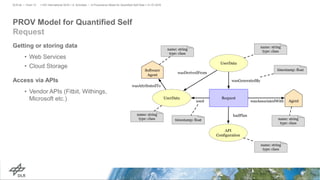
PROV Model for Quantified Self
Request
Getting or storing data
• Web Services
• Cloud Storage
Access via APIs
• Vendor APIs (Fitbit, Withings,
Microsoft etc.)
UserData
Request
Agent
UserData
timestamp: float
name: string
type: class
name: string
type: class
wasGeneratedBy
wasDerivedFrom
wasAssociatedWith
name: string
type: class
used
timestamp: float
API
Configuration
name: string
type: class
hadPlan
Software
Agent
name: string
type: class
wasAttributedTo
> HCI International 2016 > A. Schreiber • A Provenance Model for Quantified Self Data > 21.07.2016DLR.de • Chart 13
PROV Model for Quantified Self
Aggregate
Combine or analyze data
• Aggregate different data sets
• Statistical analysis
• Extract knowledge UserData
Aggregate
Agent
UserData
timestamp: float
used
name: string
type: class
name: string
type: class
wasGeneratedBy
timestamp: float
wasDerivedFrom
wasAssociatedWith
name: string
type: class
Agent
name: string
type: class
wasAttributedTo
> HCI International 2016 > A. Schreiber • A Provenance Model for Quantified Self Data > 21.07.2016DLR.de • Chart 14
PROV Model for Quantified Self
Visualize
Visualize data
• Time series plots
• Representation of statistical information
• Historical information
UserData
Visualize
Agent
Graphic
timestamp: float
used
name: string
type: class
name: string
wasGeneratedBy
timestamp: float
wasDerivedFrom
wasAssociatedWith
name: string
type: class
> HCI International 2016 > A. Schreiber • A Provenance Model for Quantified Self Data > 21.07.2016DLR.de • Chart 15
Example
Weight Tracking
> HCI International 2016 > A. Schreiber • A Provenance Model for Quantified Self Data > 21.07.2016DLR.de • Chart 16
Example
Weight Tracking
> HCI International 2016 > A. Schreiber • A Provenance Model for Quantified Self Data > 21.07.2016DLR.de • Chart 17
Weight Tracking Example
Exporting a CSV File from an Android App
> HCI International 2016 > A. Schreiber • A Provenance Model for Quantified Self Data > 21.07.2016DLR.de • Chart 18
UserData
Export
Agent
UserData
timestamp: float
used
name: string
type: class
name: string
type: class
wasGeneratedBy
timestamp: float
wasDerivedFrom
wasAssociatedWith
name: string
type: class
https://play.google.com/store/apps/details?id=de.medando.weightcompanion
Weight Tracking Example
Visualizing Data with a Python Script
> HCI International 2016 > A. Schreiber • A Provenance Model for Quantified Self Data > 21.07.2016DLR.de • Chart 19
UserData
Visualize
Agent
Graphic
timestamp: float
used
name: string
type: class
name: string
wasGeneratedBy
timestamp: float
wasDerivedFrom
wasAssociatedWith
name: string
type: class
> HCI International 2016 > A. Schreiber • A Provenance Model for Quantified Self Data > 21.07.2016DLR.de • Chart 20
Weight Tracking Example
Merged Provenance
Date,Time,Weight,Waist,Hip,Device,Comment
"Jun 13, 2012",14:00,83.7,,,Withings,
"Jun 13, 2012",14:08,79.7,,,Withings,
"Jun 15, 2012",21:59,82.7,,,Withings,
"Jun 15, 2012",22:04,82.7,,,Withings,
"Jun 24, 2012",18:32,86.1,,,Withings,
"Jun 26, 2012",07:42,80.8,,,Withings,
"Jun 27, 2012",07:40,81.1,,,Withings,
"Jun 29, 2012",07:34,79.4,,,Withings,
"Jun 30, 2012",22:12,81.7,,,Withings,
"Jul 1, 2012",11:21,80.6,,,Withings,
"Jul 7, 2012",17:04,80.7,,,Withings,
"Jul 10, 2012",07:46,81.8,,,Withings,
"Jul 11, 2012",07:32,78.6,,,Withings,
"Jul 12, 2012",07:26,79.4,,,Withings,
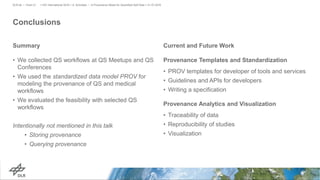
Summary Current and Future Work
Conclusions
• We collected QS workflows at QS Meetups and QS
Conferences
• We used the standardized data model PROV for
modeling the provenance of QS and medical
workflows
• We evaluated the feasibility with selected QS
workflows
Intentionally not mentioned in this talk
• Storing provenance
• Querying provenance
Provenance Templates and Standardization
• PROV templates for developer of tools and services
• Guidelines and APIs for developers
• Writing a specification
Provenance Analytics and Visualization
• Traceability of data
• Reproducibility of studies
• Visualization
> HCI International 2016 > A. Schreiber • A Provenance Model for Quantified Self Data > 21.07.2016DLR.de • Chart 21
> HCI International 2016 > A. Schreiber • A Provenance Model for Quantified Self Data > 21.07.2016DLR.de • Chart 22
Thank You!
Questions?
Andreas.Schreiber@dlr.de
www.DLR.de/sc | @onyame

A Provenance Model for Quantified Self Data

  • 1.
    A Provenance Modelfor Quantified Self Data Andreas Schreiber Department for Intelligent and Distributed Systems German Aerospace Center (DLR), Cologne/Berlin > HCI International 2016 > A. Schreiber • A Provenance Model for Quantified Self Data > 21.07.2016DLR.de • Chart 1
  • 2.
    Quantified Self (n= 1) Medical Trials (n > 1) Motivation Use Cases > HCI International 2016 > A. Schreiber • A Provenance Model for Quantified Self Data > 21.07.2016DLR.de • Chart 2
  • 3.
    Telemedicine Medical experiments Motivation MoreUse Cases > HCI International 2016 > A. Schreiber • A Provenance Model for Quantified Self Data > 21.07.2016DLR.de • Chart 3
  • 4.
    Motivation Understand, how datahas been produced, processed, stored, accessed, ... It started at the Breakout Session on Mapping Data Access (2014 QS Europe Conference, Amsterdam) https://forum.quantifiedself.com/t/breakout-mapping-data-access/995 > HCI International 2016 > A. Schreiber • A Provenance Model for Quantified Self Data > 21.07.2016DLR.de • Chart 4
  • 5.
    Motivation (Provenance) Questions Entity-focused • Whatdata about the user were created during the activity X? • What data about the user were automatically generated? • What data about the user were derived from manual input? Activity-focused • Which activities support visualization of the users data? • In which activities can the user input data? • What processes are communicating data? Agent-focused • What parties were involved in generating data X? • What parties got access on data X? • Can other parties see user’s data X? > HCI International 2016 > A. Schreiber • A Provenance Model for Quantified Self Data > 21.07.2016DLR.de • Chart 5  Data  Apps and Services  Access and Privacy
  • 6.
    Provenance Definition Provenance is informationabout entities, activities, and people involved in producing a piece of data or thing, which can be used to form assessments about its quality, reliability or trustworthiness. PROV W3C Working Group https://www.w3.org/TR/prov-overview > HCI International 2016 > A. Schreiber • A Provenance Model for Quantified Self Data > 21.07.2016DLR.de • Chart 6
  • 7.
    PROV W3C Specification forProvenance W3C Provenance Working Group: https://www.w3.org/2011/prov PROV • The goal of PROV is to enable the wide publication and interchange of provenance on the Web and other information systems • PROV enables one to represent and interchange provenance information using widely available formats such as RDF and XML PROV Family of Documents • PROV-O: PROV Ontology • PROV-DM: PROV Data Model • PROV-N: PROV Notation • PROV-CONSTRAINTS: PROV Constraints • PROV-AQ: Accessing and Querying > HCI International 2016 > A. Schreiber • A Provenance Model for Quantified Self Data > 21.07.2016DLR.de • Chart 7
  • 8.
    Overview of PROV KeyConcepts Entities • Physical, digital, conceptual, or other kinds of things • For example, documents, web sites, graphics, or data sets Activities • Activities generate new entities or make use of existing entities • Activities could be actions or processes Agents • Agents takes a role in an activity and have the responsibility for the activity • For example, persons, pieces of software, or organizations > HCI International 2016 > A. Schreiber • A Provenance Model for Quantified Self Data > 21.07.2016DLR.de • Chart 8 Activity Entity Agent wasGeneratedBy used wasDerivedFrom wasAttributedTo wasAssociatedWith
  • 9.
    PROV Example Baking aCake > HCI International 2016 > A. Schreiber • A Provenance Model for Quantified Self Data > 21.07.2016DLR.de • Chart 9 100 g butter bake 2 eggs 100 g sugar 100 g flour cake used used used used wasGeneratedBy wasDerivedFrom
  • 10.
    UserData Export Agent UserData timestamp: float used name: string type:class name: string type: class wasGeneratedBy timestamp: float wasDerivedFrom wasAssociatedWith name: string type: class UserData Input Agent UserData timestamp: float used name: string type: class name: string type: class wasGeneratedBy wasDerivedFrom wasAssociatedWith name: string type: class wasAttributedTo timestamp: float PROV Model for Quantified Self Overview > HCI International 2016 > A. Schreiber • A Provenance Model for Quantified Self Data > 21.07.2016DLR.de • Chart 10 UserData Request Agent UserData timestamp: float name: string type: class name: string type: class wasGeneratedBy wasDerivedFrom wasAssociatedWith name: string type: class used timestamp: float API Configuration name: string type: class hadPlan Software Agent name: string type: class wasAttributedTo UserData Aggregate Agent UserData timestamp: float used name: string type: class name: string type: class wasGeneratedBy timestamp: float wasDerivedFrom wasAssociatedWith name: string type: class Agent name: string type: class wasAttributedTo UserData Visualize Agent Graphic timestamp: float used name: string type: class name: string wasGeneratedBy timestamp: float wasDerivedFrom wasAssociatedWith name: string type: class Five sub models (templates) for basic activities • Input • Export • Request • Aggregate • Visualize The activities generate or change data that is associated or attributed to Agents • Users • Software
  • 11.
    PROV Model forQuantified Self Input > HCI International 2016 > A. Schreiber • A Provenance Model for Quantified Self Data > 21.07.2016DLR.de • Chart 11 UserData Input Agent UserData timestamp: float used name: string type: class name: string type: class wasGeneratedBy wasDerivedFrom wasAssociatedWith name: string type: class wasAttributedTo timestamp: float Getting (raw) data from the user • Manual input • Via sensors Usually every QS workflow needs such a functionality to record data from the user
  • 12.
    PROV Model forQuantified Self Export Exports data to other formats • Transfer to other systems • Readable by people UserData Export Agent UserData timestamp: float used name: string type: class name: string type: class wasGeneratedBy timestamp: float wasDerivedFrom wasAssociatedWith name: string type: class > HCI International 2016 > A. Schreiber • A Provenance Model for Quantified Self Data > 21.07.2016DLR.de • Chart 12
  • 13.
    PROV Model forQuantified Self Request Getting or storing data • Web Services • Cloud Storage Access via APIs • Vendor APIs (Fitbit, Withings, Microsoft etc.) UserData Request Agent UserData timestamp: float name: string type: class name: string type: class wasGeneratedBy wasDerivedFrom wasAssociatedWith name: string type: class used timestamp: float API Configuration name: string type: class hadPlan Software Agent name: string type: class wasAttributedTo > HCI International 2016 > A. Schreiber • A Provenance Model for Quantified Self Data > 21.07.2016DLR.de • Chart 13
  • 14.
    PROV Model forQuantified Self Aggregate Combine or analyze data • Aggregate different data sets • Statistical analysis • Extract knowledge UserData Aggregate Agent UserData timestamp: float used name: string type: class name: string type: class wasGeneratedBy timestamp: float wasDerivedFrom wasAssociatedWith name: string type: class Agent name: string type: class wasAttributedTo > HCI International 2016 > A. Schreiber • A Provenance Model for Quantified Self Data > 21.07.2016DLR.de • Chart 14
  • 15.
    PROV Model forQuantified Self Visualize Visualize data • Time series plots • Representation of statistical information • Historical information UserData Visualize Agent Graphic timestamp: float used name: string type: class name: string wasGeneratedBy timestamp: float wasDerivedFrom wasAssociatedWith name: string type: class > HCI International 2016 > A. Schreiber • A Provenance Model for Quantified Self Data > 21.07.2016DLR.de • Chart 15
  • 16.
    Example Weight Tracking > HCIInternational 2016 > A. Schreiber • A Provenance Model for Quantified Self Data > 21.07.2016DLR.de • Chart 16
  • 17.
    Example Weight Tracking > HCIInternational 2016 > A. Schreiber • A Provenance Model for Quantified Self Data > 21.07.2016DLR.de • Chart 17
  • 18.
    Weight Tracking Example Exportinga CSV File from an Android App > HCI International 2016 > A. Schreiber • A Provenance Model for Quantified Self Data > 21.07.2016DLR.de • Chart 18 UserData Export Agent UserData timestamp: float used name: string type: class name: string type: class wasGeneratedBy timestamp: float wasDerivedFrom wasAssociatedWith name: string type: class https://play.google.com/store/apps/details?id=de.medando.weightcompanion
  • 19.
    Weight Tracking Example VisualizingData with a Python Script > HCI International 2016 > A. Schreiber • A Provenance Model for Quantified Self Data > 21.07.2016DLR.de • Chart 19 UserData Visualize Agent Graphic timestamp: float used name: string type: class name: string wasGeneratedBy timestamp: float wasDerivedFrom wasAssociatedWith name: string type: class
  • 20.
    > HCI International2016 > A. Schreiber • A Provenance Model for Quantified Self Data > 21.07.2016DLR.de • Chart 20 Weight Tracking Example Merged Provenance Date,Time,Weight,Waist,Hip,Device,Comment "Jun 13, 2012",14:00,83.7,,,Withings, "Jun 13, 2012",14:08,79.7,,,Withings, "Jun 15, 2012",21:59,82.7,,,Withings, "Jun 15, 2012",22:04,82.7,,,Withings, "Jun 24, 2012",18:32,86.1,,,Withings, "Jun 26, 2012",07:42,80.8,,,Withings, "Jun 27, 2012",07:40,81.1,,,Withings, "Jun 29, 2012",07:34,79.4,,,Withings, "Jun 30, 2012",22:12,81.7,,,Withings, "Jul 1, 2012",11:21,80.6,,,Withings, "Jul 7, 2012",17:04,80.7,,,Withings, "Jul 10, 2012",07:46,81.8,,,Withings, "Jul 11, 2012",07:32,78.6,,,Withings, "Jul 12, 2012",07:26,79.4,,,Withings,
  • 21.
    Summary Current andFuture Work Conclusions • We collected QS workflows at QS Meetups and QS Conferences • We used the standardized data model PROV for modeling the provenance of QS and medical workflows • We evaluated the feasibility with selected QS workflows Intentionally not mentioned in this talk • Storing provenance • Querying provenance Provenance Templates and Standardization • PROV templates for developer of tools and services • Guidelines and APIs for developers • Writing a specification Provenance Analytics and Visualization • Traceability of data • Reproducibility of studies • Visualization > HCI International 2016 > A. Schreiber • A Provenance Model for Quantified Self Data > 21.07.2016DLR.de • Chart 21
  • 22.
    > HCI International2016 > A. Schreiber • A Provenance Model for Quantified Self Data > 21.07.2016DLR.de • Chart 22 Thank You! Questions? Andreas.Schreiber@dlr.de www.DLR.de/sc | @onyame