Reproducible Science with Python
Andreas Schreiber
Department for Intelligent and Distributed Systems
German Aerospace Center (DLR), Cologne/Berlin
> PyCon DE 2016 > Andreas Schreiber • Reproducible Science with Python > 29.10.2016DLR.de • Chart 1
Simulations, experiments, data analytics, …
Science
> PyCon DE 2016 > Andreas Schreiber • Reproducible Science with Python > 29.10.2016DLR.de • Chart 2
SIMULATION FAILED
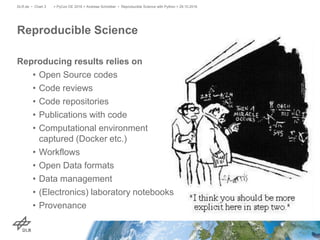
Reproducing results relies on
• Open Source codes
• Code reviews
• Code repositories
• Publications with code
• Computational environment
captured (Docker etc.)
• Workflows
• Open Data formats
• Data management
• (Electronics) laboratory notebooks
• Provenance
Reproducible Science
> PyCon DE 2016 > Andreas Schreiber • Reproducible Science with Python > 29.10.2016DLR.de • Chart 3
Provenance is information about entities, activities, and
people involved in producing a piece of data or thing,
which can be used to form assessments about its
quality, reliability or trustworthiness.
PROV W3C Working Group
https://www.w3.org/TR/prov-overview
Provenance
> PyCon DE 2016 > Andreas Schreiber • Reproducible Science with Python > 29.10.2016DLR.de • Chart 4
W3C Provenance Working Group:
https://www.w3.org/2011/prov
PROV
• The goal of PROV is to enable the wide publication and
interchange of provenance on the Web and other information
systems
• PROV enables one to represent and interchange provenance
information using widely available formats such as RDF and XML
PROV
> PyCon DE 2016 > Andreas Schreiber • Reproducible Science with Python > 29.10.2016DLR.de • Chart 5
Entities
• Physical, digital, conceptual, or other kinds of things
• For example, documents, web sites, graphics, or data sets
Activities
• Activities generate new entities or
make use of existing entities
• Activities could be actions or processes
Agents
• Agents takes a role in an activity and
have the responsibility for the activity
• For example, persons, pieces of software, or organizations
Overview of PROV
Key Concepts
> PyCon DE 2016 > Andreas Schreiber • Reproducible Science with Python > 29.10.2016DLR.de • Chart 6
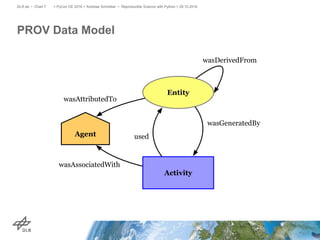
PROV Data Model
> PyCon DE 2016 > Andreas Schreiber • Reproducible Science with Python > 29.10.2016DLR.de • Chart 7
Activity
Entity
Agent
wasGeneratedBy
used
wasDerivedFrom
wasAttributedTo
wasAssociatedWith
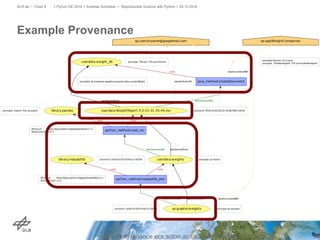
Example Provenance
> PyCon DE 2016 > Andreas Schreiber • Reproducible Science with Python > 29.10.2016DLR.de • Chart 8
https://provenance.ecs.soton.ac.uk/store/documents/113794/
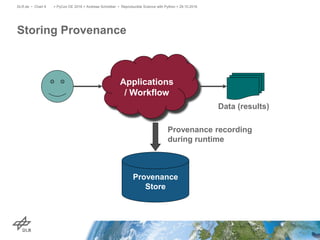
Storing Provenance
> PyCon DE 2016 > Andreas Schreiber • Reproducible Science with Python > 29.10.2016DLR.de • Chart 9
Provenance
Store
Provenance recording
during runtime
Applications
/ Workflow
Data (results)
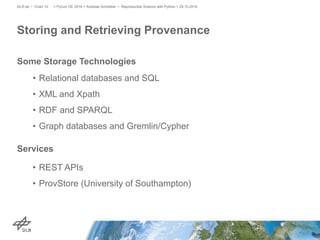
Some Storage Technologies
• Relational databases and SQL
• XML and Xpath
• RDF and SPARQL
• Graph databases and Gremlin/Cypher
Services
• REST APIs
• ProvStore (University of Southampton)
Storing and Retrieving Provenance
> PyCon DE 2016 > Andreas Schreiber • Reproducible Science with Python > 29.10.2016DLR.de • Chart 10
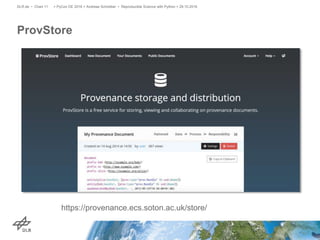
ProvStore
> PyCon DE 2016 > Andreas Schreiber • Reproducible Science with Python > 29.10.2016DLR.de • Chart 11
https://provenance.ecs.soton.ac.uk/store/
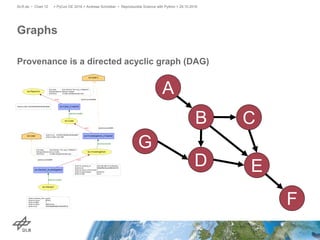
Provenance is a directed acyclic graph (DAG)
Graphs
> PyCon DE 2016 > Andreas Schreiber • Reproducible Science with Python > 29.10.2016DLR.de • Chart 12
A
B
E
F
G
D
C
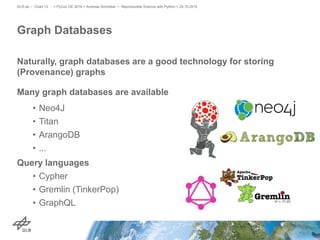
Naturally, graph databases are a good technology for storing
(Provenance) graphs
Many graph databases are available
• Neo4J
• Titan
• ArangoDB
• ...
Query languages
• Cypher
• Gremlin (TinkerPop)
• GraphQL
Graph Databases
> PyCon DE 2016 > Andreas Schreiber • Reproducible Science with Python > 29.10.2016DLR.de • Chart 13
• Open-Source
• Implemented in Java
• Stores property graphs
(key-value-based, directed)
http://neo4j.com
Neo4j
> PyCon DE 2016 > Andreas Schreiber • Reproducible Science with Python > 29.10.2016DLR.de • Chart 14
Depends on your application (tools, languages, etc.)
Libraries for Python
• prov
• provneo4j
• NoWorkflow
• …
Tools
• Git2PROV
• Prov-sty for LaTeX
• …
Gathering Provenance
> PyCon DE 2016 > Andreas Schreiber • Reproducible Science with Python > 29.10.2016DLR.de • Chart 15
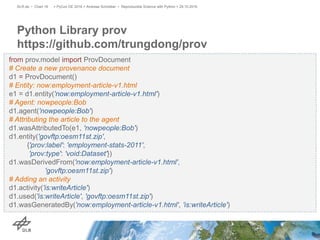
Python Library prov
https://github.com/trungdong/prov
> PyCon DE 2016 > Andreas Schreiber • Reproducible Science with Python > 29.10.2016DLR.de • Chart 16
from prov.model import ProvDocument
# Create a new provenance document
d1 = ProvDocument()
# Entity: now:employment-article-v1.html
e1 = d1.entity('now:employment-article-v1.html')
# Agent: nowpeople:Bob
d1.agent('nowpeople:Bob')
# Attributing the article to the agent
d1.wasAttributedTo(e1, 'nowpeople:Bob')
d1.entity('govftp:oesm11st.zip',
{'prov:label': 'employment-stats-2011',
'prov:type': 'void:Dataset'})
d1.wasDerivedFrom('now:employment-article-v1.html',
'govftp:oesm11st.zip')
# Adding an activity
d1.activity('is:writeArticle')
d1.used('is:writeArticle', 'govftp:oesm11st.zip')
d1.wasGeneratedBy('now:employment-article-v1.html', 'is:writeArticle')
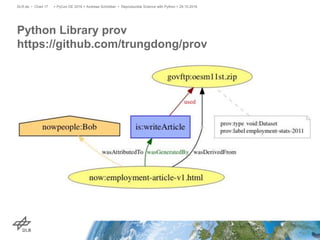
Python Library prov
https://github.com/trungdong/prov
> PyCon DE 2016 > Andreas Schreiber • Reproducible Science with Python > 29.10.2016DLR.de • Chart 17
Example
> PyCon DE 2016 > Andreas Schreiber • Reproducible Science with Python > 29.10.2016DLR.de • Chart 18
http://localhost:8888/notebooks/WeightCompanion PROV.ipynb
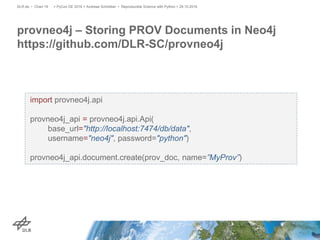
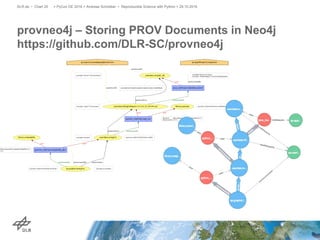
provneo4j – Storing PROV Documents in Neo4j
https://github.com/DLR-SC/provneo4j
> PyCon DE 2016 > Andreas Schreiber • Reproducible Science with Python > 29.10.2016DLR.de • Chart 19
import provneo4j.api
provneo4j_api = provneo4j.api.Api(
base_url="http://localhost:7474/db/data",
username="neo4j", password="python")
provneo4j_api.document.create(prov_doc, name=”MyProv”)
provneo4j – Storing PROV Documents in Neo4j
https://github.com/DLR-SC/provneo4j
> PyCon DE 2016 > Andreas Schreiber • Reproducible Science with Python > 29.10.2016DLR.de • Chart 20
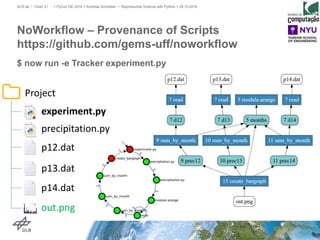
NoWorkflow – Provenance of Scripts
https://github.com/gems-uff/noworkflow
> PyCon DE 2016 > Andreas Schreiber • Reproducible Science with Python > 29.10.2016DLR.de • Chart 21
Project
experiment.py
p12.dat
p13.dat
precipitation.py
p14.dat
out.png
$ now run -e Tracker experiment.py
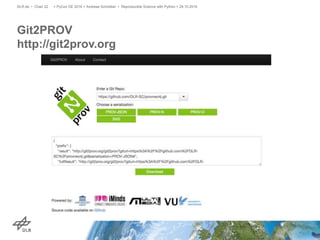
Git2PROV
http://git2prov.org
> PyCon DE 2016 > Andreas Schreiber • Reproducible Science with Python > 29.10.2016DLR.de • Chart 22
> PyCon DE 2016 > Andreas Schreiber • Reproducible Science with Python > 29.10.2016DLR.de • Chart 23
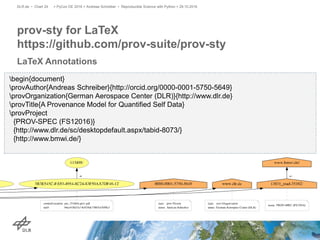
LaTeX Annotations
prov-sty for LaTeX
https://github.com/prov-suite/prov-sty
> PyCon DE 2016 > Andreas Schreiber • Reproducible Science with Python > 29.10.2016DLR.de • Chart 24
begin{document}
provAuthor{Andreas Schreiber}{http://orcid.org/0000-0001-5750-5649}
provOrganization{German Aerospace Center (DLR)}{http://www.dlr.de}
provTitle{A Provenance Model for Quantified Self Data}
provProject
{PROV-SPEC (FS12016)}
{http://www.dlr.de/sc/desktopdefault.aspx/tabid-8073/}
{http://www.bmwi.de/}
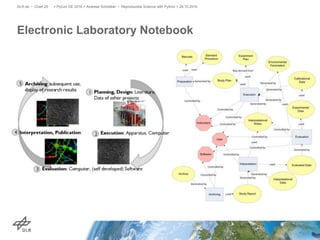
Electronic Laboratory Notebook
> PyCon DE 2016 > Andreas Schreiber • Reproducible Science with Python > 29.10.2016DLR.de • Chart 25
Query „Who worked on experiment X?“
> PyCon DE 2016 > Andreas Schreiber • Reproducible Science with Python > 29.10.2016DLR.de • Chart 26
$experiment = g.key($_g, 'identifier', X)
$user = $experiment/inE/inV/outE[@label = controlled_by]
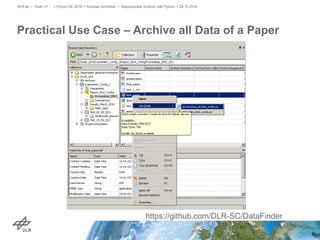
Practical Use Case – Archive all Data of a Paper
> PyCon DE 2016 > Andreas Schreiber • Reproducible Science with Python > 29.10.2016DLR.de • Chart 27
https://github.com/DLR-SC/DataFinder
New PROV Library for Python in development
• https://github.com/DLR-SC/prov-db-connector
• Connectors for Neo4j implemented, ArangoDB planned
• APIs in REST, ZeroMQ, MQTT
Trusted Provenance
• Storing Provenance in Blockchains
Provenance for people
• New approaches for visualization
• For example, PROV Comics
Current Research and Development
> PyCon DE 2016 > Andreas Schreiber • Reproducible Science with Python > 29.10.2016DLR.de • Chart 28
> PyCon DE 2016 > Andreas Schreiber • Reproducible Science with Python > 29.10.2016DLR.de • Chart 29
Thank You!
Questions?
Andreas.Schreiber@dlr.de
www.DLR.de/sc | @onyame

Reproducible Science with Python

  • 1.
    Reproducible Science withPython Andreas Schreiber Department for Intelligent and Distributed Systems German Aerospace Center (DLR), Cologne/Berlin > PyCon DE 2016 > Andreas Schreiber • Reproducible Science with Python > 29.10.2016DLR.de • Chart 1
  • 2.
    Simulations, experiments, dataanalytics, … Science > PyCon DE 2016 > Andreas Schreiber • Reproducible Science with Python > 29.10.2016DLR.de • Chart 2 SIMULATION FAILED
  • 3.
    Reproducing results relieson • Open Source codes • Code reviews • Code repositories • Publications with code • Computational environment captured (Docker etc.) • Workflows • Open Data formats • Data management • (Electronics) laboratory notebooks • Provenance Reproducible Science > PyCon DE 2016 > Andreas Schreiber • Reproducible Science with Python > 29.10.2016DLR.de • Chart 3
  • 4.
    Provenance is informationabout entities, activities, and people involved in producing a piece of data or thing, which can be used to form assessments about its quality, reliability or trustworthiness. PROV W3C Working Group https://www.w3.org/TR/prov-overview Provenance > PyCon DE 2016 > Andreas Schreiber • Reproducible Science with Python > 29.10.2016DLR.de • Chart 4
  • 5.
    W3C Provenance WorkingGroup: https://www.w3.org/2011/prov PROV • The goal of PROV is to enable the wide publication and interchange of provenance on the Web and other information systems • PROV enables one to represent and interchange provenance information using widely available formats such as RDF and XML PROV > PyCon DE 2016 > Andreas Schreiber • Reproducible Science with Python > 29.10.2016DLR.de • Chart 5
  • 6.
    Entities • Physical, digital,conceptual, or other kinds of things • For example, documents, web sites, graphics, or data sets Activities • Activities generate new entities or make use of existing entities • Activities could be actions or processes Agents • Agents takes a role in an activity and have the responsibility for the activity • For example, persons, pieces of software, or organizations Overview of PROV Key Concepts > PyCon DE 2016 > Andreas Schreiber • Reproducible Science with Python > 29.10.2016DLR.de • Chart 6
  • 7.
    PROV Data Model >PyCon DE 2016 > Andreas Schreiber • Reproducible Science with Python > 29.10.2016DLR.de • Chart 7 Activity Entity Agent wasGeneratedBy used wasDerivedFrom wasAttributedTo wasAssociatedWith
  • 8.
    Example Provenance > PyConDE 2016 > Andreas Schreiber • Reproducible Science with Python > 29.10.2016DLR.de • Chart 8 https://provenance.ecs.soton.ac.uk/store/documents/113794/
  • 9.
    Storing Provenance > PyConDE 2016 > Andreas Schreiber • Reproducible Science with Python > 29.10.2016DLR.de • Chart 9 Provenance Store Provenance recording during runtime Applications / Workflow Data (results)
  • 10.
    Some Storage Technologies •Relational databases and SQL • XML and Xpath • RDF and SPARQL • Graph databases and Gremlin/Cypher Services • REST APIs • ProvStore (University of Southampton) Storing and Retrieving Provenance > PyCon DE 2016 > Andreas Schreiber • Reproducible Science with Python > 29.10.2016DLR.de • Chart 10
  • 11.
    ProvStore > PyCon DE2016 > Andreas Schreiber • Reproducible Science with Python > 29.10.2016DLR.de • Chart 11 https://provenance.ecs.soton.ac.uk/store/
  • 12.
    Provenance is adirected acyclic graph (DAG) Graphs > PyCon DE 2016 > Andreas Schreiber • Reproducible Science with Python > 29.10.2016DLR.de • Chart 12 A B E F G D C
  • 13.
    Naturally, graph databasesare a good technology for storing (Provenance) graphs Many graph databases are available • Neo4J • Titan • ArangoDB • ... Query languages • Cypher • Gremlin (TinkerPop) • GraphQL Graph Databases > PyCon DE 2016 > Andreas Schreiber • Reproducible Science with Python > 29.10.2016DLR.de • Chart 13
  • 14.
    • Open-Source • Implementedin Java • Stores property graphs (key-value-based, directed) http://neo4j.com Neo4j > PyCon DE 2016 > Andreas Schreiber • Reproducible Science with Python > 29.10.2016DLR.de • Chart 14
  • 15.
    Depends on yourapplication (tools, languages, etc.) Libraries for Python • prov • provneo4j • NoWorkflow • … Tools • Git2PROV • Prov-sty for LaTeX • … Gathering Provenance > PyCon DE 2016 > Andreas Schreiber • Reproducible Science with Python > 29.10.2016DLR.de • Chart 15
  • 16.
    Python Library prov https://github.com/trungdong/prov >PyCon DE 2016 > Andreas Schreiber • Reproducible Science with Python > 29.10.2016DLR.de • Chart 16 from prov.model import ProvDocument # Create a new provenance document d1 = ProvDocument() # Entity: now:employment-article-v1.html e1 = d1.entity('now:employment-article-v1.html') # Agent: nowpeople:Bob d1.agent('nowpeople:Bob') # Attributing the article to the agent d1.wasAttributedTo(e1, 'nowpeople:Bob') d1.entity('govftp:oesm11st.zip', {'prov:label': 'employment-stats-2011', 'prov:type': 'void:Dataset'}) d1.wasDerivedFrom('now:employment-article-v1.html', 'govftp:oesm11st.zip') # Adding an activity d1.activity('is:writeArticle') d1.used('is:writeArticle', 'govftp:oesm11st.zip') d1.wasGeneratedBy('now:employment-article-v1.html', 'is:writeArticle')
  • 17.
    Python Library prov https://github.com/trungdong/prov >PyCon DE 2016 > Andreas Schreiber • Reproducible Science with Python > 29.10.2016DLR.de • Chart 17
  • 18.
    Example > PyCon DE2016 > Andreas Schreiber • Reproducible Science with Python > 29.10.2016DLR.de • Chart 18 http://localhost:8888/notebooks/WeightCompanion PROV.ipynb
  • 19.
    provneo4j – StoringPROV Documents in Neo4j https://github.com/DLR-SC/provneo4j > PyCon DE 2016 > Andreas Schreiber • Reproducible Science with Python > 29.10.2016DLR.de • Chart 19 import provneo4j.api provneo4j_api = provneo4j.api.Api( base_url="http://localhost:7474/db/data", username="neo4j", password="python") provneo4j_api.document.create(prov_doc, name=”MyProv”)
  • 20.
    provneo4j – StoringPROV Documents in Neo4j https://github.com/DLR-SC/provneo4j > PyCon DE 2016 > Andreas Schreiber • Reproducible Science with Python > 29.10.2016DLR.de • Chart 20
  • 21.
    NoWorkflow – Provenanceof Scripts https://github.com/gems-uff/noworkflow > PyCon DE 2016 > Andreas Schreiber • Reproducible Science with Python > 29.10.2016DLR.de • Chart 21 Project experiment.py p12.dat p13.dat precipitation.py p14.dat out.png $ now run -e Tracker experiment.py
  • 22.
    Git2PROV http://git2prov.org > PyCon DE2016 > Andreas Schreiber • Reproducible Science with Python > 29.10.2016DLR.de • Chart 22
  • 23.
    > PyCon DE2016 > Andreas Schreiber • Reproducible Science with Python > 29.10.2016DLR.de • Chart 23
  • 24.
    LaTeX Annotations prov-sty forLaTeX https://github.com/prov-suite/prov-sty > PyCon DE 2016 > Andreas Schreiber • Reproducible Science with Python > 29.10.2016DLR.de • Chart 24 begin{document} provAuthor{Andreas Schreiber}{http://orcid.org/0000-0001-5750-5649} provOrganization{German Aerospace Center (DLR)}{http://www.dlr.de} provTitle{A Provenance Model for Quantified Self Data} provProject {PROV-SPEC (FS12016)} {http://www.dlr.de/sc/desktopdefault.aspx/tabid-8073/} {http://www.bmwi.de/}
  • 25.
    Electronic Laboratory Notebook >PyCon DE 2016 > Andreas Schreiber • Reproducible Science with Python > 29.10.2016DLR.de • Chart 25
  • 26.
    Query „Who workedon experiment X?“ > PyCon DE 2016 > Andreas Schreiber • Reproducible Science with Python > 29.10.2016DLR.de • Chart 26 $experiment = g.key($_g, 'identifier', X) $user = $experiment/inE/inV/outE[@label = controlled_by]
  • 27.
    Practical Use Case– Archive all Data of a Paper > PyCon DE 2016 > Andreas Schreiber • Reproducible Science with Python > 29.10.2016DLR.de • Chart 27 https://github.com/DLR-SC/DataFinder
  • 28.
    New PROV Libraryfor Python in development • https://github.com/DLR-SC/prov-db-connector • Connectors for Neo4j implemented, ArangoDB planned • APIs in REST, ZeroMQ, MQTT Trusted Provenance • Storing Provenance in Blockchains Provenance for people • New approaches for visualization • For example, PROV Comics Current Research and Development > PyCon DE 2016 > Andreas Schreiber • Reproducible Science with Python > 29.10.2016DLR.de • Chart 28
  • 29.
    > PyCon DE2016 > Andreas Schreiber • Reproducible Science with Python > 29.10.2016DLR.de • Chart 29 Thank You! Questions? Andreas.Schreiber@dlr.de www.DLR.de/sc | @onyame