7/5/2010ERP Implementation Methodology1Yashpal Jain, Project Manager-SAP
AgendaCompanies without ERPERP ImplementationCurrent Business situation & Expectation from ERPReason behind project failuresOverview of ASAP methodology & its drawbackTheory of ConstraintsProtorative Methodology – Assumption/Schedule/AdvantageQ&A7/5/2010Protorative Methodology2
Companies without ERPModerate to high number of home grown systems.
Business functions or Systems are not integrated or at best loosely integrated.
MIS reports are generally overdue.
Management decision on market situation is often reactive.
Bird eye view of company’s status is not available to      management.7/5/2010Protorative Methodology3
ERP Implementation7/5/2010Protorative Methodology4Implementing ERP is always Top down decision.
Decision to implement ERP is taken by watching market trend and relying on different agencies reports.
With Initial cost of implementation being high, ROI cannot be calculated in short span of time. It is at best over a period of 2-3 years.
Success of system implementation has different meaning to Client and Consulting partner.
Implementation timeline is aggressive and schedule slippage is very costly to business.
ERP systems are sophisticated and not as user friendly as legacy system.Current Business Situation & Expectation7/5/2010Protorative Methodology5
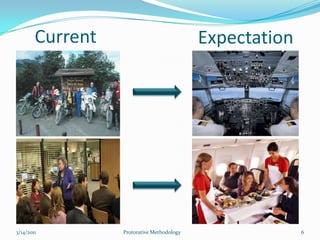
Current7/5/2010Protorative Methodology6Expectation
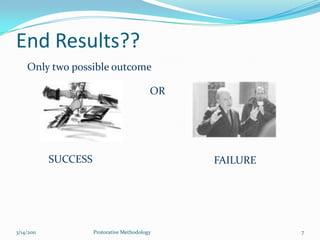
End Results??7/5/2010Protorative Methodology7Only two possible outcome      ORSUCCESSFAILURE
Project Success Rate7/5/2010Protorative Methodology8“Studies by Standish Group and others for traditional project management methods, only 44% of projects typically finish on time, projects usually complete at 222% of the duration originally planned, 189% of the original budgeted cost, 70% of projects fall short of their planned scope (technical content delivered), and 30% are cancelled before completion”.“The success rate is even lower in case when companies are going for ERP system for the first time”.
Reasons behind project failures7/5/2010Protorative Methodology9
Definition of Success7/5/2010Protorative Methodology10For Consulting Partner/System IntegratorOn time Go-Live
In-Budget Go-Live
All open issues are closed before end of stabilization phaseFor ClientOn time Go-Live
In-Budget Go-Live
All open issues are closed before end of stabilization phase
Use & leverage the system as intendedIf we compare the meaning of success of both consulting partner  and  client, the only difference is using and leverage the system as intended. This is in fact the most ignored success criteria and deciding factor between success or failure of the project.
Issue in Leveraging ERP System7/5/2010Protorative Methodology11Statistics shows that the top 2 reason behind companies not able to leverage or realize full potential of ERP is Not all requirements were met during implementation of ERP.
Users are not comfortable running the system because not all desired functionalities are provided in system and lack of sufficient time spent on the system is hindering them to work as per management expectation.Project Success7/5/2010Protorative Methodology12With all the discussion and explanation of project’s success or failure, it is very easy to comprehend that on-time and in-budget go live are not the only of the criteria of successful implementation.  It is User’s adoptability of ERP system which will decide whether project is success or not.
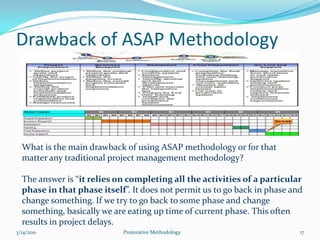
ASAP Methodology & Drawback7/5/2010Protorative Methodology13
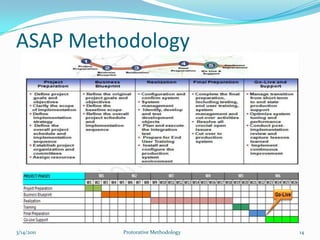
ASAP Methodology7/5/2010Protorative Methodology14
During Project Execution7/5/2010Protorative Methodology15How often requirements are captured inaccurately, insufficiently or missed to be captured at all?

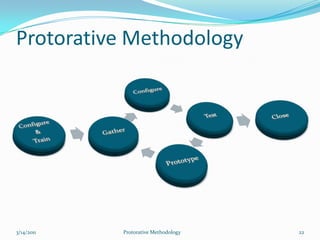
Protorative Methodology

  • 1.
  • 2.
    AgendaCompanies without ERPERPImplementationCurrent Business situation & Expectation from ERPReason behind project failuresOverview of ASAP methodology & its drawbackTheory of ConstraintsProtorative Methodology – Assumption/Schedule/AdvantageQ&A7/5/2010Protorative Methodology2
  • 3.
    Companies without ERPModerateto high number of home grown systems.
  • 4.
    Business functions orSystems are not integrated or at best loosely integrated.
  • 5.
    MIS reports aregenerally overdue.
  • 6.
    Management decision onmarket situation is often reactive.
  • 7.
    Bird eye viewof company’s status is not available to management.7/5/2010Protorative Methodology3
  • 8.
  • 9.
    Decision to implementERP is taken by watching market trend and relying on different agencies reports.
  • 10.
    With Initial costof implementation being high, ROI cannot be calculated in short span of time. It is at best over a period of 2-3 years.
  • 11.
    Success of systemimplementation has different meaning to Client and Consulting partner.
  • 12.
    Implementation timeline isaggressive and schedule slippage is very costly to business.
  • 13.
    ERP systems aresophisticated and not as user friendly as legacy system.Current Business Situation & Expectation7/5/2010Protorative Methodology5
  • 14.
  • 15.
    End Results??7/5/2010Protorative Methodology7Onlytwo possible outcome ORSUCCESSFAILURE
  • 16.
    Project Success Rate7/5/2010ProtorativeMethodology8“Studies by Standish Group and others for traditional project management methods, only 44% of projects typically finish on time, projects usually complete at 222% of the duration originally planned, 189% of the original budgeted cost, 70% of projects fall short of their planned scope (technical content delivered), and 30% are cancelled before completion”.“The success rate is even lower in case when companies are going for ERP system for the first time”.
  • 17.
    Reasons behind projectfailures7/5/2010Protorative Methodology9
  • 18.
    Definition of Success7/5/2010ProtorativeMethodology10For Consulting Partner/System IntegratorOn time Go-Live
  • 19.
  • 20.
    All open issuesare closed before end of stabilization phaseFor ClientOn time Go-Live
  • 21.
  • 22.
    All open issuesare closed before end of stabilization phase
  • 23.
    Use & leveragethe system as intendedIf we compare the meaning of success of both consulting partner and client, the only difference is using and leverage the system as intended. This is in fact the most ignored success criteria and deciding factor between success or failure of the project.
  • 24.
    Issue in LeveragingERP System7/5/2010Protorative Methodology11Statistics shows that the top 2 reason behind companies not able to leverage or realize full potential of ERP is Not all requirements were met during implementation of ERP.
  • 25.
    Users are notcomfortable running the system because not all desired functionalities are provided in system and lack of sufficient time spent on the system is hindering them to work as per management expectation.Project Success7/5/2010Protorative Methodology12With all the discussion and explanation of project’s success or failure, it is very easy to comprehend that on-time and in-budget go live are not the only of the criteria of successful implementation. It is User’s adoptability of ERP system which will decide whether project is success or not.
  • 26.
    ASAP Methodology &Drawback7/5/2010Protorative Methodology13
  • 27.
  • 28.
    During Project Execution7/5/2010ProtorativeMethodology15How often requirements are captured inaccurately, insufficiently or missed to be captured at all?

Editor's Notes

  • #4 One by one of above points
  • #5 One by one of above points
  • #9 What do you think was the probable outcome of earlier example? Or which result has more probability?
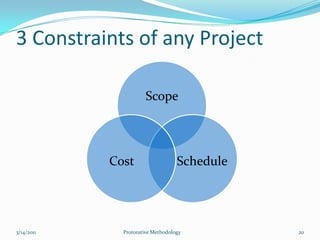
  • #21 Lesser the constraints easier to manage.Every org have constrainst. TOC states that take one constrainst at a time and restructure the methodology, project or org to solve that constraints.After that there may be new constrainsts. Repeat the same process. This way we improve the processes and bring more value for money. If we remove any one constraints, project execution becomes very simple. But unfortunately, we have to live within the intersection of these three constraints.More the overlap area, simpler it is to manage the projectThe goal is to make overlap area as big as possible.
  • #25 Talk abt how constraints are taken care of..