
Presented by:Group No. 6Amrita school of businessProject Management, Team & Stakeholders in ERP Project
What is a project?Project – “a temporary endeavor undertaken tocreate a unique product, service, or result.” PMBOK® GuideA project requires an organized set of work efforts.Projects require a level of detail that is progressively elaborated upon as more information is discovered.Projects are subject to limitations of time and resources such as money and people. Projects have a defined beginning and ending.
Introduction Project management – “The application of knowledge, skills, tools and techniques to project activities to meet project requirements.” PMBOK® GuideWhy project management is so important in ERP implementation?ERP project generally is a big and complexRequires huge resource such as time, human resource, budget etc. High Risk Factor: The Robbins-Giola Survey (2001) ”51% of surveyed companies viewed their implementation as unsuccessful.”
StakeholdersA project has a unique combination of stakeholdersstakeholders – “persons or organizations … that are actively involved in the project, or whose interests may be positively or negatively affected by …the project.” PMBOK® Guide
Important stake holdersInternalBoard of ManagementManaging Heads of Business unitsIS headERP Project TeamExternal ConsultantsSoftware Implementation Partners
Board of ManagementInitiate the implementation phaseExpectationsImproved management controlLess autonomyMore integrationCost efficiency
Managing HeadsMaintain and strengthen the position of the	business unitProtect BU for initiatives with threaten interest of business unitExpectationsTo solve problemsTo improve their positionTo increase efficiency
IS HeadImportant role of internal IS department to regain the position of ‘centre of IS expertise’ExpectationsA technical system, centrally managedImplement one integrated system in ‘vanilla’ mode
 ConsultantsInvolved Situation AnalysisNeed/ Requirement analysisExpectationsEstimating the requirement appropriatelyrealizing the predetermined objectives
Software Implementation PartnerInvolved in all the phases  Project beginning  Implementation Support & MaintenanceTrainingImplementation within time/money constraints Performance - Highly dependent on internal support from firm
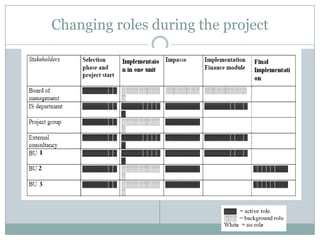
Changing roles during the project
Project management team
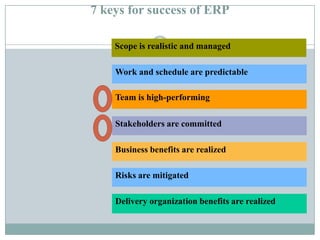
7 keys for success of ERPScope is realistic and managedWork and schedule are predictableTeam is high-performingStakeholders are committedBusiness benefits are realizedRisks are mitigatedDelivery organization benefits are realized
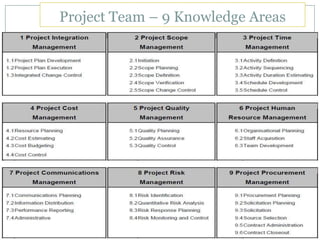
Project Team – 9 Knowledge Areas
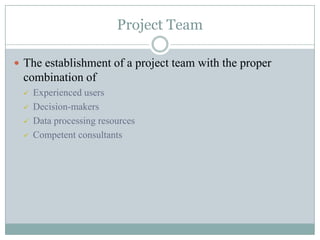
Project TeamThe establishment of a project team with the proper combination ofExperienced users
Decision-makers
Data processing resources
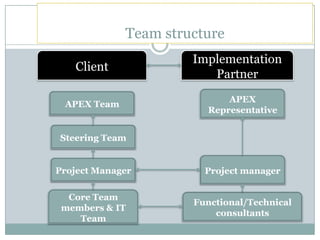
Competent consultants Team structureImplementation PartnerClientAPEX RepresentativeAPEX TeamSteering TeamProject managerProject ManagerCore Team members & IT TeamFunctional/Technical consultants
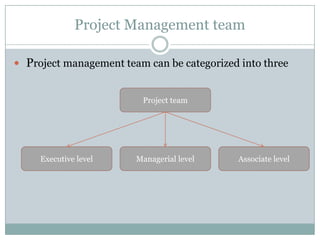
Project Management teamProject management team can be categorized into threeProject teamAssociate levelManagerial levelExecutive level
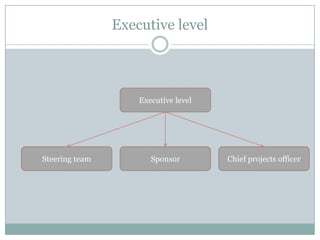
Executive levelExecutive levelChief projects officerSponsorSteering team
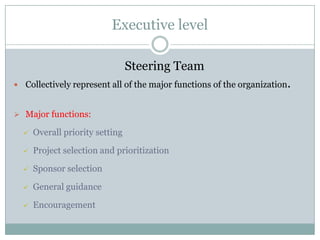
Executive level                                     Steering Team Collectively represent all of the major functions of the organization. Major functions:
Overall priority setting
Project selection and prioritization
Sponsor selection
General guidance
EncouragementExecutive level SponsorThe person or group that provides financial resources for the          project.    Has a major stake in the project outcome.    Has an active role in chartering the project.    Acts as an interface between the project core team and the           executive team.
Executive levelChief projects officerResponsible for all the people working in projectsRole varies with company size and complexityHas to ensure that the company’s steering team functions in the best wayAssigns and manages roles of each individual serving on a project
Managerial level Functional manager Decision making power in the organization is divided between project managers and functional managers Assigned for each department Has a large role in deciding how  the project work in their functional area gets done
Managerial level Project managerFocal point of the projectLeads the planning, execution, and closing of the projectResponsible for the project scheduleServe as the prime communication channel within and outside the companyResponsible for delivering the project results
Managerial level FacilitatorComes into play when the situation is complexFacilitate the meetingCan be an outside consultant
Associate level   Core team memberSmall group of people who are on the project from start to     finishAssist the project manager in decision makingSupervise the work of subject matter experts
Associate levelSubject matter experts Helps in decision making Acts as an extra helper when there is a need for specific expertise. Brought in as and when required Term of service may vary .
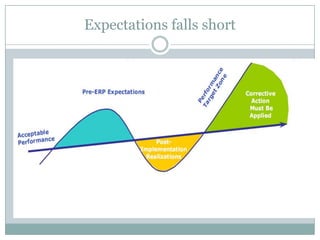
Expectations falls short
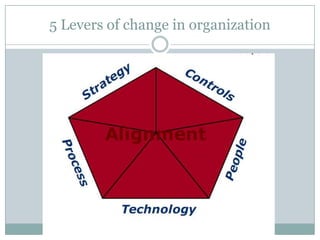
5 Levers of change in organization
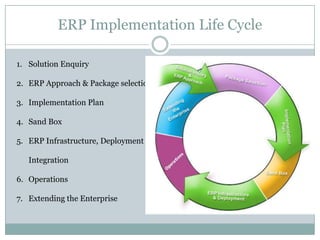
ERP Implementation Life CycleSolution EnquiryERP Approach & Package selectionImplementation PlanSand BoxERP Infrastructure, Deployment & IntegrationOperationsExtending the Enterprise
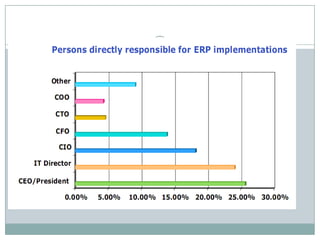
Stage 1-Solution InquiryAre we ready for ERP?How will an ERP help our business?Have we considered other solution areas beyond ERP?Who will lead our implementation effort?
Stage 2- ERP Approach and Package SelectionDo we have the in house resources, skills and experience to implement ERP?Do the features and functions meet our needs?Is the ERP package compatible with our business?Should we buy an integrated package from a single vendor or best-of-breed solutions from several vendors?
Stage 3-Implementation PlanHow do we get started with the implementation?The Big BangModular ImplementationProcess Oriented Implementation
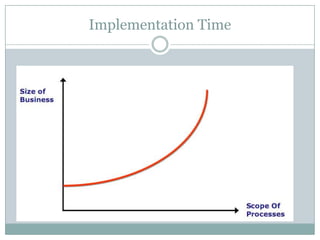
Implementation Time
Stage 4- Sand BoxWhat steps do we take to ensure that the implementation is on track?Create a separate dedicated work environment specifically for the project teamConstantly evaluate risks, constraints & assumptionsDevelop training plan for all users

Project Management Team

  • 1.
    Presented by:Group No.6Amrita school of businessProject Management, Team & Stakeholders in ERP Project
  • 2.
    What is aproject?Project – “a temporary endeavor undertaken tocreate a unique product, service, or result.” PMBOK® GuideA project requires an organized set of work efforts.Projects require a level of detail that is progressively elaborated upon as more information is discovered.Projects are subject to limitations of time and resources such as money and people. Projects have a defined beginning and ending.
  • 3.
    Introduction Project management– “The application of knowledge, skills, tools and techniques to project activities to meet project requirements.” PMBOK® GuideWhy project management is so important in ERP implementation?ERP project generally is a big and complexRequires huge resource such as time, human resource, budget etc. High Risk Factor: The Robbins-Giola Survey (2001) ”51% of surveyed companies viewed their implementation as unsuccessful.”
  • 4.
    StakeholdersA project hasa unique combination of stakeholdersstakeholders – “persons or organizations … that are actively involved in the project, or whose interests may be positively or negatively affected by …the project.” PMBOK® Guide
  • 5.
    Important stake holdersInternalBoardof ManagementManaging Heads of Business unitsIS headERP Project TeamExternal ConsultantsSoftware Implementation Partners
  • 6.
    Board of ManagementInitiatethe implementation phaseExpectationsImproved management controlLess autonomyMore integrationCost efficiency
  • 7.
    Managing HeadsMaintain andstrengthen the position of the business unitProtect BU for initiatives with threaten interest of business unitExpectationsTo solve problemsTo improve their positionTo increase efficiency
  • 8.
    IS HeadImportant roleof internal IS department to regain the position of ‘centre of IS expertise’ExpectationsA technical system, centrally managedImplement one integrated system in ‘vanilla’ mode
  • 9.
    ConsultantsInvolved SituationAnalysisNeed/ Requirement analysisExpectationsEstimating the requirement appropriatelyrealizing the predetermined objectives
  • 10.
    Software Implementation PartnerInvolvedin all the phases Project beginning Implementation Support & MaintenanceTrainingImplementation within time/money constraints Performance - Highly dependent on internal support from firm
  • 11.
  • 12.
  • 13.
    7 keys forsuccess of ERPScope is realistic and managedWork and schedule are predictableTeam is high-performingStakeholders are committedBusiness benefits are realizedRisks are mitigatedDelivery organization benefits are realized
  • 14.
    Project Team –9 Knowledge Areas
  • 15.
    Project TeamThe establishmentof a project team with the proper combination ofExperienced users
  • 16.
  • 17.
  • 18.
    Competent consultants TeamstructureImplementation PartnerClientAPEX RepresentativeAPEX TeamSteering TeamProject managerProject ManagerCore Team members & IT TeamFunctional/Technical consultants
  • 19.
    Project Management teamProjectmanagement team can be categorized into threeProject teamAssociate levelManagerial levelExecutive level
  • 20.
    Executive levelExecutive levelChiefprojects officerSponsorSteering team
  • 21.
    Executive level Steering Team Collectively represent all of the major functions of the organization. Major functions:
  • 22.
  • 23.
    Project selection andprioritization
  • 24.
  • 25.
  • 26.
    EncouragementExecutive level SponsorTheperson or group that provides financial resources for the project. Has a major stake in the project outcome. Has an active role in chartering the project. Acts as an interface between the project core team and the executive team.
  • 27.
    Executive levelChief projectsofficerResponsible for all the people working in projectsRole varies with company size and complexityHas to ensure that the company’s steering team functions in the best wayAssigns and manages roles of each individual serving on a project
  • 28.
    Managerial level Functionalmanager Decision making power in the organization is divided between project managers and functional managers Assigned for each department Has a large role in deciding how the project work in their functional area gets done
  • 29.
    Managerial level ProjectmanagerFocal point of the projectLeads the planning, execution, and closing of the projectResponsible for the project scheduleServe as the prime communication channel within and outside the companyResponsible for delivering the project results
  • 30.
    Managerial level FacilitatorComesinto play when the situation is complexFacilitate the meetingCan be an outside consultant
  • 31.
    Associate level Core team memberSmall group of people who are on the project from start to finishAssist the project manager in decision makingSupervise the work of subject matter experts
  • 32.
    Associate levelSubject matterexperts Helps in decision making Acts as an extra helper when there is a need for specific expertise. Brought in as and when required Term of service may vary .
  • 33.
  • 34.
    5 Levers ofchange in organization
  • 35.
    ERP Implementation LifeCycleSolution EnquiryERP Approach & Package selectionImplementation PlanSand BoxERP Infrastructure, Deployment & IntegrationOperationsExtending the Enterprise
  • 36.
    Stage 1-Solution InquiryArewe ready for ERP?How will an ERP help our business?Have we considered other solution areas beyond ERP?Who will lead our implementation effort?
  • 38.
    Stage 2- ERPApproach and Package SelectionDo we have the in house resources, skills and experience to implement ERP?Do the features and functions meet our needs?Is the ERP package compatible with our business?Should we buy an integrated package from a single vendor or best-of-breed solutions from several vendors?
  • 39.
    Stage 3-Implementation PlanHowdo we get started with the implementation?The Big BangModular ImplementationProcess Oriented Implementation
  • 40.
  • 41.
    Stage 4- SandBoxWhat steps do we take to ensure that the implementation is on track?Create a separate dedicated work environment specifically for the project teamConstantly evaluate risks, constraints & assumptionsDevelop training plan for all users
  • 42.
    Stage 5- ERPInfrastructure Deployment and IntegrationHow do we ensure that the project team and the end users are in sync?How do we ensure that our people are accepting change?How do we integrate the ERP with our other legacy systems?Is our IT infrastructure ready for ERP?
  • 43.
    Stage 6- OperationsHowwill we recover from a major outage?Execute a onsite maintenance SLA with partnersImplement a Disaster Recovery PlanReview Business Impact & Associated RiskOff site backupsProvide disaster recovery training to key personnel
  • 44.
    Stage 7- Extendingthe EnterpriseConsider expanding ERP to other solution areasSupply Chain ManagementCustomer Relationship ManagementE-commerce Solutions
  • 45.
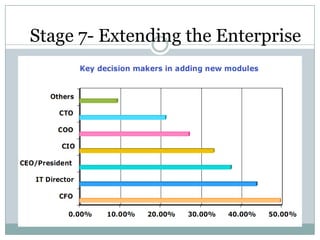
    Stage 7- Extendingthe Enterprise
  • 46.
    Risk ManagementManaging riskon an ERP project is crucial to its success There are thousands, maybe even millions of potential failure points on an ERP There are generally 5 steps to managing risk: Find potential failure points or risksAnalyze the potential failure points to determine the damage they might doAssess the probability of the failure occurringBased on the first three factors, prioritize the risksMitigate the risks through whatever action is necessary
  • 47.

Editor's Notes

  • #4 Factors that can lead to project failure are corporate culture, user resistant to change commitment from top management etc. Nestle’s SAP project Best (Business Excellence through Systems Technology) spent $200 millions contact with SAP and an additional $80 million for consulting and maintenance, but at last the implementation was fail. Consequently, by having good project management can help to minimize risk for project to fail and may help to reduce the chance for delaying and over budget which are big problems in ERP project implementation.