Protocols, methods
and devices.
By Shania Collins
Protocols:3G/4G
• 3G/4G is a type of mobile technology that provides you with internet access
anywhere at any time. You do not require wifi for 3G or 4G meaning you can
always access the internet.
• 3G is slower and less effective than 4G as 3G offers download speeds
between 3-6mbps whereas 4G offers a higher speed of 14mbps.
• 3G is a mobile communications standard that allows all types of technology
such as mobile phones, computers, tables and many other portable electronic
devices to access the internet wirelessly.
• 4G is a mobile communications standard intended to replace 3G due to the
higher speed. 4G replacing 3G on many phones would provide people with a
higher speed of wireless internet access.
Protocols: Bluetooth
• Bluetooth is a form of wireless technology that is commonly used to send
data between two people that are within a short distance of one another.
• A standard for the short range wireless interconnection of mobile phones,
computers and other electronic devices.
• In 1994 a group of engineers at Ericsson, a Swedish company, invented a
wireless communication technology, later called Bluetooth.
• A Bluetooth device rather than using wires and cables to connect to a phone
computer, uses radio waves which enables us to use devices without the
complications of wires.
Methods: Blogs
• Blogs are commonly used for people to write about experiences that they’ve
had, whether it be travel experience, opinions on politics or reviews. Usually
people use it due to the freedom to write freely and grab peoples attention.
• Blogs are regularly updates websites, typically ran by one person, or at most
a small group of people. They will commonly be written in a colloquial
language.
• With blogs you can create posts. You can upload photos, videos, audio and
texts onto your post, and then publish it, therefore allowing anyone too see
it.
• Blogger can be accessed on many technological devices such as, mobile
phones, laptops, tablets, etc.
Methods: Email
• Emails are messages that are sent electronically to another person.
• Messages are distributed by electronic means from one computer user to one
or more recipients via a network.
• Email first entered substantial use in the 1960s and by the mid 70s had
taken form ow recognized as email.
• Neither the user, or their computers are required to be online
simultaneously, they need to connect only briefly, typically to a mail server,
for as long as It takes to send or receive messages.
Methods: Wiki
• A Wiki is a website or a database developed by a group of people allowing
anyone to contribute to it.
• A website or database developed collaboratively by a community of users,
allowing any user to add and edit content.
• In a typical Wiki, text is written using a simplified markup language, known
as “Wiki markup”
Methods: IM (Instant message)
• IM is instant messages. It is an electronic message sent instantly to someone
in which you can see whether they have read the message you have sent or
not.
• It is a message sent through the internet that will appear on the recipients
screen as soon as it is transmitted.
• A mire advanced instant messenger can add file transfer, voice over IP,
clickable hyperlinks and video chat.
Services: ISP
• ISP stands for internet service provider, which is an organization that
provides services for accessing and using the internet.
• Internet providers can come in various organized forms such as commercial,
community-owned, non profit or otherwise privately owned.
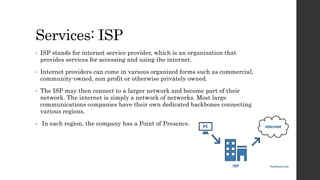
• The ISP may then connect to a larger network and become part of their
network. The internet is simply a network of networks. Most large
communications companies have their own dedicated backbones connecting
various regions.
• In each region, the company has a Point of Presence.
Services: WWW
• WWW is worldwide web and the URL is what is used to find any website
that exist on the internet.
• You can use WWW to find a website and you can do this by typing un a
website that you are looking for and it will automatically direct you to a
page if the URL for the website is correct.
• WWW is an information space where documents and other web resources
are identified by URL’s, internet by hypertext links, and can be accessed via
the internet.

Protocols

  • 1.
  • 2.
    Protocols:3G/4G • 3G/4G isa type of mobile technology that provides you with internet access anywhere at any time. You do not require wifi for 3G or 4G meaning you can always access the internet. • 3G is slower and less effective than 4G as 3G offers download speeds between 3-6mbps whereas 4G offers a higher speed of 14mbps. • 3G is a mobile communications standard that allows all types of technology such as mobile phones, computers, tables and many other portable electronic devices to access the internet wirelessly. • 4G is a mobile communications standard intended to replace 3G due to the higher speed. 4G replacing 3G on many phones would provide people with a higher speed of wireless internet access.
  • 3.
    Protocols: Bluetooth • Bluetoothis a form of wireless technology that is commonly used to send data between two people that are within a short distance of one another. • A standard for the short range wireless interconnection of mobile phones, computers and other electronic devices. • In 1994 a group of engineers at Ericsson, a Swedish company, invented a wireless communication technology, later called Bluetooth. • A Bluetooth device rather than using wires and cables to connect to a phone computer, uses radio waves which enables us to use devices without the complications of wires.
  • 4.
    Methods: Blogs • Blogsare commonly used for people to write about experiences that they’ve had, whether it be travel experience, opinions on politics or reviews. Usually people use it due to the freedom to write freely and grab peoples attention. • Blogs are regularly updates websites, typically ran by one person, or at most a small group of people. They will commonly be written in a colloquial language. • With blogs you can create posts. You can upload photos, videos, audio and texts onto your post, and then publish it, therefore allowing anyone too see it. • Blogger can be accessed on many technological devices such as, mobile phones, laptops, tablets, etc.
  • 5.
    Methods: Email • Emailsare messages that are sent electronically to another person. • Messages are distributed by electronic means from one computer user to one or more recipients via a network. • Email first entered substantial use in the 1960s and by the mid 70s had taken form ow recognized as email. • Neither the user, or their computers are required to be online simultaneously, they need to connect only briefly, typically to a mail server, for as long as It takes to send or receive messages.
  • 6.
    Methods: Wiki • AWiki is a website or a database developed by a group of people allowing anyone to contribute to it. • A website or database developed collaboratively by a community of users, allowing any user to add and edit content. • In a typical Wiki, text is written using a simplified markup language, known as “Wiki markup”
  • 7.
    Methods: IM (Instantmessage) • IM is instant messages. It is an electronic message sent instantly to someone in which you can see whether they have read the message you have sent or not. • It is a message sent through the internet that will appear on the recipients screen as soon as it is transmitted. • A mire advanced instant messenger can add file transfer, voice over IP, clickable hyperlinks and video chat.
  • 8.
    Services: ISP • ISPstands for internet service provider, which is an organization that provides services for accessing and using the internet. • Internet providers can come in various organized forms such as commercial, community-owned, non profit or otherwise privately owned. • The ISP may then connect to a larger network and become part of their network. The internet is simply a network of networks. Most large communications companies have their own dedicated backbones connecting various regions. • In each region, the company has a Point of Presence.
  • 9.
    Services: WWW • WWWis worldwide web and the URL is what is used to find any website that exist on the internet. • You can use WWW to find a website and you can do this by typing un a website that you are looking for and it will automatically direct you to a page if the URL for the website is correct. • WWW is an information space where documents and other web resources are identified by URL’s, internet by hypertext links, and can be accessed via the internet.