The Basic Codes and
Conventions of News
THE BASICS:
A Televised News Report
In class time, we spent time watching various televised news reports to spot the similarities within them - known as the basic codes and
conventions. We studied a variety of the BBC’s televised news reports and noted what codes and conventions we saw being put into
place:
• Each report began with a face-on shot of the presenter who is dressed very formally - knee-length dresses/skirts, blazers, ties and suits
etc.
• The reporter will always begin with the headlines
• Various cut-outs to pre-recorded footage of relevant happenings whilst the reporter acted as the voice over
• The news reporter is seated at a desk or sofa (depending on the time of broadcast and the type of story) before moving to a standing
position during cut-outs
• Relevant newspapers (reference purposes) as well as back-up scripts on their desks which they read through as the report finishes
• A background of a working newsroom or a view, usually, of London
• Dramatic music is played at the beginning and the end
• They will cut-out to other reporters/experts who are in a different location. The two reporters speak to each other about the reported
subject live
• Talking heads: the interviewee is made to look as though he is speaking to someone off camera, as well as having their name printed
on screen. As they speak, they play relevant footage which is muted as the interviewee becomes the voice over
• Both foreign and domestic news is given a dramatic feel look to them, although foreign news is portrayed with more violence and
extremeness
• Motion Graphics
• Vox Pops: the interviewee will ask a variety of social groups similar questions to gather a variety of answers
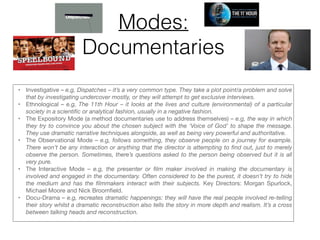
Modes:
Documentaries
	 •	 Investigative – e.g, Dispatches – it’s a very common type. They take a plot point/a problem and solve
that by investigating undercover mostly, or they will attempt to get exclusive interviews. 

	 •	 Ethnological – e.g, The 11th Hour – it looks at the lives and culture (environmental) of a particular
society in a scientific or analytical fashion, usually in a negative fashion. 

	 •	 The Expository Mode (a method documentaries use to address themselves) – e.g, the way in which
they try to convince you about the chosen subject with the ‘Voice of God’ to shape the message.
They use dramatic narrative techniques alongside, as well as being very powerful and authoritative. 

	 •	 The Observational Mode – e.g, follows something, they observe people on a journey for example.
There won’t be any interaction or anything that the director is attempting to find out, just to merely
observe the person. Sometimes, there’s questions asked to the person being observed but it is all
very pure. 

	 •	 The Interactive Mode –  e.g, the presenter or film maker involved in making the documentary is
involved and engaged in the documentary. Often considered to be the purest, it doesn’t try to hide
the medium and has the filmmakers interact with their subjects. Key Directors: Morgan Spurlock,
Michael Moore and Nick Broomfield.

	 •	 Docu-Drama – e.g, recreates dramatic happenings: they will have the real people involved re-telling
their story whilst a dramatic reconstruction also tells the story in more depth and realism. It’s a cross
between talking heads and reconstruction. 
Documentary Case Study:
‘The Greatest Movie Ever Sold’
I have chosen to use Morgan Spurlock’s: The
Greatest Movie Ever Sold documentary. The mode of
this documentary is Interactive Mode, much like
Spurlock’s previous documentaries, such as,
Supersize Me - a documentary that saw Spurlock live
off of McDonalds for an entire month.
In The Greatest Movie Ever Sold, Spurlock makes the
entire movie out of behind-the-scenes interviews and
meetings with people/companies he wants to
sponsor this film. Upon hearing this, I wasn’t sure
what to expect - how could you execute a movie like
this in the correct way?
What Codes and Conventions
did Spurlock use?
Regardless of the subject of this documentary, there were still a number of codes and conventions that were
followed; the whole documentary is nothing but informative - it gives you a VIP pass to the meetings and
people that make films possible with their adverts. Not forgetting that their is also the all-important presenter -
in the form of Morgan Spurlock - who also acts as the director. Fitting in with all other documentaries, the
element of travel is rife here: he is flying from country to country, state to state to visit these companies and
hold these meetings. Taking the viewers along with you, almost, is a really good way to keep them interested
- they feel a part of the project. Throughout this documentary in particular, we are exposed to a fair few of
infographics. These give us more in-depth knowledge of the subject in the form of a data chart or diagram.
Spurlock wanted to give us the access and knowledge of what happens behind the scenes of movies,
documentaries and more. What goes into these? Why are we seeing everyone in this film or that film drinking a
certain drink? I feel as though Spurlock wanted to achieve a fully candid and uncut portrayal of
advertisement, and provoke our thoughts on it - we see advertisements all the time but, do we ever look into
it? Think for more than twenty-seconds about that annoying TV ad? Probably not.
Spurlock is always talking - he plays the voiceover in every cut-off, every moving image and he also speaks
to the camera. By putting himself in front of the camera, he further strengthens the employment of imagery
alongside interaction. He knows what techniques to use to be able to interact with his viewers well, from
being less formal to sharing every in-between bit of information he is given. A lot of the time, we aren’t face-
on with Spurlock, we’re walking side-by-side on his travels. Being spoken to as if we’re not the camera and
instead, an actual person.

Codes and conventions

  • 1.
    The Basic Codesand Conventions of News
  • 2.
    THE BASICS: A TelevisedNews Report In class time, we spent time watching various televised news reports to spot the similarities within them - known as the basic codes and conventions. We studied a variety of the BBC’s televised news reports and noted what codes and conventions we saw being put into place: • Each report began with a face-on shot of the presenter who is dressed very formally - knee-length dresses/skirts, blazers, ties and suits etc. • The reporter will always begin with the headlines • Various cut-outs to pre-recorded footage of relevant happenings whilst the reporter acted as the voice over • The news reporter is seated at a desk or sofa (depending on the time of broadcast and the type of story) before moving to a standing position during cut-outs • Relevant newspapers (reference purposes) as well as back-up scripts on their desks which they read through as the report finishes • A background of a working newsroom or a view, usually, of London • Dramatic music is played at the beginning and the end • They will cut-out to other reporters/experts who are in a different location. The two reporters speak to each other about the reported subject live • Talking heads: the interviewee is made to look as though he is speaking to someone off camera, as well as having their name printed on screen. As they speak, they play relevant footage which is muted as the interviewee becomes the voice over • Both foreign and domestic news is given a dramatic feel look to them, although foreign news is portrayed with more violence and extremeness • Motion Graphics • Vox Pops: the interviewee will ask a variety of social groups similar questions to gather a variety of answers
  • 3.
    Modes: Documentaries • Investigative– e.g, Dispatches – it’s a very common type. They take a plot point/a problem and solve that by investigating undercover mostly, or they will attempt to get exclusive interviews.  • Ethnological – e.g, The 11th Hour – it looks at the lives and culture (environmental) of a particular society in a scientific or analytical fashion, usually in a negative fashion.  • The Expository Mode (a method documentaries use to address themselves) – e.g, the way in which they try to convince you about the chosen subject with the ‘Voice of God’ to shape the message. They use dramatic narrative techniques alongside, as well as being very powerful and authoritative.  • The Observational Mode – e.g, follows something, they observe people on a journey for example. There won’t be any interaction or anything that the director is attempting to find out, just to merely observe the person. Sometimes, there’s questions asked to the person being observed but it is all very pure.  • The Interactive Mode –  e.g, the presenter or film maker involved in making the documentary is involved and engaged in the documentary. Often considered to be the purest, it doesn’t try to hide the medium and has the filmmakers interact with their subjects. Key Directors: Morgan Spurlock, Michael Moore and Nick Broomfield. • Docu-Drama – e.g, recreates dramatic happenings: they will have the real people involved re-telling their story whilst a dramatic reconstruction also tells the story in more depth and realism. It’s a cross between talking heads and reconstruction. 
  • 4.
    Documentary Case Study: ‘TheGreatest Movie Ever Sold’ I have chosen to use Morgan Spurlock’s: The Greatest Movie Ever Sold documentary. The mode of this documentary is Interactive Mode, much like Spurlock’s previous documentaries, such as, Supersize Me - a documentary that saw Spurlock live off of McDonalds for an entire month. In The Greatest Movie Ever Sold, Spurlock makes the entire movie out of behind-the-scenes interviews and meetings with people/companies he wants to sponsor this film. Upon hearing this, I wasn’t sure what to expect - how could you execute a movie like this in the correct way?
  • 5.
    What Codes andConventions did Spurlock use? Regardless of the subject of this documentary, there were still a number of codes and conventions that were followed; the whole documentary is nothing but informative - it gives you a VIP pass to the meetings and people that make films possible with their adverts. Not forgetting that their is also the all-important presenter - in the form of Morgan Spurlock - who also acts as the director. Fitting in with all other documentaries, the element of travel is rife here: he is flying from country to country, state to state to visit these companies and hold these meetings. Taking the viewers along with you, almost, is a really good way to keep them interested - they feel a part of the project. Throughout this documentary in particular, we are exposed to a fair few of infographics. These give us more in-depth knowledge of the subject in the form of a data chart or diagram. Spurlock wanted to give us the access and knowledge of what happens behind the scenes of movies, documentaries and more. What goes into these? Why are we seeing everyone in this film or that film drinking a certain drink? I feel as though Spurlock wanted to achieve a fully candid and uncut portrayal of advertisement, and provoke our thoughts on it - we see advertisements all the time but, do we ever look into it? Think for more than twenty-seconds about that annoying TV ad? Probably not. Spurlock is always talking - he plays the voiceover in every cut-off, every moving image and he also speaks to the camera. By putting himself in front of the camera, he further strengthens the employment of imagery alongside interaction. He knows what techniques to use to be able to interact with his viewers well, from being less formal to sharing every in-between bit of information he is given. A lot of the time, we aren’t face- on with Spurlock, we’re walking side-by-side on his travels. Being spoken to as if we’re not the camera and instead, an actual person.