1/10/2016 1
Aiswarya Thomas
WHO definition
“The cellular imbalance between the supply of
nutrients & energy & the body’s demand for
them
to ensure growth, maintenance & specific
functions.”
1/10/2016 2
PROTEIN-CALORIE MALNUTRITION
 Primary nutritional problem in India.
 First National Nutritional Disorder.
1/10/2016 3
 The inadequate consumption of protein & energy
as a result of primary dietary deficiency or
conditioned deficiency may cause loss of body
mass & adipose tissue.
 Frequent due to socio-economic factors limiting
the quality & quantity of dietary intake.
 Prevalent in developing countries of Africa, Asia
& South America.
 Markedly seen in infants & children.
1/10/2016 4
 Social & economic factors.
 Biological factors.
 Environmental factors.
 Role of free radicals.
 Age of host.
1/10/2016 5
 Common causes among the social, economic,
biological & environmental factors are :
• Lack of breast feeding & giving diluted
formula.
• Improper complementary feeding.
• Over crowding in family.
• Ignorance.
• Illiteracy.
• Lack of health education.
• Poverty.
• Infection.
1/10/2016 6
 Role of free radicals : Damage liver cell giving
rise to Kwashiorkor.
 Age of host :
• Frequent in infants & young children whose rapid
growth increases nutritional requirements.
• PEM in pregnant & lactating women can affect the
growth, nutritional status & survival rates of their
foetus, newborns & infants.
• Elderly can also suffer from PEM due to alteration
of GI system.
1/10/2016 7
Five forms of PEM are :
1. Kwashiorkor
2. Marasmus
3. Marasmic – Kwashiorkor
4. Nutritional dwarfing
5. Underweight child
1/10/2016 8
 Ga language of Ghana - “ The sickness of the weaning”.
 Also called wet-protein energy malnutrition.
 Form of PEM characterized by protein deficiency.
 Refers to an insufficient protein consumption but with
sufficient calorie intake.
 Usually appear in the age of 12 months when breast feeding
is discontinued.
 May also develop at any time during a child formative
years.
1/10/2016 9
 It causes fluid retention (edema); dry ,peeling
skin & hair discolouration.
 Can have long term impact on a child’s
physical & mental development & in severe
cases may lead to
death.
 Treated by adding food energy & protein to
the diet.
1/10/2016 10
SYMPTOMS
 Change in skin pigment.
 Diarrhea.
 Decreased muscle mass.
 Swelling(edema).
 Fatigue.
 Hair changes
 Lethargy.
 Increased & more severe
infection due to damaged
immune system.
 Failure to gain weight &
grow.
 Shock(late stage).
1/10/2016 11
 Greek word Marasmos- “withering or wasting”
 Severe protein calorie malnutrition characterized
by energy deficiency and emaciation
 Causes stunted growth and wasting of muscles
and tissue
 Develop between the age of 6 months & 1 years in
children who weaned from breast feeding/who
suffer from weakening conditions like chronic
diarrhea.
1/10/2016 12
SYMPTOMS
 Severe growth retardation.
 Loss of subcutaneous fat.
 Severe muscle wasting.
 Child looks thin and limbs
appear as skin and bone.
 Wrinkled skin.
 Bony prominence.
 Frequent watery diarrhea &
acid stools.
 Temperature is abnormal.
 Edema absent.
1/10/2016 13
DIFFERENCE IN CLINICAL
FEATURES BETWEEN
MARASMUS AND
KWASHIORKOR
1/10/2016 14
1/10/2016 15
1/10/2016 16
1/10/2016 17
MARASMIC-KWASHIORKOR
Severely malnutritioned child
with features of both Marasmus
& Kwashiorkor.
 Features of Kwashiorkor :
severe edema of feet &legs &also
hands, lower arms, abdomen &
face.
Pale skin &hair.
 Features of Marasmus:
Wasting of muscles of the upper
arms, shoulders & chest.
1/10/2016 18
 Some children adopt to prolonged
insufficiency of food-energy & protein by a
marked retardation of growth.
 Weight & height are reduced in same
proportion ,so they appear superficially
normal.
1/10/2016 19
UNDERWEIGHT CHILD
 Children with subclinical
PEM
can be detected by their
weight
for height/age which are
significantly low.
 Reduced plasma albumin.
 Risk for respiratory & gastric
infections.
1/10/2016 20
 Significant changes in Kwashiorkor –
hypoalbuminemia, hypoproteinemia &
hypoglycemia.
 Plasma cortisol & growth hormone levels are
high.
 Percentage of body water & extracellular water
is increased.
 Electrolytes especially K & Mg are depleted.
1/10/2016 21
 Levels of some enzymes are decreased.
 Circulating lipid are low.
 Ketonuria can occur & may cause decrease in
urinary excretion of urea.
 In both Kwashiorkor & Marasmus , iron
deficiency anemia & metabolic acidosis are
present.
1/10/2016 22
Treatment strategy divided into 3 stages:
 Resolving life threatening conditions.
- Hospital
management
 Resolving nutritional status.
-Dietary management
 Ensuring nutritional rehabilitation.
1/10/2016 23
1. Hospital Management:
Following conditions should be corrected –
hypothermia, hypoglycemia, infections, dehydration,
electrolyte imbalance, anemia & other vitamin &
mineral deficiency.
2. Dietary Management:
Diet from staple foods– inexpensive, easily digestible,
evenly distributed & increased number of feedings.
3. Rehabilitation:
Nutritional training for mothers- feeding their children
back to health & use local food.
1/10/2016 24
o Promotion of breast feeding.
o Development of low cost weaning.
o Nutritional education.
o Family planning.
o Immunization.
o Early diagnosis & treatment.
1/10/2016 25
1/10/2016 26
 State of overall deprivation of nutrients.
 Causes:
i. deliberate fasting-religious or political.
ii. famine conditions in a country or community.
iii. chronic wasting diseases(infection,
inflammatory conditions, liver disease),cancer
etc.
1/10/2016 27
 Starved individuals has lax, dry skin, wasted
muscles and atrophy of internal organs.
 Consequences of fasting:
Plasma level of glucose, amino acid,
triglycerides falls.
 Overview of fasting;
Insulin secretion falls while glucagon is
activated.
1/10/2016 28
Early, intermediate, advance stages of starvation.
 Early stage(2 days)
• Glycogenolysis & gluconeogenesis are important
source of blood glucose.
• Energy from alternate source ( beta oxdn FA, KB)
 Intermediate stage (24 days)
• Glycogen stores mostly depleted not serves as a source
of blood glucose
• FA, KB supplied to heart, kidney, muscle.
1/10/2016 29
1/10/2016 30
 Advanced stage (>24 days)
• KB supplies to heart, kidney , muscle is decreased, limited
to
brain only.
• Heart, kidney , muscle, depend on FA as main source.
• Gluconeogenesis will be enhanced due to increased
activity
of enzymes pyruvate carboxylase , fructose-1,6-bis
phosphatase.
1/10/2016 31
ORGANS INVOLVED
 Liver in starvation.
 Adipose tissue in starvation.
 Resting muscle in starvation.
 Brain in starvation.
 Kidney in long term starvation.
1/10/2016 32
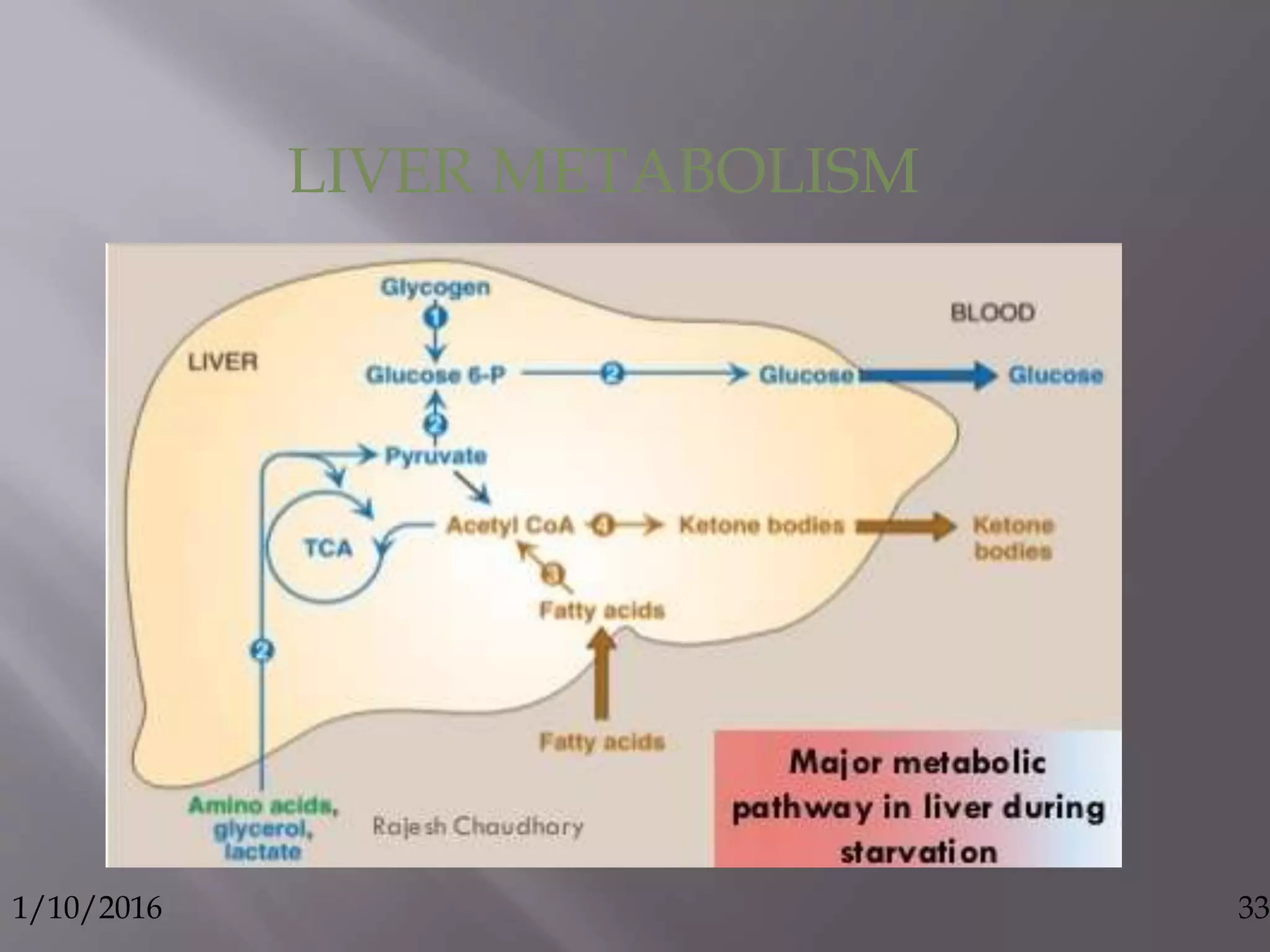
Liver in starvation
1. Carbohydrate metabolism
- Increased glycogen degradation ( glycogenolysis).
- Increased gluconeogenesis.
2. Fat metabolism
-Increased fatty acid oxidation
-Increased synthesis of ketone bodies
1/10/2016 33
LIVER METABOLISM
ADIPOSE TISSUE IN STARVATION
1. Carbohydrate metabolism
2. Fat metabolism
 Increased degradation of
TAG (hormone sensitive
lipase)
 Increased release of fatty
acid
 Decreased uptake of fatty
acid (lipoprotein , lipase of
adipose tissue is low )
1/10/2016 34
RESTING SKELETAL MUSCLE IN
STARVATION
1. Carbohydrate metabolism
2. Lipid metabolism
 During 1st two weeks :
fatty acids from adipose
tissue & ketone bodies
from liver as fuel.
3. Protein metabolism
 Alanine & glutamine are
quantitatively the most
important gluconeogenic
amino acid .
1/10/2016 35
BRAIN IN STARVATION
 During starvation,
insulin
independent tissue,
brain
continue to utilize
glucose.
 Brain also utilizes ketone
bodies as energy source.
1/10/2016 36
1/10/2016 37
1/10/2016 38
KIDNEY IN LONG TERM
STARVATION
 Kidney expresses the enzymes of gluconeogenesis
,
including glucose-6- phosphatase.
 In late fasting about 50% of gluconeogenesis
occurs.
 Provides compensation for the acidosis that
accompanies the increased production of ketone
bodies.
1/10/2016 39
 Textbook of pathology-6th edition-Harsh
Mohan.
 http://www.bettermediciene.com/article.
1/10/2016 40
1/10/2016 41

Protien calorie malnutrition & starvation

  • 1.
  • 2.
    WHO definition “The cellularimbalance between the supply of nutrients & energy & the body’s demand for them to ensure growth, maintenance & specific functions.” 1/10/2016 2
  • 3.
    PROTEIN-CALORIE MALNUTRITION  Primarynutritional problem in India.  First National Nutritional Disorder. 1/10/2016 3
  • 4.
     The inadequateconsumption of protein & energy as a result of primary dietary deficiency or conditioned deficiency may cause loss of body mass & adipose tissue.  Frequent due to socio-economic factors limiting the quality & quantity of dietary intake.  Prevalent in developing countries of Africa, Asia & South America.  Markedly seen in infants & children. 1/10/2016 4
  • 5.
     Social &economic factors.  Biological factors.  Environmental factors.  Role of free radicals.  Age of host. 1/10/2016 5
  • 6.
     Common causesamong the social, economic, biological & environmental factors are : • Lack of breast feeding & giving diluted formula. • Improper complementary feeding. • Over crowding in family. • Ignorance. • Illiteracy. • Lack of health education. • Poverty. • Infection. 1/10/2016 6
  • 7.
     Role offree radicals : Damage liver cell giving rise to Kwashiorkor.  Age of host : • Frequent in infants & young children whose rapid growth increases nutritional requirements. • PEM in pregnant & lactating women can affect the growth, nutritional status & survival rates of their foetus, newborns & infants. • Elderly can also suffer from PEM due to alteration of GI system. 1/10/2016 7
  • 8.
    Five forms ofPEM are : 1. Kwashiorkor 2. Marasmus 3. Marasmic – Kwashiorkor 4. Nutritional dwarfing 5. Underweight child 1/10/2016 8
  • 9.
     Ga languageof Ghana - “ The sickness of the weaning”.  Also called wet-protein energy malnutrition.  Form of PEM characterized by protein deficiency.  Refers to an insufficient protein consumption but with sufficient calorie intake.  Usually appear in the age of 12 months when breast feeding is discontinued.  May also develop at any time during a child formative years. 1/10/2016 9
  • 10.
     It causesfluid retention (edema); dry ,peeling skin & hair discolouration.  Can have long term impact on a child’s physical & mental development & in severe cases may lead to death.  Treated by adding food energy & protein to the diet. 1/10/2016 10
  • 11.
    SYMPTOMS  Change inskin pigment.  Diarrhea.  Decreased muscle mass.  Swelling(edema).  Fatigue.  Hair changes  Lethargy.  Increased & more severe infection due to damaged immune system.  Failure to gain weight & grow.  Shock(late stage). 1/10/2016 11
  • 12.
     Greek wordMarasmos- “withering or wasting”  Severe protein calorie malnutrition characterized by energy deficiency and emaciation  Causes stunted growth and wasting of muscles and tissue  Develop between the age of 6 months & 1 years in children who weaned from breast feeding/who suffer from weakening conditions like chronic diarrhea. 1/10/2016 12
  • 13.
    SYMPTOMS  Severe growthretardation.  Loss of subcutaneous fat.  Severe muscle wasting.  Child looks thin and limbs appear as skin and bone.  Wrinkled skin.  Bony prominence.  Frequent watery diarrhea & acid stools.  Temperature is abnormal.  Edema absent. 1/10/2016 13
  • 14.
    DIFFERENCE IN CLINICAL FEATURESBETWEEN MARASMUS AND KWASHIORKOR 1/10/2016 14
  • 15.
  • 16.
  • 17.
  • 18.
    MARASMIC-KWASHIORKOR Severely malnutritioned child withfeatures of both Marasmus & Kwashiorkor.  Features of Kwashiorkor : severe edema of feet &legs &also hands, lower arms, abdomen & face. Pale skin &hair.  Features of Marasmus: Wasting of muscles of the upper arms, shoulders & chest. 1/10/2016 18
  • 19.
     Some childrenadopt to prolonged insufficiency of food-energy & protein by a marked retardation of growth.  Weight & height are reduced in same proportion ,so they appear superficially normal. 1/10/2016 19
  • 20.
    UNDERWEIGHT CHILD  Childrenwith subclinical PEM can be detected by their weight for height/age which are significantly low.  Reduced plasma albumin.  Risk for respiratory & gastric infections. 1/10/2016 20
  • 21.
     Significant changesin Kwashiorkor – hypoalbuminemia, hypoproteinemia & hypoglycemia.  Plasma cortisol & growth hormone levels are high.  Percentage of body water & extracellular water is increased.  Electrolytes especially K & Mg are depleted. 1/10/2016 21
  • 22.
     Levels ofsome enzymes are decreased.  Circulating lipid are low.  Ketonuria can occur & may cause decrease in urinary excretion of urea.  In both Kwashiorkor & Marasmus , iron deficiency anemia & metabolic acidosis are present. 1/10/2016 22
  • 23.
    Treatment strategy dividedinto 3 stages:  Resolving life threatening conditions. - Hospital management  Resolving nutritional status. -Dietary management  Ensuring nutritional rehabilitation. 1/10/2016 23
  • 24.
    1. Hospital Management: Followingconditions should be corrected – hypothermia, hypoglycemia, infections, dehydration, electrolyte imbalance, anemia & other vitamin & mineral deficiency. 2. Dietary Management: Diet from staple foods– inexpensive, easily digestible, evenly distributed & increased number of feedings. 3. Rehabilitation: Nutritional training for mothers- feeding their children back to health & use local food. 1/10/2016 24
  • 25.
    o Promotion ofbreast feeding. o Development of low cost weaning. o Nutritional education. o Family planning. o Immunization. o Early diagnosis & treatment. 1/10/2016 25
  • 26.
  • 27.
     State ofoverall deprivation of nutrients.  Causes: i. deliberate fasting-religious or political. ii. famine conditions in a country or community. iii. chronic wasting diseases(infection, inflammatory conditions, liver disease),cancer etc. 1/10/2016 27
  • 28.
     Starved individualshas lax, dry skin, wasted muscles and atrophy of internal organs.  Consequences of fasting: Plasma level of glucose, amino acid, triglycerides falls.  Overview of fasting; Insulin secretion falls while glucagon is activated. 1/10/2016 28
  • 29.
    Early, intermediate, advancestages of starvation.  Early stage(2 days) • Glycogenolysis & gluconeogenesis are important source of blood glucose. • Energy from alternate source ( beta oxdn FA, KB)  Intermediate stage (24 days) • Glycogen stores mostly depleted not serves as a source of blood glucose • FA, KB supplied to heart, kidney, muscle. 1/10/2016 29
  • 30.
    1/10/2016 30  Advancedstage (>24 days) • KB supplies to heart, kidney , muscle is decreased, limited to brain only. • Heart, kidney , muscle, depend on FA as main source. • Gluconeogenesis will be enhanced due to increased activity of enzymes pyruvate carboxylase , fructose-1,6-bis phosphatase.
  • 31.
    1/10/2016 31 ORGANS INVOLVED Liver in starvation.  Adipose tissue in starvation.  Resting muscle in starvation.  Brain in starvation.  Kidney in long term starvation.
  • 32.
    1/10/2016 32 Liver instarvation 1. Carbohydrate metabolism - Increased glycogen degradation ( glycogenolysis). - Increased gluconeogenesis. 2. Fat metabolism -Increased fatty acid oxidation -Increased synthesis of ketone bodies
  • 33.
  • 34.
    ADIPOSE TISSUE INSTARVATION 1. Carbohydrate metabolism 2. Fat metabolism  Increased degradation of TAG (hormone sensitive lipase)  Increased release of fatty acid  Decreased uptake of fatty acid (lipoprotein , lipase of adipose tissue is low ) 1/10/2016 34
  • 35.
    RESTING SKELETAL MUSCLEIN STARVATION 1. Carbohydrate metabolism 2. Lipid metabolism  During 1st two weeks : fatty acids from adipose tissue & ketone bodies from liver as fuel. 3. Protein metabolism  Alanine & glutamine are quantitatively the most important gluconeogenic amino acid . 1/10/2016 35
  • 36.
    BRAIN IN STARVATION During starvation, insulin independent tissue, brain continue to utilize glucose.  Brain also utilizes ketone bodies as energy source. 1/10/2016 36
  • 37.
  • 38.
    1/10/2016 38 KIDNEY INLONG TERM STARVATION  Kidney expresses the enzymes of gluconeogenesis , including glucose-6- phosphatase.  In late fasting about 50% of gluconeogenesis occurs.  Provides compensation for the acidosis that accompanies the increased production of ketone bodies.
  • 39.
  • 40.
     Textbook ofpathology-6th edition-Harsh Mohan.  http://www.bettermediciene.com/article. 1/10/2016 40
  • 41.