BT5011 : Biomaterials Engineering
MECHANICAL HEART VALVES
By
Yanamala Vijay Raj
Praveen Krishna V.
1
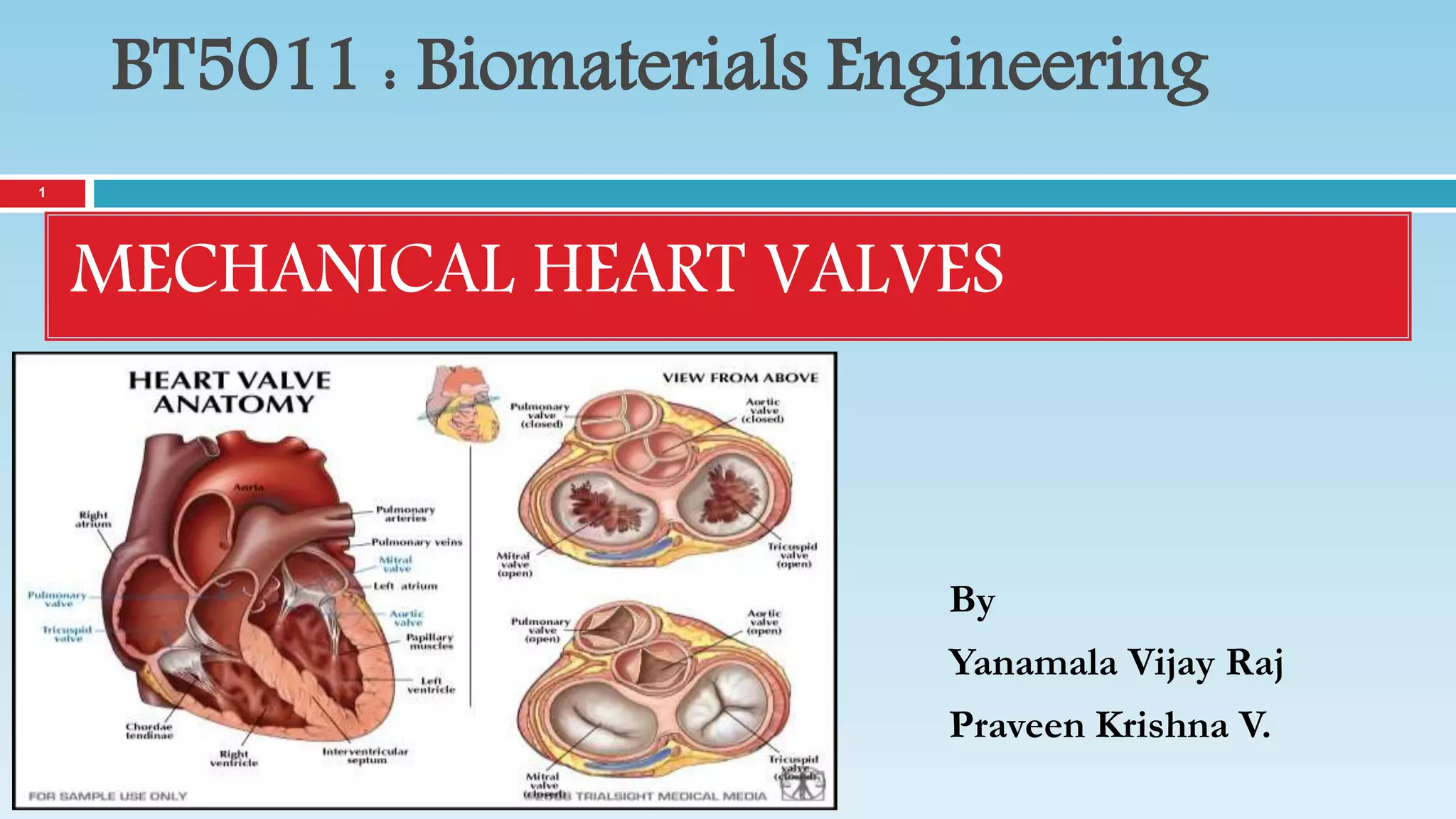
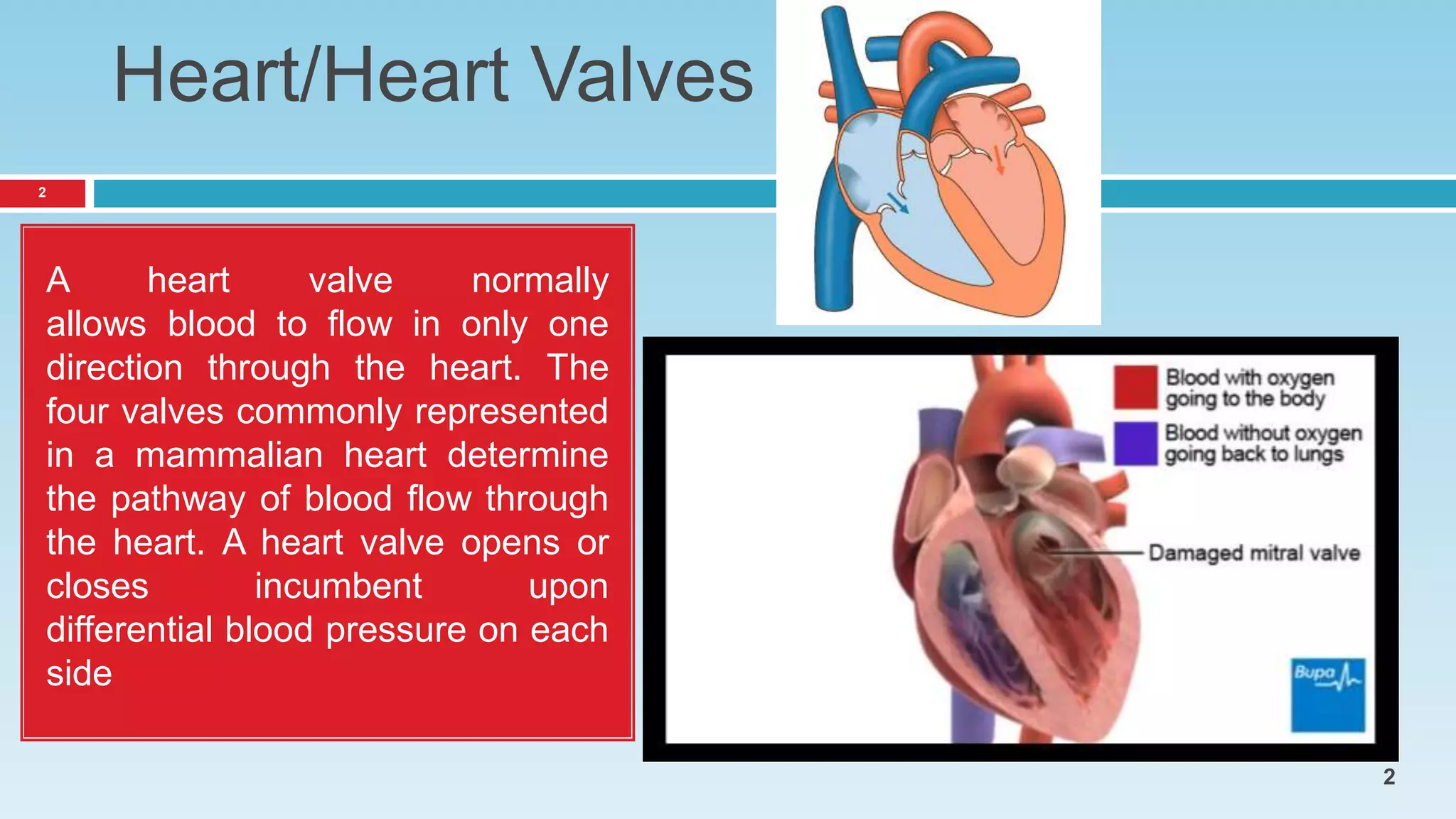
Heart/Heart Valves
A heart valve normally
allows blood to flow in only one
direction through the heart. The
four valves commonly represented
in a mammalian heart determine
the pathway of blood flow through
the heart. A heart valve opens or
closes incumbent upon
differential blood pressure on each
side
2
2
When Heart Valves Stop Working
ARTIFICIAL VALVES:
An artificial heart valve is
a device implanted in the
heart of a patient with
valvular heart disease.
When one of the four
heart valves malfunctions,
the medical choice may
be to replace the natural
valve with an artificial
valve. This requires open-
heart surgery.
Need and function-when does natural valve
need be replaced
 Heart Valve diseases fall into two categories:
 Stenosis- hardening of the valve and
incompetence- permittance of backflow
3 causes of Heart Disease:
 Rheumatic Fever: stiffens valve tissue, causing
stenosis
 Congenitally defective valves: do not form
properly as the heart develops, but often go
unnoticed until childhood
 Bacterial infection: causes inflammation of
valves, tissue scarring, and permanent
degradation
3
3
Evolution of Prosthetic Heart Valves
The development of the original
ball-and-cage valve design can
be attributed to the bottle
stopper in 1858
In the early 1950’s, it led to the
idea of a prosthetic heart valve
consisting of a cage with a
mobile spherical poppet
On July 22, 1955, at the City General
Hospital in Sheffield, England, Judson
Chesterman implanted the first
successful heart valve
The patient lived 14 hours after the
valve was placed, but died when the
poppet twisted out of position
Valve was made of Perspex, an outer
cage, a poppet, and 2 buttons to fasten
the valve to the outside of the heart
4
4
•Starr-Edwards valve was first successful long-term
valve created
•It was implanted in its first 8 patients in 1961 (6 of
8 survived
•Ball-and-Cage design
•Devised important “Nine Commandments” in
developing a prosthetic heart valve.
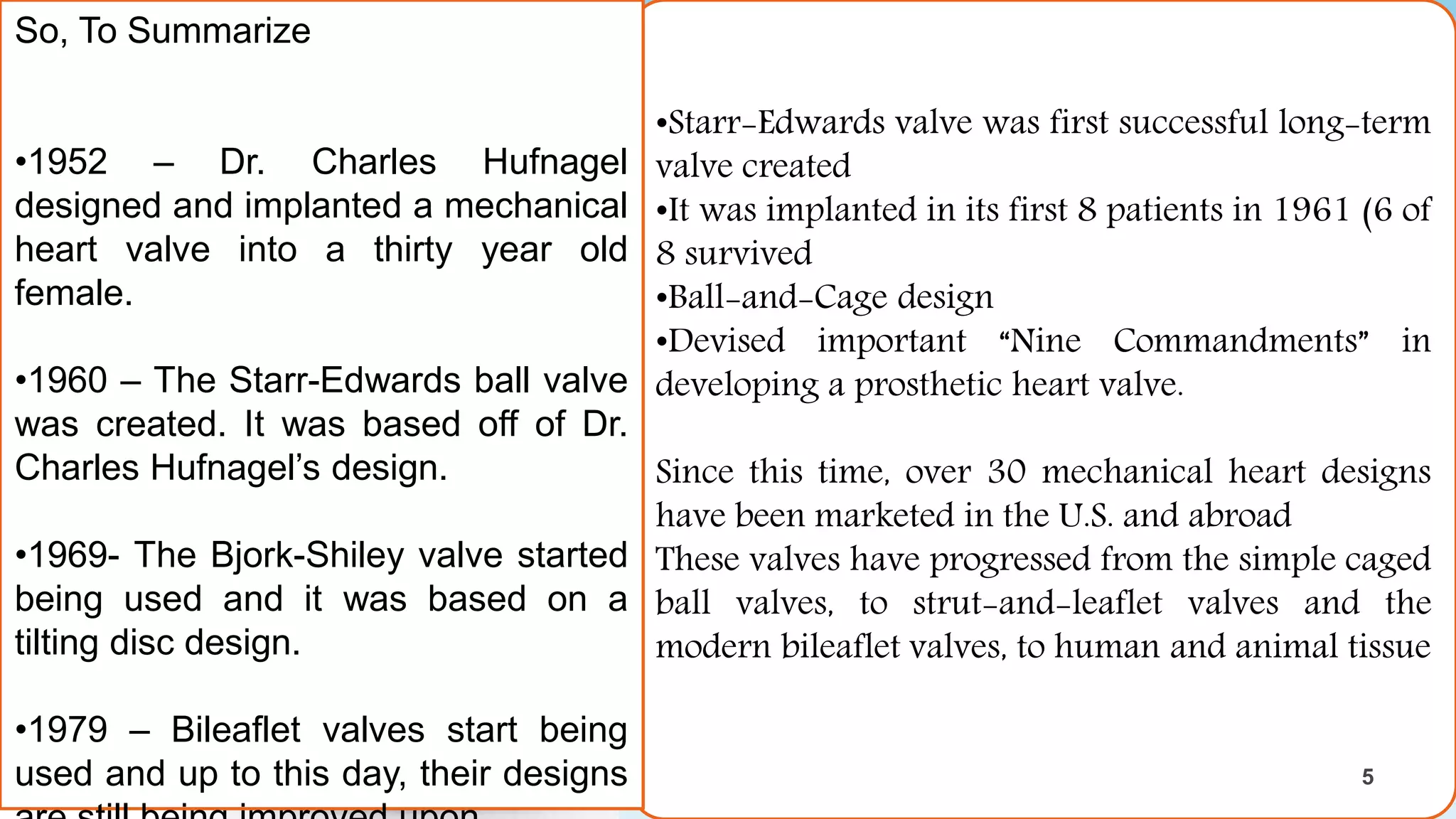
Since this time, over 30 mechanical heart designs
have been marketed in the U.S. and abroad
These valves have progressed from the simple caged
ball valves, to strut-and-leaflet valves and the
modern bileaflet valves, to human and animal tissue
So, To Summarize
•1952 – Dr. Charles Hufnagel
designed and implanted a mechanical
heart valve into a thirty year old
female.
•1960 – The Starr-Edwards ball valve
was created. It was based off of Dr.
Charles Hufnagel’s design.
•1969- The Bjork-Shiley valve started
being used and it was based on a
tilting disc design.
•1979 – Bileaflet valves start being
used and up to this day, their designs
5
5
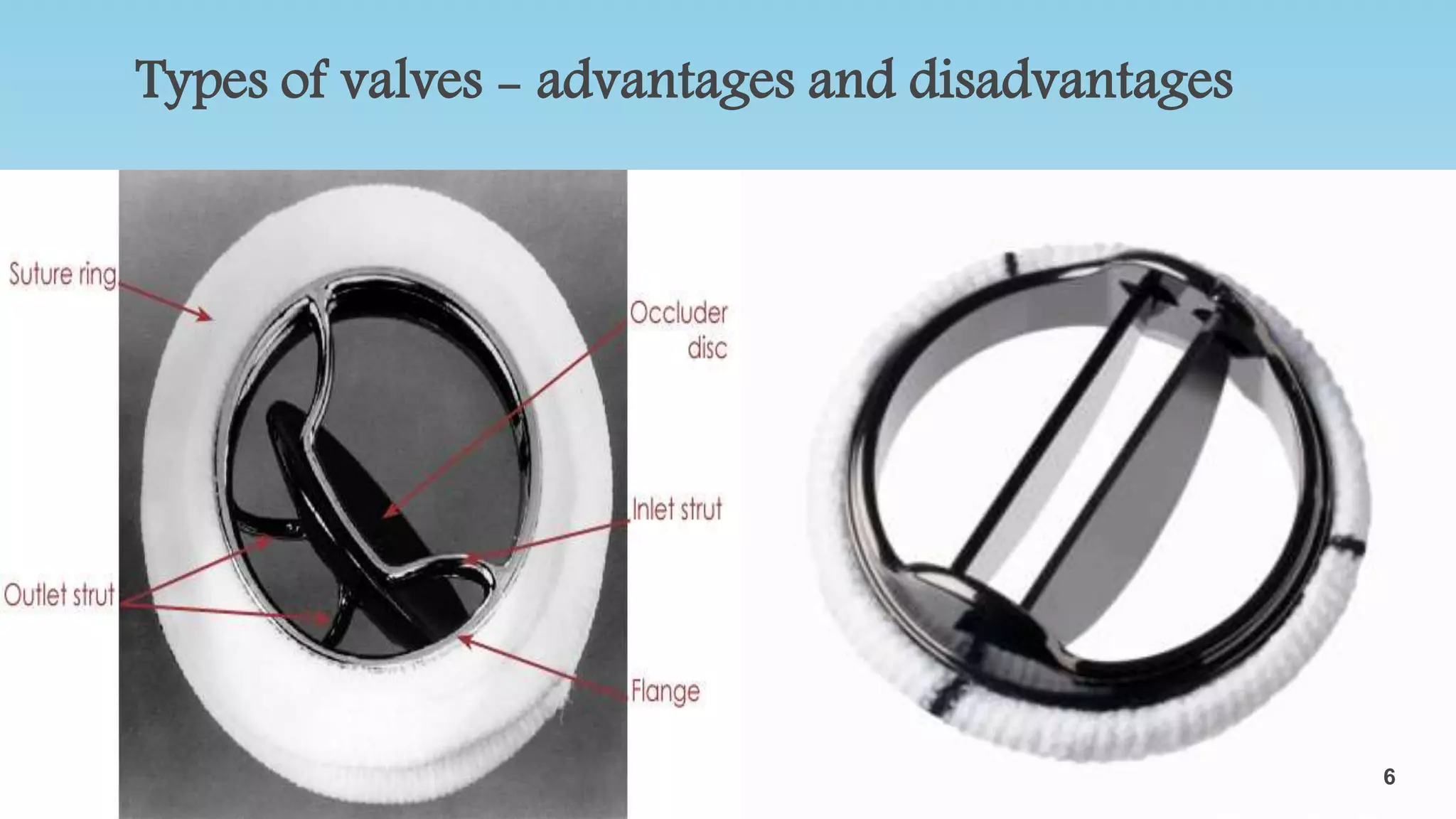
Types of valves - advantages and disadvantages
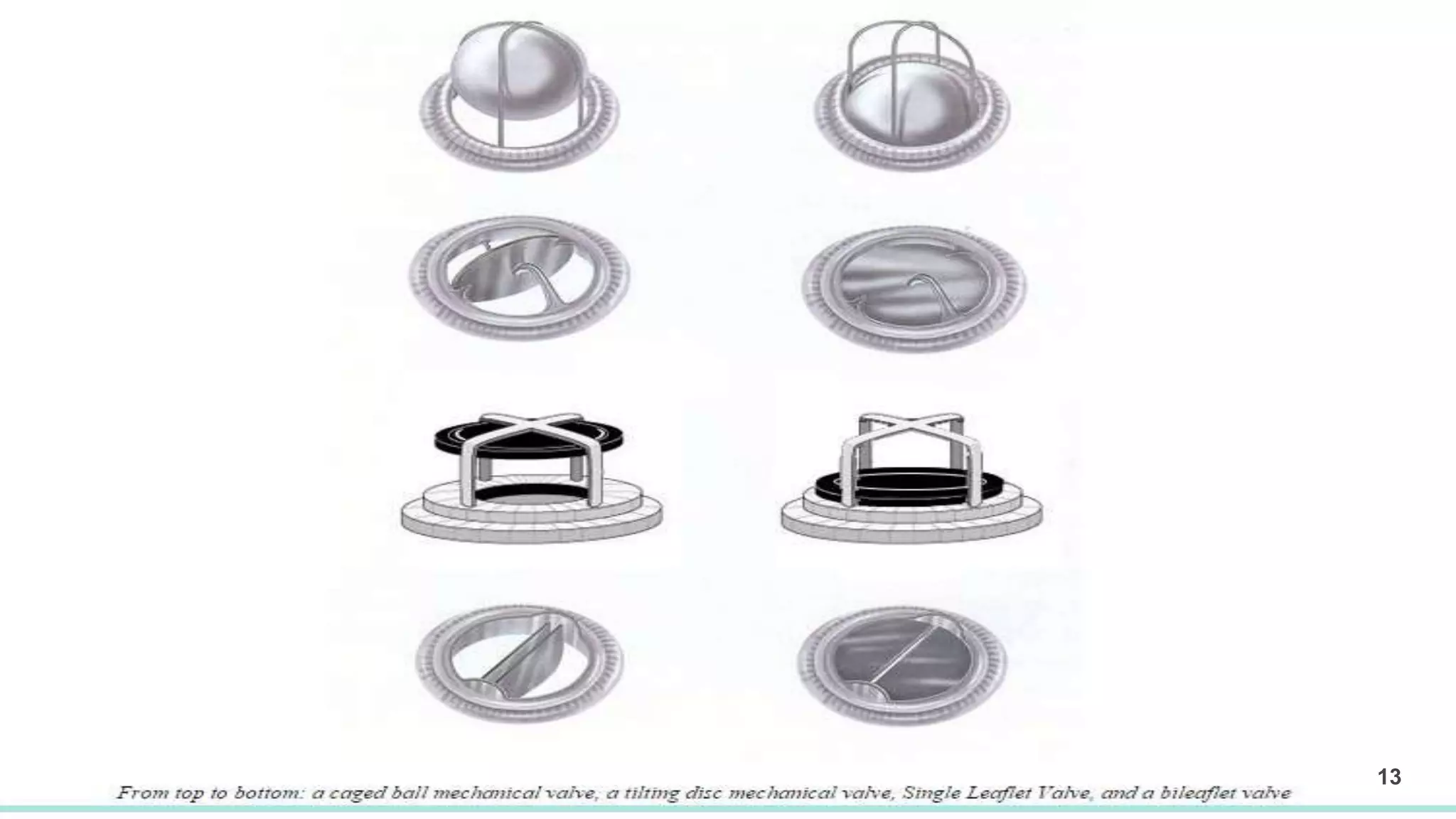
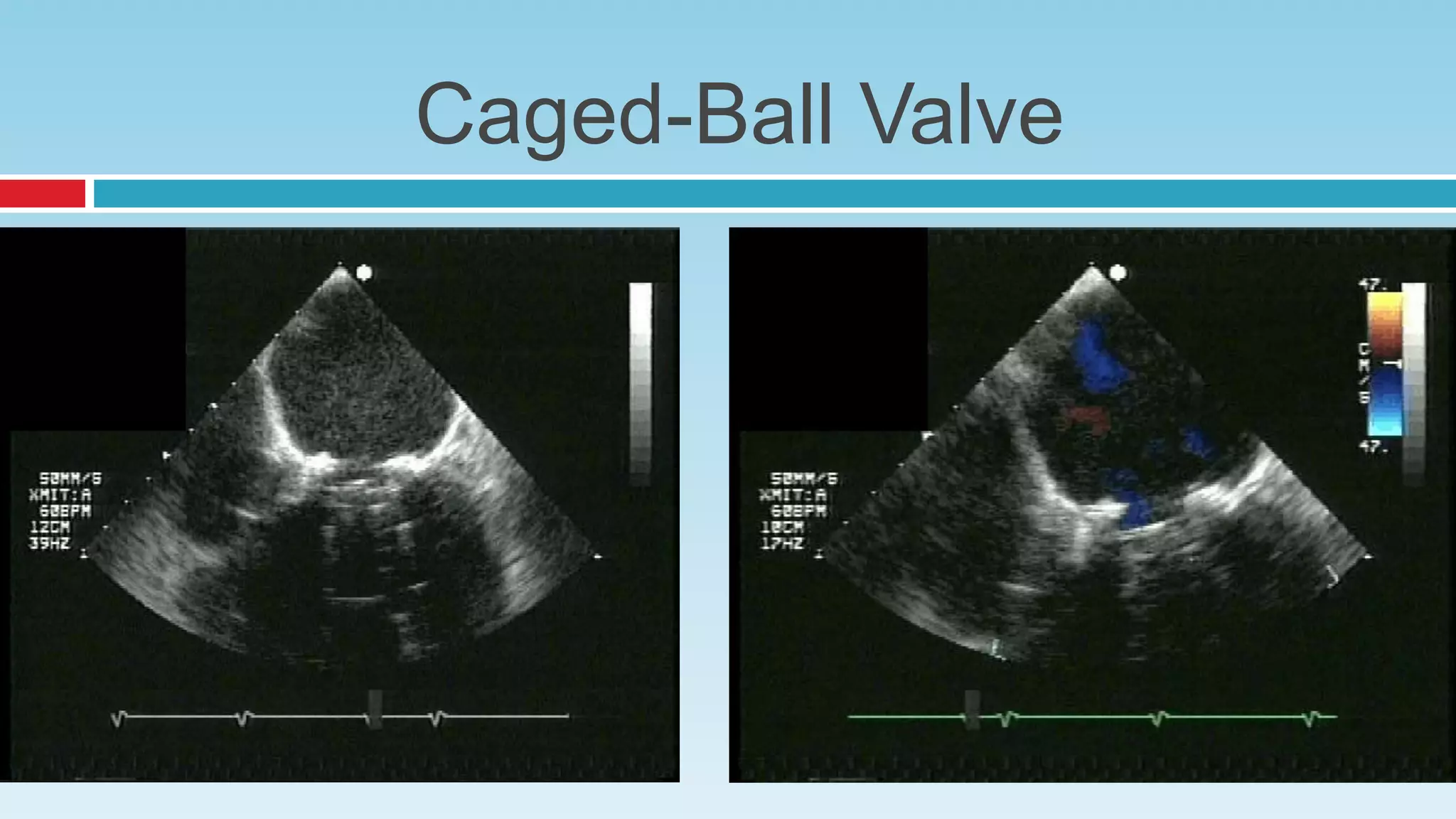
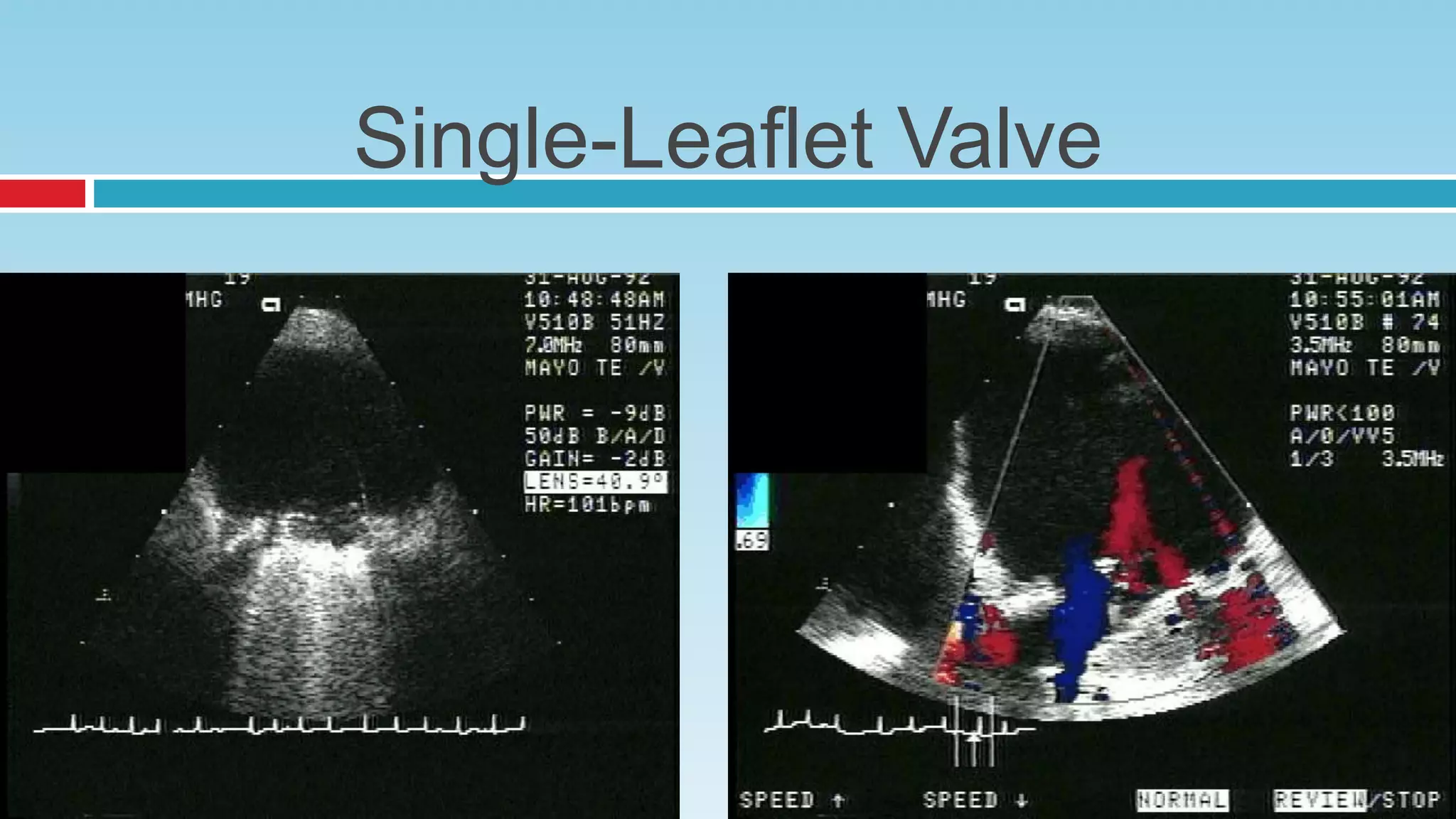
•Mechanical- There are three types. The caged ball, tilting disk, and
bileaflet. Lasts for over 20 years
•Tissue(biological)- valves that are used from animals to implant them
back into humans. Typically lasts between 10-15 years
6
6
Characteristics of ideal heart valve
“Nine Commandments”:
oEmbolism Prevention
oDurability
oEase and Security of Attachment
oPreservation of Surrounding Tissue Function
oReduction of Turbulence
oReduction of Blood Trauma
oReduction of Noise
oUse of Materials Compatible with Blood
oDevelopment of Methods of Storage and Sterilization
7
7
 Unidirectional flow
 Durable : 40million cycles/year
 Blood compatible: no thrombus, embolus
 Central flow: Laminar not turbulent
 Closing not damaging blood cells
 Last but not the least important – It should be quiet
“An ideal Prosthetic valve”
8
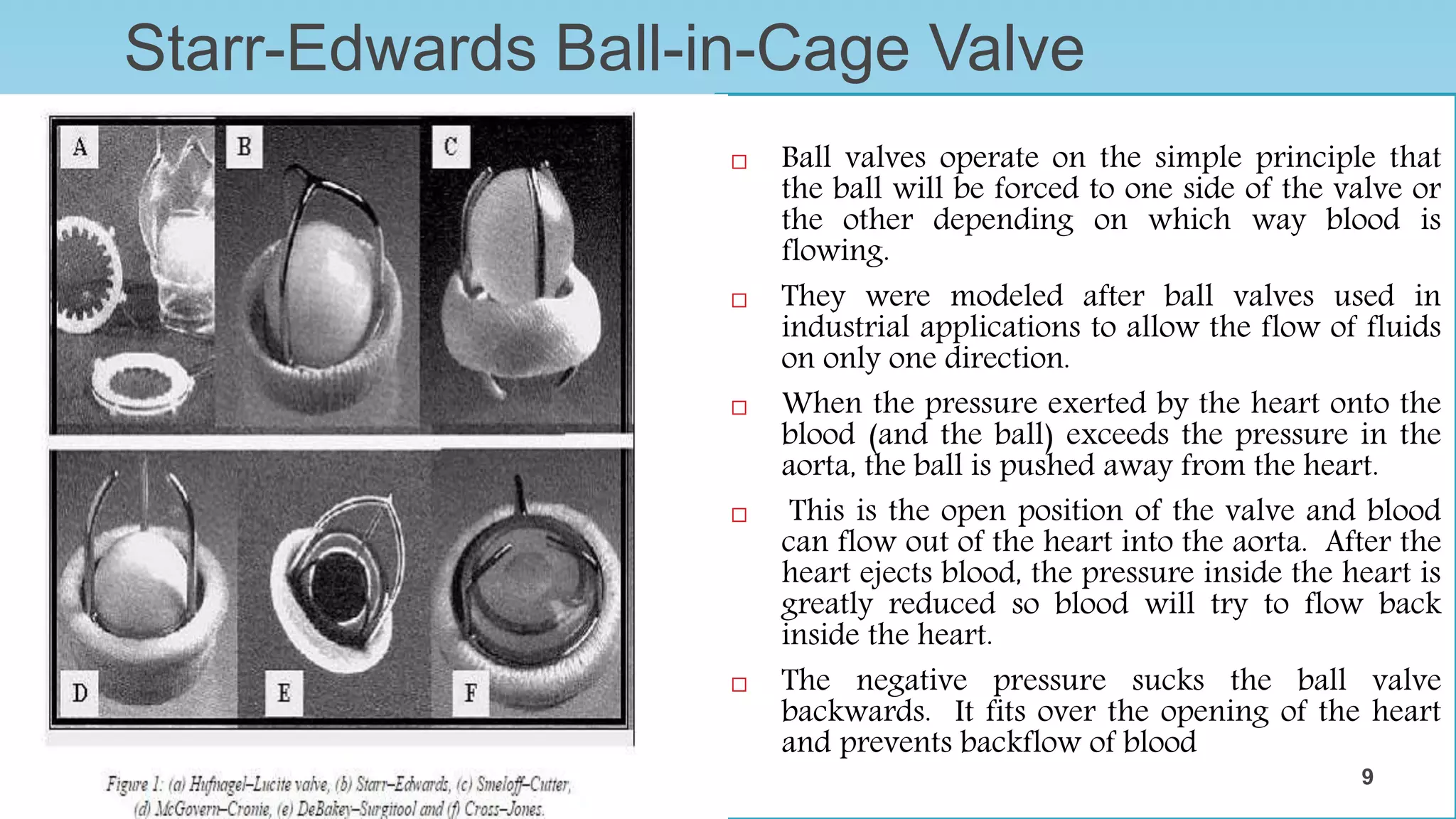
Starr-Edwards Ball-in-Cage Valve
The ball valve was the first mechanical heart
valve used and designed by Charles Hufnagel.
The Starr-Edwards ball valve was first used
clinically as a mitral valve replacement in
1960.
After the Starr-Edwards valve was established,
several other design variations were created
such as Magovern–Cromie, DeBakey–
Surgitool, and Smeloff–Cutter ball valves.
 Ball valves operate on the simple principle that
the ball will be forced to one side of the valve or
the other depending on which way blood is
flowing.
 They were modeled after ball valves used in
industrial applications to allow the flow of fluids
on only one direction.
 When the pressure exerted by the heart onto the
blood (and the ball) exceeds the pressure in the
aorta, the ball is pushed away from the heart.
 This is the open position of the valve and blood
can flow out of the heart into the aorta. After the
heart ejects blood, the pressure inside the heart is
greatly reduced so blood will try to flow back
inside the heart.
 The negative pressure sucks the ball valve
backwards. It fits over the opening of the heart
and prevents backflow of blood
9
9
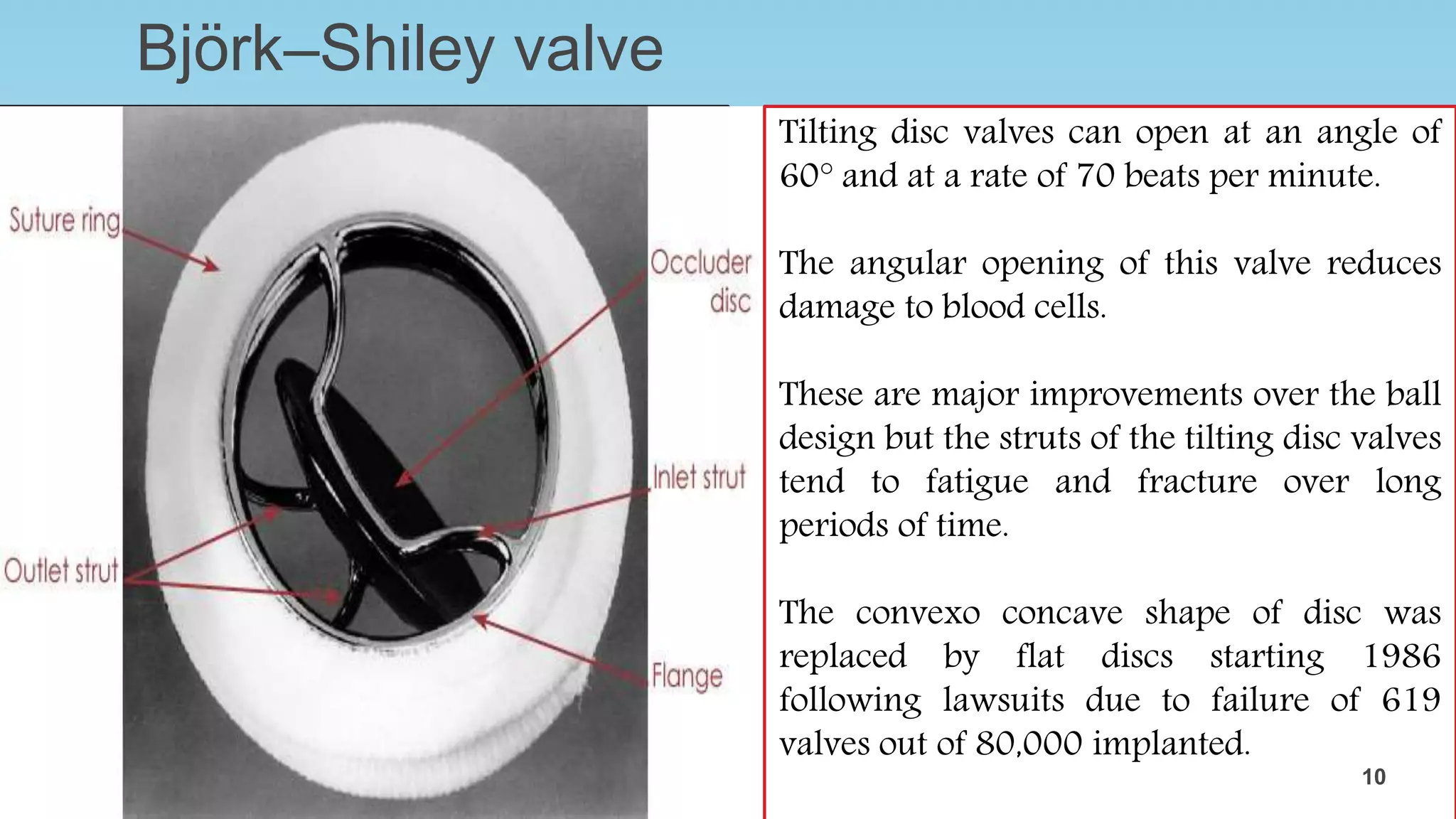
Björk–Shiley valve
Construction
• The Björk–Shiley valve consists of
a single carbon-coated disc in a
metal housing.
• The disc is held in place by two
metal struts, an inflow and an
outflow strut.
• The housing is made from the
alloy Haynes 25, which is
composed of 51% cobalt,
20% chromium, 15% tungsten,
and 10% nickel.
• The Björk–Shiley valve was
considered very durable and was
widely used in the 1970
The Björk–Shiley valve is a mechanical
prosthetic heart valve. The valve was co-
invented by American engineer Donald
Shiley and Swedish heart surgeon Viking
Björk.
Beginning in 1971, it has been used to
replace aortic valves and mitral valves. It was
the first successful tilting-disc valve
Tilting disc valves can open at an angle of
60° and at a rate of 70 beats per minute.
The angular opening of this valve reduces
damage to blood cells.
These are major improvements over the ball
design but the struts of the tilting disc valves
tend to fatigue and fracture over long
periods of time.
The convexo concave shape of disc was
replaced by flat discs starting 1986
following lawsuits due to failure of 619
valves out of 80,000 implanted.
10
10
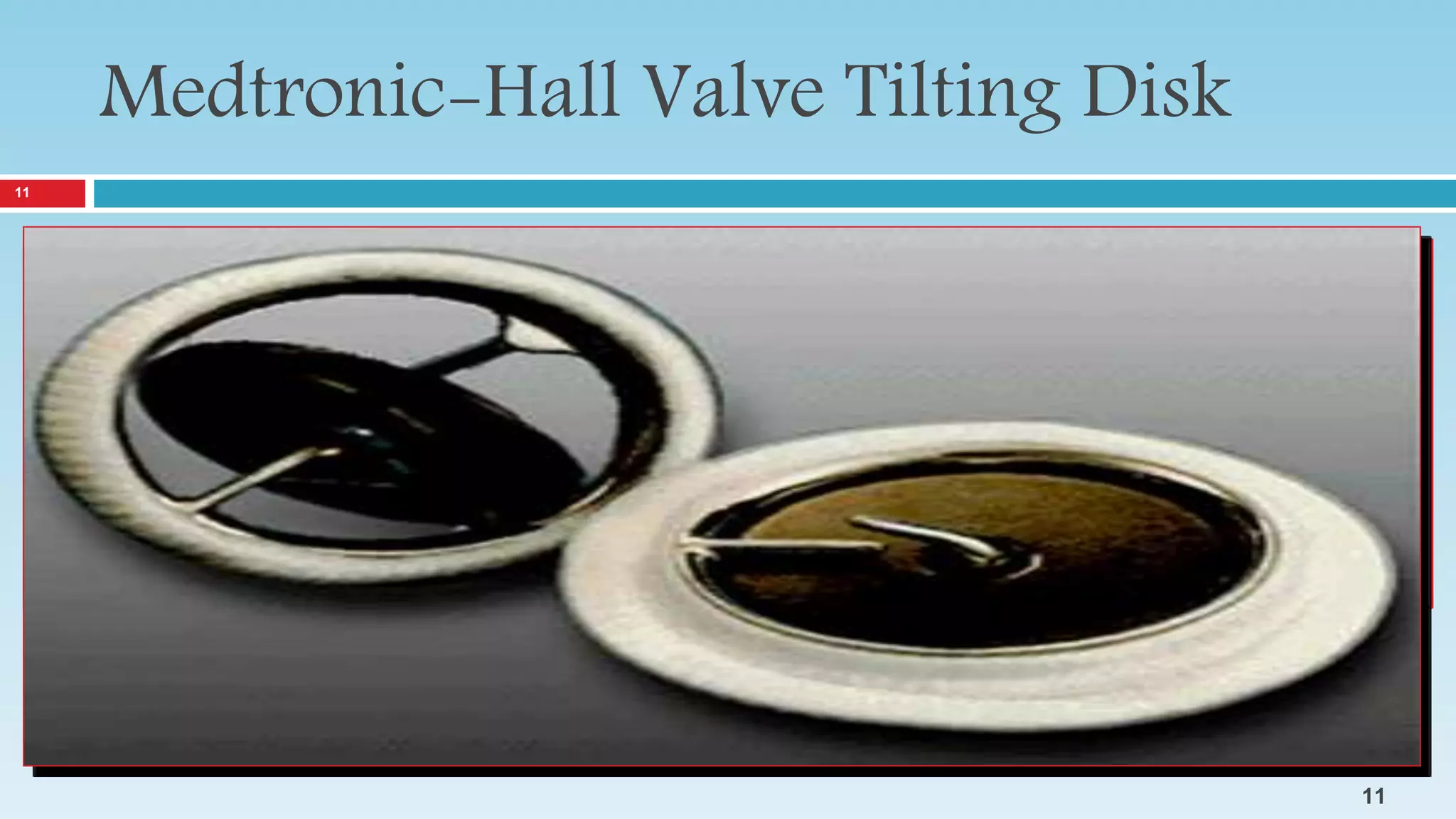
Medtronic-Hall Valve Tilting Disk
The Medtronic-Hall valve was developed to improve on existing tilting disc valves by
reducing the risk of valvular thrombosis.
This was to be accomplished by improving the hemodynamics and by allowing the
disc to move
downstream away from the orifice during opening.
The valve was also designed for maximal structural durability to minimize the risk of
mechanical breakage.
11
11
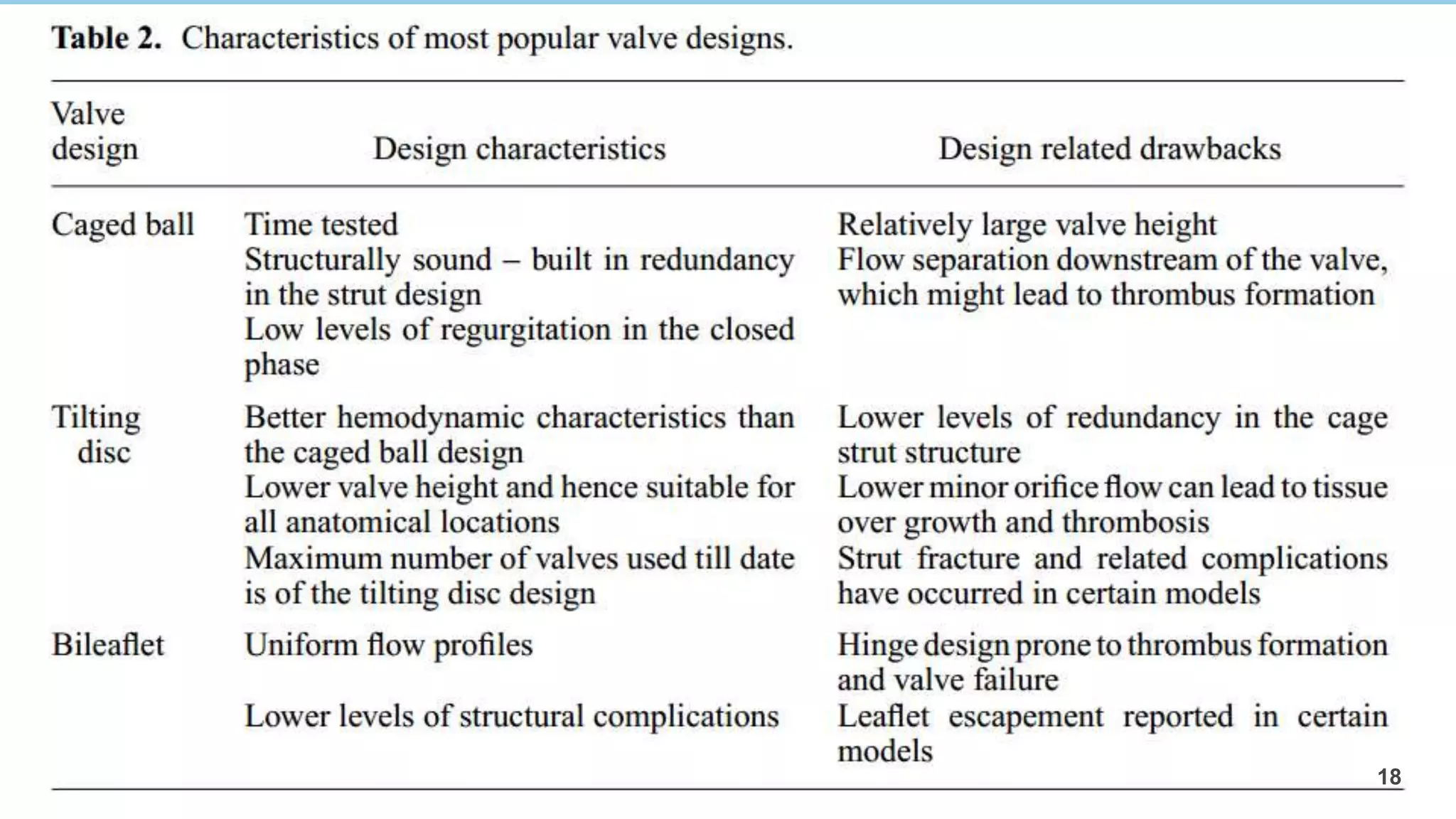
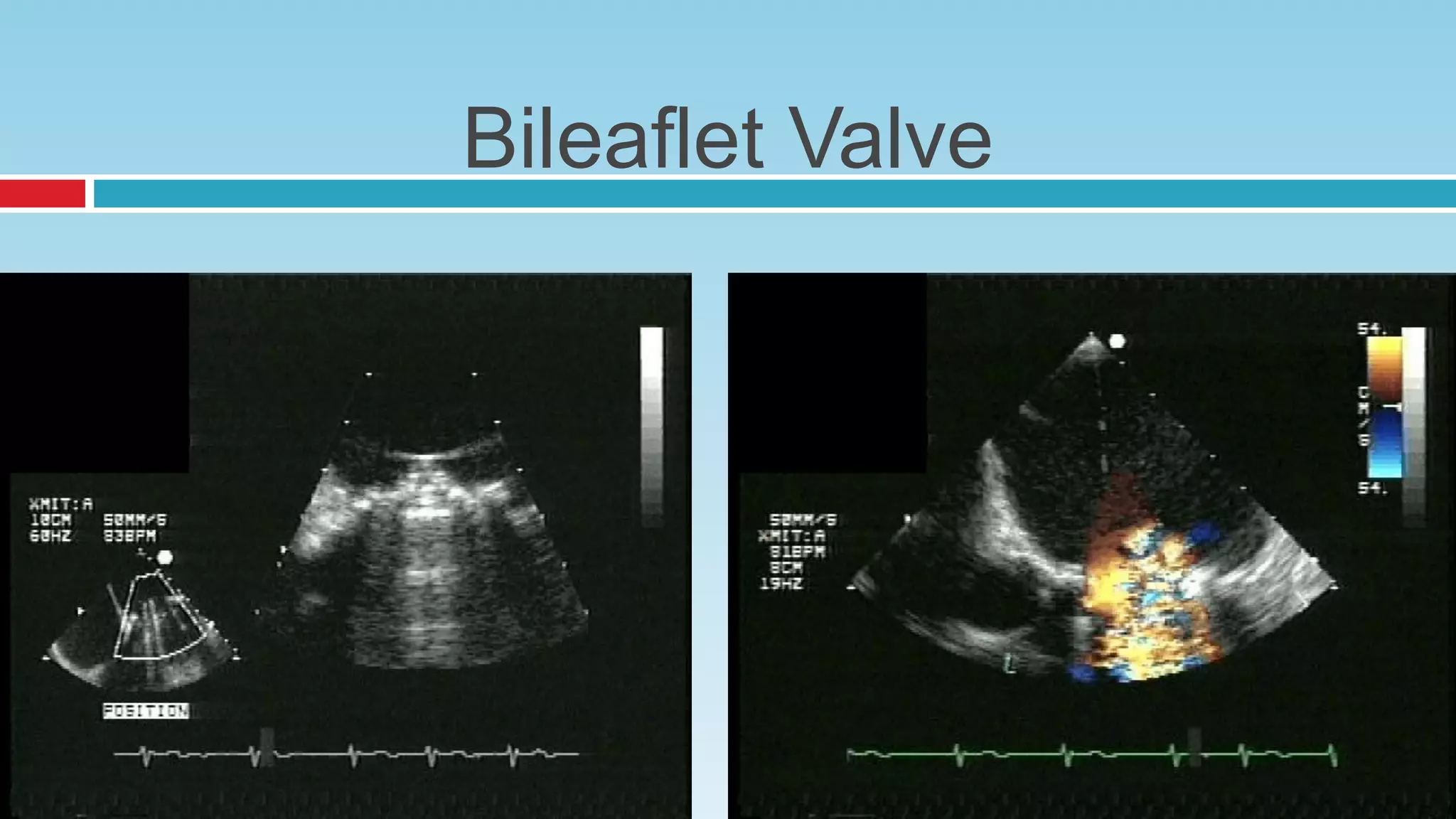
 Two semicircular leaflets that rotate about struts attached to the valve housing
 Good hemodynamic performance - improved flow characteristics, lower
transvalvular pressure gradients, less blood flow turbulence, improved
hemodynamics at a given annular diameter, a larger orifice area and low bulk
and flat profile
 the least thrombogenic of the artificial valves
 most commonly implanted mechanical valve
Bileaflet valves
12
13
13
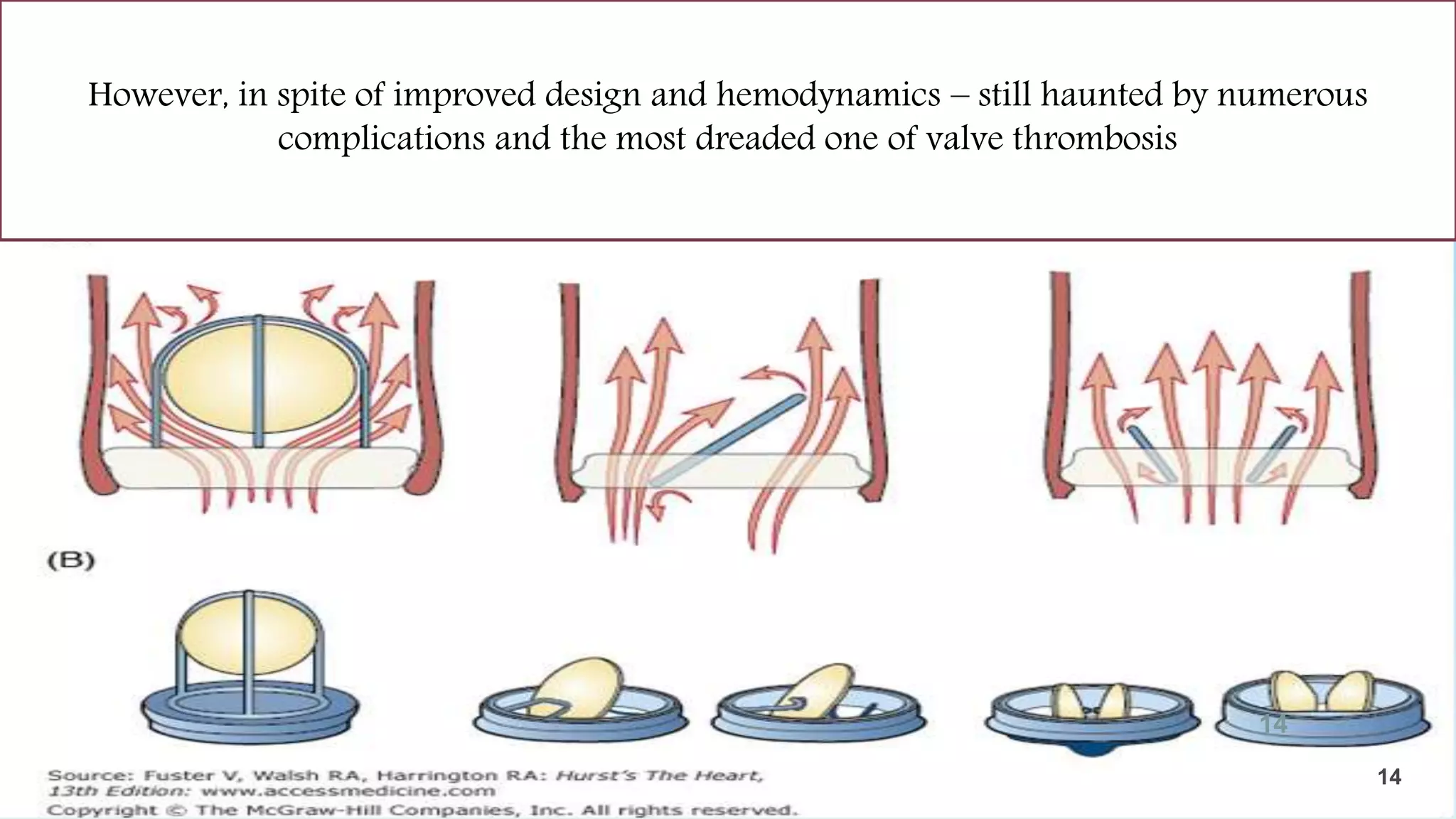
Hemodynamics of blood flow
However, in spite of improved design and hemodynamics – still haunted by numerous
complications and the most dreaded one of valve thrombosis
14
14
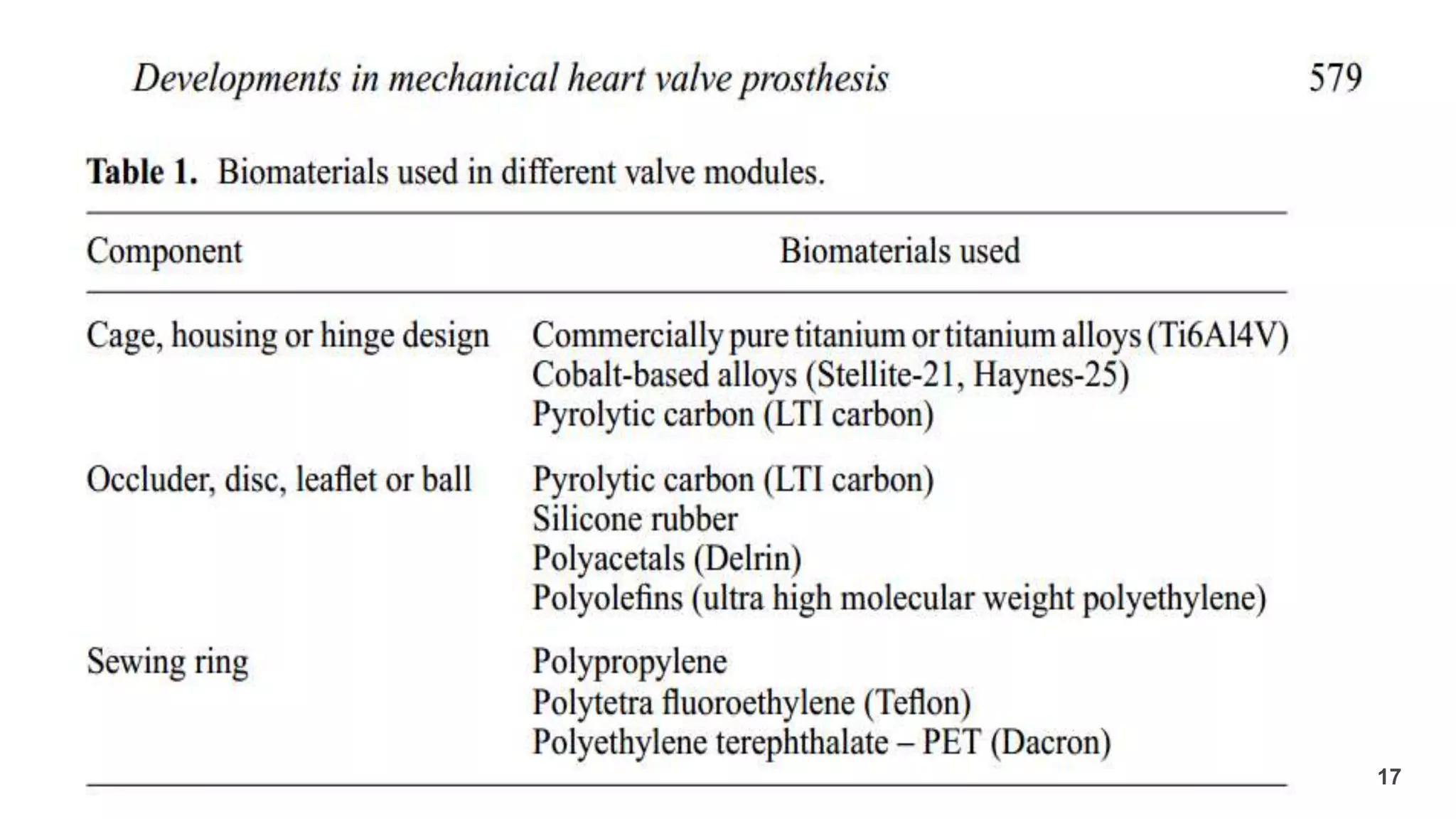
Biomaterials used
•Many different materials are used in the creation of artificial heart valves.
• Metal alloys consisting of stainless steel or titanium are often used to give mechanical
strength and for their corrosion resistance properties.
• The struts on some leaflet valves and the cage on caged-ball models are commonly made
of metal alloys due to their strength and durability requirements
Pyrolytic carbon is another valuable material for its strength and its ability to prevent clotting.
This material has a similar structure to graphite and was originally developed for
applications in the nuclear fuel industry as a coating for nuclear fuel particles. However, it was
soon realized that pyrolytic carbon had biomedical applications.
 It is biocompatible, thromboresistant, resistant to wear, and has high strength and durability.
It is able to stand up to the repeated opening and closing cycles it must endure when used in
mechanical heart valve.
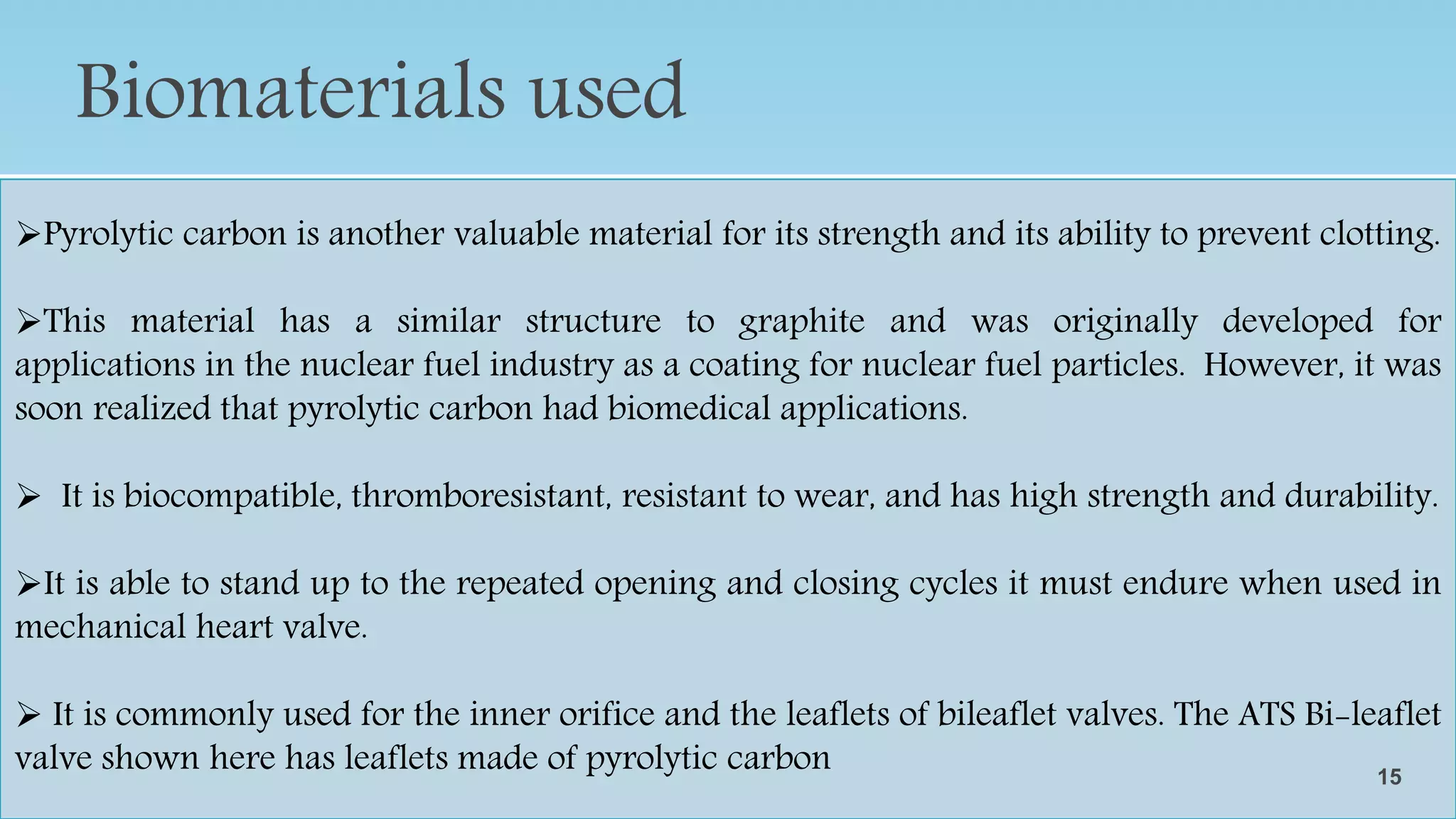
 It is commonly used for the inner orifice and the leaflets of bileaflet valves. The ATS Bi-leaflet
valve shown here has leaflets made of pyrolytic carbon 15
oA material often used for the suture ring (which is used to attach the valve to the body) is
Dacron.
o Dacron is a long chain polyester made from ethylene glycol and terephthalic acid. It is a
synthetic fiber that has many uses in industry, including thermal insulation and sails for
boats.
o In biomedical applications this material is also commonly used for vascular grafts. It is
relatively inert and its porosity allows tissue in growth.
oAnother material that is commonly used for the suture ring is Teflon
oTeflon is used in many medical applications because of its signature low coefficient of
friction
o Teflon is relatively inert and highly biocompatible. As with Dacron it is often used for
vascular grafts. 16
17
17
18
18
Failure modes in mechanical valve
Problems that interfere with the successful performance of valves can be grouped as
below.
•Degradation of valve components
•Structural failure
•Clinical complications associated with the valve.
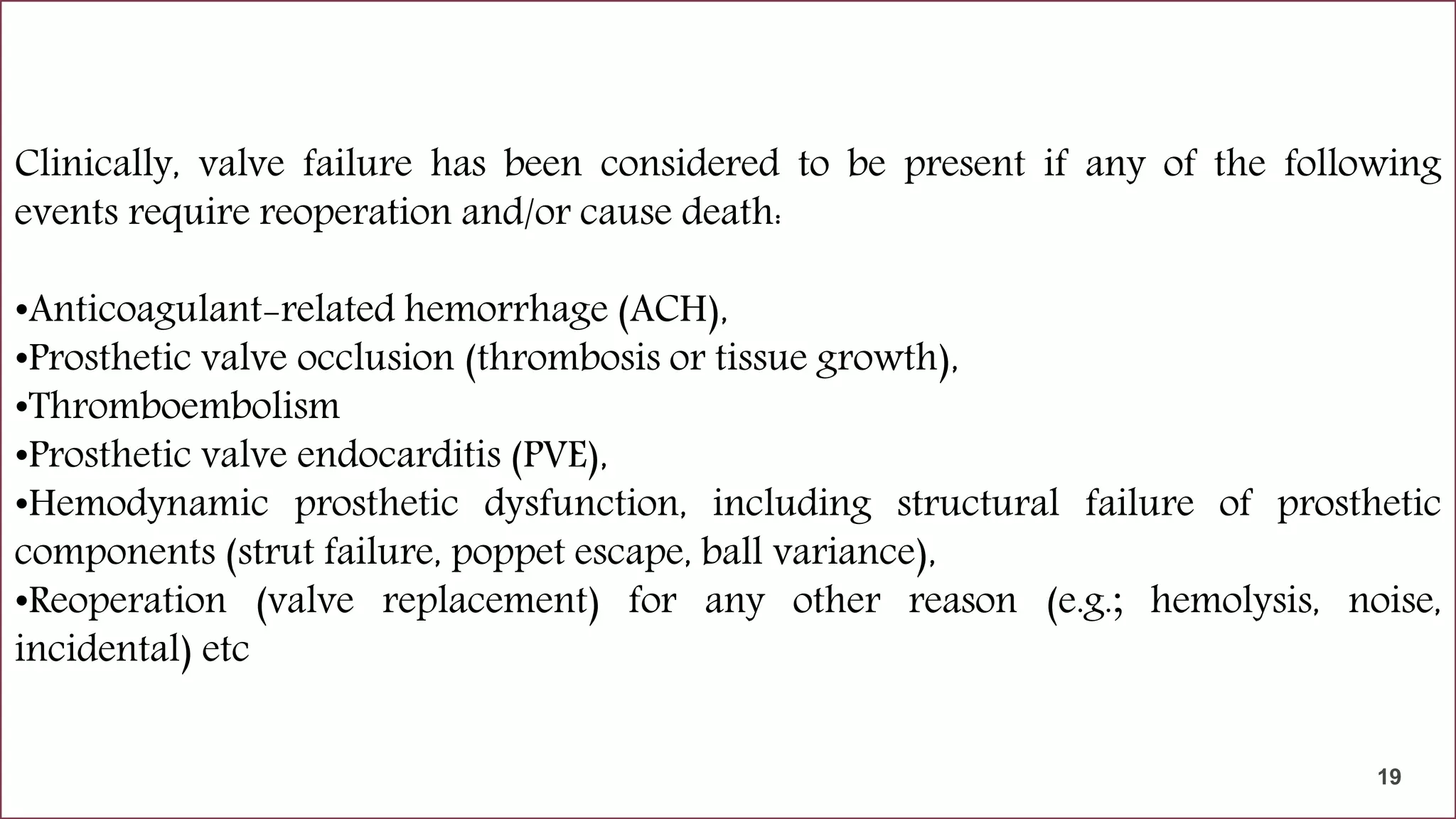
Clinically, valve failure has been considered to be present if any of the following
events require reoperation and/or cause death:
•Anticoagulant-related hemorrhage (ACH),
•Prosthetic valve occlusion (thrombosis or tissue growth),
•Thromboembolism
•Prosthetic valve endocarditis (PVE),
•Hemodynamic prosthetic dysfunction, including structural failure of prosthetic
components (strut failure, poppet escape, ball variance),
•Reoperation (valve replacement) for any other reason (e.g.; hemolysis, noise,
incidental) etc
19
19
Evaluation of Prosthetic Valves
20
Patient’s height, weight, and BSA should be recorded to assess whether
prosthesis-patient mismatch (PPM) is present.
Valves should be imaged from multiple views, with attention to:
Opening & closing motion of the moving parts (leaflets for bioprosthesis and occluders for
mechanical ones)
Presence of leaflet calcification or abnormal echo density attached to the sewing ring,
occluder, leaflets, stents, or cage
Appearance of the sewing ring, including careful inspection for regions of separation from
native annulus & for abnormal rocking motion during the cardiac cycle
Echo Imaging of Prosthetic Valves
 Regurgitation occurs at the disc margins
 The regurgitant jets converge toward the center of the valve
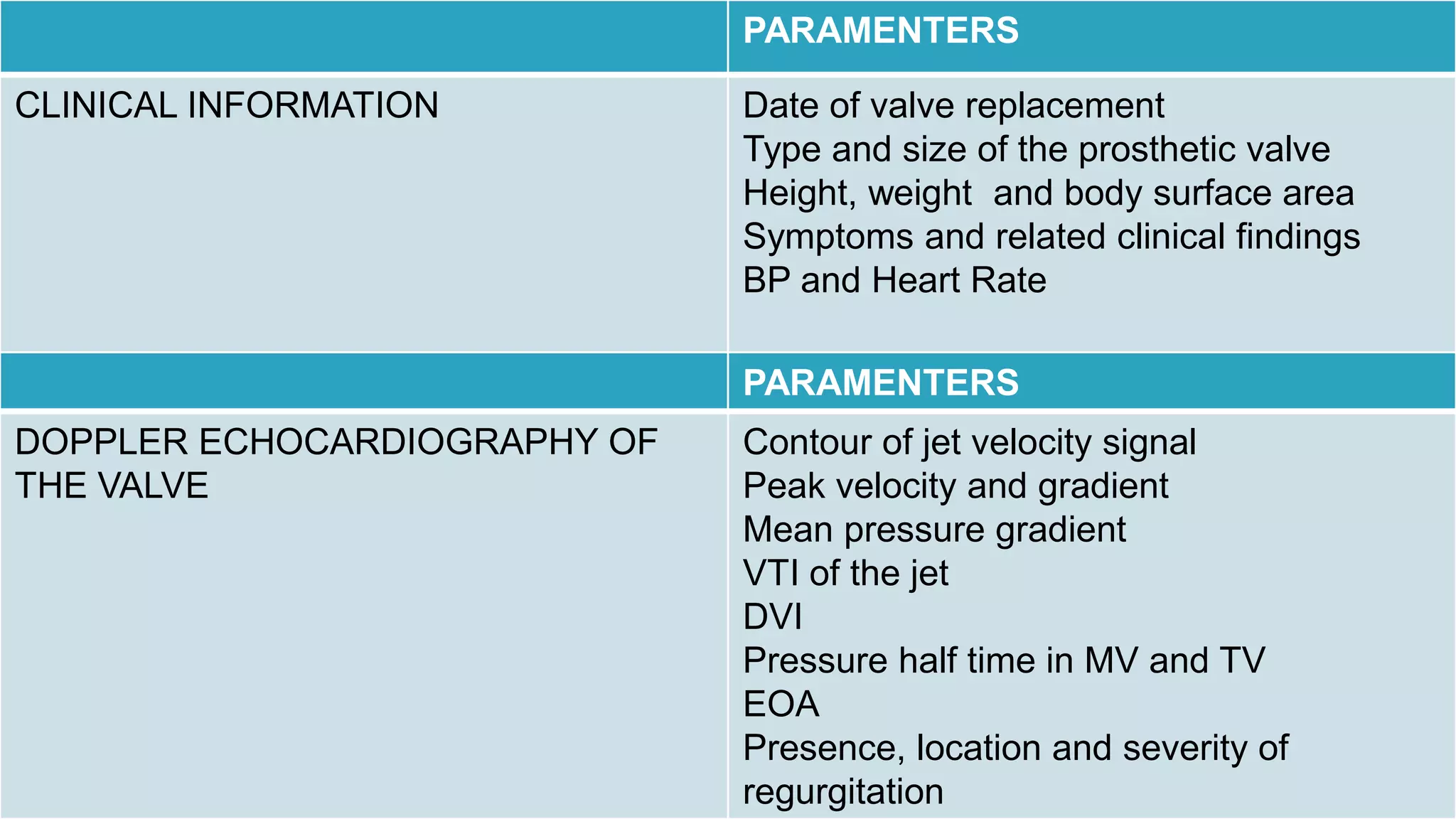
PARAMENTERS
CLINICAL INFORMATION Date of valve replacement
Type and size of the prosthetic valve
Height, weight and body surface area
Symptoms and related clinical findings
BP and Heart Rate
IMAGING OF THE VALVES Motion of leaflets or occluder
Presence of calcification on the leaflets or
abnormal densities on the various
components of the prosthesis
Valve sewing ring integrity and motion
PARAMENTERS
DOPPLER ECHOCARDIOGRAPHY OF
THE VALVE
Contour of jet velocity signal
Peak velocity and gradient
Mean pressure gradient
VTI of the jet
DVI
Pressure half time in MV and TV
EOA
Presence, location and severity of
regurgitation
Caged-Ball Valve
Single-Leaflet Valve
Bileaflet Valve
24
24
Improvements that researchers will attempt to make in the future include:
•Longer lifespan of the heart valves.
•Lower rejection rate.
•Less risk of blood clots in mechanical heart valves.
•Remove the need for blood thinning medication.
•Implant the artificial heart valves through a less intrusive method (currently open-
heart surgery).
•Polymeric Heart Valves - Scientists are looking more into polymer materials for heart
valves because it’s easy to fabricate, has a large range of polymer properties, and
durability.
•Tissue engineered heart valves- Obtaining the number of types of cells for tissue
valves, lack of scaffold material
25
References
 "Artificial Heart Valve." Wikipedia. Wikimedia Foundation, 16 Sept. 2012. Web. 16 Sept. 2012. <http://en.wikipedia.org/wiki/Artificial_heart_valve>.
 Fisher, John. Artificial Heart Valve. University of Leeds, assignee. Patent 5500016. 19 Mar. 1996. Print.
 Kidane, Asmeret G. "Current Developments and Future Prospects for Heart Valve Replacement Therapy." Wiley Online Library (n.d.): n. pag.
Http://onlinelibrary.wiley.com/doi/10.1002/jbm.b.31151/full. 9 July 2008. Web. 19 Sept. 2012.
<http://onlinelibrary.wiley.com/doi/10.1002/jbm.b.31151/full>.
 "Mechanical Heart Valve Replacement Devices." Mechanical Heart Valves. N.p., n.d. Web. 19 Sept. 2012. <http://www.heart-valve-
surgery.com/mechanical-prosthetic-heart-valve.php>.
 Oakley, Reida E., Peter Kleine, and David Bach. "Choice of Prosthetic Heart Valve in Today’s Practice." American Heart Association (2008): n. pag.
American Heart Association. Circulation. Web. 16 Sept. 2012. <http://circ.ahajournals.org/content/117/2/253.full>.
 Peck, Peggy. "Replacement Heart Valves Built to Last, and Even Grow." WebMD. WebMD, n.d. Web. 16 Sept. 2012. <http://www.webmd.com/heart-
disease/news/20000804/replacement-heart-valves-built-to-last-even-grow?page=2>.
 "Pericardial Heart Valves." Wikipedia. Wikimedia Foundation, 04 Jan. 2012. Web. 19 Sept. 2012. <http://en.wikipedia.org/wiki/Pericardial_heart_valves>.
 Pick, Adam. "Porcine Valves – What Is A Porcine Heart Valve Replacement?" Porcine Valves – What Is A Porcine Heart Valve Replacement? N.p.,
27 Aug. 2007. Web. 19 Sept. 2012. <http://www.heart-valve-surgery.com/heart-surgery-blog/2007/08/27/porcine-valve/>.
 Pick, Adam. "Porcine Valves – What Is A Porcine Heart Valve Replacement?" Porcine Valves – What Is A Porcine Heart Valve Replacement? N.p.,
27 Aug. 2007. Web. 19 Sept. 2012. <http://www.heart-valve-surgery.com/heart-surgery-blog/2007/08/27/porcine-valve/>.
 "Prosthetic Heart Valve." Prosthetic Heart Valve. AHA, 7 June 2011. Web. 16 Sept. 2012.
<http://circ.ahajournals.org/content/123/22/2602/F3.expansion.html>.
 "Types of Artificial Heart Valves." Central Florida Hospitals. N.p., n.d. Web. 16 Sept. 2012. <http://www.cfhalliance.org/allianceheart/HeartValve-
Artificial.html>.

Heart functions

  • 1.
    BT5011 : BiomaterialsEngineering MECHANICAL HEART VALVES By Yanamala Vijay Raj Praveen Krishna V. 1
  • 2.
    Heart/Heart Valves A heartvalve normally allows blood to flow in only one direction through the heart. The four valves commonly represented in a mammalian heart determine the pathway of blood flow through the heart. A heart valve opens or closes incumbent upon differential blood pressure on each side 2 2
  • 3.
    When Heart ValvesStop Working ARTIFICIAL VALVES: An artificial heart valve is a device implanted in the heart of a patient with valvular heart disease. When one of the four heart valves malfunctions, the medical choice may be to replace the natural valve with an artificial valve. This requires open- heart surgery. Need and function-when does natural valve need be replaced  Heart Valve diseases fall into two categories:  Stenosis- hardening of the valve and incompetence- permittance of backflow 3 causes of Heart Disease:  Rheumatic Fever: stiffens valve tissue, causing stenosis  Congenitally defective valves: do not form properly as the heart develops, but often go unnoticed until childhood  Bacterial infection: causes inflammation of valves, tissue scarring, and permanent degradation 3 3
  • 4.
    Evolution of ProstheticHeart Valves The development of the original ball-and-cage valve design can be attributed to the bottle stopper in 1858 In the early 1950’s, it led to the idea of a prosthetic heart valve consisting of a cage with a mobile spherical poppet On July 22, 1955, at the City General Hospital in Sheffield, England, Judson Chesterman implanted the first successful heart valve The patient lived 14 hours after the valve was placed, but died when the poppet twisted out of position Valve was made of Perspex, an outer cage, a poppet, and 2 buttons to fasten the valve to the outside of the heart 4 4
  • 5.
    •Starr-Edwards valve wasfirst successful long-term valve created •It was implanted in its first 8 patients in 1961 (6 of 8 survived •Ball-and-Cage design •Devised important “Nine Commandments” in developing a prosthetic heart valve. Since this time, over 30 mechanical heart designs have been marketed in the U.S. and abroad These valves have progressed from the simple caged ball valves, to strut-and-leaflet valves and the modern bileaflet valves, to human and animal tissue So, To Summarize •1952 – Dr. Charles Hufnagel designed and implanted a mechanical heart valve into a thirty year old female. •1960 – The Starr-Edwards ball valve was created. It was based off of Dr. Charles Hufnagel’s design. •1969- The Bjork-Shiley valve started being used and it was based on a tilting disc design. •1979 – Bileaflet valves start being used and up to this day, their designs 5 5
  • 6.
    Types of valves- advantages and disadvantages •Mechanical- There are three types. The caged ball, tilting disk, and bileaflet. Lasts for over 20 years •Tissue(biological)- valves that are used from animals to implant them back into humans. Typically lasts between 10-15 years 6 6
  • 7.
    Characteristics of idealheart valve “Nine Commandments”: oEmbolism Prevention oDurability oEase and Security of Attachment oPreservation of Surrounding Tissue Function oReduction of Turbulence oReduction of Blood Trauma oReduction of Noise oUse of Materials Compatible with Blood oDevelopment of Methods of Storage and Sterilization 7 7
  • 8.
     Unidirectional flow Durable : 40million cycles/year  Blood compatible: no thrombus, embolus  Central flow: Laminar not turbulent  Closing not damaging blood cells  Last but not the least important – It should be quiet “An ideal Prosthetic valve” 8
  • 9.
    Starr-Edwards Ball-in-Cage Valve Theball valve was the first mechanical heart valve used and designed by Charles Hufnagel. The Starr-Edwards ball valve was first used clinically as a mitral valve replacement in 1960. After the Starr-Edwards valve was established, several other design variations were created such as Magovern–Cromie, DeBakey– Surgitool, and Smeloff–Cutter ball valves.  Ball valves operate on the simple principle that the ball will be forced to one side of the valve or the other depending on which way blood is flowing.  They were modeled after ball valves used in industrial applications to allow the flow of fluids on only one direction.  When the pressure exerted by the heart onto the blood (and the ball) exceeds the pressure in the aorta, the ball is pushed away from the heart.  This is the open position of the valve and blood can flow out of the heart into the aorta. After the heart ejects blood, the pressure inside the heart is greatly reduced so blood will try to flow back inside the heart.  The negative pressure sucks the ball valve backwards. It fits over the opening of the heart and prevents backflow of blood 9 9
  • 10.
    Björk–Shiley valve Construction • TheBjörk–Shiley valve consists of a single carbon-coated disc in a metal housing. • The disc is held in place by two metal struts, an inflow and an outflow strut. • The housing is made from the alloy Haynes 25, which is composed of 51% cobalt, 20% chromium, 15% tungsten, and 10% nickel. • The Björk–Shiley valve was considered very durable and was widely used in the 1970 The Björk–Shiley valve is a mechanical prosthetic heart valve. The valve was co- invented by American engineer Donald Shiley and Swedish heart surgeon Viking Björk. Beginning in 1971, it has been used to replace aortic valves and mitral valves. It was the first successful tilting-disc valve Tilting disc valves can open at an angle of 60° and at a rate of 70 beats per minute. The angular opening of this valve reduces damage to blood cells. These are major improvements over the ball design but the struts of the tilting disc valves tend to fatigue and fracture over long periods of time. The convexo concave shape of disc was replaced by flat discs starting 1986 following lawsuits due to failure of 619 valves out of 80,000 implanted. 10 10
  • 11.
    Medtronic-Hall Valve TiltingDisk The Medtronic-Hall valve was developed to improve on existing tilting disc valves by reducing the risk of valvular thrombosis. This was to be accomplished by improving the hemodynamics and by allowing the disc to move downstream away from the orifice during opening. The valve was also designed for maximal structural durability to minimize the risk of mechanical breakage. 11 11
  • 12.
     Two semicircularleaflets that rotate about struts attached to the valve housing  Good hemodynamic performance - improved flow characteristics, lower transvalvular pressure gradients, less blood flow turbulence, improved hemodynamics at a given annular diameter, a larger orifice area and low bulk and flat profile  the least thrombogenic of the artificial valves  most commonly implanted mechanical valve Bileaflet valves 12
  • 13.
  • 14.
    Hemodynamics of bloodflow However, in spite of improved design and hemodynamics – still haunted by numerous complications and the most dreaded one of valve thrombosis 14 14
  • 15.
    Biomaterials used •Many differentmaterials are used in the creation of artificial heart valves. • Metal alloys consisting of stainless steel or titanium are often used to give mechanical strength and for their corrosion resistance properties. • The struts on some leaflet valves and the cage on caged-ball models are commonly made of metal alloys due to their strength and durability requirements Pyrolytic carbon is another valuable material for its strength and its ability to prevent clotting. This material has a similar structure to graphite and was originally developed for applications in the nuclear fuel industry as a coating for nuclear fuel particles. However, it was soon realized that pyrolytic carbon had biomedical applications.  It is biocompatible, thromboresistant, resistant to wear, and has high strength and durability. It is able to stand up to the repeated opening and closing cycles it must endure when used in mechanical heart valve.  It is commonly used for the inner orifice and the leaflets of bileaflet valves. The ATS Bi-leaflet valve shown here has leaflets made of pyrolytic carbon 15
  • 16.
    oA material oftenused for the suture ring (which is used to attach the valve to the body) is Dacron. o Dacron is a long chain polyester made from ethylene glycol and terephthalic acid. It is a synthetic fiber that has many uses in industry, including thermal insulation and sails for boats. o In biomedical applications this material is also commonly used for vascular grafts. It is relatively inert and its porosity allows tissue in growth. oAnother material that is commonly used for the suture ring is Teflon oTeflon is used in many medical applications because of its signature low coefficient of friction o Teflon is relatively inert and highly biocompatible. As with Dacron it is often used for vascular grafts. 16
  • 17.
  • 18.
  • 19.
    Failure modes inmechanical valve Problems that interfere with the successful performance of valves can be grouped as below. •Degradation of valve components •Structural failure •Clinical complications associated with the valve. Clinically, valve failure has been considered to be present if any of the following events require reoperation and/or cause death: •Anticoagulant-related hemorrhage (ACH), •Prosthetic valve occlusion (thrombosis or tissue growth), •Thromboembolism •Prosthetic valve endocarditis (PVE), •Hemodynamic prosthetic dysfunction, including structural failure of prosthetic components (strut failure, poppet escape, ball variance), •Reoperation (valve replacement) for any other reason (e.g.; hemolysis, noise, incidental) etc 19 19
  • 20.
    Evaluation of ProstheticValves 20 Patient’s height, weight, and BSA should be recorded to assess whether prosthesis-patient mismatch (PPM) is present. Valves should be imaged from multiple views, with attention to: Opening & closing motion of the moving parts (leaflets for bioprosthesis and occluders for mechanical ones) Presence of leaflet calcification or abnormal echo density attached to the sewing ring, occluder, leaflets, stents, or cage Appearance of the sewing ring, including careful inspection for regions of separation from native annulus & for abnormal rocking motion during the cardiac cycle Echo Imaging of Prosthetic Valves  Regurgitation occurs at the disc margins  The regurgitant jets converge toward the center of the valve PARAMENTERS CLINICAL INFORMATION Date of valve replacement Type and size of the prosthetic valve Height, weight and body surface area Symptoms and related clinical findings BP and Heart Rate IMAGING OF THE VALVES Motion of leaflets or occluder Presence of calcification on the leaflets or abnormal densities on the various components of the prosthesis Valve sewing ring integrity and motion PARAMENTERS DOPPLER ECHOCARDIOGRAPHY OF THE VALVE Contour of jet velocity signal Peak velocity and gradient Mean pressure gradient VTI of the jet DVI Pressure half time in MV and TV EOA Presence, location and severity of regurgitation
  • 21.
  • 22.
  • 23.
  • 24.
    24 24 Improvements that researcherswill attempt to make in the future include: •Longer lifespan of the heart valves. •Lower rejection rate. •Less risk of blood clots in mechanical heart valves. •Remove the need for blood thinning medication. •Implant the artificial heart valves through a less intrusive method (currently open- heart surgery). •Polymeric Heart Valves - Scientists are looking more into polymer materials for heart valves because it’s easy to fabricate, has a large range of polymer properties, and durability. •Tissue engineered heart valves- Obtaining the number of types of cells for tissue valves, lack of scaffold material
  • 25.
    25 References  "Artificial HeartValve." Wikipedia. Wikimedia Foundation, 16 Sept. 2012. Web. 16 Sept. 2012. <http://en.wikipedia.org/wiki/Artificial_heart_valve>.  Fisher, John. Artificial Heart Valve. University of Leeds, assignee. Patent 5500016. 19 Mar. 1996. Print.  Kidane, Asmeret G. "Current Developments and Future Prospects for Heart Valve Replacement Therapy." Wiley Online Library (n.d.): n. pag. Http://onlinelibrary.wiley.com/doi/10.1002/jbm.b.31151/full. 9 July 2008. Web. 19 Sept. 2012. <http://onlinelibrary.wiley.com/doi/10.1002/jbm.b.31151/full>.  "Mechanical Heart Valve Replacement Devices." Mechanical Heart Valves. N.p., n.d. Web. 19 Sept. 2012. <http://www.heart-valve- surgery.com/mechanical-prosthetic-heart-valve.php>.  Oakley, Reida E., Peter Kleine, and David Bach. "Choice of Prosthetic Heart Valve in Today’s Practice." American Heart Association (2008): n. pag. American Heart Association. Circulation. Web. 16 Sept. 2012. <http://circ.ahajournals.org/content/117/2/253.full>.  Peck, Peggy. "Replacement Heart Valves Built to Last, and Even Grow." WebMD. WebMD, n.d. Web. 16 Sept. 2012. <http://www.webmd.com/heart- disease/news/20000804/replacement-heart-valves-built-to-last-even-grow?page=2>.  "Pericardial Heart Valves." Wikipedia. Wikimedia Foundation, 04 Jan. 2012. Web. 19 Sept. 2012. <http://en.wikipedia.org/wiki/Pericardial_heart_valves>.  "Pericardial Heart Valves." Wikipedia. Wikimedia Foundation, 04 Jan. 2012. Web. 19 Sept. 2012. <http://en.wikipedia.org/wiki/Pericardial_heart_valves>.  Pick, Adam. "Porcine Valves – What Is A Porcine Heart Valve Replacement?" Porcine Valves – What Is A Porcine Heart Valve Replacement? N.p., 27 Aug. 2007. Web. 19 Sept. 2012. <http://www.heart-valve-surgery.com/heart-surgery-blog/2007/08/27/porcine-valve/>.  Pick, Adam. "Porcine Valves – What Is A Porcine Heart Valve Replacement?" Porcine Valves – What Is A Porcine Heart Valve Replacement? N.p., 27 Aug. 2007. Web. 19 Sept. 2012. <http://www.heart-valve-surgery.com/heart-surgery-blog/2007/08/27/porcine-valve/>.  "Prosthetic Heart Valve." Prosthetic Heart Valve. AHA, 7 June 2011. Web. 16 Sept. 2012. <http://circ.ahajournals.org/content/123/22/2602/F3.expansion.html>.  "Types of Artificial Heart Valves." Central Florida Hospitals. N.p., n.d. Web. 16 Sept. 2012. <http://www.cfhalliance.org/allianceheart/HeartValve- Artificial.html>.