Design of Prosthetic Heart Valves 
Heart valves prevent the backflow of blood which ensures the 
proper direction of blood flow through the circulatory system. 
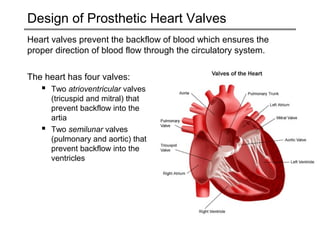
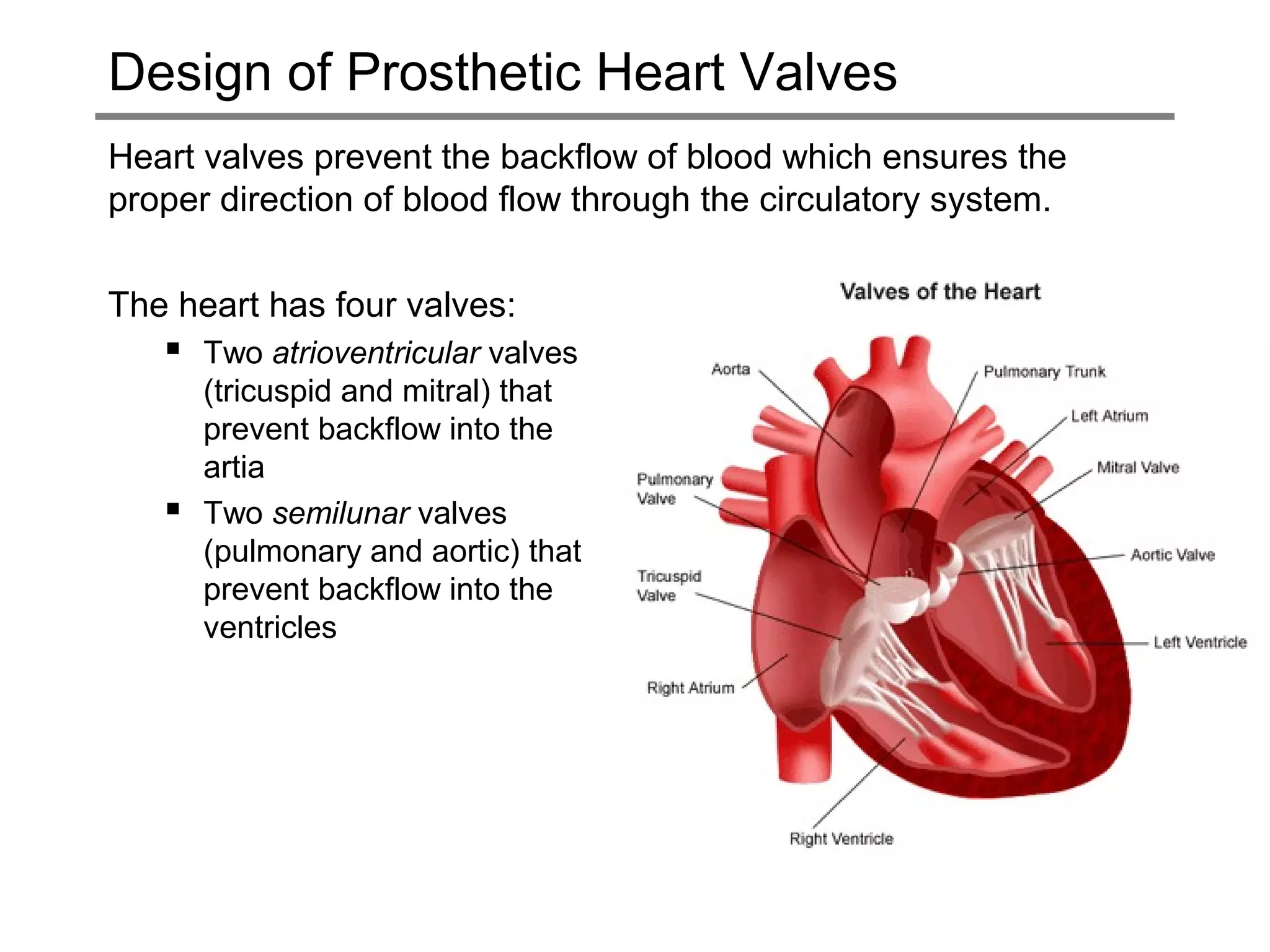
The heart has four valves: 
 Two atrioventricular valves 
(tricuspid and mitral) that 
prevent backflow into the 
artia 
 Two semilunar valves 
(pulmonary and aortic) that 
prevent backflow into the 
ventricles
Heart Valve Disease 
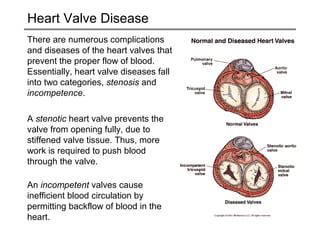
There are numerous complications 
and diseases of the heart valves that 
prevent the proper flow of blood. 
Essentially, heart valve diseases fall 
into two categories, stenosis and 
incompetence. 
A stenotic heart valve prevents the 
valve from opening fully, due to 
stiffened valve tissue. Thus, more 
work is required to push blood 
through the valve. 
An incompetent valves cause 
inefficient blood circulation by 
permitting backflow of blood in the 
heart.
Treatment Options 
On a large scale, medication is the best alternative. 
Although in some cases defective valves have to be replaced with 
a prosthetic valve in order for the patient to lead a normal life. An 
enormous amount of research and development has proven to be 
beneficial, as prosthetic heart valve technology has saved 
hundreds of thousands of lives. 
The two main prosthetic valve designs are: 
 Mechanical Heart Valves 
 Bioprosthetic Heart Valves
Evolution of Mechanical Heart Valves 
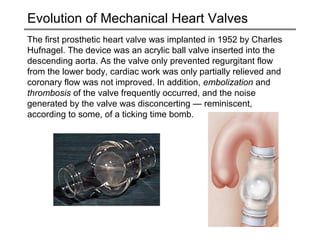
The first prosthetic heart valve was implanted in 1952 by Charles 
Hufnagel. The device was an acrylic ball valve inserted into the 
descending aorta. As the valve only prevented regurgitant flow 
from the lower body, cardiac work was only partially relieved and 
coronary flow was not improved. In addition, embolization and 
thrombosis of the valve frequently occurred, and the noise 
generated by the valve was disconcerting — reminiscent, 
according to some, of a ticking time bomb.
Evolution of Mechanical Heart Valves 
In spite of its generally poor success, others recognized the 
importance of the approach which led to the development of over 
30 different mechanical designs worldwide. 
These valves have progressed from simple caged ball valves, to 
modern bileaflet valves. Heart valves are designed to fit the 
peculiar requirements of blood flow through the specific chambers 
of the heart, with emphasis on producing more central flow and 
reducing thrombosis.
Caged-Ball Design 
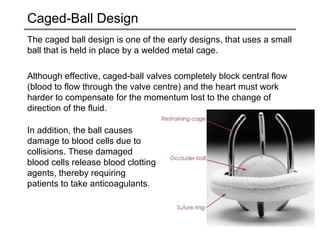
The caged ball design is one of the early designs, that uses a small 
ball that is held in place by a welded metal cage. 
Although effective, caged-ball valves completely block central flow 
(blood to flow through the valve centre) and the heart must work 
harder to compensate for the momentum lost to the change of 
direction of the fluid. 
In addition, the ball causes 
damage to blood cells due to 
collisions. These damaged 
blood cells release blood clotting 
agents, thereby requiring 
patients to take anticoagulants.
Tilting Disc Design 
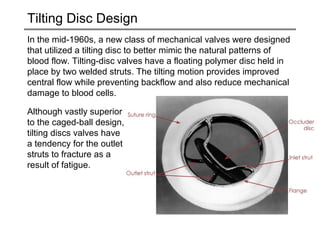
In the mid-1960s, a new class of mechanical valves were designed 
that utilized a tilting disc to better mimic the natural patterns of 
blood flow. Tilting-disc valves have a floating polymer disc held in 
place by two welded struts. The tilting motion provides improved 
central flow while preventing backflow and also reduce mechanical 
damage to blood cells. 
Although vastly superior 
to the caged-ball design, 
tilting discs valves have 
a tendency for the outlet 
struts to fracture as a 
result of fatigue.
Bileaflet Design 
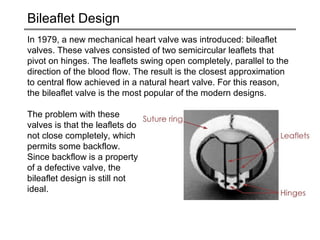
In 1979, a new mechanical heart valve was introduced: bileaflet 
valves. These valves consisted of two semicircular leaflets that 
pivot on hinges. The leaflets swing open completely, parallel to the 
direction of the blood flow. The result is the closest approximation 
to central flow achieved in a natural heart valve. For this reason, 
the bileaflet valve is the most popular of the modern designs. 
The problem with these 
valves is that the leaflets do 
not close completely, which 
permits some backflow. 
Since backflow is a property 
of a defective valve, the 
bileaflet design is still not 
ideal.
Materials 
Current designs use materials that do not induce clotting in the 
blood stream. 
Most commonly used materials include: 
 stainless steel alloys 
 molybdenum alloys 
 pyrolitic carbon for the valve housings and leaflets 
 silicone, polytetrafluoroethylene (teflon®) 
 polyester (Dacron®) for sewing rings 
A new generation of mechanical valves made of materials with 
improved blood contact properties, better wear characteristics and 
resistance to infection are currently under development.
Advantages and Disadvantages 
Advantages 
The main advantage of mechanical valves is their high durability. 
Mechanical heart valves placed in young patients can typically last for their 
lifetime 
Disadvantages 
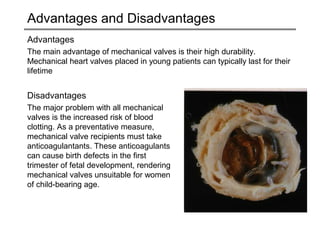
The major problem with all mechanical 
valves is the increased risk of blood 
clotting. As a preventative measure, 
mechanical valve recipients must take 
anticoagulantants. These anticoagulants 
can cause birth defects in the first 
trimester of fetal development, rendering 
mechanical valves unsuitable for women 
of child-bearing age.
Future of Mechanical Heart Valves 
To develop the next generation of mechanical heart valves, new 
age tools that are being used to improve valve design, which 
include: 
 accelerated wear testing 
 advanced blood contact property testing 
 computer assisted design and manufacturing 
 coatings to reduce the chance of infection and improve healing
Bioprosthetic Heart Valves 
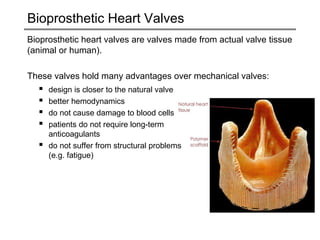
Bioprosthetic heart valves are valves made from actual valve tissue 
(animal or human). 
These valves hold many advantages over mechanical valves: 
 design is closer to the natural valve 
 better hemodynamics 
 do not cause damage to blood cells 
 patients do not require long-term 
anticoagulants 
 do not suffer from structural problems 
(e.g. fatigue)
Bioprosthetic Heart Valves 
Animal tissue valves are often referred to as xenograft valves. 
These valves are constructed from recovered heart tissue at the 
time of commercial meat processing. After fabrication, they are 
chemically crosslinked to limit degradation. 
The most commonly used animal tissues are porcine aortic valves 
(explanted valve with an attached Dacron cloth sewing skirt) and 
bovine pericardial valves (sewn leaflets from pericardial tissue with 
an attached Dacron cloth sewing skirt). Bioprosthetic valves have 
good durability and usually last for 10-15 years. 
The common cause of failure in these valves is due to tissue 
calcification. Calcification stiffens the valve tissue leading to the 
restriction of blood flow through the valve (stenosis) and/or 
generation of tears (from stress concentrations) in the valve 
leaflets.

Heart valves

  • 1.
    Design of ProstheticHeart Valves Heart valves prevent the backflow of blood which ensures the proper direction of blood flow through the circulatory system. The heart has four valves:  Two atrioventricular valves (tricuspid and mitral) that prevent backflow into the artia  Two semilunar valves (pulmonary and aortic) that prevent backflow into the ventricles
  • 2.
    Heart Valve Disease There are numerous complications and diseases of the heart valves that prevent the proper flow of blood. Essentially, heart valve diseases fall into two categories, stenosis and incompetence. A stenotic heart valve prevents the valve from opening fully, due to stiffened valve tissue. Thus, more work is required to push blood through the valve. An incompetent valves cause inefficient blood circulation by permitting backflow of blood in the heart.
  • 3.
    Treatment Options Ona large scale, medication is the best alternative. Although in some cases defective valves have to be replaced with a prosthetic valve in order for the patient to lead a normal life. An enormous amount of research and development has proven to be beneficial, as prosthetic heart valve technology has saved hundreds of thousands of lives. The two main prosthetic valve designs are:  Mechanical Heart Valves  Bioprosthetic Heart Valves
  • 4.
    Evolution of MechanicalHeart Valves The first prosthetic heart valve was implanted in 1952 by Charles Hufnagel. The device was an acrylic ball valve inserted into the descending aorta. As the valve only prevented regurgitant flow from the lower body, cardiac work was only partially relieved and coronary flow was not improved. In addition, embolization and thrombosis of the valve frequently occurred, and the noise generated by the valve was disconcerting — reminiscent, according to some, of a ticking time bomb.
  • 5.
    Evolution of MechanicalHeart Valves In spite of its generally poor success, others recognized the importance of the approach which led to the development of over 30 different mechanical designs worldwide. These valves have progressed from simple caged ball valves, to modern bileaflet valves. Heart valves are designed to fit the peculiar requirements of blood flow through the specific chambers of the heart, with emphasis on producing more central flow and reducing thrombosis.
  • 6.
    Caged-Ball Design Thecaged ball design is one of the early designs, that uses a small ball that is held in place by a welded metal cage. Although effective, caged-ball valves completely block central flow (blood to flow through the valve centre) and the heart must work harder to compensate for the momentum lost to the change of direction of the fluid. In addition, the ball causes damage to blood cells due to collisions. These damaged blood cells release blood clotting agents, thereby requiring patients to take anticoagulants.
  • 7.
    Tilting Disc Design In the mid-1960s, a new class of mechanical valves were designed that utilized a tilting disc to better mimic the natural patterns of blood flow. Tilting-disc valves have a floating polymer disc held in place by two welded struts. The tilting motion provides improved central flow while preventing backflow and also reduce mechanical damage to blood cells. Although vastly superior to the caged-ball design, tilting discs valves have a tendency for the outlet struts to fracture as a result of fatigue.
  • 8.
    Bileaflet Design In1979, a new mechanical heart valve was introduced: bileaflet valves. These valves consisted of two semicircular leaflets that pivot on hinges. The leaflets swing open completely, parallel to the direction of the blood flow. The result is the closest approximation to central flow achieved in a natural heart valve. For this reason, the bileaflet valve is the most popular of the modern designs. The problem with these valves is that the leaflets do not close completely, which permits some backflow. Since backflow is a property of a defective valve, the bileaflet design is still not ideal.
  • 9.
    Materials Current designsuse materials that do not induce clotting in the blood stream. Most commonly used materials include:  stainless steel alloys  molybdenum alloys  pyrolitic carbon for the valve housings and leaflets  silicone, polytetrafluoroethylene (teflon®)  polyester (Dacron®) for sewing rings A new generation of mechanical valves made of materials with improved blood contact properties, better wear characteristics and resistance to infection are currently under development.
  • 10.
    Advantages and Disadvantages Advantages The main advantage of mechanical valves is their high durability. Mechanical heart valves placed in young patients can typically last for their lifetime Disadvantages The major problem with all mechanical valves is the increased risk of blood clotting. As a preventative measure, mechanical valve recipients must take anticoagulantants. These anticoagulants can cause birth defects in the first trimester of fetal development, rendering mechanical valves unsuitable for women of child-bearing age.
  • 11.
    Future of MechanicalHeart Valves To develop the next generation of mechanical heart valves, new age tools that are being used to improve valve design, which include:  accelerated wear testing  advanced blood contact property testing  computer assisted design and manufacturing  coatings to reduce the chance of infection and improve healing
  • 12.
    Bioprosthetic Heart Valves Bioprosthetic heart valves are valves made from actual valve tissue (animal or human). These valves hold many advantages over mechanical valves:  design is closer to the natural valve  better hemodynamics  do not cause damage to blood cells  patients do not require long-term anticoagulants  do not suffer from structural problems (e.g. fatigue)
  • 13.
    Bioprosthetic Heart Valves Animal tissue valves are often referred to as xenograft valves. These valves are constructed from recovered heart tissue at the time of commercial meat processing. After fabrication, they are chemically crosslinked to limit degradation. The most commonly used animal tissues are porcine aortic valves (explanted valve with an attached Dacron cloth sewing skirt) and bovine pericardial valves (sewn leaflets from pericardial tissue with an attached Dacron cloth sewing skirt). Bioprosthetic valves have good durability and usually last for 10-15 years. The common cause of failure in these valves is due to tissue calcification. Calcification stiffens the valve tissue leading to the restriction of blood flow through the valve (stenosis) and/or generation of tears (from stress concentrations) in the valve leaflets.