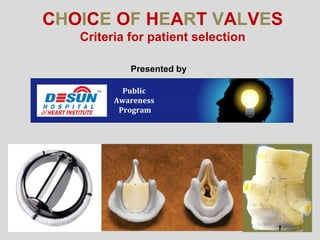

C H O I C E  O F  H E A R T  V A L V E S  Criteria for patient selection Presented by Public  Awareness  Program
Four Predictors of Performance of a valve Durability Hemodynamics Implantability Thromboresistance
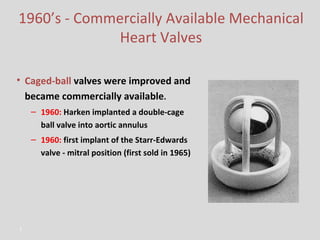
1960’s - Commercially Available Mechanical Heart Valves Caged-ball   valves were improved and became commercially available . 1960:   Harken implanted a double-cage ball valve into aortic annulus 1960:   first implant of the Starr-Edwards valve - mitral position (first sold in 1965)
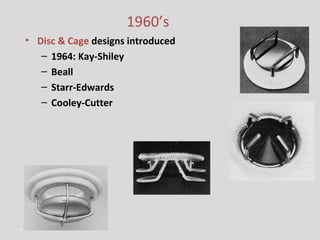
1960’s Disc & Cage  designs introduced 1964: Kay-Shiley Beall Starr-Edwards Cooley-Cutter
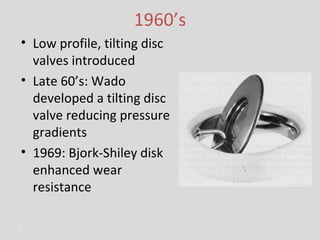
1960’s Low profile, tilting disc valves introduced Late 60’s: Wado developed a tilting disc valve reducing pressure gradients 1969: Bjork-Shiley disk enhanced wear resistance
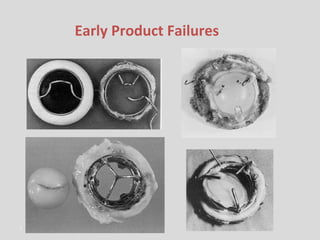
1960’s Valve replacement became widely accepted, but mortality and complication rates were high Product failures common due to:  Metal fatigue in mechanical valves. Limited thromboresistance knowledge. Biomaterials standards not established.
Early Product Failures
1977 Introduction of  the  SJM bileaflet mechanical heart valve. Largest opening angle Lowest pressure gradients Minimal turbulence and lower thrombogenicity .
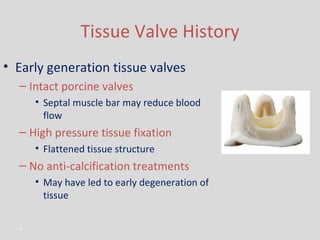
Tissue Valve History Early generation tissue valves Intact porcine valves Septal muscle bar may reduce blood flow High pressure tissue fixation Flattened tissue structure No anti-calcification treatments May have led to early degeneration of tissue
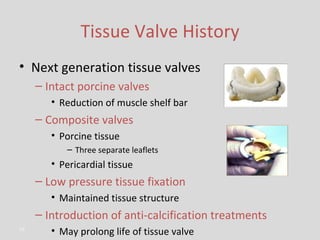
Tissue Valve History Next generation tissue valves Intact porcine valves Reduction of muscle shelf bar Composite valves Porcine tissue Three separate leaflets Pericardial tissue Low pressure tissue fixation Maintained tissue structure Introduction of anti-calcification treatments May prolong life of tissue valve
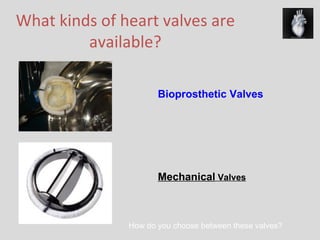
What kinds of heart valves are available? Bioprosthetic Valves Mechanical  Valves How do you choose between these valves?
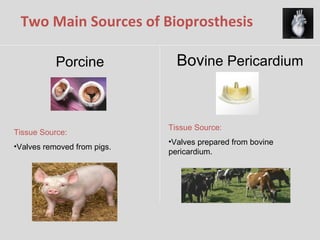
Two Main Sources of Bioprosthesis  Bov ine Pericardium Tissue Source: Valves removed from pigs. Tissue Source: Valves prepared from bovine pericardium. Porcine
What kinds of heart valves are available? Bioprosthetic Valves Valve Characteristics Gray = good Blue  = acceptable Red  = poor Non obstructive Closure is prompt Non-thrombogenic Chemically inert Noise Free Infection resistance Life of Implant Valves from human or animal tissue and sterilized for use How do you choose between these valves?
What kinds of heart valves are available? Mechanical Valves Valve Characteristics Gray = good Blue  = acceptable Red  = poor Closes quickly Durable Non-obstructive Chemically Inert Infection Resistant Noisy Non thrombogenic Valves made from Metal materials How do you choose between these valves?
Current Trends in Valve Implants Tissue valves have become more accepted in the U.S. due to concerns about quality of life and improved durability.  Mechanical valves, however, still compose a large part of valve implants, particularly in younger patients. U.S. Implant Trends Mechanical vs Tissue Valve Implants Mechanical 45% Tissue 55%
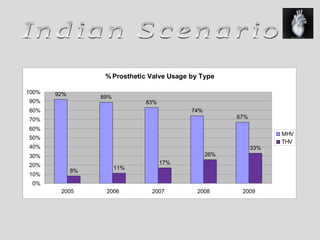
Indian Scenario
Valvular Heart Disease There are estimated 5 million patients in India suffering from Heart Valve Disease New patients added every year    50,000 Total no. of Heart Valve Surgeries performed all over India in year  2007   12,234  2009  18,587
St. Jude Medical Tissue valve usage
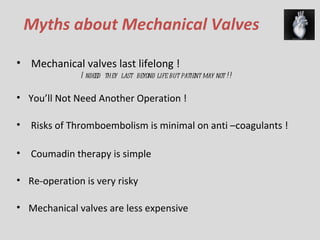
Myths about Mechanical Valves Mechanical valves last lifelong ! Indeed  they  last  beyond life but patient may not !! You’ll  Not  Need Another Operation  ! Risks of T hromboembolism is minimal on anti –coagulants ! Coumadin  therapy  is  simple  Re-operation is very risky Mechanical valves are less expensive
Mechanical   Prosthesis Cost Analysis : Anticoagulantion therapy INR Test  every 15-30 days No. of visits to Physicians Thrombolysis Treatment  of  Hemorrhage/Struck Valve Repeated Hospitalization
Cost Analysis : WARFARIN  5mg (Anticoagulant  Therapy):  Rs 150  PT / INR :  Rs 150 Professional Services: Rs 200 Misc. :  Rs 800 – Rs 1000 Total:  Rs 1,300 to Rs 1,500 per month Mechanical   Prosthesis
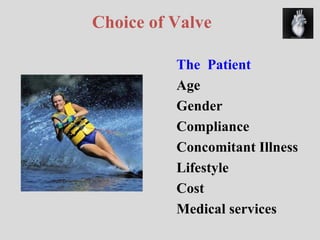
Choice of Valve The  Patient Age Gender Compliance Concomitant Illness Lifestyle Cost Medical services
Choice of Valve Indian Scenario : Rheumatic Heart Disease Children  &  Young   Males  &  Females   Rural  &  Remote   Illiteracy &  Poverty   Ignorance
Choice of Valve in Children Mechanical  Prosthesis  Advantages
BIOPROSTHESIS  Advantages  in  Young  No Anticoagulation  No Excessive Bleeding   No INR Testing  Free  Mobility, active life Noiseless   Better  Sociability
BIOPROSTHESIS  Advantages in Females  No  Anticoagulation  No  excessive  bleeding   No  embryopathy
BIOPROSTHESIS Advantages in Middle Age No Anticoagulation No Dietary Modifications No  Lifestyle Modification
BIOPROSTHESIS Advantages in the Elderly  No anticoagulation No Thromboembolic episodes Anticoagulation associated bleeding No regular follow up No PT/INR testing
Life with a Bioprosthetic Valve Safer No sudden emergency events Less hassles of anticoagulation Elective “Re-do” surgery Better Quality of life, socially acceptable
If I Need A Valve Surgery VALVE REPAIR Follow Up Leave it to the   Cardiologist
If Valve Needs to be Replaced TISSUE VALVE ( Young female, old life exp<20 yrs) No major Follow Up Re do after 10-15 yrs
If tissue valve cannot be used MECHANICAL VALVE ( young patient, poor, not ready for re op) Regular Follow Up Required Compromised lifestyle Lifetime anticoagulation required
Decisions to make Is Lifestyle Important?
Thank You!

Choices in Valve Replacement - Desun Hospital Health Insights

  • 1.
    C H OI C E O F H E A R T V A L V E S Criteria for patient selection Presented by Public Awareness Program
  • 2.
    Four Predictors ofPerformance of a valve Durability Hemodynamics Implantability Thromboresistance
  • 3.
    1960’s - CommerciallyAvailable Mechanical Heart Valves Caged-ball valves were improved and became commercially available . 1960: Harken implanted a double-cage ball valve into aortic annulus 1960: first implant of the Starr-Edwards valve - mitral position (first sold in 1965)
  • 4.
    1960’s Disc &Cage designs introduced 1964: Kay-Shiley Beall Starr-Edwards Cooley-Cutter
  • 5.
    1960’s Low profile,tilting disc valves introduced Late 60’s: Wado developed a tilting disc valve reducing pressure gradients 1969: Bjork-Shiley disk enhanced wear resistance
  • 6.
    1960’s Valve replacementbecame widely accepted, but mortality and complication rates were high Product failures common due to: Metal fatigue in mechanical valves. Limited thromboresistance knowledge. Biomaterials standards not established.
  • 7.
  • 8.
    1977 Introduction of the SJM bileaflet mechanical heart valve. Largest opening angle Lowest pressure gradients Minimal turbulence and lower thrombogenicity .
  • 9.
    Tissue Valve HistoryEarly generation tissue valves Intact porcine valves Septal muscle bar may reduce blood flow High pressure tissue fixation Flattened tissue structure No anti-calcification treatments May have led to early degeneration of tissue
  • 10.
    Tissue Valve HistoryNext generation tissue valves Intact porcine valves Reduction of muscle shelf bar Composite valves Porcine tissue Three separate leaflets Pericardial tissue Low pressure tissue fixation Maintained tissue structure Introduction of anti-calcification treatments May prolong life of tissue valve
  • 11.
    What kinds ofheart valves are available? Bioprosthetic Valves Mechanical Valves How do you choose between these valves?
  • 12.
    Two Main Sourcesof Bioprosthesis Bov ine Pericardium Tissue Source: Valves removed from pigs. Tissue Source: Valves prepared from bovine pericardium. Porcine
  • 13.
    What kinds ofheart valves are available? Bioprosthetic Valves Valve Characteristics Gray = good Blue = acceptable Red = poor Non obstructive Closure is prompt Non-thrombogenic Chemically inert Noise Free Infection resistance Life of Implant Valves from human or animal tissue and sterilized for use How do you choose between these valves?
  • 14.
    What kinds ofheart valves are available? Mechanical Valves Valve Characteristics Gray = good Blue = acceptable Red = poor Closes quickly Durable Non-obstructive Chemically Inert Infection Resistant Noisy Non thrombogenic Valves made from Metal materials How do you choose between these valves?
  • 15.
    Current Trends inValve Implants Tissue valves have become more accepted in the U.S. due to concerns about quality of life and improved durability. Mechanical valves, however, still compose a large part of valve implants, particularly in younger patients. U.S. Implant Trends Mechanical vs Tissue Valve Implants Mechanical 45% Tissue 55%
  • 16.
  • 17.
    Valvular Heart DiseaseThere are estimated 5 million patients in India suffering from Heart Valve Disease New patients added every year 50,000 Total no. of Heart Valve Surgeries performed all over India in year 2007 12,234 2009 18,587
  • 18.
    St. Jude MedicalTissue valve usage
  • 19.
    Myths about MechanicalValves Mechanical valves last lifelong ! Indeed they last beyond life but patient may not !! You’ll Not Need Another Operation ! Risks of T hromboembolism is minimal on anti –coagulants ! Coumadin therapy is simple Re-operation is very risky Mechanical valves are less expensive
  • 20.
    Mechanical Prosthesis Cost Analysis : Anticoagulantion therapy INR Test every 15-30 days No. of visits to Physicians Thrombolysis Treatment of Hemorrhage/Struck Valve Repeated Hospitalization
  • 21.
    Cost Analysis :WARFARIN 5mg (Anticoagulant Therapy): Rs 150 PT / INR : Rs 150 Professional Services: Rs 200 Misc. : Rs 800 – Rs 1000 Total: Rs 1,300 to Rs 1,500 per month Mechanical Prosthesis
  • 22.
    Choice of ValveThe Patient Age Gender Compliance Concomitant Illness Lifestyle Cost Medical services
  • 23.
    Choice of ValveIndian Scenario : Rheumatic Heart Disease Children & Young Males & Females Rural & Remote Illiteracy & Poverty Ignorance
  • 24.
    Choice of Valvein Children Mechanical Prosthesis Advantages
  • 25.
    BIOPROSTHESIS Advantages in Young No Anticoagulation No Excessive Bleeding No INR Testing Free Mobility, active life Noiseless Better Sociability
  • 26.
    BIOPROSTHESIS Advantagesin Females No Anticoagulation No excessive bleeding No embryopathy
  • 27.
    BIOPROSTHESIS Advantages inMiddle Age No Anticoagulation No Dietary Modifications No Lifestyle Modification
  • 28.
    BIOPROSTHESIS Advantages inthe Elderly No anticoagulation No Thromboembolic episodes Anticoagulation associated bleeding No regular follow up No PT/INR testing
  • 29.
    Life with aBioprosthetic Valve Safer No sudden emergency events Less hassles of anticoagulation Elective “Re-do” surgery Better Quality of life, socially acceptable
  • 30.
    If I NeedA Valve Surgery VALVE REPAIR Follow Up Leave it to the Cardiologist
  • 31.
    If Valve Needsto be Replaced TISSUE VALVE ( Young female, old life exp<20 yrs) No major Follow Up Re do after 10-15 yrs
  • 32.
    If tissue valvecannot be used MECHANICAL VALVE ( young patient, poor, not ready for re op) Regular Follow Up Required Compromised lifestyle Lifetime anticoagulation required
  • 33.
    Decisions to makeIs Lifestyle Important?
  • 34.

Editor's Notes

  • #4 Dwight Harken began the modern era of prosthetic valve replacement by insertion of his double cage-ball valve into the aortic orifice below the coronary ostia following excision of the diseased cusps. Some of his patients were still alive after 20 years. Albert Starr, a physician, and Lowell Edwards, an electrical engineer, simplified the caged-ball valve by using a single titanium cage, a silastic ball, and a sewing ring covered with teflon. The Starr-Edwards valve was first implanted in the mitral position in 1960, and leter in the aortic position. It became commercially available in 1965. The sewing ring made it easy to suture silastic ball had a tendency to absorb liquid and become deformed, sometimes jamming central flow obstruction cause high pressure gradients, especially in patients with a narrow aortic root
  • #5 Jerome Kay, a surgeon, and Donald Shiley, and engineer, introduced a low-profile disc valve for use in the mitral position. Some surgeons used it in the aortic position too, because, unlike the caged-ball valve, the disc did not extend into the supravalvular ridge; high valvular gradients were still present; valve was subject to wear and thrombosis Other sliding disc configurations were also developed
  • #6 Juro Wado (Japan) developed a tilting disc valve with teflon hinges and an opening angle of 80 degrees; the tilting disc brought down pressure gradients; the teflon hinges wore out Shiley and Dr. Viking Bjork developed a hingeless low-profile tilting disc valve made of Delrin, and designed with an opening angle of 60 degrees. The Bjork-Shiley disk was used successfully in the aortic and mitral position.
  • #8 Examples of failed valves: - crack in the silastic rubber ball - thrombus on the valve housing - wear on the post’s fabric covering - strut failure of a Bjork-Shiley valve (valve model was recalled, then redesigned as a monostrut to avoid this problem) NOTE: patient with this valve survived the failure