z
SUBMITTED BY ,
JYOTIRMAYEE BADRA
ZOOLOGY DEPARTMENT
UG 6th SEMESTER
ROLL NO :59R0020009
GUIDED BY,
PRAKASH CHANDRA PARICHHA
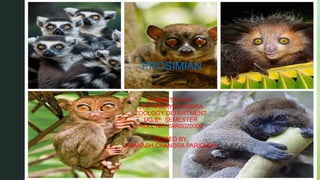
PROSIMIAN
z
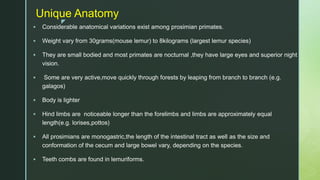
INTRODUCTION
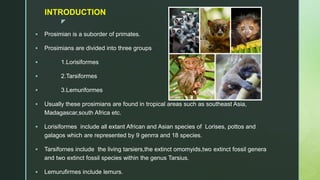
 Prosimian is a suborder of primates.
 Prosimians are divided into three groups
 1.Lorisiformes
 2.Tarsiformes
 3.Lemuriformes
 Usually these prosimians are found in tropical areas such as southeast Asia,
Madagascar,south Africa etc.
 Lorisiformes include all extant African and Asian species of Lorises, pottos and
galagos which are represented by 9 genrra and 18 species.
 Tarsifornes include the living tarsiers,the extinct omomyids,two extinct fossil genera
and two extinct fossil species within the genus Tarsius.
 Lemurufirmes include lemurs.
z
Unique Anatomy
 Considerable anatomical variations exist among prosimian primates.
 Weight vary from 30grams(mouse lemur) to 8kilograms (largest lemur species)
 They are small bodied and most primates are nocturnal ,they have large eyes and superior night
vision.
 Some are very active,move quickly through forests by leaping from branch to branch (e.g.
galagos)
 Body is lighter
 Hind limbs are noticeable longer than the forelimbs and limbs are approximately equal
length(e.g. lorises,pottos)
 All prosimians are monogastric,the length of the intestinal tract as well as the size and
conformation of the cecum and large bowel vary, depending on the species.
 Teeth combs are found in lemuriforms.
z
Special housing requirements:-
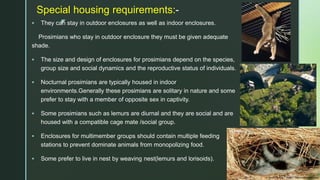
 They can stay in outdoor enclosures as well as indoor enclosures.
Prosimians who stay in outdoor enclosure they must be given adequate
shade.
 The size and design of enclosures for prosimians depend on the species,
group size and social dynamics and the reproductive status of individuals.
 Nocturnal prosimians are typically housed in indoor
environments.Generally these prosimians are solitary in nature and some
prefer to stay with a member of opposite sex in captivity.
 Some prosimians such as lemurs are diurnal and they are social and are
housed with a compatible cage mate /social group.
 Enclosures for multimember groups should contain multiple feeding
stations to prevent dominate animals from monopolizing food.
 Some prefer to live in nest by weaving nest(lemurs and lorisoids).
z
Special physiology
 They have low basal metabolic rate as compare to other mammals.
 Behaviours such as basking and huddling are related to energy conservation and thermal
regulation.
 Prosimians have no active mechanism for cooling, and temperature regulation is accomplished by
limiting activity, seeking cool locations during hot weather, licking hands to generate evaporative
cooling.
Feeding:-
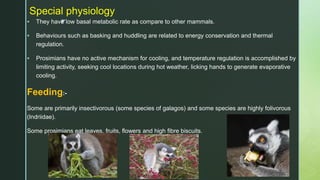
Some are primarily insectivorous (some species of galagos) and some species are highly folivorous
(Indriidae).
Some prosimians eat leaves, fruits, flowers and high fibre biscuits.
B b
z
Characteristics of Prosimian:-
 Although the group “prosimian” is vast and it has different kinds of species,they do share
some common characteristics,such as
 Active times(most species are nocturnal in nature , exception is galagos which is diurnal)
 Brain (Small brains and brains are dedicated to smell rather than eyesight.)
 Biological risk to humans( these are least acquainted to human beings)
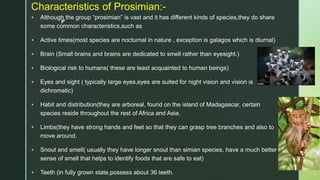
 Eyes and sight ( typically large eyes,eyes are suited for night vision and vision is
dichromatic)
 Habit and distribution(they are arboreal, found on the island of Madagascar, certain
species reside throughout the rest of Africa and Asia.
 Limbs(they have strong hands and feet so that they can grasp tree branches and also to
move around.
 Snout and smell( usually they have longer snout than simian species, have a much better
sense of smell that helps to identify foods that are safe to eat)
 Teeth (in fully grown state,possess about 36 teeth.
z
 Extinct prosimian families
 Adapidae
 Archeolemuridae.
 Archicebidae.
 Notharctidae.
.
 Megaladapidae.
 Ekmowechashalidae
 Omomyidae
 Living prosimian families
 Cheirogaleidae
 Indriidae
 Lemuridae
 Lepilemuridae
 Tarsidae
 Lorisidae
 Galagidae
 Daubentonidae
z
A catalogue of the prosimians
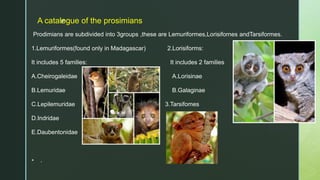
Prodimians are subdivided into 3groups ,these are Lemuriformes,Lorisifornes andTarsiformes.
1.Lemuriformes(found only in Madagascar) 2.Lorisiforms:
It includes 5 families: It includes 2 families
A.Cheirogaleidae A.Lorisinae
B.Lemuridae B.Galaginae
C.Lepilemuridae 3.Tarsifomes
D.Indridae
E.Daubentonidae
 .

Prosimian.pptx

  • 1.
    z SUBMITTED BY , JYOTIRMAYEEBADRA ZOOLOGY DEPARTMENT UG 6th SEMESTER ROLL NO :59R0020009 GUIDED BY, PRAKASH CHANDRA PARICHHA PROSIMIAN
  • 2.
    z INTRODUCTION  Prosimian isa suborder of primates.  Prosimians are divided into three groups  1.Lorisiformes  2.Tarsiformes  3.Lemuriformes  Usually these prosimians are found in tropical areas such as southeast Asia, Madagascar,south Africa etc.  Lorisiformes include all extant African and Asian species of Lorises, pottos and galagos which are represented by 9 genrra and 18 species.  Tarsifornes include the living tarsiers,the extinct omomyids,two extinct fossil genera and two extinct fossil species within the genus Tarsius.  Lemurufirmes include lemurs.
  • 3.
    z Unique Anatomy  Considerableanatomical variations exist among prosimian primates.  Weight vary from 30grams(mouse lemur) to 8kilograms (largest lemur species)  They are small bodied and most primates are nocturnal ,they have large eyes and superior night vision.  Some are very active,move quickly through forests by leaping from branch to branch (e.g. galagos)  Body is lighter  Hind limbs are noticeable longer than the forelimbs and limbs are approximately equal length(e.g. lorises,pottos)  All prosimians are monogastric,the length of the intestinal tract as well as the size and conformation of the cecum and large bowel vary, depending on the species.  Teeth combs are found in lemuriforms.
  • 4.
    z Special housing requirements:- They can stay in outdoor enclosures as well as indoor enclosures. Prosimians who stay in outdoor enclosure they must be given adequate shade.  The size and design of enclosures for prosimians depend on the species, group size and social dynamics and the reproductive status of individuals.  Nocturnal prosimians are typically housed in indoor environments.Generally these prosimians are solitary in nature and some prefer to stay with a member of opposite sex in captivity.  Some prosimians such as lemurs are diurnal and they are social and are housed with a compatible cage mate /social group.  Enclosures for multimember groups should contain multiple feeding stations to prevent dominate animals from monopolizing food.  Some prefer to live in nest by weaving nest(lemurs and lorisoids).
  • 5.
    z Special physiology  Theyhave low basal metabolic rate as compare to other mammals.  Behaviours such as basking and huddling are related to energy conservation and thermal regulation.  Prosimians have no active mechanism for cooling, and temperature regulation is accomplished by limiting activity, seeking cool locations during hot weather, licking hands to generate evaporative cooling. Feeding:- Some are primarily insectivorous (some species of galagos) and some species are highly folivorous (Indriidae). Some prosimians eat leaves, fruits, flowers and high fibre biscuits. B b
  • 6.
    z Characteristics of Prosimian:- Although the group “prosimian” is vast and it has different kinds of species,they do share some common characteristics,such as  Active times(most species are nocturnal in nature , exception is galagos which is diurnal)  Brain (Small brains and brains are dedicated to smell rather than eyesight.)  Biological risk to humans( these are least acquainted to human beings)  Eyes and sight ( typically large eyes,eyes are suited for night vision and vision is dichromatic)  Habit and distribution(they are arboreal, found on the island of Madagascar, certain species reside throughout the rest of Africa and Asia.  Limbs(they have strong hands and feet so that they can grasp tree branches and also to move around.  Snout and smell( usually they have longer snout than simian species, have a much better sense of smell that helps to identify foods that are safe to eat)  Teeth (in fully grown state,possess about 36 teeth.
  • 7.
    z  Extinct prosimianfamilies  Adapidae  Archeolemuridae.  Archicebidae.  Notharctidae. .  Megaladapidae.  Ekmowechashalidae  Omomyidae  Living prosimian families  Cheirogaleidae  Indriidae  Lemuridae  Lepilemuridae  Tarsidae  Lorisidae  Galagidae  Daubentonidae
  • 8.
    z A catalogue ofthe prosimians Prodimians are subdivided into 3groups ,these are Lemuriformes,Lorisifornes andTarsiformes. 1.Lemuriformes(found only in Madagascar) 2.Lorisiforms: It includes 5 families: It includes 2 families A.Cheirogaleidae A.Lorisinae B.Lemuridae B.Galaginae C.Lepilemuridae 3.Tarsifomes D.Indridae E.Daubentonidae  .