Save The Sparrow
by Shambhavi
Sonakiya
Sparrows
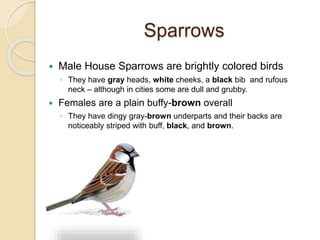
 Male House Sparrows are brightly colored birds
◦ They have gray heads, white cheeks, a black bib and rufous
neck – although in cities some are dull and grubby.
 Females are a plain buffy-brown overall
◦ They have dingy gray-brown underparts and their backs are
noticeably striped with buff, black, and brown.
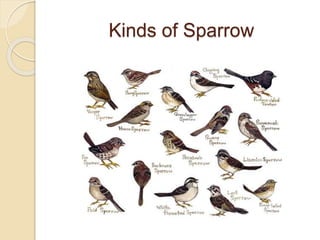
Kinds of Sparrow
Sparrows : Facts
 Sparrows never make their houses on
trees.
 House sparrows have lived alongside
humans since the Stone Age.
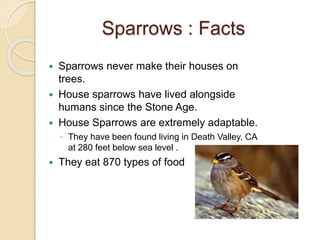
 House Sparrows are extremely adaptable.
◦ They have been found living in Death Valley, CA
at 280 feet below sea level .
 They eat 870 types of food
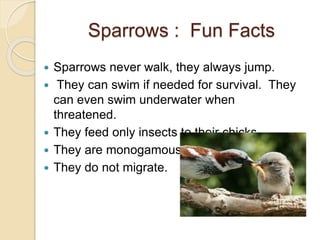
Sparrows : Fun Facts
 Sparrows never walk, they always jump.
 They can swim if needed for survival. They
can even swim underwater when
threatened.
 They feed only insects to their chicks.
 They are monogamous.
 They do not migrate.
Decline of Sparrows
 Ornithologists have observed a sharp decline in
number of sparrows across the world
Why?
 Architecture changes
 The traditional architecture allowed sparrows to make their nests in
a holes, roofs, crevices of old houses. But modern architecture
which introduced box – styled flats have no provision for sparrows to
nest and lay eggs.
 Groceries to Supermarkets
 Few years back, grains were sold in grocery stores . The grains spilt
from gunny bags were a major source of feeding omnivorous birds
like sparrows. The grains were dried in huge quantities out in the
open, which gave the birds their share of the introduction of grains.
But now the scenario is different because of Food Bazar and
packaged food.
Why?
 Mobile Radiations
 Studies have warned about the effects of these mobile radiations on
reproduction and fertility of eggs. Animals navigate by the Earth's
magnetic fields and these waves can disturb a bird's ability to find
their way around.
 Unleaded Petrol and Insectcides
 The extensive use of pesticides and insecticides in our farms and
gardens have created a scarcity of insects. The unleaded fuel,
believed to be eco-friendly, has harmful byproducts as ituses
Methyl Tertiary Butyl Ether (MTBE) as an anti-knocking agent. By
mixing with the byproducts of combustion, this kills small insects on
which sparrows feed.
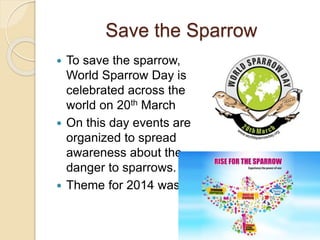
Save the Sparrow
 To save the sparrow,
World Sparrow Day is
celebrated across the
world on 20th March
 On this day events are
organized to spread
awareness about the
danger to sparrows.
 Theme for 2014 was
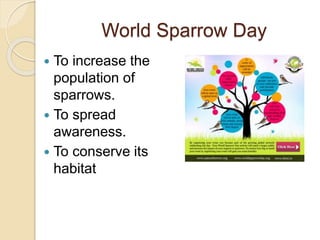
World Sparrow Day
 To increase the
population of
sparrows.
 To spread
awareness.
 To conserve its
habitat
What can we do
 We can make bird feeder
and put it outside the house.
 We can put water in a dish
and put near the bird feeder.
 We could spread awareness
by sending messages.
 We can organize events for
this in school.
Sparrows

Sparrows

  • 1.
    Save The Sparrow byShambhavi Sonakiya
  • 2.
    Sparrows  Male HouseSparrows are brightly colored birds ◦ They have gray heads, white cheeks, a black bib and rufous neck – although in cities some are dull and grubby.  Females are a plain buffy-brown overall ◦ They have dingy gray-brown underparts and their backs are noticeably striped with buff, black, and brown.
  • 3.
  • 4.
    Sparrows : Facts Sparrows never make their houses on trees.  House sparrows have lived alongside humans since the Stone Age.  House Sparrows are extremely adaptable. ◦ They have been found living in Death Valley, CA at 280 feet below sea level .  They eat 870 types of food
  • 5.
    Sparrows : FunFacts  Sparrows never walk, they always jump.  They can swim if needed for survival. They can even swim underwater when threatened.  They feed only insects to their chicks.  They are monogamous.  They do not migrate.
  • 6.
    Decline of Sparrows Ornithologists have observed a sharp decline in number of sparrows across the world
  • 7.
    Why?  Architecture changes The traditional architecture allowed sparrows to make their nests in a holes, roofs, crevices of old houses. But modern architecture which introduced box – styled flats have no provision for sparrows to nest and lay eggs.  Groceries to Supermarkets  Few years back, grains were sold in grocery stores . The grains spilt from gunny bags were a major source of feeding omnivorous birds like sparrows. The grains were dried in huge quantities out in the open, which gave the birds their share of the introduction of grains. But now the scenario is different because of Food Bazar and packaged food.
  • 8.
    Why?  Mobile Radiations Studies have warned about the effects of these mobile radiations on reproduction and fertility of eggs. Animals navigate by the Earth's magnetic fields and these waves can disturb a bird's ability to find their way around.  Unleaded Petrol and Insectcides  The extensive use of pesticides and insecticides in our farms and gardens have created a scarcity of insects. The unleaded fuel, believed to be eco-friendly, has harmful byproducts as ituses Methyl Tertiary Butyl Ether (MTBE) as an anti-knocking agent. By mixing with the byproducts of combustion, this kills small insects on which sparrows feed.
  • 9.
    Save the Sparrow To save the sparrow, World Sparrow Day is celebrated across the world on 20th March  On this day events are organized to spread awareness about the danger to sparrows.  Theme for 2014 was
  • 10.
    World Sparrow Day To increase the population of sparrows.  To spread awareness.  To conserve its habitat
  • 11.
    What can wedo  We can make bird feeder and put it outside the house.  We can put water in a dish and put near the bird feeder.  We could spread awareness by sending messages.  We can organize events for this in school.