ALCOHOL
METABOLISM
PRESNENTED BY KAWALYA STEVEN BPHARM
VICTORIA UNIVERSITY KAMPALA
 Alcohol (ethanol or ethyl alcohol) is readily absorbed by the stomach & intestine.
 Only 1% of the alcohol consumed is excreted through lungs, urine & sweat.
 It is oxidized by two pathways; oxidative pathway in the liver and non-oxidative
pathway in extra-hepatic tissues
 Major fraction of the alcohol is oxidized in liver first steps on the Endoplasmic
reticulum.
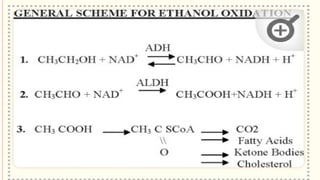
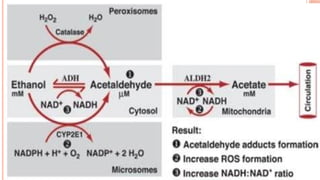
 Alcohol gets oxidized in the liver by cystolic alcohol dehydrogenase to
acetaldehyde.
ALCOHOL DEHYDROGENASE
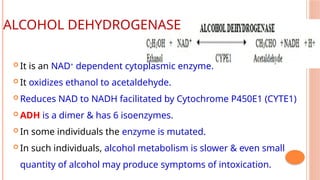
 It is an NAD+
dependent cytoplasmic enzyme.
 It oxidizes ethanol to acetaldehyde.
 Reduces NAD to NADH facilitated by Cytochrome P450E1 (CYTE1)
 ADH is a dimer & has 6 isoenzymes.
 In some individuals the enzyme is mutated.
 In such individuals, alcohol metabolism is slower & even small
quantity of alcohol may produce symptoms of intoxication.
ALDEHYDE DEHYDROGENASE (ALDH)
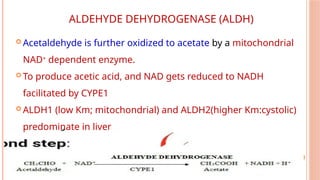
 Acetaldehyde is further oxidized to acetate by a mitochondrial
NAD+
dependent enzyme.
 To produce acetic acid, and NAD gets reduced to NADH
facilitated by CYPE1
 ALDH1 (low Km; mitochondrial) and ALDH2(higher Km:cystolic)
predominate in liver
 Acetate produced can leave the liver for its metabolism
 in extra hepatic tissues such as skeletal muscle and
 spontaneously broken down to CO2 and H2O
 In liver
 The acetate is then converted to acetyl CoA.
 Note; The activity of ADH (low km) is more than aldehyde dehydrogenase
(*ALDH).
 Acetaldehyde accumulates more in liver than rate at which its consumed.
 Aldehyde is toxic, excess may lead to cell death.
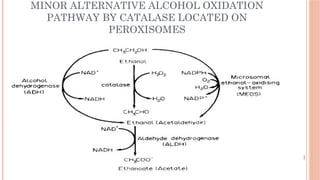
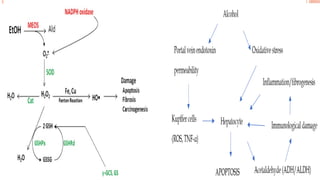
MICROSOMAL ETHANOL OXIDIZING SYSTEM (MEOS)
 Alternative mechanism of detoxification of alcohol.
 It is cytochrome P450 dependent & is inducible.
 It is activated in excess alcohol consumption
 Ethanol can be oxidized in liver microsomes to acetaldehyde by a
mixed function oxidase.
 The electron donors are ethanol & NADPH by which O2 is
reduced to water.
 MEOS is part of the superfamily of cytochrome P450, all of
which catalyze similar reactions.
 About 10 gene families & 100 different cytochrome P450
molecules are available.
 The isoenzyme with highest activity towards ethanol is
designated CYP2E1 (2 refers to the gene family, E refers to the
subfamily & 1 refers to the particular enzyme).
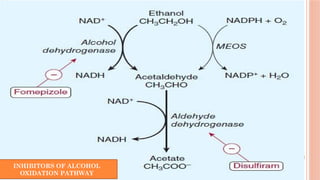
INHIBITORS OF ALCOHOL
OXIDATION PATHWAY
ALDEHYDE DEHYDROGENASE DEFFICIENCY
 Chinese and Japanese 50% individuals unable to produce ALDH1
 These individual can only tolerate significantly negligible levels of acetaldehyde in
blood (up to 35 micromol/L).
 When levels accumulate highly on alcohol consumption, a (familiar) flushing
response is observed including;
 Vasodilatation leading to flushing, a marked increase in heart rate, difficulty in
breathing, chocking sensations and general muscle weakness
 Thou it doesn’t affect overall alcohol elimination
 Disulphiram acts as an irreversible inhibitor of ALDH; interacts with one of
cystein residues in the active site. On ethanol consumption, .Acetaldehyde raises
again
MINOR ALTERNATIVE ALCOHOL OXIDATION
PATHWAY BY CATALASE LOCATED ON
PEROXISOMES
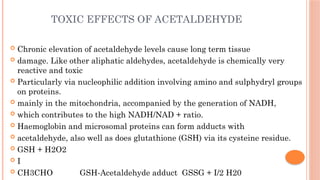
TOXIC EFFECTS OF ACETALDEHYDE
 Chronic elevation of acetaldehyde levels cause long term tissue
 damage. Like other aliphatic aldehydes, acetaldehyde is chemically very
reactive and toxic
 Particularly via nucleophilic addition involving amino and sulphydryl groups
on proteins.
 mainly in the mitochondria, accompanied by the generation of NADH,
 which contributes to the high NADH/NAD + ratio.
 Haemoglobin and microsomal proteins can form adducts with
 acetaldehyde, also well as does glutathione (GSH) via its cysteine residue.
 GSH + H2O2
 I
 CH3CHO GSH-Acetaldehyde adduct GSSG + I/2 H20
CONTN
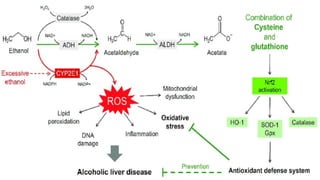
 Alcohol metabolism by CYP2E1 produces highly reactive ROS including 4-
hydroxy-nonenal HNE, H2O2, hydroxyethyl, superoxide anions and
hydroxyl radicals
 This may lead to increased liver peroxide levels and to the peroxidation of
lipids which has been suggested as a cause of fat accumulation in the liver.
 The swollen liver mitochondria of chronic alcoholics appear particularly
susceptible to the effects of acetaldehyde, which depresses the activity of
enzymes involved in fatty acid oxidation and acetaldehyde breakdown itself.
SOME OF THE TOXIC EFFECTS OF ACETALDEHYDE
 (1) Inhibition of protein synthesis
 (2) Protein-acetaldehyde adduct formation with:
 Haemoglobin
 Erythrocyte membrane proteins
 Microsomal proteins
 DNA bases
 Phospholipids
 Pyruvate (~ acetoin)
 (3) Effects on the cytoskeleton
 Changes in polymerisation of tubulin leads to disruption of microtubules,
 decreased protein secretion from liver (albumin; tubulin)
 Spindle disruption leads to impaired cell division (eg in bone marrow)
 (4) Promotion of radical-mediated reactions
 (5) Inhibition of glycoprotein and testicular steroid synthesis
 (6) Inhibition of pyridoxal 5-phosphate metabolism
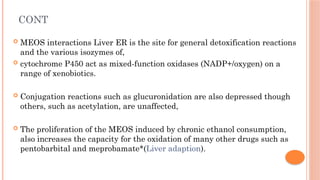
 MEOS interactions Liver ER is the site for general detoxification reactions and the vari
 (6) Inhibition of pyridoxal 5-phosphate metabolism
CONT
 MEOS interactions Liver ER is the site for general detoxification reactions
and the various isozymes of,
 cytochrome P450 act as mixed-function oxidases (NADP+/oxygen) on a
range of xenobiotics.
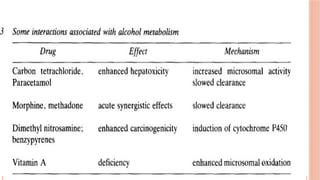
 Conjugation reactions such as glucuronidation are also depressed though
others, such as acetylation, are unaffected,
 The proliferation of the MEOS induced by chronic ethanol consumption,
also increases the capacity for the oxidation of many other drugs such as
pentobarbital and meprobamate*(Liver adaption).
ABSORPTION AND KINETICS OF ALCOHOL
ELIMINATION
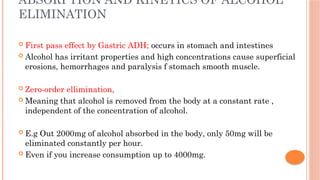
 First pass effect by Gastric ADH; occurs in stomach and intestines
 Alcohol has irritant properties and high concentrations cause superficial
erosions, hemorrhages and paralysis f stomach smooth muscle.
 Zero-order ellimination,
 Meaning that alcohol is removed from the body at a constant rate ,
independent of the concentration of alcohol.
 E.g Out 2000mg of alcohol absorbed in the body, only 50mg will be
eliminated constantly per hour.
 Even if you increase consumption up to 4000mg.
BIOCHEMICAL ALTERATIONS IN ALCOHOLISM
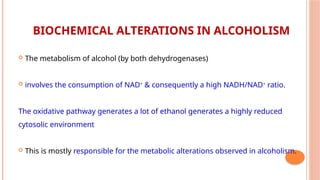
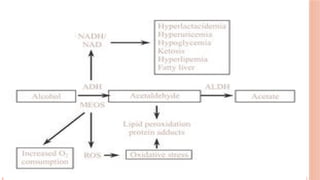
 The metabolism of alcohol (by both dehydrogenases)
 involves the consumption of NAD+
& consequently a high NADH/NAD+
ratio.
The oxidative pathway generates a lot of ethanol generates a highly reduced
cytosolic environment
 This is mostly responsible for the metabolic alterations observed in alcoholism.
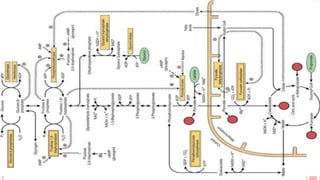
ALCOHOL AND GLUCONEOGENESIS
 Elevated NADH, inhibits key regulatory enzymes in gluconeogenesis,
 hence blocks formation and release of glucose from liver
 Hypoglycemia:
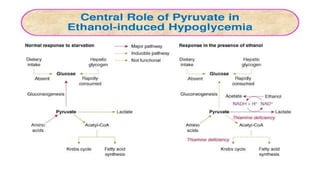
 NADH inhibits the conversion of; lactate to pyruvate by LDH and Malate
to oxaloacetate by MDH,
 Deficiency of pyruvate leads to inadequate conversion of malate to
formation of oxaloacetate for gluconeogenesis
 This is exacerbated by poor diet and depleted glycogen levels in alcoholics
 This results in depression of gluconeogenesis, leading to hypoglycemia
ALCOHOL AND HYPOGLYCEAMIA, TRIGGERED
BY INSULIN
 Hypoglycemia: BG < 50mg/dl or 2.8mmol/L
 Alcohol pancreatic microcirculation evokes massive redistribution of
pancreatic blood flow from exocrine into endocrine (insulin producing),
 These are mediated by vagus nerve by NO as second messenger
 This causes augmenting of the late phase of insulin secretion leading to
hypoglyceamia.
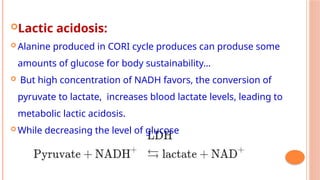
Lactic acidosis:
 Alanine produced in CORI cycle produces can produse some
amounts of glucose for body sustainability…
 But high concentration of NADH favors, the conversion of
pyruvate to lactate, increases blood lactate levels, leading to
metabolic lactic acidosis.
 While decreasing the level of glucose
ALCOHOL INDUCED HYPOGLYCEMIA AND
KETOSIS
 Lypolitic and ketogenic path ways help to maintain glucose levels
via gluconeogenesis, due to prolonged fasting and excess alcohol
 Ethanol cause structural abnormalities in mitochondria leading to
ketosis
 Conclusion;
 Inhibition of gluconeogenesis by ethanol and alcoholic ketosis is
due to increased NADH formed during in alcohol oxidation that
favors accumulation of beta hydroxyl butyrate
 FATTY ACID SYNTHESIS
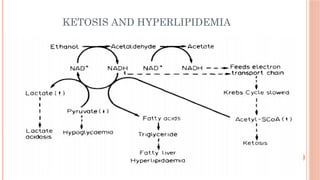
 Reduced oxaloacetate, decreased pyruvate & high NADH, causes suppression of TCA cycle.
 Acetyl CoA from alcohol oxidation is accumulated, which favors ketogenesis.
 Increased level of acetyl CoA and NADH favor an increased fatty acid synthesis and
triglycerides *(both dietary FA uptake and de novo); but fatty acids are not beta oxidized,
due to impaired mitochondrial deformities.
 Fat Acids accumulate in hepatocytes, resulting in fatty liver syndrome.
 Liver reacts by increasing protein synthesis and exporting lipids as very low density
liporoteins, resulting in elevated blood lipid levels- hyperlipidemia
KETOSIS AND HYPERLIPIDEMIA
 Chronic Alcohol consumption corrodes Thiamine transporters on intestines.
 Thiamine coenzyme becomes deficient which is necessary for transketolation pathway by
converting excess Ribose-5-phosphate (a purines precursor), back to Fructose 6 phosphate.
 Inhibition of this pathway leads to elevation in purines excreted as uric acid
 Increased concentration of serum uric acid due to its reduced excretion is observed in alcoholism.
 This is accompaned with lactic acidosis.
 Alcohol causes CNS depression by inhibiting excitatory receptors (N-methyl aspartate receptors)
& by potentiating inhibitory neurotransmitter (GABA) receptors.
EFFECTS OF CHRONIC ALCOHOLISM
 Alcoholism and liver:
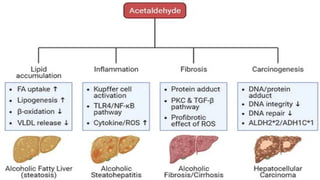
 Accumulation of fat in liver cells leading to fatty liver.
 Accumulated toxic effect of acetaldehyde leads to cellular
death & replacement by fibrous tissue.
 Fibrosis of liver is called Cirrhosis.
 When liver functions are reduced hepatic coma results.
CONSEQUENCE OF ALCOHOL OXIDATION BY
MEOS
 Activated CYP2E1 has a high redox potential which on using NADP as a
cofactor, leads to formation of ROS resulting to;
 A) Lipid peroxidation accumulate ROS such as HNE can alter gene
expression, induce hepatocarcinogenesis, up-regulate angiogenesis and
metastatic process in cancer.
 B) Oxidative stress: Acetaldehyde adducts activate Kupffer cells
(immune liver-resident macrophages) to release ROS and cytokines that
recruit other immune cells(nuetrophils and monocytes).
 Kuffer cells further activates the Toll-Like Receptors 4 (TLR4)-mediated,
Nuclear Factor (NF)kB signaling pathway, triggering inflammatory
responses.
 This pathway increases the gene expression of several pro-inflammatory
cytokines such as; Transforming growth factor beta, Tumor Necrosis
Factor alpha and Interleukin 1 and IL8. Cause of Hepatitis.
 ROS-mediated oxidative stress also accelerates liver fibrosis
 Acetaldehyde-protein adducts activate hepatic stellate cells via PCK
protein kinase C and TGF-β signaling pathway ,
 with subsequent increase in collagen production favoring the progression
of alcoholic liver disease
 Alcoholism and Nervous Systems:
 In chronic alcoholics, the brain ventricles are enlarged,
neurons are lost, neuro-degenerative changes.
 In alcoholics, combined thiamine deficiency leads to Wernick's
disease.
 Aldehyde inhibits pyridoxal phosphate; neuritis is very
common in alcoholics.
Alcohol & Cardiovascular System:
 Mild alcohol intake (red wine less than 20 mg per day) will
marginally elevate HDL & reduce the risk for myocardial
infarction to a certain extent.
 A small percent of alcohol is eliminated through lungs.
 Lungs also share the deleterious effects of alcohol.
THANK YOU