Presented by
Lokesh Mundra
FYBMS A
Roll No.-30
What are Six Thinking Hats?
The six thinking hats method was invented
by “Dr. Edward de Bono”in the early
1980s.The six thinking hats represents six
different ways of thinking."Six Thinking
Hats" and the associated idea parallel
thinking provide a means for groups to plan
thinking processes in a detailed and
cohesive way, and in doing so to think
together more effectively.
What is parallel thinking?
Parallel thinking is defined as a thinking
process where focus is split in specific
directions. When done in a group it
effectively avoids the consequences of
the adversarial approach.
Lets put on
“WHITE THINKING HAT”
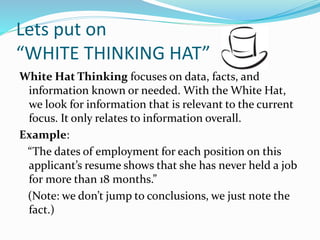
White Hat Thinking focuses on data, facts, and
information known or needed. With the White Hat,
we look for information that is relevant to the current
focus. It only relates to information overall.
Example:
“The dates of employment for each position on this
applicant’s resume shows that she has never held a job
for more than 18 months.”
(Note: we don’t jump to conclusions, we just note the
fact.)
This hat
shows
available
information
and also facts
and figures.
Lets put on
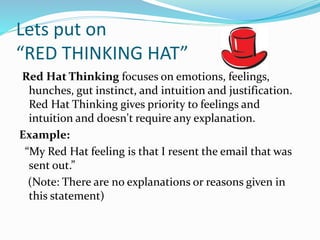
“RED THINKING HAT”
Red Hat Thinking focuses on emotions, feelings,
hunches, gut instinct, and intuition and justification.
Red Hat Thinking gives priority to feelings and
intuition and doesn't require any explanation.
Example:
“My Red Hat feeling is that I resent the email that was
sent out.”
(Note: There are no explanations or reasons given in
this statement)
This hat shows
that everyone
should keep
their opinion
during
discussion
about plans.
Lets put on
“BLACK THINKING HAT”
Black Hat Thinking we consider obstacles, existing or
potential downsides, and concerns. The single word
that best describes the nature of the Black Hat is
“caution.” Black Thinking Hat protects us from harm.
Example:
“If we describe our product in detail on the website, it
may be an open invitation for others to copy our
design.”
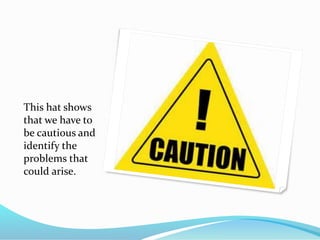
This hat shows
that we have to
be cautious and
identify the
problems that
could arise.
Lets put on
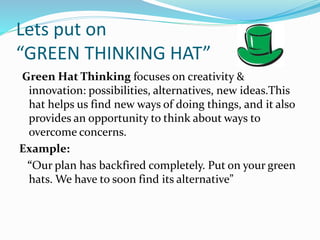
“GREEN THINKING HAT”
Green Hat Thinking focuses on creativity &
innovation: possibilities, alternatives, new ideas.This
hat helps us find new ways of doing things, and it also
provides an opportunity to think about ways to
overcome concerns.
Example:
“Our plan has backfired completely. Put on your green
hats. We have to soon find its alternative”
This hat shows
we have to plan
for alternatives
as any plan can
fail anytime
during process.
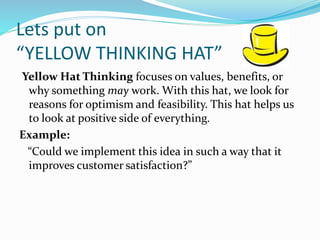
Lets put on
“YELLOW THINKING HAT”
Yellow Hat Thinking focuses on values, benefits, or
why something may work. With this hat, we look for
reasons for optimism and feasibility. This hat helps us
to look at positive side of everything.
Example:
“Could we implement this idea in such a way that it
improves customer satisfaction?”
This hat shows we
have to look upon
the benefits n
values acquired by
the performance of
task.
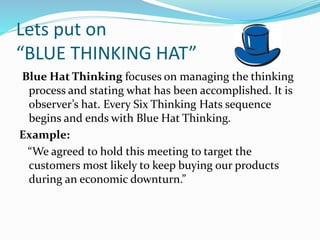
Lets put on
“BLUE THINKING HAT”
Blue Hat Thinking focuses on managing the thinking
process and stating what has been accomplished. It is
observer’s hat. Every Six Thinking Hats sequence
begins and ends with Blue Hat Thinking.
Example:
“We agreed to hold this meeting to target the
customers most likely to keep buying our products
during an economic downturn.”
This shows we
have to look in
into the process
and control
everything.
Benefits of six thinking hats
 Make meetings much shorter and more productive
 Stimulate innovation by generating more and better
ideas quickly
 Create dynamic, results oriented meetings that make
people want to participate
 See all sides of a situation
 Keep egos and "turf protection" in check
 Think clearly and objectively
Conclusion
Lets take example of a meeting from its starting till is
end through our thinking hats:
Blue hat-Everyone thinking how the meeting will be
conducted.
Red hat-Collecting opinions of everyone in the meeting
Yellow hat-Thinking about values and benefits from the
meeting
Green hat-Thinking about the solutions and alternatives
to tackle the problems
White hat-Next we have to collect information regarding
the issue
Black hat-Thinking about failures of the developed plans
and policies
Thank You

Six thinking hats final ppt

  • 1.
  • 2.
    What are SixThinking Hats? The six thinking hats method was invented by “Dr. Edward de Bono”in the early 1980s.The six thinking hats represents six different ways of thinking."Six Thinking Hats" and the associated idea parallel thinking provide a means for groups to plan thinking processes in a detailed and cohesive way, and in doing so to think together more effectively.
  • 3.
    What is parallelthinking? Parallel thinking is defined as a thinking process where focus is split in specific directions. When done in a group it effectively avoids the consequences of the adversarial approach.
  • 4.
    Lets put on “WHITETHINKING HAT” White Hat Thinking focuses on data, facts, and information known or needed. With the White Hat, we look for information that is relevant to the current focus. It only relates to information overall. Example: “The dates of employment for each position on this applicant’s resume shows that she has never held a job for more than 18 months.” (Note: we don’t jump to conclusions, we just note the fact.)
  • 5.
  • 6.
    Lets put on “REDTHINKING HAT” Red Hat Thinking focuses on emotions, feelings, hunches, gut instinct, and intuition and justification. Red Hat Thinking gives priority to feelings and intuition and doesn't require any explanation. Example: “My Red Hat feeling is that I resent the email that was sent out.” (Note: There are no explanations or reasons given in this statement)
  • 7.
    This hat shows thateveryone should keep their opinion during discussion about plans.
  • 8.
    Lets put on “BLACKTHINKING HAT” Black Hat Thinking we consider obstacles, existing or potential downsides, and concerns. The single word that best describes the nature of the Black Hat is “caution.” Black Thinking Hat protects us from harm. Example: “If we describe our product in detail on the website, it may be an open invitation for others to copy our design.”
  • 9.
    This hat shows thatwe have to be cautious and identify the problems that could arise.
  • 10.
    Lets put on “GREENTHINKING HAT” Green Hat Thinking focuses on creativity & innovation: possibilities, alternatives, new ideas.This hat helps us find new ways of doing things, and it also provides an opportunity to think about ways to overcome concerns. Example: “Our plan has backfired completely. Put on your green hats. We have to soon find its alternative”
  • 11.
    This hat shows wehave to plan for alternatives as any plan can fail anytime during process.
  • 12.
    Lets put on “YELLOWTHINKING HAT” Yellow Hat Thinking focuses on values, benefits, or why something may work. With this hat, we look for reasons for optimism and feasibility. This hat helps us to look at positive side of everything. Example: “Could we implement this idea in such a way that it improves customer satisfaction?”
  • 13.
    This hat showswe have to look upon the benefits n values acquired by the performance of task.
  • 14.
    Lets put on “BLUETHINKING HAT” Blue Hat Thinking focuses on managing the thinking process and stating what has been accomplished. It is observer’s hat. Every Six Thinking Hats sequence begins and ends with Blue Hat Thinking. Example: “We agreed to hold this meeting to target the customers most likely to keep buying our products during an economic downturn.”
  • 15.
    This shows we haveto look in into the process and control everything.
  • 16.
    Benefits of sixthinking hats  Make meetings much shorter and more productive  Stimulate innovation by generating more and better ideas quickly  Create dynamic, results oriented meetings that make people want to participate  See all sides of a situation  Keep egos and "turf protection" in check  Think clearly and objectively
  • 17.
    Conclusion Lets take exampleof a meeting from its starting till is end through our thinking hats: Blue hat-Everyone thinking how the meeting will be conducted. Red hat-Collecting opinions of everyone in the meeting Yellow hat-Thinking about values and benefits from the meeting
  • 18.
    Green hat-Thinking aboutthe solutions and alternatives to tackle the problems White hat-Next we have to collect information regarding the issue Black hat-Thinking about failures of the developed plans and policies
  • 19.