2009 GREEN  ICT INITIATIVE Green Information & Communications Technologies to Reduce Global Warming
P artnership for  R esearch on  M icroelectronics,  P hotonics and  T elecommunications between Quebec universities & Industry; A non-profit corporation that stimulates industry-university R&D partnerships to increase the  competitiveness  of Quebec’s ICT  sector Brokers with cash; Since 2003, stimulated 50 partnerships with researchers at 11 Quebec-based universities and more than 40 industry partners, valued at more than $30M in cash contributions to universities; Funded by Quebec Government, Industry and NSERC; Current program value (2008-2010): $14M; Program focus: Microelectronics; photonics; multimedia, wireless technologies, telecommunications networks & services; software; Only 3 full-time employees, headquartered in Montreal Prompt… at a glance
Why a  Green   NGI – and  Green  ICT? Source: Bill St-Arnaud, CANARIE The Challenge: It is estimated that the ICT industry produces CO 2  emissions that is equivalent to the entire aviation industry ICT is 5 th  largest industry in power consumption (2% to 6%) Fastest growth of any sector in society, doubling every 4 years One small server generates as much CO 2  as a 15 mpg SUV 40% of servers at universities and businesses are under utilized by more than 50% ICT may achieve up to 90% of Kyoto targets (Ex: savings in energy and carbon offsets) The Opportunity:  ICTs and related applications have the potential to decrease greenhouse emissions by as much as 15% and save global industry $US 800 billion in annual energy costs by 2020
International Mobilization in 2008 International Telecom Union initiative on ICTs & climate change: Targets future ICT standardization with a ‘Green perspective; Prompt involved in launch workshops (April, June). Climate Change Group report on the 2020 low carbon economy: Internet and ICT could reduce emissions by 15%; Save global industry $US800B in annual energy costs by 2020; Could cut CO 2  by current annual emissions of US or China; Virtualization & de-materialization of existing physical products and services. And many others are sounding alarms… Sources: ITU & Smart 2020
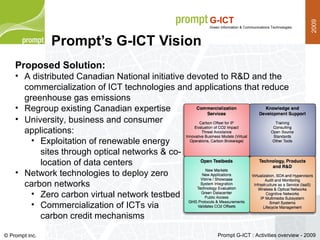
Prompt’s G-ICT Vision Proposed Solution: A distributed Canadian National initiative devoted to R&D and the commercialization of ICT technologies and applications that reduce greenhouse gas emissions Regroup existing Canadian expertise University, business and consumer applications: Exploitation of renewable energy sites through optical networks & co-location of data centers Network technologies to deploy zero carbon networks Zero carbon virtual network testbed  Commercialization of ICTs via carbon credit mechanisms
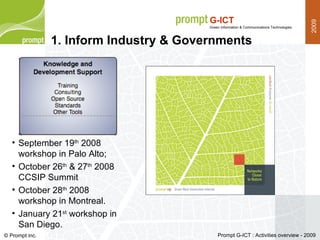
1. Inform Industry & Governments September 19 th  2008 workshop in Palo Alto; October 26 th  & 27 th  2008 CCSIP Summit October 28 th  2008 workshop in Montreal. January 21 st  workshop in San Diego.
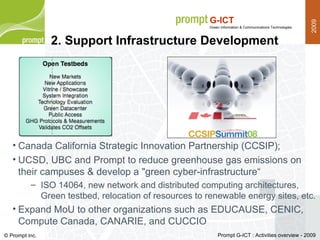
Canada California Strategic Innovation Partnership (CCSIP); UCSD, UBC and Prompt to reduce greenhouse gas emissions on their campuses & develop a "green cyber-infrastructure“ ISO 14064, new network and distributed computing architectures, Green testbed, relocation of resources to renewable energy sites, etc. Expand MoU to other organizations such as EDUCAUSE, CENIC, Compute Canada, CANARIE, and CUCCIO 2. Support Infrastructure Development
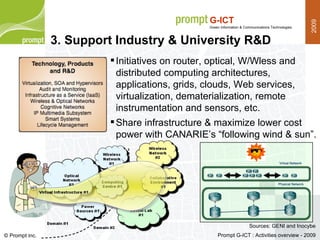
3. Support Industry & University R&D Initiatives on  router, optical, W/Wless and distributed computing architectures, applications, grids, clouds, Web services, virtualization, dematerialization, remote instrumentation and sensors, etc. Share infrastructure & maximize lower cost power with CANARIE’s “following wind & sun”. Sources: GENI and Inocybe
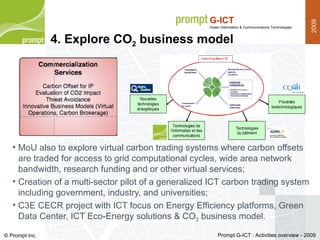
MoU also to explore virtual carbon trading systems where carbon offsets are traded for access to grid computational cycles, wide area network bandwidth, research funding and or other virtual services; Creation of a multi-sector pilot of a generalized ICT carbon trading system including government, industry, and universities; C3E CECR project with ICT focus on Energy Efficiency platforms, Green Data Center, ICT Eco-Energy solutions & CO 2  business model. 4. Explore CO 2  business model
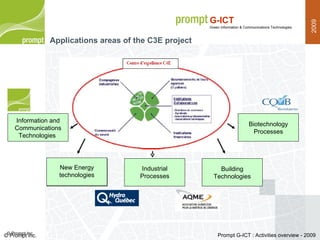
Applications areas of the C3E project © Prompt Inc. New Energy technologies Building Technologies Biotechnology Processes Information and Communications Technologies  Industrial Processes New Energy technologies
Prompt’s National Green  ICT  Initiative Using ICTs to Reduce Global Warming Charles Despins, PhD, Eng. President & CEO, Prompt +514.875.0032 ext. 101 [email_address] www.promptinc.org For Additional Information Jacques Mc Neill, mba NGI Project Coordinator +514.892.1066 [email_address] Workshop  2009

Prompt Charles Despins

  • 1.
    2009 GREEN ICT INITIATIVE Green Information & Communications Technologies to Reduce Global Warming
  • 2.
    P artnership for R esearch on M icroelectronics, P hotonics and T elecommunications between Quebec universities & Industry; A non-profit corporation that stimulates industry-university R&D partnerships to increase the competitiveness of Quebec’s ICT sector Brokers with cash; Since 2003, stimulated 50 partnerships with researchers at 11 Quebec-based universities and more than 40 industry partners, valued at more than $30M in cash contributions to universities; Funded by Quebec Government, Industry and NSERC; Current program value (2008-2010): $14M; Program focus: Microelectronics; photonics; multimedia, wireless technologies, telecommunications networks & services; software; Only 3 full-time employees, headquartered in Montreal Prompt… at a glance
  • 3.
    Why a Green NGI – and Green ICT? Source: Bill St-Arnaud, CANARIE The Challenge: It is estimated that the ICT industry produces CO 2 emissions that is equivalent to the entire aviation industry ICT is 5 th largest industry in power consumption (2% to 6%) Fastest growth of any sector in society, doubling every 4 years One small server generates as much CO 2 as a 15 mpg SUV 40% of servers at universities and businesses are under utilized by more than 50% ICT may achieve up to 90% of Kyoto targets (Ex: savings in energy and carbon offsets) The Opportunity: ICTs and related applications have the potential to decrease greenhouse emissions by as much as 15% and save global industry $US 800 billion in annual energy costs by 2020
  • 4.
    International Mobilization in2008 International Telecom Union initiative on ICTs & climate change: Targets future ICT standardization with a ‘Green perspective; Prompt involved in launch workshops (April, June). Climate Change Group report on the 2020 low carbon economy: Internet and ICT could reduce emissions by 15%; Save global industry $US800B in annual energy costs by 2020; Could cut CO 2 by current annual emissions of US or China; Virtualization & de-materialization of existing physical products and services. And many others are sounding alarms… Sources: ITU & Smart 2020
  • 5.
    Prompt’s G-ICT VisionProposed Solution: A distributed Canadian National initiative devoted to R&D and the commercialization of ICT technologies and applications that reduce greenhouse gas emissions Regroup existing Canadian expertise University, business and consumer applications: Exploitation of renewable energy sites through optical networks & co-location of data centers Network technologies to deploy zero carbon networks Zero carbon virtual network testbed Commercialization of ICTs via carbon credit mechanisms
  • 6.
    1. Inform Industry& Governments September 19 th 2008 workshop in Palo Alto; October 26 th & 27 th 2008 CCSIP Summit October 28 th 2008 workshop in Montreal. January 21 st workshop in San Diego.
  • 7.
    Canada California StrategicInnovation Partnership (CCSIP); UCSD, UBC and Prompt to reduce greenhouse gas emissions on their campuses & develop a "green cyber-infrastructure“ ISO 14064, new network and distributed computing architectures, Green testbed, relocation of resources to renewable energy sites, etc. Expand MoU to other organizations such as EDUCAUSE, CENIC, Compute Canada, CANARIE, and CUCCIO 2. Support Infrastructure Development
  • 8.
    3. Support Industry& University R&D Initiatives on router, optical, W/Wless and distributed computing architectures, applications, grids, clouds, Web services, virtualization, dematerialization, remote instrumentation and sensors, etc. Share infrastructure & maximize lower cost power with CANARIE’s “following wind & sun”. Sources: GENI and Inocybe
  • 9.
    MoU also toexplore virtual carbon trading systems where carbon offsets are traded for access to grid computational cycles, wide area network bandwidth, research funding and or other virtual services; Creation of a multi-sector pilot of a generalized ICT carbon trading system including government, industry, and universities; C3E CECR project with ICT focus on Energy Efficiency platforms, Green Data Center, ICT Eco-Energy solutions & CO 2 business model. 4. Explore CO 2 business model
  • 10.
    Applications areas ofthe C3E project © Prompt Inc. New Energy technologies Building Technologies Biotechnology Processes Information and Communications Technologies Industrial Processes New Energy technologies
  • 11.
    Prompt’s National Green ICT Initiative Using ICTs to Reduce Global Warming Charles Despins, PhD, Eng. President & CEO, Prompt +514.875.0032 ext. 101 [email_address] www.promptinc.org For Additional Information Jacques Mc Neill, mba NGI Project Coordinator +514.892.1066 [email_address] Workshop 2009