Future Grid Forum
CSIRO Energy Flagship
Mark Paterson
ADD BUSINESS UNIT/FLAGSHIP NAMEENERGY FLAGSHIP
An unprecedented transformation...
“The world’s electricity network will
change more in the next 20-years
than it has in the last 100”
IBM Energy & Utilities, ‘Smart Infrastructure – Building the Intelligent Grid of Tomorrow’, Enercom Conference (March 2009).
Australia's Electricity Futures (Copyright CSIRO 2014)
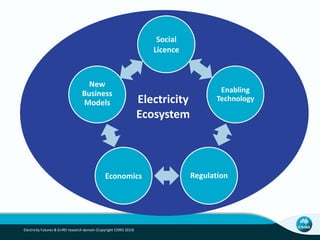
Social
Licence
Enabling
Technology
RegulationEconomics
New
Business
Models Electricity
Ecosystem
Electricity Futures & G+REI research domain (Copyright CSIRO 2014)
Australia’s Future Grid Forum
Industry-led
Whole-of-system
Long-term orientation to 2050
Electricity Futures & G+REI research domain (Copyright CSIRO 2014)
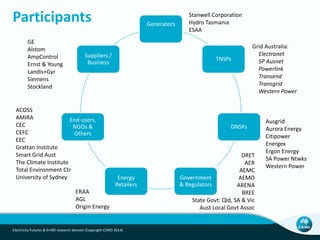
Participants
Electricity Futures & G+REI research domain (Copyright CSIRO 2014)
Generators
TNSPs
DNSPs
Government
& Regulators
Energy
Retailers
End-users,
NGOs &
Others
Suppliers /
Business
ACOSS
AMIRA
CEC
CEFC
EEC
Grattan Institute
Smart Grid Aust
The Climate Institute
Total Environment Ctr
University of Sydney
Stanwell Corporation
Hydro Tasmania
ESAA
GE
Alstom
AmpControl
Ernst & Young
Landis+Gyr
Siemens
Stockland
DRET
AER
AEMC
AEMO
ARENA
BREE
State Govt: Qld, SA & Vic
Aust Local Govt Assoc
Grid Australia:
Electranet
SP Ausnet
Powerlink
Transend
Transgrid
Western Power
Ausgrid
Aurora Energy
Citipower
Energex
Ergon Energy
SA Power Ntwks
Western Power
ERAA
AGL
Origin Energy
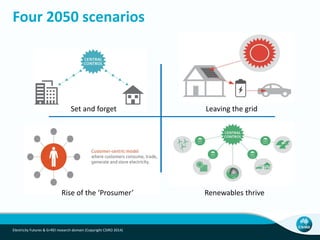
Four 2050 scenarios
Electricity Futures & G+REI research domain (Copyright CSIRO 2014)
Set and forget Leaving the grid
Rise of the ‘Prosumer’ Renewables thrive
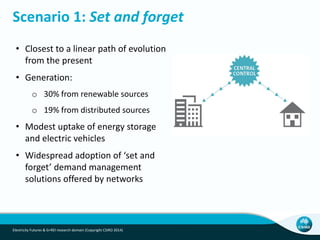
Scenario 1: Set and forget
• Closest to a linear path of evolution
from the present
• Generation:
o 30% from renewable sources
o 19% from distributed sources
• Modest uptake of energy storage
and electric vehicles
• Widespread adoption of ‘set and
forget’ demand management
solutions offered by networks
Electricity Futures & G+REI research domain (Copyright CSIRO 2014)
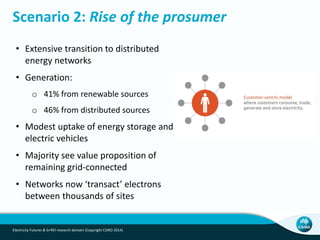
Scenario 2: Rise of the prosumer
• Extensive transition to distributed
energy networks
• Generation:
o 41% from renewable sources
o 46% from distributed sources
• Modest uptake of energy storage and
electric vehicles
• Majority see value proposition of
remaining grid-connected
• Networks now ‘transact’ electrons
between thousands of sites
Electricity Futures & G+REI research domain (Copyright CSIRO 2014)
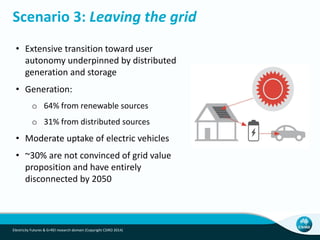
Scenario 3: Leaving the grid
• Extensive transition toward user
autonomy underpinned by distributed
generation and storage
• Generation:
o 64% from renewable sources
o 31% from distributed sources
• Moderate uptake of electric vehicles
• ~30% are not convinced of grid value
proposition and have entirely
disconnected by 2050
Electricity Futures & G+REI research domain (Copyright CSIRO 2014)
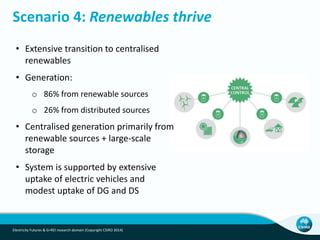
Scenario 4: Renewables thrive
• Extensive transition to centralised
renewables
• Generation:
o 86% from renewable sources
o 26% from distributed sources
• Centralised generation primarily from
renewable sources + large-scale
storage
• System is supported by extensive
uptake of electric vehicles and
modest uptake of DG and DS
Electricity Futures & G+REI research domain (Copyright CSIRO 2014)
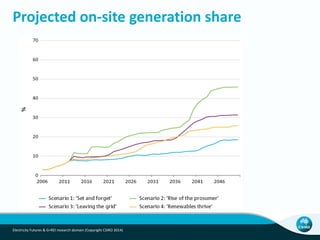
Projected on-site generation share
Electricity Futures & G+REI research domain (Copyright CSIRO 2014)
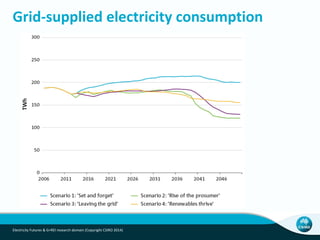
Grid-supplied electricity consumption
Electricity Futures & G+REI research domain (Copyright CSIRO 2014)
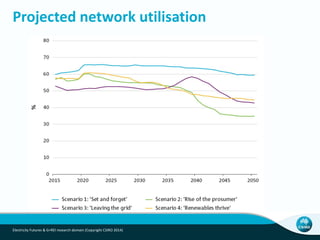
Projected network utilisation
Electricity Futures & G+REI research domain (Copyright CSIRO 2014)
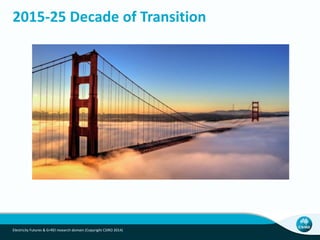
2015-25 Decade of Transition
Electricity Futures & G+REI research domain (Copyright CSIRO 2014)
Seven observations about nature of this
profound transition...
1. Network-centric → Customer-centric
2. Centralised → Decentralised/Hybrid
3. Fossil fuel generation → Continuous decarbonisation
4. Regulated natural monopoly → Increasing exposure to
competition
5. 20 – 50% of electricity generated locally by 2050
6. Grid continues to play a critical (but evolved) role in 2050
7. Current decision-making processes risk being outpaced in the
2015-25 decade en route to 2050
Electricity Futures & G+REI research domain (Copyright CSIRO 2014)
Eight ‘must haves’...
1. Treat the community as adults and partners
on a journey to a new place
2. New models for accelerated decision-making
and industry adaptation
3. New tools for network forecasting in a highly-
distributed future
4. Ubiquitous ‘taming’ of peak demand spikes is
critical for network optimisation
5. Cost-reflective pricing of electricity + enabling
technologies ( ‘transactive’ network)
Electricity Futures & G+REI research domain (Copyright CSIRO 2014)
Eight ‘must haves’...
6. National review of the social safety net parallel
to tariff reforms
7. ‘Re-invention’ of NSP business models – need
to decide what you are going to be!
8. Further regulatory reform where necessary to
enable new NSP business models
Electricity Futures & G+REI research domain (Copyright CSIRO 2014)
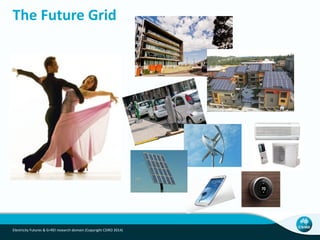
The Future Grid
Electricity Futures & G+REI research domain (Copyright CSIRO 2014)
CSIRO Energy Transformed Flagship
Mark Paterson
Energy Flagship
t 0459 841 006
e mark.paterson@csiro.au
w www.csiro.au/energy
ENERGY TRANSFORMED FLAGSHIP
Thank you

Future Grid Forum

  • 1.
    Future Grid Forum CSIROEnergy Flagship Mark Paterson ADD BUSINESS UNIT/FLAGSHIP NAMEENERGY FLAGSHIP
  • 2.
    An unprecedented transformation... “Theworld’s electricity network will change more in the next 20-years than it has in the last 100” IBM Energy & Utilities, ‘Smart Infrastructure – Building the Intelligent Grid of Tomorrow’, Enercom Conference (March 2009). Australia's Electricity Futures (Copyright CSIRO 2014)
  • 3.
  • 4.
    Australia’s Future GridForum Industry-led Whole-of-system Long-term orientation to 2050 Electricity Futures & G+REI research domain (Copyright CSIRO 2014)
  • 5.
    Participants Electricity Futures &G+REI research domain (Copyright CSIRO 2014) Generators TNSPs DNSPs Government & Regulators Energy Retailers End-users, NGOs & Others Suppliers / Business ACOSS AMIRA CEC CEFC EEC Grattan Institute Smart Grid Aust The Climate Institute Total Environment Ctr University of Sydney Stanwell Corporation Hydro Tasmania ESAA GE Alstom AmpControl Ernst & Young Landis+Gyr Siemens Stockland DRET AER AEMC AEMO ARENA BREE State Govt: Qld, SA & Vic Aust Local Govt Assoc Grid Australia: Electranet SP Ausnet Powerlink Transend Transgrid Western Power Ausgrid Aurora Energy Citipower Energex Ergon Energy SA Power Ntwks Western Power ERAA AGL Origin Energy
  • 6.
    Four 2050 scenarios ElectricityFutures & G+REI research domain (Copyright CSIRO 2014) Set and forget Leaving the grid Rise of the ‘Prosumer’ Renewables thrive
  • 7.
    Scenario 1: Setand forget • Closest to a linear path of evolution from the present • Generation: o 30% from renewable sources o 19% from distributed sources • Modest uptake of energy storage and electric vehicles • Widespread adoption of ‘set and forget’ demand management solutions offered by networks Electricity Futures & G+REI research domain (Copyright CSIRO 2014)
  • 8.
    Scenario 2: Riseof the prosumer • Extensive transition to distributed energy networks • Generation: o 41% from renewable sources o 46% from distributed sources • Modest uptake of energy storage and electric vehicles • Majority see value proposition of remaining grid-connected • Networks now ‘transact’ electrons between thousands of sites Electricity Futures & G+REI research domain (Copyright CSIRO 2014)
  • 9.
    Scenario 3: Leavingthe grid • Extensive transition toward user autonomy underpinned by distributed generation and storage • Generation: o 64% from renewable sources o 31% from distributed sources • Moderate uptake of electric vehicles • ~30% are not convinced of grid value proposition and have entirely disconnected by 2050 Electricity Futures & G+REI research domain (Copyright CSIRO 2014)
  • 10.
    Scenario 4: Renewablesthrive • Extensive transition to centralised renewables • Generation: o 86% from renewable sources o 26% from distributed sources • Centralised generation primarily from renewable sources + large-scale storage • System is supported by extensive uptake of electric vehicles and modest uptake of DG and DS Electricity Futures & G+REI research domain (Copyright CSIRO 2014)
  • 11.
    Projected on-site generationshare Electricity Futures & G+REI research domain (Copyright CSIRO 2014)
  • 12.
    Grid-supplied electricity consumption ElectricityFutures & G+REI research domain (Copyright CSIRO 2014)
  • 13.
    Projected network utilisation ElectricityFutures & G+REI research domain (Copyright CSIRO 2014)
  • 14.
    Electricity Futures &G+REI research domain (Copyright CSIRO 2014)
  • 15.
    2015-25 Decade ofTransition Electricity Futures & G+REI research domain (Copyright CSIRO 2014)
  • 16.
    Seven observations aboutnature of this profound transition... 1. Network-centric → Customer-centric 2. Centralised → Decentralised/Hybrid 3. Fossil fuel generation → Continuous decarbonisation 4. Regulated natural monopoly → Increasing exposure to competition 5. 20 – 50% of electricity generated locally by 2050 6. Grid continues to play a critical (but evolved) role in 2050 7. Current decision-making processes risk being outpaced in the 2015-25 decade en route to 2050 Electricity Futures & G+REI research domain (Copyright CSIRO 2014)
  • 17.
    Eight ‘must haves’... 1.Treat the community as adults and partners on a journey to a new place 2. New models for accelerated decision-making and industry adaptation 3. New tools for network forecasting in a highly- distributed future 4. Ubiquitous ‘taming’ of peak demand spikes is critical for network optimisation 5. Cost-reflective pricing of electricity + enabling technologies ( ‘transactive’ network) Electricity Futures & G+REI research domain (Copyright CSIRO 2014)
  • 18.
    Eight ‘must haves’... 6.National review of the social safety net parallel to tariff reforms 7. ‘Re-invention’ of NSP business models – need to decide what you are going to be! 8. Further regulatory reform where necessary to enable new NSP business models Electricity Futures & G+REI research domain (Copyright CSIRO 2014)
  • 19.
    The Future Grid ElectricityFutures & G+REI research domain (Copyright CSIRO 2014)
  • 20.
    CSIRO Energy TransformedFlagship Mark Paterson Energy Flagship t 0459 841 006 e mark.paterson@csiro.au w www.csiro.au/energy ENERGY TRANSFORMED FLAGSHIP Thank you