Smart City BenchmarkMarch 2011
This report was commissioned by Bristol City Council and funded by the Department of Climate Change as part of its Local Carbon Framework programme. It covers an international analysis of smart city activities. A further report that assesses existing Bristol smart city activities together with an analysis of how smart technologies can help Bristol achieve its carbon reduction and economic development objectives can be downloaded at http://www.slideshare.net/Bristolcc/bristol-smart-city-reportFor further information on Bristol’s smart city activities please contact:Lorraine HudsonBristol Futures Grouplorraine.hudson@bristol.gov.ukTel: +44 (0)117 9224470About this report
While Advancing Sustainability LLP considers that the information, opinions and recommendations given in this work are sound and reasonable, users of the report must rely upon their own skill and judgement when interpreting or applying it. Other than those held by contract, Advancing Sustainability cannot, and does not, accept liability for losses suffered, whether direct or consequential, arising out of any reliance on the findings presented.About Advancing Sustainability LLPAdvancing Sustainability has experience in developing organisational strategy, reporting, metrics, target setting, climate change, application of smart technologies, risk assessment, governance, thought leadership, stakeholder dialogue, media, public affairs and international industry collaboration. More information is available at advancingsustainability.comDisclaimer
Methodology and statistics
Green and/or Smart?Cities can be green without being smart, and/or smart without being green. EducationHealthRetailSafetyUtilitiesTransportWasteWaterEnergyBiodiversityOrganicGREENSMARTThis report focuses on green and smart with a particular emphasis on reducing carbon emissions.
MethodologyInitial top level trawl of global smart city activities.Detailed analysis with focus on three key areas.Presentation of findings at three levels.>100 CitiesDrawn from:Signatories to the European Green Digital Charter
Smart 2020 city case studies
City case studies highlighted by corporations active in this space such as IBM, Accenture and Cisco
ICT4EE 2010 conference case studies
Living Lab case studies
General web browsing46 CitiesAnalysis1Specific Focus on:smart grids (including meters)
transport
city dashboardDataCase studiesAssessed against:Energy Infrastructure
Transport Substitution
Transport Low C vehicles
Transport System Efficiency
Integrated Information FlowsInterim review point and narrowing of analysisDesk Research ReportThis presentation
46 global cities
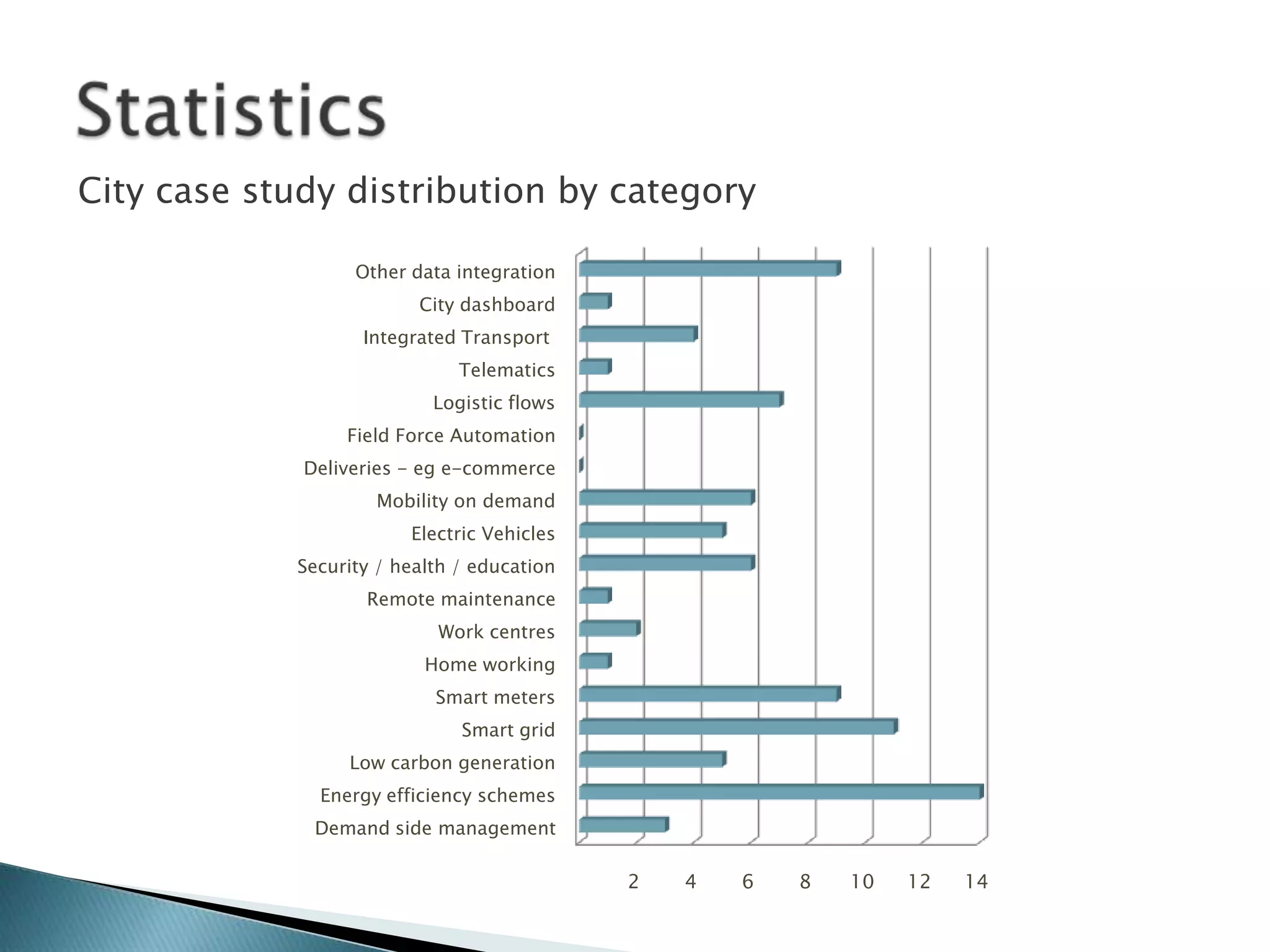
StatisticsCity case study distribution by category
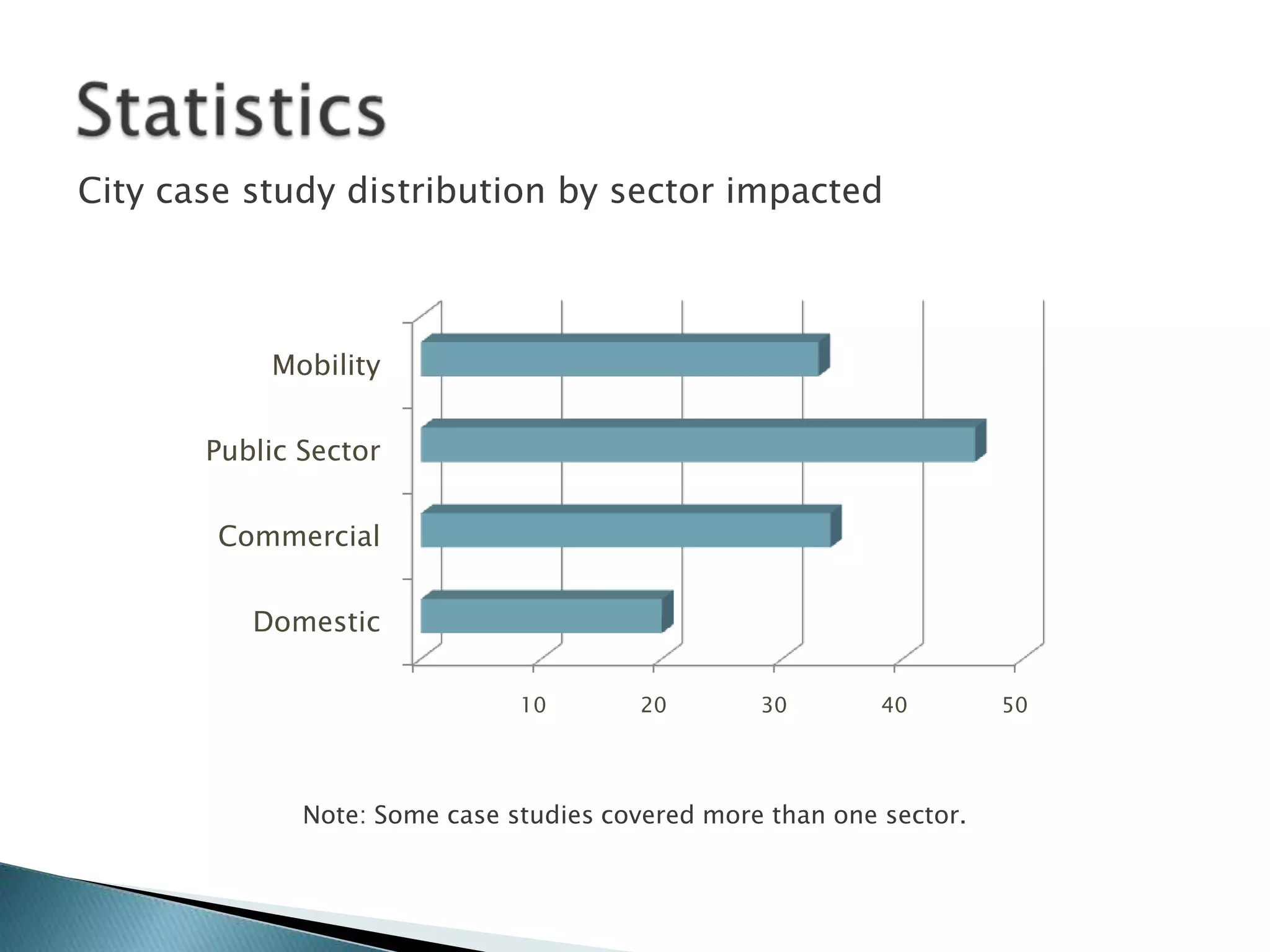
StatisticsCity case study distribution by sector impactedNote: Some case studies covered more than one sector.
StatisticsCity case study distribution by maturity of deployment Researching refers to something in the planning or early prototype stage. Implementing refers to a larger scale project under implementation. Complete means fully up and running but could still be subject to further development.
StatisticsCity case study distribution by scale of deployment
Reflections
Why deploy IT to be green?UbiquityCommunication infrastructure is now ubiquitous. In the UK fixed line broadband, mobile phone coverage, GPS etc are all reaching 100% coverage. Urban areas are also very well served by 3G.AutomatesIT can automatically optimise systems in real time.Hidden complexityWhen implemented well IT systems can manage hugely complex problems in the background and deliver simple interfaces to the user.Data RichIT creates extensive data that allows multiple systems to interact and can inform better decision making.New Solutions to Old ProblemsSmart solutions can provide more cost effective ways to solve old problems but require people to adapt to change.
The Macro-Economic CaseThere is a strong macro-economic case for smart city deployment.The Smart 2020 report identified potential energy and carbon savings across the global economy from deployment of smart technologies. The figures below show how the Smart 2020 findings scale to Bristol at 2010 values based on a GDP ratio.* Transport savings are disproportionately higher due to the much higher levels of duty and taxation. ** Smart Buildings don’t necessarily require connectivity and most of the savings arise from standalone technology including building management systems, lighting control, voltage optimisation etc.
The Business OpportunityGoldman Sachs estimates smart grids will be worth $750 billion globally for equipment makers, with Europe making up a quarter of that total. In total they say Europe could spend $187 billion through the next 30 years on transmission, distribution and metering systems.http://www.reuters.com/article/idUSTRE68T2T020100930, Sept 2010Cumulative global investment in smart grids, including smart meter implementations as well as upgrades to the transmission and distribution infrastructure, will approach $46 billion by 2015, according to the latest forecasts from ABI Research.http://www.abiresearch.com/press/1688-Smart+Grid+Spending+Will+Top+$45+Billion+by+2015Ofgem estimates that £32 billion of extra investment will be required in the next decade in the [UK] electricity networks. The Net Present Value (NPV) of the reinforcement costs avoided in a ‘smart’ system with a 50% penetration of electric cars and heat pumps could be between £2.4 and £8.1 billion.Smart Grids: Commercial Opportunities and Challenges for the UK, Knowledge Transfer Network .
Early DaysBy far the majority of case studies examined were in the research or pilot stage. There are very few examples of smart technology city deployment at scale. This may be because currently there is no commercially realisable, self sustaining business model. This means that projects tend to cease once the funding runs out and that projects are often opportunistic in the sense that they are driven more by the requirements of the funding than as part of a long term carbon reduction plan of the city.Key sources of funding are:European Commission eg FP7, Elena, Intelligent Energy Europe
UK eg LCNF, Plugged in Places
Economic stimulus packages, eg USA, South Korea
Corporate investment, eg Cisco Connected Urban Development Barriers to IT deploymentNew ways of thinkingEngineers, planners, architects etc have often not been trained to consider IT solutions to their problems. Breaking down the silosIT solutions can require a more holistic approach.Chicken and EggSome smart solutions will only work when deployed at scale. Small scale pilots often fail.Business CaseThere is very little hard data available which makes it difficult to establish the business case for action at an individual project level.RetrofitIt’s often difficult to retrofit smart solutions into existing buildings, systems and infrastructure.StandardsA lack of agreed technical standards is delaying the implementation of smart technologies.
Smart Grids
The UK government has plans to deploy smart meters to 26 million UK homes by 2020 – a project that the Department of Energy and Climate Change forecasts will cost the UK £9.2 billion.As of January 2010 there were estimated to be in excess of 170,000 domestic smart meters installed in the UK. British Gas, is considered to be leading the rollout of the new technology, and is expected to have at least 2 million meters installed by end 2012. This energy supplier is reportedly installing on average 1,000 new smart meters every day.1The world's largest smart meter deployment was undertaken by Enel SpA, the dominant utility in Italy with over 27 million customers. Between 2000 and 2005 Enel deployed smart meters to its entire customer base.2Smart MetersOpcit DECC Impact Assessment Rollout of smart meters in the domestic sector 2010http://en.wikipedia.org/wiki/Smart_meter
Demand managementBalancing the grid by controlling level of demandGrid energy efficiencyImprove efficiency of electricity distribution systemInformationChanges behaviour through transparency of usageLow carbon generationEnables increased levels of intermittent supplyCapacity EnhancementExtends traditional system capacity, storageLow Carbon economyDeployment of electric vehicles, heat pumps etc.Smart Grids Enable:
1. Demand ManagementMartha’s VineyardA GE  pilot project. 120 Profile smart appliances in 35 households, $800,000 grant from the American Recovery and Reinvestment Act. New YorkLarge retrofit of Empire State Building. Demand control ventilation using CO2 sensors to determine occupancyWashington DCSmart metering pilot project tested behavior of customers to dynamic pricing; more than 90% saved money by cutting their consumption. Customers reaction was strongest to "critical peak pricing," which hiked electricity rates to five times over normal for about 60 hours during the year. Rates reflected slight discounts during the rest of the year.
2. Grid Energy EfficiencyBoulder, ColoradoA fully network-connected system that identifies all aspects of the power grid and communicates its status and the impact of consumption changes to automated decision-making systems on that network.MaltaIntegrating both water and power systems, will be able to identify water leaks and electricity losses in the grid. 250,000 interactive meters will monitor electricity usage in real time, set variable rates, and reward customers who consume less.
3. InformationJutlandEnergiMidt (energy supplier Jutland) is deploying the NES system from Echelon to its 176,000 electricity customers. Special meters in the NES smart grid infrastructure allows the grid to be managed as one integrated system. Customers follow their energy consumption online and a new application called My Energy allows consumption display via iphone.New YorkLarge retrofit of Empire State Building. Tenant energy management –submetering provides online info allowing tenants to benchmark themselves against each other.
4. Low Carbon GenerationSouth WalesLCNF winner. Observes in real time what happens to the networks when microgeneration, such as PV solar panels, comes online. Involves over 100,000 customers – around 10 per cent of the South Wales population. Some will have a voltage monitor fitted in their home. Installs monitoring equipment at over 1,000 distribution substations, from high density urban areas to rural hamlets.
5. Capacity EnhancementOrkneyThe installation of a smart grid cost ‘substantially less’ than a new interconnect cable with the mainland (£30m) and allowed the Orkney Isles to increase the amount of electricity generated from renewable sources by 15MW. The technology manages multiple renewable generators against multiple grid bottlenecks.East LincolnshireLNCF winner “Low Carbon Hub”. Solutions to maximize renewable generation.Essentially an electricity generating plant connected to a distribution network rather than the transmission network.
6. Low carbon economyLondonLCNF winner “Low Carbon London”. Links to Plugged in Places scheme with 25,000 EV charging points by 2015 supporting 100,000 EVs. Incorporates Sainsbury’s electric delivery vehicles.
Large scale demonstratorSingaporeThe Intelligent Energy System (IES) pilot will involve around 4,500 customers in various residential, commercial and industrial locations, including the Nanyang Technological University (NTU) campus, the CleanTech Park at Jalan Bahar and the Punggol Eco-Precinct.  1st phase 2010-2012: enabling infrastructure for IES. Phase 2 (2012-2013) smart grid applications. The total budget is $30 million, funded by the Government and Singapore Power.  Accenture is lead partner working with  ST Electronics (Info-Comm Systems), Oracle, Hewlett Packard, Power Automation, Control4 and Greenwave
Large scale demonstratorMalagaThe Malaga Smartcity main goal is to achieve an optimal integration of renewable energies into the power grid.  It includes new models of distributed energy resources management, smart meters for remote management, battery storage systems for air conditioning, street lighting and electric transportation. EURO 30m budget over 4 years with aim to reduce energy consumption by 20%emissions
Large scale demonstratorSouth Korea1. Development of Korean Energy Management System2. Development of Intelligent Transmission Network Monitoring and Operation System3. IT Based Control System for Bulk Power Transmission 4.Development of Prototype for Advanced Substation Automation System based on the Digital Control Technology5. The Development of Power Equipment Monitoring System using Active Telemetrics.                                 6. Development of Intelligent Distribution Management System 7. Development of Power Line Communication (PLC) Ubiquitous Technology 8. Power Semiconductor for Dispersed Generation and Industrial Inverter Application 9. Development of integration EMS for the microgrid and application technology to site  10. Consumer Portal System for IT-Based Energy Services Business
Transport
Reducing congestionCongestion charging, traffic signal control, parking assistancePersonal mobility on demandBikes, carsPublic transport on demand Mini bus service on requestInformationReal time information systemsIntegrated logisticsExtends traditional system capacity, storageElectric vehiclesCharging / payment points, vehicle diagnostics, media etc.Travel SubstitutionHomeworking, telecentresSmart Transport Systems:
1. Reducing CongestionHamburgElbe tunnel - used by up to 150,000 vehicles a day. An automated system controls surface lights to direct vehicles as they approach.LisbonIBL Intermittent Bus Lane involves temporary creation of a bus lane as the bus approaches and then reverts back to normal road usage.
1. Reducing CongestionPortlandTraffic signal optimization ensures maximum green light times for the heaviest traffic flows and allows signal cycle time to adjust based on changing demands. First established in 2004. Won many awards. Portland claim to have eliminated more than 157,000 metric tons of CO2 emissions over six years. The priority traffic signalling programme has been applied to buses and freight reducing waiting time but also reducing wear and tear of the roads near traffic lights and intersections. In addition, Portland has deployed advance information systems to reroute travellers in real time around accidents to alternative routes.
1. Reducing CongestionSan FranciscoSmart parking meters and parking wireless sensors installed in pilot areas across the City in 2010 feeding into data hub. Real-time parking data to be available, both on SFpark.org and as open source data feed. Allows demand-responsive pricing. Designed to cut down number of vehicles circling for parking.London, StockholmCongestion charging schemes with number plate recognition systems. London feeds traffic flow data into London Congestion Analysis Project turning it into valuable journey time information.
2. Personal Mobility on DemandLondon, Paris, MontrealAutomated, self serve bike hire schemes. Real time smart phone / web applications indicate system capacity.City Car Club14 Cities in the UK whereby a member may rent a car or van on an hourly basis. Membership card read by reader mounted on dashboard to unlock car; internal computer activates vehicle when correct pin entered. Vehicle must be returned to same parking bay.
3. Public Transport on DemandHelsinkiMetropol is a university research project investigating on demand shared mini bus booking system where amount paid depends on stated priority of journey time. Higher fare (which is always less than a taxi) = fewer passengers and more direct route.
4. Real Time InformationSan FranciscoThe Connected Bus pilot has high speed wireless Internet access for all passengers. “NextMuni” real-time travel information (location, routes, wait times, and more) via onboard touch screens plus “Green Gauge” calculator that provides information on the bus’s environmental impact. Part of Cisco Connected Urban Development (CUD) program.
5. Integrated LogisticsBilbao, Helmond, Krakov, LyonAll partners in the Freilot, EC funded project (€4m). Project is a mix of smart and green. IT components include traffic signal priority for HGVs including in-cab display showing time to green signal, and delivery space booking. The Delivery Space Booking service in Bilbao enables a request for a parking zone for a specified identification card (Chip card), performed via Web or Toll machine next to the delivery zone. The system will confirm the reservation and specify the bay reserved. The parking zone operator knows in real time the status of each reservation made. If an illegal vehicle is detected a message is sent to the enforcement services. Sensors in the road (similar to cats eyes) on edge of zone flash green when available, red when booked, but are turned off when occupied.

Smart City Benchmark

  • 1.
  • 2.
    This report wascommissioned by Bristol City Council and funded by the Department of Climate Change as part of its Local Carbon Framework programme. It covers an international analysis of smart city activities. A further report that assesses existing Bristol smart city activities together with an analysis of how smart technologies can help Bristol achieve its carbon reduction and economic development objectives can be downloaded at http://www.slideshare.net/Bristolcc/bristol-smart-city-reportFor further information on Bristol’s smart city activities please contact:Lorraine HudsonBristol Futures Grouplorraine.hudson@bristol.gov.ukTel: +44 (0)117 9224470About this report
  • 3.
    While Advancing SustainabilityLLP considers that the information, opinions and recommendations given in this work are sound and reasonable, users of the report must rely upon their own skill and judgement when interpreting or applying it. Other than those held by contract, Advancing Sustainability cannot, and does not, accept liability for losses suffered, whether direct or consequential, arising out of any reliance on the findings presented.About Advancing Sustainability LLPAdvancing Sustainability has experience in developing organisational strategy, reporting, metrics, target setting, climate change, application of smart technologies, risk assessment, governance, thought leadership, stakeholder dialogue, media, public affairs and international industry collaboration. More information is available at advancingsustainability.comDisclaimer
  • 4.
  • 5.
    Green and/or Smart?Citiescan be green without being smart, and/or smart without being green. EducationHealthRetailSafetyUtilitiesTransportWasteWaterEnergyBiodiversityOrganicGREENSMARTThis report focuses on green and smart with a particular emphasis on reducing carbon emissions.
  • 6.
    MethodologyInitial top leveltrawl of global smart city activities.Detailed analysis with focus on three key areas.Presentation of findings at three levels.>100 CitiesDrawn from:Signatories to the European Green Digital Charter
  • 7.
    Smart 2020 citycase studies
  • 8.
    City case studieshighlighted by corporations active in this space such as IBM, Accenture and Cisco
  • 9.
  • 10.
  • 11.
    General web browsing46CitiesAnalysis1Specific Focus on:smart grids (including meters)
  • 12.
  • 13.
    city dashboardDataCase studiesAssessedagainst:Energy Infrastructure
  • 14.
  • 15.
  • 16.
  • 17.
    Integrated Information FlowsInterimreview point and narrowing of analysisDesk Research ReportThis presentation
  • 18.
  • 19.
    StatisticsCity case studydistribution by category
  • 20.
    StatisticsCity case studydistribution by sector impactedNote: Some case studies covered more than one sector.
  • 21.
    StatisticsCity case studydistribution by maturity of deployment Researching refers to something in the planning or early prototype stage. Implementing refers to a larger scale project under implementation. Complete means fully up and running but could still be subject to further development.
  • 22.
    StatisticsCity case studydistribution by scale of deployment
  • 23.
  • 24.
    Why deploy ITto be green?UbiquityCommunication infrastructure is now ubiquitous. In the UK fixed line broadband, mobile phone coverage, GPS etc are all reaching 100% coverage. Urban areas are also very well served by 3G.AutomatesIT can automatically optimise systems in real time.Hidden complexityWhen implemented well IT systems can manage hugely complex problems in the background and deliver simple interfaces to the user.Data RichIT creates extensive data that allows multiple systems to interact and can inform better decision making.New Solutions to Old ProblemsSmart solutions can provide more cost effective ways to solve old problems but require people to adapt to change.
  • 25.
    The Macro-Economic CaseThereis a strong macro-economic case for smart city deployment.The Smart 2020 report identified potential energy and carbon savings across the global economy from deployment of smart technologies. The figures below show how the Smart 2020 findings scale to Bristol at 2010 values based on a GDP ratio.* Transport savings are disproportionately higher due to the much higher levels of duty and taxation. ** Smart Buildings don’t necessarily require connectivity and most of the savings arise from standalone technology including building management systems, lighting control, voltage optimisation etc.
  • 26.
    The Business OpportunityGoldmanSachs estimates smart grids will be worth $750 billion globally for equipment makers, with Europe making up a quarter of that total. In total they say Europe could spend $187 billion through the next 30 years on transmission, distribution and metering systems.http://www.reuters.com/article/idUSTRE68T2T020100930, Sept 2010Cumulative global investment in smart grids, including smart meter implementations as well as upgrades to the transmission and distribution infrastructure, will approach $46 billion by 2015, according to the latest forecasts from ABI Research.http://www.abiresearch.com/press/1688-Smart+Grid+Spending+Will+Top+$45+Billion+by+2015Ofgem estimates that £32 billion of extra investment will be required in the next decade in the [UK] electricity networks. The Net Present Value (NPV) of the reinforcement costs avoided in a ‘smart’ system with a 50% penetration of electric cars and heat pumps could be between £2.4 and £8.1 billion.Smart Grids: Commercial Opportunities and Challenges for the UK, Knowledge Transfer Network .
  • 27.
    Early DaysBy farthe majority of case studies examined were in the research or pilot stage. There are very few examples of smart technology city deployment at scale. This may be because currently there is no commercially realisable, self sustaining business model. This means that projects tend to cease once the funding runs out and that projects are often opportunistic in the sense that they are driven more by the requirements of the funding than as part of a long term carbon reduction plan of the city.Key sources of funding are:European Commission eg FP7, Elena, Intelligent Energy Europe
  • 28.
    UK eg LCNF,Plugged in Places
  • 29.
    Economic stimulus packages,eg USA, South Korea
  • 30.
    Corporate investment, egCisco Connected Urban Development Barriers to IT deploymentNew ways of thinkingEngineers, planners, architects etc have often not been trained to consider IT solutions to their problems. Breaking down the silosIT solutions can require a more holistic approach.Chicken and EggSome smart solutions will only work when deployed at scale. Small scale pilots often fail.Business CaseThere is very little hard data available which makes it difficult to establish the business case for action at an individual project level.RetrofitIt’s often difficult to retrofit smart solutions into existing buildings, systems and infrastructure.StandardsA lack of agreed technical standards is delaying the implementation of smart technologies.
  • 31.
  • 32.
    The UK governmenthas plans to deploy smart meters to 26 million UK homes by 2020 – a project that the Department of Energy and Climate Change forecasts will cost the UK £9.2 billion.As of January 2010 there were estimated to be in excess of 170,000 domestic smart meters installed in the UK. British Gas, is considered to be leading the rollout of the new technology, and is expected to have at least 2 million meters installed by end 2012. This energy supplier is reportedly installing on average 1,000 new smart meters every day.1The world's largest smart meter deployment was undertaken by Enel SpA, the dominant utility in Italy with over 27 million customers. Between 2000 and 2005 Enel deployed smart meters to its entire customer base.2Smart MetersOpcit DECC Impact Assessment Rollout of smart meters in the domestic sector 2010http://en.wikipedia.org/wiki/Smart_meter
  • 33.
    Demand managementBalancing thegrid by controlling level of demandGrid energy efficiencyImprove efficiency of electricity distribution systemInformationChanges behaviour through transparency of usageLow carbon generationEnables increased levels of intermittent supplyCapacity EnhancementExtends traditional system capacity, storageLow Carbon economyDeployment of electric vehicles, heat pumps etc.Smart Grids Enable:
  • 34.
    1. Demand ManagementMartha’sVineyardA GE pilot project. 120 Profile smart appliances in 35 households, $800,000 grant from the American Recovery and Reinvestment Act. New YorkLarge retrofit of Empire State Building. Demand control ventilation using CO2 sensors to determine occupancyWashington DCSmart metering pilot project tested behavior of customers to dynamic pricing; more than 90% saved money by cutting their consumption. Customers reaction was strongest to "critical peak pricing," which hiked electricity rates to five times over normal for about 60 hours during the year. Rates reflected slight discounts during the rest of the year.
  • 35.
    2. Grid EnergyEfficiencyBoulder, ColoradoA fully network-connected system that identifies all aspects of the power grid and communicates its status and the impact of consumption changes to automated decision-making systems on that network.MaltaIntegrating both water and power systems, will be able to identify water leaks and electricity losses in the grid. 250,000 interactive meters will monitor electricity usage in real time, set variable rates, and reward customers who consume less.
  • 36.
    3. InformationJutlandEnergiMidt (energysupplier Jutland) is deploying the NES system from Echelon to its 176,000 electricity customers. Special meters in the NES smart grid infrastructure allows the grid to be managed as one integrated system. Customers follow their energy consumption online and a new application called My Energy allows consumption display via iphone.New YorkLarge retrofit of Empire State Building. Tenant energy management –submetering provides online info allowing tenants to benchmark themselves against each other.
  • 37.
    4. Low CarbonGenerationSouth WalesLCNF winner. Observes in real time what happens to the networks when microgeneration, such as PV solar panels, comes online. Involves over 100,000 customers – around 10 per cent of the South Wales population. Some will have a voltage monitor fitted in their home. Installs monitoring equipment at over 1,000 distribution substations, from high density urban areas to rural hamlets.
  • 38.
    5. Capacity EnhancementOrkneyTheinstallation of a smart grid cost ‘substantially less’ than a new interconnect cable with the mainland (£30m) and allowed the Orkney Isles to increase the amount of electricity generated from renewable sources by 15MW. The technology manages multiple renewable generators against multiple grid bottlenecks.East LincolnshireLNCF winner “Low Carbon Hub”. Solutions to maximize renewable generation.Essentially an electricity generating plant connected to a distribution network rather than the transmission network.
  • 39.
    6. Low carboneconomyLondonLCNF winner “Low Carbon London”. Links to Plugged in Places scheme with 25,000 EV charging points by 2015 supporting 100,000 EVs. Incorporates Sainsbury’s electric delivery vehicles.
  • 40.
    Large scale demonstratorSingaporeTheIntelligent Energy System (IES) pilot will involve around 4,500 customers in various residential, commercial and industrial locations, including the Nanyang Technological University (NTU) campus, the CleanTech Park at Jalan Bahar and the Punggol Eco-Precinct. 1st phase 2010-2012: enabling infrastructure for IES. Phase 2 (2012-2013) smart grid applications. The total budget is $30 million, funded by the Government and Singapore Power. Accenture is lead partner working with ST Electronics (Info-Comm Systems), Oracle, Hewlett Packard, Power Automation, Control4 and Greenwave
  • 41.
    Large scale demonstratorMalagaTheMalaga Smartcity main goal is to achieve an optimal integration of renewable energies into the power grid. It includes new models of distributed energy resources management, smart meters for remote management, battery storage systems for air conditioning, street lighting and electric transportation. EURO 30m budget over 4 years with aim to reduce energy consumption by 20%emissions
  • 42.
    Large scale demonstratorSouthKorea1. Development of Korean Energy Management System2. Development of Intelligent Transmission Network Monitoring and Operation System3. IT Based Control System for Bulk Power Transmission 4.Development of Prototype for Advanced Substation Automation System based on the Digital Control Technology5. The Development of Power Equipment Monitoring System using Active Telemetrics. 6. Development of Intelligent Distribution Management System 7. Development of Power Line Communication (PLC) Ubiquitous Technology 8. Power Semiconductor for Dispersed Generation and Industrial Inverter Application 9. Development of integration EMS for the microgrid and application technology to site 10. Consumer Portal System for IT-Based Energy Services Business
  • 43.
  • 44.
    Reducing congestionCongestion charging,traffic signal control, parking assistancePersonal mobility on demandBikes, carsPublic transport on demand Mini bus service on requestInformationReal time information systemsIntegrated logisticsExtends traditional system capacity, storageElectric vehiclesCharging / payment points, vehicle diagnostics, media etc.Travel SubstitutionHomeworking, telecentresSmart Transport Systems:
  • 45.
    1. Reducing CongestionHamburgElbetunnel - used by up to 150,000 vehicles a day. An automated system controls surface lights to direct vehicles as they approach.LisbonIBL Intermittent Bus Lane involves temporary creation of a bus lane as the bus approaches and then reverts back to normal road usage.
  • 46.
    1. Reducing CongestionPortlandTrafficsignal optimization ensures maximum green light times for the heaviest traffic flows and allows signal cycle time to adjust based on changing demands. First established in 2004. Won many awards. Portland claim to have eliminated more than 157,000 metric tons of CO2 emissions over six years. The priority traffic signalling programme has been applied to buses and freight reducing waiting time but also reducing wear and tear of the roads near traffic lights and intersections. In addition, Portland has deployed advance information systems to reroute travellers in real time around accidents to alternative routes.
  • 47.
    1. Reducing CongestionSanFranciscoSmart parking meters and parking wireless sensors installed in pilot areas across the City in 2010 feeding into data hub. Real-time parking data to be available, both on SFpark.org and as open source data feed. Allows demand-responsive pricing. Designed to cut down number of vehicles circling for parking.London, StockholmCongestion charging schemes with number plate recognition systems. London feeds traffic flow data into London Congestion Analysis Project turning it into valuable journey time information.
  • 48.
    2. Personal Mobilityon DemandLondon, Paris, MontrealAutomated, self serve bike hire schemes. Real time smart phone / web applications indicate system capacity.City Car Club14 Cities in the UK whereby a member may rent a car or van on an hourly basis. Membership card read by reader mounted on dashboard to unlock car; internal computer activates vehicle when correct pin entered. Vehicle must be returned to same parking bay.
  • 49.
    3. Public Transporton DemandHelsinkiMetropol is a university research project investigating on demand shared mini bus booking system where amount paid depends on stated priority of journey time. Higher fare (which is always less than a taxi) = fewer passengers and more direct route.
  • 50.
    4. Real TimeInformationSan FranciscoThe Connected Bus pilot has high speed wireless Internet access for all passengers. “NextMuni” real-time travel information (location, routes, wait times, and more) via onboard touch screens plus “Green Gauge” calculator that provides information on the bus’s environmental impact. Part of Cisco Connected Urban Development (CUD) program.
  • 51.
    5. Integrated LogisticsBilbao,Helmond, Krakov, LyonAll partners in the Freilot, EC funded project (€4m). Project is a mix of smart and green. IT components include traffic signal priority for HGVs including in-cab display showing time to green signal, and delivery space booking. The Delivery Space Booking service in Bilbao enables a request for a parking zone for a specified identification card (Chip card), performed via Web or Toll machine next to the delivery zone. The system will confirm the reservation and specify the bay reserved. The parking zone operator knows in real time the status of each reservation made. If an illegal vehicle is detected a message is sent to the enforcement services. Sensors in the road (similar to cats eyes) on edge of zone flash green when available, red when booked, but are turned off when occupied.
  • 52.
    6. Electric VehiclesManycities are introducing EV charging points, often encouraged by EC or national funding schemes such as Plugged in Places. Many first generation charging points in public places delivered the power for free. This will not last and charging points will have connectivity to cover payments and may included other services such as the vehicle providing service status reports to the manufacturer and options to deliver content to the cars media system.
  • 53.
    7. Travel SubstitutionAmsterdamSmartwork centres including full Cisco Telepresence. Space can be booked through http://www.w-smartwork.nl. Ipswich30 employee homeworking study measuring carbon emission reduction. Energy monitors where deployed into households and offices.
  • 54.
  • 55.
    The concept ofa ‘city dashboard’ covers the aggregation and interpretation of multiple data sets, and their presentation through one or more user interfaces. At an ideal level this would bring together city information on energy, transport, waste, water, etc. into a unified display portal.It has not been possible to identify an example of a full city dashboard. However, the following examples illustrate some of the possible building blocks.City Dashboard
  • 56.
    Open DataHelsinkiOnline servicesto allow users to search and utilise open public-sector data. Beta version will be launched at start of 2011. Afterwards, developed further using a user-centric approach based on testing and learning. The target is to have a significant portion of the data for the Helsinki region accessible by 2012. A number of cities have open data access sites:http://data.london.gov.uk/
  • 57.
  • 58.
    http://data.dc.gov/ (District of Columbia)Transport Data WarehouseLondon, York, KentTakes feeds from multiple transport related data sources. Transport for London example shown below.
  • 59.
    Hotel DashboardNebraskaIntelligent energymanagement solution designed to reduce energy costs installed in Oct 2010 in the 74 bedroom hotel Comfort Suites, Nebraska. An interactive dashboard integrates in-room electronic systems and status including occupancy, locks, safes, lighting and energy management. It allows the hotel to manage subsystems remotely over the hotel LAN or web-based connection.
  • 60.
    Eco-mapSan Francisco, AmsterdamCitydistrict level dasboard of energy, waste and transport usage designed to reduce carbon emissions whilst fostering economic growth in a community. First launched by Cisco in 2009 and further developed in Amsterdam.
  • 61.
    Novel SensorsCopenhagenHybrid e-bikesthat also function as mobile sensing units. Captures energy dissipated while cycling and braking and saves it for when you need a bit of a boost. It also maps pollution levels, traffic congestion, and road conditions in real-time. Uses apps in mobile to feed pollution data etc. into city dashboard. BordeauxLED-based street-lighting that dim in response to changing environmental conditions. Embedded sensors measure the light, temperature, intensity of current and detect motion. Light are connected to the internet enabling remote control and maintenance. EU funded.
  • 62.
  • 63.
    Making ConnectionsSMART TECHNOLOGYSMARTGRIDdataoptimisationDATA CONSOLIDATORSMART TRANSPORTcity dashboardapps creation
  • 64.
    Drive efficiencies intoa system and commodities (eg energy) can become cheaper and / or existing constraints are diminished (eg reduced road congestion)In either case there is a real danger consumption will increase to fill the voidTo prevent a rebound the system must adapt quickly to capture the carbon reductionBeware the Rebound
  • 65.
    “Sustainability is thesingle biggest business opportunity of the 21st century… it will be the next source of competitive advantage”(Lee Scott, CEO of Wal-Mart, Oct 2005)