+
Challenges for Medical
Managers in the NHS
Dr Imran Waheed
22 May 2014
+
Introduction
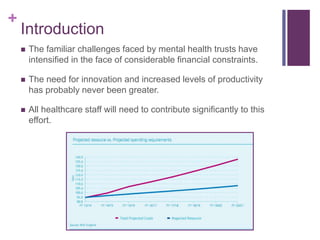
 The familiar challenges faced by mental health trusts have
intensified in the face of considerable financial constraints.
 The need for innovation and increased levels of productivity
has probably never been greater.
 All healthcare staff will need to contribute significantly to this
effort.
+
Clinical Engagement
 The challenge is to nurture a positively
committed and engaged medical
workforce
 The recent Francis and Keogh reports,
both identified a lack of strong clinical
leadership as a fundamental contributor
to the failures of some NHS Trusts
 The need to challenge the perception
that doctors who become managers go
to the “dark side”
 The crucial question is whether the
organisational culture and structure
facilitate or inhibit this.
“Good management is the art of
making problems so interesting and
their solutions so constructive that
everyone wants to get to work and
deal with them.” - Paul Hawken
+
Clinical Engagement
Organisations with engaged staff deliver:
 Better patient experience
 Fewer errors
 Stronger financial management
 Higher staff morale and motivation and
less absenteeism and stress.
“An unduly casual
attitude towards
sudden death [and]
inadequate systems
for reporting
incidents”
“Incident
reporting
systems were
criticised by
many staff”
+
The Quality Challenge:
lessons from Mid Staffs
 Setting up proper systems of supervision
 Understanding what pressures staff are
experiencing
 Taking action when things go a bit wrong
rather than waiting until they are very
wrong
 Patient feedback to be a key indicator of
performance
 Taking seriously the ‘gold dust’ of
complaints
 Prioritising patient care over
organisational needs
“We must put patients at the heart of
everything we do”
[Prof Sue Bailey, RCPsych]
+
The Innovation
Challenge
 Harnessing transformational
technologies
 Exploiting the potential of data
 Moving away from the ‘one size fits all’
model of healthcare
 A health service, not an illness service –
the NHS has helped many quit smoking
but what else can we do...?
“Insanity: doing the same thing over
and over again and expecting different
results.” [Albert Einstein]
+
Conclusion
 Financial constraints will persist for at
least a decade but cannot be allowed to
dominate management
 Challenge of ensuring quality – putting
patients first and prioritising patient
safety and well-being
 Innovation challenge – trying to increase
productivity through innovation
 Meeting these challenges is dependent
on the clinical engagement challenge –
ensuring that senior medical staff are
playing leadership roles in their clinical
teams

Challenges for Medical Managers in the NHS

  • 1.
    + Challenges for Medical Managersin the NHS Dr Imran Waheed 22 May 2014
  • 2.
    + Introduction  The familiarchallenges faced by mental health trusts have intensified in the face of considerable financial constraints.  The need for innovation and increased levels of productivity has probably never been greater.  All healthcare staff will need to contribute significantly to this effort.
  • 3.
    + Clinical Engagement  Thechallenge is to nurture a positively committed and engaged medical workforce  The recent Francis and Keogh reports, both identified a lack of strong clinical leadership as a fundamental contributor to the failures of some NHS Trusts  The need to challenge the perception that doctors who become managers go to the “dark side”  The crucial question is whether the organisational culture and structure facilitate or inhibit this. “Good management is the art of making problems so interesting and their solutions so constructive that everyone wants to get to work and deal with them.” - Paul Hawken
  • 4.
    + Clinical Engagement Organisations withengaged staff deliver:  Better patient experience  Fewer errors  Stronger financial management  Higher staff morale and motivation and less absenteeism and stress.
  • 5.
    “An unduly casual attitudetowards sudden death [and] inadequate systems for reporting incidents” “Incident reporting systems were criticised by many staff”
  • 6.
    + The Quality Challenge: lessonsfrom Mid Staffs  Setting up proper systems of supervision  Understanding what pressures staff are experiencing  Taking action when things go a bit wrong rather than waiting until they are very wrong  Patient feedback to be a key indicator of performance  Taking seriously the ‘gold dust’ of complaints  Prioritising patient care over organisational needs “We must put patients at the heart of everything we do” [Prof Sue Bailey, RCPsych]
  • 7.
    + The Innovation Challenge  Harnessingtransformational technologies  Exploiting the potential of data  Moving away from the ‘one size fits all’ model of healthcare  A health service, not an illness service – the NHS has helped many quit smoking but what else can we do...? “Insanity: doing the same thing over and over again and expecting different results.” [Albert Einstein]
  • 8.
    + Conclusion  Financial constraintswill persist for at least a decade but cannot be allowed to dominate management  Challenge of ensuring quality – putting patients first and prioritising patient safety and well-being  Innovation challenge – trying to increase productivity through innovation  Meeting these challenges is dependent on the clinical engagement challenge – ensuring that senior medical staff are playing leadership roles in their clinical teams

Editor's Notes

  • #3 Not going to talk about the financial pressures as an individual challenge; it is a given and assumed that all of what the medical manager does must require understanding of this dynamic Francis found that management thinking at Mid Staffs was dominated by financial pressures In England, continuing with the current model of care will result in the NHS facing a funding gap between projected spending requirements and resources available of around £30bn between 2013/14 and 2020/21