
Webinar, Tuesday, 14th April 2020
Prolactinomas:Updatesof
Management
Khaled Elsayed, MD
Overview
• Anatomy and histology of the pituitary gland
• Prolactinoma :
• Pathological subtypes; New WHO Classification
• Clinical
• Lab Investigations
• Visual Assessment
• Radiological
• Medical management
• Surgical management
• Apoplexy
• Conclusion
Items will be presented
PituitaryGland
• Pituitary gland : anterior and posterior lobes
• The anterior lobe surrounds the stalk : pars tuberlais
• If both lobes are separated , the pars tuberlais
remains with the posterior lobe
• Pars distalis: major part, secretory cells
• Anterior lobe: firmer, easily separated from the dura
• Posterior lobe: is softer, but adherent to the dura
• Bean shaped, 10 mm length, 5-10 mm height, 10-15 mm
width, and 600 mg weight
Anatomy and histology of the pituitary gland
HistologyofPituitaryTumors
• Posterior lobe: expression of ADH and Oxytocin
• Five different cell types
• Growth hormone (GH) producing somatotrophs
• Prolactin (PRL) producing lactotrophs
• Corticotroph (adrenocorticotrophic ACTH)
• Thyrotrophs (thyroid stimulating hormone TSH)
• Gonadotrophs (follicular stimulating hormone FSH, and Luteinizing hormone
LH)
Pathologyof Prolactinoma
• Most arise in the lateral or posterior part of the gland
• Macroadenomas tend to be aggressive and invasive
• Sparsely granulated (chromophobe):
• Most common, chromophobic or slightly acidophilic
• Calcification in the form of psammoma bodies
• Strong staining for PRL, PSA negative,
• Densely granulated:
• Less common, acidophilic cells
• Numerous secretory granules , PRL staining +ve
• Acidophil stem cell :
• Large chromophobic cells
UpdatesinPathologicalClassification
• Aim of any classification reflected on outcome and methods of management
• First : acromegaly and Cushing’s disease (adenoma)
• Staining : hematoxylin and eosin : acidophilic, basophilic and chromophobe; add
absence of secretion
• WHO 2004: EM and IHC; based on organelles and granules and hormonal
expression
• Different subtypes of each adenoma… null cell adenoma(immunonegative)
• WHO 2017: lineage restricted pituitary transcription factors
From beginning till last WHO Classification
LineageRestrictedTranscriptionFactors
• Change of name from adenoma to Pituitary Neuroendocrine Tumor (PitNET)
• Null cell adenoma
• Plurihormonal tumors
• Atypical Adenoma …… High Risk Adenoma : (male lactotroph, silent corticotroph and Crooke cell
adenoma, SG somatotroph, and silent plurihormonal Pit1
• Three linages
• PIT1: pituitary specific transcription factor 1:
• Lactotroph, Somatotroph, and Thyrotroph
• TPIT: pituitary cell restricted factor:
• Corticotroph
• SF1: splicing transcription factor 1:
• Gonadotroph
And others
Clinical
• 40% of adenomas
• Micro or Macroadenomas
• Male: decreased libido, impotence, infertility
• Female: Galactorrhea, oligo/amenorrhea
• Macroadenomas: headache, visual compromise, other cranial neuropathies
• Apoplexy:
• Pituitary hypofunction: in macroadenomas:
• Adrenal insufficiency, anorexia, wt loss, hydrocortisone replacement therapy
• Hypothyroidism: fatigue, dry skin, … thyroxine replacement
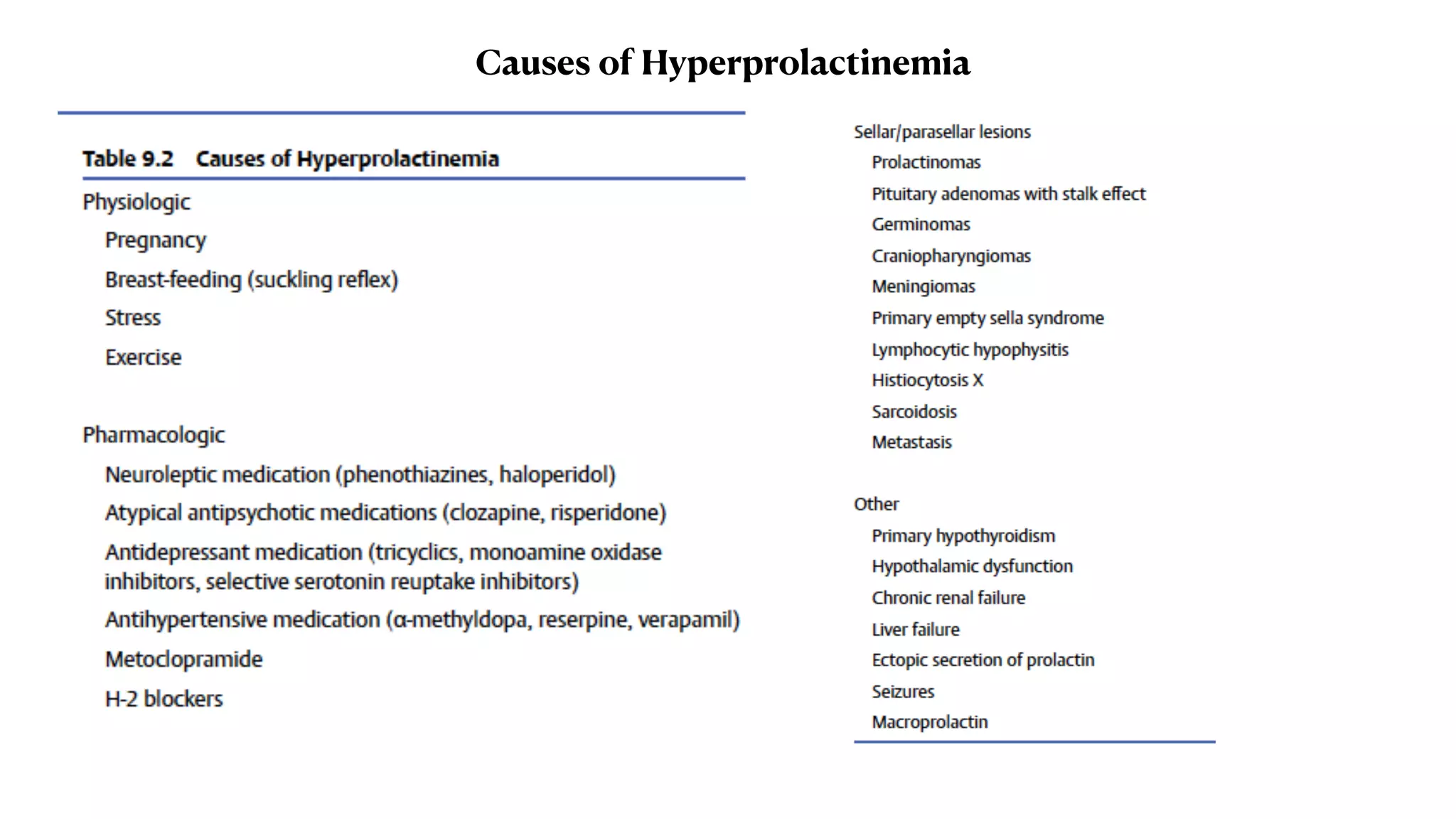
Causes of Hyperprolactinemia
LabInvestigations
• Mechanism of prolactin release
• Normal ranges: males: 0-20 ng/ml, females 0-25 ng/ml
• Hyperprolactinemia: more than 200 ng/ml, in microadenomas: 100-200 ng/ml
• Stalk effect: less than 150 ng/ml
• Hook effect: false negative in macroadenomas, at dilutions serum 1:100
• Other hormones: cortisol, growth hormone, and free T4
VisualAssessment
• Visual acuity
• Visual field assessment
• Optomotor function, cavernous sinus invasion
• Fundus examination
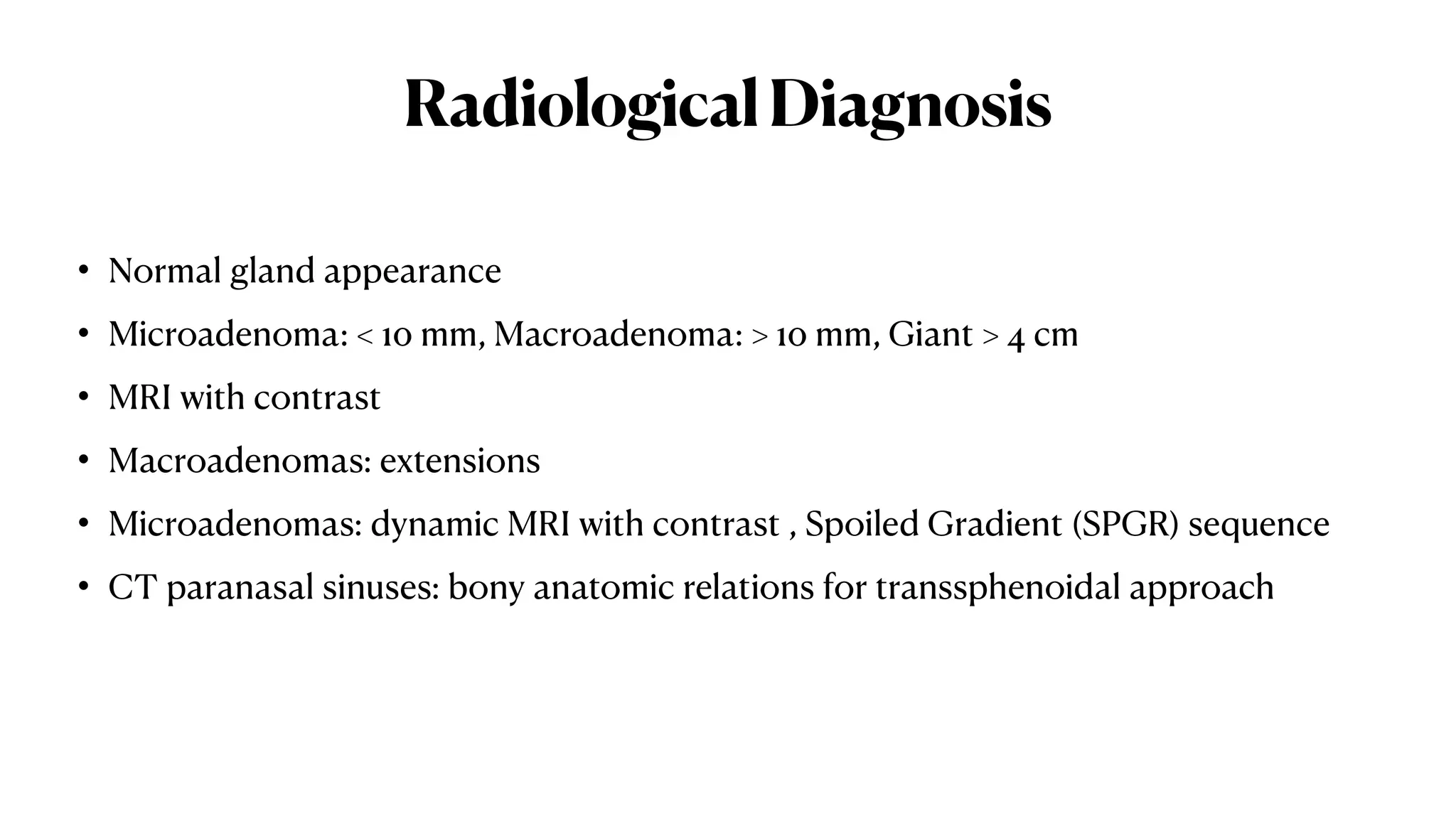
RadiologicalDiagnosis
• Normal gland appearance
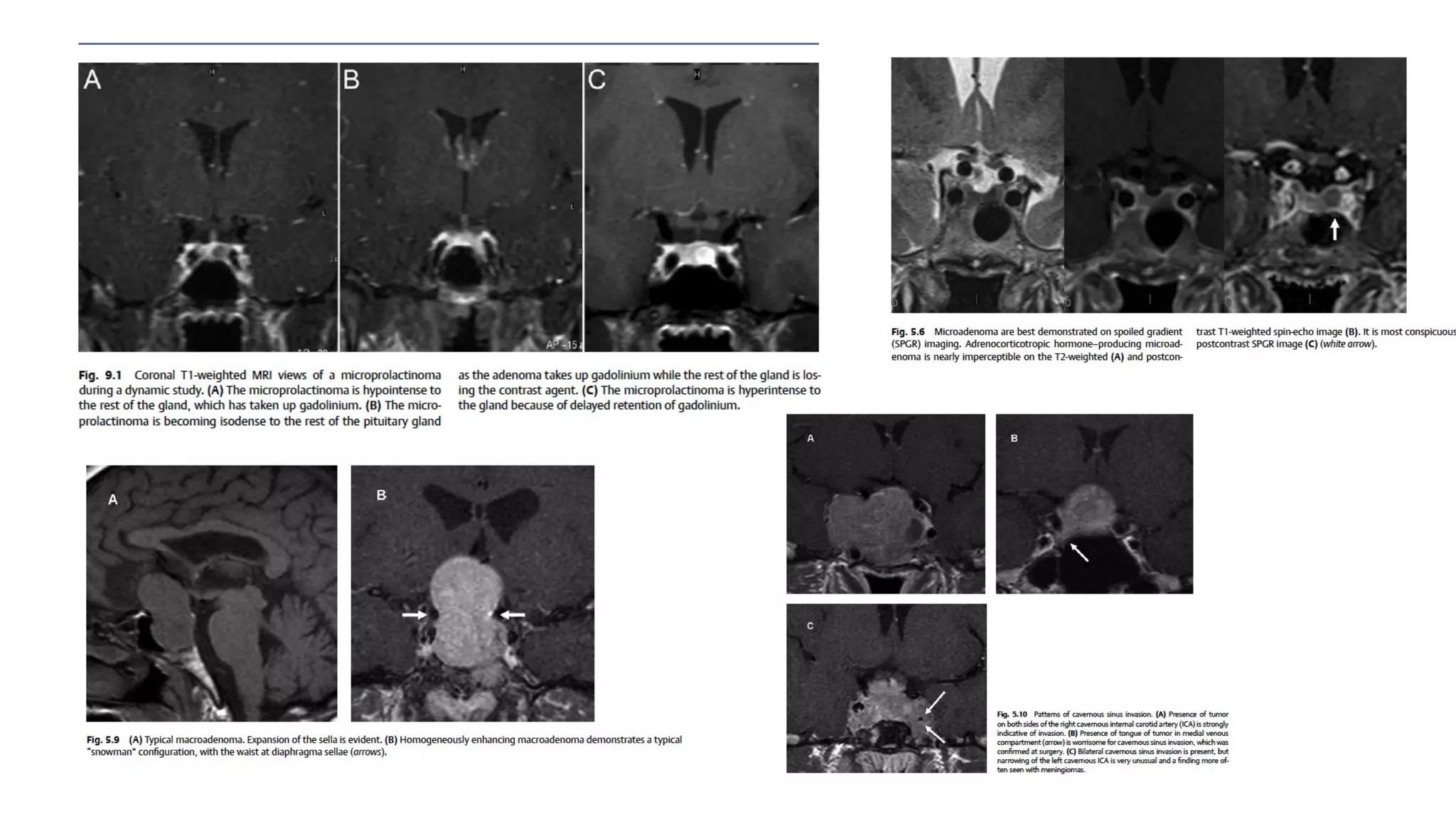
• Microadenoma: < 10 mm, Macroadenoma: > 10 mm, Giant > 4 cm
• MRI with contrast
• Macroadenomas: extensions
• Microadenomas: dynamic MRI with contrast , Spoiled Gradient (SPGR) sequence
• CT paranasal sinuses: bony anatomic relations for transsphenoidal approach
Management
• Bromocriptine and Cabergoline
• Doses:
• Bromocriptine: 2.5 mg starting dose, increasing up to 10 mg in divided doses (side effects)
• Cabergoline: 0.5 - 1.5 mg once or twice a week (less side effects)
• Indications:
• microadenomas is curative
• Macroadenomas : with minimal or without visual compromise
• Dopamine Agonists:
• Normalizes serum level of prolactin
• Tumor shrinkage
Medical Treatment
Surgical
• Indications:
• Not responding to treatment : prolactin is not normalized and the tumor does
shrink
• Intolerable side effects of the drugs
• Cystic adenomas
• Patients who wish to become pregnant (in case of microadenoma)
• To decompress the visual apparatus, cranial nerves and the rest of pituitary gland
• To prevent the tumor from progressing or recurring
SurgicalResults
• Cure rate at least 90% by experienced surgeons
• Patients achieve normal levels of prolactin
• Return menstrual cycle in women and fertility in men
• Complete cure : prolactin level in first post operative day is less than 10 ng/ml
• Recurrence of hyperprolactinemia can occur up to 5 years post op, prolactin >10 ng/
ml
• In this case: small doses of dopamine agonists
Microadenoma
SurgicalResults
• Surgical normalization of prolactin in less than 50%
• Helps tumor reduction for better response for medical therapy
• In cases of tumor invasion into the cavernous sinus: it helps extra-cavernous
resection and the residual for radiosurgery
• Staged surgery may be required: transsphenoidal then transcranial
Macroadenoma
SurgicalApproaches
• Transsphenoidal
• Microscopic
• Endoscopic
• Transcranial
• Subfrontal
• Pterional
PituitaryApoplexy
• Apoplexy=Stroke
• Haemorrhage or infarction in pituitary adenoma
• Mostly in prolactinomas and especially on medical treatment
• Sudden onset, may be subacute onset
• Increase in size
• Mild form: acute headache, meningismus, mild visual affection
• Severe : impaired consciousness, visual decline, pituitary hypofunction, ophthalmoplegia,
• Clinically evident in less than 10%, subclinical is more evident
PituitaryApoplexy
• Men are more affected than women: 2:1
• More commonly in the setting of macroadenomas
• Predisposing factors: bromocriptine administration or withdrawal, anticoagulation,
pregnancy
• Full laboratory endocrinological investigation
• CT as an emergency tool of investigation
• MRI with contrast
PituitaryApoplexy
• Administration of hydrocortisone to prevent adrenal crisis
• Authors advocate conservative therapy:
• In isolated stable meningismus or ophthalmoplegia
• Others recommend surgical decompression and do not wait metabolic and
endocrine correction
• Surgery is indicated in cases of impaired consciousness and visual compromise
• According to the extension : transcranial or transsphenoidal
• Long term hormonal replacement therapy
Management
AdjuvantTherapy
• Radiosurgery for residual tumor in cavernous sinus
• Long term hypopituitarism may develop, requires replacement therapy
• Usually reserved for elder patients
InvasiveProlactinomas
• Considered invasive: invasion of skull base: sphenoid sinus, oropharynx, clivus,
orbit, cavernous sinus, and infratemporal fossa
• Higher prolactin level
• Diagnostics: high Ki-67, mitosis, and p53 mutations, cellular atypia,
• Combined treatment: surgery, radiotherapy, and chemotherapy
• Poor prognosis
ProlactinomaandPregnancy
• Macroprolactinoma : surgery before pregnancy
• Microprolactinoma : stop medical treatment and followed up, formal visual testing,
and MRI at the appearance of symptoms of tumor enlargement
• Symptomatic tumor enlargement occurs in 0.5-1% in microadenomas , and 15-35% in
macroadenomas
• Increased treated with bromocriptine or the patient undergoes surgery in selected
cases
• Women who wish to breastfed stop medical treatment : lactation has no evidence to
increase tumor size
Management
Conclusion
• Prolactinomas 2nd most common adenoma
• Micro, Macro, Giant , or Invasive adenomas
• Prolactin level, visual assessment, and radiological diagnosis
• Medical therapy is the most common initial treatment
• Surgery has its indications
• Microscopic or endoscopic transsphenoidal , or transcranial
• Adjuvant radiosurgery for cavernous reisdual
• Apoplexy is a neurosurgical emergency
• Rarely prolactinomas are aggressive or invasive.
Khaled Elsayed, MD
Thank You

Prolactinoma; updates in management

  • 1.
    Webinar, Tuesday, 14thApril 2020 Prolactinomas:Updatesof Management Khaled Elsayed, MD
  • 2.
    Overview • Anatomy andhistology of the pituitary gland • Prolactinoma : • Pathological subtypes; New WHO Classification • Clinical • Lab Investigations • Visual Assessment • Radiological • Medical management • Surgical management • Apoplexy • Conclusion Items will be presented
  • 3.
    PituitaryGland • Pituitary gland: anterior and posterior lobes • The anterior lobe surrounds the stalk : pars tuberlais • If both lobes are separated , the pars tuberlais remains with the posterior lobe • Pars distalis: major part, secretory cells • Anterior lobe: firmer, easily separated from the dura • Posterior lobe: is softer, but adherent to the dura • Bean shaped, 10 mm length, 5-10 mm height, 10-15 mm width, and 600 mg weight Anatomy and histology of the pituitary gland
  • 5.
    HistologyofPituitaryTumors • Posterior lobe:expression of ADH and Oxytocin • Five different cell types • Growth hormone (GH) producing somatotrophs • Prolactin (PRL) producing lactotrophs • Corticotroph (adrenocorticotrophic ACTH) • Thyrotrophs (thyroid stimulating hormone TSH) • Gonadotrophs (follicular stimulating hormone FSH, and Luteinizing hormone LH)
  • 7.
    Pathologyof Prolactinoma • Mostarise in the lateral or posterior part of the gland • Macroadenomas tend to be aggressive and invasive • Sparsely granulated (chromophobe): • Most common, chromophobic or slightly acidophilic • Calcification in the form of psammoma bodies • Strong staining for PRL, PSA negative, • Densely granulated: • Less common, acidophilic cells • Numerous secretory granules , PRL staining +ve • Acidophil stem cell : • Large chromophobic cells
  • 8.
    UpdatesinPathologicalClassification • Aim ofany classification reflected on outcome and methods of management • First : acromegaly and Cushing’s disease (adenoma) • Staining : hematoxylin and eosin : acidophilic, basophilic and chromophobe; add absence of secretion • WHO 2004: EM and IHC; based on organelles and granules and hormonal expression • Different subtypes of each adenoma… null cell adenoma(immunonegative) • WHO 2017: lineage restricted pituitary transcription factors From beginning till last WHO Classification
  • 9.
    LineageRestrictedTranscriptionFactors • Change ofname from adenoma to Pituitary Neuroendocrine Tumor (PitNET) • Null cell adenoma • Plurihormonal tumors • Atypical Adenoma …… High Risk Adenoma : (male lactotroph, silent corticotroph and Crooke cell adenoma, SG somatotroph, and silent plurihormonal Pit1 • Three linages • PIT1: pituitary specific transcription factor 1: • Lactotroph, Somatotroph, and Thyrotroph • TPIT: pituitary cell restricted factor: • Corticotroph • SF1: splicing transcription factor 1: • Gonadotroph And others
  • 11.
    Clinical • 40% ofadenomas • Micro or Macroadenomas • Male: decreased libido, impotence, infertility • Female: Galactorrhea, oligo/amenorrhea • Macroadenomas: headache, visual compromise, other cranial neuropathies • Apoplexy: • Pituitary hypofunction: in macroadenomas: • Adrenal insufficiency, anorexia, wt loss, hydrocortisone replacement therapy • Hypothyroidism: fatigue, dry skin, … thyroxine replacement
  • 13.
  • 14.
    LabInvestigations • Mechanism ofprolactin release • Normal ranges: males: 0-20 ng/ml, females 0-25 ng/ml • Hyperprolactinemia: more than 200 ng/ml, in microadenomas: 100-200 ng/ml • Stalk effect: less than 150 ng/ml • Hook effect: false negative in macroadenomas, at dilutions serum 1:100 • Other hormones: cortisol, growth hormone, and free T4
  • 15.
    VisualAssessment • Visual acuity •Visual field assessment • Optomotor function, cavernous sinus invasion • Fundus examination
  • 16.
    RadiologicalDiagnosis • Normal glandappearance • Microadenoma: < 10 mm, Macroadenoma: > 10 mm, Giant > 4 cm • MRI with contrast • Macroadenomas: extensions • Microadenomas: dynamic MRI with contrast , Spoiled Gradient (SPGR) sequence • CT paranasal sinuses: bony anatomic relations for transsphenoidal approach
  • 18.
    Management • Bromocriptine andCabergoline • Doses: • Bromocriptine: 2.5 mg starting dose, increasing up to 10 mg in divided doses (side effects) • Cabergoline: 0.5 - 1.5 mg once or twice a week (less side effects) • Indications: • microadenomas is curative • Macroadenomas : with minimal or without visual compromise • Dopamine Agonists: • Normalizes serum level of prolactin • Tumor shrinkage Medical Treatment
  • 19.
    Surgical • Indications: • Notresponding to treatment : prolactin is not normalized and the tumor does shrink • Intolerable side effects of the drugs • Cystic adenomas • Patients who wish to become pregnant (in case of microadenoma) • To decompress the visual apparatus, cranial nerves and the rest of pituitary gland • To prevent the tumor from progressing or recurring
  • 20.
    SurgicalResults • Cure rateat least 90% by experienced surgeons • Patients achieve normal levels of prolactin • Return menstrual cycle in women and fertility in men • Complete cure : prolactin level in first post operative day is less than 10 ng/ml • Recurrence of hyperprolactinemia can occur up to 5 years post op, prolactin >10 ng/ ml • In this case: small doses of dopamine agonists Microadenoma
  • 21.
    SurgicalResults • Surgical normalizationof prolactin in less than 50% • Helps tumor reduction for better response for medical therapy • In cases of tumor invasion into the cavernous sinus: it helps extra-cavernous resection and the residual for radiosurgery • Staged surgery may be required: transsphenoidal then transcranial Macroadenoma
  • 22.
    SurgicalApproaches • Transsphenoidal • Microscopic •Endoscopic • Transcranial • Subfrontal • Pterional
  • 23.
    PituitaryApoplexy • Apoplexy=Stroke • Haemorrhageor infarction in pituitary adenoma • Mostly in prolactinomas and especially on medical treatment • Sudden onset, may be subacute onset • Increase in size • Mild form: acute headache, meningismus, mild visual affection • Severe : impaired consciousness, visual decline, pituitary hypofunction, ophthalmoplegia, • Clinically evident in less than 10%, subclinical is more evident
  • 24.
    PituitaryApoplexy • Men aremore affected than women: 2:1 • More commonly in the setting of macroadenomas • Predisposing factors: bromocriptine administration or withdrawal, anticoagulation, pregnancy • Full laboratory endocrinological investigation • CT as an emergency tool of investigation • MRI with contrast
  • 25.
    PituitaryApoplexy • Administration ofhydrocortisone to prevent adrenal crisis • Authors advocate conservative therapy: • In isolated stable meningismus or ophthalmoplegia • Others recommend surgical decompression and do not wait metabolic and endocrine correction • Surgery is indicated in cases of impaired consciousness and visual compromise • According to the extension : transcranial or transsphenoidal • Long term hormonal replacement therapy Management
  • 26.
    AdjuvantTherapy • Radiosurgery forresidual tumor in cavernous sinus • Long term hypopituitarism may develop, requires replacement therapy • Usually reserved for elder patients
  • 27.
    InvasiveProlactinomas • Considered invasive:invasion of skull base: sphenoid sinus, oropharynx, clivus, orbit, cavernous sinus, and infratemporal fossa • Higher prolactin level • Diagnostics: high Ki-67, mitosis, and p53 mutations, cellular atypia, • Combined treatment: surgery, radiotherapy, and chemotherapy • Poor prognosis
  • 28.
    ProlactinomaandPregnancy • Macroprolactinoma :surgery before pregnancy • Microprolactinoma : stop medical treatment and followed up, formal visual testing, and MRI at the appearance of symptoms of tumor enlargement • Symptomatic tumor enlargement occurs in 0.5-1% in microadenomas , and 15-35% in macroadenomas • Increased treated with bromocriptine or the patient undergoes surgery in selected cases • Women who wish to breastfed stop medical treatment : lactation has no evidence to increase tumor size Management
  • 29.
    Conclusion • Prolactinomas 2ndmost common adenoma • Micro, Macro, Giant , or Invasive adenomas • Prolactin level, visual assessment, and radiological diagnosis • Medical therapy is the most common initial treatment • Surgery has its indications • Microscopic or endoscopic transsphenoidal , or transcranial • Adjuvant radiosurgery for cavernous reisdual • Apoplexy is a neurosurgical emergency • Rarely prolactinomas are aggressive or invasive.
  • 30.