Creating a Project/Web Quest
How to allow students to learn what
they have neglected so far
Planning Phase:
• First, examine and select the standards you
believe are the most important for your
students to know.
Next: Ideas
• Now, you will need to brainstorm ideas on how
best to implement the lessons for the students
to learn on their own.
 Interest
 Vary
 Differentiate
 Media
 Text
 Other
Define the Tasks
• This part you need to be very clear about.
Students should not be confused by your
language or the directions,
Therefore…be CLEAR!
Resources
• You will need credible and various resources in
order to keep students interested. The use of
videos, audio, art, pictures, and text will help
your students to learn on various levels.
• If you are creating a Web Quest or a Project, be
sure to check all links for your resources. It will
be a tragedy if the links you provide for your
students are broken!
Finding Resources
• SCDOE: http://ed.sc.gov/agency/programs-
services/36/
• History.com
• Projectgutenberg.com
• PBS.org
• NBC Learn
• Classtools.net
• ISTE.org-search for web 2.0 tools
• Google scholar
• I-tunes University
• Surf & search!
Relevancy
• How does one make the Puritans relevant to
today? Look at the principles and precepts!
• Surely there are ways of linking what the
Puritans believed to religions or sects today!
• Hunt out the parallels and draw from those. The
body is not the only thing that needs exercise!
Assessment
• Without assessment, there would be
no reason to learn!
• Vary your assessments
 Essays
 Videos
 Presentations
 Music
 Podcasts
 Journals
 The most important aspect of
assessment is to make it authentic. If
it is not authentic, then it is just
useless knowledge!
Questions
• A good way to check that students are learning
is to provide questions for them to answer as
they are reading, viewing or listening to a
lesson.
Higher level thought
• While a little knowledge is a good thing…
• Application of it is so much more exciting!
• Think outside the normal comfort zone
 Walking in another’s shoes is one way to apply
learning
 Creating something
 Imagine
 Compare & contrast
 Be the Judge!
 What if???
Putting it all together
• Your task, as the teacher, will be complete once
you have assembled all of the instructions,
questions, resources and standards then
present it to your students.
• You may wish to supply a rubric
• You may wish to use resources already in the
course content.
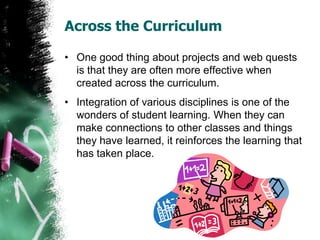
Across the Curriculum
• One good thing about projects and web quests
is that they are often more effective when
created across the curriculum.
• Integration of various disciplines is one of the
wonders of student learning. When they can
make connections to other classes and things
they have learned, it reinforces the learning that
has taken place.
Questions?
• Speak now or…wonder for ever!

Creating a project

  • 1.
    Creating a Project/WebQuest How to allow students to learn what they have neglected so far
  • 2.
    Planning Phase: • First,examine and select the standards you believe are the most important for your students to know.
  • 3.
    Next: Ideas • Now,you will need to brainstorm ideas on how best to implement the lessons for the students to learn on their own.  Interest  Vary  Differentiate  Media  Text  Other
  • 4.
    Define the Tasks •This part you need to be very clear about. Students should not be confused by your language or the directions, Therefore…be CLEAR!
  • 5.
    Resources • You willneed credible and various resources in order to keep students interested. The use of videos, audio, art, pictures, and text will help your students to learn on various levels. • If you are creating a Web Quest or a Project, be sure to check all links for your resources. It will be a tragedy if the links you provide for your students are broken!
  • 6.
    Finding Resources • SCDOE:http://ed.sc.gov/agency/programs- services/36/ • History.com • Projectgutenberg.com • PBS.org • NBC Learn • Classtools.net • ISTE.org-search for web 2.0 tools • Google scholar • I-tunes University • Surf & search!
  • 7.
    Relevancy • How doesone make the Puritans relevant to today? Look at the principles and precepts! • Surely there are ways of linking what the Puritans believed to religions or sects today! • Hunt out the parallels and draw from those. The body is not the only thing that needs exercise!
  • 8.
    Assessment • Without assessment,there would be no reason to learn! • Vary your assessments  Essays  Videos  Presentations  Music  Podcasts  Journals  The most important aspect of assessment is to make it authentic. If it is not authentic, then it is just useless knowledge!
  • 9.
    Questions • A goodway to check that students are learning is to provide questions for them to answer as they are reading, viewing or listening to a lesson.
  • 10.
    Higher level thought •While a little knowledge is a good thing… • Application of it is so much more exciting! • Think outside the normal comfort zone  Walking in another’s shoes is one way to apply learning  Creating something  Imagine  Compare & contrast  Be the Judge!  What if???
  • 11.
    Putting it alltogether • Your task, as the teacher, will be complete once you have assembled all of the instructions, questions, resources and standards then present it to your students. • You may wish to supply a rubric • You may wish to use resources already in the course content.
  • 12.
    Across the Curriculum •One good thing about projects and web quests is that they are often more effective when created across the curriculum. • Integration of various disciplines is one of the wonders of student learning. When they can make connections to other classes and things they have learned, it reinforces the learning that has taken place.
  • 13.
    Questions? • Speak nowor…wonder for ever!